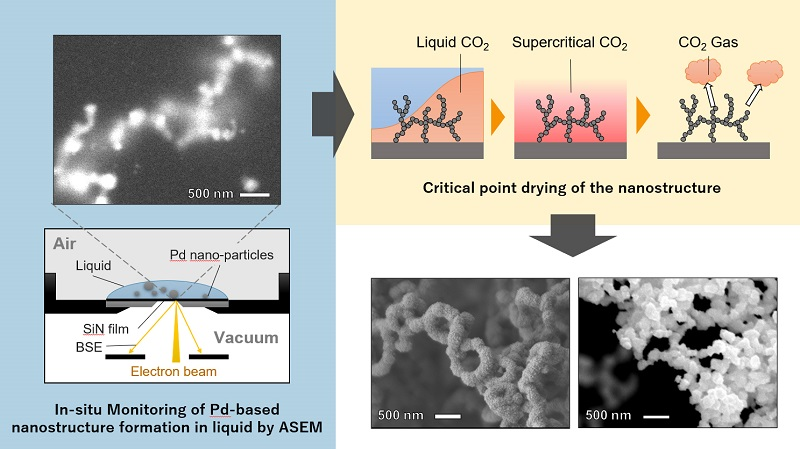
Network of Palladium-Based Nanorings Synthesized by Liquid-Phase Reduction Using DMSO-H2O: In Situ Monitoring of Structure Formation and Drying Deformation by ASEM



Abstract
Share and Cite
Komenami, T.; Yoshimura, A.; Matsuno, Y.; Sato, M.; Sato, C. Network of Palladium-Based Nanorings Synthesized by Liquid-Phase Reduction Using DMSO-H2O: In Situ Monitoring of Structure Formation and Drying Deformation by ASEM. Int. J. Mol. Sci. 2020, 21, 3271. https://doi.org/10.3390/ijms21093271
Komenami T, Yoshimura A, Matsuno Y, Sato M, Sato C. Network of Palladium-Based Nanorings Synthesized by Liquid-Phase Reduction Using DMSO-H2O: In Situ Monitoring of Structure Formation and Drying Deformation by ASEM. International Journal of Molecular Sciences. 2020; 21(9):3271. https://doi.org/10.3390/ijms21093271
Chicago/Turabian StyleKomenami, Takuki, Akihiro Yoshimura, Yasunari Matsuno, Mari Sato, and Chikara Sato. 2020. "Network of Palladium-Based Nanorings Synthesized by Liquid-Phase Reduction Using DMSO-H2O: In Situ Monitoring of Structure Formation and Drying Deformation by ASEM" International Journal of Molecular Sciences 21, no. 9: 3271. https://doi.org/10.3390/ijms21093271
APA StyleKomenami, T., Yoshimura, A., Matsuno, Y., Sato, M., & Sato, C. (2020). Network of Palladium-Based Nanorings Synthesized by Liquid-Phase Reduction Using DMSO-H2O: In Situ Monitoring of Structure Formation and Drying Deformation by ASEM. International Journal of Molecular Sciences, 21(9), 3271. https://doi.org/10.3390/ijms21093271