Review

Targeting Protein Kinases to Enhance the Response to anti-PD-1/PD-L1 Immunotherapy


by
Marilina García-Aranda
1,2,3 and
Maximino Redondo
1,2,3,4,*
1
Research Unit, Hospital Costa del Sol. Autovía A7, km 187. Marbella, 29603 Málaga, Spain
2
Red de Investigación en Servicios de Salud en Enfermedades Crónicas (REDISSEC), 28029 Madrid, Spain
3
Instituto de Investigación Biomédica de Málaga (IBIMA), 29010 Málaga, Spain
4
Departamento de Especialidades Quirúrgicas, Bioquímica e Inmunología, Universidad de Málaga, Campus Universitario de Teatinos, 29010 Málaga, Spain
*
Author to whom correspondence should be addressed.
Int. J. Mol. Sci. 2019, 20(9), 2296; https://doi.org/10.3390/ijms20092296
Submission received: 7 April 2019 / Revised: 6 May 2019 / Accepted: 7 May 2019 / Published: 9 May 2019
(This article belongs to the Special Issue Kinase Signal Transduction 1.0)

Abstract

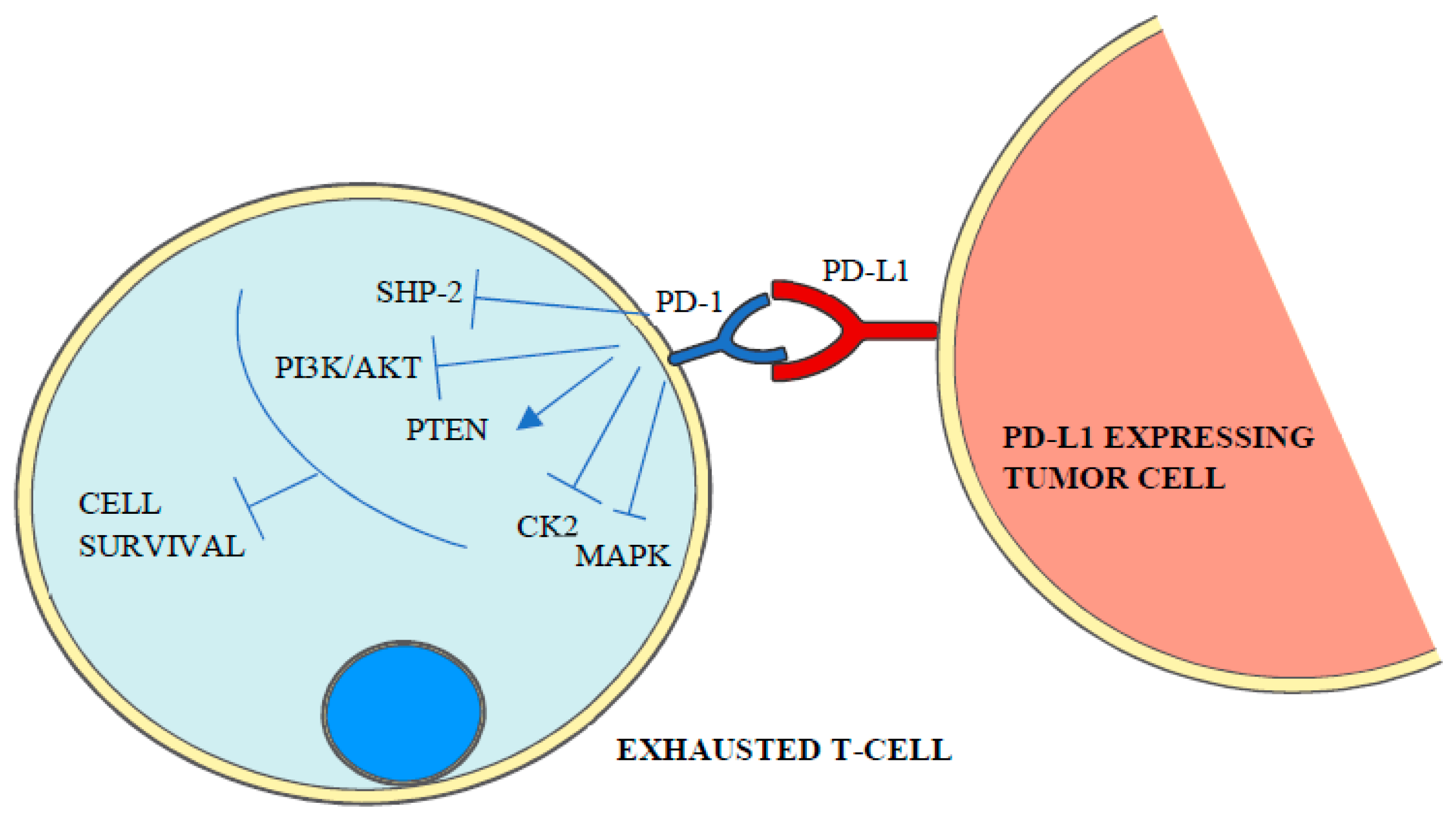
The interaction between programmed cell death protein (PD-1) and its ligand (PD-L1) is one of the main pathways used by some tumors to escape the immune response. In recent years, immunotherapies based on the use of antibodies against PD-1/PD-L1 have been postulated as a great promise for cancer treatment, increasing total survival compared to standard therapy in different tumors. Despite the hopefulness of these results, a significant percentage of patients do not respond to such therapy or will end up evolving toward a progressive disease. Besides their role in PD-L1 expression, altered protein kinases in tumor cells can limit the effectiveness of PD-1/PD-L1 blocking therapies at different levels. In this review, we describe the role of kinases that appear most frequently altered in tumor cells and that can be an impediment for the success of immunotherapies as well as the potential utility of protein kinase inhibitors to enhance the response to such treatments.
Keywords: cancer; kinase; immunotherapy; resistance; checkpoint blockade; tumor escape; inhibitor; MHC cancer; kinase; immunotherapy; resistance; checkpoint blockade; tumor escape; inhibitor; MHC