
Nutritionally Improved Gluten-Free Breads Fortified with Soluble Fiber and Bioactive Compounds from Artichoke and Broccoli By-Products




Abstract
1. Introduction
2. Results and Discussion
2.1. Chemical Composition and Physicochemical Characteristics
2.2. Starch and Sugar Content
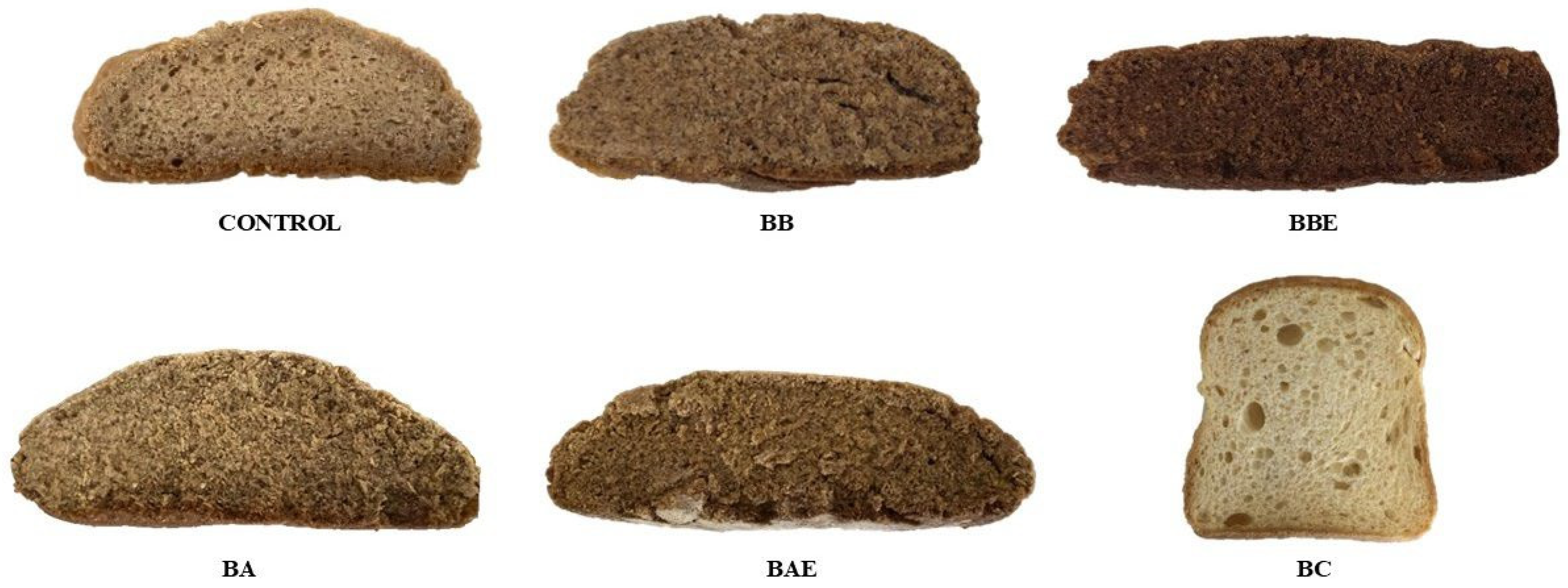
2.3. Color and Acidity Profile
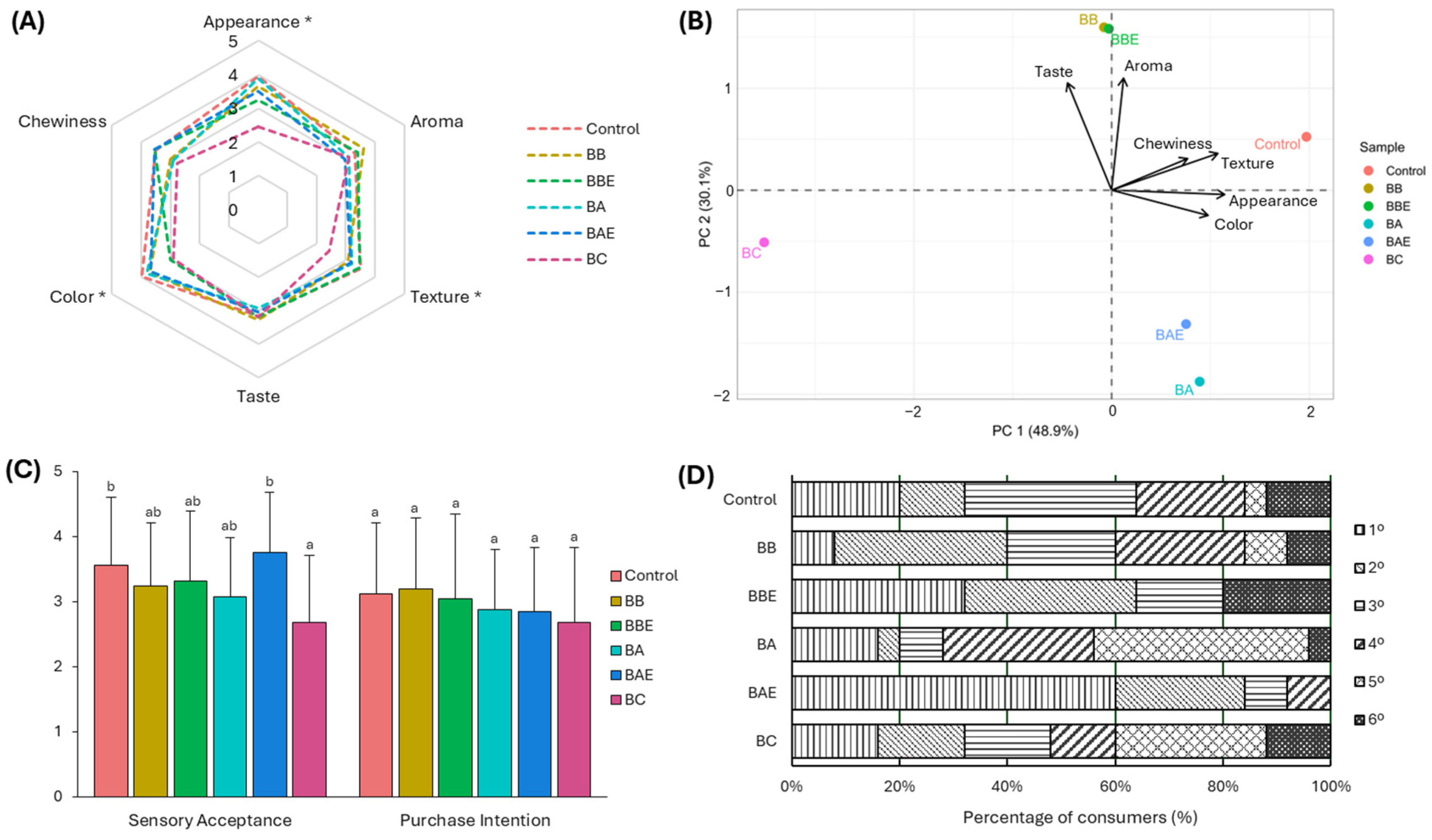
2.4. Sensory Analysis of Gluten-Free Breads
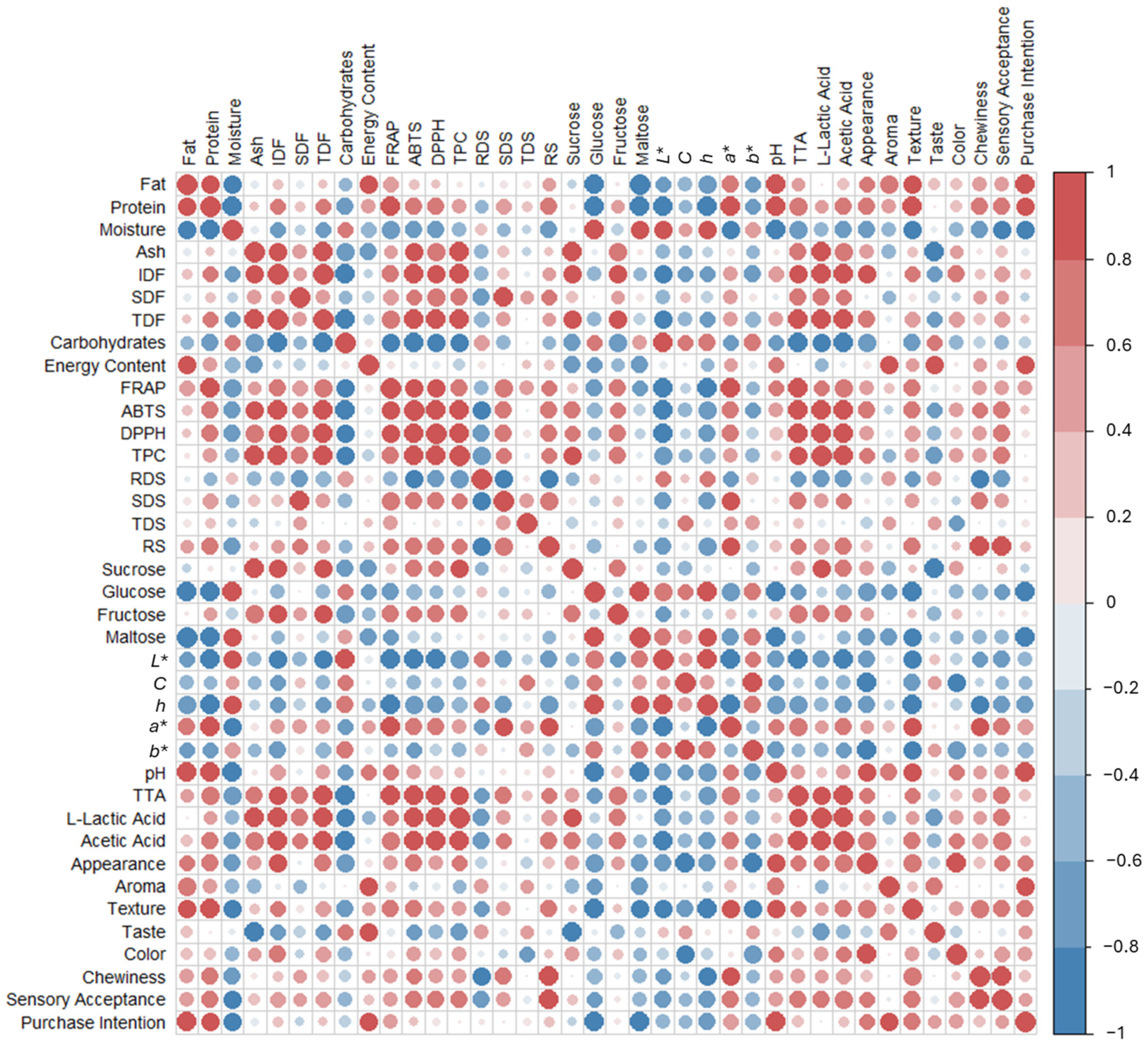
2.5. Pearson Correlations
3. Materials and Methods
3.1. Broccoli and Artichoke Extracts Preparation
3.2. Gluten-Free Breads Elaboration
3.3. Proximal Composition
3.4. Starch Determination
3.5. Physicochemical Parameters
3.6. Determination of Disaccharides and Monosaccharides
3.7. Antioxidant Capacity and Total Phenolic Content (TPC) Analysis
3.8. Sensory Analysis
3.9. Statistical Analysis
4. Conclusions
Author Contributions
Funding
Institutional Review Board Statement
Informed Consent Statement
Data Availability Statement
Conflicts of Interest
References
- Fasano, A.; Catassi, C. Celiac Disease. N. Engl. J. Med. 2012, 367, 2419–2426. [Google Scholar] [CrossRef] [PubMed]
- Khemiri, S.; Khelifi, N.; Nunes, M.C.; Ferreira, A.; Gouveia, L.; Smaali, I.; Raymundo, A. Microalgae biomass as an additional ingredient of gluten-free bread: Dough rheology, texture quality and nutritional properties. Algal Res. 2020, 50, 101998. [Google Scholar] [CrossRef]
- Lebwohl, B.; Rubio-Tapia, A. Presentation, and Diagnosis of Celiac Disease. Gastroenterology 2021, 160, 63–75. [Google Scholar] [CrossRef] [PubMed]
- Vici, G.; Belli, L.; Biondi, M.; Polzonetti, V. Gluten free diet and nutrient deficiencies: A review. Clin. Nutr. 2016, 35, 1236–1241. [Google Scholar] [CrossRef]
- Bianchi, P.I.; Aronico, N.; Santacroce, G.; Broglio, G.; Lenti, M.V.; Di Sabatino, A. Nutritional Consequences of Celiac Disease and Gluten-Free Diet. Gastroenterol. Insights 2024, 15, 878–894. [Google Scholar] [CrossRef]
- Morales, D.; Miguel, M.; Garcés-Rimón, M. Pseudocereals: A novel source of biologically active peptides. Crit. Rev. Food Sci. Nutr. 2021, 61, 1537–1544. [Google Scholar] [CrossRef]
- Peñalver, R.; Nieto, G. Developing a functional gluten-free sourdough bread by incorporating quinoa, amaranth, rice and spirulina. LWT 2024, 201, 116162. [Google Scholar] [CrossRef]
- Kaur, R.; Ahluwalia, P.; Sachdev, P.A.; Kaur, A. Development of gluten-free cereal bar for gluten intolerant population by using quinoa as major ingredient. J. Food Sci. Technol. 2018, 55, 3584–3591. [Google Scholar] [CrossRef]
- Parikh, M.; Netticadan, T.; Pierce, G.N. Flaxseed: Its bioactive components and their cardiovascular benefits. Am. J. Physiol. Heart Circ. Physiol. 2018, 314, H146–H159. [Google Scholar] [CrossRef]
- Cantero, L.; Salmerón, J.; Miranda, J.; Larretxi, I.; Fernández-Gil, M.D.P.; Bustamante, M.Á.; Matias, S.; Navarro, V.; Simón, E.; Martínez, O. Performance of Apple Pomace for Gluten-Free Bread Manufacture: Effect on Physicochemical Characteristics and Nutritional Value. Appl. Sci. 2022, 12, 5934. [Google Scholar] [CrossRef]
- Difonzo, G.; de Gennaro, G.; Pasqualone, A.; Caponio, F. Potential use of plant-based by-products and waste to improve the quality of gluten-free foods. J. Sci. Food Agric. 2022, 102, 2199–2211. [Google Scholar] [CrossRef]
- Rodríguez, M.; Bianchi, F.; Simonato, B.; Rizzi, C.; Fontana, A.R.; Tironi, V.A. Exploration of grape pomace peels and amaranth flours as functional ingredients in the elaboration of breads: Phenolic composition, bioaccessibility, and antioxidant activity. Food Funct. 2024, 15, 608–624. [Google Scholar] [CrossRef] [PubMed]
- Saadoun, J.H.; Bertani, G.; Levante, A.; Vezzosi, F.; Ricci, A.; Bernini, V.; Lazzi, C. Fermentation of Agri-Food Waste: A Promising Route for the Production of Aroma Compounds. Foods 2021, 10, 707. [Google Scholar] [CrossRef] [PubMed]
- Eliopoulos, C.; Markou, G.; Langousi, I.; Arapoglou, D. Reintegration of Food Industry By-Products: Potential Applications. Foods 2022, 11, 3743. [Google Scholar] [CrossRef] [PubMed]
- FAOSTAT. Food and Agriculture Organization of the United Nations Statistical Database. 2023. Available online: https://www.fao.org/faostat/ (accessed on 12 September 2025).
- Gudiño, I.; Casquete, R.; Martín, A.; Wu, Y.; Benito, M.J. Comprehensive Analysis of Bioactive Compounds, Functional Properties, and Applications of Broccoli By-Products. Foods 2024, 13, 3918. [Google Scholar] [CrossRef]
- Borja-Martínez, M.; Lozano-Sánchez, J.; Borrás-Linares, I.; A Pedreño, M.; Sabater-Jara, A.B. Revalorization of Broccoli By-Products for Cosmetic Uses Using Supercritical Fluid Extraction. Antioxidants 2020, 9, 1195. [Google Scholar] [CrossRef]
- Quizhpe, J.; Ayuso, P.; Rosell, M.d.L.Á.; Peñalver, R.; Nieto, G. Brassica oleracea var italica and Their By-Products as Source of Bioactive Compounds and Food Applications in Bakery Products. Foods 2024, 13, 3513. [Google Scholar] [CrossRef]
- Jiménez-Moreno, N.; Cimminelli, M.J.; Volpe, F.; Ansó, R.; Esparza, I.; Mármol, I.; Rodríguez-Yoldi, M.J.; Ancín-Azpilicueta, C. Phenolic Composition of Artichoke Waste and Its Antioxidant Capacity on Differentiated Caco-2 Cells. Nutrients 2019, 11, 1723. [Google Scholar] [CrossRef]
- Ayuso, P.; Quizhpe, J.; Rosell, M.d.L.Á.; Peñalver, R.; Nieto, G. Antioxidant and Nutritional Potential of Artichoke (Cynara scolymus L.) By-Product Extracts in Fat-Replaced Beef Burgers with Hydrogel Emulsions from Olive Oil. Appl. Sci. 2024, 14, 10123. [Google Scholar] [CrossRef]
- Ayuso, P.; Quizhpe, J.; Rosell, M.d.L.Á.; Peñalver, R.; Nieto, G. Bioactive Compounds, Health Benefits and Food Applications of Artichoke (Cynara scolymus L.) and Artichoke By-Products: A Review. Appl. Sci. 2024, 14, 4940. [Google Scholar] [CrossRef]
- Colombo, R.; Moretto, G.; Pellicorio, V.; Papetti, A. Globe Artichoke (Cynara scolymus L.) By-Products in Food Applications: Functional and Biological Properties. Foods 2024, 13, 1427. [Google Scholar] [CrossRef]
- Guan, Z.W.; Yu, E.Z.; Feng, Q. Soluble Dietary Fiber, One of the Most Important Nutrients for the Gut Microbiota. Molecules 2021, 26, 6802. [Google Scholar] [CrossRef]
- Bader Ul Ain, H.; Saeed, F.; Ahmed, A.; Asif Khan, M.; Niaz, B.; Tufail, T. Improving the physicochemical properties of partially enhanced soluble dietary fiber through innovative techniques: A coherent review. J. Food Process Preserv. 2019, 43, e13917. [Google Scholar] [CrossRef]
- Villanueva-Suárez, M.J.; Pérez-Cózar, M.L.; Redondo-Cuenca, A. Sequential extraction of polysaccharides from enzymatically hydrolyzed okara byproduct: Physicochemical properties and in vitro fermentability. Food Chem. 2013, 141, 1114–1119. [Google Scholar] [CrossRef] [PubMed]
- Yang, Y.Y.; Ma, S.; Wang, X.X.; Zheng, X.L. Modification and Application of Dietary Fiber in Foods. J. Chem. 2017, 2017, 9340427. [Google Scholar] [CrossRef]
- Luo, X.; Wang, Q.; Zheng, B.; Lin, L.; Chen, B.; Zheng, Y.; Xiao, J. Hydration properties and binding capacities of dietary fibers from bamboo shoot shell and its hypolipidemic effects in mice. Food Chem. Toxicol. 2017, 109, 1003–1009. [Google Scholar] [CrossRef]
- Uebelhack, R.; Busch, R.; Alt, F.; Beah, Z.M.; Chong, P.W. Effects of Cactus Fiber on the Excretion of Dietary Fat in Healthy Subjects: A Double Blind, Randomized, Placebo-Controlled, Crossover Clinical Investigation. Curr. Ther. Res. 2014, 76, 39–44. [Google Scholar] [CrossRef]
- Feiden, T.; Valduga, E.; Zeni, J.; Steffens, J. Bioactive Compounds from Artichoke and Application Potential. Food Technol. Biotechnol. 2023, 61, 312–327. [Google Scholar] [CrossRef]
- Dadalı, C. Artichoke bracts as fat and wheat flour replacer in cake: Optimization of reduced fat and reduced wheat flour cake formulation. J. Food Meas. Charact. 2023, 17, 98–107. [Google Scholar] [CrossRef]
- Ayuso, P.; Peñalver, R.; Quizhpe, J.; Rosell, M.d.l.Á.; Nieto, G. Broccoli, Artichoke, Carob and Apple By-Products as a Source of Soluble Fiber: How It Can Be Affected by Enzymatic Treatment with Pectinex® Ultra SP-L, Viscozyme® L and Celluclast® 1.5 L. Foods 2024, 14, 10. [Google Scholar] [CrossRef]
- De la Peña-Armada, R.; Villanueva-Suárez, M.J.; Rupérez, P.; Mateos-Aparicio, I. High Hydrostatic Pressure Assisted by Celluclast® Releases Oligosaccharides from Apple By-Product. Foods 2020, 9, 1058. [Google Scholar] [CrossRef] [PubMed]
- Schäfer, J.; Stanojlovic, L.; Trierweiler, B.; Bunzel, M. Storage related changes of cell wall based dietary fiber components of broccoli (Brassica oleracea var. italica) stems. Food Res. Int. 2017, 93, 43–51. [Google Scholar] [CrossRef] [PubMed]
- Favela-González, K.M.; Hernández-Almanza, A.Y.; De la Fuente-Salcido, N.M. The value of bioactive compounds of cruciferous vegetables (Brassica) as antimicrobials and antioxidants: A review. J. Food Biochem. 2020, 44, e13414. [Google Scholar] [CrossRef] [PubMed]
- Pagano, I.; Piccinelli, A.L.; Celano, R.; Campone, L.; Gazzerro, P.; Russo, M.; Rastrelli, L. Pressurized hot water extraction of bioactive compounds from artichoke by-products. Electrophoresis 2018, 39, 1899–1907. [Google Scholar] [CrossRef]
- Nieto, G. Incorporation of by-products of rosemary and thyme in the diet of ewes: Effect on the fatty acid profile of lamb. Eur. Food Res. Technol. 2013, 236, 379–389. [Google Scholar] [CrossRef]
- Nieto, G.; Banón, S.; Garrido, M. Administration of distillate thyme leaves into the diet of Segureña ewes: Effect on lamb meat quality. Animal 2012, 6, 2048–2056. [Google Scholar] [CrossRef]
- Banón, S.; Díaz, P.; Nieto, G.; Castillo, M.; Álvarez, D. Modelling the Yield and Texture of Comminuted Pork Products Using Color and Temperature. Effect of Fat/Lean Ratio and Starch. Meat Sci. 2008, 80, 649–655. [Google Scholar] [CrossRef]
- Lekmine, S.; Boussekine, S.; Akkal, S.; Martín-García, A.I.; Boumegoura, A.; Kadi, K.; Djeghim, H.; Mekersi, N.; Bendjedid, S.; Bensouici, C.; et al. Investigation of Photoprotective, Anti-Inflammatory, Antioxidant Capacities and LC–ESI–MS Phenolic Profile of Astragalus gombiformis Pomel. Foods 2021, 10, 1937. [Google Scholar] [CrossRef]
- Franke, K.; Djikeng, F.T.; Esatbeyoglu, T. Retention of bioactives in food processing. In Influence of Frying, Baking and Cooking on Food Bioactives; Esatbeyoglu, T., Ed.; Springer: Cham, Switzerland, 2022; pp. 93–121. [Google Scholar]
- Barbosa, P.P.M.; Ruviaro, A.R.; Macedo, G.A. Conditions of enzyme-assisted extraction to increase the recovery of flavanone aglycones from pectin waste. J. Food Sci. Technol. 2020, 58, 4303–4312. [Google Scholar] [CrossRef]
- Brienza, F.; Calani, L.; Bresciani, L.; Mena, P.; Rapacioli, S. Optimized Enzymatic Extraction of Phenolic Compounds from Verbascum nigrum L.: A Sustainable Approach for Enhanced Extraction of Bioactive Compounds. Appl. Sci. 2025, 15, 1405. [Google Scholar] [CrossRef]
- Aguiar, E.V.; Santos, F.G.; Krupa-Kozak, U.; Capriles, V.D. Nutritional facts regarding commercially available gluten-free bread worldwide: Recent advances and future challenges. Crit. Rev. Food Sci. Nutr. 2023, 63, 693–705. [Google Scholar] [CrossRef] [PubMed]
- Peñalver, R.; Ros, G.; Nieto, G. Development of Gluten-Free Functional Bread Adapted to the Nutritional Requirements of Celiac Patients. Fermentation 2023, 9, 631. [Google Scholar] [CrossRef]
- Peñalver, R.; Ros, G.; Nieto, G. Development of Functional Gluten-Free Sourdough Bread with Pseudocereals and Enriched with Moringa oleifera. Foods 2023, 12, 3920. [Google Scholar] [CrossRef] [PubMed]
- Romero-Garay, M.G.; Adaile-Pérez, V.M.; Montalvo-González, E.; Martínez-Montaño, E.; García-Magaña, M.D.L. Use of Poultry By-Products: Production of Functional Ingredients with High Bioactive Value through the Use of Ultrasound-Assisted Enzymatic Hydrolysis. J. Food Meas. Charact. 2024, 19, 1220–1233. [Google Scholar] [CrossRef]
- Qian, J.; Chen, D.; Zhang, Y.; Gao, X.; Xu, L.; Guan, G.; Wang, F. Ultrasound-Assisted Enzymatic Protein Hydrolysis in Food Processing: Mechanism and Parameters. Foods 2023, 12, 4027. [Google Scholar] [CrossRef]
- Stanek-Wandzel, N.; Krzyszowska, A.; Zarębska, M.; Gębura, K.; Wasilewski, T.; Hordyjewicz-Baran, Z.; Tomaka, M. Evaluation of Cellulase, Pectinase, and Hemicellulase Effectiveness in Extraction of Phenolic Compounds from Grape Pomace. Int. J. Mol. Sci. 2024, 25, 13538. [Google Scholar] [CrossRef]
- Nemmaru, B.; Douglass, J.; Yarbrough, J.M.; DeChellis, A.; Shankar, S.; Thokkadam, A.; Wang, A.; Chundawat, S.P.S. Supercharged Cellulases Show Superior Thermal Stability and Enhanced Activity towards Pretreated Biomass and Cellulose. Front. Energy Res. 2024, 12, 1372916. [Google Scholar] [CrossRef]
- Giuberti, G.; Gallo, A. Reducing the glycaemic index and increasing the slowly digestible starch content in gluten-free cereal-based foods: A review. Int. J. Food Sci. Technol. 2017, 53, 50–60. [Google Scholar] [CrossRef]
- Di Cairano, M.; Condelli, N.; Caruso, M.C.; Cela, N.; Tolve, R.; Galgano, F. Use of Underexploited Flours for the Reduction of Glycaemic Index of Gluten-Free Biscuits: Physicochemical and Sensory Characterization. Food Bioprocess. Technol. 2021, 14, 1490–1502. [Google Scholar] [CrossRef]
- Santamaria, M.; Ruiz, M.; Garzon, R.; Rosell, C.M. Comparison of vegetable powders as ingredients of flatbreads: Technological and nutritional properties. Int. J. Food Sci. Technol. 2024, 59, 7203–7212. [Google Scholar] [CrossRef]
- Melini, V.; Melini, F.; Salvati, A.; Luziatelli, F.; Ruzzi, M. Effect of Artichoke Outer Bract Powder Addition on the Nutritional Profile of Gluten-Free Rusks. Foods 2025, 14, 2395. [Google Scholar] [CrossRef] [PubMed]
- Kasprzak, M.M.; Lærke, H.N.; Larsen, F.H.; Knudsen, K.E.B.; Pedersen, S.; Jørgensen, A.S. Effect of Enzymatic Treatment of Different Starch Sources on the in Vitro Rate and Extent of Starch Digestion. Int. J. Mol. Sci. 2012, 13, 929–942. [Google Scholar] [CrossRef] [PubMed]
- Pashaei, M.; Bahmanyar, F.; Tahmouzi, S.; Nasab, S.; Sadrabad, E.K.; Mollakhalili-Meybodi, N.; Mirmoghtadaie, L. The role of enzymes in gluten-free bakery products: A review of technological and nutritional perspectives. Appl. Food Res. 2025, 5, 100923. [Google Scholar] [CrossRef]
- Canale, M.; Spina, A.; Summo, C.; Strano, M.C.; Bizzini, M.; Allegra, M.; Sanfilippo, R.; Amenta, M.; Pasqualone, A. Waste from Artichoke Processing Industry: Reuse in Bread-Making and Evaluation of the Physico-Chemical Characteristics of the Final Product. Plants 2022, 11, 3409. [Google Scholar] [CrossRef]
- Cannas, M.; Conte, P.; Piga, A.; Del Caro, A. Artichoke By-Product Extracts as a Viable Alternative for Shelf-Life Extension of Breadsticks. Foods 2024, 13, 2639. [Google Scholar] [CrossRef]
- Krupa-Kozak, U.; Drabińska, N.; Baczek, N.; Šimková, K.; Starowicz, M.; Jeliński, T. Application of Broccoli Leaf Powder in Gluten-Free Bread: An Innovative Approach to Improve Its Bioactive Potential and Technological Quality. Foods 2021, 10, 819. [Google Scholar] [CrossRef]
- Krupa-Kozak, U.; Drabińska, N.; Rosell, C.M.; Fadda, C.; Anders, A.; Jeliński, T.; Ostaszyk, A. Broccoli leaf powder as an attractive by-product ingredient: Effect on batter behaviour, technological properties and sensory quality of gluten-free mini sponge cake. Int. J. Food Sci. Technol. 2019, 54, 1121–1129. [Google Scholar] [CrossRef]
- Garzon, R.; Skendi, A.; Antonio Lazo-Velez, M.; Papageorgiou, M.; Rosell, C.M. Interaction of dough acidity and microalga level on bread quality and antioxidant properties. Food Chem. 2021, 344, 128710. [Google Scholar] [CrossRef]
- Longo, A.; Amendolagine, G.; Miani, M.G.; Rizzello, C.G.; Verni, M. Effect of Air Classification and Enzymatic and Microbial Bioprocessing on Defatted Durum Wheat Germ: Characterization and Use as Bread Ingredient. Foods 2024, 13, 1953. [Google Scholar] [CrossRef]
- Koirala, P.; Costantini, A.; Maina, H.N.; Rizzello, C.G.; Verni, M.; Beni, V.D.; Polo, A.; Katina, K.; Di Cagno, R.; Coda, R. Fermented Brewers’ Spent Grain Containing Dextran and Oligosaccharides as Ingredient for Composite Wheat Bread and Its Impact on Gut Metabolome In Vitro. Fermentation 2022, 8, 487. [Google Scholar] [CrossRef]
- Bourekoua, H.; Różyło, R.; Gawlik-Dziki, U.; Benatallah, L.; Zidoune, M.N.; Dziki, D. Evaluation of physical, sensorial, and antioxidant properties of gluten-free bread enriched with Moringa Oleifera leaf powder. Eur. Food Res. Technol. 2018, 244, 189–195. [Google Scholar] [CrossRef]
- Krupa-Kozak, U.; Baczek, N.; Capriles, V.D.; Łopusiewicz, Ł. Novel Gluten-Free Bread with an Extract from Flaxseed By-Product: The Relationship between Water Replacement Level and Nutritional Value, Antioxidant Properties, and Sensory Quality. Molecules 2022, 27, 2690. [Google Scholar] [CrossRef] [PubMed]
- Talens, C.; Álvarez-Sabatel, S.; Rios, Y.; Rodríguez, R. Effect of a new microwave-dried orange fibre ingredient vs. a commercial citrus fibre on texture and sensory properties of gluten-free muffins. Innov. Food Sci. Emerg. Technol. 2017, 44, 83–88. [Google Scholar] [CrossRef]
- Majzoobi, M.; Poor, Z.V.; Jamalian, J.; Farahnaky, A. Improvement of the quality of gluten-free sponge cake using different levels and particle sizes of carrot pomace powder. Int. J. Food Sci. Technol. 2016, 51, 1369–1377. [Google Scholar] [CrossRef]
- Mollakhalili-Meybodi, N.; Sheidaei, Z.; Khorshidian, N.; Nematollahi, A.; Khanniri, E. Sensory attributes of wheat bread: A review of influential factors. J. Food Meas. Charact. 2023, 17, 2172–2181. [Google Scholar] [CrossRef]
- Zheng, S.; Zhang, Y.; Chen, Q.; Fu, X.; Huang, Q.; Zhang, B.; Dong, H.; Li, C. Exploring the synergistic benefits of insoluble dietary fiber and bound phenolics: Unveiling the role of bound phenolics in enhancing bioactivities of insoluble dietary fiber. Trends Food Sci. Technol. 2024, 149, 104554. [Google Scholar] [CrossRef]
- European Parliament and Council of the European Union. Regulation (EC) No. 1924/2006 of the European Parliament and of the Council of 20 December 2006 on nutrition and health claims made on foods. Off J. Eur. Union 2006, L404, 9–25. [Google Scholar]
- AOAC International. Official Methods of Analysis of AOAC International, 19th ed.; AOAC International: Gaithersburg, MD, USA, 2012. [Google Scholar]
- Nielsen, S.S. Introduction to Food Analysis. In Food Analysis, 6th ed.; Springer: Berlin/Heidelberg, Germany, 2024; pp. 3–14. [Google Scholar]
- Charrondière, U.R.; Rittenschober, D.; Nowak, V.; Wijesinha-Bettoni, R.; Stadlmayr, B.; Haytowitz, D.; Persijn, D. FAO/INFOODS Guidelines for Converting Units, Denominators and Expressions; Version 1.0; FAO: Rome, Italy, 2012. [Google Scholar]
- Englyst, H.N.; Kingman, S.M.; Cummings, J.H. Classification and measurement of nutritionally important starch fractions. Eur. J. Clin. Nutr. 1992, 46, S33–S50. [Google Scholar]
- Benzie, I.F.F.; Strain, J.J. The Ferric Reducing Ability of Plasma (FRAP) as a Measure of “Antioxidant Power”: The FRAP Assay. Anal. Biochem. 1996, 239, 70–76. [Google Scholar] [CrossRef]
- Brand-Williams, W.; Cuvelier, M.E.; Berset, C. Use of a free radical method to evaluate antioxidant activity. LWT Food Sci. Technol. 1995, 28, 25–30. [Google Scholar] [CrossRef]
- Re, R.; Pellegrini, N.; Proteggente, A.; Pannala, A.; Yang, M.; Rice-Evans, C. Antioxidant activity applying an improved ABTS radical cation decolorization assay. Free Radic. Biol. Med. 1999, 26, 1231–1237. [Google Scholar] [CrossRef]
- Singleton, V.L.; Orthofer, R.; Lamuela-Raventós, R.M. Analysis of total phenols and other oxidation substrates and antioxidants by means of folin-ciocalteu reagent. Methods Enzymol. 1999, 299, 152–178. [Google Scholar] [CrossRef]
- ISO 8586; Sensory Analysis: General Guidelines for the Selection, Training and Monitoring of Selected Assessors and Expert Sensory Assessors. International Organization for Standardization: Geneva, Switzerland, 2012.



| Control | BB | BBE | BA | BAE | BC | |
|---|---|---|---|---|---|---|
| Proximal composition | ||||||
| Energy content (kcal/100 g) | 287.70 ± 5.66 a | 287.56 ± 3.05 a | 280.26 ± 4.90 a | 209.22 ± 3.51 c | 232.40 ± 0.66 b | 235.70 ± 4.51 b |
| Fat (g/100 g) | 12.33 ± 0.99 a | 12.10 ± 0.44 a | 11.90 ± 0.66 a | 8.45 ± 1.34 b | 8.08 ± 0.18 b | 5.58 ± 0.15 b |
| Protein (g/100 g) | 12.14 ± 0.58 a | 12.88 ± 3.28 a | 15.03 ± 0.71 a | 10.61 ± 0.30 a | 11.13 ± 0.47 a | 2.90 ± 0.06 b |
| Moisture (g/100 g) | 29.89 ± 1.44 c | 27.64 ± 0.16 c | 29.30 ± 0.31 c | 34.22 ± 0.27 b | 29.79 ± 0.10 c | 42.37 ± 1.03 a |
| Ash (g/100 g) | 2.38 ± 0.01 b | 2.42 ± 0.00 b | 2.58 ± 0.03 b | 5.46 ± 0.68 a | 4.82 ± 0.18 a | 1.61 ± 0.10 b |
| IDF (g/100 g) | 10.68 ± 1.29 b | 12.07 ± 0.24 b | 10.77 ± 0.56 b | 17.05 ± 0.42 a | 14.65 ± 0.05 a | 3.07 ± 0.01 c |
| SDF (g/100 g) | 0.54 ± 0.01 c | 1.11 ± 0.30 bc | 2.16 ± 0.69 ab | 1.52 ± 0.57 abc | 2.75 ± 0.27 a | 1.00 ± 0.02 bc |
| TDF (g/100 g) | 11.22 ± 1.28 b | 13.18 ± 0.05 b | 12.92 ± 0.13 b | 18.58 ± 0.15 a | 17.40 ± 0.22 a | 4.07 ± 0.01 c |
| Carbohydrates (g/100 g) | 32.05 ± 0.23 b | 31.79 ± 3.50 b | 28.27 ± 0.47 bc | 22.70 ± 2.43 c | 28.79 ± 0.23 bc | 43.48 ± 0.85 a |
| Antioxidant activity and TPC | ||||||
| FRAP (µmol TE/g) | 13.73 ± 0.72 b | 18.43 ± 2.75 ab | 24.12 ± 0.97 a | 19.27 ± 3.30 ab | 18.92 ± 0.67 ab | 5.72 ± 0.70 c |
| ABTS (µmol TE/g) | 27.65 ± 1.36 cd | 23.95 ± 1.33 d | 32.88 ± 3.03 bc | 37.05 ± 1.11 ab | 40.48 ± 2.18 a | 7.67 ± 1.11 e |
| DPPH (µmol TE/g) | 8.38 ± 0.76 bc | 11.29 ± 2.69 ab | 14.64 ± 1.44 ab | 15.17 ± 2.30 ab | 19.35 ± 3.53 a | 1.88 ± 1.18 c |
| TPC(mg GAE/g) | 7.72 ± 0.14 b | 7.05 ± 1.12 b | 9.09 ± 0.29 b | 12.28 ± 0.01 a | 14.40 ± 0.64 a | 2.98 ± 0.02 c |
| Control | BB | BBE | BA | BAE | BC | |
|---|---|---|---|---|---|---|
| Digestible and resistant starch | ||||||
| RDS | 44.20 ± 0.78 b | 53.25 ± 0.76 a | 41.11 ± 0.08 c | 44.97 ± 0.57 b | 38.00 ± 0.01 d | 51.96 ± 0.30 a |
| SDS | 7.17 ± 0.46 d | 7.15 ± 0.03 d | 21.72 ± 0.23 a | 10.23 ± 0.33 c | 18.23 ± 0.33 b | 4.83 ± 0.28 e |
| TDS | 51.37 ± 1.24 c | 60.41 ± 0.74 a | 62.83 ± 0.30 a | 55.19 ± 0.23 b | 56.22 ± 0.35 b | 56.79 ± 0.58 b |
| RS | 1.42 ± 0.04 b | 1.22 ± 0.05 c | 1.48 ± 0.03 ab | 1.16 ± 0.01 c | 1.58 ± 0.01 a | 1.04 ± 0.01 d |
| Disaccharides and monosaccharides | ||||||
| Sucrose | 0.15 ± 0.01 c | 0.10 ± 0.01 cd | 0.05 ± 0.01 de | 0.58 ± 0.04 a | 0.40 ± 0.03 b | 0.02 ± 0.01 e |
| Glucose | 0.11 ± 0.01 d | 0.17 ± 0.01 d | 0.14 ± 0.01 d | 0.33 ± 0.02 c | 0.41 ± 0.03 b | 0.80 ± 0.03 a |
| Fructose | 0.04 ± 0.01 d | 0.20 ± 0.01 b | 0.15 ± 0.01 c | 0.28 ± 0.02 a | 0.18 ± 0.02 bc | 0.04 ± 0.01 d |
| Maltose | 0.07 ± 0.02 d | 0.09 ± 0.02 d | 0.16 ± 0.03 d | 0.61 ± 0.06 c | 0.81 ± 0.02 b | 1.31 ± 0.02 a |
| Control | BB | BBE | BA | BAE | BC | |
|---|---|---|---|---|---|---|
| CIEL*a*b* parameters | ||||||
| L* | 55.15 ± 1.58 b | 52.93 ± 0.82 b | 41.02 ± 1.61 d | 47.67 ± 2.39 c | 47.19 ± 0.74 c | 79.45 ± 0.51 a |
| C | 12.54 ± 0.87 c | 16.92 ± 0.71 b | 18.01 ± 1.31 ab | 13.52 ± 2.20 c | 17.27 ± 0.43 ab | 20.36 ± 0.55 a |
| h | 66.94 ± 2.08 c | 71.69 ± 0.14 b | 61.36 ± 0.14 d | 71.03 ± 1.27 b | 69.49 ± 1.12 bc | 86.27 ± 0.14 a |
| a* | 5.32 ± 0.48 b | 5.32 ± 0.19 b | 8.63 ± 0.64 a | 4.37 ± 0.53 c | 6.05 ± 0.18 c | 1.33 ± 0.05 a |
| b* | 11.41 ± 0.76 d | 16.06 ± 0.69 b | 15.81 ± 1.14 bc | 12.80 ± 2.17 cd | 16.17 ± 0.52 b | 20.31 ± 0.54 a |
| ∆E* | - | 5.32 ± 0.72 c | 15.18 ± 2.98 b | 8.25 ± 2.78 c | 9.37 ± 0.92 c | 26.20 ± 1.89 a |
| Acidity profile | ||||||
| pH | 5.92 ± 0.15 a | 6.01 ± 0.21 a | 5.76 ± 0.01 ab | 5.66 ± 0.01 ab | 5.48 ± 0.02 b | 4.99 ± 0.06 c |
| TTA (ml NaOH/10 g) | 4.74 ± 0.06 c | 5.92 ± 0.16 b | 6.41 ± 0.14 ab | 6.22 ± 0.04 b | 6.82 ± 0.05 a | 3.08 ± 0.25 d |
| L-Lactic Acid (g/kg) | 0.25 ± 0.01 b | 0.24 ± 0.01 b | 0.25 ± 0.01 b | 0.34 ± 0.03 a | 0.39 ± 0.01 a | 0.15 ± 0.01 c |
| Acetic Acid (g/kg) | 1.98 ± 0.03 c | 1.94 ± 0.01 c | 2.04 ± 0.01 c | 2.26 ± 0.09 b | 2.47 ± 0.01 a | 1.20 ± 0.02 d |
| Ingredients | Control | BB | BBE | BA | BAE |
|---|---|---|---|---|---|
| Buckwheat flour (g) | 125 | 125 | 125 | 125 | 125 |
| Maize starch (g) | 75 | 75 | 75 | 75 | 75 |
| Lentil protein (g) | 20 | 20 | 20 | 20 | 20 |
| Ground flax seeds (g) | 35.2 | 35.2 | 35.2 | 35.2 | 35.2 |
| Dry yeast (g) | 7 | 7 | 7 | 7 | 7 |
| Water (g) | 175 | 175 | 175 | 175 | 175 |
| Salt (g) | 4.2 | 4.2 | 4.2 | 4.2 | 4.2 |
| Sugar (g) | 4.2 | 4.2 | 4.2 | 4.2 | 4.2 |
| Olive oil (mL) | 25 | 25 | 25 | 25 | 25 |
| Broccoli extract (g) | - | 12.5 | - | - | - |
| Enzyme-treated broccoli extract (g) | - | - | 12.5 | - | - |
| Artichoke extract (g) | - | - | - | 8.8 | - |
| Enzyme-treated artichoke extract (g) | - | - | - | - | 8.8 |
Disclaimer/Publisher’s Note: The statements, opinions and data contained in all publications are solely those of the individual author(s) and contributor(s) and not of MDPI and/or the editor(s). MDPI and/or the editor(s) disclaim responsibility for any injury to people or property resulting from any ideas, methods, instructions or products referred to in the content. |
© 2026 by the authors. Licensee MDPI, Basel, Switzerland. This article is an open access article distributed under the terms and conditions of the Creative Commons Attribution (CC BY) license.
Share and Cite
Quizhpe, J.; Peñalver, R.; Ayuso, P.; Nieto, G. Nutritionally Improved Gluten-Free Breads Fortified with Soluble Fiber and Bioactive Compounds from Artichoke and Broccoli By-Products. Molecules 2026, 31, 152. https://doi.org/10.3390/molecules31010152
Quizhpe J, Peñalver R, Ayuso P, Nieto G. Nutritionally Improved Gluten-Free Breads Fortified with Soluble Fiber and Bioactive Compounds from Artichoke and Broccoli By-Products. Molecules. 2026; 31(1):152. https://doi.org/10.3390/molecules31010152
Chicago/Turabian StyleQuizhpe, Jhazmin, Rocío Peñalver, Pablo Ayuso, and Gema Nieto. 2026. "Nutritionally Improved Gluten-Free Breads Fortified with Soluble Fiber and Bioactive Compounds from Artichoke and Broccoli By-Products" Molecules 31, no. 1: 152. https://doi.org/10.3390/molecules31010152
APA StyleQuizhpe, J., Peñalver, R., Ayuso, P., & Nieto, G. (2026). Nutritionally Improved Gluten-Free Breads Fortified with Soluble Fiber and Bioactive Compounds from Artichoke and Broccoli By-Products. Molecules, 31(1), 152. https://doi.org/10.3390/molecules31010152