Article

Novel Synthesis of Phosphorus-Doped Porous Carbons from Lotus Petiole Using Sodium Phytate for Selective CO2 Capture


1
Key Laboratory of the Ministry of Education for Advanced Catalysis Materials, Zhejiang Normal University, Jinhua 321004, China
2
Institute of Plant Nutrition, Resources and Environment, Beijing Academy of Agriculture and Forestry Science, Beijing 100097, China
3
Department of Chemical Engineering, Bogazici University, Istanbul 34342, Türkiye
4
TUBITAK Marmara Research Center, Material Institute, Gebze 41470, Türkiye
5
Department of Machine, Anadolu BIL Vocational School, Istanbul Aydin University, Istanbul 34295, Türkiye
*
Authors to whom correspondence should be addressed.
Molecules 2025, 30(19), 3990; https://doi.org/10.3390/molecules30193990
Submission received: 2 September 2025 / Revised: 24 September 2025 / Accepted: 3 October 2025 / Published: 5 October 2025
(This article belongs to the Special Issue Porous Carbons for CO2 Adsorption and Capture)

Abstract

Developing sustainable and high-performance sorbents for efficient CO2 capture is essential for mitigating climate change and reducing industrial emissions. In this study, phosphorus-doped porous carbons (LPSP-T) were synthesized via a one-step activation–doping strategy using lotus petiole biomass as a precursor and sodium phytate as a dual-function activating and phosphorus-doping agent. The simultaneous activation and phosphorus incorporation at various temperatures (650–850 °C) under a nitrogen atmosphere produced carbons with tailored textural properties and surface functionalities. Among them, LPSP-700 exhibited the highest specific surface area (525 m2/g) and a hierarchical porous structure, with abundant narrow micropores (<1 nm) and phosphorus-containing surface groups that synergistically enhanced CO2 capture performance. The introduction of P functionalities not only improved the surface polarity and binding affinity toward CO2 but also promoted the formation of a well-connected pore network. As a result, LPSP-700 delivered a CO2 uptake of 2.51 mmol/g at 25 °C and 1 bar (3.34 mmol/g at 0 °C), along with a high CO2/N2 selectivity, fast CO2 adsorption kinetics and moderate isosteric heat of adsorption (Qst). Furthermore, the dynamic CO2 adsorption capacity (0.81 mmol/g) was validated by breakthrough experiments, and cyclic adsorption–desorption tests revealed excellent stability with negligible loss in performance over five cycles. Correlation analysis revealed pores < 2.02 nm as the dominant contributors to CO2 uptake. Overall, this work highlights sodium phytate as an effective dual-role agent for simultaneous activation and phosphorus doping and validates LPSP-700 as a sustainable and high-performance sorbent for CO2 capture under post-combustion conditions.

Graphical Abstract

1. Introduction

The uncontrolled rise in atmospheric CO2 concentrations, primarily due to fossil fuel combustion, poses a serious threat to global climate stability. Among all greenhouse gases, CO2 accounts for the highest percentage of human-induced emissions and has a critical role in global warming and ocean acidification [1]. Consequently, the development of efficient, cost-effective, and environmentally benign technologies for CO2 capture and storage (CCS) has become a global research priority [2]. Traditional CCS technologies, e.g., solvent-based amine scrubbing [3], though efficient, bear drawbacks such as high energy penalty, corrosion, and secondary pollution. In contrast, adsorption using solid sorbents offers multiple advantages, including lower regeneration energy demand, enhanced operational stability, tunable surface chemistry, and reduced risk of corrosion [4]. Moreover, solid sorbents are generally easier to handle, can be regenerated under milder conditions, and produce minimal secondary environmental impact, making them attractive candidates for sustainable CO2 capture.
A wide range of solid sorbents have been explored for this purpose, such as zeolites [5], metal–organic frameworks (MOFs) [6,7], porous carbons [8,9,10,11,12,13,14,15], and porous polymers [16,17,18]. Among these, porous carbons stand out owing to their high surface areas, adjustable pore structures, and excellent chemical robustness, while also allowing heteroatom doping to further improve CO2 affinity [19,20,21,22]. These characteristics make porous carbons one of the most promising classes of sorbents for practical applications. Within this category, renewable biomass-derived carbons are particularly appealing for CCS applications because of their low cost, sustainability, and structural versatility [23,24]. Biomass feedstocks, such as agricultural residues, aquatic plants, and lignocellulosic wastes, can be converted into porous carbonaceous materials with well-developed porosity and tailored surface chemistry through thermal activation processes [25]. In this context, lotus petiole, an abundant and underutilized agricultural byproduct, represents a promising precursor due to its natural porosity, high oxygenated functional content, and renewable origin, thereby providing an environmentally benign and sustainable route for the synthesis of functional porous carbons.
Heteroatom doping has been demonstrated as an effective strategy to enhance the CO2 capture performance of porous carbons. While nitrogen and sulfur doping have been extensively studied [26,27,28,29,30,31,32,33], research on phosphorus doping remains relatively limited, despite its unique ability to introduce polar surface functional groups (e.g., P-O and P-O) and modulate the electronic properties of carbon frameworks [34,35]. These P-containing functionalities can amplify dipole–quadrupole interactions and improve Lewis acid–base interactions with CO2 molecules, thereby enhancing adsorption affinity, especially at low partial pressures [36,37]. Furthermore, phosphorus doping often promotes the formation of hierarchical pore structures during activation, which benefits diffusion kinetics and gas accessibility [38].
Various phosphorus sources, such as phosphoric acid [39], ammonium phosphate [40], and triphenylphosphine [41], have been employed for carbon activation and doping; however, these reagents often suffer from environmental concerns, high costs, or limited efficiency. Sodium phytate, a naturally occurring, phosphorus-rich compound composed of inositol hexaphosphate, represents a promising alternative. Upon thermal treatment, sodium phytate can decompose to generate P-containing functional groups while simultaneously facilitating pore creation. Nevertheless, its application in the activation of biomass-derived carbons for CO2 capture remains largely unexplored.
In this work, we address this gap by employing lotus petiole as a renewable precursor and sodium phytate as both activating and phosphorus-doping agent to synthesize porous carbons. To the best of our knowledge, this study represents the first comprehensive investigation integrating lotus petiole with sodium phytate for the fabrication of phosphorus-doped porous carbons and systematic evaluation of their CO2 capture performance. This strategy not only advances the sustainable production of functional porous carbons but also broadens the scope of phosphorus doping in carbon capture research.
In this work, we report a one-step synthesis method to phosphorus-doped porous carbons using lotus petiole, a low-cost, renewable biomass precursor, and sodium phytate as a dual doping and activation agent. The activation was conducted at various temperatures (650–850 °C) in nitrogen atmosphere, allowing for the fine-tuning of their textural and chemical properties. The effects of activation temperature on surface area, pore size distribution, elemental composition, and CO2 adsorption behavior were systematically explored. Additionally, the CO2 adsorption capacities of the porous boron-doped materials were evaluated under conditions of 0 °C and 25 °C at 1 bar pressure. The carbon dioxide capture performance of the materials was comprehensively investigated by analyzing their textural and surface properties in detail.

2. Synthesis and Characterization

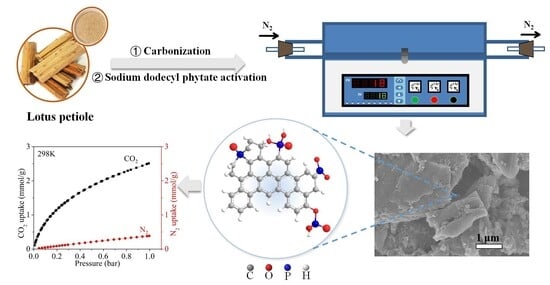
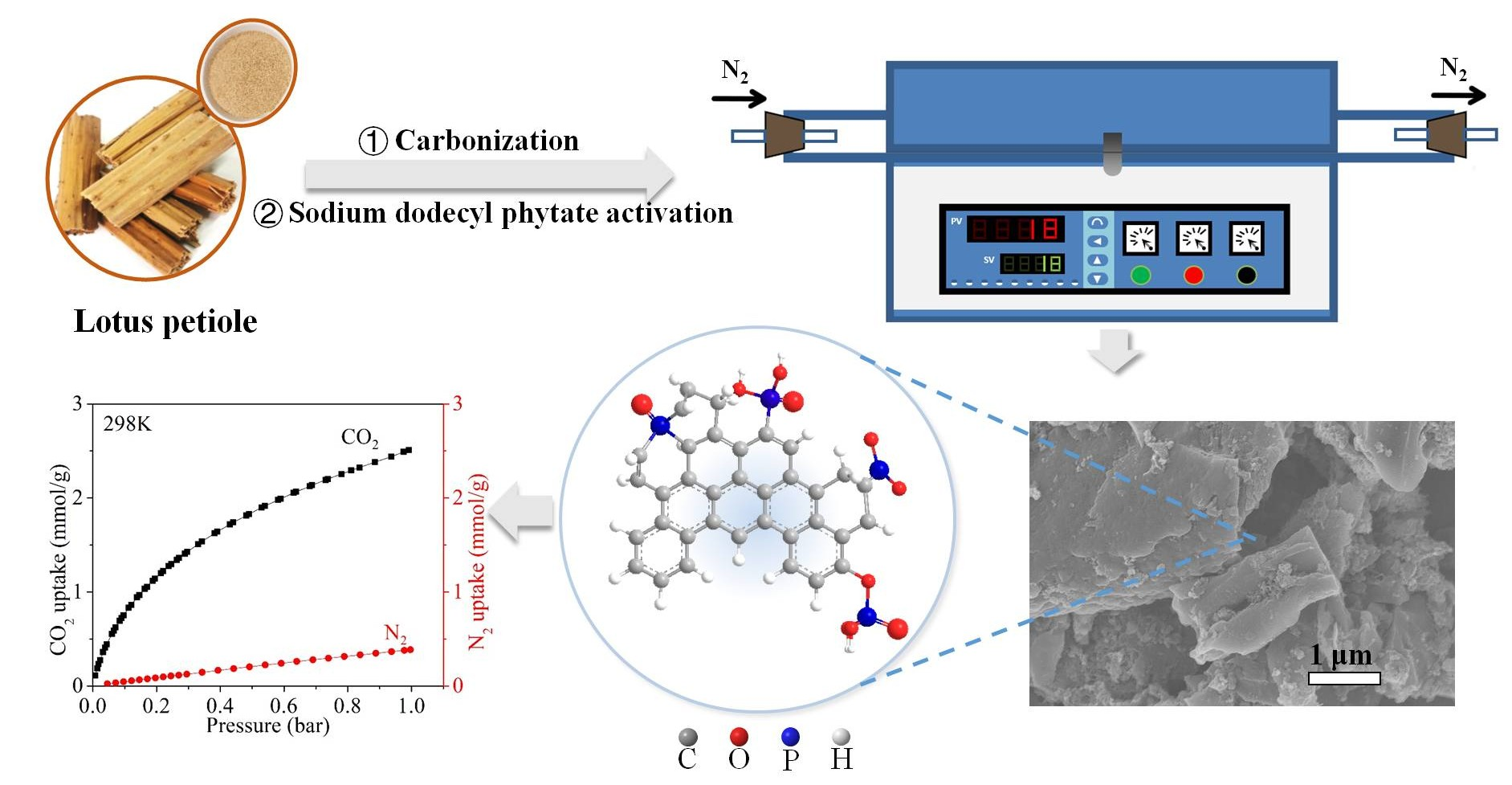
The lotus petiole biomass was initially washed with deionized water to eliminate dust and surface contamination. The purified material was then oven-dried at 105°C for 24 h and then ground and sieved to a particle size between 100 and 140 mesh (105–150 μm). The dry powder was placed in a horizontal quartz tube furnace and carbonized at continuous flow of nitrogen (200 mL/min). The furnace temperature was increased from room temperature to 500 °C at a heating rate of 5 °C/min and kept for 2 h. On simultaneously cooling in nitrogen, the material thus obtained was named as LPC. An accurate amount of LPC was mixed with sodium phytate in a 1:2 weight ratio. The homogeneous mixture was charged into a tubular furnace and treated at different temperatures (650, 700, 750, 800, and 850 °C) for 2 h under nitrogen flow (400 mL/min). The ramping rate was 5 °C/min. The resulting black powder was cleaned with hot deionized water a few times to remove the remaining salt and dried overnight in 80 °C. The resulting products were designated as LPSP-T, where T is the activation temperature. The schematic synthesis process for these P-doped porous carbons can be found in Figure S1 of the Supplementary Materials. Comprehensive details regarding the synthesis process, characterization of the adsorbents, and the measurement of CO2 adsorption performance are provided in the Supplementary Materials.

3. Results and Discussion

3.1. Characterization Results of Porous Carbon

The morphology of the as-prepared phosphorus-doped porous carbons (LPSP-T) was systematically investigated using scanning electron microscopy (SEM, Hitachi S-4800, Hitachi, Tokyo, Japan) and transmission electron microscopy (TEM, JEOL-2100F, JEOL, Kyoto, Japan) to assess the evolution of the carbon structure with varying activation temperatures. The SEM images (Figure 1a–f) show that the pristine carbonized lotus petiole (LPC) possessed a relatively smooth and compact surface with limited porosity. Upon activation with sodium phytate at elevated temperatures, the samples exhibited progressively rougher surface morphologies, accompanied by the emergence of abundant micro- and mesopores. This structural transformation can be attributed to the chemical activation process, in which the decomposition of sodium phytate etches the carbon matrix and generates hierarchical pores. The TEM image of LPSP-700 (Figure 1g) further confirmed the presence of a well-developed porous network, characterized by a disordered, amorphous carbon matrix interspersed with nano-sized pores. The combination of micro- and mesopores is particularly advantageous for gas adsorption, as micropores provide abundant active sites for CO2 capture, while mesopores enhance diffusion kinetics, ensuring rapid mass transport throughout the material. Collectively, these morphological features are highly favorable for CO2 adsorption, as they increase the accessibility of adsorption sites, strengthen gas–solid interactions, and contribute to the observed high CO2 uptake capacity.
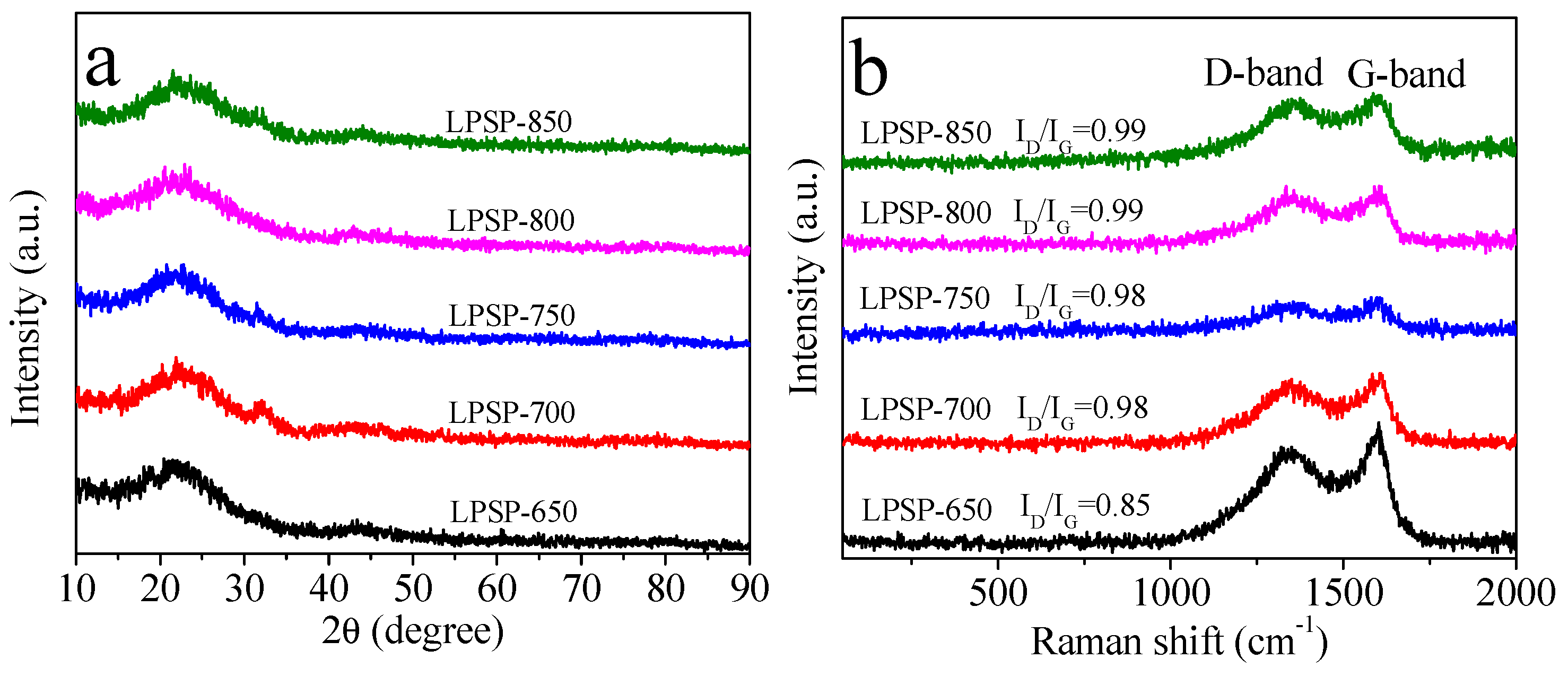
The crystalline nature of the LPSP-T materials was investigated using X-ray diffraction (XRD). As shown in Figure 2a, all samples display two broad diffraction peaks at 2θ ≈ 23° and 43°, corresponding to the (002) and (100) planes of carbon, respectively. The broadness and low intensity of these peaks indicate a predominantly amorphous carbon structure with limited graphitic ordering, which is typical for heteroatom-doped carbons derived from biomass. This amorphous nature is likely beneficial for CO2 adsorption, as it can provide a higher density of edge sites and structural defects that serve as active adsorption centers. Complementary structural insights were obtained through Raman spectroscopy (Figure 2b). The spectra displayed two prominent bands: the D-band at approximately 1345 cm−1, associated with disordered carbon or defects, and the G-band at approximately 1590 cm−1, corresponding to in-plane vibrations of sp2-bonded carbon atoms. The intensity ratio of these bands (ID/IG) serves as an indicator of structural disorder. For LPSP-T samples activated at temperatures above 650 °C, the ID/IG ratio ranged from 0.98 to 0.99, confirming a high defect concentration within the carbon framework. Such structural disorder is advantageous for gas adsorption because defects and heteroatom incorporation create additional active sites and enhance polar interactions with CO2 molecules. Moreover, the combination of amorphous structure and abundant defects can facilitate gas penetration and diffusion, thereby improving adsorption kinetics and overall uptake capacity.
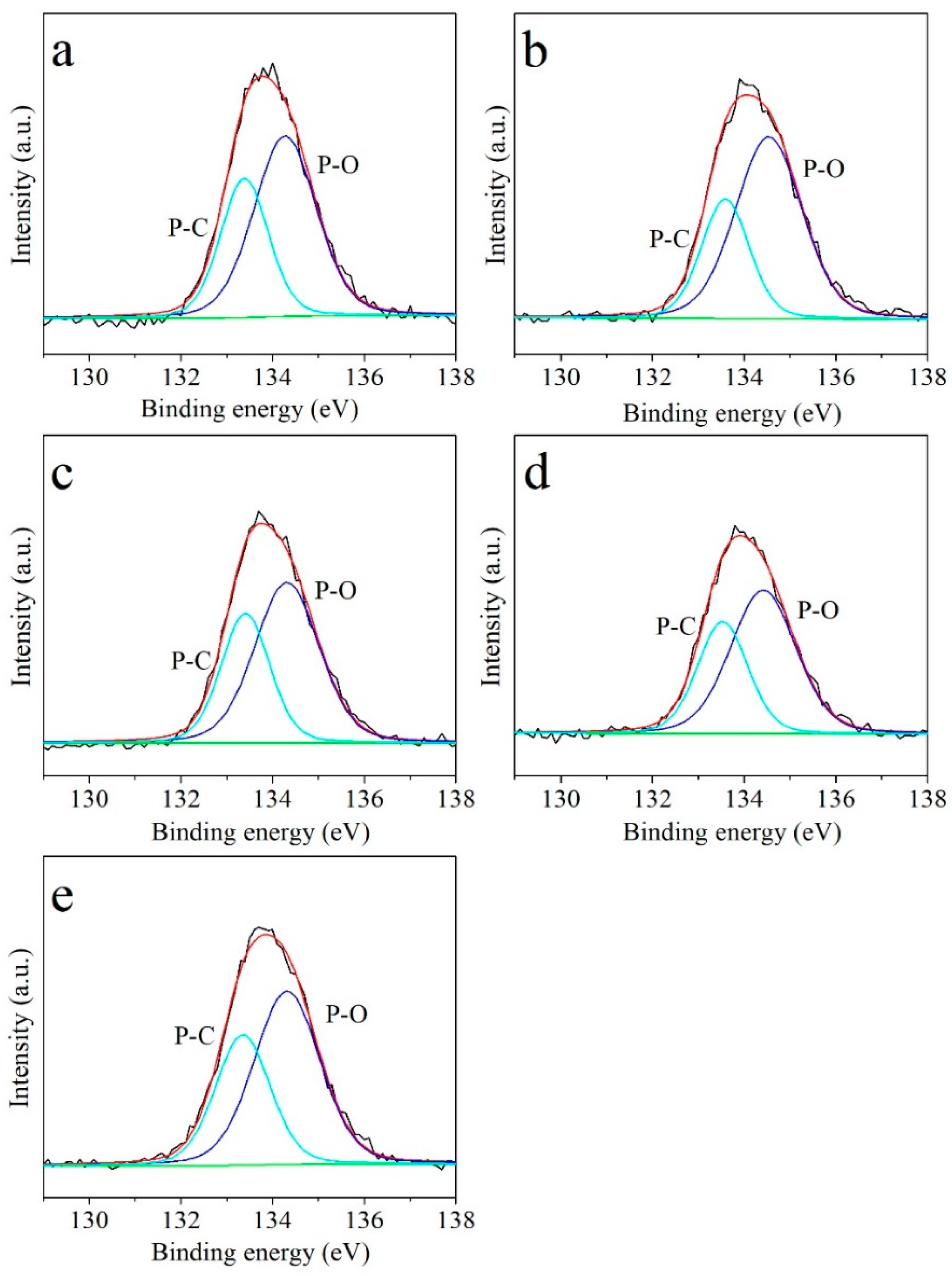
X-ray photoelectron spectroscopy (XPS) was employed to investigate the surface elemental composition and chemical bonding of the LPSP-T samples. Survey spectra confirmed the presence of carbon (C), oxygen (O), phosphorus (P), and trace amounts of nitrogen (N) in all samples, indicating successful heteroatom incorporation. As summarized in Table 1, the phosphorus content reached a maximum of 3.28 at.% in LPSP-750, while LPSP-700 also exhibited a high P concentration of 2.92 at.%. The observed O and P contents primarily originate from the thermal decomposition of sodium phytate, which served both as a phosphorus dopant and a chemical activating agent during carbonization. High-resolution P 2p spectra (Figure 3a–e) provided more detailed insights into the chemical state of phosphorus. Deconvolution of the P 2p peaks revealed two dominant components at binding energies of 133.4 eV and 134.4 eV, corresponding to P–C and P–O bonds, respectively. These results confirm the successful incorporation of phosphorus species into the carbon framework. Notably, the P–O functionalities introduce polar surface sites, enhancing the sorbent’s surface polarity and promoting stronger interactions with CO2 molecules through Lewis acid–base and dipole–quadrupole interactions [38]. Such surface modifications are critical for improving CO2 adsorption capacity, especially at low partial pressures, by providing additional active sites and increasing the affinity of the carbon matrix toward acidic gas molecules. Moreover, the uniform dispersion of phosphorus species throughout the carbon matrix may also contribute to the creation of hierarchical porosity, facilitating gas diffusion and enhancing overall adsorption kinetics.

3.2. Textural Properties

The textural properties of the LPSP-T phosphorus-doped porous carbons were thoroughly characterized to establish the relationship between pore structure and CO2 adsorption performance. Key parameters, including specific surface area (SBET), total pore volume (V0), microporous pore volume (Vt), and pore size distribution, were determined via nitrogen (N2) physisorption analyses. In addition, the volumes of narrow micropore (<1 nm) (Vn) were obtained through Dubinin-Radushkevich (D-R) equation using CO2 adsorption data at 0 °C, which are known to critically influence CO2 sorption behavior under low pressure.
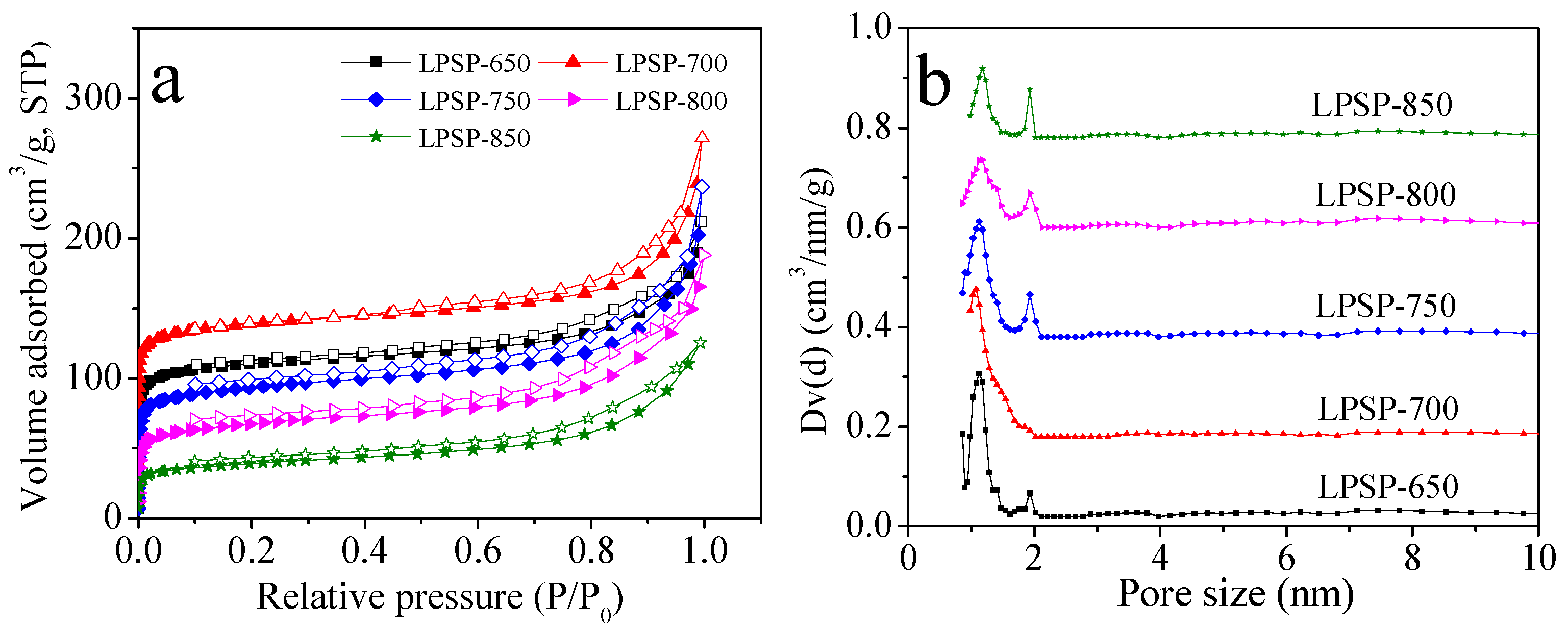
The N2 adsorption–desorption isotherms recorded at –196 °C (Figure 4a) exhibited mixed characteristics of type I and type IV, indicative of the coexistence of micropores and mesopores. A steep increase in adsorption volume at low relative pressures (P/P0 < 0.1) reflects a high degree of microporosity, whereas the pronounced hysteresis loop at higher relative pressures (P/P0 > 0.4) reflects capillary condensation within mesopores [42,43]. Among the series, LPSP-700 demonstrated the highest BET surface area (525 m2/g) and total pore volume (0.39 cm3/g), highlighting its superior textural development. In comparison, LPSP-650 and LPSP-750 exhibited moderate surface areas of 418 m2/g and 341 m2/g, respectively, while LPSP-800 and LPSP-850 showed a significant decline (237 m2/g and 132 m2/g, respectively), which can be attributed to pore coalescence or collapse at elevated activation temperatures, limiting accessible surface area and pore connectivity [44]. Pore size distribution derived from NLDFT simulations of the N2 isotherms (Figure 4b) revealed that all samples were dominated by micropores with widths below 2 nm, which are particularly favorable for CO2 adsorption under sub-ambient and ambient conditions [45]. Quantitative analysis based on CO2 adsorption isotherms at 0 °C indicated that the narrow micropore volume (<1 nm) was highest for LPSP-700 and LPSP-800 (0.28 cm3/g), followed closely by LPSP-750 (0.26 cm3/g). Although LPSP-850 retained a comparable micropore volume, its reduced total pore volume and surface area suggested partial structural collapse at 850°C. LPSP-650, despite a slightly lower narrow micropore volume (0.25 cm3/g), still exhibited substantial CO2 capacity owing to its relatively high surface area.
Overall, these findings highlight that LPSP-700 possesses a well-balanced hierarchical pore structure, with an optimal combination of micro- and mesopores and a high narrow micropore fraction. This structural arrangement maximizes molecular sieving and confinement effects, facilitates efficient gas diffusion, and ensures high accessibility of adsorption sites, all of which are critical factors for selective and high-capacity CO2 capture. The analysis further demonstrates that careful tuning of activation temperature is essential for optimizing textural properties, and that a balance between narrow micropore volume and total pore connectivity is key to maximizing CO2 adsorption performance.

3.3. CO2 Adsorption Results of Porous Carbon

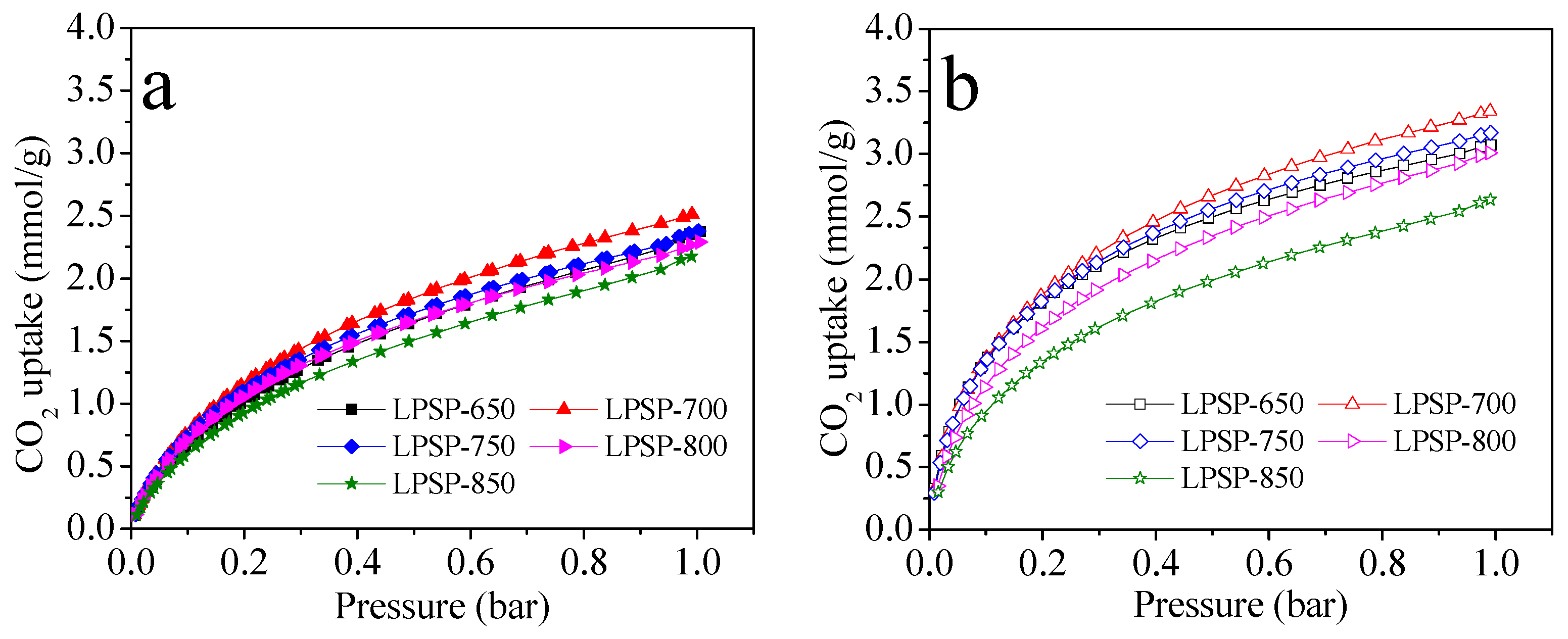
The CO2 adsorption isotherms of the phosphorus-doped LPSP porous carbons measured at 25 °C and 0 °C (Figure 5a,b) provide valuable insights into the interplay between textural features, surface chemistry, and gas adsorption performance. All samples exhibited a pronounced uptake at low pressures, indicative of a strong affinity between CO2 molecules and the adsorbent surface. Among the series, LPSP-700 demonstrated the highest CO2 adsorption capacity, reaching 2.51 mmol/g at 25 °C and 3.34 mmol/g at 0 °C under 1 bar, outperforming both lower- and higher-temperature activated samples. The adsorption performance of the lotus petiole–derived phosphorus-doped carbons is comparable to, or even surpasses, those obtained from non-sustainable phosphorus sources. For instance, cornstalk-derived carbons doped with melamine and phytic acid exhibited a CO2 uptake of approximately 3.11 mmol/g at 25 °C and 1 bar [46]. Similarly, sucrose-based carbons prepared with phosphoric acid using MCM-22 as a template achieved a maximum capacity of 1.43 mmol/g [37]. A resorcinol–formaldehyde porous carbon synthesized with phosphoric acid and F108 as a template delivered an uptake of 3.64 mmol/g [47], while carbons obtained through H3PO4-assisted polymerization showed an adsorption capacity of 2.59 mmol/g [48]. These comparisons demonstrate that the sustainable sorbent developed in this work provides competitive CO2 capture capacity relative to conventional, non-renewable phosphorus-based counterparts.
The superior performance of LPSP-700 can be attributed to its optimal combination of textural and chemical characteristics. Structurally, it possesses the highest BET surface area (525 m2/g) and largest total pore volume (0.39 cm3/g), along with a well-developed narrow micropore fraction (Vn = 0.28 cm3/g), collectively maximizing the availability of adsorption sites and enhancing molecular sieving effects. These micropores provide confinement for CO2 molecules, enhancing adsorption at low pressures, while the mesoporous network ensures efficient gas diffusion and rapid adsorption kinetics.
In addition to favorable textural features, surface chemistry plays a critical role in adsorption performance. XPS analysis shows significant heteroatom incorporation in LPSP-700, with 1.58 at.% N, 2.92 at.% P, and 22.44 at.% O. These heteroatoms introduce basic and polar functional sites, enhancing the interaction between CO2 molecules and the carbon surface via Lewis acid–base interactions and quadrupole–dipole forces [34,35,36]. In particular, phosphorus doping introduces polar P–O and P–C functionalities, which not only increase surface polarity but also synergistically interact with nitrogen and oxygen species to strengthen CO2 binding, especially under ambient conditions.
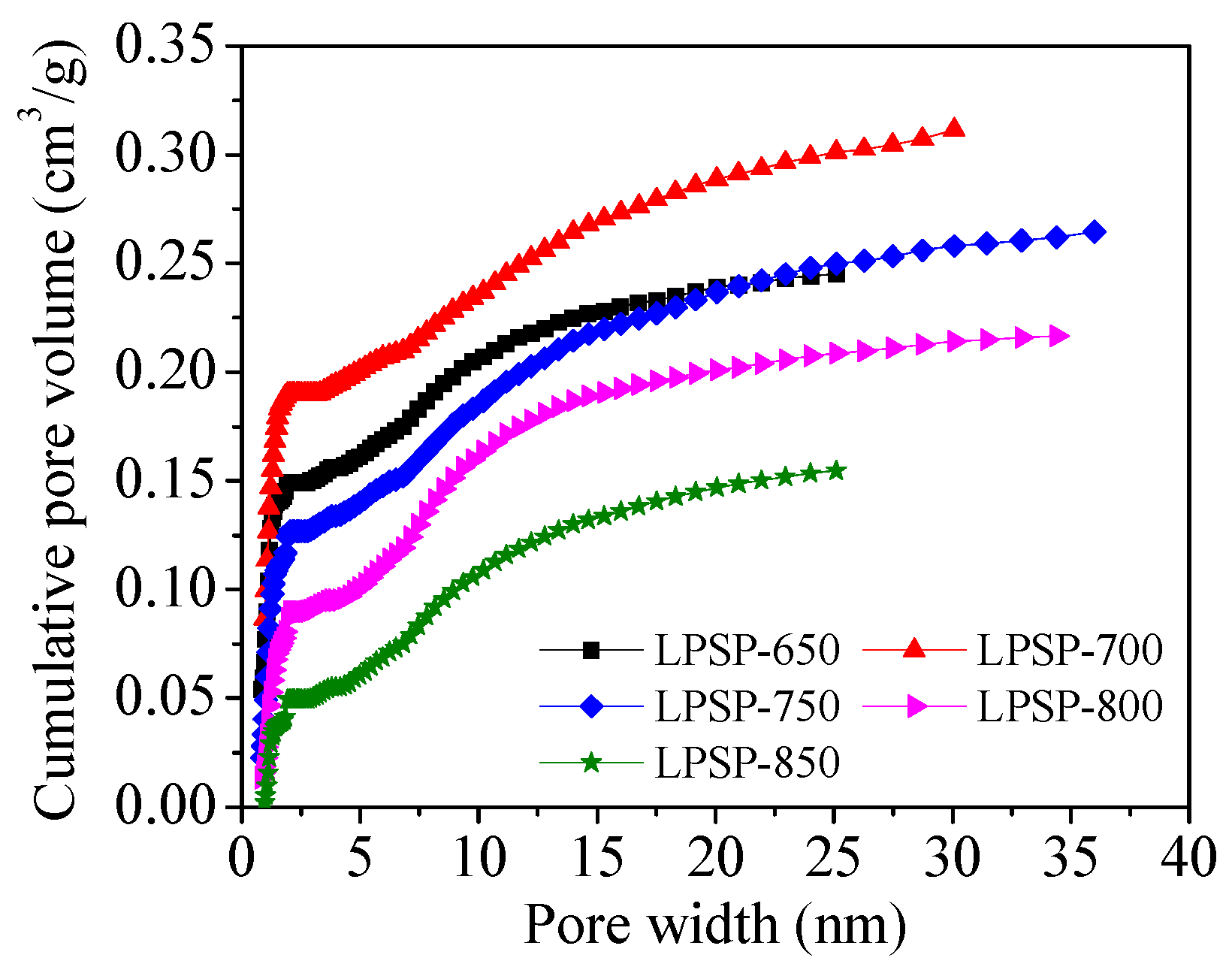
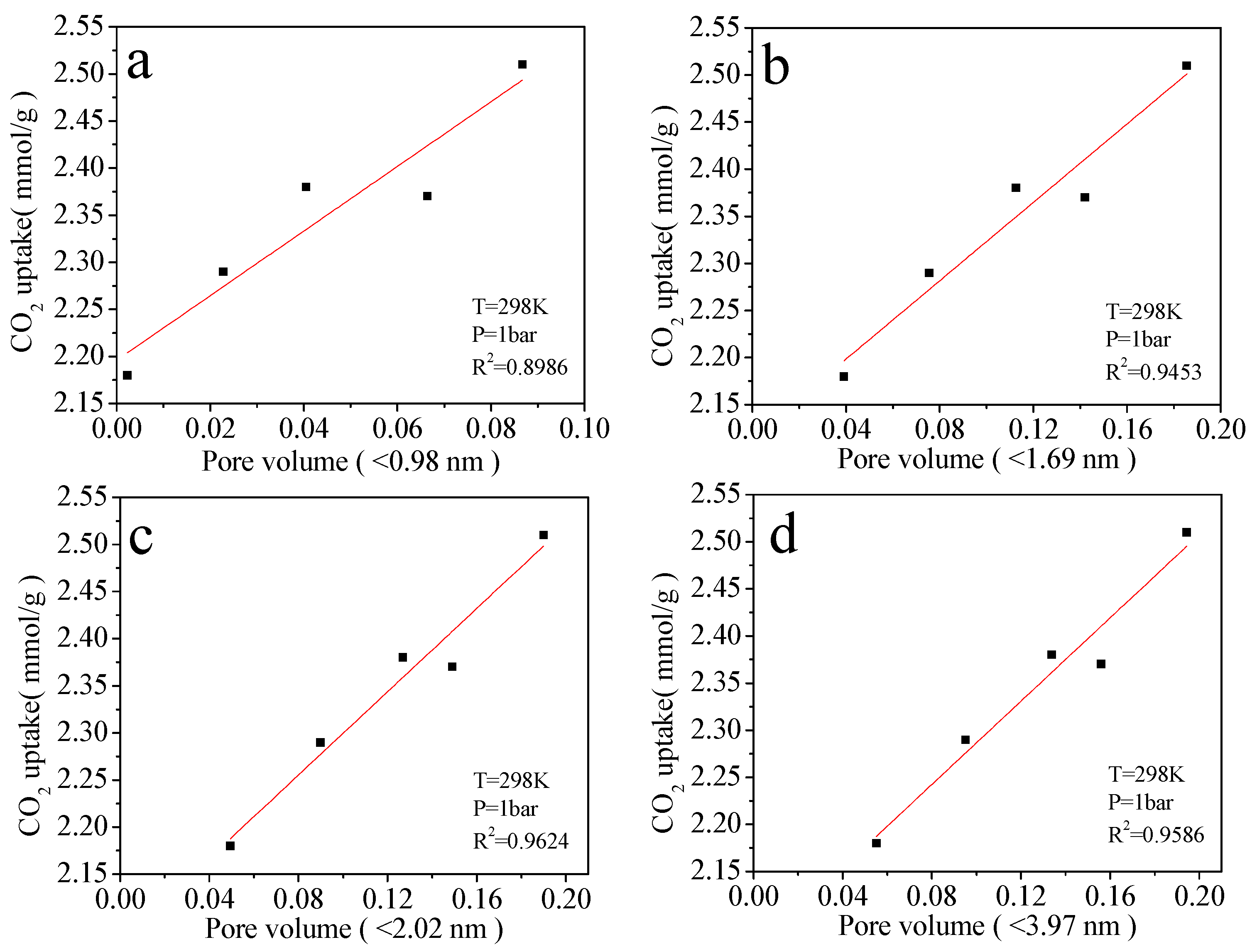
Figure 6 presents the cumulative pore volume distribution as a function of pore width for the LPSP-T series, derived from non-local density functional theory (NLDFT) analysis of N2 adsorption–desorption isotherms. Among the samples, LPSP-700 exhibited the highest cumulative pore volume (~0.30 cm3/g), followed closely by LPSP-750 and LPSP-650, indicating that these materials possess a highly developed porous network. The pronounced increase in cumulative pore volume at pore widths below ~3 nm reflects the abundant presence of micropores and narrow mesopores, which are known to play a pivotal role in CO2 capture at near-ambient pressures. In addition, the gradual increase in pore volume extending to the mesopore region (2–35 nm) confirms the existence of hierarchical porosity, which benefits gas transport and facilitates the accessibility of active adsorption sites. The structure–adsorption property relationship was further examined by correlating pore size distribution with CO2 uptake, as presented in Figure 7. This figure illustrates the linear relationship between CO2 uptake at 25 °C and cumulative pore volume in selected pore size ranges for the LPSP-T series. The four subplots (a–d) correspond to pore widths of <0.98 nm, <1.69 nm, <2.02 nm, and <3.97 nm, respectively. In each case, a clear positive correlation was observed, confirming that the pore volume within these ranges significantly influences adsorption capacity. Notably, the most pronounced dependence of CO2 uptake on pore volume is observed for pores smaller than 2.02 nm (Figure 7c), where the coefficient of determination (R2) reaches as high as ~0.96. This provides compelling evidence that narrow micropores and micropores (<2 nm) are the dominant contributors to CO2 uptake under ambient conditions, owing to their strong confinement effects and enhanced adsorbate–adsorbent interactions. Collectively, these results demonstrate that CO2 adsorption in LPSP carbons is primarily governed by the availability of narrow micropores, while mesopores act in a complementary role by ensuring efficient diffusion pathways and minimizing mass-transfer resistance. Thus, the coexistence of micropores (responsible for adsorption capacity) and mesopores (responsible for transport kinetics) creates a synergistic hierarchical pore structure, which is crucial for achieving high-performance CO2 sorbents.
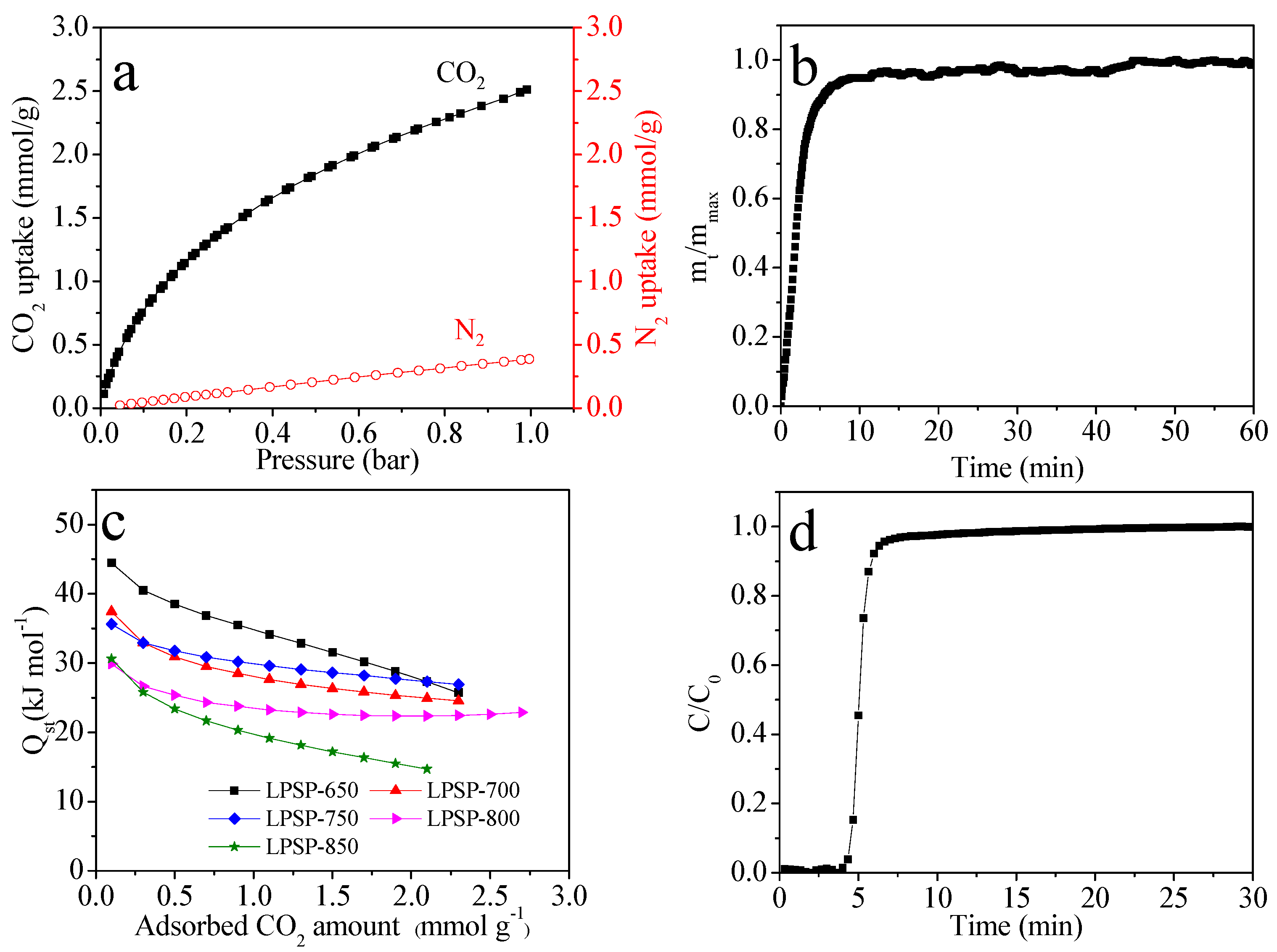
Figure 8 comprehensively evaluates the CO2 capture performance of the LPSP series, with particular emphasis on LPSP-700 owing to its superior adsorption characteristics. As shown in Figure 8a, the CO2 and N2 adsorption isotherms at 25 °C up to 1 bar clearly demonstrate that LPSP-700 possesses a markedly stronger affinity for CO2 than for N2. At 1 bar, the CO2 uptake reaches ~2.6 mmol/g, while N2 uptake remains as low as ~0.25 mmol/g, underscoring the material’s excellent CO2 selectivity. Correspondingly, the calculated IAST [49] selectivity for a CO2/N2 mixture (10:90, v/v) is 19, confirming the strong potential of LPSP-700 for post-combustion CO2 separation.
Figure 8b illustrates the CO2 adsorption kinetics of LPSP-700 at 25 °C. Nearly 90% of the equilibrium uptake is achieved within 6 min, indicating rapid diffusion and efficient accessibility of active pores. Such fast adsorption kinetics are advantageous for practical operation, especially in cyclic adsorption–desorption processes under dynamic flow conditions.
The adsorption strength was further investigated by the isosteric heat of adsorption (Qst) (Figure 8c), derived from isotherms at 0 °C and 25 °C. At near-zero coverage, LPSP-700 exhibits the highest Qst of ~44 kJ/mol, gradually decreasing to ~15 kJ/mol with increasing loading. This decline reflects the progressive filling of adsorption sites with different binding energies. The overall moderate Qst values (15–44 kJ/mol) indicate that CO2 adsorption on LPSP-700 is predominantly physisorptive in nature: sufficiently strong for selective capture yet reversible, which is favorable for long-term cyclic operation.
Finally, Figure 8d depicts the dynamic breakthrough behavior of LPSP-700 under simulated post-combustion conditions (25 °C, 1 bar, 10 vol.% CO2, 10 mL/min total flow). The breakthrough curve exhibits a sharp and well-defined mass transfer zone, indicative of efficient adsorption dynamics. The calculated dynamic CO2 uptake is 0.81 mmol/g, closely matching the equilibrium capacity, thereby validating the stability and reliability of LPSP-700 under continuous flow operation.
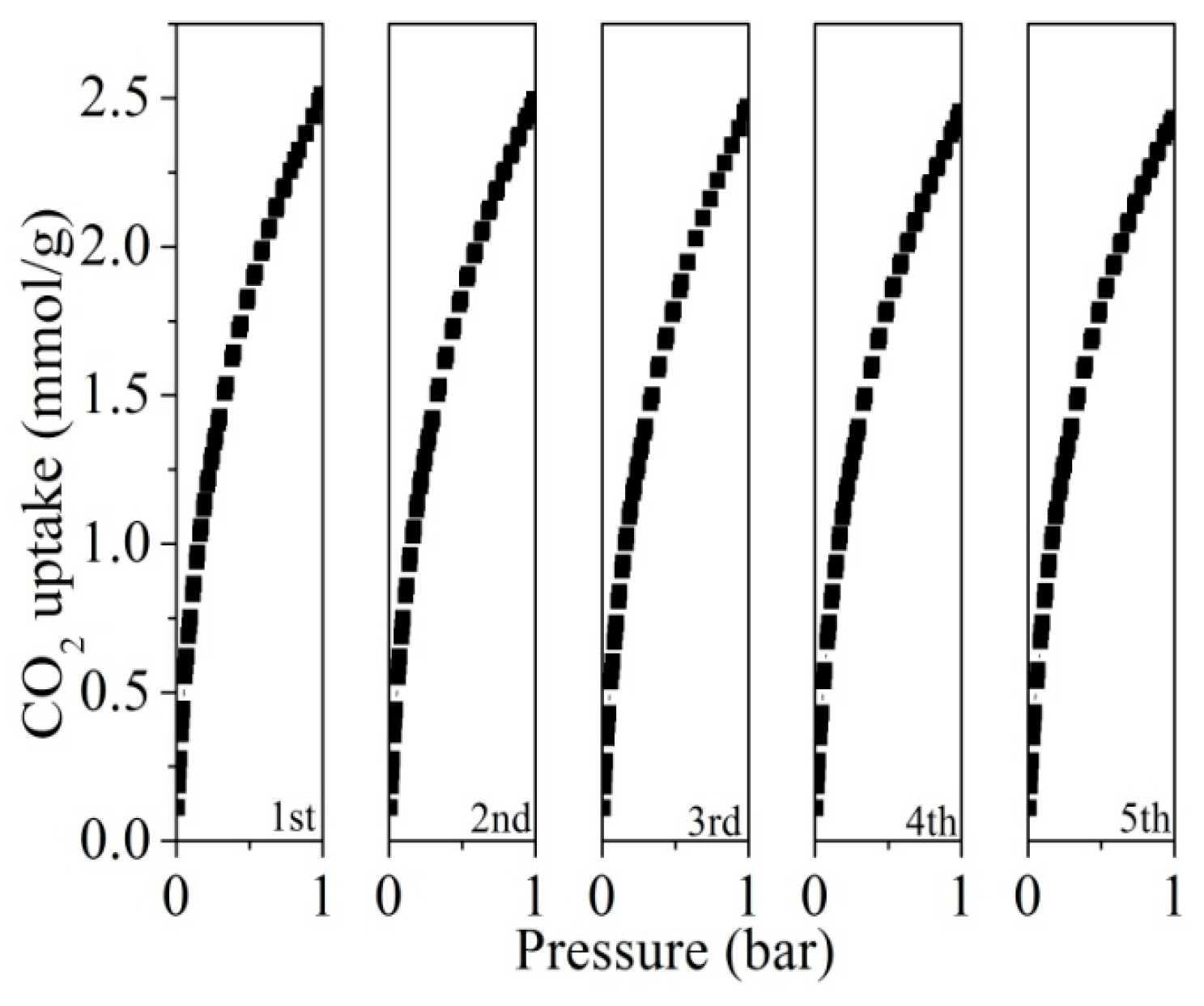
Building upon the equilibrium, kinetic, and breakthrough results in Figure 8, which collectively demonstrate the high capacity, fast diffusion, and robust dynamic performance of LPSP-700, Figure 9 further assesses its cyclic CO2 adsorption–desorption behavior to evaluate regeneration and long-term operational stability. Remarkably, the CO2 uptake capacity remains virtually unchanged over five consecutive cycles, with negligible performance loss. This outstanding recyclability highlights not only the structural robustness of LPSP-700 but also the high reversibility of the adsorption process, thereby reinforcing its practical potential for cyclic CO2 capture in real-world post-combustion scenarios.

4. Conclusions

In summary, phosphorus-doped porous carbons were successfully synthesized via a one-step phosphorus doping and thermal activation strategy using lotus petiole biomass and sodium phytate as the precursor and dual-function agent, respectively. The activation temperature was found to be a key parameter in regulating the surface area, pore structure, and heteroatom incorporation. Among the series, LPSP-700 exhibited the most favorable characteristics, with a high BET surface area of 525 m2/g, a total pore volume of 0.39 cm3/g, and a narrow micropore volume of 0.28 cm3/g. These structural advantages, together with P-containing functional groups, endowed LPSP-700 with an excellent CO2 uptake of 2.51 mmol/g at 25 °C and 3.34 mmol/g at 0 °C under 1 bar. Moreover, LPSP-700 demonstrated rapid adsorption kinetics (reaching 90% equilibrium capacity within 6 min), superior CO2/N2 selectivity (19 under 10:90 CO2/N2 mixture), and moderate isosteric heats of adsorption (15–44 kJ/mol), ensuring both high affinity and easy regeneration. Breakthrough experiments further confirmed its dynamic CO2 capture capacity (0.81 mmol/g), while cyclic tests revealed outstanding stability with negligible performance loss over at least five adsorption–desorption cycles. Importantly, micropore structure analysis highlighted the dominant role of micropores (<2.02 nm) in CO2 capture, as supported by the strong correlation (R2 ≈ 0.9624) between the uptake and micropore volume. Overall, this work demonstrates that the synergistic integration of optimized hierarchical porosity and phosphorus doping enables LPSP-700 to serve as a robust, sustainable, and high-performance sorbent for post-combustion CO2 capture.

Supplementary Materials

The following supporting information can be downloaded at: https://www.mdpi.com/article/10.3390/molecules30193990/s1, Scheme S1. Schematic diagram of the fixed-bed reactor system. Figure S1. Schematic diagram of the synthesis of lotus petiole derived P-doped porous carbons.

Author Contributions

Conceptualization, Y.Z. and X.H.; formal analysis, J.S. and X.L.; investigation, Y.Z., J.S. and J.W.; resources, Q.X., L.W. and X.H.; data curation, J.W., U.B.S. and M.D.; writing—original draft preparation, Y.Z. and X.H.; writing—review and editing, X.H. and L.W. supervision, X.H. and L.W. All authors have read and agreed to the published version of the manuscript.

Funding

This research was supported by the Zhejiang Provincial Natural Science Foundation (Grant No. LY21B070005), the Science and Technology Innovation Capacity Building Project of the Beijing Academy of Agricultural and Forestry Sciences (Grant No. KJCX20240305), and the Research Support Program for Central Labs at King Khalid University (Project No. CL/CO/B/6).

Institutional Review Board Statement

Not applicable.

Informed Consent Statement

Not applicable.

Data Availability Statement

The data presented in this study are available on request from the corresponding author.

Conflicts of Interest

The authors declare no conflicts of interest.

References

  1. Dziejarski, B.; Serafin, J.; Andersson, K.; Krzyżyńska, R. CO2 capture materials: A review of current trends and future challenges. Mater. Today Sustain. 2023, 24, 100483. [Google Scholar] [CrossRef]
  2. Wennersten, R.; Sun, Q.; Li, H. The future potential for Carbon Capture and Storage in climate change mitigation—An overview from perspectives of technology, economy and risk. J. Clean. Prod. 2015, 103, 724–736. [Google Scholar] [CrossRef]
  3. Rochelle, G.T. Amine Scrubbing for CO2 Capture. Science 2009, 325, 1652–1654. [Google Scholar] [CrossRef]
  4. Soo, X.Y.D.; Lee, J.J.C.; Wu, W.-Y.; Tao, L.; Wang, C.; Zhu, Q.; Bu, J. Advancements in CO2 capture by absorption and adsorption: A comprehensive review. J. CO2 Util. 2024, 81, 102727. [Google Scholar] [CrossRef]
  5. Chatterjee, S.; Jeevanandham, S.; Mukherjee, M.; Vo, D.-V.N.; Mishra, V. Significance of re-engineered zeolites in climate mitigation—A review for carbon capture and separation. J. Environ. Chem. Eng. 2021, 9, 105957. [Google Scholar] [CrossRef]
  6. Millward, A.R.; Yaghi, O.M. Metal-Organic Frameworks with Exceptionally High Capacity for Storage of Carbon Dioxide at Room Temperature. J. Am. Chem. Soc. 2005, 127, 17998–17999. [Google Scholar] [CrossRef]
  7. Yu, J.; Xie, L.-H.; Li, J.-R.; Ma, Y.; Seminario, J.M.; Balbuena, P.B. CO2 Capture and Separations Using MOFs: Computational and Experimental Studies. Chem. Rev. 2017, 117, 9674–9754. [Google Scholar] [CrossRef]
  8. Guo, Y.F.; Tan, C.; Sun, J.; Li, W.L.; Zhang, J.B.; Zhao, C.W. Porous activated carbons derived from waste sugarcane bagasse for CO2 adsorption. Chem. Eng. J. 2020, 381, 122736. [Google Scholar] [CrossRef]
  9. Shi, J.; Cui, H.; Xu, J.; Yan, N.; Liu, Y. Design and fabrication of hierarchically porous carbon frameworks with Fe2O3 cubes as hard template for CO2 adsorption. Chem. Eng. J. 2020, 389, 124459. [Google Scholar] [CrossRef]
  10. Shao, J.; Wang, Y.; Che, M.; Xiao, Q.; Demir, M.; Al Mesfer, M.K.; Wang, L.; Hu, X.; Liu, Y. N,S Co-doped porous carbons from coconut shell for selective CO2 adsorption. J. Energy Inst. 2025, 123, 102273. [Google Scholar] [CrossRef]
  11. Rehman, A.; Nazir, G.; Rhee, K.Y.; Park, S.-J. A rational design of cellulose-based heteroatom-doped porous carbons: Promising contenders for CO2 adsorption and separation. Chem. Eng. J. 2021, 420, 130421. [Google Scholar] [CrossRef]
  12. Singh, G.; Ruban, A.M.; Geng, X.; Vinu, A. Recognizing the potential of K-salts, apart from KOH, for generating porous carbons using chemical activation. Chem. Eng. J. 2023, 451, 139045. [Google Scholar] [CrossRef]
  13. Khosrowshahi, M.S.; Mashhadimoslem, H.; Shayesteh, H.; Singh, G.; Khakpour, E.; Guan, X.W.; Rahimi, M.; Maleki, F.; Kumar, P.; Vinu, A. Natural Products Derived Porous Carbons for CO2 Capture. Adv. Sci. 2023, 10, 2304289. [Google Scholar] [CrossRef] [PubMed]
  14. Li, Y.; Chen, B.; Gao, Y.; Zhang, J.; Wang, B. Optimization performance of viscose rayon derived flexible porous carbon cloths in relation to their CO2 capture, CO2/CH4 separation and methanol adsorption. Colloids Surf. A Physicochem. Eng. Asp. 2023, 677, 132350. [Google Scholar] [CrossRef]
  15. Wang, L.; Ma, Y.; Liu, H.; Guo, Y.; Yang, B.; Chang, B. Leveraging porosity and morphology in hierarchically porous carbon microtubes for CO2 capture and separation from humid flue gases. Sep. Purif. Technol. 2025, 354, 128910. [Google Scholar] [CrossRef]
  16. Sun, L.-B.; Kang, Y.-H.; Shi, Y.-Q.; Jiang, Y.; Liu, X.-Q. Highly Selective Capture of the Greenhouse Gas CO2 in Polymers. ACS Sustain. Chem. Eng. 2015, 3, 3077–3085. [Google Scholar] [CrossRef]
  17. Shao, L.; Li, Y.; Huang, J.; Liu, Y.-N. Synthesis of Triazine-Based Porous Organic Polymers Derived N-Enriched Porous Carbons for CO2 Capture. Ind. Eng. Chem. Res. 2018, 57, 2856–2865. [Google Scholar] [CrossRef]
  18. Sang, Y.F.; Cao, Y.W.; Wang, L.Z.; Yan, W.; Chen, T.W.; Huang, J.H.; Liu, Y.N. N-rich porous organic polymers based on Schiff base reaction for CO2 capture and mercury(II) adsorption. J. Colloid. Interface Sci. 2021, 587, 121–130. [Google Scholar] [CrossRef]
  19. Wang, J.; Wang, Y.; Liu, X.; Xiao, Q.; Demir, M.; Almesfer, M.K.; Colak, S.G.; Wang, L.; Hu, X.; Liu, Y. The Synthesis of B-Doped Porous Carbons via a Sodium Metaborate Tetrahydrate Activating Agent: A Novel Approach for CO2 Adsorption. Molecules 2025, 30, 2564. [Google Scholar] [CrossRef] [PubMed]
  20. Wang, J.; Yin, Y.; Liu, X.; Liu, Y.; Xiao, Q.; Zhao, L.; Demir, M.; Alaş Çolak, M.Ö.; Wang, L.; Hu, X. Potassium metaborate-activated boron-doped porous carbons for selective CO2 adsorption. Sep. Purif. Technol. 2025, 376, 134079. [Google Scholar] [CrossRef]
  21. Guo, X.; Zhang, G.; Wu, C.; Liu, J.; Li, G.; Zhao, Y.; Wang, Y.; Xu, Y. A cost-effective synthesis of heteroatom-doped porous carbon by sulfur-containing waste liquid treatment: As a promising adsorbent for CO2 capture. J. Environ. Chem. Eng. 2021, 9, 105165. [Google Scholar] [CrossRef]
  22. Wu, W.; Wu, C.; Liu, J.; Yan, H.; Zhang, G.; Li, G.; Zhao, Y.; Wang, Y. Nitrogen-doped porous carbon through K2CO3 activated bamboo shoot shell for an efficient CO2 adsorption. Fuel 2024, 363, 130937. [Google Scholar] [CrossRef]
  23. Aghel, B.; Behaein, S.; Alobiad, F. CO2 capture from biogas by biomass-based adsorbents: A review. Fuel 2022, 328, 125276. [Google Scholar] [CrossRef]
  24. Kundu, S.; Khandaker, T.; Anik, M.A.-A.M.; Hasan, M.K.; Dhar, P.K.; Dutta, S.K.; Latif, M.A.; Hossain, M.S. A comprehensive review of enhanced CO2 capture using activated carbon derived from biomass feedstock. RSC Adv. 2024, 14, 29693–29736. [Google Scholar] [CrossRef]
  25. Vinayakumar, K.; Palliyarayil, A.; Prakash, P.S.; Kumar, N.S.; Sil, S. A facile one pot synthesis of biocarbon derived from water hyacinth and development of pellets for CO2 capture applications. Biomass Bioenergy 2022, 167, 106648. [Google Scholar] [CrossRef]
  26. Shao, J.; Wang, Y.; Liu, C.; Xiao, Q.; Demir, M.; Al Mesfer, M.K.; Danish, M.; Wang, L.; Hu, X. Advanced microporous carbon adsorbents for selective CO2 capture: Insights into heteroatom doping and pore structure optimization. J. Anal. Appl. Pyrolysis 2025, 186, 106946. [Google Scholar] [CrossRef]
  27. Shao, J.; Wang, J.; Yu, Q.; Yang, F.; Demir, M.; Altinci, O.C.; Umay, A.; Wang, L.; Hu, X. Unlocking the potential of N-doped porous Carbon: Facile synthesis and superior CO2 adsorption performance. Sep. Purif. Technol. 2024, 333, 125891. [Google Scholar] [CrossRef]
  28. Shao, J.; Wang, Y.; Che, M.; Liu, Y.; Jiang, Y.; Xiao, Q.; Demir, M.; Wang, L.; Hu, X. Sustainable CO2 Capture: N,S-Codoped Porous Carbons Derived from Petroleum Coke with High Selectivity and Stability. Molecules 2025, 30, 426. [Google Scholar] [CrossRef]
  29. Wang, Q.; He, D.; Mu, J. Hierarchically porous carbon from cork with tunable pore size and N-doped structure for adsorption of toluene and CO2. Sep. Purif. Technol. 2025, 360, 131256. [Google Scholar] [CrossRef]
  30. Wang, Y.; Suo, Y.; Xu, Y.; Zhang, Z. Enhancing CO2 adsorption performance of porous nitrogen-doped carbon materials derived from ZIFs: Insights into pore structure and surface chemistry. Sep. Purif. Technol. 2024, 335, 126117. [Google Scholar] [CrossRef]
  31. Xu, Q.; Wang, J.; Feng, J.; Liu, C.; Xiao, Q.; Demir, M.; Simsek, U.B.; Kılıç, M.; Wang, L.; Hu, X. D-glucose-derived S-doped porous carbon: Sustainable and effective CO2 adsorption. Colloids Surf. A Physicochem. Eng. Asp. 2025, 709, 136054. [Google Scholar] [CrossRef]
  32. Xiao, J.; Wang, Y.; Zhang, T.C.; Yuan, S. N,S-containing polycondensate-derived porous carbon materials for superior CO2 adsorption and supercapacitor. Appl. Surf. Sci. 2021, 562, 150128. [Google Scholar] [CrossRef]
  33. Xiao, J.; Yuan, X.; Zhang, T.C.; Ouyang, L.; Yuan, S. Nitrogen-doped porous carbon for excellent CO2 capture: A novel method for preparation and performance evaluation. Sep. Purif. Technol. 2022, 298, 121602. [Google Scholar] [CrossRef]
  34. Zhi, Y.; Shao, J.; Liu, C.; Xiao, Q.; Demir, M.; Al Mesfer, M.K.; Danish, M.; Wang, L.; Hu, X. High-performance CO2 adsorption with P-doped porous carbons from lotus petiole biomass. Sep. Purif. Technol. 2025, 361, 131253. [Google Scholar] [CrossRef]
  35. Zhi, Y.; Yin, Y.; Ciren, Q.; Xiao, Q.; Zhao, L.; Demir, M.; Simsek, U.B.; Hu, X.; Wang, L. One-step synthesis of K3PO4-activated phosphorus-enriched carbons for enhanced carbon capture. J. Environ. Chem. Eng. 2025, 13, 116694. [Google Scholar] [CrossRef]
  36. Bao, S.D.; Jian, W.; Li, J.H.; Bao, Y.S.; Bao, A. Phosphorus-induced formation of micropores and nitrogen groups for efficient CO2 capture: Experiments and DFT calculations. Chem. Eng. J. 2023, 475, 146149. [Google Scholar] [CrossRef]
  37. Wu, R.; Hang, Y.; Li, J.; Bao, A. Preparation of biomass-derived phosphorus-doped microporous carbon material and its application in dye adsorption and CO2 capture. Surf. Interface Anal. 2022, 54, 881–891. [Google Scholar] [CrossRef]
  38. Panda, P.; Roy, S.; Barman, S. Phosphorus and Nitrogen Codoped Porous Carbon Nanosheets for Energy Storage and Gas Adsorption. ACS Appl. Nano Mater. 2024, 7, 2382–2393. [Google Scholar] [CrossRef]
  39. Lin, G.; Wang, Q.; Yang, X.; Cai, Z.; Xiong, Y.; Huang, B. Preparation of phosphorus-doped porous carbon for high performance supercapacitors by one-step carbonization. RSC Adv. 2020, 10, 17768–17776. [Google Scholar] [CrossRef]
  40. Li, J.; Ma, X.; Yu, Z.; Zhang, X.; Yue, W. Green synthesis of N, O, P co-doped porous carbon from co-pyrolysis of bamboo and ammonium polyphosphate for supercapacitors. J. Anal. Appl. Pyrolysis 2024, 178, 106427. [Google Scholar] [CrossRef]
  41. Zhang, G.; Yang, F.; Liu, X.; Zhao, H.; Che, S.; Li, J.; Yan, X.; Sun, S.; Chen, F.; Xu, C.; et al. Tuning surface chemical property in hierarchical porous carbon via nitrogen and phosphorus doping for deep desulfurization. Sep. Purif. Technol. 2022, 280, 119923. [Google Scholar] [CrossRef]
  42. Shao, S.; Wang, Y.; Ma, L.; Huang, Z.; Li, X. Sustainable preparation of hierarchical porous carbon from discarded shells of crustaceans for efficient CO2 capture. Fuel 2024, 355, 129287. [Google Scholar] [CrossRef]
  43. Tang, J.; Li, B.; Isa, Y.M.; Xie, X.; Kozlov, A.; Penzik, M.; Liu, D. Nitrogen-doped porous biocarbon materials originated from heavy bio-oil and their CO2 adsorption characteristics. Biomass Bioenergy 2024, 182, 107113. [Google Scholar] [CrossRef]
  44. Wu, Y.; Liu, H.; Cheng, Z.; Liu, L.; Zhang, S.; Shen, G.; Chen, Q. Preparation of corn straw-based porous carbon with target pore structure for high-performance electrode materials via a one-step process. Bioresour. Technol. 2025, 435, 132852. [Google Scholar] [CrossRef]
  45. Sun, Y.; Sheng, Z.; Chen, E.; Tang, Z.; Wang, J.; Zhu, X.; Wang, Z.; Li, X.; Xie, X.; Lin, X. Tuning the pore structure of N/O co-doped porous carbon nanosheets for high-performance supercapacitors and zinc-ion capacitors. Int. J. Hydrogen Energy 2025, 118, 35–45. [Google Scholar] [CrossRef]
  46. Yuan, X.; Xiao, J.; Yilmaz, M.; Zhang, T.C.; Yuan, S. N,P Co-doped porous biochar derived from cornstalk for high performance CO2 adsorption and electrochemical energy storage. Sep. Purif. Technol. 2022, 299, 121719. [Google Scholar] [CrossRef]
  47. Gong, L.; Hang, Y.; Li, J.; Dai, G.; Bao, A. Simple fabrication of a phosphorus-doped hierarchical porous carbon via soft-template method for efficient CO2 capture. Surf. Interface Anal. 2022, 54, 899–908. [Google Scholar] [CrossRef]
  48. Li, D.; Li, W.B.; Shi, J.S.; Xin, F.W. Influence of doping nitrogen, sulfur, and phosphorus on activated carbons for gas adsorption of H2, CH4 and CO2. RSC Adv. 2016, 6, 50138–50143. [Google Scholar] [CrossRef]
  49. Myers, A.L.; Prausnitz, J.M. Thermodynamics of mixed-gas adsorption. AIChE J. 1965, 11, 121–127. [Google Scholar] [CrossRef]
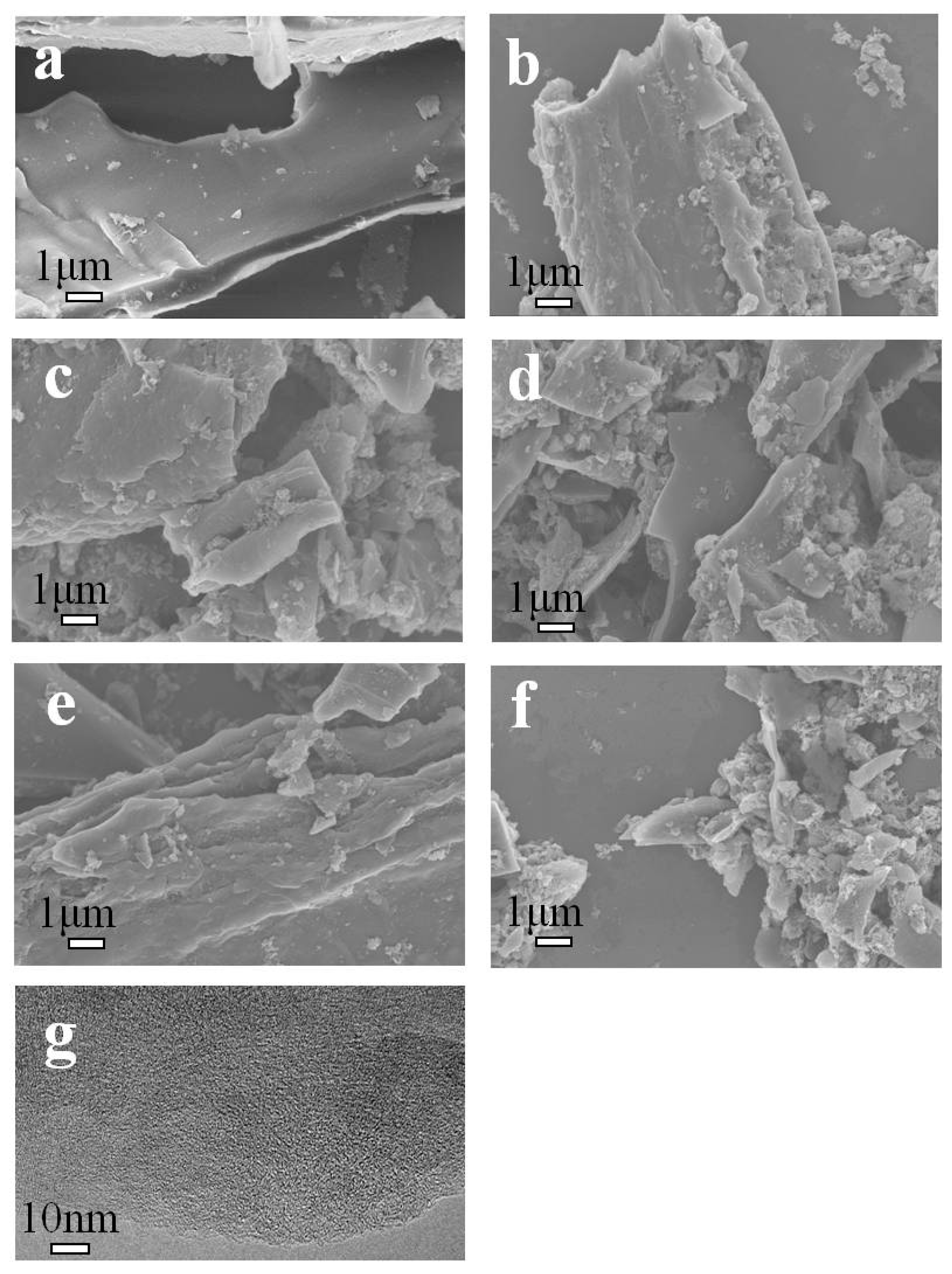
Figure 1. SEM of (a) LPC, (b) LPSP-650, (c) LPSP-700, (d) LPSP-750, (e) LPSP-800, (f) LPSP-850 and TEM of (g) LPSP-700.
Molecules 30 03990 g001
Figure 2. (a) XRD patterns and (b) Raman spectra of P-doped porous carbons.
Molecules 30 03990 g002
Figure 3. XPS P2p spectrum of (a) LPSP-650, (b) LPSP-700, (c) LPSP-750, (d) LPSP-800 and (e) LPSP-850.
Molecules 30 03990 g003
Figure 4. (a) N2 sorption isotherms and (b) pore size distribution of the samples prepared at different conditions. Filled and empty symbols in (a) represent adsorption and desorption branches, respectively.
Molecules 30 03990 g004
Figure 5. CO2 adsorption isotherms at (a) 25 °C and (b) 0 °C for P-doped LPSP porous carbons.
Molecules 30 03990 g005
Figure 6. Cumulative pore volume as a function of pore width for LPSP-T samples.
Molecules 30 03990 g006
Figure 7. Linear fitting of CO2 uptake at 298 K with (ad) pore volume for distinct pore sizes (0.98 nm, 1.69 nm, 2.02 nm, 3.97 nm).
Molecules 30 03990 g007
Figure 8. (a) CO2 and N2 isotherms of LPSP-700 at 25 °C and 1 bar, (b) adsorption kinetic of CO2 at 25 °C for LPSP-700, (c) Qst of CO2 adsorption on LPSP-T adsorbents derived from the experimental adsorption isotherms at 0 and 25 °C and (d) breakthrough plots of LPSP-700 (adsorption temperature: 25 °C, gas flow rate: 10 mL/min, inlet CO2 concentration: 10 vol.%, gas pressure: 1 bar).
Molecules 30 03990 g008
Figure 9. Cyclic study of CO2 adsorption for LPSP-700.
Molecules 30 03990 g009
Table 1. Porous properties, elemental compositions, and CO2 uptakes of precursors and sorbents derived from different conditions.
SampleSBET a
(m2/g)
V0 b
(cm3/g)
Vt c
(cm3/g)
Vn d
(cm3/g)
XPS (at. %)CO2 Uptake (mmol/g)
NCPO25 °C0 °C
LPC20.10--1.4978.510.5719.430.230.36
LPSP-6504180.310.150.251.4973.252.8422.422.373.07
LPSP-7005250.390.190.281.5873.062.9222.442.513.34
LPSP-7503410.320.120.261.4071.883.2823.432.383.17
LPSP-8002370.260.080.281.4672.422.4523.662.293.01
LPSP-8501320.190.040.281.3172.113.0923.492.182.63
a: Surface area was calculated using the BET method at P/P0 = 0.005-0.05. b: Total pore volume at P/P0= 0.99. c: Evaluated by the t-plot method. d: Pore volume of narrow micropores (<1 nm) obtained from the CO2 adsorption data at 0°C.
Disclaimer/Publisher’s Note: The statements, opinions and data contained in all publications are solely those of the individual author(s) and contributor(s) and not of MDPI and/or the editor(s). MDPI and/or the editor(s) disclaim responsibility for any injury to people or property resulting from any ideas, methods, instructions or products referred to in the content.