Abstract
Understanding intermolecular interactions is important for the design of deep eutectic solvents. Herein, potassium carbonate (K2CO3) and ethylene glycol (EG) are used to form deep eutectic solvents. The interactions between K2CO3 and EG are studied using nuclear magnetic resonance (NMR) and Fourier transform infrared (FTIR) spectra. Interestingly, the interaction results indicate that the carbonate anion can react with EG to form EG-based organic carbonate, which can occur even at room temperature. The possible reaction steps between K2CO3 and EG are presented. As K2CO3 can be prepared from CO2 and KOH, the findings of this work may provide a promising strategy for CO2 capture and conversion.
1. Introduction
Over the last few decades, deep eutectic solvents (DESs) have been developed and received a lot of attention mainly because of their advantageous characteristics, such as their low volatility, low flammability, simple preparation procedures, and structure tunability [1,2]. Generally, DESs are described as a kind of fluid consisting of at least two or more components, while they present lower melting points than each parent component [3,4]. To date, DESs can be classified into several types according to their components, and many DESs are prepared by mixing hydrogen bond donors (HBDs) and hydrogen bond acceptors (HBAs) [5,6,7,8]. Due to their attractive properties, the applications of DESs have been explored in many fields, including organic reactions, biomass treatment, separations and extractions, electrochemistry and batteries, and gas capture [9,10,11,12].
DESs based on potassium carbonate (K2CO3) are also explored mainly because K2CO3 is a common and cheap inorganic base with environmentally benign characteristics [13,14]. K2CO3-based DESs are already used in lignocellulose pretreatment, electrode material separation, supercapacitors, and gas separations [15,16,17,18,19,20,21,22]. Among these K2CO3-based DESs, K2CO3-EG DESs (EG: ethylene glycol) have received significant attention, as EG is also a cheap and renewable compound. The physiochemical properties of K2CO3-EG have been thoroughly investigated [14,22], and the interactions between K2CO3 and EG have been studied using theoretical calculations [16,19]. The theoretical results suggest that intermolecular hydrogen bonds formed between the -OH hydrogen of EG and the carbonate anion of K2CO3.
In this work, the interactions between K2CO3 and EG in DESs were further studied using NMR and FTIR spectra. Surprisingly, the NMR results reveal that the anion can react with EG to form EG-based carbonate species, which was not disclosed by the previous studies of K2CO3-EG DESs reported in the literature. The results can be found in the following sections.
2. Results and Discussion
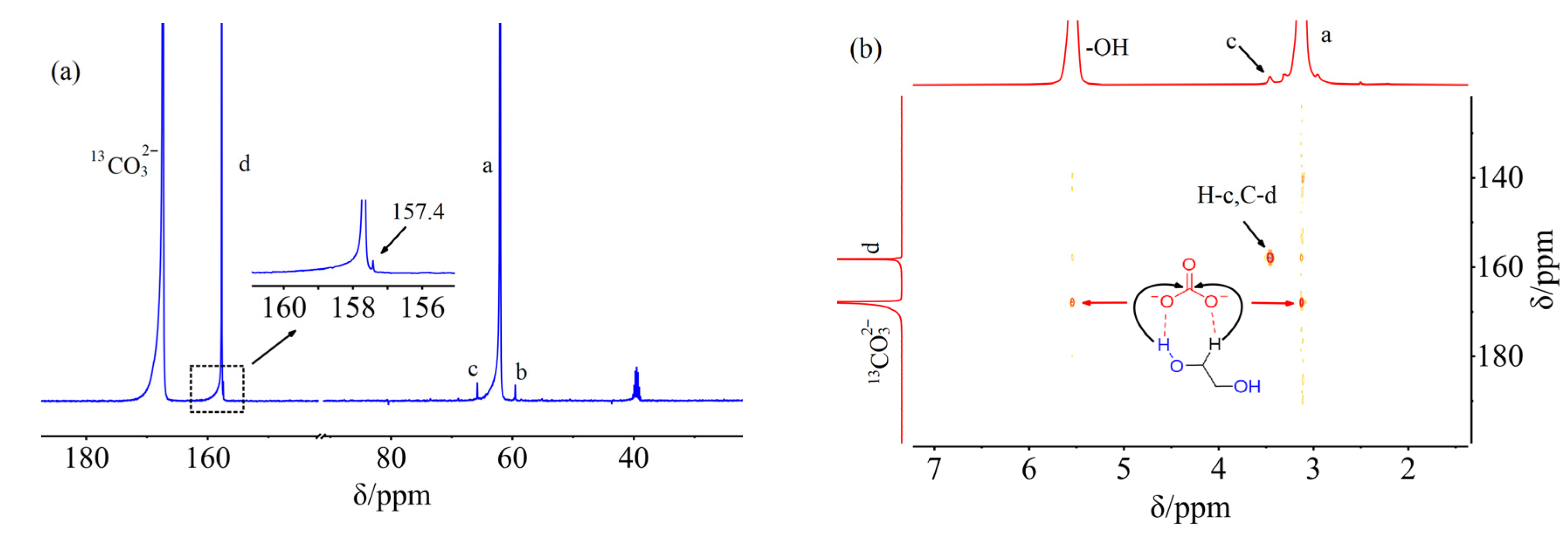
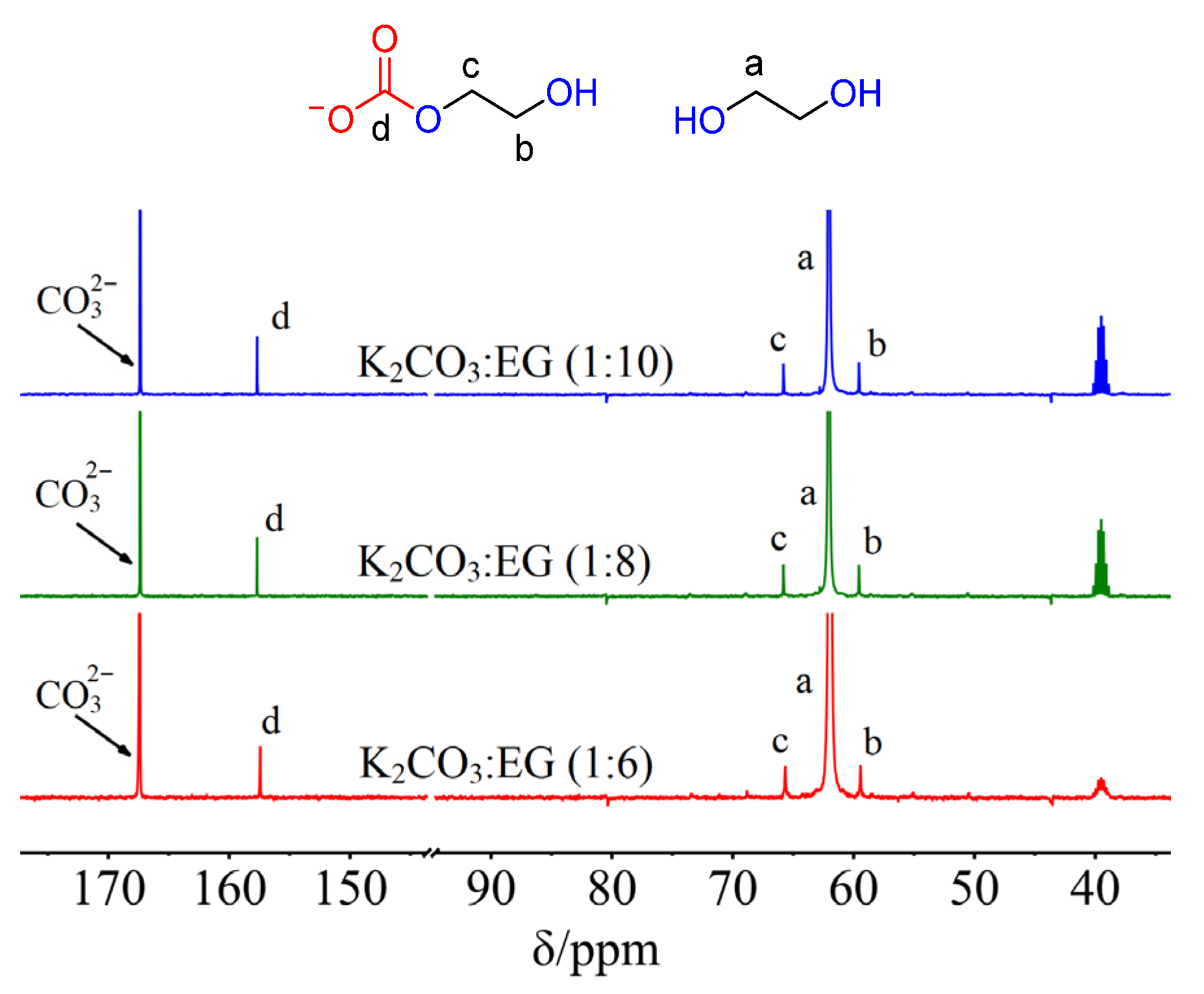
At first, three DESs K2CO3:EG (1:6), (1:8), and (1:10) were prepared. The 13C NMR spectra of these K2CO3-EG DESs were recorded using DMSO-d6 as an external solvent. Namely, the interactions between K2CO3 and EG were not disturbed by DMSO-d6. As shown in Figure 1, there are three new carbon peaks C-b, C-c, and C-d besides the carbon and -CH2- carbon (C-a) of EG for each K2CO3-EG used. The three new peaks can be found at 59.6 (C-b), 65.8 (C-c), and 157.7 (C-d) ppm for K2CO3:EG (1:8). The new peaks C-b and C-c are attributed to the -CH2- carbons of HO-CH2-CH2-O-COO− carbonate, and the peak C-d is attributed to the carbonyl carbon of HO-CH2-CH2-O-COO− [23,24,25]. The 13C NMR spectra of K213CO3:EG (1:8) were also investigated. As shown in Figure 2a, the carbon peaks C-b, C-c, and C-d can be observed. The C-d peak in K213CO3:EG (1:8) is significantly enhanced relative to that in K2CO3:EG (1:8), suggesting that C-d carbon comes from K213CO3. In other words, C-d carbon in K2CO3-EG DESs is from the carbon of K2CO3. Interestingly, there is another weak peak at 157.4 ppm (Figure 2a), which can be ascribed to the carbonyl carbon of the dianion −OOC-O-CH2-CH2-O-COO− [26]. This peak is not detected in K2CO3-EG systems, which may be due to its low concentration in K2CO3-EG DESs.
Figure 1.
The 13C NMR spectra of K2CO3-EG DESs. Letters a–d are labels of carbons of EG and EG-based carbonate.
Figure 2.
The 13C NMR (a) and 1H-13C HMBC (b) spectra of K213CO3:EG (1:8). Letters a–d are labels of carbons or hydrogens of EG and EG-based carbonate.
Furthermore, the 1H-13C HMBC spectra of K213CO3:EG (1:8) were recorded to demonstrate the interactions between K213CO3 and EG. As can be seen in Figure 2b, there is a cross-signal between H-c and C-d, confirming the formation of HO-CH2-CH2-O-13COO− carbonate. Moreover, the correlations between 13 carbon and the -OH proton or -CH2- proton can be found, suggesting that both the -OH proton and -CH2- proton in EG can form hydrogen bonds with the O atom of in K2CO3-EG DESs. However, the hydrogen bonds between the -CH2- proton and in K2CO3-EG DESs were not revealed in previous reports [16,19].
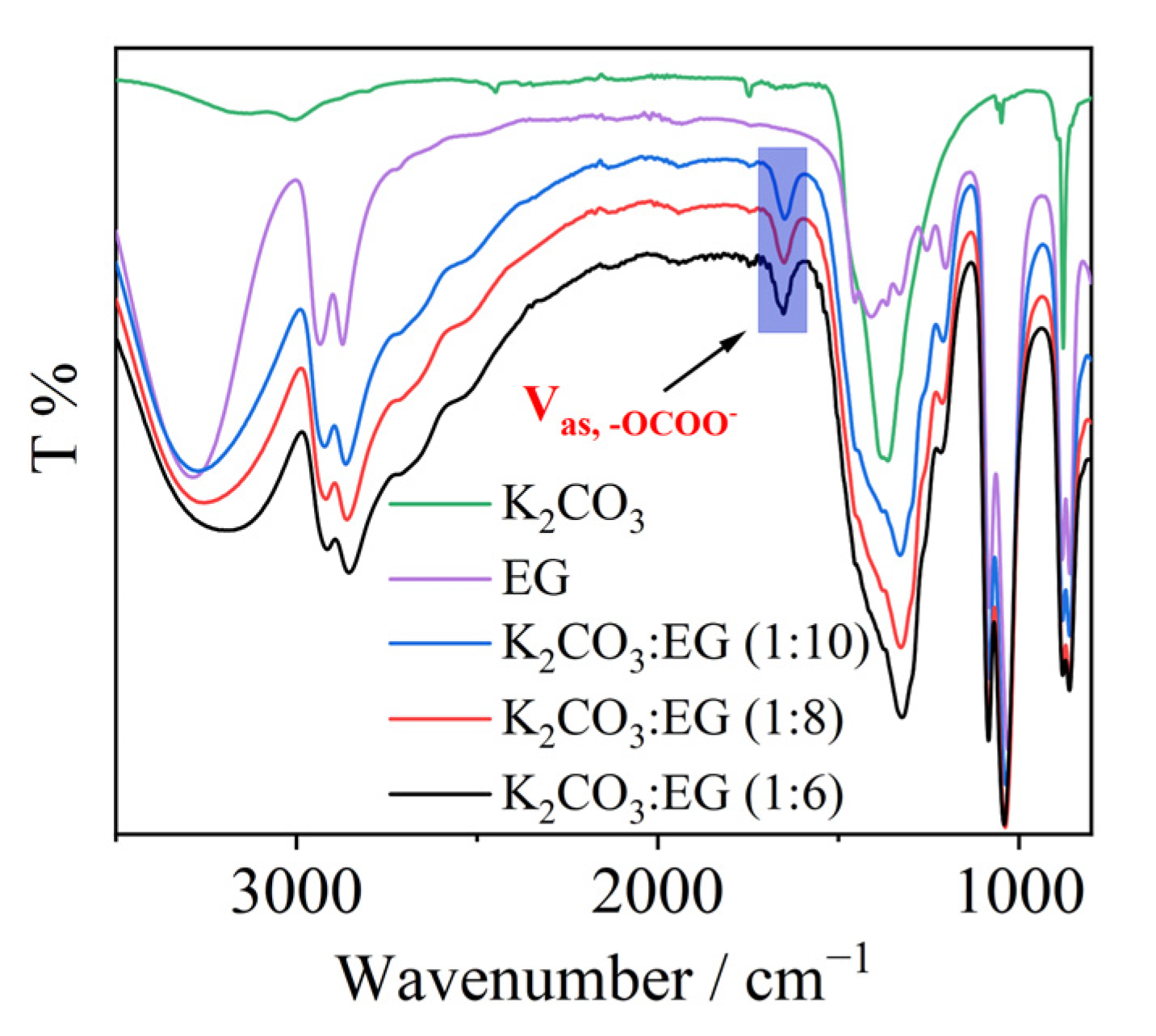
Figure 3 presents the FTIR spectra of K2CO3, EG, and K2CO3-EG used in this work. In comparison with the FTIR spectra of K2CO3 and EG, new bands can be observed at ~1650 cm−1 in the spectra of K2CO3-EG. The band at ~1650 cm−1 is ascribed to the C=O asymmetrical stretching mode of R-OCOO− [27,28]. The FTIR results again suggest the formation of EG-based carbonate. The new bands for K2CO3:EG (1:6), (1:8), and (1:10) are at 1653, 1651, and 1650 cm−1, respectively.
Figure 3.
The FTIR spectra of K2CO3, EG, and K2CO3-EG DESs.
Based on the above spectral results, the reaction between K2CO3 and EG can be elucidated, which may proceed in the following steps.
The overall reaction is shown in Equation (5).
As seen in Figure 2a, the formation of the dianion −OOC-O-CH2-CH2-O-COO− can be detected, so the reaction shown in Equation (6) can occur in K2CO3-EG DESs.
It is worth noting that the signal of the dianion −OOC-O-CH2-CH2-O-COO− is much weaker compared to that of HO-CH2-CH2-O-COO− in Figure 2a, i.e., the main product of the reaction between K2CO3 and EG is HO-CH2-CH2-O-COO−. Therefore, the main reaction between K2CO3 and EG can be represented by Equation (5). Moreover, the pH values of K2CO3:EG (1:6) and (1:8) were 12.73 and 13.2 at 30 °C [14], respectively, which implied the formation of the OH− anion in K2CO3-EG solvents and supported the reaction shown by Equations (5) and (6). The aforementioned results reveal that the reaction occurs between K2CO3 and EG, forming alcohol-based carbonates, suggesting that the reported theoretical calculations for the interactions between K2CO3 and EG are not accurate [16,19].
All the three DESs K2CO3:EG (1:6), (1:8), and (1:10) can be formed by heating K2CO3-EG mixtures at 80 °C and 1.0 atmosphere. It should be noted that K2CO3:EG (1:10) can also be easily prepared by mixing K2CO3 and EG at room temperature, and the peaks of EG-based carbonate can still be found in the NMR and FTIR spectra of K2CO3:EG (1:10) prepared at room temperature. In other words, the reaction between K2CO3 and EG could proceed at room temperature. Moreover, as we all know, K2CO3 is a common and cheap inorganic base, which can be produced through the reaction between KOH and CO2. Therefore, the findings of our work might be beneficial to developing new pathways for CO2 capture and conversion.
3. Materials and Methods
3.1. Materials and Characterizations
EG (99.5%) was purchased from J&K Scientific Ltd. (Beijing, China). K2CO3 and K213CO3 were obtained from Innochem (Beijing, China). EG was dried by a 4 Å molecular sieve prior to use, and K2CO3 and K213CO3 were dried by a vacuum pump. N2 (99.999%) was obtained from Beijing ZG Special Gases Sci. and Tech. Co., Ltd. (Beijing, China).
FTIR spectra were recorded on a Nicolet 6700 spectrometer (Waltham, MA, USA) with an attenuated total reflection (ATR) accessory. 1H NMR (400 MHz) and 13C NMR (100.6 MHz) spectra were obtained on a Bruker spectrometer (Bruker Biospin, Karlsruhe, Germany) and DMSO-d6 was used as the reference.
3.2. Synthesis of DESs
Each K2CO3-EG DES was prepared by mixing K2CO3 and EG at the desired molar ratio in a round flask (10 mL) under N2 atmosphere, and the mixture was stirred at 80 °C until a homogenous solution was formed.
For K2CO3:EG (1:10) DESs, they can also be obtained by stirring K2CO3 and EG at room temperature.
3.3. NMR and FTIR Data
NMR data:
K2CO3:EG (1:6): 13C NMR (100.6 MHz, DMSO-d6, ppm) δ = 59.4, 61.9, 65.7, 157.4, 167.4.
K2CO3:EG (1:8): 13C NMR (100.6 MHz, DMSO-d6, ppm) δ = 59.6, 62.1, 65.8, 157.7, 167.4.
K2CO3:EG (1:10): 13C NMR (100.6 MHz, DMSO-d6, ppm) δ = 59.6, 62.8, 65.8, 157.7, 167.4.
FTIR data:
K2CO3:EG (1:6): 3188, 2915, 2855, 1653, 1324, 1085, 1041, 880, 861, 516 cm−1.
K2CO3:EG (1:8): 3256, 2918, 2861, 1651, 1328, 1084, 1039, 880, 860, 515 cm−1.
K2CO3:EG (1:10): 3273, 2923, 2864, 1650, 1329, 1083, 1037, 880, 860, 514 cm−1.
4. Conclusions
In summary, K2CO3 can react with EG in K2CO3-EG DESs, resulting in the formation of EG-based organic carbonate HO-CH2-CH2-O-COO− as the main product, and the reaction can occur at room temperature. The HMBC NMR results disclose that both the -OH and -CH2- hydrogens form hydrogen bonds with the O atom of K2CO3. The transformation of carbon from K2CO3 to EG might bring valuable information for the development of CO2 capture and conversion technologies.
Author Contributions
Conceptualization, D.Y. and X.D.; methodology, D.Y. and X.D.; investigation, Y.Z., M.C., D.Y. and X.D.; formal analysis, Y.Z., M.C., D.Y. and X.D.; data curation, Y.Z. and M.C.; writing—original draft preparation, D.Y. and X.D.; writing—review and editing, D.Y. and X.D.; supervision, D.Y.; funding acquisition, D.Y. All authors have read and agreed to the published version of the manuscript.
Funding
The authors gratefully thank the funding support by the National Natural Science Foundation of China (No. 21503196) and Fundamental Research Funds for the Central Universities (Nos. 265QZ2022003 and 2652019111).
Institutional Review Board Statement
Not applicable.
Informed Consent Statement
Not applicable.
Data Availability Statement
The data used in this work are available on request from the corresponding authors.
Conflicts of Interest
The authors declare no conflicts of interest.
References
- Hansen, B.B.; Spittle, S.; Chen, B.; Poe, D.; Zhang, Y.; Klein, J.M.; Horton, A.; Adhikari, L.; Zelovich, T.; Doherty, B.W.; et al. Deep Eutectic Solvents: A Review of Fundamentals and Applications. Chem. Rev. 2021, 121, 1232–1285. [Google Scholar] [CrossRef]
- Omar, K.A.; Sadeghi, R. Database of deep eutectic solvents and their physical properties: A review. J. Mol. Liq. 2023, 384, 121899. [Google Scholar] [CrossRef]
- Yu, D.; Xue, Z.; Mu, T. Deep eutectic solvents as a green toolbox for synthesis. Cell Rep. Phys. Sci. 2022, 3, 100809. [Google Scholar] [CrossRef]
- Oyoun, F.; Toncheva, A.; Henríquez, L.C.; Grougnet, R.; Laoutid, F.; Mignet, N.; Alhareth, K.; Corvis, Y. Deep Eutectic Solvents: An Eco-friendly Design for Drug Engineering. ChemSusChem 2023, 16, e202300669. [Google Scholar] [CrossRef]
- Verma, S.; Saini, K.; Maken, S. Deep eutectic solvents: A long–term approach to chemical synthesis and separation. J. Mol. Liq. 2024, 393, 123605. [Google Scholar] [CrossRef]
- Makoś-Chełstowska, P. VOCs absorption from gas streams using deep eutectic solvents—A review. J. Hazard. Mater. 2023, 448, 130957. [Google Scholar] [CrossRef]
- Wang, Y.; Ren, S.; Hou, Y.; Zhang, Y.; Li, Y.; Zhang, W.; Wu, W. Capture and Catalytic Reduction of SO2 with H2 to Elemental Sulfur by Novel Guanidinium-Based Deep Eutectic Solvents. Ind. Eng. Chem. Res. 2023, 62, 14568–14576. [Google Scholar] [CrossRef]
- Wang, Y.; Zhang, W.; Ren, S.; Hou, Y.; Wu, W. Rapid Absorption and Desorption of CO2 by Deep Eutectic Solvents via Reversible CO2-Triggered Proton Transfer Process. ACS Sustain. Chem. Eng. 2024, 12, 3987–3995. [Google Scholar] [CrossRef]
- Deng, R.; Gao, M.; Zhang, B.; Zhang, Q. Solvent-Mediated Synthesis of Functional Powder Materials from Deep Eutectic Solvents for Energy Storage and Conversion: A Review. Adv. Energy Mater. 2024, 14, 2303707. [Google Scholar] [CrossRef]
- Cherniakova, M.; Varchenko, V.; Belikov, K. Menthol-Based (Deep) Eutectic Solvents: A Review on Properties and Application in Extraction. Chem. Rec. 2024, 24, e202300267. [Google Scholar] [CrossRef] [PubMed]
- Wang, J.; Lyu, Y.; Zeng, R.; Zhang, S.; Davey, K.; Mao, J.; Guo, Z. Green recycling of spent Li-ion battery cathodes via deep-eutectic solvents. Energy Environ. Sci. 2024, 17, 867–884. [Google Scholar] [CrossRef]
- Singh, K.; Mehra, S.; Kumar, A. Recent advances in catalytic conversion of lignin to value-added chemicals using ionic liquids and deep eutectic solvents: A critical review. Green Chem. 2024, 26, 1062–1091. [Google Scholar] [CrossRef]
- Naser, J.; Jibril, F.M.B.; Al-Hatmi, S.; Gano, Z. Potassium Carbonate as a Salt for Deep Eutectic Solvents. Int. J. Chem. Eng. Appl. 2013, 4, 114–118. [Google Scholar] [CrossRef]
- Mjalli, F.S.; Naser, J.; Jibril, B.; Al-Hatmi, S.S.; Gano, Z.S. Ionic liquids analogues based on potassium carbonate. Thermochim. Acta 2014, 575, 135–143. [Google Scholar] [CrossRef]
- Suopajärvi, T.; Ricci, P.; Karvonen, V.; Ottolina, G.; Liimatainen, H. Acidic and alkaline deep eutectic solvents in delignification and nanofibrillation of corn stalk, wheat straw, and rapeseed stem residues. Ind. Crops Prod. 2020, 145, 111956. [Google Scholar] [CrossRef]
- Ghaedi, H.; Kalhor, P.; Zhao, M.; Clough, P.T.; Anthony, E.J.; Fennell, P.S. Potassium carbonate-based ternary transition temperature mixture (deep eutectic analogues) for CO2 absorption: Characterizations and DFT analysis. Front. Environ. Sci. Eng. 2021, 16, 92. [Google Scholar] [CrossRef]
- Saeed, U.; Khan, A.U.; Khan, A.L.; Gilani, M.A.; Bilad, M.R. Separation of Carbon Dioxide by Potassium Carbonate based Supported Deep Eutectic Liquid Membranes: Influence of Hydrogen Bond Donor. J. Membr. Sci. Res. 2022, 8, 526587. [Google Scholar]
- Olalere, O.A.; Gan, C.-Y. Process optimisation of defatted wheat germ protein extraction in a novel alkaline-based deep eutectic solvent (DES) via Box–Behnken experimental design (BBD). Food Chem. 2023, 409, 135224. [Google Scholar] [CrossRef]
- Zeng, P.; Wu, D.; Wang, T.; Liu, P.; Jia, D. Redefine the existence form and function of water in potassium carbonate-based deep eutectic electrolyte. Fuel 2024, 357, 129738. [Google Scholar] [CrossRef]
- Zhu, Y.; Yang, T.-X.; Qi, B.-K.; Li, H.; Zhao, Q.-S.; Zhao, B. Acidic and alkaline deep eutectic solvents (DESs) pretreatment of grapevine: Component analysis, characterization, lignin structural analysis, and antioxidant properties. Int. J. Biol. Macromol. 2023, 236, 123977. [Google Scholar] [CrossRef]
- Hua, Y.; Xu, Z.; Zhao, B.; Zhang, Z. Efficient separation of electrode active materials and current collector metal foils from spent lithium-ion batteries by a green deep eutectic solvent. Green Chem. 2022, 24, 8131–8141. [Google Scholar] [CrossRef]
- Ghaedi, H.; Ayoub, M.; Sufian, S.; Shariff, A.M.; Lal, B.; Wilfred, C.D. Density and refractive index measurements of transition-temperature mixture (deep eutectic analogues) based on potassium carbonate with dual hydrogen bond donors for CO2 capture. J. Chem. Thermodyn. 2018, 118, 147–158. [Google Scholar] [CrossRef]
- Cui, G.; Lv, M.; Yang, D. Efficient CO2 absorption by azolide-based deep eutectic solvents. Chem. Commun. 2019, 55, 1426–1429. [Google Scholar] [CrossRef]
- Nie, M.-N.; Wang, Z.; Niu, Q.-H.; Dai, J.-X.; Wang, Q.-Q.; Peng, J.-S.; Ji, P. Acidity Scale in a Choline Chloride- and Ethylene Glycol-Based Deep Eutectic Solvent and Its Implication on Carbon Dioxide Absorption. J. Org. Chem. 2023, 88, 5368–5376. [Google Scholar] [CrossRef]
- Sen, R.; Goeppert, A.; Kar, S.; Prakash, G.K.S. Hydroxide Based Integrated CO2 Capture from Air and Conversion to Methanol. J. Am. Chem. Soc. 2020, 142, 4544–4549. [Google Scholar] [CrossRef] [PubMed]
- Xie, H.; Yu, X.; Yang, Y.; Zhao, Z.K. Capturing CO2 for cellulose dissolution. Green Chem. 2014, 16, 2422–2427. [Google Scholar] [CrossRef]
- Im, J.; Hong, S.Y.; Cheon, Y.; Lee, J.; Lee, J.S.; Kim, H.S.; Cheong, M.; Park, H. Steric hindrance-induced zwitterionic carbonates from alkanolamines and CO2: Highly efficient CO2 absorbents. Energy Environ. Sci. 2011, 4, 4284–4289. [Google Scholar] [CrossRef]
- Wang, Z.; Wu, C.; Wang, Z.; Zhang, S.; Yang, D. CO2 capture by 1,2,3-triazole-based deep eutectic solvents: The unexpected role of hydrogen bonds. Chem. Commun. 2022, 58, 7376–7379. [Google Scholar] [CrossRef]
Disclaimer/Publisher’s Note: The statements, opinions and data contained in all publications are solely those of the individual author(s) and contributor(s) and not of MDPI and/or the editor(s). MDPI and/or the editor(s) disclaim responsibility for any injury to people or property resulting from any ideas, methods, instructions or products referred to in the content. |
© 2024 by the authors. Licensee MDPI, Basel, Switzerland. This article is an open access article distributed under the terms and conditions of the Creative Commons Attribution (CC BY) license (https://creativecommons.org/licenses/by/4.0/).