Review

NMR Metabolomics Applied on the Discrimination of Variables Influencing Tomato (Solanum lycopersicum)

by
Ana Cristina Abreu
and
Ignacio Fernández
*
Department of Chemistry and Physics, Research Centre CIAIMBITAL, University of Almería, Ctra. Sacramento, 04120 Almería, Spain
*
Author to whom correspondence should be addressed.
Molecules 2020, 25(16), 3738; https://doi.org/10.3390/molecules25163738

Submission received: 30 July 2020 / Revised: 13 August 2020 / Accepted: 15 August 2020 / Published: 16 August 2020
(This article belongs to the Special Issue NMR-Based Metabolomics)

Abstract

Tomato composition and nutritional value are attracting increasing attention and interest from both consumers and producers. The interest in enhancing fruits’ quality with respect to beneficious nutrients and flavor/aroma components is based not only in their economic added value but also in their implications involving organoleptic and healthy properties and has generated considerable research interest among nutraceutical and horticultural industries. The present article reviews up to March 2020 some of the most relevant studies based on the application of NMR coupled to multivariate statistical analysis that have addressed the investigation on tomato (Solanum lycopersicum). Specifically, the NMR untargeted technique in the agri-food sector can generate comprehensive data on metabolic networks and is paving the way towards the understanding of variables affecting tomato crops and composition such as origin, variety, salt-water irrigation, cultivation techniques, stage of development, among many others. Such knowledge is helpful to improve fruit quality through cultural practices that divert the metabolism towards the desired pathways and, probably more importantly, drives further efforts towards the differentiation of those crops developed under controlled and desired agronomical conditions.
Keywords: NMR metabolomics; multivariate data analysis; chemometrics; tomato; Solanum lycopersicum NMR metabolomics; multivariate data analysis; chemometrics; tomato; Solanum lycopersicum
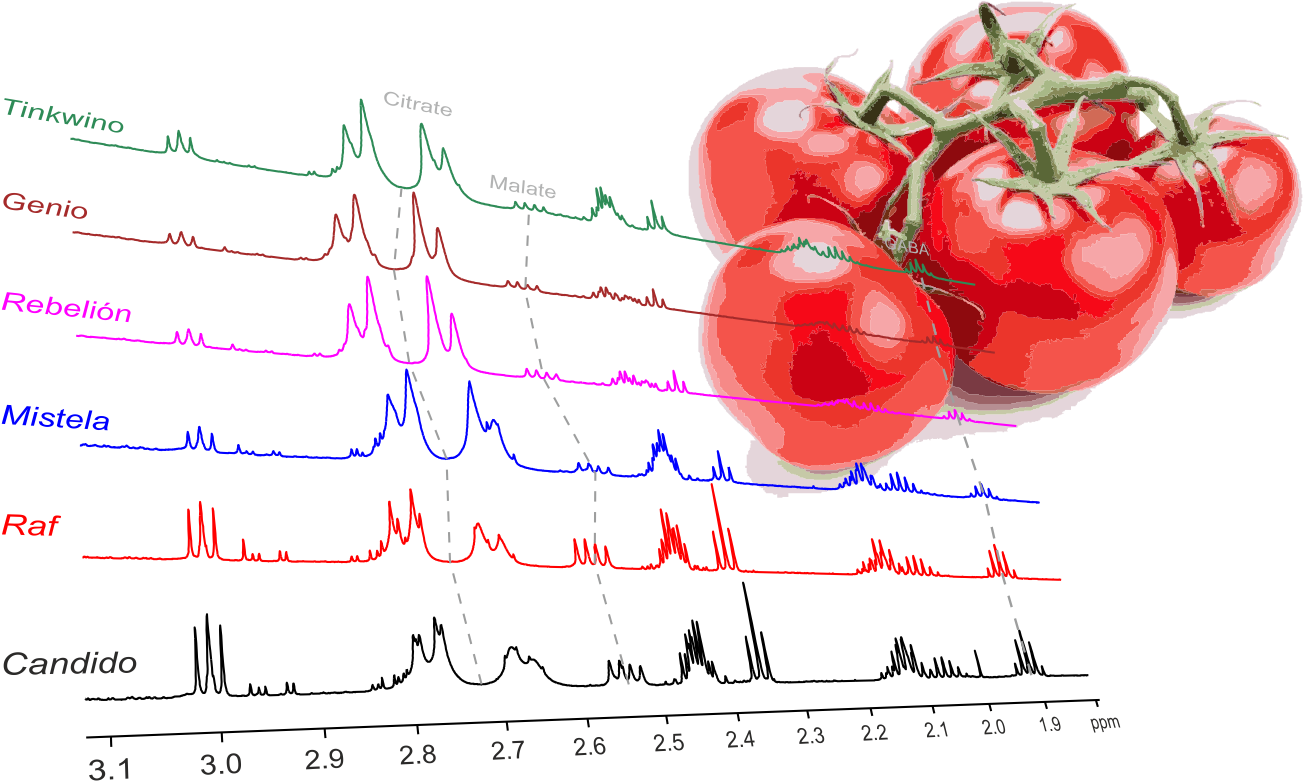
Graphical Abstract