Article

Detrended Cross-Correlations and Their Random Matrix Limit: An Example from the Cryptocurrency Market


1
Complex Systems Theory Department, Institute of Nuclear Physics, Polish Academy of Sciences, ul. Radzikowskiego 152, 31-342 Kraków, Poland
2
Faculty of Computer Science and Mathematics, Cracow University of Technology, ul. Warszawska 24, 31-155 Kraków, Poland
3
Department of Mathematics, University of the National Education Commission, Podchorążych 2, 30-084 Kraków, Poland
*
Authors to whom correspondence should be addressed.
Entropy 2025, 27(12), 1236; https://doi.org/10.3390/e27121236
Submission received: 19 November 2025 / Revised: 3 December 2025 / Accepted: 4 December 2025 / Published: 6 December 2025
(This article belongs to the Special Issue Entropy, Econophysics, and Complexity)

Abstract

Correlations in complex systems are often obscured by nonstationarity, long-range memory, and heavy-tailed fluctuations, which limit the usefulness of traditional covariance-based analyses. To address these challenges, we construct scale- and fluctuation-dependent correlation matrices using the multifractal detrended cross-correlation coefficient ρ r that selectively emphasizes fluctuations of different amplitudes. We examine the spectral properties of these detrended correlation matrices and compare them to the spectral properties of the matrices calculated in the same way from synthetic Gaussian and q-Gaussian signals. Our results show that detrending, heavy tails, and the fluctuation-order parameter r jointly produce spectra, which substantially depart from the random case even under the absence of cross-correlations in time series. Applying this framework to one-minute returns of 140 major cryptocurrencies from 2021 to 2024 reveals robust collective modes, including a dominant market factor and several sectoral components whose strength depends on the analyzed scale and fluctuation order. After filtering out the market mode, the empirical eigenvalue bulk aligns closely with the limit of random detrended cross-correlations, enabling clear identification of structurally significant outliers. Overall, the study provides a refined spectral baseline for detrended cross-correlations and offers a promising tool for distinguishing genuine interdependencies from noise in complex, nonstationary, heavy-tailed systems.

1. Introduction

Correlations among complex systems’ components play a central role in understanding their collective dynamics [1]. In fields ranging from finance [2,3,4], climatology [5,6,7,8], molecular and biological systems [9,10], neuroscience [11,12,13], and physics [14], correlation matrices serve as key tools for quantifying interdependencies between multivariate time series. However, the presence of nonstationarities and long-range dependencies in empirical data often leads to spurious correlations, challenging traditional covariance-based analyses [15,16,17]. To address these issues, detrended cross-correlation analysis (DCCA) [18] and its generalizations [19,20,21] have been developed as robust methods for quantifying power-law cross-correlations between nonstationary signals.
Correlation analysis-based methods are widely used in financial markets. They have been successfully applied to stock markets [22,23,24,25,26,27,28,29], forex [30,31,32,33,34], cryptocurrencies [35,36,37,38,39,40,41,42,43,44], and even NFT tokens [45]. These methods are useful in trading, risk management and portfolio optimization [40,41,46,47,48,49,50,51].
In this work, we study the spectral properties of matrices constructed from detrended cross-correlation coefficients ρ r (also denoted in the literature as ρ q ) , which generalize the detrended cross-correlation coefficient ρ DCCA [21], which is an equivalent of the Pearson cross-correlation for the detrended fluctuation analysis [52]. Each element of the resulting matrix captures the scale-dependent correlation between detrended fluctuations of two time series, controlled by the parameter r that governs sensitivity to fluctuation amplitudes. This approach allows us to explore interdependencies in systems characterized by heterogeneous scaling behaviors or multifractality, going beyond the scope of linear correlation measures.
Our primary interest lies in the eigenvalue spectra of such detrended correlation matrices. In conventional correlation matrix theory, the Marčenko–Pastur (M-P) distribution provides the null hypothesis for the eigenvalue density when entries are independent and identically distributed random variables, i.e., when no genuine correlations are present [53]. However, when matrix elements are derived from detrended cross-correlations, the statistical structure may differ substantially from that assumed by the M-P framework. The detrending procedure introduces scale-dependent filtering and residual cross-structure even under nominally uncorrelated conditions. Consequently, the classical random matrix limit cannot be directly applied as a baseline for identifying significant correlations.
We therefore investigate the eigenvalue spectra of the detrended correlation matrices, constructed from the ensemble of synthetic time series representing Gaussian and q-Gaussian models [54]. We aim to characterize how detrending and fluctuation-based weighting modify the spectral density and the onset of collective modes. The results provide insights into the appropriate null hypotheses for spectral analysis of detrended correlations and offer a refined framework for distinguishing genuine collective behavior from stochastic background fluctuations in complex systems.
As a practical application of this formalism, we analyze a representative set of the most liquid 140 cryptocurrencies from the Binance exchange [55]. The cryptocurrency market provides a particularly suitable testing ground for detrended correlation analysis due to its pronounced nonstationarity, strong cross-dependencies, and heterogeneity in trading activity and capitalization [56]. Price series of digital assets exhibit complex temporal structures, including volatility clustering [57,58,59,60,61,62,63,64] and multifractal scaling [65,66,67,68,69,70,71,72], which render standard correlation measures inadequate. Their price changes are also susceptible to external influences from other financial markets [58,73,74,75,76,77,78,79,80], as well as geopolitical shocks [81,82,83,84] or social media impact [85,86].
By constructing the detrended correlation matrix ρ r ( s ) from the ρ r ( s ) coefficients computed across multiple time scales s, we are able to probe the underlying architecture of interdependencies among these assets while suppressing the influence of global trends and nonstationary effects. Examination of the eigenvalue spectra reveals the presence of collective modes associated with market-wide behavior, sectoral groupings, and noise-dominated components. Comparing these empirical spectra with the corresponding limits derived for uncorrelated signals allows us to identify statistically significant deviations indicative of genuine market structure. This approach thus offers a refined spectral perspective on the collective dynamics and information flow within the cryptocurrency market.

2. Methods

2.1. Detrended Cross-Correlations

We start from a set of time series: U i = { u i ( j ) } j = 1 T with i = 1 , , N . For each time series, a corresponding signal profile is constructed by integrating the data along the time axis,
u ¯ i ( k ) = j = 1 k u i ( j ) , k = 1 , , T .
Next, for a given scale s, this signal profile is divided into 2 M s non-overlapping windows of width s starting from both ends of the time series, and, subsequently, it is detrended by best-fitting a polynomial P ν ( m ) of order m in each window ν individually,
x i ( s ν + k ) = u ¯ i ( s ν + k ) P ν ( m ) ( k ) , k = 1 , , s , ν = 0 , , 2 M s 1 .
By proceeding along this way with all time series, we obtain a set of the detrended time series X i , where i = 1 , , N , that will be subject to further analysis. Signal covariance is then calculated in each window,
f i j 2 ( s , ν ) = 1 s k = 1 s x i ( s ν + k ) x j ( s ν + k ) , i , j = 1 , , N ,
which becomes variance if i = j . In order to allow for a multiscale analysis, a parameter r R is introduced and a family of bivariate r-fluctuation functions is introduced,
F i j r ( s ) = 1 2 M s ν = 0 2 M s 1 sign [ f i j 2 ( s , ν ) ] | f i j 2 ( s , ν ) | r / 2 ,
where the sign of each covariance is preserved while the modulus allows us to avoid complex values if f i j 2 ( s , ν ) < 0 and r / 2 is not an integer [87]. These functions become univariate if i = j . Based on Equation (4), it is possible to define an r-dependent detrended cross-correlation coefficient [52],
ρ r i j ( s ) = F i j r ( s ) F i i r ( s ) F j j r ( s ) ,
whose values 1 ρ r i j ( s ) 1 have a similar interpretation as the Pearson cross-correlation coefficient in the case of r > 0 . However, by considering different values of r, we are able to focus on the cross-correlations among specific ranges of fluctuation amplitudes: large-amplitude fluctuation contribution is amplified if r > 2 and small-amplitude fluctuation contribution is amplified if r < 2 .
For a given set of time series, the coefficient ρ r i j ( s ) is symmetric with respect to time series order, and it can be calculated for all pairs ( i , j ) with j = i + 1 , , N . An r-dependent detrended cross-correlation matrix is then constructed as
ρ r ( s ) = [ ρ r i j ( s ) ] i , j = 1 N .
The whole procedure from the detrending step to the matrix construction can be repeated for different scales s in some range s min s s max .

2.2. Spectral Characteristics of the Detrended Cross-Correlation Matrix

Spectral properties of ρ r can be determined by solving the eigenvalue problem
ρ r ( s ) v i ( s ) = λ i ( s ) v i ( s ) , i = 1 , . . . , N ,
where the ordering is such that λ 1 λ 2 λ N . While the eigenvalues of ρ r are real-valued owing to the symmetry of the matrix, this matrix is not necessarily positive semi-definite. First, let us look at the simplest case of r = 2 and construct a matrix of the fluctuation functions (4) for all pairs of the time series,
F 2 ( s ) = 1 M s ν f 2 ( s , ν ) = 1 M s ν 1 s X ν T ( s ) X ν ( s ) = 1 T X T ( s ) X ( s ) ,
where X ν is a data matrix created from all time series in a window ν and X is an analogous data matrix for the whole time series (to simplify notation, we assume that their length T is a multiple of s). A dependence of X on scale s comes from the fact that detrending a signal with a polynomial of a given degree leaves more trend in the residual signal the larger the scale s is. Since it can be expressed as the product X T X , the matrix F 2 is positive semi-definite.
Now, let us consider the case of r = 2 n , n N , in which
F 2 n ( s ) = 1 M s ν f 2 ( s , ν ) n = 1 M s ν 1 s n X ν T ( s ) X ν ( s ) n ,
where [ · ] n denotes the Hadamard product of n matrices · (i.e., their element-wise multiplication). It can be shown that this operation preserves the property of positive semi-definiteness (the Schur theorem [88]). A sum of matrices preserves the positive semidefiniteness of the components; therefore, there exists a matrix X ˜ ( s ) such that
F 2 n ( s ) = 1 s n M s X ˜ T ( s ) X ˜ ( s ) .
This is generally not true for r 2 n , however. If this is the case, a condition r / 2 N 2 must hold to guarantee positive semi-definiteness of F r ( s ) as stated by the FitzGerald-Horn theorem [89]. Otherwise, this matrix may have negative eigenvalues. When they are negative indeed and when the whole spectrum is non-negative is a delicate question: typically, the smaller r is (especially if r < 1 ), the larger the probability that some eigenvalues fall below 0. The opposite is true if r increases and, eventually, the matrix enters the r / 2 N 2 region. Finally, based on Equation (5), we arrive at the conclusion that ρ r ( s ) is positive semi-definite if F r ( s ) reveals this property.

2.3. Random Matrix Limit and Departures

The property of positive semi-definiteness of ρ r ( s ) is important from the statistical point of view, because we may then ask a question: How is a given matrix related to the Wishart ensemble of random correlation matrices W [90]. In the absence of genuine cross-correlations in X , this relation is straightforward for r = 2 , because the structure of F 2 ( s ) is in this situation similar to the structure of a Pearson correlation matrix. However, for r 2 , the matrix structure of ρ r ( s ) requires applying different random matrix ensembles.
If the Wishart case is valid, there is a well-defined distribution of eigenvalues of a matrix constructed for a set of uncorrelated Gaussian-distributed time series in the thermodynamical limit N , T , T / N = Q = const (the Marčenko–Pastur distribution [53]),
ϕ W ( λ ) = 1 2 π Q λ ( λ max λ ) ( λ λ min ) , λ min λ λ max ,
where λ min = ( 1 Q ) 2 and λ max = ( 1 + Q ) 2 .
In the case of detrended correlations considered here, however, some deviations from the M-P distribution may arise even for random series due to detrending of fluctuations [16]. The space for such deviations increases with increasing the range of detrending (longer scale s). To obtain appropriate null hypotheses for the empirical correlations under consideration, in the absence of analytical formulas for the eigenvalue distributions of correlation matrices constructed in such a generalized manner, numerical simulations are necessary. Therefore, such simulated eigenvalue distributions will be conducted in parallel to such analyses for the empirical data.
Another factor that, in the presence of detrending, may lead to further modification of the above characteristics is the fluctuation distributions of the analyzed time series. Distributions of fluctuations of time series representing many natural phenomena develop thicker tails than the ones obeying the normal distribution. For instance, the distributions of fluctuations in financial rates of return on short time scales quite universally [91] satisfy the so-called inverse-cubic power law [92] and this applies even to the cryptocurrency markets [35,93,94]. Such distributions are quite efficiently described by functions called q-Gaussian [95].

2.4. q-Gaussian Distribution

In general, q-Gaussian distributions provide a highly practical analytical framework for modeling the corresponding probability distributions. They constitute a natural extension of the standard Gaussian distribution in analogy to how the Tsallis entropy S q extends the classical Boltzmann-Gibbs entropy S [54,96]. This class of distributions G q is characterized by two parameters: a shape parameter q ( , 3 ) and a scale (width) parameter β > 0 . The corresponding probability density function (PDF) assumes the form [54]
ϕ q ( x ) = β C q e q ( β x 2 ) ,
where e q ( x ) denotes the q-exponential function
e q ( x ) = ( 1 + ( 1 q ) x ) 1 / ( 1 q ) if q 1 and 1 + ( 1 q ) x > 0 0 if q 1 and 1 + ( 1 q ) x 0 e x if q = 1 ,
and C q = e q ( x 2 ) , d x is a normalization constant.
Asymptotic behavior at large | x | of a q-Gaussian for q = 3 / 2 then corresponds to the inverse-cubic power law [97].

2.5. Outlying Eigenvalues and Collectivity

The above considerations concern a set of independently generated random time series, within and between which there are no synchronous correlations. However, the essence of real, natural complex systems is the coexistence of randomness with collective synchronous effects. For fundamental and practical reasons, the latter are, of course, the primary object of interest. Within the general formalism of correlation matrices, such effects manifest themselves in significant deviations from the spectrum of eigenvalues assumed by the appropriate null hypothesis as indicated above. More specifically [98,99,100], when coherent or collective behavior arises, it effectively reduces the rank of the correlation matrix: a small number of dominant modes capture most of the system’s variance, while the remaining degrees of freedom behave as random noise. This reduced rank is reflected in the presence of a few large eigenvalues that stand well above the random matrix bounds, separating them from the random bulk of the spectrum. Such spectral segregation reveals the emergence of collective dynamics and the formation of correlated groups or patterns within the system. In this way, deviations from full-rank randomness—i.e., the appearance of a low effective rank—serve as a quantitative signature of collective effects and organized structure emerging from an otherwise random background.

3. Data

The empirical dataset consists of N = 140 exchange rates for the most actively traded cryptocurrencies, quoted in USDT on the Binance exchange [55]. It covers the period from 1 January 2021 to 30 September 2024, with data publicly available in an open repository [101]. The time series were recorded at a 1 min sampling frequency and transformed into logarithmic returns R ( t k ) = ln p ( t k + 1 ) ln p ( t k ) , where k = 1 , , T .
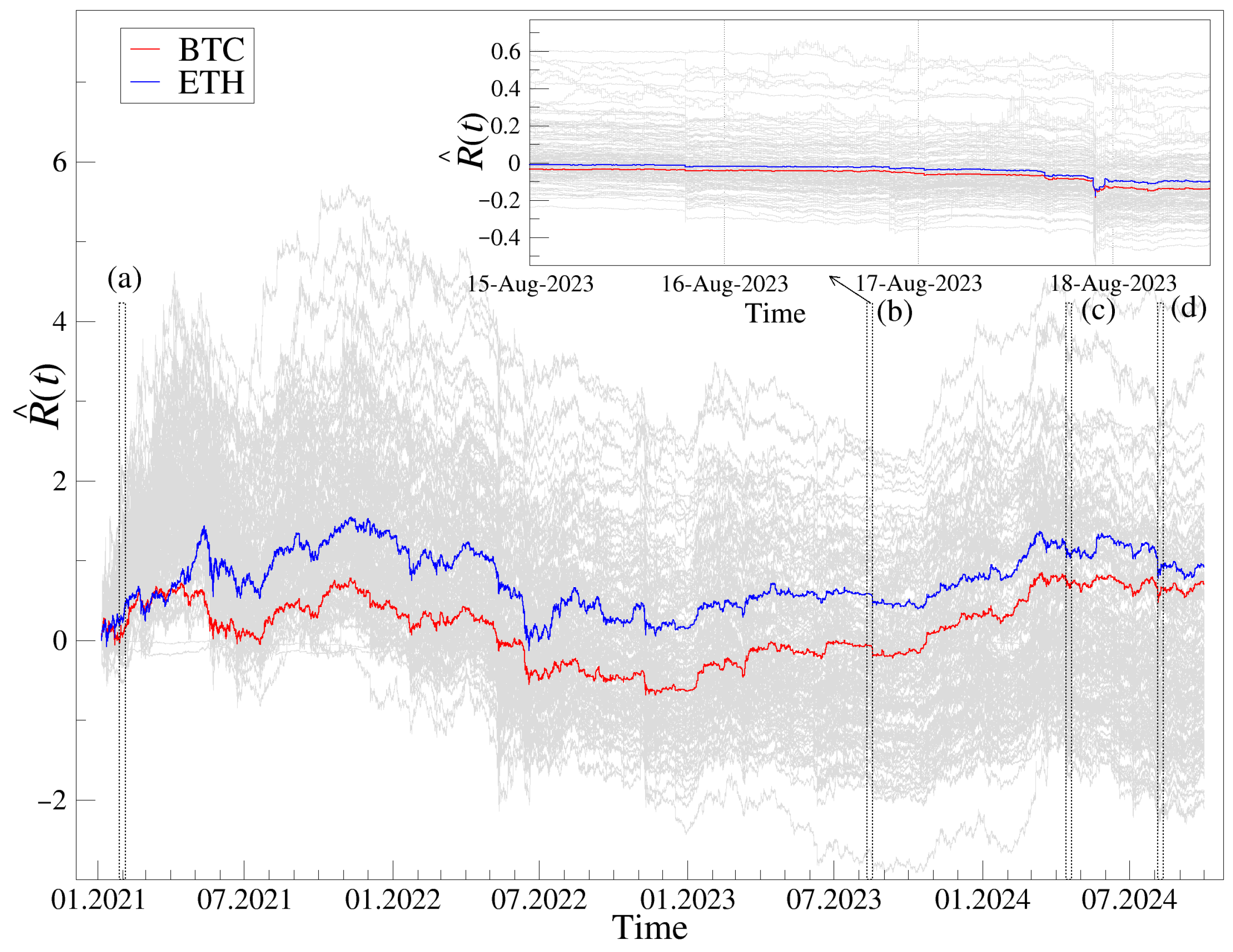
In order for the relative price changes to be directly comparable, the evolution of the cumulative logarithmic returns R ^ i ( t k ) = k = 1 T R i ( t k ) of the N = 140 cryptocurrencies considered here indexed by i ( i = 1 , , N ) over the analyzed time period is presented in Figure 1. Various phases of the market can be observed. The bull market in 2021, then the bear market in 2022 with the crash in May 2022. After reaching its bottom at the end of 2022, the market was in a slower growth phase until mid-2024, then moved sideways until the end of September 2024. Thus, the selected dataset allows for market analysis under various conditions.
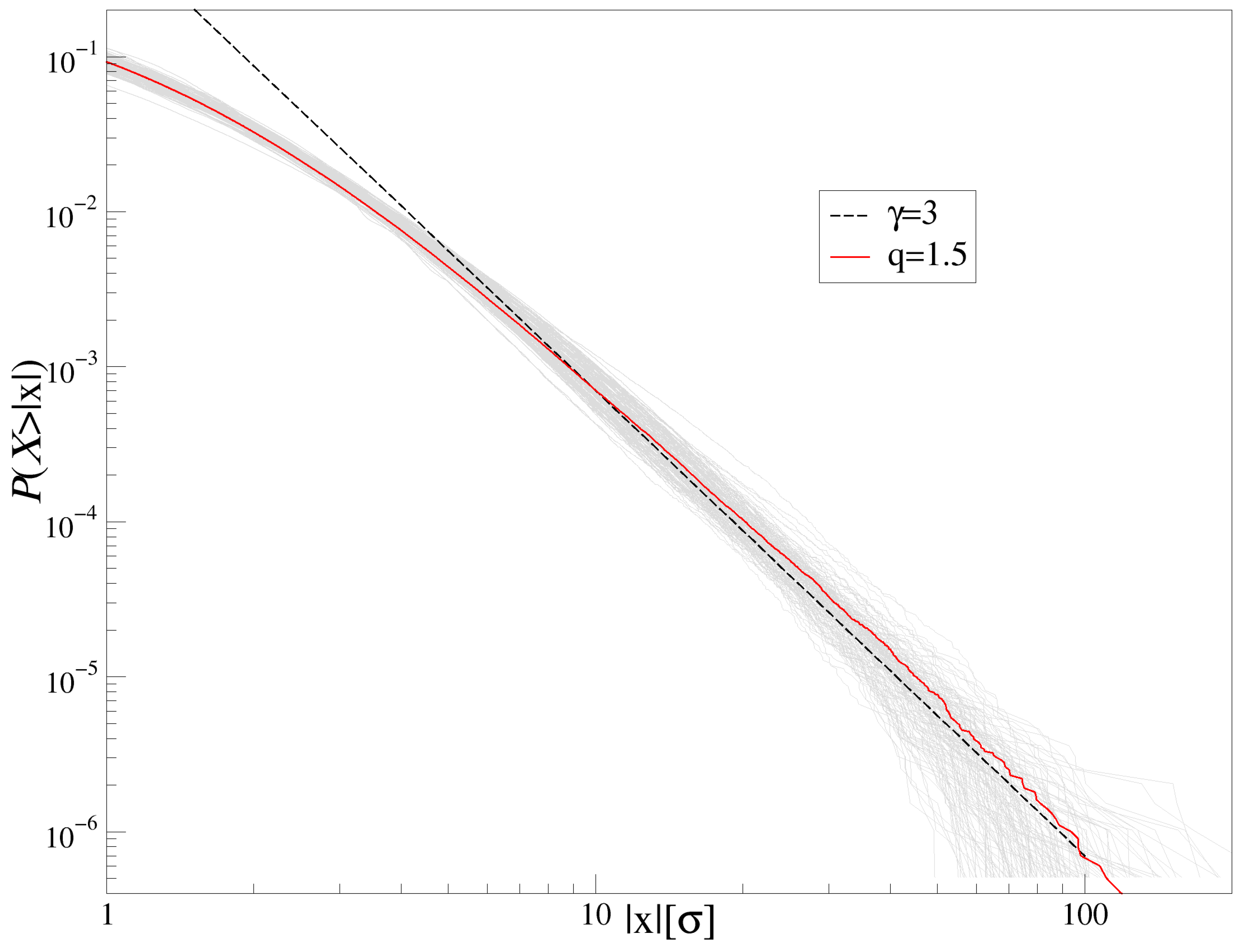
From the above rates of return, their fluctuation distributions can be directly generated. In the complementary cumulative distribution function (CCDF) representation they are displayed in Figure 2. As can be seen from the also shown comparison to the corresponding theoretical references, a very good fit of this distribution is obtained in terms of the q-Gaussian with q = 3 / 2 , which not only provides an overall good fit but also asymptotically corresponds to the inverse cubic law.
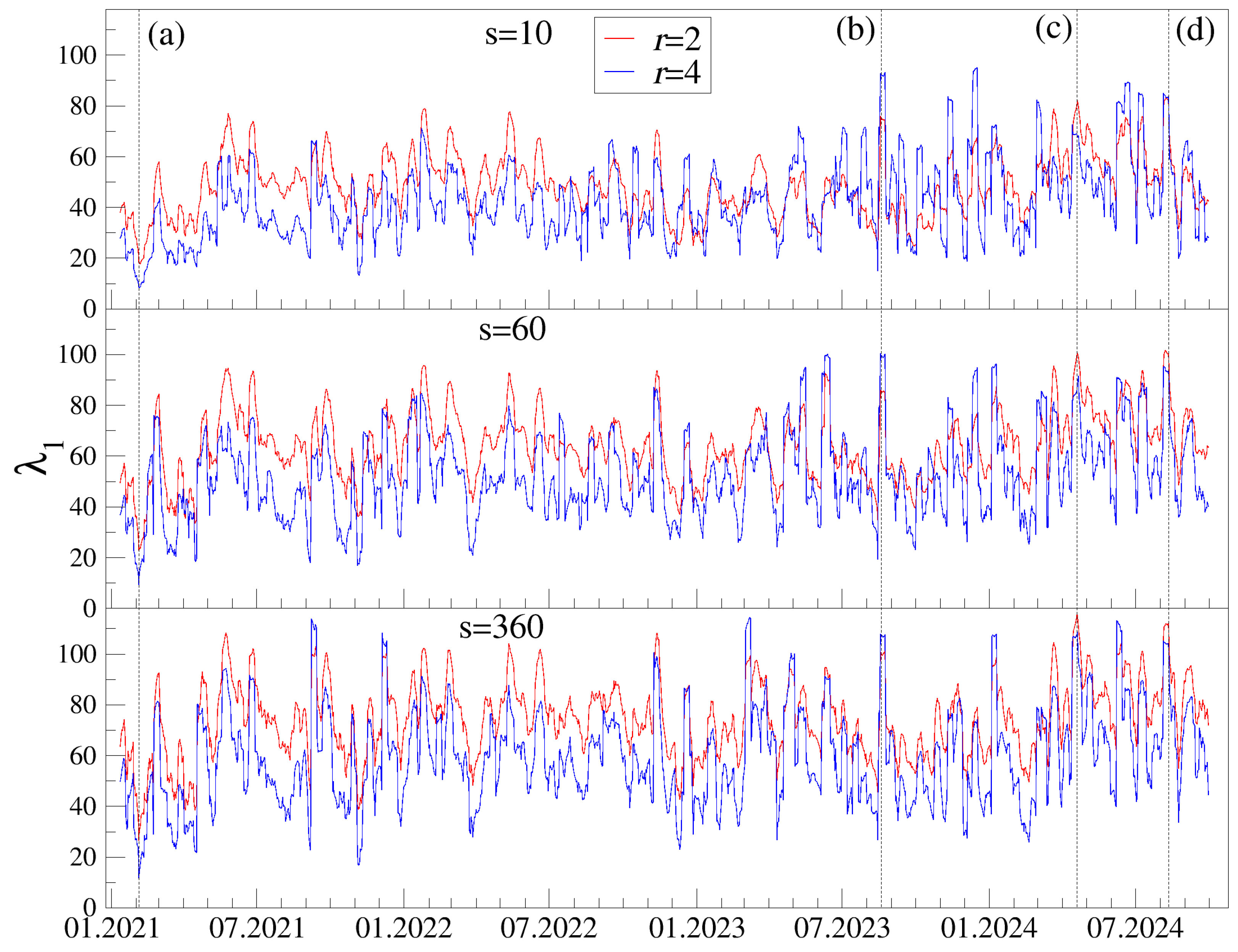
The richness of the dynamics of the set of 140 most actively traded cryptocurrencies considered here is illustrated in Figure 3, where using a moving 7-day window (with a step of one day), the evolution of the largest eigenvalue λ 1 of the corresponding matrix ρ r ( s ) for r = 2 and r = 4 and three different values of the detrending scale (s = 10, 60, and 360 min) is shown. As can be seen, λ 1 strongly depends on the window location and, in some places, exhausts a large part of the maximum possible value equal to the trace of the matrix, which in this case equals 140. In the vast majority of cases, λ 1 is larger for the r = 2 case matrix than for r = 4 , which means that cross-correlations occur here rather at the level of fluctuations with medium amplitude. However, it happens, especially in the later part of the time period considered here, that λ 1 for r = 4 takes higher values, which signals the dominance of cross-correlation at the level of larger fluctuation amplitudes. A more detailed inspection indicates that this is associated with more rapid price changes in the cryptocurrency market at such moments. It should also be noted that on average the value of λ 1 increases for increasingly larger detrending scales, which is an effect reminiscent of the Epps effect [102,103,104].

4. Detrended Correlation Matrices from Random Series

Even for random series, the form of the cross-correlation matrix depends significantly on the parameter r, on the detrending scale s, and on the fluctuation distributions of these series. As representative examples, the synthetic 140 random series of length 10,080 data points (the same as the length of the empirical series) generated from q-Gaussian distributions, for three values q = 1 , which corresponds to the normal distribution, q = 3 / 2 , which corresponds to the inverse-cubic power law satisfied by the empirical data considered, and for q = 2 , which corresponds to fluctuations already in the Lévy-stable regime, are used here.

4.1. Distribution of Matrix Elements

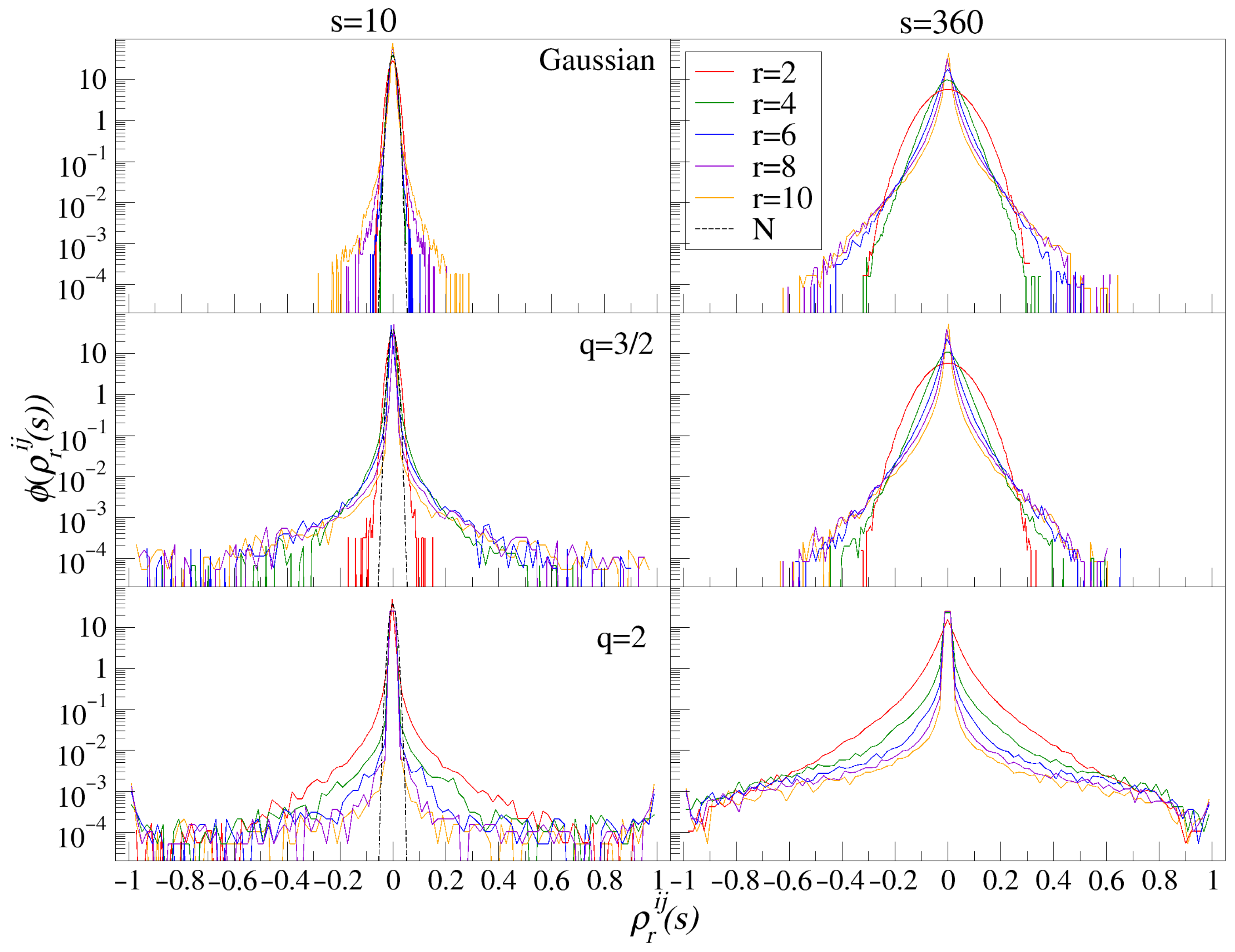
For these three values of q, two significantly different detrending scales s, and five values of parameter r from 2 to 10 with step 2, the distributions of off-diagonal entries (diagonals are units by construction) of the corresponding detrended correlation matrix are systematically illustrated in Figure 4. As can be seen, all these elements are important, and the normal distribution of these entries—as for traditional random matrices—is obtained only for q = 1 , r = 2 at small detrending scales s. Otherwise, the probability distributions of these entries develop increasingly fatter tails as q, r, and s increase, although this increase is progressing in a slightly different form for each of these parameters.
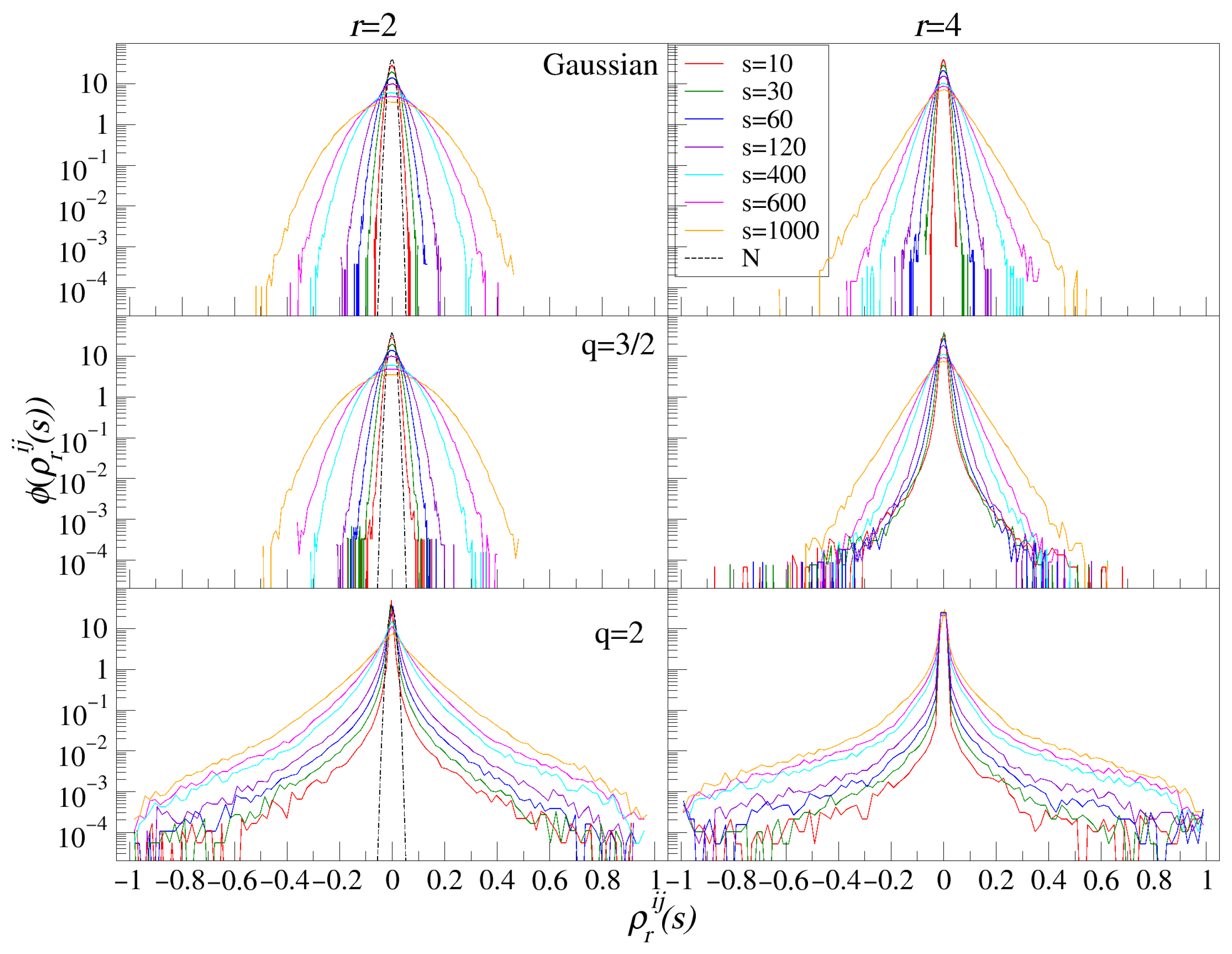
Another perspective on these relationships, somewhat complementary, is presented in Figure 5, where more variants of the scale parameter s are considered. A systematic increase in the thickness of the tails of these off-diagonal entries is visible. In general, such effects signal a reduction in the effective rank of the matrix [99], i.e., the appearance of several large eigenvalues relative to the global bulk, where the dominant portion of small eigenvalues is located.

4.2. Distribution of Eigenvalues

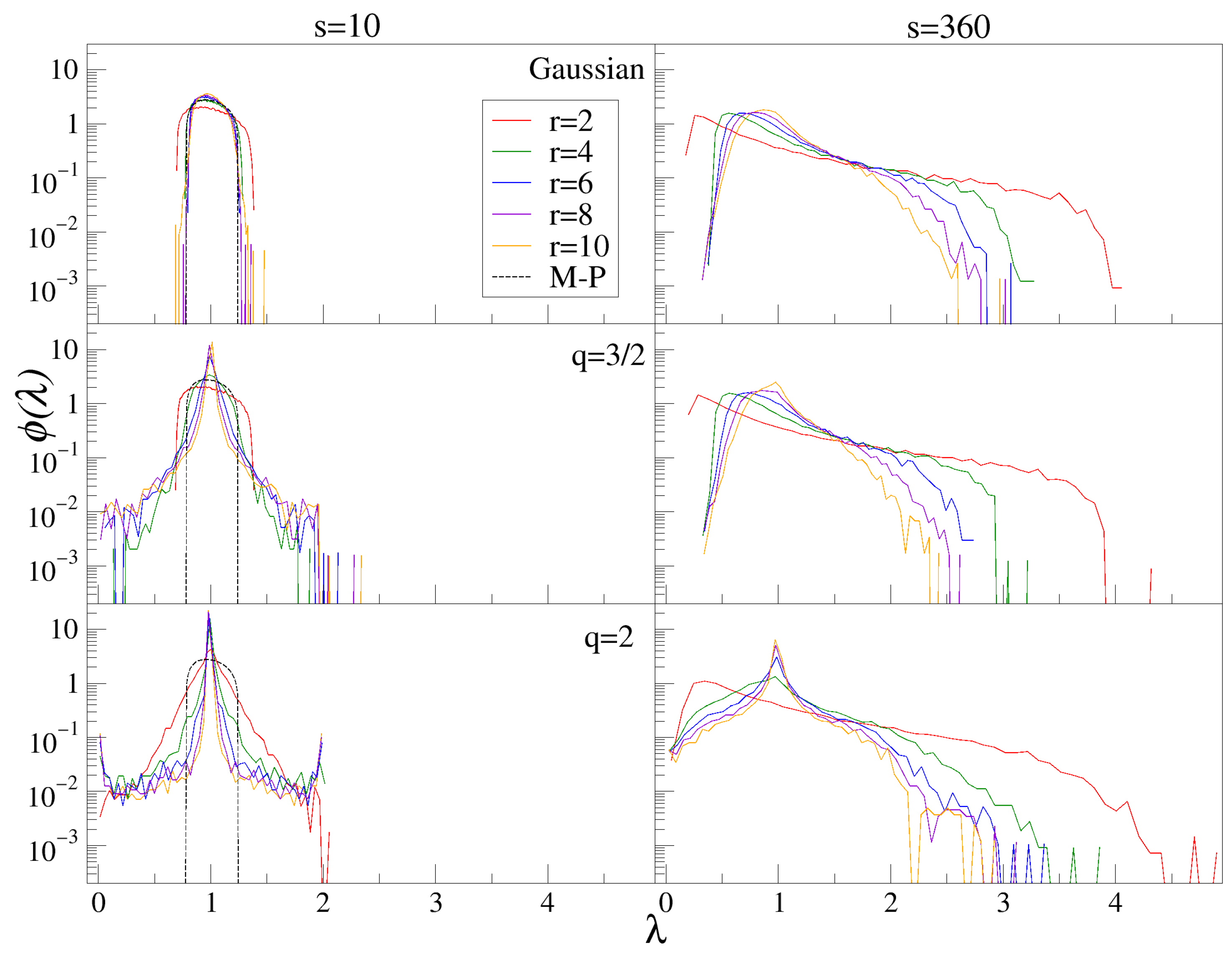
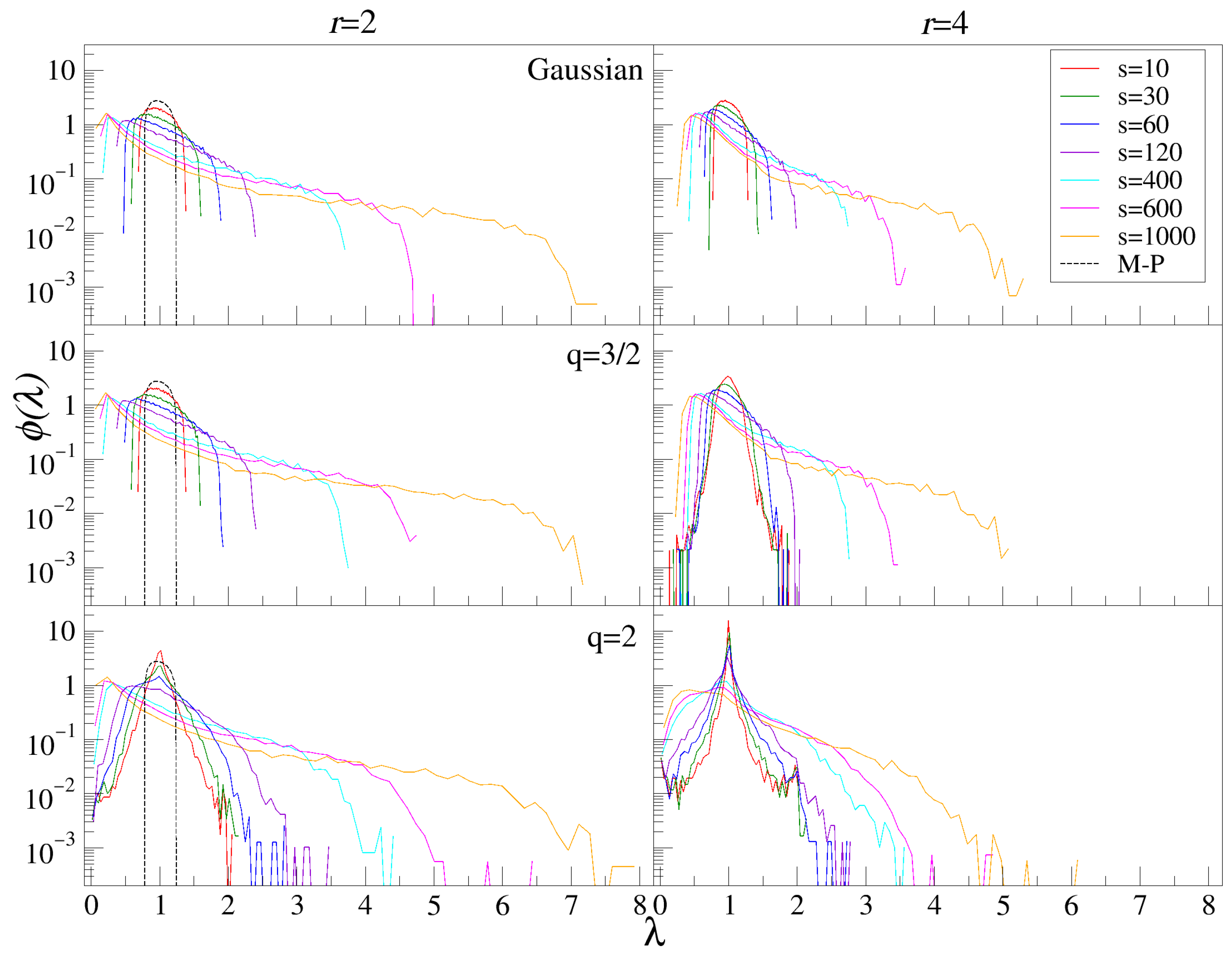
What is typically analyzed first in the context of cross-correlation is the eigenvalue spectrum { λ i } i = 1 N of the corresponding correlation matrix. For the cases of the matrices in Figure 4 and Figure 5, the density distributions ϕ ( λ ) of the eigenvalues are displayed in Figure 6 and Figure 7, respectively. It can be clearly seen that, as the deviations of the off-diagonal element distributions from the normal distribution increase, the departures of the eigenvalue distributions from the M-P distribution increase. The detrending scale s turns out to be more effective in this respect, and for larger values of s, even the maximum ϕ ( λ ) shifts slightly to the left in relation to the M-P distribution. In turn, with a fixed scale, ϕ ( λ ) narrows quite significantly towards the M-P distribution with increasing values of the r parameter. Let us recall that all these effects occur already at the level of the set (here 140) of random time series.
Figure 5. Probability density function (PDF) of the off-diagonal elements of the matrix ρ r ( s ) obtained from random uncorrelated time series with q-Gaussian distribution defined by q = 1 (i.e., a Gaussian distribution, (top)), q = 3 / 2 (middle), and q = 2 (bottom). Results for different scales 10 s 1000 and for two even values of the index r = 2 (left) and r = 4 (right) are shown. Each PDF was created from 100 independent realizations of the random dataset. The dashed line represents a Gaussian PDF corresponding to random Wishart matrices.
Entropy 27 01236 g005

5. Cross-Correlations in Empirical Data

Potential real correlations in the empirical data are reflected in the deviations of the characteristics of the respective correlation matrices from the results presented above for the matrices corresponding to random time series. In order to inspect various aspects of such correspondence in varying situations, we selected four specific positions of the moving window spanning 7 days, generated the corresponding detrended correlation matrices ρ r ( s ) and calculated a complete set of the eigenvalues in each case. The following situations were distinguished: (a) a minimum value of λ 1 ( r , s , t ) over the whole period analyzed, which occurred in a window that ends on 4 February 2021 (see Figure 3); the position of this minimum was stable across all scales s and for both considered values of the exponent r; (b) the large-amplitude cross-correlations are significantly stronger than the average ones: λ 1 ( r = 4 ) > λ 1 ( r = 2 ) for all considered scales s; a sample window with such a property ends on 18 August 2023; (c) the opposite case of λ 1 ( r = 2 ) > λ 1 ( r = 4 ) ; a sample window with such a property ends on 20 April 2024; (d) a sample case of an approximate equality λ 1 ( r = 2 ) λ 1 ( r = 4 ) , which occurred in a window that ends on 20 August 2024. As in the case of the numerical simulations, we consider two even values of the exponent: r = 2 and r = 4 , as well as three scales: s = 10 min, s = 60 min, and s = 360 min.

5.1. Distribution of Matrix Elements

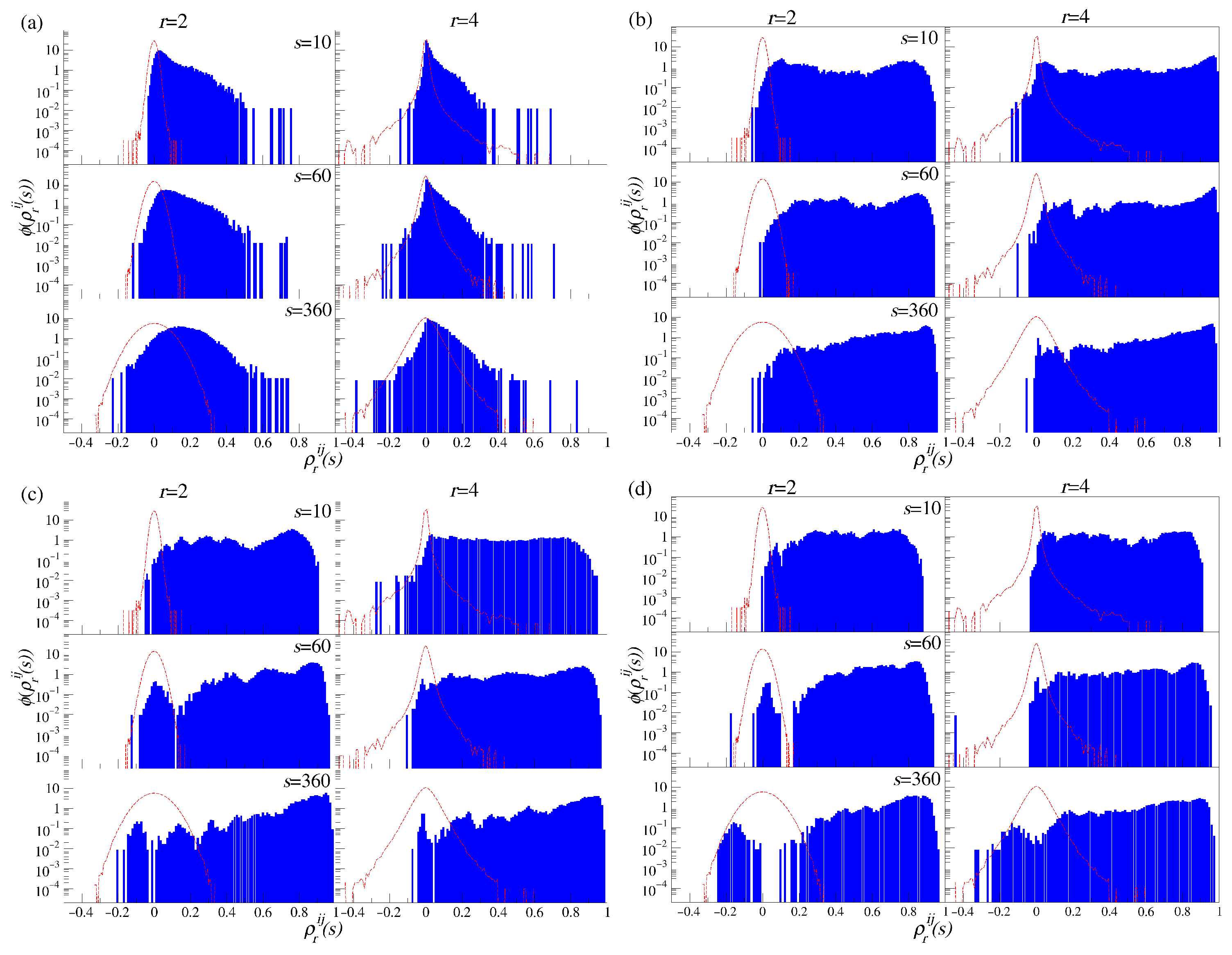
The distributions of the off-diagonal matrix elements of the resulting correlation matrices are displayed in Figure 8, where their random counterparts for q = 3 / 2 (inverse-cubic power law) are indicated by the red dashed lines. The deviations of the empirical results from the corresponding random ones are very pronounced (and the weakest for case (a)) and consist mainly in the appearance of a large number of sizable matrix elements, many of them even close to unity. These effects signal an effective reduction in the dimension of the leading component of the correlation matrix, i.e., the appearance of one large or at most several larger eigenvalues repelled from many small ones, which are remnants of the random part of this matrix [99].

5.2. Distribution of Eigenvalues

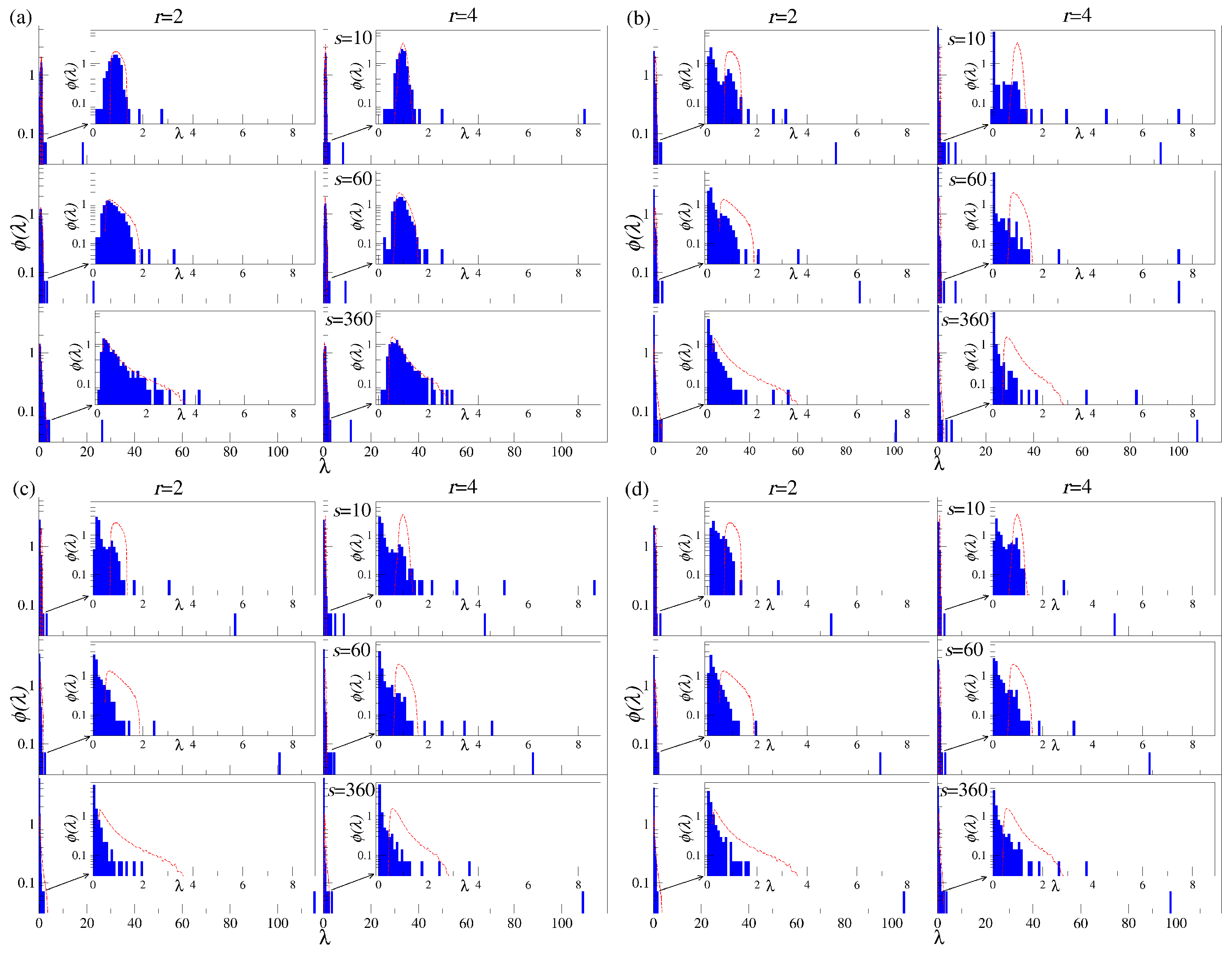
The resulting eigenvalue probability density functions for these four cases, denoted by (a)–(d), are shown in Figure 9. These eigenvalue spectra are compared with the corresponding eigenvalue distribution obtained for uncorrelated time series with an inverse cubic power-law pdf ( q = 3 / 2 , see Figure 7). The same pattern is always observed: the largest eigenvalue λ 1 is separated from the rest, and the longer the scale s under analysis is, the larger the gap between λ 1 and λ 2 becomes. This result is characteristic of all financial markets, where λ 1 can be associated with the collective movement of prices of all assets (the market factor) and the strength of this collectivity increases as longer return intervals Δ t = t k + 1 t k are considered. This comes as a natural consequence of delays in the information transfer between the assets stemming from the fact that transactions on different assets are asynchronous and take place at random moments. The market factor is not a unique collective aspect of the cross-correlations among cryptocurrencies: depending on the position of the rolling window on the time axis and on the values of the parameters r and s, a 2nd one or more eigenvalues appear to be larger than it would be expected from the eigenvalue distribution for random data. Such individual detached eigenvalues typically describe the sectoral structure of the market, in which groups of assets are more strongly correlated within the group than outside it. Depending on the specific case, in Figure 9 the number of such eigenvalues ranges from 1 to 5, with the typical pattern being that for r = 4 there are more of them than for r = 2 . It is worth noting, however, that such eigenvalues lying outside the range predicted for random data also appear below the lower bound λ min of the random spectrum. In that case, such small eigenvalues describe correlations between individual pairs of assets, without any signs of broader collectivity.

5.3. Filtering Out the Market Factor

An important feature of the spectra shown in almost all panels of Figure 9 is also a sizable displacement towards zero of the bulk of empirical eigenvalues relative to the corresponding eigenvalue distribution for random data. One of the key causes of this displacement is the fact that when the matrix trace is fixed, the presence of a large, repelled eigenvalue λ 1 λ max and several other eigenvalues above λ max reduces the available range for the remaining eigenvalues, which effectively shifts them leftward (reminiscent of the slaving principle of synergetics [105]). To reduce this effect, it is necessary to filter out the market factor and construct an analogous eigenvalue distribution for the residual data. This can be achieved by using a regression-based method [1,24],
R i res ( t k ) = R i ( t k ) a i b i Z 1 ( t k ) Z 1 ( t k ) = m = 1 N v 1 m R m ( t k ) ,
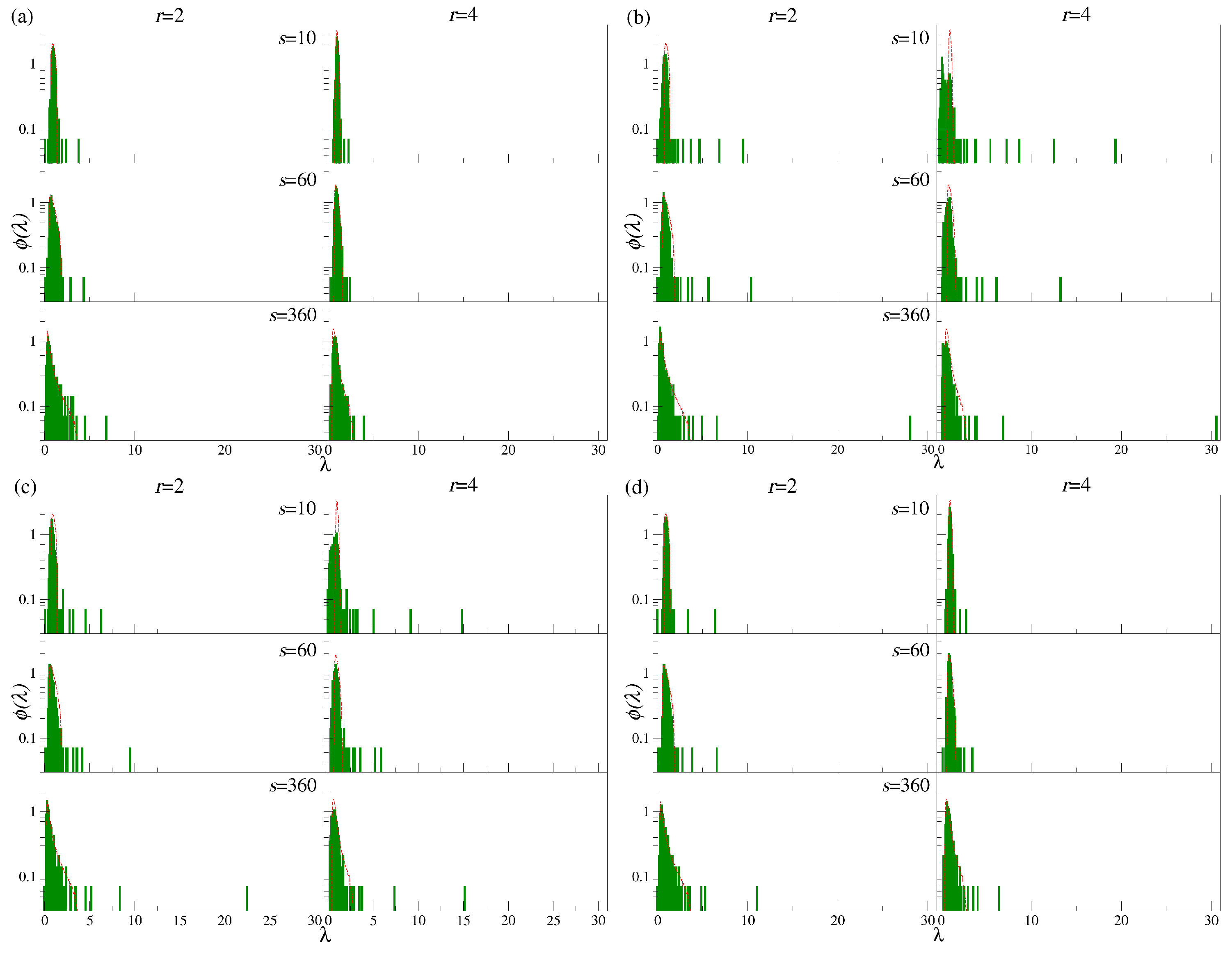
where Z 1 ( t k ) is the contribution to total variance associated with λ 1 and the filtered matrix ρ r ( s ) is constructed from the residual time series R i res ( t k ) with i = 1 , , N and k = 1 , , T . The results of diagonalization are analogously illustrated in Figure 10. Indeed, the bulk of the eigenvalues of the empirical correlation matrix coincides quite well with that of the matrix generated from random series with the same detrending scales s and other parameters. Some eigenvalues slightly pushed towards larger values remain, and they reflect more local and sectoral cross-correlations.

6. Summary

This study investigates the spectral properties of detrended cross-correlation matrices constructed from the multifractal detrended cross-correlation coefficient ρ r ( s ) , which generalizes the Pearson correlation to fluctuation-dependent and scale-dependent settings. Because real-world multivariate time series—especially financial ones—exhibit strong nonstationarities, heavy-tailed distributions, and long-range dependence, traditional covariance-based correlation matrices often generate misleading structures. To address this, the paper examines how detrending, fluctuation selection via the parameter r, and empirical heavy-tailed distributions collectively influence the eigenvalue spectra of empirical detrended correlation matrices and their counterparts constructed from random time series. Synthetic ensembles of Gaussian and q-Gaussian time series are first used to characterize the “null” spectral behavior of detrended correlation matrices. The results show that detrending modifies matrix-element distributions and eigenvalue spectra in systematic ways—most notably by fattening the tails of off-diagonal entries and producing departures from the standard Marčenko–Pastur (M-P) distribution even in fully uncorrelated data. The extent of these deviations grows with the detrending scale s , the fluctuation-order parameter r, and the heaviness of the underlying distribution tails.
The empirical analysis employs 1 min returns of 140 of the most liquid cryptocurrencies traded on Binance between 2021 and 2024. Across rolling windows and multiple detrending scales, the leading eigenvalues of the detrended correlation matrices consistently rise above their bounds for uncorrelated time series, indicating strong collective behavior. The dominant mode corresponds to market-wide synchronous motion, while several subleading modes reflect sectoral or structural groupings within the cryptocurrency market. The number and size of these outlying eigenvalues depend on both the temporal scale and the chosen fluctuation order, with r = 4 generally highlighting cross-correlations among large-amplitude price movements. By filtering out the dominant market mode and reanalyzing the residual covariance structure, the paper demonstrates that the empirical bulk eigenvalue distribution aligns closely with the corresponding null spectra derived from detrended random series. The remaining outliers then cleanly reveal local, sector-specific dependencies.
Overall, the work provides a refined spectral benchmark—beyond the classical M-P framework—suitable for systems in which detrending and heavy-tailed fluctuations cannot be neglected. Future research could extend this framework by deriving analytical approximations for the random-matrix limits of detrended correlation spectra, helping to formalize the empirical baselines established in this work.

Author Contributions

Conceptualization, S.D., J.K. and M.W.; methodology, S.D., J.K. and M.W.; software, M.W.; validation, S.D., P.J., J.K. and M.W.; formal analysis, S.D., J.K. and M.W.; investigation, S.D., P.J., J.K., M.S. and M.W.; resources, M.S. and M.W.; data curation, M.S. and M.W.; writing—original draft preparation, S.D. and J.K.; writing—review and editing, S.D., P.J., J.K. and M.W.; visualization, M.S. and M.W.; supervision, S.D.; project administration, S.D., P.J., J.K. and M.W.; funding acquisition, P.J. All authors have read and agreed to the published version of the manuscript.

Funding

This research received no external funding.

Institutional Review Board Statement

Not applicable.

Informed Consent Statement

Not applicable.

Data Availability Statement

The data are available in the open repository [101].

Conflicts of Interest

The authors declare no conflicts of interest.

References

  1. Kwapień, J.; Drożdż, S. Physical approach to complex systems. Phys. Rep. 2012, 515, 115–226. [Google Scholar] [CrossRef]
  2. Bun, J.; Bouchaud, J.P.; Potter, M. Cleaning large correlation matrices: Tools from random matrix theory. Phys. Rep. 2017, 666, 1–109. [Google Scholar] [CrossRef]
  3. Jiang, Z.Q.; Xie, W.J.; Zhou, W.X.; Sornette, D. Multifractal analysis of financial markets: A review. Rep. Prog. Phys. 2019, 82, 125901. [Google Scholar] [CrossRef] [PubMed]
  4. Bardoscia, M.; Barucca, P.; Battiston, S.; Caccioli, F.; Cimini, G.; Garlaschelli, D.; Saracco, F.; Squartini, T.; Caldarelli, G. The physics of financial networks. Nat. Rev. Phys. 2021, 3, 490–507. [Google Scholar] [CrossRef]
  5. Srikanthan, R.; McMahon, T.A. Stochastic generation of annual, monthly and daily climate data: A review. Hydrol. Earth Syst. Sci. 2001, 5, 653–670. [Google Scholar] [CrossRef]
  6. Al-Kandari, N.M.; Jolliffe, I.T. Variable selection and interpretation in correlation principal components. Environmetrics 2005, 16, 659–672. [Google Scholar] [CrossRef]
  7. Feijóo, A.; Villanueva, D. Assessing wind speed simulation methods. Renew. Sustain. Energy Rev. 2016, 56, 473–483. [Google Scholar] [CrossRef]
  8. Mengis, N.; Keller, D.P.; Oschlies, A. Systematic Correlation Matrix Evaluation (SCoMaE)—A bottom–up, science-led approach to identifying indicators. Earth Syst. Dyn. 2018, 9, 15–31. [Google Scholar] [CrossRef]
  9. Dykeman, E.C.; Sankey, O.F. Normal mode analysis and applications in biological physics. J. Phys. Condens. Matter 2010, 22, 423202. [Google Scholar] [CrossRef]
  10. Kamberaj, H. A theoretical model for the collective motion of proteins by means of principal component analysis. Cent. Eur. J. Phys. 2011, 9, 96–109. [Google Scholar] [CrossRef]
  11. Kwapień, J.; Drożdż, S.; Joannides, A. Temporal correlations versus noise in the correlation matrix formalism: An example of the brain auditory response. Phys. Rev. E 2000, 62, 5557–5564. [Google Scholar] [CrossRef][Green Version]
  12. de Cheveigné, A.; Di Liberto, G.M.; Arzounian, D.; Wong, D.D.; Hjortkjær, J.; Fuglsang, S.; Parra, L.C. Multiway canonical correlation analysis of brain data. NeuroImage 2019, 186, 728–740. [Google Scholar] [CrossRef]
  13. Snyder, A.Z.; Nishino, T.; Shimony, J.S.; Lenze, E.J.; Wetherell, J.L.; Voegtle, M.; Miller, J.P.; Yingling, M.D.; Marcus, D.; Gurney, J.; et al. Covariance and Correlation Analysis of Resting State Functional Magnetic Resonance Imaging Data Acquired in a Clinical Trial of Mindfulness-Based Stress Reduction and Exercise in Older Individuals. Front. Neurosci. 2022, 16, 825547. [Google Scholar] [CrossRef]
  14. Izenman, A.J. Random Matrix Theory and Its Applications. Stat. Sci. 2021, 36, 421–442. [Google Scholar] [CrossRef]
  15. Peng, C.K.; Buldyrev, S.V.; Havtin, S.; Simons, M.; Stanley, H.E.; Goldberger, A.L. Mosaic organization of DNA nucleotides. Phys. Rev. E 1994, 49, 1685–1689. [Google Scholar] [CrossRef] [PubMed]
  16. Chen, Z.; Ivanov, P.; Hu, K.; Stanley, H.E. Effect of nonstationarities on detrended fluctuation analysis. Phys. Rev. E 2002, 65, 041107. [Google Scholar] [CrossRef]
  17. Bryce, R.M.; Sprague, K.B. Revisiting detrended fluctuation analysis. Sci. Rep. 2012, 2, 315. [Google Scholar] [CrossRef]
  18. Podobnik, B.; Stanley, H.E. Detrended cross-correlation analysis: A new method for analyzing two nonstationary time series. Phys. Rev. Lett. 2008, 100, 084102. [Google Scholar] [CrossRef] [PubMed]
  19. Zhou, W.X. Multifractal detrended cross-correlation analysis for two nonstationary signals. Phys. Rev. E 2008, 77, 066211. [Google Scholar] [CrossRef]
  20. Oświęcimka, P.; Drożdż, S.; Forczek, M.; Jadach, S.; Kwapień, J. Detrended cross-correlation analysis consistently extended to multifractality. Phys. Rev. E 2014, 89, 023305. [Google Scholar] [CrossRef] [PubMed]
  21. Zebende, G. DCCA cross-correlation coefficient: Quantifying level of cross-correlation. Physical A 2011, 390, 614–618. [Google Scholar] [CrossRef]
  22. Drożdż, S.; Gümmer, F.; Górski, A.Z.; Ruf, F.; Speth, J. Dynamics of competition between collectivity and noise in the stock market. Physical A 2000, 287, 440–449. [Google Scholar] [CrossRef]
  23. Plerou, V.; Gopikrishnan, P.; Rosenow, B.; Amaral, L.; Stanley, H. A random matrix theory approach to financial cross-correlations. Physical A 2000, 287, 374–382. [Google Scholar] [CrossRef]
  24. Plerou, V.; Gopikrishnan, P.; Rosenow, B.; Amaral, L.A.; Guhr, T.; Stanley, H.E. Random matrix approach to cross correlations in financial data. Phys. Rev. E 2002, 65, 066126. [Google Scholar] [CrossRef]
  25. Utsugi, A.; Ino, K.; Oshikawa, M. Random matrix theory analysis of cross correlations in financial markets. Phys. Rev. E 2004, 70, 026110. [Google Scholar] [CrossRef] [PubMed]
  26. Wang, G.J.; Xie, C.; Chen, S.; Yang, J.J.; Yang, M.Y. Random matrix theory analysis of cross-correlations in the US stock market: Evidence from Pearson’s correlation coefficient and detrended cross-correlation coefficient. Physical A 2013, 392, 3715–3730. [Google Scholar] [CrossRef]
  27. Zhao, L.; Li, W.; Fenu, A.; Podobnik, B.; Wang, Y.; Stanley, H.E. The q-dependent detrended cross-correlation analysis of stock market. J. Stat. Mech. Theory Exp. 2018, 2018, 023402. [Google Scholar] [CrossRef]
  28. James, N.; Menzies, M. Efficiency of communities and financial markets during the 2020 pandemic. Chaos 2021, 31, 083116. [Google Scholar] [CrossRef]
  29. James, N.; Menzies, M.; Gottwald, G.A. On financial market correlation structures and diversification benefits across and within equity sectors. Physical A 2022, 604, 127682. [Google Scholar] [CrossRef]
  30. Drożdż, S.; Górski, A.; Kwapień, J. World currency exchange rate cross-correlations. Eur. Phys. J. B 2007, 58, 499–502. [Google Scholar] [CrossRef]
  31. Mai, Y.; Chen, H.; Zou, J.Z.; Li, S.P. Currency co-movement and network correlation structure of foreign exchange market. Physical A 2018, 492, 65–74. [Google Scholar] [CrossRef]
  32. Gębarowski, R.; Oświęcimka, P.; Wątorek, M.; Drożdż, S. Detecting correlations and triangular arbitrage opportunities in the Forex by means of multifractal detrended cross-correlations analysis. Nonlinear Dyn. 2019, 98, 2349–2364. [Google Scholar] [CrossRef]
  33. Miśkiewicz, J. Network Analysis of Cross-Correlations on Forex Market during Crises. Globalisation on Forex Market. Entropy 2021, 23, 352. [Google Scholar] [CrossRef] [PubMed]
  34. Miśkiewicz, J.; Bonarska-Kujawa, D. Evolving Network Analysis of S&P500 Components: COVID-19 Influence of Cross-Correlation Network Structure. Entropy 2022, 24, 21. [Google Scholar] [CrossRef]
  35. Stosic, D.; Stosic, D.; Ludermir, T.B.; Stosic, T. Collective behavior of cryptocurrency price changes. Physical A 2018, 507, 499–509. [Google Scholar] [CrossRef]
  36. Basnarkov, L.; Stojkoski, V.; Utkovski, Z.; Kocarev, L. Correlation patterns in foreign exchange markets. Physical A 2019, 525, 1026–1037. [Google Scholar] [CrossRef]
  37. Zięba, D.; Kokoszczyński, R.; Śledziewska, K. Shock transmission in the cryptocurrency market. Is Bitcoin the most influential? Int. Rev. Financ. Anal. 2019, 64, 102–125. [Google Scholar] [CrossRef]
  38. Drożdż, S.; Minati, L.; Oświęcimka, P.; Stanuszek, M.; Wątorek, M. Competition of noise and collectivity in global cryptocurrency trading: Route to a self-contained market. Chaos 2020, 30, 023122. [Google Scholar] [CrossRef]
  39. Briola, A.; Aste, T. Dependency Structures in Cryptocurrency Market from High to Low Frequency. Entropy 2022, 24, 1548. [Google Scholar] [CrossRef]
  40. James, N.; Menzies, M. Collective correlations, dynamics, and behavioural inconsistencies of the cryptocurrency market over time. Nonlinear Dyn. 2022, 107, 4001–4017. [Google Scholar] [CrossRef]
  41. James, N. Evolutionary correlation, regime switching, spectral dynamics and optimal trading strategies for cryptocurrencies and equities. Physical D 2022, 434, 133262. [Google Scholar] [CrossRef]
  42. Jing, R.; Rocha, L.E. A network-based strategy of price correlations for optimal cryptocurrency portfolios. Financ. Res. Lett. 2023, 58, 104503. [Google Scholar] [CrossRef]
  43. Wątorek, M.; Skupień, M.; Kwapień, J.; Drożdż, S. Decomposing cryptocurrency high-frequency price dynamics into recurring and noisy components. Chaos 2023, 33, 083146. [Google Scholar] [CrossRef]
  44. Jin, L.; Zheng, B.; Jiang, X.; Xiong, L.; Zhang, J.; Ma, J. Dynamic cross-correlation in emerging cryptocurrency market. Physical A 2025, 668, 130568. [Google Scholar] [CrossRef]
  45. Wątorek, M.; Szydło, P.; Kwapień, J.; Drożdż, S. Correlations versus noise in the NFT market. Chaos 2024, 34, 073112. [Google Scholar] [CrossRef]
  46. Cohen, G.; Qadan, M. The complexity of cryptocurrencies algorithmic trading. Mathematics 2022, 10, 2037. [Google Scholar] [CrossRef]
  47. James, N.; Menzies, M.; Chin, K. Economic state classification and portfolio optimisation with application to stagflationary environments. Chaos Solitons Fractals 2022, 164, 112664. [Google Scholar] [CrossRef]
  48. James, N.; Menzies, M.; Chan, J. Semi-Metric Portfolio Optimization: A New Algorithm Reducing Simultaneous Asset Shocks. Econometrics 2023, 11, 8. [Google Scholar] [CrossRef]
  49. Bhattacherjee, P.; Mishra, S.; Kang, S.H. Extreme frequency connectedness, determinants and portfolio analysis of major cryptocurrencies: Insights from quantile time-frequency approach. Q. Rev. Econ. Financ. 2025, 100, 101974. [Google Scholar] [CrossRef]
  50. Sila, J.; Mark, M.; Kristoufek, L.; Weber, T.A. Crypto market betas: The limits of predictability and hedging. Financ. Innov. 2025, 11, 107. [Google Scholar] [CrossRef]
  51. Tsioutsios, A.; Yarovaya, L.; Dimitriou, D. Exploring portfolio diversification with alternative investments: An international TVP-VAR approach. Res. Int. Bus. Financ. 2025, 80, 103143. [Google Scholar] [CrossRef]
  52. Kwapień, J.; Oświęcimka, P.; Drożdż, S. Detrended fluctuation analysis made flexible to detect range of cross-correlated fluctuations. Phys. Rev. E 2015, 92, 052815. [Google Scholar] [CrossRef]
  53. Marčenko, V.A.; Pastur, L.A. Distribution of eigenvalues for some sets of random matrices. Math.-Ussr-Sb. 1967, 1, 457–483. [Google Scholar] [CrossRef]
  54. Umarov, S.; Tsallis, C.; Steinberg, S. On a q-Central Limit Theorem Consistent with Nonextensive Statistical Mechanics. Milan J. Math. 2008, 76, 307–328. [Google Scholar] [CrossRef]
  55. Binance. Available online: https://www.binance.com/ (accessed on 1 October 2025).
  56. Wątorek, M.; Drożdż, S.; Kwapień, J.; Minati, L.; Oświęcimka, P.; Stanuszek, M. Multiscale characteristics of the emerging global cryptocurrency market. Phys. Rep. 2021, 901, 1–82. [Google Scholar] [CrossRef]
  57. Drożdż, S.; Gębarowski, R.; Minati, L.; Oświęcimka, P.; Wątorek, M. Bitcoin market route to maturity? Evidence from return fluctuations, temporal correlations and multiscaling effects. Chaos 2018, 28, 071101. [Google Scholar] [CrossRef] [PubMed]
  58. James, N. Dynamics, behaviours, and anomaly persistence in cryptocurrencies and equities surrounding COVID-19. Physical A 2021, 570, 125831. [Google Scholar] [CrossRef] [PubMed]
  59. Evrim Mandaci, P.; Cagli, E.C. Herding intensity and volatility in cryptocurrency markets during the COVID-19. Financ. Res. Lett. 2022, 46, 102382. [Google Scholar] [CrossRef]
  60. Nguyen, A.P.N.; Mai, T.T.; Bezbradica, M.; Crane, M. Volatility and returns connectedness in cryptocurrency markets: Insights from graph-based methods. Physical A 2023, 632, 129349. [Google Scholar] [CrossRef]
  61. Brouty, X.; Garcin, M. Fractal properties, information theory, and market efficiency. Chaos Solitons Fractals 2024, 180, 114543. [Google Scholar] [CrossRef]
  62. Sila, J.; Kocenda, E.; Kristoufek, L.; Kukacka, J. Good vs. bad volatility in major cryptocurrencies: The dichotomy and drivers of connectedness. J. Int. Financ. Mark. Inst. Money 2024, 96, 102062. [Google Scholar] [CrossRef]
  63. Queiroz, R.; Kristoufek, L.; David, S. A combined framework to explore cryptocurrency volatility and dependence using multivariate GARCH and Copula modeling. Physical A 2024, 652, 130046. [Google Scholar] [CrossRef]
  64. Bui, H.Q.; Schinckus, C.; Al-Jaifi, H. Long-range correlations in cryptocurrency markets: A multi-scale DFA approach. Physical A 2025, 661, 130417. [Google Scholar] [CrossRef]
  65. Takaishi, T. Statistical properties and multifractality of Bitcoin. Physical A 2018, 506, 507–519. [Google Scholar] [CrossRef]
  66. Stosic, D.; Stosic, D.; Ludermir, T.B.; Stosic, T. Multifractal behavior of price and volume changes in the cryptocurrency market. Physical A 2019, 520, 54–61. [Google Scholar] [CrossRef]
  67. Takaishi, T.; Adachi, T. Market efficiency, liquidity, and multifractality of Bitcoin: A dynamic study. Asia-Pac. Financ. Mark. 2020, 27, 145–154. [Google Scholar] [CrossRef]
  68. Bariviera, A.F. One model is not enough: Heterogeneity in cryptocurrencies’ multifractal profiles. Financ. Res. Lett. 2021, 39, 101649. [Google Scholar] [CrossRef]
  69. Kwapień, J.; Wątorek, M.; Bezbradica, M.; Crane, M.; Tan Mai, T.; Drożdż, S. Analysis of inter-transaction time fluctuations in the cryptocurrency market. Chaos 2022, 32, 083142. [Google Scholar] [CrossRef] [PubMed]
  70. Kwapień, J.; Wątorek, M.; Drożdż, S. Multifractal cross-correlations of bitcoin and ether trading characteristics in the post-COVID-19 time. Future Internet 2022, 14, 215. [Google Scholar] [CrossRef]
  71. Wątorek, M.; Królczyk, M.; Kwapień, J.; Stanisz, T.; Drożdż, S. Approaching Multifractal Complexity in Decentralized Cryptocurrency Trading. Fractal Fract. 2024, 8, 652. [Google Scholar] [CrossRef]
  72. Drożdż, S.; Kluszczyński, R.; Kwapień, J.; Wątorek, M. Multifractality and Its Sources in the Digital Currency Market. Future Internet 2025, 17, 470. [Google Scholar] [CrossRef]
  73. Conlon, T.; McGee, R. Safe haven or risky hazard? Bitcoin during the Covid-19 bear market. Financ. Res. Lett. 2020, 35, 101607. [Google Scholar] [CrossRef]
  74. Zhang, Y.J.; Bouri, E.; Gupta, R.; Ma, S.J. Risk spillover between Bitcoin and conventional financial markets: An expectile-based approach. N. Am. J. Econ. Financ. 2021, 55, 101296. [Google Scholar] [CrossRef]
  75. Choi, S.; Shin, J. Bitcoin: An inflation hedge but not a safe haven. Financ. Res. Lett. 2022, 46, 102379. [Google Scholar] [CrossRef]
  76. Elmelki, A.; Chaâbane, N.; Benammar, R. Exploring the relationship between cryptocurrency and S&P500: Evidence from wavelet coherence analysis. Int. J. Blockchains Cryptocurr. 2022, 3, 256–268. [Google Scholar] [CrossRef]
  77. Wątorek, M.; Kwapień, J.; Drożdż, S. Cryptocurrencies are becoming part of the world global financial market. Entropy 2023, 25, 377. [Google Scholar] [CrossRef] [PubMed]
  78. Kristjanpoller, W.; Tabak, B.M. Multifractal Cross-Correlations of Dirty and Clean Cryptocurrencies with main financial indices. Physical A 2025, 668, 130541. [Google Scholar] [CrossRef]
  79. Li, J.C.; Xu, Y.Z.; Tao, C.; Zhong, G.Y. Multi-period impacts and network connectivity of cryptocurrencies to international stock markets. Physical A 2025, 658, 130299. [Google Scholar] [CrossRef]
  80. Nguyen, A.P.N.; Crane, M.; Conlon, T.; Bezbradica, M. Herding unmasked: Insights into cryptocurrencies, stocks and US ETFs. PLoS ONE 2025, 20, e0316332. [Google Scholar] [CrossRef]
  81. Bouri, E.; Gupta, R.; Vo, X.V. Jumps in Geopolitical Risk and the Cryptocurrency Market: The Singularity of Bitcoin. Def. Peace Econ. 2022, 33, 150–161. [Google Scholar] [CrossRef]
  82. Hong, M.Y.; Yoon, J.W. The impact of COVID-19 on cryptocurrency markets: A network analysis based on mutual information. PLoS ONE 2022, 17, e0259869. [Google Scholar] [CrossRef] [PubMed]
  83. Khalfaoui, R.; Gozgor, G.; Goodell, J.W. Impact of Russia-Ukraine war attention on cryptocurrency: Evidence from quantile dependence analysis. Financ. Res. Lett. 2023, 52, 103365. [Google Scholar] [CrossRef]
  84. Fang, Y.; Tang, Q.; Wang, Y. Geopolitical Risk and Cryptocurrency Market Volatility. Emerg. Mark. Financ. Trade 2024, 60, 3254–3270. [Google Scholar] [CrossRef]
  85. Poongodi, M.; Nguyen, T.N.; Hamdi, M.; Cengiz, K. Global cryptocurrency trend prediction using social media. Inf. Process. Manag. 2021, 58, 102708. [Google Scholar] [CrossRef]
  86. Aharon, D.Y.; Demir, E.; Lau, C.K.M.; Zaremba, A. Twitter-Based uncertainty and cryptocurrency returns. Res. Int. Bus. Financ. 2022, 59, 101546. [Google Scholar] [CrossRef]
  87. Oświęcimka, P.; Drożdż, S.; Kwapień, J.; Górski, A.Z. Effect of Detrending on Multifractal Characteristics. Acta Phys. Pol. A 2013, 123, 597–603. [Google Scholar] [CrossRef]
  88. Johnson, C.R. Hadamard products of matrices. Linear Multilinear Algebra 1974, 1, 295–307. [Google Scholar] [CrossRef]
  89. FitzGerald, C.H.; Horn, R.A. On Fractional Hadamard Powers of Positive Definite Matrices. J. Math. Anal. Appl. 1977, 61, 633–642. [Google Scholar] [CrossRef]
  90. Wishart, J. The Generalised Product Moment Distribution in Samples from a Normal Multivariate Population. Biometrika 1928, 20A, 32–52. [Google Scholar] [CrossRef]
  91. Wątorek, M.; Kwapień, J.; Drożdż, S. Financial return distributions: Past, present, and COVID-19. Entropy 2021, 23, 884. [Google Scholar] [CrossRef]
  92. Gopikrishnan, P.; Meyer, M.; Amaral, L.N.; Stanley, H.E. Inverse cubic law for the distribution of stock price variations. Eur. Phys. J. B 1998, 3, 139–140. [Google Scholar] [CrossRef]
  93. James, N.; Menzies, M.; Chan, J. Changes to the extreme and erratic behaviour of cryptocurrencies during COVID-19. Physical A 2021, 565, 125581. [Google Scholar] [CrossRef]
  94. Drożdż, S.; Kwapień, J.; Wątorek, M. What is mature and what is still emerging in the cryptocurrency market? Entropy 2023, 25, 772. [Google Scholar] [CrossRef]
  95. Tsallis, C. Nonadditive entropy and nonextensive statistical mechanics—An overview after 20 years. Braz. J. Phys. 2009, 39, 337–356. [Google Scholar] [CrossRef]
  96. Tsallis, C.; Levy, S.V.F.; Souza, A.M.C.; Maynard, R. Statistical-Mechanical Foundation of the Ubiquity of Lévy Distributions in Nature. Phys. Rev. Lett. 1995, 75, 3589–3593. [Google Scholar] [CrossRef]
  97. Drożdż, S.; Kwapień, J.; Oświęcimka, P.; Rak, R. The foreign exchange market: Return distributions, multifractality, anomalous multifractality and the Epps effect. New J. Phys. 2010, 12, 105003. [Google Scholar] [CrossRef]
  98. Drożdż, S.; Wójcik, M. Nature of order from random two-body interactions. Physical A 2001, 301, 291–300. [Google Scholar] [CrossRef]
  99. Drożdż, S.; Kwapień, J.; Speth, J.; Wójcik, M. Identifying complexity by means of matrices. Physical A 2002, 314, 355–361. [Google Scholar] [CrossRef][Green Version]
  100. Guhr, T.; Kälber, B. A new method to estimate the noise in financial correlation matrices. J. Phys. A 2003, 36, 3009. [Google Scholar] [CrossRef]
  101. A Dataset of 140 Exchange Rates from the Binance Exchange. Available online: https://repod.icm.edu.pl/dataset.xhtml?persistentId=doi:10.18150/WPGY4R (accessed on 1 October 2025).
  102. Epps, T.W. Comovements in Stock Prices in the Very Short Run. J. Am. Stat. Assoc. 1979, 74, 291–298. [Google Scholar] [CrossRef] [PubMed]
  103. Kwapień, J.; Drożdż, S.; Speth, J. Time scales involved in emergent market coherence. Physical A 2004, 337, 231–242. [Google Scholar] [CrossRef]
  104. Wątorek, M.; Drożdż, S.; Oświęcimka, P.; Stanuszek, M. Multifractal cross-correlations between the world oil and other financial markets in 2012–2017. Energy Econ. 2019, 81, 874–885. [Google Scholar] [CrossRef]
  105. Haken, H. Synergetics: Introduction and Advanced Topics—Nonequilibrium Phase Transitions and Self-Organization in Physics, Chemistry and Biology; Springer: Berlin/Heidelberg, Germany, 2004. [Google Scholar] [CrossRef]
Figure 1. (Main) Evolution of the cumulative log-returns R ^ i ( t k ) of the 140 cryptocurrencies over the whole time period from 1 January 2021 to 30 September 2024. The bulk of the cryptocurrencies is shown in the background (gray lines), while BTC and ETH are distinguished by red and blue lines, respectively. Four specific periods are distinguished by narrow vertical rectangles (a)–(d). (Inset) Evolution of the same data during a selected shorter period (b): 15 August 2023 to 18 August 2023.
Entropy 27 01236 g001
Figure 2. Complementary cumulative distribution function (CCDF) of the log-returns R i ( t k ) for all 140 cryptocurrencies (grey lines) together with q-Gaussian ( q = 3 / 2 ) and power law ( γ = 3 ) CCDFs.
Entropy 27 01236 g002
Figure 3. Time evolution of the largest eigenvalue λ 1 of the matrix ρ r ( s ) with r = 2 (red) and r = 4 (blue) for s = 10 (top), s = 60 (middle), and s = 360 (bottom). A rolling window of length 7 days, shifted by 1 day, was applied. Four specific periods are marked by vertical dashed lines (a)–(d).
Entropy 27 01236 g003
Figure 4. Probability density function (PDF) of the off-diagonal elements of the matrix ρ r ( s ) obtained from random uncorrelated time series with q-Gaussian distribution defined by q = 1 (i.e., a Gaussian distribution, (top)), q = 3 / 2 (middle), and q = 2 (bottom). Results for a few even values of the index r in a range 2 r 10 and two scales s = 10 (left) and s = 360 (right) are shown. Each PDF was created from 100 independent realizations of the random dataset. The dashed line represents a Gaussian PDF corresponding to random Wishart matrices.
Entropy 27 01236 g004
Figure 6. Eigenvalue distribution ϕ ( λ ) for the matrix ρ r ( s ) obtained from random uncorrelated time series with q-Gaussian distribution defined by q = 1 (i.e., a Gaussian distribution, top), q = 3 / 2 (middle), and q = 2 (bottom). Results for a few even values of the index r in a range 2 r 10 for two scales s = 10 (left) and s = 360 (right) are shown. Each PDF was created from 100 independent realizations of the random dataset. Dashed black line—corresponding Marčenko–Pastur distribution.
Entropy 27 01236 g006
Figure 7. Eigenvalue distribution ϕ ( λ ) for the matrix ρ r ( s ) obtained from random uncorrelated time series with q-Gaussian distribution defined by q = 1 (i.e., a Gaussian distribution, (top)), q = 3 / 2 (middle), and q = 2 (bottom). Results for different scales 10 s 1000 and for two even values of the index r = 2 (left) and r = 4 (right) are shown. Dashed black line—corresponding Marčenko–Pastur distribution.
Entropy 27 01236 g007
Figure 8. Probability density function of the off-diagonal elements of the empirical matrix ρ r ( s ) (histogram) calculated in rolling windows ending on (a) 4 February 2021, (b) 18 August 2023, (c) 20 April 2024, and (d) 12 August 2024. In each case, results for three scales: s = 10 (top), s = 60 (middle), and s = 360 (bottom) and for two index values: r = 2 (left) and r = 4 (right) are shown (histogram) and the corresponding random matrix ensemble (red dashed line). The random case represents a time series with a q-Gaussian distribution with q = 3 / 2 and s and r parameters corresponding to cases shown in the middle row of Figure 5.
Entropy 27 01236 g008
Figure 9. (Main) Eigenvalue distribution ϕ ( λ ) for the matrix ρ r ( s ) obtained from the empirical data in rolling windows ending on (a) 4 February 2021, (b) 18 August 2023, (c) 20 April 2024, and (d) 12 August 2024. In each case, results for three scales, s = 10 (top), s = 60 (middle), and s = 360 (bottom), and for two index values, r = 2 (left) and r = 4 (right), are shown (histogram). Eigenvalue distributions representing random data with q-Gaussian distribution with q = 3 / 2 and s and r parameters corresponding to cases shown in the middle row in Figure 6 are denoted by the red dashed line in each panel. (Inset) Magnification of the bulk- λ region of the main panel.
Entropy 27 01236 g009
Figure 10. Eigenvalue distribution ϕ ( λ ) for the filtered matrix ρ r ( s ) obtained from the empirical data in rolling windows ending on (a) 4 February 2021, (b) 18 August 2023, (c) 20 April 2024, and (d) 12 August 2024. In each case, results for three scales: s = 10 (top), s = 60 (middle), and s = 360 (bottom) and for two index values: r = 2 (left) and r = 4 (right) are shown (histogram). Eigenvalue distributions representing random data with q-Gaussian distribution with q = 3 / 2 and s and r parameters corresponding to cases shown in the middle row in Figure 6 are denoted by the red dashed line in each panel.
Entropy 27 01236 g010
Disclaimer/Publisher’s Note: The statements, opinions and data contained in all publications are solely those of the individual author(s) and contributor(s) and not of MDPI and/or the editor(s). MDPI and/or the editor(s) disclaim responsibility for any injury to people or property resulting from any ideas, methods, instructions or products referred to in the content.