Topic Editors

Prof. Dr. Wentao Mao
School of Computer and Information Engineering, Henan Normal University, Xinxiang 453007, China
Dr. Jie Liu
School of Civil and Hydraulic Engineering, Huazhong University of Science and Technology, Wuhan 430074, China

Predictive Analytics and Fault Diagnosis of Machines with Machine Learning Techniques, 2nd Edition

Abstract submission deadline
31 March 2027
Manuscript submission deadline
31 May 2027
Viewed by
2663

Topic Information

Dear Colleagues,

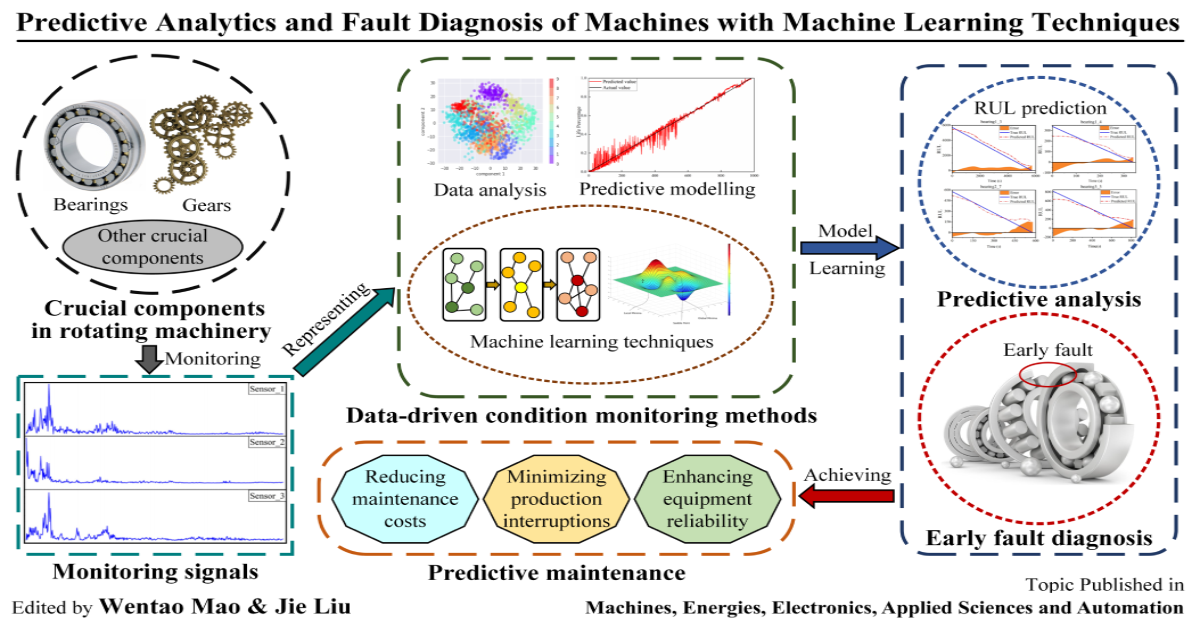
This Topic focuses on cutting-edge subjects in the industrial sector, exploring how predictive analytics and machine fault diagnosis can enhance production efficiency and equipment reliability. With the emergence of Industry 4.0, data-driven decision-making and innovative maintenance strategies have become the cornerstone of the industry. This Topic delves into the methods of employing data analysis, predictive modeling, and machine learning techniques to achieve machine health monitoring and early fault diagnosis, ultimately reducing maintenance costs, minimizing production interruptions, and enhancing equipment reliability. We pay particular attention to critical components in rotating machinery, such as bearings, which play a pivotal role in industrial manufacturing. Through state monitoring and fault diagnosis, alongside emerging technologies like deep learning, one may accurately diagnose machine conditions and proactively engage in predictive maintenance. This Topic is designed to foster collaboration between industry and academia, driving innovation in methods and applications to meet the demands of modern industrial production. We eagerly anticipate research findings in this critical field, which will provide the industry with more efficient and reliable production methods.

Prof. Dr. Wentao Mao
Dr. Jie Liu
Topic Editors

Keywords

  • fault diagnostics
  • remaining useful life prediction
  • predictive maintenance
  • condition monitoring
  • real-time
  • machine learning
  • deep learning

Participating Journals

Journal Name Impact Factor CiteScore Launched Year First Decision (median) APC
Applied Sciences
applsci
2.5 5.5 2011 16 Days CHF 2400 Submit
Automation
automation
2.0 4.1 2020 30.9 Days CHF 1200 Submit
Electronics
electronics
2.6 6.1 2012 16.4 Days CHF 2400 Submit
Energies
energies
3.2 7.3 2008 16.8 Days CHF 2600 Submit
Machines
machines
2.5 4.7 2013 17.6 Days CHF 2400 Submit

Preprints.org is a multidisciplinary platform offering a preprint service designed to facilitate the early sharing of your research. It supports and empowers your research journey from the very beginning.

MDPI Topics is collaborating with Preprints.org and has established a direct connection between MDPI journals and the platform. Authors are encouraged to take advantage of this opportunity by posting their preprints at Preprints.org prior to publication:

  1. Share your research immediately: disseminate your ideas prior to publication and establish priority for your work.
  2. Safeguard your intellectual contribution: Protect your ideas with a time-stamped preprint that serves as proof of your research timeline.
  3. Boost visibility and impact: Increase the reach and influence of your research by making it accessible to a global audience.
  4. Gain early feedback: Receive valuable input and insights from peers before submitting to a journal.
  5. Ensure broad indexing: Web of Science (Preprint Citation Index), Google Scholar, Crossref, SHARE, PrePubMed, Scilit and Europe PMC.

Published Papers (4 papers)

Order results
Result details
Journals
Select all
Export citation of selected articles as:
24 pages, 4351 KB  
Article
Monitoring of CO2 Efflux, Moisture, and Temperature in Soils of Agroecosystems in a Semi-Arid Region Using an Unmanned Aerial Vehicle and Application of Machine Learning
by Rodrigo Hemerson Lima e Silva, Elisiane Alba, Denizard Oresca, Jose Raliuson Inacio Silva, Alan Cezar Bezerra, Alexandre Maniçoba da Rosa Ferraz Jardim and Eduardo Souza
Appl. Sci. 2026, 16(8), 3943; https://doi.org/10.3390/app16083943 - 18 Apr 2026
Viewed by 137
Abstract
This study aimed to characterize the spatiotemporal dynamics of soil respiration (CO2 efflux), soil moisture, and soil temperature across different land-use systems in a semi-arid environment through in situ monthly monitoring and to evaluate the potential of UAV-based imagery combined with Random [...] Read more.
This study aimed to characterize the spatiotemporal dynamics of soil respiration (CO2 efflux), soil moisture, and soil temperature across different land-use systems in a semi-arid environment through in situ monthly monitoring and to evaluate the potential of UAV-based imagery combined with Random Forest modeling to spatialize these variables within the agroforestry system. The variables were monitored monthly using an Infrared Gas Analyzer (IRGA) over 9 months, and UAV imagery was acquired at two distinct time points. The 11-month experimental campaign enabled evaluation of seasonal and spatial variability and of soil physical and hydraulic properties. Soil CO2 efflux ranged from 1.0 to 6.7 μmol m−2 s−1, with higher values observed during the rainy period, closely following soil moisture dynamics. Soil moisture and temperature exhibited clear seasonal patterns driven by rainfall variability. The pasture system showed higher CO2 efflux in most months, while AFS2 presented more stable fluxes over time. In contrast, AFS1 exhibited lower CO2 efflux, likely associated with its soil characteristics. Despite these patterns, no significant differences were observed among land-use systems for most soil physical properties. UAV-derived data combined with machine learning techniques proved effective for modeling soil CO2 efflux, soil temperature, and soil moisture, demonstrating their potential for monitoring soil processes in semi-arid environments. Overall, agroforestry systems did not significantly differ from other land uses in terms of CO2 efflux, likely due to their early stage of development. These findings indicate that the effects of agroforestry systems on soil processes occur gradually and highlight the importance of long-term monitoring to fully capture system dynamics. Full article
Show Figures

Figure 1

35 pages, 1626 KB  
Article
Implementation of the RCM Methodology as a Technical Analysis for Maintenance and Innovation for Hydroelectric Power Plants
by Francisco Javier Martínez Monseco, Emilio Gómez Lázaro and Sergio Martín Martínez
Energies 2026, 19(6), 1394; https://doi.org/10.3390/en19061394 - 10 Mar 2026
Viewed by 427
Abstract
Hydroelectric power plants are renewable electricity generation assets that require high availability and reliability in their operation and maintenance. To justify improvement actions (modernization and investments), it is necessary to analyze the operation of the plant, the maintenance plan being implemented, and, naturally, [...] Read more.
Hydroelectric power plants are renewable electricity generation assets that require high availability and reliability in their operation and maintenance. To justify improvement actions (modernization and investments), it is necessary to analyze the operation of the plant, the maintenance plan being implemented, and, naturally, the incidents and breakdowns that affect this asset. This paper presents research on hydroelectric power plant maintenance based on the development of a database of incidents and failures of such plants, considering the methodology of failure modes, effects and criticality analysis (FMECA) as well as the reliability-centered maintenance (RCM) methodology of the initial maintenance plan of a standard hydroelectric power plant. Different maintenance standards and analysis standards (IATF criticality of failure modes, UNE 13306, ISO 14224, etc.) were considered. The results reveal different improvement and optimization actions based on the current technological development, which can be applied to hydroelectric generation (Innovation 4.0), as well as actions to optimize the initial maintenance plan based on Maintenance 4.0. The technical justification for such improvements in hydropower generation highlights a key area of development in the expansion of renewable energies worldwide. Hydropower generation assets have contributed renewable energy to the system for many years; however, they now require redesign in their operation and maintenance. Full article
Show Figures

Figure 1

82 pages, 6468 KB  
Article
Correction Functions and Refinement Algorithms for Enhancing the Performance of Machine Learning Models
by Attila Kovács, Judit Kovácsné Molnár and Károly Jármai
Automation 2026, 7(2), 45; https://doi.org/10.3390/automation7020045 - 6 Mar 2026
Viewed by 839
Abstract
The aim of this study is to investigate and demonstrate the role of correction functions and optimisation-based refinement algorithms in enhancing the performance of machine learning models, particularly in predictive anomaly detection tasks applied in industrial environments. The performance of machine learning models [...] Read more.
The aim of this study is to investigate and demonstrate the role of correction functions and optimisation-based refinement algorithms in enhancing the performance of machine learning models, particularly in predictive anomaly detection tasks applied in industrial environments. The performance of machine learning models is highly dependent on the quality of data preprocessing, model architecture, and post-processing methodology. In many practical applications—particularly in time-series forecasting and anomaly detection—the conventional training pipeline alone is insufficient, because model uncertainty, structural bias and the handling of rare events require specialised post hoc calibration and refinement mechanisms. This study provides a systematic overview of the role of correction functions (e.g., Principal Component Analysis (PCA), Squared Prediction Error (SPE)/Q-statistics, Hotelling’s T2, Bayesian calibration) and adaptive improvement algorithms (e.g., Genetic Algorithms (GA), Particle Swarm Optimisation (PSO), Simulated Annealing (SA), Gaussian Mixture Model (GMM) and ensemble-based techniques) in enhancing the performance of machine learning pipelines. The models were trained on a real industrial dataset compiled from power network analytics and harmonic-injection-based loading conditions. Model validation and equipment-level testing were performed using a large-scale harmonic measurement dataset collected over a five-year period. The reliability of the approach was confirmed by comparing predicted state transitions with actual fault occurrences, demonstrating its practical applicability and suitability for integration into predictive maintenance frameworks. The analysis demonstrates that correction functions introduce deterministic transformations in the data or error space, whereas improvement algorithms apply adaptive optimisation to fine-tune model parameters or decision boundaries. The combined use of these approaches significantly reduces overfitting, improves predictive accuracy and lowers false alarm rates. This work introduces the concept of an Organically Adaptive Predictive (OAP) ML model. The proposed model presents organic adaptivity, continuously adjusting its predictive behaviour in response to dynamic variations in network loading and harmonic spectrum composition. The introduced terminology characterises the organically emergent nature of the adaptive learning mechanism. Full article
Show Figures

Figure 1

21 pages, 3957 KB  
Article
Aero-Engine Fault Diagnosis Method Based on DANN and Feature Interaction
by Wei Huo, Baoshan Zhang and Feng Zhou
Machines 2026, 14(1), 96; https://doi.org/10.3390/machines14010096 - 13 Jan 2026
Viewed by 365
Abstract
The fault data of the aero-engine source domain are constrained by factors such as variable operating conditions, structural coupling, fault correlations, and information attenuation. Consequently, the obtained fault features often exhibit localities. This leads to significant discrepancies in fault feature distributions between the [...] Read more.
The fault data of the aero-engine source domain are constrained by factors such as variable operating conditions, structural coupling, fault correlations, and information attenuation. Consequently, the obtained fault features often exhibit localities. This leads to significant discrepancies in fault feature distributions between the source and target domains, resulting in poor generalization capabilities and insufficient stability in aero-engine fault diagnosis. To address these issues, an aero-engine fault diagnosis method based on Domain-Adversarial Neural Network (DANN) and Feature Interaction (FI-DANN) is proposed. Firstly, a fault diagnosis network architecture is designed based on traditional DANN by incorporating a feature interaction module into its feature extractor. Secondly, the Kronecker product is employed to fully excavate nonlinear relationships between the features, thereby increasing the number of fault features to obtain higher-dimensional and more accurate fault features. Finally, based on information entropy theory, the number of interacted features is controlled through a weighted combination, ensuring that the retained features possess greater fault information content. This guarantees the strong generalization capability and high stability of the model. The experimental results show that the best fault diagnosis accuracies of Convolutional Neural Network (CNN), traditional DANN, and FI-DANN are 79.64%, 90.00%, and 99.03%, respectively, indicating that the proposed FI-DANN can effectively integrate multi-source fault information and enhance the accuracy, stability, and generalization capability of fault diagnosis models. Full article
Show Figures

Figure 1

Back to TopTop