
Topic Editors


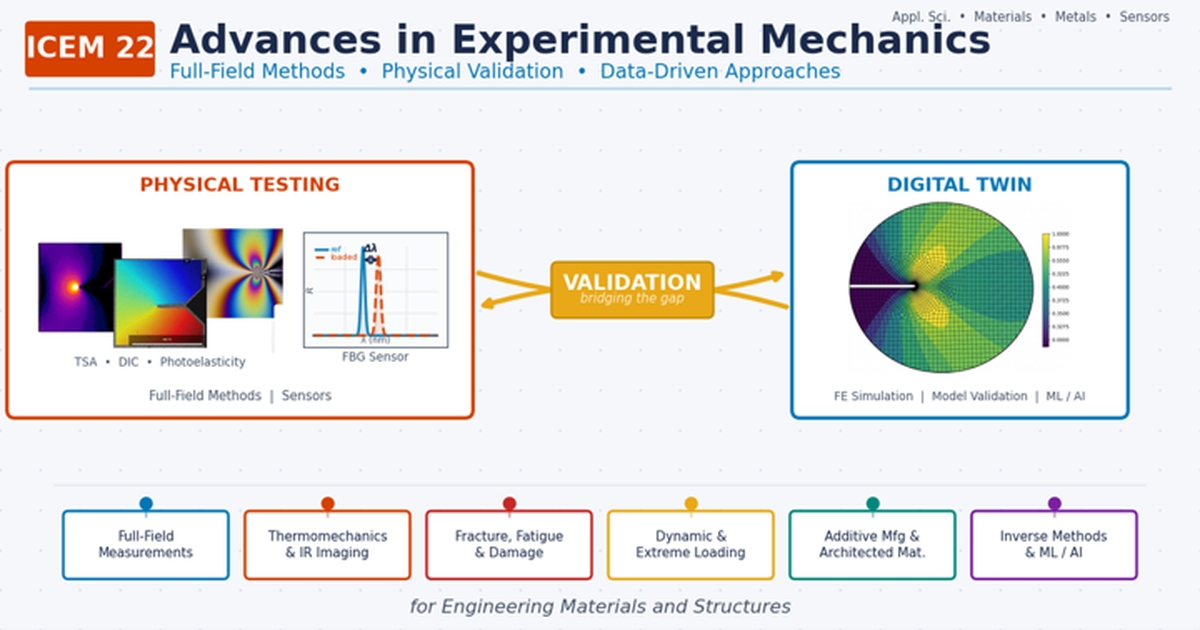
Advances in Experimental Mechanics: Full-Field Methods, Physical Validation, and Data-Driven Approaches for Engineering Materials and Structures
Topic Information
Dear Colleagues,
We are pleased to invite contributions to this Topic, organised in alignment with the 22nd International Conference on Experimental Mechanics (ICEM 22).
The rapid advancement of high-resolution sensing methods is transforming the way engineers interrogate the mechanical behaviour of materials and components under service-representative conditions. As engineering increasingly embraces digital twins, additive manufacturing, and automated design, the demand for high-fidelity physical validation has never been greater. Because simulations are only as reliable as their anchoring parameters, experimental mechanics serves as the ultimate arbiter of truth, bridging the gap between virtual modelling and real-world performance to ensure safety, longevity, and optimisation across regulated industries.
This Topic aims to gather original research and review articles presenting recent methodological advances and novel applications across the full breadth of experimental mechanics. Research areas may include (but are not limited to):
- Full-field optical and thermal measurement techniques (DIC, DVC, thermoelastic stress analysis, infrared thermography, photoelasticity, etc.);
- Advanced sensing, instrumentation, and non-destructive evaluation for structural integrity and health monitoring;
- Dynamic behaviour of materials and structures under impact, shock, blast, and extreme loading conditions;
- Fracture, fatigue, and time-dependent damage: experimental characterisation and life prediction;
- Mechanics of additively manufactured, composite, architected, and sustainable materials;
- Inverse methods, physics-informed machine learning, and hybrid experimental–computational frameworks for model validation.
Prof. Dr. Dario Croccolo
Prof. Dr. Giuseppe Pitarresi
Topic Editors
Keywords
- experimental mechanics
- full-field measurements
- digital image correlation
- infrared thermography
- non-destructive evaluation
- structural health monitoring
- fatigue and fracture
- additive manufacturing
- inverse methods
- hybrid experimental–computational validation
Participating Journals
| Journal Name | Impact Factor | CiteScore | Launched Year | First Decision (median) | APC | |
|---|---|---|---|---|---|---|

Applied Sciences
|
2.9 | 6.1 | 2011 | 15 Days | CHF 2400 | Submit |

Materials
|
3.7 | 7.0 | 2008 | 14.4 Days | CHF 2600 | Submit |

Metals
|
3.1 | 5.7 | 2011 | 15.3 Days | CHF 2600 | Submit |

Sensors
|
4.0 | 9.4 | 2001 | 17.8 Days | CHF 2600 | Submit |

Preprints.org is a multidisciplinary platform offering a preprint service designed to facilitate the early sharing of your research. It supports and empowers your research journey from the very beginning.
MDPI Topics is collaborating with Preprints.org and has established a direct connection between MDPI journals and the platform. Authors are encouraged to take advantage of this opportunity by posting their preprints at Preprints.org prior to publication:
- Share your research immediately: disseminate your ideas prior to publication and establish priority for your work.
- Safeguard your intellectual contribution: Protect your ideas with a time-stamped preprint that serves as proof of your research timeline.
- Boost visibility and impact: Increase the reach and influence of your research by making it accessible to a global audience.
- Gain early feedback: Receive valuable input and insights from peers before submitting to a journal.
- Ensure broad indexing: Web of Science (Preprint Citation Index), Google Scholar, Crossref, SHARE, PrePubMed, Scilit and Europe PMC.
