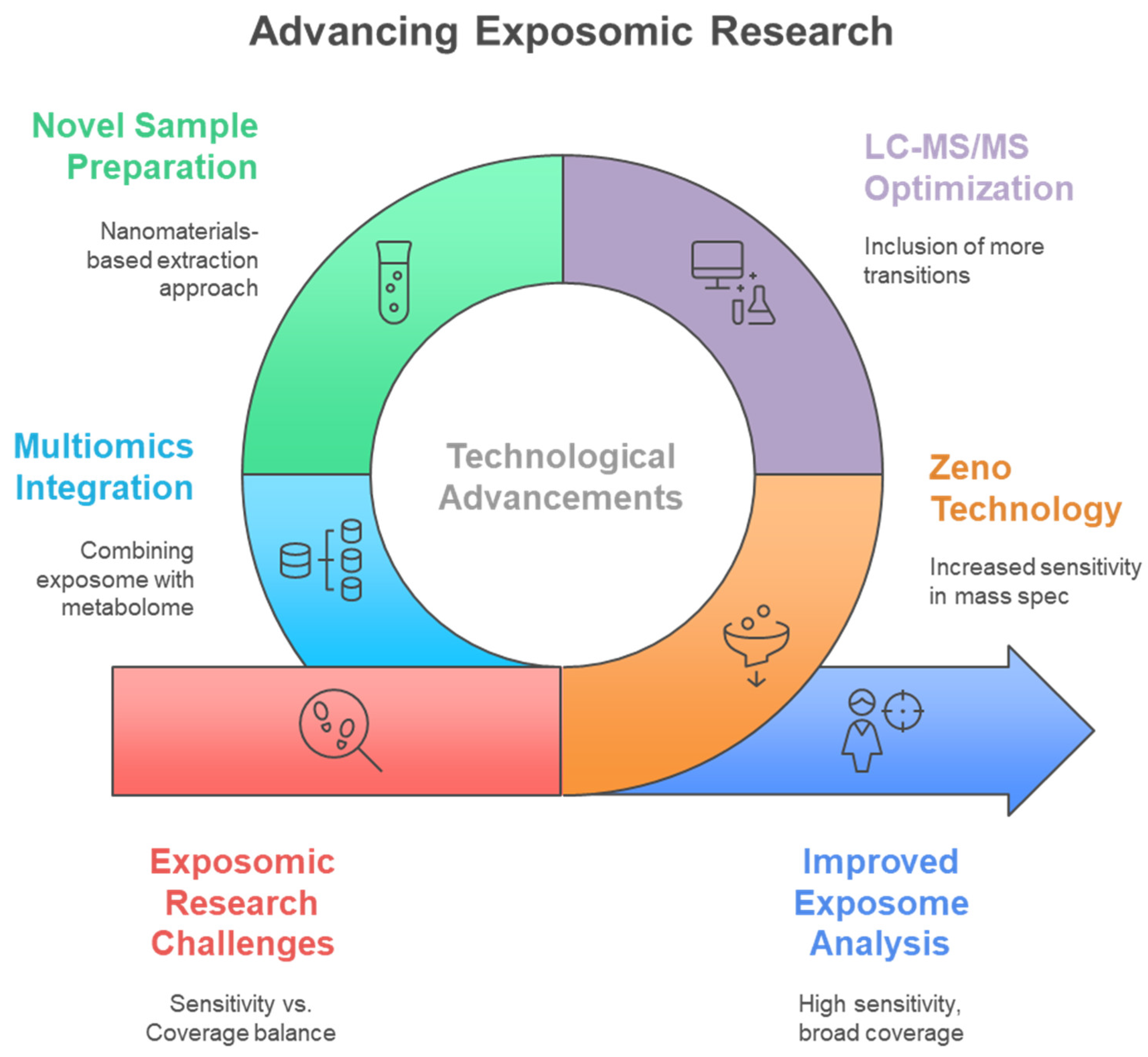


Multiclass Assays for Measuring Environmental Chemical Mixture Exposure: Analytical Methodologies and Applications in Exposomics Research
 , , , , , , and
Abstract
1. Introduction
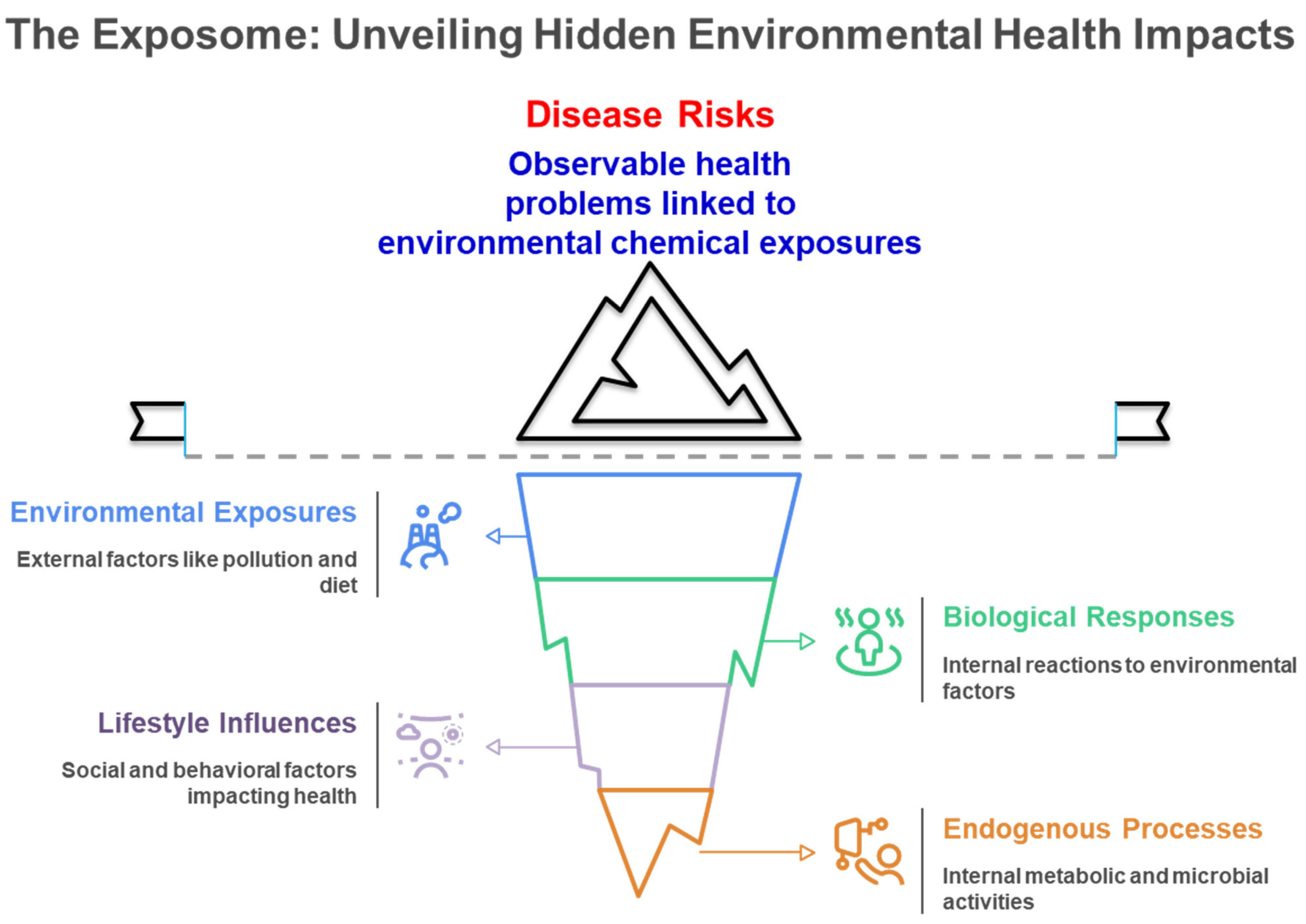
1.1. The Exposome Paradigm and Environmental Health
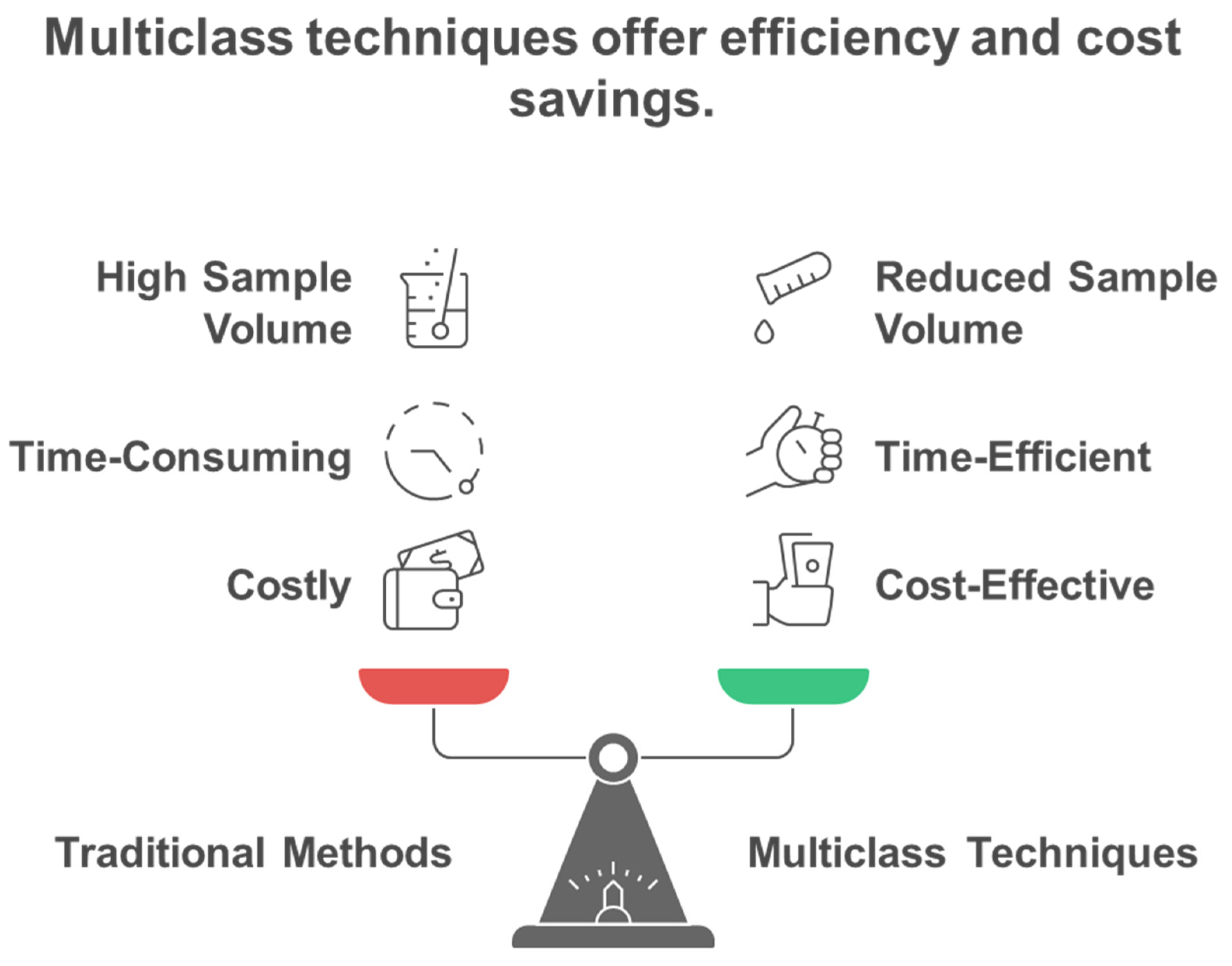
1.2. Evolution of Multiclass Analytical Approaches
1.3. Scope and Objectives of This Narrative Review
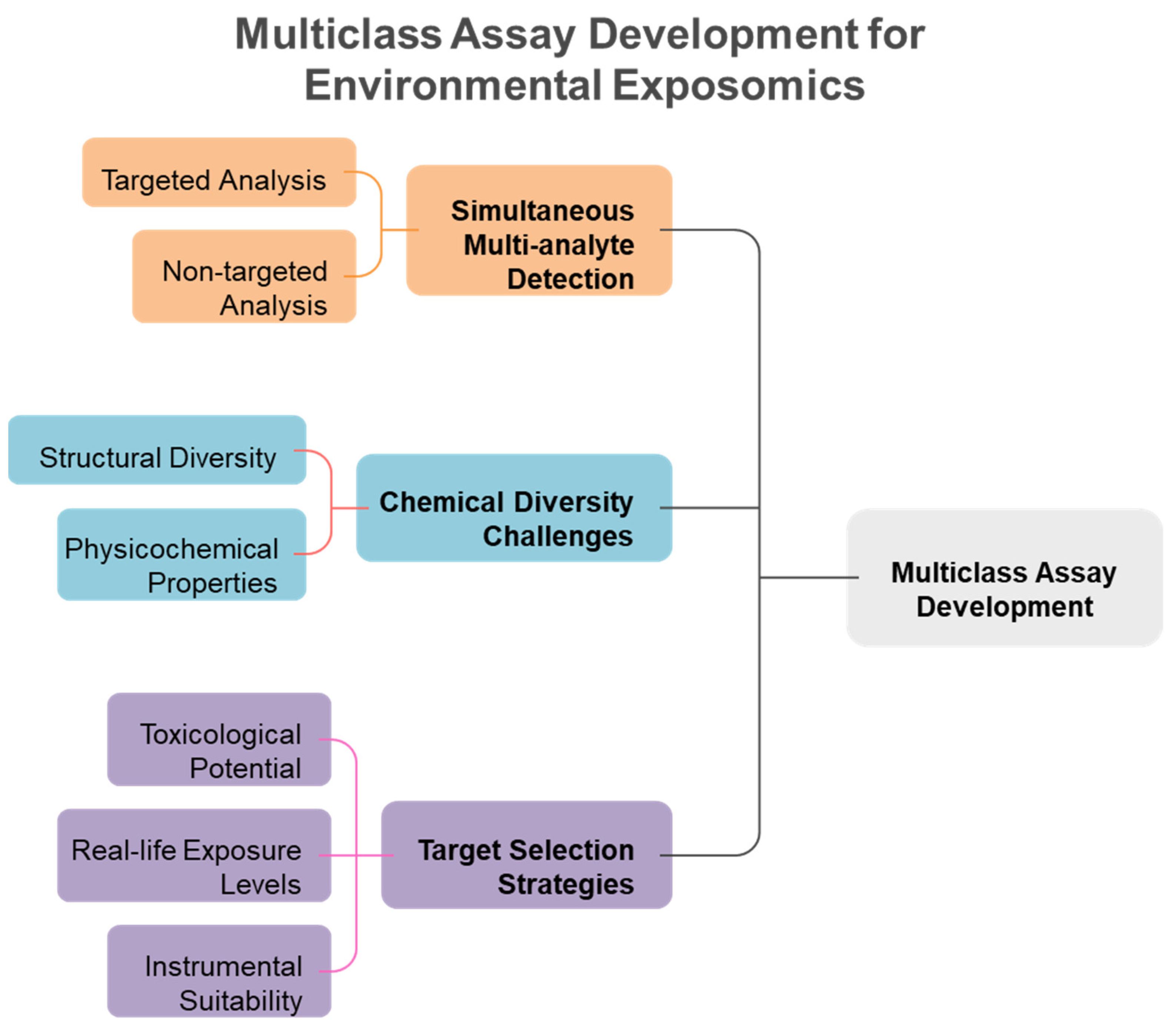
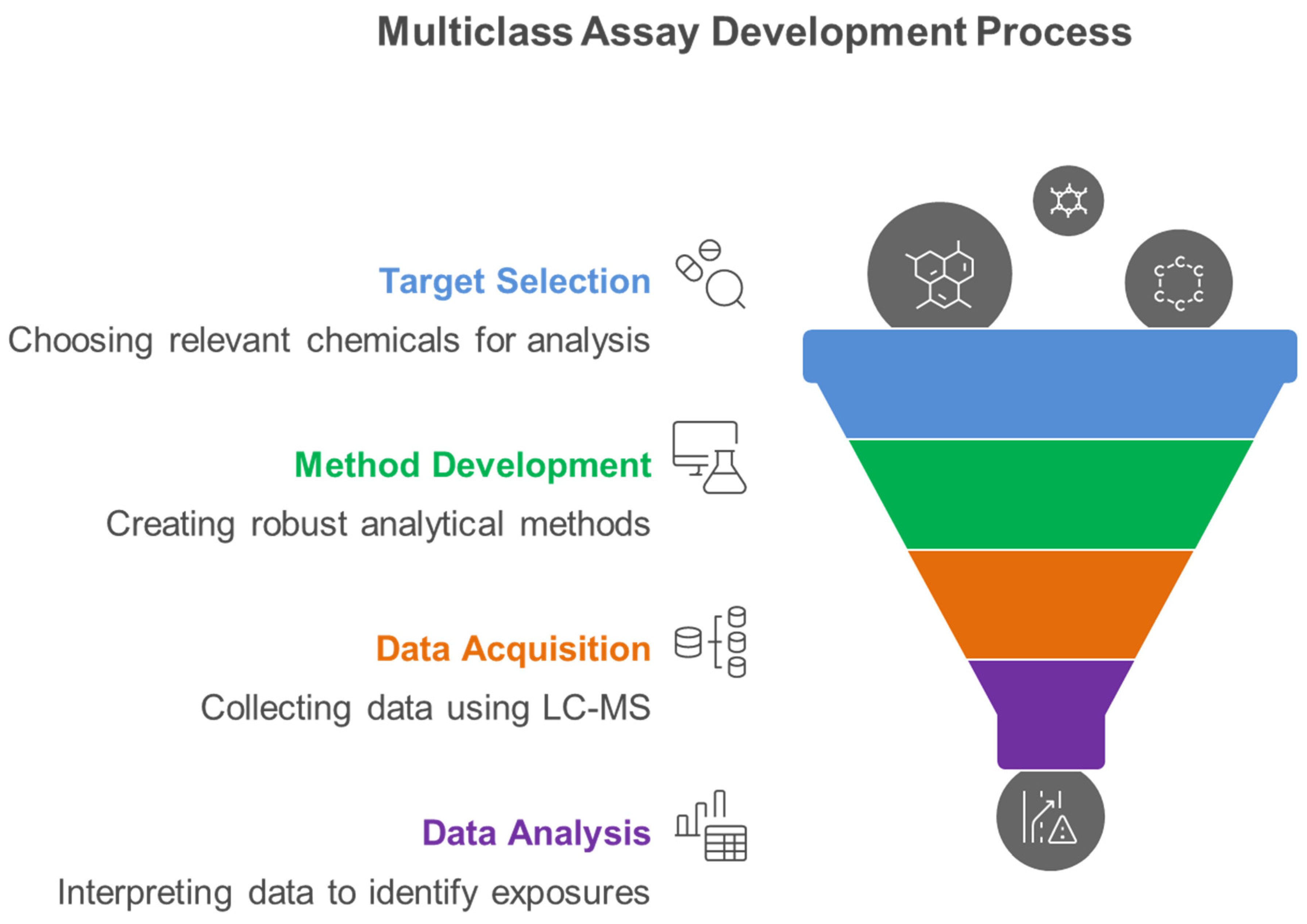
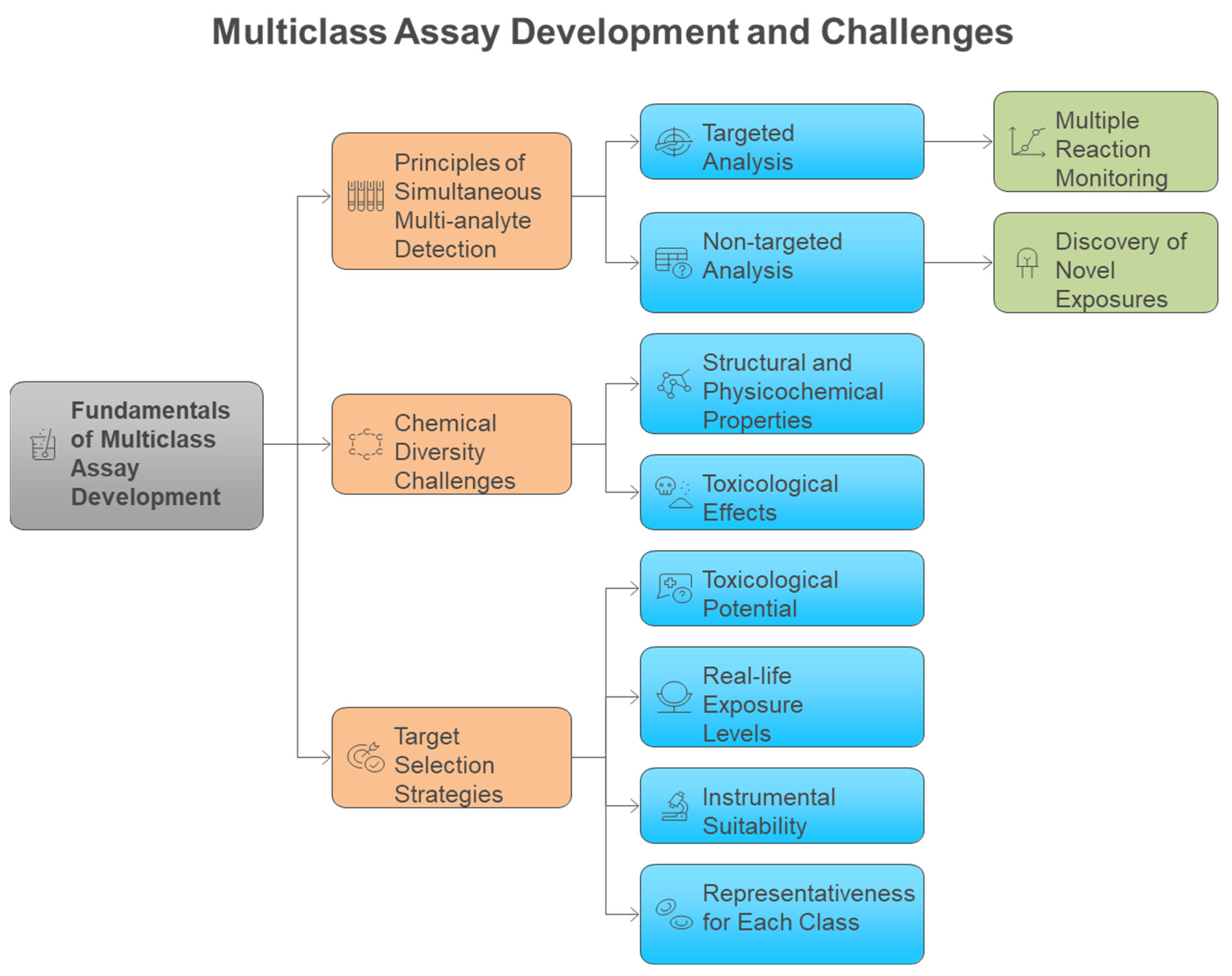
2. Fundamentals of Multiclass Assay Development
2.1. Principles of Simultaneous Multi-Analyte Detection
2.2. Chemical Diversity Challenges in Environmental Exposomics
2.3. Target Selection Strategies for Comprehensive Coverage
3. Mass Spectrometry Platforms for Multiclass Analysis
3.1. Triple Quadrupole Mass Spectrometry (QQQ-MS/MS)
3.1.1. Multiple Reaction Monitoring (MRM) Optimization
3.1.2. Sensitivity and Selectivity Considerations
3.2. High-Resolution Mass Spectrometry (HRMS)
3.2.1. Data-Dependent and Data-Independent Acquisition Approaches
3.2.2. Accurate Mass Determination and Structural Elucidation
3.3. Hybrid Approaches and Method Integration
4. Sample Preparation Strategies for Diverse Chemical Classes
4.1. Extraction Method Development and Optimization
4.1.1. Liquid–Liquid Extraction Approaches
4.1.2. Solid-Phase Extraction Techniques
4.1.3. Passive Equilibrium Sampling Methods
4.2. Matrix-Specific Considerations
4.2.1. Biological Matrix Challenges
4.2.2. Environmental Sample Complexity
4.3. Recovery and Matrix Effect Assessment
5. Chromatographic Separation Strategies
5.1. Reversed-Phase Liquid Chromatography
5.2. Mixed-Mode and Ion Exchange Chromatography
5.3. Column-Switching and Multi-Dimensional Approaches
5.4. Large Volume Injection Techniques
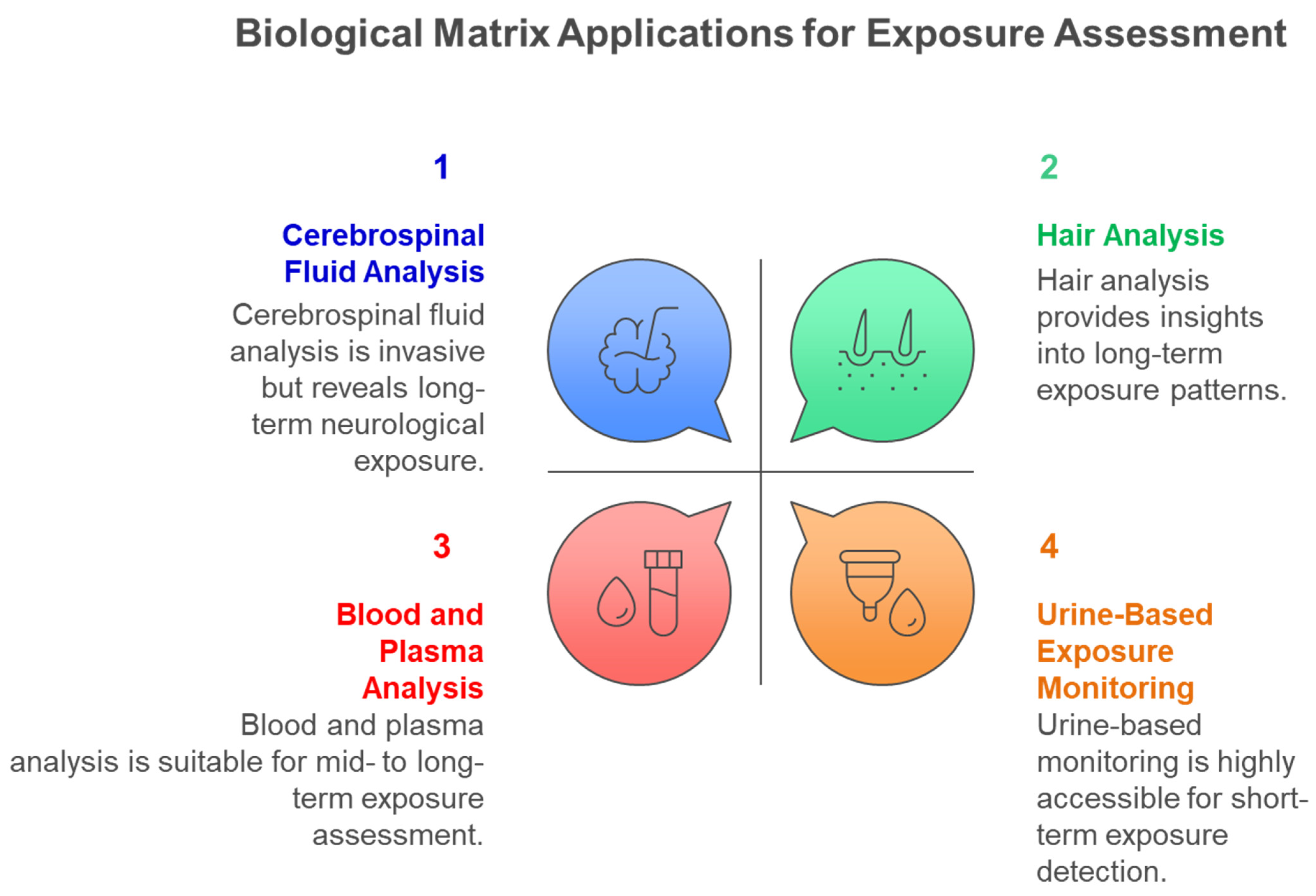
6. Biological Matrix Applications
6.1. Blood and Plasma Analysis
6.1.1. Comprehensive Plasma Exposome Characterization
6.1.2. Longitudinal Exposure Assessment
6.2. Urine-Based Exposure Monitoring
6.2.1. Pediatric Population Studies
6.2.2. Adult Exposure Patterns
6.3. Alternative Matrices for Exposure Assessment
6.3.1. Hair Analysis for Long-Term Exposure
6.3.2. Cerebrospinal Fluid for Neurological Exposure
7. Method Validation and Quality Assurance
7.1. Analytical Performance Criteria
7.1.1. Sensitivity and Detection Limits
7.1.2. Precision and Accuracy Assessment
7.2. Matrix Effect Evaluation
7.3. Reference Materials and Standardization
7.4. Practical Solutions for Standardizing Methods Between Different Laboratories
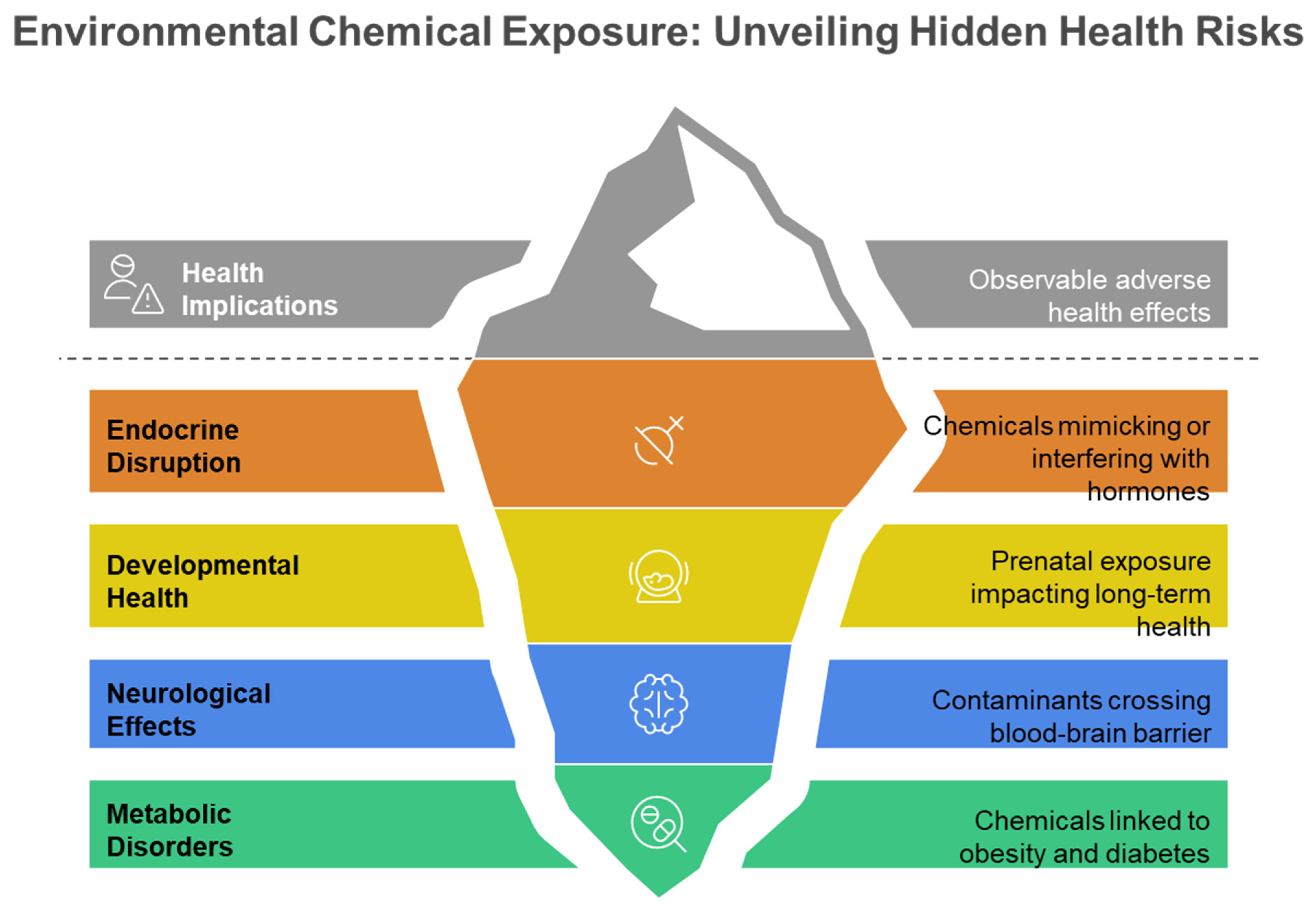
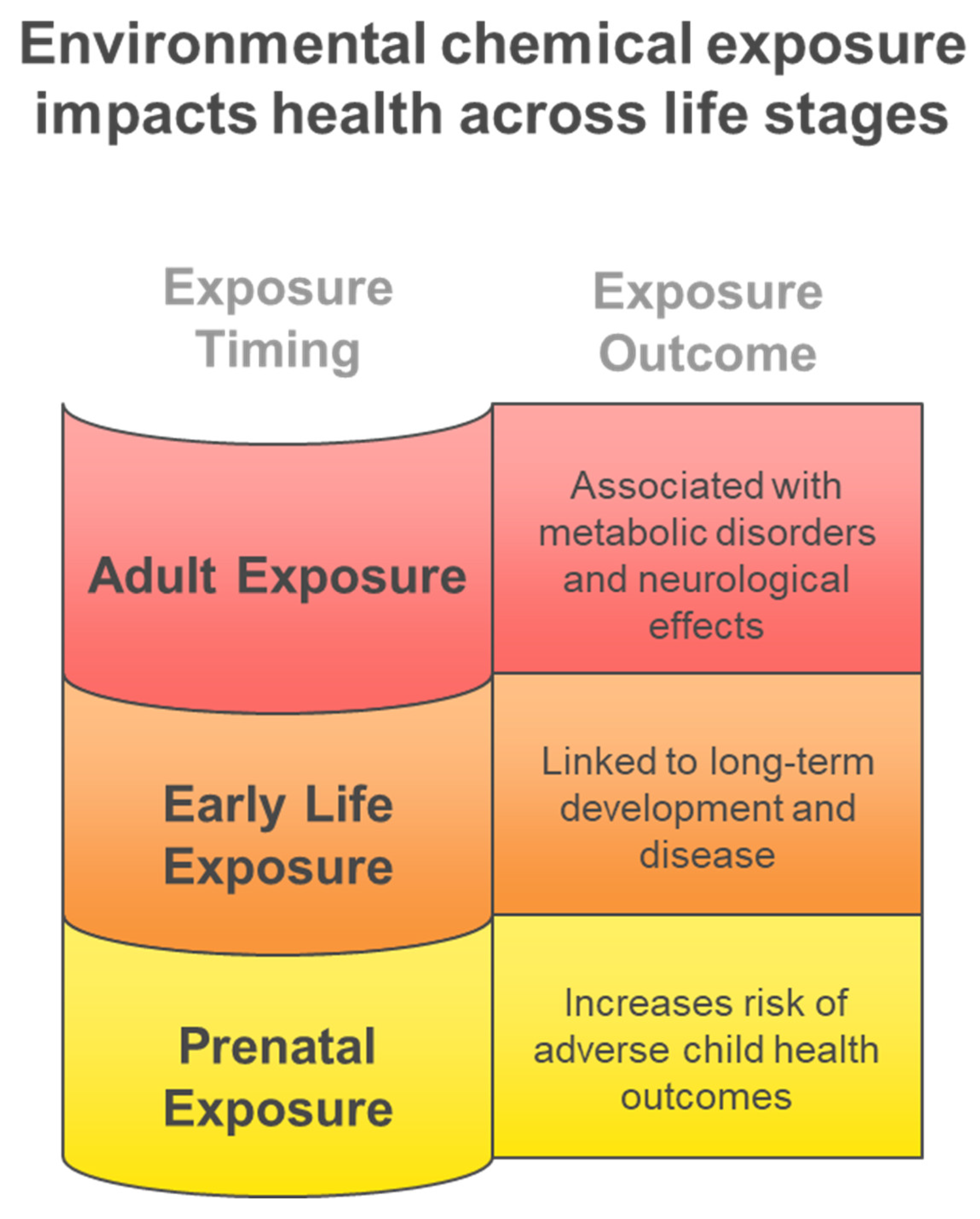
8. Health Implications and Exposure-Response Relationships
9. Current Challenges and Limitations
9.1. Analytical Challenges
9.1.1. Chemical Diversity and Physicochemical Properties
9.1.2. Sensitivity Requirements for Trace Analysis
9.2. Biological and Environmental Complexity
9.3. Data Integration and Interpretation
9.4. Practical Considerations for Selecting Analytical Methods
9.5. Ethical and Sampling Considerations for Invasive Procedures
10. Future Directions and Emerging Trends
10.1. Technological Advances in Mass Spectrometry
10.2. Novel Sample Preparation Approaches
10.3. Integration with Other Omics Technologies
10.4. Artificial Intelligence and Machine Learning Applications
11. Conclusions and Recommendations
Author Contributions
Funding
Institutional Review Board Statement
Informed Consent Statement
Data Availability Statement
Acknowledgments
Conflicts of Interest
Abbreviations
| 2,4-D | 2,4-dichlorophenoxyacetic acid |
| 2D-LC | Two-Dimensional Liquid Chromatography |
| 2D-LC-HRMS | Two-Dimensional Liquid Chromatography-High-Resolution Mass Spectrometry |
| 3-keto-LCA | 3-keto-lithocholic acid |
| 4-tOP | 4-tert octylphenol |
| AAMA | N-acetyl-S-(2-carbamoylethyl)-L-cysteine |
| ACN | Acetonitrile |
| AO2246 | 2,2′-methylenebis(4-methyl-6-tert-butylphenol) |
| BCPP | Bis(1-chloro-2-propyl) phosphate |
| BDCIPP | Bis(1,3-dichloro-2-propyl) Phosphate |
| BEH | Bridged ethyl hybrid |
| BHA | Butylated hydroxyanisole |
| BHT | Butylated Hydroxytoluene |
| BP-3 | Benzophenone-3 |
| BPA | Bisphenol A |
| BPB | Bisphenol B |
| BPS | Bisphenol S |
| BPF | Bisphenol F |
| BRPs | Brominated Phenols |
| CDCCA | Cis-3-(2,2-dichlorovinyl)-2,2-dimethyl-cyclopropane-1-carboxylic acid |
| CECs | Contaminants of Emerging Concern |
| CEMA | N-acetyl-S-(2-carboxyethyl)-L-cysteine |
| CINA6 | 6-chloronicotinic acid |
| CSF | Cerebrospinal fluid |
| CV | Coefficient of variation |
| DBUP | Dibutyl phosphate |
| DBS | Dried blood spots |
| DDA | Data-dependent acquisition |
| DEHP | Di-2-ethylhexyl phthalate |
| DIA | Data-independent acquisition |
| DiNP | Di-iso-nonyl phthalate |
| DMDP | Dimethyldithiophosphate |
| DMTP | Dimethylthiophosphate |
| DOCP | Diphenyl cresyl phosphate |
| DPCP | Diphenyl phenyl phosphate |
| DPG | 1,3-Diphenylguanidine |
| DPHP | Diphenyl Phosphate |
| EC | European Commission |
| ECHO | Environmental influences on Child Health Outcomes |
| EPOLs | Environmental Pollutants |
| ETL | Enterolactone |
| EQU | Equol |
| FLUO2 | 2-hydroxyfluorene |
| GC | Gas Chromatography |
| GC-MS | Gas chromatography-mass spectrometry |
| GC-HRMS | Gas Chromatography-High-Resolution Mass Spectrometry |
| GCDCA | Glycochenodeoxycholic acid |
| GDM | Gestational Diabetes Mellitus |
| G-EQUAS | German External Quality Assessment Scheme |
| GUDCA | Glycoursodeoxycholic acid |
| HEMA2 | N-acetyl-S-(2-hydroxyethyl)cysteine |
| HHEAR | Human Health Exposure Analysis Resource |
| HILIC | Hydrophilic Interaction Liquid Chromatography |
| HLB | Hydrophilic-lipophilic balance |
| HPMA | N-acetyl-S-(3-hydroxypropyl)-L-cysteine |
| HRMS | High-Resolution Mass Spectrometry |
| HSS | High strength silica |
| ICH | International Conference on Harmonization |
| IS | Internal Standard |
| LC | Liquid Chromatography |
| LLE | Liquid–Liquid Extraction |
| LC-ESI-MS/MS | Liquid Chromatography-Electrospray Ionization-Tandem Mass Spectrometry |
| LC-HRMS | Liquid Chromatography-High-Resolution Mass Spectrometry |
| LC-MS/MS | Liquid Chromatography-Tandem Mass Spectrometry |
| LOD | Limit of detection |
| LOQ | Limit of quantification |
| MBP | Mono-n-butyl phthalate |
| MEHP | Mono-2-ethylhexyl phthalate |
| MeOH | Methanol |
| MEOHP | Mono-2-ethyl-5-oxohexyl phthalate |
| MIBP | Mono-isobutyl phthalate |
| MMP | Monomethyl phthalate |
| NAP1 | 1-naphthol |
| NAP2 | 2-naphthol |
| NH4F | Ammonium fluoride |
| OH-PAHs | Hydroxyl Polycyclic Aromatic Hydrocarbons |
| OH-PBDEs | Hydroxyl Polybrominated Diphenyl Ethers |
| OSEQAS | Organic Substances in Urine Quality Assessment Scheme |
| PAHs | Polycyclic aromatic hydrocarbons |
| PBA | 3-Phenoxybenzoic acid |
| PES | Passive Equilibrium Sampling |
| PFP | Pentafluorophenyl |
| PFAS | Per- and polyfluoroalkyl substances |
| PFBA | Perfluorobutanoic acid |
| PFBS | Perfluorobutanesulfonic acid |
| PFDA | Perfluorodecanoic Acid |
| PFOA | Perfluorooctanoic acid |
| PFOS | Perfluorooctanesulfonic acid |
| PFHxS | Perfluorohexanesulfonic acid |
| PFNA | Perfluorononanoate |
| PHEN3 | 3-hydroxyphenanthrene |
| PNP | 4-Nitrophenolperfluorononanoate |
| QC | Quality control |
| QTrap | Quadrupole ion trap |
| RP | Reversed phase |
| RSD | Relative standard deviation |
| SPE | Solid-phase extraction |
| SRM | Standard Reference Material |
| SSE | Signal suppression/enhancement |
| SST | Systems suitability test |
| SWATH | Sequential window acquisition of all theoretical fragments |
| TCIPP | Tris(2-chloroisopropyl) phosphate |
| TCP | Trichloro-pyridinol |
| Trans-DCCA | Trans-3-(2,2-dichlorovinyl)-2,2-dimethylcyclopropane carboxylic acid |
| TEP | Triethyl phosphate |
| TPHP | Triphenyl phosphate |
| UHPLC | Ultra-high performance liquid chromatography |
| VOCs | Volatile Organic Compounds |
| ZEN | Zearalenone |
References
- Wild, C.P. The exposome: From concept to utility. Int. J. Epidemiol. 2012, 41, 24–32. [Google Scholar] [CrossRef]
- Wild, C.P. Complementing the genome with an “exposome”: The outstanding challenge of environmental exposure measurement in molecular epidemiology. Cancer Epidemiol. Biomark. Prev. 2005, 14, 1847–1850. [Google Scholar] [CrossRef]
- Niedzwiecki, M.M.; Walker, D.I.; Vermeulen, R.; Chadeau-Hyam, M.; Jones, D.P.; Miller, G.W. The Exposome: Molecules to Populations. Annu. Rev. Pharmacol. Toxicol. 2019, 59, 107–127. [Google Scholar] [CrossRef]
- Vineis, P.; Robinson, O.; Chadeau-Hyam, M.; Dehghan, A.; Mudway, I.; Dagnino, S. What is new in the exposome? Env. Int. 2020, 143, 105887. [Google Scholar] [CrossRef]
- Cui, Y.; Balshaw, D.M.; Kwok, R.K.; Thompson, C.L.; Collman, G.W.; Birnbaum, L.S. The Exposome: Embracing the Complexity for Discovery in Environmental Health. Env. Health Perspect. 2016, 124, A137–A140. [Google Scholar] [CrossRef]
- Gago-Ferrero, P.; Cousins, I.; Ghassabian, A.; Lamoree, M.; Schlenk, D.; Toms, L.M.; Wang, B.; Zimmerman, J. The Exposome and Human Health. Env. Sci. Technol. 2025, 59, 991–992. [Google Scholar] [CrossRef]
- Miller, G.W.; Jones, D.P. The nature of nurture: Refining the definition of the exposome. Toxicol. Sci. 2014, 137, 1–2. [Google Scholar] [CrossRef]
- Rappaport, S.M. Genetic Factors Are Not the Major Causes of Chronic Diseases. PLoS ONE 2016, 11, e0154387. [Google Scholar] [CrossRef] [PubMed]
- Chung, M.K.; Rappaport, S.M.; Wheelock, C.E.; Nguyen, V.K.; van der Meer, T.P.; Miller, G.W.; Vermeulen, R.; Patel, C.J. Utilizing a Biology-Driven Approach to Map the Exposome in Health and Disease: An Essential Investment to Drive the Next Generation of Environmental Discovery. Env. Health Perspect. 2021, 129, 85001. [Google Scholar] [CrossRef] [PubMed]
- Peters, A.; Hoek, G.; Katsouyanni, K. Understanding the link between environmental exposures and health: Does the exposome promise too much? J. Epidemiol. Community Health 2012, 66, 103–105. [Google Scholar] [CrossRef] [PubMed]
- Preindl, K.; Braun, D.; Aichinger, G.; Sieri, S.; Fang, M.; Marko, D.; Warth, B. A Generic Liquid Chromatography-Tandem Mass Spectrometry Exposome Method for the Determination of Xenoestrogens in Biological Matrices. Anal. Chem. 2019, 91, 11334–11342. [Google Scholar] [CrossRef]
- Jagani, R.; Pulivarthi, D.; Patel, D.; Wright, R.J.; Wright, R.O.; Arora, M.; Wolff, M.S.; Andra, S.S. Validated single urinary assay designed for exposomic multi-class biomarkers of common environmental exposures. Anal. Bioanal. Chem. 2022, 414, 5943–5966. [Google Scholar] [CrossRef]
- Lee, S.; Lee, K.M.; Han, S.M.; Lee, H.-J.; Sung, C.; Min, H.; Im, H.; Han, S.B.; Cha, S.; Lee, J. Comprehensive LC-MS/MS method combined with tandem hybrid hydrolysis for multiple exposure assessment of multiclass environmental pollutants. Environ. Res. 2022, 211, 113053. [Google Scholar] [CrossRef]
- González-Domínguez, R.; Jáuregui, O.; Queipo-Ortuño, M.I.; Andrés-Lacueva, C. Characterization of the Human Exposome by a Comprehensive and Quantitative Large-Scale Multianalyte Metabolomics Platform. Anal. Chem. 2020, 92, 13767–13775. [Google Scholar] [CrossRef]
- Hu, X.; Walker, D.I.; Liang, Y.; Smith, M.R.; Orr, M.L.; Juran, B.D.; Ma, C.; Uppal, K.; Koval, M.; Martin, G.S.; et al. A scalable workflow to characterize the human exposome. Nat. Commun. 2021, 12, 5575. [Google Scholar] [CrossRef]
- Jamnik, T.; Flasch, M.; Braun, D.; Fareed, Y.; Wasinger, D.; Seki, D.; Berry, D.; Berger, A.; Wisgrill, L.; Warth, B. Next-generation biomonitoring of the early-life chemical exposome in neonatal and infant development. Nat. Commun. 2022, 13, 2653. [Google Scholar] [CrossRef] [PubMed]
- Gu, Y.; Peach, J.T.; Warth, B. Sample preparation strategies for mass spectrometry analysis in human exposome research: Current status and future perspectives. TrAC Trends Anal. Chem. 2023, 166, 117151. [Google Scholar] [CrossRef]
- Marín-Sáez, J.; Hernández-Mesa, M.; Cano-Sancho, G.; García-Campaña, A.M. Analytical challenges and opportunities in the study of endocrine disr upting chemicals within an exposomics framework. Talanta 2024, 279, 126616. [Google Scholar] [CrossRef] [PubMed]
- Braun, G.; Krauss, M.; Escher, B.I. Recovery of 400 Chemicals with Three Extraction Methods for Low Volumes of Human Plasma Quantified by Instrumental Analysis and In Vitro Bioassays. Environ. Sci. Technol. 2023, 57, 19363–19373. [Google Scholar] [CrossRef] [PubMed]
- Engelhardt, J.A.; Athanassiadis, I.; Leonards, P.E.G.; Weiss, J.M. Multi-target analysis of synthetic phenolic compounds in human blood. Talanta 2025, 292, 127899. [Google Scholar] [CrossRef]
- Fareed, Y.; Braun, D.; Flasch, M.; Globisch, D.; Warth, B. A broad, exposome-type evaluation of xenobiotic phase II biotransformation in human biofluids by LC-MS/MS. Exposome 2022, 2, osac008. [Google Scholar] [CrossRef]
- Flasch, M.; Fitz, V.; Rampler, E.; Ezekiel, C.N.; Koellensperger, G.; Warth, B. Integrated Exposomics/Metabolomics for Rapid Exposure and Effect Analyses. JACS Au 2022, 2, 2548–2560. [Google Scholar] [CrossRef]
- Gu, Y.; Feuerstein, M.L.; Warth, B. High-Throughput Solid Phase Extraction for Targeted and Nontargeted Exposomics. Anal. Chem. 2025, 97, 6075–6082. [Google Scholar] [CrossRef]
- Gu, Y.; Feuerstein, M.L.; Johnson, C.H.; Warth, B. High-performance quantitative exposomics covering up to> 230 toxicants and key biomarkers. ChemRxiv 2025. [Google Scholar] [CrossRef]
- Hernandes, V.V.; Warth, B. Modular, Scalable, and Customizable LC-HRMS for Exposomics. In Methods in Molecular Biology; Springer: New York, NY, USA, 2024; pp. 41–66. [Google Scholar]
- Hernandes, V.V.; Zeyda, M.; Wisgrill, L.; Warth, B. Dried blood spots analysis for targeted and non-targeted exposomics. medRxiv 2025, 205, 109814. [Google Scholar] [CrossRef] [PubMed]
- Hossain, M.Z.; Feuerstein, M.L.; Gu, Y.; Warth, B. Scaling up a targeted exposome LC-MS/MS biomonitoring method by incorporating veterinary drugs and pesticides. Anal. Bioanal. Chem. 2024, 416, 4369–4382. [Google Scholar] [CrossRef]
- Huang, W.; Pan, X.F.; Tang, S.; Sun, F.; Wu, P.; Yuan, J.; Sun, W.; Pan, A.; Chen, D. Target Exposome for Characterizing Early Gestational Exposure to Contaminants of Emerging Concern and Association with Gestational Diabetes Mellitus. Env. Sci. Technol. 2023, 57, 13408–13418. [Google Scholar] [CrossRef]
- Kunde, H.; Ioannou, E.I.; Chovatiya, J.; Jagani, R.; Charisiadis, P.; Arora, M.; Andra, S.S.; Makris, K.C. An exposomics analysis of 125 biomarkers of exposure to food contaminants and biomarkers of oxidative stress: A randomized cross-over chrononutrition trial of healthy adults. Env. Int. 2025, 202, 109682. [Google Scholar] [CrossRef]
- Lin, M.; Ma, S.; Yu, Y.; Li, G.; Mai, B.; An, T. Simultaneous Determination of Multiple Classes of Phenolic Compounds in Human Urine: Insight into Metabolic Biomarkers of Occupational Exposure to E-Waste. Environ. Sci. Technol. Lett. 2020, 7, 323–329. [Google Scholar] [CrossRef]
- Marchiandi, J.; Dagnino, S.; Zander-Fox, D.; Green, M.P.; Clarke, B.O. Characterization of Chemical Exposome in A Paired Human Preconception Pilot Study. Environ. Sci. Technol. 2024, 58, 20352–20365. [Google Scholar] [CrossRef]
- Oh, J.; Buckley, J.P.; Kannan, K.; Pellizzari, E.; Miller, R.L.; Bastain, T.M.; Dunlop, A.L.; Douglas, C.; Gilliland, F.D.; Herbstman, J.B.; et al. Exposures to Contemporary and Emerging Chemicals among Children Aged 2 to 4 Years in the United States Environmental Influences on the Child Health Outcome (ECHO) Cohort. Env. Sci. Technol. 2025, 59, 13594–13610. [Google Scholar] [CrossRef]
- Peng, F.-J.; Palazzi, P.; Mezzache, S.; Adelin, E.; Bourokba, N.; Bastien, P.; Appenzeller, B.M.R. Association between Environmental Exposure to Multiclass Organic Pollu tants and Sex Steroid Hormone Levels in Women of Reproductive Age. Environ. Sci. Technol. 2023, 57, 19383–19394. [Google Scholar] [CrossRef] [PubMed]
- Sdougkou, K.; Xie, H.; Papazian, S.; Bonnefille, B.; Bergdahl, I.A.; Martin, J.W. Phospholipid Removal for Enhanced Chemical Exposomics in Human Plasma. Env. Sci. Technol. 2023, 57, 10173–10184. [Google Scholar] [CrossRef] [PubMed]
- Sdougkou, K.; Papazian, S.; Bonnefille, B.; Xie, H.; Edfors, F.; Fagerberg, L.; Uhlén, M.; Bergström, G.; Martin, L.J.; Martin, J.W. Longitudinal Exposomics in a Multiomic Wellness Cohort Reveals Distinctive and Dynamic Environmental Chemical Mixtures in Blood. Env. Sci. Technol. 2024, 58, 16302–16315. [Google Scholar] [CrossRef]
- Talavera Andújar, B.; Mary, A.; Venegas, C.; Cheng, T.; Zaslavsky, L.; Bolton, E.E.; Heneka, M.T.; Schymanski, E.L. Can Small Molecules Provide Clues on Disease Progression in Cerebrospinal Fluid from Mild Cognitive Impairment and Alzheimer’s Disease Patients? Environ. Sci. Technol. 2024, 58, 4181–4192. [Google Scholar] [CrossRef]
- Wang, Y.; Zhou, L.; Chen, T.; You, L.; Shi, X.; Liu, X.; Zheng, S.; Jiang, J.; Ke, Y.; Xu, G. Screening strategy for 1210 exogenous chemicals in serum by two-dimensional liquid chromatography-mass spectrometry. Env. Pollut 2023, 331, 121914. [Google Scholar] [CrossRef]
- Zhang, L.; Yang, P.; Shu, Y.; Huang, W.; Sun, W.; Liu, X.; Chen, D. Suspect-Screening Analysis of Environmental Chemicals in Paired Human Cerebrospinal Fluid and Serum Samples. Env. Health Perspect. 2024, 132, 47701. [Google Scholar] [CrossRef]
- Zhao, M.; Yan, S.; Zhang, Y.; Song, Y.; Chan, S.-A.; Song, W. Simultaneous and Rapid Analysis of Multiclass Emerging Contaminants Using a Column-Switching LC-MS Method. Environ. Sci. Technol. Lett. 2024, 11, 1391–1397. [Google Scholar] [CrossRef]
- Andra, S.S.; Austin, C.; Patel, D.; Dolios, G.; Awawda, M.; Arora, M. Trends in the application of high-resolution mass spectrometry for hum an biomonitoring: An analytical primer to studying the environmental c hemical space of the human exposome. Environ. Int. 2017, 100, 32–61. [Google Scholar] [CrossRef]
- Lai, Y.; Koelmel, J.P.; Walker, D.I.; Price, E.J.; Papazian, S.; Manz, K.E.; Castilla-Fernández, D.; Bowden, J.A.; Nikiforov, V.; David, A.; et al. High-Resolution Mass Spectrometry for Human Exposomics: Expanding Chem ical Space Coverage. Environ. Sci. Technol. 2024, 58, 12784–12822. [Google Scholar] [CrossRef] [PubMed]
- Pourchet, M.; Debrauwer, L.; Klanova, J.; Price, E.J.; Covaci, A.; Caballero-Casero, N.; Oberacher, H.; Lamoree, M.; Damont, A.; Fenaille, F.; et al. Suspect and non-targeted screening of chemicals of emerging concern fo r human biomonitoring, environmental health studies and support to ris k assessment: From promises to challenges and harmonisation issues. Environ. Int. 2020, 139, 105545. [Google Scholar] [CrossRef] [PubMed]
- Barr, D.B.; Needham, L.L. Analytical methods for biological monitoring of exposure to pesticides: A review. J. Chromatogr. B 2002, 778, 5–29. [Google Scholar] [CrossRef] [PubMed]
- Bedia, C. Metabolomics in environmental toxicology: Applications and challenges. Trends Environ. Anal. Chem. 2022, 34, e00161. [Google Scholar] [CrossRef]
- Guo, B.; Chen, B.; Liu, A.; Zhu, W.; Yao, S. Liquid Chromatography-Mass Spectrometric Multiple Reaction Monitoring- based Strategies for Expanding Targeted Profiling towards Quantitative Metabolomics. CDM 2012, 13, 1226–1243. [Google Scholar] [CrossRef]
- Menger, F.; Gago-Ferrero, P.; Wiberg, K.; Ahrens, L. Wide-scope screening of polar contaminants of concern in water: A crit ical review of liquid chromatography-high resolution mass spectrometry -based strategies. Trends Environ. Anal. Chem. 2020, 28, e00102. [Google Scholar] [CrossRef]
- Warth, B.; Spangler, S.; Fang, M.; Johnson, C.H.; Forsberg, E.M.; Granados, A.; Martin, R.L.; Domingo-Almenara, X.; Huan, T.; Rinehart, D.; et al. Exposome-Scale Investigations Guided by Global Metabolomics, Pathway A nalysis, and Cognitive Computing. Anal. Chem. 2017, 89, 11505–11513. [Google Scholar] [CrossRef]
- Getzinger, G.J.; Ferguson, P.L. Illuminating the exposome with high-resolution accurate-mass mass spec trometry and nontargeted analysis. Curr. Opin. Environ. Sci. Health 2020, 15, 49–56. [Google Scholar] [CrossRef]
- Ougier, E.; Ganzleben, C.; Lecoq, P.; Bessems, J.; David, M.; Schoeters, G.; Lange, R.; Meslin, M.; Uhl, M.; Kolossa-Gehring, M.; et al. Chemical prioritisation strategy in the European Human Biomonitoring I nitiative (HBM4EU)—Development and results. Int. J. Hyg. Environ. Health 2021, 236, 113778. [Google Scholar] [CrossRef]
- Vorkamp, K.; Castaño, A.; Antignac, J.-P.; Boada, L.D.; Cequier, E.; Covaci, A.; Esteban López, M.; Haug, L.S.; Kasper-Sonnenberg, M.; Koch, H.M.; et al. Biomarkers, matrices and analytical methods targeting human exposure t o chemicals selected for a European human biomonitoring initiative. Environ. Int. 2021, 146, 106082. [Google Scholar] [CrossRef]
- David, A.; Chaker, J.; Price, E.J.; Bessonneau, V.; Chetwynd, A.J.; Vitale, C.M.; Klánová, J.; Walker, D.I.; Antignac, J.-P.; Barouki, R.; et al. Towards a comprehensive characterisation of the human internal chemica l exposome: Challenges and perspectives. Environ. Int. 2021, 156, 106630. [Google Scholar] [CrossRef]
- Martín-Pozo, L.; Gómez-Regalado, M.d.C.; Moscoso-Ruiz, I.; Zafra-Gómez, A. Analytical methods for the determination of endocrine disrupting chemi cals in cosmetics and personal care products: A review. Talanta 2021, 234, 122642. [Google Scholar] [CrossRef]
- Sabbioni, G.; Castaño, A.; Esteban López, M.; Göen, T.; Mol, H.; Riou, M.; Tagne-Fotso, R. Literature review and evaluation of biomarkers, matrices and analytica l methods for chemicals selected in the research program Human Biomoni toring for the European Union (HBM4EU). Environ. Int. 2022, 169, 107458. [Google Scholar] [CrossRef]
- Gutiérrez-Martín, D.; Restrepo-Montes, E.; Golovko, O.; López-Serna, R.; Aalizadeh, R.; Thomaidis, N.S.; Marquès, M.; Gago-Ferrero, P.; Gil-Solsona, R. Comprehensive profiling and semi-quantification of exogenous chemicals in human urine using HRMS-based strategies. Anal. Bioanal. Chem. 2023, 415, 7297–7313. [Google Scholar] [CrossRef] [PubMed]
- Martínez Bueno, M.J.; Agüera, A.; Gómez, M.J.; Hernando, M.D.; García-Reyes, J.F.; Fernández-Alba, A.R. Application of Liquid Chromatography/Quadrupole-Linear Ion Trap Mass S pectrometry and Time-of-Flight Mass Spectrometry to the Determination of Pharmaceuticals and Related Contaminants in Wastewater. Anal. Chem. 2007, 79, 9372–9384. [Google Scholar] [CrossRef] [PubMed]
- Heffernan, A.L.; Thompson, K.; Eaglesham, G.; Vijayasarathy, S.; Mueller, J.F.; Sly, P.D.; Gomez, M.J. Rapid, automated online SPE-LC-QTRAP-MS/MS method for the simultaneous analysis of 14 phthalate metabolites and 5 bisphenol analogues in hum an urine. Talanta 2016, 151, 224–233. [Google Scholar] [CrossRef]
- Hermes, N.; Jewell, K.S.; Wick, A.; Ternes, T.A. Quantification of more than 150 micropollutants including transformati on products in aqueous samples by liquid chromatography-tandem mass sp ectrometry using scheduled multiple reaction monitoring. J. Chromatogr. A 2018, 1531, 64–73. [Google Scholar] [CrossRef]
- Cortéjade, A.; Kiss, A.; Cren, C.; Vulliet, E.; Buleté, A. Development of an analytical method for the targeted screening and mul ti-residue quantification of environmental contaminants in urine by li quid chromatography coupled to high resolution mass spectrometry for e valuation of human exposures. Talanta 2016, 146, 694–706. [Google Scholar] [CrossRef]
- Hill, R.H.; Shealy, D.B.; Head, S.L.; Williams, C.C.; Bailey, S.L.; Gregg, M.; Baker, S.E.; Needham, L.L. Determination of Pesticide Metabolites in Human Urine Using an Isotope Dilution Technique and Tandem Mass Spectrometry. J. Anal. Toxicol. 1995, 19, 323–329. [Google Scholar] [CrossRef]
- Flasch, M.; Koellensperger, G.; Warth, B. Comparing the sensitivity of a low- and a high-resolution mass spectro metry approach for xenobiotic trace analysis: An exposome-type case st udy. Anal. Chim. Acta 2023, 1279, 341740. [Google Scholar] [CrossRef] [PubMed]
- Hernández, F.; Ibáñez, M.; Portolés, T.; Cervera, M.I.; Sancho, J.V.; López, F.J. Advancing towards universal screening for organic pollutants in waters. J. Hazard. Mater. 2015, 282, 86–95. [Google Scholar] [CrossRef]
- Go, Y.-M.; Walker, D.I.; Liang, Y.; Uppal, K.; Soltow, Q.A.; Tran, V.; Strobel, F.; Quyyumi, A.A.; Ziegler, T.R.; Pennell, K.D.; et al. Reference Standardization for Mass Spectrometry and High-resolution Me tabolomics Applications to Exposome Research. Toxicol. Sci. 2015, 148, 531–543. [Google Scholar] [CrossRef] [PubMed]
- Manz, K.E.; Feerick, A.; Braun, J.M.; Feng, Y.L.; Hall, A.; Koelmel, J.; Manzano, C.; Newton, S.R.; Pennell, K.D.; Place, B.J.; et al. Non-targeted analysis (NTA) and suspect screening analysis (SSA): A review of examining the chemical exposome. J. Expo. Sci. Env. Epidemiol. 2023, 33, 524–536. [Google Scholar] [CrossRef]
- Oesterle, I.; Pristner, M.; Berger, S.; Wang, M.; Verri Hernandes, V.; Rompel, A.; Warth, B. Exposomic Biomonitoring of Polyphenols by Non-Targeted Analysis and Su spect Screening. Anal. Chem. 2023, 95, 10686–10694. [Google Scholar] [CrossRef]
- Picó, Y.; Barceló, D. Transformation products of emerging contaminants in the environment and high-resolution mass spectrometry: A new horizon. Anal. Bioanal. Chem. 2015, 407, 6257–6273. [Google Scholar] [CrossRef]
- Zedda, M.; Zwiener, C. Is nontarget screening of emerging contaminants by LC-HRMS successful? A plea for compound libraries and computer tools. Anal. Bioanal. Chem. 2012, 403, 2493–2502. [Google Scholar] [CrossRef]
- Aurich, D.; Miles, O.; Schymanski, E.L. Historical exposomics and high resolution mass spectrometry. Exposome 2021, 1, osab007. [Google Scholar] [CrossRef]
- Barbier Saint Hilaire, P.; Rousseau, K.; Seyer, A.; Dechaumet, S.; Damont, A.; Junot, C.; Fenaille, F. Comparative Evaluation of Data Dependent and Data Independent Acquisit ion Workflows Implemented on an Orbitrap Fusion for Untargeted Metabol omics. Metabolites 2020, 10, 158. [Google Scholar] [CrossRef]
- Broeckling, C.D.; Hoyes, E.; Richardson, K.; Brown, J.M.; Prenni, J.E. Comprehensive Tandem-Mass-Spectrometry Coverage of Complex Samples Ena bled by Data-Set-Dependent Acquisition. Anal. Chem. 2018, 90, 8020–8027. [Google Scholar] [CrossRef] [PubMed]
- Huber, C.; Nijssen, R.; Mol, H.; Philippe Antignac, J.; Krauss, M.; Brack, W.; Wagner, K.; Debrauwer, L.; Maria Vitale, C.; James Price, E.; et al. A large scale multi-laboratory suspect screening of pesticide metabolites in human biomonitoring: From tentative annotations to verified occ urrences. Environ. Int. 2022, 168, 107452. [Google Scholar] [CrossRef] [PubMed]
- Boiteau, R.; Hoyt, D.; Nicora, C.; Kinmonth-Schultz, H.; Ward, J.; Bingol, K. Structure Elucidation of Unknown Metabolites in Metabolomics by Combin ed NMR and MS/MS Prediction. Metabolites 2018, 8, 8. [Google Scholar] [CrossRef]
- Huber, C.; Müller, E.; Schulze, T.; Brack, W.; Krauss, M. Improving the Screening Analysis of Pesticide Metabolites in Human Bio monitoring by Combining High-Throughput In Vitro Incubation and Automated LC–HRMS Data Processing. Anal. Chem. 2021, 93, 9149–9157. [Google Scholar] [CrossRef] [PubMed]
- Ljoncheva, M.; Stepišnik, T.; Džeroski, S.; Kosjek, T. Cheminformatics in MS-based environmental exposomics: Current achievem ents and future directions. Trends Environ. Anal. Chem. 2020, 28, e00099. [Google Scholar] [CrossRef]
- Shi, C.; Yang, J.; You, Z.; Zhang, Z.; Fang, M. Suspect screening analysis by tandem mass spectra from metabolomics to exposomics. TrAC Trends Anal. Chem. 2024, 175, 117699. [Google Scholar] [CrossRef]
- Kind, T.; Fiehn, O. Metabolomic database annotations via query of elemental compositions: Mass accuracy is insufficient even at less than 1 ppm. BMC Bioinform. 2006, 7, 234. [Google Scholar] [CrossRef]
- Cajka, T.; Fiehn, O. Toward Merging Untargeted and Targeted Methods in Mass Spectrometry-Based Metabolomics and Lipidomics. Anal. Chem. 2016, 88, 524–545. [Google Scholar] [CrossRef]
- SRM1950; Metabolites in Frozen Human Plasma. National Institute of Standards and Technology. U.S. Department of Commerce: Gaithersburg, MD, USA, 2023.
- SRM1958; Organic Contaminants in Fortified Human Serum (Freeze-Dried). National Institute of Standards and Technology. U.S. Department of Commerce: Gaithersburg, MD, USA, 2023.
- Bylda, C.; Thiele, R.; Kobold, U.; Volmer, D.A. Recent advances in sample preparation techniques to overcome difficult ies encountered during quantitative analysis of small molecules from b iofluids using LC-MS/MS. Analyst 2014, 139, 2265. [Google Scholar] [CrossRef]
- Sitnikov, D.G.; Monnin, C.S.; Vuckovic, D. Systematic Assessment of Seven Solvent and Solid-Phase Extraction Meth ods for Metabolomics Analysis of Human Plasma by LC-MS. Sci. Rep. 2016, 6, 38885. [Google Scholar] [CrossRef]
- Abdel-Rehim, M.; Pedersen-Bjergaard, S.; Abdel-Rehim, A.; Lucena, R.; Moein, M.M.; Cárdenas, S.; Miró, M. Microextraction approaches for bioanalytical applications: An overview. J. Chromatogr. A 2020, 1616, 460790. [Google Scholar] [CrossRef]
- Rezaee, M.; Khalilian, F.; Pourjavid, M.R.; Seidi, S.; Chisvert, A.; Abdel-Rehim, M. Extraction and Sample Preparation. Int. J. Anal. Chem. 2015, 2015, 397275. [Google Scholar] [CrossRef] [PubMed]
- Chaker, J.; Kristensen, D.M.; Halldorsson, T.I.; Olsen, S.F.; Monfort, C.; Chevrier, C.; Jégou, B.; David, A. Comprehensive Evaluation of Blood Plasma and Serum Sample Preparations for HRMS-Based Chemical Exposomics: Overlaps and Specificities. Anal. Chem. 2022, 94, 866–874. [Google Scholar] [CrossRef]
- Flanagan, R.J.; Morgan, P.E.; Spencer, E.P.; Whelpton, R. Micro-extraction techniques in analytical toxicology: Short review. Biomed. Chromatogr. 2006, 20, 530–538. [Google Scholar] [CrossRef]
- Kole, P.L.; Venkatesh, G.; Kotecha, J.; Sheshala, R. Recent advances in sample preparation techniques for effective bioanal ytical methods. Biomed. Chromatogr. 2010, 25, 199–217. [Google Scholar] [CrossRef] [PubMed]
- Apffel, A.; Zhao, L.; Sartain, M.J. A Novel Solid Phase Extraction Sample Preparation Method for Lipidomic Analysis of Human Plasma Using Liquid Chromatography/Mass Spectrometr y. Metabolites 2021, 11, 294. [Google Scholar] [CrossRef]
- Baumer, A.; Jäsch, S.; Ulrich, N.; Bechmann, I.; Landmann, J.; Escher, B.I. Kinetics of Equilibrium Passive Sampling of Organic Chemicals with Pol ymers in Diverse Mammalian Tissues. Environ. Sci. Technol. 2021, 55, 9097–9108. [Google Scholar] [CrossRef]
- Jin, L.; Gaus, C.; van Mourik, L.; Escher, B.I. Applicability of Passive Sampling to Bioanalytical Screening of Bioacc umulative Chemicals in Marine Wildlife. Environ. Sci. Technol. 2013, 47, 7982–7988. [Google Scholar] [CrossRef]
- Jahnke, A.; Mayer, P.; Broman, D.; McLachlan, M.S. Possibilities and limitations of equilibrium sampling using polydimeth ylsiloxane in fish tissue. Chemosphere 2009, 77, 764–770. [Google Scholar] [CrossRef]
- Lohmann, R.; Booij, K.; Smedes, F.; Vrana, B. Use of passive sampling devices for monitoring and compliance checking of POP concentrations in water. Env. Sci. Pollut. Res. 2012, 19, 1885–1895. [Google Scholar] [CrossRef] [PubMed]
- Panuwet, P.; Hunter, R.E., Jr.; D’Souza, P.E.; Chen, X.; Radford, S.A.; Cohen, J.R.; Marder, M.E.; Kartavenka, K.; Ryan, P.B.; Barr, D.B. Biological Matrix Effects in Quantitative Tandem Mass Spectrometry-Bas ed Analytical Methods: Advancing Biomonitoring. Crit. Rev. Anal. Chem. 2015, 46, 93–105. [Google Scholar] [CrossRef] [PubMed]
- Yusa, V.; Millet, M.; Coscolla, C.; Roca, M. Analytical methods for human biomonitoring of pesticides. A review. Anal. Chim. Acta 2015, 891, 15–31. [Google Scholar] [CrossRef]
- Rappaport, S.M.; Barupal, D.K.; Wishart, D.; Vineis, P.; Scalbert, A. The blood exposome and its role in discovering causes of disease. Env. Health Perspect. 2014, 122, 769–774. [Google Scholar] [CrossRef]
- Locatelli, M.; Sciascia, F.; Cifelli, R.; Malatesta, L.; Bruni, P.; Croce, F. Analytical methods for the endocrine disruptor compounds determination in environmental water samples. J. Chromatogr. A 2016, 1434, 1–18. [Google Scholar] [CrossRef]
- Pereira, K.L.; Ward, M.W.; Wilkinson, J.L.; Sallach, J.B.; Bryant, D.J.; Dixon, W.J.; Hamilton, J.F.; Lewis, A.C. An Automated Methodology for Non-targeted Compositional Analysis of Sm all Molecules in High Complexity Environmental Matrices Using Coupled Ultra Performance Liquid Chromatography Orbitrap Mass Spectrometry. Environ. Sci. Technol. 2021, 55, 7365–7375. [Google Scholar] [CrossRef]
- Zhang, X.; Oakes, K.D.; Luong, D.; Metcalfe, C.D.; Servos, M.R. Solid-Phase Microextraction Coupled to LC-ESI-MS/MS: Evaluation and Co rrection for Matrix-Induced Ionization Suppression/Enhancement for Pha rmaceutical Analysis in Biological and Environmental Samples. Anal. Chem. 2011, 83, 6532–6538. [Google Scholar] [CrossRef]
- Harrieder, E.-M.; Kretschmer, F.; Böcker, S.; Witting, M. Current state-of-the-art of separation methods used in LC-MS based met abolomics and lipidomics. J. Chromatogr. B 2022, 1188, 123069. [Google Scholar] [CrossRef]
- Wernisch, S.; Pennathur, S. Evaluation of coverage, retention patterns, and selectivity of seven l iquid chromatographic methods for metabolomics. Anal. Bioanal. Chem. 2016, 408, 6079–6091. [Google Scholar] [CrossRef] [PubMed]
- Krauss, M.; Singer, H.; Hollender, J. LC–high resolution MS in environmental analysis: From target screening to the identification of unknowns. Anal. Bioanal. Chem. 2010, 397, 943–951. [Google Scholar] [CrossRef] [PubMed]
- Naser, F.J.; Mahieu, N.G.; Wang, L.; Spalding, J.L.; Johnson, S.L.; Patti, G.J. Two complementary reversed-phase separations for comprehensive coverag e of the semipolar and nonpolar metabolome. Anal. Bioanal. Chem. 2017, 410, 1287–1297. [Google Scholar] [CrossRef]
- Richardson, S.D.; Kimura, S.Y. Water Analysis: Emerging Contaminants and Current Issues. Anal. Chem. 2020, 92, 473–505. [Google Scholar] [CrossRef]
- Ammann, A.A.; Suter, M.J.F. Multimode gradient high performance liquid chromatography mass spectro metry method applicable to metabolomics and environmental monitoring. J. Chromatogr. A 2016, 1456, 145–151. [Google Scholar] [CrossRef]
- Contrepois, K.; Jiang, L.; Snyder, M. Optimized Analytical Procedures for the Untargeted Metabolomic Profili ng of Human Urine and Plasma by Combining Hydrophilic Interaction (HIL IC) and Reverse-Phase Liquid Chromatography (RPLC)–Mass Spectrometry*. Mol. Amp; Cell. Proteom. 2015, 14, 1684–1695. [Google Scholar] [CrossRef] [PubMed]
- Haug, L.S.; Thomsen, C.; Becher, G. A sensitive method for determination of a broad range of perfluorinate d compounds in serum suitable for large-scale human biomonitoring. J. Chromatogr. A 2009, 1216, 385–393. [Google Scholar] [CrossRef]
- Salihovic, S.; Kärrman, A.; Lindström, G.; Lind, P.M.; Lind, L.; van Bavel, B. A rapid method for the determination of perfluoroalkyl substances incl uding structural isomers of perfluorooctane sulfonic acid in human ser um using 96-well plates and column-switching ultra-high performance li quid chromatography tandem mass spectrometry. J. Chromatogr. A 2013, 1305, 164–170. [Google Scholar] [CrossRef]
- Haggarty, J.; Burgess, K.E.V. Recent advances in liquid and gas chromatography methodology for exten ding coverage of the metabolome. Curr. Opin. Biotechnol. 2017, 43, 77–85. [Google Scholar] [CrossRef]
- Renai, L.; Del Bubba, M.; Samanipour, S.; Stafford, R.; Gargano, A.F.G. Development of a comprehensive two-dimensional liquid chromatographic mass spectrometric method for the non-targeted identification of poly- and perfluoroalkyl substances in aqueous film-forming foams. Anal. Chim. Acta 2022, 1232, 340485. [Google Scholar] [CrossRef]
- Ouyang, X.; Leonards, P.; Legler, J.; van der Oost, R.; de Boer, J.; Lamoree, M. Comprehensive two-dimensional liquid chromatography coupled to high re solution time of flight mass spectrometry for chemical characterizatio n of sewage treatment plant effluents. J. Chromatogr. A 2015, 1380, 139–145. [Google Scholar] [CrossRef] [PubMed]
- Ota, M.; Kasuga, I.; Kurisu, F. Sensitivity and quantitativeness of large-volume injection combined wi th liquid chromatography/high-resolution mass spectrometry for target screening analysis of emerging contaminants. Environ. Pollut. 2024, 355, 124180. [Google Scholar] [CrossRef] [PubMed]
- Borrull, J.; Colom, A.; Fabregas, J.; Pocurull, E.; Borrull, F. A simple, fast method for the analysis of 20 contaminants of emerging concern in river water using large-volume direct injection liquid chro matography-tandem mass spectrometry. Anal. Bioanal. Chem. 2019, 411, 1601–1610. [Google Scholar] [CrossRef]
- Chiaia, A.C.; Banta-Green, C.; Field, J. Eliminating Solid Phase Extraction with Large-Volume Injection LC/MS/M S: Analysis of Illicit and Legal Drugs and Human Urine Indicators in U S Wastewaters. Environ. Sci. Technol. 2008, 42, 8841–8848. [Google Scholar] [CrossRef] [PubMed]
- Al-Salhi, R.; Monfort, C.; Bonvallot, N.; David, A. Analytical strategies to profile the internal chemical exposome and th e metabolome of human placenta. Anal. Chim. Acta 2022, 1219, 339983. [Google Scholar] [CrossRef]
- Barupal, D.K.; Fiehn, O. Generating the Blood Exposome Database Using a Comprehensive Text Mini ng and Database Fusion Approach. Environ. Health Perspect. 2019, 127, 097008. [Google Scholar] [CrossRef]
- Carlsson, H.; Sreenivasan, A.P.; Erngren, I.; Larsson, A.; Kultima, K. Combining the targeted and untargeted screening of environmental conta minants reveals associations between PFAS exposure and vitamin D metab olism in human plasma. Environ. Sci. Process. Impacts 2023, 25, 1116–1130. [Google Scholar] [CrossRef] [PubMed]
- Estévez-Danta, A.; Ayala-Cabrera, J.F.; López-Vázquez, J.; Musatadi, M.; Montes, R.; Etxebarria, N.; Quintana, J.B.; Olivares, M.; Prieto, A.; Rodil, R.; et al. Analytical methodology for unveiling human exposure to (micro)plastic additives. TrAC Trends Anal. Chem. 2024, 173, 117653. [Google Scholar] [CrossRef]
- Tebani, A.; Gummesson, A.; Zhong, W.; Koistinen, I.S.; Lakshmikanth, T.; Olsson, L.M.; Boulund, F.; Neiman, M.; Stenlund, H.; Hellström, C.; et al. Integration of molecular profiles in a longitudinal wellness profiling cohort. Nat. Commun. 2020, 11, 4487. [Google Scholar] [CrossRef]
- Walker, D.I.; Valvi, D.; Rothman, N.; Lan, Q.; Miller, G.W.; Jones, D.P. The Metabolome: A Key Measure for Exposome Research in Epidemiology. Curr. Epidemiol. Rep. 2019, 6, 93–103. [Google Scholar] [CrossRef]
- Dennis, K.K.; Marder, E.; Balshaw, D.M.; Cui, Y.; Lynes, M.A.; Patti, G.J.; Rappaport, S.M.; Shaughnessy, D.T.; Vrijheid, M.; Barr, D.B. Biomonitoring in the Era of the Exposome. Environ. Health Perspect. 2017, 125, 502–510. [Google Scholar] [CrossRef] [PubMed]
- Calafat, A.M.; Ye, X.; Valentin-Blasini, L.; Li, Z.; Mortensen, M.E.; Wong, L.-Y. Co-exposure to non-persistent organic chemicals among American pre-sch ool aged children: A pilot study. Int. J. Hyg. Environ. Health 2017, 220, 55–63. [Google Scholar] [CrossRef]
- Katsikantami, I.; Sifakis, S.; Tzatzarakis, M.N.; Vakonaki, E.; Kalantzi, O.-I.; Tsatsakis, A.M.; Rizos, A.K. A global assessment of phthalates burden and related links to health e ffects. Environ. Int. 2016, 97, 212–236. [Google Scholar] [CrossRef]
- Silva, M.J.; Barr, D.B.; Reidy, J.A.; Malek, N.A.; Hodge, C.C.; Caudill, S.P.; Brock, J.W.; Needham, L.L.; Calafat, A.M. Urinary levels of seven phthalate metabolites in the U.S. population f rom the National Health and Nutrition Examination Survey (NHANES) 1999–2000. Environ. Health Perspect. 2004, 112, 331–338. [Google Scholar] [CrossRef]
- Egeghy, P.P.; Cohen Hubal, E.A.; Tulve, N.S.; Melnyk, L.J.; Morgan, M.K.; Fortmann, R.C.; Sheldon, L.S. Review of Pesticide Urinary Biomarker Measurements from Selected US EP A Children’s Observational Exposure Studies. Int. J. Environ. Res. Public. Health 2011, 8, 1727–1754. [Google Scholar] [CrossRef]
- Philippat, C.; Bennett, D.; Calafat, A.M.; Picciotto, I.H. Exposure to select phthalates and phenols through use of personal care products among Californian adults and their children. Environ. Res. 2015, 140, 369–376. [Google Scholar] [CrossRef]
- De Jesús, V.R.; Bhandari, D.; Zhang, L.; Reese, C.; Capella, K.; Tevis, D.; Zhu, W.; Del Valle-Pinero, A.Y.; Lagaud, G.; Chang, J.T.; et al. Urinary Biomarkers of Exposure to Volatile Organic Compounds from the Population Assessment of Tobacco and Health Study Wave 1 (2013–2014). Int. J. Environ. Res. Public. Health 2020, 17, 5408. [Google Scholar] [CrossRef]
- Xu, F.; Eulaers, I.; Alves, A.; Papadopoulou, E.; Padilla-Sanchez, J.A.; Lai, F.Y.; Haug, L.S.; Voorspoels, S.; Neels, H.; Covaci, A. Human exposure pathways to organophosphate flame retardants: Associati ons between human biomonitoring and external exposure. Environ. Int. 2019, 127, 462–472. [Google Scholar] [CrossRef]
- Chen, C.-H.S.; Yuan, T.-H.; Shie, R.-H.; Wu, K.-Y.; Chan, C.-C. Linking sources to early effects by profiling urine metabolome of resi dents living near oil refineries and coal-fired power plants. Environ. Int. 2017, 102, 87–96. [Google Scholar] [CrossRef]
- Appenzeller, B.M.R.; Tsatsakis, A.M. Hair analysis for biomonitoring of environmental and occupational expo sure to organic pollutants: State of the art, critical review and futu re needs. Toxicol. Lett. 2012, 210, 119–140. [Google Scholar] [CrossRef] [PubMed]
- Appenzeller, B.M.R.; Hardy, E.M.; Grova, N.; Chata, C.; Faÿs, F.; Briand, O.; Schroeder, H.; Duca, R.-C. Hair analysis for the biomonitoring of pesticide exposure: Comparison with blood and urine in a rat model. Arch. Toxicol. 2016, 91, 2813–2825. [Google Scholar] [CrossRef]
- Hardy, E.M.; Dereumeaux, C.; Guldner, L.; Briand, O.; Vandentorren, S.; Oleko, A.; Zaros, C.; Appenzeller, B.M.R. Hair versus urine for the biomonitoring of pesticide exposure: Results from a pilot cohort study on pregnant women. Environ. Int. 2021, 152, 106481. [Google Scholar] [CrossRef]
- Peng, F.-J.; Palazzi, P.; Viguié, C.; Appenzeller, B.M.R. Hormonal profile changes induced by pesticide mixture exposure in fema le rats revealed by hair analysis. Chemosphere 2022, 303, 135059. [Google Scholar] [CrossRef]
- Ren, M.; Fang, M.; Liu, J.; Lu, Q.; Bao, H.; Zhuang, L.; Meng, F.; Pan, B.; Yan, L.; Li, Z.; et al. Applying hair exposome for linking environmental exposure to reproduct ive health: A comprehensive review and research perspective. Hyg. Environ. Health Adv. 2024, 9, 100086. [Google Scholar] [CrossRef]
- Wang, J.; Pan, Y.; Cui, Q.; Yao, B.; Wang, J.; Dai, J. Penetration of PFASs Across the Blood Cerebrospinal Fluid Barrier and Its Determinants in Humans. Environ. Sci. Technol. 2018, 52, 13553–13561. [Google Scholar] [CrossRef] [PubMed]
- Liu, Y.; Zhou, X.; Wu, Y.; Yang, X.; Wang, Y.; Li, S.; Bai, X.; Schlenk, D.; Liu, W. Exposure and Blood–Cerebrospinal Fluid Barrier Permeability of PFASs i n Neonates. Environ. Sci. Technol. Lett. 2021, 9, 64–70. [Google Scholar] [CrossRef]
- Siskos, A.P.; Jain, P.; Römisch-Margl, W.; Bennett, M.; Achaintre, D.; Asad, Y.; Marney, L.; Richardson, L.; Koulman, A.; Griffin, J.L.; et al. Interlaboratory Reproducibility of a Targeted Metabolomics Platform fo r Analysis of Human Serum and Plasma. Anal. Chem. 2016, 89, 656–665. [Google Scholar] [CrossRef] [PubMed]
- Nandania, J.; Peddinti, G.; Pessia, A.; Kokkonen, M.; Velagapudi, V. Validation and Automation of a High-Throughput Multitargeted Method fo r Semiquantification of Endogenous Metabolites from Different Biologic al Matrices Using Tandem Mass Spectrometry. Metabolites 2018, 8, 44. [Google Scholar] [CrossRef]
- Marín, J.M.; Gracia-Lor, E.; Sancho, J.V.; López, F.J.; Hernández, F. Application of ultra-high-pressure liquid chromatography–tandem mass s pectrometry to the determination of multi-class pesticides in environm ental and wastewater samples. J. Chromatogr. A 2009, 1216, 1410–1420. [Google Scholar] [CrossRef] [PubMed]
- Zhou, J.L.; Kang, Y. Matrix effect in high-performance liquid chromatography-tandem mass sp ectrometry analysis of antibiotics in environmental water samples. J. Sep. Sci. 2013, 36, 564–571. [Google Scholar] [CrossRef] [PubMed]
- Uclés, S.; Lozano, A.; Sosa, A.; Parrilla Vázquez, P.; Valverde, A.; Fernández-Alba, A.R. Matrix interference evaluation employing GC and LC coupled to triple q uadrupole tandem mass spectrometry. Talanta 2017, 174, 72–81. [Google Scholar] [CrossRef]
- Niessen, W.M.A.; Manini, P.; Andreoli, R. Matrix effects in quantitative pesticide analysis using liquid chromat ography–mass spectrometry. Mass. Spectrom. Rev. 2006, 25, 881–899. [Google Scholar] [CrossRef]
- Nasiri, A.; Jahani, R.; Mokhtari, S.; Yazdanpanah, H.; Daraei, B.; Faizi, M.; Kobarfard, F. Overview, consequences, and strategies for overcoming matrix effects i n LC-MS analysis: A critical review. Analyst 2021, 146, 6049–6063. [Google Scholar] [CrossRef]
- Van Eeckhaut, A.; Lanckmans, K.; Sarre, S.; Smolders, I.; Michotte, Y. Validation of bioanalytical LC–MS/MS assays: Evaluation of matrix effe cts. J. Chromatogr. B 2009, 877, 2198–2207. [Google Scholar] [CrossRef]
- Lippa, K.A.; Aristizabal-Henao, J.J.; Beger, R.D.; Bowden, J.A.; Broeckling, C.; Beecher, C.; Clay Davis, W.; Dunn, W.B.; Flores, R.; Goodacre, R.; et al. Reference materials for MS-based untargeted metabolomics and lipidomic s: A review by the metabolomics quality assurance and quality control consortium (mQACC). Metabolomics 2022, 18, 24. [Google Scholar] [CrossRef]
- Liu, K.H.; Nellis, M.; Uppal, K.; Ma, C.; Tran, V.; Liang, Y.; Walker, D.I.; Jones, D.P. Reference Standardization for Quantification and Harmonization of Larg e-Scale Metabolomics. Anal. Chem. 2020, 92, 8836–8844. [Google Scholar] [CrossRef]
- Ren, L.; Shi, L.; Zheng, Y. Reference Materials for Improving Reliability of Multiomics Profiling. Phenomics 2024, 4, 487–521. [Google Scholar] [CrossRef]
- SRM3672; Organic Contaminants in Smokers’ Urine (Frozen). National Institute of Standards and Technology. U.S. Department of Commerce: Gaithersburg, MD, USA, 2020.
- SRM3673; Organic Contaminants in non-Smokers’ Urine (Frozen). National Institute of Standards and Technology. U.S. Department of Commerce: Gaithersburg, MD, USA, 2020.
- SRM1957; Organic Contaminants in Non-Fortified Human Serum (Freeze-Dried). National Institute of Standards and Technology. U.S. Department of Commerce: Gaithersburg, MD, USA, 2016.
- Uppal, K.; Walker, D.I.; Liu, K.; Li, S.; Go, Y.-M.; Jones, D.P. Computational Metabolomics: A Framework for the Million Metabolome. Chem. Res. Toxicol. 2016, 29, 1956–1975. [Google Scholar] [CrossRef]
- Subramanian, I.; Verma, S.; Kumar, S.; Jere, A.; Anamika, K. Multi-omics Data Integration, Interpretation, and Its Application. Bioinform. Biol. Insights 2020, 14, 117793221989905. [Google Scholar] [CrossRef]
- Meijer, J.; Lamoree, M.; Hamers, T.; Antignac, J.-P.; Hutinet, S.; Debrauwer, L.; Covaci, A.; Huber, C.; Krauss, M.; Walker, D.I.; et al. An annotation database for chemicals of emerging concern in exposome r esearch. Environ. Int. 2021, 152, 106511. [Google Scholar] [CrossRef]
- Chen, Y.C.; Hsu, J.F.; Chang, C.W.; Li, S.W.; Yang, Y.C.; Chao, M.R.; Chen, H.J.C.; Liao, P.C. Connecting chemical exposome to human health using high-resolution mas s spectrometry-based biomonitoring: Recent advances and future perspec tives. Mass. Spectrom. Rev. 2022, 42, 2466–2486. [Google Scholar] [CrossRef] [PubMed]
- Vuckovic, D. Current trends and challenges in sample preparation for global metabol omics using liquid chromatography–mass spectrometry. Anal. Bioanal. Chem. 2012, 403, 1523–1548. [Google Scholar] [CrossRef] [PubMed]
- Ramos, L. Critical overview of selected contemporary sample preparation techniqu es. J. Chromatogr. A 2012, 1221, 84–98. [Google Scholar] [CrossRef]
- Młynarczyk, M.; Belka, M.; Hewelt-Belka, W. Novel materials and approaches for solid-phase (micro) extraction in L C-MS-based metabolomics. TrAC Trends Anal. Chem. 2024, 180, 117941. [Google Scholar] [CrossRef]
- Tian, J.; Xu, J.; Zhu, F.; Lu, T.; Su, C.; Ouyang, G. Application of nanomaterials in sample preparation. J. Chromatogr. A 2013, 1300, 2–16. [Google Scholar] [CrossRef]
- Pinu, F.R.; Beale, D.J.; Paten, A.M.; Kouremenos, K.; Swarup, S.; Schirra, H.J.; Wishart, D. Systems Biology and Multi-Omics Integration: Viewpoints from the Metab olomics Research Community. Metabolites 2019, 9, 76. [Google Scholar] [CrossRef] [PubMed]
- Santiago-Rodriguez, T.M.; Hollister, E.B. Multi ‘omic data integration: A review of concepts, considerations, an d approaches. Semin. Perinatol. 2021, 45, 151456. [Google Scholar] [CrossRef]
- Canzler, S.; Schor, J.; Busch, W.; Schubert, K.; Rolle-Kampczyk, U.E.; Seitz, H.; Kamp, H.; von Bergen, M.; Buesen, R.; Hackermüller, J. Prospects and challenges of multi-omics data integration in toxicology. Arch. Toxicol. 2020, 94, 371–388. [Google Scholar] [CrossRef] [PubMed]
- Warth, B.; Spangler, S.; Fang, M.; Johnson, C.H.; Forsberg, E.M.; Granados, A.; Martin, R.L.; Domingo, X.; Huan, T.; Rinehart, D.; et al. Exposing the Exposome with Global Metabolomics and Cognitive Computing. bioRxiv 2017. [Google Scholar] [CrossRef]
- Petrick, L.M.; Shomron, N. AI/ML-driven advances in untargeted metabolomics and exposomics for bi omedical applications. Cell Rep. Phys. Sci. 2022, 3, 100978. [Google Scholar] [CrossRef] [PubMed]
- Shamji, M.H.; Ollert, M.; Adcock, I.M.; Bennett, O.; Favaro, A.; Sarama, R.; Riggioni, C.; Annesi-Maesano, I.; Custovic, A.; Fontanella, S.; et al. EAACI guidelines on environmental science in allergic diseases and asthma—Leveraging artificial intelligence and machine learning to develop a causality model in exposomics. Allergy 2023, 78, 1742–1757. [Google Scholar] [CrossRef]
- Singh, A.V.; Varma, M.; Laux, P.; Choudhary, S.; Datusalia, A.K.; Gupta, N.; Luch, A.; Gandhi, A.; Kulkarni, P.; Nath, B. Artificial intelligence and machine learning disciplines with the pote ntial to improve the nanotoxicology and nanomedicine fields: A compreh ensive review. Arch. Toxicol. 2023, 97, 963–979. [Google Scholar] [CrossRef]



| Study | Study Design | Sample Information | Analytical Platform | Number of Biomarkers | Study Duration | Primary Objective |
|---|---|---|---|---|---|---|
| Braun, et al. [19] | Method comparison study | Pooled human plasma | LC-HRMS and GC-HRMS | >400 chemicals | Single timepoint | Compare extraction efficacy of three methods for chemical recovery and bioassay compatibility |
| Engelhardt, et al. [20] | Method development | 30 serum samples | LC-MS/MS, GC-MS | 37 target analytes | Not specified | Develop multi-target analytical methods for synthetic phenolic compounds |
| Fareed, et al. [21] | Comparative study | Breast milk, urine, plasma samples | LC-MS/MS | >80 xenobiotics | Not specified | Evaluation of phase II biotransformation in human biofluids. Compare deconjugation efficiencies of different enzymes |
| Flasch, et al. [22] | Longitudinal | 77 urine samples | LC-HRMS | 145 endogenous metabolites + 106 xenobiotics | Not specified | Comprehensive analysis of endogenous metabolome and chemical exposome |
| González-Domínguez, Jáuregui, Queipo-Ortuño and Andrés-Lacueva [14] | Method validation | 10 volunteers | LC-MS/MS | >1000 metabolites | 1 month intervention | Develop multianalyte metabolomics platform for exposome research |
| [23] | Method development | Not specified | LC-MS/MS, LC-HRMS | 94 diverse analytes | Not specified | Develop high-throughput SPE protocol for targeted and nontargeted exposomics |
| Gu, et al. [24] | Method development and validation | 200 urine samples from 50 pregnant women | LC-MS/MS with SPE in 96-well plates | >230 | Not specified | Develop scalable workflow for analyzing biomarkers in urine, plasma, and serum |
| Hernandes and Warth [25] | Method development | SRM 1950 and SRM 1958 | LC-HRMS with Zeno technology MRM-HR + SWATH | 135 toxicants | Not specified | Combined targeted/untargeted LC-MS method for exposomics |
| Hernandes, et al. [26] | Method optimization, Proof of principle for 12 compounds | 6 donors | LC-HRMS | >200 xenobiotics | 6 months storage | Optimize LC-HRMS workflow for combined exposomic and metabolomic analysis in DBS |
| Hossain, et al. [27] | Method expansion | Not specified | LC-MS/MS | >120 xenobiotics | Not specified | Scale up targeted exposome method by incorporating veterinary drugs and pesticides |
| Huang, et al. [28] | Nested case–control | 360 plasma samples (120 GDM cases, 240 controls) | LC-MS/MS | 325 CECs | Not specified | Target exposome for gestational exposure characterization |
| Jagani, Pulivarthi, Patel, Wright, Wright, Arora, Wolff and Andra [12] | Method development and validation | 15 urine samples | UHPLC-MS/MS | 50 | Not specified | Develop multi-class method for quantitation of biomarkers in urine |
| Jamnik, Flasch, Braun, Fareed, Wasinger, Seki, Berry, Berger, Wisgrill and Warth [16] | Method development and application | 21 extremely premature infants, 86 breast milk samples | LC-MS/MS with protein precipitation | >80 | Infants < 28 days, Breast milk; 211 days post-partum | Develop sensitive LC-MS approach for xenobiotics analysis |
| Kunde, et al. [29] | Randomized cross-over chrononutrition trial | 45 participants | UHPLC-MS/MS | 125 biomarkers | 14 days plus washout | Determine effect of time restricted eating on biomarkers of exposure to food contaminants and chrono-metabolism patterns |
| Lee, Lee, Han, Lee, Sung, Min, Im, Han, Cha and Lee [13] | Case–control | 39 urine samples (19 mother-newborn pairs) | LC-ESI-MS/MS | 86 EPOLs | Not specified | Multiple exposure assessment of multiclass environmental pollutants |
| Lin, et al. [30] | Cross-sectional | 20 urine samples | HPLC-MS/MS | 35 phenolic compounds | Not specified | Simultaneous determination of multiple phenolic compound classes |
| Marchiandi, et al. [31] | Preconception cohort study | 30 couples | LC-MS/MS with protein precipitation | 95 | Not specified | Characterize chemical exposome in paired human preconception pilot study |
| Oh, et al. [32] | Cross-sectional pilot study | 201 children aged 2–4 years | LC-MS/MS | 111 | Not specified | Assess chemical exposures in young children using ECHO Cohort |
| Peng, et al. [33] | Cross-sectional | 196 women | LC-MS/MS, GC-MS/MS | 54 pollutants, 9 hormones | Not specified | Evaluate relationship between multiclass organic pollutants and sex steroid hormones |
| Preindl, Braun, Aichinger, Sieri, Fang, Marko and Warth [11] | Proof-of-principle | Urine (6) serum, breast milk (9) samples | LC-MS/MS | 75 xenoestrogens | Not specified | Generic method for xenoestrogen determination in biological matrices |
| Sdougkou, et al. [34] | Method validation | 34 plasma samples | LC-HRMS | 77 priority analytes | Not specified | Validate phospholipid removal protocol for chemical exposomics |
| Sdougkou, et al. [35] | Longitudinal cohort study | 46 adults, 6 visits each | LC-HRMS | 83 targeted + 519 annotated | 2 years | Apply high-resolution chemical exposomics to plasma |
| Talavera Andújar, et al. [36] | Pilot study | 30 CSF samples | LC-HRMS | >1000 metabolites, Targeted quantification of 35 bile acids | Not specified | Complement traditional AD biomarkers with small-molecule analysis |
| Wang, et al. [37] | Cross-sectional Screening study by spiking the pooled samples | 24 pooled serum samples | 2D-LC-HRMS | 1210 exogenous chemicals | Not specified | Screening strategy for exogenous chemicals in serum using online 2D-LC-HRMS & Full MS/DIA MS2 (i.e., MS/MS) |
| Zhang, et al. [38] | Cross-sectional study | 180 outpatients | UHPLC-Orbitrap MS & MS/MS | 28 | Not specified | Develop suspect screening strategy for environmental chemicals in CSF |
| Zhao, et al. [39] | Method development | Various water and urine samples | LC-MS with column-switching | 102 | Not specified | Develop LC-MS method for simultaneous analysis of wide range of multiclass CECs |
| MS Platform | Sample Preparation Strategy | Chromatographic Approach | Sample Volume (μL) | Matrix Effects (%) | Precision (RSD%) | Method Validation | Quality Assurance | Study |
|---|---|---|---|---|---|---|---|---|
| LC-HRMS and GC-HRMS Q Exactive orbitrap | 3 extraction protocols comparison
| DB5-ms GC Column Acquity BEH C18 column | 300 | Not specified | CV < 40% for recoveries, <30% for standards | Internal standard calibration | Quality criteria applied | [19] |
| TSQ 9000, Xevo TQ-S Micro | Protein precipitation with ACN + SPE | DB-35MS UI, ACE C18-PFP | 0.5 g | Not specified | 11% average | Recovery, precision, reproducibility | Matrix-matched calibration RSD of Pooled QC, CRM | [20] |
| QTRAP 6500+ | Enzymatic hydrolysis + LLE | RP-LC | 50–200 | Variable | Not Specified | Hydrolysis efficiencies of different enzymes were checked based on signal using a Conjugate reference mixture | Matrix matched calibration, Matrix spikes and blanks | [21] |
| Q Exactive HF Quadrupole-Orbitrap | LLE with ACN/MeOH | RP + HILIC dual column | 200 | Variable | 22–31% median RSD | Recovery 74–124% | SRM validation | [22] |
| QTRAP 6500 | Protein precipitation (Plasma) Dilution (Urine) | Luna Omega Polar C18 | 20 (urine), 100 (plasma) | Majority Negligible | <20% | Linearity, recovery, matrix effects, precision (CDC, FDA) | CVs of Internal standards concentration, peak width, RT | [14] |
| QTRAP 6500+ | SPE with Oasis HLB in 96-well plates | HSS T3 column | 400 | 60–140% acceptable | Not Specified | Recovery, matrix effects, linearity | Spiked pools and NIST | [23] |
| QTRAP 7500 | SPE with Oasis HLB in 96-well plates | HSS T3 column | 400 | SSE within 60–130% | <30 | New validation framework for exposomics | Multiple QC levels | [24] |
| ZenoTOF 7600 | Protein precipitation | RP-LC | 30 | Variable | Variable | Matrix-matched calibration | Labeled IS correction | [25] |
| ZenoTOF 7600 | Liquid extraction with ACN/MeOH/water | HSS T3 column | 50 (DBS) | 76% median | 18% median | Recovery, matrix effects, LOD estimation | Pooled QC, blank samples | [26] |
| QTRAP 6500+ | Protein precipitation with ACN/MeOH | HSS T3 column | 200 | 50–140% acceptable | <20% | Linearity, accuracy, precision, LOD/LOQ EC 2002, Eurachem 2014 | Matrix matched calibration, Pooled QC | [27] |
| Triple Quad 7500 | LLE with ethyl acetate/n-hexane | RP-LC | 200 | Mean matrix effect 50–150% | <30% | Extraction Efficiency: 50–150%, Matrix effect, Intra & Inter batch variation | IS normalized calibration curve, Pooled QC, SRM 1957 validation | [28] |
| Triple Quad 6500+ | Enzymatic deconjugation + SPE with Oasis HLB | Three separate LC injections | 200 | Signal suppression or enhancement (SSE) 0.8–1.2 ratio | <20 | Proficiency testing qualification | Multiple QC pools and blanks | [12] |
| QTRAP 6500+ | LLE + Protein precipitation with ACN/MeOH | HSS T3 column | 200–250 | Variable | 16–32% | European Commission Decision No. 657/2002 | Isotope-labeled internal standards, Matrix matched calibration | [16] |
| Triple Quad 6500+ | Enzymatic deconjugation, SPE cleanup | Three LC columns: Hypersil Gold AQ, Betasil C18, Kinetex C8 | 200 | Not specified | <20% | 80–110% extraction recovery | G-EQUAS and OSEQAS proficiency testing | [29] |
| TSQ Altis QQQ | Tandem hybrid hydrolysis | RP-LC with comprehensive mobile phase | 200 | Not specified | <15% | Accuracy 85–115% Brodie & Hill Guidance, ICH Q2B guidelines | SRM validation | [13] |
| Triple Quad 6470 | Enzyme hydrolysis + SPE | C18-RP LC | 2000 | 18–63% | <20% | Spike recovery | ISTD recovery and application to urine samples | [30] |
| Triple Quad 6495 C | Enzymatic pretreatment and Protein precipitation with ACN | Zorbax C18 column | 100 | Majority 71–110 | Limit set to 25% | ICH Q2(R1) and EC 2002/657/EC | Matrix-matched calibration | [31] |
| QTRAP 5500+ | Enzymatic treatment + SPE with ABS Elut NEXUS | Single RP column | 500 | Not specified | CV 1–24% | SRM validation | Reagent blanks, Matrix blanks, HHEAR QC pools and SRMs | [32] |
| TSQ Vantage | LLE | RP-LC | 200–250 | 31–263% | <25% | Recovery 71–110% EC No 657/2002 | Matrix-matched standards Spike recoveries | [11] |
| Q Exactive HF-X | Protein precipitation with ACN + 0.5% citric acid followed by Phospholipid removal with HybridSPE | BEH C18 column | 100–200 | Negligible after cleanup Median 91–107% | <25% | Recovery, precision, matrix effects | Diuron-d6 as performance monitor Pooled plasma reference and ISTD | [34] |
| Q Exactive Orbitrap HF-X | Phospholipid removal protocol | UHPLC with DIA and DDA Acquity BEH C18 column | 50–200 | Not specified | Not specified | Reference standardization | Pooled plasma reference | [35] |
| Q-TOF 6546 | Protein precipitation + freeze-drying | 2D-LC | 90 | Variable | Variable <15% | 92% detection at 50 ng/mL Spike recoveries of 15 representative standards (70–110%) | Spiked standards | [37] |
| QTRAP 7500 | LLE with Ethyl acetate & hexane | Luna Omega PS C18 | 200 | 74–119 | <20% | Spike recovery validation | Blanks and Pools | [38] |
| Triple Quad G6470A | Large volume injection with column switching, Online SPE with custom trap column | RP + mixed-mode ion exchange columns | 900 | 70–130 | 1.3–18.6% | Spike recovery validation | Isotope standards | [39] |
| Chemical Class | Representative Analytes | Matrix | LOD Range (ng/mL) | LOQ Range (ng/mL) | Detection Frequency (%) | Recovery Range (%) | Concentration Range (ng/mL) | Study |
|---|---|---|---|---|---|---|---|---|
| Bile Acids | GCDCA, GUDCA, 3-keto-LCA | CSF | Not specified | Not specified | Variable | Not specified | Variable 0–1552 nM | [36] |
| Bisphenols | BPA, BPS | Hair | 0.57–5.47 pg/mg | Not specified | 100% | Not specified | 2.81–35.9 pg/mg median | [33] |
| Bisphenols | BPA, BPS, BPF | Multiple matrices | 0.2–1.5 | 0.5–5 | Variable | 76–108% | ND-1.6 | [11] |
| Bisphenols | BPA, BPS, BPF | CSF, Serum | 0.01–0.31 | Not specified | 19–54% | 72–128% | <LOD-44 | [38] |
| CEC’s | PFAS, Pesticides, Industrial waste, Personal care, Alkaloids, Sweeteners | Water, urine, Sewage waste | Not Specified | ≤10 ng/L Majority being ≤1 ng/L | Variable | 80–120% | Total CEC concentration 1.1 × 10³–8.8 × 10³ ng/L | [39] |
| Environmental Phenols | BPA, BPS, Triclosan, BP3 | Urine | 0.01–1.0 majority < 0.5 | 0.1–3 | Variable | 83–109 | 0.00–11.36 | [12] |
| Flame Retardants | DBUP, DPHP, BCPP | Human urine | 0.01–1.0 | Not specified | ≥20% | Not specified | Variable | [29] |
| Mixed Chemicals | >400 organic chemicals | Human plasma | Not specified | Not specified | Not specified | Mean chemical recoveries 35–62% | 10–320 ng/mL | [19] |
| Mycotoxins | Aflatoxins B1, B2, G1, G2 | DBS | 0.01–0.1 ng/mL | Not specified | Not specified | 60–140% | Not specified | [26] |
| Mycotoxins | ZEN, α-ZEL, β-ZEL | Breast milk, Urine | 0.05–45 | 0.15–140 | Variable Majority ND | 71–110% | Variable, Mostly <LOQ | [11] |
| Organophosphate | DMP, DMTP, PNP | Hair | 0.01–3.14 pg/mg | Not specified | 93–100% | Not specified | 0.15–10 pg/mg Median | [33] |
| Organophosphate esters | DPHP, BDCIPP | Plasma | Not specified | 0.002–6.9 | >70% | Spike recovery extraction efficiency 50–150% | 3.06 median | [28] |
| Organophosphate Esters | DPHP, BCPP | Urine | 0.01–1.0 majority < 0.5 | 0.2–2 | Variable | 83–109 | 0.00–4.17 | [12] |
| PAHs | NAP1, NAP2 | Urine | 0.01–1.0 majority < 0.5 | 0.1–2 | Variable | 83–109 | 0.00–768 | [12] |
| PAHs | NAP1, PHEN3, FLUO2 | Human urine | 0.01–1.0 | Not specified | ≥20% | Not specified | Variable | [29] |
| Parabens | Methylparaben, propylparaben | Urine, follicular fluid | 0.004–0.53 | 0.012–1.069 | - | 62–137 | ND-256 | [31] |
| Parabens | Methylparaben, ethylparaben, propylparaben | Urine/Serum/Breast milk | 0.02–0.3 | 0.08–1 | Variable | 77–110% | Variable ND-28.3 | [11] |
| Pesticides | Organophosphates, pyrethroids | Urine | 0.0003–6.3 | 0.0008–19 | Not specified | 81–120% | Not specified | [27] |
| Pesticides | 2,4-D, TCP, trans-DCCA | Urine | 0.01–1.0 majority < 0.5 | 0.02–3 | Variable | 83–109 | 0.00–24.6 | [12] |
| Pesticides | PBA, CINA6, CDCCA, DMDP, DMTP, PNP | Human urine | 0.01–1.0 | Not specified | ≥20% | Not specified | Variable | [29] |
| Pesticides | Chlorothalonil-4-hydroxy | Plasma | Not specified | Not specified | 100 | Not specified | 1.1–11.5 (Representative analyte) | [35] |
| Pesticides | Various classes | Serum | Not specified | Not specified | Variable | Variable | Variable, At least 58 residues detected | [37] |
| PFAS | PFOA, PFOS, PFHxS | Urine, plasma, serum | 0.015–50 pg/mL | Not specified | Up to 67% | 60–130 | Variable | [24] |
| PFAS | PFOA, PFOS, PFHxS, PFDA | Plasma | Not specified | 0.005–0.281 | >70% | 89.6–110.2% (NIST recovery) Spike recovery extraction efficiency 50–150% | 8.28 median | [28] |
| PFAS | PFOA, PFOS | Plasma, breast milk | Mostly < 0.05 | 0.016–0.22 | 86–100 | Median 54–93 | <0.092–12 | [16] |
| PFAS | PFBA, PFOA, PFHxS, PFOS | Follicular fluid, seminal fluid | 0.005–0.319 | 0.01–0.728 | Variable | 62–137% | Major representatives ND-2.91 | [31] |
| PFAS | PFOS, PFOA, PFHxS, PFNA | Plasma | Not specified | 0.02–0.16 ng/mL | Variable More than 50% analytes have DF > 70% | 77–87% | Variable ND-11.3 | [34] |
| PFAS | PFOA, PFBS, PFHxS | CSF, Serum | 0.001–0.02 | Not specified | 18–100% | 72–128% | <LOD-91.3 [Serum] <LOD-2.03 [CSF] | [38] |
| Phenolic compounds | OH-PAHs, BRPs, OH-PBDEs | Urine | 0.008–0.161 | Not specified | Variable Majority > 70% | 52.5–143% | Total 2.37–117 | [30] |
| Phthalates | MMP, MEHP, MIBP | Human urine | 0.01–1.0 | Not specified | ≥20% | Not specified | Variable | [29] |
| Phthalates | MEHP, MBP, DEHP metabolites | Urine | 0.078–0.425 | 0.236–1.289 | 0–100%, Majority > 90% | 85–114% | ND (min) > 200 (max) Mean: ND-27.8 | [13] |
| Phthalates | DEHP metabolites, DiNP metabolites | Urine | 0.004–0.53 | Not specified | 6–100% | 70–129% | <LOD-33.2 | [32] |
| Phytoestrogens | EQU, ETL | Human urine | 0.01–1.0 | Not specified | ≥20% | Not specified | Variable | [29] |
| Synthetic antioxidants | BHT-CHO, BHT-COOH, DPG | Plasma | Not specified | 0.006–4.9 | >70% | Spike recovery extraction efficiency 50–150% | 29.1 median | [28] |
| Synthetic Phenolic Antioxidants | AO2246, 4-tOP, BHA, BHT | Serum | Not specified | Method LOQ 0.034–24.1 ng/g | >93% | 36–125% Average 73% | 1.4–520 ng/g | [20] |
| Veterinary Drugs | β-lactams, tetracyclines, sulfonamides | Urine | 0.009–3.8 ng/mL | 0.027–12.6 ng/mL | Not specified | 81–120% | Not specified | [27] |
| Veterinary drugs | Various classes | Serum | Not specified | Not specified | Variable | Variable | Variable At least 58 residues detected | [37] |
| VOCs | HEMA2, AAMA, CEMA, HPMA | Human urine | 0.01–1.0 | Not specified | ≥20% | Not specified | Variable | [29] |
Disclaimer/Publisher’s Note: The statements, opinions and data contained in all publications are solely those of the individual author(s) and contributor(s) and not of MDPI and/or the editor(s). MDPI and/or the editor(s) disclaim responsibility for any injury to people or property resulting from any ideas, methods, instructions or products referred to in the content. |
© 2025 by the authors. Licensee MDPI, Basel, Switzerland. This article is an open access article distributed under the terms and conditions of the Creative Commons Attribution (CC BY) license (https://creativecommons.org/licenses/by/4.0/).
Share and Cite
Jagani, R.; Chovatiya, J.; Pulivarthi, D.; Meher, A.K.; Patel, D.; Patel, H.; Teraiya, S.; Andra, S.S. Multiclass Assays for Measuring Environmental Chemical Mixture Exposure: Analytical Methodologies and Applications in Exposomics Research. Metabolites 2025, 15, 742. https://doi.org/10.3390/metabo15110742
Jagani R, Chovatiya J, Pulivarthi D, Meher AK, Patel D, Patel H, Teraiya S, Andra SS. Multiclass Assays for Measuring Environmental Chemical Mixture Exposure: Analytical Methodologies and Applications in Exposomics Research. Metabolites. 2025; 15(11):742. https://doi.org/10.3390/metabo15110742
Chicago/Turabian StyleJagani, Ravikumar, Jasmin Chovatiya, Divya Pulivarthi, Anil K. Meher, Dhavalkumar Patel, Hiraj Patel, Sandipkumar Teraiya, and Syam S. Andra. 2025. "Multiclass Assays for Measuring Environmental Chemical Mixture Exposure: Analytical Methodologies and Applications in Exposomics Research" Metabolites 15, no. 11: 742. https://doi.org/10.3390/metabo15110742
APA StyleJagani, R., Chovatiya, J., Pulivarthi, D., Meher, A. K., Patel, D., Patel, H., Teraiya, S., & Andra, S. S. (2025). Multiclass Assays for Measuring Environmental Chemical Mixture Exposure: Analytical Methodologies and Applications in Exposomics Research. Metabolites, 15(11), 742. https://doi.org/10.3390/metabo15110742