Management of Nipple Necrosis and Wound Complications in Patients Undergoing Unilateral Skin-Sparing Mastectomy and Implant-Based Reconstruction for Breast Cancer: A Retrospective, Single-Center Study

Abstract
1. Introduction
2. Methods
2.1. Patient Selection
2.2. Inclusion Criteria
- Patients who underwent unilateral skin-sparing mastectomy (SSM) during the specified time period and underwent direct (single-stage) implant-based reconstruction during the same session.
- Patients for whom postoperative clinical follow-up or complication records were available.
2.3. Exclusion Criteria
- Patients who underwent prophylactic bilateral mastectomy and implant-based reconstruction due to high-penetration gene mutations (e.g., BRCA1, BRCA2, TP53, CDH1, PTEN).
- Patients who underwent prophylactic bilateral mastectomy and implant-based reconstruction due to a strong family history in addition to a low-penetration gene mutation.
2.4. Surgical Technique
2.5. Postoperative Nipple Necrosis and Wound Complication Classifications
- -
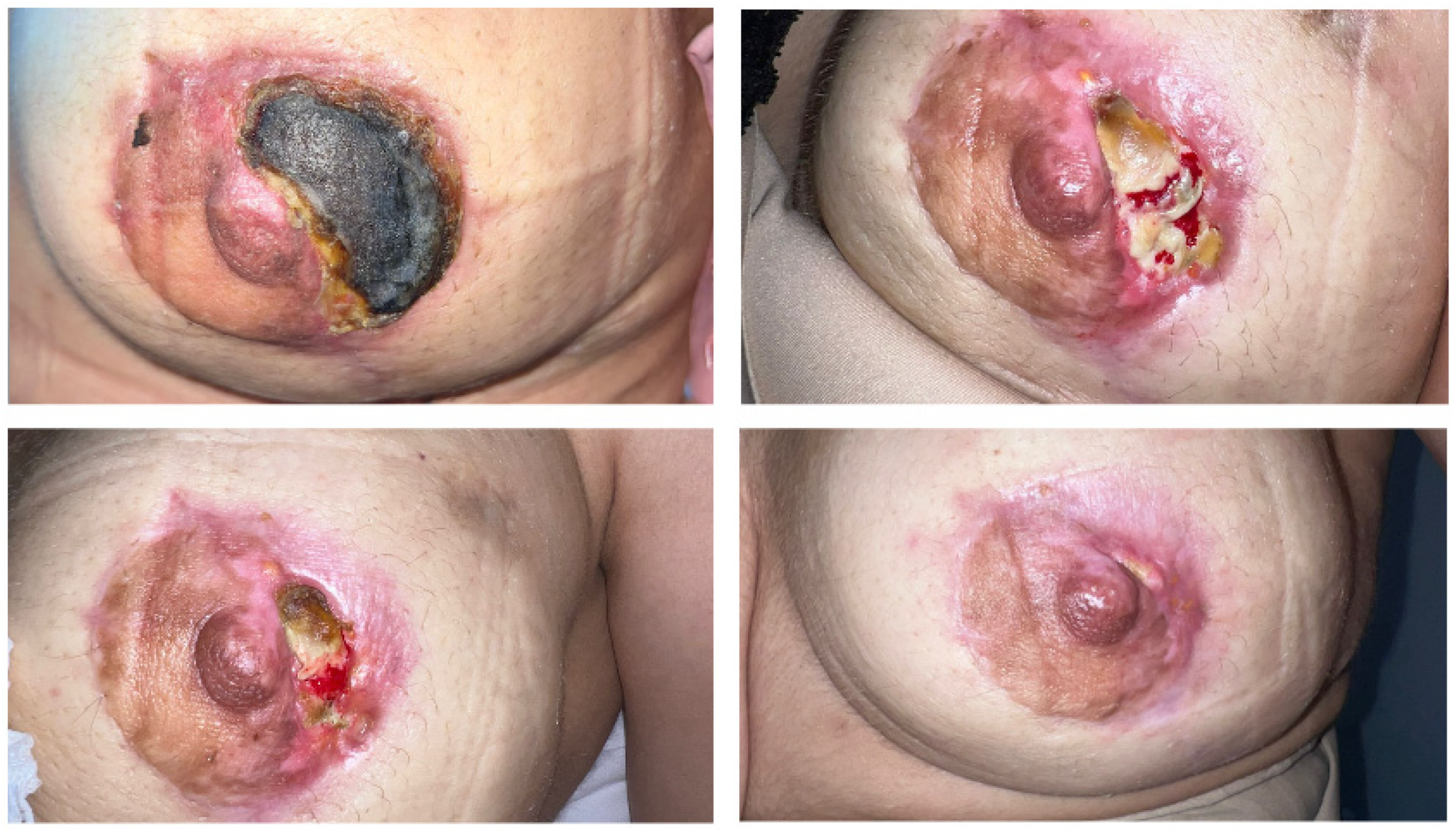
- Partial NAC necrosis: Superficial or limited full-thickness tissue loss in part of the areola and/or nipple.
- -
- Complete NAC necrosis: Findings consistent with full-thickness tissue loss/scarring in the entire NAC, and where possible, the necrosis depth was noted as “superficial (only epidermis/dermis)” or “full-thickness”; if records did not include this distinction, it was reported as “unspecified”.
2.6. Postoperative Nipple Necrosis and Wound Complication Management
2.7. Establishment of the Variables’ and Specimens’ Excisional Volume
2.8. Ethical Considerations
2.9. Statistical Analysis
3. Results
3.1. Patient Characteristics
3.2. Evaluation of Wound Complications
3.3. Distribution of Clinical–Pathological Factors According to Wound Complication Groups
3.4. Relationships Between Excision Volume and Wound Complications
3.5. Management of Wound Complications
4. Discussion
5. Conclusions
Limitations
Author Contributions
Funding
Institutional Review Board Statement
Informed Consent Statement
Data Availability Statement
Conflicts of Interest
References
- Global Cancer Observatory (GCO) Today. Available online: https://gco.iarc.fr/today/en/dataviz/pie?mode=cancer&group_populations=1&sexes=2 (accessed on 16 November 2025).
- Benson, J.R.; Jatoi, I.; Keisch, M.; Esteva, F.J.; Makris, A.; Jordan, V.C. Early breast cancer. Lancet 2009, 373, 1463–1479. [Google Scholar] [CrossRef]
- Nedeoglo, E.; Moog, P.; Jiang, J.; Suhova, I.; Machens, H.G.; Megerle, K.; Kükrek, H. Trend shift from autologous to implant-based breast reconstruction. Surg. Oncol. 2025, 62, 102256. [Google Scholar] [CrossRef]
- Mota, B.S.; Riera, R.; Ricci, M.D.; Barrett, J.; de Castria, T.B.; Atallah, Á.N.; Bevilacqua, J.L. Nipple- and areola-sparing mastectomy for the treatment of breast cancer. Cochrane Database Syst. Rev. 2016, 11, CD008932. [Google Scholar] [CrossRef]
- Fancellu, A.; Houssami, N.; Sanna, V.; Porcu, A.; Ninniri, C.; Marinovich, M.L. Outcomes after breast-conserving surgery or mastectomy in patients with triple-negative breast cancer: Meta-analysis. Br. J. Surg. 2021, 108, 760–768. [Google Scholar] [CrossRef]
- Boneti, C.; Yuen, J.; Santiago, C.; Diaz, Z.; Robertson, Y.; Korourian, S.; Klimberg, V.S. Oncologic safety of nipple skin-sparing or total skin-sparing mastectomies with immediate reconstruction. J. Am. Coll. Surg. 2011, 212, 686–693. [Google Scholar] [CrossRef]
- García-Solbas, S.; Lorenzo-Liñán, M.Á.; Castro-Luna, G. Long-Term Quality of Life (BREAST-Q) in Patients with Mastectomy and Breast Reconstruction. Int. J. Environ. Res. Public Health 2021, 18, 9707. [Google Scholar] [CrossRef] [PubMed]
- Song, Y.; Wang, L.; Huang, W.; Guo, S.; Wu, X.; Zheng, H. Comparison of nipple sparing and skin sparing mastectomy with immediate reconstruction based on patient reported outcomes. Sci. Rep. 2025, 15, 14989. [Google Scholar] [CrossRef] [PubMed]
- Romanoff, A.; Zabor, E.C.; Stempel, M.; Sacchini, V.; Pusic, A.; Morrow, M. A Comparison of Patient-Reported Outcomes After Nipple-Sparing Mastectomy and Conventional Mastectomy with Reconstruction. Ann. Surg. Oncol. 2018, 25, 2909–2916. [Google Scholar] [CrossRef]
- Bryan, J.L.; Ockerman, K.M.; Spiguel, L.R.; Cox, E.A.; Han, S.H.; Trieu, N.; Blondin-Fernandez, M.; Heath, F.; Sorice-Virk, S. Postoperative complications of direct-to-implant and two-staged breast reconstruction: A stratified analysis. Plast. Surg. 2024, 33, 574–581. [Google Scholar] [CrossRef]
- Gschwantler-Kaulich, D.; Leser, C.; Salama, M.; Singer, C.F. Direct-to-implant breast reconstruction: Higher complication rate vs cosmetic benefits. Breast J. 2018, 24, 957–964. [Google Scholar] [CrossRef] [PubMed]
- Gulcelik, M.A.; Dogan, L.; Karanlik, H.; Akinci, M.; Ugurlu, M.U.; Gulluoglu, B.M. Profile of surgical complications and complication-led reoperation rates in breast cancer patients who underwent oncoplastic breast surgery with volume displacements. Eur. J. Surg. Oncol. 2025, 51, 110252. [Google Scholar] [CrossRef]
- Koc, B.I.; Morkavuk, S.B.; Akyuz, S.; Aygun, G.; Ozdemir, O.; Gulcelik, M.A. Postoperative outcomes of one-step implant-based breast and ovarian surgery in high-penetrance gene mutation: A single-center experience. J. Clin. Med. 2025, 14, 1784. [Google Scholar] [CrossRef]
- Bogdan, R.G.; Helgiu, A.; Cimpean, A.M.; Ichim, C.; Todor, S.B.; Iliescu-Glaja, M.; Bodea, I.C.; Crainiceanu, Z.P. Assessing fat grafting in breast surgery: A narrative review of evaluation techniques. J. Clin. Med. 2024, 13, 7209. [Google Scholar] [CrossRef]
- Lemaine, V.; Hoskin, T.L.; Farley, D.R.; Grant, C.S.; Boughey, J.C.; Torstenson, T.A.; Jacobson, S.R.; Jakub, J.W.; Degnim, A.C. Introducing the SKIN score: A validated scoring system to assess severity of mastectomy skin flap necrosis. Ann. Surg. Oncol. 2015, 22, 2925–2932. [Google Scholar] [CrossRef]
- National Healthcare Safety Network (NHSN). Surgical Site Infection (SSI) Event. Centers for Disease Control and Prevention (CDC): January 2026. Available online: https://www.cdc.gov/nhsn/pdfs/pscmanual/9pscssicurrent.pdf (accessed on 8 March 2026).
- Krekel, N.M.; Zonderhuis, B.M.; Stockmann, H.B.; Schreurs, W.H.; van der Veen, H.; de Lange de Klerk, E.S.; Meijer, S.; van den Tol, M.P. A comparison of three methods for nonpalpable breast cancer excision. Eur. J. Surg. Oncol. 2011, 37, 109–115. [Google Scholar] [CrossRef]
- Haloua, M.H.; Volders, J.H.; Krekel, N.M.; Barbé, E.; Sietses, C.; Jóźwiak, K.; Meijer, S.; van den Tol, M.P. A nationwide pathology study on surgical margins and excision volumes after breast-conserving surgery: There is still much to be gained. Breast 2016, 25, 14–21. [Google Scholar] [CrossRef]
- Zarei, M.; Carlson, G.W. Periareolar skin-sparing mastectomy and immediate implant-based reconstruction: A reappraisal. Ann. Plast. Surg. 2024, 92, S441–S444. [Google Scholar] [CrossRef] [PubMed]
- Corban, J.; Shash, H.; Safran, T.; Sheppard-Jones, N.; Fouda-Neel, O. A systematic review of complications associated with direct implants vs. tissue expanders following Wise pattern skin-sparing mastectomy. J. Plast. Reconstr. Aesthetic Surg. 2017, 70, 1191–1199. [Google Scholar] [CrossRef] [PubMed]
- Clarijs, M.E.; Peeters, N.J.V.; van Dongen, S.A.; Koppert, L.B.; Pusic, A.L.; Mureau, M.A.; Rijken, B.F. Quality of life and complications after nipple-versus skin-sparing mastectomy followed by immediate breast reconstruction: A systematic review and meta-analysis. Plast. Reconstr. Surg. 2023, 152, 12e–24e. [Google Scholar] [CrossRef] [PubMed]
- Paprottka, F.J.; Schlett, C.L.; Luketina, R.; Paprottka, K.; Klimas, D.; Radtke, C.; Hebebrand, D. Risk Factors for Complications after Skin-Sparing and Nipple-Sparing Mastectomy. Breast Care 2019, 14, 289–297. [Google Scholar] [CrossRef] [PubMed]
- Wengler, C.A.; Valente, S.A.; Al-Hilli, Z.; Woody, N.M.; Muntean, J.H.; Abraham, J.; Tendulkar, R.D.; Djohan, R.; O’Rourke, C.; Crowe, J.P.; et al. Determinants of short and long term outcomes in patients undergoing immediate breast reconstruction following neoadjuvant chemotherapy. J. Surg. Oncol. 2017, 116, 797–802. [Google Scholar] [CrossRef]
- Ito, H.; Ueno, T.; Suga, H.; Shiraishi, T.; Isaka, H.; Imi, K.; Imoto, S. Risk factors for skin flap necrosis in breast cancer patients treated with mastectomy followed by immediate breast reconstruction. World J. Surg. 2019, 43, 846–852. [Google Scholar] [CrossRef]
- Nguyen, C.L.; Zhou, M.; Easwaralingam, N.; Seah, J.L.; Chan, B.; Graham, S.; Azimi, F.; Mak, C.; Pulitano, C.; Warrier, S. Mastectomy Skin Flap Necrosis after Implant-Based Breast Reconstruction: Intraoperative Predictors and Indocyanine Green Angiography. Plast. Reconstr. Surg. 2026, 157, 19–28. [Google Scholar] [CrossRef]
- Seth, I.; Xie, Y.; Lim, B.; Rozen, W.M.; Hunter-Smith, D.J. Defining skin-sparing mastectomy surgical techniques: A narrative review. Ann. Breast Surg. 2024, 8, 20. [Google Scholar] [CrossRef]
- Verras, G.I.; Mulita, F. Butyrylcholinesterase levels correlate with surgical site infection risk and severity after colorectal surgery: A prospective single-center study. Front. Surg. 2024, 11, 1379410. [Google Scholar] [CrossRef]
- Lindley, L.E.; Stojadinovic, O.; Pastar, I.; Tomic-Canic, M. Biology and Biomarkers for Wound Healing. Plast. Reconstr. Surg. 2016, 138, 18S–28S. [Google Scholar] [CrossRef]
- O’Connell, R.L.; Rusby, J.E. Anatomy relevant to conservative mastectomy. Gland Surg. 2015, 4, 476–483. [Google Scholar]
- Santanelli, F.; Longo, B.; Sorotos, M.; Farcomeni, A.; Paolini, G. Flap survival of skin-sparing mastectomy type IV: A retrospective cohort study of 75 consecutive cases. Ann. Surg. Oncol. 2013, 20, 981–989. [Google Scholar] [CrossRef] [PubMed]
- Acar, K.; Aygin, D. Yaşlılarda yara gelişimi risk faktörleri, önleme ve bakım yaklaşımları. Yoğun Bakım Hemşireliği Derg. 2015, 19, 54–59. [Google Scholar]
- Öztürk, D.; Karadağ, A. Stoma ve Yara Bakım Hemşireliği’nin tarihsel gelişim süreci: Türkiye örneği. Hemşirelikte Eğitim ve Araştırma Derg. 2019, 16, 73–77. [Google Scholar]



| Age, years, mean ± SD | 43.51 ± 6.5 |
| Height, cm, mean ± SD | 163.5 ± 5.6 |
| Weight, kg, mean ± SD | 65.9 ± 10.4 |
| Excision volume, cm3, mean ± SD | 521.45 ± 290.92 |
| Smoking, n (%) | |
| Absent | 78 (92.9) |
| Present | 6 (7.1) |
| Chronic Disease, n (%) | |
| Absent | 72 (85.7) |
| Hypertension | 3 (3.6) |
| Diabetes Mellitus | 1 (1.2) |
| Asthma | 1 (1.2) |
| Other | 8 (9.5) |
| Localization, n (%) | |
| Multicentric–multifocal | 43 (51.2) |
| Upper outer quadrant | 18 (21.4) |
| Upper inner quadrant | 14 (16.7) |
| Lower inner quadrant | 4 (4.8) |
| Central | 3 (3.6) |
| Lower outer quadrant | 2 (2.4) |
| Side, n (%) | |
| Right Breast | 49 (58.3) |
| Left Breast | 35 (41.7) |
| Pathology Result, n (%) | |
| Invasive Ductal Carcinoma | 56 (66.7) |
| Invasive Lobular Carcinoma | 14 (16.7) |
| DCIS | 10 (11.9) |
| Mixed | 3 (3.6) |
| Medullary | 1 (1.2) |
| Axillary Procedure, n (%) | |
| SLNB | 65 (77.3) |
| SLNB Axillary dissection | 16 (19.0) |
| Axillary dissection | 3 (3.6) |
| Neoadjuvant Chemotherapy, n (%) | |
| Present | 30 (35.7) |
| Absent | 54 (64.3) |
| Neoadjuvant Response, n (%) | |
| Complete Response | 10 (11.9) |
| Partial Response | 17 (20.2) |
| No Response | 3 (3.6) |
| Complication, n (%) | |
| None | 70 (84.2) |
| Wound dehiscence | 5 (6.0) |
| Nipple necrosis | 7 (8.4) |
| Infection | 1 (1.2) |
| Hematoma | 1 (1.2) |
| Complication-Related Re-operation, n (%) | |
| None | 78 (93.9) |
| Areola excision | 2 (2.4) |
| Wound debridement | 2 (2.4) |
| Implant excision | 2 (2.4) |
| Advanced Wound Care, n (%) | |
| Yes | 10 (11.9) |
| No | 74 (88.1) |
| Epithelialization time, days, mean (IQR) | 53 (43) |
| Clinicopathological Factors | Wound Complications (−) (70 Patients, 84.2%) | Wound Complications (+) (14 Patients, 16.8%) | p-Value |
|---|---|---|---|
| Age (years), mean ± SD | 43.7 ± 6.79 | 42.57 ± 5.15 | p = 0.558 T |
| Height, cm, median, IQR (Q1–Q3) | 163 (160–167) | 163.5 (155.75–168) | p = 0.660 U |
| Weight, kg, mean ± SD | 66.2 ± 10.76 | 64.79 ± 9.04 | p = 0.647 T |
| Excisional volume, cm3, median, IQR (Q1–Q3) | 438.0 (269.75–662.0) | 637.5 (375.5–945.5) | p = 0.033 U |
| Smoking, n (%) | p = 0.388 FFH | ||
| Absent | 65 (77.3%) | 12 (14.3%) | |
| Present | 5 (6.0%) | 2 (2.4%) | |
| Side, n (%) | p = 0.921 χ2 | ||
| Right | 41 (48.9%) | 8 (9.5%) | |
| Left | 29 (34.5%) | 6 (7.1%) | |
| Pathology Result, n (%) | p = 0.136 FFH | ||
| Invasive ductal carcinoma | 49 (58.3%) | 7 (8.3%) | |
| Invasive lobular carcinoma | 10 (12.0%) | 4 (4.7%) | |
| DCIS | 8 (9.5%) | 2 (2.4%) | |
| Mixed | 3 (3.6%) | 0 | |
| Medullary | 0 | 1 (1.2%) | |
| Axillary Approach, n (%) | p = 0.652 χ2 | ||
| SLNB | 55 (65.4%) | 10 (12.0%) | |
| SLNB axillary dissection | 12 (14.3%) | 4 (4.7%) | |
| Axillary dissection | 3 (3.6%) | 0 | |
| Neoadjuvant Chemotherapy, n (%) | p = 0.541 χ2 | ||
| Present | 26 (30.9%) | 4 (4.7%) | |
| Absent | 44 (52.4%) | 10 (12.0%) |
| Variables | B | O.R | 95% Cl for O.R | Overall Accuracy Percentage | p-Value | |
|---|---|---|---|---|---|---|
| Lower | Upper | |||||
| Excisional volume | 0.002 | 1.002 | 1.000 | 1.004 | 83.8% | 0.019 |
| Patients | Complication | Non-Traumatic Dressing | HBOT | Topical Products | Enzymatic Debridement | Barrier Cream | Surgical Debridement | Antibiotic | Implant Excision/Areola Excision |
|---|---|---|---|---|---|---|---|---|---|
| Wound dehiscence | x | x | x | |||||
| Partial NAC necrosis | x | x | x | x | x | |||
| Partial NAC necrosis | x | x | x | x | x | |||
| Wound dehiscence | x | x | x | |||||
| Partial NAC necrosis | x | x | x | |||||
| Wound dehiscence | x | x | x | |||||
| Partial NAC necrosis | x | x | x | x | x | |||
| Wound dehiscence | x | x | x | x | ||||
| Partial NAC necrosis | x | x | x | x | x | |||
| Wound Area Infection | x | x | x | |||||
| Wound dehiscence | x | x | ||||||
| Hematoma | x | |||||||
| Complete NAC necrosis | x | x | ||||||
| Complete NAC necrosis | x | x |
Disclaimer/Publisher’s Note: The statements, opinions and data contained in all publications are solely those of the individual author(s) and contributor(s) and not of MDPI and/or the editor(s). MDPI and/or the editor(s) disclaim responsibility for any injury to people or property resulting from any ideas, methods, instructions or products referred to in the content. |
© 2026 by the authors. Published by MDPI on behalf of the Lithuanian University of Health Sciences. Licensee MDPI, Basel, Switzerland. This article is an open access article distributed under the terms and conditions of the Creative Commons Attribution (CC BY) license.
Share and Cite
Akyuz, S.; Morkavuk, Ş.B.; Gülçelik, M.A. Management of Nipple Necrosis and Wound Complications in Patients Undergoing Unilateral Skin-Sparing Mastectomy and Implant-Based Reconstruction for Breast Cancer: A Retrospective, Single-Center Study. Medicina 2026, 62, 575. https://doi.org/10.3390/medicina62030575
Akyuz S, Morkavuk ŞB, Gülçelik MA. Management of Nipple Necrosis and Wound Complications in Patients Undergoing Unilateral Skin-Sparing Mastectomy and Implant-Based Reconstruction for Breast Cancer: A Retrospective, Single-Center Study. Medicina. 2026; 62(3):575. https://doi.org/10.3390/medicina62030575
Chicago/Turabian StyleAkyuz, Simay, Şevket Barış Morkavuk, and Mehmet Ali Gülçelik. 2026. "Management of Nipple Necrosis and Wound Complications in Patients Undergoing Unilateral Skin-Sparing Mastectomy and Implant-Based Reconstruction for Breast Cancer: A Retrospective, Single-Center Study" Medicina 62, no. 3: 575. https://doi.org/10.3390/medicina62030575
APA StyleAkyuz, S., Morkavuk, Ş. B., & Gülçelik, M. A. (2026). Management of Nipple Necrosis and Wound Complications in Patients Undergoing Unilateral Skin-Sparing Mastectomy and Implant-Based Reconstruction for Breast Cancer: A Retrospective, Single-Center Study. Medicina, 62(3), 575. https://doi.org/10.3390/medicina62030575