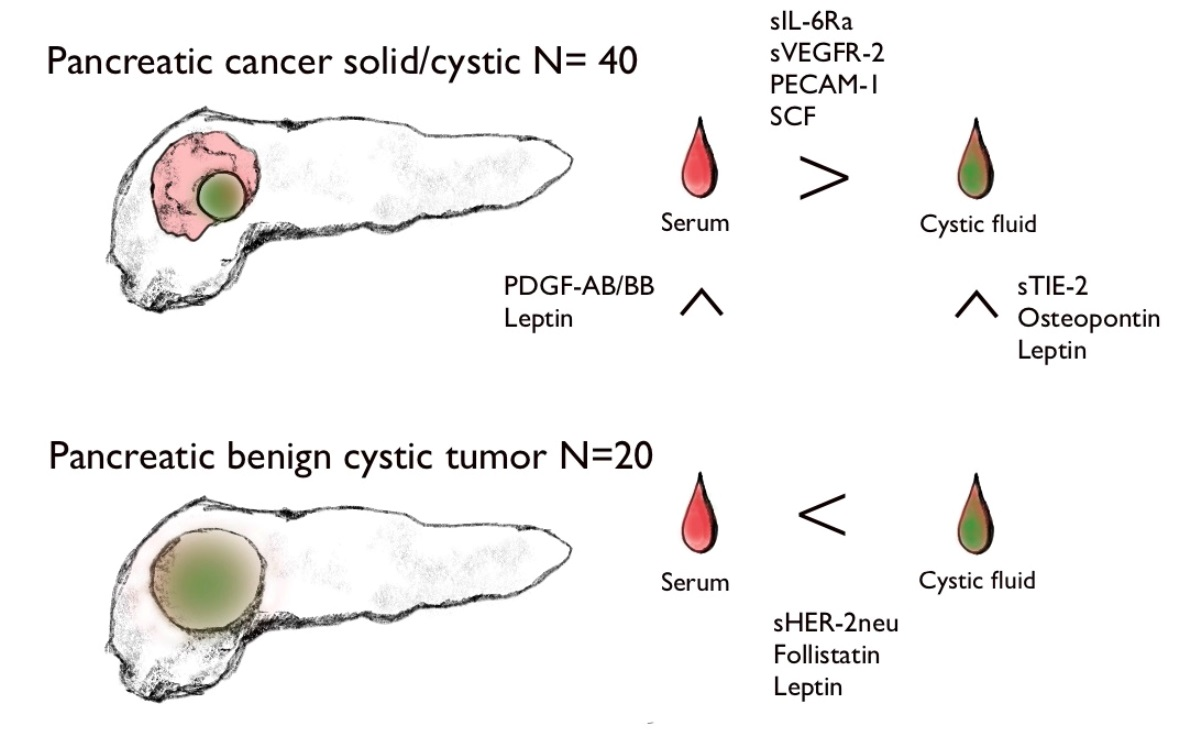
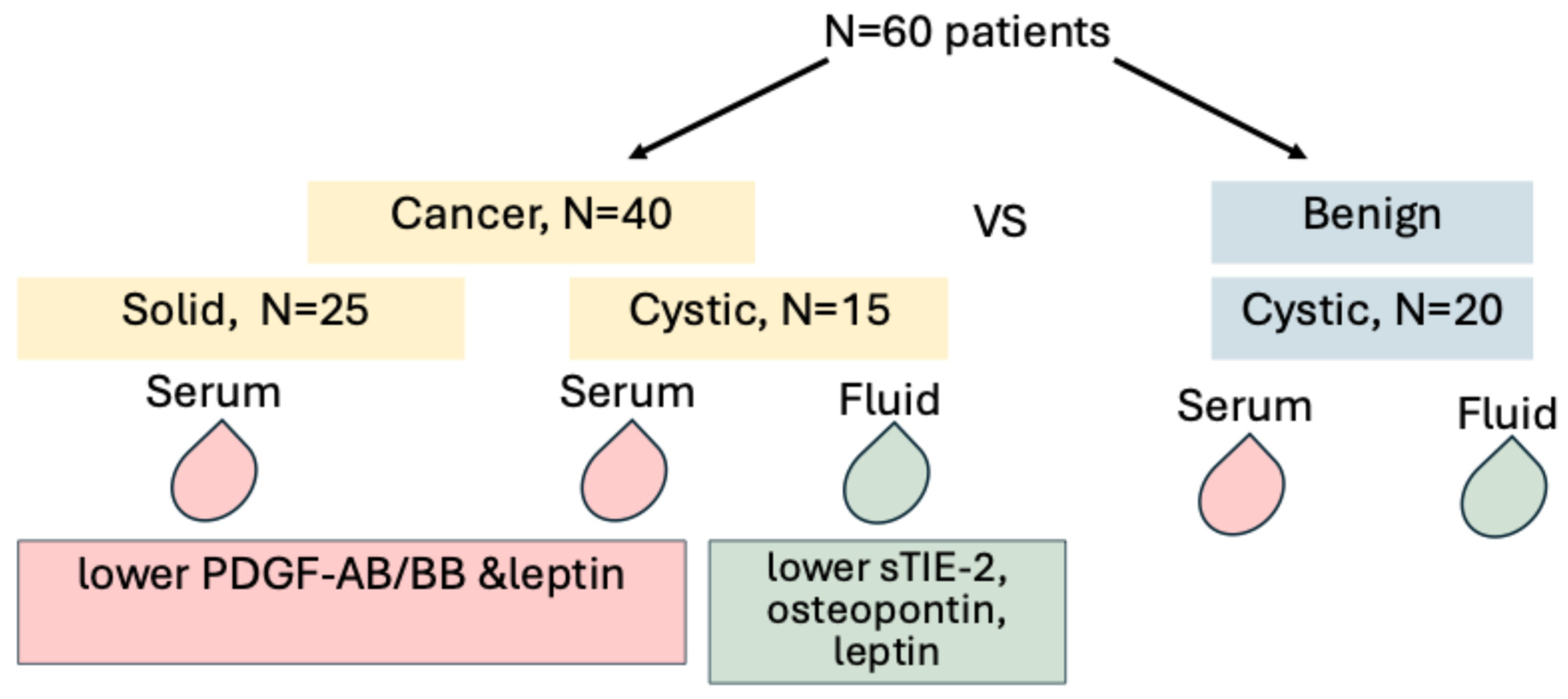
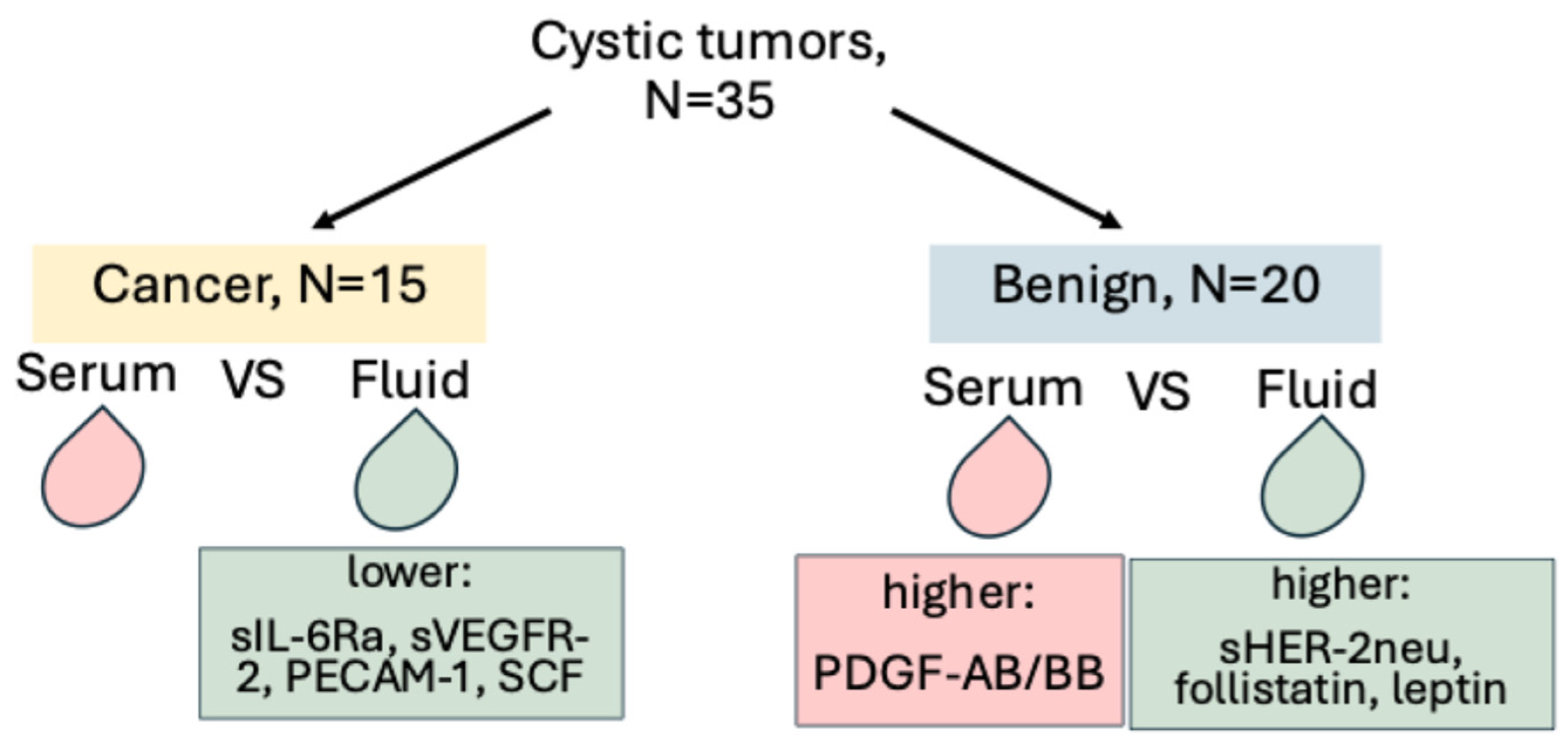
Pancreatic Cancer and Benign Pancreatic Cystic Lesions: Differences in Cytokines, Growth Factors, and Immunological Markers Concentrations in Serum and Cystic Fluid

 , ,
, ,
Simple Summary
Abstract
1. Introduction
2. Materials and Methods
3. Results
4. Discussion
4.1. PDGF AB/BB
4.2. Osteopontin
4.3. Leptin
4.4. sTIE-2
4.5. Other Differences Between Serum and Cystic Fluid
5. Conclusions
Author Contributions
Funding
Institutional Review Board Statement
Informed Consent Statement
Data Availability Statement
Acknowledgments
Conflicts of Interest
Abbreviations
| FNA | fine needle aspiration |
| PDAC | pancreatic ductal adenocarcinoma |
| MCN | mucinous cystic neoplasm |
| SPN | solid papillary neoplasm |
| SCN | serous cystic neoplasm |
| IPMN | intraductal papillary mucinous neoplasm |
| IPMN-MD | IPMN main duct |
| IMPN-BD | IPMN branch duct |
| PD | pancreatoduodenectomy |
| DP | distal pancreatectomy |
| TP | total pancreatectomy |
| EUS | endoscopic ultrasound |
| CA 19-9 serum | carbohydrate antigen 19-9 |
| WBC | white blood cell count |
| CRP | C-reactive protein |
| sEGFR | soluble epidermal growth factor receptor |
| sIL-6Ra | soluble interleukin-6 receptor alpha |
| FGF | fibroblast growth factor |
| sVEGFR-1/-2 | soluble vascular endothelial growth factor receptor-1/-2 |
| PECAM-1 | platelet endothelial cell adhesion molecule-1 |
| PDGF-AB/BB | platelet derived growth factor—AB/BB |
| G-CSF | granulocyte colony-stimulating factor |
| HGF | hepatocyte growth factor |
| sTIE-2 | soluble TIE-2 |
| SCF | stem cell factor |
| BMI | body mass index |
| ASA | American Society of Anesthesiologists |
| LEC | lymphoepithelial cyst |
| MRI | magnetic resonance imaging |
| CEA | carcinoembryonic antigen |
| IL | interleukin |
| IP-10 | interferon gamma-induced protein-10 |
| PDGFRβ | PDGF receptor β |
| PSCs | pancreatic stellate cells |
| Ang-1 | angiopoietin-1 |
| Ang-2 | angiopoietin-2 |
References
- Stoffel, E.M.; Brand, R.E.; Goggins, M. Pancreatic Cancer: Changing Epidemiology and New Approaches to Risk Assessment, Early Detection, and Prevention. Gastroenterology 2023, 164, 752–765. [Google Scholar] [CrossRef]
- Ren, S.; Song, L.-N.; Zhao, R.; Tian, Y.; Wang, Z.-Q. Serum Exosomal Hsa-Let-7f-5p: A Potential Diagnostic Biomarker for Metastatic Pancreatic Cancer Detection. World J. Gastroenterol. 2025, 31, 109500. [Google Scholar] [CrossRef]
- Younan, G. Pancreas Solid Tumors. Surg. Clin. N. Am. 2020, 100, 565–580. [Google Scholar] [CrossRef]
- van Huijgevoort, N.C.M.; Del Chiaro, M.; Wolfgang, C.L.; van Hooft, J.E.; Besselink, M.G. Diagnosis and Management of Pancreatic Cystic Neoplasms: Current Evidence and Guidelines. Nat. Rev. Gastroenterol. Hepatol. 2019, 16, 676–689. [Google Scholar] [CrossRef]
- European Study Group on Cystic Tumours of the Pancreas. European Evidence-Based Guidelines on Pancreatic Cystic Neoplasms. Gut 2018, 67, 789–804. [Google Scholar] [CrossRef] [PubMed]
- Heidt, D.G.; Burant, C.; Simeone, D.M. Total Pancreatectomy: Indications, Operative Technique, and Postoperative Sequelae. J. Gastrointest. Surg. 2007, 11, 209–216. [Google Scholar] [CrossRef]
- Del Chiaro, M.; Rangelova, E.; Segersvärd, R.; Arnelo, U. Are There Still Indications for Total Pancreatectomy? Updates Surg. 2016, 68, 257–263. [Google Scholar] [CrossRef]
- Kokkinakis, S.; Kritsotakis, E.I.; Maliotis, N.; Karageorgiou, I.; Chrysos, E.; Lasithiotakis, K. Complications of Modern Pancreaticoduodenectomy: A Systematic Review and Meta-Analysis. Hepatobiliary Pancreat. Dis. Int. 2022, 21, 527–537. [Google Scholar] [CrossRef]
- van Bodegraven, E.A.; Francken, M.F.G.; Verkoulen, K.C.H.A.; Abu Hilal, M.; Dijkgraaf, M.G.W.; Besselink, M.G. Costs of Complications Following Distal Pancreatectomy: A Systematic Review. HPB 2023, 25, 1145–1150. [Google Scholar] [CrossRef]
- Zakaria, H.M.; Stauffer, J.A.; Raimondo, M.; Woodward, T.A.; Wallace, M.B.; Asbun, H.J. Total Pancreatectomy: Short- and Long-Term Outcomes at a High-Volume Pancreas Center. World J. Gastrointest. Surg. 2016, 8, 634–642. [Google Scholar] [CrossRef]
- Crinò, S.F.; Conti Bellocchi, M.C.; Di Mitri, R.; Inzani, F.; Rimbaș, M.; Lisotti, A.; Manfredi, G.; Teoh, A.Y.B.; Mangiavillano, B.; Sendino, O.; et al. Wet-Suction versus Slow-Pull Technique for Endoscopic Ultrasound-Guided Fine-Needle Biopsy: A Multicenter, Randomized, Crossover Trial. Endoscopy 2023, 55, 225–234. [Google Scholar] [CrossRef]
- Facciorusso, A.; Crinò, S.F.; Ramai, D.; Madhu, D.; Fugazza, A.; Carrara, S.; Spadaccini, M.; Mangiavillano, B.; Gkolfakis, P.; Mohan, B.P.; et al. Comparative Diagnostic Performance of Different Techniques for EUS-Guided Fine-Needle Biopsy Sampling of Solid Pancreatic Masses: A Network Meta-Analysis. Gastrointest. Endosc. 2023, 97, 839–848.e5. [Google Scholar] [CrossRef]
- O’Neill, R.S.; Stoita, A. Biomarkers in the Diagnosis of Pancreatic Cancer: Are We Closer to Finding the Golden Ticket? World J. Gastroenterol. 2021, 27, 4045–4087. [Google Scholar] [CrossRef]
- Rahbari, N.N.; Schmidt, T.; Falk, C.S.; Hinz, U.; Herber, M.; Bork, U.; Büchler, M.W.; Weitz, J.; Koch, M. Expression and Prognostic Value of Circulating Angiogenic Cytokines in Pancreatic Cancer. BMC Cancer 2011, 11, 286. [Google Scholar] [CrossRef]
- Roshani, R.; McCarthy, F.; Hagemann, T. Inflammatory Cytokines in Human Pancreatic Cancer. Cancer Lett. 2014, 345, 157–163. [Google Scholar] [CrossRef]
- Yang, C.; Bork, U.; Schölch, S.; Kulu, Y.; Kaderali, L.; Bolstorff, U.L.; Kahlert, C.; Weitz, J.; Rahbari, N.N.; Reissfelder, C. Postoperative Course and Prognostic Value of Circulating Angiogenic Cytokines after Pancreatic Cancer Resection. Oncotarget 2017, 8, 72315–72323. [Google Scholar] [CrossRef]
- Thiruvengadam, N.; Park, W.G. Systematic Review of Pancreatic Cyst Fluid Biomarkers: The Path Forward. Clin. Transl. Gastroenterol. 2015, 6, e88. [Google Scholar] [CrossRef]
- Shaw, V.E.; Lane, B.; Jenkinson, C.; Cox, T.; Greenhalf, W.; Halloran, C.M.; Tang, J.; Sutton, R.; Neoptolemos, J.P.; Costello, E. Serum Cytokine Biomarker Panels for Discriminating Pancreatic Cancer from Benign Pancreatic Disease. Mol. Cancer 2014, 13, 114. [Google Scholar] [CrossRef]
- Zou, X.; Tang, X.Y.; Qu, Z.Y.; Sun, Z.W.; Ji, C.F.; Li, Y.J.; Guo, S.D. Targeting the PDGF/PDGFR Signaling Pathway for Cancer Therapy: A Review. Int. J. Biol. Macromol. 2022, 202, 539–557. [Google Scholar] [CrossRef]
- Farrow, B.; Albo, D.; Berger, D.H. The Role of the Tumor Microenvironment in the Progression of Pancreatic Cancer. J. Surg. Res. 2008, 149, 319–328. [Google Scholar] [CrossRef]
- Masamune, A.; Kikuta, K.; Watanabe, T.; Satoh, K.; Hirota, M.; Shimosegawa, T. Hypoxia Stimulates Pancreatic Stellate Cells to Induce Fibrosis and Angiogenesis in Pancreatic Cancer. Am. J. Physiol. Gastrointest. Liver Physiol. 2008, 295, G709–G717. [Google Scholar] [CrossRef]
- Dunér, S.; Lopatko Lindman, J.; Ansari, D.; Gundewar, C.; Andersson, R. Pancreatic Cancer: The Role of Pancreatic Stellate Cells in Tumor Progression. Pancreatology 2010, 10, 673–681. [Google Scholar] [CrossRef]
- Li, T.; Guo, T.; Liu, H.; Jiang, H.; Wang, Y. Platelet-derived Growth Factor-BB Mediates Pancreatic Cancer Malignancy via Regulation of the Hippo/Yes-associated Protein Signaling Pathway. Oncol. Rep. 2021, 45, 83–94. [Google Scholar] [CrossRef]
- Lee, J.; Lee, J.; Yun, J.H.; Choi, C.; Cho, S.; Kim, S.J.; Kim, J.H. Autocrine DUSP28 Signaling Mediates Pancreatic Cancer Malignancy via Regulation of PDGF-A. Sci. Rep. 2017, 7, 12760. [Google Scholar] [CrossRef]
- Weissmueller, S.; Manchado, E.; Saborowski, M.; Morris, J.P.; Wagenblast, E.; Davis, C.A.; Moon, S.-H.; Pfister, N.T.; Tschaharganeh, D.F.; Kitzing, T.; et al. Mutant P53 Drives Pancreatic Cancer Metastasis through Cell-Autonomous PDGF Receptor β Signaling. Cell 2014, 157, 382–394. [Google Scholar] [CrossRef]
- Sakamoto, H.; Kimura, H.; Sekijima, M.; Matsumoto, K.; Arao, T.; Chikugo, T.; Yamada, Y.; Kitano, M.; Ito, A.; Takeyama, Y.; et al. Plasma Concentrations of Angiogenesis-Related Molecules in Patients with Pancreatic Cancer. Jpn. J. Clin. Oncol. 2012, 42, 105–112. [Google Scholar] [CrossRef]
- McCarty, M.F.; Somcio, R.J.; Stoeltzing, O.; Wey, J.; Fan, F.; Liu, W.; Bucana, C.; Ellis, L.M. Overexpression of PDGF-BB Decreases Colorectal and Pancreatic Cancer Growth by Increasing Tumor Pericyte Content. J. Clin. Investig. 2007, 117, 2114–2122. [Google Scholar] [CrossRef]
- Yako, Y.Y.; Kruger, D.; Smith, M.; Brand, M. Cytokines as Biomarkers of Pancreatic Ductal Adenocarcinoma: A Systematic Review. PLoS ONE 2016, 11, e0154016. [Google Scholar] [CrossRef]
- Weber, G.F. The Cancer Biomarker Osteopontin: Combination with Other Markers. Cancer Genom. Proteom. 2011, 8, 263–288. [Google Scholar]
- Cao, J.; Li, J.; Sun, L.; Qin, T.; Xiao, Y.; Chen, K.; Qian, W.; Duan, W.; Lei, J.; Ma, J.; et al. Hypoxia-Driven Paracrine Osteopontin/Integrin Avβ3 Signaling Promotes Pancreatic Cancer Cell Epithelial-Mesenchymal Transition and Cancer Stem Cell-like Properties by Modulating Forkhead Box Protein M1. Mol. Oncol. 2019, 13, 228–245. [Google Scholar] [CrossRef]
- Koopmann, J.; Fedarko, N.S.; Jain, A.; Maitra, A.; Iacobuzio-Donahue, C.; Rahman, A.; Hruban, R.H.; Yeo, C.J.; Goggins, M. Evaluation of Osteopontin as Biomarker for Pancreatic Adenocarcinoma. Cancer Epidemiol. Biomark. Prev. 2004, 13, 487–491. [Google Scholar] [CrossRef]
- Li, J.-J.; Li, H.-Y.; Gu, F. Diagnostic Significance of Serum Osteopontin Level for Pancreatic Cancer: A Meta-Analysis. Genet. Test. Mol. Biomark. 2014, 18, 580–586. [Google Scholar] [CrossRef]
- Fiorino, S.; Visani, M.; Masetti, M.; Acquaviva, G.; Tallini, G.; De Leo, A.; Fornelli, A.; Ragazzi, M.; Vasuri, F.; Grifoni, D.; et al. Periostin, Tenascin, Osteopontin Isoforms in Long- and Non-Long Survival Patients with Pancreatic Cancer: A Pilot Study. Mol. Biol. Rep. 2020, 47, 8235–8241. [Google Scholar] [CrossRef]
- Rychlíková, J.; Vecka, M.; Jáchymová, M.; Macášek, J.; Hrabák, P.; Zeman, M.; Vávrová, L.; Řoupal, J.; Krechler, T.; Ák, A. Osteopontin as a Discriminating Marker for Pancreatic Cancer and Chronic Pancreatitis. Cancer Biomark. 2016, 17, 55–65. [Google Scholar] [CrossRef]
- Weber, C.E.; Erşahin, Ç.H.; Kuo, P.C.; Mi, Z. Pancreatic Cancer and Osteopontin: The Relationship Remains Unclear. Pancreas 2016, 45, e35–e36. [Google Scholar] [CrossRef]
- Cai, M.; Bompada, P.; Salehi, A.; Acosta, J.R.; Prasad, R.B.; Atac, D.; Laakso, M.; Groop, L.; De Marinis, Y. Role of Osteopontin and Its Regulation in Pancreatic Islet. Biochem. Biophys. Res. Commun. 2018, 495, 1426–1431. [Google Scholar] [CrossRef]
- Ito, M.; Makino, N.; Matsuda, A.; Ikeda, Y.; Kakizaki, Y.; Saito, Y.; Ueno, Y.; Kawata, S. High Glucose Accelerates Cell Proliferation and Increases the Secretion and MRNA Expression of Osteopontin in Human Pancreatic Duct Epithelial Cells. Int. J. Mol. Sci. 2017, 18, 807. [Google Scholar] [CrossRef]
- White, P.B.; True, E.M.; Ziegler, K.M.; Wang, S.S.; Swartz-Basile, D.A.; Pitt, H.A.; Zyromski, N.J. Insulin, Leptin, and Tumoral Adipocytes Promote Murine Pancreatic Cancer Growth. J. Gastrointest. Surg. 2010, 14, 1888–1894. [Google Scholar] [CrossRef]
- Fan, Y.; Gan, Y.; Shen, Y.; Cai, X.; Song, Y.; Zhao, F.; Yao, M.; Gu, J.; Tu, H. Leptin Signaling Enhances Cell Invasion and Promotes the Metastasis of Human Pancreatic Cancer via Increasing MMP-13 Production. Oncotarget 2015, 6, 16120–16134. [Google Scholar] [CrossRef]
- Mendonsa, A.M.; Chalfant, M.C.; Gorden, L.D.; VanSaun, M.N. Modulation of the Leptin Receptor Mediates Tumor Growth and Migration of Pancreatic Cancer Cells. PLoS ONE 2015, 10, e0126686. [Google Scholar] [CrossRef]
- Stolzenberg-Solomon, R.Z.; Newton, C.C.; Silverman, D.T.; Pollak, M.; Nogueira, L.M.; Weinstein, S.J.; Albanes, D.; Männistö, S.; Jacobs, E.J. Circulating Leptin and Risk of Pancreatic Cancer: A Pooled Analysis From 3 Cohorts. Am. J. Epidemiol. 2015, 182, 187–197. [Google Scholar] [CrossRef]
- Yip-Schneider, M.T.; Simpson, R.; Carr, R.A.; Wu, H.; Fan, H.; Liu, Z.; Korc, M.; Zhang, J.; Schmidt, C.M. Circulating Leptin and Branched Chain Amino Acids—Correlation with Intraductal Papillary Mucinous Neoplasm Dysplastic Grade. J. Gastrointest. Surg. 2019, 23, 966–974. [Google Scholar] [CrossRef]
- Bocian-Jastrzębska, A.; Malczewska-Herman, A.; Rosiek, V.; Kos-Kudła, B. Assessment of the Role of Leptin and Adiponectinas Biomarkers in Pancreatic Neuroendocrine Neoplasms. Cancers 2023, 15, 3517. [Google Scholar] [CrossRef]
- Dimou, N.L.; Papadimitriou, N.; Mariosa, D.; Johansson, M.; Brennan, P.; Peters, U.; Chanock, S.J.; Purdue, M.; Bishop, D.T.; Gago-Dominquez, M.; et al. Circulating Adipokine Concentrations and Risk of Five Obesity-related Cancers: A Mendelian Randomization Study. Int. J. Cancer 2021, 148, 1625–1636. [Google Scholar] [CrossRef]
- Man, T.; Seicean, R.; Lucaciu, L.; Leucuta, D.; Ilies, M.; Iuga, C.; Petrusel, L.; Seicean, A. Leptin Involvement in the Survival of Pancreatic Adenocarcinoma Patients with Obesity and Diabetes. Eur. Rev. Med. Pharmacol. Sci. 2022, 26, 1341–1349. [Google Scholar] [CrossRef]
- Harney, A.S.; Karagiannis, G.S.; Pignatelli, J.; Smith, B.D.; Kadioglu, E.; Wise, S.C.; Hood, M.M.; Kaufman, M.D.; Leary, C.B.; Lu, W.-P.; et al. The Selective Tie2 Inhibitor Rebastinib Blocks Recruitment and Function of Tie2Hi Macrophages in Breast Cancer and Pancreatic Neuroendocrine Tumors. Mol. Cancer Ther. 2017, 16, 2486–2501. [Google Scholar] [CrossRef]
- Aref, S.; El Menshawy, N.; Azmy, E.; El-Refaie, M. Soluble Angiopoietin-2/STie2 Receptor Ratio Is an Independent Prognostic Marker in Adult Acute Myeloid Leukemia. Indian J. Hematol. Blood Transfus. 2009, 25, 17–22. [Google Scholar] [CrossRef]
- Detjen, K.M.; Rieke, S.; Deters, A.; Schulz, P.; Rexin, A.; Vollmer, S.; Hauff, P.; Wiedenmann, B.; Pavel, M.; Scholz, A. Angiopoietin-2 Promotes Disease Progression of Neuroendocrine Tumors. Clin. Cancer Res. 2010, 16, 420–429. [Google Scholar] [CrossRef]
- Chen, H.-M.; Tsai, C.-H.; Hung, W.-C. Foretinib Inhibits Angiogenesis, Lymphangiogenesis and Tumor Growth of Pancreatic Cancer in Vivo by Decreasing VEGFR-2/3 and TIE-2 Signaling. Oncotarget 2015, 6, 14940–14952. [Google Scholar] [CrossRef]
- Durkin, A.J.; Bloomston, M.; Yeatman, T.J.; Gilbert-Barness, E.; Cojita, D.; Rosemurgy, A.S.; Zervos, E.E. Differential Expression of the Tie-2 Receptor and Its Ligands in Human Pancreatic Tumors. J. Am. Coll. Surg. 2004, 199, 724–731. [Google Scholar] [CrossRef]
- Saklamaz, A.; Calan, M.; Yilmaz, O.; Kume, T.; Temur, M.; Yildiz, N.; Kasap, E.; Genc, M.; Sarer Yurekli, B.; Unal Kocabas, G. Polycystic Ovary Syndrome Is Associated with Increased Osteopontin Levels. Eur. J. Endocrinol. 2016, 174, 415–423. [Google Scholar] [CrossRef]



| Pancreatic Cystic Lesion Type | Recommended Treatment |
|---|---|
| MCN | Surgery |
| SPN | Surgery |
| SCN | Observation |
| IPMN-MD | Surgery |
| IPMN mix type | Surgery |
| IPMN-BD | Observation/surgery when malignant features are present |
| Variable | Total (n = 60) | Cancer Group (n = 40, 66.67%) | Non-Cancer Group (n = 20, 33.33%) | p |
|---|---|---|---|---|
| Female sex | 42 (70%) | 26 (65%) | 16 (80%) | 0.232 |
| Age (years) | 65 (24–79, IQR = 18) | 67 (43–79, IQR = 10) | 51 (24–75, IQR = 24) | <0.001 |
| BMI (kg/m2) | 25.2 (17.7–39.1, SD = 4.12) | 24.9 (17.7–33.4, SD = 3.65) | 25.9 (17.9–39.1, SD = 4.97) | 0.393 |
| ASA class II III IV | 24 (40%) 35 (58.3%) 1 (1.7%) | 12 (30%) 27 (67.5%) 1 (2.5%) | 12 (60%) 8 (40%) 0 | 0.073 |
| Preoperative diabetes | 14 (23.3%) | 13 (32.5%) | 1 (5%) | 0.023 |
| WBC [103/mm3] Lymphocytes [103/mm3] CRP [mg/L] Serum glucose [mg/dL] | 6.4 (2.8–9.8, SD = 1.53) 1.6 (0.7–2.7, SD = 0.44) 1.2 (0.6–25.8, IQR = 1.9) 97.5 (77.5–157, IQR = 22.3) | 6.3 (3.6–9.8, SD = 1.46) 1.6 (0.7–2.7, SD = 0.5) 1.4 (0.6–25.8, IQR = 1.7) 105 (78.5–157, IQR = 40.2) | 6.7 (2.8–9.5, SD = 1.66) 1.7 (1.1–2.2, SD = 0.33) 0.8 (0.6–12.1, IQR = 2.6) 92.8 (77.5–110, IQR = 11.3) | 0.333 0.550 0.110 0.002 |
| Variable | Total (n = 59) | Cancer Group (n = 40, 67.8%) | Non-Cancer Group (n = 19, 32.2%) | p | OR (95%CI) |
|---|---|---|---|---|---|
| sHER-2 neu [ng/mL] | 2.8 (0.08–8.66, IQR = 2.54) | 2.7 (0.08–8.66, IQR = 2.65) | 3.2 (1–6.7, IQR = 2.54) | 0.095 | 0.762 (0.554–1.048) |
| sEGFR [ng/mL] | 6.3 (0.32–26.2, IQR = 6.93) | 6 (0.32–26.21, IQR = 6.43) | 8.1 (0.61–20.94, IQR = 7.31) | 0.972 | 0.998 (0.915–1.090) |
| sIL-6Ra [ng/mL] | 8.2 (2.1–25.42, IQR = 5.41) | 7.8 (2.1–22.12, IQR = 4.32) | 10.1 (3.66–25.42, IQR = 5.85) | 0.279 | 0.937 (0.833–1.054) |
| Follistatin [ng/mL] | 0.2 (0.001–0.69, IQR = 0.26) | 0.2 (0.001–0.67, IQR = 0.29) | 0.3 (0.09–0.69, IQR = 0.25) | 0.076 | 0.056 (0.002–1.356) |
| FGF-basic [pg/mL] | 108.3 (21.71–256.31, SD = 72.32) | 105 (22–254, SD = 55.7) | 114 (29–256, SD = 53.5) | 0.547 | 0.997 (0.987–1.007) |
| sVEGFR-2 [ng/mL] | 0.8 (0.31–1.61, IQR = 0.51) | 0.7 (0.31–1.61, IQR = 0.33) | 1 (0.4–1.54, IQR = 0.38) | 0.051 | 0.166 (0.027–1.008) |
| PECAM-1 [ng/mL] | 5.5 (2–8.84, SD = 2.1) | 5.4 (2–8.84, SD = 1.56) | 5.6 (3.39–8.51, SD = 1.4) | 0.587 | 0.903 (0.624–1.306) |
| PDGF-AB/BB [ng/mL] | 0.3 (0.001–4.54, IQR = 0.58) | 0.2 (0.001–1.79, IQR = 0.57) | 0.4 (0.013–4.54, IQR = 1.84) | 0.027 | 0.449 (0.221–0.913) |
| Prolactin [ng/mL] | 7 (0.01–143.8, IQR = 24.83) | 5.7 (0.01–108.67, IQR = 21.06) | 8.5 (0.01–143.8, IQR = 59.42) | 0.110 | 0.985 (0.967–1.003) |
| G-CSF H-[pg/mL] | 101 (3.37–249.64, IQR = 43.29) | 97 (3–250, IQR = 76.5) | 111 (75–175, IQR = 33.8) | 0.188 | 0.992 (0.980–1.004) |
| HGF [pg/mL] | 1021.5 (210.9–2235.83, IQR = 813.93) | 981 (211–2236, IQR = 834.9) | 1104 (300–1962, IQR = 728.8) | 0.774 | 1.000 (0.999–1.001) |
| sTIE-2 [ng/mL] | 4.1 (0.16–17.01, IQR = 5.91) | 3.7 (0.16–17.01, IQR = 5.96) | 5.6 (0.42–11.43, IQR = 5.65) | 0.547 | 0.957 (0.829–1.105) |
| SCF [pg/mL] | 159 (19.3–379.88, SD = 72.41) | 166 (19–380, SD = 71.9) | 145 (53–288, SD = 73.3) | 0.303 | 1.004 (0.996–1.012) |
| sVEGFR-1 [pg/mL] | 0.6 (0.33–4.98, IQR = 2.75) | 0.5 (0.3–5, IQR = 3.08) | 0.6 (0.4–4.4, IQR = 1.41) | 0.447 | 1.161 (0.790–1.707) |
| Osteopontin [ng/mL] | 2.9 (0.06–17.85, IQR = 3.88) | 3 (0.1–17.85, IQR = 5.48) | 2.6 (0.06–6.1, IQR = 3.31) | 0.131 | 1.165 (0.956–1.421) |
| Leptin [ng/mL] | 1.2 (0.004–17.03, IQR = 1.85) | 1 (0.004–4.6, IQR = 1.17) | 2.1 (0.05–17.03, IQR = 5.76) | 0.011 | 0.654 (0.471–0.907) |
| Variable | Total (n = 32) | Cancer Group (n = 16, 50%) | Non-Cancer Group (n = 16, 50%) | p | OR (95%CI) |
|---|---|---|---|---|---|
| sHER-2 neu [ng/mL] | 3.3 (0.01–27.62, IQR = 5.29) | 2.7 (0.01–13.63, IQR = 3.99) | 5.3 (0.44–27.62, IQR = 12.87) | 0.110 | 0.874 (0.741–1.031) |
| sEGFR [ng/mL] | 4.9 (0.06–33.67, IQR = 5.43) | 2.6 (0.06–18.1, IQR = 4.71) | 5.6 (0.74–33.67, IQR = 10.05) | 0.102 | 0.871 (0.737–1.028) |
| sIL-6Ra [ng/mL] | 2.6 (0.01–27.47, IQR = 5.23) | 1.3 (0.01–6.36, IQR = 2.45) | 4.4 (0.28–27.47, IQR = 15.09) | 0.067 | 0.757 (0.562–1.020) |
| Follistatin [pg/mL] | 398.4 (40.63–1820.63, IQR = 510.7) | 287 (40.63–1820.63, IQR = 495.9) | 683 (60–1554, IQR = 458) | 0.308 | 0.999 (0.997–1.001) |
| FGF-basic [pg/mL] | 210.8 (49.77–909.89, IQR = 222.6) | 211 (49.77–909.89, IQR = 270.2) | 217 (95–893, IQR = 197.2) | 0.954 | 1.000 (0.997–1.003) |
| sVEGFR-2 [ng/mL] | 0.5 (0.01–4.98, IQR = 0.98) | 0.3 (0.01–1.2, IQR = 0.7) | 0.7 (0.1–4.98, IQR = 1.34) | 0.060 | 0.242 (0.055–1.061) |
| PECAM-1 [ng/mL] | 3.88 (0.15–21.96, IQR = 5.12) | 2.8 (0.15–7.58, IQR = 4.33) | 4.5 (0.68–21.96, IQR = 8.23) | 0.050 | 0.800 (0.641–1.000) |
| PDGF-AB/BB [pg/mL] | 149.2 (10.75–1853.95, IQR = 198.69) | 175 (10.75–1853.95, IQR = 506.3) | 114 (12–252, IQR = 177.1) | 0.086 | 1.005 (0.999–1.010) |
| Prolactin [ng/mL] | 1 (0.06–11.12, IQR = 1.64) | 0.7 (0.06–3.41, IQR = 1.37) | 1.2 (0.14–11.12, IQR = 3.22) | 0.123 | 0.613 (0.329–1.142) |
| G-CSF [pg/mL] | 121.4 (12.59–742.5, IQR = 195.8) | 121 (12.59–370, IQR = 142.7) | 142 (18–742.5, IQR = 204) | 0.202 | 0.996 (0.990–1.002) |
| HGF [ng/mL] | 7.8 (0.002–100.85, IQR = 35.45) | 3.29 (0.04–43.87, IQR = 8.53) | 16.6 (0.002–100.85, IQR = 78.32) | 0.056 | 0.949 (0.900–1.001) |
| sTIE-2 [ng/mL] | 1 (0.14–9.54, IQR = 1.1) | 0.9 (0.14–1.53, IQR = 0.74) | 1.6 (0.23–9.54, IQR = 3.05) | 0.048 | 0.231 (0.054–0.990) |
| SCF [pg/mL] | 108 (2.57–602.1, IQR = 142.27) | 77 (2.57–257, IQR = 131.2) | 133 (15–602.1, IQR = 267) | 0.068 | 0.993 (0.986–1.000) |
| sVEGFR-1 [ng/mL] | 1.7 (0.001–20.31, IQR = 5.12) | 0.6 (0.001–7.42, IQR = 2.18) | 3 (0.83–20.31, IQR = 6.11) | 0.091 | 0.766 (0.563–1.044) |
| Osteopontin [ng/mL] | 45.4 (0.19–423.94, IQR = 222.51) | 13.24 (0.19–62.2, IQR = 37.42) | 156.2 (0.24–423.94, IQR = 342.92) | 0.039 | 0.960 (0.923–0.998) |
| Leptin [ng/mL] | 0.9 (0.02–18.01, IQR = 2.63) | 0.2 (0.03–1.85, IQR = 0.59) | 2.7 (0.02–18.01, IQR = 5.37) | 0.013 | 0.158 (0.037–0.677) |
| Variable | Group | Serum (Mean/Median) | Cystic Fluid (Mean/Median) | Mean/Median Difference (Serum-Fluid, SD/IQR) | p |
|---|---|---|---|---|---|
| sHER-2 neu [ng/mL] | Cancer | 2.7 (0.08–8.66, IQR = 2.65) | 2.7 (0.01–13.63, IQR = 3.99) | −0.6 (IQR = 3.36) | 0.221 |
| Non-cancer | 3.2 (1–6.7, IQR = 2.54) | 5.3 (0.44–27.62, IQR = 12.87) | −2.2 (IQR = 10.03) | 0.026 | |
| sEGFR [ng/mL] | Cancer | 6 (0.32–26.21, IQR = 6.43) | 2.6 (0.06–18.1, IQR = 4.71) | +2.8 (SD = 8.52) | 0.229 |
| Non-cancer | 8.1 (0.61–20.94, IQR = 7.31) | 5.6 (0.74–33.67, IQR = 10.05) | −3.2 (SD = 11.22) | 0.347 | |
| sIL-6Ra [ng/mL] | Cancer | 7.8 (2.1–22.12, IQR = 4.32) | 1.3 (0.01–6.36, IQR = 2.45) | +6.2 (IQR = 4.51) | <0.001 |
| Non-cancer | 10.1 (3.66–25.42, IQR = 5.85) | 4.4 (0.28–27.47, IQR = 15.09) | −3.6 (IQR = 13.84) | 0.460 | |
| Follistatin [ng/mL] | Cancer | 0.2 (0.001–0.67, IQR = 0.29) | 0.3 (0.04–1.82, IQR = 0.5) | −0.2 (SD = 0.36) | 0.087 |
| Non-cancer | 0.3 (0.09–0.69, IQR = 0.25) | 0.7 (0.06–1.55, IQR = 0.46) | −0.3 (SD = 0.36) | 0.005 | |
| FGF-basic [ng/mL] | Cancer | 0.1 (0.02–0.25, IQR = 0.08) | 0.2 (0.05–0.91, IQR = 0.27) | −0.1 (IQR = 0.21) | 0.002 |
| Non-cancer | 0.1 (0.03–0.26, IQR = 0.08) | 0.2 (0.1–0.89, IQR = 0.2) | −0.1 (IQR = 0.18) | 0.002 | |
| sVEGFR-2 [ng/mL] | Cancer | 0.7 (0.31–1.61, IQR = 0.33) | 0.3 (0.01–1.2, IQR = 0.7) | +0.3 (IQR = 0.58) | 0.039 |
| Non-cancer | 1 (0.4–1.54, IQR = 0.38) | 0.7 (0.1–4.98, IQR = 1.34) | +0.02 (IQR = 1.2) | 0.955 | |
| PECAM-1 [ng/mL] | Cancer | 5.5(2–8.84, IQR = 1.9) | 2.8 (0.15–7.58, IQR = 4.33) | +1.6 (SD = 2.26) | 0.011 |
| Non-cancer | 5.5 (3.39–8.51, IQR = 2.5) | 4.5 (0.68–21.96, IQR = 8.23) | −2.1 (SD = 5.9) | 0.186 | |
| PDGF-AB/BB [ng/mL] | Cancer | 0.2 (0.001–1.79, IQR = 0.57) | 0.2 (0.01–1.85, IQR = 0.51) | −0.1 (IQR = 0.57) | 0.717 |
| Non-cancer | 0.4 (0.013–4.54, IQR = 1.84) | 0.1 (0.01–0.25, IQR = 0.18) | +0.3 (IQR = 2.18) | 0.039 | |
| Prolactin [ng/mL] | Cancer | 5.7 (0.01–108.67, IQR = 21.06) | 0.7 (0.06–3.41, IQR = 1.37) | +17.5 (IQR = 24.66) | 0.001 |
| Non-cancer | 8.5 (0.01–143.8, IQR = 59.42) | 1.2 (0.14–11.12, IQR = 3.22) | +5.8 (IQR = 40.53) | 0.019 | |
| G-SCF [ng/mL] | Cancer | 0.1 (0.003–0.25, IQR = 0.08) | 0.1 (0.01–0.4, IQR = 0.14) | −0.02 (IQR = 0.18) | 0.281 |
| Non-cancer | 0.1 (0.08–0.18, IQR = 0.03) | 0.1 (0.02–0.74, IQR = 0.2) | −0.02 (IQR = 0.11) | 0.124 | |
| HGF [ng/mL] | Cancer | 1 (0.21–2.24, IQR = 0.83) | 3.29 (0.04–43.87, IQR = 8.53) | −2.6 (IQR = 8.1) | 0.011 |
| Non-cancer | 1.1 (0.3–1.96, IQR = 0.73) | 16.6 (0.002–100.85, IQR = 78.32) | −17 (IQR = 82.16) | 0.002 | |
| sTIE-2 [ng/mL] | Cancer | 3.7 (0.16–17.01, IQR = 5.96) | 0.9 (0.14–1.53, IQR = 0.74) | +0.9 (IQR = 3) | 0.008 |
| Non-cancer | 5.6 (0.42–11.43, IQR = 5.65) | 1.6 (0.23–9.54, IQR = 3.05) | +3.2 (IQR = 4.78) | 0.023 | |
| SCF [ng/mL] | Cancer | 0.2 (0.002–0.38, IQR = 0.08) | 0.1 (0.003–0.26, IQR = 0.13) | +0.1 (SD = 0.09) | 0.037 |
| Non-cancer | 0.1 (0.05–0.29, IQR = 0.13) | 0.1 (0.02–0.6, IQR = 0.27) | −0.1 (SD = 0.14) | 0.067 | |
| sVEGFR-1 [ng/mL] | Cancer | 0.0005 (0.0003–0.005, IQR = 0.003) | 0.6 (0.001–7.42, IQR = 2.18) | −0.6 (IQR = 2.17) | 0.001 |
| Non-cancer | 0.0006 (0.0004–0.004, IQR = 0.001) | 3 (0.83–20.31, IQR = 6.11) | −2.4 (IQR = 5.28) | 0.003 | |
| Osteopontin [ng/mL] | Cancer | 3 (0.1–17.85, IQR = 5.48) | 13.24 (0.19–62.2, IQR = 37.42) | −12.9 (IQR = 32.87) | 0.005 |
| Non-cancer | 2.6 (0.06–6.1, IQR = 3.31) | 156.2 (0.24–423.94, IQR = 342.92) | −179.5 (IQR = 354.38) | 0.001 | |
| Leptin [ng/mL] | Cancer | 1 (0.004–4.6, IQR = 1.17) | 0.2 (0.03–1.85, IQR = 0.59) | +0.04 (IQR = 1.21) | 0.279 |
| Non-cancer | 2.1 (0.05–17.03, IQR = 5.76) | 2.7 (0.02–18.01, IQR = 5.37) | −1.7 (IQR = 5.78) | 0.026 |
Disclaimer/Publisher’s Note: The statements, opinions and data contained in all publications are solely those of the individual author(s) and contributor(s) and not of MDPI and/or the editor(s). MDPI and/or the editor(s) disclaim responsibility for any injury to people or property resulting from any ideas, methods, instructions or products referred to in the content. |
© 2025 by the authors. Licensee MDPI, Basel, Switzerland. This article is an open access article distributed under the terms and conditions of the Creative Commons Attribution (CC BY) license (https://creativecommons.org/licenses/by/4.0/).
Share and Cite
Grudzińska, E.; Szmigiel, P.; Majewska, K.; Mrowiec, S.; Czuba, Z.P. Pancreatic Cancer and Benign Pancreatic Cystic Lesions: Differences in Cytokines, Growth Factors, and Immunological Markers Concentrations in Serum and Cystic Fluid. Cancers 2025, 17, 2783. https://doi.org/10.3390/cancers17172783
Grudzińska E, Szmigiel P, Majewska K, Mrowiec S, Czuba ZP. Pancreatic Cancer and Benign Pancreatic Cystic Lesions: Differences in Cytokines, Growth Factors, and Immunological Markers Concentrations in Serum and Cystic Fluid. Cancers. 2025; 17(17):2783. https://doi.org/10.3390/cancers17172783
Chicago/Turabian StyleGrudzińska, Ewa, Paweł Szmigiel, Karolina Majewska, Sławomir Mrowiec, and Zenon P. Czuba. 2025. "Pancreatic Cancer and Benign Pancreatic Cystic Lesions: Differences in Cytokines, Growth Factors, and Immunological Markers Concentrations in Serum and Cystic Fluid" Cancers 17, no. 17: 2783. https://doi.org/10.3390/cancers17172783
APA StyleGrudzińska, E., Szmigiel, P., Majewska, K., Mrowiec, S., & Czuba, Z. P. (2025). Pancreatic Cancer and Benign Pancreatic Cystic Lesions: Differences in Cytokines, Growth Factors, and Immunological Markers Concentrations in Serum and Cystic Fluid. Cancers, 17(17), 2783. https://doi.org/10.3390/cancers17172783