
Optical Water Type Guided Benchmarking of Machine Learning Generalization for Secchi Disk Depth Retrieval


Highlights
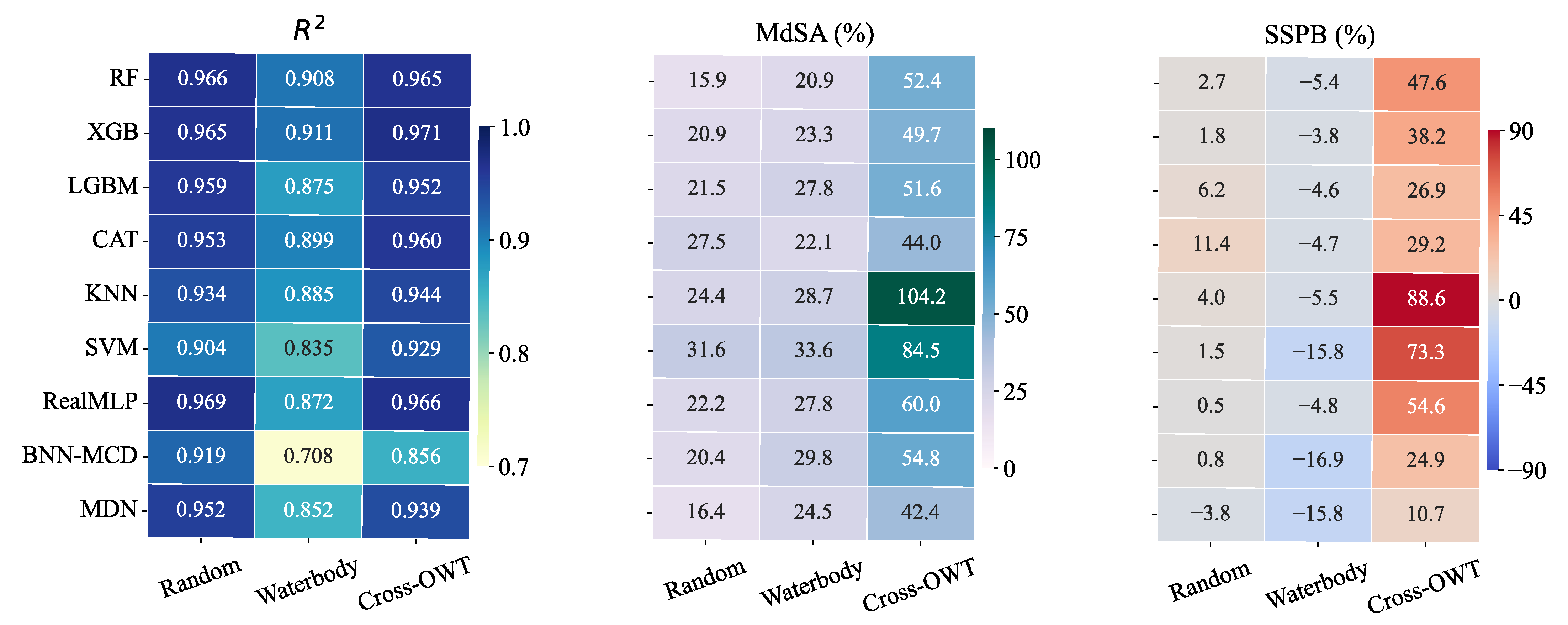
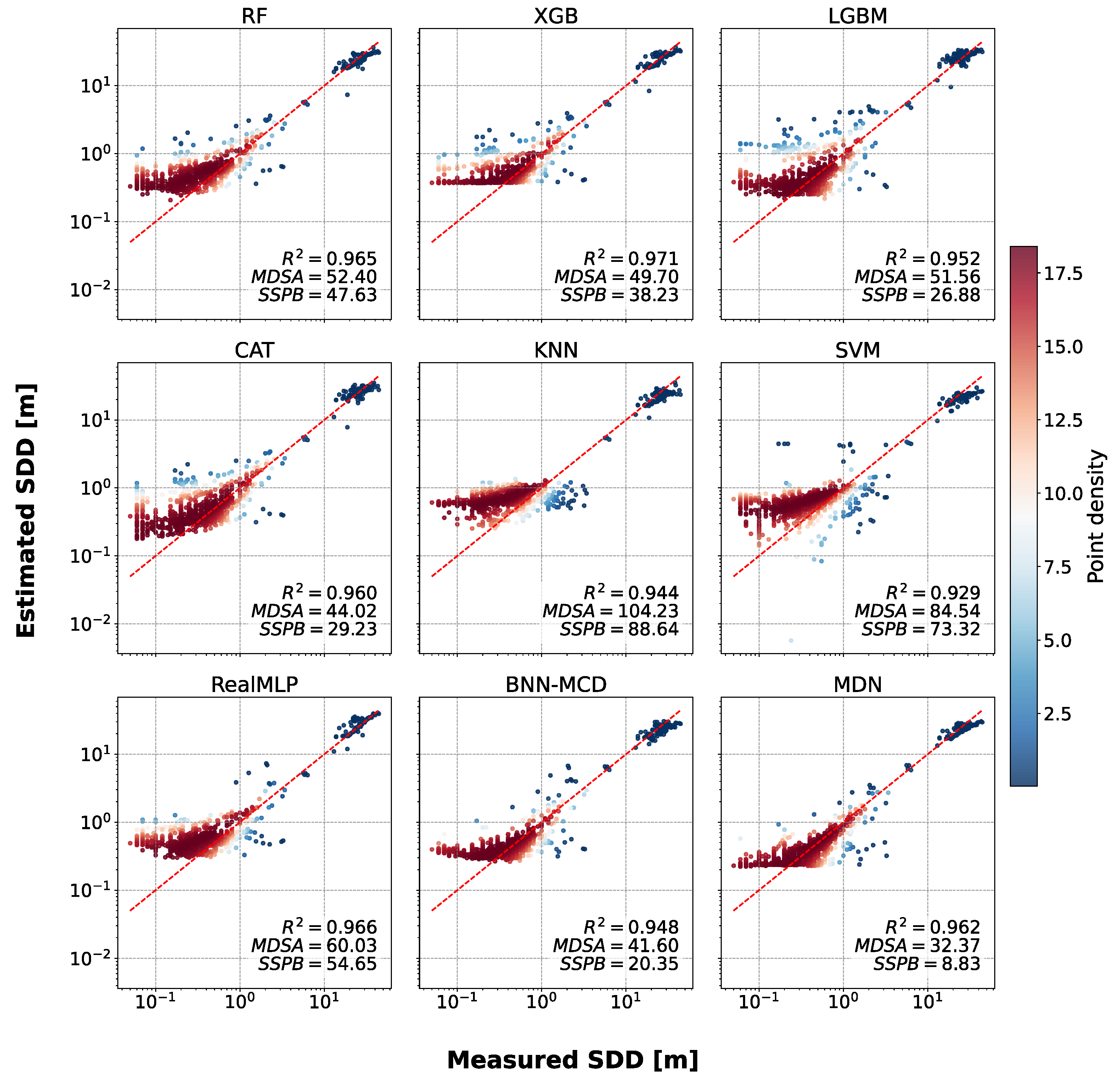
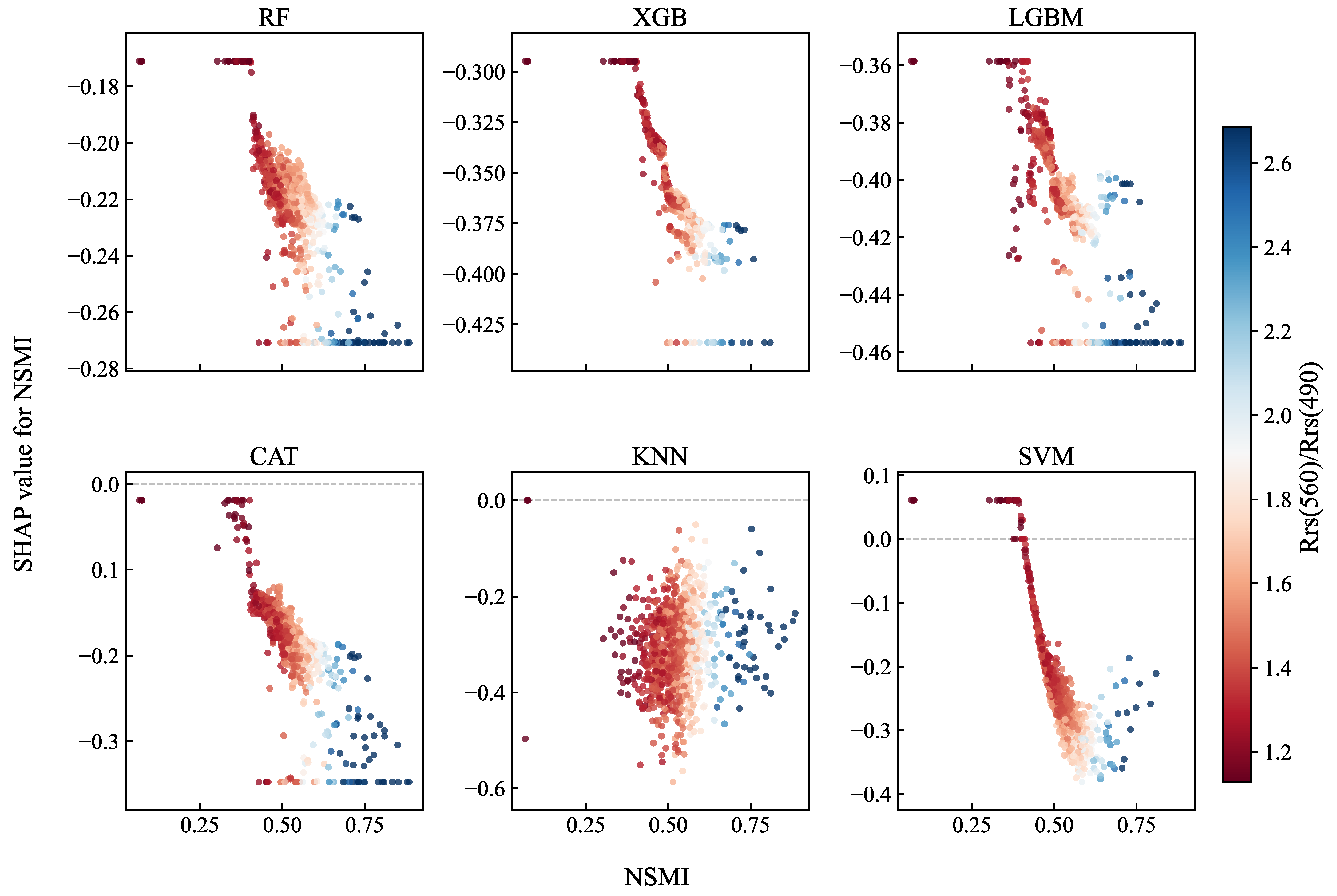
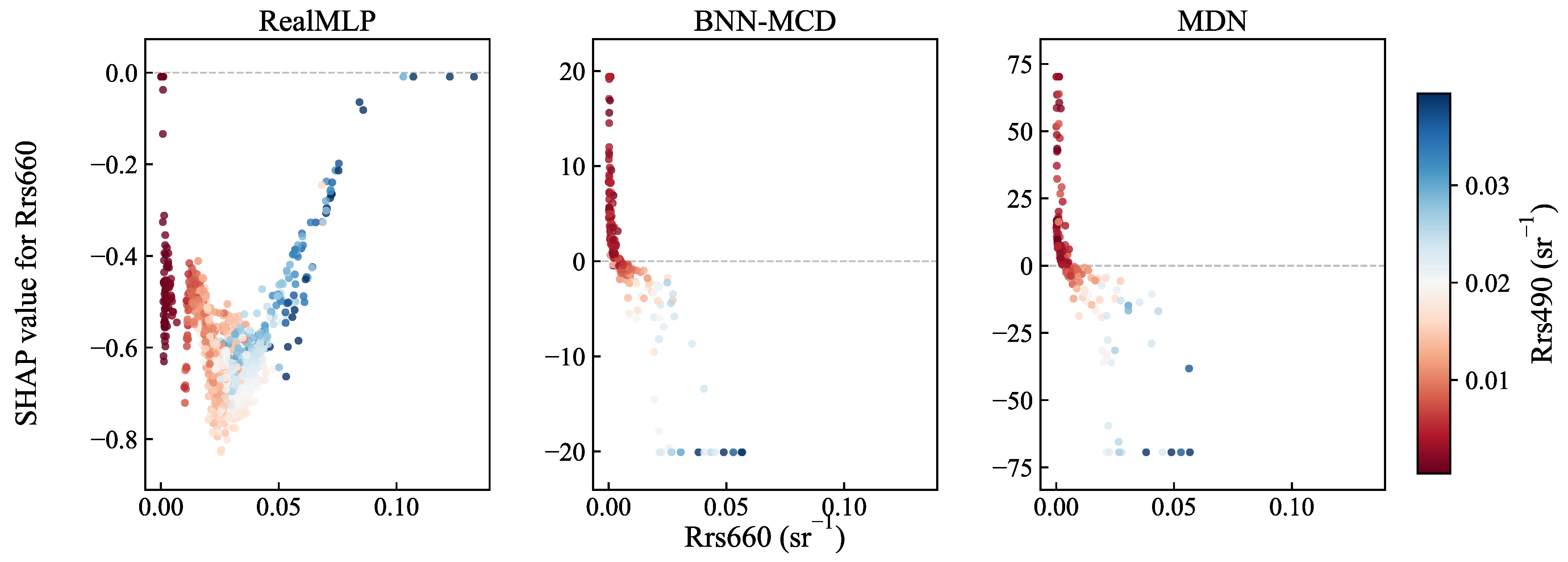
- Model bias depended on the split, MDN had the smallest Cross-OWT overestimation (SSPB = 10.7%); SHAP showed an NSMI threshold around 0.4–0.6.
- Removing ratios/indices improved Cross-OWT robustness, especially for KNN (MdSA: from 96% to 40%).
- Use deployment-relevant splits to assess SDD models (not only random splits).
- Treat feature engineering as model- and scenario-dependent, particularly under optical-regime shifts.
Abstract
1. Introduction
2. Materials and Methods
2.1. Global In Situ Datasets
2.2. Optical Water Type Classification
2.3. Machine Learning Methods
2.4. Model Training
2.4.1. Data Splitting Strategies
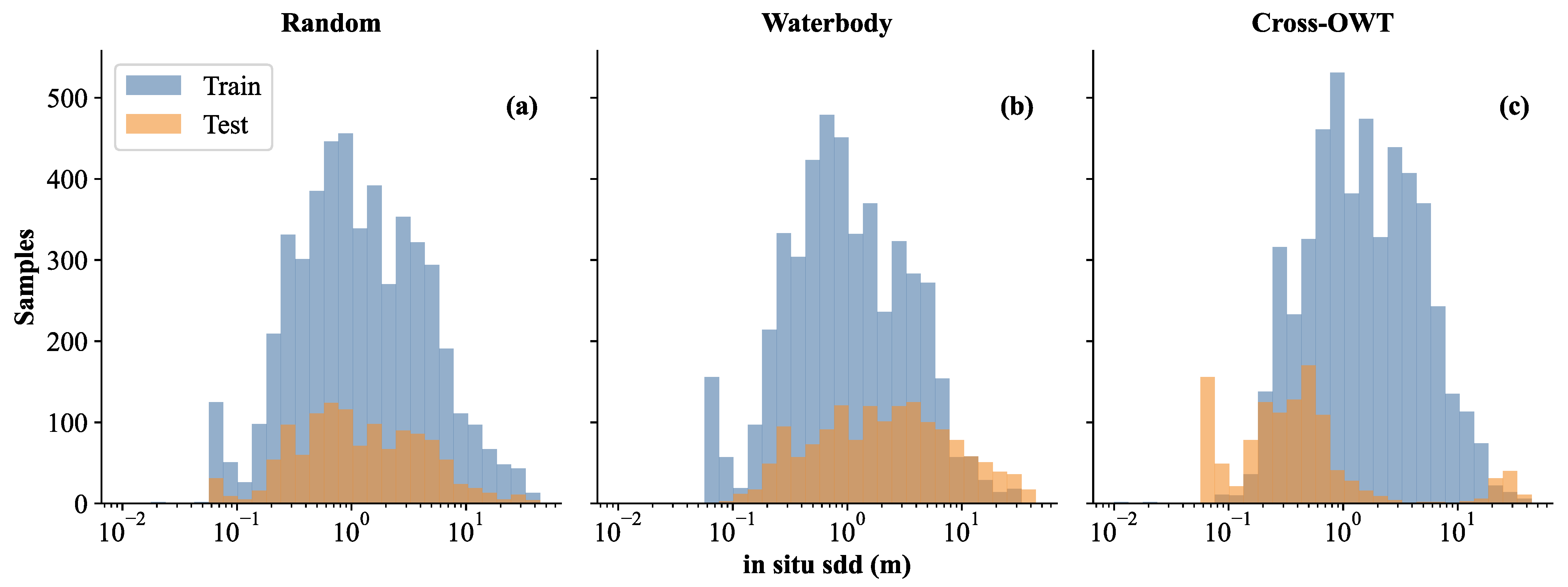
- Scenario 1: Random split (Random). Samples were randomly shuffled and partitioned into training (70%), validation (15%), and testing (15%) sets. This standard approach assesses model performance under overlapping distributions where training and test data may share similar optical characteristics.
- Scenario 2: Waterbody-based split (Waterbody). To evaluate transferability to unseen locations, samples were grouped by unique waterbody identifiers. Each waterbody was exclusively assigned to either the training, validation, or test set, ensuring spatial independence.
- Scenario 3: Cross-OWT split (Cross-OWT). To test extrapolation to unseen optical regimes, models were trained on intermediate optical types (OWT II–IV) and evaluated on extreme types (OWT I, V, and VI). This scenario challenges the models to generalize from moderate to distinct optical conditions, with the test domain dominated by turbid waters (OWT V).
2.4.2. Training and Hyperparameters
2.5. SHAP Interpretation
2.6. Statistical Metrics
2.7. Uncertainty Metric
3. Results
3.1. Optical Water Types Analysis
3.2. Model Performance Under Three Data-Splitting Strategies
3.3. Uncertainty Analysis
3.4. SHAP-Based Model Interpretation
3.4.1. Global Feature Importance
3.4.2. Partial Dependence and Thresholds
4. Discussion
4.1. Scenario-Dependent Performance and Practical Applicability
4.2. Feature Design Sensitivity Under Cross-OWT Extrapolation
4.3. Limitations and Future Work
5. Conclusions
- (1)
- Generalization depended on the validation scenario: Random splits yielded small bias across models. Waterbody transfer produced systematic underestimation, while XGB produced a strong accuracy bias trade-off under this setting. Cross OWT extrapolation produced the largest degradation and a bias reversal toward overestimation; MDN showed the smallest overestimation.
- (2)
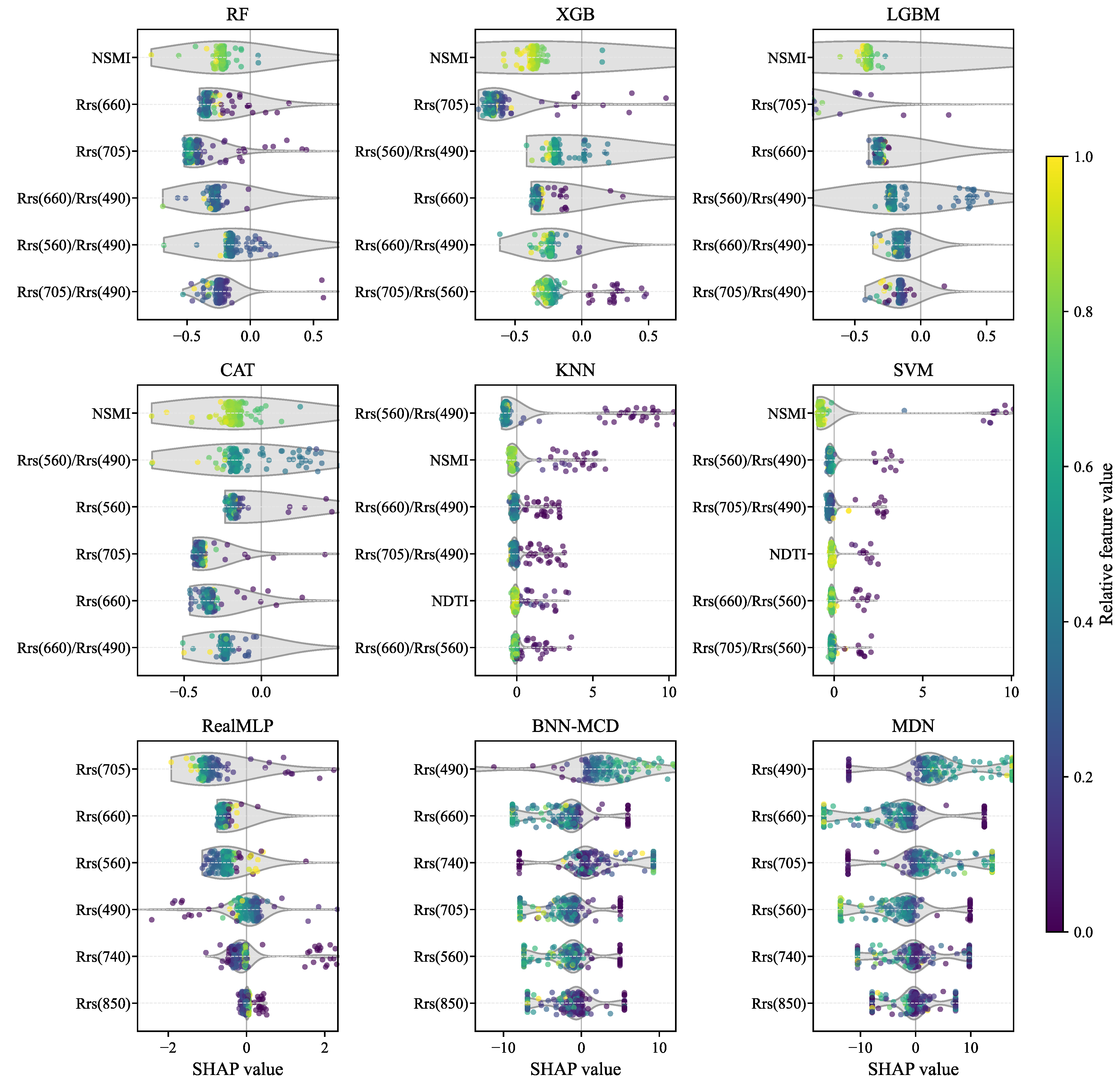
- Feature engineering affected Cross OWT performance: SHAP showed that NSMI acted as a regime-separating predictor, with attribution changes concentrated around NSMI values of about 0.4 to 0.6. Indices did not consistently improve Cross OWT robustness for tree ensemble models and could increase bias. KNN was highly feature sensitive; removing indices markedly improved its Cross OWT robustness.
- (3)
- Implications for SDD retrieval practice: Model performance should be reported for a specific validation scenario rather than inferred from a random split. Feature sets should be selected based on scenario testing under regime shifts, instead of applying index engineering by default.
Author Contributions
Funding
Data Availability Statement
Acknowledgments
Conflicts of Interest
References
- Jiang, X.; Wang, S.; Li, J.; Spyrakos, E.; Yao, H.; Zhang, F.; Tyler, A.N.; Zhang, B. Water Transparency and Color in Large Rivers Observed by Sentinel-2 MSI and Its Implications for SDG 6.3.2 Monitoring. Int. J. Appl. Earth Obs. Geoinf. 2025, 143, 104826. [Google Scholar] [CrossRef]
- Pi, X.; Feng, L.; Li, W.; Zhao, D.; Kuang, X.; Li, J. Water Clarity Changes in 64 Large Alpine Lakes on the Tibetan Plateau and the Potential Responses to Lake Expansion. ISPRS J. Photogramm. Remote Sens. 2020, 170, 192–204. [Google Scholar] [CrossRef]
- Wei, J.; Wang, M.; Jiang, L.; Lee, Z.; Kirby, R.; Mikelsons, K.; Lin, G. Satellite Observations of Water Transparency from VIIRS in Global Aquatic Ecosystems. Remote Sens. Environ. 2025, 330, 114981. [Google Scholar] [CrossRef]
- Jiang, D.; Matsushita, B.; Setiawan, F.; Vundo, A. An Improved Algorithm for Estimating the Secchi Disk Depth from Remote Sensing Data Based on the New Underwater Visibility Theory. ISPRS J. Photogramm. Remote Sens. 2019, 152, 13–23. [Google Scholar] [CrossRef]
- Lee, Z.; Shang, S.; Qi, L.; Yan, J.; Lin, G. A Semi-Analytical Scheme to Estimate Secchi-Disk Depth from Landsat-8 Measurements. Remote Sens. Environ. 2016, 177, 101–106. [Google Scholar] [CrossRef]
- Zhang, Y.; Zhang, Y.; Iestyn Woolway, R.; Cao, Z.; Wang, X.; Zhou, J.; Zhou, Y.; Wang, W.; Li, N.; Qin, B.; et al. Spatiotemporal Variations in Global Lake Clarity and Responses to Climate and Landscape Drivers. Sci. Bull. 2025, 70, 4091–4103. [Google Scholar] [CrossRef]
- Shen, M.; Duan, H.; Cao, Z.; Xue, K.; Qi, T.; Ma, J.; Liu, D.; Song, K.; Huang, C.; Song, X. Sentinel-3 OLCI Observations of Water Clarity in Large Lakes in Eastern China: Implications for SDG 6.3.2 Evaluation. Remote Sens. Environ. 2020, 247, 111950. [Google Scholar] [CrossRef]
- Wei, L.; Wang, Z.; Huang, C.; Zhang, Y.; Wang, Z.; Xia, H.; Cao, L. Transparency Estimation of Narrow Rivers by UAV-Borne Hyperspectral Remote Sensing Imagery. IEEE Access 2020, 8, 168137–168153. [Google Scholar] [CrossRef]
- Tian, S.; Sha, A.; Luo, Y.; Ke, Y.; Spencer, R.; Hu, X.; Ning, M.; Zhao, Y.; Deng, R.; Gao, Y.; et al. A Novel Framework for River Organic Carbon Retrieval through Satellite Data and Machine Learning. ISPRS J. Photogramm. Remote Sens. 2025, 221, 109–123. [Google Scholar] [CrossRef]
- Msusa, A.D.; Jiang, D.; Matsushita, B. A Semianalytical Algorithm for Estimating Water Transparency in Different Optical Water Types from MERIS Data. Remote Sens. 2022, 14, 868. [Google Scholar] [CrossRef]
- Deutsch, E.S.; Cardille, J.A.; Koll-Egyed, T.; Fortin, M.-J. Landsat 8 Lake Water Clarity Empirical Algorithms: Large-Scale Calibration and Validation Using Government and Citizen Science Data from across Canada. Remote Sens. 2021, 13, 1257. [Google Scholar] [CrossRef]
- Yan, N.; Qiu, Z.; Zhang, C.; Liu, J.; Liu, D. Observing Water Turbidity in Chinese Rivers Using Landsat Series Data over the Past 40 Years. J. Clean. Prod. 2025, 494, 145001. [Google Scholar] [CrossRef]
- Song, K.; Liu, G.; Wang, Q.; Wen, Z.; Lyu, L.; Du, Y.; Sha, L.; Fang, C. Quantification of Lake Clarity in China Using Landsat OLI Imagery Data. Remote Sens. Environ. 2020, 243, 111800. [Google Scholar] [CrossRef]
- Maciel, D.A.; Pahlevan, N.; Barbosa, C.C.F.; Martins, V.S.; Smith, B.; O’Shea, R.E.; Balasubramanian, S.V.; Saranathan, A.M.; Novo, E.M.L.M. Towards Global Long-Term Water Transparency Products from the Landsat Archive. Remote Sens. Environ. 2023, 299, 113889. [Google Scholar] [CrossRef]
- He, Y.; Lu, Z.; Wang, W.; Zhang, D.; Zhang, Y.; Qin, B.; Shi, K.; Yang, X. Water Clarity Mapping of Global Lakes Using a Novel Hybrid Deep-Learning-Based Recurrent Model with Landsat OLI Images. Water Res. 2022, 215, 118241. [Google Scholar] [CrossRef]
- Zhang, Y.; Zhang, Y.; Shi, K.; Zhou, Y.; Li, N. Remote Sensing Estimation of Water Clarity for Various Lakes in China. Water Res. 2021, 192, 116844. [Google Scholar] [CrossRef]
- Page, B.P.; Olmanson, L.G.; Mishra, D.R. A Harmonized Image Processing Workflow Using Sentinel-2/MSI and Landsat-8/OLI for Mapping Water Clarity in Optically Variable Lake Systems. Remote Sens. Environ. 2019, 231, 111284. [Google Scholar] [CrossRef]
- Chen, X.; Liu, L.; Zhang, X.; Li, J.; Wang, S.; Gao, Y.; Mi, J. Long-Term Water Clarity Patterns of Lakes across China Using Landsat Series Imagery from 1985 to 2020. Hydrol. Earth Syst. Sci. 2022, 26, 3517–3536. [Google Scholar] [CrossRef]
- Feng, L.; Hou, X.; Zheng, Y. Monitoring and Understanding the Water Transparency Changes of Fifty Large Lakes on the Yangtze Plain Based on Long-Term MODIS Observations. Remote Sens. Environ. 2019, 221, 675–686. [Google Scholar] [CrossRef]
- Alikas, K.; Kratzer, S. Improved Retrieval of Secchi Depth for Optically-Complex Waters Using Remote Sensing Data. Ecol. Indic. 2017, 77, 218–227. [Google Scholar] [CrossRef]
- Rubin, H.J.; Lutz, D.A.; Steele, B.G.; Cottingham, K.L.; Weathers, K.C.; Ducey, M.J.; Palace, M.; Johnson, K.M.; Chipman, J.W. Remote Sensing of Lake Water Clarity: Performance and Transferability of Both Historical Algorithms and Machine Learning. Remote Sens. 2021, 13, 1434. [Google Scholar] [CrossRef]
- Maciel, D.A.; Barbosa, C.C.F.; Novo, E.M.L.D.M.; Flores Júnior, R.; Begliomini, F.N. Water Clarity in Brazilian Water Assessed Using Sentinel-2 and Machine Learning Methods. ISPRS J. Photogramm. Remote Sens. 2021, 182, 134–152. [Google Scholar] [CrossRef]
- Qing, S.; Cui, T.; Lai, Q.; Bao, Y.; Diao, R.; Yue, Y.; Hao, Y. Improving Remote Sensing Retrieval of Water Clarity in Complex Coastal and Inland Waters with Modified Absorption Estimation and Optical Water Classification Using Sentinel-2 MSI. Int. J. Appl. Earth Obs. Geoinf. 2021, 102, 102377. [Google Scholar] [CrossRef]
- Zhang, Y.; Shi, K.; Sun, X.; Zhang, Y.; Li, N.; Wang, W.; Zhou, Y.; Zhi, W.; Liu, M.; Li, Y.; et al. Improving Remote Sensing Estimation of Secchi Disk Depth for Global Lakes and Reservoirs Using Machine Learning Methods. GISci. Remote Sens. 2022, 59, 1367–1383. [Google Scholar] [CrossRef]
- Zhang, L.; Zhang, C.; Ma, C.; Chen, X.; Li, Q.; Ye, X.; Yu, Z.; Tian, L. Machine Learning-Based Retrieval of Chlorophyll-a and Total Suspended Matter from HY-3A CZI: Model Development, Validation, and Application. ISPRS J. Photogramm. Remote Sens. 2025, 227, 613–631. [Google Scholar] [CrossRef]
- Li, S.; Song, K.; Wang, S.; Liu, G.; Wen, Z.; Shang, Y.; Lyu, L.; Chen, F.; Xu, S.; Tao, H.; et al. Quantification of Chlorophyll-a in Typical Lakes across China Using Sentinel-2 MSI Imagery with Machine Learning Algorithm. Sci. Total Environ. 2021, 778, 146271. [Google Scholar] [CrossRef]
- Werther, M.; Burggraaff, O.; Gurlin, D.; Saranathan, A.M.; Balasubramanian, S.V.; Giardino, C.; Braga, F.; Bresciani, M.; Pellegrino, A.; Pinardi, M.; et al. On the Generalization Ability of Probabilistic Neural Networks for Hyperspectral Remote Sensing of Absorption Properties across Optically Complex Waters. Remote Sens. Environ. 2025, 328, 114820. [Google Scholar] [CrossRef]
- Pahlevan, N.; Smith, B.; Schalles, J.; Binding, C.; Cao, Z.; Ma, R.; Alikas, K.; Kangro, K.; Gurlin, D.; Hà, N.; et al. Seamless Retrievals of Chlorophyll-a from Sentinel-2 (MSI) and Sentinel-3 (OLCI) in Inland and Coastal Waters: A Machine-Learning Approach. Remote Sens. Environ. 2020, 240, 111604. [Google Scholar] [CrossRef]
- Silva, S.J.; Keller, C.A.; Hardin, J. Using an Explainable Machine Learning Approach to Characterize Earth System Model Errors: Application of SHAP Analysis to Modeling Lightning Flash Occurrence. J. Adv. Model Earth Syst. 2022, 14, e2021MS002881. [Google Scholar] [CrossRef]
- Nallakaruppan, M.K.; Gangadevi, E.; Shri, M.L.; Balusamy, B.; Bhattacharya, S.; Selvarajan, S. Reliable Water Quality Prediction and Parametric Analysis Using Explainable AI Models. Sci. Rep. 2024, 14, 7520. [Google Scholar] [CrossRef]
- Spyrakos, E.; O’Donnell, R.; Hunter, P.D.; Miller, C.; Scott, M.; Simis, S.G.H.; Neil, C.; Barbosa, C.C.F.; Binding, C.E.; Bradt, S.; et al. Optical Types of Inland and Coastal Waters. Limnol. Oceanogr. 2018, 63, 846–870. [Google Scholar] [CrossRef]
- Bi, S.; Hieronymi, M. Holistic Optical Water Type Classification for Ocean, Coastal, and Inland Waters. Limnol. Oceanogr. 2024, 69, 1547–1561. [Google Scholar] [CrossRef]
- Neil, C.; Spyrakos, E.; Hunter, P.D.; Tyler, A.N. A Global Approach for Chlorophyll-a Retrieval across Optically Complex Inland Waters Based on Optical Water Types. Remote Sens. Environ. 2019, 229, 159–178. [Google Scholar] [CrossRef]
- Cui, T.W.; Zhang, J.; Wang, K.; Wei, J.W.; Mu, B.; Ma, Y.; Zhu, J.H.; Liu, R.J.; Chen, X.Y. Remote Sensing of Chlorophyll a Concentration in Turbid Coastal Waters Based on a Global Optical Water Classification System. ISPRS J. Photogramm. Remote Sens. 2020, 163, 187–201. [Google Scholar] [CrossRef]
- Balasubramanian, S.V.; Pahlevan, N.; Smith, B.; Binding, C.; Schalles, J.; Loisel, H.; Gurlin, D.; Greb, S.; Alikas, K.; Randla, M.; et al. Robust Algorithm for Estimating Total Suspended Solids (TSS) in Inland and Nearshore Coastal Waters. Remote Sens. Environ. 2020, 246, 111768. [Google Scholar] [CrossRef]
- Woo Kim, Y.; Kim, T.; Shin, J.; Lee, D.-S.; Park, Y.-S.; Kim, Y.; Cha, Y. Validity Evaluation of a Machine-Learning Model for Chlorophyll a Retrieval Using Sentinel-2 from Inland and Coastal Waters. Ecol. Indic. 2022, 137, 108737. [Google Scholar] [CrossRef]
- Singh, K.A.; Ryu, D.; Arora, M.; Tiwari, M.K.; Sahoo, B. Improving the Accuracy of Remotely Sensed TSS and Turbidity Using Quality Enhanced Water Reflectance by a Statistical Resampling Technique. Int. J. Appl. Earth Obs. Geoinf. 2025, 142, 104681. [Google Scholar] [CrossRef]
- Lehmann, M.K.; Gurlin, D.; Pahlevan, N.; Alikas, K.; Conroy, T.; Anstee, J.; Balasubramanian, S.V.; Barbosa, C.C.F.; Binding, C.; Bracher, A.; et al. GLORIA—A Globally Representative Hyperspectral in Situ Dataset for Optical Sensing of Water Quality. Sci. Data 2023, 10, 100. [Google Scholar] [CrossRef]
- Zhai, M.; Zhou, X.; Tao, Z.; Xie, Y.; Yang, J.; Shao, W.; Zhang, H.; Lv, T. Satellite-Ground Synchronous in-Situ Dataset of Water Optical Parameters and Surface Temperature for Typical Lakes in China. Sci. Data 2024, 11, 883. [Google Scholar] [CrossRef]
- Chowdhury, M.; De La Calle, I.; Laiz, I.; Ruescas, A.B. Near-Real-Time Turbidity Monitoring at Global Scale Using Sentinel-2 Data and Machine Learning Techniques. Remote Sens. 2025, 17, 3716. [Google Scholar] [CrossRef]
- Kuhn, C.; De Matos Valerio, A.; Ward, N.; Loken, L.; Sawakuchi, H.O.; Kampel, M.; Richey, J.; Stadler, P.; Crawford, J.; Striegl, R.; et al. Performance of Landsat-8 and Sentinel-2 Surface Reflectance Products for River Remote Sensing Retrievals of Chlorophyll-a and Turbidity. Remote Sens. Environ. 2019, 224, 104–118. [Google Scholar] [CrossRef]
- Werther, M.; Odermatt, D.; Simis, S.G.H.; Gurlin, D.; Lehmann, M.K.; Kutser, T.; Gupana, R.; Varley, A.; Hunter, P.D.; Tyler, A.N.; et al. A Bayesian Approach for Remote Sensing of Chlorophyll-a and Associated Retrieval Uncertainty in Oligotrophic and Mesotrophic Lakes. Remote Sens. Environ. 2022, 283, 113295. [Google Scholar] [CrossRef]
- Cao, Z.; Ma, R.; Duan, H.; Pahlevan, N.; Melack, J.; Shen, M.; Xue, K. A Machine Learning Approach to Estimate Chlorophyll-a from Landsat-8 Measurements in Inland Lakes. Remote Sens. Environ. 2020, 248, 111974. [Google Scholar] [CrossRef]
- Holzmüller, D.; Grinsztajn, L.; Steinwart, I. Better by Default: Strong Pre-Tuned MLPs and Boosted Trees on Tabular Data. In Proceedings of the 38th International Conference on Neural Information Processing Systems, San Diego, CA, USA, 2–7 December 2025. [Google Scholar]
- Smith, B.; Pahlevan, N.; Schalles, J.; Ruberg, S.; Errera, R.; Ma, R.; Giardino, C.; Bresciani, M.; Barbosa, C.; Moore, T.; et al. A Chlorophyll-a Algorithm for Landsat-8 Based on Mixture Density Networks. Front. Remote Sens. 2021, 1, 623678. [Google Scholar] [CrossRef]
- Sankaran, R.; Al-Khayat, J.A.; J, A.; Chatting, M.E.; Sadooni, F.N.; Al-Kuwari, H.A.-S. Retrieval of Suspended Sediment Concentration (SSC) in the Arabian Gulf Water of Arid Region by Sentinel-2 Data. Sci. Total Environ. 2023, 904, 166875. [Google Scholar] [CrossRef]
- Lundberg, S.M.; Erion, G.; Chen, H.; DeGrave, A.; Prutkin, J.M.; Nair, B.; Katz, R.; Himmelfarb, J.; Bansal, N.; Lee, S.-I. Explainable AI for Trees: From Local Explanations to Global Understanding. arXiv 2019, arXiv:1905.04610. [Google Scholar] [CrossRef]
- Yin, Z.; Li, J.; Liu, Y.; Xie, Y.; Zhang, F.; Wang, S.; Sun, X.; Zhang, B. Water Clarity Changes in Lake Taihu over 36 Years Based on Landsat TM and OLI Observations. Int. J. Appl. Earth Obs. Geoinf. 2021, 102, 102457. [Google Scholar] [CrossRef]
- Shen, M.; Luo, J.; Cao, Z.; Xue, K.; Qi, T.; Ma, J.; Liu, D.; Song, K.; Feng, L.; Duan, H. Random Forest: An Optimal Chlorophyll-a Algorithm for Optically Complex Inland Water Suffering Atmospheric Correction Uncertainties. J. Hydrol. 2022, 615, 128685. [Google Scholar] [CrossRef]
- Fan, W.; Xu, Z.; Dong, Q.; Chen, W.; Cai, Y. Remote Sensing-Based Spatiotemporal Variation and Driving Factor Assessment of Chlorophyll-a Concentrations in China’s Pearl River Estuary. Front. Mar. Sci. 2023, 10, 1226234. [Google Scholar] [CrossRef]
- Chen, X.; Liu, L.; Zhang, X.; Li, J.; Wang, S.; Liu, D.; Duan, H.; Song, K. An Assessment of Water Color for Inland Water in China Using a Landsat 8-Derived Forel–Ule Index and the Google Earth Engine Platform. IEEE J. Sel. Top. Appl. Earth Obs. Remote Sens. 2021, 14, 5773–5785. [Google Scholar] [CrossRef]
- Zhao, Y.; Chen, J.; Li, X. Sentinel-2 Observation of Water Color Variations in Inland Water across Guangzhou and Shenzhen after the Establishment of the Guangdong-Hong Kong-Macao Bay Area. Appl. Sci. 2023, 13, 9039. [Google Scholar] [CrossRef]





| OWT | Sample, n (%) | SDD (m) | Rrs(490) (sr−1) | Rrs(560) (sr−1) | Rrs(660) (sr−1) | Rrs(705) (sr−1) |
|---|---|---|---|---|---|---|
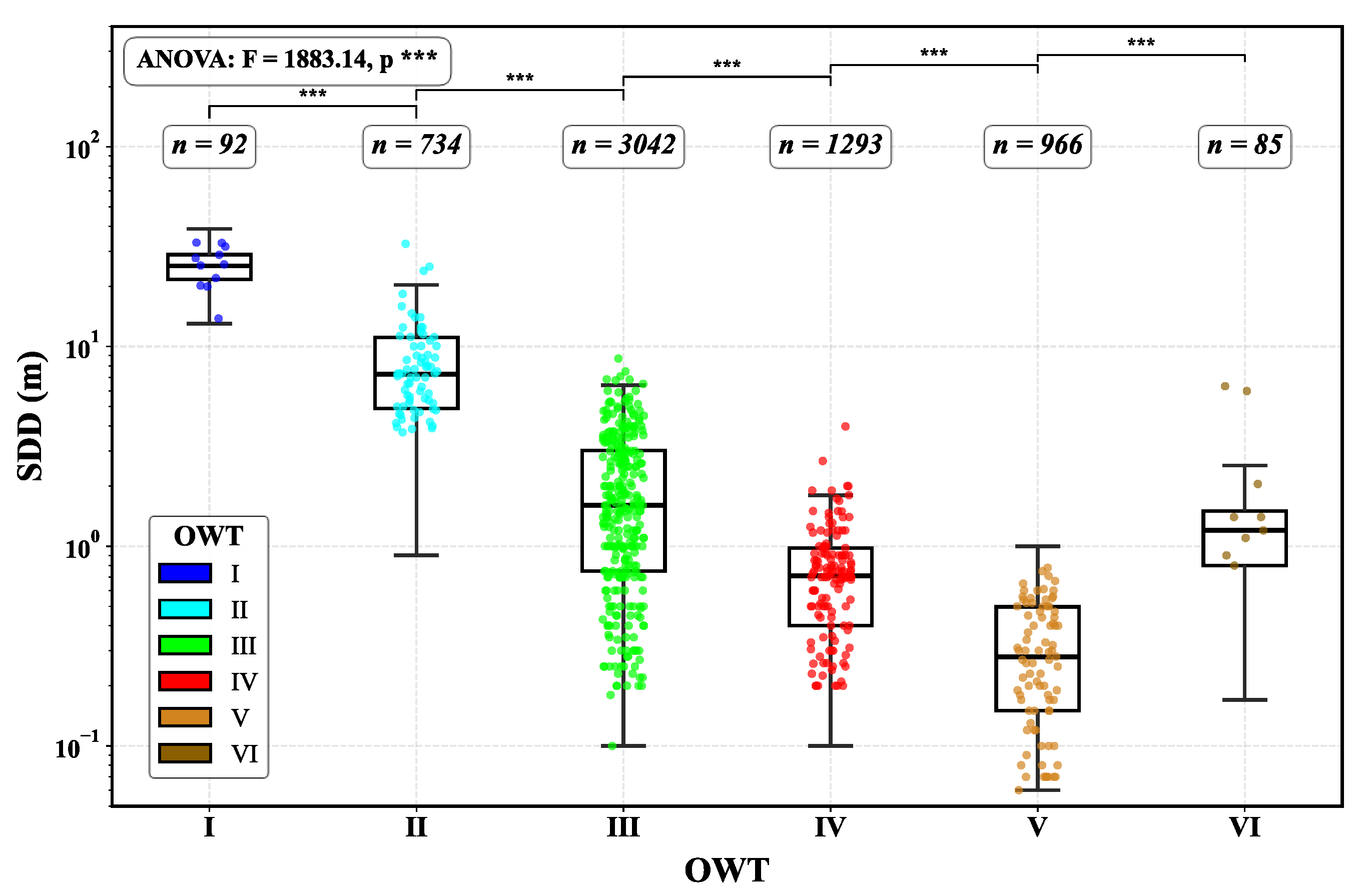
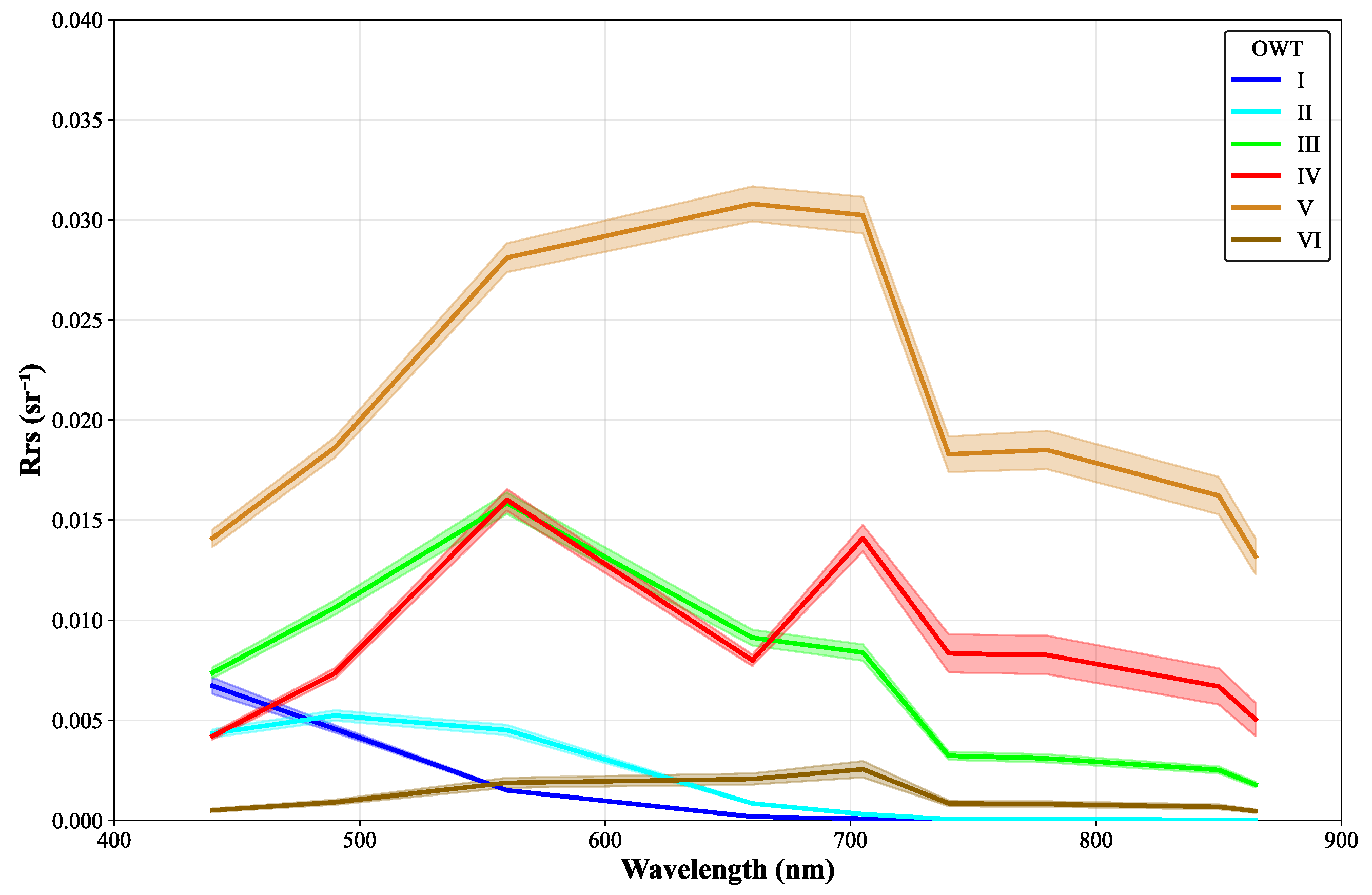
| I | 92 (1.5) | 25.32 [21.64~28.80] | 4.66 [3.97~5.12] | 1.43 [1.31~1.61] | 0.16 [0.13~0.20] | 0.07 [0.05~0.09] |
| II | 734 (11.8) | 7.25 [4.90~11.10] | 4.20 [3.04~6.11] | 3.13 [2.11~5.85] | 0.64 [0.37~1.11] | 0.195 [0.11~0.34] |
| III | 3042 (48.9) | 1.60 [0.75~3.02] | 7.23 [3.48~14.5] | 10.8 [5.59~21.0] | 4.87 [2.15~11.8] | 3.86 [1.49~10.4] |
| IV | 1298 (20.9) | 0.70 [0.40~0.98] | 6.70 [3.79~9.28] | 13.8 [9.04~20.7] | 6.93 [4.66~9.59] | 10.6 [6.54~17.6] |
| V | 967 (15.6) | 0.28 [0.15~0.49] | 18.1 [12.3~23.3] | 26.5 [20.3~33.3] | 29.2 [20.9~37.2] | 28.4 [19.6~38.7] |
| VI | 85 (1.4) | 1.20 [0.80~1.50] | 0.79 [0.53~1.20] | 1.65 [1.05~2.51] | 1.75 [1.28~2.61] | 1.92 [1.25~3.47] |
| Model | Key Hyperparameters |
|---|---|
| Probabilistic NN (BNN-MCD, MDN) | hidden layers = 5; hidden units = 500; activation = ReLU; batch = 32; optimizer = Adam; lr = 1 × 10⁻⁴; L2 = 1 × 10⁻³; loss = NLL; BNN-MCD: dropout = 0.25, MC samples = 100; MDN: mixture components = 5 |
| RealMLP | Default settings (no tuning) |
| RF | n_estimators = 200; max_depth = 18; max_features = sqrt; min_samples_split = 4 |
| KNN | n_neighbors = 12; weights = distance; p = 1 (Manhattan) |
| SVM | kernel = RBF; C = 9.91; epsilon = 0.303 |
| XGB | n_estimators = 400; max_depth = 10; learning_rate = 0.016; gamma = 1.91; min_child_weight = 3.20; colsample_bytree = 0.57 |
| LGBM | num_leaves = 200; max_depth = 9; learning_rate = 0.181; feature_fraction = 0.731; bagging_fraction = 0.967; bagging_freq = 6; min_data_in_leaf = 20 |
| CAT | depth = 8; learning_rate = 0.05; l2_leaf_reg = 3 |
| Model | Metrics | 6 Bands | Bands + Indices |
|---|---|---|---|
| RF | SSPB | 31.08 | 48.21 |
| MdSA | 47.52 | 50.50 | |
| XGB | SSPB | 30.70 | 36.45 |
| MdSA | 45.84 | 46.50 | |
| LGBM | SSPB | 27.86 | 28.25 |
| MdSA | 49.99 | 54.58 | |
| CAT | SSPB | 16.73 | 27.45 |
| MdSA | 41.14 | 44.86 | |
| SVM | SSPB | 121.77 | 70.14 |
| MdSA | 144.93 | 79.23 | |
| KNN | SSPB | 21.95 | 72.38 |
| MdSA | 39.99 | 96.40 |
Disclaimer/Publisher’s Note: The statements, opinions and data contained in all publications are solely those of the individual author(s) and contributor(s) and not of MDPI and/or the editor(s). MDPI and/or the editor(s) disclaim responsibility for any injury to people or property resulting from any ideas, methods, instructions or products referred to in the content. |
© 2026 by the authors. Licensee MDPI, Basel, Switzerland. This article is an open access article distributed under the terms and conditions of the Creative Commons Attribution (CC BY) license.
Share and Cite
Jiang, B.; Yang, H.; Deng, L.; Zhao, J. Optical Water Type Guided Benchmarking of Machine Learning Generalization for Secchi Disk Depth Retrieval. Remote Sens. 2026, 18, 287. https://doi.org/10.3390/rs18020287
Jiang B, Yang H, Deng L, Zhao J. Optical Water Type Guided Benchmarking of Machine Learning Generalization for Secchi Disk Depth Retrieval. Remote Sensing. 2026; 18(2):287. https://doi.org/10.3390/rs18020287
Chicago/Turabian StyleJiang, Bo, Hanfei Yang, Lin Deng, and Jun Zhao. 2026. "Optical Water Type Guided Benchmarking of Machine Learning Generalization for Secchi Disk Depth Retrieval" Remote Sensing 18, no. 2: 287. https://doi.org/10.3390/rs18020287
APA StyleJiang, B., Yang, H., Deng, L., & Zhao, J. (2026). Optical Water Type Guided Benchmarking of Machine Learning Generalization for Secchi Disk Depth Retrieval. Remote Sensing, 18(2), 287. https://doi.org/10.3390/rs18020287