


Highlights
What are the main findings?
- InSAR observations constrain the coseismic deformation field and fault slip distribution of the 2020 Mw 6.3 Yutian earthquake.
- Coulomb stress calculations based on slip models of four Yutian earthquakes reveal complex stress interactions among neighboring faults.
What are the implications of the main findings?
- The 2020 Yutian earthquake can only be fully understood in the context of cumulative stress changes from prior events.
- Multi-earthquake stress analysis provides improved insight into fault interaction and seismic hazard in extensional tectonic settings.
Abstract
The Yutian region at the southwestern termination of the Altyn Tagh Fault has experienced four moderate-to-strong earthquakes since 2008, providing an opportunity to investigate fault interactions within a transtensional tectonic setting. In this study, we derive the coseismic deformation and slip model of the 2020 Mw 6.3 Yutian earthquake using ascending and descending Sentinel-1 InSAR data. The deformation field exhibits a characteristic subsidence–uplift pattern consistent with normal faulting, and the preferred slip model indicates a north–south-striking fault with slip concentrated at depths of 6–9 km. To place this event in a broader tectonic context, we incorporate published slip models for the 2008 and 2014 earthquakes together with a simplified finite-fault model for the 2012 event to construct a unified four-event source framework. Static Coulomb stress calculations reveal complex interactions among the four earthquakes. Localized positive loading from the 2012 event partially counteracts the negative imposed by the 2008 and 2014 earthquakes, reshaping the stress field rather than simply promoting or inhibiting failure. The cumulative stress evolution shows persistent unclamping and repeated shear-stress reversals, indicating that the 2020 earthquake resulted from long-term extensional loading superimposed on multi-stage coseismic stress redistribution. These results demonstrate that multi-event stress analysis provides a more reliable framework for assessing seismic hazards in regions with complex local stress fields.
1. Introduction
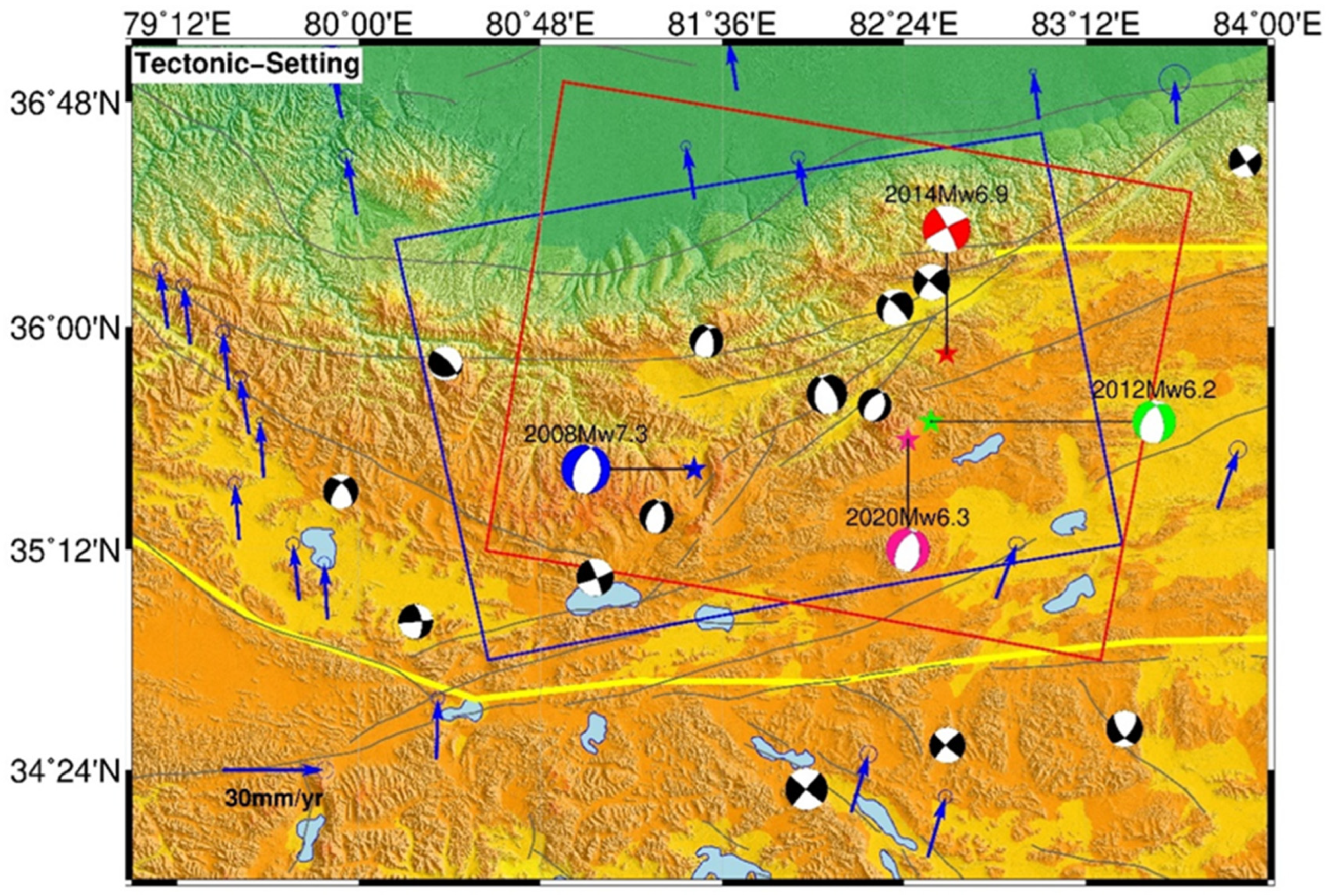
The Yutian region on the northwestern Tibetan Plateau represents a structurally complex tectonic transition zone where the left-lateral Altyn Tagh Fault system interacts with NW–SE extensional deformation associated with plateau uplift and lateral extrusion [1,2,3]. Over the past two decades, this region has experienced a sequence of moderate-to-strong earthquakes, including the 2008 Mw 7.1, 2012 Mw 6.2, 2014 Mw 6.9, and 2020 Mw 6.3 events (Figure 1). These earthquakes exhibit diverse rupture styles: the 2008, 2012, and 2020 events were dominated by normal faulting, whereas the 2014 earthquake ruptured a left-lateral strike-slip fault [4,5,6]. This contrast highlights the mechanical heterogeneity of the fault system at the southwestern termination of the Altyn Tagh Fault and within the adjacent Longmu Co–Guozha Co fault array [7,8,9].
Figure 1.
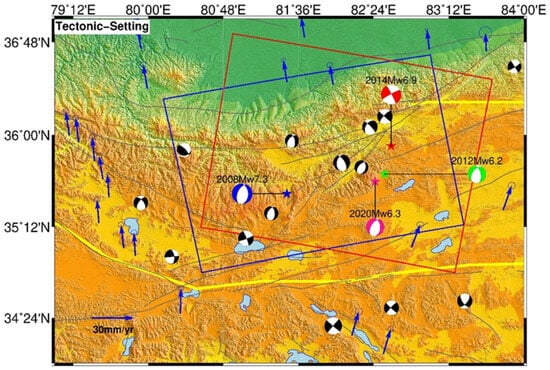
Tectonic setting of the Yutian region. The blue and red rectangles outline the coverage of ascending and descending Sentinel-1 SAR data, respectively. Focal mechanism solutions of historical earthquakes with magnitudes greater than 5.0 are shown in black and white. Blue arrows denote GPS horizontal velocity vectors. The locations of the 2008 Mw 7.3, 2012 Mw 6.2, 2014 Mw 6.9, and 2020 Mw 6.3 Yutian earthquakes are marked.
Static stress transfer has long been recognized as an important mechanism governing earthquake interactions in continental fault systems [10,11,12]. Numerous studies have shown that coseismic Coulomb stress changes () can promote or inhibit subsequent ruptures, depending on fault geometry, frictional conditions, and the regional loading environment [13,14,15]. However, interpreting patterns in tectonically complex regions remains challenging, especially when earthquakes of different magnitudes and mechanisms occur on geometrically linked structures. In such settings, stress shadows and positive loading zones may coexist, and moderate-sized events can play a non-negligible role in redistributing stress across the broader fault network. Recent studies further emphasize that distributions can be highly variable in multi-fault systems, and that factors such as rupture segmentation and local structural complexity may strongly affect the resulting stress patterns [16,17]. These findings indicate that Coulomb stress transfer must be interpreted with caution, particularly in regions characterized by mixed strike-slip and extensional faulting.
The Yutian earthquake sequence provides an ideal natural laboratory for examining these processes. Previous works have investigated individual events or pairwise stress interactions among the 2008, 2012, 2014, and 2020 earthquakes [5,6,9,18]. However, the cumulative evolution of stress across the entire sequence—and its implications for extensional faulting within a transitional strike-slip regime—remains insufficiently understood. This knowledge gap is partly due to limited ground observations and challenging terrain, which restrict source characterization for some events, particularly the 2012 earthquake [4,19,20].
The 2020 Mw 6.3 earthquake occurred during the stable operation of the Sentinel-1A/B satellites, providing high-quality InSAR data that enable accurate reconstruction of its deformation field and rupture geometry [7]. When combined with published InSAR slip models for the 2008 and 2014 earthquakes, as well as a tectonically consistent finite-fault representation of the 2012 event, it becomes possible to reassess the multi-stage static stress evolution of the Yutian sequence using uniform modeling assumptions. Recent advances in geodetic inversion and joint modeling approaches further support such integrated analyses in regions with distributed deformation [21,22].
In this study, we reconstruct the coseismic deformation and slip distribution of the 2020 Mw 6.3 Yutian earthquake using both ascending and descending Sentinel-1 observations. These results are integrated with published slip models for the 2008 and 2014 earthquakes, together with a tectonically consistent finite-fault representation of the 2012 event, to establish a unified four-event source framework. This consistent dataset enables direct comparison of rupture characteristics across the 2008–2020 sequence and provides the basis for systematic evaluation of multi-stage static stress evolution. Building on this framework, we compute the Coulomb stress changes imparted by each earthquake and assess how stress was transferred, accumulated, or reorganized across successive rupture zones and major active faults in the region. By combining high-resolution InSAR observations with multi-event stress modeling, this study offers a comprehensive perspective on fault interactions within a transtensional environment and lays the groundwork for the detailed analyses presented in the following sections.
2. Data and Fault Slip Models
2.1. Coseismic Deformation of the 2020 Yutian Earthquake
We first constructed the coseismic deformation field of the 2020 Mw 6.3 Yutian earthquake and then inverted the fault geometry and slip distribution. The SAR images come from the ascending and descending Sentinel-1A IW-mode acquisitions [23], using the closest available pre- and post-seismic observations (Table 1). We used the 30-m DEM provided by JAXA to simulate and remove the topographic phase. We applied a 10 × 2 multilook factor in the range and azimuth directions to reduce noise and enhance coherence [24]. Because the Sentinel-1 TOPS data contain burst-to-burst phase discontinuities, we performed precise co-registration and achieved a sub-pixel accuracy of 0.001 pixels to suppress azimuth phase gradients [23,25,26,27]. We then applied an adaptive filter to the interferometric phase and used the minimum cost flow algorithm to unwrap the phase [26,28]. These steps produced the final coseismic InSAR deformation fields for the 2020 event. We removed pixels with coherence lower than 0.6 to reduce snow- and terrain-related decorrelation and to ensure reliable deformation measurements for subsequent analyses. To reduce computational cost while preserving data coverage, we applied uniform down-sampling and kept approximately 2500 valid points for each track.
Table 1.
Satellite data was used in the 2020 Yutian earthquake.
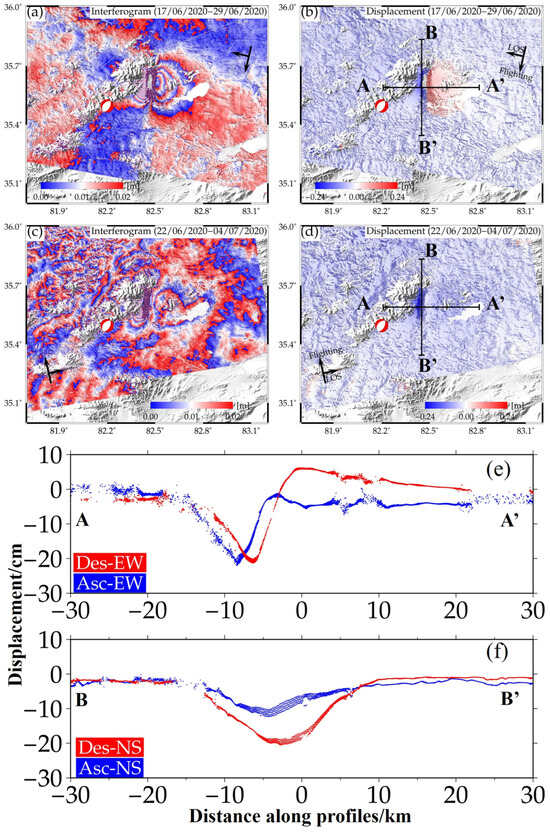
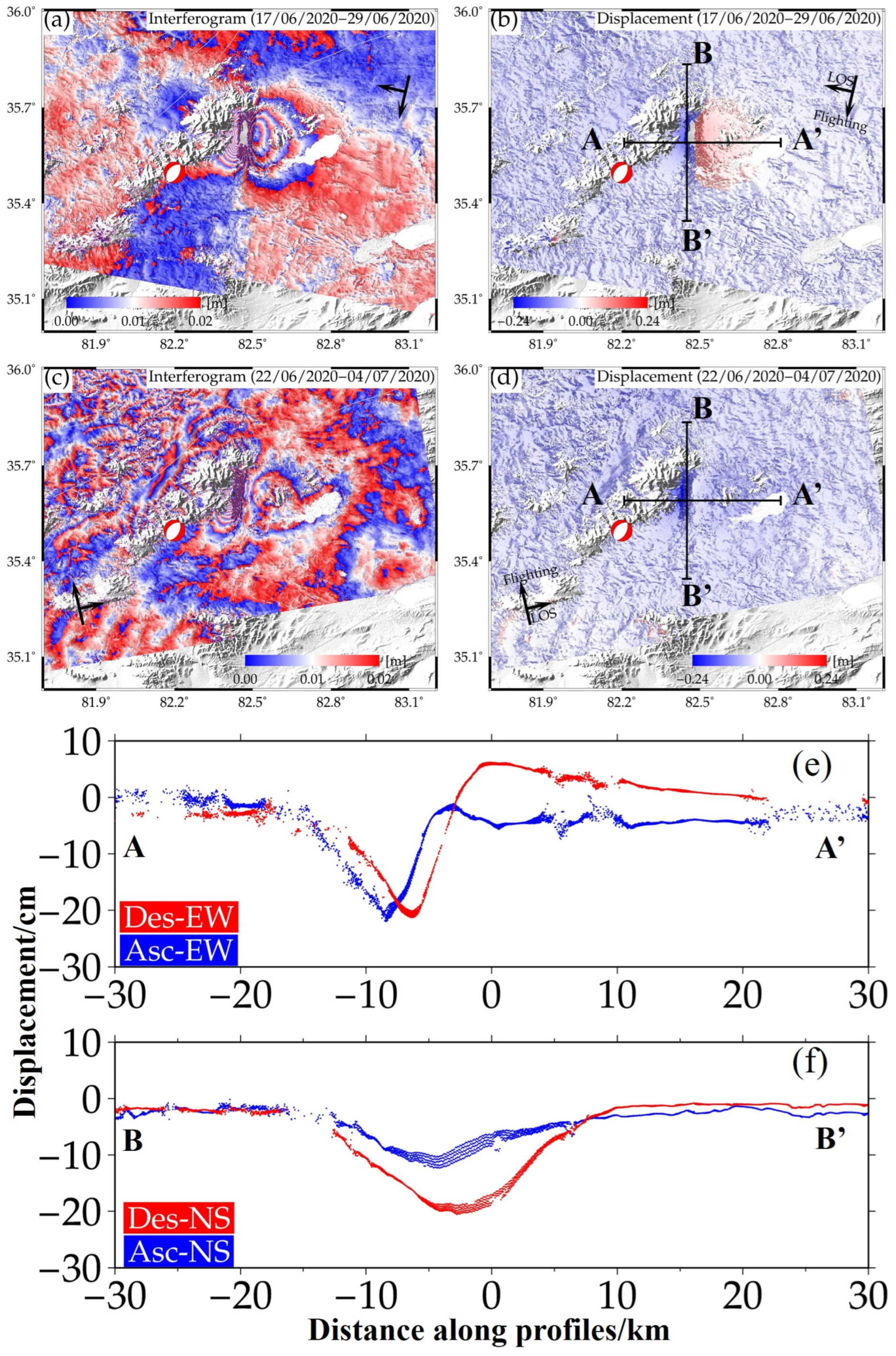
Coseismic InSAR deformation fields reveal that the 2020 Mw 6.3 Yutian earthquake produced a deformation footprint elongated in the near-north–south direction (Figure 2). The east–west extent of the observable deformation is approximately 40 km, and the along-strike dimension is about 30 km. The LOS displacement pattern is characterized by subsidence on the western side and uplift on the eastern side. The maximum subsidence reaches ~20–22 cm, whereas the uplift does not exceed ~6 cm. The well-defined boundary between subsidence and uplift, evident in both ascending and descending LOS geometries, indicates a near-north–south-striking seismogenic structure [20,29].
Figure 2.
Ascending and descending InSAR deformation fields of the 2020 Mw 6.3 Yutian earthquake. (a,b) Descending-track interferogram and corresponding LOS displacement field; (c,d) Ascending-track interferogram and LOS displacement field. A–A′ and B–B′ denote the locations of the two profile lines shown in figure (e,f). (e,f) Profile results along the A–A′ and B–B′ sections.
The descending-track deformation shows a clear pair of subsidence and uplift lobes: subsidence occurs in the basin west of the Qiongmuzitage Peak, and uplift appears on the adjacent eastern highlands. Similar patterns are observed in the ascending-track data. The western subsidence in the ascending data corresponds closely to that in the descending data, with minor uplift signals attributable to SAR look-geometry effects. This spatial deformation pattern is consistent with a normal-faulting mechanism [30]. No clear surface rupture is visible in either LOS data or the extracted profile sections (Figure 2e,f). As a result, the seismogenic fault cannot be unambiguously correlated with previously mapped surface faults in the Yutian region.
2.2. Fault Slip Distribution of the 2020 Yutian Earthquake
Using the ascending and descending Sentinel-1 coseismic deformation fields, we inverted the slip distribution of the 2020 Mw 6.3 Yutian earthquake. The fault geometry was constrained from the InSAR displacement pattern (the uplift–subsidence boundary), the USGS focal-mechanism solution, and local topographic features. Because the deformation boundary is not strictly linear, we adopted a slightly along-strike bent fault trace that follows the bend of the piedmont topography along the front of Qiongmuzi Tagh. The dip angle was determined by a grid search while fixing the surface trace, and the best-fitting model yields a dip of 58°, close to the USGS estimate (~50°). We apply the Steepest Descent Method (SDM) developed by Wang et al. (2013) [31,32] to invert for the fault slip. The forward modeling uses the Okada elastic dislocation solution in a homogeneous half-space [33]. We discretized the candidate seismogenic fault into 2 km × 2 km subfault patches. We solve the inversion using an L2-norm least-squares scheme and impose a smoothing constraint to reduce high-frequency noise. The root-mean-square (RMS) misfits between the modeled and observed deformation remain below 3 cm. This level of misfit suggests that the derived fault geometry and slip distribution are robust.
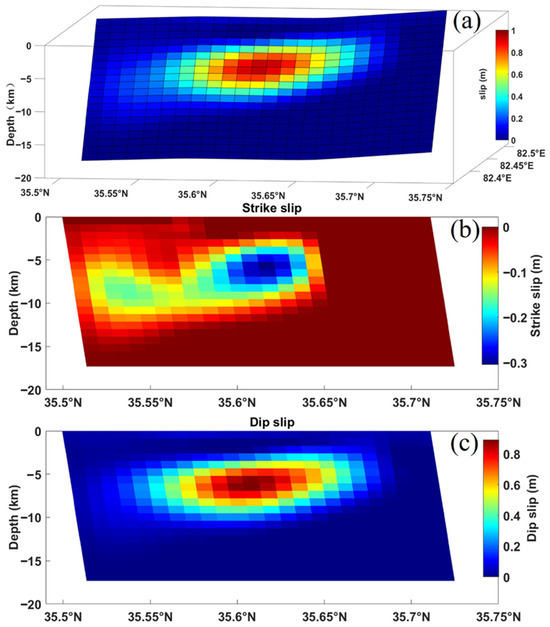
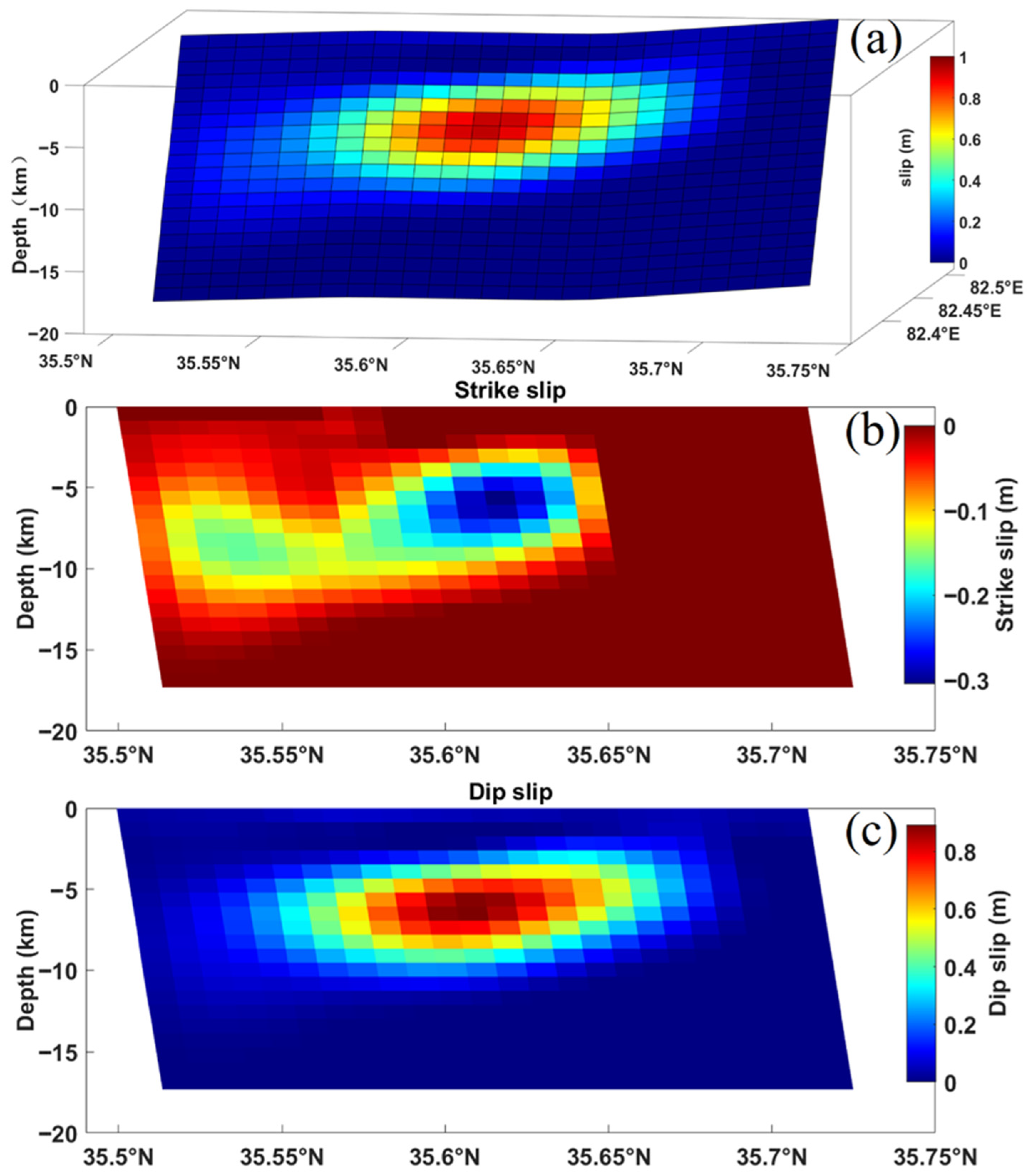
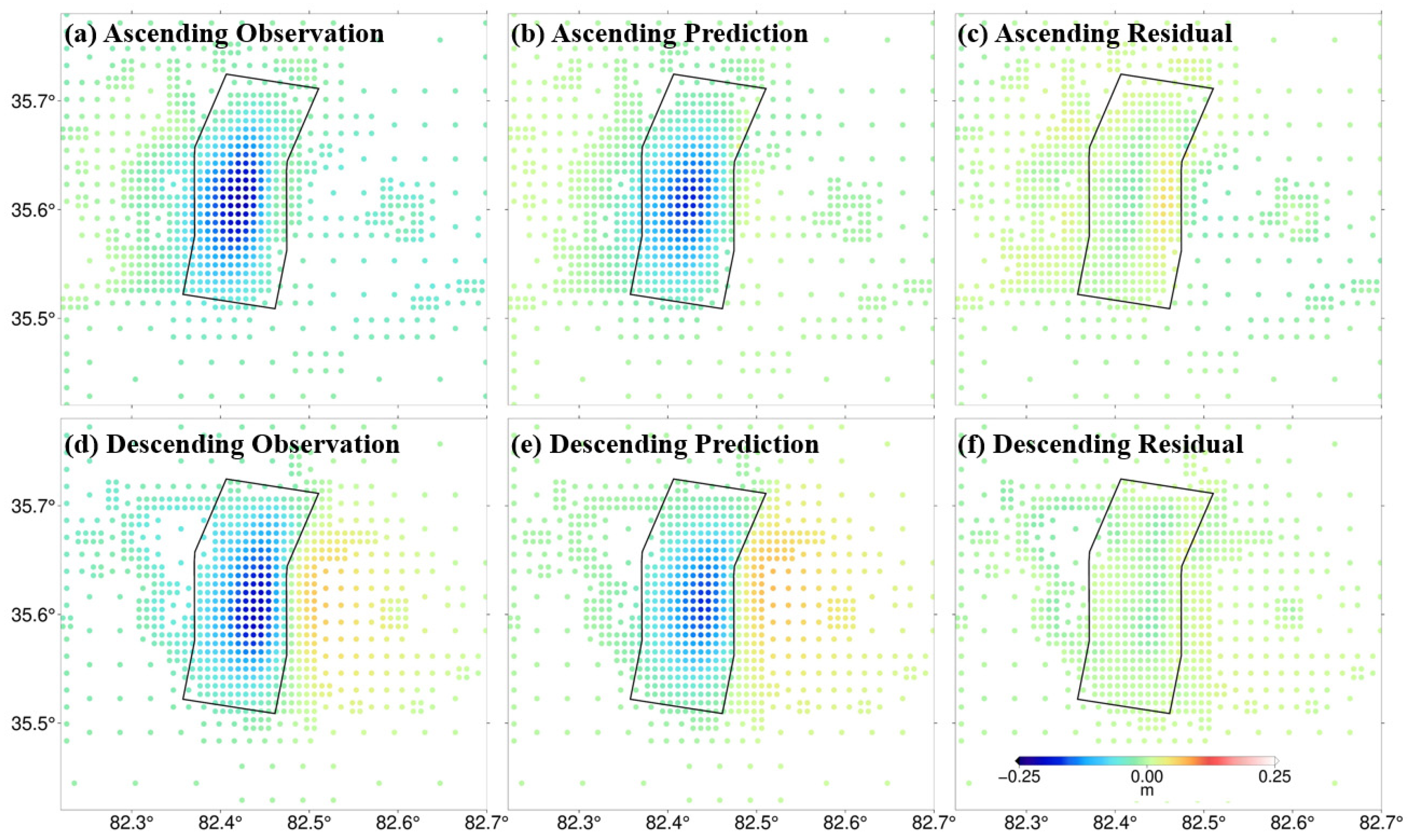
Slip inversion results show that coseismic slip is primarily concentrated at depths of ~6–9 km within a rupture area approximately 15 km long and 10 km wide (Figure 3). The maximum slip reaches ~0.94 m, and the average rake is −107.7°, indicating dominant normal faulting with a minor left-lateral component. The modeled deformation matches both the ascending and descending LOS observations in polarity and amplitude, with RMS misfits below 3 cm (Figure 4), suggesting that the inverted slip model provides a robust representation of the coseismic deformation field. The geodetic moment tensor derived from the slip model corresponds to a scalar moment of M0 = 3.53 × 10¹⁸ N·m (Mw = 6.30), which is consistent with the USGS estimate (M0 = 3.22 × 10¹⁸ N·m, Mw = 6.27) and the GCMT solution (M0 = 3.23 × 1025 dyne·cm, i.e., 3.23 × 10¹⁸ N·m; Mw = 6.3).
Figure 3.
Coseismic slip inversion results of the 2020 Yutian earthquake. (a) Total slip distribution on the fault plane; (b) Strike-slip component; (c) Dip-slip component.
Figure 4.
Data fit for the inverted fault-slip distribution. (a–c) show the observed, modeled, and residual displacement fields for the ascending InSAR data, respectively; (d–f) show the observed, modeled, and residual displacement fields for the descending InSAR data, respectively. The black line denotes the surface projection of the fault trace.
Considering the fault geometry and regional tectonic setting, the 2020 seismogenic structure is most likely associated with the normal-fault system developed along the eastern margin of Qiongmuzi Tagh. Although the rupture does not clearly correlate with any previously mapped surface fault, its position near the 2014 Yutian rupture zone suggests a possible structural or stress-related linkage within the broader mountain-front fault system [34]. To further investigate the tectonic relations and static stress transfer in this region, we incorporated the coseismic deformation and fault parameters of the 2008, 2012, and 2014 Yutian earthquakes into our analysis.
2.3. Fault Slip Model for the 2008 and 2014 Yutian Earthquakes
The 2008 and 2014 Yutian earthquakes represent two important moderate-to-strong events along the northwestern margin of the Tibetan Plateau. Researchers have used InSAR, GPS, field observations, and numerical modeling to analyze their source mechanisms, seismogenic structures, and stress conditions [6,32,34,35]. These studies provide the key data and tectonic context for our work.
- (1)
- The 2008 Mw 7.3 Yutian Earthquake
Previous studies indicate that the 2008 Yutian earthquake occurred within an extensional regime at the junction between the southwestern Altyn Tagh Fault and the western Kunlun Fault system. The rupture was accommodated by a west-dipping normal fault, with some geodetic models suggesting a minor left-lateral strike-slip component. InSAR observations [32] revealed 60–80 cm of subsidence on the western hanging wall and 10–30 cm of uplift on the eastern footwall, consistent with a dip-slip-dominated geometry. GPS measurements recorded coseismic offsets of up to ~14 mm north of the epicenter, exhibiting displacement patterns compatible with a small left-lateral component. Field investigations [36,37] documented a 31–32 km-long surface rupture with complex segmentation and an overall N–NNE strike.
In this study, we adopt the published InSAR–GPS joint inversion model of Zhang et al. (2011) for the 2008 earthquake [34]. No new inversion is performed; the published source geometry and slip distribution are used directly as inputs for the Coulomb stress calculations.
- (2)
- The 2014 Mw 6.9 Yutian Earthquake
The 2014 Mw 6.9 Yutian earthquake ruptured a structurally complex segment at the southwestern end of the Altyn Tagh Fault. High-resolution InSAR and optical imagery [8] reveal that the coseismic rupture propagated across several oblique faults, including the South Xiaoerkule Fault, the Ashikule Fault, and a previously unmapped structure near Xiaoerkule Lake, forming a geometrically linked multi-fault system. The maximum slip reached ~2.5 m and was concentrated at depths of 6–10 km. The rupture was dominated by left-lateral strike-slip motion, accompanied by a minor to moderate normal-slip component. Focal mechanism solutions from CENC and USGS similarly indicate a strike-slip faulting regime with a small extensional component.
Previous studies view this region as a tectonic transition zone between the left-lateral Altyn Tagh Fault and NW–SE oriented extensional deformation. The distributed rupture pattern reflects the combined effects of local structural bends, fault interactions, and stress heterogeneity at block boundaries [8,18]. In this study, we adopt the coseismic slip model of Li et al., derived from TanDEM-X, SPOT6/7 imagery, offset tracking, and InSAR. No new inversion is performed.
2.4. Coseismic Fault Slip Model of the 2012 Yutian Earthquake
Since the 2012 Yutian Ms6.2 earthquake lacks a well-resolved finite-fault model, its detailed rupture geometry remains uncertain. To incorporate this event into the Coulomb stress modeling, we constructed a simplified yet tectonically reasonable fault plane using the available focal mechanism and empirical magnitude–scaling relations.
First, we adopted the W-phase moment tensor solution from the USGS and selected the nodal plane most consistent with the regional extensional tectonic setting at the southwestern termination of the Altyn Tagh Fault. The preferred plane (NP1: strike 196°, dip 31°, rake −88°) indicates a normal-faulting event, consistent with the NW–SE extensional regime documented in the 2008–2012–2020 Yutian earthquake sequence [5,9].
Second, rupture dimensions were estimated using the Wells and Coppersmith (1994) [38] empirical relations. For Mw 6.23, the predicted rupture length and width are ~17.2 km and ~9.6 km, respectively—values consistent with normal events of similar magnitude in the Tibetan Plateau region. Using the reported seismic moment (M0 = 2.741 × 10¹⁸ N·m) and a shear modulus of G = 3.2 × 10¹⁰ Pa, the average slip is estimated to be ~0.52 m. This slip was decomposed into dip-slip and strike-slip components according to the focal mechanism [39].
Finally, to ensure consistency with the reported hypocentral depth of 15 km, the upper and lower fault boundaries were set to ~12.5 km and ~17.5 km, determined from the dip angle and rupture width. The resulting rectangular fault plane satisfies the constraints of magnitude–area scaling, focal mechanism geometry, and depth distribution. Although simplified, this model provides a physically meaningful representation of the 2012 Yutian normal-faulting earthquake and enables its inclusion in the Coulomb stress transfer analysis for the multi-event sequence. These four source-fault representations form a consistent dataset that serves as the basis for the Coulomb stress modeling described in the next section.
3. Coulomb Stress Calculation Method
We calculated the static Coulomb stress change () produced by the coseismic slip of the 2008, 2014, and 2020 Yutian earthquakes to assess potential interactions among these events and to quantify stress perturbations on regional active faults. Coulomb stress is widely used to evaluate whether an earthquake promotes or inhibits subsequent ruptures, and has become a standard tool in continental tectonics and earthquake sequence analysis [10,11,40].
We employed the classical Coulomb failure criterion:
where is the shear stress change resolved in the slip direction of the receiver fault, is the normal stress change (defined as positive for unclamping), and is the effective friction coefficient. Following Lin and Stein (2004), we adopted = 0.4 [41]. Although variations in may affect the absolute amplitude of , previous studies indicate that the sign of stress change and the large-scale loading patterns are relatively insensitive within a reasonable range (e.g., = 0.2–0.6). Therefore, uncertainties in are unlikely to alter the primary conclusions of this study, which focus on stress polarity, spatial patterns, and cumulative stress evolution rather than on absolute triggering thresholds. Positive values indicate stress loading that favors failure, whereas negative values indicate stress unloading.
- (1)
- Stress Transfer Between Earthquakes
To evaluate possible triggering or inhibiting interactions among the four major Yutian earthquakes (2008, 2012, 2014, and 2020), we calculated the static Coulomb stress changes [40,42]. The software implements the Okada elastic dislocation formulation for a homogeneous and isotropic elastic half-space [33] and computes the full three-dimensional stress tensor on specified receiver fault planes.
For the 2008, 2012, 2014, and 2020 earthquakes, we used the corresponding source-fault models described in Section 2.2. The receiver fault was assigned only its geometric parameters (strike, dip, and rake), without imposing slip. This ensures that the computed represents the stress resolved on a potential rupture surface rather than on a slipping plane.
The stress transfer computations were performed strictly in chronological order—2008 → 2012 → 2014 → 2020—allowing assessment of how each earthquake modified the stress state of the subsequent seismogenic fault and the evolving fault system. Under the adopted tension-positive convention for normal stress, a positive indicates increased failure potential (stress loading), whereas a negative indicates reduced failure potential (stress unloading).
- (2)
- Stress Perturbation on the Regional Fault System
To investigate the deep crustal stress redistribution in the Yutian–Altyn Tagh fault junction, we used the PSGRN/PSCMP package [43] for regional static stress modeling. PSGRN computes depth-dependent Green’s functions based on a layered elastic structure, and PSCMP uses these functions to generate the full displacement and stress fields associated with earthquake dislocations.
Because a homogeneous half-space cannot adequately represent the strong lateral and vertical variations of crustal properties along the northwestern Tibetan Plateau, we constructed a nine-layer velocity–density model for the Yutian region based on CRUST1.0 [44]. This layered model (Table 2) was used as the input structure for PSGRN (Table 2. Using the coseismic slip models of the four Yutian earthquakes (2008, 2012, 2014, and 2020), we calculated on major active faults at depths of 0 km, 5 km, 10 km, and 15 km to characterize stress redistribution throughout the upper and middle crust [43].
Table 2.
Crustal layering model of the study area.
Fault geometries were taken from published seismological and structural studies. For faults lacking direct geometric constraints, focal mechanisms of nearby historical earthquakes were used as kinematic proxies to infer their probable strike and dip orientations.
4. Discussion
4.1. Static Coulomb Stress Interactions Between Earthquakes
To quantify the static stress interactions among the 2008, 2012, 2014, and 2020 Yutian earthquakes, we calculated the Coulomb stress change () that each event imposed on the fault planes of subsequent earthquakes.
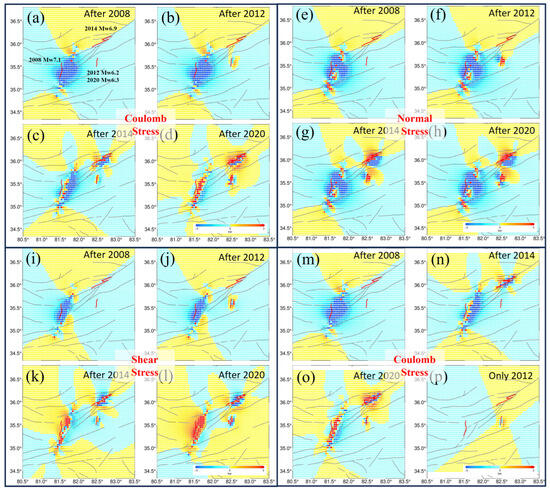
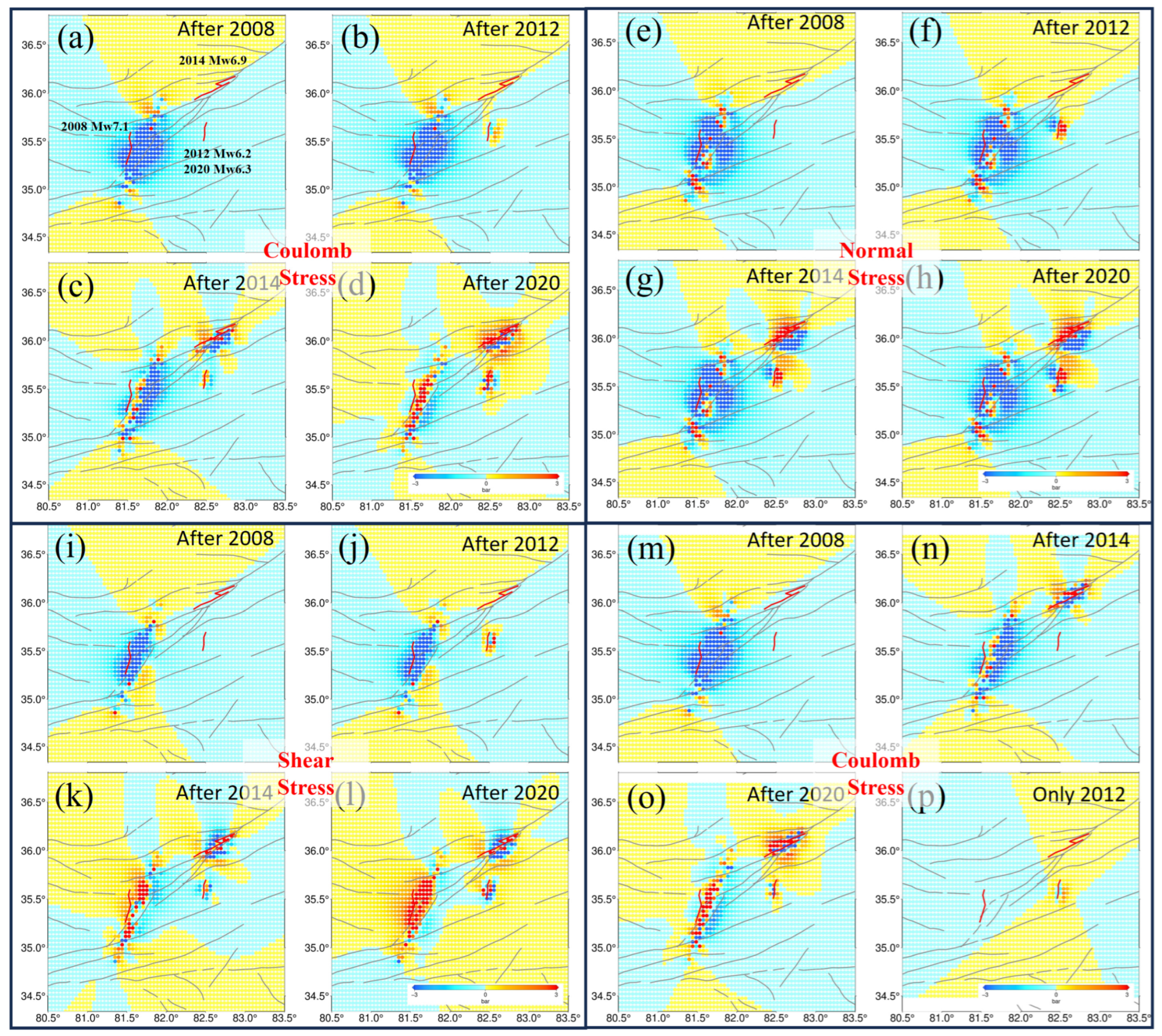
We first assessed the influence of the 2008 Mw 7.1 earthquake by computing on the 2012, 2014, and 2020 receiver faults (Figure 5a,e,i). Figure 4a shows that the normal faults of the 2012 and 2020 earthquakes lie within the negative zone created by the 2008 event. This pattern indicates a typical “stress shadow” [12] suggesting that the 2008 earthquake reduced the failure potential in these segments. In contrast, the rupture zone of the 2014 earthquake is located near the boundary between positive and negative . Figure 4e,i show that this region experienced a positive normal stress change, which promotes fault unclamping, but a negative shear stress change, which weakens the driving shear traction. This competition between unclamping from positive normal stress and inhibition from negative shear stress places the 2014 earthquake in a near-neutral stress transition zone [10], rather than in a clearly loaded or inhibited region. This stress configuration suggests that the 2014 rupture was likely controlled by the regional tectonic stress field and spatial variations in fault strength, rather than being directly triggered by the 2008 event.
Figure 5.
Static Coulomb stress transfer among the 2008, 2012, 2014, and 2020 Yutian earthquakes. For each panel group, the source faults include the coseismic ruptures of all earthquakes that occurred before the time window indicated in the upper-right corner, whereas the receiver faults are the (blank) fault planes of the earthquakes that occur after that time window. (a–d) Coulomb failure stress changes () on the receiver faults for four cumulative cases: 2008; 2008 + 2012; 2008 + 2012 + 2014; and 2008 + 2012 + 2014 + 2020. (e–h) Corresponding normal stress changes (). (i–l) Corresponding shear stress changes (). (m–o) computed excluding the 2012 event, showing stress patterns produced by different combinations of the 2008, 2014, and 2020 earthquakes. (p) computed for the 2012 event only, isolating its individual contribution to stress loading on the 2014 and 2020 receiver faults.
When we use the combined coseismic slip of the 2008 and 2012 earthquakes as the source and calculate on the 2014 and 2020 receiver faults, the 2014 fault falls almost entirely within a > 0 loading zone (Figure 5b). This result indicates that the fault entered a more failure-prone stress state following the two earlier events. The normal stress change further reduces the effective normal stress (Figure 5f). Meanwhile, the shear stress is close to the transition between positive and negative values and shows Δτ > 0 along several segments (Figure 5k). Together, strong unclamping and localized shear loading suggest that the 2008–2012 stress transfer both weakened the normal traction on the fault and increased the shear driving stress on brittle patches. As a result, the 2014 earthquake likely represents a direct outcome of the cumulative stress transfer [11] from the preceding two events, which may also explain its short recurrence interval of only two years after the 2012 earthquake.
The response of the 2020 fault to the 2008–2012 stress changes is more complex. The eastern section shows > 0, favoring unclamping, whereas the western section shows < 0, indicating a stress shadow. Despite this pronounced east–west contrast in normal stress, most of the fault experiences positive shear stress ( > 0), with only a small negative shear-stress patch in the northeastern segment. As a result, localized > 0 loading zones persist on the 2020 fault during this stage.
Using the combined slip of the 2008, 2012, and 2014 earthquakes as the source and the 2020 fault as the sole receiver yields an even more diagnostic result. The 2020 fault lies almost entirely within a > 0 zone. However, both the eastern and western sides of the fault are bounded by broad regions of negative with a larger negative magnitude on the eastern side (Figure 5c). In this configuration, the three earlier events generate a narrow positive band along the fault strike, while wide negative lobes dominate both flanks. This pattern likely constrained the rupture extent and provides a mechanical explanation for the relatively limited rupture size of the 2020 earthquake.
A decomposition of the stress components shows that the normal-stress pattern on the 2020 fault remains nearly unchanged after the 2014 event, with positive values in the east and negative values in the west (Figure 5g). In contrast, the shear-stress distribution undergoes a strong reversal (Figure 5k). Compared with the 2012 stage, the 2014 earthquake drives the shear stress on most of the 2020 fault into negative values, leaving only a small positive patch in the northeastern segment. This result indicates that cumulative coseismic stress transfer did not provide strong shear loading on the 2020 fault. Instead, the 2020 rupture likely depended on long-term tectonic loading combined with the persistent unclamping effects of the normal stress. Accordingly, the positive associated with the 2020 earthquake mainly reflects the contribution of normal-stress reduction rather than shear-stress enhancement.
In the final stress field after the 2020 earthquake, the rupture planes of all four events fall almost entirely within the > 0 region (Figure 5d). This pattern indicates that cumulative loading from multiple earthquakes produced an overall positive redistribution of stress across the fault system.
A comparison of the regional stress evolution from 2008 to 2020 shows a persistent “north–south positive and east–west negative” butterfly-shaped pattern during most of this period. However, the 2020 earthquake significantly reshaped this pattern. New negative zones developed in the southwest and northeast parts of the study region and between the 2008 and 2020 rupture planes. Meanwhile, increased markedly west of the 2008 fault and around the 2014 rupture. These changes suggest that the 2020 event not only modified the stress state near its own rupture but also reorganized stress-transfer pathways across the fault system, producing long-lasting regional effects.
Coulomb stress calculations for different earthquake combinations further reveal distinct triggering behaviors. The 2008 and 2014 earthquakes both imposed < 0 on the faults of the subsequent events, indicating an inhibitory effect (Figure 5m,n). In contrast, the 2012 earthquake generated > 0 on both the 2014 and 2020 faults (Figure 5p), demonstrating a clear triggering tendency. This finding implies that the 2012 event partially counteracted the stress shadows created by the 2008–2014 sequence, enabling certain fault segments to regain a stress state closer to failure. Overall, this nonlinear behavior highlights the spatial selectivity of multi-event stress transfer. In this process, larger earthquakes generally suppress stress, whereas smaller events may partially compensate, resulting in competing yet cooperative effects on regional stress evolution.
4.2. Regional Stress Perturbation Characteristics
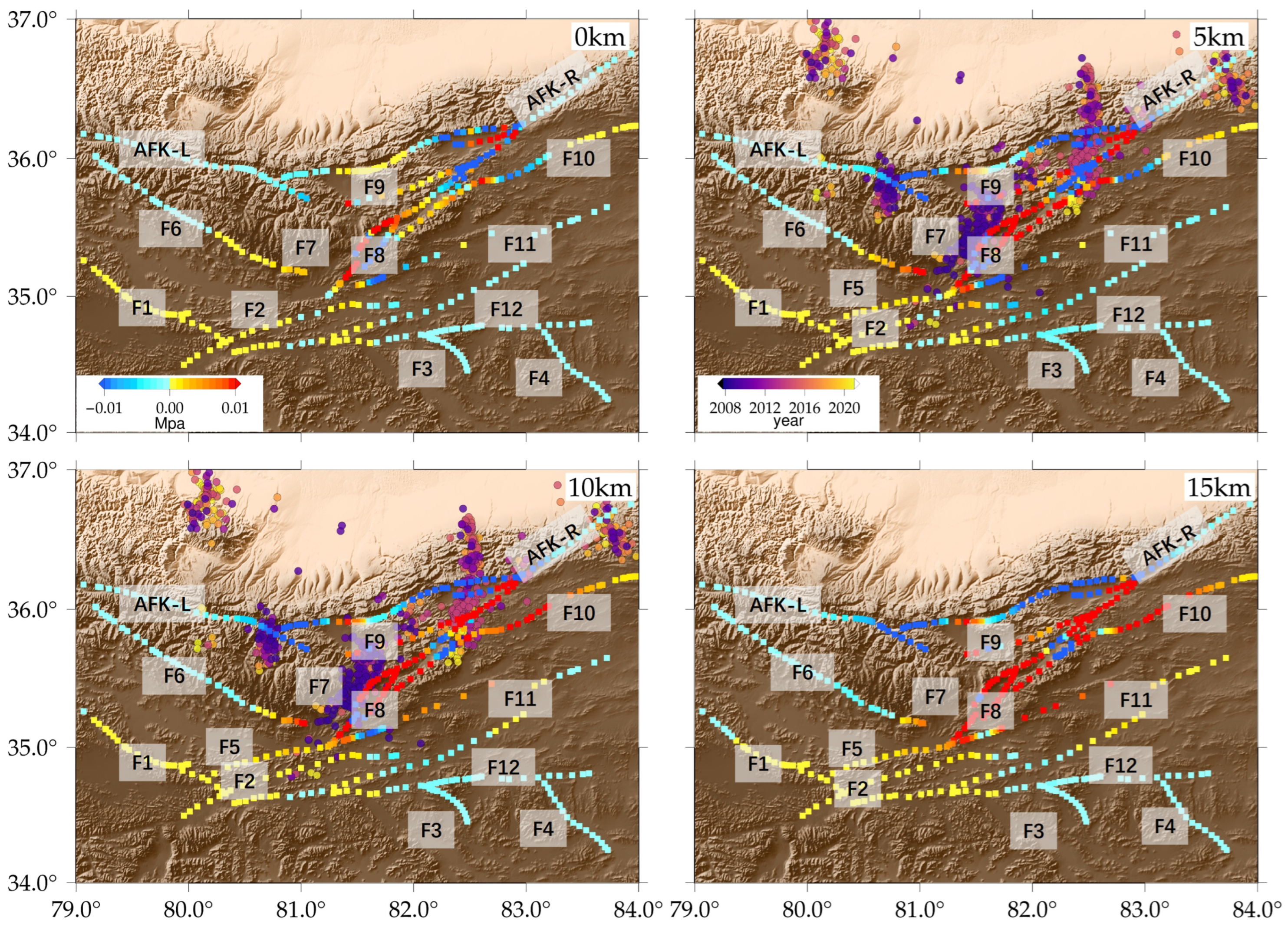
As a complement to the regional Coulomb stress evolution presented in the previous chapter, this section extends the analysis to a broader tectonic framework in order to preliminarily evaluate the seismic hazard of major faults across the wider Yutian region. Using the distributed slip models of the four Yutian earthquakes (2008, 2012, 2014, and 2020), we employed the PSGRN/PSCMP program [43] to compute the static Coulomb stress changes on major active faults in the region (Table 3, Figure A1) at depths of 0 km, 5 km, 10 km, and 15 km (Figure 5). The results show that all four events produced significant stress perturbations on the surrounding fault network, consistent with the characteristic behavior of static stress transfer in continental crustal systems [10,11,40].
Table 3.
Fault Parameters.
In general, the stress amplitudes increase from the surface to mid-crustal depths due to higher shear rigidity. At 0 km, the maximum positive Coulomb stress change reaches ~0.30 MPa, while the minimum negative value is ~0.12 MPa. At 5 km depth, the Ashikule fault segment affected by the 2014 rupture exhibits localized positive stress increases exceeding 1 MPa, whereas most other faults show loading values below 1 MPa. The maximum negative change at this depth is approximately −0.32 MPa. At 10 km depth, positive on the Ashikule segment remains near 1 MPa, while the unruptured southwestern extension of the fault system shows concentrated negative changes up to −3.7 MPa, reflecting strong elastic contrasts within the layered crustal model.
At 15 km, stress magnitudes diminish, with maximum positive values of ~0.42 MPa and negative values of ~1.3 MPa, primarily distributed near the northwestern end of the 2008 rupture. These depth-dependent patterns highlight the important role of crustal rigidity structure in modulating Coulomb stress transmission [13] and reveal that different segments of the regional fault system experience heterogeneous loading following each earthquake.
Treating each active fault segment in the region as a receiver fault reveals spatially complex Coulomb stress patterns that differ substantially from those expected for a simple mainshock–aftershock sequence. Significant positive occurs near the Yulong Kash fault zone, located close to the overlapping influence regions of the 2008, 2012, 2014, and 2020 events. The stress increase exceeds the commonly referenced triggering threshold [10,40], suggesting that this area may experience enhanced failure tendency and thus warrants continued monitoring. In contrast, notable stress reductions appear on the Kangxiwa fault along the northwestern segment of the Altyn Tagh Fault, implying inhibited near-term rupture potential.
Positive stress loading is also observed along the eastern Altyn Tagh Fault and around the Gongga Co Fault, indicating localized zones where stress may accumulate. The Guozha Co Fault and its southwestern extension experience moderate positive as well. By contrast, several near-north–south extensional faults southeast of Yutian exhibit negative , suggesting temporarily reduced likelihood of failure.
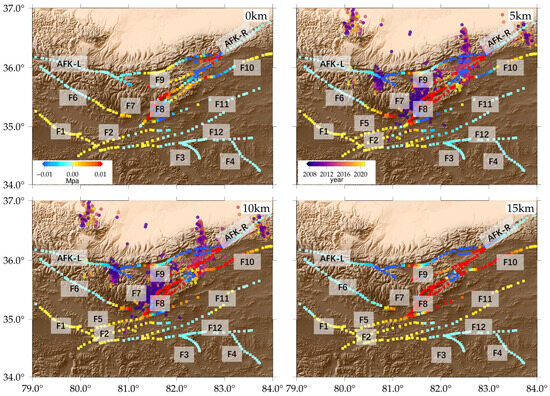
Overall, the regional Coulomb stress pattern is consistent with the presence of a southwest–northeast-oriented extensional stress concentration zone near the intersection of the Altyn Tagh, Ashikule, and Gongga Co fault systems along the northwestern margin of the Tibetan Plateau [1,2,18]. This tectonic configuration provides a favorable environment for frequent normal-faulting earthquakes, consistent with previous geological studies. In addition, we further compared the modeled stress perturbations with relocated seismicity in the 2008–2020 Yutian region. The relocated events [47] were overlain on the results at depths of 5 km and 10 km (Figure 6), and the seismicity generally exhibits a southwest–northeast trend consistent with the inferred extensional stress concentration belt. Notably, a seismic cluster near the western bend of the Altyn Tagh Fault spatially overlaps a persistent stress-adjustment zone in our results, whereas the seismicity north of the 2014 rupture suggests additional tectonic influences beyond the coseismic interactions among the four events considered in this study.
Figure 6.
Fault stress disturbance around Yutian area.
4.3. Implications for Multi-Event Stress Evolution and Fault-System Behavior
The integrated analysis of event-to-event stress transfer and regional Coulomb stress perturbations highlights the complexity of fault interactions within the Yutian earthquake sequence. The coexistence of positive, negative, and near-neutral zones demonstrates that the spatial distribution of positive Coulomb stress alone is insufficient for assessing rupture potential. Subsequent earthquakes may occur within stress-shadow or transitional zones when long-term tectonic loading, fault geometry, and strength heterogeneity are taken into account.
The stress evolution following the 2012 earthquake further illustrates the nonlinear nature of multi-event interactions. Rather than following a simple “positive loading–immediate triggering” relationship, the sequence shows that moderate-magnitude events can reorganize the stress field and partially compensate for stress shadows imposed by larger earthquakes. In the Yutian sequence, the 2012 event imposed positive on both the 2014 and 2020 faults, thereby modifying their mechanical state prior to rupture and influencing the timing and spatial extent of subsequent earthquakes.
On the future rupture plane of the 2020 earthquake, the contrasting temporal behavior of normal and shear stress provides important mechanical insight. Persistent reductions in effective normal stress promoted fault unclamping, whereas repeated reversals in shear-stress polarity limited immediate rupture. This stress configuration suggests that the 2020 earthquake was unlikely to have been directly triggered by any single preceding event. Instead, it reflects the cumulative outcome of long-term regional extensional loading superimposed on multi-stage static stress perturbations imparted by the earlier earthquakes. The presence of a narrow positive band along the fault, flanked by broad shear-stress shadows, indicates that persistent unclamping maintained high failure susceptibility while surrounding negative shear stress delayed rupture until sufficient tectonic strain accumulated.
More broadly, the Yutian sequence demonstrates strong spatial and temporal interactions among participating faults. Stress-loading and stress-shadow effects coexist, and stress redistribution exhibits pronounced structural localization. Fault bends, stepovers, and geometrical linkages play key roles in focusing or diffusing stress changes, indicating that multi-event stress transfer cannot be approximated as a simple linear superposition of elastic dislocations.
Although coseismic Coulomb stress changes provide useful insight into fault interactions and stress redistribution, they represent only one component of the processes governing seismic hazard. Geological studies indicate sustained late Quaternary activity along the Altyn Tagh, Ashikule, and adjacent fault systems [2], while GPS and long-term InSAR observations reveal ongoing southwest–northeast extensional deformation in the region [48,49]. These observations suggest that long-term tectonic loading establishes a favorable stress environment, upon which coseismic stress perturbations act as transient modulators. Therefore, the elevated seismic hazard inferred for parts of the Yutian region should be interpreted as the combined outcome of background tectonic processes and multi-event stress transfer, rather than being attributed solely to patterns.
4.4. Limitations and Future Directions
A limitation of this study is that only coseismic static Coulomb stress changes are considered, while postseismic viscoelastic relaxation is not explicitly modeled. Given the decade-long time span of the Yutian earthquake sequence, postseismic processes may have contributed to additional stress redistribution. Such effects could influence the amplitude and temporal evolution of stress changes but are not expected to fundamentally alter the first-order spatial patterns of stress transfer inferred from coseismic ruptures. Future studies incorporating viscoelastic relaxation with realistic layered rheology would help further refine the long-term stress evolution in this region.
Another limitation of this study is that lateral heterogeneity in crustal and mantle properties is not explicitly incorporated. The Coulomb stress modeling adopts a one-dimensional layered elastic structure, which may influence local stress amplitudes and fine-scale spatial variations, particularly in tectonically complex areas. Nevertheless, this simplification is considered adequate for resolving the first-order cumulative stress transfer patterns among major faults. Future work employing fully three-dimensional numerical models will be necessary to further quantify the effects of lateral rheological heterogeneity.
5. Conclusions
In this study, we integrated InSAR-derived coseismic deformation, finite-fault slip models, and static Coulomb stress calculations to investigate stress interactions among the 2008, 2012, 2014, and 2020 Yutian earthquakes and their impacts on the regional fault system. By constructing a unified four-event source framework, we provide a consistent view of how stress was progressively redistributed within this transtensional fault network.
Our analysis shows that (1) positive Coulomb stress loading alone is insufficient for evaluating rupture potential, as earthquakes may occur within stress-shadow or transitional zones under the influence of long-term tectonic loading and fault heterogeneity; (2) moderate earthquakes can play an important role in reorganizing the stress field and partially compensating for stress shadows created by larger events; and (3) the 2020 earthquake reflects cumulative stress evolution rather than direct triggering by a single preceding event. Together, these findings highlight that earthquake interaction in the Yutian sequence is governed by combined effects of unclamping, shear-stress reversals, and progressive stress reorganization, rather than a simple “positive = triggering” relationship.
At the regional scale, cumulative Coulomb stress modeling reveals heterogeneous stress loading across major faults, with several segments exhibiting elevated failure potential while others remain mechanically inhibited. This heterogeneous pattern suggests that multi-event sequences can reshape the broader stress landscape and modify where future rupture is more likely to occur. These results emphasize the importance of considering multi-event stress evolution and fault-system interactions when assessing seismic hazards in regions characterized by distributed deformation. Our approach provides a transferable framework for evaluating stress evolution in other multi-event earthquake sequences along complex continental fault systems.
Author Contributions
Conceptualization, G.Z. and X.F.; methodology, X.F.; data processing and analysis, X.F.; writing—original draft preparation, X.F.; writing—review and editing, G.Z.; funding acquisition, G.Z.; project support and discussion, X.S. All authors have read and agreed to the published version of the manuscript.
Funding
This study is co-supported by the National Natural Science Foundation of China (42274046, 41474013) & Xinjiang Tianshan Talents Science and Technology Innovation Team Project (2024TSYCTD0014).
Data Availability Statement
The coseismic deformation and slip models of the 2008 and 2012 Yutian earthquakes used in this study were obtained from previously published studies; the corresponding data can be requested directly from the original authors cited in this article. The InSAR-derived deformation data, fault slip model, and Coulomb stress calculation input and output datasets for the 2020 Mw 6.3 Yutian earthquake are available from the author upon reasonable request (fbb1108@ies.ac.cn).
Acknowledgments
Sentinel-1 SAR data are freely available through the Alaska Satellite Facility (ASF) (https://search.asf.alaska.edu/ (accessed on 13 January 2026)). Figures were generated using the Generic Mapping Tools (GMT; https://www.generic-mapping-tools.org (accessed on 26 November 2025)). Static Coulomb stress changes were calculated using the Coulomb 3.3 software package (https://pubs.usgs.gov/of/2011/1060/ (accessed on 14 December 2025)), while regional stress perturbations were evaluated using the PSGRN/PSCMP program (https://github.com/pyrocko/fomosto-psgrn-pscmp (accessed on 8 January 2026)).
Conflicts of Interest
The authors declare no conflicts of interest.
Appendix A
Figure A1.
Schematic diagram of the regional fault system.
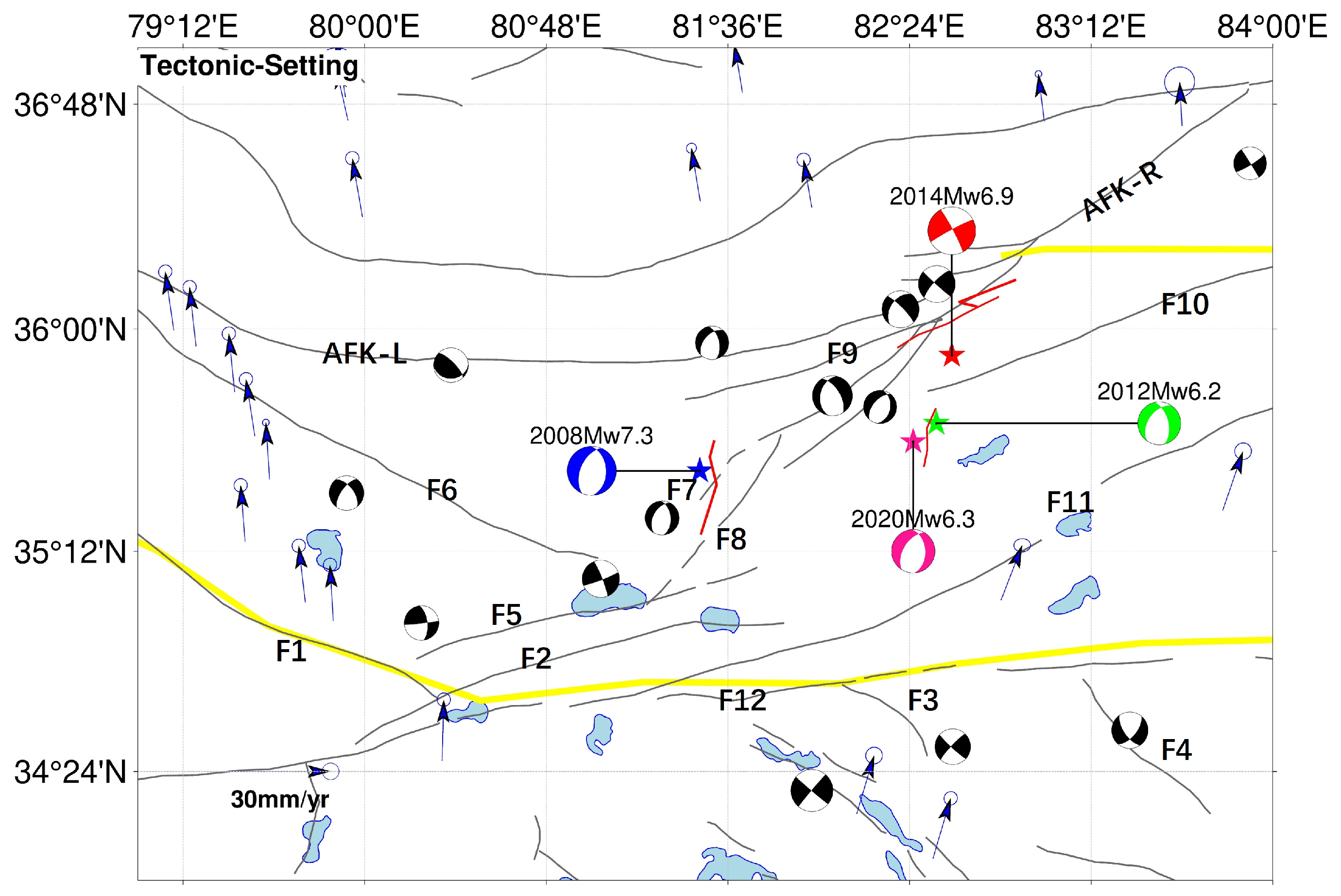
Figure A2.
2.5D surface displacement of the 2020 Yutian earthquake. (Left) East–west displacement component derived from the interferograms. (Right) Vertical displacement component derived from the interferograms.
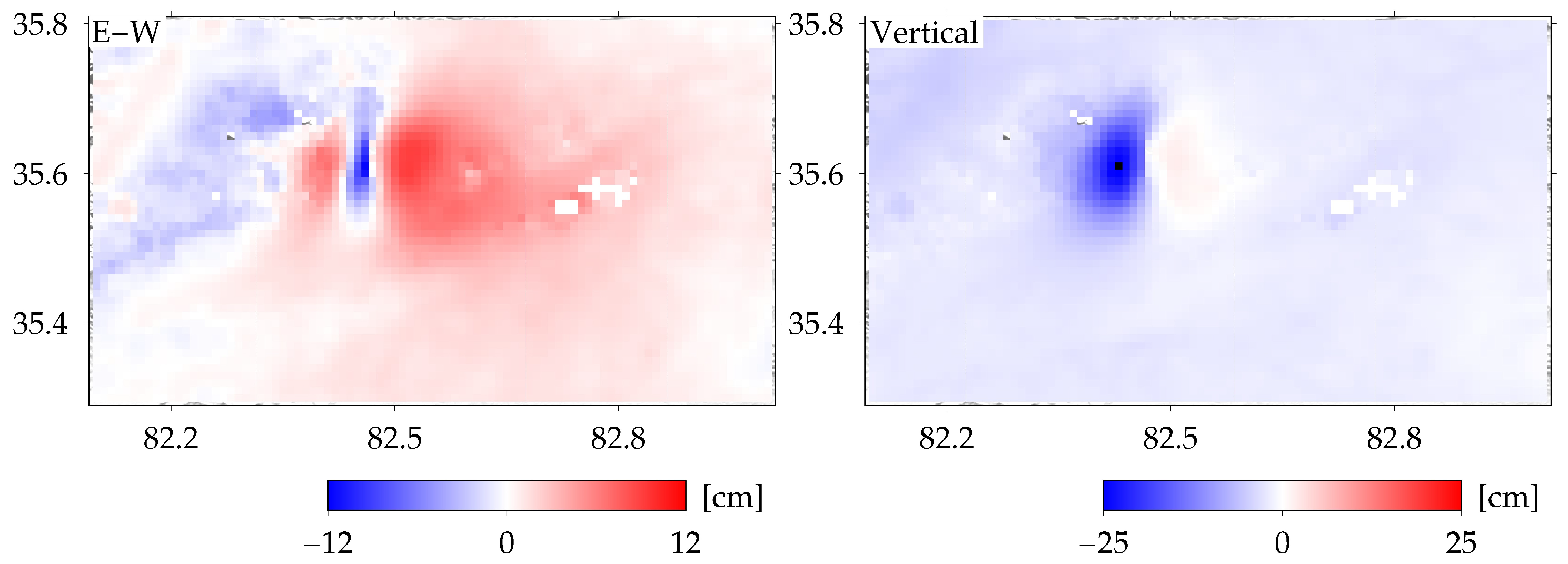
Figure A3.
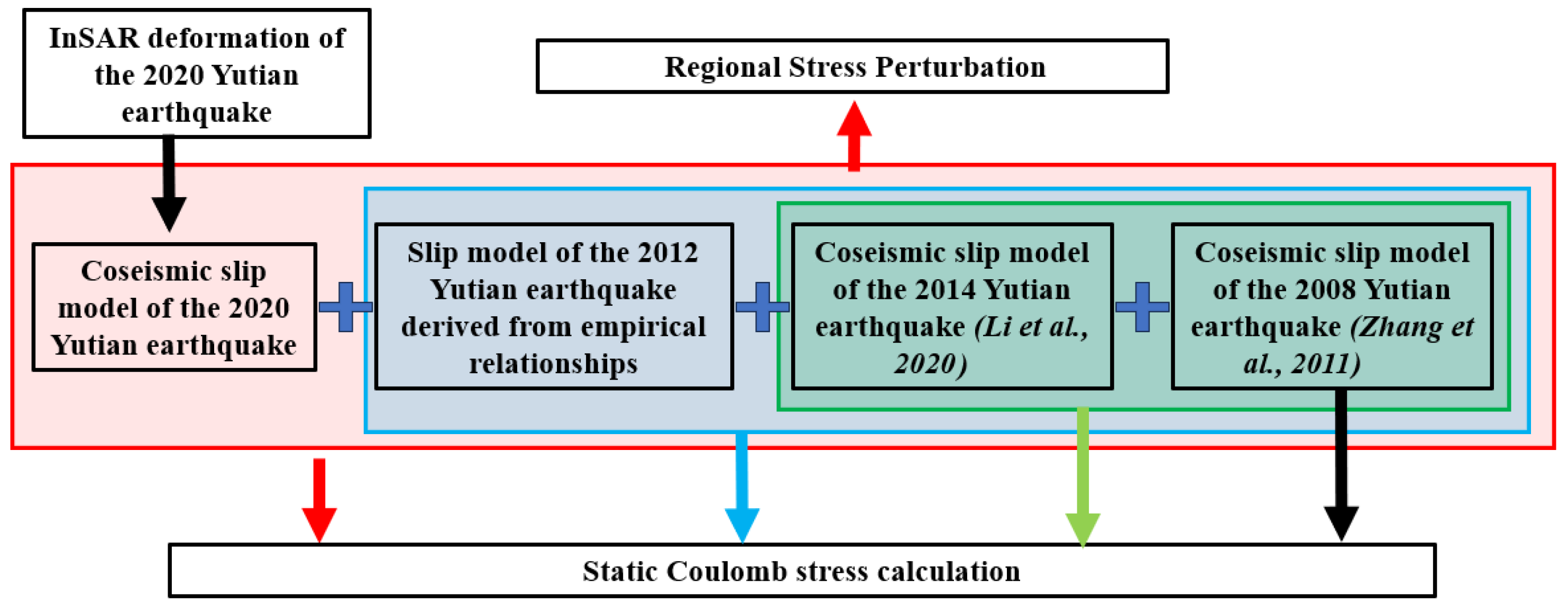
Schematic workflow of this study [6,34].
References
- Tapponnier, P.; Xu, Z.; Roger, F.; Meyer, B.; Arnaud, N.; Wittlinger, G.; Yang, J. Oblique Stepwise Rise and Growth of the Tibet Plateau. Science 2001, 294, 1671–1677. [Google Scholar] [CrossRef] [Scilit]
- Yin, A.; Harrison, T.M. Geologic Evolution of the Himalayan-Tibetan Orogen. Annu. Rev. Earth Planet. Sci. 2000, 28, 211–280. [Google Scholar] [CrossRef] [Scilit]
- Armijo, R.; Tapponnier, P.; Han, T. Late Cenozoic Right-lateral Strike-slip Faulting in Southern Tibet. J. Geophys. Res. Solid Earth 1989, 94, 2787–2838. [Google Scholar] [CrossRef] [Scilit]
- Furuya, M.; Yasuda, T. The 2008 Yutian Normal Faulting Earthquake (Mw 7.1), NW Tibet: Non-Planar Fault Modeling and Implications for the Karakax Fault. Tectonophysics 2011, 511, 125–133. [Google Scholar] [CrossRef] [Scilit]
- Bie, L.; Ryder, I. Recent Seismic and Aseismic Activity in the Ashikule Stepover Zone, NW Tibet. Geophys. J. Int. 2014, 198, 1632–1643. [Google Scholar] [CrossRef] [Scilit]
- Li, X.; Xu, W.; Jónsson, S.; Klinger, Y.; Zhang, G. Source Model of the 2014 Mw 6.9 Yutian Earthquake at the Southwestern End of the Altyn Tagh Fault in Tibet Estimated from Satellite Images. Seismol. Res. Lett. 2020, 91, 3161–3170. [Google Scholar] [CrossRef] [Scilit]
- He, P.; Wen, Y.; Ding, K.; Xu, C. Normal Faulting in the 2020 Mw 6.2 Yutian Event: Implications for Ongoing E–W Thinning in Northern Tibet. Remote Sens. 2020, 12, 3012. [Google Scholar] [CrossRef] [Scilit]
- Li, Q.; Li, C.; Tan, K.; Lu, X.; Zuo, X. Slip Model of the 2020 Yutian (Northwestern Tibetan Plateau) Earthquake Derived From Joint Inversion of InSAR and Teleseismic Data. Earth Space Sci. 2021, 8, e2020EA001409. [Google Scholar] [CrossRef] [Scilit]
- Liu, Z.; Yu, C.; Li, Z.; Zhang, X.; Zhang, M.; Feng, W.; Han, B.; Peng, J. Co- and Post-Seismic Mechanisms of the 2020 Mw 6.3 Yutian Earthquake and Local Stress Evolution. Earth Space Sci. 2023, 10, e2022EA002604. [Google Scholar] [CrossRef] [Scilit]
- King, G.C.P.; Stein, R.S.; Lin, J. Static Stress Changes and the Triggering of Earthquakes. Bull. Seismol. Soc. Am. 1994, 84, 935–953. Available online: https://pubs.geoscienceworld.org/ssa/bssa/article-abstract/84/3/935/102745/Static-stress-changes-and-the-triggering-of (accessed on 13 January 2026).
- Stein, R.S. The Role of Stress Transfer in Earthquake Occurrence. Nature 1999, 402, 605–609. [Google Scholar] [CrossRef] [Scilit]
- Harris, R.A. Introduction to Special Section: Stress Triggers, Stress Shadows, and Implications for Seismic Hazard. J. Geophys. Res. Solid Earth 1998, 103, 24347–24358. [Google Scholar] [CrossRef] [Scilit]
- Freed, A.M. Earthquake Triggering by Static, Dynamic, and Postseismic Stress Transfer. Annu. Rev. Earth Planet. Sci. 2005, 33, 335–367. [Google Scholar] [CrossRef] [Scilit]
- Parsons, T.; Stein, R.S.; Simpson, R.W.; Reasenberg, P.A. Stress Sensitivity of Fault Seismicity: A Comparison between Limited-offset Oblique and Major Strike-slip Faults. J. Geophys. Res. Solid Earth 1999, 104, 20183–20202. [Google Scholar] [CrossRef] [Scilit]
- Ziv, A.; Rubin, A.M. Static Stress Transfer and Earthquake Triggering: No Lower Threshold in Sight? J. Geophys. Res. Solid Earth 2000, 105, 13631–13642. [Google Scholar] [CrossRef] [Scilit]
- Mildon, Z.K.; Roberts, G.P.; Faure Walker, J.P.; Iezzi, F. Coulomb Stress Transfer and Fault Interaction over Millennia on Non-Planar Active Normal Faults: The Mw 6.5–5.0 Seismic Sequence of 2016–2017, Central Italy. Geophys. J. Int. 2017, 210, 1206–1218. [Google Scholar] [CrossRef] [Scilit]
- Steacy, S.; Gomberg, J.; Cocco, M. Introduction to Special Section: Stress Transfer, Earthquake Triggering, and Time-dependent Seismic Hazard. J. Geophys. Res. Solid Earth 2005, 110, 2005JB003692. [Google Scholar] [CrossRef] [Scilit]
- Jia, K.; Zhou, S.; Zhuang, J.; Jiang, C. Stress Transfer Along the Western Boundary of the Bayan Har Block on the Tibet Plateau from the 2008 to 2020 Yutian Earthquake Sequence in China. Geophys. Res. Lett. 2021, 48, e2021GL094125. [Google Scholar] [CrossRef] [Scilit]
- Elliott, J.R.; Walters, R.J.; England, P.C.; Jackson, J.A.; Li, Z.; Parsons, B. Extension on the Tibetan Plateau: Recent Normal Faulting Measured by InSAR and Body Wave Seismology: Extension on the Tibetan Plateau. Geophys. J. Int. 2010, 183, 503–535. [Google Scholar] [CrossRef] [Scilit]
- Wright, T.; Parsons, B.; Fielding, E. Measurement of Interseismic Strain Accumulation across the North Anatolian Fault by Satellite Radar Interferometry. Geophys. Res. Lett. 2001, 28, 2117–2120. [Google Scholar] [CrossRef] [Scilit]
- Bagnardi, M.; Hooper, A. Inversion of Surface Deformation Data for Rapid Estimates of Source Parameters and Uncertainties: A Bayesian Approach. Geochem. Geophys. Geosyst. 2018, 19, 2194–2211. [Google Scholar] [CrossRef] [Scilit]
- Weston, J.; Ferreira, A.M.G.; Funning, G.J. Joint Earthquake Source Inversions Using Seismo-Geodesy and 3-D Earth Models. Geophys. J. Int. 2014, 198, 671–696. [Google Scholar] [CrossRef] [Scilit]
- Yague-Martinez, N.; Prats-Iraola, P.; Rodriguez Gonzalez, F.; Brcic, R.; Shau, R.; Geudtner, D.; Eineder, M.; Bamler, R. Interferometric Processing of Sentinel-1 TOPS Data. IEEE Trans. Geosci. Remote Sens. 2016, 54, 2220–2234. [Google Scholar] [CrossRef] [Scilit]
- Goldstein, R.M.; Werner, C.L. Radar Interferogram Filtering for Geophysical Applications. Geophys. Res. Lett. 1998, 25, 4035–4038. [Google Scholar] [CrossRef] [Scilit]
- Scheiber, R.; Moreira, A. Coregistration of Interferometric SAR Images Using Spectral Diversity. IEEE Trans. Geosci. Remote Sens. 2000, 38, 2179–2191. [Google Scholar] [CrossRef] [Scilit]
- Chen, C.W.; Zebker, H.A. Two-Dimensional Phase Unwrapping with Use of Statistical Models for Cost Functions in Nonlinear Optimization. J. Opt. Soc. Am. A 2001, 18, 338–351. [Google Scholar] [CrossRef] [Scilit]
- Prats-Iraola, P.; Scheiber, R.; Marotti, L.; Wollstadt, S.; Reigber, A. TOPS Interferometry with TerraSAR-X. IEEE Trans. Geosci. Remote Sens. 2012, 50, 3179–3188. [Google Scholar] [CrossRef] [Scilit]
- Costantini, M. A Novel Phase Unwrapping Method Based on Network Programming. IEEE Trans. Geosci. Remote Sens. 1998, 36, 813–821. [Google Scholar] [CrossRef] [Scilit]
- Massonnet, D.; Feigl, K.L. Radar Interferometry and Its Application to Changes in the Earth’s Surface. Rev. Geophys. 1998, 36, 441–500. [Google Scholar] [CrossRef] [Scilit]
- Simons, M. Coseismic Deformation from the 1999 Mw 7.1 Hector Mine, California, Earthquake as Inferred from InSAR and GPS Observations. Bull. Seismol. Soc. Am. 2002, 92, 1390–1402. [Google Scholar] [CrossRef] [Scilit]
- Wang, R.; Diao, F.; Hoechner, A. SDM—A Geodetic Inversion Code Incorporating with Layered Crust Structure and Curved Fault Geometry. Geophys. Res. Abstr. 2013, 15, EGU2013-2411-1. Available online: https://meetingorganizer.copernicus.org/EGU2013/EGU2013-2411-1.pdf (accessed on 13 January 2026).
- Wang, C.; Shan, X.; Wang, C.; Ding, X.; Zhang, G.; Masterlark, T. Using Finite Element and Okada Models to Invert Coseismic Slip of the 2008 Mw 7.2 Yutian Earthquake, China, from InSAR Data. J. Seismol. 2013, 17, 347–360. [Google Scholar] [CrossRef] [Scilit]
- Okada, Y. Internal Deformation Due to Shear and Tensile Faults in A Half-Space. Bull. Seismol. Soc. Am. 1992, 82, 1018–1040. [Google Scholar] [CrossRef] [Scilit]
- Zhang, G.-H.; Qu, C.-Y.; Shan, X.-J.; Zhang, G.-F.; Song, X.-G.; Wang, R.-J.; Li, Z.-H.; Hu, J.-C. The Coseismic InSAR Measurements of 2008 Yutian Earthquake and Its Inversion for Source Parameters. Chin. J. Geophys. 2011, 54, 2753–2760. (In Chinese) [Google Scholar] [CrossRef]
- Shan, X.; Zhang, G.; Wang, C.; Qu, C.; Song, X.; Zhang, G.; Guo, L. Source Characteristics of the Yutian Earthquake in 2008 from Inversion of the Co-Seismic Deformation Field Mapped by InSAR. J. Asian Earth Sci. 2011, 40, 935–942. [Google Scholar] [CrossRef] [Scilit]
- Xu, X.; Tan, X.; Yu, G.; Wu, G.; Fang, W.; Chen, J.; Song, H.; Shen, J. Normal- and Oblique-Slip of the 2008 Yutian Earthquake: Evidence for Eastward Block Motion, Northern Tibetan Plateau. Tectonophysics 2013, 584, 152–165. [Google Scholar] [CrossRef] [Scilit]
- Song, X.; Han, N.; Shan, X.; Wang, C.; Zhang, Y.; Yin, H.; Zhang, G.; Xiu, W. Three-Dimensional Fault Geometry and Kinematics of the 2008 M 7.1 Yutian Earthquake Revealed by Very-High Resolution Satellite Stereo Imagery. Remote Sens. Environ. 2019, 232, 111300. [Google Scholar] [CrossRef] [Scilit]
- Wells, D.L.; Coppersmith, K.J. New Empirical Relationships among Magnitude, Rupture Length, Rupture Width, Rupture Area, and Surface Displacement. Bull. Seismol. Soc. Am. 1994, 84, 974–1002. [Google Scholar] [CrossRef] [Scilit]
- Kanamori, H. The Energy Release in Great Earthquakes. J. Geophys. Res. 1977, 82, 2981–2987. [Google Scholar] [CrossRef] [Scilit]
- Toda, S.; Stein, R.S.; Richards-Dinger, K.; Bozkurt, S.B. Forecasting the Evolution of Seismicity in Southern California: Animations Built on Earthquake Stress Transfer. J. Geophys. Res. Solid Earth 2005, 110, 2004JB003415. [Google Scholar] [CrossRef] [Scilit]
- Lin, J.; Stein, R.S. Stress Triggering in Thrust and Subduction Earthquakes and Stress Interaction between the Southern San Andreas and Nearby Thrust and Strike-slip Faults. J. Geophys. Res. Solid Earth 2004, 109, 2003JB002607. [Google Scholar] [CrossRef] [Scilit]
- Toda, S.; Stein, R.S.; Sevilgen, V.; Lin, J. Coulomb 3.3 Graphic-Rich Deformation and Stress-Change Software for Earthquake, Tectonic, and Volcano Research and Teaching—User Guide: U.S. Geological Survey Open-File Report 2011–1060. 2011; 63p. Available online: https://pubs.usgs.gov/of/2011/1060/ (accessed on 8 January 2026).
- Wang, R.; Lorenzo-Martín, F.; Roth, F. PSGRN/PSCMP—A New Code for Calculating Co- and Post-Seismic Deformation, Geoid and Gravity Changes Based on the Viscoelastic-Gravitational Dislocation Theory. Comput. Geosci. 2006, 32, 527–541. [Google Scholar] [CrossRef] [Scilit]
- Laske, G.; Masters, G.; Ma, Z.; Pasyanos, M. Update on CRUST1.0—A 1-Degree Global Model of Earth’s Crust. Geophys. Res. Abstr. 2013, 15, EGU2013-2658. Available online: https://meetingorganizer.copernicus.org/EGU2013/EGU2013-2658.pdf (accessed on 13 January 2026).
- Zheng, J. Geometry of the Altun Fracture Zone. Geol. Bull. China 1991, 1, 54–59+24. Available online: https://www.cgsjournals.com/dztb/article/id/02daed8c-f21a-4515-a390-7300894d1cbf (accessed on 13 January 2026).
- Wan, Y.G.; Shen, Z.K.; Sheng, S.Z.; Xu, X.-F. The mechanical effects of the 2008 Ms7.3 Yutian, Xinjiang earthquake on the neighboring faults and its tectonic origin of normal faulting mechanism. Chin. J. Geophys. 2010, 53, 280–289. (In Chinese) [Google Scholar] [CrossRef]
- Luo, J.; Zuo, K.; Zhao, C. Focal mechanism solutions and seismogenic faults of the Yutian MS6.4 earthquake on 26 June 2020. Chin. J. Geophys. 2021, 64, 2362–2373. [Google Scholar]
- Gan, W.; Zhang, P.; Shen, Z.-K.; Niu, Z.; Wang, M.; Wan, Y.; Zhou, D.; Cheng, J. Present-day crustal motion within the Tibetan Plateau inferred from GPS measurements. J. Geophys. Res. 2007, 112, B08416. [Google Scholar] [CrossRef] [Scilit]
- Zhang, P.Z.; Shen, Z.; Wang, M.; Gan, W.; Bürgmann, R.; Molnar, P.; Wang, Q.; Niu, Z.; Sun, J.; Wu, J.; et al. Continuous deformation of the Tibetan Plateau from global positioning system data. Geology 2004, 32, 809–812. [Google Scholar] [CrossRef] [Scilit]

Disclaimer/Publisher’s Note: The statements, opinions and data contained in all publications are solely those of the individual author(s) and contributor(s) and not of MDPI and/or the editor(s). MDPI and/or the editor(s) disclaim responsibility for any injury to people or property resulting from any ideas, methods, instructions or products referred to in the content. |
© 2026 by the authors. Licensee MDPI, Basel, Switzerland. This article is an open access article distributed under the terms and conditions of the Creative Commons Attribution (CC BY) license.