

Journal Menu
► ▼ Journal Menu-
- MCA Home
- Aims & Scope
- Editorial Board
- Instructions for Authors
- Special Issues
- Topics
- Sections & Collections
- Article Processing Charge
- Indexing & Archiving
- Editor’s Choice Articles
- Most Cited & Viewed
- Journal Statistics
- Journal History
- Society Collaborations
- Conferences
- Editorial Office
- 30th Anniversary
Journal Browser
► ▼ Journal BrowserNeed Help?
Announcements
3 June 2026
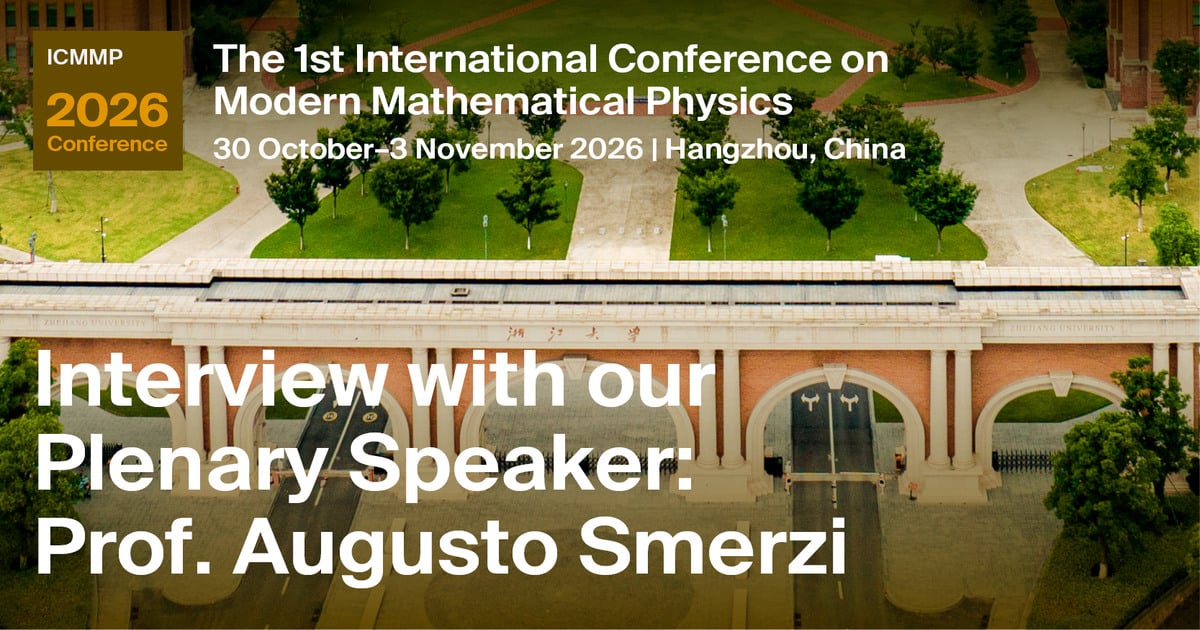
Interview with Prof. Augusto Smerzi—Plenary Speaker of the 1st International Conference on Modern Mathematical Physics (ICMMP 2026), 30 October–3 November 2026, Hangzhou, China
Quantum metrology has long promised measurement precision beyond classical limits. Yet as quantum technologies move closer to real-world applications, a deeper question emerges: what kind of entanglement is actually useful?
Few researchers have shaped this field more profoundly than Prof. Augusto Smerzi, whose pioneering work on quantum phase estimation and quantum Fisher information has helped define the modern foundations of quantum-enhanced sensing.
As a plenary speaker at the 1st International Conference on Modern Mathematical Physics (ICMMP 2026), to be held in Hangzhou, China, from 30 October to 3 November 2026, Prof. Augusto Smerzi will join leading researchers from across quantum information, field theory, AMO physics, and mathematical physics for discussions on the future of modern theoretical physics.
Ahead of the conference, we invited Prof. Smerzi to share his perspectives on quantum metrology, the challenges facing young researchers, and why scientific understanding matters more than publication itself.
Speaker introduction:
|
|
Prof. Augusto Smerzi is Chair Professor at Shenzhen Technology University (SZTU) and recipient of the CJJX Distinguished Talent Award. He works on quantum metrology, entanglement theory, and the foundations of quantum parameter estimation. He has made pioneering contributions to the quantum theory of phase estimation and to the use of Fisher information as a quantitative tool for multipartite entanglement and ultimate precision bounds. His research spans nonlinear and distributed interferometry, quantum sensing networks, and the dynamics of coherent matter waves. |

Session 3. Quantum Information and Quantum Metrology
Presentation title: “Unveiling Useful Entanglement: Quantum Advantage in Sensing and Metrology”
1. You have helped bring the theoretical limits of quantum sensing — from the standard quantum limit to the Heisenberg bound — into experimental practice. What is the next major milestone for quantum metrology that you believe will arrive in the next five years?
I think the next milestone is to move from beautiful demonstrations to useful quantum sensors. We already know that entanglement can improve sensitivity in principle. The hard question is whether this advantage survives in real conditions: noise, losses, finite time, imperfect control, and limited information.
In the next five years I expect important progress in quantum-enhanced clocks, sensing applied to bio-physical and health monitoring sensors, and distributed sensor networks.
For me, the real success will be when quantum metrology will evolve from the theoretical quantum information framework to become a practical way to design better sensors.
2. Since joining Shenzhen Technology University, you have mentored and collaborated with young Chinese researchers. What impressions have they left on you, and what advice would you give to those who wish to pursue a career in quantum science?
My impression is very positive. I have met young Chinese researchers who are extremely motivated, technically strong, and willing to work very hard. They are also very aware that quantum science is not only an academic subject, but a frontier technology with real strategic importance.
My advice I give to all my students, regardless of whether they are Chinese or not, is to build a deep foundation. One needs a solid understanding of quantum mechanics, many-body physics, and experimental reality.
My second advice is: do not confuse publication with understanding. Publications are important, of course. They are how we communicate results. But the deepest result of science is not the paper itself. It is a clearer understanding of something that was not clear before. A good paper should be the natural consequence of this understanding. So, I would tell young researchers: do not start only from the question “Where can I publish this?”, start with the question “What is the real problem, and what can I understand that others have not yet understood?”
I would also emphasize communication. Science is not only doing good work; it also explains why the work matters. Young researchers should learn to write clearly, give clear talks, and become comfortable communicating in presence of large audiences. This is not a secondary skill. It is part of becoming an independent scientist.
Finally, I would encourage young scientists to be ambitious, but not only in the conventional way. Do not be afraid to explore directions where few people are going. Many important discoveries begin as strange questions. Curiosity, courage, and patience are still essential in science.
3. In your experience, what role do international conferences play in fostering collaborations that lead to real scientific breakthroughs?
International conferences are very important because science is not made only by papers. Papers communicate results, but conferences create trust, intuition, and sometimes friendship. Very often, a real collaboration starts from a simple conversation after a talk or during a coffee break.
For me, the best conferences are not only places where people present finished work. They are places where new questions are born. Sometimes the most important outcome of a conference is not a result, but a new direction.
4. Your plenary talk at ICMMP 2026 in Hangzhou is titled “Unveiling Useful Entanglement”. What do you hope the audience will take away from your talk?
The main message is simple: not all entanglement is equally useful. Entanglement is one of the most beautiful and mysterious features of quantum mechanics, but for quantum technologies we must ask a further operational question: what can this entanglement do?
In quantum metrology, useful entanglement is entanglement that helps us distinguish physical signals better. It allows a sensor to extract more information from the same system, or to reach a precision that would be impossible with separable states.
In my talk I will discuss how this usefulness can be identified and measured, especially through quantities such as the quantum Fisher information. I hope the audience will take away the idea that entanglement is not only an abstract mathematical property. It becomes truly meaningful when it gives us a new capability.
5. What is your one-sentence wish for this first International Conference on Modern Mathematical Physics?
My wish is that this conference becomes a place where deep mathematical ideas, physical intuition, and scientific curiosity meet, and where young researchers feel encouraged to explore questions that are not yet on the standard map.
Meet Prof. Augusto Smerzi at ICMMP 2026
Join us in Hangzhou this October to explore the latest developments in quantum metrology, entanglement theory, and modern mathematical physics together with leading researchers from around the world.
Conference location: Hangzhou, China
Conference date: 30 October–3 November 2026
Submit your work by 10 July 2026: https://sciforum.net/user/submission/create/1507.
Register now for early bird prices: https://sciforum.net/event/ICMMP2026?section=#registration.
Conference website: https://sciforum.net/event/ICMMP2026.
For any inquiries, please contact us at icmmp2026@mdpi.com.
