

Journal Menu
► ▼ Journal Menu-
- IJERPH Home
- Aims & Scope
- Editorial Board
- Reviewer Board
- Topical Advisory Panel
- Instructions for Authors
- Special Issues
- Topics
- Sections & Collections
- Article Processing Charge
- Indexing & Archiving
- Editor’s Choice Articles
- Most Cited & Viewed
- Journal Statistics
- Journal History
- Journal Awards
- Society Collaborations
- Editorial Office
Journal Browser
► ▼ Journal Browser-
arrow_forward_ios
Forthcoming issue
arrow_forward_ios Current issue - Vol. 23 (2026)
- Vol. 22 (2025)
- Vol. 21 (2024)
- Vol. 20 (2023)
- Vol. 19 (2022)
- Vol. 18 (2021)
- Vol. 17 (2020)
- Vol. 16 (2019)
- Vol. 15 (2018)
- Vol. 14 (2017)
- Vol. 13 (2016)
- Vol. 12 (2015)
- Vol. 11 (2014)
- Vol. 10 (2013)
- Vol. 9 (2012)
- Vol. 8 (2011)
- Vol. 7 (2010)
- Vol. 6 (2009)
- Vol. 5 (2008)
- Vol. 4 (2007)
- Vol. 3 (2006)
- Vol. 2 (2005)
- Vol. 1 (2004)
Need Help?
Announcements
3 July 2026
International Journal of Environmental Research and Public Health | An Interview with the Author—Dr. Chetan Sharma
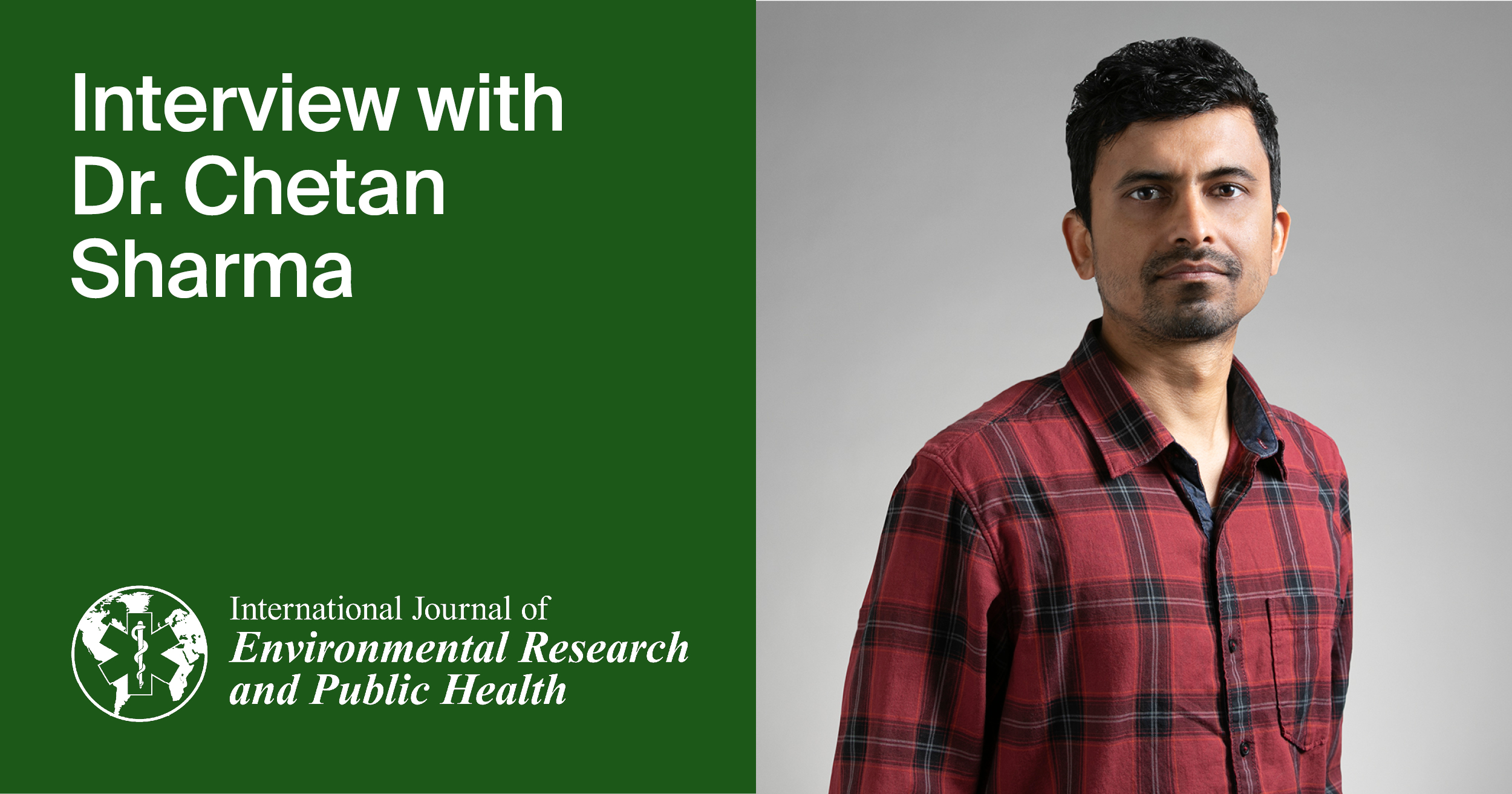
Name: Dr. Chetan Sharma
Affiliations: Department of Food and Animal Sciences, Tennessee State University, Nashville, Tennessee, 37209, USA
Interests: Food Quality, Sensory Shelf-life, Upcycled Foods, Descriptive analysis, Flavor, Texture.
1. Could you briefly introduce yourself and your current research focus?
I am Chetan Sharma, a trained sensory scientist who graduated from Kansas State University. After my graduation, I worked as a postdoc for two years in the area of context, in the form of virtual and augmented reality, and sensory cues, in the form of logos and text, in sensory science in Aotearoa, New Zealand. I then came back to Drexel University, Philadelphia. I worked in the Department of Food and Hospitality Management, driven by my interests in food sociology, food studies, and sensory science. I started my first faculty position as a teaching assistant professor at the University of Wisconsin-Stout and then came to Tennessee State University in 2024 as a research assistant professor. My current work includes teaching and research. teach courses in Sensory Science and Experimental Foods, and my research focuses on food product development, sensory perception, food quality, sensory shelf life, upcycled foods, and consumer behavior and decision-making.
2. For many of our readers, the concept of sensory science is both broad and fascinating, especially in areas like the connection between nature and mental health, or the role of taste in healthy eating. In simple terms, how would you describe the work of sensory scientists and how does this work impact research in public health?
Sensory science, for me, is a field that has contributions from many different fields. When I was at Drexel University, one of the professors I worked with was a clinical nutritionist, and during that time, we published in IJERPH about nature and well-being, which has a component related to dietary choices as well.
If we look through the lens of sensory science, I think context is a new focus. Earlier, we had booths through which we tried to control everything. But since we eat food in a more social environment rather than in a booth, we wanted to introduce context and study more about how it affects our food choices and behavior. Broadly, I think the nature in which you are eating the food affects your decision-making and well-being.
Well-being comes from food as well as nature. We often focus more on the “wellness” aspect of the word “wellbeing”, and less on the other part of the word. I believe in a people-centered approach to food research, where this sense of being is just as important as wellness. For example, when I was in Aotearoa, New Zealand, I biked to Lincoln University. So, in those moments and even today, being myself is biking, and by biking to university early in the morning, especially in the winters when it was cold, enjoying the feeling of crisp air on my face, I was not only engaging in the act of being, but also enhancing my overall wellness.
Another good example is that I worked with a student who developed anti-nausea popsicles for cancer patients. I was a co-advisor, and when she found out about sensory science, we started working more collaboratively. She then wondered how we could test these popsicles for flavor acceptance and how we could deliver this in a form that is acceptable to someone who is in need. So, we developed home-use testing (HUT), which is a part of sensory science. We did central lab testing (CLT), too. She also used a sorting method and flash profile from sensory science to describe the samples in terms of the flavors she developed for the popsicles. So, we were working on public health and providing solutions through sensory science.
3. Every scientist has a story that sparks their curiosity about their research topic. What initially drew you to the field of sensory science?
I was working in a food processing lab, developing extruded food products. I saw that there was a conference going on in the IGP, Kansas, and that a professor, Dr. Edgar IV Chambers, was explaining how they transform human beings into machines. I was sitting there thinking, can he really do something like that, because I never thought about such a metaphor of humans as machines. So I asked him a question: How much time do you need to transform a human into a machine? And he told me, if you want a good machine, with equipment precise enough to be in the lab, maybe in six months. I asked him a couple more questions, and he told me to take this sensory science class, so I transferred to that, and it was nice working with him.
In sensory science, we treat humans as an instrument, just like Gas Chromatography, which gives you very precise information about volatiles, such as whether this is a hexanal, which has a grassy taste, or if this is a benzaldehyde, which has a little sweet taste. Similarly, our human instruments are used as a trained panel, and they tell you the same precise information about the sample as you get from GC.
4. Going back to the public health perspective, which area do you think holds the most promise for achieving improvements to public health through sensory science?
I am working with Dr. Heather Krick, who is now an assistant professor at Immaculata University. We are presenting at a symposium in Florida in May about how public health is associated with sensory science. For example, difficulties in getting food or medicine in the right form or size for swallowing, which has been a problem with the elderly or with babies. So we are touching on how taste and texture are important, and if you want to improve that, you need to collaborate more with the sensory scientists so that we can work collectively on providing a solution or a form that can be swallowed easily.
The other things we are working on are the effects of aroma on mental health. We are all familiar with different kinds of therapies, like aromatherapy. This also connects with public health. For example, when I was in New Zealand, they were emphasizing regenerative agriculture, and under that they introduced mustard greens, the yellow flowers of the mustard. It was a very common thing in my state in India, so when I was biking on the weekend, the fragrance and the smell took me from that road back to my hometown, and I just stopped there and looked at the mountains and the field, and I was so happy. That takes one away from the daily chores and the mental pressures or work-related things. So, aroma is important for well-being and public health.
Publishing with MDPI, the turnaround time is something that every author appreciates because we don't want our manuscript to be under review for a year, which is very common. So, I think the speed is something that is commendable for the journals coming from MDPI.
I think the area for improvement would be more communication from known names in my field. For example, if there's a review request from someone I know, like Edgar IV Chambers or Martin Talavera, I will be more likely to open that and review it compared to receiving a request from someone whom I don't know. So, more communication from known names in the field would be an improvement moving forward.
