

Journal Menu
► ▼ Journal Menu-
- Healthcare Home
- Aims & Scope
- Editorial Board
- Reviewer Board
- Topical Advisory Panel
- Early Career Editorial Board
- Instructions for Authors
- Special Issues
- Topics
- Sections & Collections
- Article Processing Charge
- Indexing & Archiving
- Editor’s Choice Articles
- Most Cited & Viewed
- Journal Statistics
- Journal History
- Journal Awards
- Society Collaborations
- Conferences
- Editorial Office
Journal Browser
► ▼ Journal BrowserNeed Help?
Announcements
10 July 2026
Interview with Dr. Giota Tragantzopoulou—Winner of the Healthcare Outstanding Reviewer Award
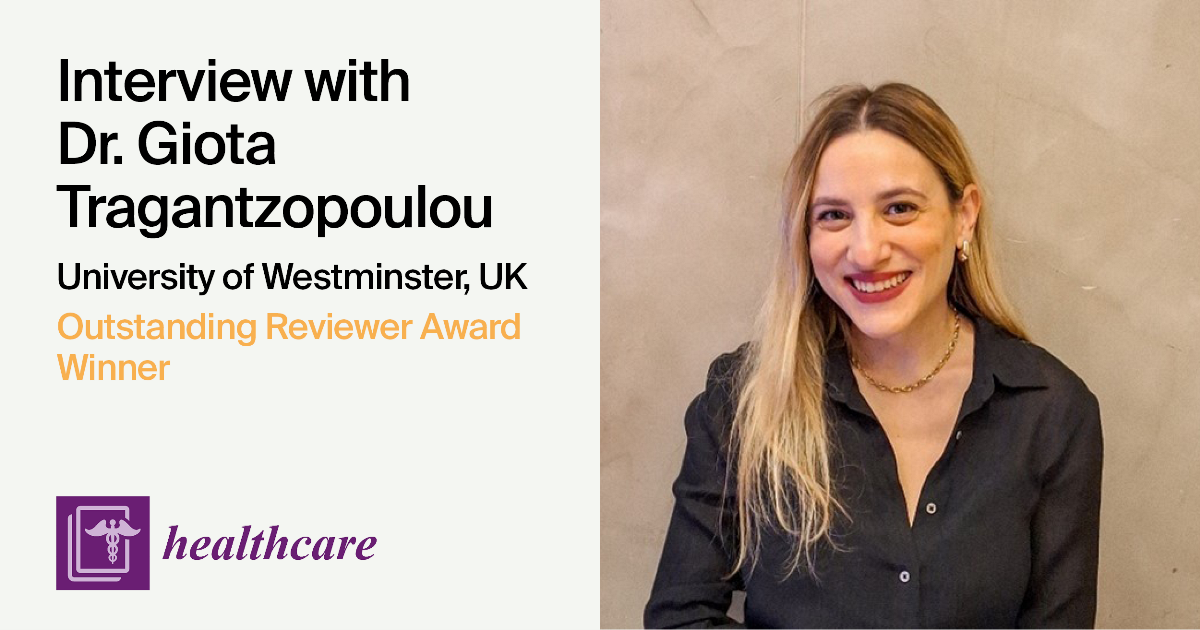
We are pleased to share a recent interview conducted with Dr. Giota Tragantzopoulou, the winner of the Healthcare 2025 Outstanding Reviewer Award.
1. What motivated you to become a reviewer for our journal, and what keeps you engaged in this role?
My motivation to become a reviewer initially came from, I would say, a sense of academic responsibility and the opportunity to contribute to maintaining scientific quality in a journal that is reputable and also to maintaining scientific quality within my field. You know, as a researcher in psychology, I see peer review as a way to support more ethical and methodologically sound research. And what keeps me engaged, I think, is the continuous learning process, because reviewing allows me to stay updated with emerging findings within my field, but also with emerging methodologies. And this kind of helps me to strengthen my own work.
2. What does the peer review process mean to you as a researcher and as a reviewer?
Peer review is not only a quality control mechanism, but also a collaborative scholarly dialogue. And what I mean by that is that, as a researcher, I see it as an essential step that improves clarity, rigor, and impact. And as a reviewer, I view my role as constructive rather than evaluative in a punitive sense, because my aim is to help authors refine their work while ensuring methodological and conceptual soundness.
3. Based on your reviewing experience, what emerging research topics or trends have you observed in our field?
One of the most prominent trends I observe is the rapid growth of digital mental health, and particularly the use of advanced technologies such as artificial intelligence and kind of real-time behavioural tracking. There is increasing interest in how AI can support early detection of psychological symptoms, how to personalize interventions with AI, and how we can improve accessibility to care through tools such as digital therapeutics or mobile- based monitoring. I feel that, at the same time, there is like a parallel focus on understanding the psychological impact of these digital environments themselves, including artificial intelligence, social media exposure, attention fragmentation, and generally their effects on mood and cognition. And on top of that, I think ethical considerations are becoming increasingly important as well, especially around privacy, data security, and algorithmic bias.
4. What advice would you give to authors who are preparing to submit their work to our journal?
It is important to clearly distinguish between association and causation, especially in cross-sectional studies. And finally, framing findings within a broader theoretical and clinical context is essential, because this helps to increase the relevance and impact of the work.
5. How has serving as a reviewer for our journal benefited your own research or career development?
I would say that reviewing has significantly improved my critical appraisal skills and has strengthened my understanding of study design and common methodological challenges. By reviewing, I am able to stay current with the emerging literature before publication, which also informs my own research directions, and it has improved my ability to write and structure manuscripts more effectively by seeing common strengths and weaknesses across submissions. So, I'm more able to identify within my own manuscripts how I need to structure them so they can move more smoothly through the peer review process.
6. How do you balance your reviewing responsibilities with your research, teaching, and other academic duties?
I balance reviewing by kind of treating it as an integral part of my academic workflow rather than as an additional task. I tend to allocate specific time blocks for reviews and prioritize them based on the deadlines that I receive. And I also try to kind of be a little selective in accepting reviews that align more closely with my expertise, because this helps with both quality and efficiency, rather than overloading my schedule with manuscripts that are not within my expertise.
