



Journal Menu
► ▼ Journal Menu-
- Fire Home
- Aims & Scope
- Editorial Board
- Reviewer Board
- Topical Advisory Panel
- Instructions for Authors
- Special Issues
- Topics
- Sections & Collections
- Article Processing Charge
- Indexing & Archiving
- Editor’s Choice Articles
- Most Cited & Viewed
- Journal Statistics
- Journal History
- Journal Awards
- Conferences
- Editorial Office
Journal Browser
► ▼ Journal BrowserNeed Help?
Announcements
22 December 2022
Special Issue Mentor Program
We are pleased to announce the launch of a new initiative—the MDPI Special Issue Mentor Program.
This program will enable early career researchers (who must hold a Ph.D. in a related field) to experience editing a Special Issue in MDPI journals, under the mentorship of our experienced Editorial Board Members or other experienced scientists. The mentor program will provide an excellent opportunity for early career scientists to gain editorial experience, and to cultivate their ability to edit scientific research.
The mentee’s responsibilities include:
- Proposing a Special Issue title and assisting the mentor in preparing a summary (around 200–400 words) and 3–10 keywords describing the background, importance, and goal of the Issue;
- Writing a brief promotion plan for the Special Issue;
- Preparing a list of scholars who may be interested in the Issue and personally e-mailing invitations on behalf of Guest Editors;
- Writing an editorial for the online Special Issue together with the mentor.
The mentor’s responsibilities include:
- Conducting a final check before the Special Issue is published online;
- Performing editorial control of the Special Issue and quality control of the publications, both of which must be carried out in a timely manner;
- Providing suggestions to younger scholars if they have any doubts or concerns regarding submissions;
- Organizing video calls with young scholars and the Editorial Office regularly to discuss problems and improvement suggestions for the Special Issue;
- Making and submitting decisions regarding submissions with the assistance of mentees.
Certificates and awards:
After the Special Issue closes, the Editorial Office will provide official certificates for all the mentors and early career researchers.
If you are interested in this opportunity, please send your Special Issue proposal to the Editorial Office of a journal you choose, and we will discuss the process (i.e., mentor collaboration, Special Issue topic feasibility analysis, etc.) in further detail. The full list of MDPI journals is as follows: https://www.mdpi.com/about/journals.
In addition to the new Special Issue Mentor Program, we will continue to welcome all Special Issue proposals focusing on hot research topics.
14 December 2022
"Thanks a Million!" – One Million Articles Published in MDPI Journals
MDPI has just become the first open access (OA) publisher to reach the milestone of one million articles published. That is one million articles freely available to all, to circulate and build upon! We are proud to share this special moment with the global scientific community.
This landmark has been reached thanks to the immeasurable support of more than 600,000 expert reviewers, 66,000 editorial board members and 6700 hard-working colleagues across MDPI’s global offices.
Within more than 25 years of publishing, our journals received 2.1 million manuscripts and generated 4.6 million peer review reports to get to one million papers published.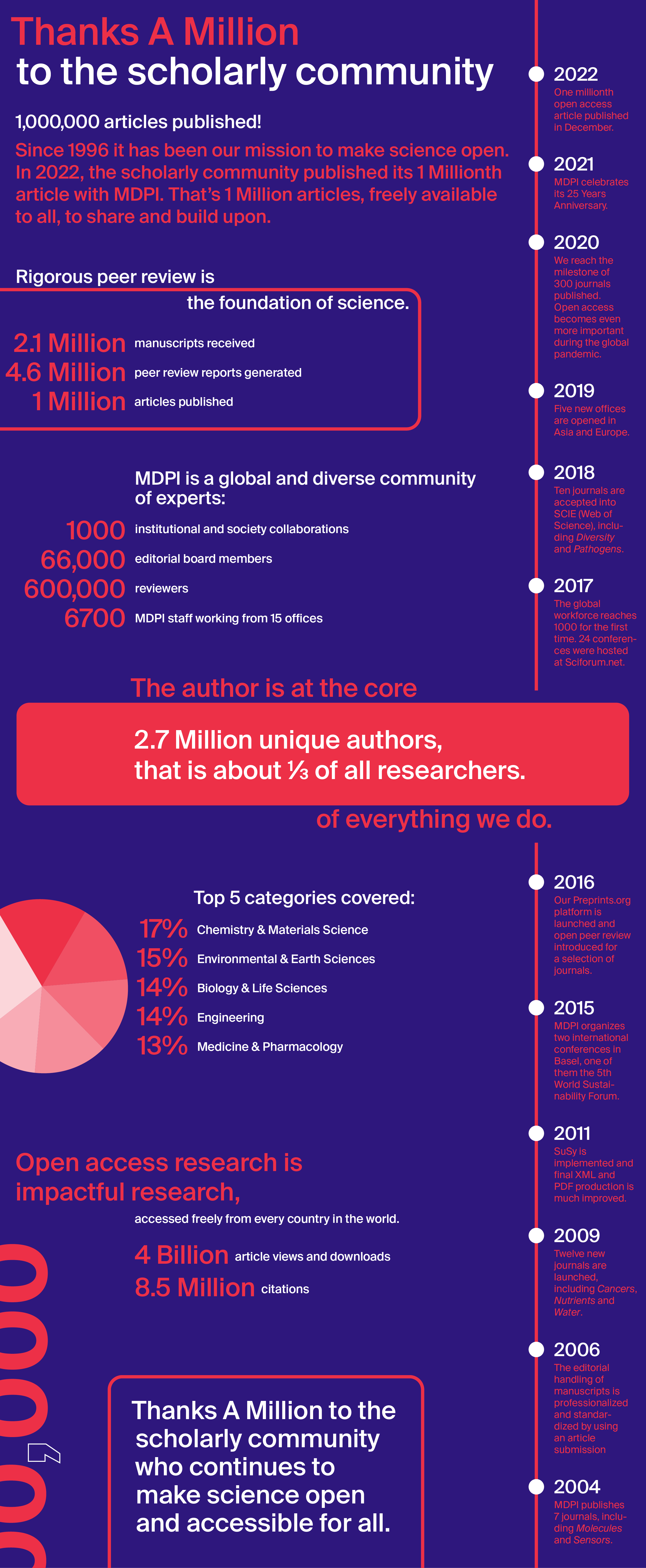
Reaching the milestone of one million articles published reinforces our mission to remove any existing barriers and to make scientific research accessible to all. Since its inception, MDPI’s goal has been to create reliable processes to make science open. This is a path towards facilitating the dissemination of novel insights in scientific communities.
Regular feedback from authors and reviewers shows that our service is greatly appreciated and needed. At the same time, the feedback helps us identify areas for further improvement.
As it stands, a significant share of published research findings remain closed access. More than half of the content published with the most well-known legacy publishers stays behind a paywall, and that is not including articles published in hybrid OA journals, or made available months or years after publication.
A new policy announced by the US administration in August 2022 requires that, as of January 2026, all US federally funded research be made freely and immediately available after publication. While the new policy does not mandate articles be published under an open access license, it is aligned with the open access movement in removing all barriers to research. Similarly, some of the most advanced research institutions in the world intend to have all funded research articles published in open access by 2025.
MDPI is proud to be the leading agent of the transition to open access.
"Thanks a Million" to all the contributors!
8 December 2022
MDPI Sustainability Foundation: New Look and Nominations for the 2023 Sustainability Awards Now Open
We are pleased to announce that the website of the MDPI Sustainability Foundation has been revamped! For the past couple of months, our UX UI team and front-end developers have been working hard to launch the website in time for the opening of the Sustainability Awards nominations.
The website is not the only thing that has had a remodeling. Indeed, the format of the Emerging Sustainability Leader Award (ESLA) has been updated. ESLA is now a competition open to individual researchers or start-ups founded by researchers under the age of 35. Nominee applications will go through 2 rounds of selection until the final 3 are decided. The finalists will then be invited to give pitch presentations during the Award Ceremony to win either first place (10,000 USD) or runner-up (2 x 5000 USD).
The World Sustainability Award, on the other hand, remains the same: a total prize money of 100,000 USD is up for grabs by senior individual researchers or groups of researchers from the international research community.
Nominations for both the World Sustainability Award and the Emerging Sustainability Leader award are now open! Check out our new website for more information on how to nominate.
4 November 2022
Editorial Board Members from Fire Featured in Stanford’s List of the World’s Top 2% Scientists
Stanford University has recently published an update of the list of the top 2% most widely cited scientists—World’s Top 2% Scientists.
The time node of the statistical data of this list is from 1960 to 2022, and it is divided into two lists: "Lifetime Scientific Influence Ranking" and "2022 Annual Scientific Influence Ranking". The "Lifetime Scientific Influence Ranking" counts the comprehensive influence performance of scientists during their careers, and the "2022 Annual Influence Ranking" focuses on highlighting the academic influence of scientists in the previous year. This ranking, considered the most prestigious worldwide, is based on the bibliometric information contained in the Scopus database and includes more than 200,000 researchers from the more than 10 million scientists considered to be active worldwide, with 22 scientific fields and 176 subfields taken into account.
We are pleased to share that 8 Editorial Members from MDPI’s journal Fire (ISSN: 2571-6255) were featured in Stanford University World’s Top 2% Scientists list in 2022.
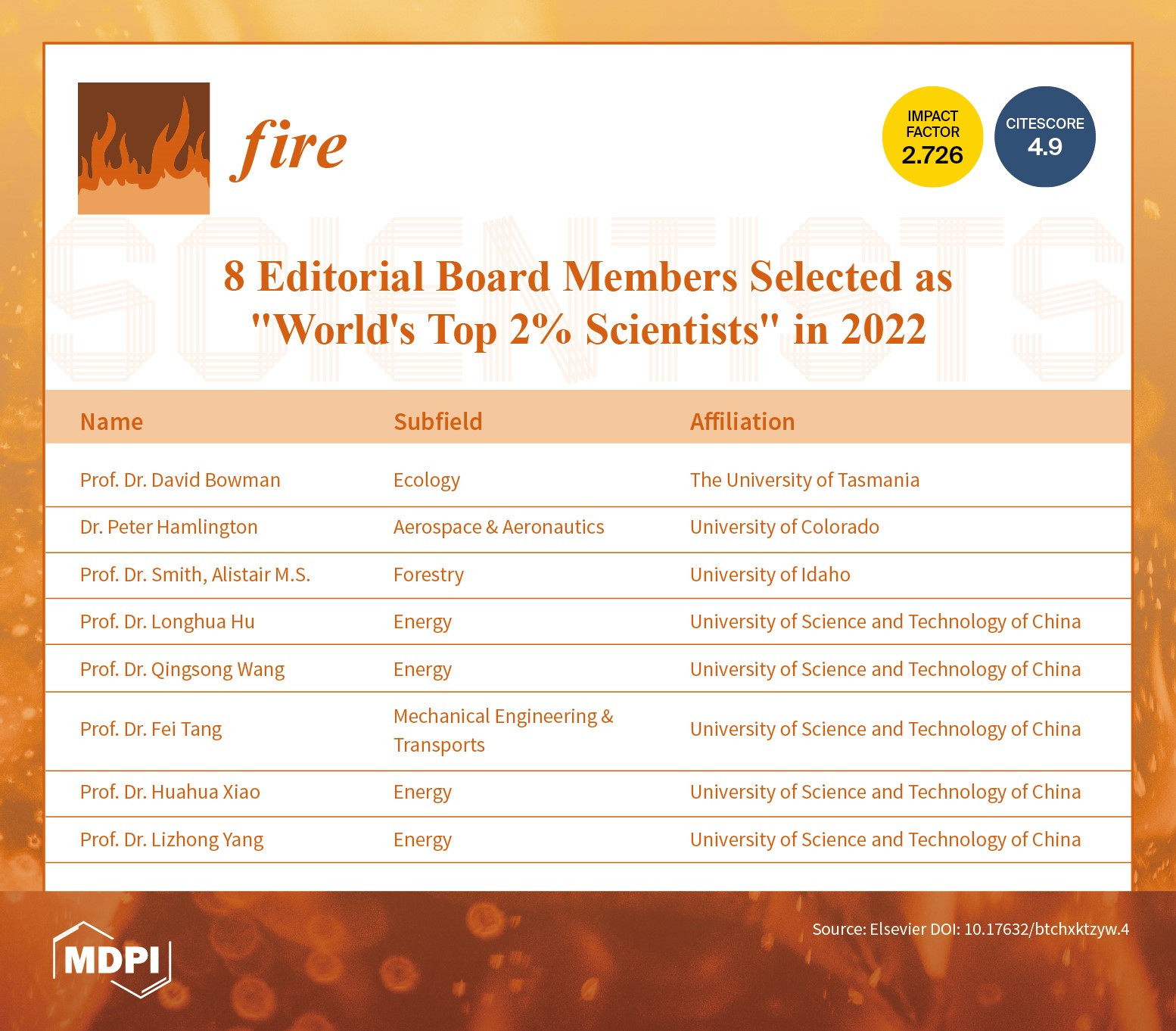
The latest Stanford rankings reflect the significant influence and research excellence of the scientists, who are committed to furthering their knowledge for the benefit of the world.
We would like to congratulate our Editorial Board Members on their excellent achievement and thank them for their immense contribution to the scientific progression and development of Fire.
31 October 2022
Fire | New Section “Mathematical Modelling and Numerical Simulation of Combustion and Fire” Established

Fire (ISSN: 2571-6255) is an international open access journal pertaining to the science, policy, and technology of fires and their interactions with communities and the environment. To develop a forum for modeling and simulation in combustion and fire research, we are pleased to announce the addition of a new Section—“Mathematical Modelling and Numerical Simulation of Combustion and Fire”.
We are currently recruiting Editorial Board Members (EBMs) for this Section. If you are an active researcher in this field and are passionate about publishing cutting-edge research, please contact us by email at fire@mdpi.com. Alternatively, you may wish to submit your work directly via the following link: https://susy.mdpi.com/user/manuscripts/upload/?journal=fire.
10 October 2022
Welcoming New Editor-in-Chief and Section Editor-in-Chief of Fire

We are pleased to announce that Dr. Grant Williamson has been appointed Editor-in-Chief of Fire (ISSN: 2571-6255, IF: 2.726, CiteScore 4.9). The founding Editor-in-Chief Prof. Dr. Alistair M. S. Smith will remain on board, and lead the Section "Fire Science Models, Remote Sensing, and Data".
Dr. Grant Williamson is a landscape ecologist and spatial scientist at the University of Tasmania, Australia, whose research has focused on the climatic and human drivers of wildfires and fire danger across Australia, the dynamics and human health impact of smoke wildfires and prescribed fires on human health, and the application of novel geospatial methodologies to fire analysis and pyrogeography. Grant is currently a work package leader with the NSW Bushfire Risk Management Research Hub, and an affiliate with the Centre for Air Quality & Health Research and Evaluation (CAR-CRE).
The following is a short Q&A with Dr. Grant Williamson, who shared his vision for the journal with us, as well as his views of the research area and open access publishing:
- What do you like about being the Editor-in-Chief of Fire? How would you like to develop Fire?
I am excited and enthusiastic to begin my role as Editor-in-Chief of Fire, having watched the journal grow under the leadership of Prof. Alistair Smith from its beginnings into an increasingly respected and active journal for the fire science community, covering a diverse range of topics in the field. Going forward, I would like to further develop our connections with research networks in the field internationally to further increase our impact in delivering quality science and to develop new journal Sections with a focus on fire and biodiversity and fire and human health. Given our research field, which is often punctuated by major wildfire seasons that drive rapid, focused research, I see a venue for building new Special Issues around specific seasonal and geographic events.
- Is open access popular among fire scientists? What might your response be to open access skeptics?
Open access academic publications, provided they are backed by a strong, scientifically credible academic team, as Fire is, provide a vital outlet for research. Our field is increasingly funded, ultimately, by public money, and our research, as it intersects with emergency and land management, also has strong impacts on the public, who have a right to discover and understand the latest science as it impacts their lives. Open access publishing is necessary to accomplish this. In an increasingly international field that, for too long, has seen research focus on a limited number of wealthy countries, open access publishing also ensures research has global readership and participation.
We warmly welcome Dr. Grant Williamson as our Editor-in-Chief, and we wish Prof. Dr. Alistair M. S. Smith success in his new role as Section Editor-in-Chief. We look forward to their valuable input for the continued success of Fire.
Fire Editorial Office
28 September 2022
Peer Review Week 2022 – Research Integrity: Creating and Supporting Trust in Research

Peer Review Week began 19 September 2022 under the theme of “Research Integrity: Creating and Supporting Trust in Research”. Through various blog articles, podcast, and webinar, we discussed this crucial subject throughout the week, celebrating the essential role peer review plays in maintaining research quality.
To begin, we held a Webinar on the topic. Professor Peter W. Choate and Dr. Emmanuel Obeng-Gyasi joined Dr. Ioana Craciun, one of MDPI’s scientific officers, for an in-depth discussion.
We invite you to view the event recording:
During the week, the MDPI Blog in a series articles highlighted how good Peer Review safeguards research integrity. The following topics were covered:
- Peer Review Week 2022
- Research Integrity
- What We’ve Learned About Peer Review Reports
- 4 Steps to the Perfect Peer Review Report
- How to Write the Perfect Peer Review Report: An Interview
- Inviting Great Peer Reviewers
In a new edition of Insight Faster, an MDPI podcast, we were delighted to talk to the co-chairs of the Peer Review Week committee, Jayashree Rajagopalan (Senior Manager of Global Community Engagement for CACTUS) and Danielle Padula (Head of Marketing and Community Development at Scholastica) to get their take on this year’s event and its related topics.
You can find the Podcast here.
We hope you enjoy the contents!
28 September 2022
Meet Us at the 9th International Conference on Forest Fire Research & 17th International Wildland Fire Safety Summit, 11–18 November 2022, Coimbra, Portugal

Fire (ISSN: 2571-6255) will be attending the International Conference on Forest Fire Research (ICFFR), held in Coimbra, Portugal, from 11 to 18 November 2022. The conference aims to be of a broad spectrum and tries to cover all aspects of wildfire management. During this conference, MDPI (at our booth) will welcome researchers from different backgrounds to visit and share their latest inspirations with us.
The following MDPI journals will be represented:
- Fire (leading journal);
- Forests (leading journal);
- Fuels;
- Land;
- Safety;
- Sustainability;
- Remote Sensing.
If you plan on attending this conference, feel free to stop by our booth in the break area. Our delegates look forward to meeting you in person to answer any questions you may have.
For more information about the conference, please see the following link: https://www.adai.pt/icffr.
23 September 2022
Meet Us at the AGU Fall Meeting 2022 (AGU22), 12–16 December 2022, Online or On-Site in Chicago, IL, USA

MDPI will be attending the AGU Fall Meeting 2022 (AGU22), held in Chicago and online, from 12 to 16 December 2022. The AGU Fall Meeting is the most influential event in the world dedicated to the advancement of Earth and space sciences. The conference unites the Earth and space science community to share findings, connect like-minded scientists from around the world, and advance our profession and shared passion for the impact of science. Researchers, scientists, educators, students, policymakers, enthusiasts, journalists, and communicators attend the AGU Fall Meeting to better understand our planet and environment, and our role in preserving its future.
During this conference, MDPI (at booth #1452) will welcome researchers from different backgrounds to visit and share their latest views and research with us.
The following MDPI journals will be represented:
- Water (leading journal);
- Remote Sensing (leading journal);
- Geosciences;
- Climate;
- Hydrology;
- Land;
- Drones;
- Environments;
- Sustainability;
- IJERPH;
- Earth;
- Fire;
- GeoHazards;
- Oceans;
- World.
If you plan on attending this conference, feel free to stop by our booth at #1452. Our delegates look forward to meeting you in person to answer any questions you may have.
For more information about the conference, please see the following link: https://igs.org/event/agu22/.
1 September 2022
Fire | New Section “Fire Social Science” Established

Fire (ISSN: 2571-6255) is an international open access journal pertaining to the science, policy, and technology of fires and their interactions with communities and the environment. To develop a forum for the advancement of social science theory and applications associated with fires, we are pleased to announce the addition of a new Section:
- “Fire Social Science” (https://www.mdpi.com/journal/fire/sections/fire_social_science)
The main aim of the Section “Fire Social Science” is to serve as a forum for the advancement of social science theory and applications associated with fires. This Section will consider articles that provide significant insights into the interactions between fire and individuals, communities, and society, broadly defined. We welcome contributions from any social science discipline as well as related interdisciplinary research. Articles that include the development and application of social science survey instruments will be considered in this Section. While theory-based, as well as qualitative, quantitative, and mixed-methods research will be considered, we particularly encourage articles based on rich empirical research. As Fire aims to address an international audience, submitted articles must advance established knowledge by drawing on, extending, or bridging a demonstrated gap in published international fire social science scholarship.
We are currently recruiting Editorial Board Members (EBMs) for this Section. If you are an active researcher in this field and are passionate about publishing cutting-edge research, please contact us by email at fire@mdpi.com. Alternatively, you may wish to submit your work directly via the following link: https://susy.mdpi.com/user/manuscripts/upload/?journal=fire.
