

Journal Menu
► ▼ Journal Menu-
- Entropy Home
- Aims & Scope
- Editorial Board
- Reviewer Board
- Topical Advisory Panel
- Photography Exhibition
- Instructions for Authors
- Special Issues
- Topics
- Sections & Collections
- Article Processing Charge
- Indexing & Archiving
- Editor’s Choice Articles
- Most Cited & Viewed
- Journal Statistics
- Journal History
- Journal Awards
- Society Collaborations
- Conferences
- Editorial Office
Journal Browser
► ▼ Journal Browser-
arrow_forward_ios
Forthcoming issue
arrow_forward_ios Current issue - Vol. 28 (2026)
- Vol. 27 (2025)
- Vol. 26 (2024)
- Vol. 25 (2023)
- Vol. 24 (2022)
- Vol. 23 (2021)
- Vol. 22 (2020)
- Vol. 21 (2019)
- Vol. 20 (2018)
- Vol. 19 (2017)
- Vol. 18 (2016)
- Vol. 17 (2015)
- Vol. 16 (2014)
- Vol. 15 (2013)
- Vol. 14 (2012)
- Vol. 13 (2011)
- Vol. 12 (2010)
- Vol. 11 (2009)
- Vol. 10 (2008)
- Vol. 9 (2007)
- Vol. 8 (2006)
- Vol. 7 (2005)
- Vol. 6 (2004)
- Vol. 5 (2003)
- Vol. 4 (2002)
- Vol. 3 (2001)
- Vol. 2 (2000)
- Vol. 1 (1999)
Need Help?
Announcements
20 September 2019
MDPI Now Gives Scholars the Possibility to Endorse and Recommend Articles

MDPI is pleased to announce the release of a new functionality giving the possibility for researchers and scholars to endorse, and formally recommend articles to their colleagues.
MDPI was an early signatory of the San Francisco Declaration on Research Assessment (https://sfdora.org/read/) which calls for improvement in how quality and impact of scholarly research outputs are evaluated, especially in moving beyond journal-based citation metrics (journal Impact Factor, Scopus Citescore, etc.).
MDPI supports the establishment of article-level impact metrics, including citations, views, downloads, and Altmetric scores. These measures serve as an impact indicator for research articles on a case–by-case basis, assessing paper on its own merit. However, these metrics are also subjective and can give a biased picture of the article impact: they do not directly reflect the quality or the intrinsic scientific value of the article.
In our view, community engagement with publications based on community-driven metrics can help to overcome this limitation. We have therefore launched an option for scholars to endorse articles, indicating their own assessment of its content and making a recommendation to their community. This follows our implementation of the open source Hypothesis commenting tool, which has been available for all articles published by MDPI for over a year (https://www.mdpi.com/about/announcements/1397). Both endorsement and commenting are available for all previously published and forthcoming MDPI articles.
In addition to potentially serving as a sustainable solution to article assessment, endorsements will help scientific communities to identify the most relevant articles, independently of the journal in which it was published.
The code for the endorsing functionality, which relies on DOIs and ORCIDs, will be made available on GitHub with an open source license.
Dr. Shu-Kun Lin, President and Founder
Dr. Franck Vazquez, Chief Scientific Officer
Dr. Martyn Rittman, Publishing Director
11 September 2019
Create an Entry in Encyclopedia to Get a 100 CHF Voucher in Publishing in MDPI Journals
Encyclopedia is a free online reference created and curated by active scholars. It aims to highlight the latest research results as well as provide a comprehensive record of scientific development. If you have any suggestions or questions, please feel free to contact us via office@encyclopedia.pub.

15 August 2019
Entropy Best Poster Awards at the 39th Workshop on Bayesian Methods and Maximum Entropy Methods in Science and Engineering (MaxEnt 2019)
We are pleased to announce the winners of the two poster awards sponsored by Entropy at the 39th Workshop on Bayesian Methods and Maximum Entropy Methods in Science and Engineering (MaxEnt 2019) held in Garching/Munich (Germany) on 30 June to 5 July 2019.
1st prize (300 CHF, certificate)
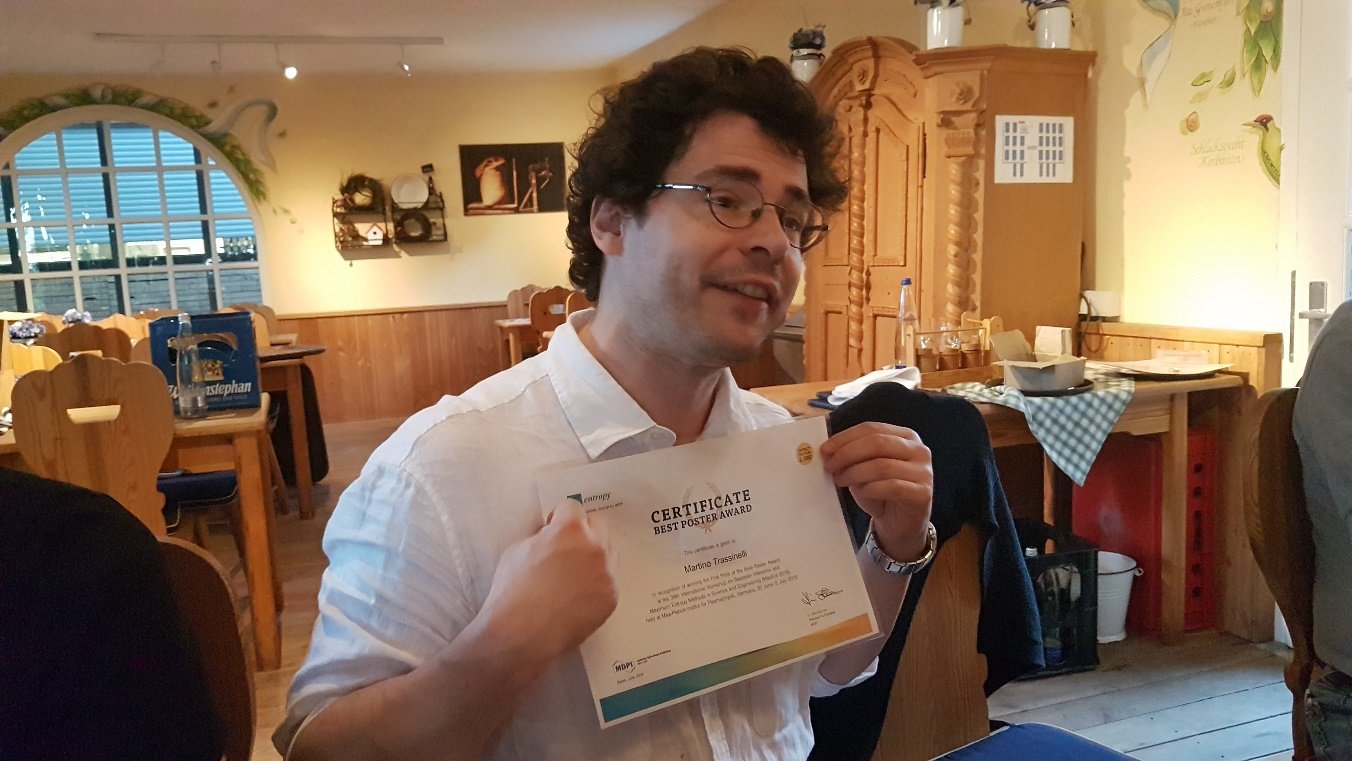
"Nested Sampling for Atomic Physics Data: The Nested_Fit Program" by Martino Trassinelli
Nested_fit is a general-purpose data analysis code [1] written in Fortran and Python. It is based on the nested sampling algorithm with the implementation of the lawn mower robot method for finding new live points. The program has been especially designed for the analysis of atomic spectra where different numbers of peaks and line shapes have to be determined. For a given dataset and chosen model, the program provides the Bayesian evidence method for the comparison of different hypotheses/models and the different parameter probability distributions. To give a concrete illustration of applications, we consider a spectrum of examples: i) determination of the potential presence of non-resolved satellite peaks in a high-resolution X-ray spectrum of pionic atoms [2] and in a photoemission spectrum of gold nanodots [3], ii) the analysis of very low-statistics spectra in a high-resolution X-ray spectrum of He-like uranium (see figure) [1] and in a photoemission spectrum of carbon nanodots [4]. In cases where the number of components cannot be clearly identified, as for the He-like U case, we show how the main component position can nevertheless be determined from the probability distributions relative to the single models.
[1] M. Trassinelli. Nucl. Instrum. Methods B 2017, 408, 301.
[2] M. Trassinelli et al. Phys. Lett. B 2016, 759, 583–588.
[3] A. Lévy et al. submitted to Langmuir.
[4] I. Papagiannouli et al. J. Phys. Chem. C 2018, 122, 14889.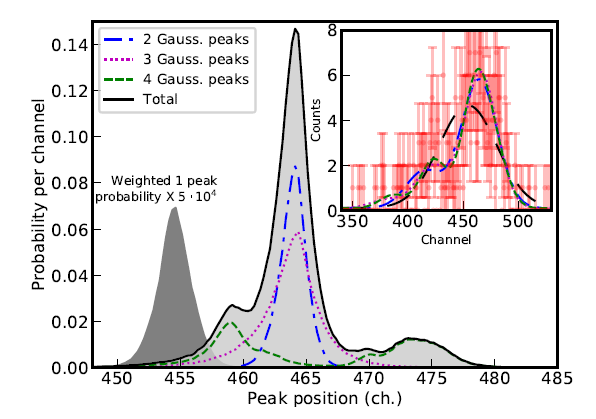
2nd prize (200 CHF, certificate)
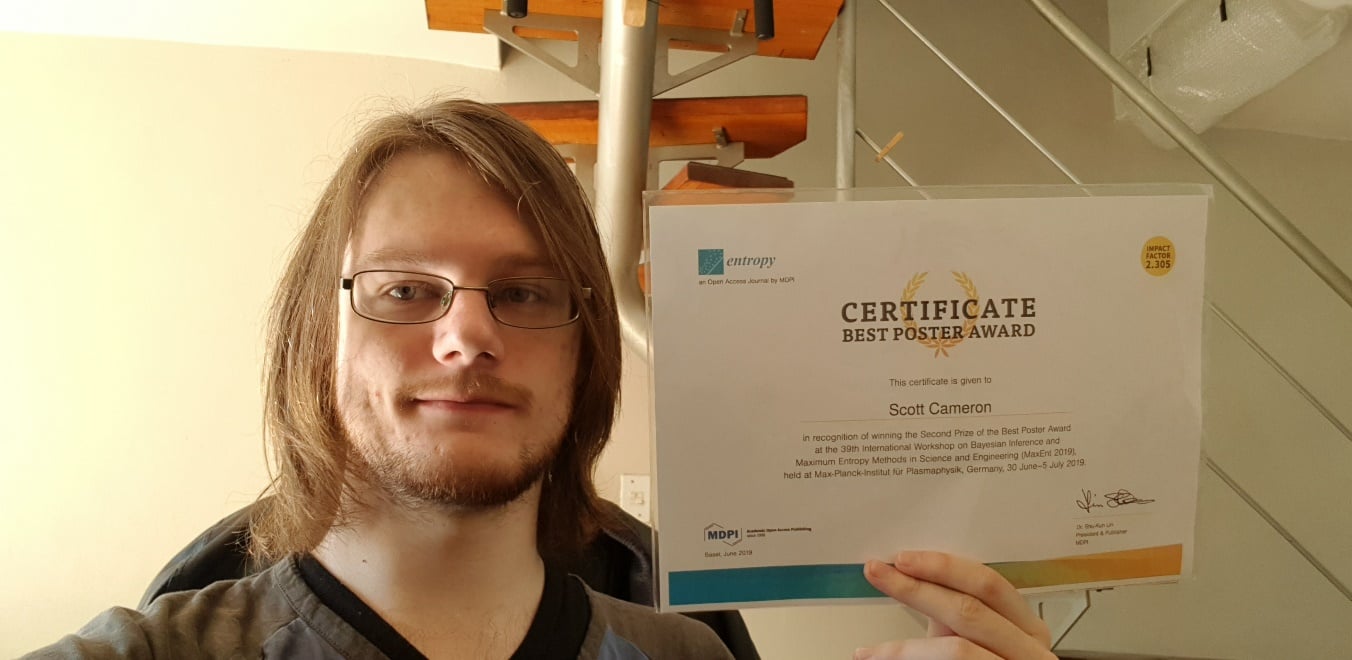
“A Sequential Marginal Likelihood Approximation Using Stochastic Gradients” by Scott Cameron
Existing algorithms such as nested sampling and annealed importance sampling are able to produce accurate estimates of the marginal likelihood of a model, but tend to scale poorly to large datasets. This is because these algorithms need to recalculate the log-likelihood for each iteration by summing over the whole dataset. Efficient scaling to large datasets requires that algorithms only visit small subsets (mini-batches) of data on each iteration. To this end, we estimated the marginal likelihood via a sequential decomposition into a product of predictive distributions $p(y_n|y_{<n})$. Predictive distributions could be approximated efficiently through Bayesian updating using stochastic gradient Hamiltonian Monte Carlo, which approximates likelihood gradients using mini-batches. Since each datapoint typically contains little information compared to the whole dataset, the convergence to each successive posterior only requires a short burn-in phase. This approach can be viewed as a special case of sequential Monte Carlo (SMC) with a single particle, but it differs from typical SMC methods in that it uses stochastic gradients. We illustrate how this approach scales favorably to large datasets using some simple models.
8 August 2019
Entropy Best Presentation Award at the International ICTP School "Complex Quantum Systems Out of Equilibrium in Many-Body Physics and Beyond"
We are pleased to announce the winner of the best presentation award that Entropy sponsored at the International ICTP School “Complex Quantum Systems Out of Equilibrium in Many-Body Physics and Beyond” in 27–31 May 2019, Yerevan, Armenia.
"The Large Nf Limit of 3D QEDs and Complex Fixed Points" by Hrachya Khachatryan
Quantum Electro-Dynamics (QED) in 2+1 dimensions is a paradigmatic example of a Quantum Field Theory with a strongly coupled infrared behaviour. We study QEDs with an even number Nf of bosonic or fermionic flavors, allowing for interactions respecting at least U(Nf/2)^2 global symmetry. Using large Nf techniques, we argue that in both the bosonic and in fermionic cases, there are four interacting fixed points: two with U(Nf/2)^2 symmetry, and two with U(Nf) symmetry. NLO corrections in 1/Nf suggest that upon lowering the number of flavors all these fixed points merge and annihilate pairwise into the complex plane or exchange their stability properties. The relevance of our studies to the phenomenon of chiral symmetry breaking is discussed.
6 August 2019
Preprints Reaches 10,000 Posted Articles Milestone
We are pleased to announce that Preprints has passed the milestone of 10,000 posted preprints. We are delighted to have reached this after just over three years of operation. Our congratulations and thanks go to our authors and advisory board who have supported growth of the platform and been crucial to its operation.
You can find further details at https://www.preprints.org/announcement/show/37.
2 August 2019
DeepGreen Partnering with Publishers and Universities in Distributing Open Access Content to Institutional Repositories
Last week, the DeepGreen initiative in Germany started into an advanced test phase with the publishing partners S. Karger AG, SAGE Publishing, MDPI, Frontiers and De Gruyter, as well as 27 universities from all over Germany, from Hamburg University of Applied Sciences to University of Konstanz.
DeepGreen aims at lowering the barriers for open access publishing by automatically delivering metadata and full text publications from participating publishers to authorized repositories at German universities.
In preparation for a later live operation, the advanced test phase serves to gain experience with extensive data deliveries from publishers and also handling different repository software (including OPUS4, DSpace, EPrints, MyCoRe). DeepGreen thereby acts as a sophisticated platform, receiving articles published by authors affiliated with German universities and depositing these articles to respective university repositories, based on the affiliation metadata. For more information about DeepGreen: https://deepgreen.kobv.de
Karger AG has been a close cooperation partner of the DeepGreen consortium since 2016. S. Karger has more than 80 subscription-based and around 20 open access journals covering a wide spectrum in health science. DeepGreen will assign S. Karger articles to authorized institutions on the legal basis of German alliance and national licenses.
SAGE Publishing was founded by Sara Miller McCune in 1965 to support the dissemination of usable knowledge and educate a global community. SAGE publishes more than 1,000 journals and over 600 new books each year, spanning a wide range of subject areas. Our growing selection of library products includes archives, data, case studies and video. SAGE remains majority owned by our founder and after her lifetime will become owned by a charitable trust that secures the company’s continued independence. Principal offices are located in Los Angeles, London, New Delhi, Singapore, Washington DC and Melbourne. SAGE Publishing has been a close cooperation partner of DeepGreen since 2016.
MDPI is a scientific open access publisher and has been a partner of DeepGreen since 2017. MDPI comprises 205 peer-reviewed journals of various disciplines. All articles are published under a CC-BY license and are freely available without embargo period.
Frontiers is a scientific open access publisher with 61 journals of over 600 academic disciplines. All articles are peer-reviewed and published freely available under CC-BY license.
De Gruyter is an academic publisher with more than 700 subscription-based and open access journals of 29 disciplines. Articles provided by De Gruyter will be assigned to institutions with German alliance and national licenses.
There is promising communication with other publishers.
DeepGreen is funded by the German Research Foundation (DFG) and the consortium comprises six institutions: the Cooperative Library Network Berlin-Brandenburg, Bavarian State Library, Bavarian Library Network, University Library of the Technische Universität Berlin, University Library of Erlangen-Nuremberg and the Helmholtz Open Science Coordination Office at the GFZ German Research Centre for Geosciences.
If you would like to know in more detail which institutions take part in the advanced test phase of DeepGreen, you can find more information here.
30 July 2019
Entropy Best Presentation Award at CNS*2019 Workshop on Methods of Information Theory in Computational Neuroscience
We are pleased to announce the winner of the best presentation award that Entropy sponsored at the CNS*2019 Workshop on Methods of Information Theory in Computational Neuroscience in Barcelona, Spain, on 16–17 July 2019.
“Adaptability and Efficiency in Neural Coding” by Wiktor Mlynarski and Ann Hermundstad
The ability to dynamically adapt to changes in the environment is one of the defining features of sensory systems. In this work, together with my collaborator Ann Hermundstad of Janelia Research Campus, we developed a normative framework to analyze information processing in adaptive sensory systems. We showed that sensory codes optimized for performing task-relevant computations can be different from codes optimized for adapting to changes in the stimulus distributions that underlie these computations. These differences manifest in the speed of adaptation, the accuracy of the code during periods of adaptation, and the accuracy in the adapted state. Our results provide a unifying perspective on adaptation across a range of sensory systems, environments, and sensory tasks.
17 July 2019
First Basel Sustainable Publishing Forum
The University of Basel and the MDPI Sustainability Foundation are organizing the First Basel Sustainable Publishing Forum on 9th September 2019.
The aim of this event is to provide background and perspectives on Plan S to Learned Societies, which have to make well-informed decisions to transition their journals to Open Access (OA).
The BSPF will bring together several representatives of Learned societies, Plan S architects as well as representatives from various publishers and publishing platforms. After getting the big picture from cOAlition S, panel discussions will allow to better understand the diverse challenges that Learned societies are facing to transition their journals to OA as well as to identify sustainable, implementable and scalable solutions for successful Open Access transition.
For program details and registration, please follow the link below:
https://sciforum.net/conference/SustainableSolutionsToOpenAccess
8 July 2019
Entropy Best Poster Award at Quantum ThermoDynamics Conference (QTD)
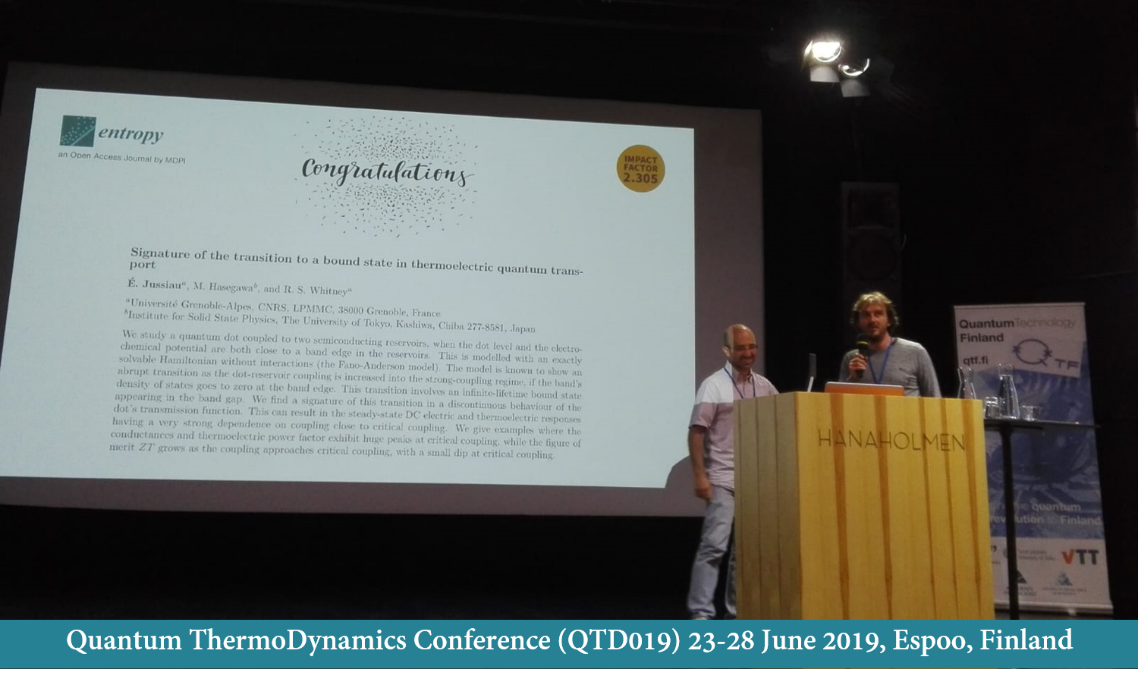
We are pleased to announce the winner of the best poster award that Entropy sponsored at the Quantum ThermoDynamics Conference (QTD) in Espoo, Finland, on 23–28 June, 2019.
“Signature of the Transition to a Bound State in Thermoelectric Quantum Transport” by É. Jussiau, M. Hasegawa, and R.S. Whitney
We are studying a quantum dot coupled to two semiconducting reservoirs when the dot level and the electrochemical potential are both close to a band edge in the reservoirs. We have modelled this with an exactly solvable Hamiltonian without interactions (the Fano–Anderson model). The model is known to show an abrupt transition for a broad class of band structures as the dot–reservoir coupling is increased into the strong-coupling regime. This transition involves an infinite-lifetime bound state appearing in the band gap. We determined a signature of this transition in the continuum states of the model, visible as a discontinuous behavior of the dot’s transmission function. This can result in steady-state DC electric and thermoelectric responses having a very strong dependence on coupling close to critical coupling. We show examples where the electrical and thermal conductances and the thermoelectric power factor exhibit huge peaks at critical coupling, while the thermoelectric figure of merit grows as the coupling approaches the critical coupling, with a small dip when reaching it.
26 June 2019
Entropy Best Poster Awards at Quantum Information Revolution: Impact to Foundations (QIRIF)
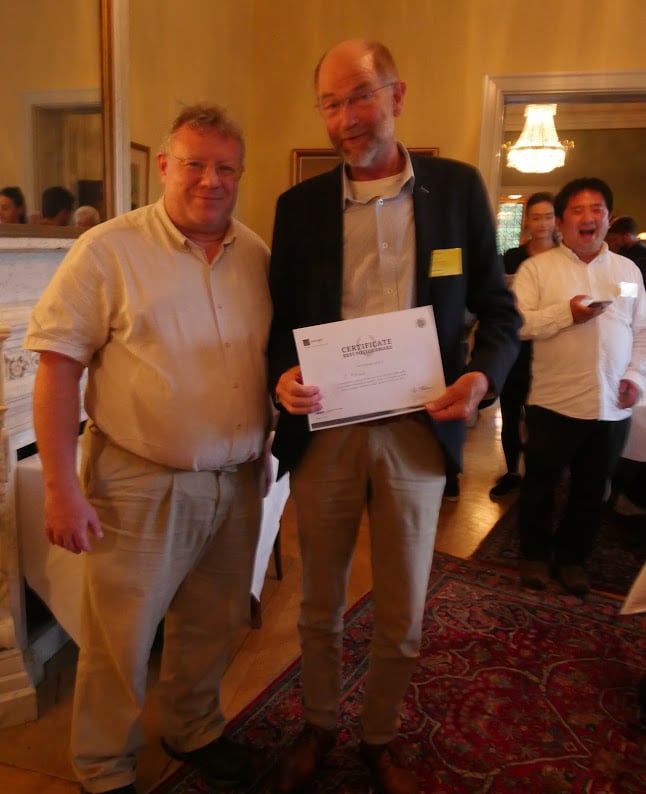
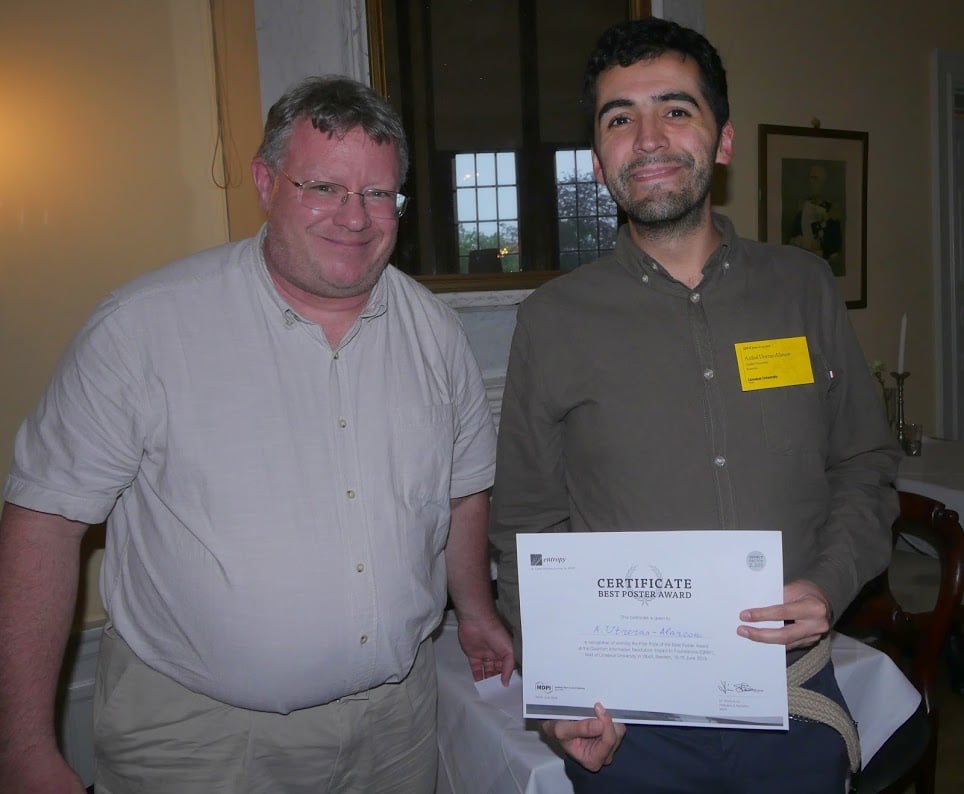
We are pleased to announce the winners of the two poster awards that Entropy sponsored at the Quantum Information Revolution: Impact to Foundations (QIRIF) in Växö (Sweden) on 10–13 June, 2019. The Editor-in-Chief of Entropy, Prof. Dr. Kevin H. Knuth (University at Albany, NY, USA), granted the certificate to the winners.
1st prize (350 CHF, certificate)
"Local Observer-Independent Facts is a weaker assumption than Local Causality" by Anibal Utreras-Alarcon
We study the set of correlations that satisfy the assumptions of freedom of choice, locality (defined as parameter independence) and observer-independent facts. The set of these assumptions was previously shown to be in contradiction with the prediction of quantum theory by Caslav Brukner (Brukner, Entropy 20, 350 (2018)). We found that these correlations are not only different from quantum correlations, but also from those that are characterized by a local hidden-variables model. Indeed, the set of local observer-independent facts correlations is a superset of the set of the local hidden-variables model.
2nd prize (150 CHF, certificate)
"Using the Quantum Zeno Effect to Create Phase Contrast in Electron Microscopy" by Pieter Kruit
The concept of interaction-free measurements as proposed by Elitzur and Vaidman [1] for photons, should also work with electrons [2]. When built into a transmission electron microscope [3], this may lead to imaging modes with reduced damage. In our scheme, the electron wave is split by an amplitude splitter in a large component (the reference beam) that passes through a hole in the specimen and a small component (the sample beam) that passes through the sample. After the passage, both beams are cycled back to the amplitude splitter and the process is repeated. If the sample has no effect on the beam, the amplitude in the sample beam slowly builds up until it has the full intensity after m cycles. If the sample does have an influence, either on the amplitude or on the phase, the intensity transfer is disturbed by the quantum Zeno effect, and the intensity stays in the reference beam. Using the model explained in [4], the signals in the reference beam (R) and the sample beam (S) can be calculated as a function of the phase change in the specimen. To get an impression of what kind of images our method would produce, we simulate electron microscopy images of proteins and show “iso-phase lines” or “iso-phase areas” while only causing damage around these lines or in these areas.
[1] Elitzur, A.C.; Vaidman, L. Found. Phys. 1993, 23, 987–997.
[2] Putnam, W.; Yanik, M. Phys. Rev. A 2009, 80, 040902.
[3] Kruit, P.; R.G. Hobbs; C.-S. Kim; Y. Yang; V.R. Manfrinato; J. Hammer; S. Thomas; P. Weber; B. Klopfer; C. Kohstall; T. Juffmann; M.A. Kasevich; P. Hommelhoff; K.K. Berggren. Ultramicroscopy 2016, doi:10.1016/j.ultramic.2016.03.004.
[4] Thomas, S.; Kohstall, C.; Kruit, P.; Hommelhoff, P. Phys. Rev. A 2014, 90, 053840.
[5] The authors acknowledge funding from the Gordon and Betty Moore Foundation and the Netherlands Organization for Scientific Research (NWO).