
Need Help?
Announcements
14 December 2022
"Thanks a Million!" – One Million Articles Published in MDPI Journals
MDPI has just become the first open access (OA) publisher to reach the milestone of one million articles published. That is one million articles freely available to all, to circulate and build upon! We are proud to share this special moment with the global scientific community.
This landmark has been reached thanks to the immeasurable support of more than 600,000 expert reviewers, 66,000 editorial board members and 6700 hard-working colleagues across MDPI’s global offices.
Within more than 25 years of publishing, our journals received 2.1 million manuscripts and generated 4.6 million peer review reports to get to one million papers published.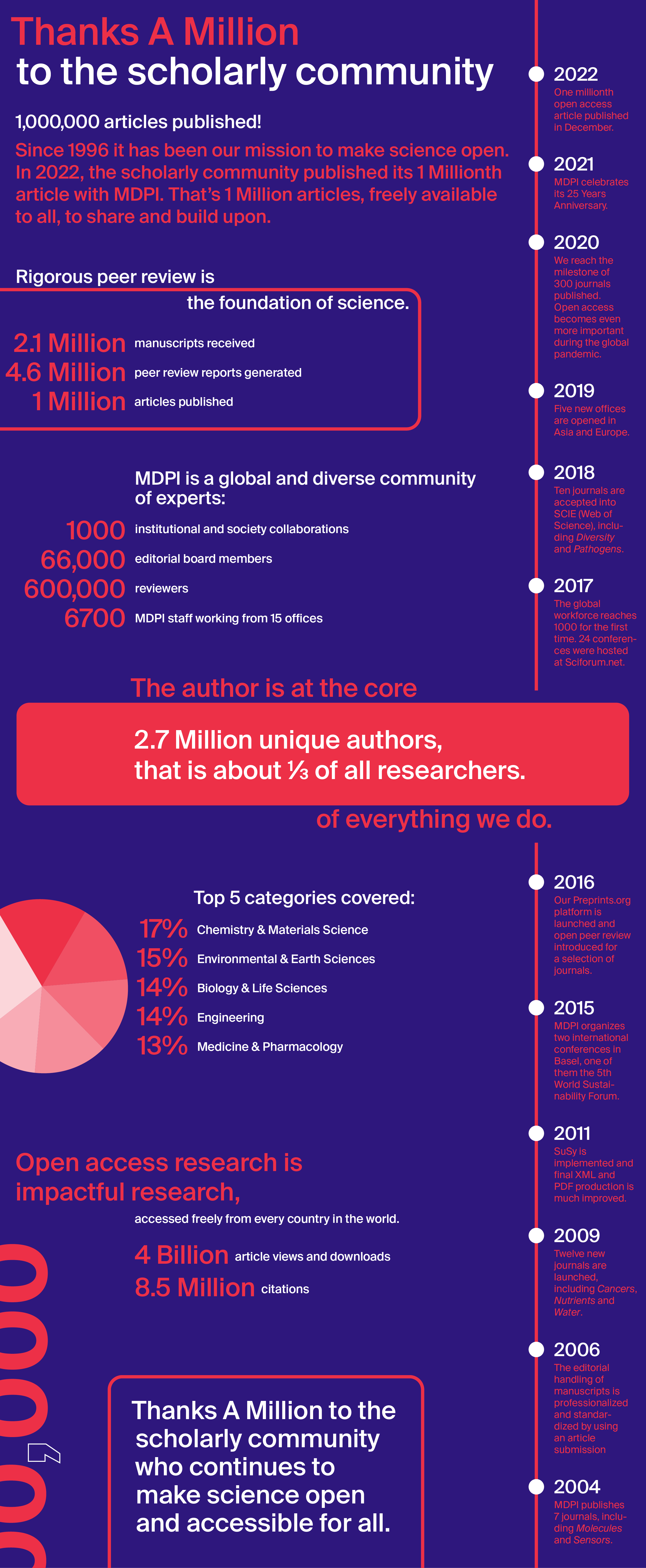
Reaching the milestone of one million articles published reinforces our mission to remove any existing barriers and to make scientific research accessible to all. Since its inception, MDPI’s goal has been to create reliable processes to make science open. This is a path towards facilitating the dissemination of novel insights in scientific communities.
Regular feedback from authors and reviewers shows that our service is greatly appreciated and needed. At the same time, the feedback helps us identify areas for further improvement.
As it stands, a significant share of published research findings remain closed access. More than half of the content published with the most well-known legacy publishers stays behind a paywall, and that is not including articles published in hybrid OA journals, or made available months or years after publication.
A new policy announced by the US administration in August 2022 requires that, as of January 2026, all US federally funded research be made freely and immediately available after publication. While the new policy does not mandate articles be published under an open access license, it is aligned with the open access movement in removing all barriers to research. Similarly, some of the most advanced research institutions in the world intend to have all funded research articles published in open access by 2025.
MDPI is proud to be the leading agent of the transition to open access.
"Thanks a Million" to all the contributors!
14 December 2022
Recruiting Editorial Board Members for Journals Covered in the Emerging Sources Citation Index (Web of Science)
We are currently recruiting Editorial Board Members (EBMs) for MDPI journals indexed in the Emerging Sources Citation Index (ESCI) in Web of Science. In particular, we are looking for experts who are interested in aiding in the development of our journals and safeguarding the scientific quality of the published findings.
Journals currently listed in the ESCI will receive an Impact Factor in June 2023, according to the changes announced by Web of Science (Clarivate). Therefore, this is an excellent time to become an Editorial Board Member for one of these fast-developing journals.
If you are interested in sharing your expertise in one of the journals listed below, please send us an application using this link.
The Editorial Office of the journal will contact you once the application has been approved.
Editorial Board Members are responsible for academic decisions on manuscripts in their field of expertise, will edit Special Issues, and may be invited to review manuscripts. The initial term lasts for two years, after which it can be renewed, and entails the following:
- Prescreening and making decisions on new submissions related to your research interests;
- Setting up at least one Special Issue during your term on a topic related to your research interests (or supervising Special Issues related to your research field);
- Providing input or feedback regarding journal policies;
- Helping to promote the journal among your peers or at conferences;
- Attending Board meetings to suggest journal development strategies;
- Reviewing manuscripts.
Editorial Board Members are entitled to a full waiver on one publication per year in the journal that they serve and need to be experts in their fields.
The list of ESCI journals can be found here: https://www.mdpi.com/about/journals/esci.
Please find the list of ESCI journals, categorized by subject, for which we are recruiting Editorial Board Members below.
Biology |
|
|
|
|
|
|
|
|
|
|
|
|
|
Chemistry & Materials Science |
|
|
|
|
|
|
|
|
|
|
|
|
|
|
|
|
Computer Science & Mathematics |
|
|
|
|
|
|
|
|
|
|
|
|
|
|
|
|
|
|
|
|
|
|
|
|
|
Engineering |
|
|
|
|
|
|
|
|
|
|
|
|
|
|
|
|
|
|
|
|
|
|
Environmental & Earth Sciences |
|
|
|
|
|
|
|
|
|
|
|
|
|
|
|
|
Life Science |
|
|
|
|
|
|
|
|
|
|
Medicine & Pharmacology |
|
|
|
|
|
|
|
|
|
|
|
|
|
|
|
|
|
|
|
|
|
|
|
|
|
Physical Sciences |
|
|
|
|
|
|
|
|
|
|
Social Sciences & Humanities |
|
|
|
|
|
|
|
|
|
|
|
|
|
|
|
|
|
|
|
|
|
|
|
|
|
|
|
|
|
|
|
Society Journals |
|
|
|
|
|
|
|
|
|
|
|
|
|













































































































8 December 2022
MDPI Sustainability Foundation: New Look and Nominations for the 2023 Sustainability Awards Now Open
We are pleased to announce that the website of the MDPI Sustainability Foundation has been revamped! For the past couple of months, our UX UI team and front-end developers have been working hard to launch the website in time for the opening of the Sustainability Awards nominations.
The website is not the only thing that has had a remodeling. Indeed, the format of the Emerging Sustainability Leader Award (ESLA) has been updated. ESLA is now a competition open to individual researchers or start-ups founded by researchers under the age of 35. Nominee applications will go through 2 rounds of selection until the final 3 are decided. The finalists will then be invited to give pitch presentations during the Award Ceremony to win either first place (10,000 USD) or runner-up (2 x 5000 USD).
The World Sustainability Award, on the other hand, remains the same: a total prize money of 100,000 USD is up for grabs by senior individual researchers or groups of researchers from the international research community.
Nominations for both the World Sustainability Award and the Emerging Sustainability Leader award are now open! Check out our new website for more information on how to nominate.
1 November 2022
Prof. Dr. Bartolo Gabriele Appointed Section Editor-in-Chief of the New Section “Molecular Organics” in Chemistry

We are pleased to announce that Prof. Dr. Bartolo Gabriele has been appointed Editor-in-Chief of the Section “Molecular Organics” in Chemistry (ISSN: 2624-8549).
Name: Prof. Dr. Bartolo Gabriele
Email: bartolo.gabriele@unical.it
Affiliation: Laboratory of Industrial and Synthetic Organic Chemistry (LISOC), Department of Chemistry and Chemical Technologies, University of Calabria, Italy
Interests: New syntheses of high-value-added molecules through catalytic assembly of simple units; innovative syntheses of heterocyclic molecules of pharmaceutical, agrochemical, or applicative interest; carbonylation chemistry; use of non-conventional solvents in organic synthesis; synthesis and semi-synthesis of bioactive compounds of pharmaceutical or agrochemical interest; synthesis of new materials for advanced applications; extraction, characterization, and evaluation of the biological activity of bioactive principles from natural matrices.
Homepage: https://encyclopedia.pub/item/revision/5ff961479a0c04725de893443501e4ec
The following is a short Q&A with Prof. Dr. Bartolo Gabriele, who shared his vision for the journal with us, as well as his views of the research area and open access publishing.
Part I—Regarding the journal Chemistry:
1. What appealed to you about the journal Chemistry that made you want to take the role as its Section Editor-in-Chief?
I have served as Guest Editor for a Special Issue of Chemistry ("Feature Paper from Top Italian Scientist"). I thought that taking on this new responsibility as Editor-in-Chief of the “Molecular Organics” Section of Chemistry was a good occasion to strengthen my active participation in the launch of this new MDPI journal.
2. What are your expectations for this journal? What perspective do you think the journal will bring to the related fields?
The journal encompasses all aspects of chemistry, so I hope it will become an internationally recognized reference for the high-quality publication of multidisciplinary chemistry papers.
3. What do you think of the development of open access in publishing?
It is useful for the wide distribution of science, as it offers free availability of scientific papers; however, it may represent an economic problem for authors if and when they lack sufficient funds to cover the article processing charges.
Part II—Regarding his main fields of Interest:
1. Can you share your career development story briefly? For example, what cases have influenced you the most?
I graduated in Chemistry at the University of Calabria (Southern Italy) in 1990, where I also received my Ph.D. in chemical sciences in 1994 (with Professor Giuseppe Salerno). I carried out very important research at the University of Parma in 1991 (with Professors Gian Paolo Chiusoli and Mirco Costa) and at Columbia University in 1997-1998 (with Professor Ronal Breslow). I became an Assistant Professor of Organic Chemistry in 1995 at the University of Calabria, where I was promoted to Associate Professor in 2002 and Full Professor in 2006. I am very grateful to all my mentors for what they have taught me and for having stimulated me to become a good scientist.
2. As a researcher in synthetic organic chemistry, what are the latest developments in your field?
Modern organic synthesis is mainly devoted to the implementation of methods able to produce the desired, high-value-added product in the most eco-friendly and sustainable manner possible.
3. Do you have any valuable suggestions you would like to share with young students and early career researchers?
Do not give up. Never.
We wish Prof. Dr. Bartolo Gabriele every success in his new position, and we look forward to his contributions to the journal.
13 October 2022
Meet the Editors | Interview with Prof. Dr. Craig Rice—Section Editor-in-Chief of Section “Supramolecular Chemistry” in Chemistry

We are pleased to announce that Prof. Dr. Craig Rice has been appointed Editor-in-Chief of the “Supramolecular Chemistry” Section in Chemistry (ISSN: 2624-8549).
Prof. Dr. Craig Rice obtained his chemistry degree from the University of Leicester and his Ph.D. in organic materials from the University of Kent at Canterbury. After several postdoctoral positions, he obtained an academic position at the University of Huddersfield in 2000. He remained at this institution and is now a professor of inorganic chemistry and Head of Department.
The following is a short Q&A with Prof. Dr. Craig Rice, who shared his vision for the journal with us, as well as his views of the research area and open access publishing:
Part I—Regarding the journal Chemistry:
1. What appealed to you about the journal Chemistry that made you want to take the role as its Section Editor-in-Chief?
Chemistry is a new and exciting journal, and its cross-disciplinary remit allows new chemical research to be disseminated across the whole chemistry community. This particularly attracted me to this post, as this will give me a holistic view of the increase in chemical knowledge across the many areas of chemistry. It is also exciting to join at this moment in time as it is a relatively new journal, and I can watch it grow and prosper.
2. What are the expectations you have for this journal? What perspective do you think the journal will bring to the related fields?
As the field of chemistry develops in the 21st century, the boundaries between different fields will inevitably become less formalized. The journal can occupy a unique perspective, encouraging publications that bridge traditional fields of study within chemical science, as well as other scientific disciplines.
3. What do you think of the development of open access in publishing?
Publication of scientific advancements has changed dramatically in the time since I became an academic, and it is likely that change will continue. I suspect that in the very near future, open access publications will become the norm, enabling research to be accessed by all. This can only be a good thing, as it will allow scrutiny and dissemination by the widest possible readership.
Part II—Regarding the main fields of interest:
1. Can you share your career development story briefly? For example, what cases have influenced you the most?
To some extent, my career path has been non-traditional. I started my career as a synthetic organic chemist and ended up as a supramolecular coordination chemist, as well as a (very) amateur crystallographer, whilst teaching organic and inorganic chemistry as well as analytical science, and occasionally forensic science. Having such eclectic research and educator experience has proved highly valuable, and fits well into the ethos of this journal.
I was influenced most by two experiences in the chemistry career. The first was upon starting my Ph.D., which was the first time I became aware of metallosupramolecular chemistry. Seeing the beautiful and elegant transition metal helicates that self-assembled due to the interplay of ligand design and metal ion coordination geometry really sparked my interest. The other experience was my transition from synthetic chemistry to coordination chemistry under the excellent guidance of Professor Mike Ward. Whilst I was only under his tutelage briefly, that short time informed the rest of my scientific career.
2. As a researcher in supramolecular chemistry, what are the latest developments in your field?
Personally, I think one of the most exciting developments in supramolecular chemistry is the application of this field to other disciplines. Moving this area of science from academic curiosity to real-world applications will allow this subject to continue to grow into a mature area of scientific study. Recent advances in cancer treatment using Scott’s dinuclear double helicates and cystic fibrosis treatment using Gale’s anion transporters are particularly noteworthy examples.
3. Do you have any valuable suggestions you would like to share with young students and early career researchers?
Making an impact in chemical science in the 21st century is in some ways easier and harder than it was when I started my career. Access to powerful instrumentation such as X-ray crystallography and high-field NMR is much easier now that crystal structure determination is almost routine (in some cases!), as is obtaining an NMR in the many hundreds of megahertz. However, the increase in the volume of research data makes finding an area in which you can make an impact seem a daunting challenge. As a result, my advice would be to gain as much and as different experience as possible. Try to gain a breadth of knowledge and apply that to your own research. Bridging different fields will allow you to occupy a unique position and apply your research to a breadth of areas. Don’t hesitate to be bold and different!
Being willing to adapt to new areas and not being siloed in one area of scientific study can have a real impact on research. I was very lucky to have a chance discussion with an esteemed cancer pharmacologist, and that brief conversation pivoted my research almost instantaneously and led to a fruitful collaboration across supramolecular chemistry, cell biology and cancer pharmacology.
We wish Prof. Dr. Craig Rice every success in his new position, and we look forward to his contributions to the journal.
8 October 2022
Recruiting Section Editors-in-Chief for Chemistry

Chemistry (ISSN: 2624-8549) is currently recruiting Section Editors-in-Chief (https://www.mdpi.com/journal/chemistry/sections) for the following Sections:
- “Astrochemistry”;
- “Bioinorganics”;
- “Food Science”;
- “Electrochemistry”;
- “Green and Environmental Chemistry”;
- “Medicinal Chemistry”;
- “Organic Materials and Polymers”;
- “Physical Chemistry and Chemical Physic”;
- “Photochemistry and Photophysics”;
- “Radiochemistry”.
The journal is looking to expand its developmental directions to cover areas requiring additional representation. If you are interested in leading a particular Section and helping us to take the next step in its development or would like to recommend potential candidates, please reach out to us.
Chemistry is a new journal published quarterly online by the leading open access publisher MDPI with Prof. Edwin Charles Constable serving as the Editor-in-Chief. Chemistry is dedicated to the publication and widespread dissemination of peer-reviewed research articles, communications, and review papers in all areas of chemistry. Particular emphasis will be given to publications that bridge traditional disciplines within chemistry or provide insights of interest to the broader chemical community.
The responsibilities of the Section Editor-in-Chief include the following:
- Acting as an ambassador for the journal, MDPI, and open access publishing;
- Issuing scientific decisions about the scope of their Section;
- Inviting distinguished scientists to join the Editorial Board;
- Suggesting topics for Special Issues;
- Providing support and guidance to Editorial Board Members and editorial staff where required;
- Maintaining oversight of the editorial process for individual manuscripts in their Section (mainly by making the final decision regarding whether or not a paper will be published after peer review and revisions);
- Understanding, leading and upholding MDPI’s peer review guidelines and ethics guidelines.
As a Section Editor-in-Chief, you will have the unique opportunity to network and communicate with scholars in the Chemistry community, building long-term relationships and establishing your influence within your discipline. Appointed members will also receive an Editor Certificate confirming this role. In addition, you will have the opportunity to publish one paper per year free of charge in any of our journals. The term for this position is two years and can be renewed.
To apply or request further information, please contact the Chemistry Editorial Office (chemistry@mdpi.com). We look forward to hearing from you soon.
Chemistry Editorial Office
5 October 2022
Inventors of “Click Chemistry” Awarded Nobel Prize in Chemistry 2022
The Nobel Prize in Chemistry 2022 has been jointly awarded to Carolyn R. Bertozzi (Stanford University, USA), Morten Meldal (University of Copenhagen, Denmark) and K. Barry Sharpless (Scripps Research, La Jolla, USA).
The trio laid the foundations for creating useful molecules by combining simple building blocks through a straightforward and efficient chemical reaction, an approach which they termed click chemistry. The idea is that the resulting molecules do not need to be exact replica of natural molecules in order to be functional. Especially in the development and production of pharmaceuticals at scale, click chemistry has brought about many advances.
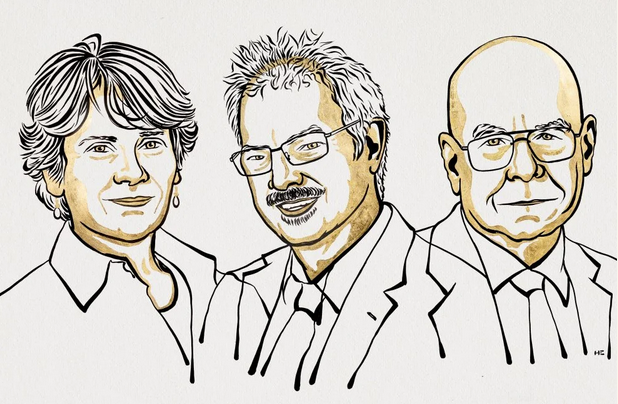
Bertozzi, Meldal, Sharpless (from left to right) © Nobel Media
“This year’s Prize in Chemistry deals with not overcomplicating matters, instead working with what is easy and simple. Functional molecules can be built even by taking a straightforward route,” the Chair of the Nobel Committee for Chemistry, Johan Åqvist, said.
The copper-catalyzed reaction Professor Meldal and Professor Sharpless discovered independently makes basic molecules “snap together quickly and efficiently” and is “utilised in the development of pharmaceuticals, for mapping DNA and creating materials that are more fit for purpose”, according to a statement by the Royal Swedish Academy of Sciences.
Carolyn Bertozzi is the eighth woman to win the prize in chemistry and a champion of open access publishing. In her seminal research, she succeeded in developing chemical tools based on click chemistry that help to study human and animal physiology in new ways. In particular, she came up with so-called bioorthogonal reactions which are so selective they do not interfere with surrounding processes in living organisms. Targeting tumors by breaking down their camouflage is one highly important application.
Barry Sharpless is only the second person to be awarded the chemistry prize for a second time, having already been honored in 2001 for previous breakthrough discoveries.
Congratulations to all of this year’s winners and a special nod to Professor Sharpless who is a one-time author in Molecules!
Díaz, D.D.; Converso, A.; Sharpless, K.B.; Finn, M.G. 2,6-Dichloro-9-thiabicyclo[3.3.1]nonane: Multigram Display of Azide and Cyanide Components on a Versatile Scaffold. Molecules 2006, 11, 212-218. https://doi.org/10.3390/11040212.
28 September 2022
Peer Review Week 2022 – Research Integrity: Creating and Supporting Trust in Research

Peer Review Week began 19 September 2022 under the theme of “Research Integrity: Creating and Supporting Trust in Research”. Through various blog articles, podcast, and webinar, we discussed this crucial subject throughout the week, celebrating the essential role peer review plays in maintaining research quality.
To begin, we held a Webinar on the topic. Professor Peter W. Choate and Dr. Emmanuel Obeng-Gyasi joined Dr. Ioana Craciun, one of MDPI’s scientific officers, for an in-depth discussion.
We invite you to view the event recording:
During the week, the MDPI Blog in a series articles highlighted how good Peer Review safeguards research integrity. The following topics were covered:
- Peer Review Week 2022
- Research Integrity
- What We’ve Learned About Peer Review Reports
- 4 Steps to the Perfect Peer Review Report
- How to Write the Perfect Peer Review Report: An Interview
- Inviting Great Peer Reviewers
In a new edition of Insight Faster, an MDPI podcast, we were delighted to talk to the co-chairs of the Peer Review Week committee, Jayashree Rajagopalan (Senior Manager of Global Community Engagement for CACTUS) and Danielle Padula (Head of Marketing and Community Development at Scholastica) to get their take on this year’s event and its related topics.
You can find the Podcast here.
We hope you enjoy the contents!
20 September 2022
Meet Us at the 12th National Organic Chemistry Conference of the Chinese Chemical Society, 25–29 September 2022, Hefei, China

Symmetry (ISSN: 2073-8994) will be attending the 12th National Organic Chemistry Conference of the Chinese Chemical Society, held in Hefei, China, from 25 to 29 September 2022. This conference aims to achieve an in-depth exchange of the latest research results in organic chemistry and related disciplines and to discuss the frontier trends and future development trends of organic chemistry. During this conference, MDPI (at booth #26) will welcome researchers from different backgrounds to visit and share their latest inspirations with us.
The following MDPI journals will be represented:
- Symmetry (leading journal);
- IJMS;
- Molecules;
- Catalysts;
- Sustainability;
- Pharmaceuticals;
- Molbank;
- Organics;
- Chemistry.
If you plan on attending this conference, feel free to stop by our booth: #26. Our delegates look forward to meeting you in person to answer any questions you may have.
For more information about the conference, please see the following link: http://12noc.ustc.edu.cn/.
23 August 2022
Meet the Editors | Interview with Prof. Dr. Huan Pang—Section Editor-in-Chief of the New Section “Nanoscale Science” in Chemistry

We are pleased to announce that Prof. Dr. Huan Pang has been appointed Section Editor-in-Chief of the Section “Nanoscale Science” in Chemistry (ISSN: 2624-8549).
Prof. Dr. Huan Pang attained M.Sc. and Ph.D. degrees from Nanjing University in 2011. He is now a university distinguished professor at Yangzhou University and Young Changjiang Scholars of the Ministry of Education, China. He is a fellow of the Royal Society of Chemistry. He was recognized as a highly cited researcher in Cross-Field by Clarivate Analytics in 2020 and 2021. He is the Editorial Board Member of the National Science Review; a number of journal editorial boards and youth editorial board members are academic part-timers. His research area mainly focuses on nano metal-organic frameworks (MOFs)-related materials. He has published more than 300 SCI papers as the first/corresponding author and won the first prize in Natural Science from the Ministry of Education.
The following is a short Q&A with Prof. Dr. Huan Pang, who shared his vision for the journal with us, as well as his views of the research area and open access publishing:
Part I—Regarding the journal Chemistry
1. What appealed to you about the journal Chemistry that made you want to take the role as its Section Editor-in-Chief?
The journal Chemistry publishes papers on various aspects of basic chemistry and applied chemistry, including inorganic chemistry, organic chemistry, physical chemistry, electrochemistry, biochemistry, green and environmental chemistry, etc. The scope of this journal is very wide. There are some experienced editors in the editorial committee team of "Nanoscale Science", such as Prof. Dr. Philippe Dugourd, Prof. Dr. Angelo Maria Taglietti, etc. I am mainly engaged in the research of energy chemistry based on nano metal-organic frameworks (MOFs)-related materials. The work of the editorial committee of chemistry enables me to come into contact with the theoretical knowledge of chemistry and the frontier issues of scientific research.
2. What are the expectations you have for this journal? What perspective do you think the journal will bring to the related fields?
This journal has covered all fields related to chemistry. I think an important direction for the future development of the journal is to apply our research materials to practice. Now, the application of nanomaterials in biology, environment, and energy storage is very common. In addition, cross disciplines are also popular, such as multi-functional composite materials.
The journal Chemistry needs to be popularized in many aspects. We still need to control the quality of journal articles, improve the impact factors, and attract more good research jobs. There are also many excellent scholars and relevant research institutions in China. my sincerest hope is that the journal will cooperate with excellent scholars at home and abroad to provide professional publishing services for more scholars and better serve the research in this field.
3. What do you think of the development of open access in publishing?
The open access model is very beneficial for researchers. Because open access journal literature can be read anywhere, we save the cost and time of purchasing literature, which is convenient for readers.
Part II—Regarding the main fields of interest
1. Can you share your career development story briefly? For example, what cases have influenced you the most?
During my master's degree, doctoral degree, and post-doctoral research work, I published papers in many journals such as Angewandte Chemie International Edition. I deeply understand the inseparable relationship between journal publishing and academic research. Therefore, since I started my work, as one of the representatives of Yangzhou University, I co-founded EnergyChem with Elsevier and served as the managing editor in 2019. This has laid a rich foundation for my future editing work and allowed me to accumulate rich experience and in 2020, I served as the young editor of eScience. I was lucky to work with many experienced editors whose words and deeds have benefited me a lot. In 2021, I served as a member of the editorial group of the National Science Review. At the same time, I served as the Editorial Board Member of FlatChem and Rare Metals, and the youth editorial board member of Nano Research, Nano Research Energy. In the process of serving on the editorial committee, I linked my theoretical knowledge of chemistry and the frontier issues of scientific research, and I am now able to apply my knowledge in familiar fields which ultimately strengthens the volume of contributions to the journal publishing house.
2. As a researcher in nanoscale science, what are the latest developments in your field?
Nanoscale Science has always been a research hotspot, such as the nano metal-organic framework material. Nano MOFs exhibit a tunable composition and rich structural diversity beyond traditional solid materials. These characteristics cause them to have a wide range of potential applications, such as separating/storing hydrocarbon mixtures by nano MOF-based membranes or column adsorption and catalyzing various important chemical processes. Especially using a nano MOF precursor, some interesting materials with special compositions and structures can be obtained, which are difficult to obtain using traditional methods. These nano MOF-derived materials exhibit excellent performance and potential applications when used in energy-related processes or designs. With the deepening of the research, we also have a new understanding. However, it still needs to be considered that research and application are unified. For example, the advantages of nanomaterials are more considered in research, while the disadvantages of nanomaterials in specific applications are more considered in the application. This is one of the important reasons why we have not fully utilized them despite our full expectations for nanomaterials. At present, the research on nanomaterials has reached a very high level. In the future, our research will stand on the shoulders of giants, which requires each researcher to stand higher to see further. The application of nanomaterials and energy storage is still a very active field, and it is still deepening and exploring its industrialization and new application fields.
3. Do you have any valuable suggestions you would like to share with young students and early career researchers?
For young students and early career researchers, I suggest that they should first pay attention to the accumulation of knowledge, read more literature, and improve their abilities in all aspects, especially their ability to think independently. Secondly, they should communicate with their peers and do more experiments. In addition, scientific research needs to be treated with a rigorous and responsible attitude, and the data should be recorded in detail to facilitate later verification. Another important thing is to maintain an optimistic attitude and stay healthy. Experimental failures are common, and they should learn from failures, never give up, and try and make mistakes.
We warmly welcome Prof. Dr. Huan Pang as the Section Editor-in-Chief of the new Section “Nanoscale Science” in Chemistry, and look forward to his contribution to the continued success of the journal.