


Translational Audiology

A topical collection in Audiology Research (ISSN 2039-4349). This collection belongs to the section "Balance".

Viewed by 5288

Editor


E-Mail Website
Collection Editor
Department of Otorhinolaryngology, Head and Neck Surgery, Charité Universitätsmedizin, Berlin, Germany
Interests: hearing research; inner ear immunology; ototoxicity
Special Issues, Collections and Topics in MDPI journals

Topical Collection Information

Dear Colleagues,

For many decades, translational science has linked basic science discoveries with their clinical translation. The translational approach is also widely used in audiology, but the term “translational audiology” is much less commonly employed.

This Topical Collection aims to bring together publications on the latest developments and applications of translational audiology, both in the clinic and the research laboratory. The focus is on multidisciplinary research, as we can only progress by working together: audiologists, physicians, biologists, physicists, and representatives of many other scientific disciplines.

Additionally, in this current collection, we will pay special attention to the reproducibility of published data. We support increasing reproducibility through rigor and transparency as a key to implementing new research solutions through translational audiology. Following the guidelines of local, national, and international Reproducibility Networks is strongly encouraged.

We encourage submitting papers that address approaches for diagnosing, monitoring, and treating auditory or vestibular disorders via a translational approach. A rigorous translational approach to audiological studies is expected to accelerate progress in developing and implementing new innovative solutions for patients with hearing and balance disorders.

Prof. Dr. Agnieszka Szczepek
Collection Editor

Manuscript Submission Information

Manuscripts should be submitted online at www.mdpi.com by registering and logging in to this website. Once you are registered, click here to go to the submission form. All submissions that pass pre-check are peer-reviewed. Accepted papers will be published continuously in the journal (as soon as accepted) and will be listed together on the collection website. Research articles, review articles as well as short communications are invited. For planned papers, a title and short abstract (about 250 words) can be sent to the Editorial Office for assessment.

Submitted manuscripts should not have been published previously, nor be under consideration for publication elsewhere (except conference proceedings papers). All manuscripts are thoroughly refereed through a single-blind peer-review process. A guide for authors and other relevant information for submission of manuscripts is available on the Instructions for Authors page. Audiology Research is an international peer-reviewed open access semimonthly journal published by MDPI.

Please visit the Instructions for Authors page before submitting a manuscript. The Article Processing Charge (APC) for publication in this open access journal is 1600 CHF (Swiss Francs). Submitted papers should be well formatted and use good English. Authors may use MDPI's English editing service prior to publication or during author revisions.

Keywords

  • tinnitus
  • hyperacusis
  • cochlear synaptopathy
  • vertigo
  • vestibular disorders
  • hearing loss

Published Papers (2 papers)

2026

Jump to: 2024

16 pages, 999 KB  
Article
New Insight into Potential Otoprotective Effects of Lactoferrin: Is It Paradoxically Ototoxic? An Experimental Investigation
by Ahmet Mutlu, Ayse Yasemin Gunduz, Burcu Bakici, Murat Erinc, Erdogan Bulut, Onur Ersoy, Serdal Celik, Dogan Cakan and Mahmut Tayyar Kalcioglu
Audiol. Res. 2026, 16(2), 40; https://doi.org/10.3390/audiolres16020040 - 6 Mar 2026
Viewed by 524
Abstract
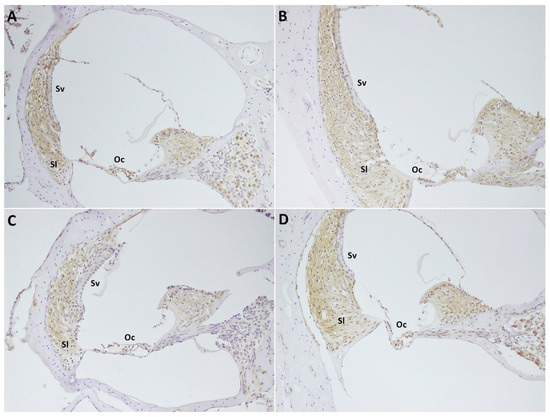
To evaluate the potential ototoxic effects of lactoferrin on the inner ear using electrophysiological and histological methods. Methods: Thirty-two Sprague-Dawley rats (64 ears) were divided into four groups: control, saline, antiseptic solution (70% isopropyl alcohol + 2% chlorhexidine), and lactoferrin. Groups II–IV received [...] Read more.
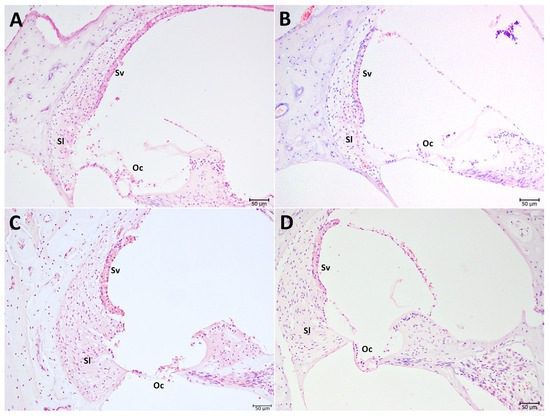
To evaluate the potential ototoxic effects of lactoferrin on the inner ear using electrophysiological and histological methods. Methods: Thirty-two Sprague-Dawley rats (64 ears) were divided into four groups: control, saline, antiseptic solution (70% isopropyl alcohol + 2% chlorhexidine), and lactoferrin. Groups II–IV received three intratympanic injections. Auditory brainstem response (ABR) tests were performed at baseline, day 7, and day 21. Cochlear histology and VEGF immunoreactivity were assessed. Results: Baseline hearing was similar across groups. Post-treatment, Groups II and IV showed partial recovery at 8, 16, and 24 kHz, while Groups III and IV had worsening thresholds at higher frequencies. Histologically, Group IV’s cochlear structures remained largely intact. VEGF immunoreactivity was severe to moderate in Groups I, II, and IV, and weaker in Group III. Conclusions: Lactoferrin showed relative safety at lower frequencies but possible ototoxicity at higher frequencies. However, no significant structural damage was observed in cochlear tissues. Full article
Show Figures

Figure 1

2024

Jump to: 2026

15 pages, 1669 KB  
Article
Zinc–Air Hearing Aid Batteries: An Analysis of Functional Performance
by James Thomas, Barry Bardsley, Jane Wild and Michael William Owen Penman
Audiol. Res. 2024, 14(4), 659-673; https://doi.org/10.3390/audiolres14040056 - 23 Jul 2024
Viewed by 3331
Abstract
Background: The aim of this study was to evaluate the performance of three disposable hearing aid battery brands available in Wales. Hearing-impaired individuals who utilise hearing aids rely on the functionality of their devices, which is often contingent upon the quality and longevity [...] Read more.
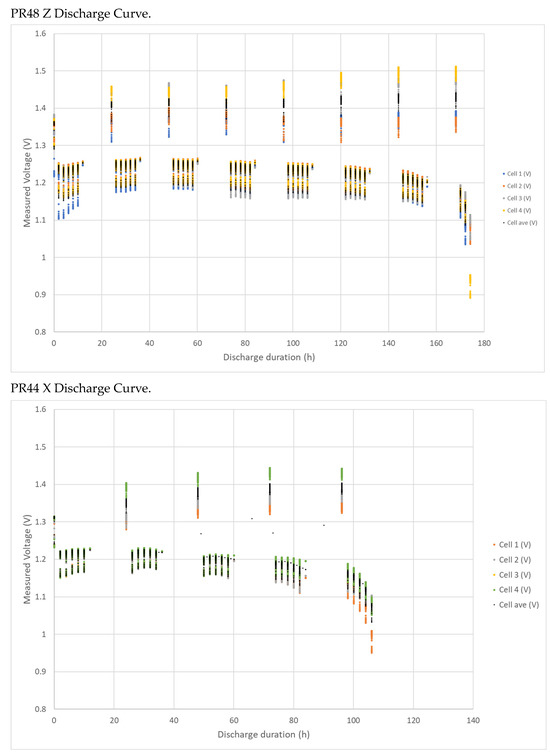
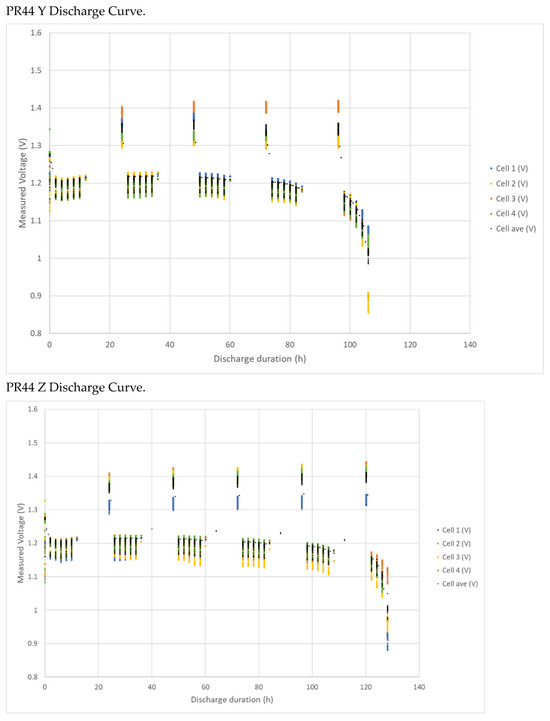
Background: The aim of this study was to evaluate the performance of three disposable hearing aid battery brands available in Wales. Hearing-impaired individuals who utilise hearing aids rely on the functionality of their devices, which is often contingent upon the quality and longevity of disposable batteries. Materials and Methods: A grey literature review foregrounded the battery standards. The “real-life” use of batteries was supplemented through laboratory testing. Parameters relating to performance quality were used to quantify an overall service life of five PR44- and four PR48-size batteries per manufacturer. Results: The literature review signalled a large gap in hearing aid battery consumption research. All battery brands underperformed compared to their specifications but met IEC standards. Conclusions: Revisions to battery consumption test conditions should reflect new technological features and refine expectations of real-life use. It was possible to statistically identify the best performing hearing aid battery brand. Full article
Show Figures

Figure A1

Back to TopTop