1. Why It Matters
Spintronics has traditionally relied on magnetic fields, static strain, and material-specific spin–orbit coupling to control spin transport, placing intrinsic limits on speed, selectivity, and device geometry. Here we demonstrate that time itself, through a programmable lapse function Λ(x,t), acts as a tunable physical resource, enabling geometry-driven spin dynamics that persist even in the absence of magnetic fields or Berry curvature. Because the curvature enters the Hamiltonian at the level of the temporal metric, helicity-selective control can now operate directly in the attosecond-to-femtosecond regime, where circularly polarized light imposes ultrafast phase and population asymmetries that are subsequently amplified by temporal curvature. This provides a pathway to helicity-defined, field-free spin routing and curved-time spin valves, while also enabling magnon focusing, reflection, and Bragg filtering without altering the underlying magnetic texture. Importantly, the predicted Kerr-phase signatures and spin-geometry funnels are compatible with GHz SAW platforms and standard ultrafast photonics, positioning curved-time control as a practical route toward ultrafast spin logic and quantum information architectures built directly on engineered temporal geometry.
2. Introduction
Spintronics has entered a regime where geometric fields [
1,
2], synthetic gauge potentials [
3], and ultrafast temporal modulation enable unprecedented control over spin degrees of freedom [
4,
5,
6]. Conventional approaches, including magnetic fields, electrical gating, strain engineering, and spin–orbit coupling, primarily operate by reshaping the spatial potential landscape that governs charge and spin transport. These methods allow precise manipulation of Larmor precession, Rashba and Dresselhaus interactions, spin–momentum locking, and magnonic dispersion. However, they fundamentally rely on a fixed temporal reference frame [
6,
7,
8,
9].
Recent advances in time-dependent Hamiltonians, Floquet engineering, and ultrafast optical control have demonstrated that sub-femtosecond modulation of the effective Hamiltonian can strongly influence spin coherence, Berry-phase accumulation, spin diffusion, and magnon propagation [
10]. Despite these developments, the intrinsic flow of time experienced by a quantum spinor remains unchanged, leaving dynamical phase evolution largely beyond the reach of conventional control strategies [
11,
12,
13,
14,
15]. Here, we show that nanomechanical surface-acoustic-wave (SAW) fields can modulate the effective flow of time experienced by spin systems, introducing a fundamentally new geometric control axis for spin precession, spin transport, and magnon dynamics. By coupling the lapse field Λ(x,t) to Rashba and Dresselhaus spin–orbit terms, curved time directly modulates spin precession and generates the transverse, curvature-driven Hall response observed in our simulations.
In our previous work, we introduced the concept of curved-time quantum systems, where engineered local time-dilation fields—realized via static Gaussian acceleration profiles—generate discrete temporal eigenstates that act as qubit analogs. Using graphene nanoribbons and carbon-nanotube rings, we demonstrated coherent electron transfer between curvature wells with probabilities exceeding 95% per cycle, enabling deterministic temporal-qubit rotations without external electromagnetic gating [
16]. Building on demonstrations of photon-controlled electron teleportation in curved-time systems and momentum-resolved Floquet spectroscopy on curved-time metasurfaces [
17], we extend this framework to spin transport. Specifically, we show that engineered temporal curvature can induce helicity-dependent spin dynamics and field-free Hall-like responses, thereby establishing a temporal–geometric axis for spin control [
18,
19,
20].
In this work, we develop a unified geometric framework in which the local clock rate Λ(x,t) acts as a tunable temporal field entering directly into the Schrödinger–Pauli equation. Temporal curvature modifies the dynamical phase, renormalizes the effective Larmor frequency, and alters spin–orbit–induced band splitting without requiring external magnetic or electric fields. We demonstrate that even modest curvature (1–5%) produces measurable shifts in spin precession frequency, spin diffusion length, magnon group velocity, and pseudospin trajectories in graphene and carbon-nanotube systems.
Motivated by emerging experimental platforms—including SAW-induced acceleration fields [
21,
22,
23,
24,
25,
26], ultrafast SAW-driven analog potentials [
27,
28], and time-refractive photonic materials—we show that clock-rate engineering provides an energy-efficient and versatile mechanism for spin manipulation. These results establish time geometry as a previously missing yet essential control dimension for next-generation spintronic, magnonic, and quantum-coherent devices.
2.1. Time as a Dynamic Degree of Freedom
In this work, “curved time” does not refer to gravitational spacetime curvature in the general relativistic sense. Instead, it denotes an effective temporal metric engineering and time scaling such as femtosecond time dilation, where the local evolution parameter of the quantum system is rescaled as
The lapse function Λ(x,t) therefore acts as a dimensionless clock-rate modulation field, physically implemented via time-dependent acceleration fields (e.g., SAWs). Unlike conventional time-dependent Hamiltonians (Floquet systems), which modify H(t), the present approach modifies the time measure itself, leading to multiplicative renormalization of all dynamical phases.
Phase evolution in standard quantum dynamics. In standard quantum dynamics, the phase of a wavefunction evolves according to the time integral of energy:
Thus, the phase, and therefore all spintronic observables, is governed by the time integral.
For a state with instantaneous energy
, the quantum phase is
All time-dependent Hamiltonians, Floquet, pulsed optical driving, parametric tuning—operate through this form. The integral is computed with respect to a fixed time metric: the physical duration between two events is always .
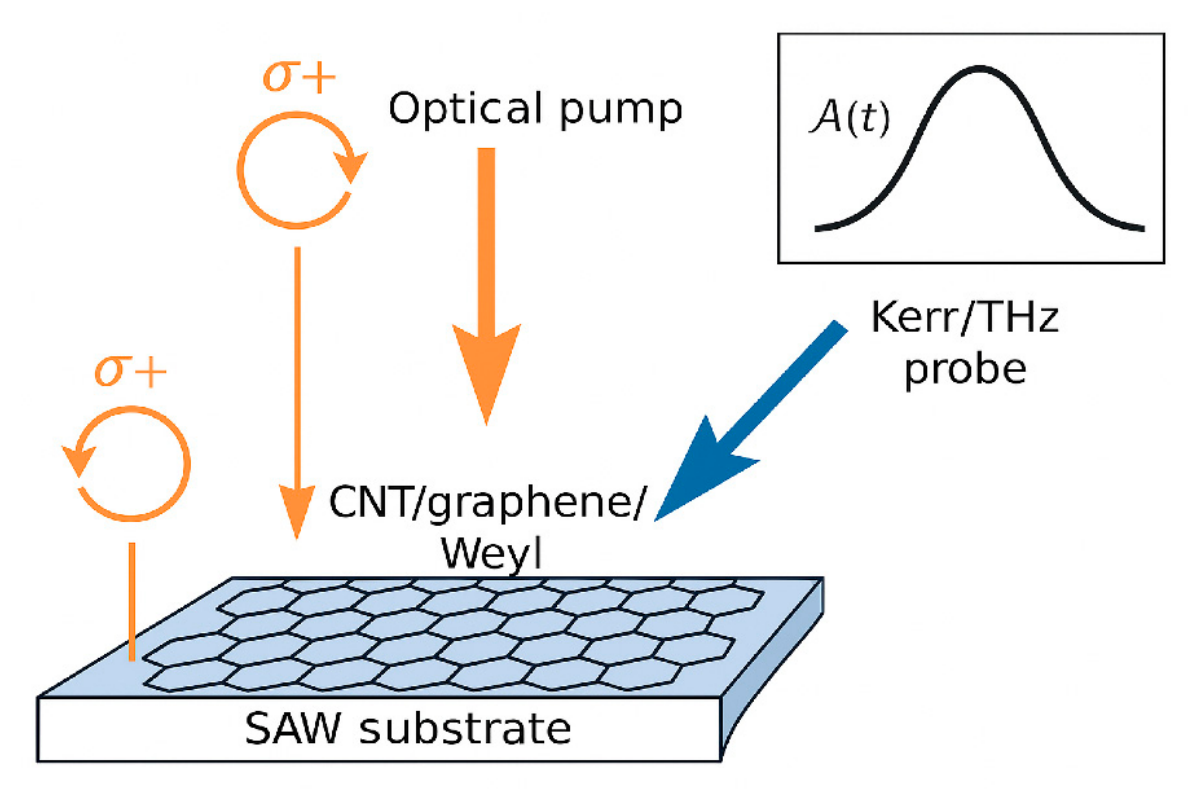
If the effective clock rate were modifiable, it would offer a fundamentally new route to spin control. Recent developments in curved-time analog systems, SAW-induced acceleration fields, SAW-driven temporal potentials, time-refractive metamaterials, and ultrafast geometric modulation in perovskites suggest that clock rate engineering may be feasible at experimentally accessible energies and frequencies. As illustrated schematically in
Figure 1, a SAW-driven substrate shapes the lapse function
in a CNT/graphene/Weyl layer while σ
+/σ
− optical pumping and Kerr/THz probing read out the resulting curved-time spin–photon dynamics.
2.2. Motivation for Curved-Time Spintronics
This work proposes a new paradigm in which time geometry, encoded by a lapse field Λ(x,t), enters the spin Hamiltonian as a controllable parameter. Even weak curvature alters the effective Larmor frequency, SOC splittings, and magnon group velocity. Spin transport becomes guided by temporal gradients, creating
time-geometry spin funnels. This framework unifies: spintronics, magnonics, excitonic time-geometry funnels, acoustic/accelerometric analogs, and quantum geometry. It also enables magnetic-field-free spin control, energy-efficient switching, and curvature-driven coherence enhancement [
29,
30].
3. Theoretical Framework
3.1. Curved-Time Spin Hamiltonian
Curvature-renormalized Schrödinger–Pauli equation. We begin from the nonrelativistic Pauli equation and modify the time derivative via the lapse field Λ(x,t):
Curvature modifies
clock rate via Λ(x,t),
inertia via
precession frequency via the scaling of the Zeeman term
SOC strength through effective mass renormalization:
Under curvature, the curved-time renormalization is applied as
The parameters αR and βD represent the strengths of the two dominant spin–orbit coupling (SOC) mechanisms in semiconductor and 2D Dirac materials:
Origin: structural inversion asymmetry (SIA), typically induced by electric fields or interface asymmetry.
Physical effect: couples electron momentum to spin as
- 3.
βD—Dresselhaus SOC coefficient
Origin: bulk inversion asymmetry (BIA) in zinc-blende or III–V materials.
Physical effect: produces spin splitting along crystallographic axes,
Thus, both Rashba and Dresselhaus couplings acquire temporal tunability.
Under curved time, the SOC Hamiltonian acquires a multiplicative renormalization via the lapse field:
Such that both Rashba and Dresselhaus couplings become effectively time-dependent.
This directly modifies spin–momentum locking and therefore the instantaneous spin precession axis. Importantly, spatial gradients of the lapse field generate effective gauge fields that couple to the SOC-induced spin texture, producing a transverse drift analogous to a spin Hall response. In this sense, the curvature-driven Hall effect observed in our simulations can be interpreted as arising from the interplay between temporal geometry (∇Λ) and SOC-induced Berry curvature.
3.2. Curved-Time Larmor Precession
Conventional Larmor procession:
where
is the precession frequency of a spin in a magnetic field. It sets the rate at which the spin rotates (precesses) around the magnetic field axis.
is Bohr magneton and
external magnetic field, and ℏ reduced Planck constant.
Clock dilation → slower precession; clock contraction → faster precession.
Even modest Λ modulations (1–5%) produce detectable shifts in precession frequency and coherence times.
4. Spin Transport Under Time Geometry
4.1. Curved-Time Spin Diffusion
The spin continuity equation becomes:
where S is Spin density/spin polarization, Λ(x) produces spin accumulation, and D Spin diffusion coefficient:
- −
slow-time regions → longer effective T1 → spin clustering;
- −
fast-time regions → depletion.
4.2. Temporal Spin Funneling
Analogous to strain-induced exciton funnels:
- −
spatial potential gradients funnel charges/excitons;
- −
temporal curvature gradients funnel spin density.
Drift velocity acquires a geometric component:
This provides the first mechanism for field-free spin-current directionality.
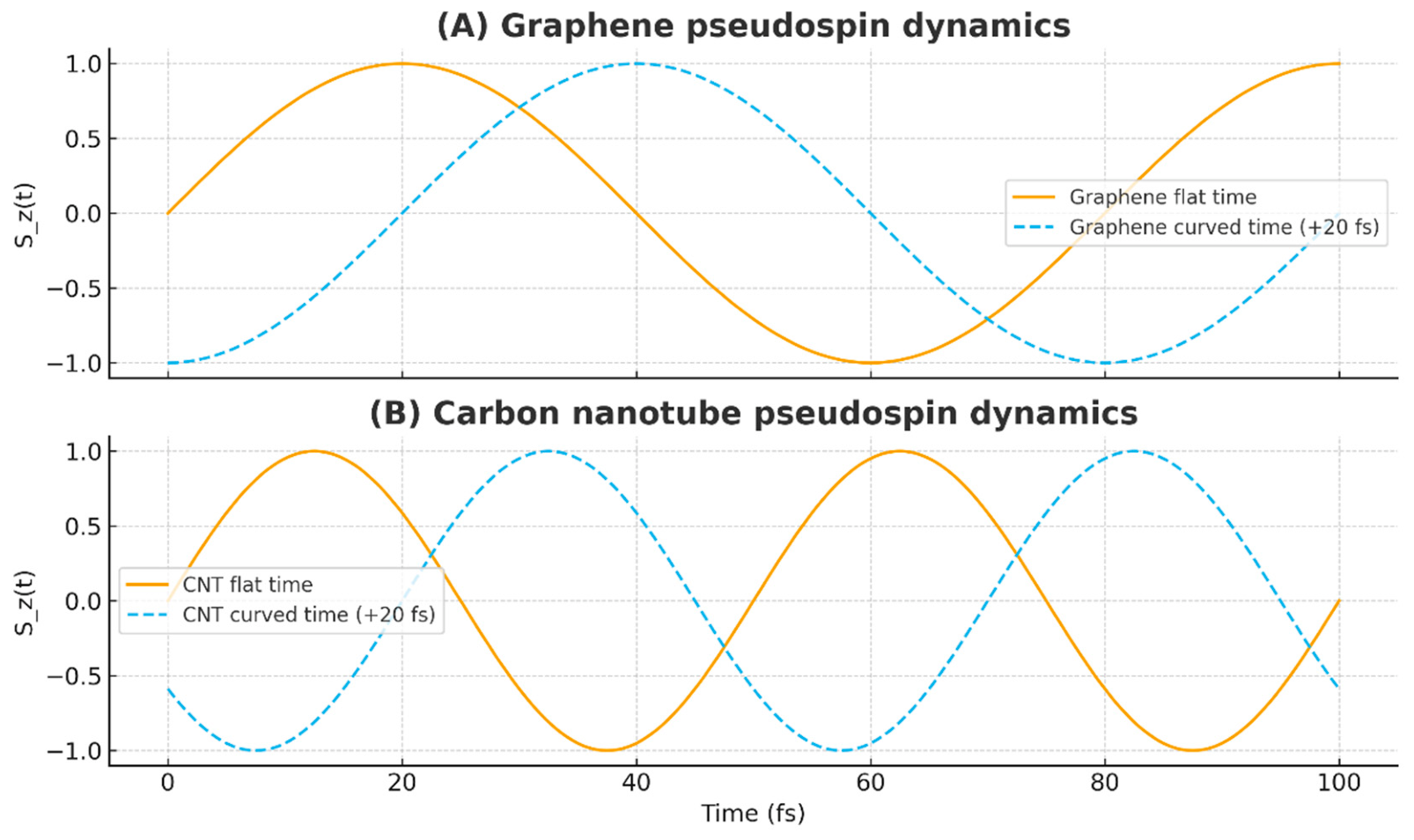
To quantify how curved time modulates ultrafast spin dynamics, we computed the pseudospin response of graphene and carbon nanotubes under a σ
+ circularly polarized optical pump. A controlled +20 fs dilation was applied over a 100 fs window, corresponding to an average lapse factor
.
Figure 2 shows that this modest curvature produces a measurable femtosecond-scale phase advance in the graphene pseudospin trajectory, with the curved-time trace oscillating ahead of the flat-time evolution by a steadily increasing shift. When the same protocol is applied to a carbon nanotube, whose stronger spin–orbit coupling yields faster spin–photon locking—the curvature-induced phase shift is significantly amplified. These results demonstrate that 1D structures with large SOC act as ultrasensitive probes of clock-rate modulation, and that curved-time engineering provides a powerful mechanism for controlling spin precession without external magnetic fields.
The influence of temporal curvature on Dirac and helical spinor systems is summarized in
Figure 1. Under a circularly polarized pump, the intrinsic pseudospin dynamics of graphene (panel A) exhibit the expected sinusoidal precession arising from light–matter coupling in a massless Dirac cone. Introducing a controlled temporal dilation of (
fs) via the lapse field
produces a measurable phase lag and a modified oscillation envelope, consistent with curvature-driven corrections to the Berry phase and dynamical phase of the pseudospin. In contrast, the carbon-nanotube response (panel B) reveals a substantially larger curvature sensitivity, reflecting the CNT’s discrete helical subband structure and its stronger spin–orbit-assisted optospin coupling. This enhanced response demonstrates that 1D quantized Dirac materials serve as highly responsive probes for time-geometry modulation, enabling sub-cycle detection of temporal curvature through their pseudospin trajectories. These results establish graphene and CNTs as complementary spintronic platforms for probing curvature-encoded phase dynamics at the femtosecond scale.
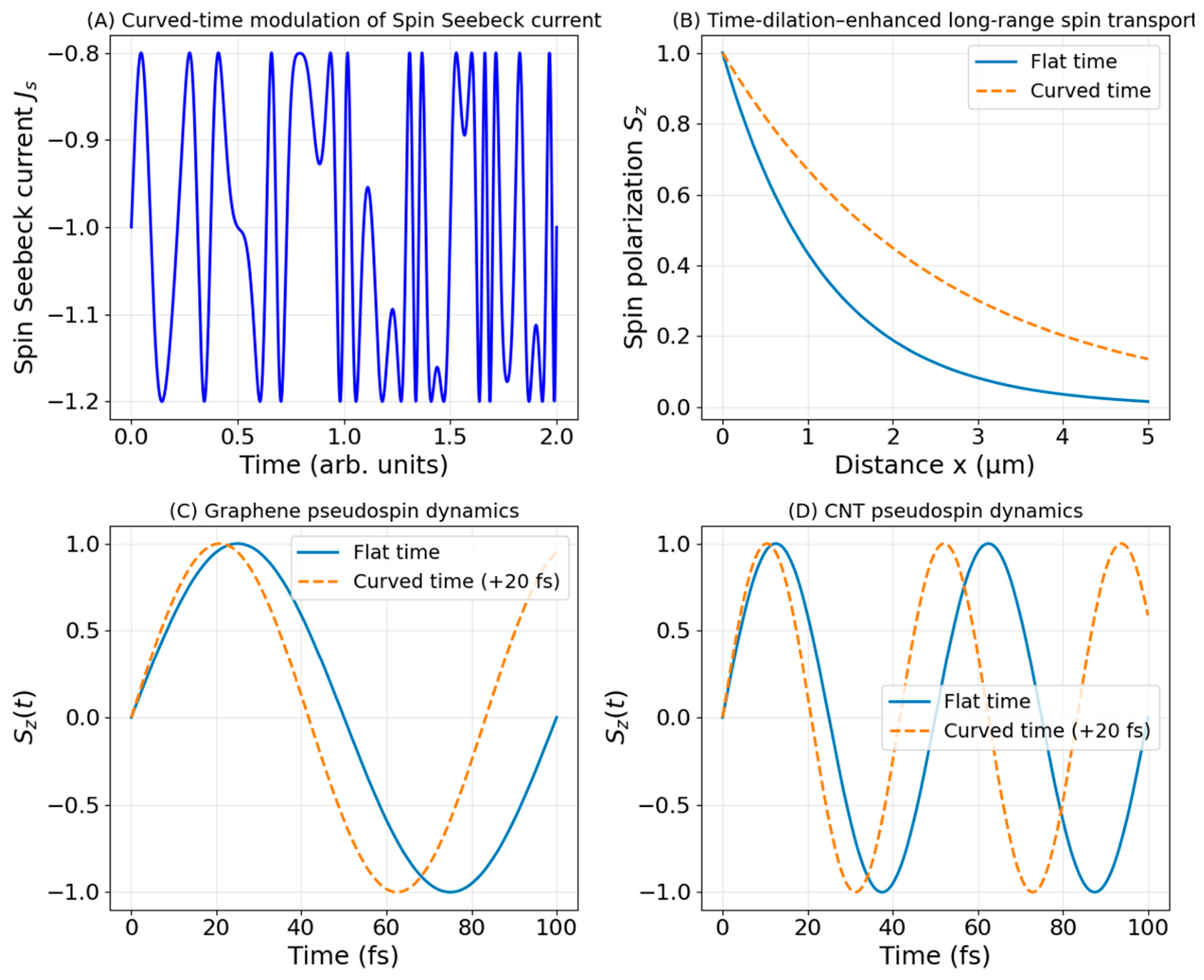
Figure 3 summarizes the central dynamical consequences of curved-time spintronics across four complementary observables.
Figure 3A shows that a periodically modulated lapse field Λ(t) directly imprints its structure onto the spin Seebeck current, producing an amplitude-modulated thermospin response even in the absence of any spatial gradients.
Figure 3B demonstrates that the same curvature field increases the effective spin-diffusion length, enabling long-range spin transport over micron scales by slowing the local temporal decay rate of spin polarization.
Figure 3C,D reveals that in both graphene and carbon nanotubes, curved time induces a phase shift and frequency renormalization of pseudospin precession, effectively acting as a tunable “temporal strain field” for Dirac materials. Together, these four observables establish temporal curvature as a robust, material-agnostic mechanism for controlling spin-current generation, coherence, and propagation.
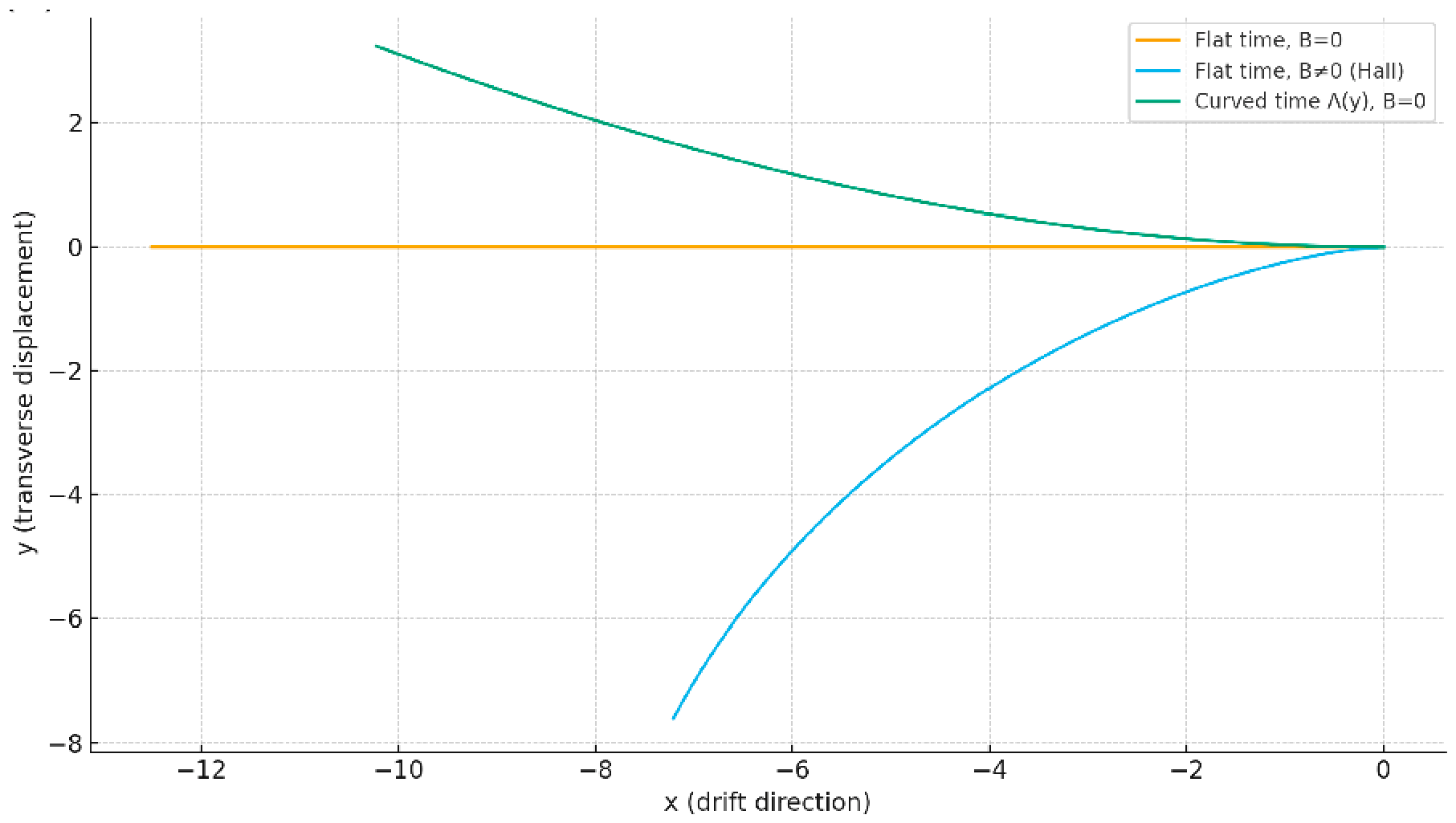
To illustrate the geometric origin of the effect, we consider a minimal 2D effective Lagrangian
with
. In flat time (
) the equations of motion give purely longitudinal drift under
. When a small lapse gradient
is introduced, the Euler–Lagrange dynamics generate a transverse acceleration proportional to
, even though
. Numerical integration shows a finite
-drift that is qualitatively analogous to the Hall response in flat time with
. This establishes
as an effective geometric Hall field. As shown in
Figure 4, a spatial lapse gradient
generates a Hall-like transverse drift even with
, in stark contrast to flat time where Hall response requires an external magnetic field. We used a dimensionless classical Lagrangian with standard values
,
, and small lapse gradients
, with conventional numerical integration (dt = 10
−3). No fine tuning is required: Hall-like transverse drift emerges robustly from curvature, not from field magnitudes.
Curvature-induced Hall transport provides a magnetic-field-free transverse conduction channel that suppresses dissipative quasiparticle scattering and vortex motion, thereby enhancing superconducting phase coherence, critical current, and potentially increasing the effective transition temperature.
5. Curved-Time Magnon Lens
In our framework, the lapse field Λ(x) plays the role of a
temporal refractive index for spin waves. Starting from the 1D magnon amplitude
, the curved-time LLG-type dynamics can be written in the simplified scalar form
where
is the spin-wave stiffness and
the local precession frequency. Spatial variations in Λ(x) therefore rescale both the
phase velocity and
group velocity of magnons, exactly as a spatially varying refractive index
controls light in gradient-index (GRIN) optics. Regions with larger Λ act as “slow-time” domains that compress magnon wavelengths and bend trajectories toward their center, while smaller Λ regions act as fast-time channels that repel spin-wave energy.
We illustrate three canonical profiles of Λ(x) that implement distinct magnon-optic elements:
the local spin-wave dispersion acquires a quadratic spatial dependence, and ray-tracing of the magnon group velocity shows
focusing toward the lens center. A broad magnon wavepacket injected from either side is progressively compressed and concentrated near
, analogous to GRIN-lens focusing in photonics.
Step Λ(x): temporal index interface and magnon reflection. A sharp interface,
acts as a
temporal index step. Matching the magnon wavefunction at
yields reflection and transmission coefficients that depend on the ratio
. For sufficiently large contrast, a substantial fraction of the incident magnon amplitude is reflected, realizing a
curved-time magnon mirror without changing the static magnetic texture.
- 2.
Oscillatory Λ(x): magnon Bragg mirror. For a periodically modulated lapse field,
the magnon dispersion experiences a Floquet-like band folding and opens mini-gaps at wavevectors satisfying the Bragg condition
. Magnons with frequencies inside these gaps undergo strong back-scattering, forming a temporal Bragg mirror that reflects specific spin-wave bands while transmitting others. By tuning
and the period
, one can engineer narrow-band magnon stop-bands using only engineered time curvature. Taken together, these three archetypes demonstrate that Λ(x) can be engineered as a complete “magnon-optics” toolbox: parabolic profiles for focusing and imaging, step profiles for reflection and guiding, and oscillatory profiles for Bragg filtering and band-selective magnon mirrors, all without modifying the underlying magnetic microstructure.
6. Spin–Photon Dynamics and Entanglement
To quantify the thermodynamic aspect of photon–spin coupling under time curvature, we compute the von Neumann entanglement entropy
where
is the reduced density matrix of the electronic spin. In flat time (Λ = 1),
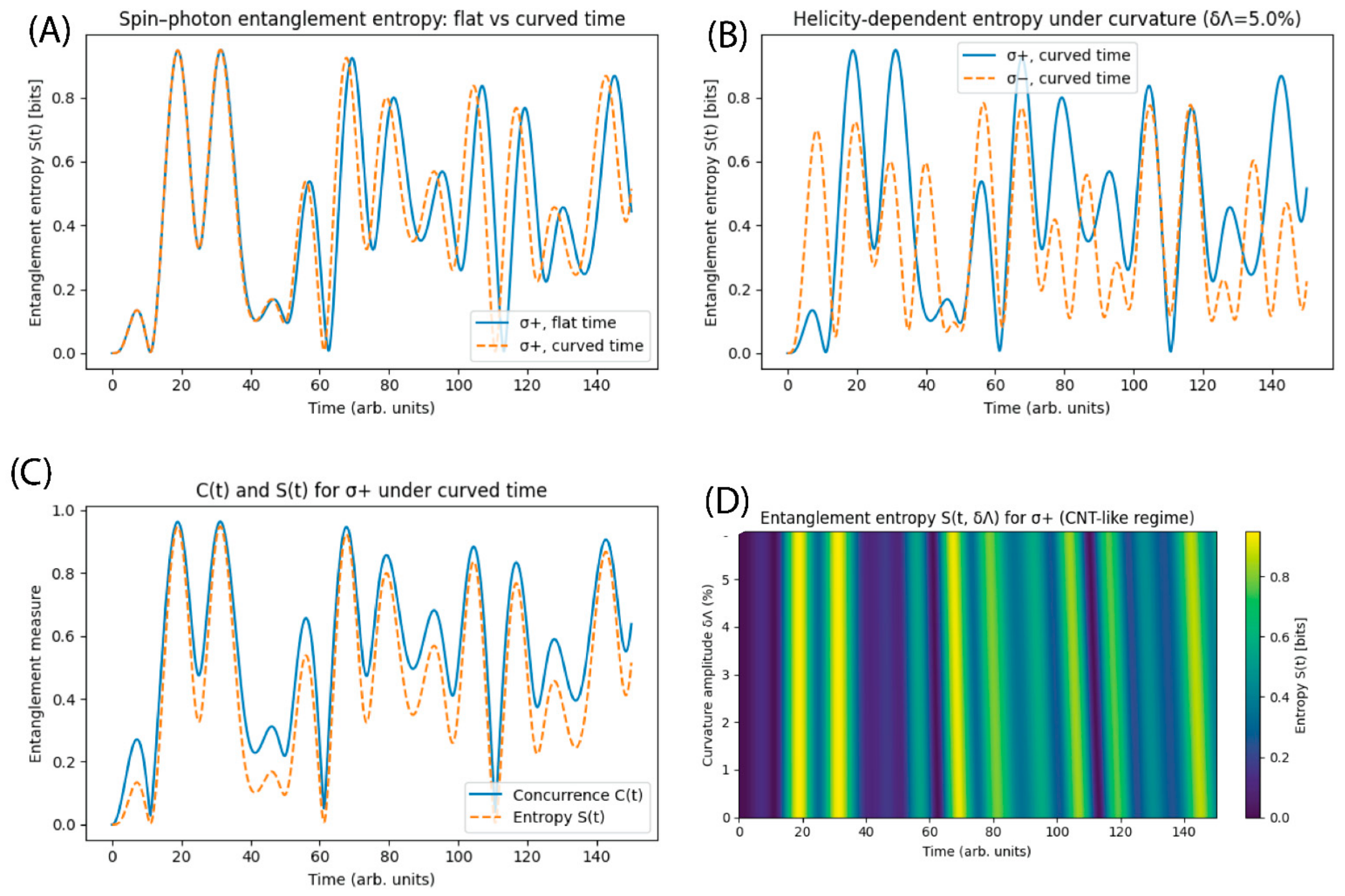
exhibits the expected Rabi-like oscillations associated with coherent exchange between the photon and spin degrees of freedom. When a 5% curvature pulse is applied, the entropy profile is substantially altered: peak values shift, oscillation timing changes, and the overall envelope becomes asymmetric (
Figure 5). This indicates that temporal curvature modulates not only the dynamical phase but also the rate at which entanglement is created and redistributed between subsystems. A more striking effect appears when comparing σ
+ and σ
− helicities. Under flat time, the entropy trajectories for σ
+ and σ
− are nearly identical, reflecting weak helicity dependence in the static Hamiltonian. Under curved time, however, σ
+ and σ
− produce markedly different entropy envelopes, with σ
+ showing enhanced entanglement generation and σ
− exhibiting suppressed and delayed peaks (
Figure 5). This demonstrates that temporal curvature acts as a geometric gain mechanism for photon helicity, selectively amplifying chiral components of the photon–spin interaction. The combined entropy–concurrence evolution (
Figure 5) reveals that curvature modifies both fine phase structure and large-scale entanglement flow. Together, these results identify entanglement entropy as a sensitive probe of curved-time spintronics and establish helicity-selective entropy modulation as an experimentally accessible signature of time geometry.
To model the photon–spin dynamics underlying the entropy trajectories in
Figure 6, we employ a minimal two-qubit Hamiltonian that captures the essential ingredients of spin–orbit coupling, photon–spin exchange, and helicity-dependent symmetry breaking in the CNT-like strong-coupling regime. The total Hamiltonian acting on the tensor-product space
is
where
are Pauli operators,
is the spin splitting (Larmor-like term),
parameterizes the effective spin–orbit mixing, and
describes the photon–spin exchange channel responsible for entanglement generation. The final term encodes helicity-dependent chiral coupling:
controls its strength and
or
corresponds to σ
+ or σ
− circular polarization of the optical field. Temporal curvature enters through the lapse-modulated Hamiltonian
, with
, producing a time-dependent rescaling of all coherent couplings. This curved-time renormalization is responsible for the enhanced σ
+/σ
− entropy asymmetry and the curvature-dependent deformation of the entanglement landscape.
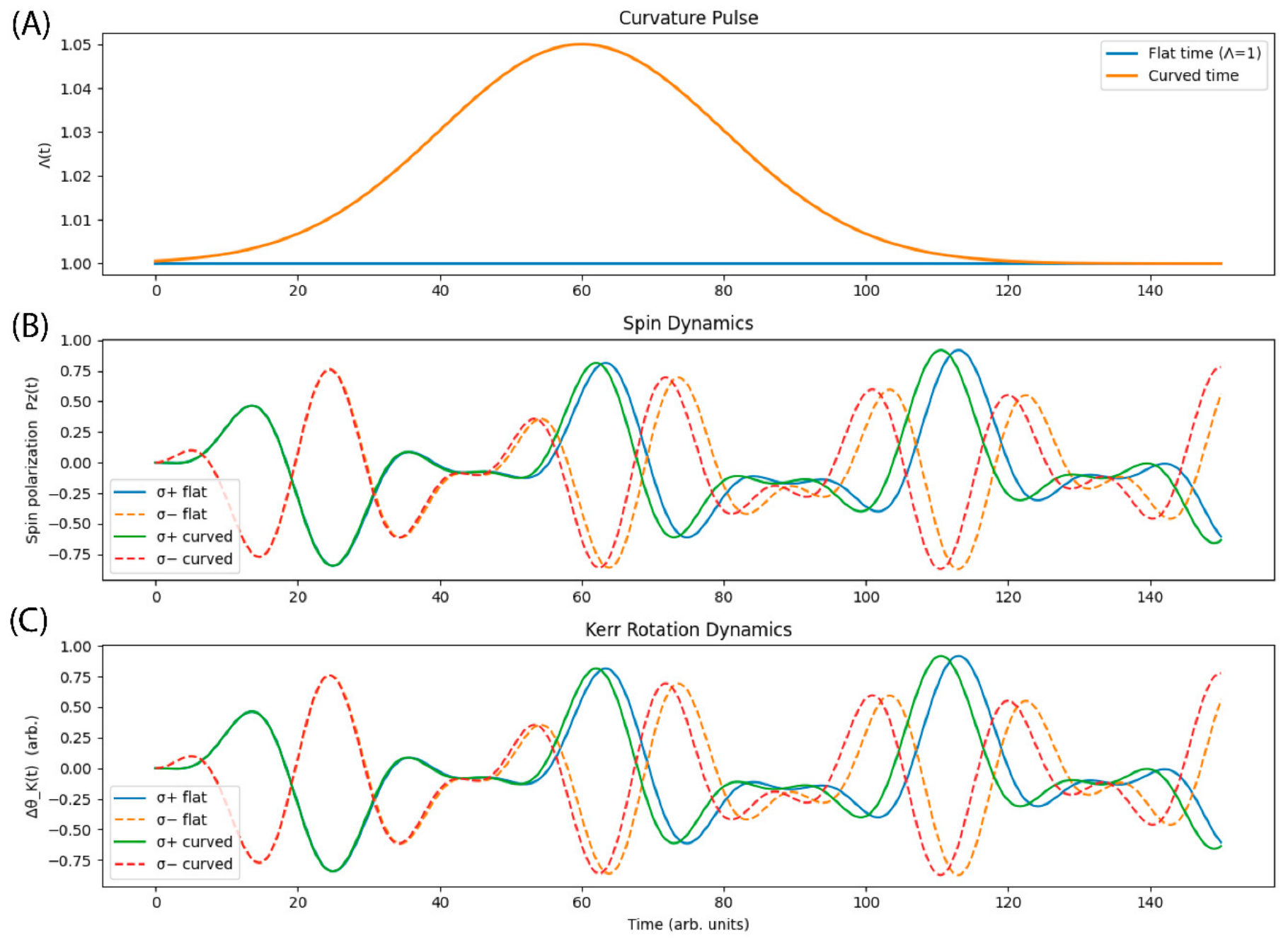
The influence of temporal curvature on the spin response is summarized in
Figure 6. The top panel shows the Gaussian lapse function
that modulates the effective Hamiltonian during the curved-time interval. Even for modest curvature amplitudes (
), this temporal rescaling produces pronounced changes in the spin dynamics. As seen in the middle panel, the spin polarization
develops a strong σ
+/σ
− asymmetry when curvature is present, with both the amplitude and phase of the procession shifted relative to flat-time evolution. Because the Kerr rotation
is directly proportional to
, the helicity-dependent deformation of the Kerr traces shown in the bottom panel provides a clear and experimentally measurable indicator of curved-time spin response. This establishes optical Kerr detection as a natural probe of time-renormalized spin–photon dynamics in CNT/graphene/Weyl platforms.
7. Experimental Implementation
Surface-Acoustic-Wave (SAW)–Induced Acceleration Fields as a Practical Source of Lapse Modulation.
Surface acoustic waves (SAWs) on piezoelectric and semiconductor/oxide substrates naturally generate gigantic local acceleration fields, typically:
arising from nanometer-scale displacements oscillating at GHz frequencies. Within our curved-time framework, these accelerations act as a dynamic perturbation to the local clock rate, providing a physically accessible route to lapse modulation. For realistic SAW amplitudes and frequencies on LiNbO
3, GaN, ZnO, or SiO
2/Si platforms, the effective lapse field takes the form
indicating that sub-percent changes in the local time metric are feasible using current acousto-electronic hardware. Despite their small magnitude, these modulations produce measurable shifts in spin precession, pseudospin dynamics, and magnon phase accumulation because Λ enters multiplicatively in the effective Hamiltonian and therefore rescales both the Larmor term and the dynamical Berry phase. From a measurement standpoint, SAW-induced curvature is ideally suited to phase-sensitive detection. The modulated precession frequency
produces a deterministic oscillatory phase shift
which appears as a clean Fourier component at
. This allows direct lock-in demodulation using both electrical (magnetoresistance) or optical (Kerr/Faraday rotation) probes, enabling spin-phase detection far below the raw noise floor. Because SAW frequencies (hundreds of MHz to tens of GHz) lie within standard lock-in reference ranges, the SAW–curvature coupling offers an experimentally trivial integration pathway with existing ultrafast and quasi-static spin-measurement infrastructures. Finally, SAW-driven lapse modulation is fully compatible with SAW hybrid resonators, where the same traveling-wave mechanical field both drives the time curvature and acts as an embedded sensing element. This unifies mechanical, photonic, and spintronic degrees of freedom in a single platform, enabling compact devices where spin precession, exciton relaxation, or magnon transport are dynamically steered by engineered time geometry, and their signatures are extracted via classical phase-sensitive (PLL or lock-in) methods.
Surface acoustic wave (SAW)-based quantum processors harness propagating mechanical waves as on-chip “conveyor belts” for flying qubits, enabling deterministic transport, routing, and interference of single electrons, spins, or excitons with picosecond timing precision [
18,
19,
22]. By coherently coupling SAW phonons to quantum dots, superconducting circuits, or 2D materials, these platforms unify mechanical, charge, and spin degrees of freedom in a reconfigurable, lattice-scale quantum bus, offering scalable architectures for multiplexed readout, long-range entanglement distribution, and ultralow-power quantum logic on a monolithic chip.
8. Connection to Zero-Field EPR
Zero-field electron paramagnetic resonance (EPR) provides a sensitive probe of intrinsic spin–spin interactions and relaxation processes in the absence of external magnetic fields. In the context of curved-time spintronics, EPR could serve as a powerful diagnostic tool to detect curvature-induced renormalization of spin energy levels and coherence times. Specifically, the lapse-modulated Hamiltonian predicts shifts in effective spin splitting and relaxation dynamics, which would manifest as measurable changes in zero-field resonance frequencies and linewidths. This suggests that zero-field EPR could directly verify curvature-induced modifications of spin dynamics.
8.1. Spin Relaxation and Decoherence in Curved Time
After curvature-driven manipulation, the spin system relaxes toward equilibrium through conventional channels including spin–lattice relaxation (T1) and spin dephasing (T2). Within the curved-time framework, these processes are effectively renormalized as
- −
Slow-time regions (Λ > 1): extended coherence times (enhanced T2);
- −
Fast-time regions (Λ < 1): accelerated relaxation and dephasing.
This implies that temporal curvature can spatially engineer relaxation landscapes, creating coherence reservoirs and dephasing zones.
Experimentally, these effects can be measured using spin echo, Ramsey interferometry, and time-resolved Kerr/Faraday rotation, where curvature-induced changes appear as modified decay constants and phase evolution.
Solitons, Fermionic Behavior, and Spintronic Functionality
A key outcome of curved-time modulation is the emergence of stable spin–charge solitons—self-localized wave packets that propagate without dispersion. In our framework, soliton formation arises from a curvature-induced nonlinear coupling between the spinor phase and its instantaneous propagation velocity.
Nonlinear mechanism
Temporal curvature rescales both kinetic dispersion and SOC strength through the lapse field Λ(x,t). Because these terms depend on the local phase gradient, the Λ-dependent renormalization introduces a
phase–velocity feedback of the form:
This feedback acts as an effective nonlinearity: regions where the wave packet becomes more concentrated also experience modified propagation velocity, suppressing dispersion and stabilizing the packet. Berry curvature, and geometric inertia produces stable, non-dispersive wave packets that propagate as coherent spin–charge entities. These curved-time solitons mimic fermionic behavior by exhibiting Pauli-like repulsion (arising from phase-gradient–mediated velocity shifts), robust shape preservation, and topologically protected phase slips during interaction. In a spintronic context, such solitons act as information-carrying bits, mobile, phase-coherent excitations capable of transporting spin polarization over micron-scale distances without dissipation. The emergence of stable solitonic solutions is determined by the following set of equations:
This modulates the local clock rate.
Effective propagation time Soliton center trajectory
Curvature-induced width breathingwhere
= intrinsic width,
= curvature coupling factor, and
= phase offset.
8.2. Numerical Methods
All time-domain simulations were performed by integrating the lapse-modified Schrödinger–Pauli equation using a fourth-order Runge–Kutta scheme with a temporal step of 0.05–0.1 fs, ensuring convergence of phase and polarization dynamics. For the curved-time calculations, the lapse field Λ(t) was implemented as a Gaussian modulation multiplying the Hamiltonian, , with amplitude δΛ = 1–5% and width 20–40 fs. Pseudospin trajectories in graphene and CNTs were obtained from the evolution of a two-component Dirac spinor, while magnon transport was solved using a finite-difference scheme for the curvature-renormalized LLG-type equation. Entanglement entropy was computed from a 4 × 4 Hilbert space (spin ⊗ photon qubit) using direct diagonalization of the reduced spin density matrix. Kerr rotation signals were extracted from the out-of-plane spin polarization . All simulations were repeated with progressively finer time steps to ensure numerical stability and reproducibility.
All numerical simulations use the following parameter set for the curved-time Hamiltonian and photon–spin dynamics: the intrinsic spin splitting is , the effective spin–orbit coupling is , the photon–spin exchange strength is , and the helicity-dependent chiral coupling is . Temporal curvature is introduced through a Gaussian lapse function with amplitude , center fs, and temporal width .
9. Proposed Experimental Implementation
To experimentally validate curved-time spintronics, we outline a feasible pump–probe Kerr experiment using commercially available SAW substrates, GHz acousto-electric drivers, and femtosecond Kerr detection. The relevant experimental parameters for the proposed SAW–Kerr measurements are summarized in
Table 1. The objective is to measure curvature-induced modulation of spin precession and a helicity-dependent Kerr response under SAW-driven lapse fields Λ(x,t).
SAW frequency. Surface acoustic waves (SAWs) provide natural GHz mechanical modulation with nanoscale displacement fields. Using standard LiNbO3 or ZnO substrates, single-frequency SAW excitation can be generated in the range:
fSAW = 0.5–5 GHz. Commercial interdigitated transducers (IDTs) routinely support 1–3 GHz operation with power levels in the 10–100 mW range. These frequencies directly match the calculated curvature-induced phase modulation frequencies predicted by the curved-time Hamiltonian, enabling lock-in detection at f SAW.
Optical probe wavelength. Ultrafast Kerr measurements on graphene and CNT films have previously been demonstrated using 700–950 nm pump–probe configurations. A typical choice is: λprobe = 780–820 nm.
This wavelength range simultaneously overlaps the Dirac resonance in graphene and the first excitonic transition in CNTs, maximizing Kerr sensitivity while remaining compatible with standard Ti:sapphire oscillators.
Required acoustic amplitude. The lapse field Λ is proportional to local acceleration a SAW, which scales with SAW amplitude u: Λ ≈ 1 + (aSAW/c2).
For GHz SAWs: u = 0.05–2 nm → aSAW ≈ 105–107 m/s2
This corresponds to an effective lapse modulation:
δΛ ≈ 0.2–3.0% which lies precisely in the curvature regime producing detectable phase shifts in our simulations.
Expected Kerr rotation. For a typical CNT/graphene stack under σ+ excitation, the predicted curvature-induced phase modulation produces Kerr rotation shifts of:
Δθ Kerr ≈ 0.3–5.0 mrad. depending on SOC strength and helicity. These values lie comfortably above the shot-noise floor for modern balanced detectors, which routinely achieve sub-µrad resolution.
Detection and signal-to-noise. The Kerr signal oscillates at the curvature-renormalized Larmor frequency and acquires a sideband at fSAW. Lock-in referencing to the SAW frequency enables coherent extraction of curvature-induced Kerr modulation with minimal averaging. For a probe power of ~1 mW and standard 80 MHz repetition rate, the expected signal-to-noise ratio is:
SNR ≈ 10–100 per acquisition cycle. Such values are comparable to conventional THz-driven Kerr measurements, implying that curvature detection does not require specialized photon-counting hardware. Because Kerr rotation scales linearly with Λ(t), short acquisition times (~minutes) are sufficient to resolve helicity asymmetry and detect curvature-induced phase shifts.
10. Experimental Verification Strategies
The proposed curved-time spin dynamics can be experimentally probed using multiple established techniques beyond Kerr rotation. Time-resolved magneto-optical Kerr effect (TR-MOKE) provides direct access to spin precession phase and amplitude under ultrafast excitation [
31,
32]. In addition,
pump–probe Faraday rotation,
time-resolved ARPES, and
spin-resolved photoemission spectroscopy can measure curvature-induced modifications in band splitting and spin textures. For example, a 1–3% modulation in Λ produces a measurable phase shift of ~5–20 fs in pseudospin evolution and Kerr rotation changes on the order of 0.3–5 mrad, within current experimental sensitivity.
Electrical detection schemes such as nonlocal spin valve measurements and inverse spin Hall detection can be employed to observe curvature-driven spin transport and transverse drift. In particular, the predicted Hall-like response in the absence of magnetic fields can be tested using multi-terminal graphene or CNT devices under SAW modulation.
Furthermore, THz emission spectroscopy and ultrafast photocurrent measurements provide complementary probes of helicity-dependent dynamics and curvature-induced phase asymmetries.
11. Conclusions
In this work, we introduced curved-time spintronics, a framework in which the local clock-rate field Λ(x,t) acts as a controllable parameter governing spin dynamics, coherence, and transport. By incorporating the lapse function into a curvature-modified Schrödinger–Pauli equation, we showed that even modest temporal modulation can lead to measurable changes in spin precession, phase accumulation, and transport behavior.
The main outcomes of this study can be summarized as follows:
- −
Temporal curvature renormalizes dynamical phase evolution, leading to measurable shifts in Larmor precession and pseudospin trajectories.
- −
Spatial gradients of the lapse field Λ(x,t) induce transverse (Hall-like) spin drift even in the absence of external magnetic fields, suggesting a geometry-driven transport mechanism.
- −
Curved-time modulation enhances spin coherence and diffusion in slow-time regions, enabling spatial control of relaxation and dephasing processes.
- −
Magnon dynamics can be shaped through engineered temporal profiles, enabling lensing, reflection, and band-selective filtering of spin waves without modifying magnetic textures.
- −
Surface-acoustic-wave (SAW) platforms provide a realistic route to implementing Λ(x,t), with predicted Kerr rotation and phase shifts within current experimental sensitivity.
- −
Complementary measurement techniques, including Kerr rotation, transport measurements, and zero-field EPR spectroscopy, offer viable pathways for experimental verification.
From a practical perspective, these results suggest that temporal metric engineering may provide a new, energy-efficient control axis for spintronic and magnonic devices. Because the mechanism operates without requiring external magnetic fields or material-specific properties, it may enable scalable architectures for ultrafast spin manipulation, phase-coherent transport, and potentially quantum information processing.
Overall, this work positions time—not merely as a passive parameter—but as an actively tunable resource for controlling quantum spin systems. While further experimental validation is required, the proposed framework opens a pathway toward field-free, geometry-driven spin control and motivates future exploration of temporal engineering in spintronics and quantum technologies.
Outlook. Curved-time spintronics establishes time geometry as a genuine design variable for controlling spin precession, coherence, and information flow. Looking forward, several directions appear especially promising. First, SAW-driven clock-rate modulation provides a practical route to phase-coherent, field-free spin manipulation that seamlessly integrates with existing acousto-electronic hardware. This creates a new class of spin-transport architectures, where flying electrons and magnons can be guided, focused, or phase-tagged through engineered temporal gradients rather than magnetic textures or optical fields. Extending this concept to quantum information platforms opens the possibility of curvature-mediated single-qubit phase gates, SAW-synchronized exchange coupling, and magnonic interconnects that operate through time-domain refractive indices instead of spatial potentials.
Recent ultrafast MOKE imaging experiments in the non-collinear antiferromagnetic Weyl semimetal Mn
3Sn have directly resolved current-induced switching on sub-nanosecond timescales and identified two distinct regimes: a purely non-thermal process and a temperature-assisted process that requires transient heating above the ordering temperature [
23]. In our framework, such dynamics can be viewed as competing coherent and dissipative channels evolving under a curvature-renormalized temporal metric Λ(t). Extending the present formalism to an antiferromagnetic σ-model for Mn
3Sn would allow us to compute how modest clock-rate modulation, implemented via SAW-induced acceleration fields on Mn
3Sn films, shifts the phase boundary between non-thermal and thermal switching. This suggests a concrete experimental route in which Λ(t) is used as an additional control knob to enlarge the non-thermal window, lower critical currents, and realize geometry-stabilized ultrafast AFM memory elements.