Article

Verifying Quantum Network Nonlocality Based on the Extended Mermin Inequality

School of Information Science and Technology, Southwest Jiaotong University, Chengdu 610031, China
*
Author to whom correspondence should be addressed.
Quantum Rep. 2026, 8(2), 41; https://doi.org/10.3390/quantum8020041
Submission received: 21 March 2026 / Revised: 27 April 2026 / Accepted: 28 April 2026 / Published: 1 May 2026
(This article belongs to the Topic Quantum Computing: Latest Advances and Prospects)

Abstract

This work proposes an extended Mermin inequality based on a hybrid classical model that involves only one classical source, with the remaining sources being post-quantum. In a chain-structured quantum network consisting of hybrid Einstein–Podolsky–Rosen (EPR) pairs and Greenberger–Horne–Zeilinger (GHZ) states, joint measurements are performed at the central node, while local measurements are conducted at the peripheral nodes. This setup shows that the obtained quantum correlations can violate the proposed inequality with fewer measurement settings, thereby verifying network nonlocality. Furthermore, we extend this method to chain networks of arbitrary length n and show that the proposed inequality remains effective in verifying network nonlocality.

1. Introduction

As one of the most profound features of quantum mechanics, the study of quantum nonlocality dates back to the EPR paradox proposed in 1935 [1], fundamentally challenging the classical framework of local realism. Bohm’s Local Hidden Variable (LHV) models [2] sought to restore determinism via unobservable parameters, yet ultimately failed to resolve Einstein’s objections. A major breakthrough occurred in 1964 when Bell’s theorem [3] transitioned these foundational debates into an experimentally testable framework [4,5,6,7,8]. By demonstrating that no LHV theory can fully reproduce quantum predictions [1,3], the derivation of Bell inequalities [9,10,11,12] paved the way for experimental violations [13,14,15] that conclusively confirmed nonlocality. Since then, nonlocality has been widely exploited in applications like quantum key distribution and quantum computing [16,17,18,19,20].
As nonlocality research expanded to multipartite systems [21,22,23], Mermin translated the GHZ paradox [24,25] into testable inequalities, while Svetlichny successfully isolated genuine tripartite nonlocality [11,26]. Recently, theorists established strict Mermin bounds to rigorously detect genuine n-partite nonlocality (GMNL) across complex networks and noisy environments [27,28,29,30]. Advances with photons and superconducting qubits have enabled violations of this inequality using GHZ and W states, with scalable platforms demonstrating GMNL beyond 24 qubits [31,32,33,34]. These breakthroughs provide vital benchmarks for Noisy Intermediate-Scale Quantum (NISQ) devices and enable device-independent applications like device-independent quantum key distribution(DI-QKD) and quantum state self-testing [30,35,36].
Concurrent with the development of quantum information, the paradigm of nonlocality research has shifted from traditional single-source Bell tests to complex networks driven by independent entanglement sources. Early foundational works established N-local frameworks for linear [37] and star [38] topologies; however, these protocols are primarily restricted to networks with homogeneous bipartite sources. To ensure that all independent sources in a network are non-classical, Full Network Nonlocality (FNN) was introduced [4].
Certifying FNN in heterogeneous networks remains a formidable challenge. While advanced methodologies like inflation techniques [39] or generalized causal models [40] provide versatile causal inference, they rely heavily on resource-intensive numerical optimization and struggle to yield compact analytical inequalities. Furthermore, while conventional experiments can verify genuine multipartite nonlocality [41], they typically assume global entangled states, lacking the causal independence required for distributed networks and demanding measurement settings that grow exponentially with the node count. Designed primarily for global GHZ states, the traditional Mermin inequality fails in heterogeneous quantum networks composed of local, indirectly coupled hybrid sources (e.g., coexisting EPR and GHZ sources). Consequently, directly applying the standard multi-partite Mermin inequality to such networks overestimates the classical bound by neglecting their inherent topological and causal constraints [4].
To address these limitations, this work extends the Mermin inequality to complex quantum networks, aiming to verify network nonlocality with only minimal local measurement settings per node. Specifically, under a hybrid model containing at least one classical source and multiple post-quantum sources, an extended Mermin inequality is derived. Based on this, we construct a multi-source distributed scenario featuring a hybrid EPR-GHZ entanglement structure within the quantum framework. By employing an asymmetric measurement strategy, we confirm network nonlocality. In Section 2, we construct a chain network composed of GHZ and EPR states and verify its nonlocality using the extended Mermin inequality. Section 3 further develops a more complex n-partite network model using GHZ states and EPR pairs, confirming its nonlocality and verifying the scalability of the proposed inequality.

2. Nonlocality of 3-Sources Chain Quantum Networks

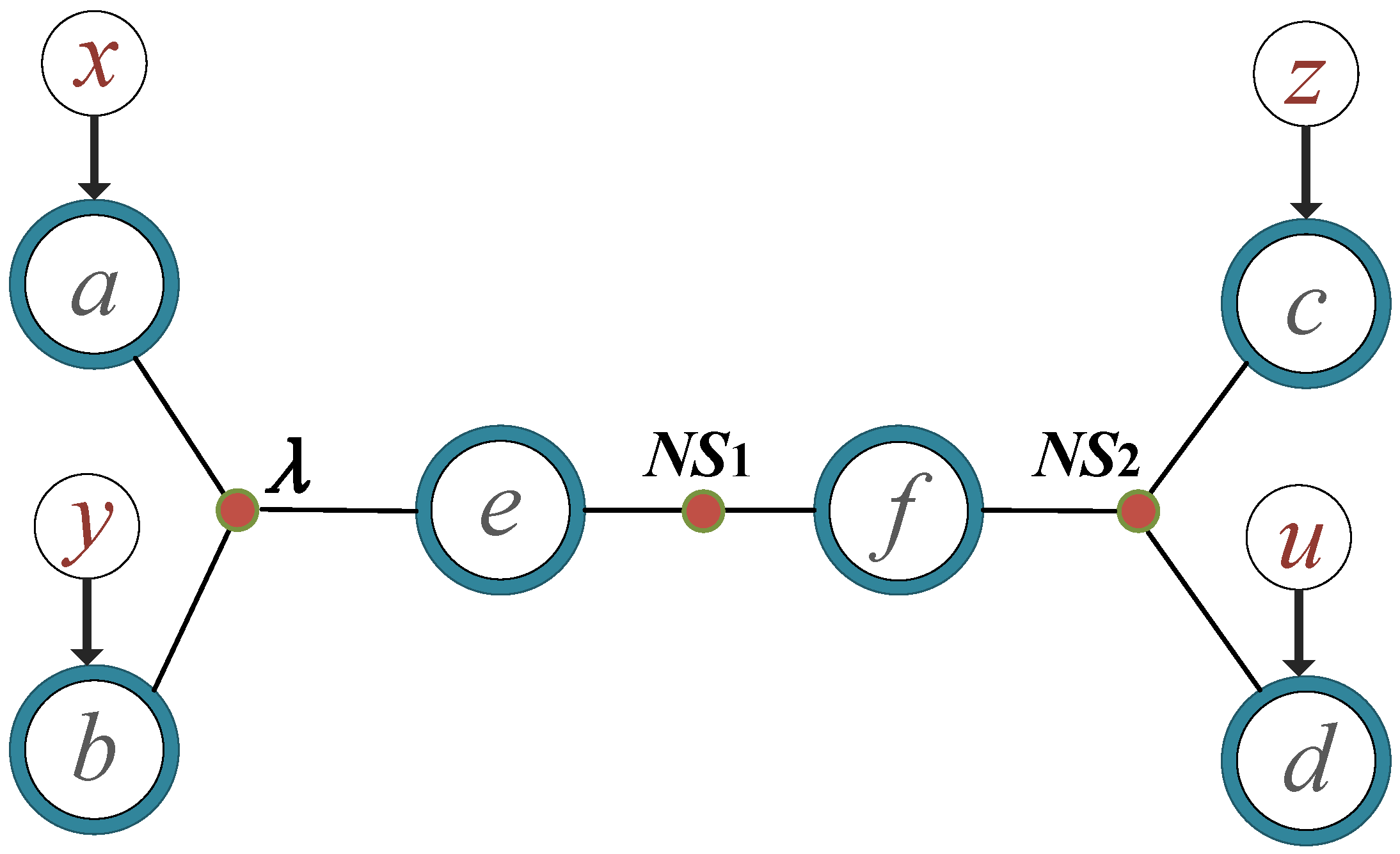
We consider a hybrid classical model [4,6,7,8] in which two of the shared resources are assumed to be non-signaling post-quantum sources, while the third is a classical variable. One example is shown in Figure 1, where λ denotes the classical source, and N S 1 , N S 2 represent two independent non-signaling post-quantum sources. Each party’s measurement outcome depends only on the physical systems it receives: Alice’s output is a function of λ alone, i.e., A = A ( λ ) ; Bob’s output depends only on λ , i.e., B = B ( λ ) ; Charlie’s output is determined exclusively by N S 2 , i.e., C = C ( N S 2 ) ; the measurement outcome for Dan depends solely on N S 2 , which can be expressed as D = D ( N S 2 ) ; the central node Eve’s outcome is a function of all two sources, i.e., E = E ( λ , N S 1 ) ; and the central node Frank’s outcome is a function of all two sources, i.e., F = F ( N S 1 , N S 2 ) .
While the Mermin inequality serves as a fundamental criterion for detecting multipartite nonlocality in quantum information theory [6,25,33], its conventional formulation is structurally incompatible with our proposed network model. This discrepancy arises from two key factors. First, the standard Mermin framework presupposes a fixed quantum state generated by a single global source. In our scenario, however, the post-measurement state is not unique; rather, it is conditional and dynamically governed by the central node’s measurement setting, w. Second, traditional Mermin scenarios typically assume a single four-partite source, inherently failing to account for the statistical independence required when multiple distinct sources are involved. In contrast, the four peripheral nodes in our architecture are distributed and share no common origin.
In our quantum network, we derive a network-adapted Mermin inequality. Since the three sources λ , N S 1 , and N S 2 are independently distributed, the joint probability conditional on the inputs can be factorized as:
P ( a , b , c , d , e , f | x , y , z , u ) = P ( λ ) P ( N S 1 ) P ( N S 2 ) P ( a | x , λ ) P ( b | y , λ ) × P ( c | z , N S 2 ) P ( d | u , N S 2 ) P ( e | λ , N S 1 ) P ( f | N S 1 , N S 2 ) d λ d N S 1 d N S 2 ,
where P ( a | x , λ ) , P ( b | y , λ ) , P ( c | z , N S 2 ) and P ( d | u , N S 2 ) represent the conditional probability distributions of the outputs for Alice, Bob, Charlie and Dan, respectively. P ( e | λ , N S 1 ) and P ( f | N S 1 , N S 2 ) represent the joint output probability distribution of nodes Eve and Frank.
To detect nonlocality within complex network architectures, we propose a generalized extension of the standard Mermin operator. The core of this generalization lies in explicitly incorporating the central node’s measurement setting w into the correlation function. Consequently, the resulting novel operator is formulated as
M net = M ( 0 ) e M ( 0 ) f R 4 ( A x , B y , C z , D u ) + M ( 0 ) e M ( 1 ) f R 4 ( A ¯ x , B y , C z , D u ) + M ( 0 ) e M ( 2 ) f R 4 ( A x , B y , C z T , D u ) + M ( 0 ) e M ( 3 ) f R 4 ( A ¯ x , B y , C z T , D u ) + M ( 1 ) e M ( 0 ) f R 4 ( A ¯ x , B y , C z , D u ) + M ( 1 ) e M ( 1 ) f R 4 ( A x , B y , C z , D u ) + M ( 1 ) e M ( 2 ) f R 4 ( A ¯ x , B y , C z T , D u ) + M ( 1 ) e M ( 3 ) f R 4 ( A x , B y , C z T , D u ) + M ( 2 ) e M ( 0 ) f R 4 ( A x , B y , C z T , D u ) + M ( 2 ) e M ( 1 ) f R 4 ( A ¯ x , B y , C z T , D u ) + M ( 2 ) e M ( 2 ) f R 4 ( A x , B y , C z , D u ) + M ( 2 ) e M ( 3 ) f R 4 ( A ¯ x , B y , C z , D u ) + M ( 3 ) e M ( 0 ) f R 4 ( A ¯ x , B y , C z T , D u ) + M ( 3 ) e M ( 1 ) f R 4 ( A x , B y , C z T , D u ) + M ( 3 ) e M ( 2 ) f R 4 ( A ¯ x , B y , C z , D u ) + M ( 3 ) e M ( 3 ) f R 4 ( A x , B y , C z , D u ) .
Here, A x , B y , C z , and D u represent the dichotomous measurement outcomes for Alice, Bob, Charlie, and Dan, respectively. Among them, A x ¯ = A x ; D u represents the reversal of D u , which means D 0 = D 1 and D 1 = D 0 ; while C T denotes the transpose of matrix C, because matrix transposition preserves the spectrum, the eigenvalues of C T remain ± 1 , thus mathematically justifying its utilization. Additionally, M ( i ) e and M ( i ) f correspond to the measurement results at the central nodes Eve and Frank. R 4 ( A x , B y , C z , D u ) is the standard Mermin expression [25] for a four particle system, the specific form is as follows:
R 4 ( A x , B y , C z , D u ) = A 0 B 0 C 0 D 1 + A 0 B 0 C 1 D 0 + A 0 B 1 C 0 D 0 + A 1 B 0 C 0 D 0 A 0 B 1 C 1 D 1 A 1 B 0 C 1 D 1 A 1 B 1 C 0 D 1 A 1 B 1 C 1 D 0
The specific expressions of other functions are the same as above. In contrast to recent post-selection techniques [8,40,41] that require multiple measurement settings per party, our method avoids this overhead.
The definition of M i is as follows:
M 0 = M ( 0 ) e M ( 0 ) f + M ( 1 ) e M ( 1 ) f + M ( 2 ) e M ( 2 ) f + M ( 3 ) e M ( 3 ) f M 1 = M ( 0 ) e M ( 1 ) f + M ( 1 ) e M ( 0 ) f + M ( 2 ) e M ( 3 ) f + M ( 3 ) e M ( 2 ) f M 2 = M ( 0 ) e M ( 2 ) f + M ( 1 ) e M ( 3 ) f + M ( 2 ) e M ( 0 ) f + M ( 3 ) e M ( 1 ) f M 3 = M ( 0 ) e M ( 3 ) f + M ( 1 ) e M ( 2 ) f + M ( 2 ) e M ( 1 ) f + M ( 3 ) e M ( 0 ) f
The formula can be simplified as:
M net = M 0 R 4 ( A x , B y , C z , D u ) + M 1 R 4 ( A ¯ x , B y , C z , D u ) + M 2 R 4 ( A x , B y , C z T , D u ) + M 3 R 4 ( A ¯ x , B y , C z T , D u ) .
Given that the outcomes of Alice and Bob are governed exclusively by the classical hidden variable λ , the network correlation M net can be evaluated by assigning the deterministic values A x , B y = ± 1 as follows:
M net = max { ± 2 [ ( M 0 M 1 ) ( C 0 D 1 + C 1 D 0 ) + ( M 2 M 3 ) ( C 0 T D 0 + C 1 T D 1 ) ] ± 2 [ ( M 0 M 1 ) ( C 0 D 0 C 1 D 1 ) + 2 ( M 2 M 3 ) ( C 0 T D 1 C 1 T D 0 ) ] } .
According to the following conditions:
C 0 D 1 + C 1 D 0 , C 0 T D 0 + C 1 T D 1 , C 0 D 0 C 1 D 1 , C 0 T D 1 C 1 T D 0 2 ,
M net can be written in the following form:
M net = ± 4 [ ( M 0 M 1 ) + ( M 2 M 3 ) ] .
Since i = 0 1 | M 2 i M 2 i + 1 |   i = 0 1 | M 2 i | 1 from the inequalities M i 0 and i = 0 3 M i = 1 , this implies that:
| M net   | 4 ,
Similar proof holds for other hybrid classical models consisting of at least one classical variable and other being post-quantum sources.
In what follows, we show it can be violated in quantum mechanics, with a maximum violation of 8. To this end, we construct a specific quantum network topology comprising two central nodes coupled with three mutually independent entanglement sources and four peripheral nodes. Specifically, we assume that Alice, Bob, and Eve, as well as Charlie, Dan, and Frank, share a standard tripartite GHZ state, respectively. Meanwhile, the central nodes Eve and Frank share a standard bipartite EPR entangled pair. Within this architecture, by implementing joint measurements at the central nodes alongside local measurements at the peripheral nodes, the system ultimately exhibits nonlocality that violates the local realism bound given by Equation (2).
Specifically, let the shared standard tripartite GHZ state and the bipartite EPR state be expressed as [1,24]:
| φ θ = cos θ 0 | 00 + sin θ 0 | 11 ,
| G H Z θ = cos θ 0 | 000 + sin θ 0 | 111 ,
with parameter θ 0 ( 0 , π / 4 ) , each particle will be distributed to Alice, Bob, Charlie, Dan, Eve and Frank, respectively. The joint quantum state of the entire system is given as
| Ψ = | G H Z θ A B E | φ θ E F | G H Z θ C D F = cos 3 θ 0 | 00000000 + cos 2 θ 0 sin θ 0 ( | 00000111 + | 00011000 + | 11100000 ) + cos θ 0 sin 2 θ 0 ( | 00011111 + | 11100111 + | 11111000 ) + sin 3 θ 0 | 11111111 .
The central nodes Eve and Frank perform a joint measurement using the Bell basis for a two-qubit system, defined as:
| ϕ ( + ) = 1 2 | 00 + | 11 , | ϕ ( ) = 1 2 | 00 | 11 , | ψ ( + ) = 1 2 | 01 + | 10 , | ψ ( ) = 1 2 | 01 | 10 .
If the central nodes Eve and Frank both obtain the measurement result | ϕ ( + ) , the particles of Alice, Bob, Charlie and Dan will collapse into the state | Ψ 0 = 1 cos 6 θ 0 + sin 6 θ 0 cos 3 θ 0 | 0000 + sin 3 θ 0 | 1111 . To show the local measurements of Alice, Bob, Charlie and Dan for each resultant, we firstly change all the resultants into the form | Ψ 0 . Here, all local recovery unitary operations are shown in Table 1.
With local operations in Table 1, we obtain the local measurement settings for each party as follows:
A 0 = X , A 1 = Y , B 0 = cos φ 1 X + sin φ 1 Y , B 1 = cos φ 1 X sin φ 1 Y , C 0 = cos φ 2 X + sin φ 2 Y , C 1 = cos φ 2 Y sin φ 2 X , D 0 = cos φ 3 X + sin φ 3 Y , D 1 = cos φ 3 X sin φ 3 Y ,
where φ 1 , φ 2 , φ 3 ( 0 , 2 π ) .
For the quantum state | Ψ and measurement operators { M m } , the probability of obtaining measurement result m is given by P ( m ) = Ψ | M m M m | Ψ . We can simplify the Bell operator as:
M net = α ( M m 0 R ( A x , B y , C z , D u ) + M m 1 R ( A x ¯ , B y , C z , D u ) ) + β ( M m 2 R ( A x , B y , C z T , D u ) + M m 3 R ( A x ¯ , B y , C z T , D u ) )
where α and β are defined as the sum of probabilities corresponding to a specific measurement result, and their specific values are as follows: α = 1 2 ( cos 6 θ 0 + sin 6 θ 0 ) , β = 7 2 ( cos 4 θ 0 sin 2 θ 0 + cos 2 θ 0 sin 4 θ 0 ) . Among them, M m i represents the measurement selection set corresponding to the collapse state, ρ = | Ψ Ψ | . A x ¯ = A x ; C T denotes the transpose of matrix C; and D u represents the reversal of D u , which means D 0 = D 1 and D 1 = D 0 . R ( A x , B y , C z , D u ) is the Mermin operator, M m 0 R ( A x , B y , C z , D u ) , defined as follows, and the specific expressions of other functions are the same as it:
M m 0 R ( A x , B y , C z , D u ) = Tr ( M m 0 ( A 0 B 0 C 0 D 1 ) ρ ) + Tr ( M m 0 ( A 0 B 0 C 1 D 0 ) ρ ) + Tr ( M m 0 ( A 0 B 1 C 0 D 0 ) ρ ) + Tr ( M m 0 ( A 1 B 0 C 0 D 0 ) ρ ) Tr ( M m 0 ( A 0 B 1 C 1 D 1 ) ρ ) Tr ( M m 0 ( A 1 B 0 C 1 D 1 ) ρ ) Tr ( M m 0 ( A 1 B 1 C 0 D 1 ) ρ ) Tr ( M m 0 ( A 1 B 1 C 1 D 0 ) ρ )
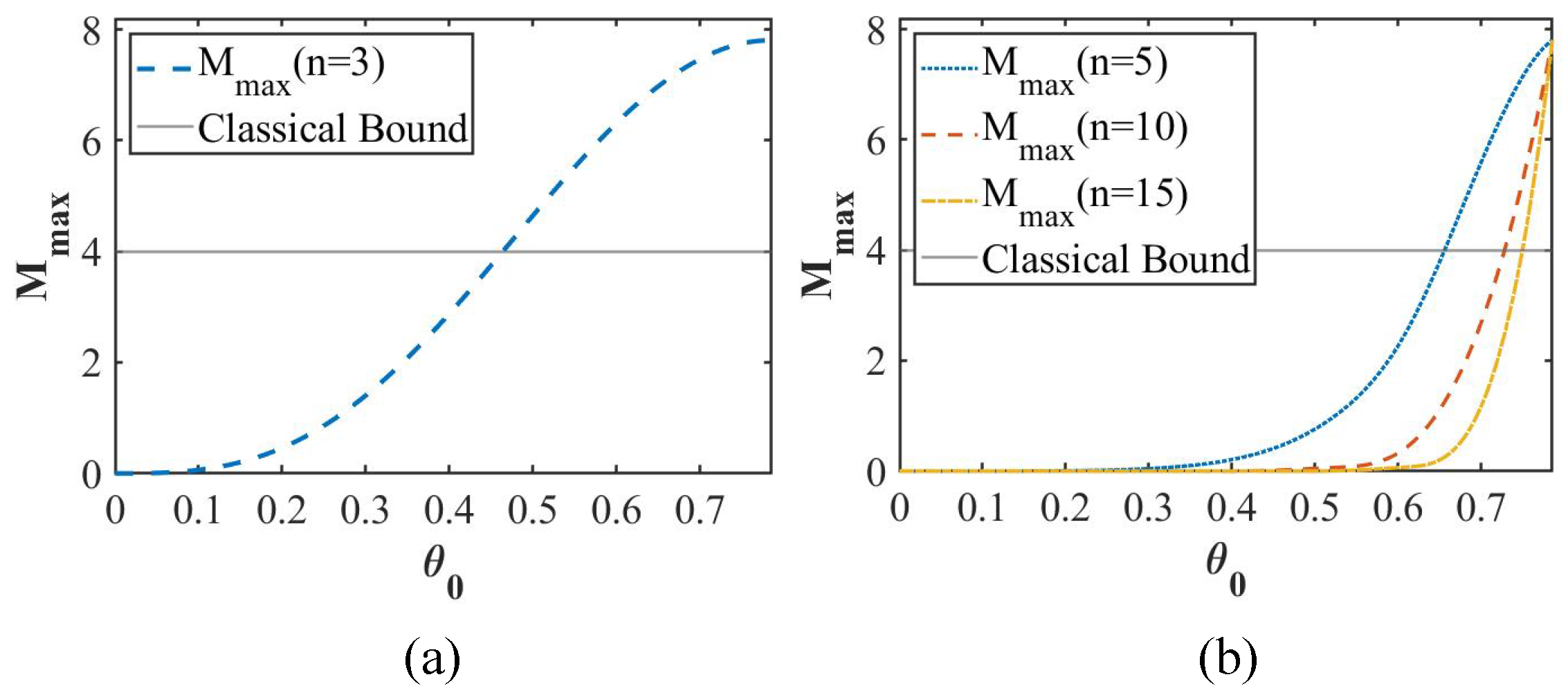
The corresponding numerical simulation curves are depicted in Figure 2. The results demonstrate that, provided the parameters satisfy θ 0 > 0.46 , the system parameter explicitly surpasses the local realism bound of 4. Specifically, if and only if the initially prepared bipartite EPR state and tripartite GHZ states are maximally entangled (i.e., θ 0 = π / 4 ) can Alice, Bob, Charlie, and Dan establish a maximally entangled four-partite GHZ state, thereby achieving the maximum quantum violation of 8. This verifies that the nonlocality precludes any possibility of hybrid classical models; such nonlocality can only emerge within a genuine quantum network where all sources exhibit nonclassicality.

3. Nonlocality of N-Sources Quantum Networks

To further investigate the nonlocality within scalable network topologies, this section constructs a class of complex chain-structured quantum networks. This network model is perfectly adaptable to arbitrary multipartite quantum systems comprising n sources.
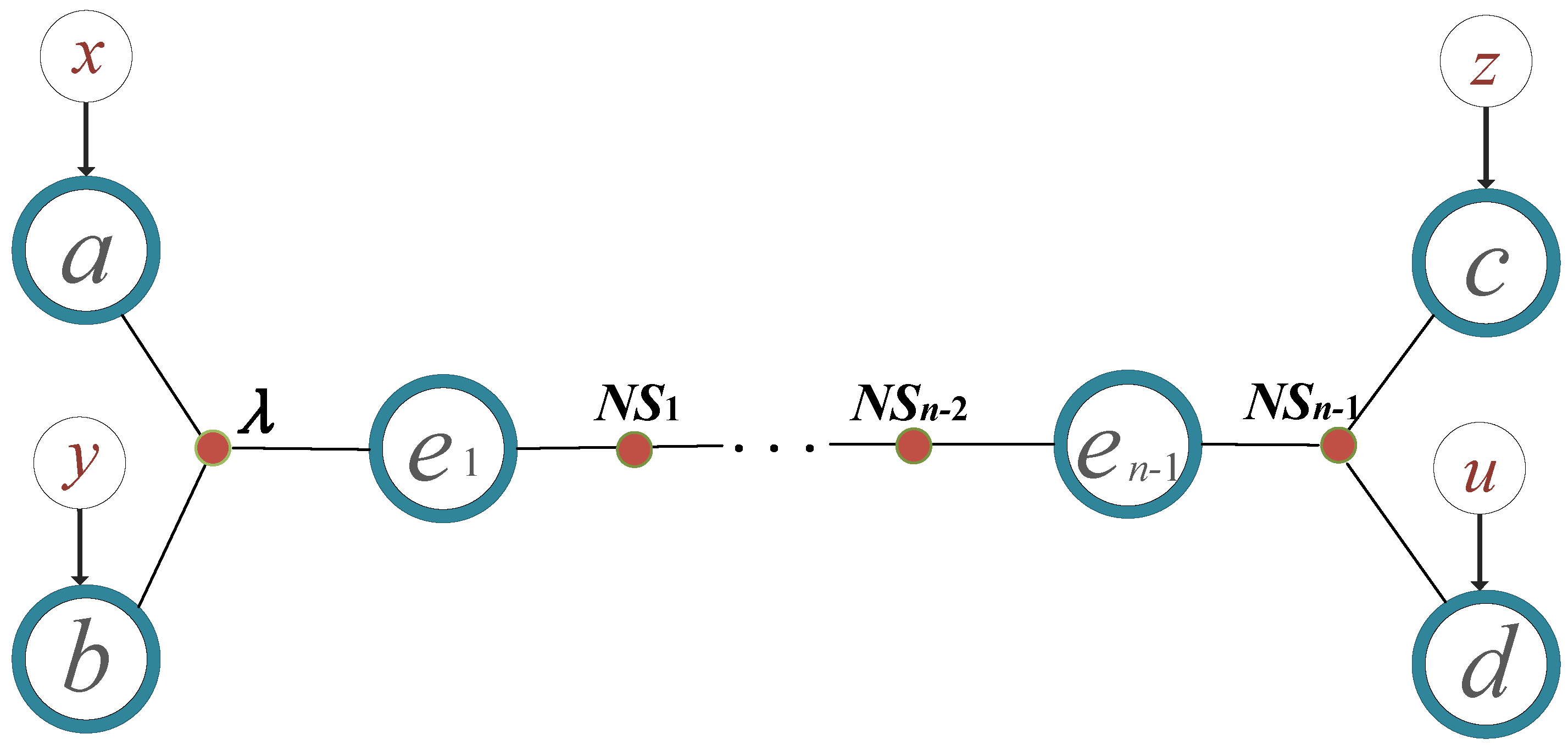
This section investigates a long-chain hybrid classical model. The n sources shared by the system comprise n 1 non-signaling post-quantum sources and a classical source λ . As illustrated in Figure 3, the network topology consists of n 1 central nodes, denoted as E i , alongside four peripheral nodes: A, B, C, and D. Here, the parameter λ characterizes the classical source, while N S i represents the mutually independent non-signaling post-quantum sources. Under the assumption of physical independence, the measurement outcome of each node is dictated exclusively by its accessed resources. Specifically, the outputs of nodes A and B depend solely on the classical variable λ , such that A = A ( λ ) and B = B ( λ ) ; the outputs of nodes C and D are determined by their corresponding post-quantum source, yielding C = C ( N S n 1 ) and D = D ( N S n 1 ) . In contrast, the measurement outcome of the central node E i is jointly governed by multiple input resources, formulated as E 1 = E 1 ( λ , N S 1 ) and E i = E i ( N S i 1 , N S i ) .
Given that the n sources λ , N S 1 , , N S n 1 are independently distributed, the joint probability distribution conditioned on the measurement inputs can be factorized as:
P ( a , b , c , d , e 1 , e 2 e n 1 | x , y , z , u ) = P ( λ ) i = 1 n 1 P ( N S i ) P ( a | x , λ ) P ( b | y , λ ) P ( c | z , N S n 1 ) P ( d | u , N S n 1 ) × P ( e 1 | λ , N S 1 ) j = 2 n 1 P ( e j | N S j 1 , N S j ) d λ d N S 1 d N S n 1 ,
where P ( a | x , λ ) , P ( b | y , λ ) , P ( c | z , N S n 1 ) and P ( d | u , N S n 1 ) represent the probability distributions of the outcomes for A, B, C and D, respectively; P ( e 1 | λ , N S 1 ) , P ( e j | N S j 1 , N S j ) denote the joint probability distributions of the nodes E 1 and E i , respectively.
For this test, the extended Mermin correlator is defined as:
M net = ( A 0 B 0 A 1 B 1 ) ( M ( 0 ) M ( 1 ) ) ( C 0 D 1 + C 1 D 0 ) + ( A 0 B 1 + A 1 B 0 ) ( M ( 0 ) M ( 1 ) ) ( C 0 D 0 C 1 D 1 ) + ( A 0 B 0 A 1 B 1 ) ( M ( 2 ) M ( 3 ) ) ( C 0 T D 0 + C 1 T D 1 ) + ( A 0 B 1 + A 1 B 0 ) ( M ( 2 ) M ( 3 ) ) ( C 0 T D 1 C 1 T D 0 )
where A x , B y , C z and D u are the two possible measurement outcomes for A, B, C and D, respectively; C i T is the transpose of C i . The definition of M ( m ) is as
M ( m ) = j 1 j 2 j n 1 = m j 1 , , j n 1 = 0 3 M ( j 1 ) e 1 M ( j 2 ) e 2 M ( j n 1 ) e n 1 ,
where ⊕ denotes bitwise XOR, and M ( j 1 ) e 1 , M ( j 2 ) e 2 , , M ( j n 1 ) e n 1 denote the measurement results on central nodes E 1 , E 2 , …, E n 1 .
Given that the outputs of A and B are governed exclusively by λ , their respective measurement outcomes assume deterministic values when λ is fixed. Therefore, by combining and simplifying the expressions M net under this condition A x , B y = ± 1 , we ultimately arrive at the form presented as:
M net = max { ± 2 ( M ( 0 ) M ( 1 ) ) ( C 0 D 1 + C 1 D 0 ) + ( M ( 2 ) M ( 3 ) ) ( C 0 T D 0 + C 1 T D 1 ) , ± 2 ( M ( 0 ) M ( 1 ) ) ( C 0 D 0 C 1 D 1 ) + ( M ( 2 ) M ( 3 ) ) ( C 0 T D 1 C 1 T D 0 ) } .
Note we have i = 0 1 | M ( 2 i ) M ( 2 i + 1 ) |   i = 0 1 | M ( 2 i ) | 1 from M ( j 1 ) e 1 M ( j 2 ) e 2 M ( j n 1 ) e n 1 0 and j 1 = 0 3 j n 1 = 0 3 M ( j 1 ) e 1 M ( j 2 ) e 2 M ( j n 1 ) e n 1 = 1 . By using the inequalities C 0 D 1 + C 1 D 0 , C 0 T D 0 + C 1 T D 1 , C 0 D 0 C 1 D 1 , C 0 T D 1 C 1 T D 0 2 , we have the inequality | M net |   4 under the hybrid classical model.
The above reasoning applies equally to other hybrid classical models: it suffices that the system contains at least one classical source, even if all remaining sources are post-quantum no-signaling sources.
Next, we demonstrate that this inequality can be violated within the framework of quantum mechanics, reaching a maximum value of 8. To this end, we design a specific quantum network topology: the system comprises four peripheral nodes (A, B, C, and D), n 1 central nodes ( E i ), and n mutually independent entanglement sources that collectively connect the entire network. Specifically, nodes A, B, and E 1 share a tripartite GHZ state; nodes C, D, and E n 1 share another independent tripartite GHZ state; and the adjacent central nodes E i and E i + 1 are linked by a bipartite EPR entangled pair. The explicit forms of these states are given by Equations (10) and Equation (11), respectively. Consequently, the initial quantum state of the network is defined as:
| Ψ = | G H Z θ A B E 1 | φ θ E 1 E 2 | φ θ E n 2 E n 1 | G H Z θ C D E n 1 .
Subsequently, Bell-basis measurements, as defined in Equation (13), are sequentially performed on the central nodes E i of these multipartite quantum states. Upon generalizing to an n-partite system, inductive analysis reveals a distinct correspondence between the collapsed quantum states induced by the measurements and the subsequent recovery operations required. These specific mappings are detailed in Table 2.
With local operations in Table 2, we choose local measurement settings for each party as Equation (14). Calculate all possible joint expectation values, and substitute the results into the M net inequality, where α = i = 0 n 2 n 2 i 2 ( cos 2 n 2 i θ 0 sin 2 i θ 0 + cos 2 i θ 0 sin 2 n 2 i θ 0 ) , β = i = 1 n 1 n 2 i 1 2 ( cos 2 n 2 i θ 0 sin 2 i θ 0 + cos 2 i θ 0 sin 2 n 2 i θ 0 ) , where a b denotes the binomial coefficient.
As shown in Figure 2, we evaluated networks with 5, 10, and 15 particle pairs. For small source parameters θ 0 , M m a x remains near zero, indicating suppressed global nonlocality. As θ 0 increases, nonlocality grows nonlinearly, eventually violating the classical bound of 4. The θ 0 threshold for this violation increases with network size n, highlighting that larger networks require higher-purity initial entanglement to maintain global nonlocality. Despite this scale dependence, all curves converge to the quantum maximum of 8 as θ 0 π / 4 . This demonstrates that, given an initially maximally entangled state, the proposed model achieves the maximal quantum violation in all cases.
This proposed network architecture not only enables the simulation of realistic physical environments but also provides a theoretical framework to investigate nonlocality in large-scale quantum networks. Fundamentally, the model indicates how local measurements cooperatively induce global nonlocality within complex network topologies.
Beyond fundamental implications, the observed nonlocality provide essential resources for device-independent information processing in multi-node networks. Violating the classical network bound ( M net > 4 ) certifies that the network nonlocality cannot be forged by classical shared randomness or a compromised central relay. This facilitates two key applications: (i) multipartite DI-QKD, enabling secure key generation among multiple peripheral nodes without trusting the central router; and (ii) certified quantum randomness generation, where strong nonlocality guarantees intrinsic, quantifiable randomness in the joint measurement outcomes. Crucially, the security of both protocols derives fundamentally from the network’s causal topology, eliminating the requirement for characterized or trusted hardware.

4. Conclusions

We systematically introduced and applied the extended Mermin inequality to verify the network nonlocality in chain-like quantum networks. This method reduces the number of measurement settings and overcomes the limitations of verifying nonlocality in large-scale networks. We construct a new Bell inequality specifically for hybrid classical-local models containing at least one classical source. In a chain topology comprising one EPR state and two GHZ states, we theoretically demonstrate that joint measurements at the central nodes collapse the peripheral nodes into a four-particle GHZ-like entangled state. This state’s strong violation of the extended Mermin inequality conclusively reveals network nonlocalities that transcend any hybrid framework of "classical variables plus post-quantum no-signaling sources." Furthermore, this theoretical framework is successfully extended to a hybrid long-chain network cascading two GHZ states with multiple EPR pairs. The maximum violation approaches 8, breaking through the classic limits. This broadens the applicability of the Mermin inequality in heterogeneous topologies and provides theoretical support for establishing nonlocality criteria in large-scale quantum systems. Unlike existing models [4,26], the method presented here scales to arbitrary network layouts. Furthermore, by requiring no more than four local measurement settings, our protocol avoids the operational overhead of multi-setting frameworks [8] and fundamentally bypasses post-selection requirements [8,40,41]. Future work may also employ neural-network-based approaches, such as Kolmogorov–Arnold Networks, to discover novel Bell inequalities in complex quantum networks where analytical derivations remain challenging [42]. Subsequent investigations will leverage these criteria for multipartite applications—specifically secure communication and randomness generation—alongside a rigorous assessment of their resilience against decoherence and experimental imperfections [43,44].

Author Contributions

Conceptualization, X.L., Y.-H.Y. and M.-X.L.; Methodology, X.L., Y.-H.Y. and M.-X.L.; Software, X.L.; Validation, X.L.; Investigation, X.L. and M.-X.L.; Resources, X.L.; Data curation, Y.-H.Y.; Writing—review and editing, M.-X.L.; Visualization, X.L.; Supervision, M.-X.L. All authors have read and agreed to the published version of the manuscript.

Funding

This work was supported by the National Natural Science Foundation of China (No. 62172341) and Interdisciplinary Research of Southwest Jiaotong University China (No. 2682022KJ004).

Data Availability Statement

The raw data supporting the conclusions of this article will be made available by the authors on request.

Conflicts of Interest

The authors declare no conflicts of interest.

References

  1. Einstein, A.; Podolsky, B.; Rosen, N. Can quantum-mechanical description of physical reality be considered complete? Phys. Rev. 1935, 47, 777. [Google Scholar] [CrossRef] [Scilit]
  2. Bohm, D. A suggested interpretation of the quantum theory in terms of “hidden” variables. I. Phys. Rev. 1952, 85, 166–179. [Google Scholar] [CrossRef] [Scilit]
  3. Bell, J.S. On the Einstein Podolsky Rosen paradox. Phys. Phys. Fiz. 1964, 1, 195–200. [Google Scholar] [CrossRef] [Scilit]
  4. Pozas-Kerstjens, A.; Gisin, N.; Tavakoli, A. Full network nonlocality. Phys. Rev. Lett. 2022, 128, 010403. [Google Scholar] [CrossRef] [Scilit] [PubMed]
  5. Wang, N.N.; Yang, X.; Yang, Y.H.; Zhang, C.; Luo, M.X.; Liu, B.H.; Huang, Y.F.; Li, C.F.; Guo, G.C. Simultaneous verification of genuine multipartite nonlocality and full network nonlocality. Phys. Rev. Lett. 2025, 134, 080202. [Google Scholar] [CrossRef] [Scilit]
  6. Yang, Y.-H.; Yang, X.; Luo, M.-X. Device-independently verifying full network nonlocality of quantum networks. Phys. A 2023, 617, 128680. [Google Scholar] [CrossRef] [Scilit]
  7. Jiang, J.-L.; Liu, X.-Z.; Yang, X.; Ding, X.; Zhang, D.; Luo, M.X. One-way network nonlocality of continuous variable entangled networks. Adv. Quantum Technol. 2025, 8, e2500147. [Google Scholar] [CrossRef] [Scilit]
  8. Luo, M.X.; Yang, X.; Pozas-Kerstjens, A. Hierarchical certification of nonclassical network correlations. Phys. Rev. A 2024, 110, 022617. [Google Scholar] [CrossRef] [Scilit]
  9. Bell, J.S. On the problem of hidden variables in quantum mechanics. Rev. Mod. Phys. 1966, 38, 447–452. [Google Scholar] [CrossRef] [Scilit]
  10. Freedman, S.J.; Clauser, J.F. Experimental test of local hidden-variable theories. Phys. Rev. Lett. 1972, 28, 938–941. [Google Scholar] [CrossRef] [Scilit]
  11. Svetlichny, G. Distinguishing three-body from two-body nonseparability by a Bell-type inequality. Phys. Rev. D 1987, 35, 3066–3069. [Google Scholar] [CrossRef] [Scilit] [PubMed]
  12. Liu, W.-Z.; Li, M.-H.; Ragini, S.; Zhao, S.R.; Bai, B.; Liu, Y.; Brown, P.J.; Zhang, J.; Colbeck, R.; Fan, J.; et al. Device-independent randomness expansion against quantum side information. Nat. Phys. 2021, 17, 448–451. [Google Scholar] [CrossRef] [Scilit]
  13. Aspect, A.; Dalibard, J.; Roger, G. Experimental test of Bell’s inequalities using time-varying analyzers. Phys. Rev. Lett. 1982, 49, 1804–1807. [Google Scholar] [CrossRef] [Scilit]
  14. Giustina, M.; Versteegh, M.A.M.; Wengerowsky, S.; Handsteiner, J.; Hochrainer, A.; Phelan, K.; Steinlechner, F.; Kofler, J.; Larsson, J.Å.A.; Abellán, C.; et al. Significant-loophole-free test of Bell’s theorem with entangled photons. Phys. Rev. Lett. 2015, 115, 250401. [Google Scholar] [CrossRef] [Scilit]
  15. Hensen, B.; Bernien, H.; Dréau, A.E.; Reiserer, A.; Kalb, N.; Blok, M.S.; Ruitenberg, J.; Vermeulen, R.F.; Schouten, R.N.; Abellán, C.; et al. Loophole-free Bell inequality violation using electron spins separated by 1.3 kilometres. Nature 2015, 526, 682–686. [Google Scholar] [CrossRef] [Scilit]
  16. Buhrman, H.; Cleve, R.; Massar, S.; de Wolf, R. Nonlocality and communication complexity. Rev. Mod. Phys. 2010, 82, 665–698. [Google Scholar] [CrossRef] [Scilit]
  17. Dhara, C.; Prettico, G.; Acín, A. Maximal quantum randomness in Bell tests. Phys. Rev. A 2013, 88, 052116. [Google Scholar] [CrossRef] [Scilit]
  18. Barrett, J.; Hardy, L.; Kent, A. No signaling and quantum key distribution. Phys. Rev. Lett. 2005, 95, 010503. [Google Scholar] [CrossRef] [Scilit] [PubMed]
  19. Bennett, C.H.; DiVincenzo, D.P.; Fuchs, C.A.; Mor, T.; Rains, E.; Shor, P.W.; Smolin, J.A.; Wootters, W.K. Quantum nonlocality without entanglement. Phys. Rev. A 1999, 59, 1070–1091. [Google Scholar] [CrossRef] [Scilit]
  20. Popescu, S.; Rohrlich, D. Quantum nonlocality as an axiom. Found. Phys. 1994, 24, 379–385. [Google Scholar] [CrossRef] [Scilit]
  21. Yao, X.-C.; Wang, T.-X.; Xu, P.; Lu, H.; Pan, G.S.; Bao, X.H.; Peng, C.Z.; Lu, C.Y.; Chen, Y.A.; Pan, J.W. Observation of eight-photon entanglement. Nat. Photonics 2012, 6, 225–228. [Google Scholar] [CrossRef] [Scilit]
  22. Omran, A.; Levine, H.; Keesling, A.; Semeghini, G.; Wang, T.T.; Ebadi, S.; Bernien, H.; Zibrov, A.S.; Pichler, H.; Choi, S.; et al. Generation and manipulation of Schrödinger cat states in Rydberg atom arrays. Science 2019, 365, 570–574. [Google Scholar] [CrossRef] [Scilit]
  23. Yu, Y.; Ma, F.; Luo, X.-Y.; Jing, B.; Sun, P.F.; Fang, R.Z.; Yang, C.W.; Liu, H.; Zheng, M.Y.; Xie, X.P.; et al. Entanglement of two quantum memories via fibres over dozens of kilometres. Nature 2020, 578, 240–245. [Google Scholar] [CrossRef] [Scilit]
  24. Greenberger, D.M.; Horne, M.A.; Zeilinger, A. Going beyond Bell’s theorem. In Bell’s Theorem, Quantum Theory and Conceptions of the Universe; Kafatos, M., Ed.; Springer: Dordrecht, The Netherlands, 1989; pp. 69–72. [Google Scholar]
  25. Mermin, N.D. Extreme quantum entanglement in a superposition of macroscopically distinct states. Phys. Rev. Lett. 1990, 65, 1838. [Google Scholar] [CrossRef] [Scilit]
  26. Lavoie, J.; Kaltenbaek, R.; Resch, K.J. Experimental violation of Svetlichny’s inequality. New J. Phys. 2009, 11, 073051. [Google Scholar] [CrossRef] [Scilit]
  27. Bancal, J.-D.; Branciard, C.; Gisin, N.; Pironio, S. Quantifying multipartite nonlocality. Phys. Rev. Lett. 2009, 103, 090503. [Google Scholar] [CrossRef] [Scilit] [PubMed]
  28. Baccari, F.; Augusiak, R.; Šupić, I.; Acín, A.; Tura, J. Scalable Bell inequalities for qubit graph states and robust self-testing. Phys. Rev. Lett. 2020, 124, 020402. [Google Scholar] [CrossRef] [Scilit]
  29. Tavakoli, A.; Pozas-Kerstjens, A.; Luo, M.-X.; Renou, M.-O. Bell nonlocality in networks. Rep. Prog. Phys. 2022, 85, 056001. [Google Scholar] [CrossRef] [Scilit]
  30. Adhikary, R.; Sasmal, S.; Roy, A. Nonlocality without entanglement in quantum networks. Phys. Rev. A 2025, 112, 022205. [Google Scholar]
  31. Mooney, G.J.; Hill, C.D.; Hollenberg, L.C.L. Entanglement in a 20-qubit superconducting quantum computer. Sci. Rep. 2019, 9, 13465. [Google Scholar] [CrossRef] [Scilit] [PubMed]
  32. Swain, M.; Rai, A.; Behera, B.K.; Panigrahi, P.K. Experimental demonstration of the violations of Mermin’s and Svetlichny’s inequalities for W and GHZ states. Quantum Inf. Process. 2019, 18, 218. [Google Scholar] [CrossRef] [Scilit]
  33. Chen, L.; Wu, B.; Lu, L.; Wang, K.; Lu, Y.; Zhu, S.; Ma, X.S. Observation of quantum nonlocality in Greenberger–Horne–Zeilinger entanglement on a silicon chip. Opt. Express 2024, 32, 14904–14913. [Google Scholar] [CrossRef] [Scilit] [PubMed]
  34. Wang, K.; Li, W.; Xu, S.; Hu, M.; Chen, J.; Wu, Y.; Zhang, C.; Jin, F.; Zhu, X.; Gao, Y.; et al. Probing many-body Bell correlation depth with superconducting qubits. Phys. Rev. X 2025, 15, 021024. [Google Scholar] [CrossRef] [Scilit]
  35. Murta, G.; van Dam, S.B.; Ribeiro, J.; Hanson, R.; Wehner, S. Towards a realization of device-independent quantum key distribution. Quantum Sci. Technol. 2019, 4, 035011. [Google Scholar] [CrossRef] [Scilit]
  36. Singh, R.K.; Sasmal, S.; Pan, A.K. Robust self-testing of the m-partite maximally entangled state and observables. arXiv 2024, arXiv:2408.10732. [Google Scholar]
  37. Branciard, C.; Rosset, D.; Gisin, N.; Pironio, S. Bilocal versus N-local correlations in network scenarios. Phys. Rev. A 2012, 85, 032119. [Google Scholar] [CrossRef] [Scilit]
  38. Tavakoli, A.; Skrzypczyk, P.; Cavalcanti, D.; Acín, A. Nonlocal correlations in the star-network configuration. Phys. Rev. A 2014, 90, 062109. [Google Scholar] [CrossRef] [Scilit]
  39. Wolfe, E.; Spekkens, R.W.; Fritz, T. The inflation technique for causal inference with latent variables. J. Causal Inference 2019, 7, 20190020. [Google Scholar] [CrossRef] [Scilit]
  40. Renou, M.-O.; Bäumer, E.; Boreiri, S.; Brunner, N.; Gisin, N.; Beigi, S. Genuine quantum nonlocality in the triangle network. Phys. Rev. Lett. 2019, 123, 140401. [Google Scholar] [CrossRef] [Scilit]
  41. Wang, Z.; Zhang, C.; Huang, Y.F.; Liu, B.H.; Li, C.F.; Guo, G.C. Experimental demonstration of genuine multipartite quantum nonlocality without shared reference frames. Phys. Rev. A 2016, 93, 032127. [Google Scholar] [CrossRef] [Scilit]
  42. Noorizadegan, A.; Wang, S.; Ling, L.; Dominguez-Morales, J.P. A Practitioner’s Guide to Kolmogorov-Arnold Networks. arXiv 2025, arXiv:2510.25781. [Google Scholar]
  43. Philip, A.; Kaur, E.; Bierhorst, P.; Wilde, M.M. Multipartite intrinsic non-locality and device-independent conference key agreement. Quantum 2023, 7, 898. [Google Scholar] [CrossRef] [Scilit]
  44. Poderini, D.; Agresti, I.; Marchese, G.; Polino, E.; Giordani, T.; Suprano, A.; Valeri, M.; Milani, G.; Spagnolo, N.; Carvacho, G.; et al. Experimental violation of n-locality in a star quantum network. Nat. Commun. 2020, 11, 2467. [Google Scholar] [CrossRef] [Scilit] [PubMed]
Figure 1. A 3-source chain-shaped quantum network consisting of four peripheral nodes Alice (A), Bob (B), Charlie (C), and Dan (D); and two central nodes Eve (E) and Frank (F). The inputs x, y, z and u are chosen by Alice, Bob, Charlie and Dan, respectively, and their corresponding outputs are denoted by a, b, c, and d. Eve and Frank perform a joint measurement on the systems received from all parties, their outputs are e and f, respectively. In the hybrid model under consideration, Alice and Bob share a classical variable λ with Eve, Eve shares a non-signaling post-quantum source N S 1 with Frank, while Charlie and Dan share non-signaling post-quantum sources N S 2 with Frank, respectively.
Quantumrep 08 00041 g001
Figure 2. The relationship between the maximum quantum violation of the extended Mermin inequality and the parameter θ 0 in quantum networks. (a) Experimental results for a three-pair network; (b) for networks with n = 5 , 10, and 15 particle pairs, respectively.
Quantumrep 08 00041 g002
Figure 3. A quantum network consisting of four peripheral nodes A, B, C, D and n 1 central nodes E 1 , E 2 , …, E n 1 . Inputs x, y, z and u are chosen by A, B, C and D, respectively, yielding outputs a, b, c and d. E i perform a joint measurement on the systems received from all parties, their outputs are e i , respectively. In the hybrid model considered, A and B share a classical local hidden variable λ with E 1 ; C and D share a non-signaling post-quantum source N S n 1 with E n 1 ; and E i and E i + 1 share non-signaling post-quantum source N S i .
Quantumrep 08 00041 g003
Table 1. Collapse states and corresponding Pauli operations on 3 sources to be transformed into the form | Ψ 0 . Here, X, Z are Pauli matrices; r 0 = 1 / cos 6 θ 0 + sin 6 θ 0 ; and r 1 = 1 / cos 2 θ 0 + sin 2 θ 0 .
Collapse StateOperation
r 0 ( cos 3 θ 0 | 0000 + sin 3 θ 0 | 1111 ) ,
r 1 ( cos θ 0 | 0000 + sin θ 0 | 1111 )
I I I I
r 0 ( cos 3 θ 0 | 0000 sin 3 θ 0 | 1111 ) ,
r 1 ( cos θ 0 | 0000 sin θ 0 | 1111 )
Z I I I
r 1 ( cos θ 0 | 0011 + sin θ 0 | 1100 ) ,
r 1 ( sin θ 0 | 0011 + cos θ 0 | 1100 )
I I X X
r 1 ( cos θ 0 | 0011 sin θ 0 | 1100 ) ,
r 1 ( sin θ 0 | 0011 cos θ 0 | 1100 )
Z I X X
Table 2. Each collapse state and recovery operation of the n-sources pair. Here r 0 , i = ( cos 2 n 2 i θ 0 sin 2 i θ 0 + cos 2 i θ 0 sin 2 n 2 i θ 0 ) 1 / 2 for i = 0 , , n 2 and r 1 , i = ( cos 2 n 2 i θ 0 sin 2 i θ 0 + cos 2 i θ 0 sin 2 n 2 i θ 0 ) 1 / 2 for i = 1 , , n 1 . cos i θ 0 sin n i θ 0 = C S i .
Collapse StateOperation
r 0 , i C S n i | 0000 + C S i | 1111 , i I I I I
r 0 , i C S n i | 0000 C S i | 1111 , i Z I I I
r 1 , i C S n i | 0011 + C S i | 1100 , i I I X X
r 1 , i C S n i | 0011 C S i | 1100 , i Z I X X
Disclaimer/Publisher’s Note: The statements, opinions and data contained in all publications are solely those of the individual author(s) and contributor(s) and not of MDPI and/or the editor(s). MDPI and/or the editor(s) disclaim responsibility for any injury to people or property resulting from any ideas, methods, instructions or products referred to in the content.