
Review of Rotary-Wing Morphing Actuation Systems


Abstract
1. Introduction


2. Literature Review
2.1. Scope, Methodology and Literature Characteristics of This Review
- Primary focus on rotary systems, including helicopter main rotors, tail rotors and high-thrust rotors for e/VTOL platforms.
- Clear description of actuation technology, structural integration, or morphing mechanism (piezoelectric, SMA, magnetostrictive, pneumatic, compliant and adaptive structures, electromechanical, etc.).
- Provision of quantitative performance parameters, including flap deflection, twist amplitude, bandwidth, force output, aerodynamic coefficients, or vibration/noise metrics.
- Experimental, numerical, computational, aeroelastic, or wind-tunnel test validation relevant to rotary systems.
- Inclusion of fixed-wing morphing studies only when they clarified technology readiness gaps, demonstrated mechanisms later repurposed for rotary systems, or provided transferable actuation architectures (e.g., MFC/SMA mechanisms first demonstrated in fixed-wing platforms).
2.2. Trailing Edge, Leading Edge and Gurney Flaps


2.3. Active and Variable Twist
2.3.1. High-Frequency Actuation (Surface-Mounted vs. Internally Mounted)


2.3.2. Quasi-Static Actuation (Variable-Twist Rotor Designs)
2.4. Variable Span Rotary Morphing

2.5. Variable-Chord Rotary Morphing

2.6. Variable-Camber Rotary Morphing

2.7. Variable-Nose-Droop Rotary Morphing
2.8. Variable-Speed Technologies
3. Critical Analysis of Existing Systems
3.1. Camber, Chord and Spanwise “Location” of Rotor Blade Actuation System
3.2. Main Challenges for Rotary Actuation Systems
3.3. Actuation Synthesis
3.3.1. Gaps in Aerodynamic and Full-Scale Investigations of Rotary-Wing Morphing Concepts

| Author & Year | Type of Investigation | Purpose of Investigation | Rotor Type | Vibration Reduction | Controller Response Time | Noise Reduction | Performance |
|---|---|---|---|---|---|---|---|
| Martin & Hall (1969) [168] | Experimental | P | tilt rotor | ● | ● | ● | disc loading, rotor tip speed, drag |
| Fradenburgh (1973) [137] | Wind tunnel | P | helicopter | ↓ | ● | ● | drag at high advance ratios |
| Keys et al. (1987) [77] | Wind tunnel | P (-ve twist) | single blade | ● | ● | ● | ↓ hover power: −2.4%; ↑ FM: +2.4%; ↑ load: +5%; ↑ download: +6%; ↑ fwd power: +5%; ↓ L/De: −11% |
| Spangler & Hall (1990) [169] | Wind tunnel | C & P | CH-47D (scaled) | Potential IBC/HHC capability | 3 Rev. | ● | ↑10–20% CL and bandwidth ↑30% |
| Studebaker & Matuska (1993) [142] | Experimental | P | tilt rotor | ● | ● | ● | ↑ hover and cruise |
| Fenn et al. (1993) [170] | Theoretical & Design Study | VR | UH-60A | ↓ >90% (predicted) | Moderate | ● | actuation weights 1% of total gross weight and only uses 0.7% of cruise power |
| Barrett et al. (1996) [171] | Experimental | C | small UAV | ● | ● | ● | ● |
| Brender et al. (1997) [172] | Experimental | P | tilt rotor | ● | ● | ● | disc loading |
| Wang et al. (1999) [148] | Numerical | P | tilt rotor | ● | ● | ● | disc loading |
| Lee (1999) [22] | Wind tunnel | C | ● | ● | ● | ● | ● |
| Barrett (2002) [173] | Experimental | P & C | enhanced co-axial rotor | ● | Moderate (servo-based) | ● | safe transition between modes |
| Bernhard & Chopra (2002) [108] | Experimental | P | single blade | Demonstrated at 1–3/rev | 3 Rev. | ● | up to ±2.2° twist; 1.9° at 3/rev; 10% thrust variation at 150 V RMS |
| Martin et al. (2003) [161] | Wind tunnel | P | airfoil | 31–37% peak moment reduction | drag ↓ 63%, lift ↓ ~8%, drag @ α = 0 | ||
| Nissly et al. (2005) [159] | Experimental | VR | airfoil | Freq. 38.75 | ● | ↑ 17–22% lift, ↓ 50–75% drag | |
| Dietrich et al. (2006) [4] | Experimental | VR | 4-bladed | ↓ >80% (at 2/rev, 40% amplitude) | 3-5 Rev. | ● | ● |
| Kim et al. (2007) [70] | Computational & Experimental | VR | single blade | ● | ● | ● | actuation auth. ↑ 2.1–3.5X |
| Kota et al. (2008) [93] | Computational & Experimental | P | single blade | ● | 6 Hz | ● | ↑ 35% in CL-Max |
| Mistry et al. (2008) [80] | Numerical | P | single blade | ● | ● | ● | ↑ 1.5% FoM |
| Léon et al. (2009) [150] | Experimental | P | generic rotor | ● | Low freq. (Q-S) | ● | 0.03–0.14% strain, ↓ required power 450 HP, ↑ 6.7% MTOW |
| Gagliardi et al. (2009) [69] | Computational | P | 4-bladed | ↑ 37.3% to 126% | 2 Rev. | ● | ↑ 2.4% FoM |
| Barbarino et al. (2010) [174] | Experimental | P | full-scale rotor blade | ● | Low freq. (Q-S) | ● | 30% chord extension; 39.7% strain; 610 N force; 86:1 efficiency |
| Khoshlahje et al. (2010) [175] | Numerical | P | single blade | ● | ● | ● | ↑ 18% power |
| Kammegne et al. (2015) [160] | Computational & Experimental | P | airfoil | ● | ~1 s | ● | ↓ 3–10.5% drag |
| Takeda et al. (2015) [81] | Computational | P | HOITS | ● | ● | ● | ↑ +1.5% FoM |
| Chia et al. (2017) [71] | Computational | NR & VR | 4-bladed | ↑ 47.1% near-field ↑ 14% far-field. | ● | ↓ in-plane noise 6 dB | out-of-plane noise ↑ (up to 18 dB) |
| Feinerman et al. (2017) [72] | Experimental | NR | single blade | ● | ● | 3 dB | ● |
| Xiong et al. (2020) [176] | Computational & Experimental | NR | KDE & APC | ● | KDE: ↓ 2.1 dB (hover), ↓ 1.1 dB (forward flight) APC: ↓ 4.0 dB (hover), ↓ 1.3 dB (forward flight), ↓ 6 dB (experiment) | thrust ↑ up to 5.1% (KDE), ↑ 3.9% (APC) | |
| Koning et al. (2024) [177] | Experimental (Wind Tunnel) | NR & P | 4-bladed | ● | ● | ↓ qualitative only, BVI lower in spectrograms; no dB value reported | Cl ↑ 11.8%, Cd ↓15.6%, thrust/power ↑ 9.7% (calculated from tables) |
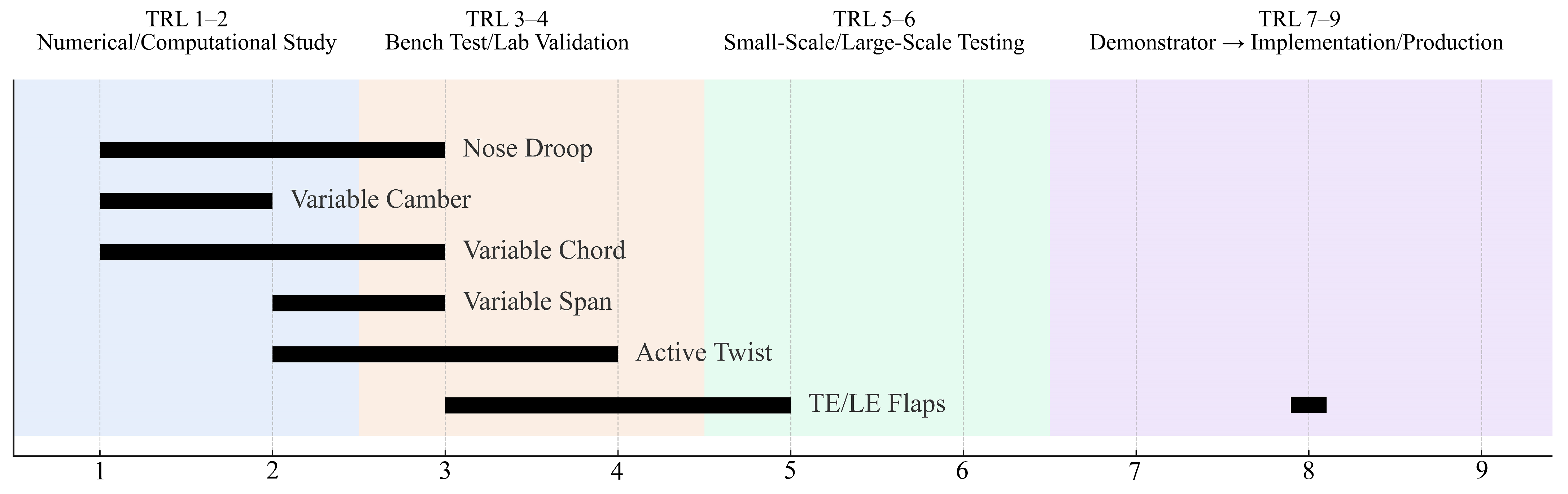
3.3.2. Technology Readiness Level for Rotary-Wing vs. Fixed-Wing Morphing Actuation Systems

| Actuation Type | Key Studies | Platform | Performance/Output | Advantages | Limitations |
|---|---|---|---|---|---|
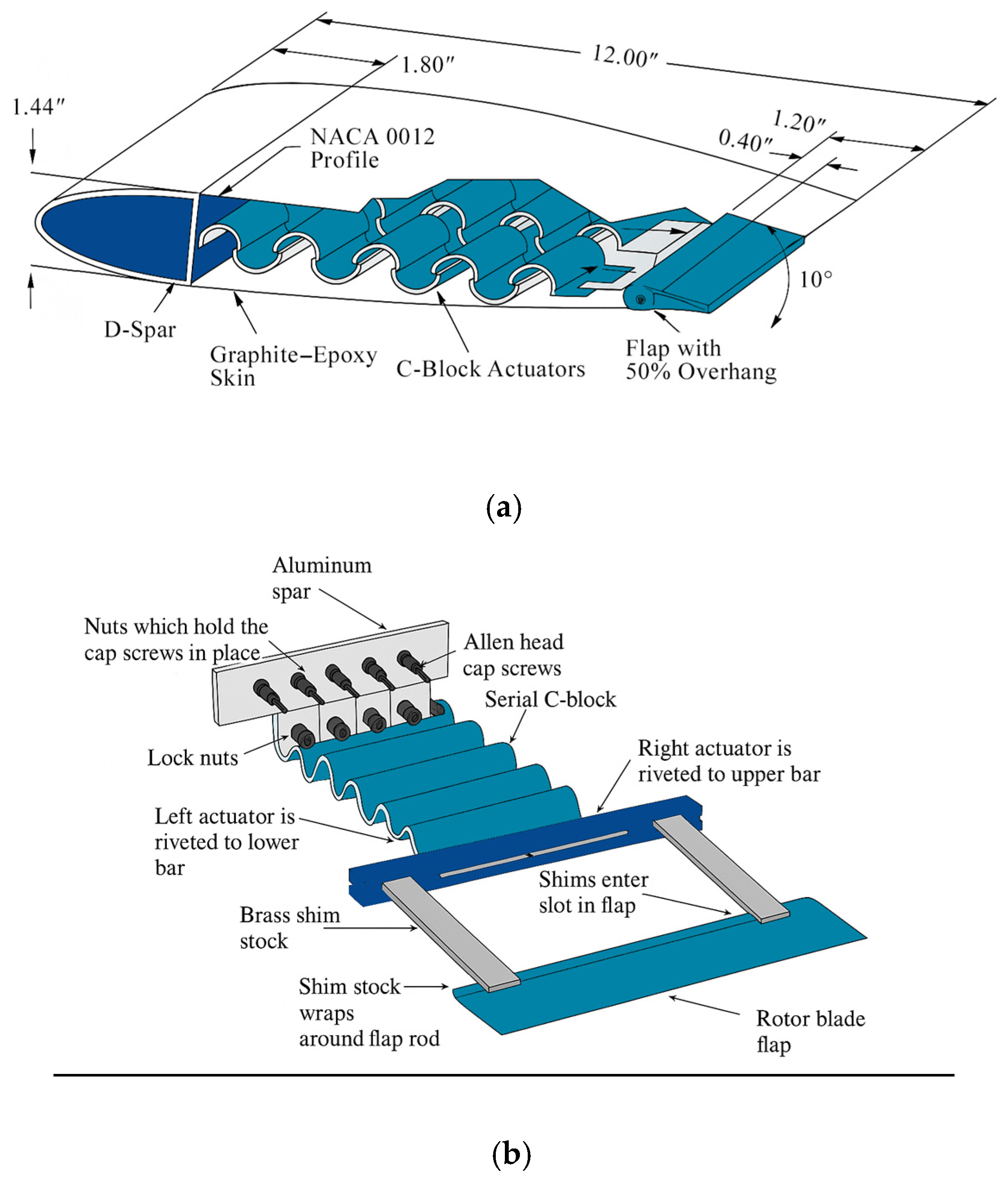
| Piezo-bender/piezo-stack TE flaps (incl. L–L amplifiers, X-frame, C-block stacks) | Lee & Chopra [20,21,22]; Hall & Prechtl [23,24,25]; Clement et al. [33] | Bench + spin + wind tunnel/scaled rotor | C-block: ≥8° pp (0–40 Hz), 11.6–13.6° pp @ 40 Hz, extrapolated ≈20° pp at 340 V; validated under rotor-relevant dynamics | High bandwidth; compact integration; high force density | High voltage; hysteresis/creep; bond-line sensitivity (≈40% variation noted); fatigue/long-life certification risk |
| ADASYS flap optimisation (geometry/placement) | Dietrich et al. [4] | Numerical (design optimisation) | ΔCL ≲ 0.3 for ~+5° TE flap; at Mach 0.33 ΔCL ~0.2, at Mach 0.74 ΔCL ~0.3 | Identifies “minimum chord” designs that still deliver most controllability | Aero-performance implications secondary (study emphasis is loads/noise/vibration) |
| Resonant PZT TE flap (tuned system) | Kim, Wang & Smith [70] | Rotor vibration-control concept | Up to 4.5° flap deflection; 2.1–3.5× authority increase vs. non-resonant; resonance at 4/rev (26.6 Hz) | Authority boost without scaling actuator size | Resonant fatigue/heating concerns; narrowband sensitivity (needs robust control) |
| Closed-loop TE flap noise control (HHC framework) | Chia et al. [71] | Numerical framework (aeroelastic–acoustic) | Up to 6 dB in-plane noise reduction (left-boom feedback) but out-of-plane noise up to +18 dB; vertical hub shear +14% (far-field) and +47.1% (left-boom) | Demonstrates controllability and sensor-placement sensitivity | Explicit noise–load trade-offs; saturation/tuning complexity |
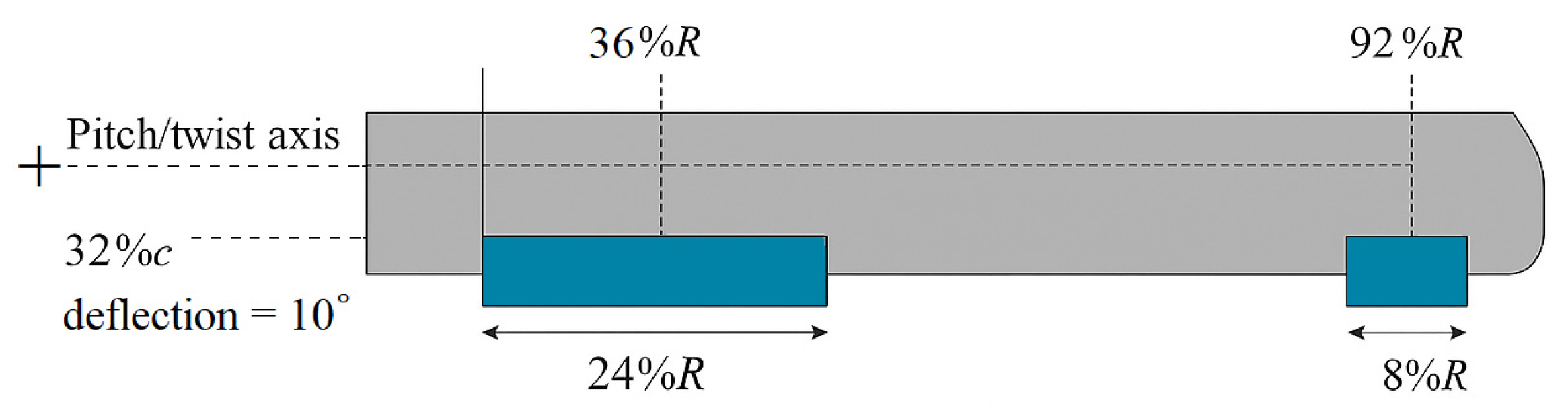
| Passive/deployable TE flaps for hover performance | Gagliardi & Barakos [69] | BE + RANS CFD | Best case: inboard slotted flap (32% chord, 10°) → FoM +4.7%; configuration matched “+6° twist” equivalence; further case reported +6.5% performance gain with trim reduction ~1° | Shows flap scheduling can recover hover performance without committing to high twist | Wake interaction + structural complexity; sensitive to spanwise placement/operating point |
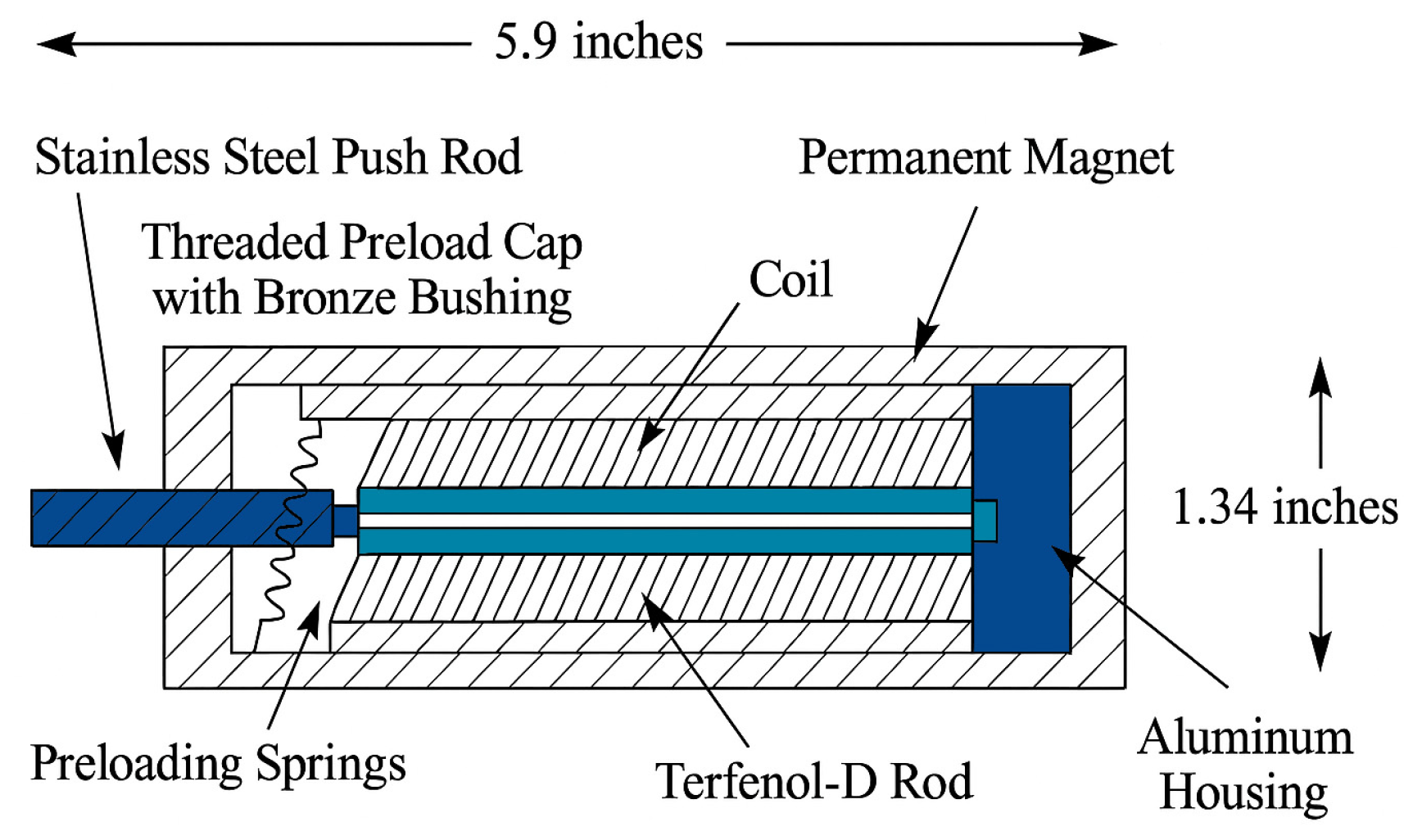
| Magnetostrictive TE actuation (Terfenol-D families) | Fenn et al. [47]; Bothwell/Chandra/Chopra [63] | Bench- + concept-level rotor integration | Reported: ~90% vibration reduction (system-level concept) but with major installed mass | Attractive force characteristics; demonstrated vibration benefit | Authority-to-weight weak vs. piezo; mass + integration burden (e.g., many actuators, linkages) |
| Electromagnetic TE actuator | Duvernier et al. [64] | Bench | Near-constant force across stroke; mass penalty highlighted | Good controllability in principle | Weight, hysteresis/friction, and magnetic stiffness effects reduce feasibility |
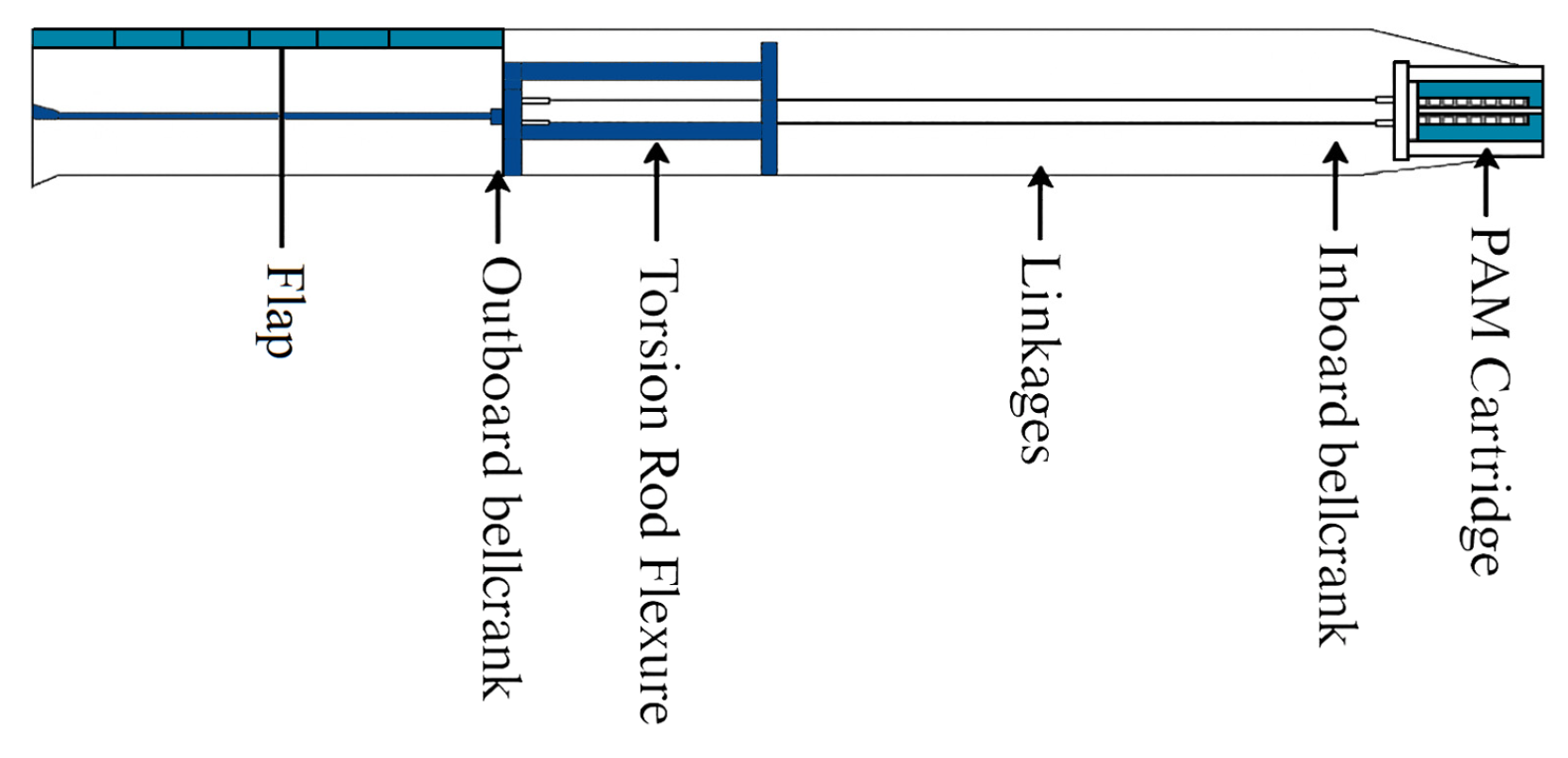
| PAM-based TE flap | Woods et al. [65] | Wind tunnel/scaled rotor | Very large authority (reported up to ±40° on scaled tests) | Highest stroke of all approaches | Pneumatic infrastructure; bandwidth/response; durability under cyclic loading |
| Gurney flaps (active/passive concepts) | Concilio et al. [2]; Woodgate et al. [68] | CFD + concept studies | ~7.4% thrust increase in selected configurations but ~20% average nose-down pitching-moment increase noted | Large lift augmentation with small device | Drag + pitching-moment penalties; scheduling complexity for rotor azimuth variation |
| LE serrations (passive) | Feinerman et al. [72] | Hover/BVI experiment | Up to 3 dB peak-to-peak BVI noise reduction (primary direction) | Passive, low integration complexity | Directional/encounter sensitivity; possible aero penalties/non-optimal response |
| Quasi-static twist (retwist for performance) | Keys, Tarzanin & McHugh [77] | Mach-scaled rotor test | Twist 11.5° → 17.3° → FoM +2.4% hover but 4/rev hub loads +37.3% to +126%; torsion +6% to +11% | Demonstrates measurable performance benefit | Potentially unacceptable vibration penalties; not “free” aeromechanically |
| Surface-mounted piezo: DAP (directionally attached) | Barrett [83] & Chopra [87] | Bench/concept lineage | “First-generation” active twist (modest twist authority) | Integrable approach; enabled later architectures | Limited strain authority; early maturity |
| AFC/IDEPFC/MFC-class fibre composites | NASA/Army/MIT ATR; Boeing AMR; DLR; etc. [87,88,89,90,91,92,93,94,95,96,97,98,99,100,101,102,103,104,105,106,107,108,179] | Wind-tunnel + hover tests | Tip twist up to ~1.5°; reported relative insensitivity vs. flight state in cited work | Better d33 utilisation; improved authority vs. DAP | High voltage (often hundreds of V); durability/fatigue and repairability concerns |
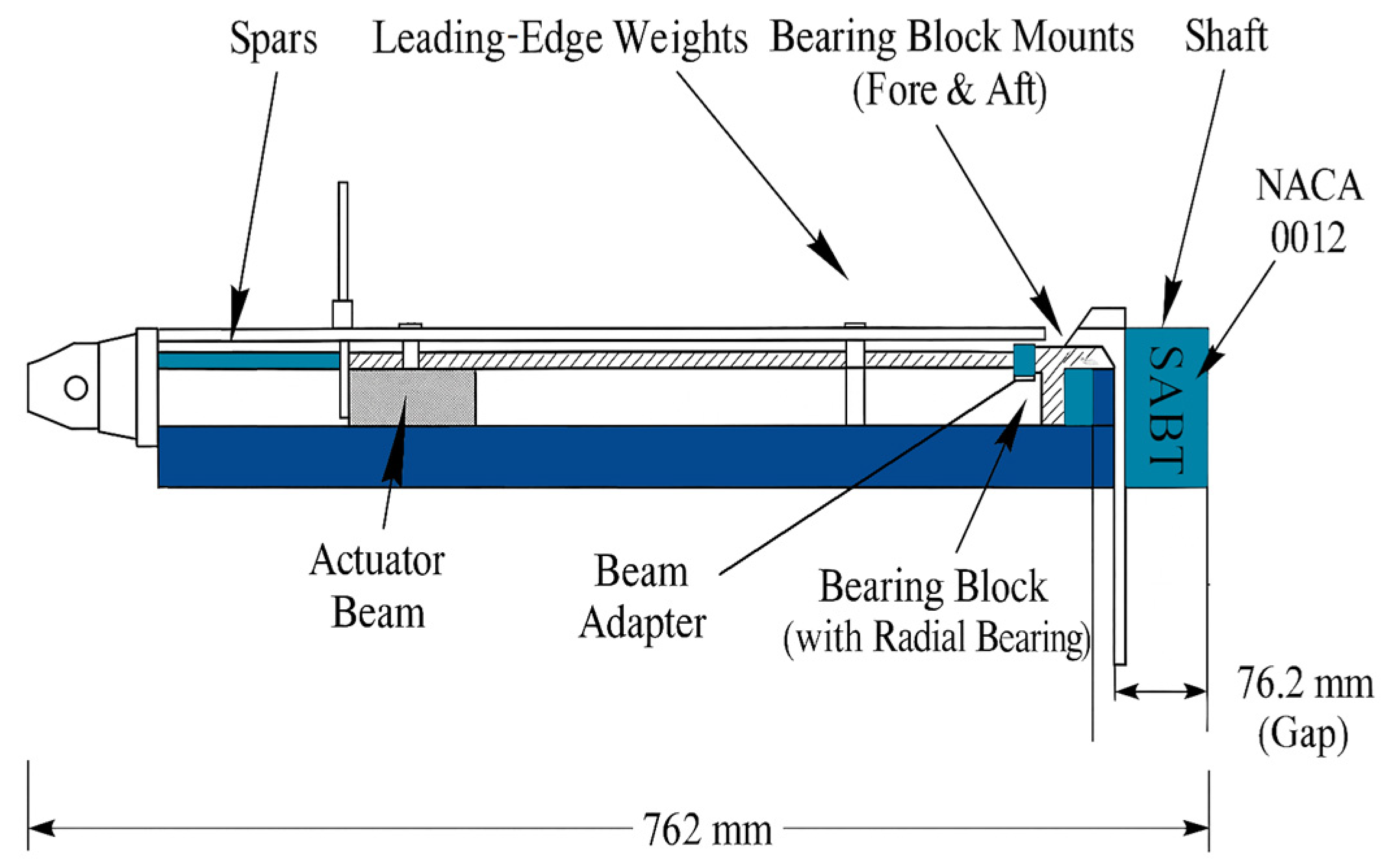
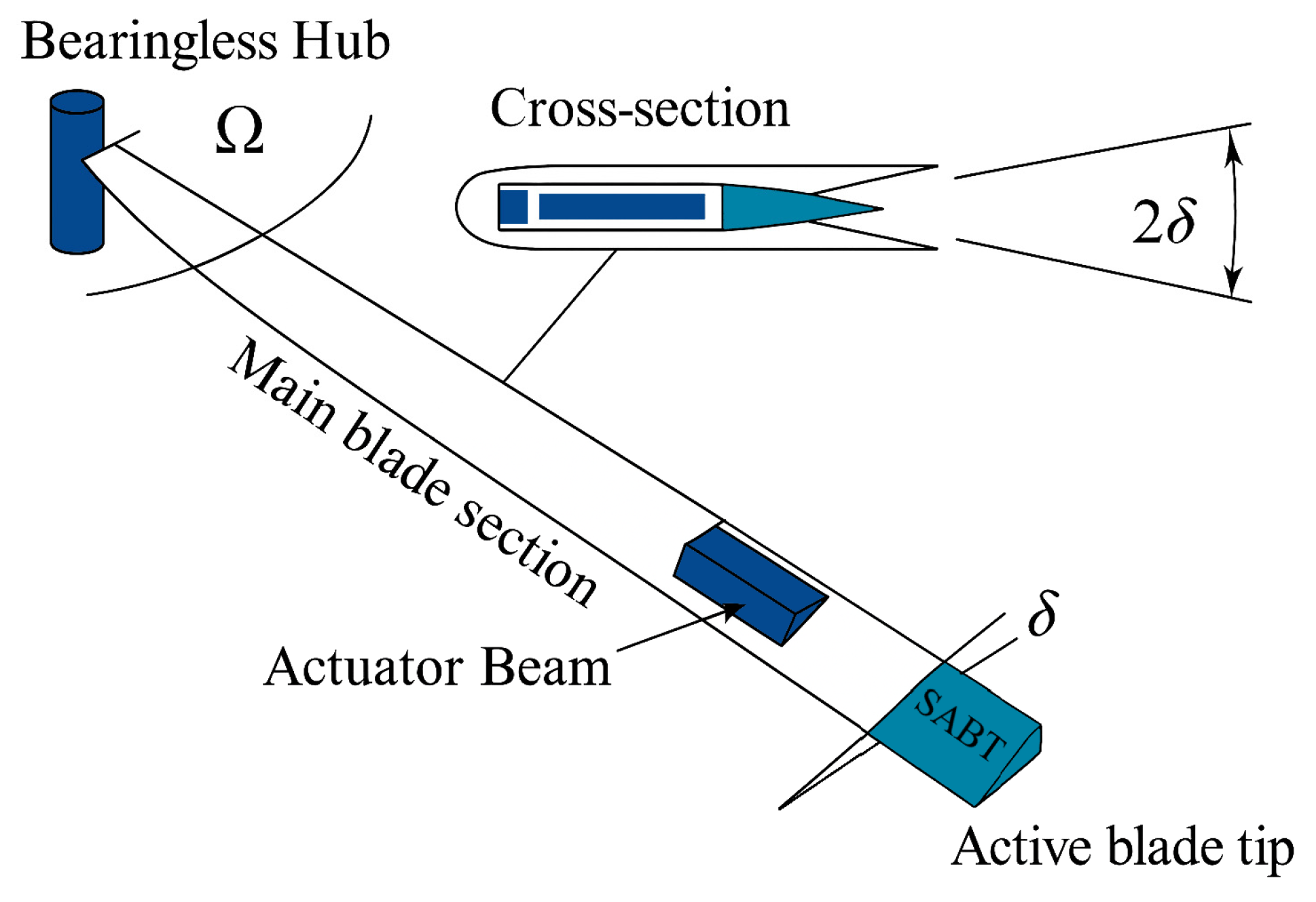
| Internal active twist (bend–torsion beam concepts) | Bernhard & Chopra (SABT lineage) [108,109] | Hover/Mach-scale | Reported tip twist up to ±2.2° (hover); control authority reported as >10% at 3/rev in described case | Clean aerodynamic integration (no external flap) | Large mass penalty (example text cites ~48% blade mass increase); piezo degradation risks |
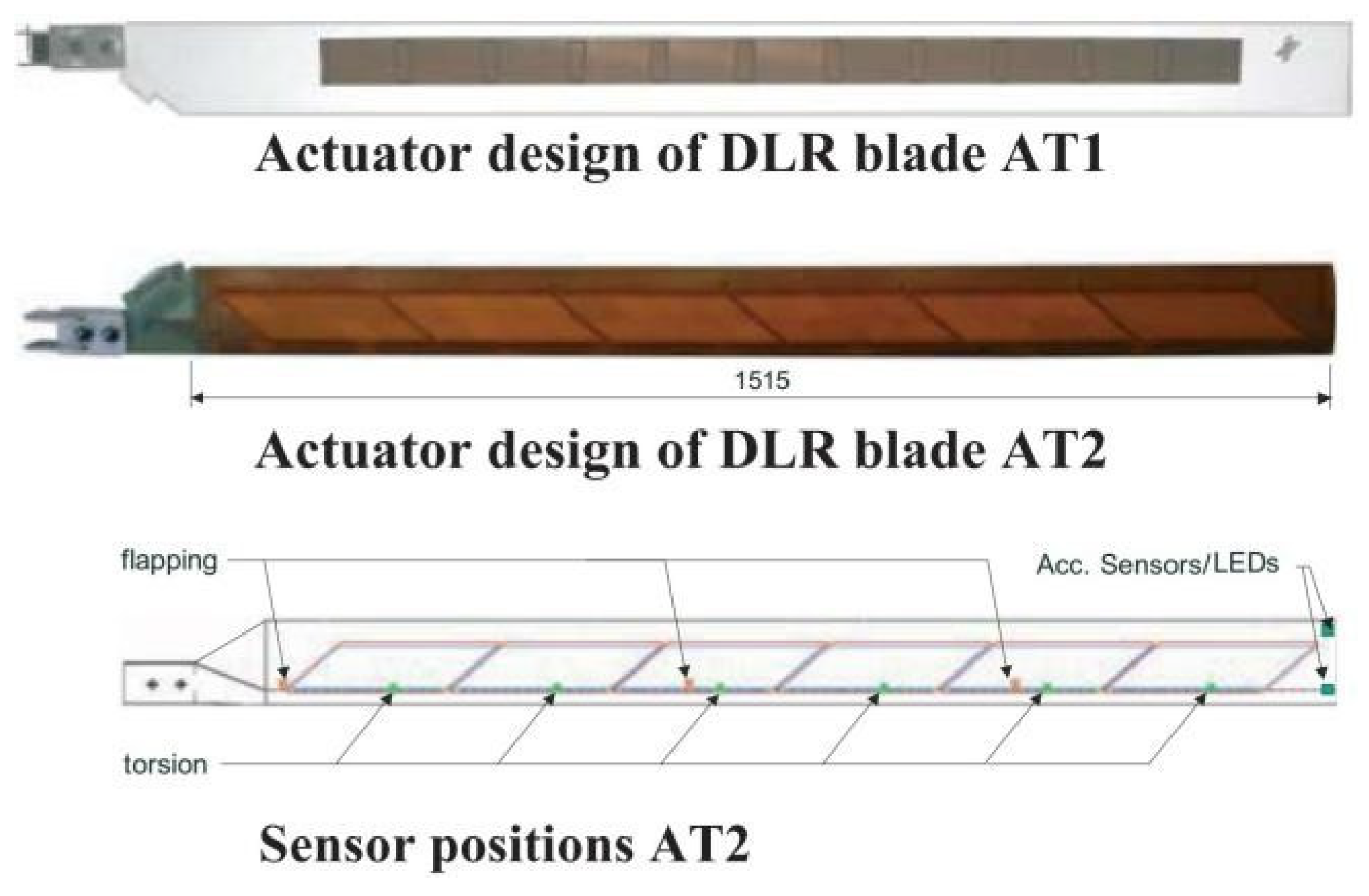
| TWISCA/cut-section twist concepts | AT1 vs. AT2 [98], ONERA [111]; | Experimental comparisons | Reported better twist performance per active area (low-voltage concept cited) | Potentially lower drive voltage than some MFC systems | Failure safety + maintainability/repairability flagged as major barriers |
| Quasi-static variable twist by centrifugal/coupling | NASA/Army composite coupling [112,113]; centrifugal concepts [114,115] | Concept + limited demonstrations | Large twist targets (up to ~30° cited as requirement class) | Avoids large on-blade high-frequency actuators | Strongly coupled to RPM architecture; limited retrofit feasibility |
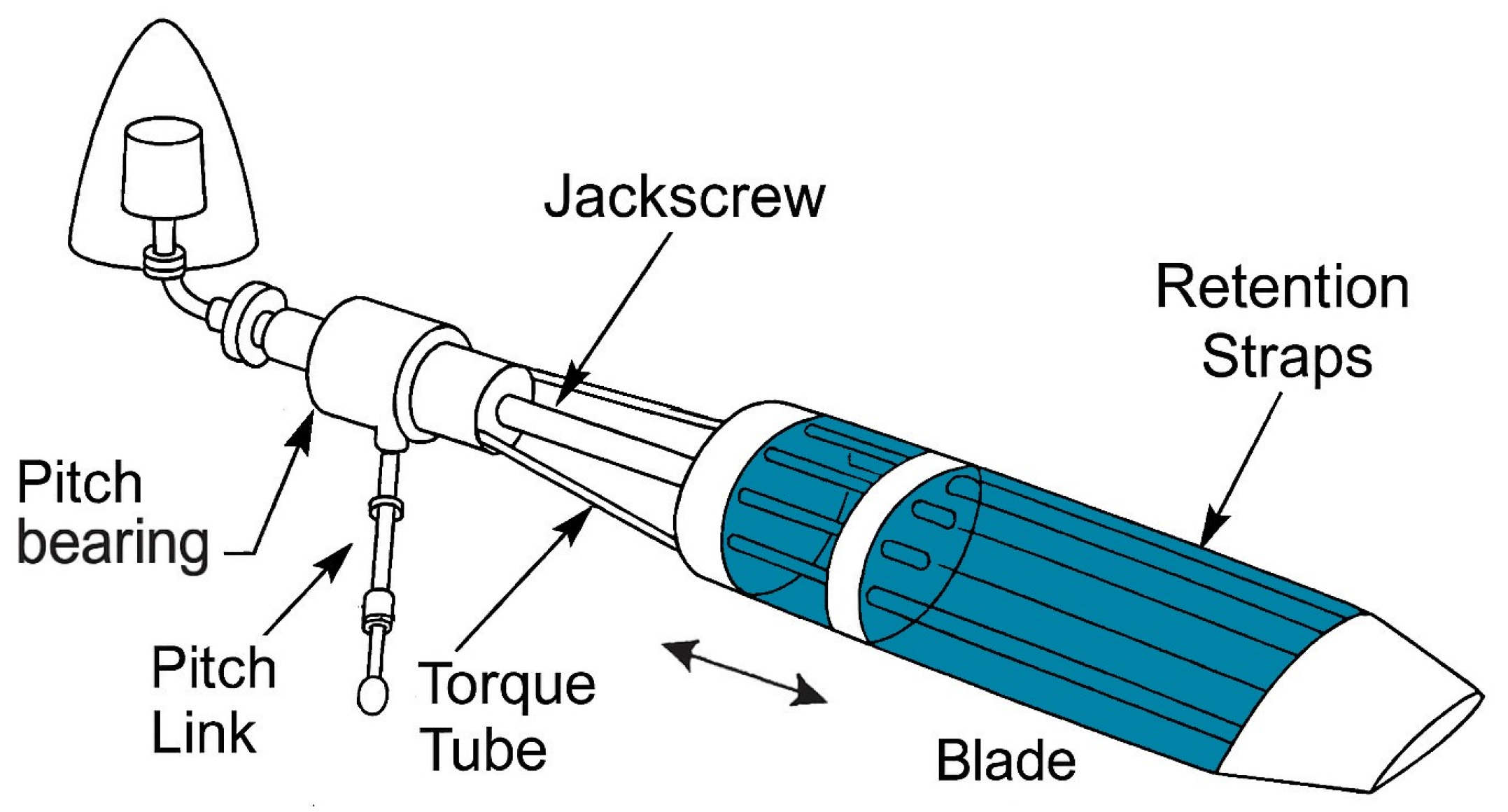
| Telescoping blades (VDR/TRAC/VDTR line) | VDR (HaigK); TRAC (Sikorsky); VDTR; Wang et al. [148] | Hover stand + wind tunnel + analysis | Example stated: telescoping to 100% span hover and ~67% cruise (VDTR class) | Reconciles hover vs. cruise requirements | Mechanical complexity; mass and reliability under centrifugal loads |
| Passive span-extending morphing tip | Vocke et al. [149] | Structural test /concept | “100% increase” span extension (tip concept class) | Low actuation energy (centrifugal assisted) | Quasi-static; flightworthiness/bonding/skin durability remain limiting |
| Static Extended Trailing Edge (SETE) | Léon et al. [150] | Analysis + prototype description | 30% chord extension → 16.7% power reduction (sea-level class); +6.7% to +10% GW capability (low/high altitude noted in text) | Very large aero benefit | Mechanism complexity; packaging; reliability/certification burden |
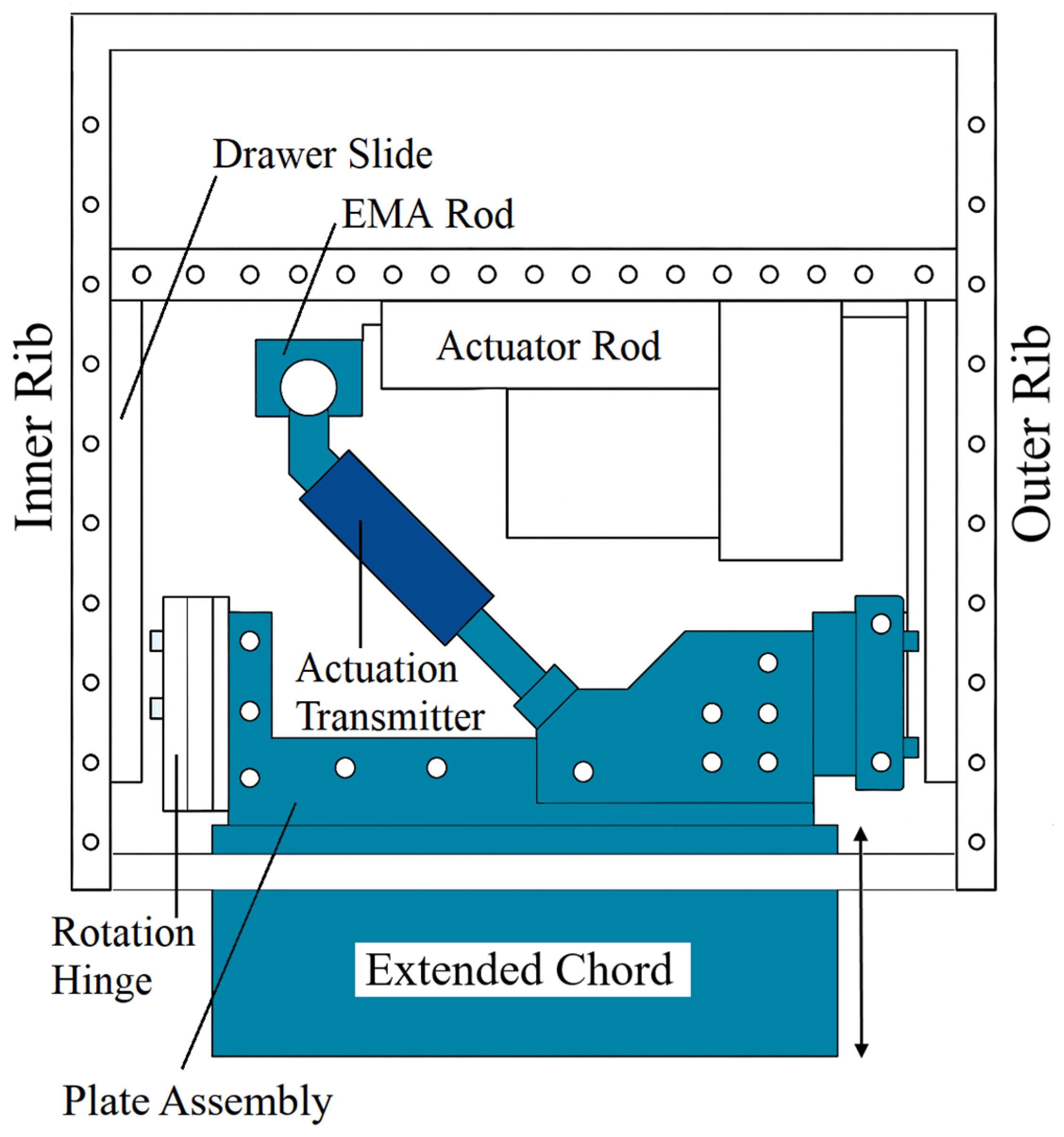
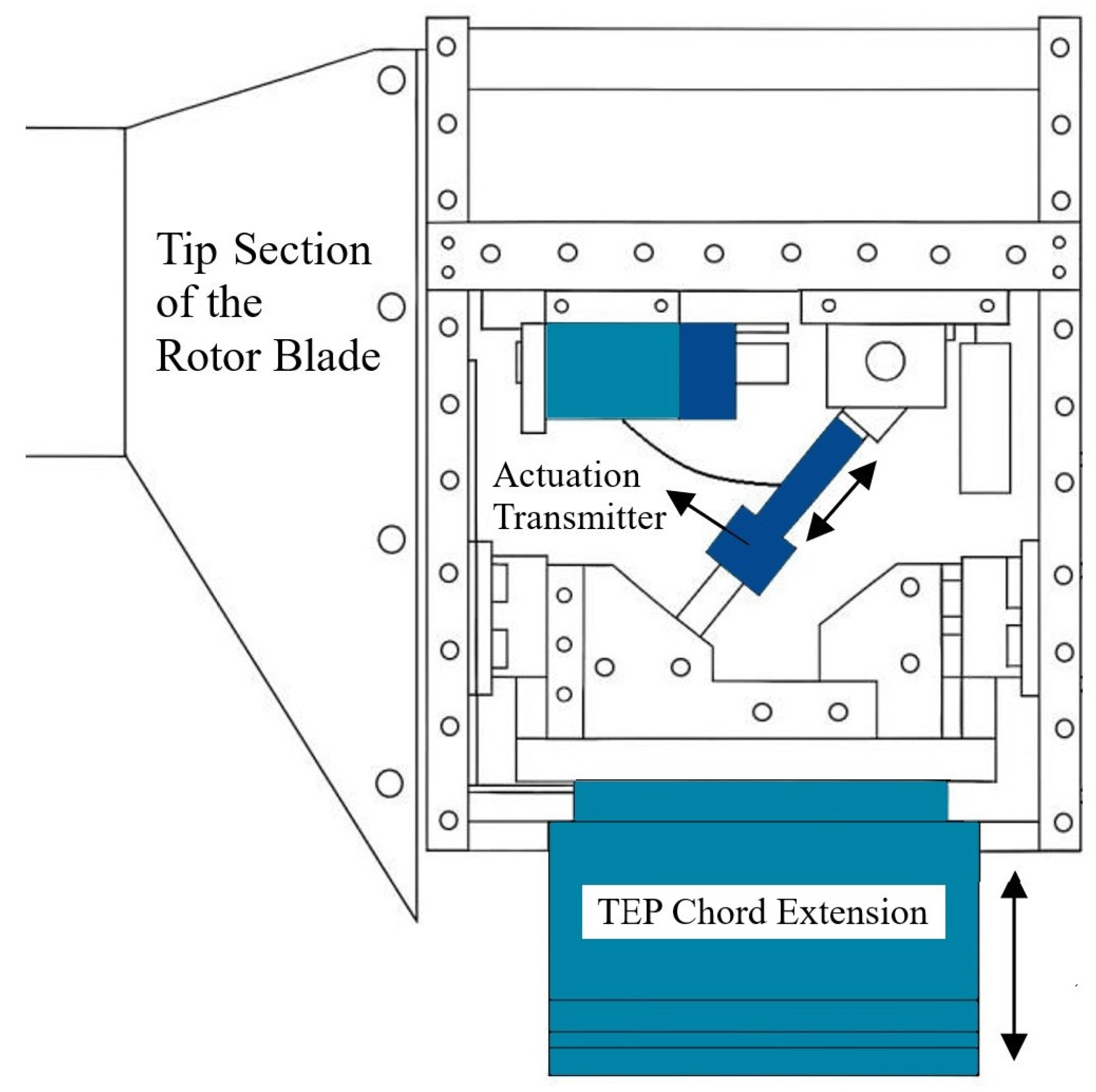
| Deployable trailing-edge plate (TEP) via morphing truss | Khoshlahjeh et al. [153] | CFD + RCAS | 20% chord over 63–83%R; power ↓ up to 18%; cruise speed ↑ 18 kt; altitude ↑ 1800 ft (as described) | Retractable: avoids “always-on” penalty | Pitch-link load growth; aeroelastic twist interactions; integration complexity |
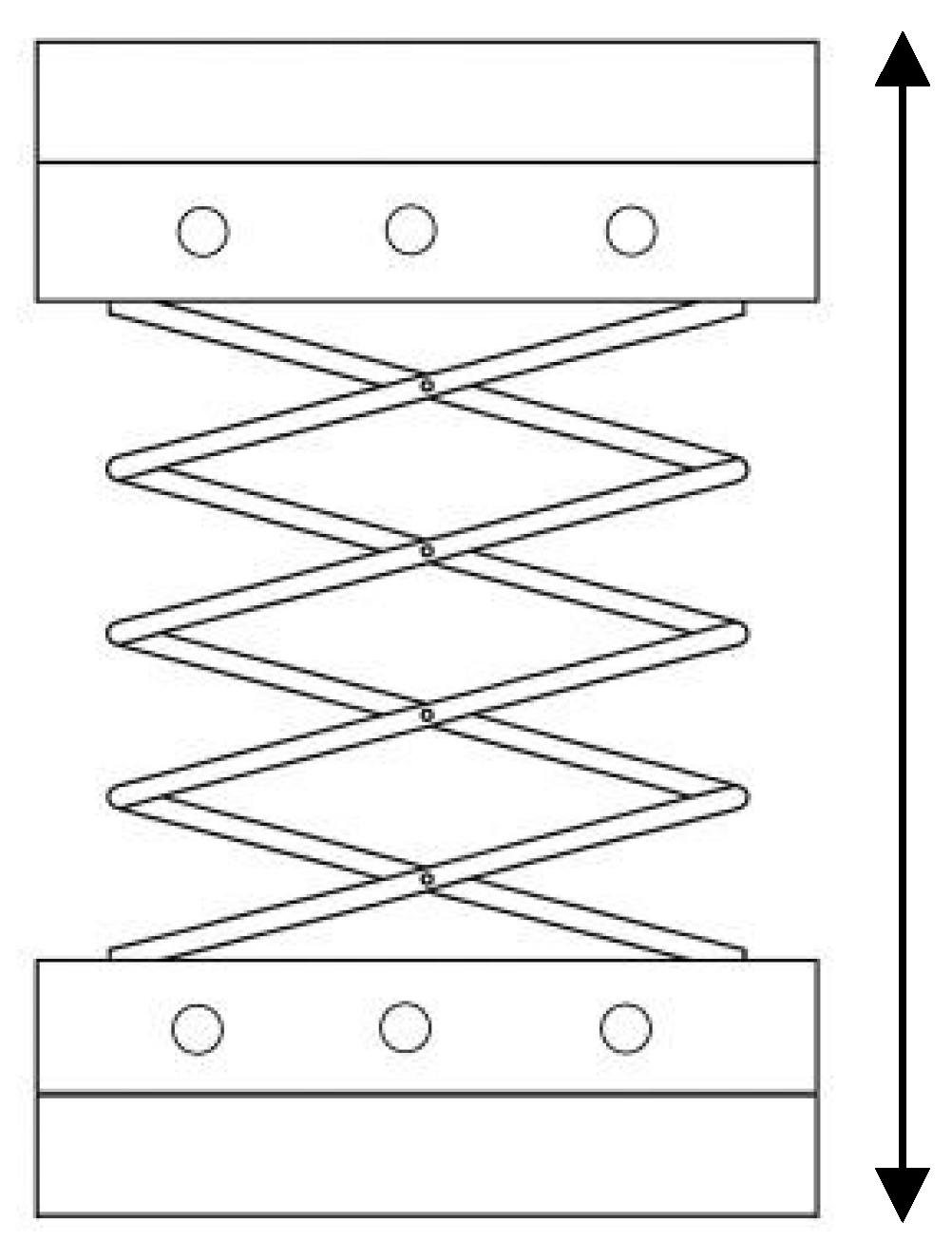
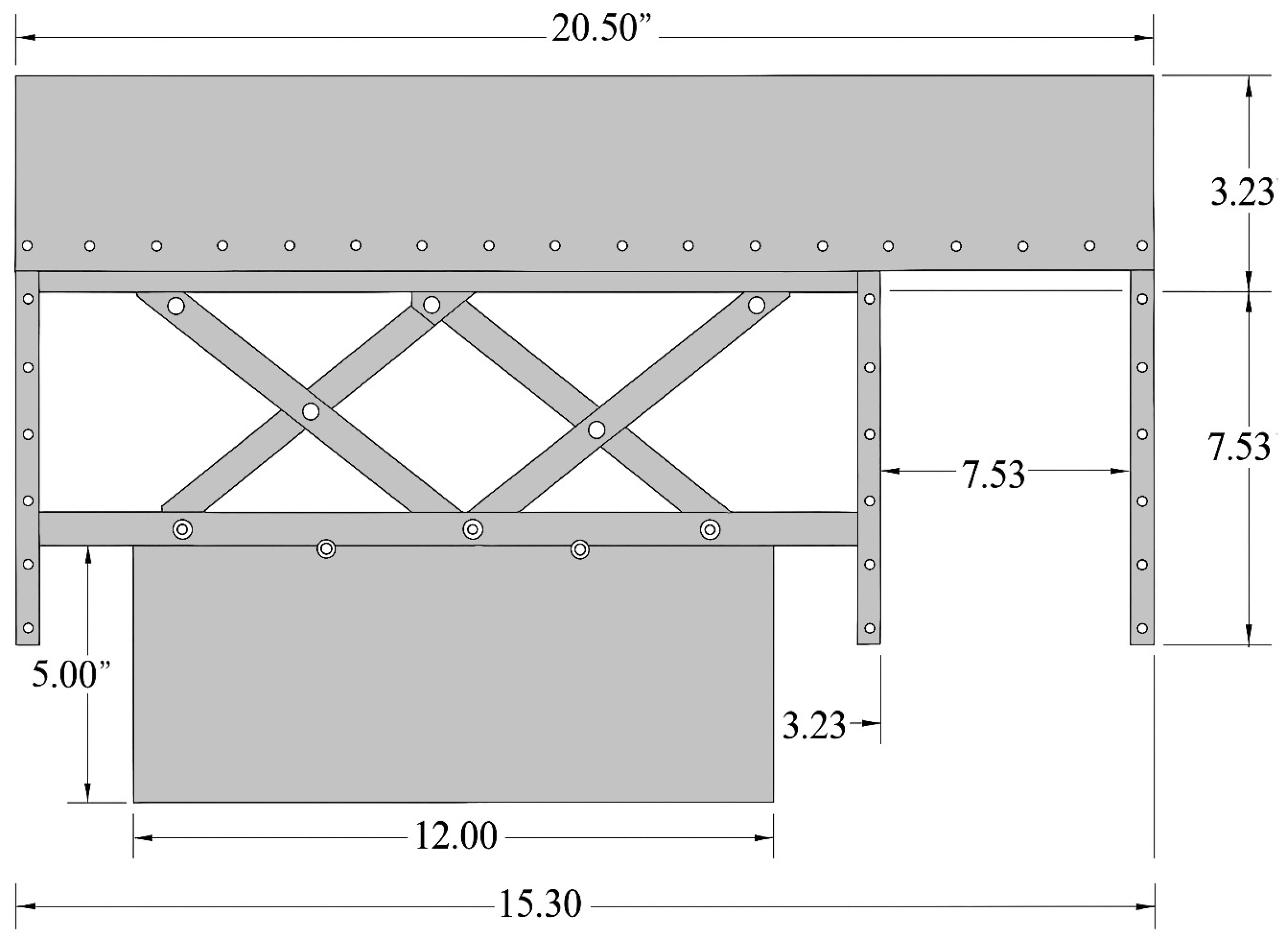
| X-truss electromechanical chord extension | Hayden [154] | Bench/rotating prototype | ~8.1% chord extension (1.3 in of 16 in chord); demonstrated operation to ~209.5 g (385 rpm class) | Compact TE packaging; controllable | Efficiency/current draw issues under rotation; scaling risk |
| SMA bistable truss (VMT) | Barbarino et al. [156] | Bench | Snap-through with short SMA wires (amplified stroke) | Lock-free bistability | Thermal lag; fatigue; control complexity; integration into rotor TE remains immature |
| Hub-driven high-frequency tab concepts | JAXA active tab programme [2] | Model-scale wind tunnel (noted in text) | Noise reduction potential (described as multi-harmonic) | Moves actuation off-blade | Adds hub complexity; authority limits; transmission requirements |
| Conformable camber (compliant mechanisms + PZT stacks) | Gandhi et al. [158] | Bench prototype | TD-optimised: 6.0 mm (≈4.6° flap equiv); tested: 3.65 mm static; natural freq 38.75 Hz; lift +17–22% with 50–75% less drag penalty vs. 15% flap (as reported) | Aerodynamically clean; lower drag penalty than discrete flap | Fabrication complexity; lower lift per “equiv. deflection”; stiffness trade-offs |
| Electrically actuated camber (motor + eccentric shafts) | Kammegne et al. [160] | Wind tunnel + control validation | Transition delay 2–18% chord; drag ↓ 3–10.5%; stable actuation ~1 s | Avoids SMA thermal limits; controllable shapes | Actuator bulk; linkage complexity; packaging limits |
| VDLE (variable drooped LE) | Martin et al. [161] | Drag ↓ up to 63%; peak moment ↓ 31–37%; negative pitch damping eliminated; lift penalty ~8% | Strong dynamic-stall mitigation with fewer low-AoA penalties | Full-scale integration in D-spar region is difficult; mechanism packaging in rotor blade remains a key barrier | |
| Piezo-stack nose droop | Shaner & Chopra [162] | Achieved ~1° vs. 5° target (as described) | Compact; high force potential | Stroke losses, hinge stiffness, alignment issues dominate; needs major mechanical refinement | |
| Electromagnetic droop (LEEMA) | Fink et al. [163] | Bench prototype demonstration (as described) | Smooth actuation feasibility | Mass/packaging remain key concerns | |
| Variable RPM envelope studies (UH-60A-type models) | [92,116,117,118,119,164] | Power reduction up to ~14% (described) | Benefits increase when combined with span/twist morphing; shifts complexity to drivetrain/controls | ||
| Compliant morphing LE (FlexSys/AMRDEC class) | FlexSys/AMRDEC [180] | ±10° at 6 Hz (described); 35% retreating-blade lift increase without stall; power ~885 W for 7 ft span flap (described) | Jointless smooth surface; high aerodynamic benefit | Stress/structural optimisation needed; backlash issues noted; full-scale integration not yet mature | |
| Slowed-rotor experiment (NFAC 40 × 80, UH-60A) | [122,123] | Full-scale | Tested at 65% and 40% nominal RPM; advance ratio up to ~1.0; max forward speed reported up to 182 kt | Revealed new aeroelastic phenomena (reverse-chord dynamic stall and large torsional excursions); feasibility demonstrated but system-level integration dominates maturity |


3.3.3. Actuation Concept-Transfer Feasibility (ACTF) Study of Mature Fixed-Wing Morphing Systems to Rotary-Wing Platforms
- (a).
- Fully Transferable Technologies
- (b).
- Partially Transferable/High-Risk Technologies
- (c).
- Non-Transferable Technologies
| Actuation Specifics | Transferability | Why/Why Not | Evidence | |
|---|---|---|---|---|
| Piezo-electric | ||||
| Piezoelectric Servo Flaps [9,10,24] | High | Proven for HHC, BVI noise reduction | Rotary: ADASTYS, Hall & Precht, CH-47D scale tests | |
| Piezo Bimorphs [13] | Moderate–High | Good flap authority but limited stroke; fatigue minor issue | Fixed: LE/TE flexure actuation; Rotary: several 0.125R–0.2R flap demos | |
| PZT Stack Actuators [30] | High | High bandwidth, high force, compact; ideal for TE flaps | Fixed: TE camber actuation; Rotary: Hall & Precht, APC-850 servo flaps | |
| Macro-Fibre Composite (MFC) [52,108,111,159] | High | High strain, surface-conforming, lightweight | Fixed: FishBAC/MFC skins; Rotary: MFC twist prototypes | |
| Surface-Embedded Piezo Patches [86] | Moderate–High | Scalable and low-mass for dynamic control; voltage limits | Fixed: Aeroelastic control; Rotary: concept studies + limited tests | |
| SMA | ||||
| SMA Flexure Mechanisms [10,13] | Moderate | Good for LE morphing; thermal lag limits high-freq control | Fixed: LE droop demos; Rotary: feasible only for slow morphing | |
| SMA Wires [33] | Moderate | High force, slow response; thermal issues at rpm | Fixed: LE morphing; Rotary: limited twist demos | |
| SMA Bistable Structures [51,52,156,167] | Moderate | High energy efficiency; snap-through may fatigue under rpm | Fixed: bistable camber; Rotary: no demos yet | |
| SMA Torque Tubes [64,182] | Moderate–High | Good torsion, compact; heating/cooling challenge | Fixed: Ajaj et al. torque work; Rotary: twist actuation prototypes | |
| Compliant & Flexural Architectures | ||||
| Bistable Composite Surfaces [50,51] | Moderate | Lightweight but bistability may cause dynamic instability | Fixed: Schultz et al.; Rotary: no high-rpm data | |
| Compliant LE Skins [93,162,163] | Moderate | Good morphing but high suction peaks under rpm | Fixed: LE adaptive structures; Rotary: structural risk at high Mach tip | |
| Compliant TE (FishBAC) [182,183] | High | Smooth continuous camber, low mass | Fixed: FishBAC proven; Rotary: high potential but needs fatigue proofing | |
| Corrugated/Zigzag Skins [184] | Low–Moderate | Flexible but structurally weak under centrifugal force | Fixed: Zigzag wingbox; Rotary: insufficient stiffness | |
| Magnetic/Electromagnetic Actuation | ||||
| Magnetostrictive (Terfenol-D) [47,64] | Low–Moderate | Good force; very heavy; heating at rpm | Fixed: limited camber work; Rotary: untested | |
| Electromagnetic Linear Actuators [164] | Low | Too heavy + wiring complexity in rotating frame | Fixed: some prototypes; Rotary: impractical | |
| Magnetic Torque Rods (Magnetorquers) [167] | Low | Weak torsion under centrifugal stiffening (mainly used in satellites) | Only conceptual evidence | |
| Pneumatic/Hydraulic/Fluidic Systems | ||||
| Hydraulic Micro-Actuators [53] | Low–Moderate | High authority, too heavy unless near hub | Fixed: control surfaces; Rotary: mass penalty | |
| Fluidic Flexible Matrix Composites (F2MC) [114] | Low | Pressure-dependent response incompatible with rpm | Fixed: twist & bend; Rotary: no viable path | |
| Pneumatic Elastomeric Honeycombs [149] | None–Low | Pressurisation fails under 300–600 g centrifugal loads | Fixed: camber/thickness morphing; Rotary: impossible at tip loads | |
| Deployable Structures | ||||
| Origami/Folding Structures [185,186,187,188] | None | Joints and folds fail under cyclic rpm loads | Fixed: deployables; Rotary: impossible | |
| Scissor/Lattice Deployables [189] | None | Cannot withstand centrifugal stiffness demands | Fixed: polymorphing wings; Rotary: nonviable | |
| Multi-Segment Wingboxes [190,191] | None | Too many moving parts; vibration-induced failure | Fixed: HECS-type wings; Rotary: structurally impossible | |
| Aeroelastic Morphing | ||||
| Passive Twist (bend–twist coupling) [178] | High | Already used in rotor blades; natural transfer | Fixed: aeroelastic tailoring; Rotary: standard practice | |
| Aeroelastic Camber Morphing [178] | Moderate | Needs compliant skins; risks LE/TE divergence | Fixed: passive cambering; Rotary: partially feasible | |
| Flutter-Induced Morphing [178] | Moderate | High risk; nonlinear behaviour | Fixed: academic; Rotary: hazardous but theoretically usable | |
| Post-Buckling Morphing [178] | Low | Uncontrolled under rpm; dangerous | Fixed: safe on static wings; Rotary: catastrophic risk | |
| Passive Twist (bend–twist coupling) [178] | High | Already used in rotor blades; natural transfer | Fixed: aeroelastic tailoring; Rotary: standard practice | |
| Aeroelastic Camber Morphing [178] | Moderate | Needs compliant skins; risks LE/TE divergence | Fixed: passive cambering; Rotary: partially feasible | |
| Macro-mechanical Actuator | ||||
| Servo-Driven Flaps [9,10,23,24] | Moderate–High | Proven using specialised linkages; mass penalty | Fixed: ubiquitous; Rotary: used in slow-rotor UAVs | |
| Tendon/Cable Systems [192] | Moderate | Lightweight; routing complexity in rotating frame | Fixed: compliant TE; Rotary: possible but delicate | |
| Rack-and-Pinion Systems [193] | Low–Moderate | Hard to embed in slender blade | Fixed: span morphing; Rotary: geometric incompatibility | |
| Linear Screw Actuators [194] | Low | Heavy, slow, friction-sensitive | Fixed: chord morphing; Rotary: impractical | |
| Unique Fixed-Wing only (Non-transferable) | ||||
| Variable Span [134,135,136,137,138,139,140,141,142,143,144,145,146,147,148,149] | None | Centrifugal stiffening prevents telescoping | Fixed: telescopic wings; Rotary: impossible | |
| Thickness Morphing [178] | None | No internal volume in rotor airfoils | Fixed: pneumatic skins; Rotary: incompatible | |
| Variable Sweep [195,196] | None | Cannot pivot under 400 g loads | Fixed: mission adaptive wings; Rotary: nonviable | |
| High-TRL Rotary-Specific | ||||
| High-Bandwidth TE Flaps [20,30] | High | Already used in fixed-wing gust control | Rotary → Fixed proven | |
| Active Twist (distributed) [7,74,75,83,85,86,87,92,94,95,96,97,98,99,100,101,102,105,107,108,110,111,133] | Moderate | Fixed wings do not need high-frequency twist | Rotary: lab demos | |
| Smart Spars [197] | Moderate | Possible but limited payload | Rotary: concept-level |
4. Conclusions
Author Contributions
Funding
Data Availability Statement
Conflicts of Interest
Declarations
Abbreviations
| ACTF | Actuation Concept-Transfer Feasibility |
| ADASYS | ADAptive Dynamic SYStems |
| AFC | Active Fibre Composite |
| AMR | Advanced Material Rotor |
| AMRDEC | Aviation & Missile Research, Development, & Engineering Center |
| APC | Automatic Pitch Control |
| ATR | Active-Twist Rotor |
| ATB | Active-Twist Blade |
| AVINOR | Rotorcraft Analysis Code |
| BCDI | Blade-Controlled Disturbance Interaction |
| BVI | Blade–Vortex Interaction |
| CFD | Computational Fluid Dynamics |
| CFD/CSD | CFD & Computational Structural Dynamics Coupling Investigation |
| DAP | Directionally Attached Piezoelectric |
| DSP | Digital Signal Processor |
| EMC | Elastomer-Matrix Composite |
| FEM | Finite Element Method |
| FoM | Figure of Merit, |
| HELINOIR | Rotorcraft Acoustic Code |
| HHC | Higher Harmonic Control |
| HOTIS | Hover Tip Vortex Structure Test |
| IBC | Individual Blade Control |
| IDEPFC | Interdigitated Electrode–Piezo Fibre Composite |
| JAXA | Japan Aerospace Exploration Agency |
| Ksi | Kilo-pounds per square inch |
| LEEMA | Leading-Edge Electromagnetic Airfoil |
| LRTA | Large Rotor Test Apparatus |
| LVPZT | Low-Voltage Lead Zirconate Titanate |
| MFC | Macro-Fibre Composite |
| MTOW | Maximum Take-Off Weight |
| NACA | National Advisory Committee for Aeronautics |
| NFAC | National Full-Scale Aerodynamics Complex |
| NIDAQ | National Instruments Data Acquisition System |
| ONERA | Rotorcraft CFD tool |
| OSR | Optimal Speed Rotor |
| PAM | Pneumatic Artificial Muscle |
| PZT | Lead Zirconate Titanate (chemistry notation) |
| RANS | Reynolds-Averaged Navier–Stokes |
| RCAS | Rotorcraft Comprehensive Analysis System |
| RMS | Root Mean Square (effective/equivalent DC voltage) |
| RPM | Rotations Per Minute |
| RRB | Reconfigurable Rotor Blade |
| SABT | Smart Active Blade Tip |
| SETE | Static Extended Trailing Edge |
| SHCT | Short-Haul Civil Tiltrotor |
| SMA | Shape Memory Alloy |
| SMART | Smart-Material-Actuated Rotor Technology |
| TEF | Trailing-Edge Flap |
| TEP | Trailing-Edge Plate |
| TD | Tip Deflection |
| TRAC | Telescoping Rotor AirCraft |
| TRL | Technology Readiness Level |
| TWISCA | TWIstable Section Closed by Actuation |
| UAV | Unmanned Aerial Vehicle |
| UMARC | FEM-Based Helicopter Simulation Code |
| VDLE | Variable-Droop Leading Edge |
| VDR | Variable-Diameter Rotor |
| VDTR | Variable-Diameter Tilt Rotor |
| VGART | Variable-Geometry Advanced Rotor Technology |
| VMT | Von Mises Truss |
| Vrms | Volts Root-Mean-Square |
| Nomenclature and Greek Symbols | |
| CD | drag coefficient |
| CL | lift coefficient |
| CL/CD | aerodynamic efficiency |
| CL-Max | maximum lift coefficient |
| CM | moment coefficient |
| CP | power coefficient |
| CT | thrust coefficient |
| CT/σ | blade loading |
| c | blade chord, m |
| D | drag force, N |
| L | lift force, N |
| L/D | aerodynamic efficiency |
| M | Mach number |
| r/R | the ratio of spanwise blade position to total rotor length |
| σ | solidity ratio, σ = NbcrefR |
| µoρϕη′ | morphing |
Appendix A
| Actuation Mechanism | Key Investigation | Investigation Type | Performance Output | Actuation Advantages | Actuation Limitations |
|---|---|---|---|---|---|
| Span | |||||
| Rack-and-pinion (Servo-driven telescoping wing) | Arrison et al. (2003) [198] | Design, fabrication, CFD (VLM), flight testing (RC demonstrator) |
|
|
|
| Pneumatic inflatable telescopic spar—Span/aspect-ratio morphing | Blondeau et al. (2003) [199] | Structural design, analytical modelling, wind-tunnel experimental validation |
| Very low mass compared with lead-screw or motorised telescoping systems
|
|
| Obliquing, symmetric & asymmetric span extensions (electromechanical) | Sullivan and Watkins (2003) [200] | Numerical and prototype |
| ||
| Hybrid pneumatic-electromechanical system enabling multi-DOF planform morphing (span, sweep, twist, tail extension) | Neal et al. (2004) [201] | Full-scale wind-tunnel demonstrator; analytical modelling; control-system integration |
|
|
|
| Hybrid pneumatic-electromechanical actuation enabling large- and small-scale morphing (span, sweep, twist, tail translation, tail incidence) | Neal et al. (2006) [202] | Wind-tunnel experimental testbed; structural design; actuation integration; strength analysis |
|
|
|
| Telescopic variable-span morphing wing (span/aspect-ratio DOF) | Bae et al., 2005 [203] | Aerodynamic analysis (DHM panel code), structural FE modelling (MSC/NASTRAN), static aeroelastic analysis |
|
|
|
| Electromechanical DC motor + reduction gear + lead-screw linkage (span/aspect-ratio morphing DOF) | Heryawan et al. 2005 [204] | Structural design, fabrication, wind-tunnel experimental validation (Re ≈ 30,000) |
|
|
|
| Electromechanical screw-driven telescopic ribs + telescopic spars—Span, chord, thickness (airfoil shape) morphing DOFs | Vale et al. 2006 [205] | Multidisciplinary design optimisation (MDO); aero-structural FEM coupling; mission-level performance assessment |
|
|
|
| Electromechanical screw-driven rib expansion + telescopic spar actuation (span and chord morphing DOFs) | Gamboa et al. 2007 [206] | Aerodynamic optimisation (XFOIL + lifting-line), coupled aero-structural FEM, prototype design and partial testing |
|
|
|
| Tendon (cable)-actuated cellular mechanism using parallelogram linkage cells—Span reduction & sweep increase DOFs | Bharti et al. 2007 [192] | Kinematic design, structural sizing, analytical load modelling, prototype fabrication and bench testing |
|
|
|
| Folding-wing morphing architecture with seamless skins—Span, wing area, effective sweep DOFs | Bye et al. 2007 [207] | Mission-driven system design; CFD; MDO; full-scale subcomponent testing; large-scale half-span wind-tunnel testing (NASA TDT) |
|
|
|
| Out-of-plane folding wing using electromechanical drivetrains—Span, wing area, effective sweep DOFs | Ivanco et al. 2007 (DARPA MAS Phase II) [208] | Large-scale semi-span wind-tunnel testing (NASA TDT); aeroelastic validation; system-level demonstration |
|
|
|
| Coordinated electromechanical rotary actuation with hinge-line brakes—Primary wing-fold DOF (span, wing area, effective sweep) | Love et al., 2007 (DARPA MAS) [209] | Large semi-span wind-tunnel testing (NASA TDT); ground vibration tests; FEM–CFD correlation |
|
|
|
| Computer-controlled linear actuators driving mechanised four-bar linkage—Wing sweep & in-plane shear (wing area) DOFs | Andersen et al., 2007 (DARPA N-MAS) [190] | Full-scale half-span wind-tunnel testing (NASA TDT); subscale UAV flight testing; FEM-based aeroelastic analysis |
|
|
|
| Electromechanical rack-and-pinion linear actuator + servo-driven bell-crank—Span (telescopic), gull, and inverted-gull DOFs | Supekar, 2007 [193] | Structural design; FEM (ANSYS); AVL aerodynamics; low-speed wind-tunnel testing |
|
|
|
| Shape Memory Polymer (SMP) composite hinge actuator—Wing sweep angle and planform area reduction DOFs | Yu et al., 2007 [210] | Material characterisation (DMA); analytical modelling (ADAMS); prototype fabrication; experimental validation |
|
|
|
| Electromechanical screw-driven telescopic ribs + telescopic spars—Span, chord, airfoil thickness/camber DOFs | Gamboa et al., 2009 [194] | Multidisciplinary design optimisation (SQP); coupled aero-structural FEM; mission-level UAV performance analysis |
|
|
|
| Distributed linear pneumatic actuators embedded in scissor (four-bar) cellular mechanism—In-plane shear/wing area/sweep-related DOF | O’Grady, 2010 [211] | Experimental testing (single-cell & three-cell); multibody dynamics (ADAMS); FEM (NASTRAN); SQP optimisation |
|
|
|
| Chord | |||||
| Shape Memory Polymer (SMP) skin with internal sliding/telescoping ribs—Chord morphing DOF (primary) | Perkins et al., 2004 (CRG Phase I) [212] | Conceptual design; material development; subcomponent fabrication and testing. Material & structural feasibility study (sub-scale prototypes) |
|
|
|
| Out-of-plane morphing: Twist | |||||
| Hydraulically actuated leading- and trailing-edge control surfaces on a flexible wing—Aeroelastic twist & camber control (roll, load, and mode control DOF) | Miller (1988), Active Flexible Wing (AFW) Technology [213] | Large-scale wind-tunnel experimental validation with active control |
|
|
|
| Aerodynamic control surfaces + adaptive stiffness attachments (active aeroelasticity, not geometric morphing)—Wing twist, roll effectiveness, load redistribution DOFs | Kuzmina et al. (2002), ICAS Congress [214] | Analytical + wind-tunnel + flight-test review (Russia & Europe, incl. 3AS project) |
|
|
|
| Electromechanically actuated movable & rotating wing spars—Aeroelastic twist control DOF (via shear-centre and torsional stiffness shift) | Amprikidis & Cooper (2003), AIAA 2003-1799/EU 3AS [197] | Analytical aeroelastic modelling + bench tests + low-speed wind-tunnel tests |
|
|
|
| Hydraulically actuated Variable Stiffness Spar (VSS)—Aeroelastic twist & stiffness tuning DOF (via spar rotation vertical↔horizontal) | Florence et al. (2004) [215] | Large-scale wind-tunnel experiment (NASA TDT) with aeroelastic measurements |
|
|
|
| Distributed anisotropic piezoelectric actuators (AFC/SCFC) embedded in wing skin—Wing warping (torsion & shear) for roll control DOF | Sahoo & Cesnik (2002) [216] | Coupled aeroservoelastic modelling + optimisation (UCAV case study) |
|
|
|
| Shape memory alloy (NiTi) torque tube + SMA wire-actuated hingeless trailing-edge surfaces + TERFENOL-D linear actuators—Wing twist, camber, and control-surface contouring DOFs | Martin et al. (1998),” Smart Materials and Structures—Smart Wing Phase I” [217] | Large-scale wind-tunnel experiments (16% scale, NASA LaRC TDT) + system integration study |
|
|
|
| Servo-driven torque tubes—Wing-warping (spanwise twist) DOF, 3 independent actuation sections | Gatto (2023) [218] | Wind-tunnel experiments + CFD/AVL/FEA + closed-loop control implementation |
|
|
|
| Shape memory alloy (SMA) face sheets on a bio-inspired “vertebrate” cellular metal core—Fully reversible bending/curvature morphing DOF (airfoil camber & twist) | Elzey et al. (2003) [219] | Analytical modelling + prototype morphing airfoil panel demonstration |
|
|
|
| Dihedral/Gull | |||||
| Servo-driven linear lead-screw actuator + jointed spar linkage—Variable gull-wing dihedral (±40° inboard/outboard) DOF; wingtip twist via rotary servo | Abdulrahim & Lind (2004) [220] | Flight testing of small UAV + system identification of dynamics |
|
|
|
| Independently servo-actuated articulated split wingtips (fore & aft)—Wingtip dihedral morphing for roll, pitch & yaw control DOFs | Bourdin, Gatto & Friswell (2007) [186] | VLM analysis + wind-tunnel experiments (Re ≈ 3.2 × 10⁵) |
|
|
|
| High-torque servo-actuated articulated winglets (belt-drive, ±75° dihedral)—Wingtip dihedral morphing for load redistribution, roll & gust alleviation DOFs | Gatto, Bourdin & Friswell (2010) [221] | Wind-tunnel experimental study with dense surface-pressure measurements |
|
|
|
| Thermopolymer actuator driving helical spline (primary wing fold) + electromechanical fallback; seamless elastomeric/SMP skins—Large out-of-plane wing folding DOFs (span, wing area, effective sweep) | Bye & McClure (2007) [207] | System-level design + full-scale subcomponent tests + large half-span TDT wind-tunnel validation |
|
|
|
| Camber | |||||
| Servo-actuated torque rods (24-in MAV) and Kevlar-thread pulling mechanism (12-in MAV)—Wing twist + twist/span coupling for roll-control DOF | Garcia et al. (2003) [222] | Flight testing of two MAVs with system identification |
|
|
|
| Micro-servo-actuated compliant camber mechanism (pulling inflexion point) + passive carbon plate wing—Variable camber DOF (≈3% → 9–12% of chord) | Shkarayev, Null & Wagner (2004) [223] | Wind-tunnel testing + theoretical performance analysis + flight tests (MAV) |
|
|
|
| Macro-fibre composite (MFC) piezoelectric bimorph with pinned–pinned supports—Continuous camber morphing DOF (±4–5% chord camber) | Bilgen et al. (2010) [224] | Wind-tunnel experiments + coupled FSI analysis (Re ≈ 1.27 × 10⁵) |
|
|
|
| Load-bearing electromechanical linear actuators driving segmented morphing ribs—True-scale variable-camber aileron DOF (continuous camber, no chord extension) | Rea et al. (2017) [225] | High-fidelity FEM-DLM aeroelastic analysis + wind-tunnel validation (CRIAQ MDO-505 |
|
|
|
| Manually set, segmented hinged flap elements sealed with elastomer (VCCTEF)—Spanwise & chordwise continuous-camber morphing DOFs (15 independently shaped flap segments) | Precup, Mor & Livne (2014) [226] | Aeroelastic wind-tunnel testing + NASTRAN FEM/DLM correlation |
|
|
|
| Passive/semi-active free-folding wingtip hinge with flare angle (Semi-Aeroelastic Hinge); actuator + lock for release/recovery—Out-of-plane wingtip fold DOF for gust & manoeuvre load alleviation | Wilson et al. (2019) [227] | Wind-tunnel tests + first-ever flight tests of free-folding wingtips (small-scale demonstrator) |
|
|
|
| Servo-driven torque rod coupled with programmable ultralight lattice (architected cellular metamaterial). Passive + active aeroelastic twist & camber morphing DOFs | Cramer et al. (2019) [228] | Full-scale wind-tunnel experiments (NASA LaRC 14×22) + FEM -VLM correlation |
|
|
|
| Hybrid electro-active trailing-edge: surface-embedded SMA wires (low-frequency camber) + piezoelectric MFC vibrating trailing edge (HFVTE)—Camber (±10% chord) + high-frequency TE vibration DOFs | Jodin et al. (2017) [229] | Subsonic wind-tunnel experiments (Re ≤ 1 × 10⁶) with closed-loop actuation control |
|
|
|
References
- Wright, O.; Wright, W. IFI CLAIMS Patent Services: US821393A-Flying-Machine. U.S. Patent US821393A, 22 May 1906. Available online: https://patents.google.com/patent/US821393A/en (accessed on 16 January 2023).
- Concilio, A.; Dimino, I.; Lecce, L.; Pecora, R. Morphing Wing Technologies: Large Commercial Aircraft and Civil Helicopters; Butterworth-Heinemann: Cambridge, MA, USA, 2018. [Google Scholar]
- Straub, F.; Anand, V.; Birchette, T.; Lau, B. SMART Rotor Development and Wind Tunnel Test. In Proceedings of the 35th European Rotorcraft Forum, Hamburg, Germany, 22–25 September 2009. [Google Scholar]
- Dietrich, O.; Enenkl, B.; Roth, D. Trailing Edge Flaps for Active Rotor Control: Aeroelastic Characteristics of the ADASYS Rotor System. In Proceedings of the 62nd American Helicopter Society Forum, Phoenix, AZ, USA, 9–11 May 2006. [Google Scholar]
- Roth, D.; Enenkl, B.; Dieterich, O. Active Rotor Control by Flaps for Vibration Reduction—Full Scale Demonstrator and First Flight Test Results. In Proceedings of the 32nd European Rotorcraft Forum (ERF), Maastricht, The Netherlands, 12–14 September 2006; National Aerospace Laboratory (NLR): Amsterdam, The Netherlands, 2006; Volume 2, pp. 801–814. [Google Scholar]
- Léon, O. Reducing Helicopter Main Rotor Power Requirements Using Multiple Trailing Edge Flaps and Extendable Chord Sections. Master’s Thesis, The Pennsylvania State University, University Park, PA, USA, 2009. [Google Scholar]
- Chen, P.C.; Chopra, I. Induced Strain Actuation of Composite Beams and Rotor Blades with Embedded Piezoceramic Elements. Smart Mater. Struct. 1996, 5, 35–48. [Google Scholar] [CrossRef]
- Spangler, R. Piezoelectric Actuators for Helicopter Rotor Control. Master’s Thesis, Massachusetts Institute of Technology, Cambridge, MA, USA, February 1989. [Google Scholar]
- Prechtl, E. Development of a Piezoelectric Servo-Flap Actuator for Helicopter Rotor Control. Master’s Thesis, Massachusetts Institute of Technology, Cambridge, MA, USA, May 1994. [Google Scholar]
- Hall, S.; Prechtl, E. Development of a Piezoelectric Servo flap for Helicopter Rotor Control. Smart Mater. Struct. 1996, 5, 26–34. [Google Scholar] [CrossRef]
- Samak, D.; Chopra, I. A Feasibility Study to Build a Smart Rotor: Trailing Edge Flap Actuation. In Proceedings of the 1993 North American Conference on Smart Structures and Materials, Albuquerque, NM, USA, 1–4 February 1993; Volume 1917. [Google Scholar] [CrossRef]
- Walz, C.; Chopra, I. Design and Testing of a Helicopter Rotor Model with Smart Trailing Edge Flaps. In Proceedings of the 35th Structures, Structural Dynamics, and Materials Conference, Hilton Head, SC, USA, 21–22 April 1994. Adaptive Structures Forum. [Google Scholar] [CrossRef]
- Fulton, M.; Ormiston, R. Hover Testing of a Small-Scale Rotor with On-Blade Elevons. In Proceedings of the 53rd American Helicopter Society Forum, Virginia Beach, VA, USA, 29 April–1 May 1997. [Google Scholar] [CrossRef]
- Ben-Zeev, O.; Chopra, I. Advances in the Development of an Intelligent Helicopter Rotor Employing Smart Trailing-Edge Flaps. Smart Mater. Struct. 1996, 5, 11–25. [Google Scholar] [CrossRef]
- Fulton, M.; Ormiston, R. Small-Scale Rotor Experiments with On-Blade Elevons to Reduce Blade Vibratory Loads in Forward Flight. In Proceedings of the 54th American Helicopter Society Forum, Washington, DC, USA, 20–22 May 1998. [Google Scholar]
- Koratkar, N.; Chopra, I. Analysis and Testing of Mach Scaled Rotor Model with Piezoelectric Bender Actuated Trailing-Edge Flaps for Helicopter Vibration Control. In Proceedings of the 40th AIAA/ASME/ASCE/AHS/ASC Structures, Structural Dynamics, and Materials Conference, St. Louis, MO, USA, 12–15 April 1999. [Google Scholar] [CrossRef]
- Koratkar, N. Smart Helicopter Rotor with Piezoelectric Bender Actuated Trailing-Edge Flaps. Ph.D. Thesis, University of Maryland, College Park, MD, USA, 2000. [Google Scholar]
- Koratkar, N.; Chopra, I. Wind Tunnel Testing of a Mach-Scaled Rotor Model with Trailing-Edge Flaps. Smart Mater. Struct. 2001, 10, 1–14. [Google Scholar] [CrossRef]
- Spencer, B.; Chopra, I. Design and Testing of a Helicopter Trailing Edge Flap with Piezoelectric Stack Actuators. In Proceedings of the 1996 Symposium on Smart Structures and Materials, San Diego, CA, USA, 25–29 February 1996; Volume 2717. [Google Scholar] [CrossRef]
- Lee, T.; Chopra, I. Design of a piezostack-driven trailing-edge flap actuator for helicopter rotors. Smart Mater. Struct. 2001, 10, 15–24. [Google Scholar] [CrossRef]
- Lee, T.; Chopra, I. Design and static testing of a trailing-edge flap actuator with piezostacks for a rotor blade. In Proceedings of the 5th Annual International Symposium on Smart Structures and Materials, San Diego, CA, USA, 1–5 March 1998; Volume 3329. [Google Scholar] [CrossRef]
- Lee, T. High Displacement Piezoelectric Trailing-Edge Flap Mechanism for Helicopter Rotors. Ph.D. Thesis, University of Maryland, College Park, MD, USA, 1999. [Google Scholar]
- Hall, S.; Prechtl, E. Preliminary Testing of a Mach-Scaled Active Rotor Blade with a Trailing Edge ServoFlap. In Proceedings of the 1999 Symposium on Smart Structures and Materials, Newport Beach, CA, USA, 1 March 1999. [Google Scholar] [CrossRef]
- Prechtl, E. Design and Implementation of a Piezoelectric Servo-Flap Actuation System for Helicopter Rotor Individual Blade Control. Ph.D. Thesis, MIT, Cambridge, MA, USA, February 2000. [Google Scholar]
- Hall, S.; Tzianetopoulou, T.; Straub, F.; Ngo, H. Design and Testing of a Double X-Frame Piezoelectric Actuator. In Proceedings of the SPIE’S 7th Annual International Symposium on Smart Structures And Materials, Newport Beach, CA, USA, 6–9 March 2000. [Google Scholar] [CrossRef]
- Straub, F.K.; Ngo, H.T.; Anand, V.; Domzalski, D.B. Development of a piezoelectric actuator for trailing edge flap control of full scale rotor blades. Smart Mater. Struct. 2001, 10, 25–34. [Google Scholar] [CrossRef]
- Straub, F.; Merkley, D. Design of a Smart Material Actuator for Rotor Control. In Proceedings of the SPIE North American Conference, on Smart Structures and Materials, San Diego, CA, USA, 26 February–3 March 1995. [Google Scholar] [CrossRef]
- Straub, F.; Ealey, M.; Schetky, L. Application of Smart Materials to Helicopter Rotor Active Control. In Proceedings of the Smart Structures and Materials ’97, San Diego, CA, USA, 3–6 March 1997. [Google Scholar]
- Straub, F.; Ngo, H.; Anand, V.; Domzalski, D. Development of a Piezoelectric Actuator for Trailing Edge Flap Control of Full Scale Rotor Blades. In Proceedings of the 1999 Symposium on Smart Structures and Materials, Newport Beach, CA, USA, 1 March 1999; Volume 3668. [Google Scholar]
- Straub, F.; Kennedy, D.; Domzalski, D.; Hassan, A.; Ngo, H.; Anand, V.; Birchette, T. Smart Material-Actuated Rotor Technology—SMART. J. Intell. Mater. Syst. Struct. 2004, 15, 249–260. [Google Scholar] [CrossRef]
- Bernhard, A.; Chopra, I. Trailing Edge Flap Activated by a Piezo-Induced Bending-Torsion Coupled Beam. In Proceedings of the 52nd American Helicopter Society Annual Forum, Washington, DC, USA, 4–6 June 1996. [Google Scholar] [CrossRef]
- Bernhard, A. Smart Helicopter Rotor with Active Blade Tips. Ph.D. Thesis, University of Maryland, College Park, MD, USA, 2000. [Google Scholar]
- Clement, J.; Brei, D.; Moskalik, A.; Barrett, R. Bench-top Characterization of an Active Rotor Blade Flap System Incorporating C-Block Actuators. In Proceedings of the 39th AIAA/ASME/ASCE/AHS/ASC Structures, Structural Dynamics, and Materials Conference, Long Beach, CA, USA, 20–23 April 1998. [Google Scholar] [CrossRef]
- Clement, J.; Brei, D.; Barrett, R. Wind Tunnel Testing of a High Authority Airspeed Insensitive Rotor Blade Flap. In Proceedings of the 40th AIAA/ASME/ASCE/AHS/ASC Structures, Structural Dynamics, and Materials Conference, St. Louis, MO, USA, 12–15 April 1999. [Google Scholar]
- Centolanza, L.; Smith, E.; Munsky, B. Induced-Shear Piezoelectric Actuators for Rotor Blade Trailing Edge Flaps. Smart Mater. Struct. 2002, 11, 24–35. [Google Scholar] [CrossRef]
- Centolanza, L. Induced Shear Piezoelectric Actuators for Smart Rotor Blades. Ph.D. Thesis, Penn State University, University Park, PA, USA, 2001. [Google Scholar]
- Szefi, J.; Mockensturm, E.; Smith, E.; Rehrig, W.K.P.; Centolanza, L. Development of a Novel High Authority Piezo-Electric Actuator for Rotor Blades with Trailing Edge Flaps. In Proceedings of the 62nd American Helicopter Society Annual Forum, Phoenix, AZ, USA, 9–11 May 2006. [Google Scholar]
- Hongu, T.; Sato, M.; Yamakawa, E. Elementary Studies of Active Flap Control with Smart Material Actuators. In Proceedings of the 12th European Rotorcraft Forum, Rome, Italy, 14–16 September 1999. [Google Scholar]
- Hasegawa, Y.; Katayama, N.; Kobiki, N.; Nakasato, E.; Yamakawa, E.; Okawa, H. Experimental and Analytical Results of Whirl Tower Test of ATIC Full Scale Rotor System. In Proceedings of the 57th American Helicopter Society Annual Forum, Washington, DC, USA, 9–11 May 2001. [Google Scholar]
- Mainz, H.; van der Wall, B.; Leconte, P. ABC Rotor Blades: Design, Manufacturing and Testing. In Proceedings of the 31st European Rotorcraft Forum, Florence, Italy, 13–15 September 2005. [Google Scholar]
- Leconte, P.; des Rochettes, H.M. Experimental Assessment of an Active Flap Device. In Proceedings of the 58th American Helicopter Society Annual Forum, Montreal, QC, Canada, 11–13 June 2002. [Google Scholar]
- Delrieux, Y.; Le Pape, A.; Leconte, P.; Crozier, P.; Gimonet, B.; des Rochettes, H.M. Wind-Tunnel Assessment of the Concept of Active Flaps on a Helicopter Rotor Model. In Proceedings of the 63rd American Helicopter Society Annual Forum, Virginia Beach, VA, USA, 1–3 May 2007. [Google Scholar]
- Enenkl, B.; Kloppel, V.; Preissler, D.; Janker, P. Full Scale Rotor with Piezoelectric Actuated Blade Flaps. In Proceedings of the 28th European Rotorcraft Forum, Bristol, UK, 17–21 September 2002. [Google Scholar]
- Lee, J.; Kwak, J.; Son, K.; Shin, S. Development of an SNU Intelligent Rotor Blade with an Active Trailing Edge Flap. In Proceedings of the 66th American Helicopter Society Annual Forum, Phoenix, AZ, USA, 11–13 May 2010. [Google Scholar]
- Fukami, T.; Kobiki, N.; Komura, T.; Saito, S. Design and Performance Evaluation of Full Scale On-Board Active Flap System. In Proceedings of the 63rd American Helicopter Society Annual Forum, Virginia Beach, VA, USA, 1–3 May 2007. [Google Scholar]
- Dawson, S.; Straub, F. Design, Validation and Test of a Model Rotor with Tip Mounted Active Flaps. In Proceedings of the 50th American Helicopter Society Annual Forum, Washington, DC, USA, 11–13 May 1994. [Google Scholar]
- Fenn, R.; Downer, J.; Bushko, D.; Gondhalekar, V.; Ham, N. Terfenol-D driven flap for helicopter vibration reduction. Smart Mater. Struct. 1996, 5, 49–57. [Google Scholar] [CrossRef]
- Bowen, J.; Sanders, B.; Cannon, B.; Kudva, J.; Joshi, S.; Weisshaar, T. Development of next generation morphing aircraft structures. In Proceedings of the 48th AIAA/ASME/ASCE/AHS/ASC Structures, Structural Dynamics, and Materials Conference, Honolulu, HI, USA, 23–26 April 2007. [Google Scholar] [CrossRef]
- Hyer, M.W.; Dano, M.; Schultz, M.R.; Aimmanee, S.; Jilani, A.B. A summary of several studies with unsymmetric laminates. In Adaptive Structures: Engineering Applications; Wiley: Hoboken, NJ, USA, 2007; pp. 191–229. [Google Scholar]
- Schultz, M.R. Use of Piezoelectric Actuators to Effect Snap-Through Behaviour of Unsymmetric Composite Laminates. Ph.D. Thesis, Virginia Polytechnic Institute and State University, Blacksburg, VA, USA, 2003. [Google Scholar]
- Schultz, M.R.; Hyer, M.W. Snap-through of unsymmetric cross-ply laminates using piezoceramic actuators. J. Intell. Mater. Syst. Struct. 2003, 14, 795–814. [Google Scholar] [CrossRef]
- Schultz, M.; Hyer, M. A morphing concept based on unsymmetric composite laminates and piezoceramic MFC actuators. In Proceedings of the 45th AIAA/ASME/ASCE/AHS/ASC Structures, Structural Dynamics & Materials Conference, Palm Springs, CA, USA, 19–22 April 2004. [Google Scholar] [CrossRef]
- Dano, M.-L.; Hyer, M.W. SMA-induced snap-through of unsymmetric fiber-reinforced composite laminates. Int. J. Solids Struct. 2003, 40, 5949–5972. [Google Scholar] [CrossRef]
- Sinapius, M.; Monner, H.P.; Kintscher, M.; Riemenschneider, J. DLR’s morphing wing activities within the European network. Procedia IUTAM 2009, 10, 416–426. [Google Scholar] [CrossRef]
- El Sayed, M.Y.; Oswald, P.; Sattler, S.; Kumar, P.; Radespiel, R.; Behr, C.; Sinapius, M.; Petersen, J.; Wierach, P.; Quade, M.; et al. Open- and closed-loop control investigations of unsteady Coanda actuation on a high-lift configuration. In Proceedings of the 2018 Flow Control Conference, Atlanta, GA, USA, 25–29 June 2018. [Google Scholar] [CrossRef]
- Woods, B.K.; Friswell, M.I. The adaptive aspect ratio morphing wing: Design concept and low fidelity skin optimization. Aerosp. Sci. Technol. 2015, 42, 209–217. [Google Scholar] [CrossRef]
- Kaygan, E. Development of an Active Morphing Wing with Novel Adaptive Skin for Aircraft Control and Performance. Ph.D. Thesis, Brunel University London, Uxbridge, UK, 2016. Available online: http://bura.brunel.ac.uk/handle/2438/15224 (accessed on 17 June 2023).
- Cheung, K.; Cellucci, D.; Copplestone, G.; Cramer, N.; Fusco, J.; Jenett, B.; Kim, J.; Langford, A.; Mazhari, A.; Trinh, G.; et al. Development of Mission Adaptive Digital Composite Aerostructure Technologies (MADCAT). In Proceedings of the 17th AIAA Aviation Technology, Integration, and Operations Conference, 5–9 June 2017. [Google Scholar] [CrossRef]
- Jenett, B.; Calisch, S.; Cellucci, D.; Cramer, N.; Gershenfeld, N.; Swei, S.; Cheung, K.C. Digital morphing wing: Active wing shaping concept using composite lattice-based cellular structures. Soft Robot. 2017, 4, 33–48. [Google Scholar] [CrossRef]
- Rivas-Padilla, J.R.; Boston, D.M.; Boddapati, K.; Arrieta, A.F. Aero-structural optimization and actuation analysis of a morphing wing section with embedded selectively stiff bistable elements. J. Compos. Mater. 2023, 57, 737–757. [Google Scholar] [CrossRef]
- Wang, C.; Khodaparast, H.H.; Friswell, M.I.; Shaw, A.D.; Xia, Y.; Walters, P. Development of a morphing wingtip based on compliant structures. J. Intell. Mater. Syst. Struct. 2018, 29, 3293–3304. [Google Scholar] [CrossRef]
- Antcliff, R.R.; McGowan, A.R. Active control technology for enhanced performance operational capabilities of military aircraft, land vehicles and sea vehicles/Active Control Technology NASA Langley Research Centre. In Proceedings of the NATO RTO AVT Symposium, Braunschweig, Germany, 8–11 May 2000. [Google Scholar]
- Bothwell, C.; Chandra, R.; Chopra, I. Torsional actuation with extension-torsion composite coupling and a magnetostrictive actuator. AIAA J. 1995, 33, 723–729. [Google Scholar] [CrossRef]
- Duvernier, M.; Reithler, L.; Guerrero, J.; Rossi, R. Active control system for a rotor blade trailing-edge flap. In Proceedings of the SPIE’S 7th Annual International Symposium on Smart Structures and Materials, Newport Beach, CA, USA, 6–9 March 2000; Volume 3985. [Google Scholar] [CrossRef]
- Woods, B.; Wereley, N.; Kothera, C. Wind tunnel testing of a helicopter rotor trailing edge flap actuated via pneumatic artificial muscles. In Proceedings of the ASME Conference, on Smart Materials, Adaptive Structures and Intelligent Systems, Philadelphia, PA, USA, 28 September–1 October 2010. [Google Scholar] [CrossRef]
- Thepvongs, S. Design and Testing of an Active Gurney Flap Actuator for Helicopter Rotor Blade Control. Bachelor’s Thesis, The Pennsylvania State University, University Park, PA, USA, 2002. [Google Scholar]
- Thiel, M. Actuation of an Active Gurney Flap for Rotorcraft Applications. Master’s Thesis, The Pennsylvania State University, University Park, PA, USA, 2006. [Google Scholar]
- Woodgate, M.A.; Pastrikakis, V.A.; Barakos, G.N. Method for calculating rotors with active Gurney flaps. AIAA J. 2016, 53, 605–626. [Google Scholar] [CrossRef]
- Gagliardi, A.; Barakos, G.N. Analysis and design of a flap-equipped low-twist rotor for hover. J. Aircr. 2009, 46, 251–259. [Google Scholar] [CrossRef]
- Kim, J.-S.; Wang, K.W.; Smith, E.C. Development of a resonant trailing-edge flap actuation system for helicopter rotor vibration control. Smart Mater. Struct. 2007, 16, 2275–2285. [Google Scholar] [CrossRef]
- Chia, M.H.; Padtke, A.K.; Duraisamy, K.; Friedmann, P.P. An efficient approach for the simulation and on-blade control of helicopter noise and the impact on vibration. J. Am. Helicopter Soc. 2017, 62, 042004. [Google Scholar] [CrossRef]
- Feinerman, J.A.; Koushik, S.; Schmitz, F.H. Effect of leading-edge serrations on helicopter blade–vortex interaction noise. J. Am. Helicopter Soc. 2017, 62, 032001. [Google Scholar] [CrossRef]
- Palacios, J.; Overmeyer, A.; Smith, E.; Maughmer, M.; Kinzel, M.; Szefi, J. Experimental measurement of unsteady lift and pitching moments for MiTEs on a S903 airfoil. In Proceedings of the 67th American Helicopter Society Forum, Virginia Beach, VA, USA, 3–5 May 2011. [Google Scholar]
- Wilbur, M.L.; Yeager, W.T., Jr.; Sekula, M.K. Further examination of the vibratory loads reduction results from the NASA/Army/MIT active twist rotor test. In Proceedings of the 58th Annual Forum of the American Helicopter Society, Montreal, QC, Canada, 11–13 June 2002. [Google Scholar]
- Sekula, M.; Wilbur, M.; Yeager, W. A parametric study of the structural design for an advanced active twist rotor. In Proceedings of the 61st American Helicopter Society Forum, Grapevine, TX, USA, 1–3 June 2005. [Google Scholar]
- Floros, M.; Johnson, W.; Scully, M. Advanced rotor aerodynamics concepts with application to large rotorcraft. In Proceedings of the AHS Aerodynamics, Acoustics, and Test and Evaluation Technical Specialists Meeting, San Francisco, CA, USA, 23–25 January 2002. [Google Scholar]
- Keys, C.; Tarzanin, F.; McHugh, F. Effect of twist on helicopter performance and vibratory loads. In Proceedings of the 13th European Rotorcraft Forum, Arles, France, 8–11 September 1987. [Google Scholar]
- Bousman, W. Airfoil design and rotorcraft performance. In Proceedings of the 58th American Helicopter Society Forum, Montreal, QC, Canada, 11–13 June 2002. [Google Scholar]
- Leishman, G. Principles of Helicopter Aerodynamics; Cambridge University Press: Cambridge, UK, 2006. [Google Scholar]
- Mistry, M.; Gandhi, F. Twist control of an I-beam through Vlasov bimoment actuation. In Proceedings of the 49th AIAA/ASME/ASCE/AHS/ASC Structures, Structural Dynamics, and Materials Conference, Schaumburg, IL, USA, 7–10 April 2008. [Google Scholar] [CrossRef]
- Takeda, S.; Sugiura, M.; Tanabe, Y.; Sugawara, H.; Kanazaki, M.; Harigae, M. Influence of pre-twist distribution at the rotor blade tip on performance during hovering flight. Trans. Jpn. Soc. Aeronaut. Space Sci. 2015, 58, 39–44. [Google Scholar] [CrossRef]
- Proctor, P. Adaptive Rotor Makes First Flight. Aviat. Week Space Technol. 1997, 146, 47. [Google Scholar]
- Barrett, R.M. Adaptive Aerostructures: Improving High Performance Subscale Military UAVs. Presented at the 45th AIAA/ASME/ASCE/AHS/ASC Structures, Structural Dynamics & Materials Conference, Palm Springs, CA, USA, 19–22 April 2004. AIAA Paper 2004-1886. [Google Scholar] [CrossRef]
- Barrett, R. Intelligent Rotor Blade and Structures Development Using Directionally Attached Piezoelectric Crystals. Master’s Thesis, University of Maryland, College Park, MD, USA, 1990. [Google Scholar]
- Jang, J.; Chopra, I. Ground and air resonance of an advanced bearingless rotor in hover. J. Am. Helicopter Soc. 1988, 33, 20–29. [Google Scholar] [CrossRef]
- Chen, P. Development of a Smart Rotor with Induced-Strain Actuation of Blade Twist. Ph.D. Thesis, University of Maryland, College Park, MD, USA, 1996. [Google Scholar]
- Chen, P.; Chopra, I. Wind tunnel test of a smart rotor model with individual blade twist control. J. Intell. Mater. Syst. Struct. 1997, 8, 414–425. [Google Scholar] [CrossRef]
- Rodgers, J. Development of an Integral Twist-Actuated Rotor Blade for Individual Blade Control. Ph.D. Thesis, Massachusetts Institute of Technology, Cambridge, MA, USA, 1999. [Google Scholar]
- Shin, S. Integral Twist Actuation of Helicopter Rotor Blades for Vibration Reduction. Ph.D. Thesis, Massachusetts Institute of Technology, Cambridge, MA, USA, 2001. [Google Scholar]
- Shin, S.; Cesnik, C.; Hall, S. Integral twist actuation of rotor blades. In Proceedings of the 59th American Helicopter Society Forum, Phoenix, AZ, USA, 6–8 May 2003. [Google Scholar]
- Derham, R.; Weems, D.; Mathew, M.B.; Bussom, R. The design evolution of an active materials rotor. In Proceedings of the 57th American Helicopter Society Forum, Washington, DC, USA, 9–11 May 2001. [Google Scholar]
- Weems, D.; Anderson, D.; Mathew, M.B.; Bussom, R. A large-scale active twist rotor. In Proceedings of the 60th American Helicopter Society Forum, Baltimore, MD, USA, 7–10 June 2004. [Google Scholar]
- Kota, S.; Ervin, G.; Osborn, R.; Ormiston, R. Design and fabrication of an adaptive leading edge rotor blade. In Proceedings of the 64th American Helicopter Society Forum, Montreal, QC, Canada, 29 April–1 May 2008. [Google Scholar]
- Shin, S.; Cesnik, C.; Wilkie, W.; Wilbur, M. Design and manufacturing of a model-scale active twist rotor prototype blade. J. Intell. Mater. Syst. Struct. 2008, 19, 1443–1456. [Google Scholar] [CrossRef]
- Wierach, P.; Riemenschneider, J.; Opitz, S.; Hoffmann, F. Experimental investigation of an active twist model rotor blade under centrifugal loads. In Proceedings of the 33rd European Rotorcraft Forum, Kazan, Russia, 11–13 September 2007. [Google Scholar]
- Monner, H.P.; Opitz, S.; Riemenschneider, J.; Wierach, P. Evolution of active twist rotor designs at DLR. In Proceedings of the 49th AIAA/ASME/ASCE/AHS/ASC Structures, Structural Dynamics and Materials Conference, Schaumburg, IL, USA, 7–10 April 2008. [Google Scholar] [CrossRef]
- Hoffmann, F.; Opitz, S.; Riemenschneider, J. Validation of active twist modeling based on whirl tower tests. In Proceedings of the 65th Annual American Helicopter Society Forum, Grapevine, TX, USA, 27–29 May 2009. [Google Scholar]
- Riemenschneider, J.; Opitz, S.; Wierach, P.; des Rochettes, H.M.; Buchaniek, L.; Joly, D. Structural design and testing of active twist blades—A comparison. In Proceedings of the 35th European Rotorcraft Forum, Hamburg, Germany, 22–25 September 2009. [Google Scholar]
- Opitz, S.; Riemenschneider, J.; Hoffmann, F.; Schneider, O. Measurement of the dynamic tip twist angle of an active twist model scale rotor blade. In Proceedings of the 36th European Rotorcraft Forum, Paris, France, 7–9 September 2010. [Google Scholar]
- Opitz, S.; Riemenschneider, J.; Schulz, M. Prerequisites for the closed loop control of an active twist rotor blade. In Proceedings of the 67th American Helicopter Society Forum, Virginia Beach, VA, USA, 3–5 May 2011. [Google Scholar]
- Monner, H.P.; Riemenschneider, J.; Opitz, S.; Schulz, M. Development of active twist rotors at the German Aerospace Center (DLR). In Proceedings of the 52nd AIAA/ASME/ASCE/AHS/ASC Structures, Structural Dynamics and Materials Conference, Denver, CO, USA, 4–7 April 2011. [Google Scholar] [CrossRef]
- Sekula, M.K.; Wilbur, M.; Yeager, W. Aerodynamic design study of an advanced active twist rotor, American Helicopter Society. In Proceedings of the 4th Decennial Specialists Conference on Aeromechanics, San Francisco, CA, USA, 21–23 January 2004. [Google Scholar]
- Wilbur, M.; Sekula, M. The effect of tip geometry on Active-twist rotor response. In Proceedings of the 61st American Helicopter Society Forum, Grapevine, TX, USA, 1–3 June 2005. [Google Scholar]
- Thornburgh, R.; Kreshock, A.; Wilbur, M. Structural optimization of active-twist rotor blades. In Proceedings of the 67th American Helicopter Society Forum, Virginia Beach, VA, USA, 3–5 May 2011. [Google Scholar]
- Cesnik, C.; Mok, J.; Morillo, J.; Parikh, A. Design optimization of active twist rotor blades. In Proceedings of the 30th European Rotorcraft Forum, Marseille, France, 14–16 September 2004. [Google Scholar]
- Kreshock, A.; Thornburgh, R.; Wilbur, M.; Langston, C.W. Experimental bench testing of an active-twist rotor blade. In Proceedings of the 53rd AIAA/ASME/ASCE/AHS/ASC Structures, Structural Dynamics and Materials Conference, Honolulu, HI, USA, 23–26 April 2012. [Google Scholar] [CrossRef]
- Thakkar, D.; Ganguli, R. Induced shear actuation of helicopter rotor blade for active twist control. J. Thin-Walled Struct. 2007, 45, 111–121. [Google Scholar] [CrossRef]
- Bernhard, A.P.F.; Chopra, I. Hover test of Mach-scale active twist rotor using piezo-bending–torsion actuators. J. Aircr. 2002, 39, 678–688. [Google Scholar] [CrossRef]
- Bernhard, A.; Chopra, I. Analysis of a bending-torsion coupled actuator for a smart rotor with active blade tips. Smart Mater. Struct. 2001, 10, 35–52. [Google Scholar] [CrossRef]
- Rochettes, H.M.D.; Joly, D.; Buchaniek, L.; Leconte, P. A new concept of active twist rotor blade applied to main rotor of helicopter. In Proceedings of the RTO Applied Vehicle Technology Panel (AVT) Symposium, Evora, Portugal, 20–24 April 2009. [Google Scholar]
- Riemenschneider, J.; Keye, S.; Wierach, P.; des Rochetter, H. Review of the common DLR/ONERA project Active Twist Blade (ATB). In Proceedings of the 30th European Rotorcraft Forum, Marseille, France, 14–16 September 2004; pp. 22.1–22.9. [Google Scholar]
- Lake, R.; Nixon, M.; Wilbur, M.; Singleton, J. A demonstration of passive blade twist control using extension-twist coupling. In Proceedings of the 33rd AIAA/ASME/ASCE/AHS/ASC Structures, Structural Dynamics and Materials Conference, Dallas, TX, USA, 13–15 April 1992. [Google Scholar] [CrossRef]
- Lake, R.; Nixon, M.; Wilbur, M.; Singleton, J.; Mirick, P. Demonstration of an elastically coupled twist control concept for tilt rotor blade application. In Proceedings of the 33rd AIAA/ASME/ASCE/AHS/ASC Structures, Structural Dynamics and Materials Conference, Dallas, TX, USA, 13–15 April 1992. [Google Scholar] [CrossRef]
- Nampy, S. Structural Behavior and Design of Flexible Matrix Composite Box Beams with Extension Twist Coupling. Master’s Thesis, The Pennsylvania State University, University Park, PA, USA, August 2005. [Google Scholar]
- Kosmatka, J.; Lake, R. Extension-twist behavior of initially twisted composite spars for tilt-rotor applications. In Proceedings of the 37th AIAA/ASME/ASCE/AHS/ASC Structures, Structural Dynamics and Materials Conference, Salt Lake City, UT, USA, 15–17 April 1996. [Google Scholar] [CrossRef]
- DiOttavio, J.; Friedmann, D. Operational benefits of an optimal, widely variable speed rotor. In Proceedings of the 66th American Helicopter Society Forum, Phoenix, AZ, USA, 11–13 May 2010. [Google Scholar]
- Guo, W. Flight Control Design for Rotorcraft with Variable Rotor Speed. Ph.D. Thesis, The Pennsylvania State University, University Park, PA, USA, December 2009. [Google Scholar]
- Steiner, J.; Gandhi, F.; Yoshizaki, Y. An investigation of variable rotor RPM on performance and trim. In Proceedings of the AHS 64th Annual Forum, Montreal, QC, Canada, 29 April–1 May 2008. [Google Scholar]
- Mistry, M.; Gandhi, F. Performance improvement with variable rotor span and RPM. In Proceedings of the 66th Annual AHS Forum, Phoenix, AZ, USA, 11–13 May 2010. [Google Scholar]
- Bowen-Davies, G.; Chopra, I. Aeromechanics of a variable-speed rotor. In Proceedings of the 67th American Helicopter Society Forum, Virginia Beach, VA, USA, 3–5 May 2011. [Google Scholar]
- Berry, B.; Chopra, I. Wind tunnel testing for performance and vibratory loads of a variable-speed mach-scale rotor. In Proceedings of the 67th American Helicopter Society Forum, Virginia Beach, VA, USA, 3–5 May 2011. [Google Scholar]
- Datta, A.; Yeo, H.; Norman, T. Experimental investigation and fundamental understanding of a slowed UH-60A rotor at high advance ratios. In Proceedings of the 67th American Helicopter Society Forum, Virginia Beach, VA, USA, 3–5 May 2011. [Google Scholar]
- Berry, B.; Chopra, I. Performance and vibratory load measurements of a slowed-rotor at high advance ratios. In Proceedings of the 68th American Helicopter Society Forum, Fort Worth, TX, USA, 1–3 May 2012. [Google Scholar]
- Clingman, D.J.; Jacot, D. Shape memory alloy consortium and demonstration. In Proceedings of the SPIE Smart Structures and Materials Conference, Newport Beach, CA, USA, 7 March 2000. [Google Scholar] [CrossRef]
- Ruggeri, R.; Jacot, D.; Clingman, D. Shape memory actuator systems and the use of thermoelectric modules. In Proceedings of the SPIE Smart Structures and Materials Conference, San Diego, CA, USA, 18 March 2002. [Google Scholar] [CrossRef]
- Caldwell, N.; Gutmark, E. Performance predictions of a blade twist actuator system. In Proceedings of the 45th AIAA Aerospace Sciences Meeting and Exhibit, Reno, NV, USA, 8–11 January 2007. [Google Scholar] [CrossRef]
- Arbogast, D.; Ruggeri, R.; Bussom, R. Development of a 1/4th -scale NiTinol actuator for reconfigurable structures. In Proceedings of the SPIE Industrial and Commercial Applications of Smart Structures Technologies, San Diego, CA, USA, 9–13 March 2008; Volume 6930. [Google Scholar] [CrossRef]
- Ruggeri, R.; Arbogast, D.; Bussom, R. Wind tunnel testing of a lightweight 1/4th -scale actuator utilizing shape memory alloy. In Proceedings of the 49th AIAA/ASME/ASCE/AHS/ASC Structures, Structural Dynamics, and Materials Conference, Schaumburg, IL, USA, 7–10 April 2008. [Google Scholar] [CrossRef]
- Prahlad, H.; Chopra, I. Design of a variable twist tiltrotor blade using shape memory alloys (SMA) actuators. In Proceedings of the SPIE Smart Structures and Materials Conference, Newport Beach, CA, USA, 5 March 2001. [Google Scholar] [CrossRef]
- Prahlad, H. Development of Shape Memory Alloy (SMA) Torsional Actuators for Variable Twist Tilt Rotor (VTTR) Blades. Ph.D. Thesis, University of Maryland, College Park, MD, USA, 2002. [Google Scholar]
- Park, J.; Kim, S.; Jung, S.N. Application of shape memory alloy hybrid composites for variable-twist proprotors. In Proceedings of the 66th American Helicopter Society Forum, Phoenix, AZ, USA, 11–13 May 2010. [Google Scholar]
- Mistry, M. Induced Warp Systems to Obtain Active Twist of Rotor Blades. Master’s Thesis, The Pennsylvania State University, University Park, PA, USA, 2008. [Google Scholar]
- Van Weddingen, Y.; Bauchau, O.; Kottapalli, S.; Ozbay, S.; Mehrotra, Y. Application of out-of-plane warping to control rotor blade twist. In Proceedings of the American Helicopter Society Aeromechanics Specialists Conference, San Francisco, CA, USA, 20–22 January 2010. [Google Scholar]
- Linden, A.W.; Beck, D.; D’Onofrio, M.; Flemming, R.; Hibyan, E.; Johnston, R.A.; Murrill, R.J.; Unsworth, D.K.; Bausch, W.E. Variable Diameter Rotor Study; Tech. Rep. AFFDL-TR-71-170; Air Force Flight Dynamics Laboratory, Wright-Patterson AFB: Dayton, OH, USA, 1972. [Google Scholar]
- Fenny, C. Mechanism for varying the diameter of rotors using compound differential rotary transmissions. In Proceedings of the 61st American Helicopter Society Forum, Grapevine, TX, USA, 13 June 2005. [Google Scholar]
- Segel, R.M.; Fradenburgh, E.A. Development of the TRAC variable diameter rotor concept. In Proceedings of the AIAA/AHS VTOL Research, Design, and Operations Meeting, Atlanta, GA, USA, 17–19 February 1969. [Google Scholar] [CrossRef]
- Fradenburgh, E.A.; Murrill, R.J.; Kiely, E. Dynamic Model Wind Tunnel Tests of a Variable Diameter, Telescoping-Blade Rotor System (TRAC Rotor); Tech. Rep. USAAMRDL-TR-73-32; Sikorsky Aircraft: Newport News, VA, USA, 1973. [Google Scholar] [CrossRef]
- Fradenburgh, E.A. Application of a variable diameter rotor system to advanced VTOL aircraft. In Proceedings of the 31st American Helicopter Society Forum, Washington, DC, USA, 13–15 May 1975. [Google Scholar]
- Fradenburgh, E.A.; Hager, L.; Kefford, N. Evaluation of the TRAC Variable-Diameter Rotor: Preliminary Design of a Full-Scale Rotor and Parametric Mission Analysis Comparison; Tech. Rep. USAAMRDL-TR-75-54; Sikorsky Aircraft: Newport News, VA, USA, 1976. [Google Scholar]
- Frint, H. Design Selection Tests for TRAC Retraction Mechanism; Tech. Rep. USAAMRDL-TR-76-43; Sikorsky Aircraft: Newport News, VA, USA, 1977. [Google Scholar]
- Fradenburgh, E.A.; Matuska, D.G. dvancing tiltrotor state-of-the-art with variable diameter rotors. In Proceedings of the 48th American Helicopter Society Forum, Washington, DC, USA, 3–5 June 1992. [Google Scholar]
- Studebaker, K.; Matuska, D.G. Variable diameter tiltrotor wind tunnel test results. In Proceedings of the 49th American Helicopter Society Forum, St. Louis, MO, USA, 19–21 May 1993. [Google Scholar]
- Turmanidze, R.S.; Khutsishvili, S.N.; Dadone, L. Design and experimental investigation of variable geometry rotor concepts. In Proceedings of the Adaptive Structures and Materials Symposium, IMECE, New York, NY, USA, 11–16 November 2001. [Google Scholar]
- Turmanidze, R.S.; Dadone, L. New design of a variable geometry prop-rotor with cable and hydraulic system actuation. In Proceedings of the 66th American Helicopter Society Forum, Phoenix, AZ, USA, 11–13 May 2010. [Google Scholar]
- Prabhakar, T.; Gandhi, F.; Steiner, J.; McLaughlin, D. A centrifugal force actuated variable span morphing helicopter rotor. In Proceedings of the AHS 63rd Annual Forum, Virginia Beach, VA, USA, 1–3 May 2007. [Google Scholar]
- Prabhakar, T. A Centrifugal Force Actuated Morphing Rotor. Master’s Thesis, The Pennsylvania State University, University Park, PA, USA, 2007. [Google Scholar]
- Mistry, M. Quasi-Static Rotor Morphing Concepts for Rotorcraft Performance Improvements. Ph.D. Thesis, The Pennsylvania State University, University Park, PA, USA, 2012. [Google Scholar]
- Wang, J.M.; Jones, C.T.; Nixon, M.W. A variable diameter short haul civil tiltrotor. In Proceedings of the 55th Annual Forum of the American Helicopter Society, Montreal, QC, Canada, 25–27 May 1999. [Google Scholar]
- Vocke, R.D., III; Kothera, C.S.; Wereley, N.M. Development of a span-extending blade tip system for a reconfigurable helicopter rotor. In Proceedings of the 53rd AIAA/ASME/ASCE/AHS/ASC Structures, Structural Dynamics, and Materials Conference, Honolulu, HI, USA, 23–26 April 2012. AIAA Paper 2012-1664. [Google Scholar] [CrossRef]
- Léon, O.; Hayden, E.; Gandhi, F. Rotorcraft operating envelope expansion using extendable chord sections. In Proceedings of the American Helicopter Society 65th Annual Forum, Grapevine, TX, USA, 27–29 May 2009. [Google Scholar]
- Moser, P.R.; Barbarino, S.; Gandhi, F. Helicopter rotor blade chord extension morphing using a centrifugally actuated bi-stable von-Mises truss. J. Aircr. 2014, 51, 1422–1431. [Google Scholar] [CrossRef]
- Barbarino, S.; Gandhi, F.; Webster, S. Design of extendable chord sections for morphing helicopter rotor blades. J. Intell. Mater. Syst. Struct. 2011, 22, 891–905. [Google Scholar] [CrossRef]
- Khoshlahjeh, M.; Gandhi, F. Extendable chord rotors for helicopter envelope expansion and performance improvement. J. Am. Helicopter Soc. 2014, 59, 012007. [Google Scholar] [CrossRef]
- Hayden, E. Design and Testing of a Helicopter Rotor Blade Chord Extension System. Master’s Thesis, The Pennsylvania State University, University Park, PA, USA, 2012. [Google Scholar]
- Barbarino, S.; Gandhi, F.S.; Visdeloup, R. A bi-stable von-Mises truss for morphing applications actuated using shape memory alloys. In Proceedings of the ASME 2013 Conference, on Smart Materials, Adaptive Structures and Intelligent Systems (SMASIS2013), Snowbird, UT, USA, 16–18 September 2013. Paper No. SMASIS2013-3062. [Google Scholar] [CrossRef]
- Barbarino, S.; Gandhi, F.S. A cellular frame for morphing applications based on bi-stable von-Mises trusses actuated using shape memory alloys. In Proceedings of the AIAA SciTech Forum and Exposition, National Harbor, MD, USA, 13–17 January 2014; p. 1736921. [Google Scholar] [CrossRef]
- Buter, A.; Ehlert, C.; Sachau, U.D.; Breitbach, E. Adaptive rotor blade concepts—Direct twist and camber variation. In Proceedings of the RTO AVT Symposium on Active Control Technology for Enhanced Performance Operational Capabilities of Military Aircraft, Land Vehicles and Sea Vehicles, Braunschweig, Germany, 8–11 May 2000. [Google Scholar]
- Anusonti-Inthra, P.; Sarjeant, R.; Frecker, M.; Gandhi, F. Design of a conformable rotor airfoil using distributed piezoelectric actuators. AIAA J. 2005, 43, 1684–1695. [Google Scholar] [CrossRef]
- Nissly, A.; Anusonti-Inthra, P.; Gandhi, F.; Frecker, M. Design optimization of a controllable camber rotor airfoil. In Proceedings of the 61st American Helicopter Society Forum, Grapevine, TX, USA, 1–3 July 2005. [Google Scholar]
- Kammegne, M.J.T.; Grigorie, L.T.; Botez, R.M.; Koreanschi, A. Design and wind tunnel experimental validation of a controlled new rotary actuation system for a morphing wing application. Proc. Inst. Mech. Eng. Part G J. Aerosp. Eng. 2016, 230, 132–145. [Google Scholar] [CrossRef]
- Martin, P.; McAlister, K.; Chandrasekhara, M.; Geissler, W. Dynamic stall measurements and computations for a VR-12 airfoil with a variable droop leading edge. In Proceedings of the 59th American Helicopter Society Forum, Phoenix, AZ, USA, 6–8 May 2003. [Google Scholar]
- Shaner, M.; Chopra, I. Design and testing of a piezostack actuated leading-edge flap. In Proceedings of the SPIE Symposium on Smart Structures and Materials, Newport Beach, CA, USA, 1 March 1999; Volume 3668. [Google Scholar]
- Fink, D.; Reinhardt, N.; Severance, R.; Phillips, R.; Gaudreau, M.; Ormiston, R. Deformable leading edge electromagnetic airfoil. In Proceedings of the 63rd American Helicopter Society Forum, Virginia Beach, VA, USA, 1–3 May 2007. [Google Scholar]
- Guo, W.; Horn, J. Helicopter flight control with variable rotor speed and torque limiting. In Proceedings of the 65th Annual American Helicopter Society Forum, Grapevine, TX, USA, 27–29 May 2009. [Google Scholar]
- Rauleder, J.; Wall, B.; Abdelmoula, A.; Komp, D.; Kumar, S.; Ondra, V.; Titurus, B.; Woods, B. Aerodynamic performance of morphing blades and rotor systems. In Proceedings of the 74th Annual American Helicopter Society International Forum and Technology Display 2018 (FORUM 74): The Future of Vertical Flight, Phoenix, AZ, USA, 14–17 May 2018. [Google Scholar] [CrossRef]
- Woods, B.K.S.; Bilgen, O.; Friswell, M.I. Wind tunnel testing of the Fish Bone Active Camber morphing concept. J. Intell. Mater. Syst. Struct. 2014, 25, 772–785. [Google Scholar] [CrossRef]
- Barbarino, S.; Bilgen, O.; Ajaj, R.M.; Friswell, M.I.; Inman, D.J. A review of morphing aircraft. J. Intell. Mater. Syst. Struct. 2011, 22, 823–877. [Google Scholar] [CrossRef]
- Martin, S.; Hall, G. Rotor Will Retract in Flight to Improve V/STOL Cruise Performance. Space Aeronaut. 1969, 52, 72. [Google Scholar]
- Spangler, R.L.; Hall, S.R. Piezoelectric actuators for helicopter rotor control. In Proceedings of the 31st AIAA/ASME/ASCE/AHS/ASC Structures, Structural Dynamics and Materials Conference, Long Beach, CA, USA, 24 April 1990. AIAA1990-1076. [Google Scholar] [CrossRef]
- Fenn, R.C.; Downer, J.R.; Bushko, D.A.; Gondhalekar, V.; Ham, N.D. Terfenol-D-Driven Flaps for Helicopter Vibration Reduction. In Proceedings of the Smart Structures and Materials 1993: Smart Structures and Intelligent Systems, Bellingham, WA, USA, 8 September 1993. Proc. SPIE 1917. [Google Scholar] [CrossRef]
- Barrett, R. Active aeroelastic tailoring of an adaptive Flexspar stabilator. Smart Mater. Struct. 1996, 5, 723–730. [Google Scholar] [CrossRef]
- Brender, S.; Mark, H.; Aguilera, F. The Attributes of a Variable-Diameter Rotor System Applied to Civil Tiltrotor Aircraft; NASA Contractor Report, NASA-CR-203092; Ames Research Center: Mountain View, CA, USA, 1997.
- Barrett, R.M. Convertible Vertical Take-Off and Landing Miniature Aerial Vehicle. US Patent 6,502,787,22, 22 February 2002. [Google Scholar]
- Barbarino, S.; Gandhi, F.; Webster, S.D. Design of Extendable Chord Sections for Morphing Helicopter Rotor Blades. In Proceedings of the ASME 2010 Conference on Smart Materials, Adaptive Structures and Intelligent Systems, Philadelphia, PA, USA, 28 September–1 October 2010; pp. 323–336. [Google Scholar] [CrossRef]
- Khoshlahjeh, M.; Bae, E.S.; Gandhi, F. Helicopter Performance Improvement with Variable Chord Morphing Rotors. In Proceedings of the 36th European Rotorcraft Forum, Paris, France, 7–9 September 2010. [Google Scholar]
- Xiong, J.; Nguyen, N.; Cramer, N.B. Acoustic optimization for anti-phase asymmetric rotor. In Proceedings of the 2020 AIAA SciTech Forum, Orlando, FL, USA, 6–10 January 2020; American Institute of Aeronautics and Astronautics: Reston, VA, USA, 2020; Paper No. 2020-1496. [Google Scholar]
- Koning, W.J.F.; Perez Perez, N.; Cummings, H.V.; Nagata, T.; Kanzaki, Y.; Kasai, M.; Miyagi, M.; Nonomura, T.; Asai, K.; Caros, L.; et al. Experimental Results for Mars Rotorcraft Airfoils (roamx-0201 and clf5605) at Low Reynolds Number and Compressible Flow in a Mars Wind Tunnel; NASA Technical Memorandum; NASA: Washington, DC, USA, 2024; NASA/TM-20240004230.
- Ajaj, R.M.; Parancheerivilakkathil, M.S.; Amoozgar, M.; Friswell, M.I.; Cantwell, W.J. Recent Developments in the Aeroelasticity of Morphing Aircraft. Prog. Aerosp. Sci. 2021, 120, 100682. [Google Scholar] [CrossRef]
- Bent, A.; Hagood, N. Piezoelectric fiber composites with interdigitated electrodes. J. Intell. Mater. Syst. Struct. 1997, 8, 903–919. [Google Scholar] [CrossRef]
- Huang, Q.; Abdelmoula, A.; Chourdakis, G.; Rauleder, J.; Uekermann, B. CFD/CSD coupling for an isolated rotor using precice. In Proceedings of the 14th World Congress on Computational Mechanics (WCCM), ECCOMAS Congress, Virtual, 11–15 January 2021. [Google Scholar] [CrossRef]
- Crawley, E.F.; De Luis, L. Use of piezoelectric actuators as elements of intelligent structures. AIAA J. 1987, 25, 10. [Google Scholar] [CrossRef]
- Szyszko, S. Feasibility of FishBAC Morphing Camber Technology in Fixed Wing UAV Applications. Master’s Thesis, School of Civil, Aerospace and Design Engineering, University of Bristol, Bristol, UK, 23 January 2024. [Google Scholar]
- Wong, A.; Bil, C.; Marino, M. Design and Aerodynamic Performance of a FishBAC Morphing Wing. In Proceedings of the AIAA SCITECH 2022 Forum, San Diego, CA, USA, 3–7 January 2022; American Institute of Aeronautics and Astronautics: Reston, VA, USA, 2022; Paper No. AIAA-2022-1298. [Google Scholar] [CrossRef]
- Fincham, J.H.S.; Ajaj, R.M.; Friswell, M.I. Aerodynamic performance of corrugated skins for spanwise wing morphing. In Proceedings of the AIAA AVIATION 2014 – 14th AIAA Aviation Technology, Integration, and Operations Conference, Atlanta, GA, USA, 16–20 June 2014; American Institute of Aeronautics and Astronautics: Reston, VA, USA, 2014; Paper No. AIAA-2014-2724. [Google Scholar] [CrossRef]
- Skillen, M.D.; Crossley, W.A. Modeling and Optimization for Morphing Wing Concept Generation II Part I: Morphing Wing Modeling and Structural Sizing Techniques; NASA Report, NASA/CR-2008-214902; NASA: Washington, DC, USA, 2008.
- Bourdin, P.; Gatto, A.; Friswell, M.I. Potential of Articulated Split Wingtips for Morphing-Based Control of Flying Wing. In Proceedings of the 25th AIAA Applied Aerodynamics Conference, Miami, FL, USA, 25–28 June 2007. Paper No. AIAA 2007-4443. [Google Scholar]
- Bourdin, P.; Gatto, A.; Friswell, M.I. Aircraft Control via Variable Cant-Angle Winglets. J. Aircr. 2008, 45, 414–423. [Google Scholar] [CrossRef]
- Bourdin, P.; Gatto, A.; Friswell, M.I. Performing Co-Ordinated Turns with Articulated Wing Tips as Multi-Axis Control Effectors. Aeronaut. J. 2010, 114, 35–47. [Google Scholar] [CrossRef]
- Liao, Y.; Krishnan, S. Deployable Scissor Structures: Classification of Modifications and Applications. Autom. Constr. 2024, 165, 105547. [Google Scholar] [CrossRef]
- Andersen, G.R.; Cowan, D.L.; Piatak, D.J. Aeroelastic Modeling, Analysis and Testing of a Morphing Wing Structure. In Proceedings of the 48th AIAA/ASME/ASCE/AHS/ASC Structures, Structural Dynamics and Materials Conference, Honolulu, HI, USA, 23–26 April 2007; AIAA: Reston, VA, USA, 2007; Paper No. AIAA-2007-1734. [Google Scholar] [CrossRef]
- Manzo, J.; Garcia, E. Demonstration of an In Situ Morphing Hyperelliptical Cambered Span Wing Mechanism. Smart Mater. Struct. 2010, 19, 025012. [Google Scholar] [CrossRef]
- Bharti, S.; Frecker, M.I.; Lesieutre, G.; Browne, J. Tendon Actuated cellular Mechanisms for Morphing Aircraft Wing. In Proceedings of the SPIE Modeling, Signal Processing, and Control for Smart Structures, San Diego, CA, USA, 19 March 2007; Volume 6523. [Google Scholar] [CrossRef]
- Supekar, A.H. Design, Analysis and Development of a Morphable Wing Structure for Unmanned Aerial Vehicle Performance Augmentation. Master’s Thesis, University of Texas, Arlington, TX, USA, 2007. [Google Scholar]
- Gamboa, P.; Vale, J.; Lau, F.J.P.; Suleman, A. Optimization of a Morphing Wing Based on Coupled Aerodynamic and Structural Constraints. AIAA J. 2009, 47, 2087–2104. [Google Scholar] [CrossRef]
- Kress, R.W. Variable Sweep Wing Design. In Proceedings of the Aircraft Prototype and Technology Demonstrator Symposium, Dayton, OH, USA, 23–24 March 1983; AIAA: Reston, VA, USA, 1983; Paper No. AIAA-1983-1051. [Google Scholar]
- Mattioni, F.; Gatto, A.; Weaver, P.M.; Friswell, M.I.; Potter, K.D. The Application of Residual Stress Tailoring of Snap-through Composites for Variable Sweep Wings. In Proceedings of the 47th AIAA/ASME/ASCE/AHS/ASC Structures, Structural Dynamics, and Materials Conference, Newport, RI, USA, 1–4 May 2006; AIAA: Reston, VA, USA, 2006; Paper No. AIAA 2006-1972. [Google Scholar]
- Amprikidis, M.; Cooper, J.E. Development of Smart Spars for Active Aeroelastic Structures. In Proceedings of the 44th AIAA/ASME/ASCE/AHS Structures, Structural Dynamics, and Materials Conference, Norfolk, VA, USA, 7–10 April 2003. AIAA 2003 1799. [Google Scholar] [CrossRef]
- Arrison, L.; Birocco, K.; Gaylord, C.; Herndon, B.; Manion, K.; Metheny, M. 2002–2003 AE/ME Morphing Wing Design; Virginia Tech Aerospace Engineering Senior Design Project Final Report; Virginia Tech: Blacksburg, VA, USA, 2003; Available online: https://archive.aoe.vt.edu/mason/Mason_f/AEMEMorph03FinalRpt.pdf (accessed on 16 January 2023).
- Blondeau, J.; Richeson, J.; Pines, D.J. Design, Development and Testing of a Morphing Aspect Ratio Wing Using an Inflatable Telescopic Spar. In Proceedings of the 44th AIAA/ASME/ASCE/AHS/ASC Structures, Structural Dynamics and Materials Conference, Norfolk, VA, USA, 7–10 April 2003; AIAA: Reston, VA, USA, 2003. [Google Scholar] [CrossRef]
- Sullivan, J.; Watkins, W. Obliquing Wing with Extendable Span Critical Design Review; Critical Design Review, AAE 490T/590T AT 490D Tech 581N Design/Build/Test; Purdue University: West Lafayette, IN, USA, 2003. [Google Scholar]
- Neal, D.A.; Good, M.G.; Johnston, C.O.; Robertshaw, H.H.; Mason, W.H.; Inman, D.J. Desing and Wind-Tunnel Analysis of a Fully Adaptive Aircraft Configuration. In Proceedings of the 45th AIAA/ASME/ASCE/AHS/ASC Structures, Structural Dynamics, and Materials Conference, Palm Springs, CA, USA, 19–22 April 2004. AIAA 2004-1727. [Google Scholar] [CrossRef]
- Neal, D.A.; Farmer, J.; Inman, D.J. Development of a Morphing Aircraft Model for Wind Tunnel Experimentation. In Proceedings of the 47th AIAA/ASME/ASCE/AHS/ASC Structures, Structural Dynamics, and Materials Conference, Newport, RI, USA, 1–4 May 2006. AIAA 2006-2141. [Google Scholar] [CrossRef]
- Bae, J.-S.; Seigler, T.M.; Inman, D.J. Aerodynamic and Static Aeroelastic Characteristics of a Variable-Span Morphing Wing. J. Aircr. 2005, 42, 528–534. [Google Scholar] [CrossRef]
- Heryawan, Y.; Park, H.C.; Goo, N.S.; Yoon, K.J.; Byun, Y.H. Design and Demonstration of a Small Expandable Morphing Wing. In Proceedings of the SPIE 12th Annual International Symposium on Smart Structures and Materials, San Diego, CA, USA, 6–10 March 2005; Volume 5764, pp. 224–231. [Google Scholar] [CrossRef]
- Vale, J.; Lau, F.; Suleman, A.; Gamboa, P. Multidisciplinary Design Optimization of a Morphing Wing for an Experimental UAV. In Proceedings of the 11th AIAA/ISSMO Multidisciplinary Analysis and Optimization Conference, Portsmouth, VA, USA, 6–8 September 2006. AIAA 2006-7131. [Google Scholar] [CrossRef]
- Gamboa, P.; Aleixo, P.; Vale, J.; Lau, F.; Suleman, A. Design and Testing of a Morphing Wing for an Experimental UAV; RTO-MP-AVT-146; NATO Research and Technology Organization: Neuilly-sur-Seine, France, 2007. [Google Scholar]
- Bye, D.R.; McClure, P.D. Design of a Morphing Vehicle. In Proceedings of the 48th AIAA/ASME/ASCE/AHS/ASC Structures, Structural Dynamics, and Materials Conference, Honolulu, HI, USA, 23–26 April 2007; AIAA 2007-1728. p. 16. [Google Scholar] [CrossRef]
- Ivanco, T.G.; Scott, R.C.; Love, M.H.; Zink, S.; Weisshaar, T.A. Validation of the Lockheed Martin Morphing Concept with Wind Tunnel Testing. In Proceedings of the 48th AIAA/ASME/ASCE/AHS/ASC Structures, Structural Dynamics, and Materials Conference, Honolulu, HI, USA, 23–26 April 2007; AIAA 2007-2235. p. 17. [Google Scholar] [CrossRef]
- Love, M.H.; Zink, P.S.; Stroud, R.L.; Bye, D.R.; Rizk, S.; White, D. Demonstration of Morphing Technology through Ground and Wind Tunnel Tests. In Proceedings of the 48th AIAA/ASME/ASCE/AHS/ASC Structures, Structural Dynamics, and Materials Conference, Honolulu, HI, USA, 23–26 April 2007; AIAA 2007-1729. p. 12. [Google Scholar] [CrossRef]
- Yu, Y.; Li, X.; Zhang, W.; Leng, J. Investigation on Adaptive Wing Structure based on Shape Memory Polymer Composite Hinge. In Proceedings of the SPIE International Conference on Smart Materials and Nanotechnology in Engineering, Harbin, China, 1 July 2007; Volume 6423. [Google Scholar] [CrossRef]
- Grady, B. Multi-Objective Optimization of a Three Cell Morphing Wing Substructure. Master’s Thesis, University of Dayton, Dayton, OH, USA, 2010. [Google Scholar]
- Perkins, D.A.; Reed, J.L.; Havens, E. Morphing Wing Structures for Loitering Air Vehicles. In Proceedings of the 45th AIAA/ASME/ASCE/AHS/ASC Structures, Structural Dynamics & Materials Conference, Palm Springs, CA, USA, 19–22 April 2004; AIAA 2004-1888. p. 10. [Google Scholar] [CrossRef]
- Miller, G.D. Active Flexible Wing (AFW) Technology; AFWAL-TR-87-3096; Rockwell International North American Aircraft Operations: Los Angeles, CA, USA, 1988. [Google Scholar]
- Kuzmina, S.; Gennadi, A.; Schweiger, J.; Cooper, J.; Amprikidis, M.; Sensberg, O. Review and Outlook on Active and Passive Aeroelastic Design Concepts for Future Aircraft. In Proceedings of the International Congress of the Aeronautical Sciences (ICAS 2002), Toronto, ON, Canada, 8–13 September 2002; pp. 432.1–432.10. [Google Scholar]
- Florance, J.R.; Heeg, J.; Spain, C.V.; Lively, P.S. Variable Stiffness Spar Wind-Tunnel Modal Development and Testing. In Proceedings of the 45th AIAA/ASME/ASCE/AHS/ASC Structures, Structural Dynamics and Materials Conference, Palm Springs, CA, USA, 19–22 April 2004; AIAA 2004-1588. p. 11. [Google Scholar] [CrossRef]
- Sahoo, D.; Cesnik, C.E.S. Roll Maneuver Control for UCAV Wing Using Anisotropic Piezoelectric Actuators. In Proceedings of the 43rd AIAA/ASME/ASCE/AHS/ASC Structures, Structural Dynamics and Materials Conference, Denver, CO, USA, 22–25 April 2002; AIAA 2002-1720. p. 11. [Google Scholar] [CrossRef]
- Martin, C.A.; Kudva, J.; Austin, F.; Jardine, A.P.; Scherer, L.B.; Lockyer, A.J.; Carpenter, B.F. Smart Materials and Structures-Smart Wing Volumes I, II, III, and IV; AFRL-ML-WP-TR-1999-4162; Northrop Corporation: Hawthorne, CA, USA; Grumman: West Falls Church, VA, USA, 1998. [Google Scholar]
- Gatto, A. Development of a morphing UAV for optimal multi-segment mission performance. Aeronaut. J. 2023, 127, 1320–1352. [Google Scholar] [CrossRef]
- Elzey, D.M.; Sofla, A.Y.N.; Wadley, H.N.G. A Bio Inspired, High-Authority Actuator for Shape Morphing Structures. In Proceedings of SPIE, Smart Structures and Materials 2003: Active Materials: Behavior and Mechanics, San Diego, CA, USA, 13 August 2003; Logoudas, D.C., Ed.; SPIE: Bellingham, WA, USA, 2003; Volume 5053, pp. 92–100. [Google Scholar] [CrossRef]
- Abdulrahim, M.; Lind, R. Flight Testing and Response Characteristics of a Variable Gull-Wing Morphing Aircraft. In Proceedings of the AIAA Guidance, Navigation, and Control Conference and Exhibit, Providence, RI, USA, 16–19 August 2003; AIAA 2004-5113. pp. 1664–1679. [Google Scholar] [CrossRef]
- Gatto, A.; Bourdin, P.; Friswell, M.I. Experimental Investigation into Articulated Winglet Effects on Flying Wing Surface Pressure Aerodynamics. J. Aircr. 2010, 47, 1811–1815. [Google Scholar] [CrossRef]
- Garcia, H.M.; Abdulrahim, M.; Lind, R. Roll Control for a Micro Air Vehicle Using Active Wing Morphing. In Proceedings of the AIAA Guidance, Navigation, and Control Conference Exhibit, Austin, TX, USA, 11–14 August 2003; p. 10. [Google Scholar] [CrossRef]
- Shkarayev, S.; Null, W.; Wagner, M. Development of Micro Air Vehicle Technology with In-Flight Adaptive Wing Structure; Contractor Report; NASA/CR-2004-213271; NASA Langley Research Center: Hampton, VA, USA, 2004.
- Bilgen, O.; Kochersberger, K.B.; Inman, D.J. Macro Fiber Composite Actuated Simply-Supported Thin Morphing Airfoils. Smart Mater. Struct. 2010, 19, 055010. [Google Scholar] [CrossRef]
- Rea, F.; Pecora, R.; Amoroso, F.; Arena, M.; Noviello, M.C.; Amendola, G. Aeroelastic stability analysis of a wind tunnel wing model equipped with a true scale morphing aileron. Int. J. Mech. Eng. Robot. Res. 2017, 6, 440–450. [Google Scholar] [CrossRef]
- Livne, E.; Precup, N.; Mor, M. Design, construction, and tests of an aeroelastic wind tunnel model of a variable camber continuous trailing edge flap (VCCTEF) concept wing. In Proceedings of the 32nd AIAA Applied Aerodynamics Conference, Atlanta, GA, USA, 16–20 June 2014. [Google Scholar] [CrossRef]
- Wilson, T.; Kirk, J.; Hobday, J.; Castrichini, A. Small scale flying demonstration of semi aeroelastic hinged wing tips. In Proceedings of the International Forum on Aeroelasticity and Structural Dynamics, IFASD 2019, Savannah, GA, USA, 9–13 June 2019. [Google Scholar]
- Cramer, N.B.; Cellucci, D.W.; Formoso, O.B.; Gregg, C.E.; Jenett, B.E.; Kim, J.H.; Lendraitis, M.; Swei, S.S.; Trinh, G.T.; Trinh, K.V. Elastic Shape Morphing of Ultralight Structures by Programmable Assembly. Smart Mater. Struct. 2019, 28, 055006. [Google Scholar] [CrossRef]
- Jodin, G.; Scheller, J.; Duhayon, E.; Rouchon, J.F.; Braza, M. Implementation of a hybrid electro-active actuated morphing wing in wind tunnel. Solid State Phenom. 2017, 260, 85–91. [Google Scholar] [CrossRef]
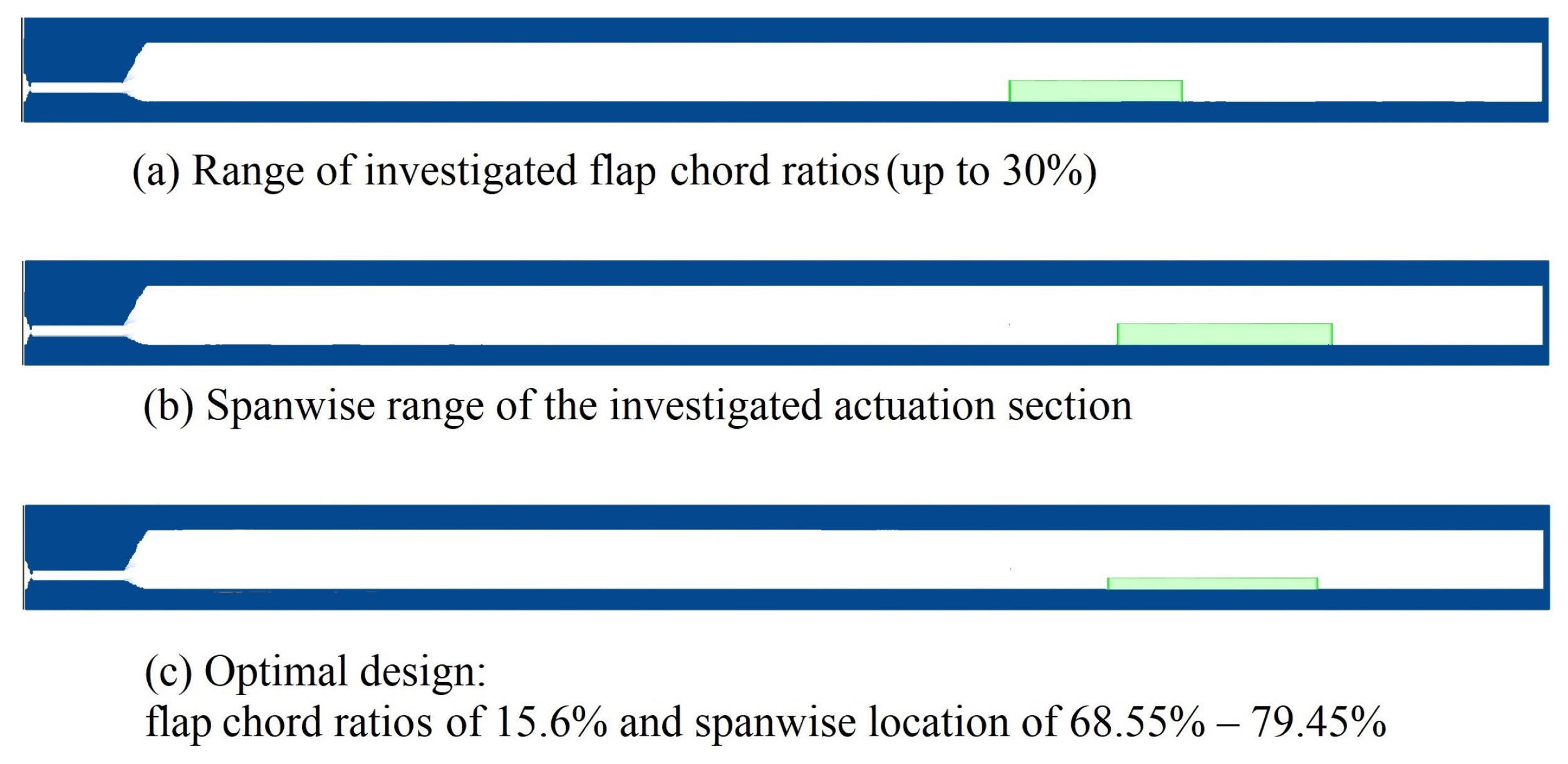


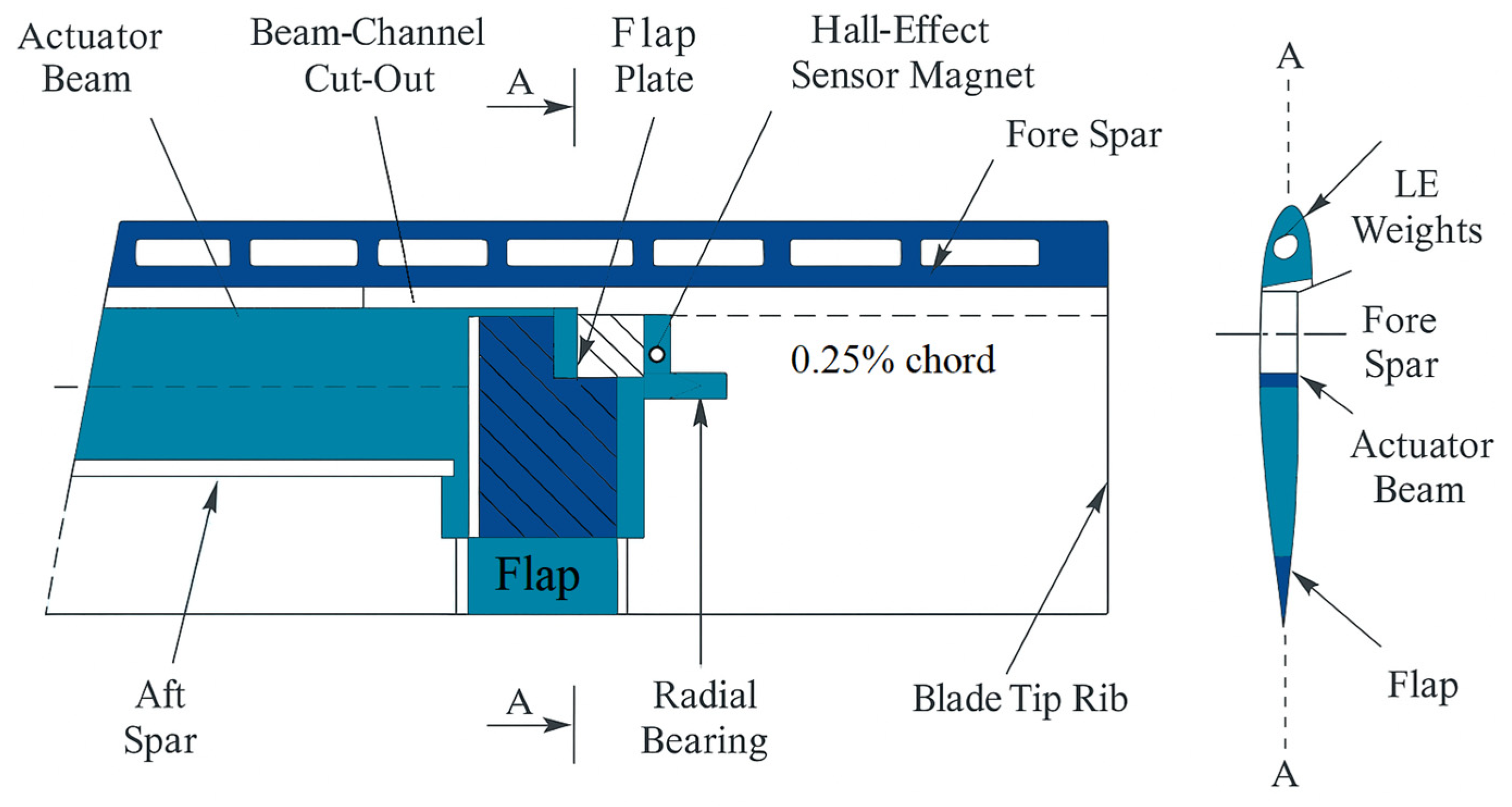
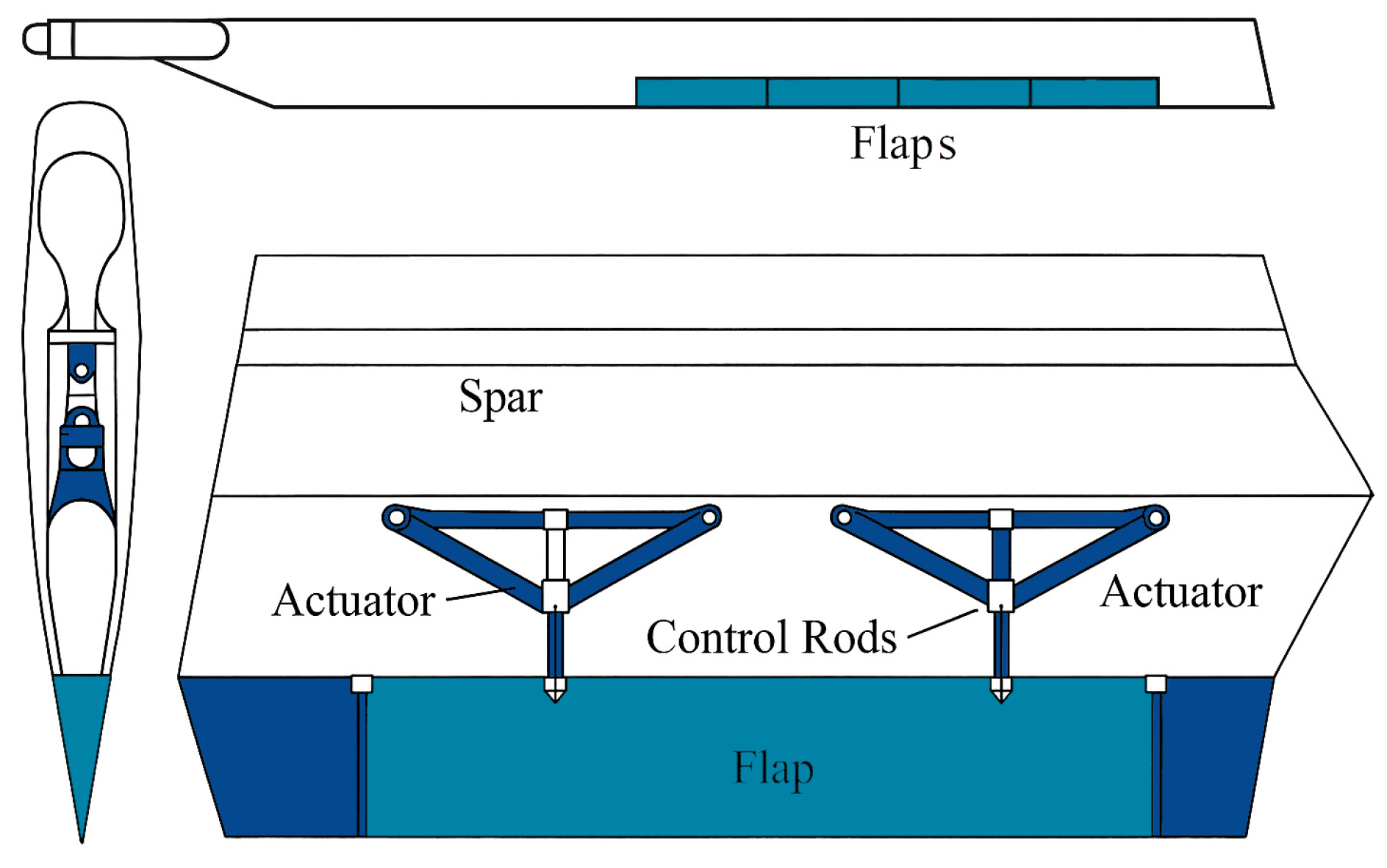


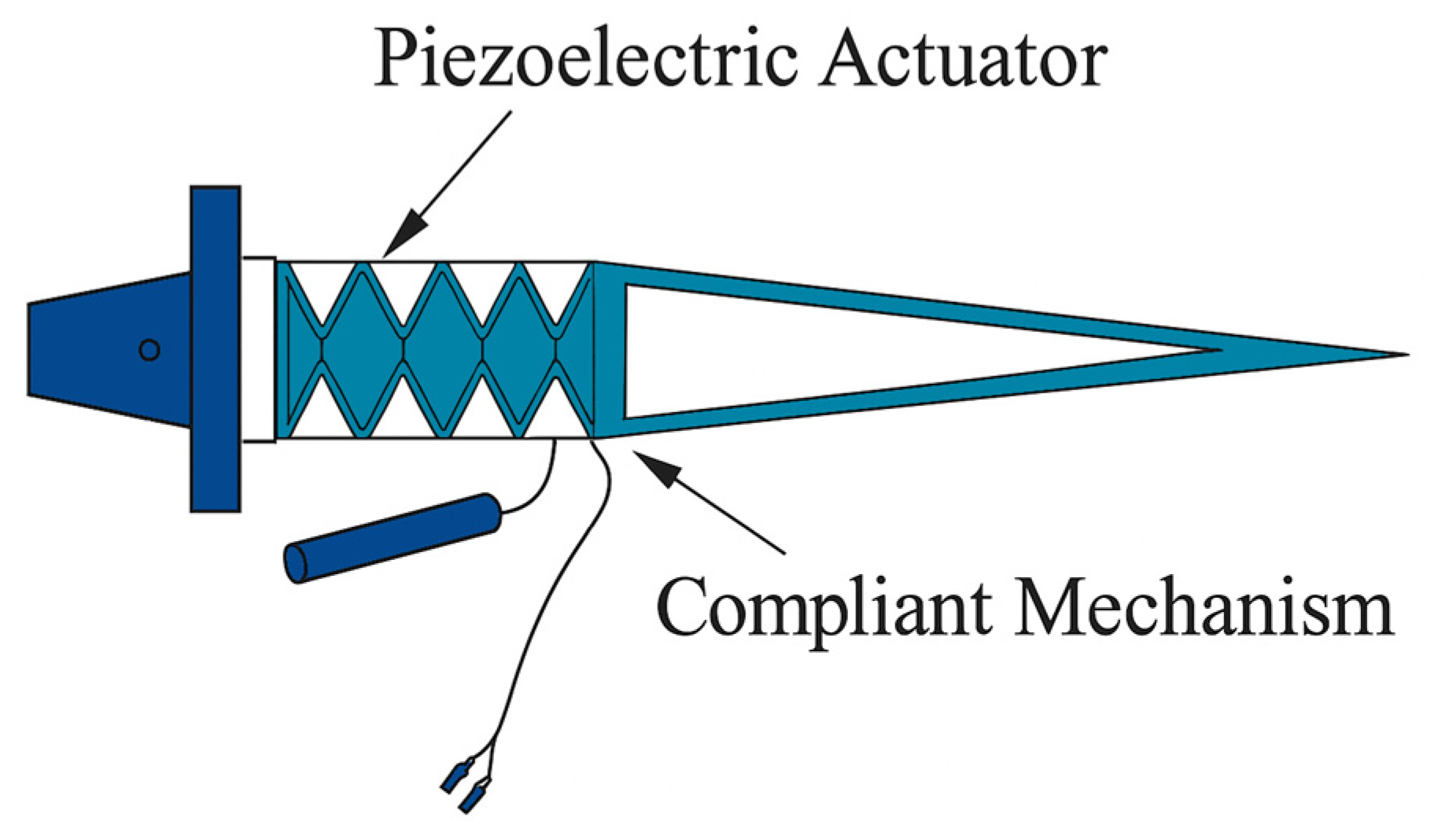


Disclaimer/Publisher’s Note: The statements, opinions and data contained in all publications are solely those of the individual author(s) and contributor(s) and not of MDPI and/or the editor(s). MDPI and/or the editor(s) disclaim responsibility for any injury to people or property resulting from any ideas, methods, instructions or products referred to in the content. |
© 2026 by the authors. Licensee MDPI, Basel, Switzerland. This article is an open access article distributed under the terms and conditions of the Creative Commons Attribution (CC BY) license.
Share and Cite
Burke, M.; Gatto, A. Review of Rotary-Wing Morphing Actuation Systems. Aerospace 2026, 13, 297. https://doi.org/10.3390/aerospace13030297
Burke M, Gatto A. Review of Rotary-Wing Morphing Actuation Systems. Aerospace. 2026; 13(3):297. https://doi.org/10.3390/aerospace13030297
Chicago/Turabian StyleBurke, Mars, and Alvin Gatto. 2026. "Review of Rotary-Wing Morphing Actuation Systems" Aerospace 13, no. 3: 297. https://doi.org/10.3390/aerospace13030297
APA StyleBurke, M., & Gatto, A. (2026). Review of Rotary-Wing Morphing Actuation Systems. Aerospace, 13(3), 297. https://doi.org/10.3390/aerospace13030297