Multi-Criteria LCA Framework for Sustainable Hydropower Refurbishment Design

 ,
,  ,
,  ,
,  ,
,  and
and 
Abstract
1. Introduction
2. Materials and Methods
3. Results
3.1. Context Analysis
3.2. Content Analysis
3.2.1. Current LCA Approaches in Hydropower Systems
3.2.2. Multi-Criteria Frameworks for Sustainable Refurbishment
3.2.3. Circular Economy Principles in Hydropower Refurbishment
4. Discussion
4.1. Gaps and Limitations
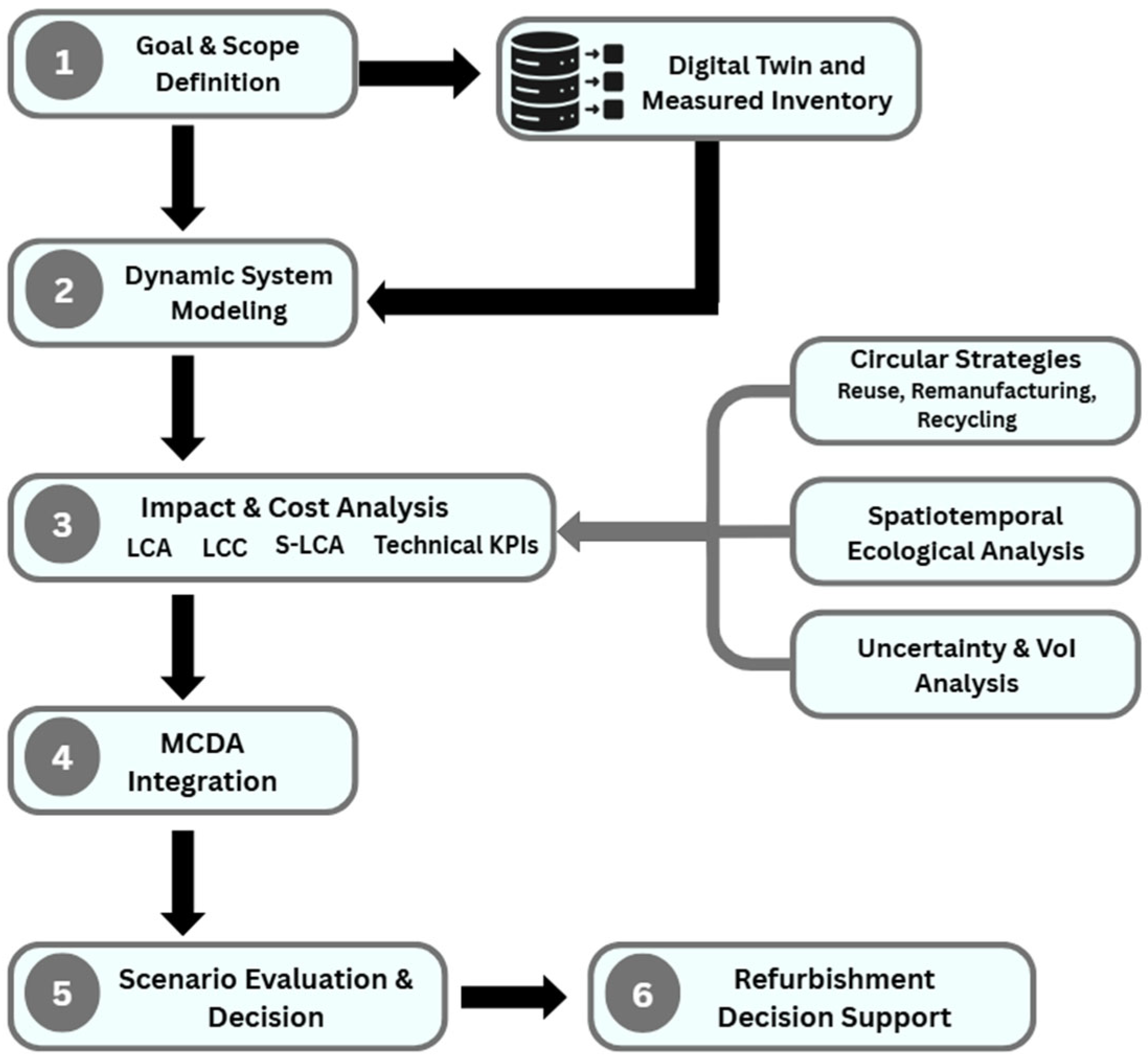
4.2. Proposed Novel LCA Framework for Sustainable Hydropower Refurbishment Design
- a.
- Rationale and Novelty
- (i)
- Dynamic LCI updating through digital-twin and IoT/SCADA data streams, allowing the inventory to reflect measured operational states, degradation patterns, and refurbishment events;
- (ii)
- A spatiotemporal impact layer that links hydropower operation (e.g., hydropeaking, ramping, seasonal constraints) to location-dependent ecological stressors, supporting compliance-oriented assessments (e.g., WFD-aligned decision contexts); and
- (iii)
- Circularity by design embedded in the LCI through parametric representation of reuse, remanufacturing, recyclability, and design for disassembly (DfD), enabling transparent quantification of circular strategies and their influence on life-cycle impacts.
- b.
- Framework Overview and Modules
- Module A. Goal, scope, and refurbishment baselines
“1 MWh net electricity delivered to the grid over the residual lifetime under a specified flexibility requirement (e.g., number of starts, ramping rate, hydropeaking constraints).”
- Module B. Dynamic system representation and state variables
- Component health index, H(t) (e.g., runner, guide vanes, bearings, seals);
- Efficiency trajectory, η(t) and performance losses due to wear;
- Operational profile, F(t) (load factor, starts, ramping, hydropeaking frequency);
- Auxiliary energy use, Eaux(t) (cooling, lubrication, pumps);
- Consumables and fluids, L(t) (lubricants, seals, coatings);
- Maintenance/refurbishment event indicator, M(t) (none/minor/medium/major).
- S(t) = start–stop cycles,
- R(t) = ramping intensity,
- Se(t) = sediment load,
- C(t) = cavitation risk,
- V(t) = vibration intensity.
- is the nominal efficiency at commissioning or immediately after major refurbishment,
- η(t) is the net turbine–generator efficiency at time t;
- H(τ) is the normalized component health index (H = 1 pristine condition, H = 0 failure);
- is the rate of component degradation over time;
- g is a degradation to efficiency coupling function, translating health deterioration into efficiency losses;
- τ is the integration time variable;
- t is the elapsed operational time since the reference state.
- Δηrefurb represents efficiency recovery due to refurbishment,
- η0 is the nominal efficiency;
- t−r and t+r denote the instants immediately before and after refurbishment.
- Module C. Digital-twin and measured-inventory LCI engine
- SCADA and operational logs (starts, load, ramping, flow regimes);
- Condition monitoring systems (vibration spectra, bearing temperatures, partial discharge);
- Maintenance management systems (MMS) (work orders, component replacements, downtime);
- Digital reconstruction for geometry inference and performance mapping;
- Procurement records for materials and spare parts (mass, alloys, coatings).
- LCIbase is the baseline inventory associated with the initial system configuration,
- ΔLCIop(t) represents operation-related flows (e.g., auxiliary electricity, consumables, losses),
- ΔLCImaint(t) accounts for maintenance-related flows (e.g., spare parts, transport, workshop processes),
- ΔLCIrefurb(t) captures refurbishment or major overhaul interventions occurring at time t.
- Module D. Embedded circularity by design parameterization
- Reuse rate (ru): fraction of components reused without reprocessing;
- Remanufacturing rate (rrm): fraction restored to specification through reconditioning;
- Recycling rate (rrc): fraction recycled into secondary materials;
- Design for disassembly score (DfD): influences dismantling energy, labor, and achievable ru/rm/rrc;
- Material substitution factor (sm): accounts for alternative materials/coatings influencing lifespan and replacement frequency.
- mdemand(t) is the total material demand at time t,
- ru = reuse rate,
- rrm = remanufacturing rate.
- rrc = recycling rate,
- αsec = effective substitution ratio of secondary materials and can be aligned with the selected allocation approach (e.g., substitution or cut-off), which must be transparently reported.
- Module E. Spatiotemporal ecological layer for water and biodiversity
- river typology/ecoregion, habitat connectivity, protected areas;
- WFD status, environmental flow requirements;
- fish migration sensitivity (seasonality), sediment regime, temperature vulnerability.
- Peco(t) is the ecological pressure indicator;
- R(t) is ramping intensity;
- S(t) is start–stop frequency;
- Secol is the site-specific ecological sensitivity factor;
- β1,β2 are weighting coefficients.
- where
- Cop(t) are operating costs,
- Cmaint(t) maintenance costs,
- Crefurb(t) refurbishment costs,
- Cdt(t) downtime costs,
- i is the discount rate.
- Module F. Uncertainty quantification and Value-of-Information (VoI)
- c.
- Scenario Definition and Decision Outputs
- Environmental impacts (LCIA indicators) aggregated over the residual lifetime and optionally disaggregated over time;
- Economic results via LCC (NPV, CAPEX/OPEX, avoided replacement costs, downtime costs);
- Optional social metrics (e.g., worker safety proxies, local employment effects, acceptance indicators);
- Technical performance indicators (availability, efficiency recovery, expected life extension);
- Circularity outcomes (mass loop closure, reuse/reman/recycle fractions, DfD-enabled recovery).
- d.
- Practical Implementation Pathway
5. Conclusions
Author Contributions
Funding
Data Availability Statement
Conflicts of Interest
Abbreviations
| CAPEX | Capital Expenditure |
| CE | Circular Economy |
| CEAP | Circular Economy Action Plan |
| CEI | Circular Economy Indicator |
| DNSH | Do no significant harm |
| DfD | Design for Disassembly |
| DT | Digital Twin |
| EoL | End of Life |
| EPD | Environmental Product Declaration |
| FU | Functional unit |
| HPP | Hydropower Plant |
| IoT | Internet of Things |
| LCA | Life Cycle Assessment |
| LCC | Life Cycle Cost |
| LCI | Life Cycle Inventory |
| LCIA | Life Cycle Impact Assessment |
| LCSA | Life Cycle Sustainability Assessment |
| MCDA | Multi-Criteria Decision Analysis |
| ML | Machine Learning |
| NPV | Net Present Value |
| PCR | Product Category Rules |
| PdM | Predictive Maintenance |
| PSHP | Pumped-Storage Hydropower Plant |
| SEETA | Social, Economic, Environmental, and Technical Assessment |
| S-LCA | Social Life Cycle Assessment |
| TBL | Triple Bottom Line |
Appendix A

| Ref. | Short Citation | Review Type | Main Scope | Main Dimensions Covered | Contribution to This Manuscript (Why Analyzed in Detail) | Main Section(s) Informed |
|---|---|---|---|---|---|---|
| [1] | Gemechu & Kumar (2022) | Narrative review | Use of LCA in hydropower environmental impact assessment | LCA, LCIA, hydropower | Core baseline review for how LCA has been applied to hydropower systems; supports framing of current LCA practices and methodological inconsistencies | Introduction; 3.2.1; 4.1 |
| [3] | Pranoto et al. (2025) | Comprehensive systematic literature review | Hydropower sustainability across environmental, social, economic and technical dimensions | TBL + technical, sustainability assessment | Supports the need for integrated multi-dimensional assessment beyond environmental-only approaches | Introduction; 3.2.2; 4.1 |
| [12] | Quaranta & Davies (2022) | Review | Innovative materials for hydropower engineering (turbines, bearings, seals, dams, waterways) | Materials, eco-design, refurbishment engineering | Supports discussion on material innovation, lightweight composites, durability, and performance implications in refurbishment | Introduction; 3.2.3; 4.2 |
| [25] | Zhang et al. (2021) | Review and modeling paper | Hydropower sustainability assessment methods | Sustainability indicators, assessment models | Used to justify lack of harmonized hydropower sustainability standards and the need for structured frameworks | Introduction; 4.1 |
| [27] | Wulf et al. (2019) | Review | Life-cycle-based sustainability assessment approaches | LCA, LCC, S-LCA, LCSA | Provides methodological grounding for integrated life-cycle sustainability approaches used in the conceptual framework | Introduction; 3.2.1; 3.2.2 |
| [30] | Mwakangale et al. (2025) | Systematic review | Lifecycle-based approaches for hydropower sustainability | LCA/LCC/S-LCA/LCSA in hydropower | Core hydropower-focused lifecycle synthesis; supports state-of-the-art mapping and identification of gaps | Introduction; 3.2.1; 4.1 |
| [31] | Bruno et al. (2025) | Comprehensive overview review | Integrated LCSA approaches (LCA + S-LCA + LCC) | LCSA methodology | Supports the integration logic of environmental-economic-social dimensions in the proposed framework | Introduction; 3.2.1; 3.2.2 |
| [32] | Costa et al. (2019) | Systematic review | LCSA state-of-the-art, challenges, and implementation barriers | LCSA, methodological challenges | Used to substantiate implementation challenges and uncertainty/standardization needs in integrated assessment | Introduction; 3.2.1; 4.1 |
| [33] | Wu (2024) | Review | Circular economy concepts in hydropower generation | CE, sustainable practices, future prospects | Supports CE framing in hydropower and motivates circularity indicators in refurbishment decisions | Introduction; 3.2.3; 4.2 |
| [36] | Campos-Guzman et al. (2019) | Review | LCA + MCDA integration for renewable energy sustainability evaluation | LCA-MCDA, renewable energy | Key methodological reference for combining lifecycle indicators with decision-making/ranking methods | 3.2.2; 4.2 |
| [37] | Zanghelini et al. (2017) | Review | MCDA support for LCA results interpretation | LCA interpretation, MCDA methods | Foundational methodological source for explaining why MCDA is needed to interpret multiple LCIA indicators | 3.2.1; 3.2.2; 4.1 |
| [43] | Motuzienė et al. (2022) | Review | LCA results across different energy conversion technologies | Comparative energy LCA | Provides comparative context for hydropower within broader energy technologies and supports cross-technology benchmarking discussion | 3.2.1; 3.2.2 |
| [46] | Luangphon et al. (2025) | Review | Environmental effects of hydropower plants assessed by LCA | Hydropower LCA, environmental impacts, system boundaries | Core reference for hydropower LCA stages, hotspots, boundary inconsistencies, and limitations | 3.2.1; 4.1 |
| [62] | Ubando et al. (2022) | Critical review | Sustainable manufacturability of Archimedes screw turbines | Manufacturing, materials, eco-design, MCDA relevance | Supports component-level sustainable design/refurbishment discussion and material/manufacturing trade-offs | 3.2.2; 3.2.3 |
| [64] | Hemmati et al. (2024) | Review | Integrated LCSA methodologies for multiple power generation technologies | LCSA, future energy mix, multi-technology evaluation | Used to position hydropower refurbishment within broader multi-technology sustainability assessment practice | 3.2.1; 3.2.2 |
| [68] | Shanbhag et al. (2025) | Review | Predictive maintenance of critical components in hydroelectric turbines | PdM, sensors, digitalization, turbine maintenance | Key support for digitalization, condition-based maintenance, and dynamic inventory updating concepts in DT-DySC-LCA | 3.2.1; 4.1; 4.2 |
| [74] | Sebestyén (2021) | Review/synthesis (network-based) | Environmental impact networks of renewable energy power plants | Comparative environmental impacts, renewable systems | Provides comparative context for interpreting hydropower impacts relative to other renewables | 3.2.1 |
| [78] | Ferreira & Gonçalves (2021) | Systematic review | Industrial life-extension strategies: remanufacturing and refurbishment | Refurbishment, remanufacturing, life extension, circularity | Important for conceptual transfer of refurbishment/remanufacturing principles to hydropower CE strategies | 3.2.2; 3.2.3; 4.1 |
| [92] | Quaranta et al. (2021) | Technology review/perspective review | Environmentally enhanced turbines for hydropower | Fish-friendly turbines, eco-design, ecological mitigation | Supports biodiversity-sensitive refurbishment options and trade-offs between efficiency and ecological performance | 3.2.3; 4.2 |
References
- Gemechu, E.; Kumar, A. A Review of How Life Cycle Assessment Has Been Used to Assess the Environmental Impacts of Hydropower Energy. Renew. Sustain. Energy Rev. 2022, 167, 112684. [Google Scholar] [CrossRef] [Scilit]
- Rhazzali (Birgovan), A.L.; Lakatos, E.S.; Minea, G.; Cioca, L.-I.; Barnisca, M.; Ferenci, S.; Szabo, L.; Munteanu, R.A. Measuring Circular Economy Indicator in Hydropower Refurbishment. Energies 2025, 18, 5922. [Google Scholar] [CrossRef] [Scilit]
- Pranoto, B.; Hartulistiyoso, E.; Aidi, M.N.; Sutrisno, D.; Soekarno, H.; Efiyanti, L.; Indrawan, D.A.; Rahmila, Y.I.; Anwar, A.; Gunawan, Y.; et al. Sustainability assessment of hydropower: A comprehensive systematic literature review of environmental, social, economic, and technical dimensions. J. Sustain. Sci. Manag. 2025, 20, 573–610. [Google Scholar] [CrossRef] [Scilit]
- IRENA. The Changing Role of Hydro Power: Challenges and Opportunities; International Renewable Energy Agency: Abu Dhabi, United Arab Emirates, 2023; ISBN 978-1-5231-5171-4.
- Mišech, A.; Schleiss, A.; Fry, J.-J.; Multhaupt, H. Research & Innovation Agenda. Hydropower Europe Forum. 2021. Available online: https://hydropower-europe.eu/latest-news/the-research-and-innovation-agenda-ria-and-the-strategic-industry-roadmap-sir/ (accessed on 9 January 2026).
- de Albuquerque, V.C.; Calili, R.F.; de Almeida, M.F.L.; Albuquerque, R.; Castro, T.; Kelman, R.; de Albuquerque, V.C.; Calili, R.F.; de Almeida, M.F.L.; Albuquerque, R.; et al. Integrated Spatiotemporal Life Cycle Assessment Framework for Hydroelectric Power Generation in Brazil. Energies 2025, 18, 5606. [Google Scholar] [CrossRef] [Scilit]
- Joint Research Centre. Hydropower and Pumped Hydropower Storage in the European Union. Status Report on Technology Development, Trends, Value Chains and Markets; European Commission: Clean Energy Technology Observatory: Ispra, Italy, 2023. [Google Scholar]
- Kumar, A.; Schei, T.; Ahenkorah, A.; Rodriguez, R.C.; Salvador, E.; Devernay, J.-M.; Freitas, M.; Hall, D.; Killingtveit, Å.; Liu, Z.; et al. Hydropower. In The IPCC Special Report on Renewable Energy Sources and Climate Change Mitigation; Cambridge University Press: Cambridge, UK, 2011. [Google Scholar]
- Meier, J. Hydropower’s Universal Dilemma: Repair or Replace? National Hydropower Association: Washington, DC, USA, 2022. [Google Scholar]
- International Energy Agency. Hydropower; IEA Technology Roadmaps; OECD: Paris, France, 2012; ISBN 978-92-64-18920-1. [Google Scholar]
- Rahi, O.P.; Kumar, A. Economic Analysis for Refurbishment and Uprating of Hydro Power Plants. Renew. Energy 2016, 86, 1197–1204. [Google Scholar] [CrossRef] [Scilit]
- Quaranta, E.; Davies, P. Emerging and Innovative Materials for Hydropower Engineering Applications: Turbines, Bearings, Sealing, Dams and Waterways, and Ocean Power. Engineering 2022, 8, 148–158. [Google Scholar] [CrossRef] [Scilit]
- Water Power Technologies Office. Curious About Modernizing Hydropower Facilities? Explore These Six Questions. Available online: https://www.energy.gov/eere/water/articles/curious-about-modernizing-hydropower-facilities-explore-these-six-questions (accessed on 12 January 2026).
- Hydropower Sustainability Alliance. ESG RISK 6: Biodiversity and Habitat Connectivity. Available online: https://www.hs-alliance.org/hydroselect-esg-risks/biodiversity-and-habitat-connectivity (accessed on 12 January 2026).
- European Commission. The European Green Deal. Striving to Be the First Climate-Neutral Continent. Available online: https://commission.europa.eu/strategy-and-policy/priorities-2019-2024/european-green-deal_en (accessed on 12 January 2026).
- European Commission. Commission Notice: Technical Guidance on the Application of ‘Do No Significant Harm’ Under the Recovery and Resilience Facility Regulation (2021/C 58/01). 2021. Available online: https://eur-lex.europa.eu/legal-content/GA/ALL/?uri=CELEX:52021XC0218(01) (accessed on 12 January 2026).
- European Commission. A New Circular Economy Action Plan. Available online: https://eur-lex.europa.eu/resource.html?uri=cellar:9903b325-6388-11ea-b735-01aa75ed71a1.0011.02/DOC_1&format=PDF (accessed on 12 January 2026).
- Bruel, A.; Kronenberg, J.; Troussier, N.; Guillaume, B. Linking Industrial Ecology and Ecological Economics: A Theoretical and Empirical Foundation for the Circular Economy. J. Ind. Ecol. 2019, 23, 12–21. [Google Scholar] [CrossRef] [Scilit]
- European Commission. Circular Economy—Environment. Available online: https://environment.ec.europa.eu/strategy/circular-economy_en (accessed on 12 January 2026).
- Kirchherr, J.; Reike, D.; Hekkert, M. Conceptualizing the Circular Economy: An Analysis of 114 Definitions. Resour. Conserv. Recycl. 2017, 127, 221–232. [Google Scholar] [CrossRef] [Scilit]
- Lakatos, E.S.; Yong, G.; Szilagyi, A.; Clinci, D.S.; Georgescu, L.; Iticescu, C.; Cioca, L.-I. Conceptualizing Core Aspects on Circular Economy in Cities. Sustainability 2021, 13, 7549. [Google Scholar] [CrossRef] [Scilit]
- European Parliament; European Council. Directive 2000/60/EC of the European Parliament and of the Council of 23 October 2000 Establishing a Framework for Community Action in the Field of Water Policy. 2000. Available online: https://eur-lex.europa.eu/eli/dir/2000/60/oj/eng (accessed on 12 January 2026).
- European Commission. Commission Notice: Guidance Document on the Requirements for Hydropower in Relation to EU Nature Legislation (2018/C 213/01). Off. J. Eur. Union 2018, 61, C213/1–C213/61. [Google Scholar]
- European Parliament; European Council. Directive (EU) 2023/2413 of the European Parliament and of the Council of 18 October 2023 Amending Directive (EU) 2018/2001, Regulation (EU) 2018/1999 and Directive 98/70/EC as Regards the Promotion of Energy from Renewable Sources, and Repealing Council Directive (EU) 2015/652. 2023. Available online: https://eur-lex.europa.eu/eli/dir/2023/2413/oj/eng (accessed on 12 January 2026).
- Zhang, Y.; Ma, H.; Zhao, S. Assessment of Hydropower Sustainability: Review and Modeling. J. Clean. Prod. 2021, 321, 128898. [Google Scholar] [CrossRef] [Scilit]
- Hauschild, M.Z.; Rosenbaum, R.K.; Olsen, S.I. About This Book. In Life Cycle Assessment; Hauschild, M.Z., Rosenbaum, R.K., Olsen, S.I., Eds.; Springer International Publishing: Cham, Switzerland, 2018; pp. 3–8. ISBN 978-3-319-56474-6. [Google Scholar]
- Wulf, C.; Werker, J.; Ball, C.; Zapp, P.; Kuckshinrichs, W. Review of Sustainability Assessment Approaches Based on Life Cycles. Sustainability 2019, 11, 5717. [Google Scholar] [CrossRef] [Scilit]
- ISO 14040:2006; Environmental Management—Life Cycle Assessment—Principles and Framework. International Organization for Standardization: Geneva, Switzerland, 2006.
- ISO 14044:2006; Environmental Management—Life Cycle Assessment—Requirements and Guidelines. International Organization for Standardization: Geneva, Switzerland, 2006.
- Mwakangale, J.; Cook, D.; Ögmundarson, Ó.; Davíðsdóttir, B. A Systematic Review on the Application of Lifecycle-Based Approaches in Assessing Sustainability of Hydropower. Renew. Sustain. Energy Rev. 2025, 219, 115841. [Google Scholar] [CrossRef] [Scilit]
- Bruno, A.; Menichini, T.; Silvestri, L. Life Cycle Sustainability Assessment (LCSA): A Comprehensive Overview of Existing Integrated Approaches to LCA, S-LCA, and LCC. Eur. J. Sustain. Dev. 2025, 14, 13. [Google Scholar] [CrossRef] [Scilit]
- Costa, D.; Quinteiro, P.; Dias, A.C. A Systematic Review of Life Cycle Sustainability Assessment: Current State, Methodological Challenges, and Implementation Issues. Sci. Total Environ. 2019, 686, 774–787. [Google Scholar] [CrossRef] [Scilit]
- Wu, J. Embracing Circular Economy Concepts in Hydropower Generation: A Review of Sustainable Practices and Future Prospect. Appl. Comput. Eng. 2024, 85, 242–248. [Google Scholar] [CrossRef] [Scilit]
- United Nations Department of Economic and Social Affairs. The 17 Sustainable Development Goals. Available online: https://sdgs.un.org/goals (accessed on 12 January 2026).
- International Energy Agency. Hydropower Special Market Report: Analysis and Forecast to 2030; OECD: Paris, France, 2021; ISBN 978-92-64-48263-0. [Google Scholar]
- Campos-Guzman, V.; García-Cascales, M.S.; Espinosa, N.; Urbina, A. Life Cycle Analysis with Multi-Criteria Decision Making: A Review of Approaches for the Sustainability Evaluation of Renewable Energy Technologies. Renew. Sustain. Energy Rev. 2019, 104, 343. [Google Scholar] [CrossRef] [Scilit]
- Zanghelini, G.; Cherubini, E.; Soares, S. How Multi-Criteria Decision Analysis (MCDA) Is Aiding Life Cycle Assessment (LCA) in Results Interpretation. J. Clean. Prod. 2017, 172, 609–622. [Google Scholar] [CrossRef] [Scilit]
- Atilgan, B.; Azapagic, A. An Integrated Life Cycle Sustainability Assessment of Electricity Generation in Turkey. Energy Policy 2016, 93, 168–186. [Google Scholar] [CrossRef] [Scilit]
- Sadeghi, A.; Maleki, A.; Ahmadi, M.H.; Kiani, A.H. Comparative Evaluation of Renewable Energy Investments: A Multi-Criteria Decision-Making Approach. Energy Convers. Manag. X 2025, 28, 101190. [Google Scholar] [CrossRef] [Scilit]
- Dale, A.T.; de Lucena, A.F.P.; Marriott, J.; Borba, B.S.M.C.; Schaeffer, R.; Bilec, M.M.; Dale, A.T.; de Lucena, A.F.P.; Marriott, J.; Borba, B.S.M.C.; et al. Modeling Future Life-Cycle Greenhouse Gas Emissions and Environmental Impacts of Electricity Supplies in Brazil. Energies 2013, 6, 3182–3208. [Google Scholar] [CrossRef] [Scilit]
- Geller, M.T.B.; Meneses, A.A.D.M. Life Cycle Assessment of a Small Hydropower Plant in the Brazilian Amazon. J. Sustain. Dev. Energy Water Environ. Syst.-Jsdewes 2016, 4, 379–391. [Google Scholar] [CrossRef] [Scilit]
- Sobhani, S.S.; Zahedi, R.; Yousefi, H.; Hajinezhad, A. Configuring Renewable Energy Supply for Electric Vehicle Charging Stations in Switzerland: Life Cycle Assessment and Multi-Objective Optimization. Energy Convers. Manag. X 2026, 29, 101457. [Google Scholar] [CrossRef] [Scilit]
- Motuzienė, V.; Čiuprinskas, K.; Rogoža, A.; Lapinskienė, V. A Review of the Life Cycle Analysis Results for Different Energy Conversion Technologies. Energies 2022, 15, 8488. [Google Scholar] [CrossRef] [Scilit]
- Mostafaei, H.; Chamasemani, N.F.; Mashayekhi, M.; Hamzehkolaei, N.S.; Santos, P. Sustainability Enhancement and Evaluation of a Concrete Dam Using Recycling. Appl. Sci. 2025, 15, 2479. [Google Scholar] [CrossRef] [Scilit]
- Rashid, E.; Majed, N. Integrated Life Cycle Sustainability Assessment of the Electricity Generation Sector in Bangladesh: Towards Sustainable Electricity Generation. Energy Rep. 2023, 10, 3993–4012. [Google Scholar] [CrossRef] [Scilit]
- Luangphon, S.; Shen, J.; Huang, X.; Ramirez, J.; Han, Y.; Ruan, X. Evaluation of the Environmental Effects from Hydropower Plants Using Life Cycle Assessment: A Review. Resour. Conserv. Recycl. 2025, 223, 108530. [Google Scholar] [CrossRef] [Scilit]
- Singh, S.; Upadhyay, S.P.; Powar, S. Developing an Integrated Social, Economic, Environmental, and Technical Analysis Model for Sustainable Development Using Hybrid Multi-Criteria Decision Making Methods. Appl. Energy 2022, 308, 118235. [Google Scholar] [CrossRef] [Scilit]
- Gilad, D.; Borgelt, J.; May, R.; Dorber, M.; Verones, F. Biodiversity Impacts of Norway’s Renewable Electricity Grid. J. Clean. Prod. 2024, 469, 143096. [Google Scholar] [CrossRef] [Scilit]
- Vougioukli, A.Z.; Didaskalou, E.; Georgakellos, D. Financial Appraisal of Small Hydro-Power Considering the Cradle-to-Grave Environmental Cost: A Case from Greece. Energies 2017, 10, 430. [Google Scholar] [CrossRef] [Scilit]
- Halych, O.; Bilkova, E.; Nowak, P.; Riabenko, O. Analysis of Hydropotential and Prospects for Small Hydropower Development in Ukraine. Environ. Clim. Technol. 2023, 27, 763–774. [Google Scholar] [CrossRef] [Scilit]
- Ohiemi, I.E.; McNabola, A.; Ohiemi, I.E.; McNabola, A. Design Optimisation of Legacy Francis Turbine Using Inverse Design and CFD: A Case Study of Bérchules Hydropower Plant. Energies 2025, 18, 5602. [Google Scholar] [CrossRef] [Scilit]
- Ohiemi, I.E.; McNabola, A. Supporting the Digitalisation of Existing Hydropower Plants Using Computational Fluid Dynamics Modelling. Renew. Energy 2026, 256, 124174. [Google Scholar] [CrossRef] [Scilit]
- Gómez-Gener, L.; Gubau, M.; von Schiller, D.; Marcé, R.; Obrador, B. Integrated Assessment of the Net Carbon Footprint of Small Hydropower Plants. Environ. Res. Lett. 2023, 18, 084015. [Google Scholar] [CrossRef] [Scilit]
- Kjeld, A.; Bjarnadóttir, H.J.; Ólafsdottir, R. Life Cycle Assessment of Hydropower Utilization in Iceland as a Driving Force for Climate Strategy and Decarbonization. Int. J. Life Cycle Assess. 2025, 30, 1806–1826. [Google Scholar] [CrossRef] [Scilit]
- Atsafack, B.M.; Kabiri, C.; Rushingabigwi, G. A Multi-Model Predictive Framework for Unsupervised Anomaly Detection in Univariate Time Series Data from Hydraulic Turbine Units. Energy Rep. 2025, 14, 4701–4709. [Google Scholar] [CrossRef] [Scilit]
- Lang, X.; Nilsson, H.; Mao, W. Analysis of Hydropower Plant Guide Bearing Vibrations by Machine Learning Based Identification of Steady Operations. Renew. Energy 2024, 236, 121463. [Google Scholar] [CrossRef] [Scilit]
- Vázquez-López, E.; Matitos-Montoya, V.; Marrero, M. Rehabilitation or Demolition of Small Hydropower Plants: Evaluation of the Environmental and Economic Sustainability of the Case Study “El Cerrajón.”. Environments 2024, 11, 184. [Google Scholar] [CrossRef] [Scilit]
- de Visser, S.; Verones, F.; Dorber, M. Scaling Effects on Material Demand in Hydropower: Implications for Life Cycle Inventory Modeling. Resour. Conserv. Recycl. 2026, 226, 108680. [Google Scholar] [CrossRef] [Scilit]
- Fadul-Bonamusa, M.; Jarquin Laguna, A.; Steubing, B. Life Cycle Assessment of Offshore Low-Head Pumped Hydro Storage and Its Comparison with Other Energy Storage Technologies. Int. J. Life Cycle Assess. 2025, 30, 3005–3017. [Google Scholar] [CrossRef] [Scilit]
- Quaranta, E. Assessment of the Electro-Mechanical Equipment’s Weight of the European Hydropower Fleet. Sci. Rep. 2023, 13, 16792. [Google Scholar] [CrossRef] [Scilit]
- Quaranta, E.; Bergamin, R.; Schleiss, A.J. How to Estimate the Weight of Hydropower Electro-Mechanical Equipment? Available Evidence, Novel Equations and Challenges for Engineering Applications. Results Eng. 2023, 18, 101067. [Google Scholar] [CrossRef] [Scilit]
- Ubando, A.T.; Marfori, I.A.V., III; Peradilla, M.S.; Sy, C.L.; Calapatia, A.M.A.; Chen, W.-H. Sustainable Manufacturability of Archimedes Screw Turbines: A Critical Review. J. Manuf. Mater. Process. 2022, 6, 161. [Google Scholar] [CrossRef] [Scilit]
- Sousa, S.; Botelho, A.; Pinto, L.M.C.; Valente, M. How Relevant Are Non-Use Values and Perceptions in Economic Valuations? The Case of Hydropower Plants. Energies 2019, 12, 2986. [Google Scholar] [CrossRef] [Scilit]
- Hemmati, M.; Bayati, N.; Ebel, T. Integrated Life Cycle Sustainability Assessment with Future Energy Mix: A Review of Methodologies for Evaluating the Sustainability of Multiple Power Generation Technologies Development. Renew. Energy Focus 2024, 49, 100581. [Google Scholar] [CrossRef] [Scilit]
- Berridy-Segade, L.; Del Prado Díaz De Mera Sánchez, M.; Reyes-Belmonte, M.Á.; Martín-Gamboa, M. Assessing the Social Life Cycle Impacts of the Spanish Electricity Mix: A Decadal Analysis. Sustain. Prod. Consum. 2024, 49, 329–340. [Google Scholar] [CrossRef] [Scilit]
- Li, X.; Gui, F.; Li, Q. Can Hydropower Still Be Considered a Clean Energy Source? Compelling Evidence from a Middle-Sized Hydropower Station in China. Sustainability 2019, 11, 4261. [Google Scholar] [CrossRef] [Scilit]
- Huang, X.; Hayashi, K.; Fujii, M.; Villa, F.; Yamazaki, Y.; Okazawa, H. Identification of Potential Locations for Small Hydropower Plant Based on Resources Time Footprint: A Case Study in Dan River Basin, China. Renew. Energy 2023, 205, 293–304. [Google Scholar] [CrossRef] [Scilit]
- Shanbhag, V.V.; Kandukuri, S.T.; Olimstad, G.; Schlanbusch, R. Predictive Maintenance of Critical Components in Hydroelectric Turbines: A Review. IEEE Sens. J. 2025, 25, 31959–31979. [Google Scholar] [CrossRef] [Scilit]
- Jiang, T.; Shen, Z.; Liu, Y.; Hou, Y. Carbon Footprint Assessment of Four Normal Size Hydropower Stations in China. Sustainability 2018, 10, 2018. [Google Scholar] [CrossRef] [Scilit]
- Lazo-Vásquez, D.; Urbina, C.; Rivela, B. On the Potential Environmental Repercussions of Hydroelectricity: A Contribution Based on Life Cycle Assessment of Ecuadorian Hydropower Plants. Rev. Virtual Quím. 2022, 14, 50–55. [Google Scholar] [CrossRef] [Scilit]
- Mortey, E.M.; Ofosu, E.A.; Kolodko, D.V.; Kabobah, A.T. Sustainability Assessment of the Bui Hydropower System. Environments 2017, 4, 25. [Google Scholar] [CrossRef] [Scilit]
- Eshra, N.M.; Zobaa, A.F.; Abdel Aleem, S.H.E. Assessment of Mini and Micro Hydropower Potential in Egypt: Multi-Criteria Analysis. Energy Rep. 2021, 7, 81–94. [Google Scholar] [CrossRef] [Scilit]
- Karkour, S.; Ichisugi, Y.; Abeynayaka, A.; Itsubo, N. External-Cost Estimation of Electricity Generation in G20 Countries: Case Study Using a Global Life-Cycle Impact-Assessment Method. Sustainability 2020, 12, 2002. [Google Scholar] [CrossRef] [Scilit]
- Sebestyén, V. Renewable and Sustainable Energy Reviews: Environmental Impact Networks of Renewable Energy Power Plants. Renew. Sustain. Energy Rev. 2021, 151, 111626. [Google Scholar] [CrossRef] [Scilit]
- Fearnside, P.M. Emissions from Tropical Hydropower and the IPCC. Environ. Sci. Policy 2015, 50, 225–239. [Google Scholar] [CrossRef] [Scilit]
- Quaranta, E.; Aggidis, G.; Boes, R.M.; Comoglio, C.; De Michele, C.; Ritesh Patro, E.; Georgievskaia, E.; Harby, A.; Kougias, I.; Muntean, S.; et al. Assessing the Energy Potential of Modernizing the European Hydropower Fleet. Energy Convers. Manag. 2021, 246, 114655. [Google Scholar] [CrossRef] [Scilit]
- Quaranta, E.; Muntean, S. Wasted and Excess Energy in the Hydropower Sector: A European Assessment of Tailrace Hydrokinetic Potential, Degassing-Methane Capture and Waste-Heat Recovery. Appl. Energy 2023, 329, 120213. [Google Scholar] [CrossRef] [Scilit]
- Ferreira, C.; Gonçalves, G. A Systematic Review on Life Extension Strategies in Industry: The Case of Remanufacturing and Refurbishment. Electronics 2021, 10, 2669. [Google Scholar] [CrossRef] [Scilit]
- Santos, M.J.; Ferreira, P.; Araujo, M.; Portugal-Pereira, J.; Lucena, A.F.P.; Schaeffer, R. Scenarios for the Future Brazilian Power Sector Based on a Multi Criteria Assessment. J. Clean. Prod. 2017, 167, 938–950. [Google Scholar] [CrossRef] [Scilit]
- Zebra, E.I.C.; van der Windt, H.J.; Nhambiu, J.O.P.; Golinucci, N.; Gandiglio, M.; Bianco, I.; Faaij, A.P.C.; Zebra, E.I.C.; van der Windt, H.J.; Nhambiu, J.O.P.; et al. The Integration of Economic, Environmental, and Social Aspects by Developing and Demonstrating an Analytical Framework That Combines Methods and Indicators Using Mavumira Village as a Case Study. Sustainability 2024, 16, 9829. [Google Scholar] [CrossRef] [Scilit]
- Pfister, S.; Saner, D.; Koehler, A. The Environmental Relevance of Freshwater Consumption in Global Power Production. Int. J. Life Cycle Assess. 2011, 16, 580–591. [Google Scholar] [CrossRef] [Scilit]
- Gaete-Morales, C.; Gallego-Schmid, A.; Stamford, L.; Azapagic, A. Assessing the Environmental Sustainability of Electricity Generation in Chile. Sci. Total Environ. 2018, 636, 1155–1170. [Google Scholar] [CrossRef] [Scilit]
- Gazar, A.M.; Borsuk, M.E.; Calder, R.S.D. Causal Inference to Scope Environmental Impact Assessment of Renewable Energy Projects and Test Competing Mental Models of Decarbonization. Environ. Res. Infrastruct. Sustain. 2024, 4, 045005. [Google Scholar] [CrossRef] [Scilit]
- Schomberg, A.C.; Bringezu, S.; Floerke, M.; Biederbick, H. Spatially Explicit Life Cycle Assessments Reveal Hotspots of Environmental Impacts from Renewable Electricity Generation. Commun. Earth Environ. 2022, 3, 197. [Google Scholar] [CrossRef] [Scilit]
- Dorber, M.; Scherer, L.; Verones, F. Midpoint Characterization Factors to Assess Impacts of Turbine Water Use from Hydropower Production. Int. J. Life Cycle Assess. 2024, 29, 2151–2164. [Google Scholar] [CrossRef] [Scilit]
- Mirosevic, E.; Romão, É.L.; Kasemodel, M.C. Socioeconomic Impact Assessment during the Stages of Building and Operating Hydropower Plants in the Legal Amazon Region. Rev. Bras. Ciênc. Ambient. 2023, 58, 437–446. [Google Scholar] [CrossRef] [Scilit]
- Patro, E.R.; Kishore, T.S.; Haghighi, A.T. Levelized Cost of Electricity Generation by Small Hydropower Projects under Clean Development Mechanism in India. Energies 2022, 15, 1473. [Google Scholar] [CrossRef] [Scilit]
- Zvirgzdins, J.; Linkevics, O. Pumped-Storage Hydropower Plants as Enablers for Transition to Circular Economy in Energy Sector: A Case of Latvia. Latv. J. Phys. Tech. Sci. 2020, 57, 20–31. [Google Scholar] [CrossRef] [Scilit]
- Atilgan, B.; Azapagic, A. Renewable Electricity in Turkey: Life Cycle Environmental Impacts. Renew. Energy 2016, 89, 649–657. [Google Scholar] [CrossRef] [Scilit]
- Günkaya, Z.; Özdemir, A.; Özkan, A.; Banar, M. Environmental Performance of Electricity Generation Based on Resources: A Life Cycle Assessment Case Study in Turkey. Sustainability 2016, 8, 1097. [Google Scholar] [CrossRef] [Scilit]
- Schroeder, R.E.; Loots, I.; van Dijk, M.; Coetzee, G.L. Development of a Procedure and Tool for Retrofit Hydropower Evaluation at South African Dams. Water SA 2023, 49, 230–238. [Google Scholar] [CrossRef] [Scilit]
- Quaranta, E.; Pérez-Díaz, J.I.; Romero–Gomez, P.; Pistocchi, A. Environmentally Enhanced Turbines for Hydropower Plants: Current Technology and Future Perspective. Front. Energy Res. 2021, 9, 703106. [Google Scholar] [CrossRef] [Scilit]
- Lu, S.; Wei, W.; Zhu, Z.; Liang, Y.; Liu, H. Operation Risk Assessment of Hydroelectric Energy Storage Based on Data Visualization and Convolutional Neural Network. Front. Energy Res. 2022, 9, 827942. [Google Scholar] [CrossRef] [Scilit]
- RevHydro—Developing Innovative Equipment. Available online: https://revhydro.eu/ (accessed on 14 January 2026).
- Merida García, A.; Gallagher, J.; Crespo Chacón, M.; Mc Nabola, A. The Environmental and Economic Benefits of a Hybrid Hydropower Energy Recovery and Solar Energy System (PAT-PV), under Varying Energy Demands in the Agricultural Sector. J. Clean. Prod. 2021, 303, 127078. [Google Scholar] [CrossRef] [Scilit]


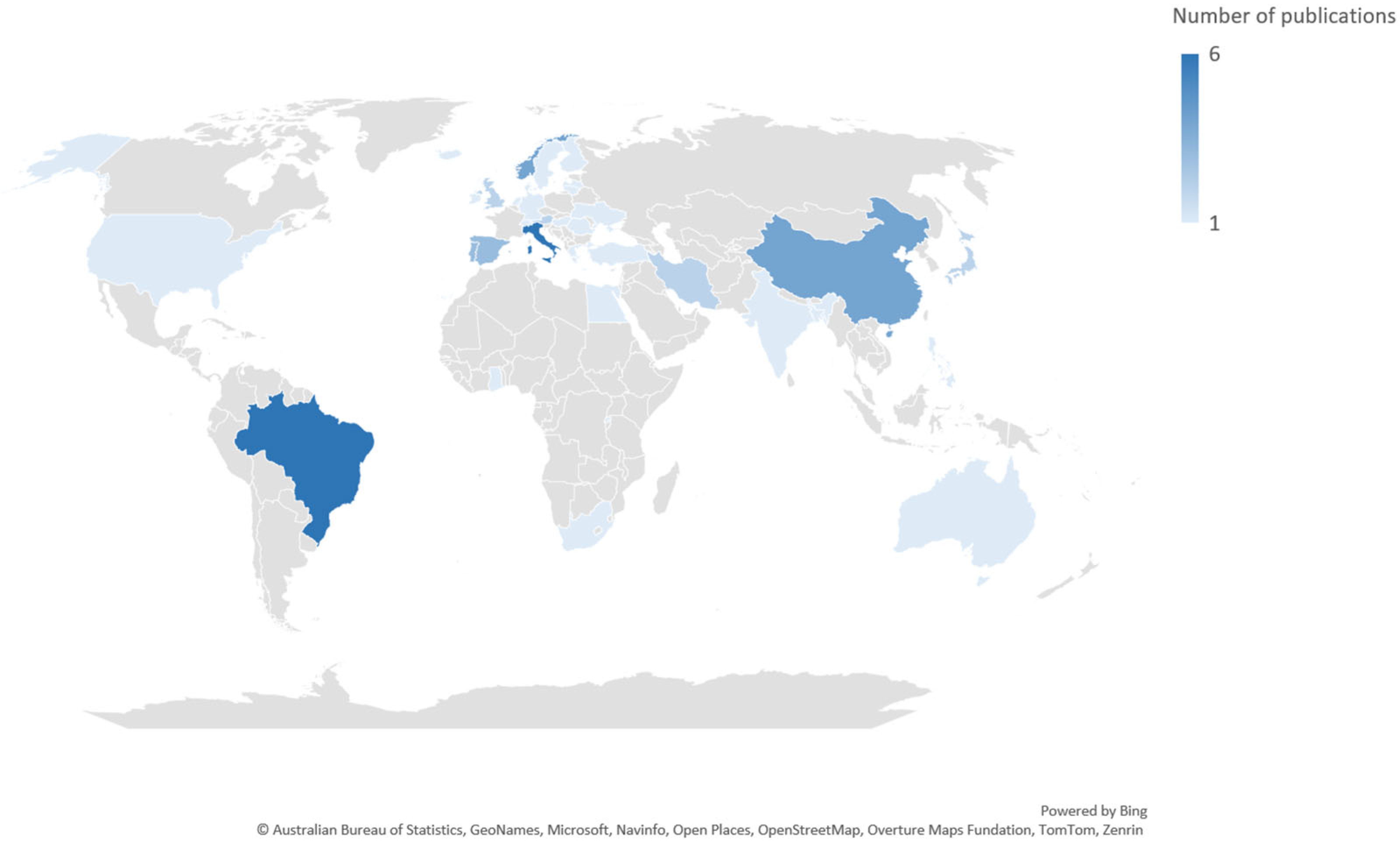
| Country | Assessment Focus | Methodological Approach | Key Findings | Refs. |
|---|---|---|---|---|
| Spain | Renovation of small hydropower nearing concession end | LCA | Renovation can save up to 175 kg CO2-eq/MWh compared to national electricity mix; significant embodied energy and carbon savings | [57] |
| Iceland | Environmental performance of hydropower | LCA | Carbon intensity ranges from 0.5–21.1 g CO2-eq/kWh; brownfield expansions show the lowest impacts | [54] |
| Norway | Ecosystem impacts | LCA + ecological analysis | Hydropower is a major driver of aquatic biodiversity loss and habitat fragmentation | [48] |
| Switzerland | Renewable electricity portfolios for EV charging | LCA + multi-objective optimization | Hydropower and wind consistently ranked as least harmful to human health and ecosystem quality | [42] |
| China | Large-scale hydropower facilities | LCA | Average emission factor of ~32.6 g CO2-eq/kWh | [66] |
| Small hydropower systems | LCA | Small HPPs show lower resource-time footprints per unit of electricity | [67] | |
| India | Site selection and refurbishment | LCA + Economic, Environmental, and Technical Assessment (SEETA) | Integration of social displacement and land use enables strategies that minimize social disruption while maximizing energy output | [47] |
| Nepal | Technical degradation and environmental performance | Technical & environmental assessment | Sediment erosion and component degradation affect turbine efficiency, cavitation risk, and long-term sustainability | [68] |
| Brazil | Tropical hydropower life cycle impacts | LCA | When biogenic emissions are excluded, construction dominates life-cycle impacts | [41] |
| Carbon intensity (large-scale plants) | LCA | Long operational lifetimes result in low carbon intensity (4.3–5.0 g CO2-eq/kWh) | [69] | |
| Ecuador | Comparison of plant scales | Comparative LCA | Large storage plants distribute environmental burdens more efficiently than small run-of-river plants | [70] |
| Ghana | Sustainability trade-offs | Integrated sustainability indices | Significant trade-offs between national energy benefits and local socio-economic impacts | [71] |
| Egypt & Nigeria | Conversion of existing water infrastructure | LCA | High sustainability potential due to avoided dam construction; steel and concrete dominate life-cycle impacts | [72,73] |
| Type of Criteria | Focus | Refs. |
|---|---|---|
| Environmental criteria | Commonly include global warming potential, acidification, eutrophication, water consumption and abiotic resource depletion | [37,38,45,80,81,82,83,84,85] |
| Social criteria | Address employment creation, labor safety, human health impacts, and community acceptance, often supported by composite measures such as the Human Development Index (HDI) | [37,39,45,86] |
| Economic criteria | Is evaluated using LCC indicators such as capital expenditure (CAPEX), net present value (NPV), levelized cost of electricity (LCOE), and payback periods | [39,45,47,57,80,87] |
| Technical criteria | Focus on technological maturity, system efficiency, reliability, and lifespan extension, which is frequently identified as the most influential factor in refurbishment decision models | [2,39,47,80] |
| Gaps | Limitations | Refs. |
|---|---|---|
| Technological underrepresentation in hydropower lifecycle data | A strong bias towards large-scale projects limits the availability of data on the environmental performance of small-scale facilities. | [46,53,54] |
| Lack of detailed technical documentation for old hydroelectric power plants. | Many of the power plants built in the mid-20th century do not have complete documentation, which poses a significant obstacle to performance optimization. | [51,52,55,56] |
| Empirical validation of integrated LCA-MCDA frameworks is limited. | Many proposed frameworks remain theoretical and have not been validated based on real-world refurbishment case studies. | [37,39] |
| Refurbishment-specific LCA methodologies remain underdeveloped | Most existing LCAs use static system boundaries that do not adequately reflect the dynamic nature of refurbishment, deterioration, and life extension. | [42,46,76] |
| Constrained system boundaries in hydropower LCA | Existing hydropower LCAs often use inconsistent or narrowly defined system boundaries, which can lead to incomplete representation of upstream material flows and circular processes related to refurbishment. | [46] |
| Social dimension of hydropower refurbishment is weakly represented | They primarily focus on economic and technical criteria. | [2,42,47] |
| Digitalization remains insufficiently embedded in LCI and LCA | Although DT, IoT technologies, and PdM systems are increasingly being applied in the hydropower industry, their potential for improving LCI modeling and LCA is rarely exploited. | [37,52,62,68] |
| Scenario ID | Description | Digitalization | Eco-Design/Circularity | Expected Effect on Lifecycle |
|---|---|---|---|---|
| S0 | Minimal intervention/run to failure baseline | None | Low | Higher unplanned repairs, higher downtime impacts |
| S1 | Conventional refurbishment (major at fixed interval) | Low | Medium | Efficiency recovery, reduced failures vs. S0 |
| S2 | Eco-design refurbishment (DfD + material optimization) | Low | High (DfD, higher reuse/reman) | Lower virgin materials, improved EoL recovery |
| S3 | PdM-enabled refurbishment (IoT/ML, condition-based) | High | Medium | Fewer premature replacements, fewer outages |
| S4 | Integrated circular-digital refurbishment (Eco + PdM) | High | High | Lowest material intensity, optimized intervention timing |
| S5 | Biodiversity enhanced option (fish-friendly + operation constraints) | Medium | Medium–High | Lower ecological risk, potential trade-off in CAPEX/η |
Disclaimer/Publisher’s Note: The statements, opinions and data contained in all publications are solely those of the individual author(s) and contributor(s) and not of MDPI and/or the editor(s). MDPI and/or the editor(s) disclaim responsibility for any injury to people or property resulting from any ideas, methods, instructions or products referred to in the content. |
© 2026 by the authors. Licensee MDPI, Basel, Switzerland. This article is an open access article distributed under the terms and conditions of the Creative Commons Attribution (CC BY) license.
Share and Cite
Lakatos, E.S.; Ferenci, S.; Albu, R.M.; Posa, M.-V.; Munteanu, R.A.; Szabó, L.; Cioca, L.-I. Multi-Criteria LCA Framework for Sustainable Hydropower Refurbishment Design. Energies 2026, 19, 1390. https://doi.org/10.3390/en19061390
Lakatos ES, Ferenci S, Albu RM, Posa M-V, Munteanu RA, Szabó L, Cioca L-I. Multi-Criteria LCA Framework for Sustainable Hydropower Refurbishment Design. Energies. 2026; 19(6):1390. https://doi.org/10.3390/en19061390
Chicago/Turabian StyleLakatos, Elena Simina, Sára Ferenci, Roxana Maria Albu (Druta), Marius-Viorel Posa, Radu Adrian Munteanu, Loránd Szabó, and Lucian-Ionel Cioca. 2026. "Multi-Criteria LCA Framework for Sustainable Hydropower Refurbishment Design" Energies 19, no. 6: 1390. https://doi.org/10.3390/en19061390
APA StyleLakatos, E. S., Ferenci, S., Albu, R. M., Posa, M.-V., Munteanu, R. A., Szabó, L., & Cioca, L.-I. (2026). Multi-Criteria LCA Framework for Sustainable Hydropower Refurbishment Design. Energies, 19(6), 1390. https://doi.org/10.3390/en19061390