Article

Urban Circular Economy and Energy Efficiency Improvement: Evidence from China’s “Zero-Waste City” Pilot Program

School of Finance and Economics, Jimei University, Xiamen 361021, China
*
Author to whom correspondence should be addressed.
Energies 2026, 19(10), 2470; https://doi.org/10.3390/en19102470
Submission received: 16 April 2026 / Revised: 16 May 2026 / Accepted: 19 May 2026 / Published: 21 May 2026
(This article belongs to the Special Issue Circular Economy Mechanisms for Improving Energy Efficiency)

Abstract

The circular economy offers a key pathway to achieve the joint improvement of resource conservation and carbon reduction, yet its causal effect on urban energy efficiency remains insufficiently examined. This paper takes China’s Zero-Waste City (ZWC) policy as a quasi-natural experiment and uses panel data from prefecture-level cities between 2006 and 2023. By applying staggered difference-in-differences and double machine learning methods, we evaluate the effect of urban circular economy transformation on energy efficiency. The results reveal four main findings: (1) The ZWC policy significantly improves energy efficiency in pilot cities. (2) The policy operates through three mechanisms: resource circulation, structural optimization, and innovation compensation. (3) Policy effects are stronger in environmentally regulated cities, large cities, and regions with higher artificial intelligence development. (4) The policy also generates broader benefits beyond energy savings, including coordinated fiscal, economic, and environmental gains. Overall, this paper highlights the spillover benefits of the circular economy from waste reduction to energy conservation and provides policy implications for coordinating waste management and energy transition at the urban level.

1. Introduction

With climate change and resource scarcity intensifying, the circular economy is widely regarded as a key pathway to transcend traditional end-of-pipe governance and decouple economic growth from resource consumption [1]. According to estimates by the UNEP, global cities generate over 2 billion tons of solid waste annually, projected to reach 3.4 billion tons by 2050 without intervention [2]. In this context, unlike the linear “take–use–dispose” model, the circular economy emphasizes the efficient circulation of resources throughout the entire lifecycle of products, including design, production, consumption, and disposal [3]. In recent years, major economies have established systematic policy frameworks for the circular economy. For instance, the European Union has set a binding target of achieving a 65% recycling rate for municipal waste by 2030 and has implemented eco-design requirements and extended producer responsibility schemes [4]. Japan, through a comprehensive legislative system, has increased its resource productivity by nearly 40% over the past two decades [5]. South Korea has banned the direct landfilling of recyclable waste and introduced volume-based waste fee systems as economic incentives [6]. These practices suggest that a systematic combination of policy instruments is crucial for advancing the circular economy in practice. More importantly, the circular economy is increasingly viewed not merely as a waste management strategy, but as a systemic transformation capable of reshaping urban resource allocation, industrial organization, and energy utilization patterns. In this sense, the circular economy may generate broader synergistic effects across the resource–energy–environment nexus.
China is also facing significant pressure from the rapid growth of waste generation. The China Statistical Yearbook reports that municipal solid waste collection and transport rose from 118 million tons to 235 million tons over 2000–2020 in China, while the annual generation of industrial solid waste has exceeded 4 billion tons [7]. In response, China formally launched the “Zero-Waste City” (ZWC) pilot program in 2018, aiming to minimize landfill disposal through source reduction, resource utilization, and harmless treatment, and to establish a comprehensive circular economy management system covering industrial, agricultural, municipal, and hazardous waste [8]. The first batch of pilot cities was initiated in 2019, followed by a gradual expansion in coverage. To date, participating cities have achieved notable progress in reducing solid waste generation and improving resource utilization. In 2023, across more than 100 pilot cities, the intensity of industrial solid waste generation decreased by an average of 6.8% compared to 2020. However, whether this systemic urban circular economy policy has generated spillover benefits beyond waste management, particularly in terms of energy efficiency, remains unclear due to the lack of rigorous causal evidence. This issue is theoretically important because energy efficiency constitutes a critical intermediate link connecting resource utilization, environmental governance, and low-carbon transition. While existing circular economy studies mainly focus on waste reduction and recycling outcomes, it remains unclear whether circular economy governance can fundamentally improve the efficiency of urban energy systems through resource circulation, industrial restructuring, and technological upgrading. Clarifying this issue can therefore deepen the understanding of the cross-domain synergistic effects of circular economy policies from “waste reduction” to “energy saving,” and provide new insights into coordinated governance between urban waste management and energy transition.
The existing literature falls into three strands. The first strand focuses on the direct environmental benefits of the circular economy, such as waste reduction and resource recycling. A large body of research shows that measures such as waste sorting, recycling, and extended producer responsibility can effectively reduce landfill volumes and improve resource recovery rates [9,10,11]. In addition, studies based on life cycle assessment indicate that waste resource utilization can further reduce greenhouse gas emissions, mainly through substituting virgin materials and reducing methane emissions from incineration and landfilling processes [12,13,14]. More recently, some studies have begun to emphasize that the circular economy may contribute not only to pollution reduction, but also to broader green transformation and sustainable urban development [15]. However, the existing literature still predominantly evaluates circular economy performance from the perspectives of waste treatment, emissions reduction, or material recycling, while the energy-efficiency dimension remains largely underexplored.
The second strand examines the relationship between environmental regulation and energy efficiency. This literature typically analyzes policies such as pollution charges, low-carbon city pilots, and total emission control schemes, and finds that the impact of environmental regulation on energy efficiency is non-monotonic [16,17,18,19]. Moderate regulatory intensity may enhance efficiency by inducing technological upgrading, while excessively high compliance costs may have a suppressing effect [20,21,22]. Although this literature provides important insights into the relationship between environmental governance and energy efficiency, most existing studies focus on pollution-control regulations or carbon-reduction policies [23], rather than comprehensive circular economy policies characterized by multi-sector coordination and full-lifecycle governance. Therefore, whether systemic circular economy transformation can generate energy-efficiency gains remains theoretically and empirically unclear.
The third strand evaluates China’s ZWC pilot policy. Existing studies mainly rely on policy descriptions, comparisons of pilot schemes, or case studies, and analyze preliminary outcomes in terms of waste reduction, resource utilization, and institutional development [24,25,26]. A few studies employ difference-in-differences (DID) methods to assess the policy’s effects on pollutant emissions or green technological innovation [27,28,29,30]. These studies provide important evidence regarding the environmental and innovation effects of the ZWC policy. However, they mainly treat the policy as a waste governance or environmental regulation initiative, while largely overlooking its potential role in reshaping urban energy systems. In particular, little attention has been paid to whether circular economy governance can generate energy-efficiency spillovers through resource circulation, industrial restructuring, and green technological upgrading.
Despite these contributions, several research gaps remain. First, existing studies on the circular economy mainly focus on waste reduction, recycling, and emission mitigation, while paying relatively limited attention to energy efficiency. As a key indicator linking resource utilization, industrial transformation, and low-carbon transition, energy efficiency provides an important perspective for understanding the broader governance effects of circular economy policies. However, whether circular economy transformation can substantially improve urban energy efficiency still lacks rigorous causal evidence. Second, as a comprehensive and systemic pilot policy covering multiple sectors, including industry, agriculture, municipal waste, and hazardous waste, and emphasizing full-process management, the overall effects of the ZWC initiative have not been sufficiently evaluated. Although a small number of studies have examined its impact on pollutant emissions and green innovation, no research has systematically investigated its effect on energy efficiency. More importantly, existing studies have yet to clarify whether circular economy policies can generate cross-domain spillover effects beyond waste governance, thereby contributing to the coordinated transformation of urban resource and energy systems.
Motivated by the potential synergy between circular economy transformation and urban energy transition, this paper exploits China’s ZWC pilot as a quasi-natural experiment. Based on panel data from prefecture-level cities over 2006–2023, it applies a staggered DID approach and double machine learning (DML) to identify the causal effect of urban circular economy transformation on energy efficiency. Rather than merely evaluating the environmental outcomes of a waste governance policy, this study aims to explore whether circular economy governance can generate broader energy-efficiency spillovers and resource–energy synergy effects at the urban level. Specifically, this study addresses three key questions: (1) Does the ZWC pilot policy significantly improve urban energy efficiency? (2) Through which mechanisms does the policy effect operate? (3) Are there heterogeneous effects across different types of cities and institutional environments? In addition, we extend the analysis to evaluate the policy’s broader impacts beyond energy-saving benefits, including fiscal, economic, and environmental effects.
This paper makes three contributions. First, from the perspective of theoretical development, this study extends the literature on the circular economy by shifting the focus from traditional waste reduction outcomes to urban energy efficiency. Existing studies mainly conceptualize the circular economy as a waste governance framework, whereas this paper demonstrates that circular economy policies can also reshape urban energy systems and generate broader resource–energy synergy effects. By identifying the energy-efficiency spillover of the ZWC pilot, this study provides new evidence on the cross-domain governance effects of circular economy transformation. Second, unlike previous studies that primarily examine pollutant emissions, green innovation, or environmental performance, this paper investigates how a systemic circular economy policy affects energy efficiency through multiple transmission channels. Specifically, this study integrates resource circulation theory, industrial structure theory, and the Porter Hypothesis into a unified analytical framework, and identifies three mechanisms through which the ZWC pilot improves energy efficiency: waste resource utilization, industrial structure optimization, and green technological innovation. Third, in terms of policy implications, through heterogeneity analysis and an assessment of broader fiscal, economic, and environmental effects, this study provides differentiated guidance on whether and how cities with varying characteristics should promote circular economy policies. It also offers empirical evidence from China for other cities worldwide seeking to explore coordinated governance pathways between the circular economy and energy systems.
The remainder of this paper is organized as follows. Section 2 presents the institutional background and theoretical framework. Section 3 describes the research design, including the model specification, variables, and data sources. Section 4 reports the empirical results, robustness tests, mechanism analysis, and heterogeneity analysis. Section 5 further examines the broader fiscal, economic, and environmental effects. Section 6 provides a discussion, comparing our findings with those of the existing literature. Finally, Section 7 concludes the paper and provides policy implications.

2. Institutional Background and Theoretical Framework

2.1. Institutional Background

The transition toward a circular economy has become a key global strategy for addressing resource constraints, environmental pollution, and climate change, with major economies such as the European Union, Japan, and South Korea having established systematic policy frameworks. Against this international backdrop, China officially launched the ZWC pilot program in 2018 as a localized urban-level implementation of circular economy principles. The concept of a ZWC does not imply the complete elimination of solid waste; rather, it emphasizes minimizing landfill disposal and environmental impacts through source reduction, resource utilization, and harmless treatment. This model highlights a systemic transformation from end-of-pipe governance to full-process resource circulation.
The construction of ZWC revolves around several key tasks: (1) industrial source reduction constraints targeting bulk industrial solid waste, achieved through green production mechanisms that gradually lead to near-zero growth in storage and disposal; (2) a circular agricultural system integrating major agricultural waste into full utilization, enabling a systematic transition from discharge to regeneration; (3) positive guidance of household consumption focusing on source reduction and recycling of municipal solid waste, thereby reshaping end-of-pipe urban waste management; (4) full-process controllability of hazardous waste, building safety governance capacity across generation, storage, transportation, and disposal; and (5) functional activation of market actors driven by policy incentives to foster a self-evolving industrial system.
In terms of implementation, cities with suitable conditions, solid foundations, and appropriate scales were selected nationwide to carry out the ZWC pilot construction. The selection process comprehensively considered regional differences, development levels, industrial characteristics, and local government enthusiasm, giving priority to qualified cities in National Ecological Civilization Pilot Zones, Circular Economy Demonstration Cities, Industrial Resource Comprehensive Utilization Demonstration Bases, and those that had achieved positive results in solid waste recycling and harmless disposal pilots. Based on this selection framework, the first batch of 11 pilot cities was officially launched in 2019, focusing on systematic institutional innovation and model exploration. The program was subsequently expanded in a gradual manner, and by 2022, a total of 113 cities had been included in the ZWC development plan during the 14th Five-Year Plan period. This progressive expansion has made China an important case for exploring the coordinated governance of the circular economy and energy systems at the urban scale, while also providing a valuable quasi-experimental setting for this study to evaluate the impact of urban circular economy policies on energy efficiency.

2.2. Theoretical Framework

2.2.1. Overall Effect

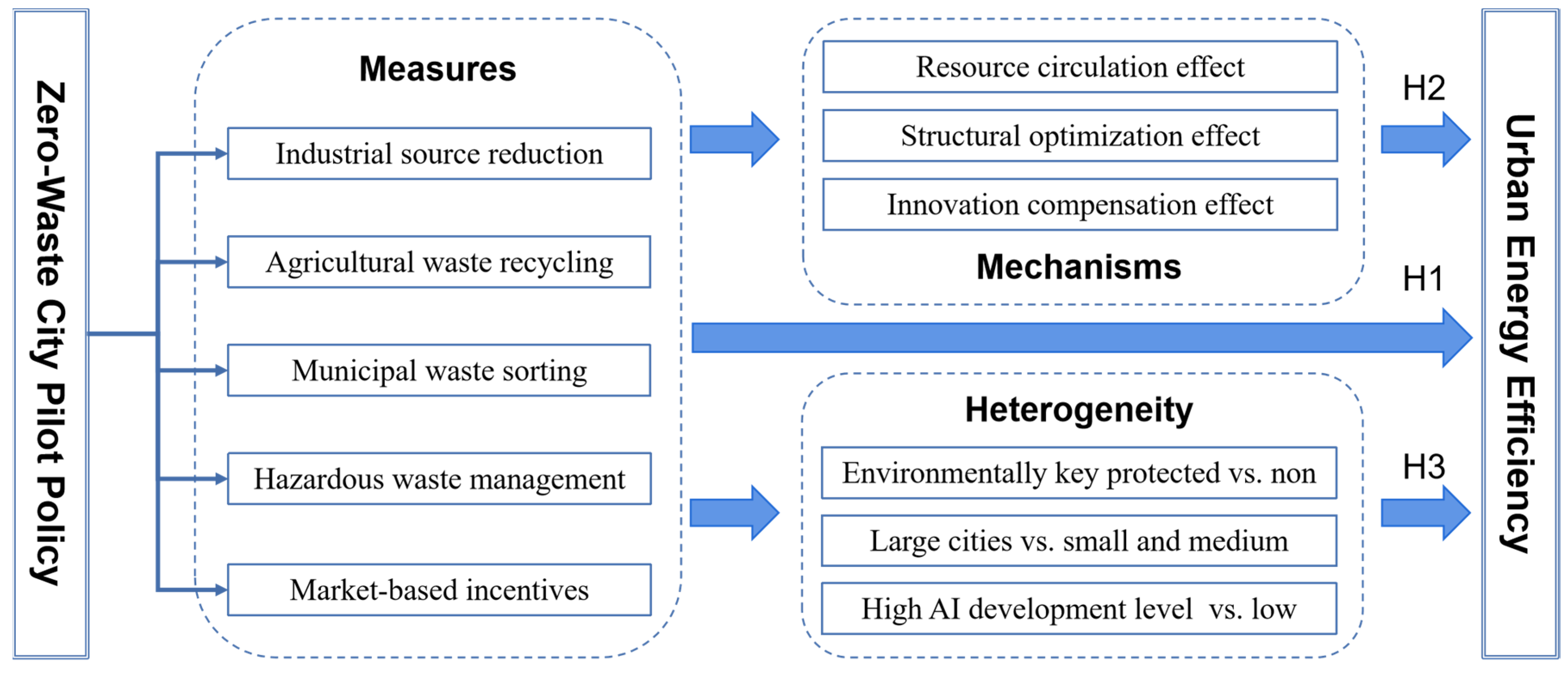
The ZWC pilot is designed as a comprehensive circular economy governance framework covering industrial production, agricultural recycling, household consumption, hazardous waste treatment, and market-based incentive systems. Unlike traditional end-of-pipe environmental regulations that mainly focus on pollution control, the ZWC pilot emphasizes source reduction, resource circulation, and full-process management across the entire lifecycle of waste generation, treatment, and reuse.
From the perspective of urban metabolism and circular economy theory, the implementation of such a systemic policy may improve urban energy efficiency in several ways. First, source reduction and resource recycling decrease the demand for virgin resource extraction and energy-intensive raw material processing, thereby reducing embodied energy consumption throughout production chains. Second, cleaner production requirements and waste reduction constraints encourage firms to optimize production processes and eliminate inefficient energy use. Third, the coordinated management of industrial, agricultural, and municipal waste promotes resource reallocation and improves the overall efficiency of urban resource circulation systems. In addition, market-oriented incentive mechanisms further stimulate firms and households to adopt energy-saving and environmentally friendly practices.
Therefore, as a comprehensive urban governance policy integrating waste reduction, recycling systems, cleaner production, and market incentives, the ZWC pilot may reshape urban production and resource utilization patterns, thereby generating overall improvements in urban energy efficiency. Accordingly, this study proposes:
H1. 
The ZWC pilot significantly improves urban energy efficiency.

2.2.2. Mechanism Analysis

As a comprehensive circular economy policy, the ZWC pilot may influence urban energy efficiency through multiple channels. Drawing on circular economy theory, industrial structure theory, and environmental regulation theory, this study argues that the policy can promote energy efficiency by enhancing resource circulation, optimizing industrial structure, and stimulating green technological innovation.
(1) Resource circulation effect
Within the ZWC pilot, policies such as waste sorting, recycling, and resource recovery are designed to promote the circular utilization of solid waste, which may further generate energy-saving effects. The core of circular economy theory lies in breaking the traditional linear model of “extraction–production–consumption–disposal” and establishing a closed-loop flow of “resources–products–recycled resources” [31]. Within this framework, waste resource utilization reintegrates end-of-life waste into the production cycle, thereby reducing energy consumption associated with the extraction and processing of virgin resources [32]. From the perspective of material flow analysis, the embodied energy of each unit of recycled material is typically far lower than that required to produce primary materials from raw inputs such as ores or crude oil [33]. For example, steel production using scrap can save approximately 60% of energy compared to production from iron ore, while recycled aluminum can achieve energy savings of over 90% [34].
The ZWC pilot promotes the transformation of waste into secondary resources through the development of urban mining systems, the expansion of waste sorting and recycling, and the implementation of coordinated waste treatment systems [35]. These measures directly reduce the energy input required per unit of output. Moreover, in the absence of resource utilization, waste must be disposed of through landfilling or incineration [36]. The former generates greenhouse gases such as methane, while the latter, although capable of recovering some thermal energy, is generally less energy-efficient than recycling pathways. By substituting inefficient disposal with resource utilization, the policy enables systematic energy savings. Accordingly, this study proposes:
H2a. 
The ZWC pilot enhances urban energy efficiency through waste resource utilization.
(2) Structural optimization effect
The ZWC pilot also includes cleaner production requirements and environmental regulation measures, which may indirectly affect energy efficiency by promoting industrial structure optimization. Industrial structure theory suggests that significant differences exist in energy intensity across sectors during the process of economic development. In general, the tertiary sector exhibits the lowest energy intensity, followed by the secondary sector, while an industrial structure dominated by heavy and chemical industries tends to be highly energy-intensive [37]. The Petty–Clark theorem and the subsequent “structural dividend” hypothesis indicate that the reallocation of production factors from low-productivity, high-energy-consumption sectors to high-productivity, low-energy-consumption sectors can lead to improvements in overall energy efficiency [38,39].
The ZWC pilot may accelerate industrial restructuring through environmental regulation and circular economy requirements [27]. On the one hand, the policy imposes stricter disposal costs and regulatory pressures on industries characterized by high waste generation and low resource efficiency, thereby forcing technological upgrading or capacity exit. On the other hand, complementary measures—such as green finance and preferential land policies—encourage the reallocation of capital and labor toward modern service industries and clean manufacturing sectors with lower waste generation and higher value added. This “cleaning” of the industrial structure contributes to a reduction in overall urban energy intensity [40]. Moreover, structural optimization can enhance energy efficiency through inter-industry linkage effects, facilitating coordinated energy use among upstream and downstream firms (e.g., combined heat and power and waste heat recovery), thereby improving the efficiency of energy allocation [41]. Accordingly, this study proposes:
H2b. 
The ZWC pilot enhances urban energy efficiency through industrial structure optimization.
(3) Innovation compensation effect
In addition, the ZWC pilot encourages firms to adopt cleaner production technologies and improve waste treatment efficiency, which may stimulate green technological innovation with energy-saving characteristics. Traditional theories of environmental regulation, such as the compliance cost hypothesis, argue that environmental requirements increase firms’ costs and may thus hinder productivity [42]. In contrast, the Porter Hypothesis posits that well-designed environmental regulations can stimulate firms to engage in technological innovation. Such innovations not only offset compliance costs but also enhance resource productivity, generating an “innovation compensation effect” that ultimately improves firm competitiveness and overall efficiency [43].
The ZWC pilot requires firms to meet targets for waste reduction and resource utilization, thereby directly incentivizing the development of new production processes, waste treatment technologies, and product designs. Examples include high-value-added recycling technologies, low-energy-consumption treatment equipment, and intelligent management systems. These green innovations often possess energy-saving attributes: process improvements are typically accompanied by reductions in fuel and electricity use, while intelligent management systems help minimize unnecessary transportation and idle energy consumption [44,45]. At the micro level, firms reduce the comprehensive energy consumption per unit of output through innovation [46]. At the meso level, technological spillover effects facilitate the diffusion of innovations across firms within the same industry or along the value chain, further enhancing overall urban energy efficiency [47]. In addition, the stable market expectations created by the policy encourage greater R&D investment in energy-saving and environmental protection technologies, forming a virtuous cycle of “policy-driven innovation and innovation-driven energy conservation” [48]. Accordingly, this study proposes:
H2c. 
The ZWC pilot enhances urban energy efficiency through green technological innovation.

2.2.3. Heterogeneous Effects

Although the ZWC pilot is expected to improve urban energy efficiency overall, its policy effectiveness may vary across cities with different institutional conditions, economic foundations, and technological capacities. According to environmental governance theory and regional heterogeneity theory, the effectiveness of environmental policies is often shaped by differences in regulatory intensity, factor endowments, infrastructure conditions, and technological support across regions. As a comprehensive circular economy policy, the implementation effect of the ZWC pilot therefore depends on whether cities possess sufficient governance capacity, industrial coordination, and digital technological foundations to support resource circulation and green transformation.
First, the policy effect may differ between environmentally key protected cities and non-key protected cities. Environmentally key protected cities are generally subject to stricter environmental supervision, more intensive regulatory inspections, and stronger policy support from higher-level governments. According to the Porter Hypothesis, stronger environmental regulation can stimulate firms to accelerate cleaner production and technological upgrading, thereby improving resource utilization and energy performance. In addition, these cities often possess better environmental infrastructure, more mature waste treatment systems, and stronger administrative capacity, which facilitate the implementation of waste sorting, recycling, and circular economy governance. The combination of regulatory pressure and institutional support may therefore strengthen the energy-saving effect of the ZWC pilot. By contrast, non-key protected cities may face weaker regulatory constraints and lower implementation efficiency, limiting the effectiveness of the policy. Accordingly, this study proposes:
H3a. 
The ZWC pilot is more likely to improve urban energy efficiency in environmentally key protected cities than in non-key protected cities.
Second, the energy-efficiency effect of the ZWC pilot may vary with city size. Urban economics and agglomeration theory suggest that large cities benefit from economies of scale, industrial coordination, and infrastructure sharing. Large cities generally possess more developed recycling systems, stronger fiscal capacity, and higher levels of industrial specialization, which facilitate the implementation of circular economy policies and improve resource allocation efficiency. Moreover, larger cities tend to attract more innovative firms, skilled labor, and green investment, thereby accelerating technological upgrading and cleaner production transformation. These advantages help strengthen the coordination between waste management systems and urban energy systems. In contrast, small- and medium-sized cities may face greater constraints in terms of infrastructure, governance capacity, and technological support, thereby weakening the policy effect. Accordingly, this study proposes:
H3b. 
The ZWC pilot generates stronger energy-efficiency effects in large cities than in small- and medium-sized cities.
Third, the effectiveness of the ZWC pilot may depend on the level of artificial intelligence (AI) development. Digital governance theory suggests that AI technologies can improve information processing, intelligent monitoring, and resource allocation efficiency. In the context of the ZWC pilot, AI technologies can enhance waste sorting, recycling management, energy scheduling, and environmental supervision, thereby strengthening the coordination between resource circulation systems and urban energy systems. In addition, AI development can facilitate data sharing and intelligent decision-making, helping local governments and firms optimize production processes and reduce unnecessary energy consumption. Therefore, cities with higher levels of AI development are more capable of realizing the energy-saving potential of circular economy governance, whereas those with lower levels may face technological constraints in policy implementation and intelligent resource management. Accordingly, this study proposes:
H3c. 
The ZWC pilot generates stronger energy-efficiency effects in cities with higher levels of AI development than in cities with lower levels of AI development.
Overall, the ZWC pilot may improve urban energy efficiency through direct effects, multiple transmission mechanisms, and heterogeneous policy impacts across different urban contexts. Based on the above theoretical analysis, this study constructs a conceptual framework linking the ZWC pilot, transmission mechanisms, heterogeneous conditions, and urban energy efficiency, as illustrated in Figure 1.

3. Research Design

3.1. Model

3.1.1. Staggered Difference-in-Differences Model

To examine whether the ZWC policy affects urban energy efficiency, this paper constructs a staggered DID model, as the ZWC pilot program was implemented in two batches across different cities and time periods.
E E i , t = a 1 + β 1   Z W C i , t + β 2 Z i , t + μ i + θ t + ε i , t
where E E i , t is the city-level energy efficiency. Z W C i , t is a dummy variable equal to 1 if the city is included in the pilot in the year t , and 0 otherwise. Z f , i , t is a vector of controls, μ i and θ t capture city and time fixed effects, and ε i , t is the error term. A positive coefficient of β 1   implies a causal improvement in urban energy efficiency due to the policy.

3.1.2. Double Machine Learning Model

DML combines machine learning algorithms with orthogonalization methods. When estimating treatment effects, it flexibly captures nonlinear relationships between high-dimensional controls and outcomes, mitigates regularization bias in traditional machine learning, and yields consistent estimates. Traditional linear models are prone to functional form misspecification. In contrast, DML does not require prespecifying a specific functional form, enabling it to more accurately isolate the net effect of the ZWC policy from complex confounding factors, thereby improving the reliability of causal inference. Following Chernozhukov, et al. [49], we specify a partially linear DML model as follows:
E E i , t = θ 0 Z W C i , t + g ( Z i , t ) + U i , t , E ( U i , t Z i , t , Z W C i , t ) = 0
where Z W C i , t is a dummy variable for the ZWC policy. g ( Z f , t ) is an unknown function of the control variables, which is fitted using machine learning algorithms such as random forest without requiring a prespecified linear form. Compared with traditional linear models, DML can flexibly capture the nonlinear relationships between high-dimensional control variables and energy efficiency, and eliminate regularization bias through orthogonalization and sample-splitting techniques, thereby obtaining unbiased estimates of the policy effect.

3.2. Variables Definition

3.2.1. Dependent Variable

Urban energy efficiency (EE) is adopted as the dependent variable and measured using a super-efficiency Slacks-Based Measure (SBM) model with undesirable outputs. Traditional Data Envelopment Analysis (DEA) methods are mostly radial models, requiring proportional changes in inputs or outputs and failing to handle undesirable outputs effectively. Although the standard SBM model accounts for slack improvements, it cannot further distinguish multiple efficient decision units when their efficiency values are all equal to 1. The super-efficiency SBM model allows the efficiency value of efficient decision units to exceed 1, thereby enabling ranking and comparison across all samples, making it more suitable for constructing continuous variables in policy evaluation.
Each city is set as a decision-making unit (DMU), and the following input-output system is constructed: input variables include capital, labor, and energy. Specifically, capital stock is measured by the fixed asset stock of prefecture-level cities calculated using the perpetual inventory method, with 2006 as the base year. Nominal fixed asset investment is deflated to 2006 constant prices, and a depreciation rate of 9.6% is adopted. The 2006 base-year stock is derived from the 2006 investment and the 2006–2023 average investment growth rate; labor is measured by the number of employed persons in prefecture-level cities; energy input is measured by the total urban energy consumption. Urban energy consumption is measured by the total urban energy consumption, which is aggregated from three primary energy carriers: total societal electricity consumption, coal, gas, and natural gas supply, and liquefied petroleum gas (LPG) supply. All energy carriers are converted into tonnes of standard coal equivalent (tce) using official national conversion coefficients: electricity: 0.1229 kgce/kWh (1.229 tce/104 kWh); natural gas: 1.33 kgce/m3 (13.3 tce/104 m3); LPG: 1.7143 kgce/kg (1.7143 tce/t). The aggregated TCE value is taken as the total urban energy consumption. The desirable output is the real gross domestic product of prefecture-level cities. Undesirable outputs are selected as emissions of industrial sulfur dioxide, industrial smoke and dust, and industrial wastewater, reflecting the environmental costs of urban development. The specific formula of the model is as follows:
ρ = min 1 m i = 1 m x ¯ i x i 0 1 s 1 + s 2 ( r = 1 s 1 y ¯ r g y r 0 g + t = 1 s 2 y ¯ t b y t 0 b )
where x i 0 , y r 0 g , and y t 0 b denote the input vector, desirable output vector, and undesirable output vector of the 0th decision unit, respectively; x ¯ , y ¯ r g , and y ¯ t b are the slack improvement target values of the corresponding inputs and outputs on the efficiency frontier; m , s 1 , and s 2 represent the numbers of input, desirable output, and undesirable output types, respectively. The target value ρ is the energy efficiency index of the city. ρ 1 indicates that the city lies on the efficiency frontier, with larger values reflecting higher efficiency; ρ 1 implies input redundancy or output insufficiency. This measurement approach fully reflects the core concepts of the ZWC, namely reduction, resource recovery, and harmless treatment, and comprehensively captures the green development level of cities under the dual constraints of energy consumption and environmental pollution.

3.2.2. Independent Variable

The independent variable is a dummy Z W C i , t for the ZWC policy. Cities included in the two pilot batches (2019 and 2022) constitute the treatment group, and others constitute the control group. The policy dummy equals 1 for pilot cities in and after the year of designation, and 0 otherwise, while non-pilot cities are always assigned a value of 0.

3.2.3. Control Variables

This paper includes several city-level control variables to mitigate omitted variable bias: economic development (PGDP), proxied by real GDP per capita in logarithmic form; population density (PD), defined as permanent residents per square kilometer in logarithms; government intervention (GOV), measured by the ratio of local general public budget expenditure to GDP; and foreign direct investment (FDI), measured by the ratio of actual utilized FDI to GDP

3.3. Data Source and Process

The sample covers 282 prefecture-level cities from 2006 to 2023, yielding 5076 city–year observations after data cleaning. Data processing includes: (1) excluding cities with severe missing observations on key variables; (2) taking natural logarithms for non-ratio variables, including PGDP and PD, to alleviate heteroskedasticity and non-stationarity; (3) using interpolation to fill in missing data for individual cities in specific years. City boundaries are harmonized using the 2020 prefecture-level city standard to maintain panel consistency.
Variable-specific data sources are specified as follows: urban energy efficiency inputs, including capital stock, labor and energy consumption, as well as output indicators such as GDP and pollutant emissions, are mainly collected from the China City Statistical Yearbook and China Environmental Statistical Yearbook. Relevant energy data and control variables are sourced from the China City Statistical Yearbook and China Urban Rural Construction Statistical Yearbook. AI patent data are compiled from the database of the State Intellectual Property Office. The ZWC pilot city information is manually compiled from official documents issued by the Ministry of Ecology and Environment and the State Council, corresponding to two batches announced in 2019 and 2022, respectively. Table 1 presents the variable definitions, and Table 2 shows the descriptive statistics.

4. Results

4.1. Baseline Regression

Table 3 reports the impact of the ZWC policy on urban energy efficiency. Columns (1)–(3) indicate that the coefficient of the ZWC pilot is significantly positive at the 1% level, and this result remains robust after progressively adding control variables and incorporating two-way fixed effects. These findings suggest that the ZWC policy has a significant positive effect on urban energy efficiency, providing supporting evidence for H1.

4.2. Parallel Trend Test

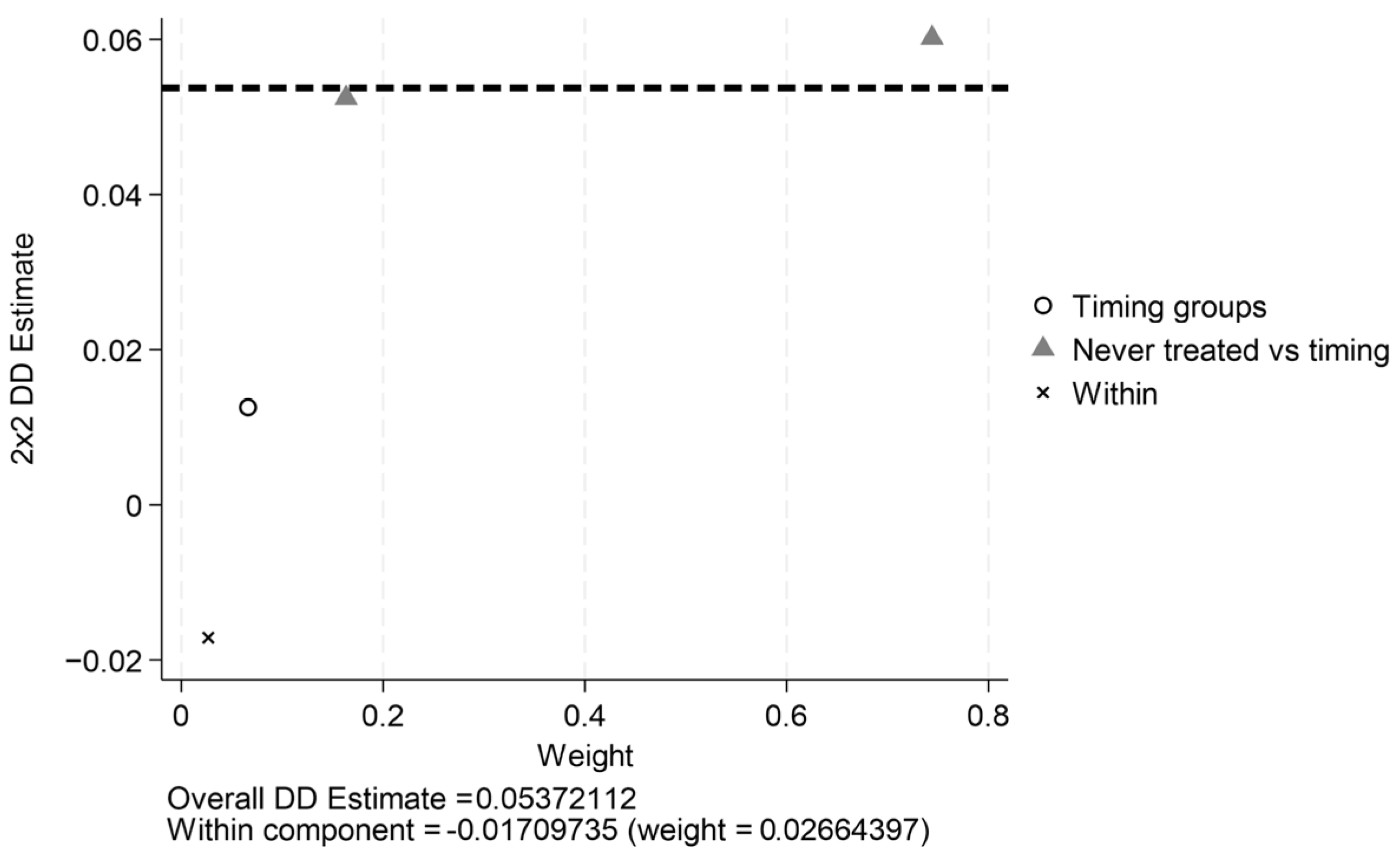
Recent literature shows that under a staggered DID design, the traditional TWFE estimator is a weighted average of treatment effects across cohorts with different treatment timing and may assign negative weights to some effects [50,51]. When negative weights arise, TWFE can deviate from the true average treatment effect and even yield estimates with opposite signs. To address this issue, this paper adopts the Bacon decomposition method proposed by Goodman-Bacon [52], which decomposes the TWFE estimator into several groups of “good” comparisons (early vs. late treated, late vs. early treated, and treated vs. never treated) and “bad” comparisons (early treated vs. already treated). The decomposition results in Figure 2 suggest that the TWFE estimator is mainly driven by “good” comparisons, and the contribution of negative-weighted comparisons appears limited. Overall, these results support the robustness of the baseline findings.
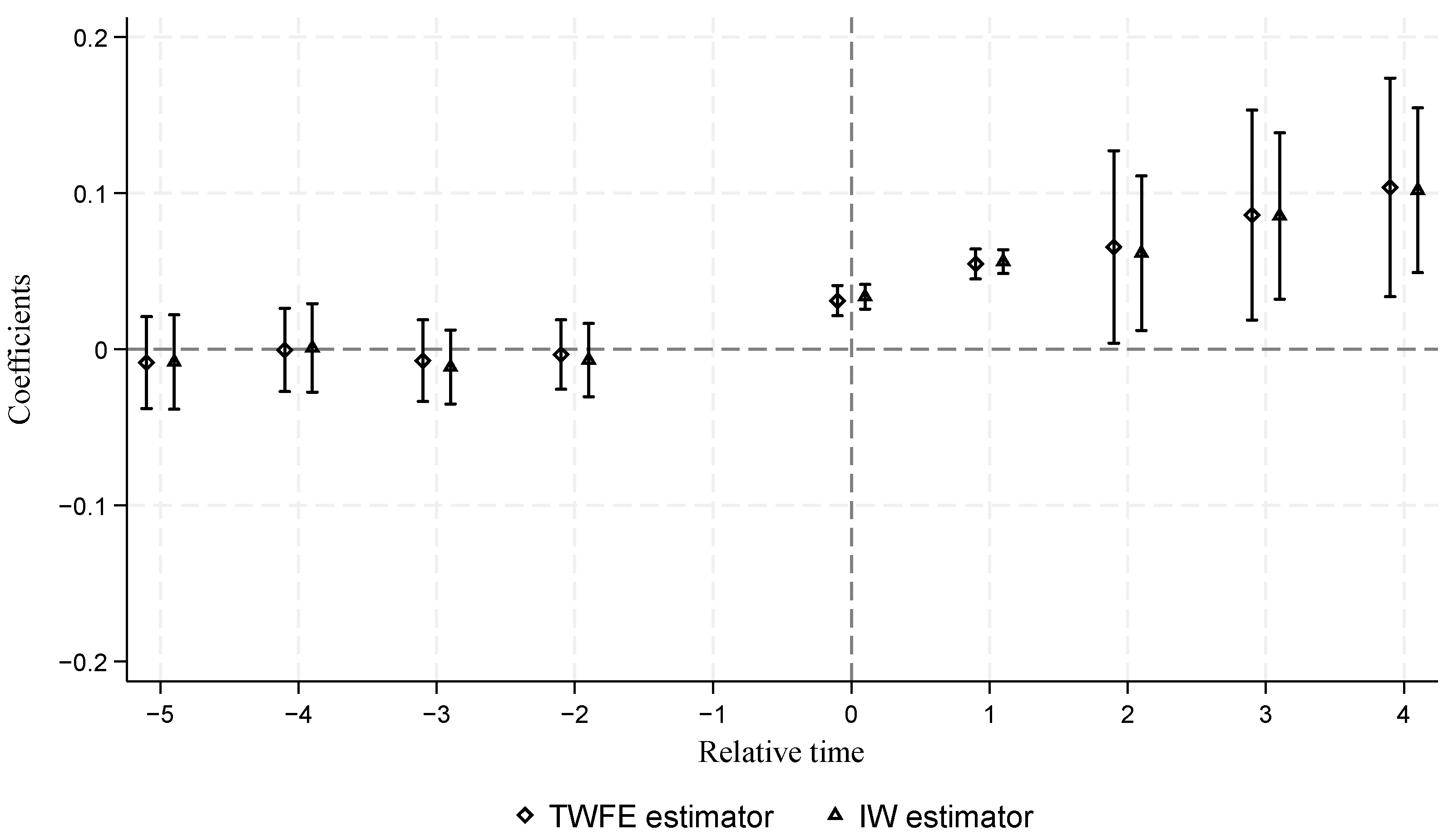
Regarding the parallel trend test, given the small number of samples before five years prior to policy implementation, this paper consolidates these samples into period negative 5. The interaction weighted (IW) estimator proposed by Sun and Abraham [53] uses the sample sizes of different treatment periods as weights for treatment effects, thereby avoiding the negative weight problem. Therefore, this paper adopts the IW estimator as a robustness estimator. Figure 3 shows similar parallel trend results for the TWFE and IW estimators. All pretreatment coefficients are small in magnitude and statistically insignificant at conventional levels, confirming that energy efficiency trends were parallel between treated and control cities prior to the policy. These findings support the validity of the parallel trend assumption.

4.3. Endogenous Discussion

4.3.1. Lagged Independent Variable

To mitigate the endogeneity problem arising from reverse causality, that is, the possibility that improvements in urban energy efficiency may in turn affect the probability of a city being selected as a ZWC pilot, this paper adopts the method of lagging the core explanatory variable. Specifically, the explanatory variable is lagged by one to four periods, respectively, and then reincorporated into the baseline model for regression. The logic behind using lagged variables is that past policy interventions cannot be reverse-determined by current energy efficiency, thus partially eliminating the interference of bidirectional causality. Columns (1)–(4) of Table 4 report significantly positive coefficients for the one- to four-period lags of the explanatory variable, suggesting that the ZWC policy exerts a persistent positive effect on urban energy efficiency and providing further support for the robustness of the baseline findings.

4.3.2. Control for Selection Variables

In selecting ZWC pilot cities, policymakers balanced diversity in regional, scale, and functional characteristics with a preference for cities possessing stronger initial foundations, such as those involved in ecological civilization, circular economy, or solid waste treatment pilot programs. To mitigate potential bias from this non-exogenous selection, this paper introduces three choice variables: National Ecological Civilization Pilot Zone (ECPZ), Industrial Resource Comprehensive Utilization Base (IRCUB), and National Circular Economy Demonstration City (CEDC). We construct corresponding dummy variables equal to one if a city had been included in any of these programs before the ZWC pilot, and zero otherwise, capturing cities’ pre-existing endowments. Building on this, we interact these variables with time dummies rather than imposing a linear time trend. This approach flexibly captures time-varying effects of initial conditions, allowing for nonlinear and phase-specific dynamics. Column (5) of Table 4 reports a significantly positive coefficient on the core explanatory variable, suggesting that non-random pilot selection is unlikely to substantially affect the baseline findings. This result provides further support for the robustness of the estimated policy effect on urban energy efficiency.

4.3.3. Double Machine Learning Estimation

Although the baseline model controls for observable confounders through selection variables, their interactions with time dummies, and two-way fixed effects, it imposes a linear and additive structure. If the true relationship is nonlinear, such as exhibiting increasing and then decreasing effects, the linear specification may be biased due to omitted nonlinear terms. To address this concern, we employ DML as a robustness check. DML leverages nonparametric algorithms (e.g., random forest) to flexibly capture nonlinear relationships without prespecifying functional forms. For panel data, directly incorporating individual fixed effects as dummy variables in DML may lead to the curse of dimensionality and violate the Neyman orthogonality condition [54]. To address this issue, we adopt a within-group demeaning approach to eliminate individual fixed effects. All models are implemented with default hyperparameter settings without additional manual tuning or grid search, which avoids arbitrary parameter selection and ensures model consistency.
Table 5 reports the DML estimation results. Across a range of algorithms, including random forest, decision tree, XGBoost, LightGBM, and neural networks, the coefficient of ZWC remains significantly positive and highly consistent. This pattern also holds under different sample split ratios. We further conduct robustness checks using ten different random seeds. The core policy coefficient remains stable and statistically significant at the 1% level under alternative random seeds, confirming that the DML estimation results are free from random initialization bias. Notably, the DML estimates are generally larger than those from the baseline regression, suggesting that the linear specification may underestimate the magnitude of the policy effect. Overall, these findings indicate that potential specification bias does not materially affect the main conclusions, and the results remain broadly robust across alternative estimation frameworks.

4.4. Robustness Test

4.4.1. Placebo Test

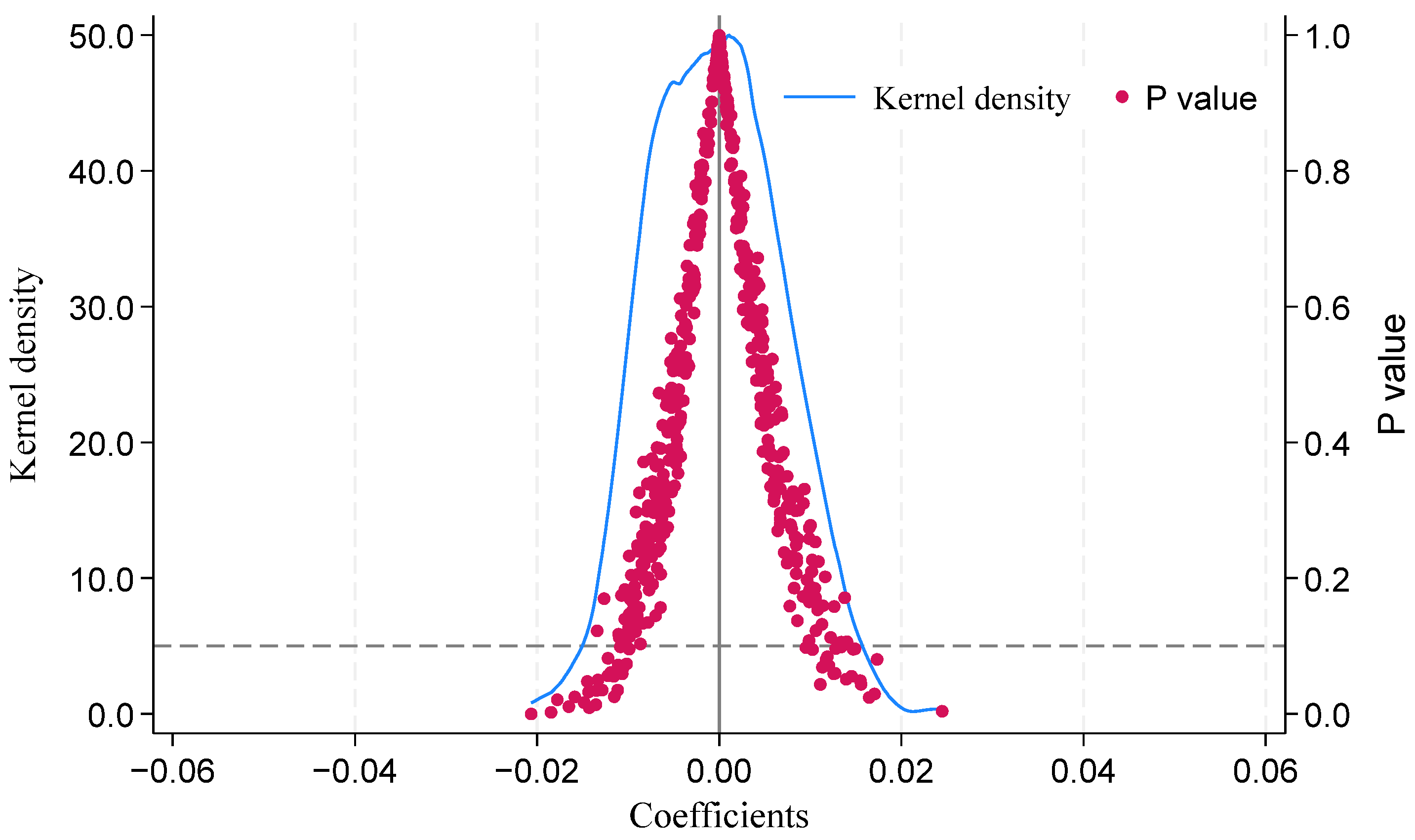
To test whether unobserved omitted variables or random factors drive the baseline results, we randomly assign ZWC policy pilot cities and timing, then re-estimate a DID model. Repeating this placebo test 500 times yields 500 fake DID coefficients and p-values. Figure 4 shows their kernel density distribution: the coefficients center around zero and follow a normal distribution, with most being insignificant. The actual ZWC coefficient lies at the far right tail of this distribution, indicating that such an estimate would be unlikely to occur under random assignment. Thus, the baseline estimates are unlikely to be driven by random factors. Overall, this placebo exercise provides counterfactual evidence consistent with a genuine policy effect, supporting the main findings of the paper.

4.4.2. Heterogeneous Treatment Effects

To further rule out potential estimation biases caused by heterogeneous treatment effects, this paper employs a variety of heterogeneity-robust estimators to re-evaluate the impact of the ZWC policy on EE. Given that different robust estimators have their own strengths and applicability conditions, we simultaneously adopt the following four methods: first, the interaction-weighted estimator (IW_DID) proposed by Sun and Abraham [53]; second, the stacked estimator (Stackedev_DID) proposed by Cengiz, et al. [55]; third, the imputation estimator (Imputation_DID) proposed by Borusyak, et al. [56]; and fourth, the two-stage estimator (2s_DID) proposed by Gardner [57]. Columns (1)–(4) of Table 6 show that all heterogeneity-robust estimators yield similar results, with consistently positive and statistically significant coefficients. Overall, these findings are consistent with the baseline results and suggest that the main conclusions are not driven by heterogeneous treatment effects.

4.4.3. Synthetic DID

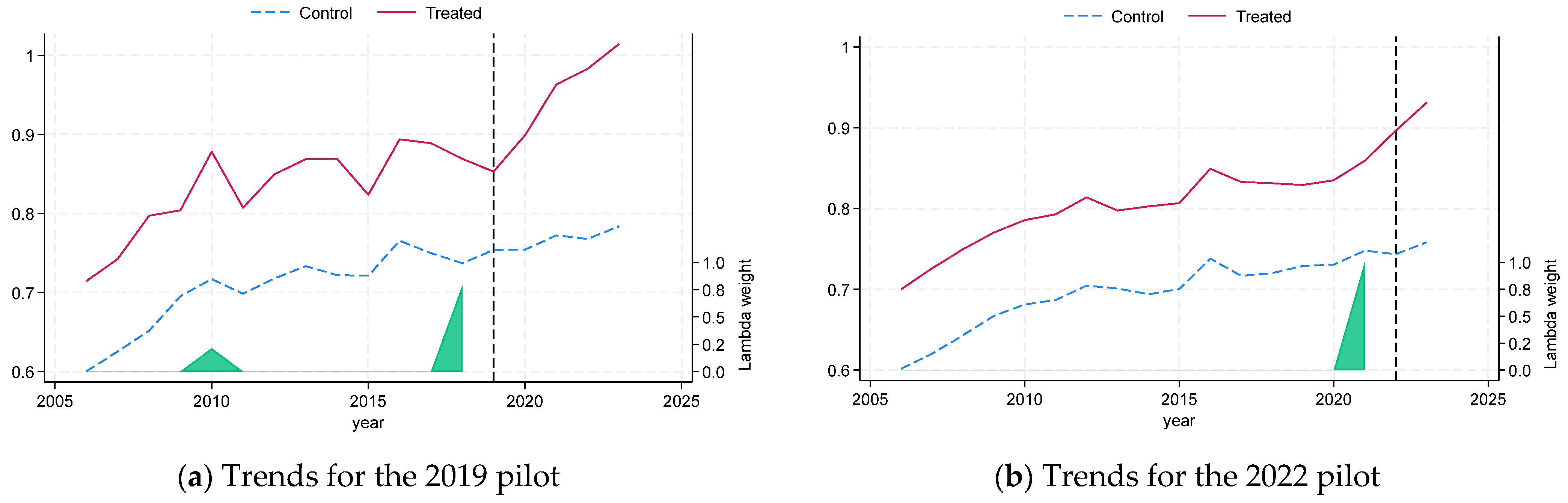
Previous heterogeneity-robust estimators have confirmed the baseline results but do not alter sample composition or comparability. To strengthen counterfactual construction, we employ synthetic DID [58], which assigns optimal weights to control units to create a synthetic control group aligned with the pre-policy trend of treated units. Column (5) of Table 6 reports a significantly positive average treatment effect of ZWC at the 1% level, which is consistent with the baseline and robustness results. Figure 5 presents the synthetic DID trends for treated and control groups in the 2019 and 2022 pilot batches. Energy efficiency in the treatment group increases more markedly than in the control group after the implementation of the ZWC policy. Notably, the increase is particularly pronounced for the 2019 batch, while the 2022 batch shows a relatively moderate but still positive trend. These visual patterns suggest that the ZWC policy is associated with improvements in urban energy efficiency, with stronger effects observed in earlier pilot cohorts.

4.4.4. Propensity Score Matching

The propensity score matching method is used as a robustness check to improve comparability between the treatment and control groups and identify the net effect of the ZWC policy. Specifically, caliper matching is performed with a bandwidth of 0.05. Under the condition of satisfying the common support domain, we match control units to treated units with similar characteristics and re-estimate the regression on the matched sample. Column (1) of Table 7 shows that, after accounting for potential self-selection bias, the estimated effect of the ZWC policy remains significantly positive, which is consistent with the baseline findings and suggests a positive impact of the policy on urban energy efficiency.

4.4.5. Excluding the Interference of Concurrent Policies

Existing studies suggest that policies such as the Energy Conservation and Emission Reduction Fiscal Policy (FP), the Low-Carbon City Pilot (LCC), as well as ECPZ, IRCUB, and CEDC, may all exert significant influences on energy efficiency [17,59,60,61,62]. To rule out potential confounding effects from these concurrent policies, we construct dummy variables indicating whether each policy is implemented and include them in the baseline regression. The results in Column (2) of Table 7 show that, after controlling for these policy interventions, the coefficient on ZWC remains significantly positive. This finding suggests that the estimated effect of the ZWC policy is unlikely to be driven by other contemporaneous policy interventions, providing further support for the robustness of the baseline results.

4.4.6. Replacing the Dependent Variable

To address potential measurement bias, this paper re-measures energy efficiency using the super-efficiency Charnes–Cooper–Rhodes (CCR) model and constructs an alternative indicator (EE2). This alternative measure is then used to re-estimate the baseline regression model. Column (3) of Table 7 shows that the coefficient of the core explanatory variable remains significantly positive after replacing the dependent variable, further supporting the robustness of the findings.

4.4.7. Interactive Fixed Effects and Higher-Level Clustered Standard Errors

To account for unobserved provincial-level time-varying factors and spatial correlations, this paper uses interactive fixed effects and higher-level clustered standard errors as robustness checks. Specifically, Column (4) of Table 7 adds province-year interactive fixed effects to the baseline model to absorb time-varying provincial shocks. Column (5) clusters standard errors at the province level to address error correlations across cities within the same province. Column (6) simultaneously controls for province-year interactive fixed effects and clusters standard errors at the province level. The estimation results show that the coefficient of the ZWC policy remains significantly positive across all three columns, consistent with the baseline findings. This indicates that after further controlling for inter-provincial time-varying factors and intra-province correlations, the estimated effect of the ZWC policy on EE remains robust.

4.4.8. Excluding Interpolated Observations

To verify whether the core findings are affected by data interpolation, we exclude all observations filled by linear interpolation and re-estimate the baseline staggered DID model. The restricted sample covers 4862 city-year observations. As shown in Column (7) of Table 7, the coefficient of ZWC remains significantly positive at the 1% level, with a consistent sign, significance, and magnitude compared with the baseline result. This suggests that interpolation for missing data is unlikely to drive the core conclusion and provides evidence that the baseline findings are robust.

4.5. Mechanism Test

Theoretically, the ZWC pilot may promote improvements in urban energy efficiency through three channels: the resource circulation effect, the structural optimization effect, and the innovation compensation effect. This section empirically tests the above mechanisms.

4.5.1. Resource Circulation Effect Test

First, we examine the resource circulation effect associated with waste sorting, recycling, and resource recovery policies under the ZWC pilot. It is measured by the comprehensive utilization rate of industrial solid waste (ISWUR), defined as the ratio of the amount of industrial solid waste comprehensively utilized to the amount generated. A higher value of this indicator indicates a stronger capacity for resource recovery and utilization of solid waste in a city. Column (1) of Table 8 shows that the ZWC policy significantly improves the ISWUR. The increase in this indicator implies that more waste is transformed into reusable resources, thereby reducing energy consumption in both primary resource extraction and waste treatment processes. This not only alleviates environmental pressure but also enhances urban energy efficiency. These results are consistent with H2a and suggest that waste resource utilization may serve as an important channel through which the ZWC pilot improves urban energy efficiency.

4.5.2. Structural Optimization Effect Test

Second, we examine the structural optimization effect generated by cleaner production requirements and environmental regulation measures under the ZWC pilot. Following [63], this study uses the Theil index to measure the rationalization of the industrial structure. This index reflects the degree of structural deviation by comparing the matching between sectoral value added and employment; a lower value indicates a more rational industrial structure. Column (2) of Table 8 shows that the ZWC policy significantly reduces the Theil index, indicating an improvement in the rationalization of the industrial structure. Specifically, the ZWC pilot exerts pressure on high-energy-consuming and high-emission industries to undergo green transformation or exit in an orderly manner, while simultaneously encouraging the development of cleaner production and resource-efficient industries. This process facilitates the transition of the industrial structure from energy-intensive to efficient and clean sectors, thereby reducing energy intensity at the macro level and improving overall urban energy efficiency. These findings are consistent with H2b and indicate that industrial structure optimization may be an important pathway linking the ZWC pilot to improvements in urban energy efficiency.

4.5.3. Innovation Compensation Effect Test

Finally, we examine the innovation compensation effect associated with the adoption of cleaner technologies and green innovation incentives under the ZWC pilot. It is measured by the number of green invention patent applications (GIPA) filed in a city in a given year. A higher value of this indicator reflects stronger vitality in green technological innovation. Column (3) of Table 8 shows that the ZWC policy significantly promotes the growth of green invention patent applications. From an economic perspective, the ZWC pilot induces firms to engage in green technological research and innovation through environmental regulation. To meet the requirements of solid waste reduction and resource utilization, firms are compelled to improve production processes and develop cleaner technologies. The resulting “innovation compensation” effect partially offsets the increase in compliance costs associated with environmental regulations, enhances production efficiency and resource utilization, and thereby promotes improvements in urban energy efficiency. These findings are consistent with H2c and suggest that green technological innovation may constitute an important transmission channel through which the ZWC pilot affects urban energy efficiency.

4.6. Heterogeneity Test

To further examine the heterogeneity effects of the ZWC pilot on urban energy efficiency, this study conducts analyses from three dimensions: environmentally key protected cities, city size, and the level of AI development. This aims to explore how the policy effects vary under different levels of environmental regulatory pressure, resource agglomeration, and technological foundations. We adopt Fisher’s Permutation test with 1000 random permutations to statistically examine the significance of coefficient differences across grouped samples.

4.6.1. Environmentally Key Protected Cities

First, we examine heterogeneity based on whether a city is designated as an environmentally key protected city. According to the National Environmental Protection “Eleventh Five-Year Plan” issued by the State Council in 2007, this study classifies 112 environmentally key protected cities as one group, with the remaining cities serving as the comparison group for subgroup regressions. Columns (1)–(2) of Table 9 show that the ZWC pilot significantly improves energy efficiency in environmentally key protected cities, while the effect is not significant in non-key protected cities. This finding is consistent with H3a. A possible explanation is that environmentally key protected cities face stronger environmental regulatory pressure and possess more advanced environmental governance infrastructure and institutional arrangements, making the marginal effect of the ZWC pilot more pronounced. In contrast, non-key protected cities are subject to relatively weaker environmental regulations, and their solid waste management capacity and supporting institutional frameworks still need improvement, which may constrain the full realization of the policy effects to some extent.

4.6.2. City Size

To examine city size heterogeneity, cities are classified into large and small- and medium-sized groups using a one-million urban resident population threshold in municipal districts, following the State Council’s classification criteria. Columns (3)–(4) of Table 9 show that the ZWC pilot significantly improves energy efficiency in large cities, while the effect is not significant in small- and medium-sized cities. This finding is consistent with H3b. A possible explanation is that large cities typically possess more abundant resource endowments, more complete industrial systems, and stronger technological innovation capabilities, which are conducive to the implementation and effectiveness of the ZWC policy. In contrast, small- and medium-sized cities face relative constraints in solid waste treatment infrastructure, technical talent, and fiscal support, and the realization of policy effects may require a longer time horizon.

4.6.3. Artificial Intelligence Development Level

Finally, we examine heterogeneity based on the level of AI development. We measure the level of AI development using the number of AI-related patents. Following the Key Digital Technology Patent Classification System (2023), AI patents are identified by adopting the official International Patent Classification codes for AI technology, combined with data from the State Intellectual Property Office, to search and match annual patent applications at the city level and screen those classified as AI technology. Given the highly skewed distribution of patent data, this study classifies cities into high-AI and low-AI development groups according to the median value of AI patent volume, which avoids the instability of mean-based grouping and guarantees the rationality of subgroup division. Columns (5)–(6) of Table 9 show that the ZWC pilot significantly improves energy efficiency in cities with a higher level of AI development, while the effect is not significant in cities with a lower level of AI development. This finding is consistent with H3c. One possible explanation is that AI, as a core driver of the digital economy, may enhance the synergistic governance of solid waste management and energy consumption through precise sensing, intelligent scheduling, and process optimization, thereby amplifying the energy efficiency improvement effects of the policy.

5. Further Analysis

The previous analysis confirms that the ZWC policy significantly improves energy efficiency. However, this finding mainly reflects the policy’s effect on resource utilization efficiency and does not fully capture its broader implications for urban development. To provide a more comprehensive evaluation, this section further examines the fiscal, economic, and environmental effects associated with the interaction between the ZWC policy and energy efficiency improvements. Specifically, it is important to assess whether the policy, while increasing fiscal and environmental protection expenditures, can also promote fiscal revenue growth, economic development, and environmental improvement. Such an analysis contributes to a more comprehensive understanding of the overall policy effects and its role in promoting sustainable urban development. To capture the heterogeneous policy effect contingent on urban resource endowment, we further construct the interaction term between the ZWC policy and energy efficiency (ZWC × EE). This interaction reflects how the marginal impacts of ZWC on fiscal, economic, and environmental performance vary with the level of inherent energy efficiency across cities. Unlike the baseline model that only estimates the average policy effect, the interaction specification allows us to explore the nonlinear synergies between policy implementation and existing urban green development foundations, which cannot be fully revealed by a simple direct regression of outcomes on the ZWC dummy.
From a fiscal perspective, columns (1) and (2) of Table 10 show that the interaction term has positive and statistically significant effects on both fiscal expenditure and fiscal revenue at the 1 percent level, with estimated coefficients of 0.0928 and 0.1060. The increase in fiscal revenue is larger than that of fiscal expenditure, suggesting that the policy may improve fiscal capacity while maintaining fiscal sustainability. Column (3) shows the strongest effect on energy conservation and environmental protection expenditure (EC&EPC), with a coefficient of 0.2336, indicating that the policy is associated with increased investment in green governance. Column (4) reports a positive and significant coefficient of 0.1172 on GDP, implying that increased environmental spending does not appear to hinder economic growth and may instead support it. From an environmental perspective, columns (5) and (6) show that the interaction term has significantly negative effects on CO2 intensity and PM2.5 concentration, with coefficients of −0.0563 and −0.0481. These results indicate that the policy is associated with reductions in environmental pollution while coinciding with economic expansion and fiscal revenue growth. Overall, by improving energy efficiency, the zero-waste city policy appears to generate both economic and environmental co-benefits, suggesting its broader positive implications for sustainable urban development.

6. Discussion

The findings of this study both complement and extend the existing literature on the circular economy, environmental regulation, and urban energy transition. Unlike most previous studies that primarily evaluate circular economy policies from the perspectives of waste reduction, recycling performance, or pollutant mitigation [9,10,11,12,13,14], this paper demonstrates that circular economy transformation can also generate significant improvements in urban energy efficiency. In this sense, our results provide new empirical evidence that the circular economy is not merely a waste governance framework, but also an important pathway for optimizing urban energy systems and promoting coordinated resource–energy governance.
First, the baseline results are generally consistent with the literature emphasizing the positive environmental and economic effects of circular economy policies. Existing studies have shown that waste recycling, industrial symbiosis, and resource reutilization can reduce raw material dependence and lower environmental externalities [12,13,14,15]. Our findings further extend this perspective by showing that the ZWC policy significantly improves urban energy efficiency. This suggests that the benefits of circular economy governance are not limited to reducing waste disposal pressure, but also include improving the allocation efficiency of energy and material inputs across urban production systems. Therefore, this study broadens the analytical boundary of circular economy research from “waste reduction effects” to “resource–energy synergy effects.”
Second, our findings are also broadly consistent with the literature on environmental regulation and energy efficiency. Previous studies argue that properly designed environmental regulation can stimulate technological upgrading and efficiency improvement, which is in line with the Porter Hypothesis [20,21,22]. Similar to studies on low-carbon city pilots and environmental regulation policies [16,17,18,19], this paper finds that the ZWC policy improves energy efficiency through green technological innovation and industrial upgrading. However, compared with traditional pollution-control regulations, the ZWC policy differs in that it adopts a more systemic governance framework covering waste generation, recycling, industrial coordination, and resource circulation throughout the entire production lifecycle. Therefore, the energy-efficiency gains identified in this paper reflect not only regulatory pressure, but also structural optimization arising from circular resource flows and coordinated urban governance.
Third, this study differs from the existing ZWC policy literature in several important aspects. Current studies on the ZWC initiative mainly focus on pollutant emissions, waste treatment capacity, or green innovation outcomes [24,25,26,27,28,29,30]. Although these studies provide valuable evidence regarding the environmental benefits of the policy, they largely overlook its potential impacts on urban energy systems. This paper contributes to the literature by identifying energy efficiency as a new and important policy outcome. Moreover, unlike previous studies that generally treat the ZWC policy as a conventional environmental regulation tool, this paper conceptualizes it as a systemic circular economy transformation policy capable of generating cross-domain spillover effects across the resource, industrial, and energy sectors.
Another contribution of this study lies in the mechanism analysis. Existing research rarely explains how circular economy policies influence energy efficiency. This paper integrates resource circulation theory, industrial structure upgrading, and the Porter Hypothesis into a unified analytical framework and identifies three transmission channels: the resource circulation effect, the structural optimization effect, and the innovation compensation effect. These findings enrich the theoretical understanding of how circular economy governance can reshape urban production and energy utilization patterns.
Finally, the broader fiscal, economic, and environmental effects identified in this study further distinguish it from prior research. Most existing studies evaluate circular economy policies primarily through environmental indicators [24,25,26,28], while paying limited attention to their long-term economic sustainability. This paper finds that the ZWC policy not only reduces carbon intensity and PM2.5 concentration, but also promotes fiscal capacity, green investment, and economic growth. These results imply that circular economy governance can simultaneously achieve economic and environmental gains, thereby supporting the long-term sustainability of urban green transformation.

7. Conclusions

Amid global climate change and tightening resource constraints, achieving coordinated governance between waste reduction and energy efficiency improvement has become a critical challenge for sustainable urban development. In theory, the circular economy can influence energy consumption through resource substitution and technological progress, yet its causal impact on urban energy efficiency lacks sufficient empirical evidence. This paper therefore treats China’s ZWC policy as an exogenous shock and constructs a quasi-natural experiment. Using prefecture-level city panel data from 2006 to 2023, it applies staggered DID and DML methods to evaluate the effects of urban circular economy transformation on energy efficiency and further explores the underlying mechanisms and heterogeneity. The key findings are as follows.
(1)
The ZWC policy significantly enhances urban energy efficiency, as confirmed by multiple robustness checks such as parallel trend, placebo, synthetic DID, propensity score matching, and DML tests.
(2)
The policy enhances energy efficiency through three mechanisms. The first is the resource circulation effect, which improves the comprehensive utilization rate of industrial solid waste, promotes waste reuse, and reduces energy consumption in primary resource extraction and processing. The second is the structural optimization effect, which facilitates industrial upgrading and promotes the green transformation of energy-intensive industries, thereby lowering energy use per unit of output. The third is the innovation compensation effect, which induces firms to engage in green technological innovation, partially offsets pollution control costs, and improves overall production efficiency.
(3)
The policy effects exhibit significant heterogeneity across city characteristics. The impact is more pronounced in environmentally regulated cities, large cities, and regions with higher levels of AI development. This suggests that environmental regulation intensity, city size, and digital technology development are important moderating factors.
(4)
Further analysis shows that the ZWC policy, through improving energy efficiency, generates broader positive fiscal, economic, and environmental effects, indicating strong sustainability. The policy enhances fiscal capacity through faster revenue growth than expenditure, promotes green investment, supports GDP growth, and significantly reduces carbon intensity and PM2.5 concentration. Overall, it achieves coordinated improvements in economic and environmental performance, supporting urban circular economy transformation.
These findings provide several policy implications for promoting the coordinated transformation of urban circular economy development and energy transition in China.
First, the empirical results suggest that the ZWC policy can significantly improve urban energy efficiency through resource circulation, industrial upgrading, and green technological innovation. Therefore, policymakers should continue to deepen the implementation of the ZWC initiative within the framework of China’s “Dual Carbon” strategy and the 15th Five-Year Circular Economy Development Plan. In particular, local governments should strengthen support for industrial solid waste recycling, renewable resource utilization, and cleaner production technologies in order to enhance the resource–energy synergy effects identified in this study.
Second, the heterogeneity analysis indicates that the policy effects are more pronounced in environmentally regulated cities, large cities, and regions with relatively high levels of digital development. This suggests that local conditions play an important role in determining policy effectiveness. Accordingly, large metropolitan areas and key environmental governance regions, such as the Beijing–Tianjin–Hebei region and the Yangtze River Delta, may further integrate circular economy governance with smart energy management and digital monitoring systems. Meanwhile, small and medium-sized cities may place greater emphasis on industrial restructuring, waste classification systems, and the diffusion of green technologies according to their industrial foundations and governance capacities.
Third, the results show that the ZWC policy generates broader economic and environmental co-benefits, including improved fiscal capacity, increased green investment, and reduced carbon intensity. Therefore, future policy design may further strengthen the coordination between circular economy governance and urban green development objectives. For example, local governments may incorporate indicators related to waste reduction, resource utilization, and energy efficiency into urban sustainability evaluation systems, thereby improving the long-term effectiveness and accountability of circular economy governance. In addition, governments can explore supportive policy tools, such as green finance and targeted fiscal guidance, to facilitate technological upgrading and resource recycling infrastructure construction.


Author Contributions

Conceptualization, R.L. and J.X.; data curation, R.L. and J.X.; formal analysis, R.L.; investigation, J.X.; methodology, R.L. and J.X.; software, J.X.; validation, R.L.; visualization, J.X.; writing—original draft preparation, R.L.; writing—review and editing, R.L. and J.X. All authors have read and agreed to the published version of the manuscript.

Funding

This work was supported by the Fujian Provincial Social Science Foundation Project (Grant No. FJ2026BF013).

Data Availability Statement

The original data presented in the study are openly available in FigShare at https://doi.org/10.6084/m9.figshare.32029503.

Acknowledgments

The authors are grateful to the anonymous referees who provided valuable comments and suggestions to significantly improve the quality of the paper.

Conflicts of Interest

The authors declare no conflicts of interest.

References

  1. Ng, S.-L.; Chen, C.-Y. Circular Economy and Energy Transition: Research Trends, Knowledge Structure, and Future Directions. Energies 2026, 19, 763. [Google Scholar] [CrossRef] [Scilit]
  2. Cao, Q.; Song, J.; Liu, C.; Yang, W.; Yabar, H.; Zheng, H.; Mi, Z. Expediting co-benefits of tailored municipal solid waste management strategies globally. Nat. Sustain. 2025, 8, 1164–1176. [Google Scholar] [CrossRef] [Scilit]
  3. Korhonen, J.; Honkasalo, A.; Seppälä, J. Circular economy: The concept and its limitations. Ecol. Econ. 2018, 143, 37–46. [Google Scholar] [CrossRef] [Scilit]
  4. Chioatto, E.; Sospiro, P. Transition from waste management to circular economy: The European Union roadmap. Environ. Dev. Sustain. 2023, 25, 249–276. [Google Scholar] [CrossRef] [Scilit]
  5. Kirikkaleli, D. Resource efficiency, energy productivity, and environmental quality in Japan. Resour. Policy 2023, 85, 104006. [Google Scholar] [CrossRef] [Scilit]
  6. Park, S. Factors influencing the recycling rate under the volume-based waste fee system in South Korea. Waste Manag. 2018, 74, 43–51. [Google Scholar] [CrossRef] [Scilit]
  7. Li, H.; Lu, X.; Liu, F.; Li, Z.; Liu, X.; Lu, B.; Ma, S.; Gu, B.; Zhou, C.; Wang, Z. The waste-environmental-economic nexus facilitates city-specific cost-effective transition for China’s municipal solid waste treatment. Innovation 2026, 7, 101315. [Google Scholar] [CrossRef] [Scilit]
  8. Chen, Q.; Chen, P.; Chu, Z. Riddled with challenges: Are zero-waste cities transitioning to circular economies? Insights from Chinese cities. J. Environ. Manag. 2025, 385, 125662. [Google Scholar] [CrossRef] [Scilit]
  9. Tumu, K.; Vorst, K.; Curtzwiler, G. Global plastic waste recycling and extended producer responsibility laws. J. Environ. Manag. 2023, 348, 119242. [Google Scholar] [CrossRef] [Scilit]
  10. Mayanti, B.; Helo, P. Circular economy through waste reverse logistics under extended producer responsibility in Finland. Waste Manag. Res. 2024, 42, 59–73. [Google Scholar] [CrossRef] [Scilit]
  11. Joltreau, E. Extended Producer Responsibility, Packaging Waste Reduction and Eco-design: E. Joltreau. Environ. Resour. Econ. 2022, 83, 527–578. [Google Scholar] [CrossRef] [Scilit]
  12. Zhan, H.; Shao, L.; Pan, Y.; Wu, Z. Life-cycle carbon emissions from pilot zero-waste technologies in China. Environ. Impact Assess. Rev. 2023, 103, 107279. [Google Scholar] [CrossRef] [Scilit]
  13. Deniz, R.F.; Chen, X.; Orak, N.H. Investigation of greenhouse gas emissions from municipal solid waste management practices using an economic input-output life cycle analysis approach. J. Clean. Prod. 2023, 420, 138450. [Google Scholar] [CrossRef] [Scilit]
  14. Zhao, R.; Sun, L.; Zou, X.; Dou, Y. Greenhouse gas emissions analysis working toward zero-waste and its indication to low carbon city development. Energies 2021, 14, 6644. [Google Scholar] [CrossRef] [Scilit]
  15. Liu, Q.; Xie, M.; Mi, G.; Yuan, X. Integrating circular economy policies in urban policy making: Strategies for green energy and environmental management to reinforce city image in China. J. Environ. Manag. 2025, 375, 124128. [Google Scholar] [CrossRef] [Scilit]
  16. Liu, Y.; Fan, H.; Wei, X. Pollution charges and firms’ energy efficiency: Evidence from a quasi-natural experiment in China. Appl. Econ. 2024, 56, 7582–7599. [Google Scholar] [CrossRef] [Scilit]
  17. Wang, L.; Shao, J.; Ma, Y. Does China’s low-carbon city pilot policy improve energy efficiency? Energy 2023, 283, 129048. [Google Scholar] [CrossRef] [Scilit]
  18. Song, P.; Mao, X.; Li, Z.; Tan, Z. Study on the optimal policy options for improving energy efficiency and Co-controlling carbon emission and local air pollutants in China. Renew. Sustain. Energy Rev. 2023, 175, 113167. [Google Scholar] [CrossRef] [Scilit]
  19. Lin, J.; Xu, C. The impact of environmental regulation on total factor energy efficiency: A cross-region analysis in China. Energies 2017, 10, 1578. [Google Scholar] [CrossRef] [Scilit]
  20. Xu, L.; Luo, Y.; Wu, C.; Umar, M.; Li, H.; Muhammad, S. Environmental regulation and green innovation efficiency: A revisit of the porter hypothesis based on Chinese cities. Environ. Dev. Sustain. 2025, 27, 11819–11843. [Google Scholar] [CrossRef] [Scilit]
  21. Zhang, W.; Zhu, B.; Li, Y.; Yan, D. Revisiting the Porter hypothesis: A multi-country meta-analysis of the relationship between environmental regulation and green innovation. Humanit. Soc. Sci. Commun. 2024, 11, 232. [Google Scholar] [CrossRef] [Scilit]
  22. Hu, H.; Zhu, Y.; Ye, L.; Wang, Y. How does environmental tax reform drive corporate innovation to green technologies? Quasi-natural experimental evidence from China. J. Bus. Econ. Manag. 2025, 26, 798–824. [Google Scholar] [CrossRef] [Scilit]
  23. Kilinc-Ata, N.; Xavier, B.; Bhat, M.A. Decoupling economic growth and CO2 emissions: A geopolitical comparison of the EU and GCC energy transitions. Qual. Quant. 2026, 60, 7377–7406. [Google Scholar] [CrossRef] [Scilit]
  24. Zhang, N.; Liu, W.; Li, J.; Liu, L.; Tan, Q. Quantifying carbon reduction potential of “Zero-Waste City” pilot: A case study of Shenzhen based on source reduction-recycling-disposal framework. J. Environ. Sci. 2025, 161, 411–420. [Google Scholar] [CrossRef] [Scilit]
  25. Huang, Q.; Zhao, T.; Lin, M.; Li, W.; Zhou, Q.; Chen, C. Insights and practices for industrial solid waste management under “zero-waste city” construction in China. Circ. Econ. 2025, 4, 100155. [Google Scholar] [CrossRef] [Scilit]
  26. Yang, G.; Zhang, Q.; Zhao, Z.; Zhou, C. How does the “Zero-waste City” strategy contribute to carbon footprint reduction in China? Waste Manag. 2023, 156, 227–235. [Google Scholar] [CrossRef] [Scilit] [PubMed]
  27. Liu, M.; Chen, L.; Sheng, X.; Xu, Y.; Yuan, X.; Wang, Q.; Ma, Q.; Zuo, J. Zero-waste city pilot and urban green and low-carbon transformation: Quasi-experimental evidence from China. Resour. Conserv. Recycl. 2024, 206, 107625. [Google Scholar] [CrossRef] [Scilit]
  28. Tian, C.; Sui, H.; Chen, Y.; Wang, W.; Deng, H. Estimating carbon emission reductions from China’s “Zero-waste City” construction pilot program. Resour. Conserv. Recycl. 2025, 212, 107975. [Google Scholar] [CrossRef] [Scilit]
  29. Huang, M.; Chen, S.; Cheng, P. Green path without waste: Zero-waste city pilot construction and corporate green innovation. Humanit. Soc. Sci. Commun. 2025, 12, 1771. [Google Scholar] [CrossRef] [Scilit]
  30. Qian, Y.; Jiang, J.; Guo, B.; Hu, F. The impact of “zero-waste city” pilot policy on corporate green transformation: A causal inference based on double machine learning. Front. Environ. Sci. 2025, 13, 1564418. [Google Scholar] [CrossRef] [Scilit]
  31. Pearce, D.W.; Turner, R.K. Economics of Natural Resources and the Environment; Johns Hopkins University Press: Baltimore, MD, USA, 1989. [Google Scholar]
  32. Del Borghi, A.; Gallo, M.; Del Borghi, M. A survey of life cycle approaches in waste management. Int. J. Life Cycle Assess. 2009, 14, 597–610. [Google Scholar] [CrossRef] [Scilit]
  33. Haas, W.; Krausmann, F.; Wiedenhofer, D.; Heinz, M. How circular is the global economy? An assessment of material flows, waste production, and recycling in the European Union and the world in 2005. J. Ind. Ecol. 2015, 19, 765–777. [Google Scholar] [CrossRef] [Scilit]
  34. Harvey, L.D. Iron and steel recycling: Review, conceptual model, irreducible mining requirements, and energy implications. Renew. Sustain. Energy Rev. 2021, 138, 110553. [Google Scholar] [CrossRef] [Scilit]
  35. Wei, M.; Zhang, X. From waste to wealth: Evaluating the impact of zero-waste city policy on urban GTFP in China. Environ. Dev. Sustain. 2025, 14, 1–31. [Google Scholar] [CrossRef] [Scilit]
  36. Demirbas, A. Waste management, waste resource facilities and waste conversion processes. Energy Convers. Manag. 2011, 52, 1280–1287. [Google Scholar] [CrossRef] [Scilit]
  37. Muhammad, S.; Pan, Y.; Agha, M.H.; Umar, M.; Chen, S. Industrial structure, energy intensity and environmental efficiency across developed and developing economies: The intermediary role of primary, secondary and tertiary industry. Energy 2022, 247, 123576. [Google Scholar] [CrossRef] [Scilit]
  38. Peneder, M. Industrial structure and aggregate growth. Struct. Change Econ. Dyn. 2003, 14, 427–448. [Google Scholar] [CrossRef] [Scilit]
  39. Hongjun, G.; Liye, D.; Aiwu, Z. Energy structure dividend, factor allocation efficiency and regional productivity growth—An empirical examination of energy restructuring in China. Energy Policy 2023, 172, 113307. [Google Scholar] [CrossRef] [Scilit]
  40. Xue, L.; Li, H.; Xu, C.; Zhao, X.; Zheng, Z.; Li, Y.; Liu, W. Impacts of industrial structure adjustment, upgrade and coordination on energy efficiency: Empirical research based on the extended STIRPAT model. Energy Strategy Rev. 2022, 43, 100911. [Google Scholar] [CrossRef] [Scilit]
  41. Bian, Y.; Ma, X. Dynamic evolution and influencing factors of internal and external synergy in China’s energy industry: From the perspective of industrial chain. Sustain. Futures 2024, 8, 100360. [Google Scholar] [CrossRef] [Scilit]
  42. Palmer, K.; Oates, W.E.; Portney, P.R. Tightening environmental standards: The benefit-cost or the no-cost paradigm? J. Econ. Perspect. 1995, 9, 119–132. [Google Scholar] [CrossRef] [Scilit]
  43. Porter, M.E.; Linde, C. v. d. Toward a new conception of the environment-competitiveness relationship. J. Econ. Perspect. 1995, 9, 97–118. [Google Scholar] [CrossRef] [Scilit]
  44. Mischos, S.; Dalagdi, E.; Vrakas, D. Intelligent energy management systems: A review. Artif. Intell. Rev. 2023, 56, 11635–11674. [Google Scholar] [CrossRef] [Scilit]
  45. Šūmakaris, P.; Korsakienė, R.; Ščeulovs, D. Determinants of energy efficient innovation: A systematic literature review. Energies 2021, 14, 7777. [Google Scholar] [CrossRef] [Scilit]
  46. Shin, J.; Kim, C.; Yang, H. Does reduction of material and energy consumption affect to innovation efficiency? The case of manufacturing industry in South Korea. Energies 2019, 12, 1178. [Google Scholar] [CrossRef] [Scilit]
  47. Lee, C.-C.; Wen, H. Global value chain embedding and enterprise energy efficiency: A worldwide firm-level analysis. Renew. Sustain. Energy Rev. 2025, 207, 114955. [Google Scholar] [CrossRef] [Scilit]
  48. Liu, C.; Ma, C.; Xie, R. Structural, innovation and efficiency effects of environmental regulation: Evidence from China’s carbon emissions trading pilot. Environ. Resour. Econ. 2020, 75, 741–768. [Google Scholar] [CrossRef] [Scilit]
  49. Chernozhukov, V.; Chetverikov, D.; Demirer, M.; Duflo, E.; Hansen, C.; Newey, W.; Robins, J. Double/debiased machine learning for treatment and structural parameters. Econom. J. 2018, 21, C1–C68. [Google Scholar] [CrossRef] [Scilit]
  50. Callaway, B.; Sant’Anna, P.H. Difference-in-differences with multiple time periods. J. Econom. 2021, 225, 200–230. [Google Scholar] [CrossRef] [Scilit]
  51. De Chaisemartin, C.; D’Haultfoeuille, X. Two-way fixed effects and differences-in-differences with heterogeneous treatment effects: A survey. Econom. J. 2023, 26, C1–C30. [Google Scholar] [CrossRef] [Scilit]
  52. Goodman-Bacon, A. Public insurance and mortality: Evidence from Medicaid implementation. J. Political Econ. 2018, 126, 216–262. [Google Scholar] [CrossRef] [Scilit]
  53. Sun, L.; Abraham, S. Estimating dynamic treatment effects in event studies with heterogeneous treatment effects. J. Econom. 2021, 225, 175–199. [Google Scholar] [CrossRef] [Scilit]
  54. Clarke, P.S.; Polselli, A. Double machine learning for static panel models with fixed effects. Econom. J. 2026, 29, 69–86. [Google Scholar] [CrossRef] [Scilit]
  55. Cengiz, D.; Dube, A.; Lindner, A.; Zipperer, B. The effect of minimum wages on low-wage jobs. Q. J. Econ. 2019, 134, 1405–1454. [Google Scholar] [CrossRef] [Scilit]
  56. Borusyak, K.; Jaravel, X.; Spiess, J. Revisiting event-study designs: Robust and efficient estimation. Rev. Econ. Stud. 2024, 91, 3253–3285. [Google Scholar] [CrossRef] [Scilit]
  57. Gardner, J. Two-stage differences in differences. arXiv 2022, arXiv:2207.05943. [Google Scholar]
  58. Arkhangelsky, D.; Athey, S.; Hirshberg, D.A.; Imbens, G.W.; Wager, S. Synthetic difference-in-differences. Am. Econ. Rev. 2021, 111, 4088–4118. [Google Scholar] [CrossRef] [Scilit]
  59. Zhou, Y.; Lin, B. The energy-saving effect of green fiscal policy: Empirical evidence from China’s comprehensive demonstration cities of energy conservation and emission reduction fiscal policy. Appl. Energy 2025, 378, 124784. [Google Scholar] [CrossRef] [Scilit]
  60. Zhang, P.; Tan, L.; Liu, F. Assessing the implications of ecological civilization pilots in urban green energy industry on carbon emission mitigation: Evidence from China. Energies 2023, 16, 7638. [Google Scholar] [CrossRef] [Scilit]
  61. Bai, Y.; Wang, N.; Xie, S.; Zhang, J. Paradigm and efficiency of industrial waste resource utilization: Evidence from China. J. Environ. Manag. 2025, 380, 124922. [Google Scholar] [CrossRef] [Scilit]
  62. Li, S.; Hu, Z. The impact of the circular economy pilot policy on carbon emissions in Chinese cities and its underlying mechanisms. Sustainability 2024, 16, 7859. [Google Scholar] [CrossRef] [Scilit]
  63. Hu, L.; Yuan, W.; Jiang, J.; Ma, T.; Zhu, S. Asymmetric effects of industrial structure rationalization on carbon emissions: Evidence from thirty Chinese provinces. J. Clean. Prod. 2023, 428, 139347. [Google Scholar] [CrossRef] [Scilit]
Figure 1. Conceptual theoretical framework.
Energies 19 02470 g001
Figure 2. Bacon decomposition.
Energies 19 02470 g002
Figure 3. Parallel trends test results.
Energies 19 02470 g003
Figure 4. Placebo test results.
Energies 19 02470 g004
Figure 5. SDID results trend.
Energies 19 02470 g005
Table 1. Variable definitions.
VariablesDefinitionMeasurement
EEUrban energy efficiencysuper-efficiency Slacks-Based Measure (SBM)
ZWCZero-Waste City pilot policy dummy1 if the city is included in the pilot in year t, 0 otherwise
PGDPEconomic developmentReal GDP per capita (logarithm)
PDPopulation densityPermanent residents per square kilometer (logarithm)
GOVGovernment interventionLocal general public budget expenditure/GDP
FDIForeign direct investmentActual utilized foreign direct investment/GDP
Table 2. Descriptive statistics.
VariablesObsMeanStd. DevMinMax
EE50760.34670.14420.08901.2058
ZWC50760.04730.21240.00001.0000
PGDP507610.54460.74187.229812.4863
PD50765.65731.00431.60947.9919
GOV50760.20230.14630.14631.9054
FDI50760.00270.00320.00000.0352
Table 3. Baseline regression results.
(1)(2)(3)
EEEEEE
ZWC0.1772 ***0.0554 ***0.0537 ***
(0.0145)(0.0182)(0.0171)
Control NNY
Time-fixedNYY
Individual-fixedNYY
N507650765076
R20.06990.26090.2665
Note: *** denotes significance at the 1% level.
Table 4. Results of lagged independent variable and control for selection variables.
(1)(2)(3)(4)(5)
EEEEEEEEEE
L1.ZWC0.0625 ***
(0.0179)
L2.ZWC 0.0675 *
(0.0397)
L3.ZWC 0.0679 *
(0.0380)
L4.ZWC 0.06693 *
(0.0363)
ZWC 0.0551 ***
(0.0116)
ECPZ × t −0.0044 ***
(0.0014)
IRCUB × t −0.0030
(0.0020)
CEDC × t 0.0007
(0.0026)
Control YYYYY
Time-fixedYYYYY
Individual-fixedYYYYY
N47944512423039485076
R20.21430.16640.13750.12390.2735
Note: *, *** denote significance at the 10%, and 1% levels, respectively.
Table 5. Results of the DML model.
(1)(2)(3)(4)(5)(6)(7)
EEEEEEEEEEEEEE
ZWC0.0485 ***0.0393 ***0.0441 ***0.0496 ***0.0680 ***0.0481 ***0.0468 ***
(0.0098)(0.0101)(0.009)(0.0099)(0.0068)(0.0097)(0.0099)
Control YYYYYYY
Time-fixedYYYYYYY
Individual-fixedYYYYYYY
N5076507650765076507650765076
AlgorithmRandom forestDecision treeXGBoostLightGBMNeural networkRandom forestRandom forest
Sample proportion1:41:41:41:41:41:21:7
Note: *** denotes significance at the 1% level.
Table 6. Heterogeneity-robust estimators.
(1)(2)(3)(4)(5)
EEEEEEEEEE
IW_DIDStackedev_DIDImputation_DID2s_DIDSynthetic DID
ZWC0.0538 ***0.0575 ***0.0592 ***0.0596 ***0.0485 ***
(0.0146)(0.0178)(0.0181)(0.0173)(0.0094)
Control YYYYY
Time-fixedYYYYY
Individual-fixedYYYYY
N50765076507650765076
Note: *** denotes significance at the 1% level.
Table 7. Robustness test results.
(1)(2)(3)(4)(5)(6)(7)
EEEEEE2EEEEEEEE
ZWC0.0505 ***0.0527 ***0.0412 *0.0698 ***0.0537 ***0.0698 ***0.0512 ***
(0.0175)(0.0160)(0.0210)(0.0173)(0.0148)(0.0149)(0.0182)
Control YYYYYYY
Time-fixedYYYYYYY
Individual-fixedYYYYYYY
Province Time-fixed NNNYNYY
N5002507650765076507650674862
R20.25990.27770.26720.46100.26650.46100.4603
Note: * and *** denote significance at the 10%, and 1% levels, respectively.
Table 8. Mechanism test results.
(1)(2)(3)
ISWURTheilGIPA
ZWC0.1515 ***−0.0662 ***0.1556 ***
(0.0576)(0.0170)(0.0516)
Control YYY
Time-fixedYYY
Individual-fixedYYY
N507649904948
R20.02640.05810.8084
Note: *** denotes significance at the 1% level.
Table 9. Heterogeneity test results.
(1)(2)(3)(4)(5)(6)
Key ProtectedNon-Key ProtectedLarge CitiesSmall and MediumHigh-AILow-AI
EEEEEEEEEEEE
ZWC0.0581 **0.02780.0650 ***0.01080.0573 ***0.0005
(0.0264)(0.0170)(0.0197)(0.0245)(0.0166)(0.0182)
Control YYYYYY
Time-fixedYYYYYY
Individual-fixedYYYYYY
N199830421818322227932270
R20.34020.23430.38330.20760.27370.2754
Fisher’s Permutation test p-value0.071 *0.047 **0.084 ***
Note: *, ** and *** denote significance at the 10%, 5%, and 1% levels, respectively.
Table 10. Fiscal, economic, and environmental effects test.
(1)(2)(3)(4)(5)(6)
Fiscal ExpenditureFiscal RevenueEC&EPCGDPCO2 IntensityPM2.5
ZWC × EE0.0928 ***0.1060 ***0.2336 ***0.1172 ***−0.0563 ***−0.0481 ***
(0.0171)(0.0264)(0.0731)(0.0159)(0.0153)(0.0160)
ControlYYYYYY
Time-fixedYYYYYY
Individual-fixedYYYYYY
N507650764794507650395076
R20.33380.64010.29880.20760.77900.7185
Note: *** denotes significance at the 1% level.
Disclaimer/Publisher’s Note: The statements, opinions and data contained in all publications are solely those of the individual author(s) and contributor(s) and not of MDPI and/or the editor(s). MDPI and/or the editor(s) disclaim responsibility for any injury to people or property resulting from any ideas, methods, instructions or products referred to in the content.