Article

Unpacking the Impact of E-Commerce Development on Electricity Consumption: Evidence from Chinese Cities

1
School of Management, Hefei University of Technology, Hefei 230009, China
2
Philosophy and Social Sciences Laboratory of Data Science and Smart Society Governance, Ministry of Education, Hefei 230009, China
3
School of Finance, Tongling University, Tongling 244061, China
4
School of Foreign Studies, Tongling University, Tongling 244061, China
*
Author to whom correspondence should be addressed.
Energies 2026, 19(6), 1392; https://doi.org/10.3390/en19061392
Submission received: 16 January 2026 / Revised: 25 February 2026 / Accepted: 4 March 2026 / Published: 10 March 2026
(This article belongs to the Section C: Energy Economics and Policy)

Abstract

E-commerce has become the driving force of regional sustainable development in the digital age. E-commerce has generated considerable economic benefits, but its resource and environmental costs have not been given sufficient attention. This study utilizes the national e-commerce demonstration city (NEDC) as a quasi-natural experiment and employs the difference-in-differences (DID) model to examine the influence of e-commerce on urban electricity consumption. The results show that e-commerce significantly reduces urban electricity intensity. Further analysis reveals that population agglomeration, economic agglomeration, and green innovation are potential channels. Meanwhile, the effect of e-commerce has obvious urban heterogeneity. The promising government and efficient market can significantly regulate the role of e-commerce in electricity utilization. Moreover, with the addition of more pilot cities, the inhibitory effect of e-commerce on electricity intensity will be weakened. These findings provide empirical evidence and implications for understanding the digitalization and energy use.

1. Introduction

Industrialization and urbanization have greatly increased energy demand, resulting in substantial pollution and greenhouse gas emissions [1,2,3]. Climate change is threatening global economic and social sustainable development. Countries are trying to reduce energy consumption and develop renewable energy to achieve green development. The United Nations and other international organizations have long called on countries to reconcile economic growth and energy utilization. However, due to backward green technology and huge economic demand, global carbon emissions continue to rise rapidly [4]. Among them, energy conservation is the premise of reducing carbon emissions. Further improving energy efficiency is an important part of achieving global sustainable development [5].
China’s energy conservation efforts have a bearing on global green development [6,7]. Since 1978, China’s GDP has maintained a medium-to-high growth rate. However, rapid economic growth consumes substantial energy, especially fossil energy. Among them, electricity is the main form of energy utilization [8]. China’s economic growth needs a lot of electricity to support. In particular, China’s energy structure has led to a large number of thermal and coal-fired power plants [9]. Therefore, reducing electricity intensity can directly reduce carbon emission sources and optimize the energy structure. Currently, China needs to reduce electricity intensity and improve electricity efficiency [10]. To sum up, it is necessary to implement stronger policy measures to achieve efficient electricity use.
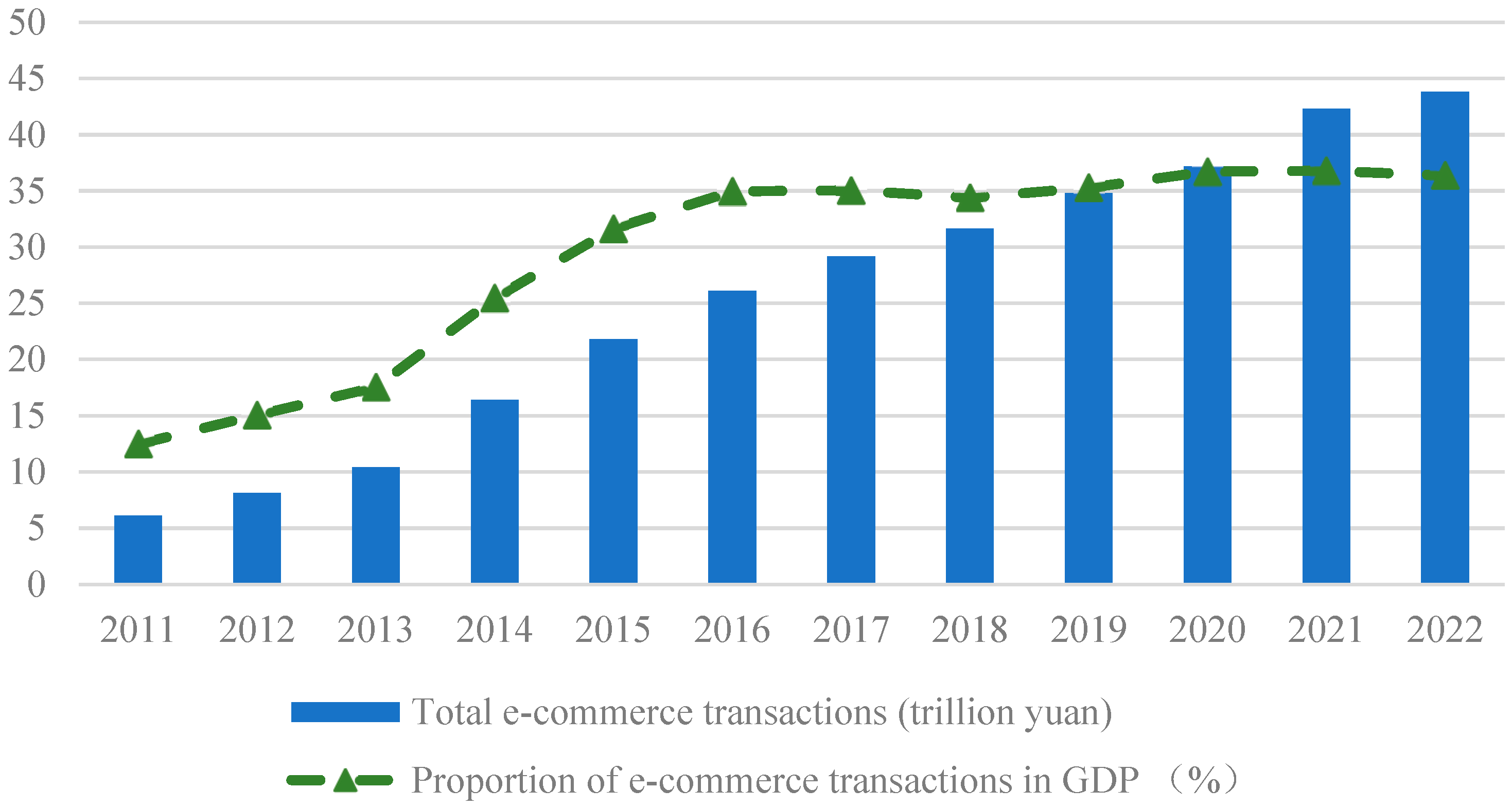
Digital technology and traditional business are deeply integrated in the digital age, resulting in e-commerce and other new models [11,12]. E-commerce is the primary mode of the digital economy. Global e-commerce has developed rapidly and driven economic growth. China developed e-commerce earlier and has become the largest e-commerce market in the world [13,14]. As shown in Figure 1, China’s e-commerce transaction size is growing rapidly. The e-commerce transaction volume is CNY 43.83 trillion, accounting for 36.38% of GDP in 2022. With the development of digital platforms, e-commerce transactions will continue to increase. The Chinese government attaches importance to e-commerce and uses policy instruments to support e-commerce and digital platforms.
The digital economy may bring significant environmental costs [15]. In particular, digital infrastructure may require a lot of electricity. Thus, the role of e-commerce in electricity intensity deserves full attention, and there is limited research on this topic. Specifically, previous studies have not thoroughly analyzed the theoretical relationship between e-commerce and electricity consumption. However, this is an important starting point for understanding the environmental costs associated with e-commerce. Furthermore, the influence of e-commerce on electricity intensity has not yet been empirically verified, and the channels and marginal effects of this impact remain unclear. Therefore, our findings not only provide a more comprehensive theoretical explanation for the energy burden of digital development but also offer guidance for implementing low-carbon digital policies. This study mainly solves the following problems. Can e-commerce save electricity? What are the roles of a promising government and an efficient market? Answering the above questions helps to scientifically understand e-commerce and electricity intensity.
The purpose of our study is to assess the effect of e-commerce on electricity intensity, and how this impact is moderated by the promising government and efficient market. China has a huge e-commerce market and is at an important stage of green transformation. This provides a typical subject for our study. This research is based on panel data of Chinese cities. We then use the policy assessment method to examine the influence of e-commerce on urban electricity intensity. Our findings reveal that e-commerce helps to reduce the electricity intensity and identify its influencing channels. More importantly, the influence of e-commerce needs to be considered alongside the role of government and market environment. The marginal contribution to the existing literature is as follows. Firstly, some studies have focused on the impact of e-commerce on entrepreneurship and innovation [16,17,18], consumer behavior [19], and business development [20,21], but have overlooked its role in electricity consumption. Ignoring the electricity consumption effect of e-commerce may not fully recognize the resource and environmental burdens of digitalization. Our study takes e-commerce as the research object and complements the related research on digital policy. This study emphasizes the identification of causal relationships between e-commerce and electricity intensity. The estimation bias caused by the endogeneity problem can be alleviated by using the national e-commerce demonstration city (NEDC) policy and the difference-in-differences (DID) model. Secondly, this paper highlights the important role of market and government in e-commerce and electricity intensity, and deeply examines their relationship. Moreover, the promising government and efficient market are included in the research framework, expanding the assessment of digital policies. Thirdly, a comprehensive investigation of China’s e-commerce development can obtain rich information and findings. Our findings provide a reference for policymakers in developing countries to measure the electricity costs of digital policy. Our conclusions validate the positive contribution of e-commerce in reducing electricity intensity.

2. Literature Review and Theoretical Analysis

2.1. Literature Review

This section discusses the literature, which includes three aspects. (1) Impact of e-commerce on macro-economy and micro-enterprises. (2) Impact of e-commerce on household residents. (3) Impact of digitization on green development.
Several studies have examined the economic effects of e-commerce and basically affirmed that it can promote economic growth [22,23,24]. E-commerce has changed the traditional business model, increased residents’ consumption, and stimulated the vitality of the real economy [25,26]. Meanwhile, e-commerce is a new business model that offers irreplaceable advantages for promoting industrial development. The digital industry and other industries can accelerate agglomeration through e-commerce [27,28]. The e-commerce development improves transportation, logistics, and other infrastructure, generating more entrepreneurial opportunities. Some literature has found that e-commerce improves entrepreneurship in the region and surrounding cities [29]. More importantly, micro-enterprises have achieved significant improvements in productivity and economic benefits through e-commerce platforms [30,31]. Enterprises use e-commerce to change the original production mode and supply chain mode, and promote enterprise innovation [32]. Skare et al. (2023) [33] found a significant positive correlation between e-commerce and innovation rate based on enterprise data from the European Union.
Then, the existing studies focus on the relationship between e-commerce and household residents. On the one hand, the digital economy increases employment opportunities and ways for household residents [34,35]. Among them, e-commerce can often increase residents’ income, especially for rural households [36]. Wei et al. (2024) [37] found that e-commerce is an important factor in promoting China’s common prosperity. E-commerce improves material welfare and social capital, and can make residents happier [14]. On the other hand, e-commerce has enriched residents’ daily shopping and consumption habits. Online shopping has become the main form of household consumption [38,39]. Guan and Lin (2024) [40] found that energy saving is the main consideration for household residents when purchasing electrical appliances on e-commerce platforms. In addition, e-commerce can help attract more migrant workers to settle down and work, and improve social mobility [41]. In short, e-commerce has a wide impact on household residents.
Another body of literature related to this study is digitization and green low-carbon development. Existing studies have found the positive effect of digitization on green transformation [42,43,44]. This is mainly because digitization has changed the backward enterprises’ production mode and raised residents’ environmental awareness. Many scholars emphasize the important role of digitalization in green technology and argue that it can drive green innovation [45]. A study of China’s digitalization policy reveals similar findings. For example, smart city policy and big data development policy have become the driving forces for regional green low-carbon development [46,47]. However, digitization requires significant computing power and data centers to support it. Thus, digitization may increase energy consumption and carbon emissions [48,49,50]. Axenbeck et al. (2024) [51] used data from German enterprises and found that digitization significantly increased energy and electricity consumption of enterprises.
Furthermore, there are also some studies that examine the relationship between digitalization and electricity demand. On the one hand, digitalization could significantly increase electricity demand [52,53], as the digital industry and data centers will generate a growing energy demand. Castro et al. (2024) [54] found that although the production capacity of renewable energy has increased, it still cannot meet the continuously growing power demand in the digital sector. On the other hand, some studies have also acknowledged that digitalization can contribute to energy conservation [55]. This is mainly because digitalization can bring about advanced power equipment and green lifestyles. Wang et al. (2022) [56] revealed that digital transformation significantly reduced electricity consumption in the industrial and household sectors. Given the complex impact of digitalization on electricity demand, prior studies have also discussed the nonlinear relationship between digitalization and electricity demand [57,58]. Specifically, digitalization may have a threshold effect on electricity consumption.
In summary, the previous studies have deepened the understanding of e-commerce and electricity consumption, but some limitations remain. Firstly, the topic of whether e-commerce consumes electricity is subject to further discussion. Although e-commerce can actively contribute to economic development, whether it will increase electricity intensity remains to be investigated. Particularly, the potential mechanisms by which e-commerce affects electricity intensity have not been fully explored. Our research aims to investigate how e-commerce can help reduce electricity intensity. Second, some literature uses e-commerce transaction volume to reflect e-commerce status, which can lead to potential endogeneity and estimation bias. This paper uses the policy assessment method and the DID model to mitigate endogeneity and identify the causal relationship.

2.2. Institutional Background and Theoretical Analysis

The National Development and Reform Commission launched the NEDC policy in 2009, approving Shenzhen as the first demonstration city. The NEDC policy aims to promote the popularization and application of e-commerce. The first batch of pilot programs was launched in 23 cities in 2011. The NEDC policy includes developing e-commerce facilities and improving the policy environment. Meanwhile, the policy requires banks, tax departments, and other departments to provide necessary policy support for e-commerce development in demonstration cities. Corresponding honors are awarded to cities with good policy implementation results, thus mobilizing the enthusiasm of demonstration cities to develop e-commerce. Three batches of pilot cities were implemented from 2011 to 2017, encompassing 70 cities.
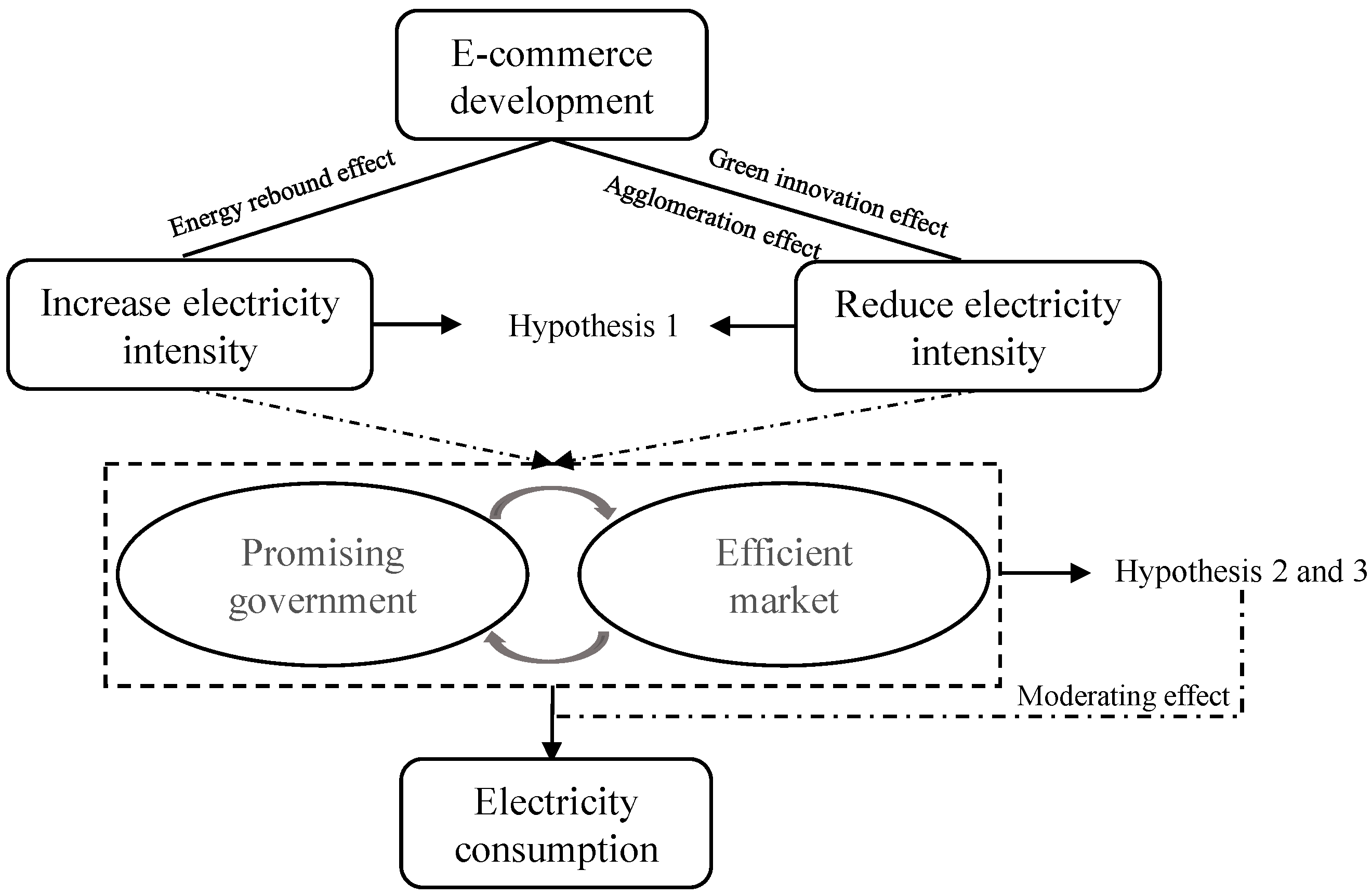
Taking into account the multiple impacts of digitalization on energy conservation, e-commerce may have both positive and negative effects on electricity consumption. Figure 2 presents the logical framework.
(1) E-commerce may increase electricity consumption. The energy rebound effect caused by digitalization has received extensive attention [59,60], and e-commerce may lead to significant increases in electricity demand. For one thing, e-commerce development relies on the data facilities and Internet equipment [61]. Although e-commerce enables businesses to avoid renting multiple stores, the digital infrastructure supporting e-commerce platforms is often a major electricity consumer. For another, e-commerce promotes the development of the logistics industry, while most transportation modes, such as roads and railways, are powered by electricity or fossil fuels. In addition, the construction of storage centers may increase the demand for air conditioners, lighting, and other electrical equipment.
(2) E-commerce may reduce the electricity intensity. Among them, the agglomeration effect and green innovation effect are likely to serve as potential channels. First, the agglomeration effect. Population agglomeration and economic agglomeration are important factors in the energy-efficient use [62,63]. Agglomeration can enable efficient resource allocation and reduce unnecessary electricity waste. E-commerce development creates more jobs and entrepreneurial opportunities [64,65,66]. In this context, NEDC can attract more population and industrial agglomeration. Second, the green innovation effect. Green innovation can encourage enterprises and residents to adopt clean technologies and green products, and reduce electricity consumption [10]. With the development of green consumption and the environmental protection industry, the social demand for green products is increasing [67]. E-commerce provides the necessary platform support for green products and reduces their transportation cost. Additionally, consumers’ market demand for green products continues to expand under the e-commerce model, which is conducive to forcing enterprises to green innovation. For example, Jingdong actively promotes upstream and downstream enterprises to develop green innovation and provide more environmentally friendly products.
Thus, we propose the following hypotheses:
Hypothesis 1a: 
E-commerce may significantly increase electricity intensity.
Hypothesis 1b: 
E-commerce may reduce electricity intensity.
In discussing e-commerce development, the role of an efficient market and a promising government cannot be ignored. China’s digitization policies are mostly set by the central government and implemented by local governments. At the same time, digitization is largely dependent on the market environment. The establishment of e-commerce enterprises and related supporting services, such as logistics and warehousing, requires a healthy market environment.
Specifically, for one thing, excessive government intervention in the market will undermine the vitality of e-commerce development. Some studies have found that unreasonable administrative intervention in China reduces market vitality [68]. E-commerce needs land, capital, and labor support, and it also faces government approval and supervision. Therefore, a strong government-market relationship can provide essential support for e-commerce enterprises and drive e-commerce toward green and energy-saving practices. For another, government strategic guidance on science and technology can empower digital infrastructure [69]. The government’s strategic orientation can provide fiscal support for e-commerce-related R&D activities. More importantly, more green technology and financial funds can flow to e-commerce. This study provides the following hypotheses.
Hypothesis 2: 
The promising government can strengthen the positive contribution of e-commerce to electricity utilization.
Market environment is an effective engine for e-commerce. The allocation efficiency of factor resources may be affected by the market environment. Optimizing the market environment can attract more e-commerce enterprises to settle in and enhance the comprehensive benefits. The operational efficiency of e-commerce can be greatly improved in a favorable market environment, thereby reducing unnecessary electricity consumption. The Chinese government has actively improved the market environment, created a good business environment, and provided market incentives for the e-commerce [70]. Moreover, the Chinese government actively creates an external environment for green e-commerce development. Therefore, as the market environment continues to improve, e-commerce can abandon the extensive development model. We propose Hypothesis 3.
Hypothesis 3: 
In the efficient market, the effect of e-commerce on reducing electricity intensity may be more pronounced.

3. Methodology and Data

3.1. Model

We design the DID model to identify the net effect of e-commerce on electricity intensity, as shown in Equation (1):
E I i t = β 0 + α 1 E C i t + α 2 C o n t r o l i t + μ i + γ t + ε i t ,
where EI is the dependent variable, referring to urban electricity intensity. EC and Control are independent variables, respectively representing the e-commerce and control variable set. γ t and μ i are year- and city-fixed effects, respectively. β 0 is a constant term. ε i t represents a random error term, i and t stand for city and time. α 1 indicates the impact of EC on EI.

3.2. Variables

Dependent variable: Urban electricity intensity (EI). Refer to Duan et al. (2021) [71] and Zhou et al. (2025) [58], EI is expressed as the ratio of total urban electricity consumption to GDP (in logarithmic form). Additionally, we use the logarithm of industrial electricity intensity as an alternative indicator in the robustness test, because industrial electricity accounts for the largest share of total electricity consumption.
Independent variable: E-commerce (EC). We regard the NEDC as a quasi-natural experiment. In addition to Shenzhen’s inclusion in the NEDC in 2009, the policy mainly consists of three pilot batches (2011, 2014, 2017). If city i is included in the NEDC list, and city i is considered the processing group, and the EC is set to 1 for that year and subsequent years. The other cities are treated as the control group, with the EC set to 0.
Control variables. Drawing on Chai et al. (2022) [72], this paper adds some control variables to the econometric model. (1) Economic growth (GDP). Economic growth is expressed using urban GDP per capita. (2) Trade openness (TRADE). We use the share of import and export trade in GDP to characterize trade openness. (3) Fiscal autonomy (FD). FD is expressed using the ratio of budget revenue to budget expenditure. (4) Transport infrastructure (ROAD) is measured by road area per capita. (5) Financial development (LOAN) is expressed using the proportion of loans from financial institutions to GDP. (6) Industrial structure (INDU). We use the proportion of the secondary industry’s added value to measure INDU.

3.3. Data

The sample of this study includes panel data of 282 cities in China from 2004 to 2021. To reduce the heteroscedasticity, the variables, except the dummy variables, are logarithmically transformed. The data are from the China Urban Statistical Yearbook and the China Statistical Yearbook. Table 1 presents descriptive statistics.

4. Empirical Results and Discussion

4.1. Benchmark Regression

Table 2 displays the baseline regression of the DID model. We add fixed effects and control variables gradually, which helps to better demonstrate the stability of the estimated results.
We find that EC is significantly negative at 1% level regardless of whether control variables and fixed effects are included. It can be seen that e-commerce development can significantly reduce urban electricity intensity. This result supports the viewpoint of Qian et al. (2025) [73]. In general, e-commerce can generate substantial economic benefits while also enabling efficient electricity use. This result implies that e-commerce improves the electricity efficiency, thereby verifying Hypothesis 1b.

4.2. Robustness Test

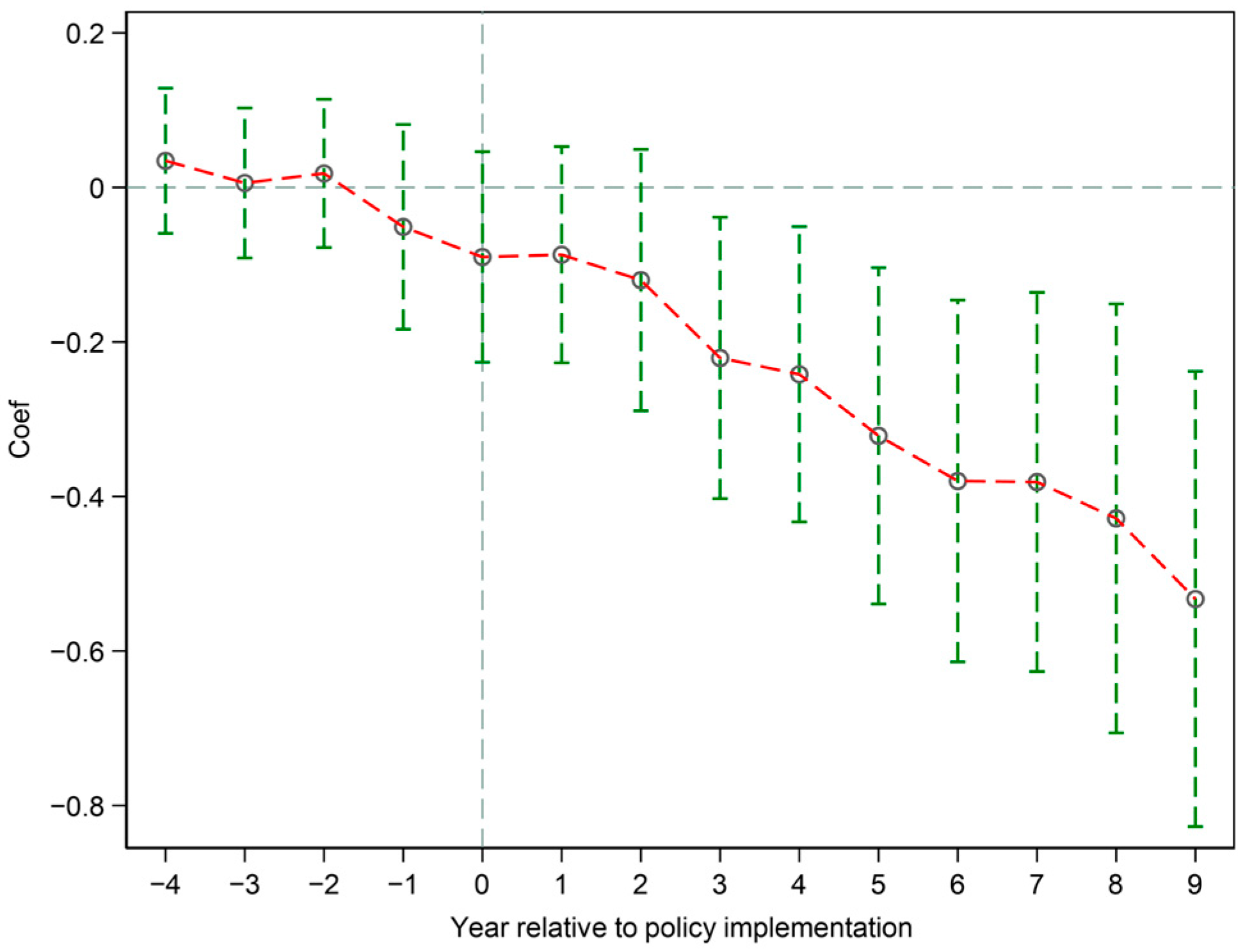
(1) Parallel trend test. The premise of the DID model is that the dependent variable in the experimental group and the control groups follows the same trend before the policy occurs. Following Yan et al. (2023) [74], we use the event study method in Figure 3. The results show that there is no significant difference in EI before policy implementation. Beginning in the third year after policy implementation, EI in the experimental group begins to decline significantly. This result shows that the DID model satisfies the parallel trend hypothesis. Moreover, the effect of e-commerce policy is significant, and this impact has a certain lag.
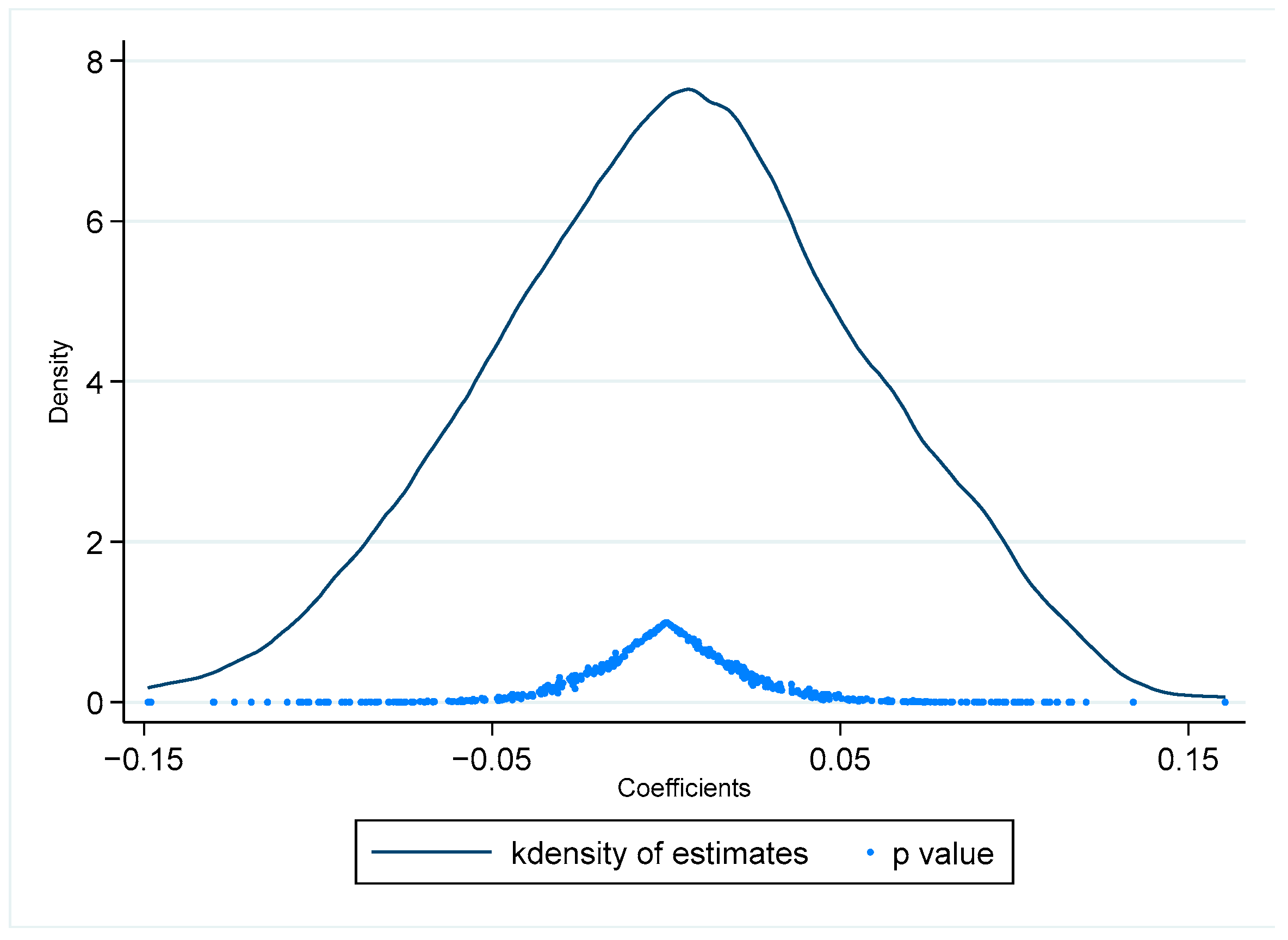
(2) Placebo test. Considering that missing variables may interfere with the relationship between e-commerce and electricity consumption, we further use a placebo test (Cai et al., 2016) [75]. We construct hypocritical policy variables by randomly selecting treatment groups. Then, the estimates are repeated 500 times. The result is shown in Figure 4. These coefficients are basically distributed around 0, and the p-value is greater than 0.1. Therefore, the influence of e-commerce policy is not disturbed by other unobservable factors.
(3) PSM-DID. The estimation results may be biased due to sample selection. Specifically, there are systematic differences between NEDC and non-NEDC, leading to different trends in EI. Therefore, this study uses PSM-DID for a robustness test. We screen the control group similarly to the treatment group using the 1:1 nearest-neighbor matching method. Then, the baseline model is re-estimated, as shown in Table 3. We find that the NEDC remains significantly negative, indicating that e-commerce has a significant inhibitory effect on electricity intensity.
(4) Other robustness tests. We conduct additional robustness tests in Table 3. Firstly, the dependent variable is replaced by industrial electricity intensity. The results show that e-commerce significantly reduces industrial electricity intensity, which is consistent with the benchmark results. Secondly, control for province-year joint fixed effect. The results display that it is significantly negative, indicating that the core results are robust. Thirdly, the Chinese government also implemented some digitization policies during the NEDC period, which may affect the effect of the NEDC. Thus, we add the policy dummy variables for the big data development pilot area, smart city, and logistics standardization to the control variables to re-estimate. The results show that EC is significantly negative, which verifies the robustness of the results. Fourth, given the interference of COVID-19 on data, we delete the samples after 2020. The results show that the baseline estimate is valid. Fifth, to mitigate the impact of outliers, we apply 1% and 99% truncation to the dependent variable. Column (6) indicates that EC’s coefficient is consistent with the benchmark estimate.
(5) Considering the heterogeneity issue of treatment effects in the multi-timepoint DID model, the estimation results may be biased. Following Cengiz et al. (2019) [76] and Borusyak et al. (2024) [77], we conduct the robust test using the stacked regression model and the imputation estimator. These estimation methods can avoid using the earlier treatment group as the control group to address the heterogeneity of treatment effects. Among them, the stacked DID estimation is achieved by matching the observations of each treatment group with those from untreated or never-treated groups, and then stacking them into a dataset for regression. Table 4 shows that the results are consistent with the benchmark regression.

4.3. Mechanism Test

Following Shang et al. (2025) [78], this study employs the two-step estimation to provide suggestive evidence on potential channels, as shown in Table 5.
Firstly, this study uses the number of green patents (GP) and green invention patents (GIP) applications to measure the quantity and quality of green innovation [79]. Columns (1) and (2) indicate that EC’s coefficients are significantly positive, implying that e-commerce significantly increases the quantity and quality of green innovation. E-commerce provides a platform for green products and services, stimulating consumers’ motivation for green consumption [80], and helping to promote green innovation activities by economic entities and improve energy utilization.
Secondly, the agglomeration effect is examined from the perspectives of population agglomeration and economic agglomeration. The number of people per unit area is used to represent population agglomeration (PAGG). The gross product per unit area is used to reflect economic agglomeration (EAGG). Columns (3) and (4) show that EC’s coefficients on PAGG and EAGG are significantly positive, which means that e-commerce significantly promotes population agglomeration and economic agglomeration. E-commerce breaks the limitations of time and space [21], promoting the concentration of population and industries in specific regions, and forming an efficient economic network. During this process, the power resources can be utilized efficiently.

4.4. Role of Promising Government and Efficient Market

E-commerce development needs the support of a promising government and an efficient market. This part constructs an interaction-term model to test the impact of promising government and efficient market on e-commerce.
E I i t = β 0 + β 1 E C i t + β 2 E C i t × M O D i t + β 3 C o n t r o l i t + μ i + γ t + ε i t
where MOD is a moderating variable that specifically reflects the promising government and efficient market. From the perspective of the government, it is represented by the government-market relationship (GMR) and the government’s science and technology strategic guidance (GSG). GMR uses the government-market relationship index from China’s Provincial Marketization Index Database. GSG uses the proportion of fiscal expenditure on science and technology relative to total fiscal expenditure [69]. In addition, this paper uses two ways to reflect the regional market environment. The marketization index and the non-state-owned economic index in China’s Provincial Marketization Index Database are used to express the regional marketization degree (MAR) and business environment (BE). Based on this, the means of MAR, BE, GMR, and GSG are calculated separately. Then, the median of these means is used as the standard to construct the dummy variables for “promising government” and “efficient market”. For example, if the mean value of MAR is greater than its median value, then High_MAR = 1; Otherwise, High_MAR = 0.
Table 6 provides the result of moderating effect. The coefficients of EC × High_MAR and EC × High_BE are significantly negative in columns (1) and (2), but EC’s coefficients are not statistically significant. In the sample of “efficient markets”, the marginal effect of e-commerce on electricity intensity is significantly negative. Specifically, EC fails to significantly affect the electricity intensity in samples with low levels of marketization and business environment. Compared with the samples with a poor regional market environment, EC’s marginal effects on electricity intensity in the sample of “efficient markets” are reduced by 0.060 and 0.179 units, respectively. Thus, the marketization and business environment can significantly enhance the positive impact of e-commerce on electricity utilization. Column (3) displays that the coefficient of EC is not significant, and EC × High_GMR is significantly negative, indicating that the excellent government-market relationship enhances the positive contribution of e-commerce to reducing electricity intensity. Column (4) shows that EC × High_GSG is significantly negative, indicating that the government’s strategic guidance can strengthen the effectiveness of e-commerce in reducing electricity intensity. Specifically, in the sample of the promising government, EC’s marginal effect on electricity intensity significantly decreases by 0.136 and 0.149 units, respectively. Therefore, the promising government plays an important role in green e-commerce development. The above analysis verifies Hypotheses 2 and 3. In conclusion, a favorable market environment can guide the direction of e-commerce development and provide impetus for green e-commerce. More importantly, the promising government provides policy support for the green e-commerce development, and guides e-commerce to adopt green technologies and low-carbon logistics.

4.5. Heterogeneity Analysis

(1) Geographical location. According to the traditional geographical division method, the entire sample is divided into four regions. We find that EC is significantly negative in eastern and central provinces, but not significant in western and northeastern provinces, as shown in Table 7. This result means that the positive contribution of e-commerce to reducing electricity intensity is mainly reflected in eastern and central provinces. The eastern and central provinces are more economically developed and have a high digitization level. In this context, e-commerce has better external incentive conditions and reduces electricity intensity. Conversely, the central and western regions lack well-developed e-commerce industries and logistics systems, which limits the positive impact of e-commerce on improving power utilization. This result may imply that the central and western regions do not attach sufficient importance to the green e-commerce development.
(2) Resource endowment. Resource-based cities face significant pressure on energy demand and carbon emission reduction. We divide cities into resource-based and non-resource-based cities based on the list of sustainable development plans for resource-based cities, as shown in Table 8. The coefficient of EC is not significant in resource-based cities, but is significantly negative in non-resource-based cities. The result shows that e-commerce does not significantly reduce the electricity intensity of resource-based cities. Resource-based cities often rely on resource exploitation to maintain economic development and have a weak institutional environment [81]. Meanwhile, the digital infrastructure in resource-based cities is backward, and the effect of e-commerce fails to appear.
(3) Major regional strategy. The Yangtze River Economic Belt is an important area to achieve green development [82]. This paper further conducts subsample regression in columns (3) and (4) of Table 8. We find that EC is significantly negative in the Yangtze River Economic Belt, but not in the Non-Yangtze River Economic Belt. This result indicates that e-commerce development is an important driver of efficient electricity use in the Yangtze River Economic Belt. More importantly, the Non-Yangtze River Economic Belt should accelerate the development of e-commerce to provide support for regional energy-efficient utilization.
(4) Heterogeneity of digital finance. E-commerce development cannot be separated from the support for digital finance. This study divides the sample based on the median of the digital finance index mean from 2011 to 2022. Among them, the digital finance index uses the data from the Peking University Digital Finance Center. Columns (5) and (6) show that EC is significantly negative in cities with high digital finance, but not statistically significant in cities with low digital finance. Digital finance provides efficient financial services and payment means for e-commerce [83], and improves the efficiency of e-commerce development. E-commerce can promote green products and low-carbon activities through digital financial platforms. Therefore, cities with a low level of digital finance may not be able to provide the necessary financial and payment methods for e-commerce development, thereby weakening the positive impact of e-commerce on improving power utilization.

4.6. Cumulative Effect of Policy

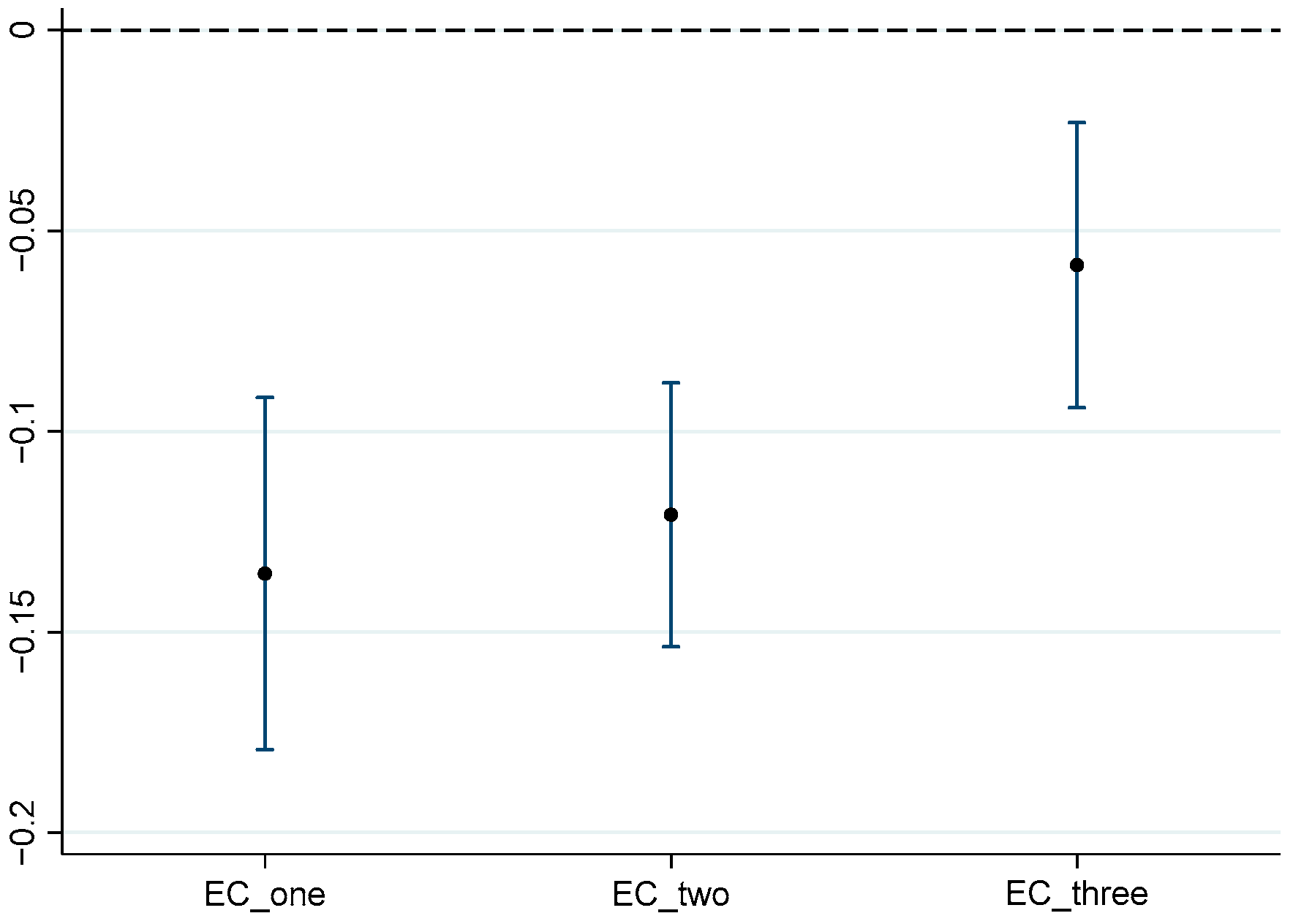
China’s policy implementation adopts the model of partial pilot and comprehensive promotion. As more batches of pilot cities are approved, the policy’s effects may change. It is essential to identify whether the influence of e-commerce will change as more pilot cities are added. This can provide experience for the full policy implementation. Following Qin et al. (2024) [69], we construct the dummy variables for the first batch, the first two batches, and all three pilot cities, respectively. The result is plotted as shown in Figure 5. It is found that the coefficients of EC decrease after the second and third batch of pilot cities are added. Specifically, the NEDC coefficients decrease by 10.8% and 52.6%, respectively, after the addition of the second and third batches of pilot cities. A possible reason is that the early NEDC invested heavily and enjoyed obvious policy dividends. Meanwhile, the time interval between different batches of pilot cities is 3 years. Thus, including more pilot cities may weaken the effect of the e-commerce policy. In the composition of pilot cities, the second and third batches of pilot policies approved more underdeveloped cities and midwestern cities. The reason for this is that the Chinese government aims to balance the development of the digital economy across different regions. However, these cities may lack a solid industrial base and advantages in e-commerce. Additionally, these cities have strong electricity demand, which makes the NEDC policy less effective in improving electricity utilization, and further dilutes the positive impact of the entire e-commerce policy.

5. Conclusions and Policy Implications

E-commerce has been integrated into economic development, but prior studies have not examined e-commerce and electricity intensity. Using NEDC as a natural experiment, we combine with the DID model to investigate the influence of e-commerce on urban electricity intensity. First, e-commerce reduces energy intensity through the green innovation effect and agglomeration effect. Meanwhile, the influence of e-commerce on electricity intensity varies across geographical locations, resource endowments, regional major strategies, and digital finance. With the addition of more batches of NEDC, the positive role of e-commerce on electricity utilization has weakened. Furthermore, the promising government and efficient market strengthen the role of e-commerce in reducing energy intensity.
These research findings explore the role of e-commerce in electricity intensity and offer policy implications. First, the government should pay attention to e-commerce and the digital economy. E-commerce requires digital infrastructure as support, but attention should also be paid to the electricity consumption brought about by this digital infrastructure. Policymakers not only need to reduce the electricity consumption of digital infrastructure, but also should shift the policy focus to improving its electricity efficiency. On the one hand, logistics, the Internet, and digital platforms should be continuously optimized to improve e-commerce operational efficiency. On the other hand, the e-commerce development requires significant capital and policy support. The government can use fiscal and financial measures to establish special funds to support green e-commerce development. Second, considering the impact of other factors on e-commerce and electricity utilization is crucial. Given its significant role for both the promising government and efficient market, it is necessary to leverage its contribution to efficient electricity utilization fully. The policymakers should create a reasonable market environment. It is necessary to prevent unfair competition and market distortion from harming e-commerce development. The green low-carbon development of e-commerce needs to be guided by building a fair and reasonable market environment, thereby stimulating the potential of e-commerce to improve the electricity utilization efficiency. Moreover, e-commerce platforms can be used to develop green products and green technologies, creating an atmosphere of green development across society. Third, due to the heterogeneity of the impact of e-commerce on different cities’ electricity intensity, this study suggests implementing targeted policy measures. Developed cities should leverage the technological advantages of e-commerce enterprises to achieve efficient use of energy. Less developed cities can improve their digital infrastructure for e-commerce and consolidate the industrial base for e-commerce development. These policy measures can provide digital support to help less developed cities reduce their electricity intensity.
There are some potential limitations. Firstly, this paper discusses the relationship between e-commerce and electricity intensity. Future studies can further examine the influence of e-commerce on green consumption. Secondly, due to data limitations, we use policy evaluation methods to analyze the effect of e-commerce. Considering the lack of data from data centers or logistics activities, it is difficult to establish indicators to examine their impact on e-commerce and power intensity. We look forward to seeing more information on logistics data or data center density being released in the future.

Author Contributions

Conceptualization, Y.Z. and Y.X.; methodology, Y.Z. and W.O.; validation, Y.X.; formal analysis, Y.X.; investigation, Y.Z. and W.O.; resources, Y.Z., W.O. and Y.X.; data curation, Y.Z. and W.O.; writing—original draft preparation, Y.Z. and Y.X.; writing—review and editing, Y.X.; supervision, Y.X.; project administration, Y.Z. and Y.X.; funding acquisition, Y.Z. and Y.X. All authors have read and agreed to the published version of the manuscript.

Funding

This research was funded by the National Natural Science Foundation of China, grant number 72504079, the Key Research Project of the Higher Education Institutions’ Scientific Research Program in Anhui Province, grant number 2024AH053420, the Fundamental Research Funds for the Central Universities, grant number JZ2025HGTA0165, and the Postdoctoral Fellowship Program of CPSF, grant number GZC20251258.

Data Availability Statement

Data will be made available on request.

Conflicts of Interest

The authors declare no conflicts of interest.

Abbreviations

The following abbreviations are used in this manuscript:
NEDCNational e-commerce demonstration city
DIDDifference-in-difference
GDPEconomic growth
ECE-commerce
EIElectricity intensity
TRADETrade openness
FDFiscal autonomy
ROADTransport infrastructure
LOANFinancial development
INDUIndustrial structure

References

  1. Magazzino, C.; Mele, M.; Morelli, G.; Schneider, N. The nexus between information technology and environmental pollution: Application of a new machine learning algorithm to OECD countries. Util. Policy 2021, 72, 101256. [Google Scholar] [CrossRef]
  2. Xu, M.; Wang, Z.; Zhou, Y.; Wang, F.; Wu, Z. Environmental information transparency and firms’ sustainable development: Evidence from automatic environment monitoring and information disclosure in China. Energy Econ. 2025, 150, 108826. [Google Scholar] [CrossRef]
  3. Kilinc-Ata, N. Investigation of the Impact of Environmental Degradation on the Transition to Clean Energy: New Evidence from Sultanate of Oman. Energies 2025, 18, 839. [Google Scholar] [CrossRef]
  4. Zhou, Y.; Song, M.; Xu, W.; Ouyang, W. Empowering carbon neutrality: Impact of the technology factor market on China’s carbon emission intensity. J. Environ. Manag. 2025, 391, 126568. [Google Scholar] [CrossRef]
  5. Binsaeed, R.H.; Khan, Z.; Dogan, E.; Rahim, S. The role of energy efficiency, renewable resources, green innovation, and fiscal decentralization in sustainable development: Evidence from OECD countries. Util. Policy 2025, 95, 101915. [Google Scholar] [CrossRef]
  6. Zhou, Y.; Zhuo, C.; Deng, F. Can the rise of the manufacturing value chain be the driving force of energy conservation and emission reduction in China? Energy Policy 2021, 156, 112408. [Google Scholar] [CrossRef]
  7. González-Torres, M.; Pérez-Lombard, L.; Clementi, E.L.; Coronel, J.F. Examining the reasons for changes in buildings’ energy consumption in the United States, China and the European Union. Energy Build. 2025, 332, 115461. [Google Scholar] [CrossRef]
  8. Perillo, F.; Pereira Da Silva, P.; Cerqueira, P.A. Decoupling efficiency from electricity intensity: An empirical assessment in the EU. Energy Policy 2022, 169, 113171. [Google Scholar] [CrossRef]
  9. Li, M.; Li, F.; Qiu, J.; Zhou, H.; Wang, H.; Lu, H.; Zhang, N.; Song, Z. Multi-objective optimization of non-fossil energy structure in China towards the carbon peaking and carbon neutrality goals. Energy 2024, 312, 133643. [Google Scholar] [CrossRef]
  10. Zhou, Y.; Lin, B. The energy-saving effect of green fiscal policy: Empirical evidence from China’s comprehensive demonstration cities of energy conservation and emission reduction fiscal policy. Appl. Energy 2025, 378, 124784. [Google Scholar] [CrossRef]
  11. Saridakis, G.; Lai, Y.; Mohammed, A.; Hansen, J.M. Industry characteristics, stages of E-commerce communications, and entrepreneurs and SMEs revenue growth. Technol. Forecast. Soc. 2018, 128, 56–66. [Google Scholar] [CrossRef]
  12. Huang, Z.; Wang, L.; Meng, J. Does rural e-commerce improve the economic resilience of family farms? Int. Rev. Econ. Financ. 2024, 95, 103505. [Google Scholar] [CrossRef]
  13. Guo, J.; Jin, S.; Zhao, J.; Wang, H.; Zhao, F. Has COVID-19 accelerated the E-commerce of agricultural products? Evidence from sales data of E-stores in China. Food Policy 2022, 112, 102377. [Google Scholar] [CrossRef]
  14. Wei, B.; Zhao, C.; Luo, M. Online markets, offline happiness: E-commerce development and subjective well-being in rural China. China Econ. Rev. 2024, 87, 102247. [Google Scholar] [CrossRef]
  15. Xiu, G. Analyzing the impact of supply chain and digitalization in the Chinese economy: What is the role of energy consumption, government expenditure, and industrialization in environmental pollution? Energy Econ. 2025, 145, 108412. [Google Scholar] [CrossRef]
  16. Jiang, Y.; Zhang, Y. Cross-border e-commerce comprehensive pilot zones, tax expenditures, and firm innovation. Financ. Res. Lett. 2025, 83, 107725. [Google Scholar] [CrossRef]
  17. Zhang, J.; Phelps, N.A.; Miao, J.T. The uneven power of the platform: Variations in E-commerce entrepreneurial behaviours in urban, suburban, and rural contexts. Cities 2026, 171, 106700. [Google Scholar] [CrossRef]
  18. Sun, K.; Zhong, X.; Xiong, D.; Han, Z. Cross-Border E-Commerce Comprehensive Pilot Zones and urban entrepreneurial activity: Causal evidence from double-debiased machine learning. J. Asian Econ. 2026, 103, 102131. [Google Scholar] [CrossRef]
  19. Lo, H.; Chang, W.; Chen, I. From purchase to return: How personalized E-commerce recommendations shape consumer behavior. J. Retail. Consum. Serv. 2026, 88, 104459. [Google Scholar] [CrossRef]
  20. Cao, Z.; Liu, Y. Development of cross-border E-commerce, digital finance development, and the digital transformation of manufacturing enterprises. Int. Rev. Financ. Anal. 2026, 110, 104835. [Google Scholar] [CrossRef]
  21. Bi, W.; Min, Y.; Xu, W.; Zhang, X. Institutional Reform and Enterprise Digitalization: A Quasi-Natural Experiment in Cross-Border E-Commerce Pilot Zones. Econ. Anal. Policy 2026, 90, 799–817. [Google Scholar] [CrossRef]
  22. Alsaad, A.; Taamneh, A. The effect of international pressures on the cross-national diffusion of business-to-business e-commerce. Technol. Soc. 2019, 59, 101158. [Google Scholar] [CrossRef]
  23. Ju, C.; Liu, H.; Xu, A.; Zhang, J. Green logistics of fossil fuels and E-commerce: Implications for sustainable economic development. Resour. Policy 2023, 85, 103991. [Google Scholar] [CrossRef]
  24. Armah, A.K.; Li, J.; Wei, M. Effect of infrastructure and technological factors on slum online commerce and product delivery: A structural functionalism perspective. J. Retail. Consum. Serv. 2025, 85, 104292. [Google Scholar] [CrossRef]
  25. Lyu, J. China cross-border e-commerce comprehensive pilot zone and urban residents’ tourism consumption: Empirical study based on CHFS data. Financ. Res. Lett. 2024, 64, 105396. [Google Scholar] [CrossRef]
  26. Mohammed, A.; Lopes De Sousa Jabbour, A.B.; Zubairu, N.; Chiappetta Jabbour, C.J.; Al Naabi, H. Food waste in the era of e-commerce: A novel farm-to-fork management methodology. Int. J. Prod. Econ. 2025, 285, 109603. [Google Scholar] [CrossRef]
  27. Tang, W.; Zhu, J. Informality and rural industry: Rethinking the impacts of E-Commerce on rural development in China. J. Rural Stud. 2020, 75, 20–29. [Google Scholar] [CrossRef]
  28. Song, L.; Yuan, J.; Li, T. Harmonizing digital trade for sustainable stride: Unveiling the industrial pollution reduction effect of China’s cross-border E-commerce comprehensive pilot zones. J. Environ. Manag. 2024, 370, 122834. [Google Scholar] [CrossRef]
  29. Hu, S.; Zhang, H.; Wang, Y. Does e-commerce development drive regional entrepreneurial activity? Spatial spillover effect and mechanism analysis. Int. J. Prod. Econ. 2025, 284, 109611. [Google Scholar] [CrossRef]
  30. Liu, T.; Chen, J.; Huang, C.C.J.; Yang, C. E-commerce, R&D, and productivity: Firm-level evidence from Taiwan. Inf. Econ. Policy 2013, 25, 272–283. [Google Scholar]
  31. Karanki, F.; Bilotkach, V.; Gao, Y.; Lu, C. The economic impact of E-commerce on the U.S. airports: Cost savings and productivity growth. J. Air Transp. Manag. 2024, 118, 102598. [Google Scholar] [CrossRef]
  32. Feng, L.; Jin, M. Platform vs. Manufacturer: Who should implement innovation in e-commerce supply chains? Transp. Res. Part E Logist. Transp. Rev. 2022, 166, 102858. [Google Scholar] [CrossRef]
  33. Skare, M.; Gavurova, B.; Rigelsky, M. Innovation activity and the outcomes of B2C, B2B, and B2G E-Commerce in EU countries. J. Bus. Res. 2023, 163, 113874. [Google Scholar] [CrossRef]
  34. Balsmeier, B.; Woerter, M. Is this time different? How digitalization influences job creation and destruction. Res. Policy 2019, 48, 103765. [Google Scholar] [CrossRef]
  35. Neumann, U. Digital transformation, employment change and the adaptation of regions in Germany. Struct. Change Econ. Dyn. 2025, 73, 37–50. [Google Scholar] [CrossRef]
  36. Li, W.; He, W. Revenue-increasing effect of rural e-commerce: A perspective of farmers’ market integration and employment growth. Econ. Anal. Policy 2024, 81, 482–493. [Google Scholar] [CrossRef]
  37. Wei, X.; Yang, Z.; Yan, Y.; Sun, J. Rural E-commerce, Digital finance, and urban–rural common prosperity: A Quasi-natural Experiment Based on China’s Comprehensive Demonstration of E-commerce Entering Rural Areas Policy. Financ. Res. Lett. 2024, 69, 106237. [Google Scholar] [CrossRef]
  38. Kim, M.; Chung, N.; Lee, C. The effect of perceived trust on electronic commerce: Shopping online for tourism products and services in South Korea. Tour. Manag. 2011, 32, 256–265. [Google Scholar] [CrossRef]
  39. Xu, L.; Saphores, J. Does e-shopping impact household travel? Evidence from the 2017 U.S. NHTS. J. Transp. Geogr. 2024, 115, 103827. [Google Scholar] [CrossRef]
  40. Guan, C.; Lin, B. Do consumers concern about energy saving in purchasing energy-efficient home appliances? Evidence from online e-commerce review. Energy Policy 2024, 193, 114277. [Google Scholar] [CrossRef]
  41. Wei, B.; Zhao, C.; Cai, W.; Luo, M. Online markets, offline homes: E-commerce development and rural migrant workers’ urban settlement intentions in China. Cities 2025, 161, 105867. [Google Scholar] [CrossRef]
  42. Li, G.; Liao, F. Input digitalization and green total factor productivity under the constraint of carbon emissions. J. Clean. Prod. 2022, 377, 134403. [Google Scholar] [CrossRef]
  43. Spudys, P.; Jurelionis, A.; Fokaides, P. Digitizing buildings sustainability assessment: Integrating energy audits, operational energy assessments, and life cycle assessments for enhanced building assessment. Energy 2025, 316, 134429. [Google Scholar] [CrossRef]
  44. Xie, F.; Ma, H.; Kong, X.; Jiang, J.; Chen, Z. Study of the Spatio-Temporal Effects of Digital Economic Development on Hydropower Resource Mismatch. Energies 2025, 18, 5044. [Google Scholar] [CrossRef]
  45. Wang, B.; Khan, I.; Ge, C.; Naz, H. Digital transformation of enterprises promotes green technology innovation—The regulated mediation model. Technol. Forecast. Soc. Change 2024, 209, 123812. [Google Scholar] [CrossRef]
  46. Guo, Q.; Wang, Y.; Dong, X. Effects of smart city construction on energy saving and CO2 emission reduction: Evidence from China. Appl. Energy 2022, 313, 118879. [Google Scholar] [CrossRef]
  47. Wei, X.; Jiang, F.; Yang, L. Does digital dividend matter in China’s green low-carbon development: Environmental impact assessment of the big data comprehensive pilot zones policy. Environ. Impact Assess. Rev. 2023, 101, 107143. [Google Scholar] [CrossRef]
  48. Xue, Y.; Tang, C.; Wu, H.; Liu, J.; Hao, Y. The emerging driving force of energy consumption in China: Does digital economy development matter? Energy Policy 2022, 165, 112997. [Google Scholar] [CrossRef]
  49. Charfeddine, L.; Umlai, M. ICT sector, digitization and environmental sustainability: A systematic review of the literature from 2000 to 2022. Renew. Sustain. Energy Rev. 2023, 184, 113482. [Google Scholar] [CrossRef]
  50. Jahanger, A.; Hossain, M.R.; Awan, A.; Adebayo, T.S. Uplifting India from severe energy poverty accounting for strong asymmetries: Do inclusive financial development, digitization and human capital help reduce the asymmetry? Energy Econ. 2024, 134, 107568. [Google Scholar] [CrossRef]
  51. Axenbeck, J.; Berner, A.; Kneib, T. What drives the relationship between digitalization and energy demand? Exploring heterogeneity in German manufacturing firms. J. Environ. Manag. 2024, 369, 122317. [Google Scholar] [CrossRef]
  52. Farfan, J.; Lohrmann, A. Gone with the clouds: Estimating the electricity and water footprint of digital data services in Europe. Energy Convers. Manag. 2023, 290, 117225. [Google Scholar] [CrossRef]
  53. Leiva Vilaplana, J.A.; Yang, G.; Monaco, R.; Bergaentzlé, C.; Ackom, E.; Morais, H. Digital versus grid investments in electricity distribution grids: Informed decision-making through system dynamics. Appl. Energy 2025, 386, 125536. [Google Scholar] [CrossRef]
  54. Castro, V.; Georgiou, M.; Jackson, T.; Hodgkinson, I.R.; Jackson, L.; Lockwood, S. Digital data demand and renewable energy limits: Forecasting the impacts on global electricity supply and sustainability. Energy Policy 2024, 195, 114404. [Google Scholar] [CrossRef]
  55. Qin, P.; Liu, M.; Su, L.; Fei, Y.; Tan-Soo, J. Electricity consumption in the digital era: Micro evidence from Chinese households. Resour. Conserv. Recycl. 2022, 182, 106297. [Google Scholar] [CrossRef]
  56. Wang, Q.; Hu, A.; Tian, Z. Digital transformation and electricity consumption: Evidence from the Broadband China pilot policy. Energy Econ. 2022, 115, 106346. [Google Scholar] [CrossRef]
  57. Lin, B.; Huang, C. How will promoting the digital economy affect electricity intensity? Energy Policy 2023, 173, 113341. [Google Scholar] [CrossRef]
  58. Zhou, Y.; Song, M.; Long, X.; Ouyang, W. Curse or blessing: How does digital inclusive finance affect urban electricity consumption in China? Sustain. Cities Soc. 2025, 125, 106348. [Google Scholar] [CrossRef]
  59. Tan, Y.; Walheer, B. On decomposing the energy rebound effect. Energy Econ. 2025, 149, 108770. [Google Scholar] [CrossRef]
  60. Deng, Y.; Zou, Y.; Guang, F. Unveiling the energy efficiency paradox: Industrial automation and energy rebound in China. Energy 2025, 328, 136482. [Google Scholar] [CrossRef]
  61. Zhou, Q.; Lou, J.; Jiang, Y. Optimization of energy consumption of green data center in e-commerce. Sustain. Comput. Inform. Syst. 2019, 23, 103–110. [Google Scholar] [CrossRef]
  62. Liu, J.; Cheng, Z.; Zhang, H. Does industrial agglomeration promote the increase of energy efficiency in China? J. Clean. Prod. 2017, 164, 30–37. [Google Scholar] [CrossRef]
  63. Song, Y.; Liu, C.; Zhang, M. Producer services agglomeration and energy efficiency enhancement: A serial mediation model with digital economy moderation. Energy 2025, 318, 134774. [Google Scholar] [CrossRef]
  64. Jiang, P.; Qin, S. E-commerce empowers urban entrepreneurial activity—Empirical evidence from the construction of national e-commerce demonstration cities. Cities 2024, 150, 105092. [Google Scholar] [CrossRef]
  65. Zhang, H.; Zhou, J.; Qiao, H.; Cui, G. E-commerce as a catalyst? Unpacking the link between rural revitalization and agricultural investment. Financ. Res. Lett. 2026, 91, 109429. [Google Scholar] [CrossRef]
  66. Wang, L.; Sun, Y. Digital dividends? Rural E-commerce policy and urban-rural income disparity in China. Telecommun. Policy 2025, 49, 103058. [Google Scholar] [CrossRef]
  67. Gao, R.; Hua, K.; Wang, X.; Wei, J. Analysis of green e-commerce supply chain considering delivery time under reward–penalty mechanism based on confidence level. Socio-Econ. Plan. Sci. 2025, 99, 102203. [Google Scholar] [CrossRef]
  68. Zhang, S.; Luo, J.; Huang, D.; Xu, J. Market distortion, factor misallocation, and efficiency loss in manufacturing enterprises. J. Bus. Res. 2023, 154, 113290. [Google Scholar] [CrossRef]
  69. Qin, B.; Yu, Y.; Ge, L.; Liu, Y.; Zheng, Y.; Liu, Z. The role of digital infrastructure construction on green city transformation: Does government governance matters? Cities 2024, 155, 105462. [Google Scholar] [CrossRef]
  70. Chen, Z.; Wan, J.; Liu, F.; Hou, Z. Driving Enterprise Digital Transformation: Unveiling the Significance of E-Commerce Demonstration City in China. IEEE Trans. Eng. Manag. 2024, 71, 5641–5655. [Google Scholar] [CrossRef]
  71. Duan, R.; Shen, T.; Li, C.; Fatima, N.; Anser, M.K. Estimating the determinants and spatial effects of electricity intensity in China. Energy Strateg. Rev. 2021, 35, 100651. [Google Scholar] [CrossRef]
  72. Chai, J.; Wu, H.; Hao, Y. Planned economic growth and controlled energy demand: How do regional growth targets affect energy consumption in China? Technol. Forecast. Soc. 2022, 185, 122068. [Google Scholar] [CrossRef]
  73. Qian, X.; Wang, Y.; Pan, M.; Gatto, A.; Taghizadeh-Hesary, F.; Zhao, X. Does e-commerce development reduce carbon emissions? Empirical analysis based on spatial durbin difference-in-difference model. Comput. Ind. Eng. 2025, 203, 110954. [Google Scholar] [CrossRef]
  74. Yan, Z.; Sun, Z.; Shi, R.; Zhao, M. Smart city and green development: Empirical evidence from the perspective of green technological innovation. Technol. Forecast. Soc. 2023, 191, 122507. [Google Scholar] [CrossRef]
  75. Cai, X.; Lu, Y.; Wu, M.; Yu, L. Does environmental regulation drive away inbound foreign direct investment? Evidence from a quasi-natural experiment in China. J. Dev. Econ. 2016, 123, 73–85. [Google Scholar] [CrossRef]
  76. Cengiz, D.; Dube, A.; Lindner, A.; Zipperer, B. The effect of minimum wages on low-wage jobs. Q. J. Econ. 2019, 134, 1405–1454. [Google Scholar] [CrossRef]
  77. Borusyak, K.; Jaravel, X.; Spiess, J. Revisiting event-study designs: Robust and efficient estimation. Rev. Econ. Stud. 2024, 91, 3253–3285. [Google Scholar] [CrossRef]
  78. Shang, Y.; Xiao, Z.; Nasim, A.; Zhao, X. Influence of ESG on corporate debt default risk: An analysis of the dual risk scenarios. J. Int. Money Financ. 2025, 151, 103248. [Google Scholar] [CrossRef]
  79. Mangudhla, T.; Yong, L.; Tong, J.J.J.; Ahakwa, I.; Appiah-Twum, F. Achieving net zero in Africa: Can crowdfunding propel green technological innovation and renewable energy adoption? J. Environ. Manag. 2025, 380, 125037. [Google Scholar] [CrossRef]
  80. Liu, Z.; Liu, P. Has e-commerce promoted regional green consumption transformation? Evidence from Chinese provincial panel data. Environ. Impact Assess. Rev. 2025, 112, 107833. [Google Scholar] [CrossRef]
  81. Yan, D.; Kong, Y.; Ren, X.; Shi, Y.; Chiang, S. The determinants of urban sustainability in Chinese resource-based cities: A panel quantile regression approach. Sci. Total Environ. 2019, 686, 1210–1219. [Google Scholar] [CrossRef] [PubMed]
  82. Chen, S.; Tan, Z.; Mu, S.; Wang, J.; Chen, Y.; He, X. Synergy level of pollution and carbon reduction in the Yangtze River Economic Belt: Spatial-temporal evolution characteristics and driving factors. Sustain. Cities Soc. 2023, 98, 104859. [Google Scholar] [CrossRef]
  83. Yang, J.; Shi, J.; Xu, L. Effect of digital finance on household financial asset allocation: A social psychology perspective. N. Am. J. Econ. Financ. 2025, 78, 102427. [Google Scholar] [CrossRef]
Figure 1. China’s e-commerce transactions.
Energies 19 01392 g001
Figure 2. Theoretical framework.
Energies 19 01392 g002
Figure 3. Parallel trend test.
Energies 19 01392 g003
Figure 4. Placebo test.
Energies 19 01392 g004
Figure 5. Cumulative effect test.
Energies 19 01392 g005
Table 1. Descriptive statistics.
VariablesObsMeanStd. Dev.MinMax
EI50760.1400.1200.0142.096
GDP507641,733.431,862.972126218,118
TRADE50760.1960.3560.000014.622
FD50760.4670.2260.0541.541
ROAD507612.83121.0170.018692.632
LOAN50760.9210.5750.1129.622
INDU50760.4650.1110.1070.859
Table 2. Benchmark Regression.
EI (1)EI (2)EI (3)EI (4)
EC−0.326 ***
(−15.68)
−0.052 ***
(−2.87)
−0.262 ***
(−10.92)
−0.057 ***
(−3.16)
GDP −0.170 ***
(−13.23)
−0.291 ***
(−8.12)
TRADE 0.003
(0.43)
0.039 ***
(4.10)
FD −0.115 ***
(−4.77)
−0.040
(−1.31)
ROAD 0.103 ***
(7.61)
0.079 ***
(6.75)
LOAN 0.261 ***
(12.25)
0.123 ***
(4.64)
INDU 0.525 ***
(12.67)
−0.065
(−1.19)
City FE××
Year FE××
R20.03330.66470.10050.6832
Obs5076507650765076
Notes: *** p < 0.01; t-statistics in parentheses.
Table 3. Robustness tests.
PSM-DID (1)Change Dependent Variable (2)Control Province-Year FE (3)Control Similar Policies (4)Adjust Sample (5)Data Truncation Processing (6)
EC−0.05 ***
(−2.68)
−0.104 ***
(−4.07)
−0.088 ***
(−5.17)
−0.040 **
(−2.21)
−0.057 ***
(−2.97)
−0.051 ***
(−2.85)
Controlyesyesyesyesyesyes
City FEyesyesyesyesyesyes
Year FEyesyesyesyesyesyes
R20.68140.65730.73220.68580.70210.6900
Obs494250764968507645125076
Notes: *** p < 0.01, ** p < 0.05; t-statistics in parentheses.
Table 4. Robust estimators under heterogeneous treatment effects.
Estimation MethodEI (1)
Interpolation estimator−0.054 *** (−3.21)
Stacked regression estimators−0.075 * (−1.91)
Notes: *** p < 0.01, * p < 0.1; t-statistics in parentheses.
Table 5. Mechanism test.
GP (1)GIP (2)PAGG (3)EAGG (4)
EC0.104 ***
(4.20)
0.283 ***
(9.13)
0.117 ***
(11.77)
0.107 ***
(17.25)
Control
City FE
Year FE
R20.94780.92210.96620.9967
Obs5076507650765076
Notes: *** p < 0.01; t-statistics in parentheses.
Table 6. Moderating effect test.
EI (1)EI (2)EI (3)EI (4)
EC−0.024
(−0.75)
0.048
(1.57)
0.022
(0.70)
0.066
(1.17)
EC × High_MAR−0.060 *
(−1.86)
EC × High_BE −0.179 ***
(−5.55)
EC × High_GMR −0.136 ***
(−4.23)
EC × High_GSG −0.149 ***
(−2.60)
Control
City FE
Year FE
R20.68330.68450.68390.6837
Obs5076507650765076
Notes: *** p < 0.01, * p < 0.1; t-statistics in parentheses.
Table 7. Heterogeneity test: geographical location.
Eastern (1)Middle (2)Western (3)Northeast (4)
EC−0.091 ***
(−4.28)
−0.063 **
(−1.96)
−0.009
(−0.21)
−0.047
(−1.29)
Control
City FE
Year FE
R20.69830.74050.69380.7093
Obs154814401476612
Notes: *** p < 0.01, ** p < 0.05; t-statistics in parentheses.
Table 8. Heterogeneity test.
Resource-Based City (1)Non-Resource-Based City (2)Yangtze River Economic Belt (3)Non-Yangtze River Economic Belt (4)High Digital Finance (5)Low Digital Finance (6)
EC0.011
(0.19)
−0.096 ***
(−5.06)
−0.074 ***
(−3.68)
−0.039
(−1.29)
−0.04 **
(−2.09)
0.056
(0.86)
Control
City FE
Year FE
R20.60190.72300.64150.67460.73890.6498
Obs199830782502257425382538
Notes: *** p < 0.01, ** p < 0.05; t-statistics in parentheses.
Disclaimer/Publisher’s Note: The statements, opinions and data contained in all publications are solely those of the individual author(s) and contributor(s) and not of MDPI and/or the editor(s). MDPI and/or the editor(s) disclaim responsibility for any injury to people or property resulting from any ideas, methods, instructions or products referred to in the content.