Article

Self-Learning Control for Multi-Agent Consensus

by
Chengxi Zhang
School of Internet of Things Engineering, Jiangnan University, Wuxi 214122, China
AppliedMath 2026, 6(3), 37; https://doi.org/10.3390/appliedmath6030037
Submission received: 8 October 2025 / Revised: 5 February 2026 / Accepted: 24 February 2026 / Published: 3 March 2026
(This article belongs to the Section Computational and Numerical Mathematics)

Abstract

This paper addresses the consensus problem in multi-agent systems via a self-learning control scheme that directly reuses prior control information to accelerate transient coordination while maintaining robustness. I study agents with linear dynamics and external disturbances, and design a lightweight self-learning consensus control law for the distributed consensus domain, formulated as u i ( t ) = k 1 u i ( t τ ) + k 2 s i ( t ) with learning intensity k 1 and learning interval τ . I provide a Lyapunov-based stability proof showing uniform ultimate boundedness of the consensus error under bounded disturbances. Compared to non-learning consensus laws, the proposed strategy achieves faster agreement with reduced long-term effort and retains simplicity suitable for resource-constrained multi-agent platforms, while also achieving decent performance against external disturbances. Simulations validate the improved transient speed and steady accuracy. The full-version-source code is open-sourced.

1. Introduction

Consensus control of networked multiagent systems (MAS) has broad applications in robotic swarms, spacecraft formations, and distributed sensing [1,2,3,4]. Practical deployments require controllers that are simple in structure, robust to disturbances, and fast in transients. Classical consensus controllers use static or dynamic feedback gains; while effective, they often trade off convergence speed and robustness, and may demand significant computational or communication resources when augmented by adaptive/observer structures [5,6,7]. See reviews and survey for more [8,9].
Recent research on multi-agent systems has largely advanced by adding algorithmic complexity to meet coordination objectives. This trajectory often overlooks the value of simpler structures that reuse information already generated within the loop. Time delay illustrates this point. Classical designs regard delay as detrimental and seek to cancel or compensate it [10,11,12], which removes the informative trace of recent control effort. That trace encodes how the controller acted just before the present and is typically discarded. I explicitly retain and exploit this history. A conventional consensus law takes the form u ( t ) = k s ( t ) , akin to a minimal PID-like action. The proposed self-learning law u ( t ) = k 1 u ( t τ ) + k 2 s ( t ) utilizes the delayed term as a compact memory [13] to stabilize transients and improve robustness without increasing structural complexity. The idea is intuitive and interesting. Consider backing a car into a garage. A helper rarely specifies exact distances to the driver in that car at each moment. The instruction is to “keep reversing”, and only when the car reaches the desired position does the helper say “stop”. The driver’s recent action is continued until a condition triggers a change. Our controller follows the same principle: it carries forward the recent control action as learned experience and adjusts only when the disagreement signal calls for it. This converts past actions into a lightweight prior that accelerates convergence while preserving simplicity. Therefore, the self-learning control (SLC) mechanism is very familiar with the former scenario: guidance proceeds by maintaining an effective action until a condition is met, rather than by prescribing precise increments at every instant (Due to disturbances, it is akin to aeroplanes: even when following identical flight paths, their control processes will surely differ). In this sense, the controller converts past actions into a lightweight prior that accelerates convergence while preserving simplicity.
Self-learning control, which leverages prior control information as a memory, provides a compelling alternative for accelerating transients without complex adaptation. The self-learning control paradigm showed that directly reusing previous control inputs via an algebraic recursion can enhance robustness and energy efficiency while preserving simplicity [13,14]. Its engineering value has been demonstrated in both unmanned rotorcraft [15] and gyroscope systems [16], achieving decent performances. In a related line, I developed learning observers and performance tuning policies for robust multiagent consensus with guaranteed boundedness under uncertainties [17]. Motivated by these findings, this paper develops a self-learning control consensus controller that integrates previous control information with current consensus errors. The design retains the algebraic simplicity of the learning concept, avoids the need for persistent excitation or heavy observers, and provably ensures the uniform ultimate boundedness of the consensus error using Lyapunov methods similar to those in our prior spacecraft control study. I also discuss parameter tuning to achieve fast convergence with weakened saturation tendencies.
The main contributions of this paper are:
(1)
I propose a self-learning control consensus law for MAS that combines a learning term and an updating term, implemented via a single-step algebraic update with low computational cost.
(2)
Using a Lyapunov function on the stacked consensus error, I derive uniform ultimate boundedness (UUB) stability under bounded disturbances, and provide transparent gain conditions linking learning intensity, interval, and consensus gains.
(3)
Simulations show faster convergence and accuracy compared to non-learning baselines, resulting in an order-of-magnitude improvement over traditional algorithms. I present a practical tuning guideline to help readers implement the scheme.

2. Preliminary and Problem Formulation

2.1. Agent Dynamics with Disturbance

Consider N agents with dynamics for each i 1 , , N
x ˙ i = A x i + B u i + d ,
y i = C x i ,
where x i R n , u i R m , y i R p . The disturbance d R n is shared (or equivalently, an agent-wise bounded disturbance can be handled with minor notation changes) and satisfies
d ( t ) d ¯ , t 0 .
Assumption 1.
The pair ( A , B ) is stabilizable, and ( A , C ) is detectable.

2.2. Graph and Consensus Error

I use graph theory to express the topology of the multi-agent system. Let G = ( V , E ) be a connected undirected graph with | V | = N . The weighted adjacency matrix A = [ a i j ] R N × N is defined by
a i j = > 0 , if ( i , j ) E , i j , 0 , else , with A = A ,
in block form, i.e.,
A = 0 a 12 a 1 N a 21 0 a 2 N a N 1 a N 2 0 , a i j = a j i 0 .
Let D = diag ( d ̲ 1 , , d ̲ N ) with
d ̲ i = j = 1 N a i j ,
and define the Laplacian L = D A .
Define the local consensus error (disagreement signal)
s i ( t ) = j = 1 N a i j x i ( t ) x j ( t ) ,
and the stacked vectors x = col ( x 1 , , x N ) R N n and s = col ( s 1 , , s N ) R N n . We have the compact form
s ( t ) = L I n x ( t ) .

2.3. Control Objective

Here, I design a distributed control law u i ( t ) for each agent using only local information such that the consensus error s ( t ) is UUB in the presence of bounded disturbances, and achieves fast transient convergence.
(1) Consensus in the disturbance-free case ( d i 0 ), i.e., consensus corresponds to s ( t ) 0 (equivalently, x i x j 0 for all pairs): lim t s ( t ) = 0 .
(2) UUB under bounded disturbances: there are constants b > 0 and a class- K L function β ( · , · ) such that for all initial conditions and all disturbances satisfying d i ( t ) D ,
s ( t ) β s ( 0 ) , t + b , t 0 ,
hence there is a T 0 (possibly dependent on s ( 0 ) ) with
s ( t ) b , t T .
For connected G , ker ( L I n ) = span { 1 N v : v R n } , so s ( t ) 0 is equivalent to x i ( t ) x j ( t ) 0 for all i , j .

3. Self-Learning Control for Multiagent Systems

3.1. Self-Learning Consensus Control Law

I propose the self-learning control scheme:
u i ( t ) = k 1 u i ( t τ ) Self Learning + k 2 s i ( t ) Consensus , i = 1 , , N ,
where k 1 ( 0 , 1 ) is the learning intensity, k 2 < 0 is the consensus gain, and τ > 0 is the learning interval. The control law reuses the past input information u i ( t τ ) (memory term) and adds a proportional consensus update k 2 s i ( t ) (fresh feedback). In fact, the specific form of the consensus update is not crucial—any minimal controller that guarantees consensus suffices. Our self-learning control plays the role of the keep-reversing cue: as long as consensus has not been achieved, it persistently carries forward and amplifies the recent control effort, and only relaxes once the task is effectively done.
Remark 1.
Here, whether k 2 > 0 or k 2 < 0 depends on the implementation within the controller; it is not mandatory. If a plus sign (+) is used between two elements in (7), then k 2 < 0 . If a minus sign (−) is employed, indicating that it represents inherently negative feedback, then we say k 2 > 0 is required. To avoid ambiguity, we strictly define k 2 as a negative scalar ( k 2 < 0 ).
Define the stacked format of the control variable u = col ( u 1 , , u N ) R N m ,
u ( t ) = k 1 u ( t τ ) + k 2 s ( t ) .

3.2. Closed-Loop Disagreement Dynamics

Stacking (1) across agents and using (6)–(8),
x ˙ ( t ) = I N A x ( t ) + I N B u ( t ) + 1 d , s ( t ) = L I n x ( t ) , u ( t ) = k 1 u ( t τ ) + k 2 s ( t ) .
Differentiating s:
s ˙ ( t ) = ( L I n ) x ˙ ( t ) = ( L A ) x ( t ) + ( L B ) u ( t ) + ( L I n ) ( 1 d ) .
Since L 1 = 0 , the disturbance injects only through agent channels yet cancels in the agreement subspace; in the disagreement subspace, it manifests via heterogeneity. Specifically, the term w ( t ) is introduced to represent these heterogeneous components, whose boundedness is directly guaranteed by the limits of individual agent disturbances.
s ˙ ( t ) = ( L A ) x ( t ) + ( L B ) u ( t ) + w ( t )
where w ( t ) w ¯ . Using the orthogonal decomposition [18]
x = ( L I n ) s + 1 N 1 1 I n x ,
the consensus component vanishes in s-dynamics. Standard in consensus analysis, we can bound x by ϱ s in the disagreement subspace (via spectral properties of L).
Remark 2.
L denotes the pseudoinverse of the graph Laplacian L. Their relationship is as follows: L is symmetric positive semidefinite with L 1 = 0 , hence singular (has a zero eigenvalue). L satisfies L L L = L , L L L = L , and ( L L ) = L L , ( L L ) = L L . For a connected graph, L L = L L = I N 1 N 1 1 , the orthogonal projector onto the disagreement subspace 1 . Consequently, ( L I n ) s is the minimum-norm solution of ( L I n ) x = s in the orthogonal complement of the consensus subspace.
Remark 3.
In the following analysis, I utilize the standard spectral graph theory result x 1 λ 2 ( L ) s to explicitly bound the state deviation x by the disagreement vector s, where λ 2 ( L ) denotes the algebraic connectivity of the graph.
Hence there is an α A > 0 , α B > 0 such that
( L A ) x α A s ,
( L B ) u α B u .
Substituting (8) into (11), we have
s ˙ ( t ) = Φ s ( t ) + Ψ u ( t τ ) + w ( t ) ,
where
Φ : = ( L A ) + k 2 ( L B ) ,
Ψ : = k 1 ( L B ) .

3.3. Theorem and Stability Analysis

Theorem 1.
Consider (1) over a connected undirected graph, with disturbance bounded by (3). Under the self-learning control scheme (7) with k 1 ( 0 , 1 ) , k 2 < 0 , and a small learning interval τ such that learning difference upper bound α τ is small, if there is a P = P > 0 , Q = Q > 0 satisfying Ξ 0 in (28), then the consensus error s ( t ) is uniformly ultimately bounded and obeys (31), i.e., s ( t ) enters a small region exponentially.
Proof. 
I employ a Lyapunov-type functional similar to self-learning analysis methods to analyze the UUB property
V ( t ) = 1 2 s ( t ) P s ( t ) + t τ t s ( ζ ) Q s ( ζ ) d ζ ,
where P = P > 0 , Q = Q > 0 . Differentiating, we have
V ˙ ( t ) = s P s ˙ + s Q s s ( t τ ) Q s ( t τ ) = s P Φ s + Ψ u ( t τ ) + w + s Q s s τ Q s τ = s ( P Φ + Q ) s + s P Ψ u ( t τ ) + s P w s τ Q s τ ,
where s τ : = s ( t τ ) . From (8), u ( t τ ) = k 1 u ( t 2 τ ) + k 2 s ( t τ ) . To avoid infinite recursion, we upper-bound the learning term via the actuator smoothness assumption as in our self-learning work: we define the learning difference
u ˜ ( t ) : = u ( t ) u ( t τ )
and assume u ˜ ( t ) α τ , with α τ 0 as τ 0 (small sampling). Then
u ( t τ ) = u ( t ) u ˜ ( t )
and using u ( t ) = k 1 u ( t τ ) + k 2 s ( t ) , we obtain the equivalent algebraic form
u ( t ) = κ 1 s ( t ) κ 2 u ˜ ( t ) ,
with
κ 1 : = k 2 1 k 1 , κ 2 : = k 1 1 k 1 .
Thus,
u ( t τ ) = u ( t ) u ˜ ( t ) = κ 1 s ( t ) ( κ 2 + 1 ) u ˜ ( t ) .
Substitute (24) into (19), and we have
V ˙ ( t ) = s ( P Φ + Q ) s + s P Ψ κ 1 s ( κ 2 + 1 ) u ˜ + s P w s τ Q s τ = s P Φ + Q + κ 1 P Ψ s s P Ψ ( κ 2 + 1 ) u ˜ + s P w s τ Q s τ .
By Young’s inequality, for any η 1 > 0 , η 2 > 0 ,
s P Ψ ( κ 2 + 1 ) u ˜ η 1 s 2 + ( κ 2 + 1 ) 2 4 η 1 P Ψ 2 u ˜ 2 , s P w η 2 s 2 + 1 4 η 2 P 2 w ¯ 2 .
Using u ˜ α τ and s τ Q s τ 0 , we obtain
V ˙ ( t ) s P Φ + Q + κ 1 P Ψ s + ( η 1 + η 2 ) s 2 + ( κ 2 + 1 ) 2 4 η 1 P Ψ 2 α τ 2 + 1 4 η 2 P 2 w ¯ 2 .
Choose P , Q such that the symmetric part
Ξ : = 1 2 P Φ + Φ P + Q + κ 1 2 P Ψ + Ψ P
is negative definite. Then there is a λ > 0 such that s P Φ + Q + κ 1 P Ψ s λ s 2 . With this,
V ˙ ( t ) ( λ η 1 η 2 ) s 2 + δ ,
where
δ : = ( κ 2 + 1 ) 2 4 η 1 P Ψ 2 α τ 2 + 1 4 η 2 P 2 w ¯ 2 .
Select η 1 , η 2 small enough so that λ η 1 η 2 = : λ > 0 . Since V ( t ) 1 2 λ min ( P ) s 2 , it follows from (29) that s ( t ) is uniformly ultimately bounded, and
lim sup t s ( t ) 2 δ λ λ min ( P ) .
This result explicitly establishes the mapping to the standard class- KL definition of UUB, confirming that the system state converges exponentially to a residual set characterized by the ultimate bound radius b = 2 δ / ( λ λ min ( P ) ) . This completes the proof. □
Remark 4.
Sketch of gain feasibility. Since Φ and Ψ scale with k 2 and k 1 , respectively, per (17), the LMI Ξ 0 can be satisfied by (i) choosing k 2 large enough to dominate L A in the disagreement subspace, and (ii) choosing k 1 ( 0 , 1 ) such that κ 1 , κ 2 are finite. A small τ yields a small α τ , tightening the ultimate bound.

3.4. Tuning Guidelines and Practical Notes

  • Sequential Tuning Workflow: fix τ according to hardware limits; select k 2 for baseline stability; adjust k 1 to accelerate convergence.
  • Learning intensity k 1 : A larger k 1 increases prior information usage and accelerates early transients but also increases κ 2 and sensitivity to α τ . Values in [ 0.7 , 0.95 ) are effective; near 1 may risk peaking if actuators saturate.
  • Consensus gain k 2 : Boosts damping in the disagreement subspace. Pick k 2 to satisfy Ξ 0 with a margin; a larger k 2 yields a faster decay but may excite saturation.
  • Learning interval τ : choose as one or a few sampling periods so that the learning difference α τ is small; this directly reduces δ and the ultimate bound (31).
  • Saturation: As in our study, learning can cause initial peaks. Reducing k 1 at large s (variable learning intensity) can weaken saturation; a static conservative choice of k 1 already achieves improved speed with low complexity.

4. Simulation

This section validates the proposed self-learning consensus controller with the finalized implementation. I emphasize: (i) a fully specified undirected connected topology that can be modified by edge pairs, (ii) negative-feedback consensus with self-learning intensity, and (iii) open sources.

4.1. Communication Graph

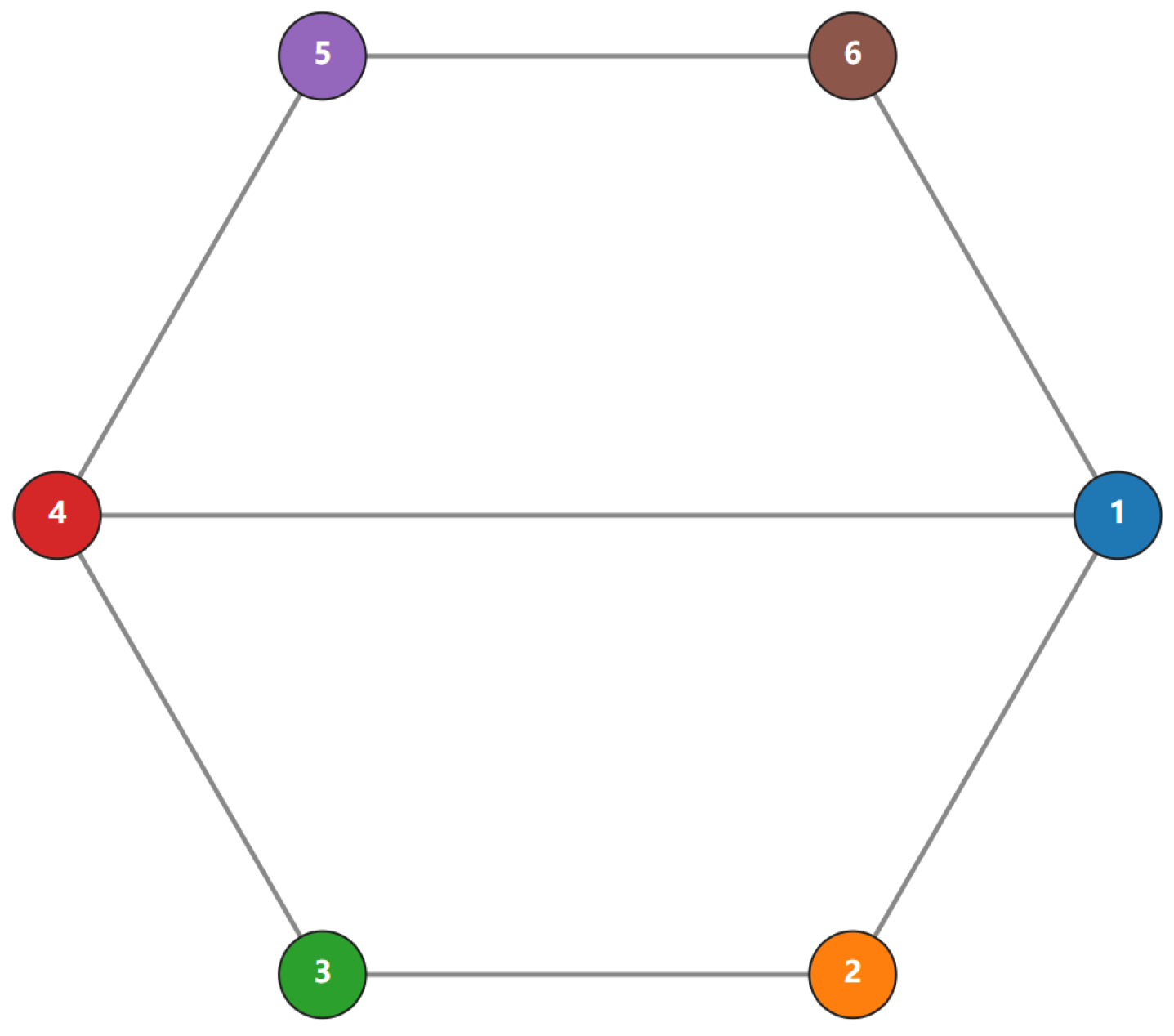
We consider N = 6 agents with an undirected connected topology specified directly by edge pairs E = { ( 0 , 1 ) , ( 1 , 2 ) , ( 2 , 3 ) , ( 3 , 4 ) , ( 4 , 5 ) , ( 5 , 0 ) , ( 0 , 3 ) } where nodes are zero-indexed in the simulation. See Figure 1. The Laplacian matrix L R 6 × 6 is computed from the adjacency A by L = D A , D = diag ( A 1 ) . This topology can be changed at will by editing the set E ; L can be rebuilt for any N and any undirected edge list.
Agent Dynamics and Disturbance: Each agent follows A = 0 1 1 0.4 , B = I 2 , C = I 2 . Agent-wise disturbances are d i ( t ) = 0.5 sin ( 0.6 t + φ i ) 0.5 cos ( 0.5 t + ψ i ) , where phases ( φ i , ψ i ) are evenly distributed in [ 0 , π ) and [ 0 , π / 2 ) , respectively.

4.2. Controller and Implementation Details

4.2.1. Self-Learning Control Law

u i ( t ) = k 1 u i ( t τ ) + k 2 s i ( t ) , s i ( t ) = j = 1 6 a i j x i x j , with parameters:
k 1 = 0.90 , k 2 = 2.5 , τ = 0.01 s .
The differential equations are integrated by RK4 with step Δ t = 0.001 s and horizon T = 30 s . The learning delay is implemented by an integer buffer of N τ = τ / Δ t = 10 steps. Optional actuator constraints are enabled: u i ( t ) 2 , u ˙ i ( t ) 50 ( per second ) , applied componentwise. Initial states are sampled uniformly within x i ( 0 )     0.8 .

4.2.2. Baselines and Metrics

A non-learning baseline is u i ( t ) = k 2 s i ( t ) . I report the disagreement norm s ( t ) 2 and other matrices, the cumulative control effort J u = 0 T i = 1 6 u i ( t ) 2 d t , and representative state trajectories.

4.3. Results

This section evaluates the proposed self-learning consensus control strategy against a proportional baseline (BL) on a network of N = 6 second-order agents under bounded actuation and exogenous disturbances. Unless otherwise stated, both methods use the same initial conditions, network topology, and simulation parameters. I report four complementary views: agent trajectories, disagreement norm, raw control inputs, and cumulative control effort.

4.3.1. State Trajectories and Cohesion

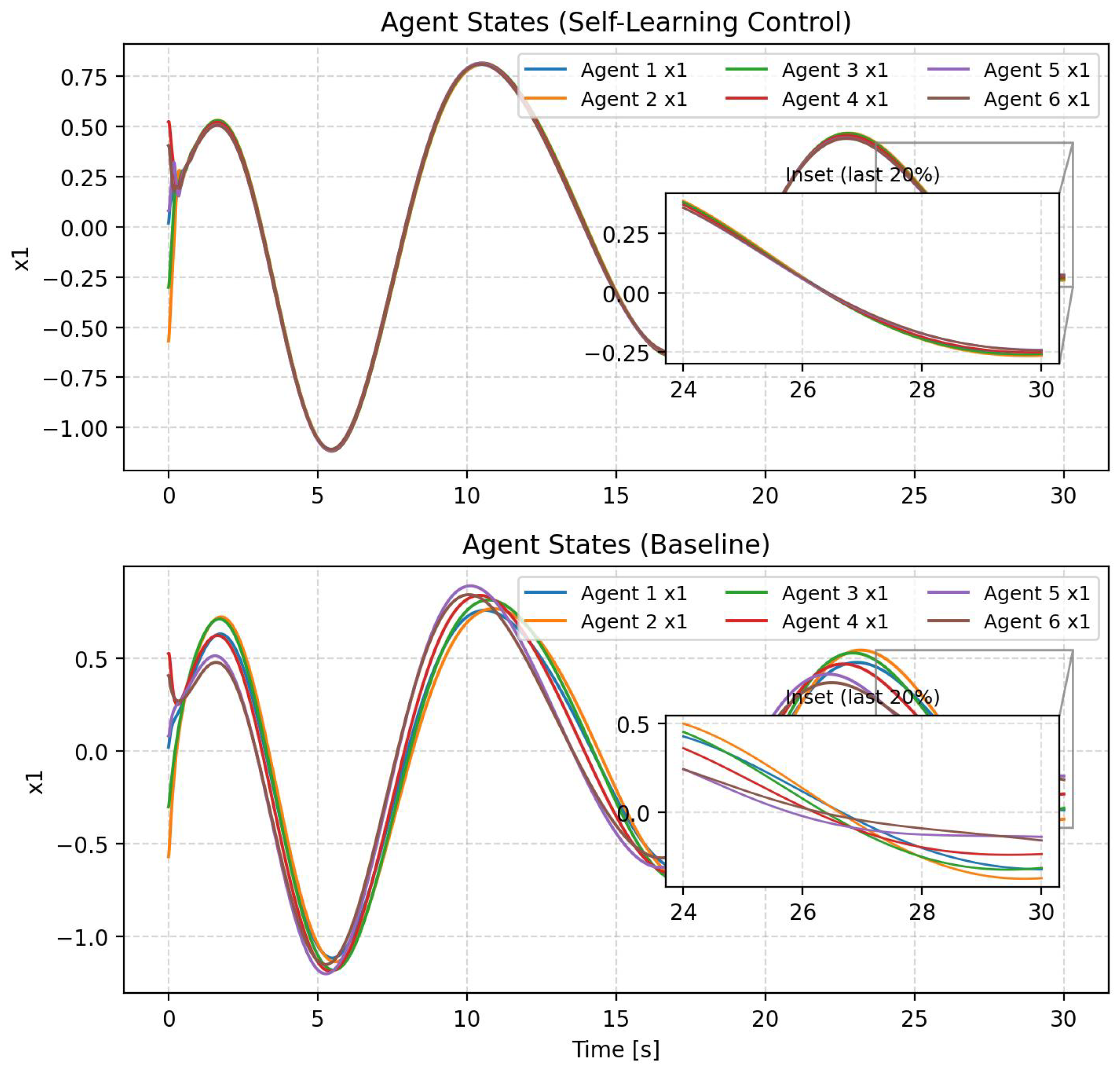
Figure 2 compares the first state component x i , 1 ( t ) of all agents for self-learning control (top) and BL (bottom). For clarity, each panel includes an inset that zooms into the last 20 % of the horizon. The self-learning control trajectories remain tightly clustered throughout the transient and converge nearly synchronously, while the BL trajectories exhibit noticeable dispersion near the end of the horizon. The inset highlights that self-learning control maintains a smaller inter-agent spread during the final convergence phase, indicating stronger cohesion.

4.3.2. Disagreement Norm

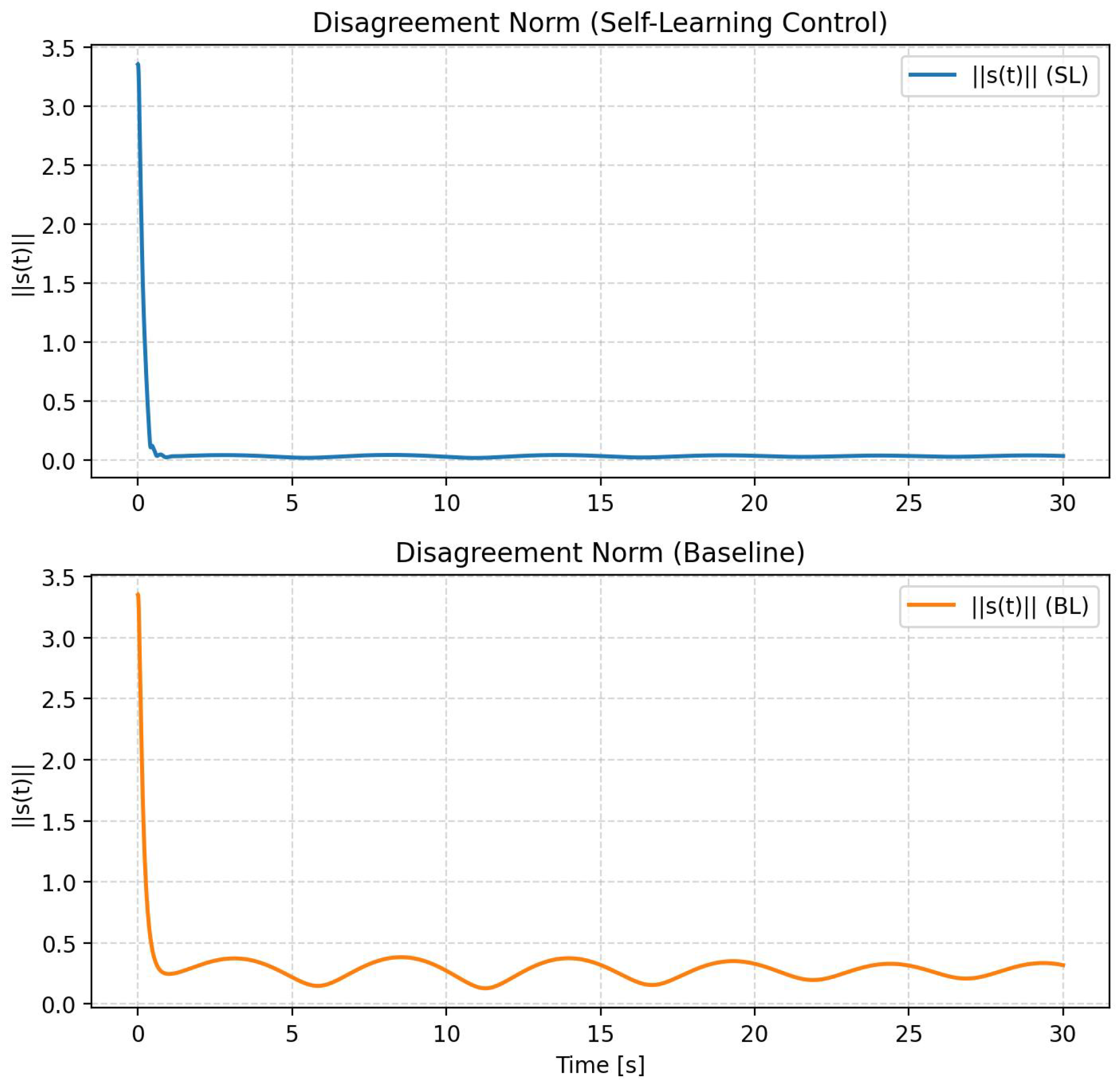
Figure 3 depicts the time evolution of the disagreement norm s ( t ) , where s ( t ) = L X ( t ) with L the Laplacian. The self-learning control curve decays rapidly and remains close to zero for the remainder of the horizon, whereas the BL curve shows a slower decay with residual oscillations. This confirms that SL accelerates consensus formation and effectively suppresses disturbance-induced disagreements.

4.3.3. Control Inputs (Raw)

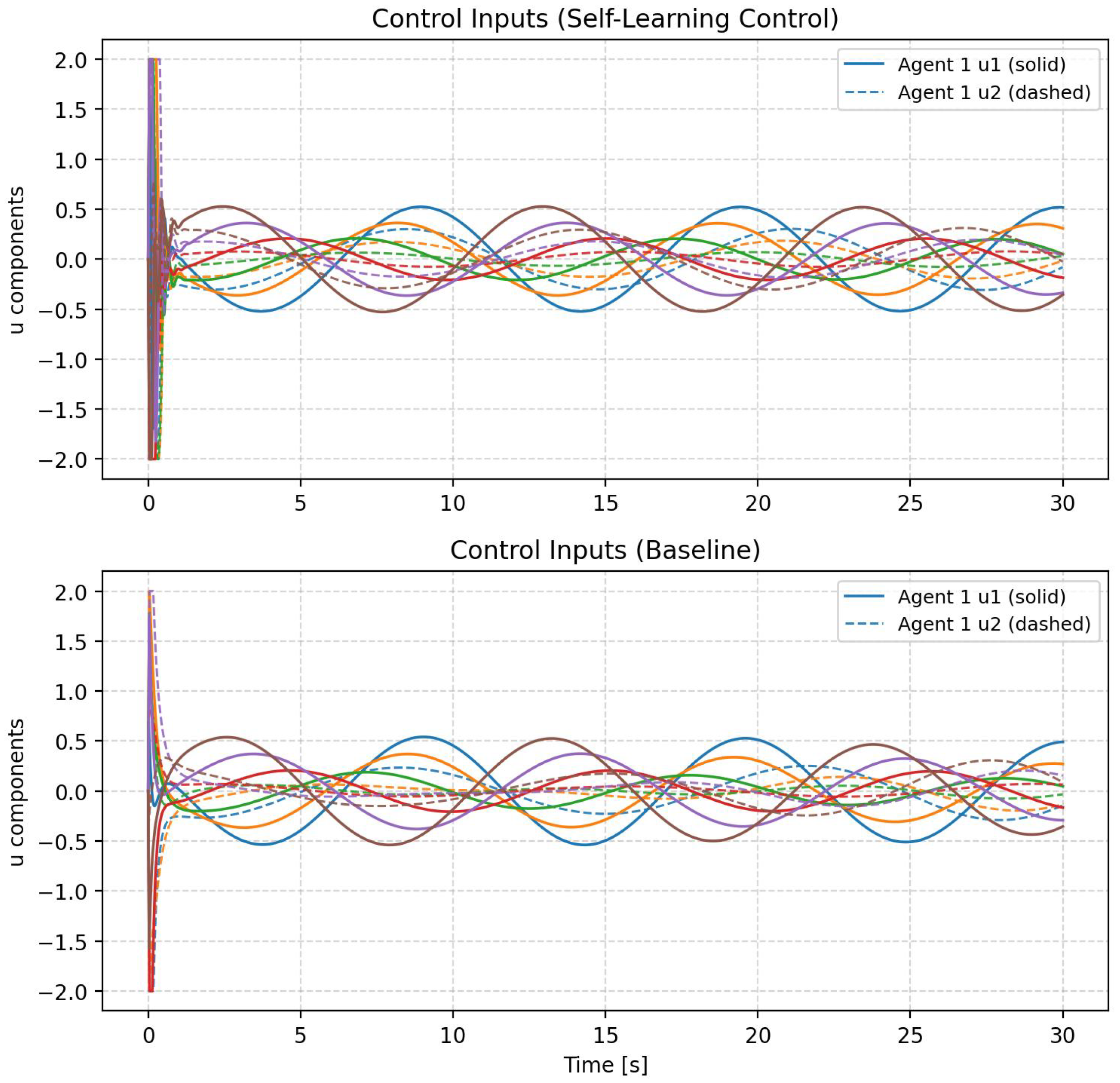
Figure 4 presents the raw control inputs for all agents and both input channels: u i , 1 ( t ) (solid) and u i , 2 ( t ) (dashed) with consistent colors per agent. Despite its faster convergence, SL does not incur persistent high-amplitude actuation; after a short transient, all channels settle to small magnitudes comparable to or lower than BL. This indicates that the proposed memory-based feedback primarily reshapes the early transient rather than sustaining aggressive control.
Remark 5.
Since this study primarily focuses on undirected graph scenarios, directed topologies, switching topologies, and similar scenarios are not covered. I should note that, in the Data Availability Statement of the manuscript, I have made the source code open on http://doi.org/10.13140/RG.2.2.31052.48003, allowing readers to modify the code to test the specific scenario needed.

4.3.4. Summary

The steady-phase statistics in Table 1 (computed for t 5 s) show that the proposed self-learning control maintains substantially tighter consensus than the proportional baseline (BL). Specifically, self-learning control reduces the mean disagreement by about 89 % (0.0297 vs. 0.2703) and the maximum steady-phase disagreement by an order of magnitude (0.0403 vs. 0.3831), while its variance is two orders of magnitude smaller ( 4.58 × 10 5 vs. 4.81 × 10 3 ), indicating markedly improved coherence and disturbance rejection in the stable regime. This enhanced accuracy is achieved with only a modest increase in cumulative control effort ( J u ), reflecting an efficient trade-off between precision and effort during steady operation.

5. Conclusions

I have proposed here a consensus control strategy for multiagent systems based on a self-learning control that reuses prior control inputs. With a Lyapunov-type analysis inspired by our self-learning control framework, I established UUB consensus under bounded disturbances and derived clear tuning insights. The approach is algebraically simple, computationally light, and effective for accelerating transients while preserving robustness. Future research will focus on nonlinear systems, time-varying learning intensity, and dynamic networks. I will also explore low-bit-rate communication and directed graph topologies, comparing the proposed approach with existing methods. Additionally, the framework will be extended to output-feedback scenarios using learning observers.

Supplementary Materials

The following supporting information can be downloaded at: https://www.mdpi.com/article/10.3390/appliedmath6030037/s1, Supplementary Materia File. Figure S1: Cumulative Control Effort (Self-Learning Control) and Cumulative Control Effort (Baseline); Figure S2: Disagreement Norm (Self-Learning Control) and Disagreement Norm (Baseline); Figure S3: Agent States (Self-Learning Control) and Agent States (Baseline); Figure S4: Control Inputs (Self-Learning Control) and Control Inputs (Baseline); Figure S5: The graph of 6 agents with edge pairs; Table S1: Summary Metrics; HTML: Network Topology (N = 6, topology = “custom_pairs”).

Funding

Supported by the National Natural Science Foundation of China (No. 62573211).

Data Availability Statement

The original contributions presented in this study are included in the Supplementary Materials. Further inquiries can be directed to the corresponding author.

Acknowledgments

Thank you to the editors and anonymous reviewers.

Conflicts of Interest

The author declares no conflicts of interest.

References

  1. Zhu, W.; Pu, H.; Wang, D.; Li, H. Event-based consensus of second-order multi-agent systems with discrete time. Automatica 2017, 79, 78–83. [Google Scholar] [CrossRef]
  2. Jiang, Y.; Fan, J.L.; Gao, W.N.; Chai, T.Y.; Lewis, F.L. Cooperative Adaptive Optimal Output Regulation of Discrete-Time Nonlinear Multi-Agent Systems. Automatica 2020, 121, 109149. [Google Scholar] [CrossRef]
  3. Yi, X.; Liu, K.; Dimarogonas, D.V.; Johansson, K.H. Dynamic event-triggered and self-triggered control for multi-agent systems. IEEE Trans. Autom. Control 2018, 64, 3300–3307. [Google Scholar] [CrossRef]
  4. Doostmohammadian, M. Single-bit consensus with finite-time convergence: Theory and applications. IEEE Trans. Aerosp. Electron. Syst. 2020, 56, 3332–3338. [Google Scholar] [CrossRef]
  5. Zhang, C.; Ahn, C.K.; Wu, J.; He, W. Online-learning control with weakened saturation response to attitude tracking: A variable learning intensity approach. Aerosp. Sci. Technol. 2021, 117, 106981. [Google Scholar] [CrossRef]
  6. Dai, M.Z.; Xiao, F.; Wei, B. Event-triggered and quantized self-triggered control for multi-agent systems based on relative state measurements. J. Frankl. Inst. 2019, 356, 3711–3732. [Google Scholar] [CrossRef]
  7. Ruan, X.; Feng, J.; Xu, C.; Wang, J. Observer-based dynamic event-triggered strategies for leader-following consensus of multi-agent systems with disturbances. IEEE Trans. Netw. Sci. Eng. 2020, 7, 3148–3158. [Google Scholar] [CrossRef]
  8. Amirkhani, A.; Barshooi, A.H. Consensus in multi-agent systems: A review. Artif. Intell. Rev. 2022, 55, 3897–3935. [Google Scholar] [CrossRef]
  9. Chen, F.; Ren, W. On the control of multi-agent systems: A survey. Found. Trends Syst. Control 2019, 6, 339–499. [Google Scholar] [CrossRef]
  10. Ni, J.; Zhao, Y.; Cao, J.; Li, W. Fixed-time practical consensus tracking of multi-agent systems with communication delay. IEEE Trans. Netw. Sci. Eng. 2022, 9, 1319–1334. [Google Scholar] [CrossRef]
  11. Ji, Z.; Wang, Z.; Lin, H.; Wang, Z. Controllability of multi-agent systems with time-delay in state and switching topology. Int. J. Control 2010, 83, 371–386. [Google Scholar] [CrossRef]
  12. Yu, X.; Yang, F.; Zou, C.; Ou, L. Stabilization parametric region of distributed PID controllers for general first-order multi-agent systems with time delay. IEEE/CAA J. Autom. Sin. 2019, 7, 1555–1564. [Google Scholar] [CrossRef]
  13. Zhang, C.; Xiao, B.; Wu, J.; Li, B. On low-complexity control design to spacecraft attitude stabilization: An online-learning approach. Aerosp. Sci. Technol. 2021, 110, 106441. [Google Scholar] [CrossRef]
  14. Zhang, C. Self-Learning Control under Practical Actuation. Aerosp. Eng. Commun. 2026, 1, 36–46. Available online: https://www.icck.org/article/abs/aec.2025.320719 (accessed on 6 February 2026).
  15. Tan, L.; Jin, G.; Zhou, S.; Wang, L. A Model-Free Online Learning Control for Attitude Tracking of Quadrotors. Appl. Sci. 2024, 14, 980. [Google Scholar] [CrossRef]
  16. Li, C.; Wang, Y.; Ahn, C.K.; Zhang, C.; Wang, B. Milli-Hertz Frequency Tuning Architecture Toward High Repeatable Micromachined Axi-Symmetry Gyroscopes. IEEE Trans. Ind. Electron. 2023, 70, 6425–6434. [Google Scholar] [CrossRef]
  17. Zhang, C.; Wu, J.; Ahn, C.K.; Fei, Z.; Wei, C. Learning Observer and Performance Tuning-Based Robust Consensus Policy for Multiagent Systems. IEEE Syst. J. 2022, 16, 431–439. [Google Scholar] [CrossRef]
  18. Mesbahi, M.; Egerstedt, M. Graph Theoretic Methods in Multiagent Networks; Princeton University Press: Princeton, NJ, USA, 2010. [Google Scholar]
Figure 1. The graph of 6 agents with edge pairs.
Appliedmath 06 00037 g001
Figure 2. Agent state trajectories ( x i , 1 ( t ) ) for Self-Learning (top) and Baseline (bottom). Insets zoom into the last 20% of the horizon, highlighting the tighter clustering achieved by the proposed method.
Appliedmath 06 00037 g002
Figure 3. Disagreement norm s ( t ) for Self-Learning (top) and Baseline (bottom). The proposed controller exhibits a faster decay and lower steady-level disagreement under disturbances.
Appliedmath 06 00037 g003
Figure 4. Raw control inputs for all agents and both channels: u i , 1 ( t ) (solid) and u i , 2 ( t ) (dashed). The Self-Learning control concentrates effort in the early transient without sustained high-amplitude actuation.
Appliedmath 06 00037 g004
Table 1. Steady-phase performance (custom_pairs, N = 6 , T = 30 s; steady phase defined as t 5 s).
Method J u s final Average | s | max s Var [ | s | ]
self-learning control24.310.03160.02970.0403 4.58 × 10 5
BL21.790.3180.27030.3831 4.81 × 10 3
Disclaimer/Publisher’s Note: The statements, opinions and data contained in all publications are solely those of the individual author(s) and contributor(s) and not of MDPI and/or the editor(s). MDPI and/or the editor(s) disclaim responsibility for any injury to people or property resulting from any ideas, methods, instructions or products referred to in the content.