Article

Energy-Efficient Actuator Concept for Two-Speed Transmissions in Battery Electric Vehicles

Chair of Transmission and Drive Technology, Faculty of Mechanical Engineering and Marine Technologies, University of Rostock, Justus-von-Liebig-Weg 6, 18059 Rostock, Germany
*
Author to whom correspondence should be addressed.
World Electr. Veh. J. 2026, 17(1), 12; https://doi.org/10.3390/wevj17010012
Submission received: 21 November 2025 / Revised: 16 December 2025 / Accepted: 18 December 2025 / Published: 24 December 2025
(This article belongs to the Section Propulsion Systems and Components)

Abstract

Two-speed transmissions can improve battery electric vehicle (BEV) drivetrain efficiency. However, the additional losses caused by shifting actuators offset these efficiency gains. Particularly hydraulic actuated wet-running multi-plate clutches, which enable powershifts, typically require rotary feedthroughs. Commonly used rectangular sealing rings (RSR) demand continuous hydraulic power due to leakage and cause friction torque. This leads to high RSR temperatures, especially at high angular velocities of electric machines. This article introduces a two-speed BEV transmission concept using wet-running multi-plate clutches actuated via a rotating 5/3-way valve that can shut off, i.e., lock up the actuating pressure directly in the rotating system. Consequently, the rotary feedthrough is depressurized and contactless gap seals are usable. This reduces supply pressure requirements and minimizes hydraulic and friction losses while retaining powershift capability. Component-level tests evaluate leakage, pressure shut off, actuator dynamics and power consumption. Results show that actuating pressure in a shut-off clutch is maintained for longer than 60 min and electrical actuator power consumption is less than 20 W. During overlapping gearshifts, gap seal leakage is less than 1 L/min at 10 bar and sufficient pressure dynamics are achieved. These findings confirm the feasibility of the proposed actuator for multi-plate clutches in two-speed BEV transmissions.

1. Introduction

The finite nature of fossil fuel resources, coupled with rising energy demand and the need to meet climate targets, necessitates the development and widespread adoption of alternative drive systems. In 2024 alone, 17.44 million new electric vehicles were registered worldwide [1]. By 2030, electric vehicles are already projected to have a global market share of 26.44% [2]. This market trend is driving the development of more efficient electrified drivetrain concepts. Since the vehicle battery accounts for up to one-third of the total vehicle cost [3,4], the focus is shifting to the efficient use of vehicle battery capacity. A more efficient powertrain enables an increase in range with the same vehicle battery size or a reduction in vehicle battery size with the same range [5].
One way to improve the efficiency of electrified drivetrains in passenger cars is to use multi-speed transmissions. These offer advantages over widely used electric drivetrains with fixed gear ratios in terms of power density, energy efficiency, range, and driving dynamics [6,7]. To ensure customer acceptance, powershift capability is required [8]. Dual-clutch transmissions or continuously variable transmissions are usually recommended for gearshifts without any loss of drive power [5,9]. However, the significant losses that occur in continuously variable transmissions under real-world conditions negate the advantage of continuous, efficiency-optimized operating point selection [10].
In the literature, two-speed transmissions are considered the best compromise between cost and benefit for passenger cars compared to transmissions with a higher number of gears or continuously variable transmissions [5].
A multi-speed transmission test bench at TU Darmstadt with dog clutches shows energy savings of 5–10% [11]. The prototype of a two-speed transmission with a simple synchronizing mechanism from the Technical University of Crete achieves energy savings of 3.4% [12]. Other sources indicate a possible reduction in energy consumption of up to 15% [13]. However, the above data refers to different or unspecified driving cycles.
The energy savings of a two-speed transmission compared to a single-speed transmission are mostly determined using simulations in the literature. For example, energy savings in the NEDC driving cycle range between 3% and 11.4% (compact car), while in the WLTP they range between approx. 2.4% up to 7.4% depending on vehicle segment [9,14,15,16,17]. In [18], the size of the electric motor is optimized by using a two-speed transmission, achieving a 25% reduction in motor weight and a simultaneous 5% reduction in energy consumption for the EPA (Environmental Protection Agency) US06 driving cycle. Reference [19] discusses the advantages of using two-speed transmissions in dual-motor four-wheel drive vehicles in terms of reducing weight and size of the motor and increasing the vehicle’s range. It also emphasizes the importance of shifting without power interruption.
When using simulation to determine energy requirements, the relevant losses of the shift actuators and shift elements are usually only approximated roughly. This applies, for example, to the drag losses of open multi-plate clutches, but also to the gearshift sequences. Energy-efficient and comfortable gearshift sequences also require good controllability and dynamics of the shift actuators and shift elements, which can usually only be verified experimentally.
An assessment of the simulated potential of two-speed transmissions in BEVs in terms of energy efficiency therefore depends largely on the losses caused by the additional required shift actuators. In the following, a concept for a two-speed transmission including low-loss shift actuators is presented and examined, which enables gearshifts without loss of drive power using two wet-running multi-plate clutches. For this purpose, the function of the shift actuators must be experimentally verified using appropriate test setups and their power losses must be evaluated.
Typically, wet-running multi-plate clutches are used in automatic transmissions of conventional vehicle drivetrains with combustion engines. The associated shift actuators usually show high power losses and only allow limited speeds. For example, the clutch actuating pressure of a closed clutch (normally open) of approx. 10 bar must be maintained continuously via the rotary feedthrough. Conventional rotary feedthroughs are typically sealed with rectangular sealing rings (RSR). Friction of the RSR in a pressurized rotary feedthrough results in loss torques in the range of 0.5–1.0 Nm [20] (p. 132). This leads to power losses in the range of 250–500 W at combustion engine speeds of 5000   min 1 , for example. In addition, leakage from the RSR during driving with a closed clutch results in permanent hydraulic power loss. Leakage from the RSR is subject to an enormous range of 5 to 800 mL/min, depending on manufacturing tolerances [20]. Supply pressure is therefore required constantly, which usually requires continuous operation of a transmission oil pump. For transmission oil pumps which supply the clutch actuating pressure and the cooling oil volume flow, a power requirement of approx. 450–500 W is specified in the literature [21] (p. 5).
In addition, drivetrains with electric machines typically have higher speeds than combustion engine drivetrains. This would result in high power losses when using RSRs, combined with high component temperatures. This can lead to melting of the flank surfaces of the RSR, associated thermal effects, and ultimately thermal destruction of the RSR [20] (p. 140).
In addition to the energy required during gearshifts, energy losses also occur in phases when a gear is engaged. One objective of the novel gearshift actuator presented here is to minimize these losses.
Therefore, a concept is presented below in which RSRs are replaced by contactless, low-friction gap seals. The basic idea is that the pressure at the rotary feedthrough or at the gap seals is only present for a short time. This limits the hydraulic power loss due to leakage. To operate the rotary feedthrough depressurized, a rotating shut-off valve is presented that shuts-off the actuating pressure in the pressure chamber of a closed clutch. A component level test setup is employed to verify that the shut-off valve of the novel gearshift actuator maintains the actuating pressure while a clutch is closed and the rotary feedthrough is depressurized.
The leakage through the gap seal of the pressurized rotary feedthrough is investigated using an experimental setup. The results show acceptable leakage flow rates for various operating parameters.
An overlapping gearshift is replicated on a test setup. This demonstrates sufficient pressure dynamics when using the novel gearshift actuator. In addition, energy losses are analyzed. When using the novel gearshift actuator, lower power losses are observed compared to conventional actuators for wet-running multi-plate clutches.

2. Concept of the Actuator for a Two-Speed Transmission

Below, a drivetrain concept consisting of a two-speed transmission with two wet-running multi-plate clutches is proposed. This enables efficiency-optimized operating point selection for the electric machine and gearshifts without a loss of drive power. To minimize losses in the shift actuator, a 5/3-way valve that rotates concentrically with the drive shaft is being developed. It can shut off, i.e., lock up the pressure chamber of a closed multi-plate clutch in the rotating system, thereby maintaining the clutch actuating pressure. This allows the pressure at the rotary feedthrough and the gap seals to be reduced, and thus a reduction in the supply pressure. This minimizes leakage and allows contactless gap seals to be used in the rotary feedthrough.
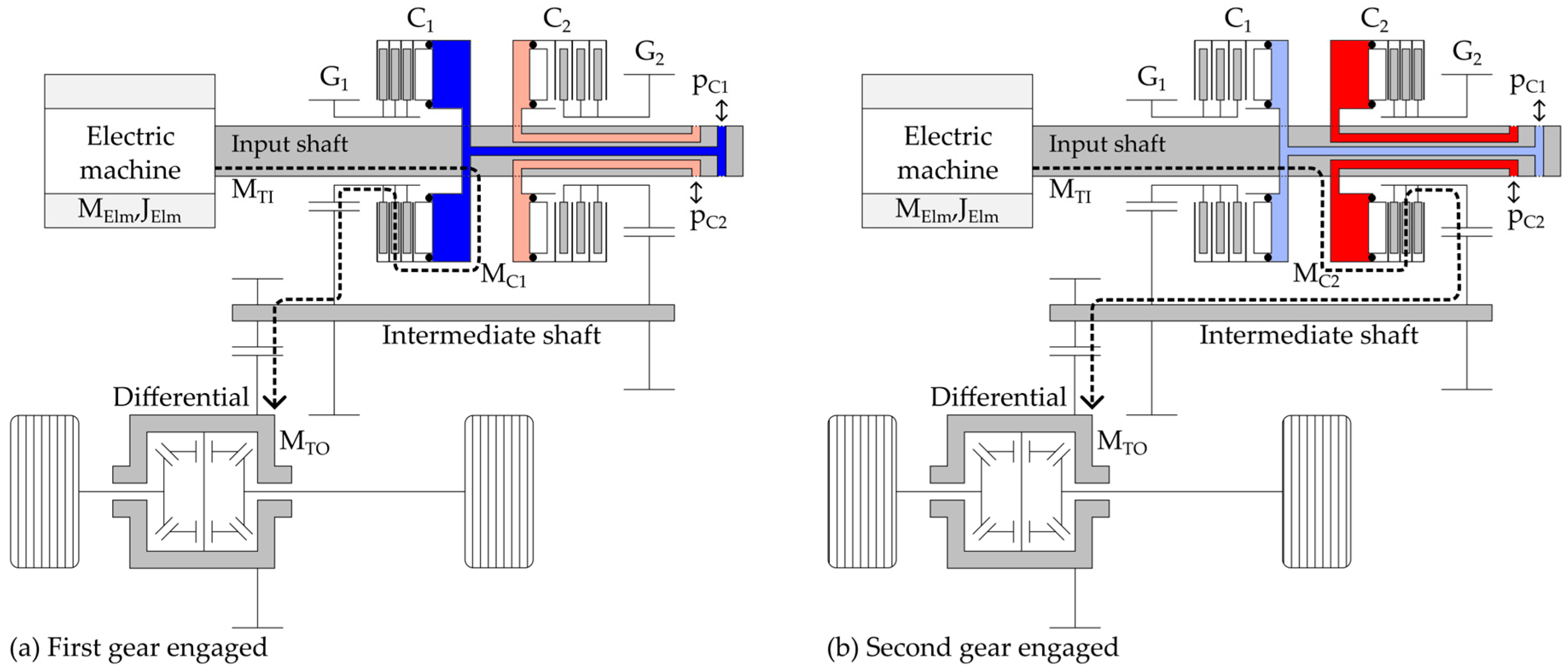
Figure 1 shows a schematic representation of the drivetrain concept. An electric machine drives a transmission input shaft on which two hydraulically actuated wet-running multi-plate clutches C 1 and C 2 are mounted. The outer plate carriers of clutches C 1 and C 2 , including the pressure pistons, are attached to the transmission input shaft. The externally toothed outer plates, which are made of steel, mesh with the internal teeth of the outer plate carrier.
The inner plate carriers of clutches C 1 and C 2 are connected to the gearwheels of first gear G 1 and second gear G 2 and are mounted by bearings on the transmission input shaft. The internally toothed inner plates, which are equipped with friction linings, mesh with the external teeth of the inner plate carrier.
The gearwheels of gears G 1 and G 2 mesh with the corresponding output wheels, which are attached to an intermediate shaft. The intermediate shaft drives a differential via a second gear stage. The mechanical torque or power path for the first gear G 1 with the clutch C 1 closed and the clutch C 2 open is shown in Figure 1a. Similarly, Figure 1b shows the closed clutch C 2 and the open clutch C 1 for the second gear G 2 .
The clutches C 1 respectively C 2 are closed by building up a clutch actuating pressure p C 1 respectively p C 2 . Therefore, the spring force of the piston return spring and the friction of the seals on the pressure piston must first be exceeded. Subsequent movement of the pressure piston reduces the running clearance between the inner and outer plates. As the actuating pressure is further increased, the pressure piston generates an axial or contact force and thus friction between the inner and outer plates. This allows torque to be transmitted. The amount of torque M C 1 or M C 2 that can be transmitted between the outer and inner plate carriers can be calculated using Equation (1) and depends on the axial force F a x 1 or F a x 2 that corresponds to the actual force applied to the clutch plates. It is determined by the actuating pressure and the piston area taking into account the effects of a piston return spring and seal friction. In addition, the current friction coefficient μ of the friction pairs, the mean friction radius r m of the plates, and the number of friction pairs z are considered [22] (p. 430). It is assumed that the axial force and the friction coefficient are identical for all friction pairs.
M C 1,2 = F a x 1,2 · r m · μ · z
A clutch is opened by a piston return spring while the actuating pressure is reduced.
All driving conditions in which a gear is engaged and the corresponding clutch is closed are referred to below as “driving with gear engaged”. When driving with first gear G 1 engaged, clutch C 1 is closed. In this case, the actuating pressure is, for example, p C 1 = 10   b a r , which is symbolized in Figure 1a by a dark blue pressure chamber. At the same time, clutch C 2 must be open at an actuating pressure of p C 2 = 0   b a r (Figure 1a, colored light red).
When driving with second gear G 2 engaged, clutch C 2 is closed with an actuating pressure of p C 2 = 10   b a r (Figure 1b, colored dark red) and clutch C 1 is open with an actuating pressure of p C 1 = 0   b a r (Figure 1b, colored light blue).

2.1. Overlapping Gearshift Sequence

A shift between first and second gear is performed using a so-called overlapping gearshift. With a corresponding powershift, the torque flow through the transmission is maintained during the shifting process.
In principle, gearshifts are classified according to shift direction and torque flow. In terms of shift direction, a distinction is made between upshifts (shifting to a higher gear with a lower ratio) and downshifts (shifting to a lower gear with a higher ratio). Depending on the direction of torque flow, a distinction is made between power up- and downshifts (positive transmission input torque M T I ) and coast up- and downshifts (negative transmission input torque M T I ). A positive transmission input torque corresponds to driving the vehicle in the forward direction.
The combination of possible shift and torque flow directions results in the gearshift types shown in Table 1.
Here, i 1 denotes the total transmission ratio in first gear, which also includes the ratio of the axle gearbox or differential. The same applies to the total transmission ratio i 2 in second gear.
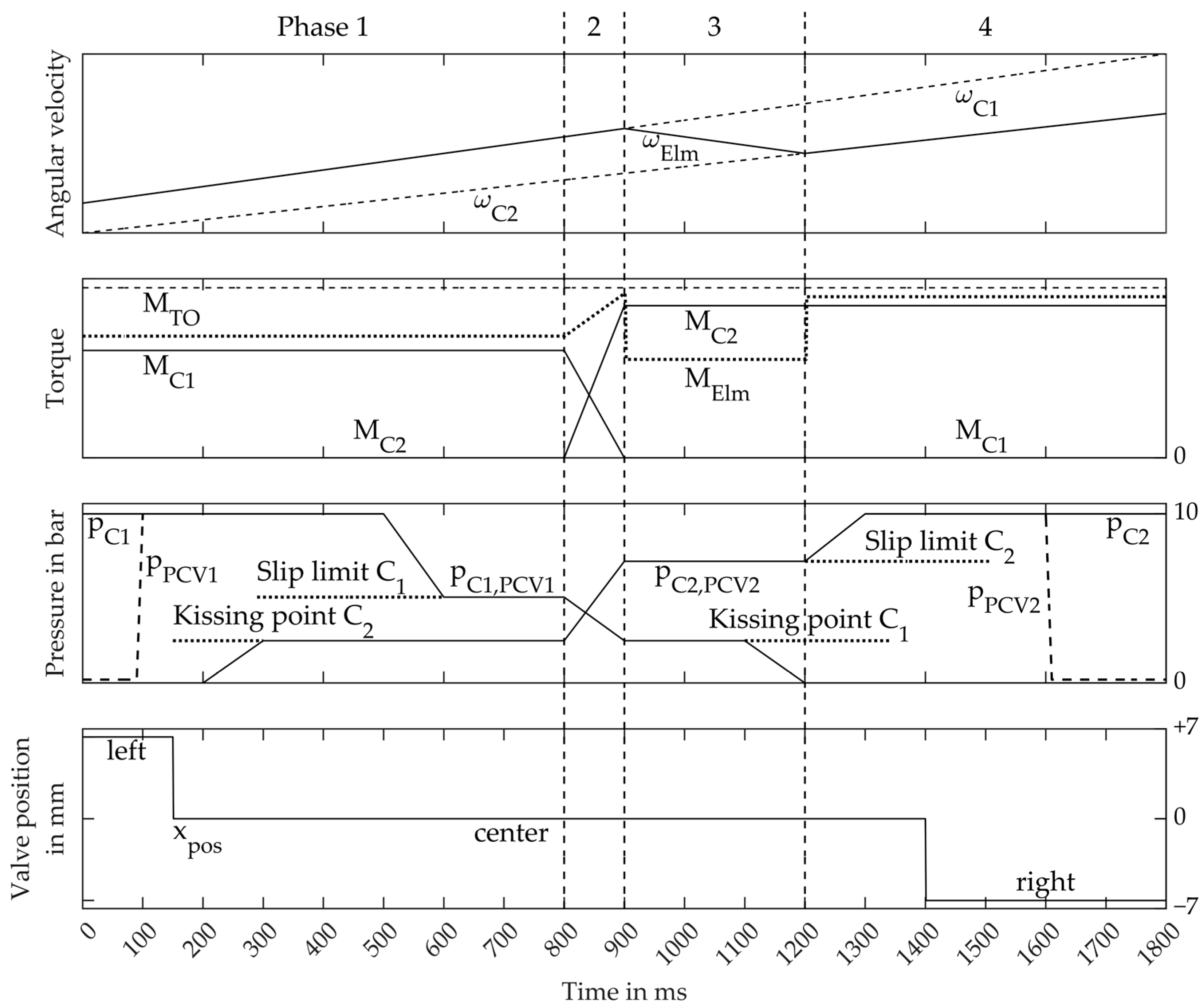
The following investigations consider an example of power upshifting—meaning the gear change from first to second gear with positive transmission input torque—which is replicated in Section 3.3. A power upshift with uninterrupted torque transfer consists of the preparation phase, the transition phase, the synchronization phase, and the completion phase. The phases are explained below using an idealized gearshift from first gear to second gear with motor torque intervention. Figure 2 shows the basic curves of the angular velocities, torques, pressures, and valve position for the idealized power upshift. To avoid any interruption of torque transfer, the transmission output torque M T O specified by the driver or driver assistance systems should be ensured during the whole gearshift. In the following, a constant transmission output torque M T O is assumed as an example.
At the start of the preparation phase (phase 1), clutch C 1 is closed and clutch C 2 is open. The pressure chamber of clutch C 2 is depressurized and connected to the tank. The torque of the open clutch C 2 is M C 2 = 0   N m . The valve slide of the rotating 5/3-way valve (Figure 3a) is in the left position and shuts off the pressure chamber of clutch C 1 with p C 1 = 10   b a r . The currently transmitted torque M C 1 of the closed clutch C 1 is calculated according to Equation (2) from the air gap torque of the electric machine M E l m minus the inertia term from the mass moment of inertia of the electric machine J E l m and the current angular acceleration of the electric machine ω ˙ E l m .
M C 1 = M E l m J E l m · ω ˙ E l m
The moments of inertia of components connected to the electric machine, such as the transmission input shaft, outer plate carrier, and pressure pistons of both clutches, etc., are added to the moment of inertia of the electric machine J E l m .
The transmission output torque M T O is calculated according to Equation (3) from the transmission ratio i 1 and the currently transmitted torque M C 1 . The mass moments of inertia on the output side of the transmission are neglected here.
M T O = i 1 · M C 1
The transmission output torque M T O corresponds to the sum of the drive torques at both drive wheels.
During the preparation phase (phase 1), the pressure level in the inlet of clutch C 1 is set to p P C V 1 = 10   b a r via pressure control valve PCV1. This adjusts the pressure level p P C V 1 in the inlet to the actuating pressure p C 1 in the still shut-off pressure chamber of clutch C 1 . Once the target pressure level of p P C V 1 = 10   b a r has been reached, the valve slide of the 5/3-way valve (Figure 3a) is moved to the middle position. This establishes connections from PCV1 to the pressure chamber of clutch C 1 and from PCV2 to the pressure chamber of clutch C 2 . The connection between the pressure chamber of clutch C 2 and the tank is interrupted. The actuating pressures of both clutches are then specified by the pressure control valves PCV1 and PCV2.
At the end of the preparation phase (phase 1), the actuating pressure p C 1 of clutch C 1 is reduced to a pressure level that corresponds to the slip limit. This pressure is determined by the currently transmitted torque M C 1 and ensures that clutch C 1 reaches the threshold between a closed and a slipping state. During the preparation phase (phase 1) the actuating pressure of the previously open clutch C 2 is raised to the pressure level of the kissing point. At this pressure, the spring force of the piston return spring and the seal friction are overcome and clutch C 2 reaches a limit at which torque transmission in a slipping state begins.
During the entire preparation phase (phase 1), torque is transmitted via the first clutch C 1 . The angular velocities of the electric machine ω E l m and the inner plate carrier of the torque-transmitting clutch ω C 1 are identical and are determined by the driving condition. In this example, the angular velocities increase linearly (see Figure 2).
During the transition phase (phase 2), clutch C 2 is increasingly closed with an actuating pressure p C 2 that rises over time, while clutch C 1 opens at the same time as a result of an actuating pressure p C 1 that falls over time. The actuating pressures are specified via corresponding target pressure ramps for the pressure control valves. As a result, the torque M C 2 transmitted by the slipping clutch C 2 increases, while the torque M C 1 transmitted by the clutch C 1 decreases accordingly. Both torques are coordinated in time so that the specified transmission output torque M T O is set according to Equation (4).
M T O = i 1 · M C 1 + i 2 · M C 2
The transferable torque of clutch C 1 is adjusted so that it is completely reduced by the end of the transition phase ( M C 1 = 0   N m ). As a result, the entire transmission output torque M T O is transmitted by clutch C 2 and the target gear G 2 . After that, the reduction in the actuating pressure of the opening clutch C 1 down to p C 1 = 0   b a r can be started. To allow the pressures p C 1 and p C 2 to be regulated, the valve slide of the 5/3-way valve (Figure 3a) remains in the middle position throughout the entire transition phase (phase 2).
At the end of the transition phase (phase 2), the torque M C 2 to be transmitted by the slipping clutch C 2 can be calculated from the specified transmission output torque M T O and the transmission ratio i 2 of the second gear according to Equation (5).
M T O = i 2 · M C 2
During the synchronization phase (phase 3), the angular velocity ω E l m of the electric machine is reduced to the new target angular velocity ω C 2 due to the change in transmission ratio from i 1 to i 2 . This corresponds to the angular velocity of the inner plate carrier of the clutch C 2 . The synchronization phase (phase 3) can take place with or without motor torque intervention. A gearshift with motor torque intervention is perceived as more harmonious and less power is dissipated at the slipping clutch, as torque overshoot is avoided. During the reduction in the angular velocity ω E l m of the electric machine, the transmission output torque M T O and the transmitted torque M C 2 of the clutch C 2 are kept constant. As a result of the negative angular acceleration ω ˙ E l m of the electric machine with the mass moment of inertia J E l m , there is an inertia effect, i.e., a torque. This is compensated by the air gap torque of the electric machine M E l m , which is referred to as motor torque intervention. The air gap torque of the electric machine M E l m must be adjusted taking into account the constant transmission output torque M T O and the constant transmitted torque M C 2 of the clutch C 2 according to Equation (6).
M T O = i 2 · M C 2 = i 2 · ( M E l m J E l m · ω ˙ E l m )
As soon as the angular velocity ω E l m of the electric machine is almost equal to the output angular velocity ω C 2 of the clutch C 2 , the completion phase (phase 4) begins after a rapid increase in the torque M E l m of the electric machine. This completes the reduction in the angular velocity of the electric machine for synchronization purposes.
During the completion phase (phase 4), the pressure p C 2 of the clutch C 2 is increased to a higher level of 10 bar to ensure protection against slippage. The valve slide of the 5/3-way valve (Figure 3a) is then moved to the right position, thereby shutting off the pressure p C 2 = 10   b a r in the pressure chamber of clutch C 2 . The clutch C 2 is now completely closed and shut off, allowing the supply pressure to be reduced.
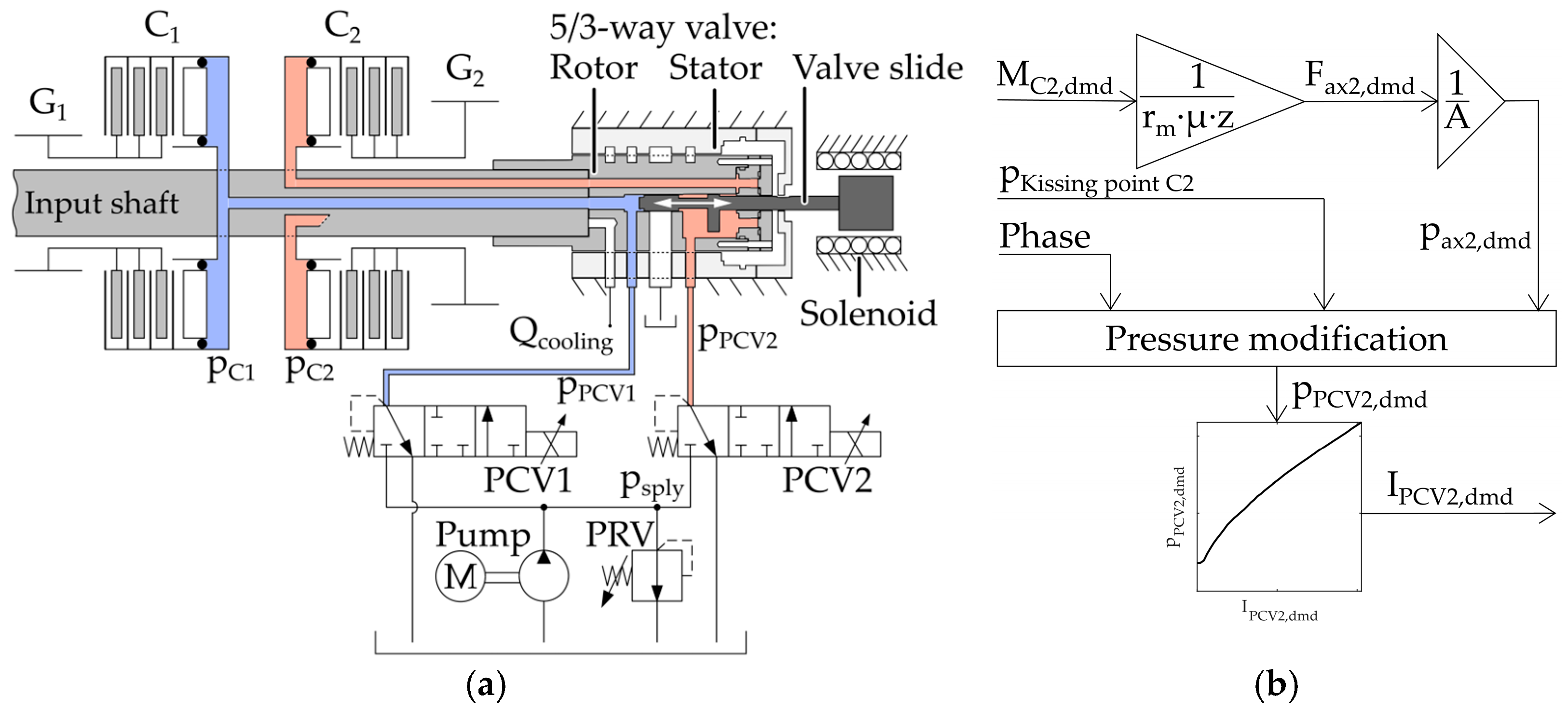
To set the time curves of the clutch torques M C 1 and M C 2 shown in Figure 2, the signal path shown in Figure 3b as an example for clutch C 2 is used. In the middle position of the 5/3-way valve (as shown in Figure 3a), the pressure chamber of clutch C 2 is connected to pressure control valve PCV2. A curve corresponding to Figure 2 for a setpoint M C 2 , d m d for the clutch torque M C 2 is converted to a setpoint for an axial force F a x 2 , d m d according to Equation (1). Considering the piston area A this results in a setpoint p a x 2 , d m d for the clutch pressure, which does not yet consider the effects of the spring force of the piston return spring and the seal friction. A corresponding correction is made in the “Pressure modification” block. Here, for example, the pressure level of the kissing point p Kissing point C 2 is added to the setpoint p a x 2 , d m d . This is done at the beginning of phase 1, whereby the output value increases gradually. This results in a setpoint p P C V 2 , d m d for the pressure control valve PCV2. It is corrected using a characteristic curve that compensates for non-linearities of the pressure control valve PCV2. This results in a setpoint I P C V 2 , d m d for the current of the pressure control valve PCV2 in Figure 3a.

2.2. Concept of a Rotating 5/3-Way Valve for Clutch Control

When driving with a gear engaged, shutting off one of the clutches C 1 or C 2 or maintaining one of the actuating pressures p C 1 or p C 2 is achieved by the electromagnetically actuated 5/3-way valve. The underlying valve arrangement is shown schematically in Figure 3a and is based on patent DE102020127947B3 [24].
The 5/3-way valve consists of a rotor that rotates concentrically with the transmission input shaft, a valve slide that also rotates and is actuated by an electromagnetic actuator (solenoid), and a stationary housing, below referred to as the stator. Grooves are cut into the stator and rotor to form rotary feedthroughs. The associated seals are designed as contactless and therefore low-friction gap seals. The actuating pressures p C 1 and p C 2 are transmitted from the stationary stator to the rotating rotor via the rotary feedthrough. The actuating pressures p C 1 and p C 2 are adjusted using pressure control valves PCV1 and PCV2, which are located outside the rotating system. The supply pressure p s p l y for the pressure control valves is provided by a gear pump and limited by a pressure relief valve PRV. Cooling oil enters the rotating system via another integrated contactless rotary feedthrough.
The rotor serves as a rotating valve body for the valve slide of the 5/3-way valve. The rotating valve slide is secured against rotation relative to the valve body and can be moved axially in both directions, i.e., along the axis of rotation of the transmission input shaft. Three valve slide positions are possible:
  • Middle position (as shown in Figure 3a): The pressure chambers of clutches C 1 and C 2 are connected to pressure control valves PCV1 and PCV2, respectively.
  • Left position: The pressure chamber of clutch C 1 is shut off, and the actuating pressure p C 1 is maintained. The pressure chamber of clutch C 2 is connected to the tank.
  • Right position: The pressure chamber of clutch C 2 is shut off, the actuating pressure p C 2 is maintained. The pressure chamber of clutch C 1 is connected to the tank.
The middle valve slide position is position-controlled, with the electromagnetic force on the plunger of the electromagnetic actuator representing the control variable. In the left and right valve slide positions, the electromagnetic force or the required valve current for shut off can be specified in a way that optimizes power loss. The valve arrangement shown in Figure 3a ensures that when the pressure chamber of one of the clutches is shut off, the pressure chamber of the other clutch is connected to the unpressurized tank. This means that the pressure chambers of both clutches can never be mechanically shut off at the same time. This offers advantages in terms of functional safety.
During an overlapping gearshift, with the valve slide in the middle position, the pressure chambers of both clutches can be pressurized. In the event of a fault, a safety-critical closing of both clutches simultaneously is possible. However, the duration of an overlapping gearshift is limited. In terms of functional safety, a time criterion defined in the control system can be used to check for safe system behavior. The same applies to the “refilling” described below.
The valve slide shuts-off the pressure channels leak-free using O-rings. Tests with a non-optimized series-production multi-plate clutch from a conventional dual-clutch transmission show that the actuating pressure in the pressure chamber of the clutch is maintained for more than one hour when shut off (see Section 3.2). No supply pressure p s p l y is required for this period, or the supply pressure can be reduced to a low level for the lubrication and cooling oil supply. If the actuating pressure drops over a longer period of time as a result of leakage, it can be recovered by temporarily moving the valve slide to the middle position and suitably controlling one of the pressure control valves (“refilling”). To do this, the supply pressure p s p l y is temporarily increased. A transmission oil pump can therefore be controlled on demand. Higher output power is only required during the overlapping gearshift or the cyclical recovery of the actuating pressure (“refilling”), which significantly reduces energy consumption.
In addition, the rotary feedthrough between the rotor and stator of the 5/3-way valve is depressurized when one of the clutches is shut off. Contactless gap seals can be used, which have nearly no friction losses in depressurized state. Leakage only occurs during overlapping gearshifts or “refilling”. In addition, the contactless gap seals allow significantly higher angular velocities than the rectangular sealing rings used in conventional double-clutch transmissions, which exhibit high power losses and component temperatures due to friction.
However, the 5/3-way valve must be electrically powered to shut off the actuating pressure. Tests from Section 3 show a low electrical power demand of less than 20 W.
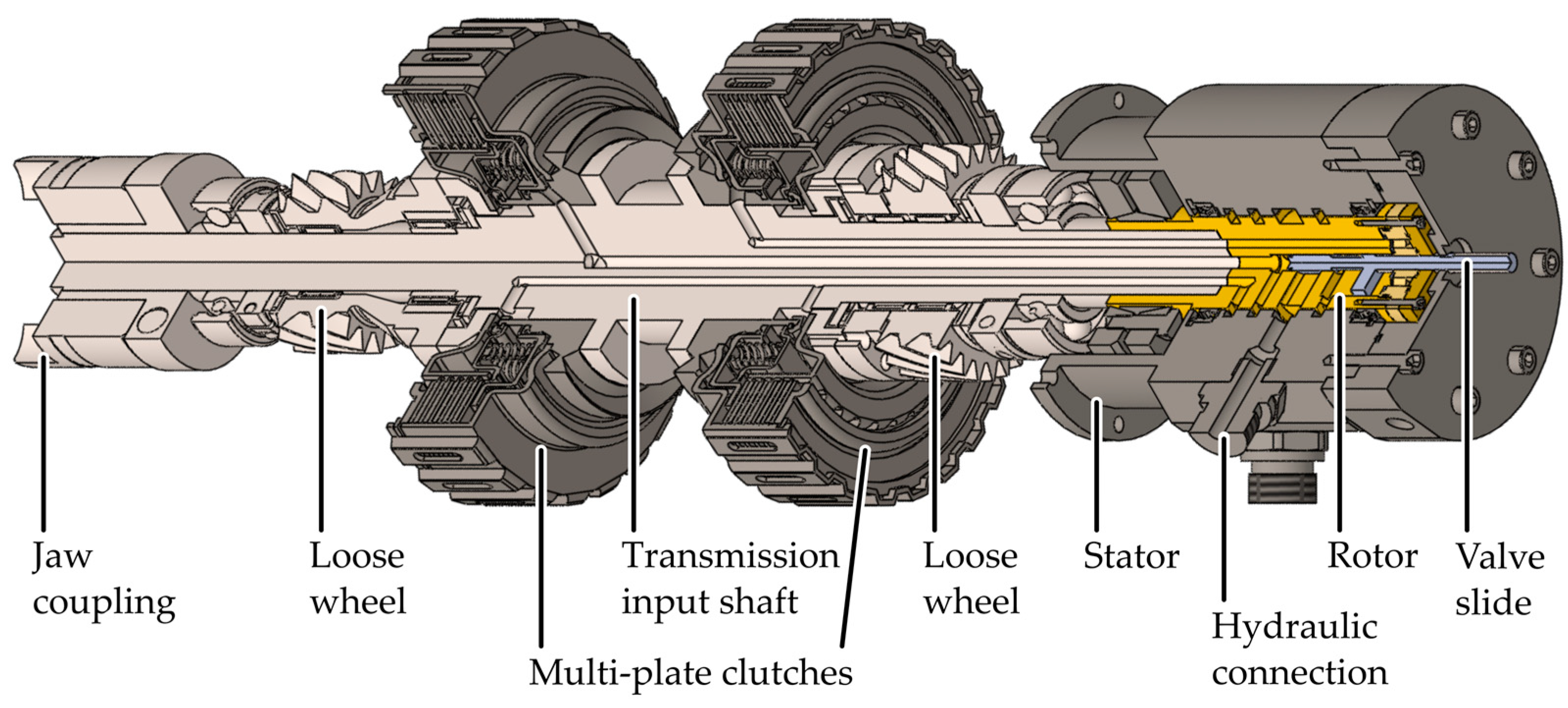
A transmission prototype for the concept presented in Figure 1 is currently under development. Its integration into a hardware-in-the-loop test bench (see Section 4) allows investigating the feasibility and potential of 2-speed transmissions for electric vehicles. Figure 4 shows the latest development status of the transmission input shaft and the 5/3-way valve from Figure 3a. Final optimization and production will take place in the future after two separate partial function tests, which are described below. Section 3 presents test setups for verifying the function of the gap seal and the position control and shut-off function of the 5/3-way valve. For better comparability, the test setups are based on the components and dimensions of the planned design shown in Figure 4.
Parts of the clutches shown in Figure 4 originate from a series-production dual-clutch transmission for conventional vehicles. These are two identical inner multi-plate clutch packs that have been removed from two donor transmissions and reworked. The outer diameter of the outer plate carriers of 150 mm defines a minimum center distance for the two gear pairs of the first and second gear. For simplified realization, two gear pairs from another donor transmission are used. The gear pairs define the center distance of 88.5 mm. Together with the axle transmission, i.e., the differential, the total gear ratios are i 1 = 10.25 and i 2 = 6.44 . The design in Figure 4 is adapted to the parts of the donor transmissions. The axial distance of the fixed-loose bearings is 310 mm which is determined by the donor components. The 5/3-way valve including the stator has a length of 135 mm. The electromagnetic actuator acting on the valve slide also takes up axial clearance. The large axial space requirement for the proposed prototype can be reduced in series applications. An optimized and more compact axial design for clutches, gears, 5/3-way valve and electromagnetic actuator is expected to have a total axial length of approximately 400–450 mm.
The transmission input shaft is connected to the electric machine via an elastic jaw coupling. The transmission input shaft is equipped with several bores or channels for transmitting the actuating pressures p C 1 and p C 2 and for lubricating and cooling oil volume flow. The rotor of the 5/3-way valve is connected to the transmission input shaft with an external clamping set and guided by two bearings in the stator of the 5/3-way valve. To prevent overdetermination of the transmission input shaft, the stator is elastically connected to the transmission housing. The radially arranged bores in the transmission input shaft are sealed with O-rings to the inlets of the pressure chambers of the clutches. The loose gearwheels of the gear pairs are mounted on the transmission input shaft with needle bearings.
Figure 4 indicates hydraulic connections for transmitting the actuating pressures p C 1 and p C 2 and for the cooling oil volume flow. The pressure control valves and the pressure supply are located outside the stator of the 5/3-way valve.
The rotating valve slide of the 5/3-way valve is moved in the axial direction by an electromagnetic actuator (solenoids). It is planned to integrate the plunger of the solenoids into the valve slide and allow it to rotate as well.

3. Proof of Functionality of the Novel Gearshift Actuator

3.1. Test Setup for Proving the Functionality of the Gap Seal

First, the hydraulic functionality of the clutch control must be verified, as rotary feedthroughs with gap seals are used in the 5/3-way valve instead of the usual rectangular sealing rings. It must be demonstrated that the resulting increase in leakage volume flow has little or no effect on the functionality of the pressure control valves, i.e., the pressure build-up dynamics of the actuating pressures p C 1 and p C 2 . Consequently, the theoretical leakage volume flow through the gap seal must be minimized in the design process and an acceptable leakage volume flow through a real gap seal must be verified.

3.1.1. Theoretical Consideration on the Gap Seal

For hydraulic smooth, centric parallel gaps with laminar flow of an incompressible fluid, the leakage volume flow can be estimated using Equation (7) [25] (p. 34). The leakage volume flow V ˙ depends on the average gap diameter D, the pressure difference ∆p, the dynamic viscosity η, the gap length L, and the gap height h.
V ˙ = π · D · p 12 · η · L · h 3
The smallest possible mean gap diameter D and the largest possible gap length L are specified by the design. A dual-clutch transmission oil with a dynamic viscosity of η = 64.84   m P a · s at 20 °C (measured with a MCR 302e rheometer from Anton Paar GmbH) is used for the tests. For better comparability between the separate test setups for the partial functionality tests, the test results shown below were obtained at room temperature (approx. 20 °C). The influence of reduced viscosity at higher operating temperatures (up to approx. 120 °C in vehicle transmissions) on the gap seal is investigated separately in a worst-case scenario.
The gap height h, which is included in Equation (7) as a cubic value, has the greatest influence on the leakage volume flow. For manufacturing reasons, brass is used as the base material for the rotor in the transmission prototype. To prevent major damage in the event of contact between the rotor and stator, a plastic sleeve is inserted into the steel stator. Due to the different thermal expansion coefficients of brass with α B r a s s = 1.8 · 10 5   K 1 , the plastic sleeve with α P l a s t i c 5.0 · 10 5   K 1 , and steel with α S t e e l = 1.2 · 10 5   K 1 , higher operating temperatures reduce the gap height.
As a worst-case scenario, it is assumed that the steel stator does not expand and its inner diameter does not increase. For a rough calculation, it is therefore assumed that the brass rotor and the plastic sleeve reach a temperature of 120 °C, while the steel rotor remains at room temperature.
A reduction in the inner diameter of the plastic sleeve as a result of an increasing wall thickness reduces the gap height. The increase in the wall thickness Δ s can be calculated according to Equation (8) depending on the wall thickness of the plastic sleeve s 0 = 2.0   m m at room temperature, the coefficient of thermal expansion α P l a s t i c and the relative temperature change T [26] (p. 363).
s = s 0 · α P l a s t i c · T
The assumed maximum temperature of 120 °C results in a relative change to the room temperature of T = 100   K . According to Equation (8), a wall thickness increase of Δ s = 10.0   μ m can be expected for the plastic sleeve.
The change in the outer diameter of the rotor as a result of thermal expansion is D = 65.25   μ m . The total reduction in the gap height is therefore h 120 ° C = s + 0.5 · D = 42.63   μ m . For the transmission prototype, a minimum gap height of h m i n = 50   μ m at room temperature is determined, taking into account a reserve for manufacturing inaccuracies. The problem of different thermal expansion coefficients exists in the transmission prototype due to the choice of materials but can be mitigated in series applications by selecting suitable materials.
According to Equation (7), a theoretical leak volume flow of V ˙ = 0.411   L / m i n can be expected for a gap seal consisting of two gaps with a length of L = 5.35   m m each, a height of 50   μ m and an average gap diameter of D = 36.25   m m at a system-wide temperature of 20 °C and a differential pressure of 10 bar. The actual leakage volume flow depends significantly on the change in gap height and the dynamic viscosity due to the temperature change during operation.
In reality, transmission oil is not ideally incompressible and there is no ideal laminar flow, as swirl flow can occur [27] (p. 23). In addition, it is possible that air bubbles can become trapped in the transmission oil circuit. Furthermore, manufacturing tolerances of the shaft and bore diameters and surface roughness lead to deviations from the ideal gap geometry. In addition, fluid friction causes a change in the transmission oil temperature in the gap and thus of the dynamic viscosity.
As a result, the parameters of Equation (7) change during operation. An experimental verification of the functionality and leakage volume flow of the gap seal is considered necessary.

3.1.2. Experimental Investigation of the Gap Seal

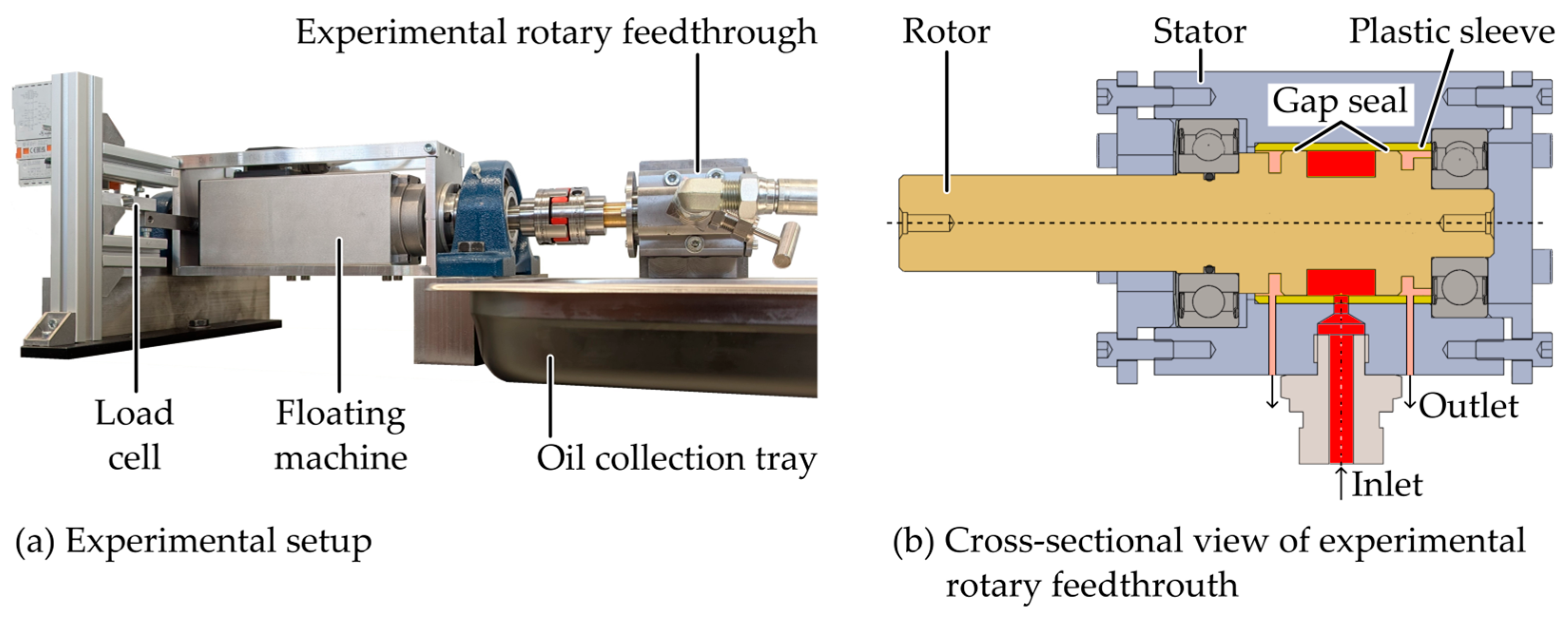
This is done using an experimental rotary feedthrough (see Figure 5a), which consists of a rotating rotor and a stationary stator with the above-mentioned dimensions of the gap seal of the 5/3-way valve. The test rotary feedthrough shown in Figure 5b replicates a pressure chamber of the 5/3-way valve, including the inlet, gap seal, and outlet.
The pressure in the inlet is adjusted via a pressure control valve taken from a series-production dual-clutch transmission. The leakage volume flow through the gap seal is collected in an oil collection tray.
A plastic sleeve is inserted into the stator and turned to the specified dimension. In the event of unwanted contact, the plastic sleeve fails, limiting the transmitted torque and preventing jamming. The rotor is guided in the stator with fixed-loose bearings and is driven by an electric floating machine via an elastic jaw coupling. The drive torque of the floating machine is supported on a load cell with a defined lever arm which is used to measure the required drive torque.
The volume flow through the gap seal V ˙ can be calculated from the collected oil mass m , the duration of the active pressure supply t and the oil density ρ O i l according to Equation (9).
V ˙ = m ρ O i l · t
The test duration for determining the leak oil volume flows is t = 60   s in each case. The density of the transmission oil is ρ O i l = 858 kg/m3. The conditions and parameters of the experimental tests on the test setup shown in Figure 5 are summarized in Table 2.
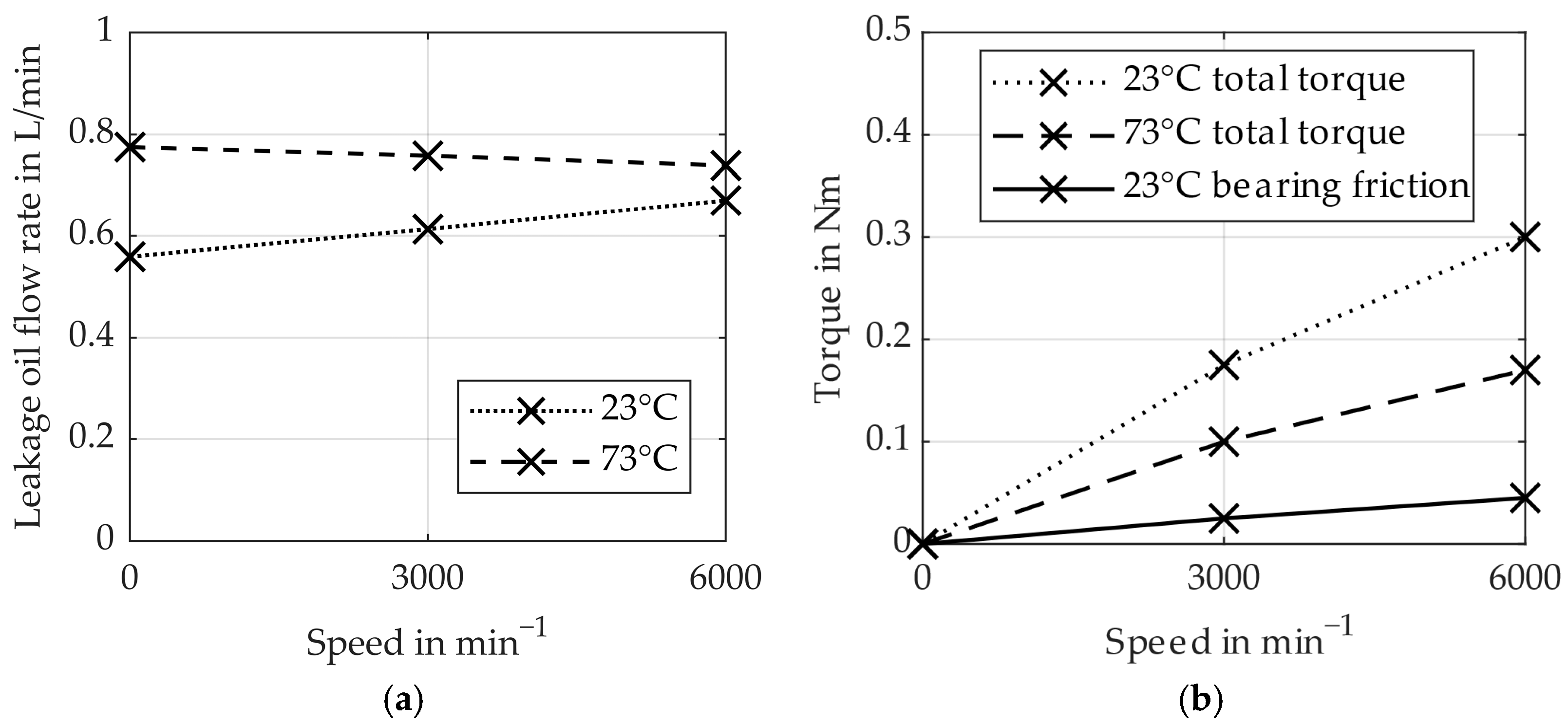
Figure 6 shows the results for rotor speeds of 0, 3000, and 6000 m i n 1 . The measurements are carried out at transmission oil temperatures of approx. 23 °C and approx. 73 °C. The transmission oil temperature is measured in the inlet directly in front of the rotary feedthrough.
The oil tank, hose lines, and fittings are flushed with the heated oil before the measurement and brought to the target temperature to ensure that the temperature of the inflowing oil is as constant as possible.
The leakage volume flow at an oil temperature of 23 °C increases slightly with increasing rotor speed. Typically, internal fluid friction effects increase the oil temperature in the gap as the rotor speed increases. On the one hand, this can lead to a decrease in dynamic viscosity and thus to higher leakage volume flows. On the other hand, thermal expansion can reduce the gap height, resulting in smaller leakage volume flows.
It is assumed that the former effect predominates in tests at an oil temperature of 23 °C and the latter effect in tests at an oil temperature of 73 °C.
Because of the influences described above, the test results show a deviation from the theoretical leakage volume flow of V ˙ = 0.411   L / m i n .
As a worst-case scenario, another test is carried out with hot transmission oil and a non-preheated rotary feedthrough. The oil temperature in the inlet directly in front of the rotary feedthrough is approx. 77 °C, as higher temperatures are not permitted in the current experimental setup. The rotary feedthrough, consisting of the rotor, plastic sleeve, and stator, has a temperature of approx. 21 °C before the test. For a rotor speed of 0   m i n 1 and a test duration of t = 60   s , the leakage volume flow is V ˙ = 0.868   L / m i n and is therefore comparable to the measurement results for higher oil temperatures shown in Figure 6.
Higher oil temperatures typically have a significant impact on transmission applications. The leakage volume flows are crucial for the proposed concept. However, experimental investigations show that leakage is not significantly dependent on temperature. A significant increase with further temperature rise is not to be expected.
The gap height of 50   μ m calculated above represents an acceptable compromise between low oil leakage volume flow and sufficient safety against failure of the plastic sleeve due to contact between the rotor and stator during thermal expansion. For example, an additional examined gap height of 100   μ m results in oil leakage volume flows of V ˙ > 3   L / m i n .
Figure 6b shows the torques measured with the load cell on the floating machine, which are recorded parallel to the tests in Figure 6a. The measured total torque consists of the friction torque resulting from rolling bearing friction and the friction torque due to fluid friction in the gap, which depends on oil viscosity, temperature, and rotor speed. The moments of inertia of the floating machine and the rotor are neglected, as the tests are carried out at stationary speeds. Also, air friction and disturbing forces caused by the motor connection cable on the floating machine housing are not taken into account.
The tests at 23 °C and a rotor speed of 6000 m i n 1 show a total torque of 0.3 Nm. This corresponds to a power loss of P M , V = 188.5   W . The friction torque component included here due to fluid friction in the gap occurs exclusively during overlapping gearshifts or refilling phases and is therefore limited in time.
The isolated consideration of the friction torque due to rolling bearing friction is carried out with the plastic sleeve removed and without leak volume flow. This results in a friction torque of 0.045 Nm at a rotor speed of 6000 m i n 1 . This corresponds to a power loss due to the rolling bearings of P L , V = 28.3   W , which occurs during driving with the clutch shut off.
The disadvantage of conventional RSRs is the higher friction torques of approx. 0.5–1.0 Nm, which also occur continuously and lead to critical temperatures at higher speeds. In contrast, contactless gap seals have less friction torque and higher maximum speeds. At speeds of 5000 m i n 1 and a temperature of 23 °C, a friction torque of approx. 0.26 Nm occurs as a result of fluid friction and bearing friction (Figure 6).

3.2. Test Setup for Proving the Shut-Off Function of the 5/3-Way Valve

Another functionality test concerns the shut-off function of the 5/3-way valve. This test verifies whether the actuating pressure in the pressure chamber of a series-production dual-clutch can be shut off without leakage or for a long period of time using the shut-off valve shown in Figure 3a. It must then be verified that the pressure build-up dynamics required for the overlapping gearshift can also be achieved with an increased leakage volume flow through the rotary feedthrough.
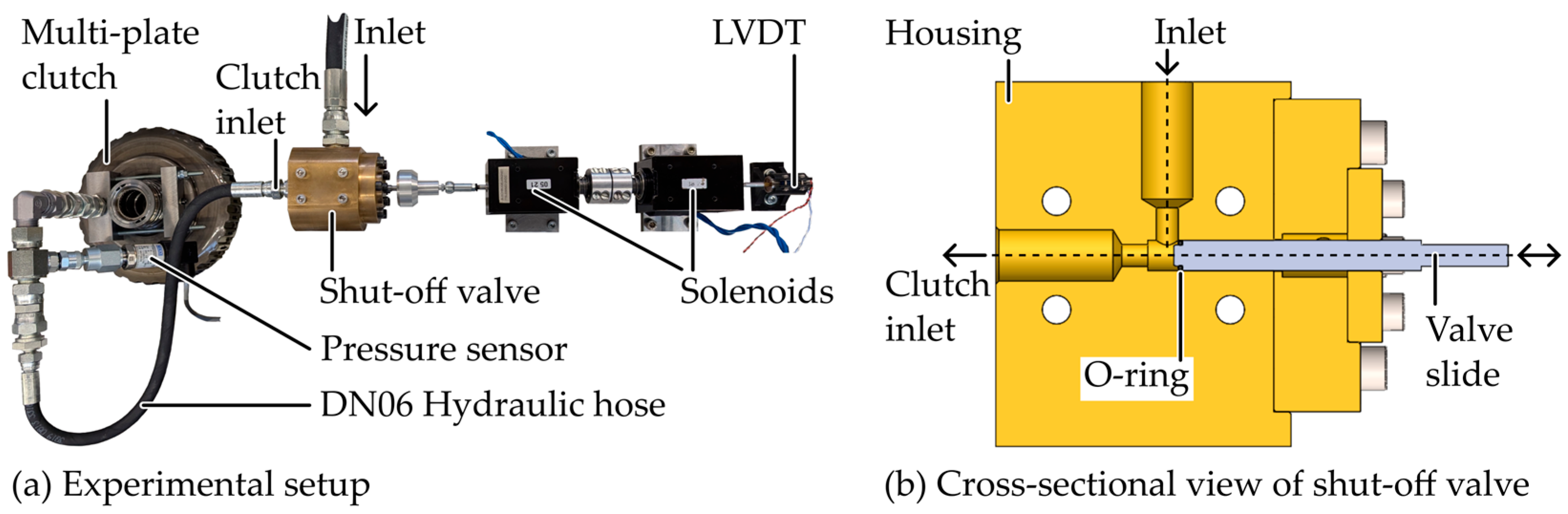
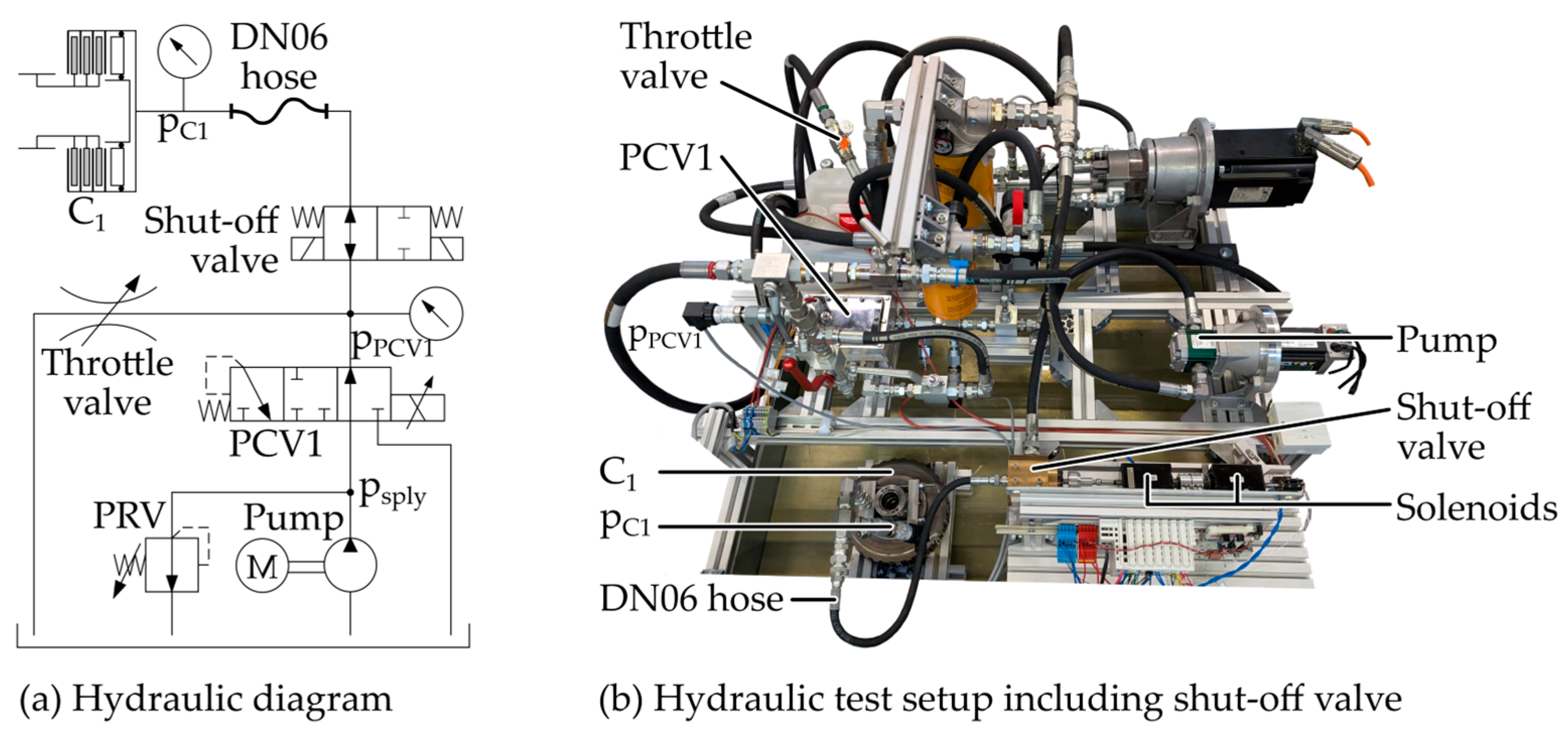
To replicate the concept shown in Figure 3a, the test setup shown in Figure 7 is realized. This corresponds to the target dimensions shown in Figure 4. The non-rotating shut-off valve shown in Figure 7 thus simulates the 5/3-way valve in simplified form. In addition, a non-rotating clutch is used, which corresponds to the type of clutch C 1 shown in Figure 4.
The pressure in the inlet of the non-rotating shut-off valve is adjusted via a pressure control valve of a series-production dual-clutch transmission. The valve slide is connected via an axial joint to the coupled plungers of two mirrored solenoids. A linear variable differential transformer (LVDT) measures the position of the valve slide. The pressure channel to the pressure chamber of the non-rotating clutch can be sealed or shut off by axial displacement of the valve slide to the left, which is fitted with an O-ring (see Figure 7). The shut-off valve is connected to the clutch with a DN06 hydraulic hose. This hose has a length of 500 mm and a minimum flow diameter of 4.4 mm in the area of the hose connections and replicates the volume and flow resistance of the pressure channel of the designed transmission input shaft from Figure 4. The clutch is connected to the hydraulic hose with a clamp mount that sits on the holes leading to the pressure chamber and seals them with PTFE seals.
In the test setup shown in Figure 7, a leakage volume flow is realized through a bypass with a throttle valve. This is located behind the pressure control valve and before the inlet of the shut-off valve. The throttle valve is shown in the hydraulic diagram in Figure 8a. The corresponding hydraulic setup shown in Figure 8b allows investigations to be carried out independently of the test setup of the rotary feedthrough shown in Figure 5. The tests in Section 3.1 show that the expected leakage volume flow through the gap seal of the rotary feedthrough increases only slightly at higher oil temperatures. For simplification and improved repeatability, the following tests are therefore carried out at room temperature. The leakage volume flow is set to 2.74 L/min at a pressure difference of 8.6 bar and room temperature using the throttle valve. This simulates a leakage volume flow that is greater by a factor of S > 3 compared to the results from Section 3.1. This worst-case assumption ensures that subsequent functional tests also apply to varying operating parameters.
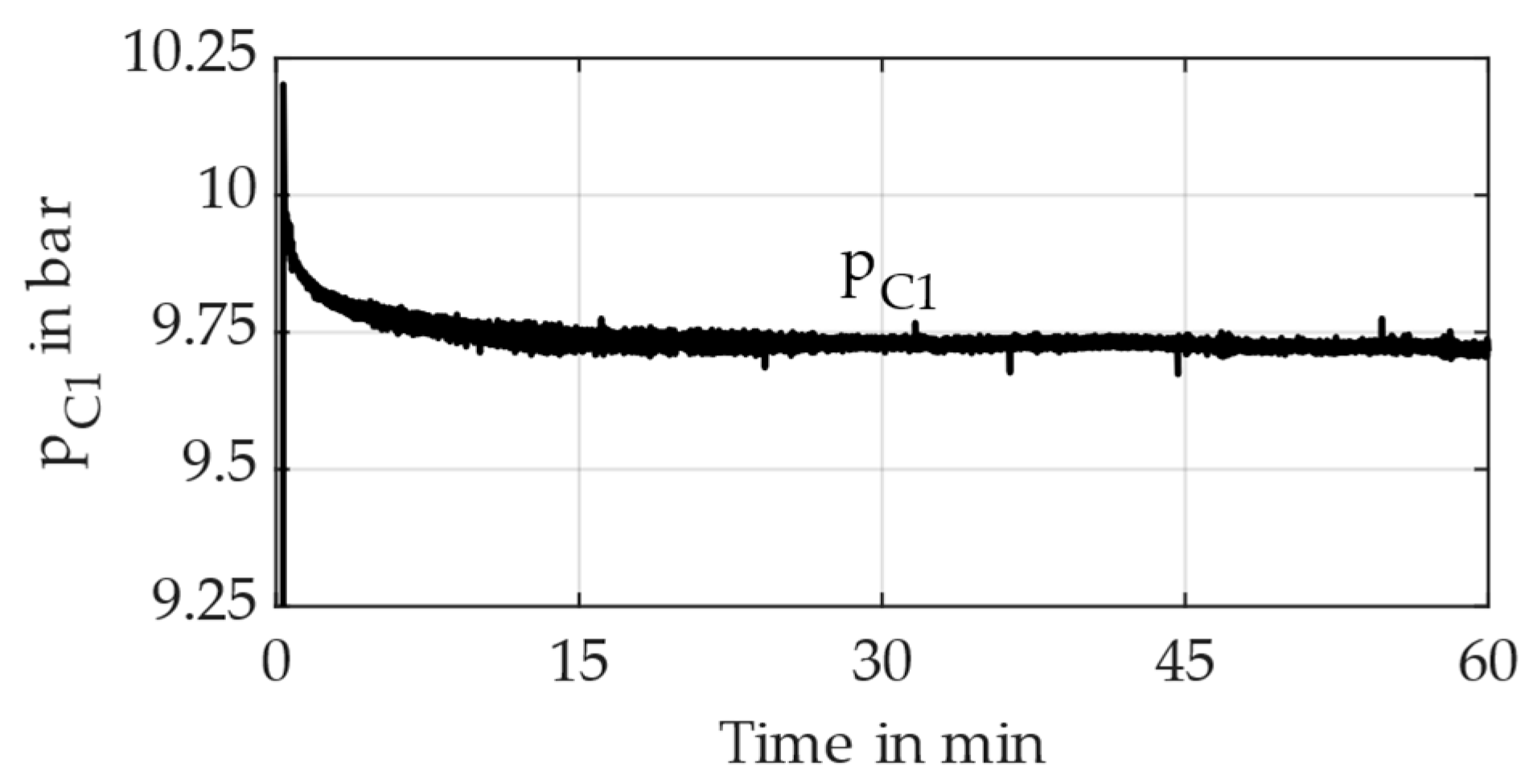
Firstly, the leakage through the piston seals of the clutch and through the shut-off valve is examined. For this purpose, the pressure in the pressure chamber of the clutch C 1 is set to 10 bar via the pressure control valve PCV1. Subsequently, the pressure channel is sealed or shut off with the valve slide of the shut-off valve by correspondingly controlling the solenoid valves. Figure 9 shows the pressure curve in the shut-off pressure chamber over time.
Displacement of the transmission oil by the valve slide during closing the pressure chamber leads to a short-term pressure increase to approx. 10.2 bar. After the test duration of 60 min, the pressure remains at 9.72 bar. Consequently, the leakage within the shut-off pressure chamber is negligible.

3.3. Replication of an Overlapping Gearshift

Another functionality test concerns the replication of an overlapping gearshift. For this purpose, the control system of the test setup shown in Figure 7 and Figure 8 is extended by a position control for the valve slide of the shut-off valve.
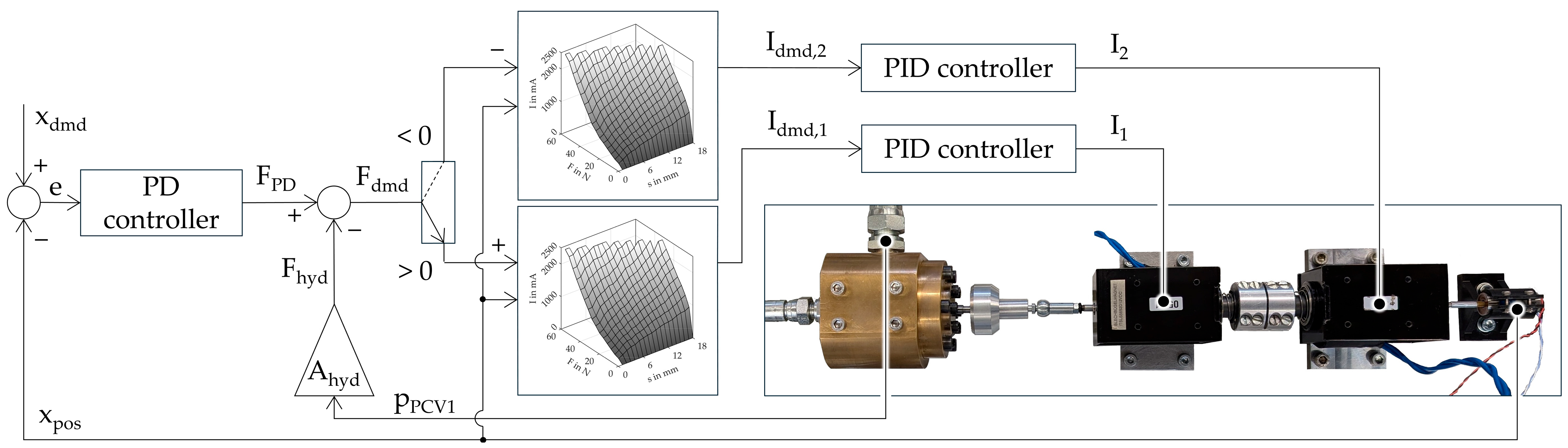
Figure 10 shows a schematic representation of the position control. The valve slide target position x d m d as the reference variable is specified by the target value curves shown in Figure 2. The LVDT as the measuring element feeds back the measured valve slide position x p o s . According to the control deviation e = x d m d x p o s , a PD controller outputs a force F P D . This is added to a force F h y d , which represents pressure compensation and is calculated from the cross-sectional area A h y d of the valve slide to be shut off and the actual value of the pressure p P C V 1 behind the pressure control valve PCV1. This is also typically measured in series applications. The sum of the forces F P D and F h y d corresponds to a setpoint force F d m d for controlling the solenoids. For example, the left solenoid is only energized when the setpoint force is positive, while the right solenoid, which acts in the opposite direction, is only energized when the setpoint force is negative (see Figure 10). The characteristic maps contain the coil setpoint current I d m d of a solenoid as a function of the setpoint force F d m d and the corresponding plunger position s , which is determined by the valve slide position. The respective coil current I 1,2 is set at the corresponding solenoid by a lower-level PID current control and pulse width modulation.
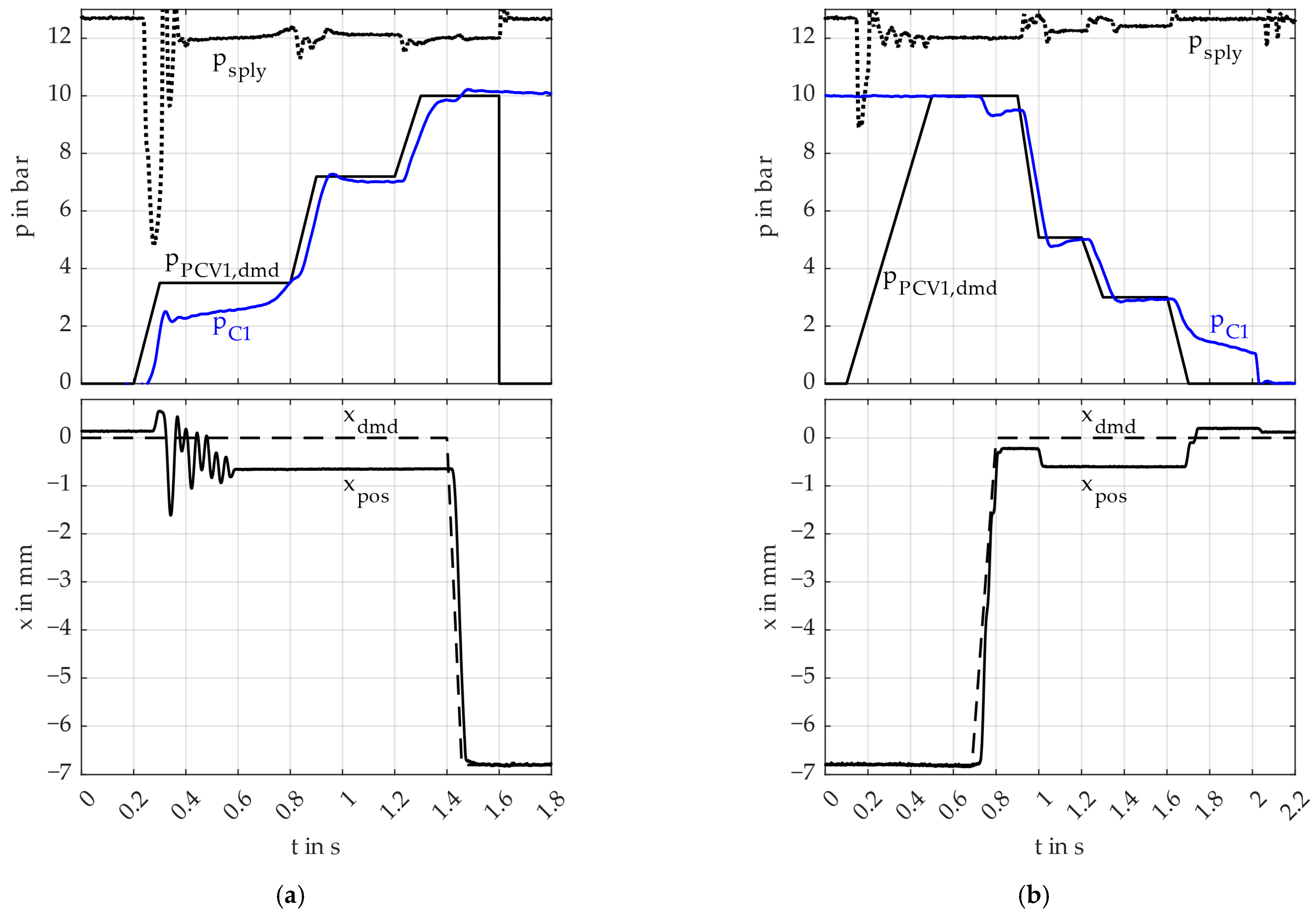
To replicate an overlapping gearshift, target curves in Figure 11a are specified in the test bench control system based on Figure 2. The pressure and valve position curves of the overlapping gearshift of an opening clutch C 1 and a closing clutch C 1 are considered below. Since the shut-off valve only has one shut-off pressure channel, the tests apply to separate gearshift operations.
In Figure 11, the upper diagrams show the curves for supply pressure p s p l y , the target value for the pressure behind the pressure control valve p P C V 1 , d m d , and the measured actuating pressure p C 1 of the clutch. The nonlinearities in the transfer behavior of the pressure control valve are corrected in the test bench control system using a previously recorded characteristic curve. The lower diagrams in Figure 11 show the curves for the target position x d m d and the measured position x p o s of the valve slide of the shut-off valve.
Figure 11a shows the sequence of an overlapping gearshift of a closing clutch. Starting at approx. t = 0.2   s , the pressure chamber is filled with transmission oil until the pressure level of the kissing point of the closing clutch is reached. The movement of the pressure piston overcomes the running clearance between the plates. This process takes place during the preparation phase (phase 1) and lasts approx. 0.6 s. The kissing point of the clutch used is at a pressure of approx. 3.5   b a r . In the subsequent transition phase (phase 2) lasting 0.1 s from t = 0.8   s , the actuating pressure is increased to approx. p C 1 = 7.2   b a r until the slip limit is reached. To synchronize the angular velocity of the electric machine in the synchronization phase (phase 3), the pressure level of the slip limit is maintained for 0.3 s from t = 0.9   s . Finally, in the completion phase (phase 4) the actuating pressure is increased to 10 bar in 0.1 s and then sealed or shut off by the shut-off valve at t = 1.4   s . The clutch is now completely closed. Then, at t = 1.6   s , the pressure behind the pressure control valve is reduced to p P C V 1 = 0   b a r . The supply pressure p s p l y can also be reduced to minimize losses.
Figure 11b shows an example of the sequence for an overlapping gearshift of an opening clutch with modified timings compared to Figure 2. Initially, the pressure chamber is shut off with an actuating pressure of p C 1 = 10   b a r and the pressure behind the pressure control valve is p P C V 1 = 0   b a r . By time t = 0.5   s , the pressure behind the pressure control valve has built up to 10 bar. The drop in supply pressure can be reduced by increasing the duration of pressure build-up in the preparation phase (phase 1) compared to Figure 2. The shut-off valve is then open at t = 0.8   s so that the actuating pressure p C 1 can be set via the pressure control valve. By the time t = 1.0   s , the actuating pressure is set to the pressure level of the slip limit, for example, to approx. 5.1 bar. In the subsequent 0.1 s transition phase (phase 2) starting at t = 1.2   s , the actuating pressure is reduced until the kissing point is reached. To synchronize the angular velocity of the electric machine (phase 3), for example the pressure level of the kissing point of the opening clutch is maintained for 0.3 s starting at t = 1.3   s . From t = 1.6   s , the actuating pressure is reduced to 0 bar. The piston return spring displaces the transmission oil via the pressure piston until the total running clearance between the plates is restored. This process lasts approx. 0.4 s.
Figure 11a,b shows that the actuating pressure can generally follow the target value sufficiently well.
Deviations occur primarily during the filling of the closing clutch up to the kissing-point pressure level and during the return of the opening clutch by the piston return spring below kissingpoint pressure level, as the higher resulting volume flows cause pressure losses across the shut-off valve and the DN06 hydraulic hose. These only occur during the preparation and completion phases and can be tolerated as they have no negative effects on the transition or synchronization phase.
The control deviation e = x d m d x p o s of the position control of the valve slide is mainly caused by inaccuracies in the pressure compensation with the force F h y d . In addition, the valve slide exhibits stick-slip behavior due to friction effects. However, the control deviation is within an acceptable range, as there is sufficient distance between the middle and both outer valve slide positions, meaning that small changes in the valve slide position x p o s have no influence.
The tests shown in Figure 11a,b are each performed several times in a row. For example, in nine consecutively performed tests, deviations of the measured actuating pressure of a maximum of 0.3 bar were determined.
The advantage of conventional RSRs is their lower leakage rates, ranging from 5 to 800 mL/min, which occur permanently in conventional systems. When gap seals are used, higher leakage rates of approx. 868 mL/min are measured experimentally. However, these only occur during overlapping gearshifts or “refilling”. Nevertheless, sufficient pressure dynamics must be demonstrated.
As a worst-case scenario, experimental investigations above are carried out with a leakage of 2.74 L/min at 8.6 bar via a bypass. The results shown in Figure 11a,b prove that sufficient pressure dynamics are still achieved when gap seals are used.

4. Conclusions

A rotary feedthrough is developed that uses gap seals instead of conventional rectangular sealing rings. This offers advantages in terms of the permissible rotational velocities. In addition, the permanently friction losses typical of conventional rotary feedthroughs with rectangular sealing rings, for example, in the range of 250–500 W at speeds of 5000 m i n 1 [20] (p. 132), are avoided.
During active pressure transfer via the gap seal of one clutch, a total torque of 0.3 Nm is determined at a speed of 6000 m i n 1 . The total torque leads to a short-term power loss of 188.5 W, mainly due to fluid friction in the gap. The proportion of the permanently occurring friction torque due to rolling bearing friction results in a power loss of only 28.3 W.
The greater leakage volume flow through the gap seal, in combination with the shut-off function of the 5/3-way valve, is limited to the short durations of overlapping gearshifts or refilling phases (active pressure transfer). For example, tests at 23 °C and 10 bar show a leakage volume flow of 0.67 L/min for one clutch, which corresponds to a hydraulic power loss of 11.2 W. During the overlapping gearshifts or refill phases, the maximum hydraulic supply power for the actuator is 156 W, whereby the cooling oil flow rates, lubricating oil flow rates, etc., are not considered.
A shut-off valve is implemented to verify that the actuating pressure is maintained while a clutch is closed. When the shut-off valve is closed, the actuating pressure drops from an initial 10 bar to 9.72 bar after 60 min. Thereby, the electromagnetic actuation of the shut-off valve requires less than 20 W of power. While the actuating pressure is maintained, the supply pressure can be reduced. This offers advantages over conventional transmission oil supplies, which have a permanent power requirement of, for example, 450–500 W to provide supply pressure for clutch actuation and for the cooling oil volume flow [21] (p. 5).
Finally, an overlapping gearshift is successfully replicated by appropriately controlling the shut-off valve. This demonstrates sufficient pressure dynamics.
The investigations demonstrate the potential of the proposed approach with regard to optimizing losses. However, the concept presented, with two clutches on a transmission shaft and an axially arranged rotary feedthrough as shown in Figure 3a, requires a larger axial construction space and causes higher costs due to additional components. This needs to be optimized for application in real-world vehicles. Initial estimates predict a required axial space of 400–450 mm for series applications.
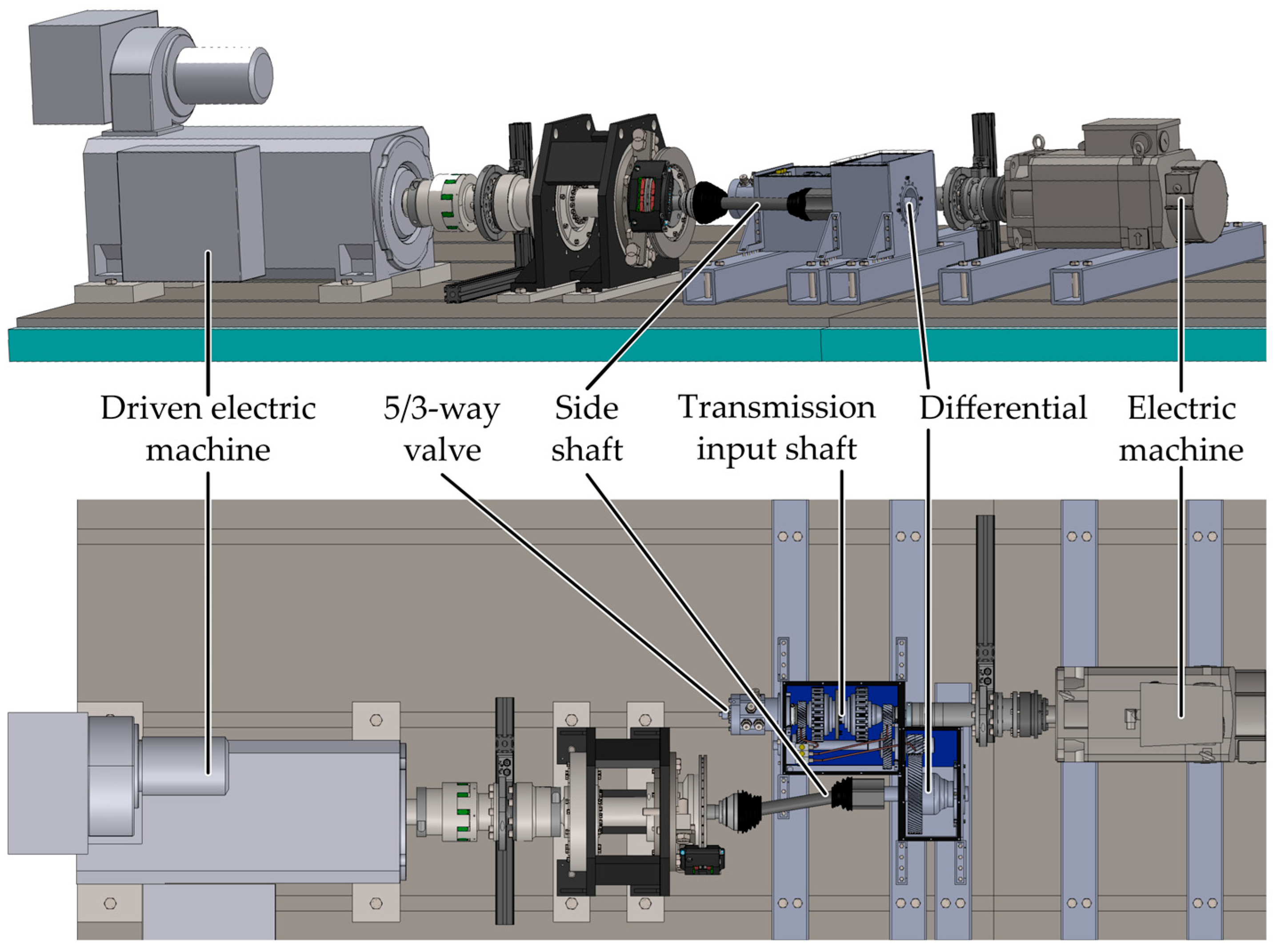
In [5], the additional costs of a two-speed dual-clutch transmission compared to a single-speed transmission in BEVs are stated as approximately €1090. The associated increase in energy efficiency and minimization of battery capacity result in a lower BEV retail price than for single-speed transmission. In [28], the advantages of increased energy efficiency also overcompensate the additional costs of a two-speed dual-clutch transmission in BEVs of approximately €500–1000. We assume that the proposed concept will be at the higher end of the cost range due to the additional 5/3-way valve. These higher initial costs are counterbalanced by the potential for increased energy efficiency of the proposed system. This allows, for example, the use of smaller battery capacities, reduces energy consumption and therefore the electricity cost in lifetime. More detailed experimental investigations on a hardware-in-the-loop test bench shown in Figure 12 are planned.
In terms of durability, no problems are expected for the gap seals due to elimination of friction. However, the 5/3-way valve, the associated actuators and control still need to be tested for durability, long time operation and behavior at extreme temperatures.
In the future, the designed two-speed transmission will be implemented and tested on a hardware-in-the-loop test bench.
Figure 12 shows the planned integration of the transmission input shaft from Figure 4 into the prototype of a two-speed transmission, which will be tested on the hardware-in-the-loop test bench. An electric machine drives the two-speed transmission, including axle transmission, i.e., (locked) differential, and a vehicle side shaft, that is connected to a driven machine. This simulates the tire-road contact and driving resistances of a vehicle. In the future, the hardware-in-the-loop test bench will be used to determine and optimize shift quality, efficiency, and energy losses based on driving cycles.
In addition, investigations are being conducted with the aim of reducing drag torques and preventing plate movement in open wet-running multi-plate clutches at higher speeds.

Author Contributions

Conceptualization, J.F., J.B. and H.B.; methodology, J.F.; software, J.F., J.B. and H.B.; validation, J.F., J.B. and H.B.; investigation, J.F. and J.B.; resources, J.F.; writing—original draft preparation, J.B.; writing—review and editing, J.F., J.B. and H.B.; visualization, J.B. and H.B.; project administration, J.F. All authors have read and agreed to the published version of the manuscript.

Funding

This research received no external funding.

Data Availability Statement

The datasets presented in this article are not readily available because the data are part of an ongoing study. Requests to access the datasets should be directed to the corresponding author.

Conflicts of Interest

The authors declare no conflicts of interest.

Abbreviations

The following abbreviations are used in this manuscript:
BEVBattery Electric Vehicle
EPAEnvironmental Protection Agency
LVDTLinear Variable Differential Transformer
NEDCNew European Driving Cycle
PCVPressure Control Valve
PRVPressure Relief Valve
PTFEPolytetrafluoroethylene
RSRRectangular Sealing Rings
WLTPWorldwide harmonized Light vehicles Test Procedure

References

  1. ZSW. Anzahl der Neuzulassungen von Elektroautos Weltweit in den Jahren 2012 bis 2024. Statista GmbH. 2025. Available online: https://de.statista.com/statistik/daten/studie/406683/umfrage/anzahl-der-verkaeufe-von-elektroautos-weltweit-prognose/ (accessed on 14 November 2025).
  2. Statista Mobility Market Insights. Anteil der Abgesetzten Personenkraftwagen nach Antriebsarten Weltweit in den Jahren 2015 bis 2024 und Prognose bis 2030. Statista GmbH. 2025. Available online: https://de.statista.com/statistik/daten/studie/1534721/umfrage/prognose-pkw-absatz-weltweit-nach-antrieb/ (accessed on 14 November 2025).
  3. König, A.; Nicoletti, L.; Schröder, D.; Wolff, S.; Waclaw, A.; Lienkamp, M. An Overview of Parameter and Cost for Battery Electric Vehicles. World Electr. Veh. J. 2021, 12, 21. [Google Scholar] [CrossRef]
  4. Barman, P.; Dutta, L.; Azzopardi, B. Electric Vehicle Battery Supply Chain and Critical Materials: A Brief Survey of State of the Art. Energies 2023, 16, 3369. [Google Scholar] [CrossRef]
  5. Ruan, J.; Walker, P.; Zhang, N. A comparative study energy consumption and costs of battery electric vehicle transmissions. Appl. Energy 2016, 165, 119–134. [Google Scholar] [CrossRef]
  6. He, B.; Chen, Y.; Wei, Q.; Wang, C.; Wei, C.; Li, X. Performance Comparison of Pure Electric Vehicles with Two-Speed Transmission and Adaptive Gear Shifting Strategy Design. Energies 2023, 16, 3007. [Google Scholar] [CrossRef]
  7. Kim, J.; Ahn, J.; Jeong, S.; Park, Y.-G.; Kim, H.; Cho, D.; Hwang, S.-H. Driving Control Strategy and Specification Optimization for All-Wheel-Drive Electric Vehicle System with a Two-Speed Transmission. World Electr. Veh. J. 2024, 15, 476. [Google Scholar] [CrossRef]
  8. Gao, B.; Meng, D.; Shi, W.; Cai, W.; Dong, S.; Zhang, Y.; Chen, H. Topology optimization and the evolution trends of two-speed transmission of EVs. Renew. Sustain. Energy Rev. 2022, 161, 112390. [Google Scholar] [CrossRef]
  9. Machado, F.A.; Kollmeyer, P.; Barroso, D.G.; Emadi, A. Multi-Speed Gearboxes for Battery Electric Vehicles: Current Status and Future Trends. IEEE Open J. Veh. Technol. 2021, 2, 419–435. [Google Scholar] [CrossRef]
  10. Ritari, A.; Vepsäläinen, J.; Kivekäs, K.; Tammi, K.; Laitinen, H. Energy Consumption and Lifecycle Cost Analysis of Electric City Buses with Multispeed Gearboxes. Energies 2020, 13, 2117. [Google Scholar] [CrossRef]
  11. Störiko, A. Effizientere E-Autos Dank Gangschaltung. Technische Universität Darmstadt. 2024. Available online: https://www.tu-darmstadt.de/energy-and-environment/forschungsfeld_ee/news_ee/news_ee_details_439616.de.jsp (accessed on 14 November 2025).
  12. Spanoudakis, P.; Tsourveloudis, N.; Koumartzakis, G. Evaluation of a 2-speed Transmission on Electric Vehicle’s Energy Consumption. In Proceedings of the 2014 IEEE International Electric Vehicle Conference (IEVC), Florence, Italy, 17–19 December 2014; pp. 1–6. [Google Scholar] [CrossRef]
  13. SUZUKI Deutschland GmbH. Suzuki und Inmotive Entwickeln Zweiganggetriebe für Elektrofahrzeuge. 2023. Available online: https://presse.suzuki.de/collection/news/2023/2023-01-18-suzuki-und-inmotive-entwickeln-zweiganggetriebe-fr-elektrofahrzeuge (accessed on 14 November 2025).
  14. Witham, G.; Hemsen, J.; Swierc, D.; Eckstein, L. Potentials of Dual-speed Transmissions in Electric Powertrains depending on Passenger Vehicle Segment. In Proceedings of the 2022 International Symposium on Electromobility (ISEM), Puebla, Mexico, 17–19 December 2022; pp. 1–6. [Google Scholar] [CrossRef]
  15. De Pinto, S.; Camocardi, P.; Chatzikomis, C.; Sorniotti, A.; Bottiglione, F.; Mantriota, G.; Perlo, P. On the Comparison of 2- and 4-Wheel-Drive Electric Vehicle Layouts with Central Motors and Single- and 2-Speed Transmission Systems. Energies 2020, 13, 3328. [Google Scholar] [CrossRef]
  16. Hinov, N.; Punov, P.; Gilev, B.; Vacheva, G. Model-Based Estimation of Transmission Gear Ratio for Driving Energy Consumption of an EV. Electronics 2021, 10, 1530. [Google Scholar] [CrossRef]
  17. Ahssan, M.R.; Ektesabi, M.; Gorji, S. Gear Ratio Optimization along with a Novel Gearshift Scheduling Strategy for a Two-Speed Transmission System in Electric Vehicle. Energies 2020, 13, 5073. [Google Scholar] [CrossRef]
  18. Patel, H.D.; Kollmeyer, P.J.; Machado, F.A.; Biswas, A.; Emadi, A. Electric Vehicle Motor Sizing and Optimization with Two-Speed Gearbox. In Proceedings of the 2024 IEEE Transportation Electrification Conference and Expo (ITEC), Chicago, IL, USA, 19–21 June 2024; pp. 1–6. [Google Scholar] [CrossRef]
  19. Zhang, C.; Wang, J.; Guan, C.; Xia, Y.; Yang, F.; Wang, W. Multimode Shift Control Strategy Without Power Interruption of Dual-Motor 4WD Electric Vehicle with Two-Speed Transmission. IEEE Trans. Transp. Electrif. 2025, 11, 6267–6278. [Google Scholar] [CrossRef]
  20. Gronitzki, M. Untersuchungen zur Funktion uns Auslegung von Rechteckdichtringen für Drehdurchführungen. Ph.D. Thesis, Gottfried Wilhelm Leibniz Universität, Hannover, Germany, 2006. [Google Scholar]
  21. Wagner, U.; Berger, R.; Friedmann, O.; Esly, N. Elektromotorische Automatisierung für Doppelkupplungsgetriebe. In Proceedings of the Getriebe in Fahrzeugen 2004: Tagung Friedrichshafen, Friedrichshafen, Germany, 22–23 June 2004; VDI-Berichte: Düsseldorf, Germany, 2004. [Google Scholar]
  22. Naunheimer, H.; Bertsche, B.; Ryborz, J.; Novak, W.; Fietkau, P. Fahrzeuggetriebe: Grundlagen, Auswahl, Auslegung und Konstruktion, 3rd ed.; Springer: Berlin/Heidelberg, Germany, 2019; ISBN 978-3-662-58882-6. [Google Scholar]
  23. Fischer, R.; Küҫükay, F.; Jürgens, G.; Pollak, B. Das Getriebebuch, 2nd ed.; Springer Fachmedien: Wiesbaden, Germany, 2016; ISBN 978-3-658-13103-6. [Google Scholar]
  24. Universität Rostock, 18055 Rostock, Germany. Ventilanordnung. Patent DE102020127947B3, 28 October 2021.
  25. Haas, W. Grundlehrgang Dichtungstechnik. Available online: https://www.ima.uni-stuttgart.de/dokumente/forschung/dichtungstechnik/flyer/skript_dichtungstechnik.pdf (accessed on 24 October 2025).
  26. Ponn, J.; Lindemann, U. Konzeptentwicklung und Gestaltung Technischer Produkte, 2nd ed.; Springer: Berlin/Heidelberg, Germany, 2011; ISBN 978-3-642-20579-8. [Google Scholar]
  27. Borosi, G. Die Drallströmung in Wirbelkammern. Ph.D. Thesis, Otto-von-Guericke-Universität, Magdeburg, Germany, 2003. [Google Scholar]
  28. Bertucci, E.; Bucchi, F.; Ceraolo, M.; Frendo, F.; Lutzemberger, G. Battery Electric Vehicles: How Many Gears? A Technical–Economic Analysis. Vehicles 2024, 6, 71–92. [Google Scholar] [CrossRef]
Figure 1. Concept of a two-speed transmission with hydraulically actuated wet-running multi-plate clutches.
Wevj 17 00012 g001
Figure 2. Sequence of the overlapping gearshift for upshifting with motor torque intervention.
Wevj 17 00012 g002
Figure 3. Concept sketch of a rotating 5/3-way valve for clutch control (a) and flowchart of the actuating pressure control system for clutch C 2 (b).
Wevj 17 00012 g003
Figure 4. 3/4 sectional view of the transmission input shaft (housing hidden).
Wevj 17 00012 g004
Figure 5. Test setup for investigating the rotary feedthrough with gap seal.
Wevj 17 00012 g005
Figure 6. Leakage volume flow (a) and torque (b) due to the rotary feedthrough at a differential pressure of ∆p = 10 bar and at approx. 23 °C or approx. 73 °C oil temperature.
Wevj 17 00012 g006
Figure 7. Test setup for investigating the shut-off function and dynamics of the actuating pressure.
Wevj 17 00012 g007
Figure 8. Test setup including hydraulics for investigations of the shut-off valve.
Wevj 17 00012 g008
Figure 9. Actuating pressure curve after shutting off the pressure chamber of a series-production dual-clutch.
Wevj 17 00012 g009
Figure 10. Position control diagram.
Wevj 17 00012 g010
Figure 11. Replication of an overlapping gearshift of a closing clutch (a) and opening clutch (b).
Wevj 17 00012 g011
Figure 12. Planned hardware-in-the-loop test bench for a two-speed transmission prototype.
Wevj 17 00012 g012
Table 1. Gearshift types according to [23] (p. 54).
Transmission Ratio M T I > 0 M T I 0
i 1 i 2 Power upshiftCoast upshift
i 2 i 1 Power downshiftCoast downshift
Table 2. Parameters for investigating the volume flow through the gap seal.
ParameterSymbolValue
Number of gaps-2
Gap length L 5.35   m m
Gap height (20 °C) h 50   μ m
Average gap diameter D 36.25   m m
Differential pressure p approx. 10 bar
Test duration t 60   s
Density of transmission oil ρ O i l 858   k g / m 3
Dynamic viscosity of transmission oil (20 °C) η 64.84   m P a · s
Dynamic viscosity of transmission oil (80 °C) η 8.27   m P a · s
Disclaimer/Publisher’s Note: The statements, opinions and data contained in all publications are solely those of the individual author(s) and contributor(s) and not of MDPI and/or the editor(s). MDPI and/or the editor(s) disclaim responsibility for any injury to people or property resulting from any ideas, methods, instructions or products referred to in the content.