

Targeting Stress Mindset and Irrational Beliefs to Improve Performance and Reduce Anxiety and Depression Symptoms in Academy Athletes

 ,
,  , , , , and
Abstract
1. Introduction
1.1. Mental Health and Academy Football
1.2. Stress Mindset
1.3. Irrational Beliefs
1.4. Self-Compassion
1.5. Education and Reappraisal
1.6. Aims and Hypothesis
2. Method
2.1. Participants and Design
2.2. Measures
2.2.1. Stress Mindset
2.2.2. Irrational Beliefs
2.2.3. Anxiety and Depression
2.2.4. Self-Compassion
2.2.5. Perceived Performance
2.2.6. Engagement Checks
2.2.7. Social Validation
2.3. Procedures
2.4. Intervention
2.5. Data Analyses
3. Results
3.1. Manipulation Checks
3.2. Stress Mindset
3.3. Irrational Beliefs
3.4. Anxiety
3.5. Depression
3.6. Self-Compassion
3.7. Perceived Performance
3.8. Social Validation
4. Discussion
4.1. Strengths and Limitations
4.2. Applied Recommendations
5. Conclusions
Author Contributions
Funding
Institutional Review Board Statement
Informed Consent Statement
Data Availability Statement
Conflicts of Interest
References
- Bailey, R. G., & Turner, M. J. (2023). The effects of a brief online rational-emotive-behavioral-therapy program on coach irrational beliefs and well-being. The Sport Psychologist, 1, 266–273. [Google Scholar] [CrossRef] [Scilit]
- Barry, A. E. (2005). How attrition impacts the internal and external validity of longitudinal research. Journal of School Health, 75, 267. [Google Scholar] [CrossRef]
- Berelson, B. (1952). Content analysis in communication research. Free Press. [Google Scholar]
- Blakelock, D., Chen, M., & Prescott, T. (2016). Psychological distress in elite adolescent soccer players following deselection. Journal of Clinical Sport Psychology, 10, 59–77. [Google Scholar] [CrossRef] [Scilit]
- Burton, D. (1990). Multimodal stress management in sport: Current status and future directions. In J. G. Jones, & L. Hardy (Eds.), Stress and performance in sport (pp. 171–201). John Wiley & Sons. [Google Scholar]
- Chrysidis, S., Turner, M. J., & Wood, A. G. (2020). The effects of REBT on irrational beliefs, self-determined motivation, and self-efficacy in American football. Journal of Sports Sciences, 38, 2215–2224. [Google Scholar] [CrossRef] [Scilit] [PubMed]
- Cormier, D. L., Kowalski, K. C., Ferguson, L. J., Mosewich, A. D., McHugh, T. L. F., & Röthlin, P. (2023). Self-compassion in sport: A scoping review. International Review of Sport and Exercise Psychology, 18, 154–193. [Google Scholar] [CrossRef] [Scilit]
- Crum, A. J., Salovey, P., & Achor, S. (2013). Rethinking stress: The role of mindsets in determining the stress response. Journal of Personality and Social Psychology, 104, 716–733. [Google Scholar] [CrossRef] [Scilit]
- Crum, A. J., Santoro, E., Handley-Miner, I., Smith, E. N., Evans, K., Moraveji, N., Achor, S., & Salovey, P. (2023). Evaluation of the “rethink stress” mindset intervention: A metacognitive approach to changing mindsets. Journal of Experimental Psychology: General, 152, 2603. [Google Scholar] [CrossRef] [Scilit]
- da Silva, S. M., Mansell, P., Fonseca, A., & Barker, J. (2025). Using a multimodal cognitive behavioral 1-2-1 intervention to target irrational beliefs, perceived performance, and stress mindset with elite youth football Players. The Sport Psychologist, 39, 280–288. [Google Scholar] [CrossRef] [Scilit]
- Deen, S., Turner, M. J., & Wong, R. S. (2017). The effects of REBT, and the use of credos, on irrational beliefs and resilience qualities in athletes. The Sport Psychologist, 31, 249–263. [Google Scholar] [CrossRef] [Scilit]
- Donachie, T. C., Mallinson-Howard, S. H., Hill, A. P., & Tamminen, K. A. (2025). Exploring how soccer players with perfectionism navigate challenges in talent pathways. Journal of Sport and Exercise Psychology, 47, 90–101. [Google Scholar] [CrossRef] [Scilit]
- Ellis, A., & Dryden, W. (2007). The practice of rational emotive behavior therapy. Springer Publishing Company. [Google Scholar]
- Gomes, A. R., Almeida, A., & Resende, R. (2020). Athletes’ perception of leadership according to their perceptions of goal achievement and sport results. Perceptual and Motor Skills, 127, 415–431. [Google Scholar] [CrossRef] [Scilit]
- Gouttebarge, V., Castaldelli-Maia, J. M., Gorczynski, P., Hainline, B., Hitchcock, M. E., Kerkhoffs, G. M., Rice, S. M., & Reardon, C. L. (2019). Occurrence of mental health symptoms and disorders in current and former elite athletes: A systematic review and meta-analysis. British Journal of Sports Medicine, 53, 700–706. [Google Scholar] [CrossRef] [Scilit]
- Gulliver, A., Griffiths, K. M., Mackinnon, A., Batterham, P. J., & Stanimirovic, R. (2015). The mental health of Australian elite athletes. Journal of Science and Medicine in Sport, 18, 255–261. [Google Scholar] [CrossRef] [Scilit]
- Hanton, S., & Jones, G. (1999). The effects of a multimodal intervention program on performers: II. Training the butterflies to fly in formation. The Sport Psychologist, 13, 22–41. [Google Scholar] [CrossRef] [Scilit]
- James, I. A., Medea, B., Harding, M., Glover, D., & Carraça, B. (2022). The use of self-compassion techniques in elite footballers: Mistakes as opportunities to learn. The Cognitive Behaviour Therapist, 15, 43. [Google Scholar] [CrossRef] [Scilit]
- Jenkins, A., Weeks, M. S., & Hard, B. M. (2021). General and specific stress mindsets: Links with college student health and academic performance. PLoS ONE, 16, e0256351. [Google Scholar] [CrossRef] [Scilit] [PubMed]
- Jordana, A., Ramis, Y., Chamorro, J. L., Pons, J., Borrueco, M., De Brandt, K., & Torregrossa, M. (2023). Ready for failure? Irrational beliefs, perfectionism and mental health in male soccer academy players. Journal of Rational-Emotive and Cognitive-Behavior Therapy, 41, 454–477. [Google Scholar] [CrossRef] [Scilit]
- Keech, J. J., Hagger, M. S., & Hamilton, K. (2021a). Changing stress mindsets with a novel imagery intervention: A randomized controlled trial. Emotion, 21, 123. [Google Scholar] [CrossRef] [Scilit]
- Keech, J. J., Hagger, M. S., O’Callaghan, F. V., & Hamilton, K. (2018). The influence of university students’ stress mindsets on health and performance outcomes. Annals of Behavioral Medicine, 52, 1046–1059. [Google Scholar] [CrossRef] [Scilit]
- Keech, J. J., Orbell, S., Hagger, M. S., O’Callaghan, F. V., & Hamilton, K. (2021b). Psychometric properties of the stress control mindset measure in university students from Australia and the UK. Brain and Behavior, 11, e01963. [Google Scholar] [CrossRef] [Scilit]
- Kim, J., & Tamminen, K. A. (2023). Emotion regulation among competitive youth athletes: Exploring the independent and interactive effects of cognitive reappraisal and expressive suppression. International Journal of Sport and Exercise Psychology, 21, 534–556. [Google Scholar] [CrossRef] [Scilit]
- Kola-Palmer, S., Lewis, K., Rodriguez, A., & Kola-Palmer, D. (2020). Help-seeking for mental health issues in professional rugby league players. Frontiers in Psychology, 11, 570690. [Google Scholar] [CrossRef] [Scilit] [PubMed]
- Kuchar, A. L., Neff, K. D., & Mosewich, A. D. (2023). Resilience and Enhancement in Sport, Exercise, & Training (RESET): A brief self-compassion intervention with NCAA student-athletes. Psychology of Sport and Exercise, 67, 102426. [Google Scholar] [CrossRef] [Scilit]
- Lang, P. J. (1979). A bio-informational theory of emotional imagery. Psychophysiology, 16, 495–512. [Google Scholar] [CrossRef] [Scilit]
- Lazarus, R. S. (2000). How emotions influence performance in competitive sports. The Sport Psychologist, 14, 229–252. [Google Scholar] [CrossRef] [Scilit]
- Lazarus, R. S., & Folkman, S. (1984). Transactional theory and research on emotions and coping. European Journal of Personality, 1, 141–169. [Google Scholar] [CrossRef] [Scilit]
- Mansell, P. C. (2021). Stress mindset in athletes: Investigating the relationships between beliefs, challenge and threat with psychological wellbeing. Psychology of Sport and Exercise, 57, 102020. [Google Scholar] [CrossRef] [Scilit]
- Mansell, P. C., Sparks, K., Wright, J., Roe, L., Carrington, S., Lock, J., & Slater, M. (2023). “Mindset: Performing under pressure”—A multimodal cognitive-behavioural intervention to enhance the well-being and performance of young athletes. Journal of Applied Sport Psychology, 36, 623–642. [Google Scholar] [CrossRef] [Scilit]
- Mansell, P. C., & Turner, M. J. (2023). The mediating role of proactive coping in the relationships between stress mindset, challenge appraisal tendencies, and psychological wellbeing. Frontiers in Psychology, 14, 1140790. [Google Scholar] [CrossRef] [Scilit]
- Maurice, J., Devonport, T. J., & Knight, C. J. (2021). Toward improved triadic functioning: Exploring the interactions and adaptations of coaches, parents and athletes in professional academy soccer through the adversity of COVID-19. Frontiers in Psychology, 12, 609631. [Google Scholar] [CrossRef] [Scilit] [PubMed]
- Maynard, I. W., Hemmings, B., Greenlees, I. A., Warwick-Evans, L., & Stanton, N. (1998). Stress management in sport: A comparison of unimodal and multimodal interventions. Anxiety, Stress, & Coping, 11, 225–246. [Google Scholar] [CrossRef] [Scilit]
- Meijen, C., Turner, M., Jones, M. V., Sheffield, D., & McCarthy, P. (2020). A theory of challenge and threat states in athletes: A revised conceptualization. Frontiers in Psychology, 11, 126. [Google Scholar] [CrossRef] [Scilit] [PubMed]
- Mertens, N., Boen, F., Steffens, N. K., Haslam, S. A., Bruner, M., Barker, J. B., Slater, M. J., & Fransen, K. (2021). Harnessing the power of ‘us’: A randomized wait-list controlled trial of the 5R shared leadership development program (5RS) in basketball teams. Psychology of Sport and Exercise, 54, 101936. [Google Scholar] [CrossRef] [Scilit]
- Mishra, P., Singh, U., Pandey, C. M., Mishra, P., & Pandey, G. (2019). Application of student’s t-test, analysis of variance, and covariance. Annals of Cardiac Anaesthesia, 22, 407–411. [Google Scholar] [CrossRef] [Scilit]
- Moore, L. J., Young, T., Freeman, P., & Sarkar, M. (2018). Adverse life events, cardiovascular responses, and sports performance under pressure. Scandinavian Journal of Medicine & Science in Sports, 28, 340–347. [Google Scholar] [CrossRef] [Scilit]
- Mosewich, A. D., Kowalski, K. C., Sabiston, C. M., Sedgwick, W. A., & Tracy, J. L. (2011). Self-compassion: A potential resource for young women athletes. Journal of Sport and Exercise Psychology, 33, 103–123. [Google Scholar] [CrossRef] [Scilit]
- Munnik, J. B., Turner, M. J., & van Niekerk, R. L. (2023). Recommendations for integrating Psychological Skills Training (PST) into Rational Emotive Behavioral Therapy (REBT). Journal of Sport Psychology in Action, 15, 235–246. [Google Scholar] [CrossRef] [Scilit]
- Neff, K. (2003). Self-compassion: An alternative conceptualization of a healthy attitude toward oneself. Self and Identity, 2, 85–101. [Google Scholar] [CrossRef] [Scilit]
- Nixdorf, I., Frank, R., & Beckmann, J. (2016). Comparison of athletes’ proneness to depressive symptoms in individual and team sports: Research on psychological mediators in junior elite athletes. Frontiers in Psychology, 7, 893. [Google Scholar] [CrossRef] [Scilit]
- Nogueira, D., Fontes, L., Gomes, A. R., & Resende, R. (2022). Referees’ emotions and performance perception: The importance of stress and cognitive appraisal. Cuadernos de Psicología del Deporte, 22, 156–170. [Google Scholar] [CrossRef] [Scilit]
- Pain, M. A., & Harwood, C. G. (2004). Knowledge and perceptions of sport psychology within English soccer. Journal of Sports Sciences, 22, 813–826. [Google Scholar] [CrossRef] [Scilit]
- Premier League. (2011). Elite player performance plan-goal reports. Available online: https://www.goalreports.com/EPLPlan.pdf (accessed on 24 July 2025).
- Premier League. (2022). The elite player performance plan. Available online: https://resources.premierleague.com/premierleague/document/2022/11/17/5c3d5e72-567e-4886-80ab-9a2e68857b8b/Premier-League-Elite-Player-Performance-Plan-Report-2022.pdf (accessed on 1 July 2024).
- Purcell, R., Walton, C. C., Currie, A., & Rice, S. (2023). Young athletes’ mental health and well-being. In I. Nixdorf, R. Nixdorf, J. Beckmann, S. Martin, & T. Macintyre (Eds.), Routledge handbook of mental health in elite sport (pp. 389–405). Routledge. [Google Scholar]
- Raes, F., Pommier, E., Neff, K. D., & Van Gucht, D. (2011). Construction and factorial validation of a short form of the self-compassion scale. Clinical Psychology & Psychotherapy, 18, 250–255. [Google Scholar] [CrossRef] [Scilit]
- Reeves, C. W., Nicholls, A. R., & McKenna, J. (2009). Stressors and coping strategies among early and middle adolescent premier league academy soccer players: Differences according to age. Journal of Applied Sport Psychology, 21, 31–48. [Google Scholar] [CrossRef] [Scilit]
- Rice, S. M., Purcell, R., De Silva, S., Mawren, D., McGorry, P. D., & Parker, A. G. (2016). The mental health of elite athletes: A narrative systematic review. Sports Medicine, 46, 1333–1353. [Google Scholar] [CrossRef] [Scilit]
- Sothern, N. A., & O’Gorman, J. (2021). Exploring the mental health and wellbeing of professional academy footballers in England. Soccer and Society, 22, 641–654. [Google Scholar] [CrossRef] [Scilit]
- Sparks, K. V., Mansell, P., Wright, J., & Slater, M. (2025). The influence of a multimodal cognitive behavioural intervention on the stress mindset, psychological wellbeing, and performance of students aged 16–18 facing exams. Stress and Health, 41, e70075. [Google Scholar] [CrossRef] [Scilit]
- Stephenson, E., Watson, P. J., Chen, Z. J., & Morris, R. J. (2018). Self-compassion, self-esteem, and irrational beliefs. Current Psychology, 37, 809–815. [Google Scholar] [CrossRef] [Scilit]
- Thrower, S. N., Barker, J. B., Bruton, A. M., Coffee, P., Cumming, J., Harwood, C. G., Howells, K., Knight, C. J., McCarthy, P. J., & Mellalieu, S. D. (2024). Enhancing wellbeing, long-term development, and performance in youth sport: Insights from experienced applied sport psychologists working with young athletes in the United Kingdom. Journal of Applied Sport Psychology, 36, 519–541. [Google Scholar] [CrossRef]
- Turner, M. J. (2022). The rational practitioner: The sport and performance psychologist’s guide to practicing rational emotive behaviour therapy. Taylor & Francis. [Google Scholar]
- Turner, M. J., Allen, M. S., Slater, M. J., Barker, J. B., Woodcock, C., Harwood, C. G., & McFayden, K. (2018). The development and initial validation of the Irrational Performance Beliefs Inventory (iPBI). European Journal of Psychological Assessment, 34, 3. [Google Scholar] [CrossRef] [Scilit]
- Turner, M. J., & Barker, J. B. (2013). Examining the efficacy of Rational Emotive Behavior Therapy (REBT) on irrational beliefs and anxiety in elite youth cricketers. Journal of Applied Sport Psychology, 25, 131–147. [Google Scholar] [CrossRef] [Scilit]
- Turner, M. J., Jones, M. V., Sheffield, D., Slater, M. J., Barker, J. B., & Bell, J. J. (2013). Who thrives under pressure? Predict-ing the performance of elite academy cricketers using the cardiovascular indicators of challenge and threat states. Journal of Sport and Exercise Psychology, 35(4), 387–397. [Google Scholar] [CrossRef] [Scilit] [PubMed]
- Turner, M. J., Miller, A., Youngs, H., Barber, N., Brick, N. E., Chadha, N. J., Chandler, C., Coyle, M., Didymus, F. F., Evans, A. L., & Jones, K. (2022). “I must do this!”: A latent profile analysis approach to understanding the role of irrational beliefs and motivation regulation in mental and physical health. Journal of Sports Sciences, 40, 934–949. [Google Scholar] [CrossRef] [Scilit] [PubMed]
- Turner, M. J., Slater, M. J., & Barker, J. B. (2014). Not the end of the world: The effects of rational-emotive behavior therapy (REBT) on irrational beliefs in elite soccer academy athletes. Journal of Applied Sport Psychology, 26, 144–156. [Google Scholar] [CrossRef] [Scilit]
- Turner, M. J., Wood, A. G., Boatwright, D., Chadha, N., Jones, J. K., & Bennett, R. (2021). Assessing beliefs about emotion generation and change: The conceptualisation, development, and validation of the Cognitive Mediation Beliefs Questionnaire (CMBQ). Psychotherapy Research: Journal of the Society for Psychotherapy Research, 31, 932–949. [Google Scholar] [CrossRef] [Scilit]
- Watson, D. R., Hill, A. P., & Madigan, D. J. (2022). Psychological skills training and perfectionism: A single-subject multiple baseline study. Journal of Applied Sport Psychology, 35, 854–873. [Google Scholar] [CrossRef] [Scilit]
- White, A., & Hardy, L. (1998). An in-depth analysis of the uses of imagery by high-level slalom canoeists and artistic gymnasts. The Sport Psychologist, 12, 387–403. [Google Scholar] [CrossRef] [Scilit]
- Wilkinson, R. J. (2021). A literature review exploring the mental health issues in academy football players following career termination due to deselection or injury and how counselling could support future players. Counselling and Psychotherapy Research, 21(4), 859–868. [Google Scholar] [CrossRef] [Scilit]
- Wood, A. G., Barker, J. B., & Turner, M. J. (2017). Developing performance using Rational Emotive Behavior Therapy (REBT): A case study with an elite archer. The Sport Psychologist, 31, 78–87. [Google Scholar] [CrossRef] [Scilit]
- Wood, A. G., Barker, J. B., Turner, M. J., & Sheffield, D. (2018). Examining the effects of rational emotive behavior therapy on performance outcomes in elite paralympic athletes. Scandinavian Journal of Medicine & Science in Sports, 28, 329–339. [Google Scholar] [CrossRef] [Scilit]
- Zigmond, A. S., & Snaith, R. P. (1983). The hospital anxiety and depression scale. Acta Psychiatrica Scandinavica, 67, 361–370. [Google Scholar] [CrossRef] [Scilit] [PubMed]



| Session Topic | Session Content | Theory | Example Activities |
|---|---|---|---|
| Introduction of intervention (aims, practicalities). Explore understanding of stress. Introduction of stress mindset | Stress Mindset (Crum et al., 2013) | Production of mind map of words associated with stress. Video: Rethinking stress. The ‘Stress Piggy Bank’. |
| Understand how to apply stress mindset theory. Introduction of seeing a stressful situation as a challenge or threat | The Theory of Challenge and Threat in Athletes-Revised (Meijen et al., 2020) | Control Map: Acknowledging what an individual can/cannot control. |
| Introduction of the ABC framework poised within REBT to help players think more adaptively prior to stressful situations | Rational Emotive Behaviour Therapy (REBT; Ellis & Dryden, 2007) | The ‘Badness Scale’ to dispute players’ beliefs. Demonstration of a credo and assist players to create their own. |
| Understand how players might think prior to a competitive match and which strategies players can use to approach competition more helpfully | Self-compassion (self-kindness, common humanity, and mindfulness) (Neff, 2003) | ‘Fear Wall’ activity to promote common humanity. Task to promote self-kindness. |
| Introduction to imagery, practice imagery underpinned by the Bioinformational Theory of Imagery (Lang, 1979) | Enhancing stress mindset through imagery (Keech et al., 2021a) | Depiction of the importance of imagery. Co-write imagery script for future use. |
| Recap and reflect on how athletes’ thoughts and feelings about stressful situations may have changed over the course of the intervention | All the above | Athletes were provided with an overview of strategies they had learned on the intervention, which was referred to as their toolkit. |
| Baseline (N = 59) Mean (SD) | Post-Intervention (N = 59) Mean (SD) | Effect Size (% Change Baseline to Post-Intervention) | Post-Intervention (N = 39) Mean (SD) | Follow-Up (N = 39) Mean (SD) | Effect Size (% Change Post-Intervention to Follow-Up) | |
|---|---|---|---|---|---|---|
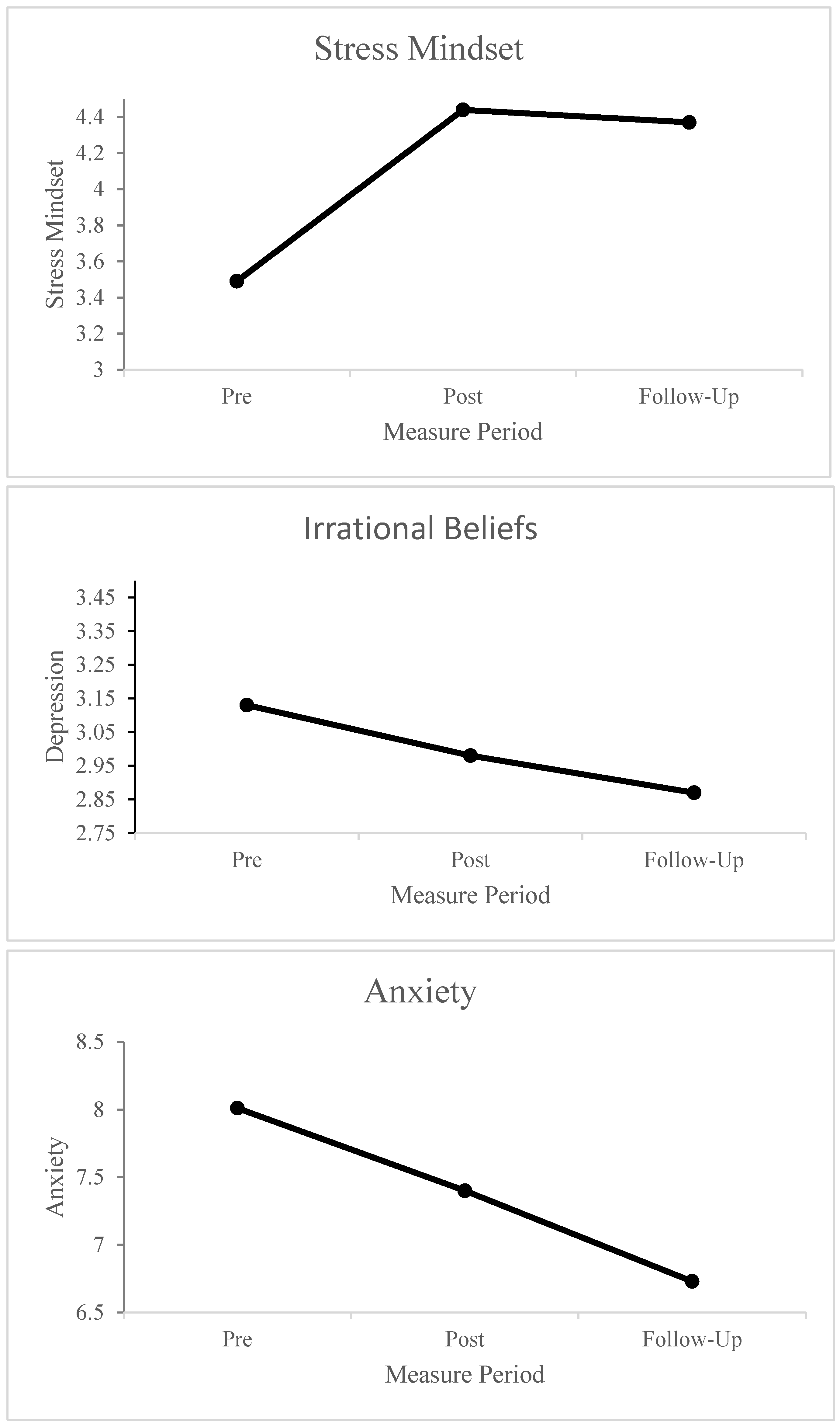
| Stress mindset | 3.49 (0.80) | 4.44 (0.72) * | 1.19 (+27.2%) | 4.47 (0.71) | 4.37 (0.76) | 0.14 (−2.2%) |
| Irrational beliefs | 3.13 (0.53) | 2.98 (0.51) * | 0.28 (−4.8%) | 2.89 (0.45) | 2.87 (0.46) | 0.04 (−0.7%) |
| Anxiety | 8.01 (3.59) | 7.40 (3.54) * | 0.17 (−7.6%) | 6.76 (3.29) | 6.73 (3.43) | 0.00 (−0.4%) |
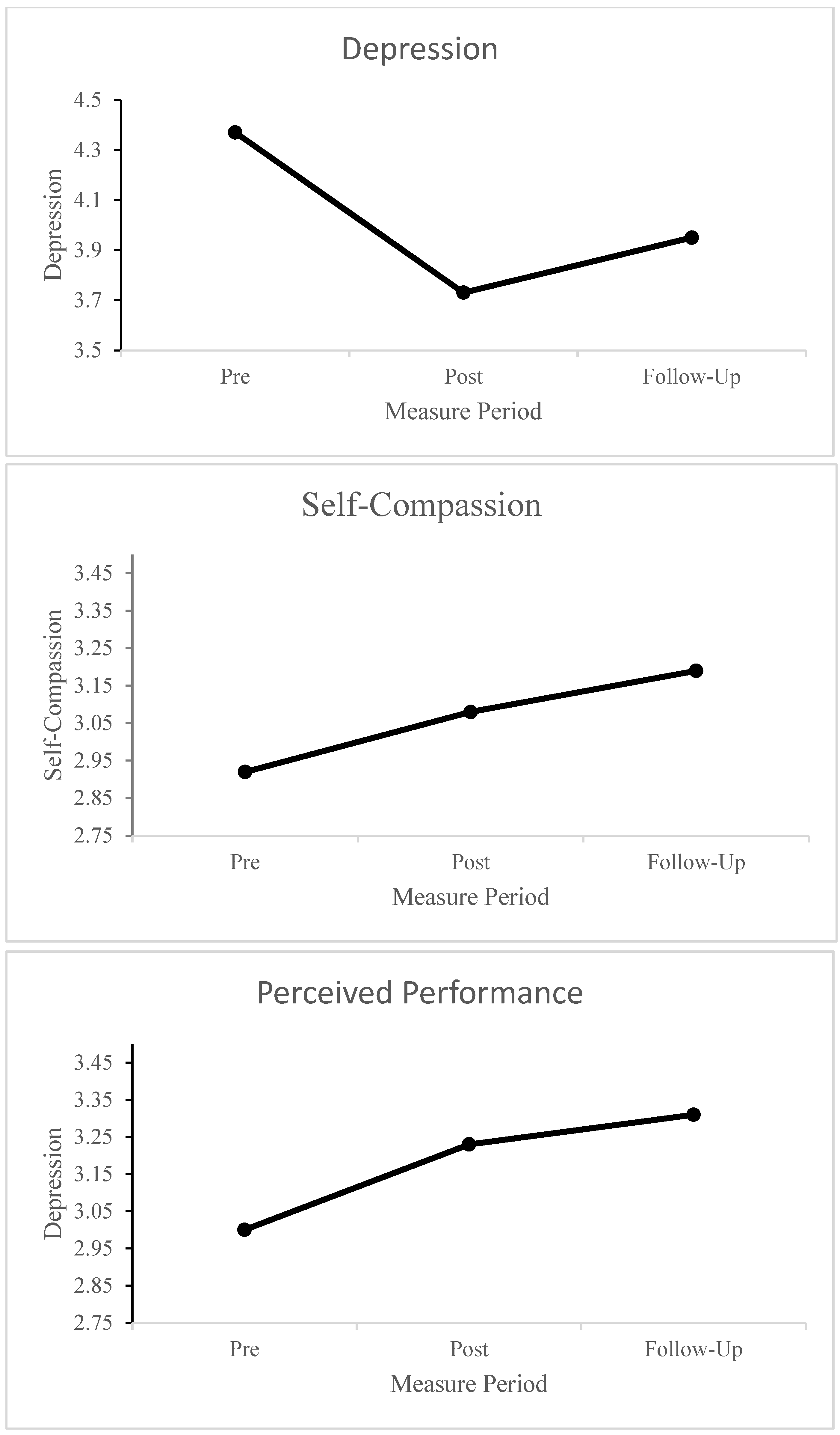
| Depression | 4.37 (3.23) | 3.73 (2.42) * | 0.20 (−14.6%) | 3.32 (2.44) | 3.95 (3.66) | 0.25 (+19.0%) |
| Self-compassion | 2.92 (0.57) | 3.08 (0.55) * | 0.28 (+5.5%) | 3.12 (0.60) | 3.19 (0.50) | 0.12 (+2.2%) |
| Perceived performance | 3.00 (0.71) | 3.23 (0.79) * | 0.32 (+7.7%) | 3.15 (0.83) | 3.31 (0.83) | 0.19 (+5.1%) |
Disclaimer/Publisher’s Note: The statements, opinions and data contained in all publications are solely those of the individual author(s) and contributor(s) and not of MDPI and/or the editor(s). MDPI and/or the editor(s) disclaim responsibility for any injury to people or property resulting from any ideas, methods, instructions or products referred to in the content. |
© 2026 by the authors. Licensee MDPI, Basel, Switzerland. This article is an open access article distributed under the terms and conditions of the Creative Commons Attribution (CC BY) license.
Share and Cite
Mansell, P.; Clark, K.; Brookes, J.; Wright, J.; Westley, S.; Sparks, K.; Slater, M. Targeting Stress Mindset and Irrational Beliefs to Improve Performance and Reduce Anxiety and Depression Symptoms in Academy Athletes. Psychol. Int. 2026, 8, 9. https://doi.org/10.3390/psycholint8010009
Mansell P, Clark K, Brookes J, Wright J, Westley S, Sparks K, Slater M. Targeting Stress Mindset and Irrational Beliefs to Improve Performance and Reduce Anxiety and Depression Symptoms in Academy Athletes. Psychology International. 2026; 8(1):9. https://doi.org/10.3390/psycholint8010009
Chicago/Turabian StyleMansell, Paul, Katie Clark, Jordan Brookes, Jason Wright, Samuel Westley, Katherine Sparks, and Matthew Slater. 2026. "Targeting Stress Mindset and Irrational Beliefs to Improve Performance and Reduce Anxiety and Depression Symptoms in Academy Athletes" Psychology International 8, no. 1: 9. https://doi.org/10.3390/psycholint8010009
APA StyleMansell, P., Clark, K., Brookes, J., Wright, J., Westley, S., Sparks, K., & Slater, M. (2026). Targeting Stress Mindset and Irrational Beliefs to Improve Performance and Reduce Anxiety and Depression Symptoms in Academy Athletes. Psychology International, 8(1), 9. https://doi.org/10.3390/psycholint8010009