5.1. Interpretation of Principal Findings
This study provides one of the first empirical evaluations of cognitive workload among students when developing a virtual world, which fills a gap in the literature on immersive educational technologies [
11,
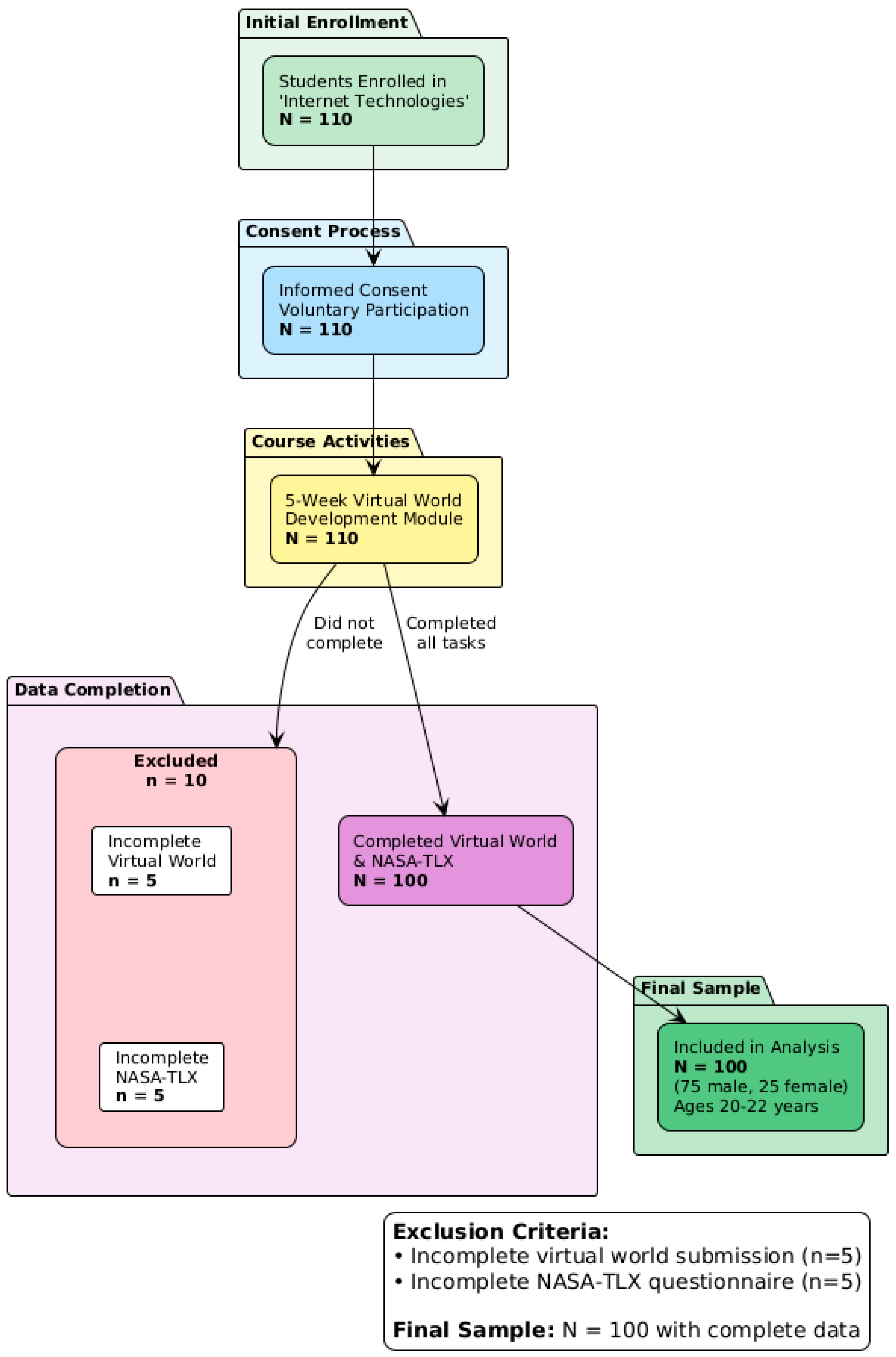
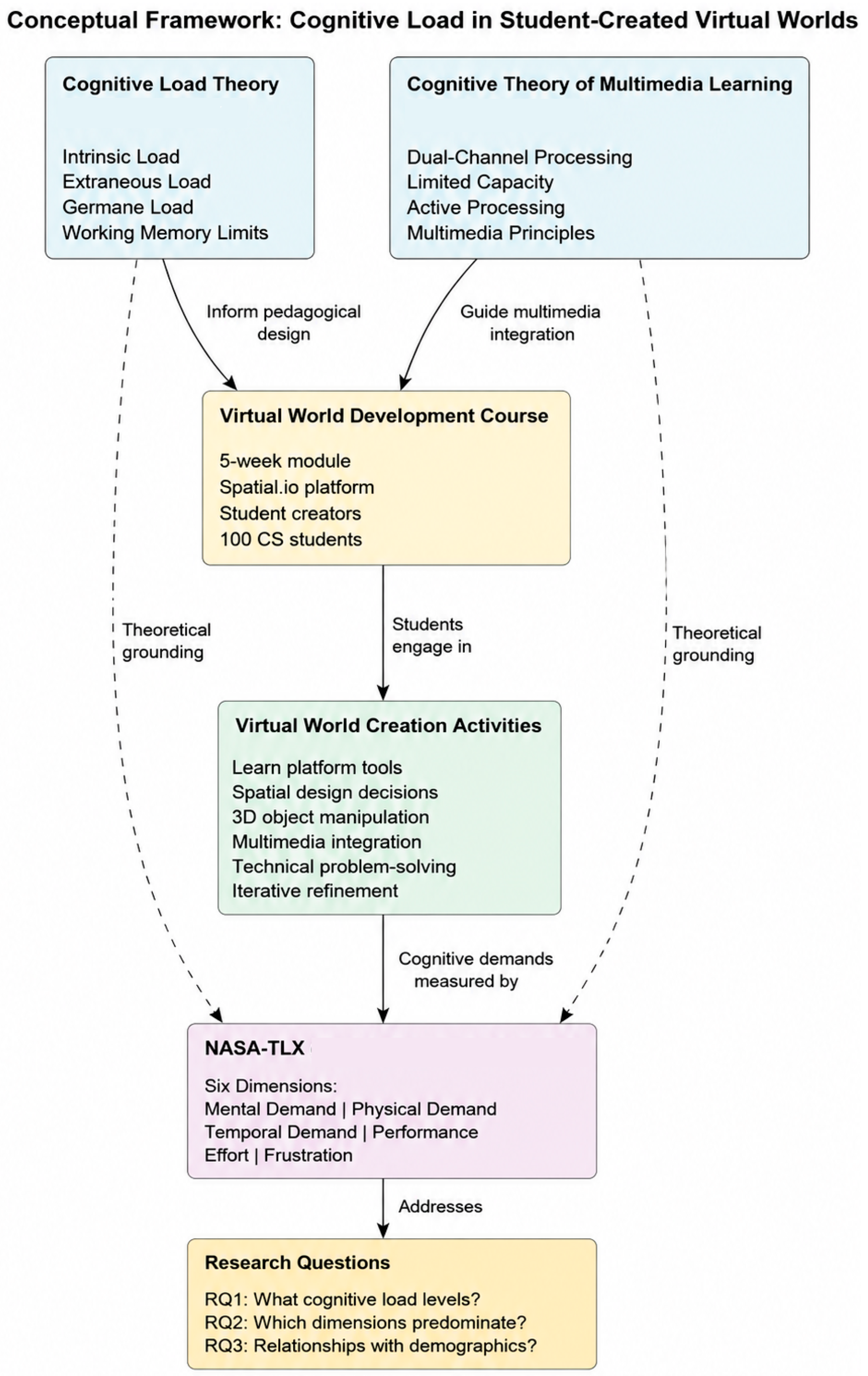
12]. The NASA-TLX evaluation of 100 undergraduate computer science students working on a five-week virtual world development project on Spatial.io produced three main results. Being a descriptive baseline study, interpretations are inherently exploratory and must be understood in the context of this cohort and instructional setting.
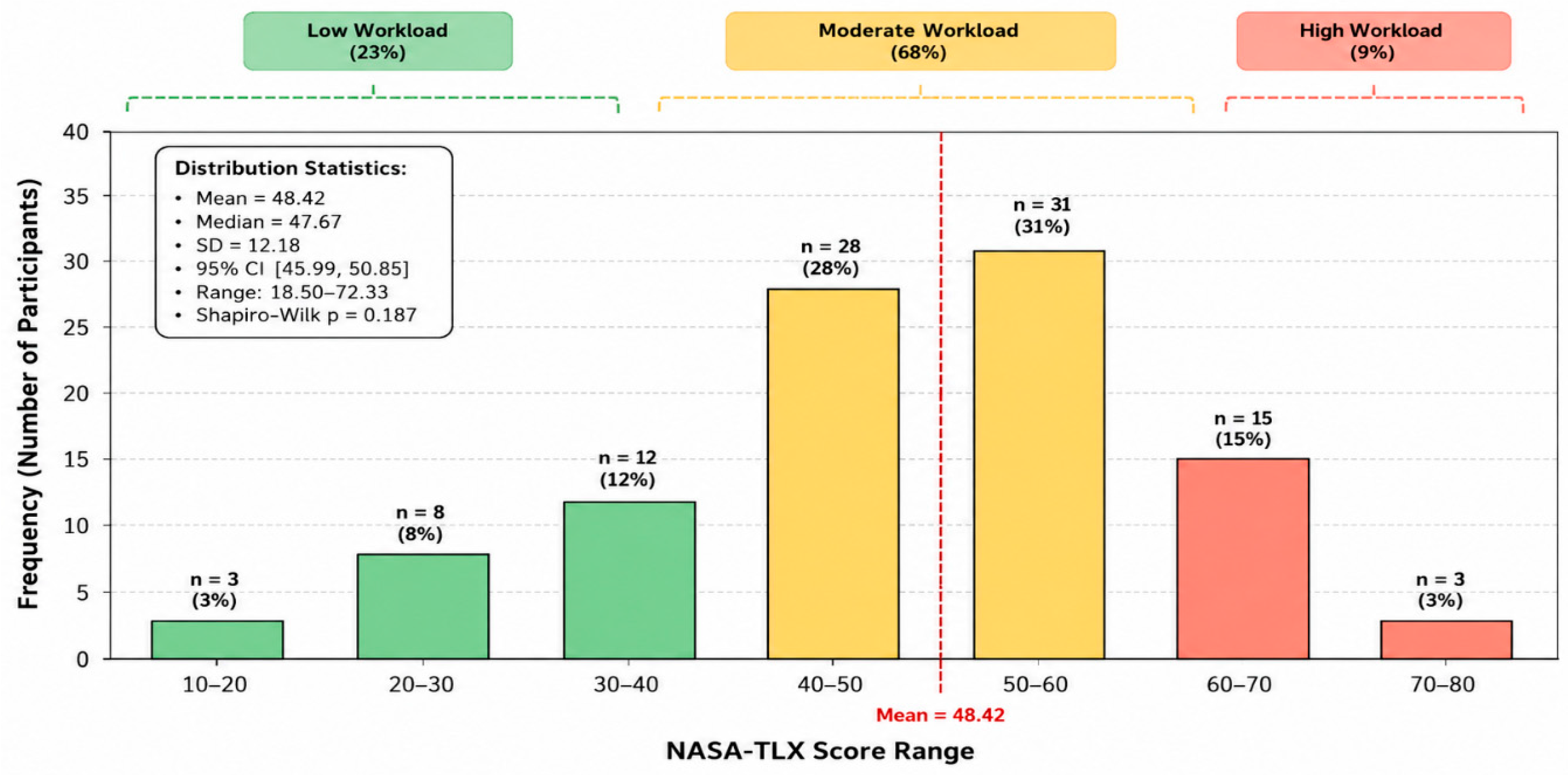
The first principal finding is that students had moderate overall cognitive load (weighted M = 48.42, SD = 12.18), which places the development of virtual worlds in the range of workload that is normally linked with successful educational technology activities [
25]. This result indicates that, in this particular teaching situation, the development tasks of the virtual world did not place an undue cognitive burden on most of the participants. It is important to note that 9% of the respondents indicated high workload (scores > 60), and no respondents indicated extreme overload (scores > 80), which indicates that cognitive load was not exceeded in levels that are typically linked to effective learning in educational technology settings [
16,
19]. To compare, Radianti et al. [
8] found mean NASA-TLX scores of 35–55 in immersive VR learning tasks, which mainly involved navigation and interaction, whereas the current study found a weighted mean of 48.42 in creation tasks—which is within the upper range of this range and indicates that creation is a relatively more demanding task than consumption.
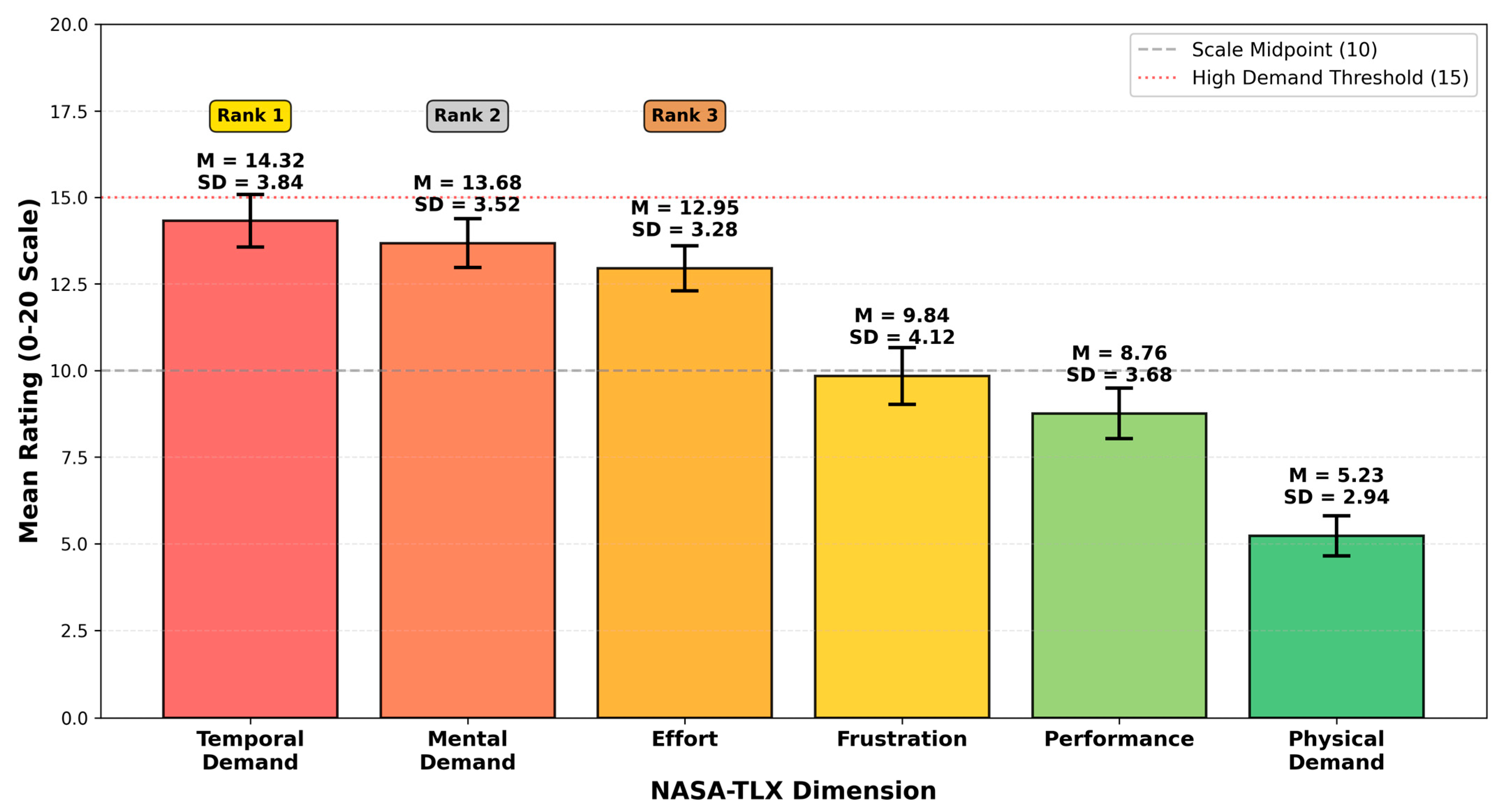
The second principal finding concerns the dominance of Temporal Demand (M = 14.32, SD = 3.84) as the main component of workload, as 78 percent of the participants rated time pressure as high or higher than the midpoint of the scale. The high temporal demand is probably a concurrent coursework demand, the iterative nature of creative design work that needs numerous cycles of refinement, and the learning curve of learning to use an unfamiliar platform [
15,
22]. Research on consumption, but not creation, of virtual worlds has always found Mental Demand to be the dominant workload com-ponent [
8,
23]. The difference between the temporal demand profile in this case and the mental demand profiles in consumption-oriented VR studies is a theoretically significant difference. When students are fed ready-made virtual environments, the main cognitive task is to process spatial and informational information—a mental task. When students develop virtual environments, the difficulty lies in time management in a long iterative design process and, at the same time, building platform competency. The implications of this temporal-cognitive change on the way educators plan and sequence virtual world development projects are significant.
The third main result is about Mental Demand (M = 13.68, SD = 3.52), which was second in rank and was relatively low in the variation among the participants. This regular trend of mental demand—including spatial design decision-making, technical problem-solving, and multimedia integration—indicates that the mental challenge was more task-based than individual differences. These processes are cognitively challenging and seem to be within the working memory capacity due to the moderate mean score [
18,
19], which is in line with Cognitive Load Theory perspective of intrinsic load as a factor of element interactivity [
18].
5.2. Theoretical and Practical Implications
The findings contribute to both theoretical understanding of cognitive load in immersive learning environments and practical guidance for educators implementing virtual world development curricula.
Theoretical Contributions: This study applies Cognitive Load Theory and multimedia learning concepts to a largely understudied field of student-created immersive content [
18,
22]. There is a lack of empirical evaluations of cognitive load in the process of creating digital artifacts in immersive settings [
13], and the current results start to fill this gap. The exceptionally low Physical Demand (M = 5.23) in comparison with the high Temporal and Mental Demand scores indicates a unique cognitive load pattern where physical activity is not a significant factor. These results are in line with the postulation of the constructionist theory that active knowledge construction involves working memory more than passive information intake [
13,
22]. The fact that the temporal, as opposed to the mental, demand is predominant implies that time management, and not cognitive overload as such, may be the main issue in the context of student-led virtual world creation.
Mapping the NASA-TLX findings onto the tripartite framework of CLT to gain additional theoretical understanding. The large Temporal Demand (M = 14.32) is probably due to extraneous cognitive load—pressure not due to the complexity of the design task itself but to simultaneous academic obligations and time constraints of the five-week project schedule [
18,
19]. The closest correlation to intrinsic load is Mental Demand (M = 13.68), which is the element of interactivity of simultaneous spatial reasoning, multimedia integration, and technical decision-making [
18]. The moderate Effort scores (M = 12.95) and the low Physical Demand scores (M = 5.23) indicate that the germane load—the productive cognitive work of schema formation—was engaged without overloading working memory capacity [
19,
22]. The low Physical Demand validates that browser-based creation tools like Spatial.io are successful in removing motor-physical extraneous load, redirecting cognitive resources toward design-relevant processing.
The findings also offer empirical evidence of the use of constructionist pedagogy in immersive settings. Constructionism by Papert assumes that more profound learning takes place when shareable artifacts are created [
13], and the moderate cognitive load (M = 48.42) indicates that the creation of virtual worlds sustains cognitive demands within the working memory capacity and maintains adequate challenge to facilitate meaningful learning [
19]. In a CTML sense [
22], the simultaneous control of several design factors—spatial structure, media, in-interactive functionality, and aesthetic integrity—is consistent with the dual-channel processing requirements. The moderate Mental Demand scores indicate that the available interface design of Spatial.io could have minimized extraneous processing, enabling students to allocate cognitive resources to coherent design instead of interface navigation, which is in line with the principles of coherence and signaling of CTML [
22].
Practical Implications: To educators planning to develop virtual world development courses, the temporal demand finding has the most direct practical implications. A project time longer than five weeks is advisable; the temporal demand was high (M = 14.32) which indicates that the five-week schedule placed a lot of time pressure, probably enhanced by the demands of coursework at the same time. In particular, a seven-to-eight-week schedule would enable enough iteration cycles without time pressure overwhelming the workload profile. Scheduled milestone dates—a design plan at Week 2, a prototype at Week 3, and a near-complete draft at Week 4—would spread cognitive load over the project timeline instead of clustering it around the submission deadline [
15,
16]. Giving clear time allocation instructions in every stage of development (planning, building, testing, and refinement) would also help students to cope with the iterative nature of the creative process [
22].
The moderate Mental Demand score indicates that the available drag-and-drop interface at Spatial.io might have minimized extraneous cognitive loads related to technical complexity, which instead channeled cognitive resources to design-relevant tasks—spatial design thinking, creative problem-solving, and multimedia integration [
22]. This observation justifies the use of available platform interfaces instead of pro-professional tools with higher learning curves in introducing students to the development of a virtual world in the first instance.
The lack of statistically significant gender differences in cognitive load is indicative that the development of virtual worlds can be similar between the genders in this sample, but due to the low statistical power of the gender comparison, no conclusive results can be drawn. Teachers must, however, not make assumptions about students having prior gaming or technical backgrounds, as the variability of backgrounds in students has been documented [
24], and should offer fair instructional support to meet the needs of students with varying levels of prior experience.
5.3. Limitations and Future Directions
This study’s findings must be interpreted within the context of several methodological limitations that constrain generalizability and causal inference.
Limitations of the Study Prediction: The single-group descriptive design was suitable to the exploratory objectives of the current study, but it does not allow making comparative or causal inferences. The study will not be able to establish the comparative workload levels with other teaching methods, other platforms, or other project times without a control group or comparison condition. The moderate work-load score observed (M = 48.42) cannot be characterized as optimal, for example, until comparative data from other platforms (e.g., Mozilla Hubs, Roblox Studio) or consumption-focused virtual world activities are available.
Study Sample Details: The sample is homogeneous (100 computer science students at one institution) and thus cannot be generalized to students in other fields and levels of education. Students of computer science probably have programming skills and technology-related self-efficacy that are not necessarily representative of students in other fields, and this could lead to a reduced cognitive load than would otherwise be the case with non-technical groups. The gender imbalance (75:25 male:female ratio), although mirroring the reported enrollment trends in computer science [
24], led to a low statistical power of gender comparisons. A post-hoc power analysis revealed that at
n = 25 in the female subpopulation, the Mann–Whitney U test has a power of about 40–50 percent to reject the null hypothesis in the case of a medium effect (d = 0.50) at an 80 percent significance level—far lower than the traditional 80 percent level [
35]. Future research ought to use gender-balanced samples or use prospective power analysis to make sure that gender comparisons are adequately sensitive. The small age group (2022 years) is also a result of the cohort under investigation and does not allow generalizing to older or non-traditional students, who might have other obligations like employment or family life and have less time.
Platform Specificity: The findings are platform-specific to Spatial.io, a browser-based platform chosen due to its ease of access and low barrier to entry. The development of virtual worlds with more professional tools that have higher learning curves, like Unity or Unreal Engine, would probably cause significantly greater cognitive load and qualitatively different workload profiles. Further studies are needed to determine whether the workload patterns here are replicated in platforms of different complexity.
Uncontrolled Variables: A set of potentially influential variables was not re-recorded or measured. The personal devices (laptops or desktop computers) of the students were of different technical specifications and internet connection speeds, which could have brought variability in platform performance and, therefore, frustration and effort ratings. The real time spent on development was not recorded in an official manner, and it was not possible to tell whether the high time requirement was due to the lack of time allocation, poor time management, or both. The first week of the module involved an informal self-report assessment of prior experience with gaming platforms, three-dimensional design tools, and virtual environments instead of validated psychometric measures. This meant that prior experience could not be included as a variable in the statistical tests, which restricted RQ3 to gender comparisons only. The next round of research must utilize validated measures to quantify previous experience in a systematic way to be able to test whether gaming background, experience in three-dimensional design, or familiarity with VR influences cognitive workload when developing a virtual world.
NASA-TLX does not separate the three types of loads of CLT (intrinsic, extraneous, and germane); thus, this research is unable to conclude how much Mental Demand is a measure of task difficulty, quality of instructional design, or both. The one post-task administration of NASA-TLX does not allow the analysis of the changes in cognitive load during the five-week development. Longitudinal designs with repeated NASA-TLX at various time points would allow establishing whether cognitive load is greatest in the early stages of learning the platforms and declines as students become familiar with the development tools.
Future Research Directions: The limitations and results of this study present several priority directions. To begin with, comparative research on workload in various platforms (e.g., Mozilla Hubs, Roblox Studio, and Unity), project timeframes, and scaffolding would determine whether the moderate workload profile observed in this case is unique to Spatial.io or can be applied to other creation environments. Second, longitudinal designs with repeated NASA-TLX administration would allow monitoring cognitive load variations during project phases and determining when peak demand occurs, which could be supported with specific instructional help. Third, mixed-method designs that would integrate NASA-TLX data with qualitative interviews would give a more detailed understanding of the exact causes of the temporal demand that students experience. Fourth, objective validation of subjective workload ratings would be provided by complementing self-reported workload data with physiological data, including heart rate variability or eye tracking. Fifth, evidence-based course design would be informed by intervention studies that test the effects of structured milestone deadlines and time management scaffolding on temporal demand. Sixth, the generalizability of these baseline findings would be tested by replication studies with diverse populations, such as students of non-technical disciplines, different educational levels, and different cultural contexts.