1. Introduction
The veteran population is often characterized by distinct health outcomes compared with the non-veteran population. Chronic disease, psychological conditions, low levels of self-reported physical activity, and substance use disorders are highly prevalent among U.S. veterans [
1,
2,
3,
4]. Physical activity and alcohol use are two modifiable health behaviors that serve significant roles in shaping health outcomes. Participation in physical activity (PPA) is associated with better cardiometabolic health, improved mental well-being, and reduced mortality [
5,
6]. In contrast, alcohol use, specifically binge drinking, is associated with injury, suppressed immune function, cardiovascular disease, obesity, and mental health conditions [
7,
8].
Physical activity and alcohol use may interact to influence overall health and well-being. Previous studies have shown a linear relationship between physical activity and alcohol use, indicating that the more someone reports being active, the more likely they are to consume alcohol—called the Incongruous Association [
9,
10]. The relationship between alcohol use and physical activity has been interpreted through behavioral clustering and compensatory health behavior frameworks, which posit that health behaviors may either co-occur due to shared social and environmental determinants or diverge as individuals engage in trade-offs between risk and health-promoting behaviors. These perspectives suggest that the alcohol–physical activity association is context-dependent and may vary across populations. Although prior research has often examined overall alcohol consumption, the present study focuses specifically on binge drinking to capture episodic patterns of high-risk use that may differentially relate to health behaviors such as leisure-time physical activity.
Veterans constitute a distinct population for examining these behavioral relationships. Veterans report higher rates of anxiety, depression, and alcohol use compared to non-veterans, and also exhibit greater burden of chronic health conditions [
1,
2]. Physical activity patterns may vary among veterans due to prior military training, service-related injury or disability, and access to healthcare systems [
11]. In addition, the transition from structured military environments to civilian life may alter health behavior patterns, including both alcohol use and engagement in physical activity, in ways that are not well captured in general population studies. These factors suggest that associations between binge drinking and physical activity may differ by veteran status, yet this relationship has not been well examined using nationally representative data. To address this gap, a secondary data analysis (SDA) examined the relationship between binge drinking and participation in physical activity among veterans and nonveterans using data from the 2021-2023 Behavioral Risk Factor Surveillance System (BRFSS).
2. Materials and Methods
2.1. Study Design and Data Source
This study used cross-sectional data from the Behavioral Risk Factor Surveillance System (BRFSS) for the years 2021 (
n = 438,693), 2022 (
n = 445,132), and 2023 (
n = 433,323), administered by the Centers for Disease Control and Prevention (CDC). BRFSS is an ongoing, state-based telephone survey of noninstitutionalized 18-year-olds and older U.S. adults (i.e., active-duty service members and incarcerated individuals are excluded). The publicly available, de-identified BRFSS data can be found on the CDC’s BRFSS website (
https://www.cdc.gov/brfss/annual_data/annual_data.htm, accessed on 21 January 2026). BRFSS utilizes a complex, multistage probability sampling design to produce nationally representative estimates. Detailed information on BRFSS methodology, weighting procedures, and questionnaire design can be found elsewhere [
12].
2.2. Study Population
The analytic sample in this study included adult respondents aged ≥18 years with complete data on binge drinking, participation in physical activity, and veteran status. Participants who responded “don’t know” to any question, or refused to answer a question, were removed from the dataset. Additionally, respondents with missing values for key exposure, outcome, or covariate measures were excluded from analyses. The final analytic sample size for pooled 2021–2023 data was 107,498.
2.3. Measures
Binge drinking was assessed using BRFSS alcohol consumption items. Consistent with CDC definitions, binge drinking was defined as consuming ≥5 drinks for men or ≥4 drinks for women on a single occasion during the past 30 days. Respondents provided the number of times they engaged in binge drinking during the past 30 days.
Participation in physical activity (PPA), our primary dependent variable, was assessed using the BRFSS core question, which asked whether respondents participated in any physical activity or exercise (e.g., running, walking, gardening) outside their regular job during the past 30 days. PPA was operationalized as a binary indicator, coded 0 (no PPA) or 1 (PPA).
Veteran status was determined by self-report and categorized as veteran (yes) or non-veteran (no), based on respondents’ indication of having ever served on active duty in the U.S. Armed Forces, including the National Guard or Reserves. Additional sociodemographic and health information for each participant were included, such as their age in years, sex, race, whether or not they have a primary care physician, marital status, educational attainment, annual income, rural/urban dwelling location, number of children in the home, body mass index (BMI), report of whether or not a doctor had told them that they have cardiovascular disease, number of poor mental health days in the past month, and lifetime smoking. Covariates were selected a priori based on prior literature and theoretical relevance to both alcohol use and physical activity, including sociodemographic characteristics, health status, and healthcare access variables to reduce potential confounding.
2.4. Statistical Analysis
All analyses accounted for the complex survey design of BRFSS, including stratification, clustering, and sampling weights. Detailed information on how the complex survey design weights can be used with BRFSS data are published elsewhere [
12]. Descriptive statistics were calculated to characterize the study population overall and by veteran status. Multivariable survey-weighted logistic regression models were used to examine the association between binge drinking and participation in physical activity, stratified by veteran status. The primary independent variable was binge drinking days in the past month, and the dependent variable was PPA. Model assumptions for logistic regression were evaluated, and multicollinearity among covariates was assessed using variance inflation factors, with no evidence of problematic collinearity observed. Model fit was examined using standard diagnostic measures appropriate for survey-weighted analyses. Statistical significance was defined as
p < 0.05. All analyses were conducted using R version 4.3.1, with survey procedures appropriate for complex sampling designs. Specifically, we used the “survey” package in R in order to estimate the aforementioned multivariable logistic regression models.
3. Results
The sample for this study comprised 107,498 adults: 13,337 veterans and 94,161 nonveterans (
Table 1). Veterans were older on average than nonveterans (
M = 60.77 vs.
M = 51.38 years) and were more likely to be male (89.96% vs. 47.16%). Veterans also had a higher prevalence of cardiovascular disease (8.94% vs. 3.43%) and lifetime smoking (56.35% vs. 40.35%) compared to nonveterans.
Participation in physical activity was common in both groups but slightly less prevalent among veterans than nonveterans (80.84% vs. 83.44%). Veterans reported fewer poor mental health days per month (M = 3.33 vs. M = 4.37) and slightly fewer binge drinking days in the past 30 days (M = 1.47 vs. M = 1.37). Veterans had a lower mean BMI than nonveterans (28.57 vs. 30.04), although BMI variability was greater among nonveterans primarily due to one participant’s outlier response (which we did not delete from the dataset).
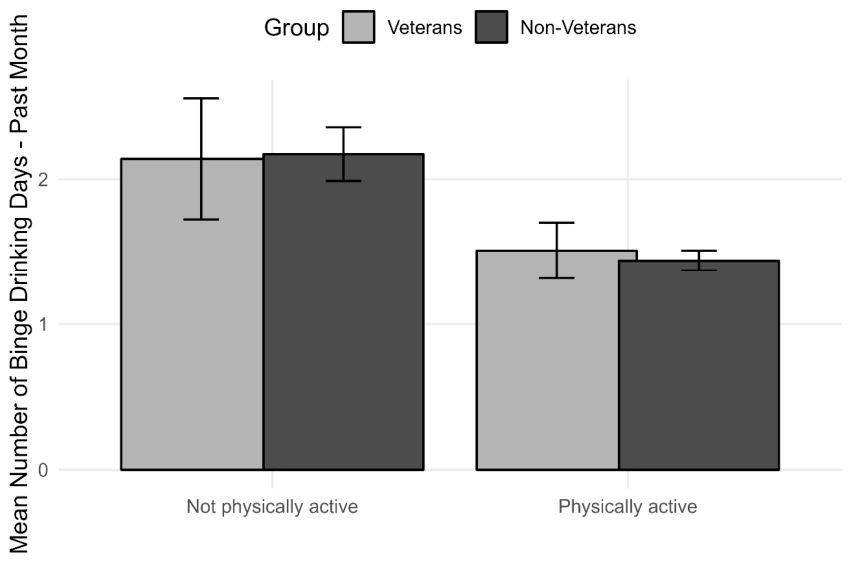
Among veterans, binge drinking days were negatively associated with participation in physical activity after adjusting for sociodemographic and health-related covariates (aOR = 0.98,
p = 0.01;
Table 2;
Figure 1). Older age and greater numbers of poor mental health days were also associated with lower odds of participating in physical activity. In contrast, higher educational attainment, higher income, and lifetime smoking were associated with greater odds of physical activity.
Rural residence and higher BMI were inversely associated with physical activity among veterans. Sex, race, marital status, access to a primary care physician, cardiovascular disease, and number of children were not significantly associated with physical activity in the adjusted model.
Among nonveterans, binge drinking days were also significantly and negatively associated with participation in physical activity (aOR = 0.98,
p < 0.001;
Table 3). Increasing age, female sex, Black race, other race, rural residence, number of children, and poor mental health days were associated with lower odds of physical activity participation.
In contrast, having a primary care physician, higher educational attainment, higher income, cardiovascular disease, and lifetime smoking were positively associated participation in physical activity among nonveterans. BMI was not significantly associated with physical activity in the nonveteran model.
4. Discussion
The present findings contribute to the empirical literature examining the association between binge drinking days and PPA by evaluating whether the alcohol–physical activity incongruence is evident within a nationally representative sample of U.S. adults. Although the observed associations were statistically significant, their magnitude was modest, suggesting that while binge drinking is consistently associated with lower likelihood of reporting physical activity, the practical impact at the individual level may be limited but still relevant at the population level. Prior research has often reported a positive association between alcohol consumption and physical activity, suggesting that individuals who drink may be more likely to be physically active. Much of this evidence, however, has been derived from convenience samples, particularly college student populations, in which alcohol use and physical activity are socially normative and frequently embedded in shared leisure routines [
13].
Binge drinking is a behavioral pattern that is characterized by episodic context and social occasion rather than by overall alcohol volume alone [
14]. This distinction complicates direct comparisons across studies that operationalize alcohol use differently. Against the aforementioned review of literature, the present study assessed whether the alcohol-physical activity association commonly reported in prior research persists at the population level when binge drinking is explicitly examined.
This cross-sectional analysis found that more frequent binge drinking was associated with a lower likelihood of PPA. These findings have important implications for how associations between alcohol consumption and physical activity are interpreted within the broader literature. Population-based research increasingly demonstrates that health behaviors tend to cluster in complex and non-uniform ways rather than forming consistently health-promoting or health-compromising profiles [
15]. Within this context, the co-occurrence of alcohol use and physical activity reported in some studies may reflect shared social environments or sampling frames rather than a generalized behavioral pattern.
Although the present study does not directly assess screening practices or intervention effectiveness, the observed patterns highlight the importance of avoiding assumptions that binge drinking behavior coincides with changes in physical activity, or vice versa. Recognizing that these behaviors may not be linearly related may help refine how risk behaviors are conceptualized in population health research and guide more nuanced hypotheses in future intervention studies.
Some other findings in this study warrant additional consideration, including the positive associations observed for lifetime smoking and poverty with participation in physical activity among veterans. These patterns may reflect unmeasured heterogeneity within the veteran population, such as differences in occupational demands, access to structured programs (e.g., VA services), or compensatory health behaviors among individuals with higher risk profiles.
Several limitations should be considered when interpreting these findings. First, the cross-sectional design precludes causal inference and does not allow determination of the temporal ordering between binge drinking and PPA. As a result, the observed associations should be interpreted as descriptive of population-level patterns rather than indicative of causal relationships.
Second, both binge drinking and PPA were assessed using self-reported measures, which are subject to recall error and social-desirability bias. For example, the measure of PPA did not account for frequency, duration, intensity, or adherence to physical activity guidelines. Such reporting biases may lead to underestimation of binge drinking frequency or overestimation of physical activity participation, potentially attenuating observed associations. In addition, binge drinking was measured using a single-item indicator capturing frequency within the past 30 days, which did not differentiate between episodic versus repeated binge drinking or contextual features such as social versus solitary consumption. We also did not test an interaction term for binge drinking and veteran status, which is something future studies should consider including. Lastly, the mean number of binge drinking days was low for both veterans and nonveterans. Given such narrow variance in this variable, utilizing our measure of binge drinking as a linear predictor for a binary physical activity outcome might have masked more nuanced, non-linear relationships or failed to accurately capture the impact of true heavy episodic drinking.
Although the analyses adjusted for a wide range of sociodemographic and health-related characteristics, residual confounding cannot be ruled out. Factors such as social networks, occupational physical activity, or environmental context were not directly measured and may influence both binge drinking and PPA. Nevertheless, the use of standardized measures and a nationally representative sample supports the relevance of the findings for understanding broad population-level associations.
5. Conclusions
By leveraging a large, nationally representative BRFSS sample and focusing specifically on binge drinking rather than general alcohol use, the present study extends prior survey-based research by demonstrating that the commonly reported positive alcohol–physical activity association does not generalize to population-level patterns. The present findings indicate that more frequent binge drinking is associated with a lower likelihood of engaging in PPA among veterans and nonveterans.
By leveraging a large, nationally representative sample and accounting for a broad range of sociodemographic and health-related characteristics, this study provides evidence that binge drinking and PPA are inversely related among veterans and nonveterans. Future research should examine these associations longitudinally and incorporate more detailed measures of drinking patterns and physical activity to clarify how these behaviors intersect across diverse adult populations and social contexts.
Author Contributions
Conceptualization, J.T.M., S.M.; methodology, J.T.M., S.M., K.I.; formal analysis, J.T.M., S.M., K.I.; writing—original draft preparation, J.T.M., S.M., K.I., J.A.P.; writing—review and editing, J.T.M., S.M., K.I., J.A.P. All authors have read and agreed to the published version of the manuscript.
Funding
This research received no external funding.
Institutional Review Board Statement
Ethical review and approval were waived for this study due to the fact that data were publicly available and de-identified from the Centers for Disease Control and Prevention’s BRFSS website.
Informed Consent Statement
This study used publicly available, de-identified data and thus was exempt from Institutional Review Board Approval. Information about the data are provided below.
Data Availability Statement
Conflicts of Interest
The authors declare no conflicts of interest.
Abbreviations
The following abbreviations are used in this manuscript:
| BMI | Body Mass Index |
| PPA | Participation in Physical Activity |
| BRFSS | Behavioral Risk Factor Surveillance System |
| CDC | Centers for Disease Control and Prevention |
References
- Betancourt, J.A.; Granados, P.S.; Pacheco, G.J.; Reagan, J.; Shanmugam, R.; Topinka, J.B.; Fulton, L.V. Exploring health outcomes for U.S. veterans compared to non-veterans from 2003 to 2019. Healthcare 2021, 9, 604. [Google Scholar] [CrossRef] [PubMed]
- Thomas, K.; McDaniel, J.T.; Haring, E.; Albright, D.L.; Fletcher, K. Mental health needs of military and veteran women: An assessment conducted by the Service Women’s Action Network. Traumatology 2018, 24, 104–112. [Google Scholar] [CrossRef]
- Whitworth, J.W.; Scioli, E.R.; Keane, T.M.; Marx, B.P. Physical inactivity, cigarette smoking, and psychiatric comorbidity among veterans with posttraumatic stress disorder. Health Psychol. 2022, 41, 169–177. [Google Scholar] [CrossRef] [PubMed]
- McDaniel, J.T.; Redner, R.; Jayawardene, W.; Haun, J.; Clapp, J.; Che, D.; Renzaglia, K.; Abou-Jabal, D. Moral injury is a risk factor for substance use and suicidality among U.S. military veterans with and without traumatic brain injury. J. Relig. Health 2023, 62, 3926–3941. [Google Scholar] [CrossRef] [PubMed]
- American College of Sports Medicine. ACSM’s Guidelines for Exercise Testing and Prescription, 9th ed.; Lippincott Williams & Wilkins: Philadelphia, PA, USA, 2013. [Google Scholar]
- McKinney, J.; Lithwick, D.J.; Morrison, B.; Nazzari, H.; Isserow, S.H.; Heilbron, B.; Krahn, A.D. The health benefits of physical activity and cardiorespiratory fitness. Br. Columbia Med. J. 2016, 58, 131–137. [Google Scholar]
- Rehm, J. The risks associated with alcohol use and alcoholism. Alcohol Res. Health 2011, 34, 135–143. [Google Scholar] [PubMed]
- Naimi, T.S.; Nelson, D.E.; Brewer, R.D. The intensity of binge alcohol consumption among U.S. adults. Am. J. Prev. Med. 2010, 38, 201–207. [Google Scholar] [CrossRef] [PubMed]
- Mama, S.; Heredia, N.; Johnston, H.; Conroy, D. Associations between physical activity and alcohol consumption in rural cancer survivors. Front. Oncol. 2022, 12, 871192. [Google Scholar] [CrossRef] [PubMed]
- Brellenthin, A.G.; Lee, D.C. Physical activity and the development of substance use disorders: Current knowledge and future directions. Prog. Prev. Med. 2018, 3, e0018. [Google Scholar] [CrossRef] [PubMed]
- Goodrich, D.E.; Hall, K.S.; Pinter, J.M.; Erwin, M.S. Physical activity among military veterans. In Physical Activity in Diverse Populations; Routledge: Abingdon, UK, 2025; pp. 278–307. [Google Scholar]
- United States Centers for Disease Control and Prevention. Behavioral Risk Factor Surveillance System. Available online: https://www.cdc.gov/brfss/index.html (accessed on 4 February 2026).
- Musselman, J.R.B.; Rutledge, P.C. The incongruous alcohol–activity association: Physical activity and alcohol consumption in college students. Psychol. Sport Exerc. 2010, 11, 609–618. [Google Scholar] [CrossRef]
- D’Alessandro, S.; Carter, L.; Webster, C. Binge drinking: A review and research agenda. J. Consum. Behav. 2023, 22, 177–198. [Google Scholar] [CrossRef]
- Verswijveren, S.J.J.M.; Dingle, S.; Donnelly, A.E.; Dowd, K.P.; Ridgers, N.D.; Carson, B.P.; Kearney, P.M.; Harrington, J.M.; Chappel, S.E.; Powell, C. How are different clusters of physical activity, sedentary, sleep, smoking, alcohol, and dietary behaviors associated with cardiometabolic health in older adults? A cross-sectional latent class analysis. J. Act. Sedentary Sleep Behav. 2023, 2, 16. [Google Scholar] [CrossRef] [PubMed]
| Disclaimer/Publisher’s Note: The statements, opinions and data contained in all publications are solely those of the individual author(s) and contributor(s) and not of MDPI and/or the editor(s). MDPI and/or the editor(s) disclaim responsibility for any injury to people or property resulting from any ideas, methods, instructions or products referred to in the content. |