1. Introduction
Prolonged grief disorder (PGD) is a debilitating condition characterized by persistent yearning or preoccupation with the deceased, emotional pain, and functional impairment that persists for at least 12 months following bereavement. The disorder has recently been codified in both the Diagnostic and Statistical Manual of Mental Disorders, Fifth Edition, Text Revision (DSM-5-TR) and the 11th edition of the International Classification of Diseases (ICD-11) [
1,
2,
3]. Approximately 10% of bereaved individuals develop PGD, which remains distinct from typical grief in terms of its chronicity, severity, and associated functional disruption [
4,
5]
PGD represents a maladaptive grief response whereby individuals fail to integrate the reality of the loss over time, resulting in chronic emotional pain, functional impairment, and heightened risk for adverse outcomes including suicidality, comorbid psychiatric disorders such as depression and PTSD, reduced quality of life, and intergenerational transmission of distress within families [
6,
7]. Beyond symptom persistence, PGD often involves existential distress marked by feelings of meaninglessness, loneliness, and a fractured sense of identity [
8].This underscores that PGD is not only a psychiatric condition but also a profound disruption of psychological and social well-being.
Current treatment options for PGD are limited. Pharmacological interventions, such as antidepressants, have demonstrated limited efficacy in addressing the core symptoms of prolonged grief [
8]. While targeted psychotherapies—including complicated grief treatment (CGT) and cognitive–behavioral approaches—have shown promise, response rates remain modest, with high dropout rates [
9,
10,
11]. The unique phenomenology of PGD, characterized by existential distress and identity disruption, may require innovative therapeutic interventions.
Recent clinical interest has turned to the potential of psychedelic-assisted therapy, notably psilocybin, for treatment-resistant mental health conditions [
12]. Psilocybin is a serotonergic hallucinogen that acts primarily as a 5-HT2A receptor agonist, leading to transient alterations in perception, cognition, and emotion. In randomized trials, a single dose of psilocybin (approximately 25 mg) has been associated with rapid, robust, and enduring reductions in depressive and anxious symptoms across a variety of clinical populations, including patients with major depressive disorder and end-of-life existential distress [
12,
13]. These effects are often mediated by a so-called “mystical-type” experience, marked by a sense of unity, emotional breakthrough, and cognitive reframing. Clinical trials indicate that psilocybin can induce profound mystical-type or transformative subjective experiences that correlate with sustained psychological benefits and improved mental health outcomes [
14,
15,
16,
17]. Mechanistically, psilocybin is thought to promote neuroplasticity, disrupt maladaptive neural circuits, and facilitate emotional processing and psychological flexibility, processes that may be highly relevant to the resolution of complicated grief pathology. Emerging neurobiological frameworks increasingly situate psychedelic drug effects within large-scale brain systems, emphasizing their capacity to induce rapid and sustained neuroplasticity and to reorganize activity across distributed networks implicated in affect regulation and cognitive flexibility. Within this systems-level view, recent work has begun to highlight that neurobiological clearance pathways (for example, glymphatic and other waste-removal processes) and broader brain homeostatic mechanisms may also be disrupted in psychiatric conditions marked by chronic affective dysregulation and rigidity of thought and behavior, potentially contributing to synaptic and network-level “stuckness”. Integrating these perspectives suggests that psychedelic-assisted interventions might exert therapeutic effects not only by acutely modulating receptor-level signaling and network dynamics but also by interacting with clearance and homeostatic systems in ways that facilitate sustained rebalancing of maladaptive affective and cognitive patterns over time [
18]. Unlike prior therapies that focus on exposure, cognitive restructuring, or attachment work, psilocybin-assisted therapy offers a distinctive approach by inducing transformative experiences that alter consciousness and meaning-making, which are not typically achieved through traditional grief therapies.
This emerging body of research suggests that psilocybin may be particularly well-suited to address the core features of PGD, including emotional rigidity, disrupted meaning-making, and prolonged existential suffering. Psychedelic experiences can support transformative psychological processes relevant to grief integration, and structured investigation into psilocybin’s role in facilitating emotional processing in grief-related disorders has been called for [
15,
16,
17,
19]. Research is first needed to evaluate the feasibility, acceptability, and safety of such treatments.
This study will evaluate the feasibility of conducting a psilocybin-assisted intervention in individuals with prolonged grief disorder (PGD), with a focus to assess acceptability and safety, and with secondary aims to explore whether a single 25 mg dose of psilocybin reduces symptoms of grief and trauma. We hypothesize that psilocybin will facilitate meaningful subjective experiences associated with symptom improvement over time.
2. Objectives and Hypotheses
Our primary objectives are to assess the feasibility (in terms of recruitment and retention), acceptability, and safety of a single 25 mg psilocybin session in individuals with PGD. A secondary objective is to evaluate changes in PGD symptoms, including depressive symptoms. Additionally, we have exploratory hypotheses regarding the positive impact on trauma symptoms and psychosocial functioning. Specific aims are listed below.
Aim 1: To evaluate the feasibility, acceptability, and safety of a single-arm, open-label trial in which adult participants meeting criteria for PGD complete one preparation session, a single 25 mg oral dose of psilocybin, and two semi-structured integration sessions. Outcomes will include recruitment, retention rates, and safety data over a six-month follow-up period, as well as preliminary changes in PGD symptoms to inform the design of a future Phase 2 trial.
Aim 2: To assess changes in grief and trauma symptoms following the intervention. Observed improvements will be considered preliminary and will primarily inform the design of future randomized trials. Assessments will occur immediately post-intervention and at one-, three-, and six-month follow-ups.
Aim 3: To examine whether psilocybin facilitates subjective mystical, spiritual, or insightful experiences that are associated with reductions in grief and trauma symptoms.
Subjective experiences will be assessed using the Mystical Experiences Questionnaire (MEQ), 5-Dimensions of Altered States of Consciousness (5-D), Awe Experience Scale (AWE), Challenging Experiences Questionnaire (CEQ), Acceptance and Action Questionnaire (AAQ), Inclusion of Others in the Self (IOS), Meaning in Life Questionnaire (MIL), and Psychological Insight Questionnaire (PIQ). Relevant subscales will be analyzed, and pre- to post-intervention changes will be examined quantitatively. Qualitative analyses of session transcripts will further explore themes of integration and the relationship between subjective experiences and symptom change.
Exploratory Aim: To explore potential neural correlates of therapeutic response using pre- and post-intervention functional MRI (fMRI). Neuroimaging outcomes will serve as exploratory endpoints to inform future hypothesis-driven research.
We wish to characterize the phenomenology of the psilocybin experience using MPIs and to explore neural correlates of emotion regulation via functional neuroimaging. We postulate that psilocybin will be an acceptable, safe, and effective intervention for PGD, given its established effect of creating transformative experiences and enhancing neuroplasticity. Specifically, we hypothesize (1) that the intervention will be well tolerated, (2) that participants will show a reduction in PGD symptoms and improved functioning, and (3) that participants will have strong subjective experiences of connectedness and meaning-making that will correlate with clinical benefit. Ultimately, this research aims to add to clinical research in grief therapy by introducing psilocybin as a novel treatment for people suffering from PGD.
3. Design and Methods
3.1. Study Design
We present an open-label, single-arm feasibility study to assess the acceptability, safety, tolerability, and preliminary therapeutic effects of a single 25 mg dose of psilocybin administered with psychological support in individuals diagnosed with PGD. The rationale for selecting a fixed 25 mg dose of psilocybin specifically for PGD is based on previous successful applications in similar contexts, where this dose achieved optimal therapeutic effects while minimizing adverse experiences. Prior studies have demonstrated that a 25 mg dose provides the necessary potency to induce profound psychological insights and emotional breakthroughs without the need for weight-based adjustments, which can introduce variability and complexity. By standardizing the dose, we aim to align with established protocols that have consistently shown safety and efficacy in treating various conditions marked by emotional and psychological distress.
The open-label design allows for intensive clinical observation and experiential data collection during this early stage of investigation. Through a multimodal approach integrating quantitative symptom measures, microphenomenological qualitative interviews (MPIs), and functional neuroimaging, this protocol aims to comprehensively examine the therapeutic potential, mechanistic underpinnings, and subjective experience correlates of psilocybin-assisted therapy for PGD. This protocol aims to generate foundational data to inform the design of future randomized controlled trials and contribute to the development of novel treatments for PGD. This study will be conducted at one site at the University of Virginia. The research has been approved by the University’s Institutional Review Board, with a plan to enroll 20 participants diagnosed with prolonged grief disorder.
In line with methodological guidance that pilot and feasibility trials are typically small and primarily focused on feasibility and parameter estimation rather than hypothesis testing, we did not conduct a formal power calculation for efficacy outcomes. Instead, our target sample size of N = 20 was informed as follows: (1) rule-of-thumb recommendations that approximately 12 participants per group are sufficient to estimate key parameters (means, variances, recruitment and retention rates) in early-phase trials [
20], (2) recent single-arm psilocybin feasibility studies in related populations, which have enrolled samples in the range of 12–30 participants [
21,
22,
23], and (3) pragmatic considerations, including cost and regulatory constraints associated with delivering psilocybin-assisted therapy and pre/post neuroimaging in a complex grief-focused protocol. A sample of 20 participants is therefore expected to provide adequate precision to estimate recruitment and retention rates, characterize safety and tolerability, and yield preliminary effect size estimates on grief and trauma outcomes sufficient to inform the design and formal power calculations of a subsequent randomized controlled trial.
Our planned sample size is comparable to other early-phase psilocybin studies that have focused on feasibility and preliminary efficacy, including open-label or pilot trials in PTSD, existential distress, and treatment-resistant depression, which have typically enrolled between 12 and 30 participants per arm and have successfully characterized safety and generated effect size estimates for subsequent larger trials
3.2. Eligibility
Twenty participants meeting the DSM-5-TR PGD criteria will be enrolled, aged approximately 18 to 65 years, with an emphasis on recruiting young adults aged 18–30. Participants will not be eligible if they have or have a history of (1) psychosis, including family history of psychosis or thought disorder; (2) bipolar disorder, or severe psychiatric instability, as well as those with active suicidal ideation; (3) contraindications for MRI; (4) current use of serotonergic medications, including antidepressants (e.g., SSRIs, SNRIs, TCAs, MAO inhibitors), tramadol, methadone, and any other medication deemed by the study medical doctor to interfere; (5) prior psychedelic use within the past year; (6) uncontrolled cardiovascular disease; (7) Type I diabetes; (8) head trauma with neurological deficit; (9) neurological/neurodegenerative disorders including cerebrovascular disease; or being (10) pregnant, nursing, or planning to get pregnant. While personality disorders are not specifically an exclusion and will not be assessed, the PI has the ability to deny enrollment to anyone who is deemed unable to safely or meaningfully participate. These exclusions are primarily for safety and scientific clarity. Recent psychedelic use or ongoing serotonergic treatments (e.g., SSRIs) can alter neurobiological responses to psilocybin, potentially blunting effects or increasing risk of adverse reactions such as serotonin toxicity. Individuals with severe psychiatric instability (e.g., active psychosis, mania, or acute suicidality) are excluded because psilocybin can temporarily intensify emotions and perceptual experiences, which may exacerbate symptoms. Together, these criteria help protect participants while ensuring that observed effects can be more confidently attributed to the intervention.
3.3. Procedure Timeline
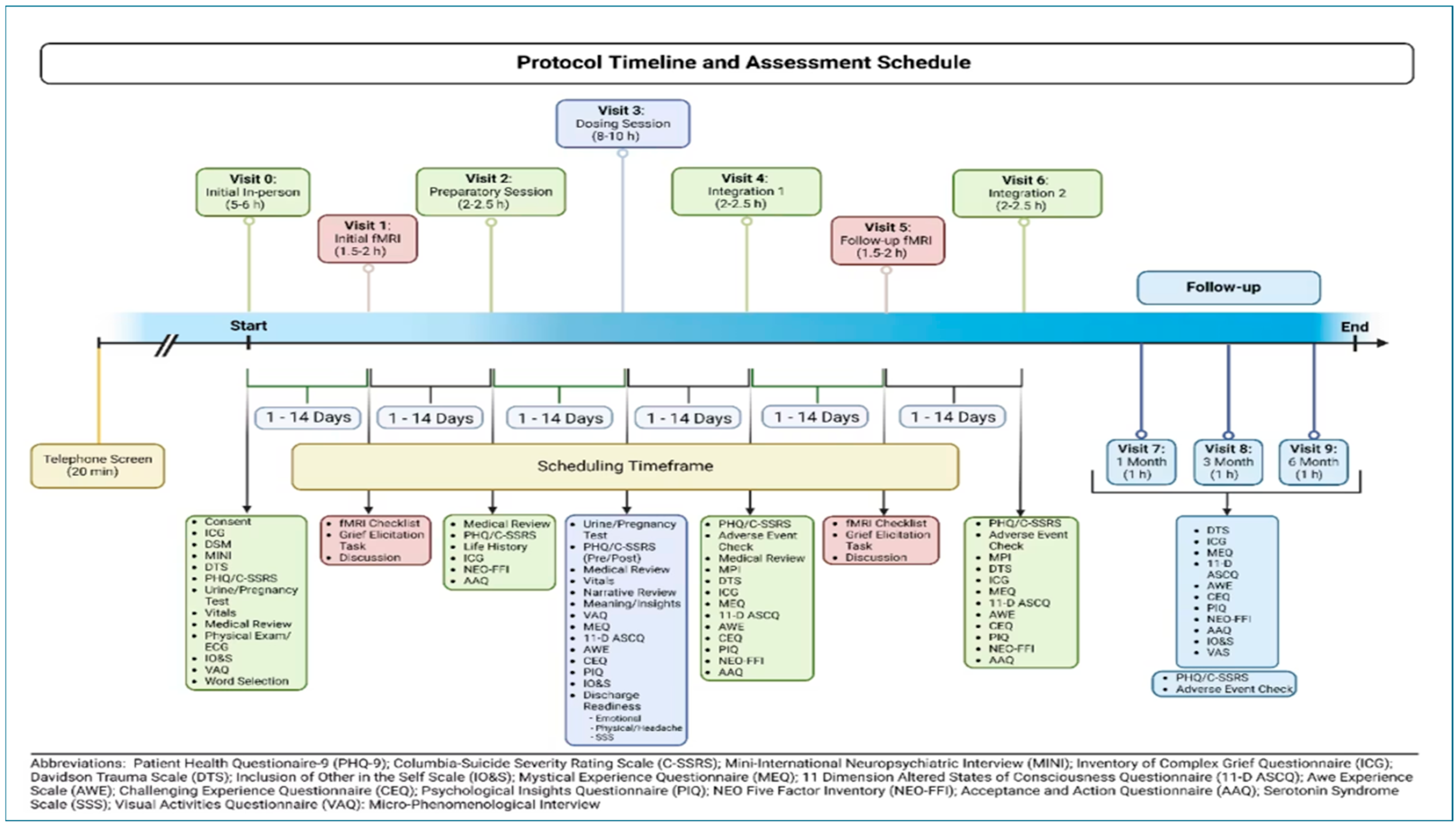
The study timeline is illustrated in
Figure 1. All procedures and protocols are carried out with best practices and have been approved by the IRB. All clinicians and study personnel are trained in a standardized manner on clinical research best practices and must adhere to the approved protocols. In the first two to four weeks, participants will undergo screening, provide consent, and complete baseline assessments. Next, a participant preparation session will be held, consisting of a therapeutic orientation, setting realistic expectations, and reviewing safety measures. This session will consist of a semi-structured interview focused on building rapport, exploring the individual grief, and setting intentions for the dosing session. All clinicians are trained in culturally appropriate interviewing.
On dosing day, in a supportive environment with two trained clinicians present, participants will be given a single 25 mg oral psilocybin dose while wearing an eye mask and listening to music via headphones. Within the two weeks following the treatment, participants will undergo two integration sessions. Structured integration sessions are designed to act as dose–response amplifiers, enhancing the durability of the psychedelic experience and its therapeutic gains, supported by evidence indicating that a structured approach predicts better long-term outcomes [
14]. These sessions will involve semi-structured interviews regarding the subjective experiences and their impact on the participant and their grief, with the first interview focused on phenomenological experiences and the second on the microphenomenology of a specific salient experience. Functional MRIs will be conducted prior to and following psilocybin dosing, per the schedule in
Figure 1. Follow-up visits will continue for up to six months post-dosing to monitor symptoms and safety.
3.4. Therapeutic Model
Study clinicians are trained in psychedelic-assisted psychotherapy and the lead clinician is certified by the Integrated Psychiatry Institute. The therapeutic protocol includes structured preparation and integration procedures designed to support participants throughout the psilocybin-assisted therapy process and to optimize both safety and therapeutic benefit. Prior to dosing, clinicians engage participants in preparatory sessions aimed at developing a comprehensive understanding of the individual’s grief history, cultural and emotional context, and current symptoms or functional impairments. This individualized assessment informs a tailored therapeutic approach sensitive to each participant’s experiences of loss.
Preparation sessions also focus on collaboratively identifying intentions for the psychedelic session and clarifying therapeutic goals. Participants are encouraged to reflect on areas of emotional exploration or healing they hope to address, while clinicians emphasized that psychedelic experiences can be unpredictable and may include challenging psychological material. The preparatory phase additionally involves detailed discussion of the dosing procedures, safety protocols, and the supportive clinical environment in which the session would occur.
Following the dosing session, structured integration meetings are conducted to facilitate meaning-making and psychological processing of the experience. During these sessions, participants reflected on insights that emerged during the psychedelic state and considered how these insights might inform coping, grief processing, and daily functioning. Integration is conceptualized as an ongoing therapeutic process that extends beyond the acute psychedelic experience.
Throughout the preparation and integration phases, clinicians emphasize the importance of maintaining realistic expectations. Participants are informed that responses to psilocybin vary widely and that both positive and challenging experiences may occur. These discussions are intended to promote openness to the full range of potential outcomes and to frame difficult experiences as opportunities for reflection and growth within the broader therapeutic context.
Participants will receive non-directive support before, during, and after dosing, with a focus on meaning-making and emotional processing. Semi-structured interviews will be used at the pre-dosing session to help participants explore and establish intentions surrounding their own grief. Standard psychedelic-informed care during the administration of the psilocybin will be used to provide a safe, supportive and therapeutic environment for participants to experience their psilocybin dosing. Participants will be in a reclined position, wearing eye masks and listening to a predetermined soundtrack via headphones, commonly used in psychedelic experiences. The soundtrack is identical to those used at other academic institutions for psilocybin research. In the first integration session, we will explore the phenomenology of participants’ unique subjective experiences employing a semi-structured interview focused on collecting qualitative data about their macroexperiences, such as feeling out of their body, experiencing awe, seeing visual stimuli, and connecting with ancestors. Next, participants will choose the most salient experience from the first integration session, and in the second integration session, structured microphenomenological interviews will be conducted to obtain information about that moment of insight. Vitals of participants and any emergent adverse effects will be monitored throughout the study.
4. Outcome Measures and Aims
The primary goals are to assess feasibility, acceptability, safety, and changes over time in symptoms of grief and trauma, with the secondary assessments being more exploratory. The assessment schedule is detailed in
Table 1 and described in more detail below.
Safety and tolerability are monitored with both general and psychedelic-specific instruments. Psychedelic-related adverse effects are systematically assessed with the Swiss Psychedelic Side Effects Inventory (SPSI), which queries multiple specific side effects with standardized ratings of severity, duration, functional impact, and perceived relatedness to treatment at defined follow-up points [
24]. Symptoms suggestive of serotonin toxicity are evaluated using a Serotonin Syndrome Scale, a clinician-rated checklist of mental status changes, autonomic instability, and neuromuscular abnormalities (e.g., agitation, hyperreflexia, clonus, tremor, diaphoresis, fever), allowing quantification of syndrome severity when serotonergic agents are involved [
25]. Finally, functional visual difficulties in everyday life are measured with the Visual Activities Questionnaire (VAQ), which assesses problems with tasks such as reading, driving, night vision, and glare sensitivity, providing an index of vision-related quality of life and potential treatment-emergent visual changes [
26].
Measures included self-report questionnaires and structured interviews assessing grief, trauma, altered states of consciousness, psychological processes, personality, and safety outcomes. Complicated grief symptoms are assessed with the Inventory of Complicated Grief (ICG), a 19-item measure of maladaptive grief reactions such as persistent yearning, disbelief, anger, and difficulty accepting the loss [
27]. Posttraumatic stress symptoms are measured using the Davidson Trauma Scale (DTS), a 17-item self-report instrument that evaluates frequency and severity of DSM-IV PTSD symptoms over the past week in relation to an index trauma, yielding cluster and total scores [
28]. Depressive symptoms are assessed with the Patient Health Questionnaire-9 (PHQ-9), which maps the nine DSM criteria for major depressive episodes onto a four-point frequency scale over the past two weeks and provides a widely used continuous severity score [
29]. Suicidal ideation and behavior are monitored with the Columbia–Suicide Severity Rating Scale (C-SSRS), a semi-structured interview that rates the presence, intensity, and recentness of suicidal thoughts as well as actual, aborted, and preparatory suicidal behaviors [
30]. Lifetime and current psychiatric diagnoses are established with the Mini-International Neuropsychiatric Interview (MINI), a modular structured interview assessing DSM/ICD mood, anxiety, psychotic, substance use, and related disorders using standardized branching algorithms [
31].
Psychedelic-related acute experiences are characterized by several validated altered states instruments. Mystical-type experiences are assessed with the Mystical Experience Questionnaire (MEQ), which evaluates dimensions such as unity, sacredness, noetic quality, positive mood, transcendence of time and space, and ineffability during or shortly after a discrete session, with higher scores indicating more intense mystical experiences [
32]. Broader altered state phenomenology is captured using the 5-Dimensional Altered States of Consciousness Questionnaire (5D-ASC), a 94-item visual analog measure yielding scores on Oceanic Boundlessness, Anxious Ego Dissolution, Visionary Restructuralization, Auditory Alterations, and Vigilance Reduction, thus providing a detailed profile of the psychedelic state [
33,
34]. Positive awe is measured with the Awe Experience Scale (AWE-S), which assesses altered time perception, self-diminishment, connectedness, perceived vastness, physical sensations, and need for accommodation in response to an awe-eliciting event [
35]. Challenging psychedelic experiences (“bad trips”) are assessed with the Challenging Experience Questionnaire (CEQ), which yields scores across grief, fear, death, insanity, isolation, physical distress, and paranoia dimensions based on retrospective ratings of a specific psychedelic session [
36]. Acute psychological insights arising from the session are assessed with the Psychological Insight Questionnaire (PIQ), a 23-item measure with subscales for insight into avoidance and maladaptive patterns and insight into goals and adaptive patterns, rated for intensity during or shortly after dosing [
37].
Several measures targeted enduring psychological processes and personality traits. Psychological inflexibility and experiential avoidance are assessed with the Acceptance and Action Questionnaire-II (AAQ-II), a seven-item self-report scale in which higher scores reflect greater difficulty allowing and engaging with unwanted internal experiences and pursuing valued actions [
38]. Meaning in life is measured using the Meaning in Life Questionnaire (MLQ), which provides Presence of Meaning and Search for Meaning subscales indexing the degree to which participants experience life as meaningful and the extent to which they are actively seeking meaning [
39]. Perceived interpersonal closeness is captured with the Inclusion of Other in the Self (IOS) Scale, a single-item pictorial measure in which respondents select overlapping circles representing the degree of inclusion of a specified other (or group) in the self [
40]. Broad personality traits are assessed with the NEO Five-Factor Inventory (NEO-FFI), a 60-item self-report inventory providing Neuroticism, Extraversion, Openness, Agreeableness, and Conscientiousness scores for use as baseline descriptors and potential moderators of treatment response [
41].
4.1. Quantitative Assessments
Grief severity will be measured with the ICG to enable standardized symptom tracking over time. Secondary clinical measures will include those reported in
Table 1. To characterize acute and persisting psychedelic effects, participants will complete the Mystical Experience Questionnaire (MEQ-30) and other quantitative measures listed in
Table 1.
4.2. Neuroimaging
We will acquire functional MRI (fMRI) before and after dosing to assess modulation of emotion-regulation circuitry and large-scale networks implicated in prolonged grief. Each session includes (a) resting-state fMRI and (b) a grief-elicitation task based on the Singer paradigm [
42].
Prior to the initial fMRI scan date, participants are asked to provide three photographs of the person who has passed away. They will then rate their attachment level to the person who has passed away on the Inclusion of Other in the Self (IOS) Scale, which asks, “Which picture best describes your relationship with the person who has passed away, before their death?” on a seven-point Likert scale [
40], and “Which picture best describes your current relationship with the person who has passed away?” Participants will also provide three pictures of one other family member or friend they feel similar closeness to (within 1 on the IOS; [
40]). For example, if they rated the person who has passed away as a 5, they would choose a family member or friend they would rate as a 4, 5, or 6 on the IOS as their living loved-one control picture. After the study staff receive the images, a database [
43] will be used to select images of a stranger that were matched to the person for sex, age, and race. After the pictures are sent to the study staff, stimulus words (80 active and 80 control words) [
42] are sent to participants and they are asked to rate each of them as 0: not relevant to their loss, 1: relevant to their loss, 2: extremely relevant to their loss. Then, 15 words that are rated as 2, supplemented with words rated as 1 if needed, are randomly selected. These photos and words are then made into 60 total composites, each consisting of one picture (person who has passed away, living family member, or stranger) and one word (grief-related or neutral), forming a 3 (picture groups) × 2 (grief vs neutral words) factorial design. The 60 composites are presented in a randomized order (see Singer et al., [
42]) for a full description of the grief-elicitation task). During the scan, each participant will be provided with the same set of instructions: “Focus on any thoughts, feelings or memories you have to the combination of the picture and the word on the slide. Let yourself respond emotionally to each slide by being aware of your feelings without trying to alter them”. The composite (i.e., word plus picture) will appear on the screen followed by a fixation point (i.e., +), which has been validated in past grief research studies [
44].
4.2.1. Preprocessing
All functional data will be preprocessed in SPM12 Toolbox [
45], supplemented with in-house MATLAB 24B scripts. The preprocessing pipeline includes realignment to correct for signal displacements caused by head motion. The mean EPI image will be co-registered to each participant’s T1-weighted anatomical image to ensure accurate alignment between functional and structural data.
The anatomical image will be segmented into tissue classes and used to generate deformation fields for normalization of both anatomical and functional images to the MNI152 template (1 mm × 1 mm × 1 mm for anatomical and 3 mm × 3 mm × 3 mm for functional). Following normalization, skull stripping will be performed to remove non-brain tissue. An in-house PCA-based method will be applied to remove low-frequency drifts and global signal fluctuations, improving temporal stability of the BOLD signal [
46]. Finally, the normalized images will be spatially smoothed with a 6 mm full-width at half-maximum (FWHM) Gaussian kernel to enhance signal-to-noise ratio and reduce intersubject variability.
4.2.2. General Linear Model
First-level analyses will be conducted using the general linear model implemented in SPM12. For each participant, the design matrix will be constructed based on the timing of experimental trials. Regressors will be generated from trial onset and duration information and convolved with the canonical hemodynamic response function. Temporal derivatives will be included to account for variability in response timing. Motion parameters derived from realignment will be included as nuisance regressors, along with standard temporal filtering and correction for temporal autocorrelation.
At the first level, no statistical thresholding will be applied. Instead, subject-specific contrast images will be computed and carried forward to group-level random-effects analyses.
At the group level, contrast images will be entered into one-sample t-tests to assess population-level effects. Whole-brain statistical inference will follow commonly adopted practices in the neuroimaging literature, using a voxelwise threshold of p < 0.001 (uncorrected), with control for multiple comparisons implemented using a false discovery rate (FDR) correction at q < 0.05.
In addition to the primary voxelwise inference, an exploratory cluster-level analysis will be conducted using a Monte Carlo simulation-based approach. Specifically, Gaussian noise volumes matched to the spatial resolution, smoothness, and dimensions of the data will be generated to estimate the null distribution of maximal cluster sizes. Based on this empirically derived null distribution and the chosen voxelwise threshold, a minimum cluster extent threshold corresponding to
p < 0.05 will be determined. Results from this analysis will be reported as exploratory and interpreted in the context of the primary voxelwise findings. This approach is consistent with cluster-based inference methods commonly used in naturalistic fMRI paradigms, where effects are often spatially extended rather than highly focal [
47], and whose statistical properties and implementation considerations have been extensively characterized in the neuroimaging literature [
47].
4.2.3. Functional Connectivity Analyses
In addition to task-evoked activation analyses, exploratory functional connectivity analyses will be conducted to characterize large-scale network organization. Connectivity will be assessed using a region-to-region approach based on predefined anatomical regions from a standard atlas (e.g., Automated Anatomical Labeling, AAL). Time series will be extracted from each region, and pairwise functional connectivity will be computed using correlation-based measures, followed by appropriate transformation for statistical analysis.
Connectivity patterns will be examined both at the level of individual region-to-region interactions and within canonical large-scale networks, including the default mode network, executive control network, frontoparietal network, salience network, and dorsal attention network. Network-level summaries will be derived by aggregating connectivity strengths within and between these predefined systems.
Group-level analyses will be performed to evaluate connectivity differences across conditions using standard statistical models. Multiple comparisons will be controlled using false discovery rate correction across tested connections or network-level metrics. These analyses are exploratory in nature and are intended to complement the primary activation-based findings by providing insight into distributed functional organization.
Regions of interest and whole-brain analyses. A priori ROIs include the amygdala, hippocampus, anterior/subgenual cingulate, vmPFC/dlPFC, anterior insula, PCC/precuneus, and ventral striatum. We test pre-to-post changes in activation and brain–behavior coupling, with complementary whole-brain analyses (multiple comparisons corrected).
Outcomes and hypotheses. We expect post-dosing attenuation of limbic/salience responses (e.g., amygdala, anterior insula) during grief cues, increased engagement of regulatory vmPFC/sgACC, reduced amygdala–DMN coupling during grief, strengthened regulatory connectivity, and normalization of DMN coherence. Trial-level grief ratings are expected to decline and show weaker positive coupling with limbic activation.
Session timing and standardization. Two identical scan batteries are acquired pre- and post-dosing within the protocol window. Personalized cue sets of photos are standardized (formatting, intensity bounds) and held constant across sessions to balance habituation and comparability.
4.3. Qualitative Data
Two semi-structured interviews will be conducted at approximately one week and six weeks after dosing. Session 1 (phenomenological interview, ~60–90 min) characterizes the overall phenomenology of the psilocybin session and its aftermath—scope, intensity, and meaning.
Session 2 (microphenomenological interview, ~60–90 min) is meant to elicit a fine-grained, moment-by-moment reconstruction of one specific experience identified in Session one via microphenomenological interviewing.
These are described in more detail below.
4.3.1. Session 1: Phenomenological Interview
Qualitative interviews will be analyzed using a phenomenological, theme-oriented framework. These interviews will be coded inductively to identify recurrent themes in domains such as affective–cognitive shifts, self-identity, relational experiences with the deceased, somatic/perceptual phenomena, and grief processing and integration. The interviews will be examined at a finer temporal grain, focusing on moment-to-moment sequences of perception, affect, and meaning-making within single, highly salient episodes.
The interviews will be transcribed verbatim and entered into a qualitative analysis software; a coding framework will be developed iteratively by at least two analysts who will first code a subset of transcripts jointly to refine the codebook, resolve discrepancies through discussion, and ensure a shared understanding of categories. We will document analytic decisions in an audit trail, hold regular reflexive meetings, and, where appropriate, use double-coding on a subset of transcripts to enhance analytic credibility rather than to compute formal reliability coefficients, which are less informative for phenomenological work.
In the mixed-methods integration, qualitative themes (e.g., shifts in meaning, connectedness, or acceptance) will be linked to individual-level quantitative trajectories (ICG, DTS, and measures of psychological flexibility, meaning in life, and mystical-type experience) and exploratory fMRI markers. Specifically, we will (a) compare narrative patterns for participants who show larger versus smaller symptom improvements, (b) examine whether particular experiential/process themes co-occur with higher MEQ-30 or related scale scores, and (c) use qualitative case vignettes to contextualize observed neuroimaging changes in emotion-regulation circuitry. This convergent mixed-methods approach is intended to triangulate subjective, behavioral, and neural indicators of grief transformation and to refine hypotheses for subsequent, fully powered trials.
Focus is placed on broad experiential domains and putative therapeutic mechanisms. Core domains include the following:
Affective/cognitive: awe, serenity, fear/anxiety, insight, shifts in appraisal of loss.
Self/identity: ego attenuation or expansion, changes in self-narrative and values, connectedness (to self/others/world).
Relational/attachment: perceived interactions with the deceased (e.g., sensing presence, “meeting” deceased loved-ones/ancestors), forgiveness/reconciliation themes.
Perceptual/somatic: visual/auditory phenomena, body sensations, out-of-body experiences.
Grief processing and meaning-making: yearning, acceptance, continuing bonds, changes in avoidance/rumination, reorientation to life goals.
Integration/aftereffects: emotional tone days 1–7, sleep/dreams, social functioning, rituals/practices adopted.
Interviewers will use open prompts (e.g., “Walk me through the most salient moments from onset to resolution”) and brief clarification probes, avoiding interpretation. Participants will nominate 2–3 salient moments; one will be selected (collaboratively) as the target for Session 2.
4.3.2. Session 2: Microphenomenology
A microphenomenological analysis begins with a carefully conducted interview that invites the participant to re-evoke a specific, singular moment from their psilocybin experience that felt most meaningful in relation to their grief and therapeutic intentions. The interviewer guides the participant away from general interpretations and toward a detailed re-experiencing of the moment, focusing on how it unfolded in real time—across sensory, emotional, cognitive, and bodily dimensions. The interview is then transcribed verbatim, and the analyst engages in repeated readings to develop a holistic understanding while bracketing prior assumptions.
Next, the transcript is segmented into discrete experiential phases based on shifts in attention, emotion, or perception, allowing the analyst to reconstruct the temporal unfolding of the experience. Within each segment, fine-grained experiential elements are identified, including perceptual features (e.g., imagery), bodily sensations, emotional tone, shifts in meaning, and relational experiences (such as a sense of connection to the deceased). Attention is given to how these elements interact dynamically—for example, how a somatic release may precede a meaningful insight or emotional resolution.
Finally, these elements are synthesized into a coherent description of the participant’s most salient experience, highlighting key turning points and mechanisms of change related to grief processing, such as reconnection, emotional release, or meaning reconstruction. When applied across participants, this approach also allows for identification of shared experiential patterns that may underlie therapeutic effects in psilocybin-assisted treatment for prolonged grief.
Using a microphenomenological approach, the interviewer guides the participant to re-evoke a single chosen episode (e.g., an encounter with a deceased loved one, an out-of-body experience, or a surge of awe) and describe it with high temporal and sensory resolution. Probes address the following:
Temporal unfolding: onset cues → peak → resolution (seconds to minutes).
Attention and intention: what was noticed first; shifts in focus; implicit goals.
Sensory/somatic micro-events: visuals, sounds, interception, proprioception.
Affect and appraisal dynamics: moment-to-moment emotions; meaning updates as they occurred.
Relational stance: perceived reciprocity/agency in encounters (if applicable).
Regulatory processes: spontaneous strategies (breath, surrender, reframing) and their immediate effects.
The interviewer reflects wording back in the participant’s terms, minimizes leading questions, and anchors descriptions to precise markers (“What happened just before/after…?”).
Microphenomenological interviewers are trained and certified in microphenomenological interviewing and analysis. All interviews are audio-recorded and professionally transcribed; transcripts are de-identified.
4.4. Safety Monitoring
Ensuring and evaluating safety will be central to the study. Safety monitoring procedures are implemented throughout the dosing session to ensure participant well-being and to allow for timely management of any physiological or psychological reactions.
Safety screening will include structured assessment of psychiatric risk, with specific attention to suicidality, to confirm eligibility and support participant safety. During screening, participants will complete the MINI and PHQ-9, and the C-SSRS will be administered when indicated to assess the presence, severity, and acuity of suicidal ideation, intent, plan, and behavior. Grief severity and diagnostic eligibility will be determined using the DSM-5-TR criteria for PGD in conjunction with the ICG; participants must score greater than 25 on the ICG and must not meet exclusionary criteria on the MINI, including thought disorder or any other condition that, in the judgment of the principal investigator, would preclude safe or meaningful participation. Additional distress symptoms will be assessed using the DTS.
If screening identifies a psychiatric or psychological condition of a crisis nature, including acute psychosis, suicidal intent, or other imminent safety concerns, the individual will be excluded from the study and referred for immediate emergency evaluation, including transfer to the emergency department when clinically indicated. During study participation, participants will be monitored for emergent or worsening suicidality, and additional assessment will be conducted if there is evidence of increased hopelessness, worsening mood, suicidal ideation, or other clinically concerning changes in mental status. Any positive or clinically significant finding on the C-SSRS, or an equivalent concern identified during clinical interview, will prompt immediate review by the study team and the principal investigator, with escalation to emergency services when risk is determined to be acute or otherwise not safely manageable within the research setting.
Psychological distress will be managed using a stepped-care approach. If a participant becomes anxious, frightened, or overwhelmed, staff will first provide verbal reassurance, grounding, and other nonpharmacological support strategies such as grounding, breath coaching, orientation to the room, and therapeutic containment. If these measures are insufficient, rescue medication may be administered under medical supervision according to protocol and documented in real time. The dosing session will be stopped if distress becomes severe, persistent, or functionally destabilizing, or if the participant requests to discontinue. Participants will also be monitored for common acute or transient effects of psilocybin, including headache, nausea, transient increases in anxiety, and sleep disruption, and may receive appropriate symptomatic treatment after the session if clinically indicated.
Vital signs, including blood pressure, heart rate, and other clinically relevant indicators, will be assessed repeatedly every thirty minutes during the session by trained study staff using an automated cuff and, when indicated, confirmatory manual measurement to reduce artifact and ensure accuracy. If blood pressure or other vital signs show sustained or clinically concerning elevations, staff will intensify monitoring, pause or slow the session as needed, notify the study physician immediately, and determine whether additional medical evaluation or pharmacologic intervention is required. Clear stopping rules will be followed if prespecified thresholds are exceeded, if symptoms worsen despite supportive measures, or if the study physician judges that continued participation is no longer safe.
In the event of a serious adverse event or medical emergency, the study physician will be contacted immediately and will assume responsibility for clinical decision-making. Emergency procedures will include activation of emergency medical services, implementation of site-specific emergency response pathways, and transfer to a nearby hospital when necessary. Staff will be trained in advance on escalation procedures, documentation requirements, and roles during emergencies so that the response is rapid and coordinated. Participants will be informed before dosing about possible risks, available supports, and the conditions under which the session may be paused or discontinued, thereby strengthening both participant safety and protocol transparency.
5. Analysis Plan
5.1. Feasibility and Safety
Analyses will primarily be descriptive and exploratory, consistent with the single-arm feasibility design and small sample size. Feasibility outcomes (e.g., numbers screened and enrolled, recruitment rate, retention through each visit, and completion of key assessments) will be summarized using counts, proportions, and simple 95% confidence intervals where informative. Safety will be characterized by descriptive summaries of adverse events, serious adverse events, and Columbia–Suicide Severity Rating Scale (C-SSRS) findings, along with descriptive statistics for PHQ-9 scores and vital signs over time. No formal hypothesis tests will be performed for feasibility or safety endpoints; the focus is on identifying procedural challenges and characterizing the safety profile to inform a subsequent randomized trial.
5.2. Clinical Outcomes
Given the exploratory nature of this feasibility study and the planned sample of 20 participants, analyses of clinical and experiential outcomes will be treated as preliminary signal detection rather than confirmatory hypothesis testing. For the primary clinical measures (ICG and DTS), we will compute within-subject change scores from baseline to each post-dosing assessment (immediately post-intervention and at one, three, and six months) and summarize these with means, standard deviations, and 95% confidence intervals. Where helpful for gauging the magnitude of change, we will report standardized effect sizes (e.g., Cohen’s d for paired observations); any associated p-values from paired t-tests will be considered exploratory and interpreted cautiously, without claims of definitive efficacy.
Secondary quantitative measures (e.g., MEQ-30, AWE, CEQ, AAQ, MIL, IOS, and related scales) will be summarized descriptively at each time point. When appropriate, pre- to post-change scores for these measures will also be presented with effect sizes and exploratory paired comparisons. Simple correlations between experiential measures (e.g., MEQ-30 scores) and changes in grief and trauma symptoms (ICG, DTS) will be examined in an exploratory fashion to generate hypotheses for future trials; no adjustments will be made for multiple comparisons, and results will be framed as hypothesis-generating only. No a priori Type I or Type II error rates are specified for these exploratory clinical analyses, and the study is not powered to detect prespecified effect sizes.
In this feasibility trial with repeated follow up assessments over six months, some missing data due to attrition and intermittent nonresponse is expected. Missing data will be minimized through flexible scheduling, reminders, and remote follow-up when feasible, and we will report retention and assessment completion rates at each visit. Clinical outcomes will be analyzed under an intention-to-treat framework using paired t-tests.
Qualitative analysis of subjective experiences. Subjective experiences reported in participant narratives from the intention-setting preparation session and integration sessions I and II will be explored qualitatively using qualitative data analysis software to review transcribed narratives. We will use thematic analysis to identify, analyze, and report patterns (themes) in the data, defining and naming themes to capture their content and relevance in the context of the study. This approach will support interpretation of participants’ narratives in relation to personal history, cultural context, and circumstances of grief and will enable synthesis of findings into an integrated account of perceived impact and change following psilocybin administration.
Dropout analysis. Dropout will be characterized using survival analysis methods, and we will explore patterns and potential predictors of dropout.
5.3. Integration of Mixed-Methods and fMRI (Exploratory)
Integration of qualitative, quantitative, and neuroimaging data will be explicitly exploratory and aimed at hypothesis generation. Qualitative themes (e.g., shifts in meaning, connectedness, or acceptance) will be examined alongside individual-level symptom trajectories and experiential scale scores to identify convergent and divergent patterns across data streams. Pre- and post-intervention fMRI data will be summarized using within-subject contrasts (e.g., grief versus control cues) in a descriptive manner, focusing on the direction and approximate magnitude of changes in a priori regions of interest. Given the limited sample size, no formal inferential tests or corrections for multiple comparisons will be emphasized for fMRI outcomes; instead, findings will be used to refine mechanistic hypotheses and to inform the design and analytic strategy of a future adequately powered randomized controlled trial.






 ,
,