Article

Learning Objectives as Strategic Learning Tools: Divergence Between Educator-Endorsed and Student-Described Practices in Medical Education


Frank H. Netter MD School of Medicine, Quinnipiac University, Hamden, CT 06518, USA
*
Author to whom correspondence should be addressed.
Int. Med. Educ. 2026, 5(2), 36; https://doi.org/10.3390/ime5020036
Submission received: 16 March 2026 / Revised: 3 April 2026 / Accepted: 3 April 2026 / Published: 5 April 2026

Abstract

Learning objectives are a foundational component of undergraduate medical education and are widely assumed to guide students’ studying, planning, and self-assessment. Despite these assumptions, limited empirical work has examined how medical students actually use them in practice. This study examined learning objectives as strategic learning tools by contrasting educator-endorsed strategies identified through a scoping review with student-described practices derived from qualitative focus groups with pre-clerkship medical students. The scoping review identified educator-centered strategies emphasizing proactive planning, self-directed learning, and assessment alignment. Focus group findings revealed that students engaged with objectives selectively and reactively. Most often after learning events for self-testing, gap identification, and content triage; a pattern markedly different from educator assumptions of routine, front-end use. Two novel findings emerged: students’ use was shaped by conditional trust in objective quality and assessment alignment, and a subset of students independently developed technology-enabled adaptations (including AI-generated practice questions and flashcard conversion) not reflected in the existing educator literature. These findings highlight a meaningful gap between prescriptive guidance and student learning realities, and suggest that more learner-aligned approaches to supporting learning objective use are warranted.

1. Introduction

Learning objectives are a foundational component of undergraduate medical education. They are used to articulate expected competencies, guide curricular design, inform assessment strategies, and demonstrate alignment with accreditation standards [1,2,3]. From an educator perspective, well-written learning objectives provide clarity regarding instructional intent and define measurable outcomes that learners are expected to achieve by the end of a course, session, or program [4,5]. As such, learning objectives are often treated as quality indicators within curriculum review, faculty evaluation, and program accreditation processes [1,2,3].
Beyond their administrative and curricular roles, learning objectives are also intended to function as strategic tools for learners. In theory, they signal priority content, delineate the scope and depth of expected knowledge, and support self-directed learning, study planning, and self-assessment [4,5,6]. Educational frameworks commonly imply that learners will actively use learning objectives to preview material, structure study activities, and evaluate readiness for assessment [4,6]. Despite these assumptions, relatively little empirical attention has been paid to whether, and how, medical students actually use learning objectives in their day-to-day studying and learning practices [2,7].
The existing literature on learning objectives in medical education has predominantly focused on their construction, alignment, and evaluation from an educator or curricular standpoint [1,2,4,5]. Prior studies and guidance emphasize writing clear, measurable objectives, mapping objectives to assessments, and ensuring alignment across courses and programs [2,4,5]. While some authors suggest ways in which students should engage with learning objectives, these recommendations are typically prescriptive and faculty-driven, rather than grounded in empirical investigation of student behavior or lived experience [4,6].
This emphasis on educator-endorsed practices raises an important and underexplored question: to what extent do medical students actually use learning objectives as strategic learning tools, and how does this compare with educator assumptions and recommendations? Without a clear understanding of student-led applications, curricular efforts to improve or refine learning objectives risk reinforcing assumptions that may not align with learners’ realities, preferences, or constraints [6,7,8].
Understanding how medical students engage with learning objectives has practical implications for instructional design, learner support, and academic coaching. If learning objectives are underutilized, misinterpreted, or perceived as burdensome rather than helpful, this may represent a missed opportunity to support self-regulated learning and efficient study practices [7,8]. Conversely, identifying how students meaningfully integrate learning objectives into their learning routines may inform more learner-centered guidance and faculty development efforts [6,7,8].
These considerations are usefully framed within self-regulated learning (SRL) theory, which positions learners as active agents who set goals, select strategies, monitor progress, and reflect on outcomes [9]; processes that learning objectives are ostensibly designed to support. Examining how students actually engage with learning objectives in relation to these regulatory processes may therefore illuminate not only gaps in practice, but also the conditions under which objectives can most effectively serve their intended function.
Accordingly, our purpose was to examine the use of learning objectives as strategic learning tools in undergraduate medical education by contrasting educator-endorsed strategies described in the literature with student-led applications derived from learners’ lived experiences. In this study, “strategic” refers to purposeful, goal-directed decisions learners make to manage learning demands. By integrating a scoping review of the literature with qualitative focus group data from pre-clerkship medical students, the work aims to illuminate gaps between prescription and practice and to inform more learner-aligned approaches to the use of learning objectives.

Research Questions and Objectives

This investigation was guided by the following research questions:
  • What strategies do educators endorse in the peer-reviewed literature for how medical students should use learning objectives as part of their studying and learning practices?
  • How do medical students describe using learning objectives in practice before, during, and after learning events?
  • In what ways do educator-endorsed strategies align with or diverge from student-led applications of learning objectives?
The corresponding study objectives were to:
  • Identify and characterize educator-endorsed strategies for using learning objectives as strategic learning tools through a scoping review of the literature.
  • Explore medical students’ lived experiences and practical use of learning objectives through qualitative focus groups.
  • Compare and contrast educator-prescribed approaches with student-described practices to identify gaps, mismatches, and opportunities for more learner-centered guidance.

2. Materials and Methods

2.1. Study Design

This study employed a two-phase, mixed-methods design to examine how learning objectives are used as strategic learning tools in undergraduate medical education. Phase 1 consisted of a scoping review of the peer-reviewed literature to identify educator-endorsed strategies for incorporating learning objectives into medical students’ study practices. Phase 2 consisted of qualitative focus groups with medical students to explore student-led applications of learning objectives based on learners’ lived experiences. Together, these complementary phases were designed to contrast prescriptive guidance from the literature with authentic student practices [10]. Phase 1 directly informed Phase 2: the educator-endorsed strategies identified in the scoping review shaped the organizing framework of the focus group facilitation guide (specifically, the before/during/after structure) and provided the deductive codes applied during the initial phase of thematic analysis. This sequential, integrated design allowed the qualitative phase to interrogate student practices in relation to the prescriptive strategies identified in the literature, enabling a systematic comparison across both phases. The before/during/after framework was additionally informed by Zimmerman’s three-phase model of self-regulated learning (forethought, performance, and self-reflection), which provided a theoretically grounded structure for examining how students engage with learning objectives across the learning cycle [9].

2.2. Ethical Considerations

This study was reviewed by the Quinnipiac University Institutional Review Board (IRB) and determined to meet criteria for exempt research under U.S. federal regulation 45 CFR 46.104(d), as it involved normal educational practices and minimal-risk qualitative inquiry in an established educational setting. All focus group participants provided written informed consent prior to participation. To protect confidentiality, audio recordings were transcribed and de-identified using participant markers, and all subsequent analysis and dissemination were conducted using anonymized data.

2.3. Phase 1: Scoping Review of Educator-Endorsed Strategies

2.3.1. Review Framework

The scoping review was conducted in accordance with the Preferred Reporting Items for Systematic Reviews and Meta-Analyses Extension for Scoping Reviews (PRISMA-ScR) guidelines [11]. Although a broad body of literature discusses the role and construction of learning objectives in medical education, the scoping review was intentionally limited to peer-reviewed studies that explicitly examined or prescribed how medical students use learning objectives in their studying or learning practices. As a result, foundational or conceptual articles addressing learning objectives at the curricular or instructional level, but not student study behaviors, were not captured by the review.
A scoping approach was selected to map the extent, nature, and characteristics of existing literature addressing how learning objectives are recommended for use by medical students, rather than to assess intervention effectiveness [10,12]. The search was restricted to peer-reviewed publications; gray literature sources such as institutional curriculum documents, program handbooks, and educational practice reports were not systematically included. This decision reflected the study’s aim to characterize the peer-reviewed evidence base for educator-endorsed guidance; the implications of this boundary are addressed in Section 4.6.

2.3.2. Data Sources and Search Strategy

Seven electronic databases indexing health professions and education literature were searched in October 2023: PubMed®, Scopus®, CINAHL, JSTOR, the Cochrane Library, LGBTQ+ Life, and the Education Resources Information Center (ERIC). The Journal/Author Name Estimator (J.A.N.E.) was additionally used to identify relevant journals and potential sources.
Search terms were applied to article title and abstract fields using the following Boolean string:
(“learning objectives” OR “educational objectives” OR “learning outcomes” OR “study objectives”) AND (students OR learners) AND (“study habits” OR “studying techniques” OR “learning techniques” OR “academic performance”).
An updated search of the literature through March 2026 using the original search strategy did not identify any additional articles meeting the inclusion criteria. Although several recent studies addressed related constructs such as learning styles, motivation, blended learning, and academic performance, none explicitly examined how medical students use learning objectives as part of their study habits or learning techniques.

2.3.3. Eligibility Criteria and Study Selection

Inclusion criteria were: (1) peer-reviewed articles published in English, (2) studies involving undergraduate medical students, and (3) articles that explicitly addressed learning objectives in relation to student learning, studying, or academic performance. No publication date restrictions were applied.
Titles and abstracts were independently screened by pairs of reviewers, followed by full-text review of potentially relevant articles. Discrepancies were resolved through discussion and consensus with the principal investigator (DM) [11]. To calibrate the screening process, reviewer pairs first independently screened a shared pilot set of records and reconciled their decisions before proceeding to independent screening of the remaining records. Formal inter-rater reliability statistics (e.g., Cohen’s kappa) were not calculated; consistent with established scoping review methodology, the JBI Manual for Evidence Synthesis does not require kappa coefficients for scoping reviews, which rely on consensus-based rather than statistical agreement processes [12].

2.3.4. Data Extraction and Synthesis

Data extraction forms were developed to capture descriptive information from included studies, including publication year, journal, study design, and described applications of learning objectives. Included articles underwent qualitative thematic analysis using a combination of deductive coding (based on predefined concepts related to learning objectives) and inductive coding to capture emergent themes [13,14]. Findings were synthesized to characterize educator-endorsed strategies for integrating learning objectives into study practices.

2.4. Phase 2: Medical Student Focus Groups

2.4.1. Study Context and Participants

Participants were recruited from the Class of 2027 and the Class of 2028 at the Frank H. Netter MD School of Medicine at Quinnipiac University. Medical students were eligible if they were currently enrolled in the pre-clerkship curriculum. A total of 38 students participated across eight in-person focus groups, each consisting of approximately four-to-six participants.

2.4.2. Recruitment and Consent

Students were invited via email by the principal investigator (DM), which included a description of the study purpose, procedures, and voluntary nature of participation. Random sampling was used to determine which students from the Classes of 2027 and 2028 were invited. There were no academic consequences for participation or non-participation. Written informed consent was obtained prior to each focus group session.

2.4.3. Data Collection

Focus groups were conducted in-person and lasted approximately 50 min each. Sessions were audio-recorded and facilitated by trained medical student co-investigators using a semi-structured facilitation guide designed to elicit students’ practical use of learning objectives before, during, and after learning events. The facilitator guide is provided in Appendix A. Questions also explored students’ attitudes toward learning objectives, perceived utility, and desire for additional guidance.

2.4.4. Data Management and Analysis

Audio recordings were transcribed verbatim and de-identified by replacing participant names with alphanumeric codes. Transcripts were analyzed using qualitative thematic analysis. Researchers first familiarized themselves with the transcripts before generating initial codes through an iterative process that combined deductive codes informed by the literature with inductive codes derived from participants’ responses. Codes were subsequently organized into candidate themes, which were refined through collaborative discussion among the research team to ensure analytic rigor and conceptual clarity. Data collection continued until thematic sufficiency was achieved [13,14,15]. The coding framework and thematic development are summarized in Appendix B Table A1.

3. Results

3.1. Scoping Review Results and Study Selection

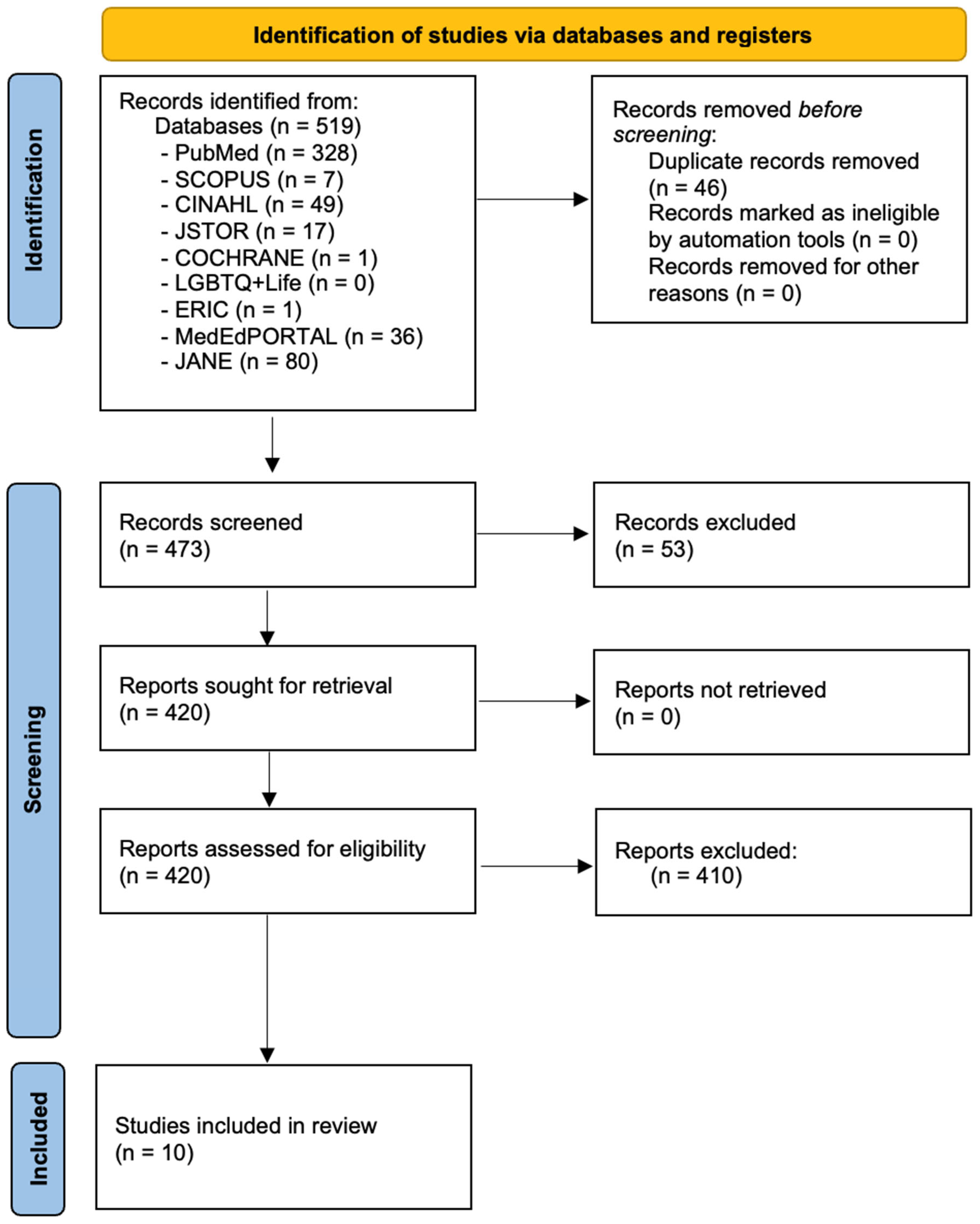
The database search yielded 519 records, of which duplicates were removed prior to screening. Following title and abstract screening, a subset of articles underwent full-text review for eligibility. A total of 10 articles met the inclusion criteria and were included in the scoping review. The study selection process is illustrated in Figure 1 and was conducted in accordance with PRISMA-ScR guidelines [11]. The relatively small number of included articles reflects the intentional specificity of the review question; which was limited to studies explicitly addressing how medical students use learning objectives as part of their studying practices, rather than the substantially larger literature on learning objective construction, curricular alignment, or assessment design. This itself constitutes a meaningful finding regarding the scarcity of empirical work in this area.
The characteristics of the included articles and the ways in which learning objectives were positioned within each study are summarized in Table 1.

3.2. Educator-Endorsed Strategies for Using Learning Objectives (Research Question 1)

All 10 articles included in the scoping review conceptualized learning objectives from an educator-centered perspective, describing how learning objectives are intended to be used by students within structured instructional, curricular, or academic support contexts. Several studies examined student perceptions or outcomes related to educator-designed interventions; however, none examined or documented how medical students independently used learning objectives as part of their self-directed study practices.
Analysis of the included literature revealed four recurring categories of educator-endorsed strategies for the use of learning objectives, described below.

3.2.1. Orienting and Previewing Content Prior to Learning Activities

Several studies described learning objectives as tools to help students orient to upcoming instructional content, particularly prior to lectures or small-group sessions (e.g., Grant et al., 2006; Nyland & Sawarynski, 2017; Hu et al., 2017) [16,19,21]. In these articles, educators recommended that students review learning objectives in advance to identify unfamiliar terminology, anticipate key concepts, and establish a preliminary framework for learning. Learning objectives were positioned as advance organizers intended to support attention and reduce cognitive load during instruction.
Across these studies, such practices were introduced through explicit educator guidance, including structured preparatory activities or facilitated interventions, rather than through observation of spontaneous student behaviors.

3.2.2. Structuring Self-Directed Learning and Study Planning

Multiple articles framed learning objectives as scaffolds for planning and organizing study activities, often embedded within academic coaching models or structured learning interventions (e.g., Reynolds, 2019; Mahmoodi et al., 2016; Yousaf et al., 2023) [17,22,25]. In these contexts, learning objectives were used to help students prioritize content, allocate study time, and monitor progress toward course expectations. These approaches were frequently embedded within academic coaching models, remediation efforts, or educator-designed learning tools.
Across the literature, effective use of learning objectives was portrayed as a skill requiring instruction, modeling, or coaching by educators, rather than as an assumed or naturally occurring student practice.

3.2.3. Supporting Active Learning and Retrieval-Based Strategies

A subset of articles linked learning objectives to active learning strategies, including retrieval practice and self-testing, typically within educator-facilitated contexts (e.g., Reynolds, 2019; Guerrasio et al., 2017) [18,22]. Educators encouraged students to transform learning objectives into questions or prompts to promote deeper engagement with course material and support long-term retention.
However, these strategies were consistently described within educator-facilitated environments, such as academic skills workshops or structured learning interventions. None of the included studies examined whether students independently adopted these practices outside of designed instructional settings.

3.2.4. Aligning Instruction, Assessment, and Expectations

Across the included literature, learning objectives were emphasized as mechanisms for aligning instructional content, assessment practices, and learner expectations (e.g., Sánchez et al., 2020; Hu et al., 2017; Yousaf et al., 2023) [19,23,25]. In this role, learning objectives functioned primarily as communicative tools, clarifying what knowledge or competencies would be emphasized and evaluated.
In these descriptions, learning objectives flowed unidirectionally from educator to learner. The literature did not explore how students might reinterpret, adapt, or repurpose learning objectives beyond their intended curricular framing.

3.2.5. Summary of Findings for Research Question 1

Taken together, the scoping review literature reflects a consistent pattern in which learning objectives are conceptualized and operationalized as educator-defined tools. While several studies examined student perceptions or outcomes within educator-designed interventions, none investigated student-led or self-initiated use of learning objectives in routine study practices.

3.3. Student-Described Use of Learning Objectives (Research Question 2)

Across eight focus groups, medical students described learning objectives as a familiar but variably trusted feature of the curriculum. While learning objectives were widely available and consistently encountered, students’ accounts revealed substantial variability in whether, how, and when objectives were used as part of their learning and study practices. Rather than serving as a single, stable study tool, learning objectives were described as being used selectively and pragmatically, depending on perceived quality, alignment with assessment, time constraints, and instructional context. Although the analysis explored student-described use of learning objectives before, during, and after learning events, students most frequently described engagement with learning objectives after instruction, with more limited and conditional use before learning events and minimal use during live instructional sessions.
Analysis of the focus group transcripts revealed several recurring themes that characterized students’ practical engagement with learning objectives.

3.3.1. Learning Objectives as Signals for Scope and Prioritization

Many students described using learning objectives as a means of identifying the scope of required content and determining what to prioritize. When learning objectives were perceived as clearly aligned with course assessments, students reported using them to focus attention on what “mattered most” and to guide decisions about depth of study. In these instances, objectives functioned as boundary-setting tools that helped students manage large volumes of material.
“I’ll look at the objectives just to see, like, okay, what are they expecting us to know from this lecture.” (FG6-P2)
However, learning objectives frequently competed with other cues that students perceived as more reliable indicators of importance, including faculty emphasis during lectures, repetition across sessions, and peer advice. Several students described using learning objectives primarily as a secondary reference or “backup,” rather than as a primary driver of study planning, particularly when uncertainty existed about assessment alignment.
“If the objectives line up with what they actually test on, then I trust them a lot more.” (FG6-P5)
“Sometimes the objectives say one thing, but what the professor keeps stressing feels more important.” (FG6-P6)

3.3.2. Learning Objectives as Organizational Frameworks for Notes and Shared Study Materials

A common student-led strategy involved transforming learning objectives into an organizational scaffold for note-taking and collaborative study resources. Students described copying learning objectives into personal documents or shared platforms (e.g., Google Docs) and then adding notes, summaries, or images beneath each objective. This approach was described as especially helpful early in the curriculum, when students were still developing personal systems for managing content.
“I’ll paste the objectives into a Google Doc and then just fill in notes under each one.” (FG1-P3)
For some students, these objective-based documents served multiple purposes: organizing lecture material, enabling keyword searching, and providing a sense of completeness during exam preparation.
“It helps me feel like I didn’t miss anything, because I can check off each objective.” (FG1-P4)
At the same time, many students reported that this approach became increasingly time-intensive and difficult to sustain as the perceived number of learning objectives associated with individual lectures increased. Consequently, some students described abandoning this strategy or reserving it for selected lectures or particularly challenging topics. As one participant expressed, using hyperbole to convey the magnitude of the workload:
“It worked early on, but once there were like forty objectives for a lecture, it just wasn’t realistic anymore.” (FG4-P2)

3.3.3. Learning Objectives as Prompts for Self-Testing and Gap Identification

Students most often described engaging deeply with learning objectives after learning events, using them as prompts for self-assessment and retrieval. In this use pattern, students reported reading a learning objective and asking whether they could “answer it” without assistance, using difficulty as a signal to revisit recordings, slides, or external resources.
“After I watch the lecture, I’ll go back to the objectives and ask myself if I can answer them.” (FG7-P1)
Some students described rewriting learning objectives as questions or using them to guide summary sheets and targeted review, particularly in the days leading up to examinations. These practices were framed as efficient ways to identify gaps in understanding, though students emphasized that such approaches were typically employed selectively rather than comprehensively.
“If I read an objective and realize I can’t explain it, that tells me I need to review that part again.” (FG7-P3)
“I’ll turn the objectives into questions when I’m studying for the test.” (FG7-P2)

3.3.4. Learning Objectives as Triage Tools During Cognitive Overload or Uncertainty

Learning objectives were frequently described as tools students turned to during moments of confusion, overload, or time pressure. In these situations, objectives were used to help decide whether content warranted deeper attention or could be deprioritized. Several students described consulting objectives when lectures felt excessively detailed or when they were unsure how much effort to devote to a particular topic.
“If a lecture is really dense, I’ll look at the objectives and decide what I actually need to focus on.” (FG6-P4)
At the same time, some students expressed concern that relying too heavily on objectives could lead them to miss nuanced or emphasized material that might still appear on assessments. This tension contributed to cautious or selective use of objectives rather than consistent reliance on them as definitive guides.
“I worry that if I only study the objectives, I’ll miss those random details they still put on exams.” (FG6-P6)

3.3.5. Influence of Format and Modality on Learning Objective Use

Students’ engagement with learning objectives varied depending on how objectives were presented and how students interacted with instructional content. Objectives were described as more usable when they were clearly embedded within lecture slides, explicitly labeled, or mapped to specific portions of content. Students reported that visible, well-integrated objectives reduced the effort required to connect objectives to material.
“It helps a lot when the objectives are actually on the slides, so you can see what goes with what.” (FG6-P1)
Asynchronous learning contexts also facilitated greater use of objectives, as students could pause recordings and cross-reference objectives while reviewing content. In contrast, live sessions were described as less conducive to objective use, as students prioritized attention, note-taking, and comprehension in real time.
“When I’m watching recordings, I’ll stop and check the objectives, but during live lecture I don’t have time.” (FG6-P2)

3.3.6. Barriers to Sustained Use: Volume, Vagueness, and Misalignment

Students consistently described barriers that limited their sustained use of learning objectives. A major challenge was volume; objectives were often described as too numerous to meaningfully operationalize, particularly when coupled with dense slide decks and limited study time.
“There are just too many objectives sometimes to actually do anything meaningful with them.” (FG7-P4)
Vagueness was also cited, with students expressing frustration when objectives used broad or non-actionable language (e.g., “understand” or “be familiar with”).
“When an objective just says ‘understand,’ I don’t really know what I’m supposed to do with that.” (FG6-P3)
Perceived misalignment between learning objectives and assessments further eroded trust. Students described instances in which exam questions emphasized content not clearly reflected in objectives, leading them to rely more heavily on alternative signals such as practice questions or faculty guidance.
“If questions show up on exams that weren’t really in the objectives, I stop relying on them.” (FG6-P5)

3.3.7. Student-Generated Adaptations and Technology-Enabled Transformations

A smaller subset of students described adapting learning objectives into technology-supported study tools. These adaptations included converting objectives into flashcards, using them to generate practice questions, or employing artificial intelligence tools to transform objectives into retrieval prompts or NBME-style questions.
“I’ve used AI to turn objectives into practice questions and then put them into Anki.” (FG4-P1)
While students noted that these approaches could be efficient, they also emphasized variability in output quality and the need for significant editing or filtering. As a result, such adaptations were described as experimental or situational rather than routine practices.
“Sometimes it’s helpful, but other times you spend just as long fixing the questions.” (FG4-P3)

3.3.8. Summary of Findings for Research Question 2

Overall, students described learning objectives not as a consistently applied planning tool, but as a flexible, context-dependent resource. Learning objectives were most commonly used after learning events for self-testing and gap identification, or intermittently as organizational or triage tools when perceived as high quality and assessment-aligned. Sustained use was constrained by volume, vagueness, time pressure, and competing curricular signals.

3.4. Alignment and Divergence Between Educator-Endorsed and Student-Described Uses of Learning Objectives (Research Question 3)

This section synthesizes findings from the scoping review (Research Question 1) and focus group analysis (Research Question 2) to examine areas of alignment, partial alignment, and divergence between educator-endorsed strategies for using learning objectives and students’ reported practices. Table 2 provides a summary of these relationships across key functional domains.

3.4.1. Areas of Alignment: Learning Objectives as Scope-Defining Tools

Both educators and students conceptualized learning objectives as mechanisms for defining the scope of required learning. In the educator-endorsed literature, learning objectives were described as tools to signal priority content and guide learners’ focus. Similarly, students described using learning objectives to determine what content merited attention, particularly when objectives were perceived as clearly aligned with assessments.
However, students’ accounts suggested that this alignment was conditional. Learning objectives were more likely to function as scope-defining tools when their relevance and reliability were reinforced by other curricular signals, such as faculty emphasis or assessment patterns.

3.4.2. Partial Alignment in Planning and Self-Assessment, with Divergent Timing of Use

Educator-endorsed strategies emphasized the use of learning objectives to support proactive study planning and continuous self-assessment across learning events. In contrast, students most often described engaging with learning objectives after instruction, using them as prompts for self-testing and gap identification rather than as front-end planning tools.
While both groups valued learning objectives for self-assessment, students’ reported timing of use diverged from educator assumptions. Limited use of objectives before or during learning events was attributed to time constraints, cognitive load, and the practical demands of live instruction.

3.4.3. Divergence in Assumptions of Routine Versus Situational Use

The educator literature largely assumed that learning objectives would be used routinely and consistently once introduced. In contrast, students described highly situational use, selectively engaging with learning objectives based on perceived quality, clarity, and alignment with assessment.
Students reported evaluating learning objectives before deciding whether to invest time in using them, leading to variability in use across courses, instructors, and blocks. This selective engagement contrasted with educator-endorsed models that implicitly assumed sustained and uniform adoption.

3.4.4. Divergence Related to Assessment Alignment and Trust

Educator-endorsed strategies positioned learning objectives as transparent indicators of assessable content. Student accounts revealed that perceived misalignment between learning objectives and examination content undermined trust and reduced use. When students encountered exam questions that extended beyond stated objectives, they described shifting reliance toward alternative signals, such as practice questions or peer guidance.
This divergence highlights differing assumptions about the stability and reliability of learning objectives as indicators of assessment expectations.

3.4.5. Emergent Student Practices Absent from the Educator Literature

Several student-described practices were not reflected in the educator-endorsed literature. In particular, students reported using technology-enabled tools, including artificial intelligence and flashcard platforms, to transform learning objectives into retrieval prompts or practice questions. These adaptations were described as experimental and variable in effectiveness, but nonetheless represented a novel form of engagement with learning objectives not anticipated in the reviewed literature.
Another area of partial alignment concerned the role of educator guidance in shaping how learning objectives are used. In the reviewed literature, effective engagement with learning objectives was frequently introduced through structured workshops, academic coaching, or educator-facilitated learning strategies. In contrast, students in the focus groups reported receiving limited explicit instruction on how to use learning objectives and instead described developing their own approaches, often through peer collaboration or experimentation with technology-enabled study tools.

3.4.6. Summary of Findings for Research Question 3

Overall, comparison of educator-endorsed strategies and student-described practices revealed areas of conceptual alignment alongside meaningful divergence in timing, consistency, and implementation. While both groups viewed learning objectives as potentially valuable tools, students’ use was more selective, context-dependent, and adaptive than assumed in the educator literature.

3.4.7. Mechanisms Underlying Divergence

Across analyses, the divergence between educator-endorsed and student-described uses of learning objectives appears to be driven by three interacting mechanisms. First, cognitive load constraints limit students’ ability to engage with learning objectives during real-time instructional contexts, particularly during live sessions where attention is directed toward comprehension and note-taking. Second, assessment-driven behavior within the hidden curriculum shapes students’ prioritization of learning resources; when perceived misalignment exists between learning objectives and assessments, students recalibrate their strategies toward more reliable signals such as practice questions or faculty emphasis. Third, students demonstrate metacognitive evaluation of learning objective quality, resulting in conditional and selective engagement rather than routine use. Together, these mechanisms suggest that divergence is not simply a failure of adoption, but a rational adaptation to contextual constraints within the learning environment.

4. Discussion

This study examined how learning objectives function as strategic learning tools in undergraduate medical education by juxtaposing educator-endorsed strategies described in the literature with student-described practices derived from focus group data.
These findings extend beyond descriptive divergence by suggesting that students’ use of learning objectives reflects adaptive responses to cognitive, instructional, and assessment-related constraints, rather than simple underutilization.
The findings are usefully interpreted through the lens of SRL theory, which conceptualizes learning as a cyclical process of goal-setting, strategy selection, monitoring, and reflection [8,9]. Zimmerman’s influential model of SRL describes three phase (i.e., forethought, performance, and self-reflection) that correspond closely to the before, during, and after framework employed in our focus groups. From an SRL perspective, educator-endorsed guidance implicitly assumes that students operate in the forethought phase when engaging with learning objectives: setting goals, activating prior knowledge, and planning study activities prospectively. Our findings, however, suggest that students most often engaged with learning objectives during the self-reflection phase, using them reactively for self-testing, gap identification, and content triage after instructional events. This temporal displacement (from anticipated front-end use to predominantly back-end engagement) aligns with documented patterns in the SRL literature showing that novice learners frequently prioritize reactive over proactive regulatory strategies, particularly under high cognitive load. Cognitive load theory further illuminates why proactive use of learning objectives may be curtailed during live instruction: when working memory is engaged in real-time comprehension and note-taking, students have limited cognitive resources available for simultaneous goal-referencing [26]. These theoretical frames suggest that the gap between prescribed and enacted use of learning objectives is not merely a motivational or behavioral issue, but reflects predictable constraints in how learners allocate cognitive resources under the conditions of intensive medical curricula.

4.1. Learning Objectives as Boundary Markers Rather than Planning Tools

Across data sources, both educators and students recognized learning objectives as mechanisms for defining the scope of learning. Educator-endorsed strategies emphasized the use of learning objectives to guide prioritization, planning, and self-directed learning across instructional contexts [5,6]. Similarly, students described using learning objectives to identify what content “mattered most,” particularly when managing large volumes of material.
However, students’ accounts suggest that learning objectives functioned less as proactive planning tools and more as boundary markers—used to confirm relevance, triage content, or support post hoc review. This distinction is important. While educator models frequently position learning objectives as front-end organizers, students more often engaged with objectives after instruction or during moments of overload. This temporal shift underscores a gap between intended and enacted use that may not be readily apparent in curriculum design or faculty review processes [7,8].

4.2. Conditional Trust and Selective Engagement with Learning Objectives

A central finding of this study is that students’ engagement with learning objectives was highly conditional. Unlike educator assumptions of routine and sustained use, students described actively evaluating the “quality” of learning objectives before deciding whether to engage with them. Perceived clarity, specificity, and alignment with assessment emerged as key determinants of trust [5,6].
When learning objectives were viewed as vague, overly numerous, or misaligned with examinations, students described deprioritizing them in favor of alternative signals such as faculty emphasis, practice questions, or peer guidance. This finding extends prior literature by illustrating that learning objectives are not neutral artifacts; rather, they compete with a broader ecosystem of curricular cues [7]. Without consistent reinforcement, objectives risk being interpreted as advisory rather than authoritative.

4.3. Alignment and Divergence as Products of Instructional Context

The observed alignment and divergence between educator-endorsed and student-led uses of learning objectives appear strongly shaped by instructional context. Students reported greater use of learning objectives in asynchronous settings, where pausing, revisiting content, and cross-referencing objectives were feasible. In contrast, live instructional environments were described as less conducive to objective use due to cognitive load and competing demands such as note-taking and comprehension [7,8].
These findings suggest that the effectiveness of learning objectives as strategic tools may depend less on their presence and more on how they are integrated into instructional design.

4.4. Emergent Student Practices and the Evolving Role of Technology

An important contribution of this study is the identification of student-led adaptations not reflected in the educator literature, particularly the use of technology to transform learning objectives into retrieval tools. Students described using flashcard platforms and artificial intelligence to convert objectives into practice questions or study prompts, often as part of exam preparation.
These emergent practices suggest that students are actively repurposing learning objectives to meet their learning needs, even when formal guidance is absent. Similar patterns of learner-driven adaptation have been described in the self-regulated learning literature, particularly in contexts where institutional guidance lags behind student innovation [8]. At the same time, students described variability in the effectiveness and efficiency of these approaches, highlighting opportunities for more intentional instructional support. As educational technologies continue to evolve, educator guidance that fails to account for these practices may quickly become outdated.
These findings carry several educational implications. First, faculty development efforts may benefit from acknowledging and engaging with student-led technology adaptations rather than treating them as peripheral to formal instruction. Explicitly modeling how AI-generated questions or flashcard-based retrieval practice can be used as extensions of learning objective engagement, while also fostering critical appraisal of AI output quality, could enhance the pedagogical coherence of these emergent practices. Second, academic coaches and advisors may be well positioned to introduce students to structured, technology-supported workflows that build on their existing adaptive behaviors. Third, these practices warrant attention from a risk and quality perspective: students in the current study noted that AI-generated questions were sometimes inaccurate or poorly calibrated to assessment expectations, suggesting that uncritical reliance on such tools could reinforce misconceptions. Faculty guidance that helps students evaluate and filter AI-generated content may reduce these risks while supporting more effective self-directed learning.

4.5. Implications for Curriculum Design and Learner Support

Taken together, these findings suggest that efforts to improve learning objectives should move beyond refinement of wording or alignment matrices alone. While clarity and alignment remain important, students’ selective and context-dependent use of learning objectives indicates a need for learner-centered guidance that explicitly acknowledges how objectives are realistically used.
Academic coaching, faculty development, and orientation programming may represent important opportunities to support more effective engagement with learning objectives; particularly by modeling how objectives can be used flexibly for self-testing, prioritization, and reflection rather than as rigid checklists [22]. Importantly, such efforts should respect students’ adaptive strategies rather than attempting to enforce idealized patterns of use.

4.6. Limitations and Future Directions

This study has several limitations. Data were drawn from a single institution and focused on pre-clerkship medical students, which may limit generalizability. The focus group sample relied on volunteers recruited from two pre-clerkship classes, which introduces the potential for self-selection bias; students who agreed to participate may hold stronger opinions about learning objectives than those who did not. The sample also reflects the curricular context, culture, and instructional norms of a single institution, which limits transferability to programs with different pedagogical models (e.g., purely problem-based, team-based, or lecture-based curricula) or different accreditation environments. Additionally, while the scoping review captured a range of educator-endorsed strategies within the peer-reviewed literature, gray literature sources—including institutional guidance documents, curriculum handbooks, and educational practice reports—were not systematically included in the search. It is therefore possible that relevant educator-endorsed recommendations exist outside the formal publication record and were not captured by the review. The relatively small number of articles meeting the inclusion criteria (n = 10) reflects the narrow and specific nature of the review question rather than a broad literature gap; the search was intentionally scoped to studies explicitly addressing how medical students use learning objectives in their study practices, rather than the much larger body of work on learning objective construction or curricular alignment.
Future research could extend this work by examining how learning objective use evolves during clinical training, exploring differences across institutions or curricular models, and empirically testing targeted interventions that explicitly teach flexible, learner-aligned strategies for using learning objectives. Longitudinal studies may also help clarify whether early experiences with learning objectives shape later patterns of engagement.

5. Conclusions

Learning objectives are ubiquitous in undergraduate medical education and are commonly treated as indicators of curricular quality, alignment, and instructional intent. This study demonstrates, however, that the ways learning objectives are assumed to function by educators differ meaningfully from how they are actually used by medical students in practice. By integrating educator-endorsed strategies identified through a scoping review with qualitative accounts of student-described use, this work offers an empirical examination of learning objectives as lived learning tools rather than solely as curricular artifacts.
Across data sources, both educators and students recognized the potential value of learning objectives. However, students’ engagement with objectives was selective, context-dependent, and adaptive. Learning objectives were most often used after learning events for self-testing, gap identification, or content triage, rather than as routine front-end planning tools. Trust in learning objectives was shaped by perceived clarity, volume, and alignment with assessment, and students routinely weighed objectives against competing curricular signals when making study decisions.
These findings highlight a gap between prescriptive guidance in the literature and the realities of student learning practices. Educator-endorsed models frequently assume sustained and proactive use of learning objectives, whereas students described pragmatic and situational engagement, including emergent technology-enabled adaptations not reflected in existing guidance. Attending more closely to how learners actually interpret and operationalize learning objectives may support more learner-aligned instructional practices. Ultimately, aligning educator expectations with student practice may enhance the educational value of learning objectives; not by enforcing idealized patterns of use, but by leveraging how students already engage with them.

Author Contributions

Conceptualization, D.M., and A.M.P.; methodology, S.T.H., C.L.G., C.B., S.Q., M.J., S.D., D.B., E.S.S., K.F., J.H., B.Q., S.K., M.G., A.C.L., A.M.P., and D.M.; software, D.M.; formal analysis, S.T.H., C.L.G., C.B., S.Q., M.J., S.D., D.B., E.S.S., K.F., J.H., B.Q., S.K., M.G., A.C.L., A.M.P., and D.M.; investigation, S.T.H., C.L.G., C.B., S.Q., M.J., S.D., D.B., E.S.S., K.F., J.H., B.Q., S.K., M.G., A.C.L., A.M.P., and D.M.; resources, D.M., and A.M.P.; data curation, D.M.; writing—original draft preparation, S.T.H., C.L.G., C.B., S.Q., M.J., S.D., D.B., E.S.S., K.F., J.H., B.Q., S.K., M.G., A.C.L., A.M.P., and D.M.; writing—review and editing, S.T.H., C.L.G., C.B., S.Q., M.J., S.D., D.B., E.S.S., K.F., J.H., B.Q., S.K., M.G., A.C.L., A.M.P., and D.M.; visualization, D.M.; supervision, D.M., and A.M.P.; project administration, D.M., and A.M.P. All authors have read and agreed to the published version of the manuscript.

Funding

This research received no external funding.

Institutional Review Board Statement

This study received institutional review board approval from Quinnipiac University and was determined to meet criteria for exempt research under category 2(ii) of 45 CFR 46.104, pertaining to interview-based research in which disclosure of responses would not reasonably pose risk to participants (protocol #02924).

Informed Consent Statement

Informed consent was obtained from all participants prior to participation in the study.

Data Availability Statement

The datasets generated and analyzed during the current study are available from the corresponding author upon reasonable request.

Conflicts of Interest

The authors declare no conflicts of interest.

Abbreviations

The following abbreviations are used in this manuscript:
AIArtificial intelligence
CFRCode of Federal Regulations
CINAHLCumulative Index to Nursing and Allied Health Literature
CTConnecticut (U.S. state abbreviation)
ERICEducation Resources Information Center
FGFocus group (used in participant quote labels, e.g., FG6-P2)
IRBInstitutional Review Board
J.A.N.E.Journal/Author Name Estimator
JSTORJournal Storage (digital library/database)
MDDoctor of Medicine
NBMENational Board of Medical Examiners
PParticipant (used in participant quote labels, e.g., FG6-P2)
PRISMA-ScRPreferred Reporting Items for Systematic Reviews and Meta-Analyses Extension for Scoping Reviews

Appendix A

Appendix A.1. Focus Group Facilitator Guide

  • Welcome & Set-up
  • Sign Informed Consent Forms
  • Preamble
Say this out loud:
“Welcome to this focus group. We’ll be audio recording our discussion today. All participant names will be removed following transcription and replaced with a participant code. All data will them remain de-identified.”
4.
Context/Shared Understanding (15 min)
Ask these questions in order to establish a baseline understanding of learning objectives:
  • What’s your understanding of what a learning objective is?
  • What’s the purpose of learning objectives? (For educators/faculty? For learners/students?)
  • What was your experience of learning objectives before beginning medical school? (High School? Undergrad? Grad School?)
  • Do you remember getting any instructions or guidance on what to do with learning objectives? (Med School? High School? Undergrad? Grad School?)
5.
In this study…
Say this out loud:
“In this study, we are investigating what medical students do with learning objectives? How do they incorporate them into their studying/learning habits practically speaking? In other words, what do you actually do with them before, during, or after a given learning event?”
6.
Before (5 min)
Ask these questions:
  • Do you do anything with the relevant learning objectives before a learning event begins? (e.g., before a lecture or small group activity that you have tomorrow or next week) If so, what? why? If not, why not?
7.
During (5 min)
Ask these questions:
  • Do you do anything with the relevant learning objectives during a learning event? (e.g., during a lecture or small group activity) If so, what? why? If not, why not?
8.
After (5 min)
Ask these questions:
  • Do you do anything with the relevant learning objectives after a learning event? (e.g., after a lecture or small group activity when you are studying on your own or with others) If so, what? why? If not, why not?
9.
Additional (10 min)
Ask these questions:
  • Do learning objectives show up in 3rd party resources?
  • Can you give an example of a time when a learning objective directly influenced your study approach for a particular topic?
  • How do learning objectives shape your preparation for exams?
  • Would you like more guidance on how to use learning objectives? If so, from whom? When? What do you imagine that might look like?
10.
Thanks & Wrap-Up
Say out loud:
“This is the end of the focus group. Thanks everyone for participating today.”

Appendix B

Appendix B.1. Coding Framework Used in Thematic Analysis

Table A1. Coding framework used in thematic analysis.
Initial CodesSubthemesFinal Themes
Scope signalingIdentifying what matters mostLearning objectives as signals for scope and prioritization
Assessment alignmentUsing objectives to anticipate exam contentLearning objectives as signals for scope and prioritization
Objective-based note organizationStructuring shared study documentsLearning objectives as organizational frameworks
Collaborative note buildingGoogle Docs organized by objectivesLearning objectives as organizational frameworks
Retrieval practice promptsTurning objectives into questionsLearning objectives as prompts for self-testing
Gap identificationChecking whether an objective could be answeredLearning objectives as prompts for self-testing
Cognitive overloadUsing objectives to triage contentLearning objectives as triage tools
Time pressureDeciding what to skipLearning objectives as triage tools
Slide visibilityEasier use when embedded in slidesInfluence of format and modality
Asynchronous reviewCross-referencing objectives while watching recordingsInfluence of format and modality
Excessive number of objectivesToo many to operationalizeBarriers to sustained use
Vague language“Understand” or “be familiar with”Barriers to sustained use
AI question generationTurning objectives into NBME-style questionsTechnology-enabled transformations
Flashcard conversionCreating Anki cards from objectivesTechnology-enabled transformations

Appendix C

Appendix C.1. Full Boolean Search Strings by Database

The following search string was adapted and applied to title and abstract fields across all seven databases searched: (“learning objectives” OR “educational objectives” OR “learning outcomes” OR “study objectives”) AND (students OR learners) AND (“study habits” OR “studying techniques” OR “learning techniques” OR “academic performance”). The original database searches were conducted in October 2023. Due to ongoing database updates and indexing changes, the number of records retrieved using these reconstructed strategies may differ from the original search yields reported in the PRISMA diagram.
PubMed: ((“learning objectives” [tiab] OR “educational objectives” [tiab] OR “learning outcomes” [tiab] OR “study objectives” [tiab]) AND (students [tiab] OR learners [tiab]) AND (“study habits” [tiab] OR “studying techniques” [tiab] OR “learning techniques” [tiab] OR “academic performance” [tiab])).
Scopus: TITLE-ABS-KEY ((“learning objectives” OR “educational objectives” OR “learning outcomes” OR “study objectives”) AND (students OR learners) AND (“study habits” OR “studying techniques” OR “learning techniques” OR “academic performance”)).
CINAHL: (TI “learning objectives” OR AB “learning objectives” OR TI “educational objectives” OR AB “educational objectives” OR TI “learning outcomes” OR AB “learning outcomes” OR TI “study objectives” OR AB “study objectives”) AND (TI students OR AB students OR TI learners OR AB learners) AND (TI “study habits” OR AB “study habits” OR TI “studying techniques” OR AB “studying techniques” OR TI “learning techniques” OR AB “learning techniques” OR TI “academic performance” OR AB “academic performance”).
JSTOR: (“learning objectives” OR “educational objectives” OR “learning outcomes” OR “study objectives”) AND (students OR learners) AND (“study habits” OR “studying techniques” OR “learning techniques” OR “academic performance”).
Cochrane Library: (“learning objectives” OR “educational objectives” OR “learning outcomes” OR “study objectives”):ti,ab,kw AND (students OR learners):ti,ab,kw AND (“study habits” OR “studying techniques” OR “learning techniques” OR “academic performance”):ti,ab,kw.
LGBTQ + Life: (TI “learning objectives” OR AB “learning objectives” OR TI “educational objectives” OR AB “educational objectives” OR TI “learning outcomes” OR AB “learning outcomes” OR TI “study objectives” OR AB “study objectives”) AND (TI students OR AB students OR TI learners OR AB learners) AND (TI “study habits” OR AB “study habits” OR TI “studying techniques” OR AB “studying techniques” OR TI “learning techniques” OR AB “learning techniques” OR TI “academic performance” OR AB “academic performance”).
ERIC: (“learning objectives” OR “educational objectives” OR “learning outcomes” OR “study objectives”) AND (students OR learners) AND (“study habits” OR “learning strategies” OR “academic achievement” OR “academic performance”).
MedEdPORTAL: (“learning objectives” OR “learning outcomes”) AND (medical students OR learners).
J.A.N.E.: learning objectives students study habits medical education.

References

  1. Kassebaum, D.G.; Eaglen, R.H.; Cutler, E.R. The objectives of medical education. Acad. Med. 1997, 72, 648–656. [Google Scholar] [CrossRef]
  2. Harden, R. Developments in outcome-based education. Med. Teach. 2002, 24, 117–120. [Google Scholar] [CrossRef]
  3. Dalseg, T.R.; Thoma, B.; Wycliffe-Jones, K.; Frank, J.R.; Taber, S. Enabling Implementation of Competency Based Medical Education through an Outcomes-Focused Accreditation System. Perspect. Med. Educ. 2024, 13, 75–84. [Google Scholar] [CrossRef]
  4. Chatterjee, D.; Corral, J. How to Write Well-Defined Learning Objectives. J. Educ. Perioper. Med. 2017, 19, E610. [Google Scholar] [CrossRef] [PubMed]
  5. Harden, R. Learning outcomes and instructional objectives: Is there a difference? Med. Teach. 2002, 24, 151–155. [Google Scholar] [CrossRef] [PubMed]
  6. Orr, R.B.; Csikari, M.M.; Freeman, S.; Rodriguez, M.C. Writing and using learning objectives. CBE—Life Sci. Educ. 2022, 21, fe3. [Google Scholar] [CrossRef] [PubMed]
  7. Cho, K.K.; Marjadi, B.; Langendyk, V.; Hu, W. The self-regulated learning of medical students in the clinical environment—A scoping review. BMC Med. Educ. 2017, 17, 112. [Google Scholar] [CrossRef]
  8. Panadero, E. A review of Self-regulated Learning: Six models and four directions for research. Front. Psychol. 2017, 8, 422. [Google Scholar] [CrossRef]
  9. Zimmerman, B.J. Becoming a self-regulated learner: An overview. Theory Pract. 2002, 41, 64–70. [Google Scholar] [CrossRef]
  10. Arksey, H.; O’Malley, L. Scoping studies: Towards a methodological framework. Int. J. Soc. Res. Methodol. 2005, 8, 19–32. [Google Scholar] [CrossRef]
  11. Tricco, A.C.; Lillie, E.; Zarin, W.; O’Brien, K.K.; Colquhoun, H.; Levac, D.; Moher, D.; Peters, M.D.; Horsley, T.; Weeks, L.; et al. PRISMA Extension for Scoping Reviews (PRISMA-SCR): Checklist and explanation. Ann. Intern. Med. 2018, 169, 467–473. [Google Scholar] [CrossRef] [PubMed]
  12. Peters, M.D.J.; Godfrey, C.; McInerney, P.; Munn, Z.; Tricco, A.C.; Khalil, H. Scoping Reviews (2020). In JBI Manual for Evidence Synthesis; Aromataris, E., Lockwood, C., Porritt, K., Pilla, B., Jordan, Z., Eds.; JBI: Adelaide, SA, Australia, 2024. [Google Scholar] [CrossRef]
  13. Braun, V.; Clarke, V. Using thematic analysis in psychology. Qual. Res. Psychol. 2006, 3, 77–101. [Google Scholar] [CrossRef]
  14. Guest, G.; MacQueen, K.M.; Namey, E.E. Applied Thematic Analysis; SAGE Publications: Thousand Oaks, CA, USA, 2011. [Google Scholar]
  15. Saunders, B.; Sim, J.; Kingstone, T.; Baker, S.; Waterfield, J.; Bartlam, B.; Burroughs, H.; Jinks, C. Saturation in qualitative research: Exploring its conceptualization and operationalization. Qual. Quant. 2017, 52, 1893–1907. [Google Scholar] [CrossRef] [PubMed]
  16. Grant, A.; Kinnersley, P.; Metcalf, E.; Pill, R.; Houston, H. Students’ views of reflective learning techniques: An efficacy study at a UK medical school. Med. Educ. 2006, 40, 379–388. [Google Scholar] [CrossRef]
  17. Mahmoodi, B.; Sagheb, K.; Sagheb, K.; Schulz, P.; Willershausen, B.; Al-Nawas, B.; Walter, C. Catalogue of Interactive Learning Objectives to improve an Integrated Medical and Dental Curriculum. J. Contemp. Dent. Pract. 2016, 17, 965–968. [Google Scholar] [CrossRef]
  18. Guerrasio, J.; Nogar, C.; Rustici, M.; Lay, C.; Corral, J. Study skills and test taking strategies for coaching medical learners based on identified areas of struggle. MedEdPortal 2017, 13, 10593. [Google Scholar] [CrossRef]
  19. Hu, Y.; Gao, H.; Wofford, M.M.; Violato, C. A longitudinal study in learning preferences and academic performance in first year medical school. Anat. Sci. Educ. 2017, 11, 488–495. [Google Scholar] [CrossRef]
  20. Malenczak, D.; Nemec, P.B. Helping learners level up with cognitive supports. Psychiatr. Rehabil. J. 2017, 40, 113–115. [Google Scholar] [CrossRef]
  21. Nyland, R.L.; Sawarynski, K.E. Setting Students Up for Success: A short interactive workshop designed to increase effective study habits. MedEdPortal 2017, 13, 10610. [Google Scholar] [CrossRef]
  22. Reynolds, A.K. Academic coaching for learners in medical education: Twelve tips for the learning specialist. Med. Teach. 2019, 42, 616–621. [Google Scholar] [CrossRef]
  23. Sánchez, J.; Andreu-Vázquez, C.; Lesmes, M.; García-Lecea, M.; Rodríguez-Martín, I.; Tutor, A.S.; Gal, B. Quantitative and qualitative evaluation of a learning model based on workstation activities. PLoS ONE 2020, 15, e0236940. [Google Scholar] [CrossRef]
  24. Onello, R. Brain Science Learning Guides. Nurse Educ. 2023, 48, 332–335. [Google Scholar] [CrossRef]
  25. Yousaf, A.; Moin, H.; Majeed, S.; Shafi, R.; Mansoor, S. The positive impact of introducing modified directed self-learning using pre–small group discussion worksheets as an active learning strategy in undergraduate medical education. Med. Educ. Online 2023, 28, 2204547. [Google Scholar] [CrossRef]
  26. Sweller, J.; van Merriënboer, J.J.G.; Paas, F. Cognitive architecture and instructional design. Educ. Psychol. Rev. 1998, 10, 251–296. [Google Scholar] [CrossRef]
Figure 1. PRISMA flow diagram illustrating the identification, screening, eligibility, and inclusion of studies in the scoping review.
Ime 05 00036 g001
Table 1. Characteristics of included articles and educator-endorsed uses of learning objectives.
Author(s), YearJournalArticle TypeEducational ContextHow Learning Objectives Are PositionedStudent-Led Use Examined
Grant et al., 2006 [16]Medical EducationResearch ArticleThird-year medical studentsTargets for learner identification and prioritization within an educator-designed reflective frameworkNo
Mahmoodi et al., 2016 [17]The Journal of Contemporary Dental PracticeResearch ArticleUndergraduate medical educationGuides for structuring directed self-learning activitiesNo
Guerrasio et al., 2017 [18]MedEdPORTALEducational innovation/instructional strategy reportMedical students, residents, fellows, and facultyImplicit reference points embedded within educator-guided study strategiesNo
Hu et al., 2017 [19]Anatomical Sciences EducationResearch ArticleFirst-year medical studentsIndicators of curricular priorities and performance expectationsNo
Malenczak & Nemec, 2017 [20]Psychiatric Rehabilitation JournalConceptual/practice-oriented instructional commentaryAcademic and professional learnersCognitive scaffolds for planning, attention, and memoryNo
Nyland & Sawarynski, 2017 [21]MedEdPORTALEducational innovation/instructional strategy reportFirst-year medical students (orientation)Advance organizers and prompts for effective study strategiesNo
Reynolds, 2019 [22]Medical TeacherPractice-oriented guidance (“Twelve Tips”)/conceptual articleAcademic coaching in medical educationTools for goal-setting, reflection, and self-regulated learningNo
Sánchez et al., 2020 [23]PLOS ONEResearch ArticlePre-clerkship medical studentsAnchors for learning outcomes and academic performanceNo
Onello, 2023 [24]Nurse EducatorEducational innovation/instructional strategy reportUndergraduate nursing educationAnchors for structured, scaffolded independent learningNo
Yousaf et al., 2023 [25]Medical Education OnlineResearch ArticleSecond-year medical studentsPredefined educator-generated targets that structure directed self-learningNo
Table 2. Alignment and Divergence Between Educator-Endorsed and Student-Described Uses of Learning Objectives.
Functional DomainEducator-Endorsed Use (RQ1)Student-Described Use (RQ2)Relationship and MechanismIllustrative Evidence
Scope definition and prioritizationLearning objectives used proactively to identify priority content and guide study focusLearning objectives used selectively to set boundaries or confirm importance, often overridden by other cuesPartial alignment
Conditional trust mechanism: objectives function as secondary signals when reinforced by assessment alignment or faculty emphasis
Students described objectives as “backup” signals when alignment with assessment was uncertain
Study planning and organizationLearning objectives used to structure study plans and allocate time before learning eventsObjectives occasionally used to organize notes or shared documents, typically early in the curriculumPartial alignment
Cognitive load + efficiency trade-off: objective-based planning is abandoned as volume exceeds manageable cognitive bandwidth
Students reported abandoning objective-based organization as volume increased
Self-assessment and retrieval practiceLearning objectives transformed into questions or prompts to support active learningObjectives most commonly used after learning events to check understanding and identify gapsPartial alignment
Temporal shift in SRL phase use: objectives are repurposed for reflection rather than forethought under time and workload constraints
Students described asking whether they could “answer” objectives during exam preparation
Timing of useLearning objectives intended to be used before, during, and after instructionObjectives predominantly used after learning events; limited use during live sessionsDivergence
Cognitive load constraint: real-time processing demands limit concurrent use of objectives during instruction
Students cited cognitive load and note-taking demands during live sessions
Consistency of useAssumed routine and sustained use across courses and blocksUse described as situational and highly variable across blocks and instructorsDivergence
Metacognitive filtering mechanism: students selectively engage based on perceived clarity, relevance, and utility
Students described evaluating “quality” before deciding whether to engage
Alignment with assessmentLearning objectives assumed to reflect assessable contentPerceived misalignment reduced trust and useDivergence
Assessment-driven behavior (hidden curriculum): students prioritize empirically validated signals of exam relevance over stated objectives
Students reported deprioritizing objectives when exam content extended beyond them
Role of educator guidanceLearning objectives introduced and modeled by educators and academic coachesStudents desired guidance but adapted objectives independently when support was absentPartial alignment
Instructional gap mechanism: absence of explicit strategy training leads to learner-generated adaptations
Students described informal peer- and technology-mediated adaptations
Technology-enabled transformationsNot identified in the educator literature included in the scoping reviewStudents reported using AI tools and flashcard platforms to transform objectives into practice questions and retrieval promptsDivergence
Adaptive strategy innovation: students independently develop tools to operationalize objectives in more actionable formats
AI-supported question generation emerged as a novel student practice
Disclaimer/Publisher’s Note: The statements, opinions and data contained in all publications are solely those of the individual author(s) and contributor(s) and not of MDPI and/or the editor(s). MDPI and/or the editor(s) disclaim responsibility for any injury to people or property resulting from any ideas, methods, instructions or products referred to in the content.