
AI-Supported Adaptive Simulation for Diagnostic Disclosure in Medical Students: A Randomized Controlled Trial
 , , , and
Abstract
1. Introduction
2. Materials and Methods
2.1. Study Design and Trial Oversight
2.2. Participants and Setting
2.3. Randomization and Allocation Concealment
2.4. Interventions
2.4.1. Conventional Asynchronous Instruction (Control Group)
2.4.2. AI-Supported Simulation (Intervention Group)
2.5. Outcomes
2.6. Assessment Procedures and Blinding
2.7. Sample Size
2.8. Statistical Analysis
3. Results
3.1. Participant Flow and Baseline Characteristics
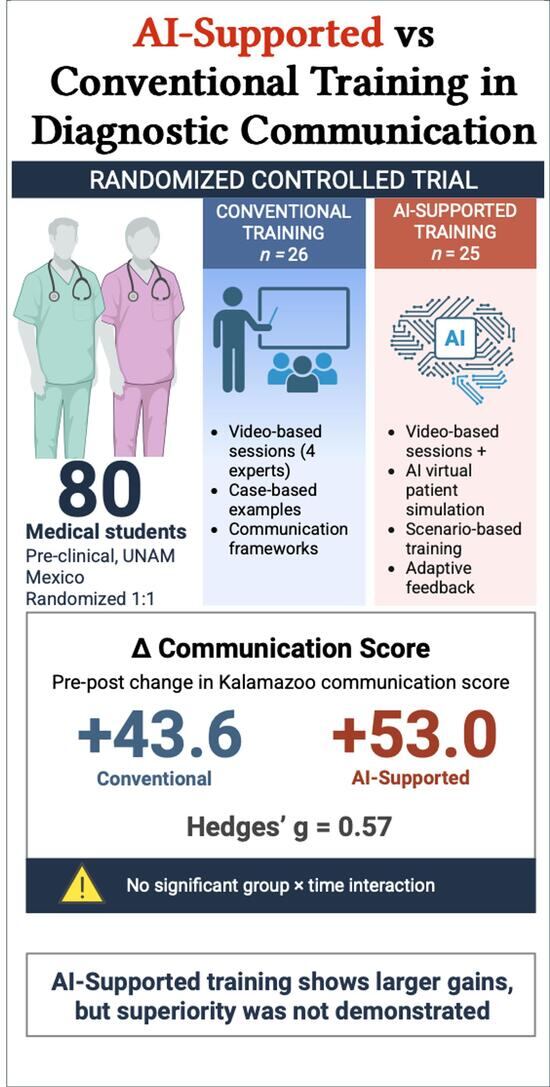
3.2. Primary Outcome: Diagnostic Communication Performance
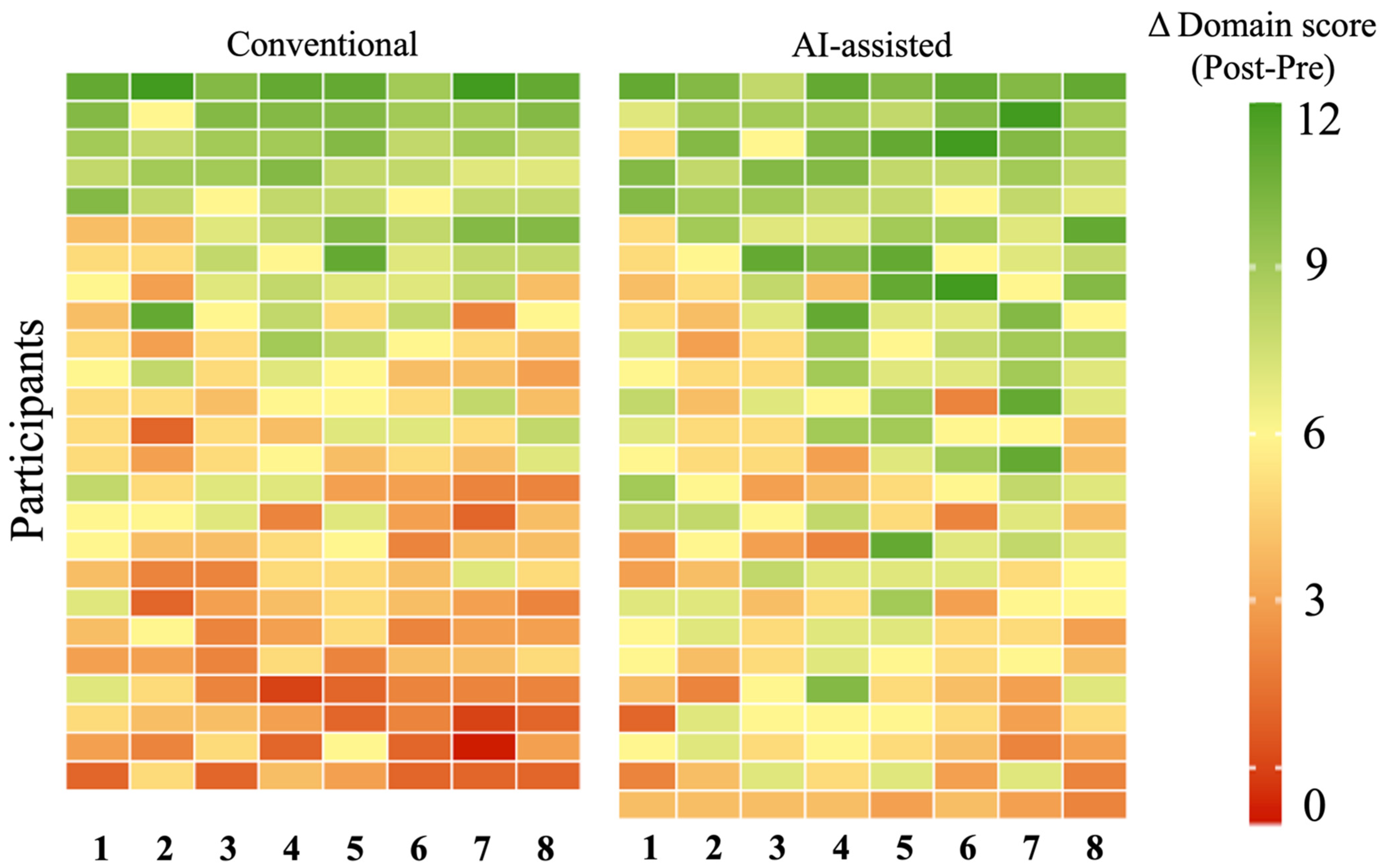
3.3. Domain-Specific Communication Outcomes
3.4. Individual Learning Trajectories and Heterogeneity of Response
3.5. Secondary Outcomes
4. Discussion
4.1. Positioning Relative to the Literature
4.2. Why AI-Supported Simulation May Work: Deliberate Practice with Feedback at Scale
4.3. Domain Specificity: Which Skills Improved More, and Why That Matters
4.4. Learner-Level Variability and Patterns of Response
4.5. Context and Equity: Evidence from a Mexican Public University
4.6. Limitations and Risks Specific to AI-Enabled Training
4.7. Implications for Implementation and Future Research
5. Conclusions
Author Contributions
Funding
Institutional Review Board Statement
Informed Consent Statement
Data Availability Statement
Acknowledgments
Conflicts of Interest
Abbreviations
| AI | Artificial intelligence |
| ANCOVA | Analysis of covariance |
| LLM | Large language model |
| T2DM | Type 2 diabetes mellitus |
| SPIKES | Setting, Perception, Invitation, Knowledge, Emotions, Strategy, and Summary |
Appendix A

| Item | Domain (Kalamazoo Framework) | Conventional (n = 40) (Mean ± SD) | AI-Supported (n = 40) (Mean ± SD) |
|---|---|---|---|
| 1 | Build a Relationship | 2.19 ± 0.78 | 1.90 ± 0.55 |
| 1.1 | Eye contact and open posture | 2.30 ± 0.91 | 2.15 ± 0.74 |
| 1.2 | Friendly body language | 2.40 ± 0.96 | 2.02 ± 0.66 |
| 1.3 | Self-introduction and role | 1.88 ± 1.09 | 1.52 ± 0.82 |
| 2 | Opening the Discussion | 1.73 ± 0.52 | 1.58 ± 0.46 |
| 2.1 | Greeting and identity verification | 1.85 ± 0.62 | 1.85 ± 0.53 |
| 2.2 | Explains purpose of the visit | 1.82 ± 0.78 | 1.55 ± 0.68 |
| 2.3 | Asks patient expectations | 1.53 ± 0.60 | 1.35 ± 0.48 |
| 3 | Gather Information | 1.94 ± 0.62 | 1.95 ± 0.66 |
| 3.1 | Uses open-ended questions | 1.98 ± 0.72 | 1.98 ± 0.70 |
| 3.2 | Listens without interrupting | 2.38 ± 1.08 | 2.70 ± 1.20 |
| 3.3 | Summarizes to confirm | 1.48 ± 0.72 | 1.18 ± 0.45 |
| 4 | Understand the Patient’s Perspective | 1.63 ± 0.53 | 1.57 ± 0.52 |
| 4.1 | Explores beliefs about illness | 1.50 ± 0.68 | 1.50 ± 0.51 |
| 4.2 | Inquires about concerns/fears | 1.75 ± 0.74 | 1.65 ± 0.62 |
| 4.3 | Acknowledges impact on daily life | 1.63 ± 0.70 | 1.57 ± 0.68 |
| 5 | Share Information | 1.47 ± 0.48 | 1.77 ± 0.52 |
| 5.1 | Explains diagnosis clearly | 1.55 ± 0.60 | 1.90 ± 0.63 |
| 5.2 | Uses supports/examples | 1.35 ± 0.48 | 1.60 ± 0.63 |
| 5.3 | Checks understanding (teach-back) | 1.50 ± 0.72 | 1.55 ± 0.68 |
| 6 | Reach Agreement | 1.67 ± 0.55 | 1.70 ± 0.61 |
| 6.1 | Discusses therapeutic options | 1.85 ± 0.62 | 1.62 ± 0.71 |
| 6.2 | Involves the patient | 1.50 ± 0.60 | 1.58 ± 0.68 |
| 6.3 | Negotiates realistic goals | 1.65 ± 0.66 | 1.65 ± 0.74 |
| 7 | Provide Closure | 1.76 ± 0.64 | 1.81 ± 0.55 |
| 7.1 | Provides final summary | 1.65 ± 0.70 | 1.40 ± 0.50 |
| 7.2 | Checks final questions | 1.80 ± 0.72 | 1.82 ± 0.59 |
| 7.3 | Closes with empathy and follow-up | 1.82 ± 0.68 | 2.20 ± 0.88 |
| 8 | Diabetes-specific communication | 1.72 ± 0.58 | 1.69 ± 0.49 |
| 8.1 | Communicates results clearly (glucose/HbA1c) | 1.72 ± 0.68 | 1.70 ± 0.56 |
| 8.2 | Initial T2DM plan + anxiety reduction | 1.70 ± 0.72 | 1.65 ± 0.57 |
| 8.3 | Complications and follow-up | 1.75 ± 0.74 | 1.72 ± 0.56 |
| Total | Total score (24–120) | 42.50 ± 10.55 | 42.14 ± 9.67 |
| Item | Domain (Kalamazoo Framework) | Conventional Δ Mean ± SD | AI-Supported Δ Mean ± SD | Hedges’ g |
|---|---|---|---|---|
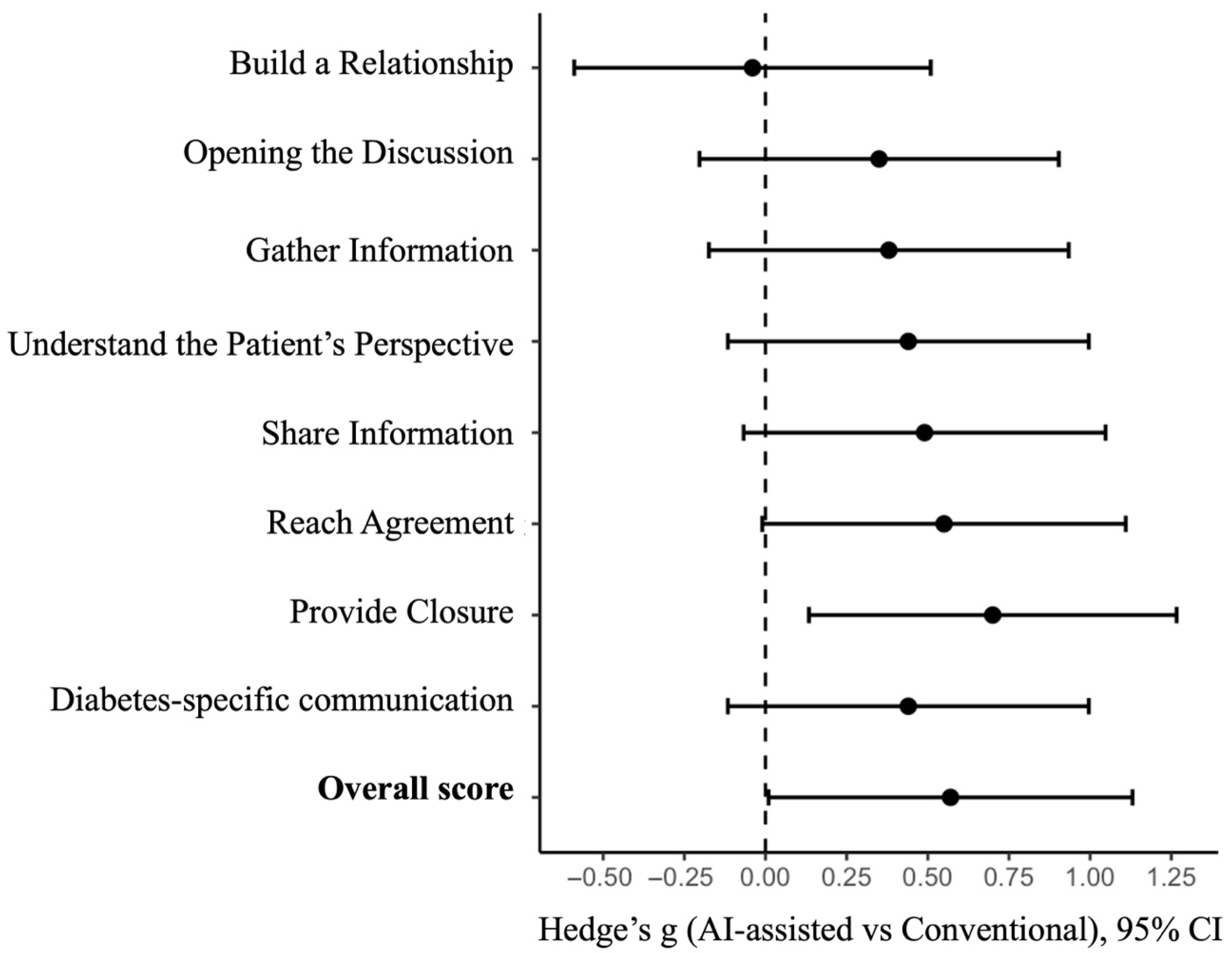
| 1 | Build a Relationship | 5.88 ± 2.42 | 5.77 ± 2.80 | −0.04 |
| 1.1 | Eye contact and open posture | 1.85 ± 0.97 | 1.84 ± 1.18 | −0.01 |
| 1.2 | Friendly body language | 1.88 ± 0.99 | 1.52 ± 1.23 | −0.32 |
| 1.3 | Self-introduction and role | 2.12 ± 1.03 | 2.24 ± 1.23 | 0.11 |
| 2 | Opening the Discussion | 5.16 ± 2.88 | 6.08 ± 2.23 | 0.35 |
| 2.1 | Greeting and identity verification | 1.27 ± 1.37 | 1.80 ± 1.15 | 0.41 |
| 2.2 | Explains purpose of the visit | 1.85 ± 1.16 | 2.00 ± 1.08 | 0.14 |
| 2.3 | Asks patient expectations | 2.23 ± 1.03 | 2.04 ± 0.84 | −0.20 |
| 3 | Gather Information | 5.40 ± 2.61 | 6.31 ± 2.05 | 0.38 |
| 3.1 | Uses open-ended questions | 1.77 ± 0.91 | 2.00 ± 1.00 | 0.24 |
| 3.2 | Listens without interrupting | 1.54 ± 1.27 | 1.76 ± 1.16 | 0.18 |
| 3.3 | Summarizes to confirm | 2.12 ± 1.21 | 2.32 ± 1.11 | 0.17 |
| 4 | Understand the Patient’s Perspective | 5.96 ± 2.91 | 7.19 ± 2.56 | 0.44 |
| 4.1 | Explores beliefs about illness | 2.31 ± 1.16 | 2.40 ± 1.19 | 0.08 |
| 4.2 | Inquires about concerns/fears | 1.92 ± 1.16 | 2.24 ± 1.16 | 0.27 |
| 4.3 | Acknowledges impact on daily life | 1.88 ± 1.31 | 2.16 ± 0.90 | 0.24 |
| 5 | Share Information | 6.24 ± 2.98 | 7.54 ± 2.18 | 0.49 |
| 5.1 | Explains diagnosis clearly | 2.12 ± 1.24 | 2.16 ± 1.03 | 0.04 |
| 5.2 | Uses supports/examples | 2.08 ± 1.35 | 2.32 ± 0.99 | 0.2 |
| 5.3 | Checks understanding (teach-back) | 2.23 ± 1.14 | 2.60 ± 1.26 | 0.3 |
| 6 | Reach Agreement | 4.88 ± 2.85 | 6.46 ± 2.85 | 0.55 |
| 6.1 | Discusses therapeutic options | 1.46 ± 1.27 | 1.60 ± 1.22 | 0.11 |
| 6.2 | Involves the patient | 1.88 ± 1.03 | 2.08 ± 1.32 | 0.16 |
| 6.3 | Negotiates realistic goals | 1.81 ± 1.30 | 1.92 ± 1.29 | 0.09 |
| 7 | Provide Closure | 5.00 ± 3.54 | 7.23 ± 2.70 | 0.7 |
| 7.1 | Provides final summary | 1.92 ± 1.52 | 2.04 ± 1.21 | 0.08 |
| 7.2 | Checks final questions | 1.50 ± 1.24 | 2.36 ± 1.32 | 0.66 |
| 7.3 | Closes with empathy and follow-up | 1.77 ± 1.39 | 2.24 ± 1.01 | 0.38 |
| 8 | Diabetes-specific communication | 5.04 ± 3.43 | 6.38 ± 2.61 | 0.44 |
| 8.1 | Communicates results clearly (glucose/HbA1c) | 2.00 ± 1.10 | 1.96 ± 0.84 | −0.04 |
| 8.2 | Initial T2DM plan + anxiety reduction | 1.50 ± 1.24 | 2.12 ± 1.20 | 0.5 |
| 8.3 | Complications and follow-up | 1.69 ± 1.59 | 1.84 ± 1.34 | 0.1 |
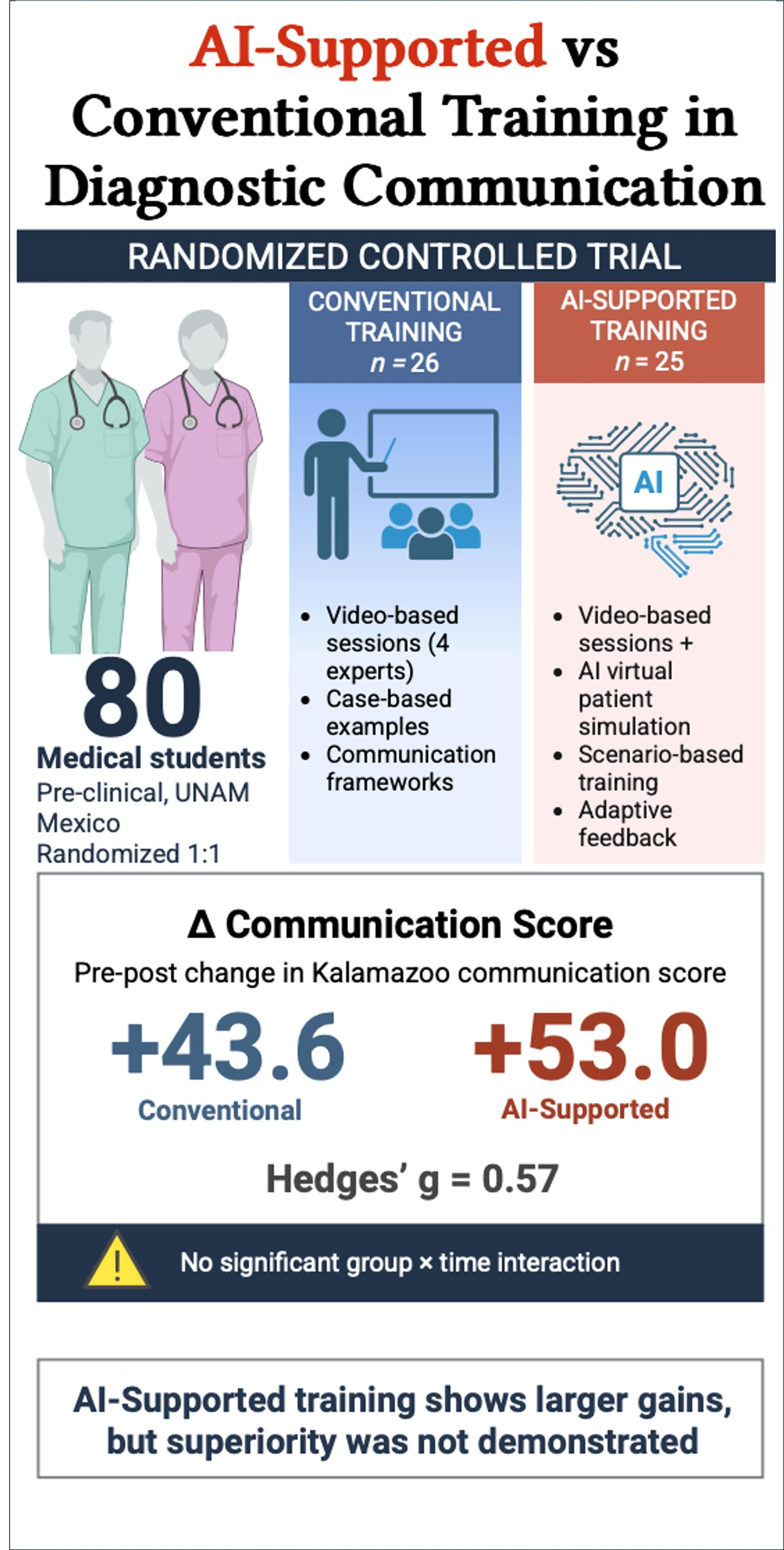
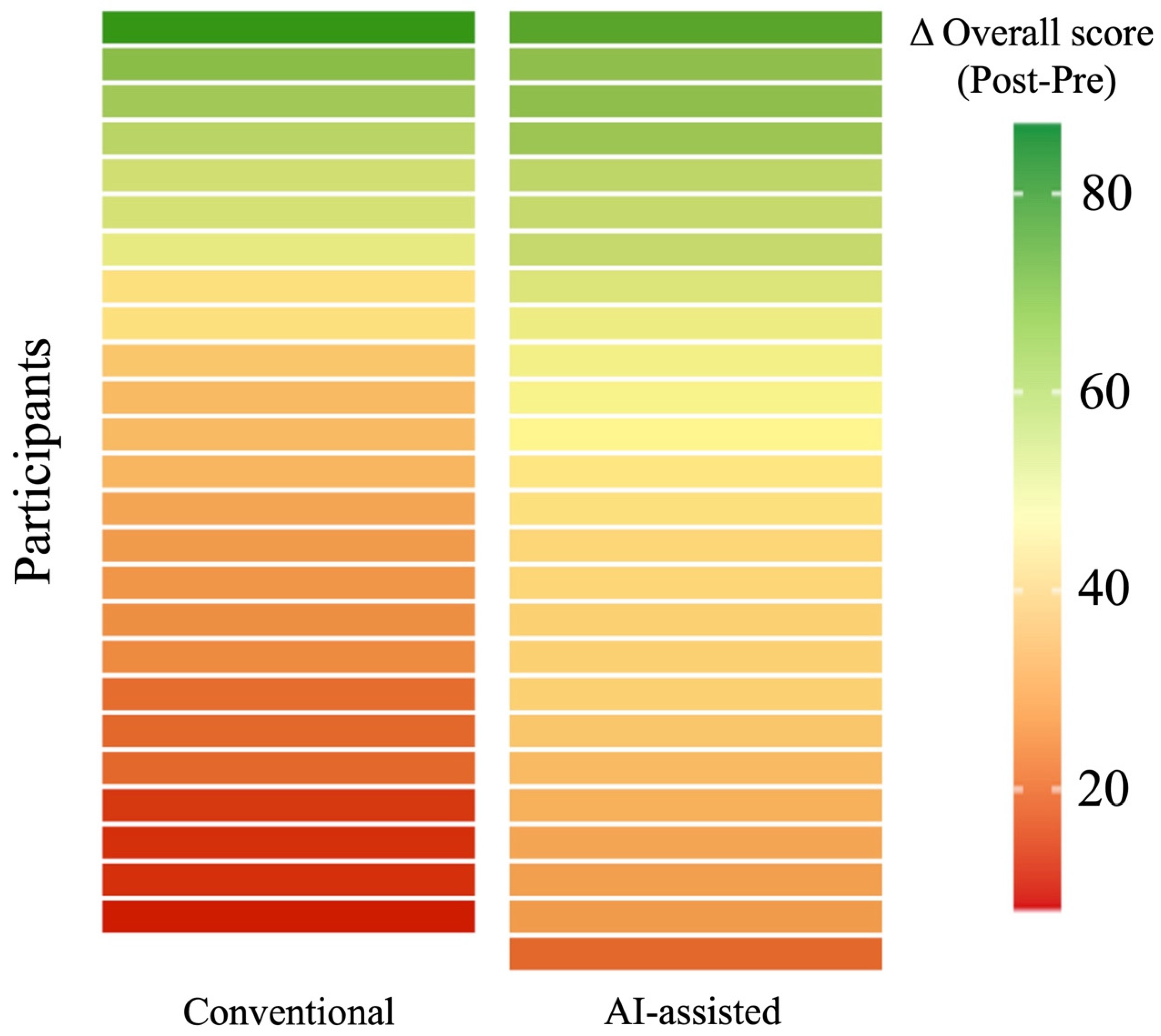
| Total | Overall score | 43.56 ± 19.38 | 52.96 ± 12.85 | 0.57 |
| Item | Domain (Kalamazoo Framework) | Time × Group β | 95% CI | p-Value | Hedges’ g |
|---|---|---|---|---|---|
| 1 | Build a Relationship | −0.09 | −0.56 to 0.38 | 0.707 | −0.09 |
| 1.1 | Eye contact and open posture | −0.02 | −0.29 to 0.25 | 0.876 | −0.03 |
| 1.2 | Friendly body language | −0.18 | −0.52 to 0.15 | 0.286 | −0.21 |
| 1.3 | Self-introduction and role | 0.13 | −0.22 to 0.48 | 0.466 | 0.15 |
| 2 | Opening the Discussion | 0.41 | −0.06 to 0.88 | 0.086 | 0.44 |
| 2.1 | Greeting and identity verification | 0.41 | −0.05 to 0.87 | 0.081 | 0.48 |
| 2.2 | Explains purpose of the visit | 0.22 | −0.26 to 0.69 | 0.369 | 0.25 |
| 2.3 | Asks patient expectations | −0.09 | −0.52 to 0.34 | 0.676 | −0.10 |
| 3 | Gather Information | 0.45 | −0.03 to 0.93 | 0.066 | 0.46 |
| 3.1 | Uses open-ended questions | 0.29 | −0.18 to 0.76 | 0.227 | 0.33 |
| 3.2 | Listens without interrupting | 0.18 | −0.33 to 0.69 | 0.488 | 0.2 |
| 3.3 | Summarizes to confirm | 0.21 | −0.29 to 0.71 | 0.405 | 0.24 |
| 4 | Understand the Patient’s Perspective | 0.34 | −0.15 to 0.83 | 0.173 | 0.35 |
| 4.1 | Explores beliefs about illness | 0.12 | −0.36 to 0.60 | 0.624 | 0.14 |
| 4.2 | Inquires about concerns/fears | 0.34 | −0.12 to 0.80 | 0.145 | 0.38 |
| 4.3 | Acknowledges impact on daily life | 0.28 | −0.21 to 0.77 | 0.257 | 0.31 |
| 5 | Share Information | 0.31 | −0.12 to 0.74 | 0.157 | 0.36 |
| 5.1 | Explains diagnosis clearly | 0.05 | −0.40 to 0.50 | 0.822 | 0.06 |
| 5.2 | Uses supports/examples | 0.26 | −0.20 to 0.72 | 0.265 | 0.3 |
| 5.3 | Checks understanding (teach-back) | 0.39 | −0.09 to 0.87 | 0.111 | 0.45 |
| 6 | Reach Agreement | 0.24 | −0.31 to 0.79 | 0.39 | 0.24 |
| 6.1 | Discusses therapeutic options | 0.14 | −0.37 to 0.65 | 0.586 | 0.16 |
| 6.2 | Involves the patient | 0.19 | −0.36 to 0.74 | 0.495 | 0.22 |
| 6.3 | Negotiates realistic goals | 0.11 | −0.43 to 0.65 | 0.685 | 0.12 |
| 7 | Provide Closure | 0.49 | −0.16 to 1.14 | 0.138 | 0.39 |
| 7.1 | Provides final summary | 0.1 | −0.45 to 0.65 | 0.722 | 0.11 |
| 7.2 | Checks final questions | 0.61 | 0.04 to 1.18 | 0.036 | 0.66 |
| 7.3 | Closes with empathy and follow-up | 0.38 | −0.19 to 0.95 | 0.191 | 0.4 |
| 8 | Diabetes-specific communication | 0.38 | −0.17 to 0.93 | 0.174 | 0.36 |
| 8.1 | Communicates results clearly (glucose/HbA1c) | −0.04 | −0.52 to 0.44 | 0.866 | −0.04 |
| 8.2 | Initial T2DM plan + anxiety reduction | 0.49 | −0.02 to 1.00 | 0.061 | 0.55 |
| 8.3 | Complications and follow-up | 0.15 | −0.40 to 0.70 | 0.594 | 0.17 |
| Total | Overall score | 7.45 | −1.98 to 16.88 | 0.121 | 0.41 |

References
- Epstein, R.M.; Street, R.L., Jr. The values and value of patient-centered care. Ann. Fam. Med. 2011, 9, 100–103. [Google Scholar] [CrossRef]
- Holmes-Rovner, M. Skills for Communicating with Patients (2e). Health Expect. 2005, 8, 277–278. [Google Scholar] [CrossRef][Green Version]
- Al Shahrani, A.; Baraja, M. Patient Satisfaction and it’s Relation to Diabetic Control in a Primary Care Setting. J. Fam. Med. Prim. Care 2014, 3, 5–11. [Google Scholar] [CrossRef]
- Levinson, W.; Roter, D.L.; Mullooly, J.P.; Dull, V.T.; Frankel, R.M. Physician-patient communication. The relationship with malpractice claims among primary care physicians and surgeons. JAMA 1997, 277, 553–559. [Google Scholar] [CrossRef]
- Makoul, G. Essential elements of communication in medical encounters: The Kalamazoo consensus statement. Acad. Med. 2001, 76, 390–393. [Google Scholar] [CrossRef]
- Street, R.L., Jr.; Makoul, G.; Arora, N.K.; Epstein, R.M. How does communication heal? Pathways linking clinician-patient communication to health outcomes. Patient Educ. Couns. 2009, 74, 295–301. [Google Scholar] [CrossRef] [PubMed]
- von Fragstein, M.; Silverman, J.; Cushing, A.; Quilligan, S.; Salisbury, H.; Wiskin, C. UK consensus statement on the content of communication curricula in undergraduate medical education. Med. Educ. 2008, 42, 1100–1107. [Google Scholar] [CrossRef] [PubMed]
- Kee, J.W.; Khoo, H.S.; Lim, I.; Koh, M.Y. Communication Skills in Patient-Doctor Interactions: Learning from Patient Complaints. Health Prof. Educ. 2018, 4, 97–106. [Google Scholar] [CrossRef]
- Yedidia, M.J.; Gillespie, C.C.; Kachur, E.; Schwartz, M.D.; Ockene, J.; Chepaitis, A.E.; Snyder, C.W.; Lazare, A.; Lipkin, M., Jr. Effect of communications training on medical student performance. JAMA 2003, 290, 1157–1165. [Google Scholar] [CrossRef]
- Back, A.L.; Arnold, R.M.; Tulsky, J.A.; Baile, W.F.; Fryer-Edwards, K.A. Teaching communication skills to medical oncology fellows. J. Clin. Oncol. 2003, 21, 2433–2436. [Google Scholar] [CrossRef]
- Hodges, B.D.; Albert, M.; Arweiler, D.; Akseer, S.; Bandiera, G.; Byrne, N.; Charlin, B.; Karazivan, P.; Kuper, A.; Maniate, J.; et al. The future of medical education: A Canadian environmental scan. Med. Educ. 2011, 45, 95–106. [Google Scholar] [CrossRef]
- Barrows, H.S. An overview of the uses of standardized patients for teaching and evaluating clinical skills. AAMC. Acad. Med. 1993, 68, 443–451; discussion 451–453. [Google Scholar] [CrossRef]
- Cook, D.A.; Hamstra, S.J.; Brydges, R.; Zendejas, B.; Szostek, J.H.; Wang, A.T.; Erwin, P.J.; Hatala, R. Comparative effectiveness of instructional design features in simulation-based education: Systematic review and meta-analysis. Med. Teach. 2013, 35, e867–e898. [Google Scholar] [CrossRef]
- Cleland, J. Simulation-based education: What’s it all about? Perspect. Med. Educ. 2018, 7, 30–33. [Google Scholar] [CrossRef]
- Nestel, D.; Groom, J.; Eikeland-Husebø, S.; O’Donnell, J.M. Simulation for learning and teaching procedural skills: The state of the science. Simul. Healthc. 2011, 6, S10–S13. [Google Scholar] [CrossRef]
- Frenk, J.; Chen, L.; Bhutta, Z.A.; Cohen, J.; Crisp, N.; Evans, T.; Fineberg, H.; Garcia, P.; Ke, Y.; Kelley, P.; et al. Health professionals for a new century: Transforming education to strengthen health systems in an interdependent world. Lancet 2010, 376, 1923–1958. [Google Scholar] [CrossRef] [PubMed]
- Ross, S.; Poth, C.N.; Donoff, M.; Humphries, P.; Steiner, I.; Schipper, S.; Janke, F.; Nichols, D. Competency-based achievement system: Using formative feedback to teach and assess family medicine residents’ skills. Can. Fam. Physician 2011, 57, e323–e330. [Google Scholar] [PubMed]
- Gilson, A.; Safranek, C.W.; Huang, T.; Socrates, V.; Chi, L.; Taylor, R.A.; Chartash, D. How Does ChatGPT Perform on the United States Medical Licensing Examination (USMLE)? The Implications of Large Language Models for Medical Education and Knowledge Assessment. JMIR Med. Educ. 2023, 9, e45312. [Google Scholar] [CrossRef]
- Kung, T.H.; Cheatham, M.; Medenilla, A.; Sillos, C.; De Leon, L.; Elepaño, C.; Madriaga, M.; Aggabao, R.; Diaz-Candido, G.; Maningo, J.; et al. Performance of ChatGPT on USMLE: Potential for AI-assisted medical education using large language models. PLoS Digit. Health 2023, 2, e0000198. [Google Scholar] [CrossRef] [PubMed]
- Moldt, J.A.; Festl-Wietek, T.; Fuhl, W.; Zabel, S.; Claassen, M.; Wagner, S.; Nieselt, K.; Herrmann-Werner, A. Assessing AI Awareness and Identifying Essential Competencies: Insights From Key Stakeholders in Integrating AI Into Medical Education. JMIR Med. Educ. 2024, 10, e58355. [Google Scholar] [CrossRef]
- Ericsson, K.A.; Krampe, R.T.; Tesch-Römer, C. The role of deliberate practice in the acquisition of expert performance. Psychol. Rev. 1993, 100, 363–406. [Google Scholar] [CrossRef]
- Hattie, J.; Timperley, H. The Power of Feedback. Rev. Educ. Res. 2007, 77, 81–112. [Google Scholar] [CrossRef]
- Lee, P.; Bubeck, S.; Petro, J. Benefits, Limits, and Risks of GPT-4 as an AI Chatbot for Medicine. N. Engl. J. Med. 2023, 388, 1233–1239. [Google Scholar] [CrossRef] [PubMed]
- Sallam, M. ChatGPT Utility in Healthcare Education, Research, and Practice: Systematic Review on the Promising Perspectives and Valid Concerns. Healthcare 2023, 11, 887. [Google Scholar] [CrossRef]
- Weisman, A.; Yona, T.; Masharawi, Y. Education about pain and experience with cognitive-based interventions do not reduce healthcare professionals’ chronic pain. PeerJ 2025, 13, e19448. [Google Scholar] [CrossRef]
- Plackett, R.; Kassianos, A.P.; Mylan, S.; Kambouri, M.; Raine, R.; Sheringham, J. The effectiveness of using virtual patient educational tools to improve medical students’ clinical reasoning skills: A systematic review. BMC Med. Educ. 2022, 22, 365. [Google Scholar] [CrossRef]
- Quail, N.P.A.; Boyle, J.G. Virtual Patients in Health Professions Education. In Biomedical Visualisation: Volume 4; Rea, P.M., Ed.; Springer International Publishing: Cham, Switzerland, 2019; pp. 25–35. [Google Scholar]
- Suárez-García, R.X.; Chavez-Castañeda, Q.; Orrico-Pérez, R.; Valencia-Marin, S.; Castañeda-Ramírez, A.E.; Quiñones-Lara, E.; Ramos-Cortés, C.A.; Gaytán-Gómez, A.M.; Cortés-Rodríguez, J.; Jarquín-Ramírez, J.; et al. DIALOGUE: A Generative AI-Based Pre–Post Simulation Study to Enhance Diagnostic Communication in Medical Students Through Virtual Type 2 Diabetes Scenarios. Eur. J. Investig. Health Psychol. Educ. 2025, 15, 152. [Google Scholar] [CrossRef]
- McGaghie, W.C.; Issenberg, S.B.; Cohen, E.R.; Barsuk, J.H.; Wayne, D.B. Does simulation-based medical education with deliberate practice yield better results than traditional clinical education? A meta-analytic comparative review of the evidence. Acad. Med. 2011, 86, 706–711. [Google Scholar] [CrossRef] [PubMed]
- Baile, W.F.; Buckman, R.; Lenzi, R.; Glober, G.; Beale, E.A.; Kudelka, A.P. SPIKES-A six-step protocol for delivering bad news: Application to the patient with cancer. Oncologist 2000, 5, 302–311. [Google Scholar] [CrossRef]
- Childers, J.W.; Bulls, H.; Arnold, R. Beyond the NURSE Acronym: The Functions of Empathy in Serious Illness Conversations. J. Pain Symptom Manag. 2023, 65, e375–e379. [Google Scholar] [CrossRef]


| Variable | Total (n = 80) | Conventional (n = 40) | AI-Supported (n = 40) |
|---|---|---|---|
| Age (years) | 19.45 ± 1.83 | 19.15 ± 1.19 | 20.67 ± 2.99 |
| Academic semester | Sem 1: 26 (32.5%) Sem 2: 48 (60%) Sem 3: 3 (3.75%) Sem 4: 3 (3.75%) | Sem 1: 10 (25%) Sem 2: 26 (65%) Sem 3: 2 (5%) Sem 4: 2 (5%) | Sem 1: 16 (40%) Sem 2: 22 (55%) Sem 3: 1 (2.5%) Sem 4: 1 (2.5%) |
| Sex, n (%) | |||
| Female | 48 (60.0%) | 23 (57.5%) | 25 (62.5%) |
| Male | 31 (38.75%) | 16 (40.0%) | 15 (37.5%) |
| Non-binary | 1 (1.25%) | 1 (2.5%) | 0 (0%) |
| Extracurricular clinical experience, n (%) | 5 (6.3%) | 3 (7.5%) | 2 (5.0%) |
| Item | Domain (Kalamazoo Framework) | Conventional (n = 40) (Mean ± SD) | AI-Supported (n = 40) (Mean ± SD) |
|---|---|---|---|
| 1 | Build a Relationship | 6.57 ± 2.34 | 5.70 ± 1.65 |
| 2 | Opening the Discussion | 5.19 ± 1.56 | 4.74 ± 1.38 |
| 3 | Gather Information | 5.82 ± 1.86 | 5.88 ± 1.95 |
| 4 | Understand the Patient’s Perspective | 4.77 ± 1.65 | 4.62 ± 1.44 |
| 5 | Share Information | 4.41 ± 1.44 | 5.31 ± 1.56 |
| 6 | Reach Agreement | 5.61 ± 1.98 | 5.73 ± 1.59 |
| 7 | Provide Closure | 4.98 ± 2.04 | 5.13 ± 1.80 |
| 8 | Diabetes-specific communication | 5.13 ± 1.80 | 5.04 ± 1.35 |
| Total | Overall score (24–120) | 42.50 ± 10.55 | 42.14 ± 9.67 |
| Item | Domain (Kalamazoo Framework) | Conventional Δ (n = 25) Mean ± SD | AI-Supported Δ (n = 26) Mean ± SD | Hedges’ g (AI-Supported Minus Conventional) |
|---|---|---|---|---|
| 1 | Build a Relationship | 5.88 ± 2.42 | 5.77 ± 2.80 | −0.04 |
| 2 | Opening the Discussion | 5.16 ± 2.88 | 6.08 ± 2.23 | 0.35 |
| 3 | Gather Information | 5.40 ± 2.61 | 6.31 ± 2.05 | 0.38 |
| 4 | Understand the Patient’s Perspective | 5.96 ± 2.91 | 7.19 ± 2.56 | 0.44 |
| 5 | Share Information | 6.24 ± 2.98 | 7.54 ± 2.18 | 0.49 |
| 6 | Reach Agreement | 4.88 ± 2.85 | 6.46 ± 2.85 | 0.55 |
| 7 | Provide Closure | 5.00 ± 3.54 | 7.23 ± 2.70 | 0.70 |
| 8 | Diabetes-specific communication | 5.04 ± 3.43 | 6.38 ± 2.61 | 0.44 |
| Total | Overall score (24–120) | 43.56 ± 19.38 | 52.96 ± 12.85 | 0.57 |
| Item | Domain (Kalamazoo Framework) | Time × Group β | 95% CI | p-Value | Hedges’ g |
|---|---|---|---|---|---|
| 1 | Build a Relationship | −0.09 | −0.56 to 0.38 | 0.707 | −0.09 |
| 2 | Opening the Discussion | 0.41 | −0.06 to 0.88 | 0.086 | 0.44 |
| 3 | Gather Information | 0.45 | −0.03 to 0.93 | 0.066 | 0.46 |
| 4 | Understand the Patient’s Perspective | 0.34 | −0.15 to 0.83 | 0.173 | 0.35 |
| 5 | Share Information | 0.31 | −0.12 to 0.74 | 0.157 | 0.36 |
| 6 | Reach Agreement | 0.24 | −0.31 to 0.79 | 0.39 | 0.24 |
| 7 | Provide Closure | 0.49 | −0.16 to 1.14 | 0.138 | 0.39 |
| 8 | Diabetes-specific communication | 0.38 | −0.17 to 0.93 | 0.174 | 0.36 |
| Total | Overall score | 7.45 | −1.98 to 16.88 | 0.121 | 0.41 |
Disclaimer/Publisher’s Note: The statements, opinions and data contained in all publications are solely those of the individual author(s) and contributor(s) and not of MDPI and/or the editor(s). MDPI and/or the editor(s) disclaim responsibility for any injury to people or property resulting from any ideas, methods, instructions or products referred to in the content. |
© 2026 by the authors. Published by MDPI on behalf of the Academic Society for International Medical Education. Licensee MDPI, Basel, Switzerland. This article is an open access article distributed under the terms and conditions of the Creative Commons Attribution (CC BY) license.
Share and Cite
Jay-Jímenez, B.O.; Martínez-Islas, D.A.; Marroquin-Aguilar, A.T.; Avelino-Vivas, F.; Solis-Galván, D.M.; Laguna-González, A.A.; García-García, B.M.; Minaya-Pérez, E.; Quiñones-Lara, E.; Martínez-Bonilla, I.; et al. AI-Supported Adaptive Simulation for Diagnostic Disclosure in Medical Students: A Randomized Controlled Trial. Int. Med. Educ. 2026, 5, 35. https://doi.org/10.3390/ime5020035
Jay-Jímenez BO, Martínez-Islas DA, Marroquin-Aguilar AT, Avelino-Vivas F, Solis-Galván DM, Laguna-González AA, García-García BM, Minaya-Pérez E, Quiñones-Lara E, Martínez-Bonilla I, et al. AI-Supported Adaptive Simulation for Diagnostic Disclosure in Medical Students: A Randomized Controlled Trial. International Medical Education. 2026; 5(2):35. https://doi.org/10.3390/ime5020035
Chicago/Turabian StyleJay-Jímenez, Brenda Ofelia, Diego Alberto Martínez-Islas, Axel Tonatiuh Marroquin-Aguilar, Fernanda Avelino-Vivas, Dafne Montserrat Solis-Galván, Alexis Arturo Laguna-González, Bruno Manuel García-García, Eduardo Minaya-Pérez, Efren Quiñones-Lara, Ismael Martínez-Bonilla, and et al. 2026. "AI-Supported Adaptive Simulation for Diagnostic Disclosure in Medical Students: A Randomized Controlled Trial" International Medical Education 5, no. 2: 35. https://doi.org/10.3390/ime5020035
APA StyleJay-Jímenez, B. O., Martínez-Islas, D. A., Marroquin-Aguilar, A. T., Avelino-Vivas, F., Solis-Galván, D. M., Laguna-González, A. A., García-García, B. M., Minaya-Pérez, E., Quiñones-Lara, E., Martínez-Bonilla, I., Méndez-Cruz, A. R., & Saldívar-Cerón, H. I. (2026). AI-Supported Adaptive Simulation for Diagnostic Disclosure in Medical Students: A Randomized Controlled Trial. International Medical Education, 5(2), 35. https://doi.org/10.3390/ime5020035