1. Introduction
Definition of wellbeing (info box):
Wellbeing is a dynamic, multifaceted concept influenced by cognitive processes, emotions, personality traits, age, biomarkers, and individual goals [
1,
2]. It involves both the experience of positive emotions, such as happiness and contentment, and the ability to develop one’s potential, maintain a sense of purpose, and foster positive relationships. Key to wellbeing is the balance between professional obligations, personal health, and the presence of positive resources like resilience, social capital, and positive psychology [
3]. This conceptualization emphasizes that wellbeing goes beyond the absence of mental illness, encompassing a sustainable condition that enables individuals and populations to thrive [
4].
The demands placed on GPs have increased over time, creating a complex working environment that can contribute to feelings of uncertainty, stress, and overload, particularly for trainees and those in the early stages of their career [
5].
The literature has described a persistent neglect of physicians’ wellbeing [
6]. A lack of happiness at work is a contributing factor [
7]. Happiness in medical education tends to focus on individual factors, disregarding social influences including political, social, and economic factors [
8]. The understanding of wellbeing varies, and consequently, wellbeing lacks a universally accepted definition, leading to varied interpretations in published research [
9,
10].
In a recent study, Junge et al. identified doctors’ and patients’ wellbeing as a key competency for future general practitioners within the European Young Family Doctors Movement (EYFDM). While there was no consensus on a level of agreement (LoA) for wellbeing, all other competencies comparable to the WONCA tree reached a high LoA [
11]. Rather than indicating a lack of relevance, wellbeing stimulated the greatest debate among participants in the study. It was ranked third among competencies, highlighting its perceived importance and its conceptual complexity. Young GPs pointed out the lack of training in affective competencies. They expressed an interest in integrating learning activities for wellbeing, including how wellbeing applies to patients and practitioners [
12]. This interest is rooted in empirical evidence demonstrating that doctors’ mental wellbeing can benefit patients by enhancing doctors’ empathy towards patients and team members [
13]. Role modeling was mentioned as one concrete example during the data collection of the study. While role modeling is not a new concept in wellbeing, its impact remains inconclusive, especially for early-career GPs [
14]. Additionally, the literature suggests that role modeling as a learning activity is often underdeveloped or difficult to establish in curricula [
15,
16].
Targeted interventions can support effective learning and the achievement of affective competencies in medical practice [
17,
18]. In contrast to training in other affective competencies, such as communication skills, a consensus is currently lacking on the optimal way of teaching wellbeing within postgraduate medical curricula. Skills in managing personal wellbeing are not uniformly included in European postgraduate medical curricula [
19]. Most research in this field focuses on preventing mental illness, rather than promoting positive mental health [
5]. Wellbeing is often viewed as a binary state, with “low” encompassing depression and anxiety, and “high” characterized by positive emotions [
20]. Studies have investigated the efficacy of interventions to enhance wellbeing [
21]. Standalone interventions such as “resilience training” and “compulsory coffee breaks” have demonstrated minimal improvement in reducing burnout and supporting wellbeing by not addressing broader organizational and systematic stressors that contribute to physician distress [
22]. This suggests that a comprehensive enhancement of wellbeing requires a general “system-level change”, not discrete interventions [
23].
Grounded in the EURACT Educational Agenda and operationalized through the WONCA tree, this study focuses on the integration of “wellbeing” and presents the perspective of trainee competency. This paper aims to identify desired learning activities to facilitate improvements in future GP curricula.
2. Materials and Methods
2.1. Participants
In this exploratory concurrent mixed-methods study, participants compromised two groups: 1. workshop participants, who were initially recruited through a voluntary workshop at the EYFDM pre-conference of WONCA (2023), focusing on early-career GPs, as defined by EYFDM [
24], while also including GPs with over five years of experience; and 2. community-member-checking participants, who contributed exclusively through two digital rounds of stakeholder consultation. The inclusion of GPs with over five years of experience reflects EYFDM’s participatory ethos and broader “community of interest” in family medicine. In the results, if not indicated otherwise, comments come from the EYFDM definition of early-career GPs. All contributors are collectively referred to as “community members”.
2.2. Setting and Data Collection Strategy
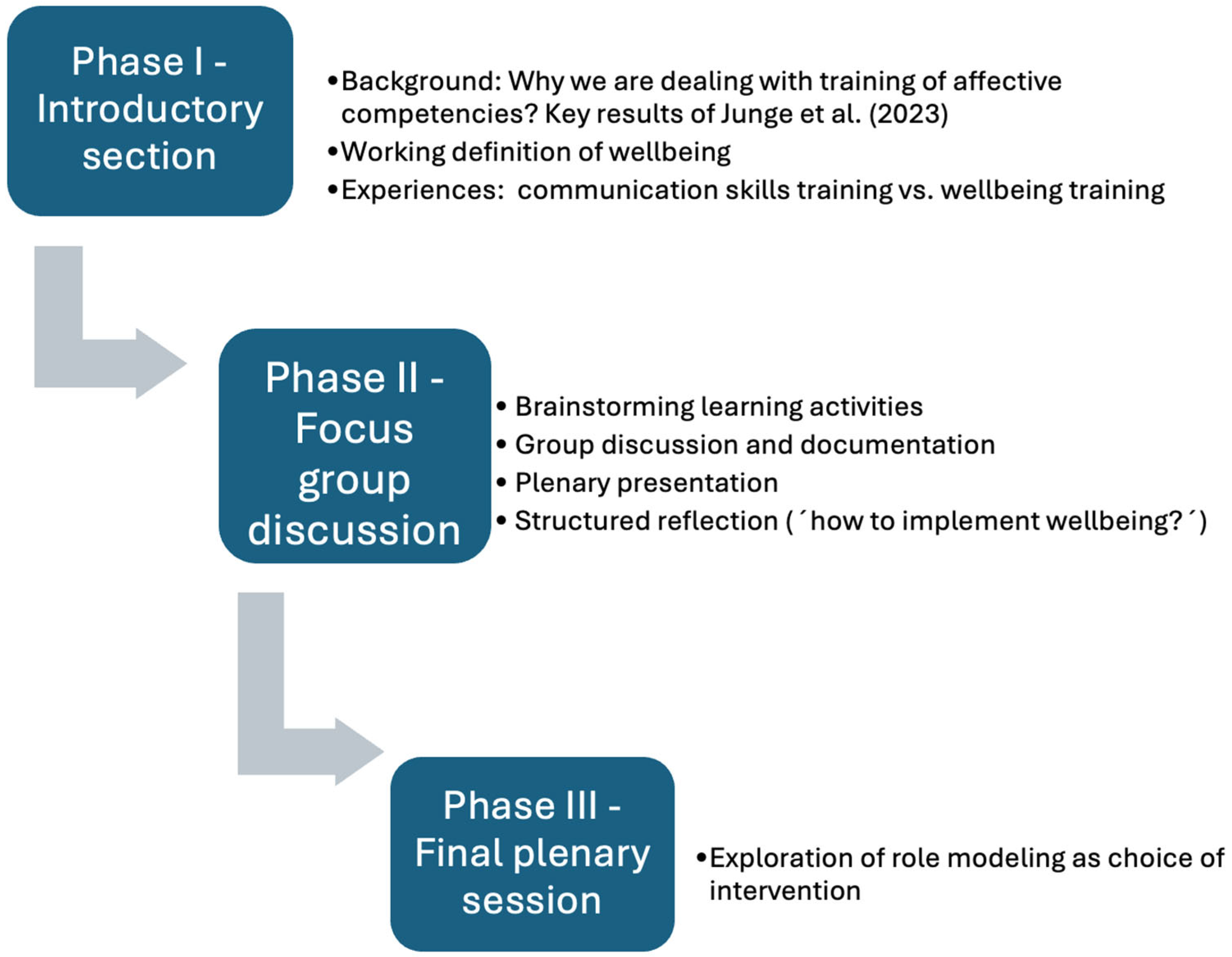
The workshop was conducted on 7 June 2023. As seen in
Figure 1, it followed a structured town-hall format across three phases [
25]. The town hall methodology enabled the incorporation of an open-forum discussion as a data collection tool, allowing participants to engage in an open dialog with transparency between participants and researchers [
26]. Phase I of the workshop started with a contextual presentation of Junge et al.’s findings as the basis of this paper. Junge et al. stated that doctors’ wellbeing is a key competency of the future, and this was identified in the study cohort [
12]. Junge et al. also describes the difficulty of having to explore new approaches to learning when wanting to introduce wellbeing as a new learning objective. Doctors’ wellbeing was described to be a new affective learning activity, while another core affective learning objective (communication skills) was described as more unanimously accepted in curricula [
12]. A prepared definition of wellbeing was presented to the participants to prevent misinterpretations. In phase II, participants were voluntarily divided into three groups (7–8 members each) to brainstorm possible learning activities, addressing benefits, issues, and implementation choices (taught as mandatory, included in the formal curriculum; self-directed, taking responsibility for own learning, or guided regarding to optional classes led by trainee faculty). These suggestions were brought together in a final plenary session (phase III) and participants were encouraged to discuss the concept of role modeling, a concept that had re-emerged and was also already discussed during Junge et al.’s data collection [
12].
Quantitative data was collected during the workshop survey, capturing sociodemographic information (training stage, gender, affective competency training experience, and country of origin). Descriptive data was collected separately from qualitative responses to ensure that no personal identifiers were revealed. Real-life data was gathered continuously through anonymous real-time feedback of submitted responses via Sli.do™, alongside moderated group discussions (facilitated by CD, AP, and FD). Audio recordings were made, and responses were digitally recorded (by submitted comments) and complemented by structured researcher notes and in moderation minutes. Representative quotes were assigned to each participant within each subgroup according to the chronological order of their contributions, and they were then pseudonymized (e.g., G1Q11).
Qualitative data consisted of anonymized written submissions, peer-sourced questions, and pseudonymized quotes derived from subgroup discussions. Peer-sourced questions ensured depth until theoretical saturation was reached and were submitted anonymously and moderated by the facilitators. Participant wording was preserved, and all coded comments were checked for accuracy and precision in a peer debriefing process after the workshop and again after coding (see below).
2.3. Ethical Considerations
Ethical approval was obtained prior to study initiation (Saarland Medical Association Ethics Committee; 25 September 2020, extended on 14 April 2022 (Bu234/20)). All participants were informed of the study design before taking part. Written consent for participation, recordings of verbal contributions, and anonymous data collection were obtained digitally through Sli.doTM. Participants had the opportunity to log in and log out at any time. In the online consultations, the participants provided descriptive answers about their age, country of origin, and professional status. Researchers (CD, JK, and FD) were unable to draw any conclusions about participants’ personal identity.
2.4. Data Analysis
Quantitative data were analyzed using Jamovi™ (version 2.3.28) and Excel™ (version 16.91), excluding incomplete responses (9 of 41). Given the sample size and the exploratory design of the study, no inferential statistical analyses were conducted. Qualitative data were analyzed according to Mayring et al.’s content analysis criteria, employing a structured, iterative coding process to ensure intersubject comprehensibility and intercoder reliability [
25,
26]. Categories were developed inductively and refined through feedback loops. Independent analysis by CD, JK, and FD was validated collegially, ensuring transparency through peer debriefing. This reflexive approach minimized the influence of preconceived opinions. Researcher triangulation during data collection and analysis enhanced credibility [
27,
28]. To confirm findings and reduce bias, stakeholder consultation was conducted in two rounds (Round 1: 14.10.23–31.12.23, Round 2: 26.09.24–26.10.24, both via Google Forms™). “Community members” provided feedback, which was coded and integrated until full consensus (100%) was reached in Round 2.
3. Results
3.1. Demographics
A total of 22 participants took part in the workshop (7 June 2023). All consented to a recording of the group phase I–II–III discussion, and 19 participants (86%) took part in a digital data collection (
n = 13 early-career GPs;
n = 6 GPs > 5 years post-training). Participants were from 11 countries, with the majority being from Belgium (
n = 6), Austria (=3), and the Netherlands (
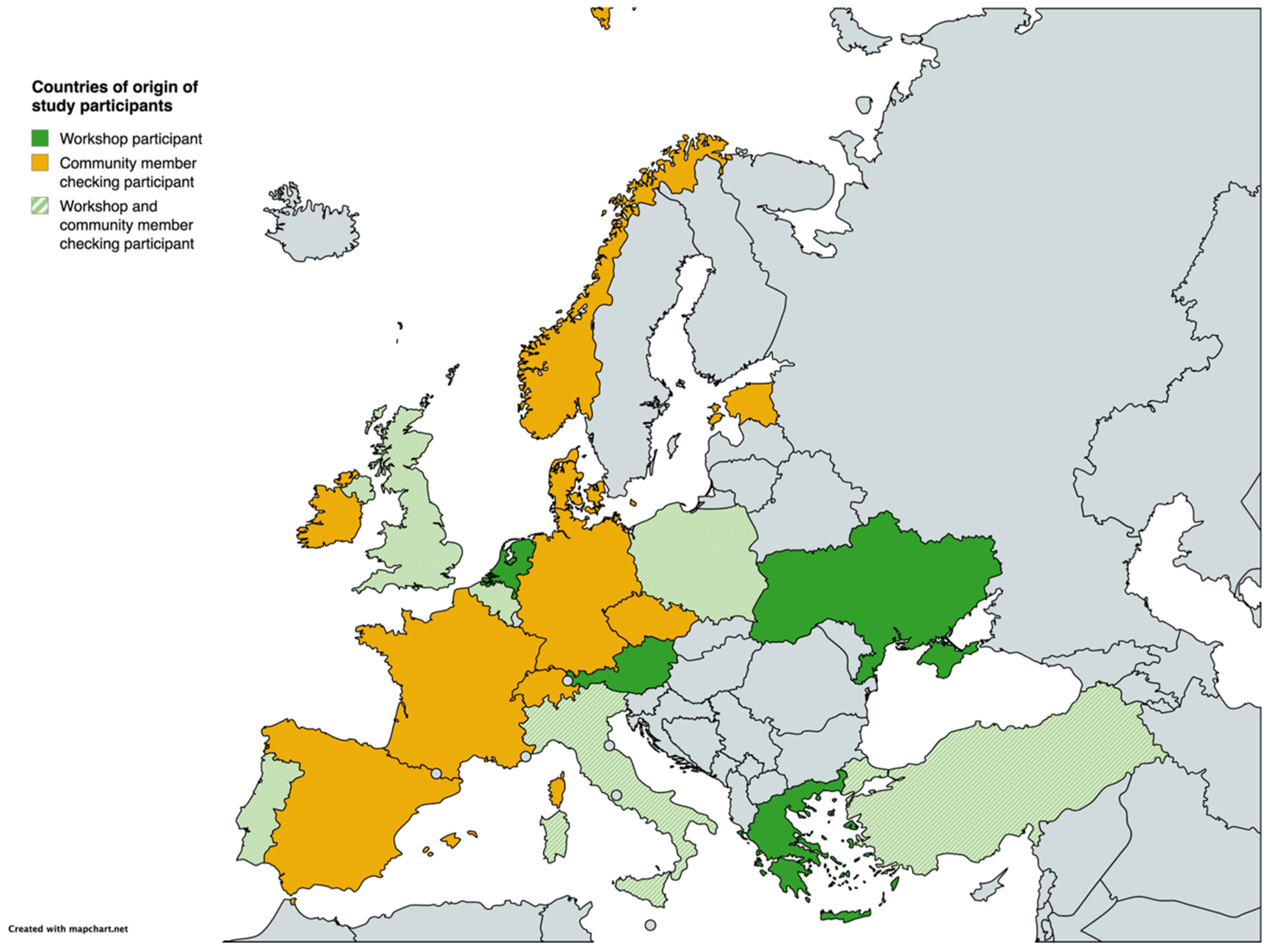
n = 2). Participant age ranged from 24 to 64 (mean 34.4 years, SD 9.3 years). In the stakeholder consultation process, 32 participants from 11 countries took part (first round:
n = 19, second round:
n = 13; see
Figure 2). Participants were early-career GPs (
n = 23), senior GPs (>5 years post-training) (
n = 7), and medical students (
n = 2).
3.2. Discrepancy Between Communication and Wellbeing Training
Participants described a large difference between having experiences with communication training and wellbeing training as part of their medical training. A total of 76.5% reported having received curricular communication training, while 17.6% reported to have received curricular wellbeing training. In participants’ home countries, the predominant teaching method for communication training was simulation and role-play with actors (63.2%).
3.3. Desired Learning Activities to Support Wellbeing
Participants (
n = 22) proposed a diverse set of learning activities to foster personal wellbeing, which were grouped into six main categories (see
Table 1). The quotes in
Table 1 are pseudonymized using subgroup-based identifiers (e.g., G1Q11), indicating the subgroup and the contributions without implying frequency or prioritization:
- a.
Self-reflection: participants emphasized the relevance of self-exploration through reflective tools (e.g., personality tests, guided questions) to align personal needs and professional goal, for instance, “What would your dream—and your nightmare—practice look like?” (G2Q5).
- b.
Peer exchange: proposed group-based formats such as “team time-outs and feedback sessions help […] reflect together” (G3Q2). These formats also included the following:
Intervision: structured peer mentoring in small groups with institutional support.
Tutor sessions: small-group discussions facilitated by senior physicians.
Feedback groups: platforms to address professional and personal challenges.
Team counseling: workplace-specific discussions to enhance professionalism and error culture.
- c.
Mentorship: participants advocated for structured mentoring relationships between junior and senior physicians. Mentoring was described as a mutual, voluntary process involving goal-oriented coaching, with clearly defined expectations and the possibility for dissolution by either party. The primary focus was “meeting the right person” (G1Q3) to connect on both a professional and personal level.
- d.
- e.
Courses: structured educational programs, such as the online Yale Science of Wellbeing course, were cited as valuable resources for self-directed wellbeing education. Leadership courses are a valuable resource to “help people […] to step up and [develop confidence to do] what they love” (G2Q8).
- f.
Workplace interventions: on-the-job learning and a supportive work environment were identified as essential, because “[a]good mental health [was acknowledged] as more financially attractive” (G2Q12). Proposed interventions included the following:
Cultural, musical, and physical activities.
Childcare services and flexible working conditions.
Mindfulness exercises (e.g., daily breathing exercises).
Working wellbeing models (e.g., “the GoogleTM approach, which offers cultural, musical and physical activities at work” (G2Q11)). This refers to a reinterpretation of the workplace.
Table 1.
Categorized learning activities, given by the participants. Abbreviations: G = focus group number (G1–3), Q = quote of participants (1–13).
Table 1.
Categorized learning activities, given by the participants. Abbreviations: G = focus group number (G1–3), Q = quote of participants (1–13).
| Category | Suggestions on Learning
Activities | Sample Quotes/Opinions |
|---|
| Self-reflection | Self-personality tests,
reflection questions | G2Q1: “Implementing personality traits into the curricula”,
G2Q2: “Find out what are your strengths and what can match [with] you”,
G2Q4: “What do I need to [ful-] fill my needs?”,
G2Q5: “How would your dream- and on the other hand your nightmare practice looks like?” |
| Group exchange | Tutor sessions,
team counseling,
Balint groups,
feedback groups,
Intervision (peer mentoring) | G3Q1: “share and reflect”,
G3Q2: “team time-out”,
G1Q2: “to discuss about working- and non-working-based associated topics” |
| Mentorship | Senior/junior GP
mentoring programs | G1Q3: “meeting the right person”, G1Q4: “making a good connection” |
| Role modeling | G2Q5: “Tinder for GPs”
“job-hopping” | G1Q5: “matchmaking”,
G2Q5: “Senior GPs present themselves (…)”,
G2Q6: “different types of role models”, |
| Courses | Yale Course,
G2Q8: “Leadership courses” | G2Q8: “Help for people to step up and what they love”,
G2Q9: “Not for everybody”, |
| Workplace interventions | Cultural, physical, and
musical offers
activities besides work,
babysitting service,
mindfulness exercises
G2Q11: “GoogleTM approach” | G2Q10: “The facilities need to accept and facilitate non-working activities”,
G2Q11: “Google and Facebook provide those activities”,
G2Q12: “Good mental health is also financially more attractive”,
G2Q13: “Important, because most of the people still with their thoughts at home” |
3.4. Perceived Benefits and Challenges
The reported benefits (positive outcomes expected from the proposed learning activities) included increased self-awareness as key to personal and professional growth (G2Q14: “finding yourself, reflecting on what you want”, G1Q7: “knowing your character”), stress reduction (G3Q3: “identifying what gives u stress”), and a supportive work environment for staff retention (G3Q4: “[…] less drop outs”, G1Q9: “How to express ask for rights? e.g., having lunch”). Several challenges were noted:
Individual preferences (G2Q16: “[…] subjective, not for everybody”, G1Q10: “Some people find it hard to express problems”).
Workplace personality mismatches (G3Q5: “Meeting the right person”, which can offer personal support, “[this] is key to avoid mismatches [in the workplace]”).
Time constraints and prioritization at work (G3Q6: “too much work, no time”).
3.5. Conditions for Successful Implementation
Participants agreed that wellbeing-related learning should be embedded meaningfully and sustainably. Key conditions included the following:
Attitude and cultural shift: promote openness and reduce competition; emulate supportive corporate models (G2Q17: “attitude change”).
Time allocation: mandate protected time for wellbeing activities (G2Q18: “more time needed”).
Individual choice: offer a modular “toolbox” for personalized wellbeing strategies (G2Q19: “give opportunities what you can do”).
Curricular integration: establish wellbeing as an explicit, standalone competency.
Coach training: educators should be equipped to support junior physicians (G1Q11: “train-the-trainer”).
Intergenerational responsibility: senior staff should model wellbeing practices.
According to these conditions, most respondents (57.9%) favored guided wellbeing activities; fewer preferred traditional (33.3%) and self-directed formats (4.8%). This quantitative preference is reflected in the qualitative data, which highlights the need for structured support, facilitation, and protected time when engaging with wellbeing-related learning.
3.6. Role Modeling
Role modeling was identified as a desired learning activity and a crucial element in shaping professional values and behaviors. Seventeen of the nineteen participants (89.5%) emphasized its importance, describing ideal role models as empathetic, honest, and capable of discussing emotional and work–life challenges in clinical practice. Effective role models exemplify both personal and professional wellbeing. Proposed strategies included the following:
A matching platform (e.g., “Tinder for GPs” (G2Q5)), based on personality traits, is intended to “[make a match]” (G1Q5), helping suitable role models to be found for every GP in training.
Exposure to diverse role models through job rotation or increased visibility into role models’ lives. “Job-hopping” as a term was mentioned by participants, describing the purposefully high volume of job changes seen in the younger generation. However, here, it aims to provide the trainee with a larger variation in perspectives on how to have a fulfilled professional and personal life as a GP.
Role modeling should be implemented via authentic interactions, emphasizing the mentor’s lifestyle, values, and career decisions.
As one participant noted, “Meeting the right person” (G1Q3) can make a crucial difference on how trainees internalize wellbeing practices.
3.7. Online Stakeholder Consultation
“Community members” reviewed the data for credibility and confirmability. In the first round, 94.7% endorsed the ideas as valuable for future research, with feedback emphasizing flexibility and individual choice in learning activities (Q1: “(…) ideas recognize the different needs of GPs and the solutions offered are pragmatic and underscore the importance of flexibility and individual choice”). One respondent suggested a “mentor database” for matching mentors with trainees, as an addition to the “Tinder concept”. Codes were revised based on feedback from the online stakeholder consultation process. In the second round, all participants (100%) approved the results. A medical student emphasized the need for a supportive environment where mistakes are viewed as learning opportunities and called for a cultural shift to effectively implement wellbeing in the workforce as a lived experience.
4. Discussion
This study explores the perspectives of trainee and early-career GPs on learning activities related to doctors’ wellbeing. By utilizing participatory methods and community member checking, the study gathered diverse views and collected innovative ideas, such as “Tinder for mentors” platforms to help young GPs find suitable role models. This holistic approach is particularly important because it links personal wellbeing to wider systemic outcomes. However, several limitations must be acknowledged. The list of learning activities is not exhaustive. This paper should be viewed as an exploratory contribution to ongoing discussions on medical wellbeing education. We acknowledge the potential for selection bias in this study. Data collection occurred in English at an in-person conference in Brussels, resulting in a higher proportion of participants from Belgium and neighboring countries. It is important to acknowledge that general practitioners who are highly engaged in their professional activities are more likely to participate in such initiatives. The self-selected sample limits statistical generalizability and may overrepresent positive attitudes towards wellbeing and related educational approaches. This observation is an inherent limitation of participatory research. Although participants represented multiple countries, the sample size was limited (n = 22). Online community member checking expanded the range of countries and opinion leaders. Broader discussions at several WONCA events and through various EYFDM channels helped mitigate this bias. The inclusion of new participants in community member checking, due to the participatory involvement of the EYFDM group, may introduce interpretive variation and affect analytical consistency. Despite triangulation and validation procedures, interpretative bias remains in the qualitative analysis. Participants were treated as a single community (EYFDM), and subgroup analyses by age or training stage were not conducted.
Relating to affective competencies, communication education has evolved through methods like patient actor simulations and reflection exercises, becoming standard over time [
27,
28]. This underscores the need for a similar shift in wellbeing education. Participants expressed strong support for the integration of wellbeing into GP training, particularly through allocated time for engagement rather than prescriptive learning activities. This approach encourages educators to prioritize wellbeing as a learning objective. A “toolbox” of activities was proposed, reflecting previous findings that no single solution is adequate [
18]. The literature supports the participants’ view that mentors and role models play a crucial role in fostering physicians’ wellbeing and benefiting their health [
10,
29,
30,
31]. Participants emphasized the need for positive, personalized mentor–mentee relationships. Given the responsibility that mentors bear, it is vital to equip them with the skills needed to fulfill their role as “active coaches” [
30]. The necessity for the integration of wellbeing results not only from personal need but also from its impact on patient care, workforce engagement, and performance [
32,
33]. Participants referred to examples from other sectors (e.g., Google
TM company) to illustrate how organizational approaches to wellbeing, by offering free-time activities at work during working hours, may interact with productivity expectations [
34]. The literature reflects broader concerns about balancing productivity with genuine wellbeing support. This phenomenon can be exemplified within the medical field through the concept of a learned culture of sacrifice for work, which young doctors have been taught since university [
35,
36].
This study provides exploratory insights that may inform conceptual discussions on the integration of wellbeing into GP training. The proposed “toolbox” illustrates flexible approaches to wellbeing learning, allowing trainee GPs to choose the methods most relevant for them and ensure that time is protected for wellbeing during training. Mentoring and role modeling emerge as central strategies, underscoring the need for collaborative efforts between early-career and senior GPs and educational policymakers. Formalizing mentoring systems, including the development of innovative matching platforms, might help address the unique needs of new GPs and reduce issues like job-hopping linked to inadequate support. Future studies should evaluate the feasibility, effectiveness, and long-term impact of the proposed activities within national and cultural contexts. Especially regarding the role-modeling idea, ethical and practical considerations such as privacy, consent, and professional boundaries will need to be carefully addressed in the design of any future programs.
Additionally, more granular research is needed to understand how wellbeing needs evolve across different career stages, enabling the design of more tailored interventions and ultimately improving physician wellbeing across GPs’ professional lives.
5. Conclusions
This study highlights perceived gaps in the integration of wellbeing into current GP curricula, demonstrating its potential and revealing young GPs’ ideas for its future implementation. They advocate for structured, mandatory learning activities and a cultural shift that prioritizes wellbeing alongside clinical skills. They also call for mentoring, institutional support, and a change in professional attitudes across generations. Proposed solutions include creating a diverse “toolbox” of activities, formalized mentoring systems, and innovative tools like a “Tinder for Mentors” platform to help early-career GPs find suitable role models. The creation of GP-wellbeing role models requires collaboration between early-career GPs, senior GPs, and educational policymakers. A holistic generational approach is essential to drive improvements in wellbeing training within general practice.
Author Contributions
Conceptualization, C.D., J.K. and F.D.; methodology, C.D., F.D. and A.P.; formal analysis, C.D., J.K., A.P. and F.D., validation: H.J., S.J., S.S., A.P. and F.D.; data curation, C.D., J.K., H.J., S.J., S.S., A.P. and F.D.; writing—original draft preparation, C.D. and F.D.; writing—review and editing, C.D., J.K., H.J., S.J., S.S. and A.P.; supervision, F.D. All authors have read and agreed to the published version of the manuscript.
Funding
C.D. and F.D. received funds from the German College of Family Medicine (DEGAM) and Saarland University (employer) to participate in the EYFDM and WONCA Brussels. AP received funds from Keele University (employer) and the Royal College of General Practice (RCGP), as well as WONCA Europe. No financial incentives or funding were received by any of the authors.
Institutional Review Board Statement
The study was conducted in accordance with the Declaration of Helsinki and approved by Ethics Committee of the Medical Association Saarland (Ethikkommission der Ärztekammer des Saarlandes) (234/20-14 April 2022).
Informed Consent Statement
Informed consent was obtained from all subjects involved in the study.
Data Availability Statement
The data provided in this work are available from the corresponding author upon reasonable request.
Conflicts of Interest
Fabian Dupont is a director and elected WONCA world executive board member 2025–2027. AP is an elected WONCA Europe executive board member. The funders had no role in the design of the study; in the collection, analyses, or interpretation of data; in the writing of the manuscript; or in the decision to publish the results.
Abbreviations
The following abbreviations are used in this manuscript:
| GP | general practice |
| GPs | general practitioners |
| WONCA | World Organization of Family Doctors |
| EYFDM | European Young Family Doctors Movement |
References
- Sun, S. Productive Man, Machine Man Machine: The Wellbeing Imperative. Master’s Thesis, Université Jean Moulin Lyon 3, Lyon, France, 2017. [Google Scholar]
- Ruggeri, K.; Garcia-Garzon, E.; Maguire, Á.; Matz, S.; Huppert, F.A. Well-being is more than happiness and life satisfaction: A multidimensional analysis of 21 countries. Health Qual. Life Outcomes 2020, 18, 192. [Google Scholar] [CrossRef] [PubMed]
- Neighbour, R. Challenging consultations. InnovAiT 2018, 12, 24–29. [Google Scholar] [CrossRef]
- RCGP RCoGP. The RCGP Curriculum: Being a General Practitioner. 2023. Available online: https://www.rcgp.org.uk/mrcgp-exams/gp-curriculum/rcgp-curriculum-being-gp (accessed on 11 November 2024).
- Murray, M.; Murray, L.; Donnelly, M. Systematic review of interventions to improve the psychological well-being of general practitioners. BMC Fam. Pract. 2016, 17, 36. [Google Scholar] [CrossRef]
- Shanafelt, T.D.; Sloan, J.A.; Habermann, T.M. The well-being of physicians. Am. J. Med. 2003, 114, 513–519. [Google Scholar] [CrossRef]
- Schwitz, F.; Torti, J.; Lingard, L. What about Happiness? A Critical Narrative Review with Implications for Medical Education. Perspect. Med. Educ. 2023, 12, 208–217. [Google Scholar] [CrossRef] [PubMed]
- McKenzie, J. Deconstructing Happiness: Critical Sociology and the Good Life; Routledge: New York, NY, USA, 2016. [Google Scholar] [CrossRef]
- Simons, G.; Baldwin, D.S. A critical review of the definition of ‘wellbeing’ for doctors and their patients in a post COVID-19 era. Int. J. Soc. Psychiatry 2021, 67, 984–991. [Google Scholar] [CrossRef] [PubMed]
- Wilson, G.; Larkin, V.; Redfern, N.; Stewart, J.; Steven, A. Exploring the relationship between mentoring and doctors’ health and wellbeing: A narrative review. J. R. Soc. Med. 2017, 110, 188–197. [Google Scholar] [CrossRef]
- Allen, J.; Gay, B.; Crebolder, H. The European Definition of General Practice/Family Medicine, Revision 2011 by Mola E., Eriksson T., Evans T.P. 2011. Available online: https://www.woncaeurope.org/file/41f61fb9-47d5-4721-884e-603f4afa6588/WONCA_European_Definitions_2_v7.pdf (accessed on 18 July 2025).
- Junge, H.; Poppleton, A.; Sun, S.; Janos, S.; Dupont, F. What competencies do European general practice trainees value the most? A prioritisation exercise using a Delphi-informed approach. Educ. Prim. Care 2023, 34, 192–198. [Google Scholar] [CrossRef]
- Shanafelt, T.D.; West, C.; Zhao, X.; Novotny, P.; Kolars, J.; Habermann, T.; Sloan, J. Relationship between increased personal well-being and enhanced empathy among internal medicine residents. J. Gen. Intern. Med. 2005, 20, 559–564. [Google Scholar] [CrossRef]
- Gobble, D.; Mullen, K. Relationships between wellness role modeling and professional training in health education. Health Values 1983, 7, 19–24. [Google Scholar]
- Kenny, N.P.; Mann, K.V.; MacLeod, H. Role modeling in physicians’ professional formation: Reconsidering an essential but untapped educational strategy. Acad. Med. 2003, 78, 1203–1210. [Google Scholar] [CrossRef]
- Passi Vimmi, J.N. The impact of positive doctor role modeling. Med. Teach. 2016, 38, 1139–1145. [Google Scholar] [CrossRef]
- Baniaghil, A.S.; Ghasemi, S.; Rezaei-Aval, M.; Behnampour, N. Effect of Communication Skills Training Using the Calgary-Cambridge Model on Interviewing Skills among Midwifery Students: A Randomized Controlled Trial. Iran. J. Nurs. Midwifery Res. 2022, 27, 24–29. [Google Scholar] [CrossRef] [PubMed]
- Abdulaziz Al Odhayani, S.R. Teaching communication skills. Can. Fam. Physician 2011, 57, 1216–1218. [Google Scholar]
- Michels, N.R.; Maagaard, R.; Buchanan, J.; Scherpbier, N. European Training Requirements for GP/FM in specialist training. Educ. Prim. Care 2018, 29, 322–326. [Google Scholar] [CrossRef]
- Dodge, R.; Daly, A.; Huyton, J.; Sanders, L. The challenge of defining wellbeing. Int. J. Wellbeing 2012, 2, 222–235. [Google Scholar] [CrossRef][Green Version]
- Melnyk, B.M.; Kelly, S.A.; Stephens, J.; Dhakal, K.; McGovern, C.; Tucker, S.; Hoying, J.; McRae, K.; Ault, S.; Spurlock, E.; et al. Interventions to Improve Mental Health, Well-Being, Physical Health, and Lifestyle Behaviors in Physicians and Nurses: A Systematic Review. Am. J. Health Promot. 2020, 34, 929–941. [Google Scholar] [CrossRef]
- Rich, A.; Aly, A.; Cecchinato, M.E.; Lascau, L.; Baker, M.; Viney, R.; Cox, A.L. Evaluation of a novel intervention to reduce burnout in doctors-in-training using self-care and digital wellbeing strategies: A mixed-methods pilot. BMC Med. Educ. 2020, 20, 294. [Google Scholar] [CrossRef] [PubMed]
- Hall, L.H.; Johnson, J.; Heyhoe, J.; Watt, I.; Anderson, K.; O’Connor, D.B. Strategies to improve general practitioner well-being: Findings from a focus group study. Fam. Pract. 2018, 35, 511–516. [Google Scholar] [CrossRef]
- WONCA. World Family Doctors. Caring for People. Available online: https://www.woncaeurope.org/institutes/display/fb6e4270-0b45-4997-a574-8da248227aec/EYFDM (accessed on 12 January 2024).
- Packer-Muti, B. Conducting A Focus Group. Qual. Rep. 2010, 15, 1023–1026. [Google Scholar] [CrossRef]
- Creswell, J.W.; Poth, C.N. Qualitative Inquiry and Research Design: Choosing Among Five Approaches; SAGE Publications: Thousand Oaks, CA, USA, 2016. [Google Scholar]
- MapChart. Create Your Own Custom Map. Available online: https://www.mapchart.net/europe.html (accessed on 22 November 2024).
- Braddock, C.H., III; Eckstrom, E.; Haidet, P. The “New Revolution” in Medical Education. J. Gen. Intern. Med. 2004, 19, 610. [Google Scholar] [CrossRef][Green Version]
- Hardee, J.T.; Kasper, I.K. From Standardized Patient to Care Actor: Evolution of a Teaching Methodology. Perm. J. 2005, 9, 79. [Google Scholar] [CrossRef][Green Version]
- Oliver, S.W.; Collins, K. The hidden professionalism curriculum: Teach it, see it, do it and repeat! MedEdPublish 2024, 14, 39. [Google Scholar] [CrossRef] [PubMed]
- Paice, E.; Heard, S.; Moss, F. How important are role models in making good doctors? BMJ Open 2002, 325, 707–710. [Google Scholar] [CrossRef] [PubMed]
- Steven, A.; Oxley, J.; Fleming, W.G. Mentoring for NHS doctors: Perceived benefits across the personal-professional interface. J. R. Soc. Med. 2008, 101, 552–557. [Google Scholar] [CrossRef]
- Cohen, C.; Pignata, S.; Bezak, E.; Tie, M.; Childs, J. Workplace interventions to improve well-being and reduce burnout for nurses, physicians and allied healthcare professionals: A systematic review. BMJ Open 2023, 13, e071203. [Google Scholar] [CrossRef]
- Juba, O.O. Impact of Workplace Safety, Health, and Wellness Programs on Employee Engagement and Productivity. Int. J. Health Med. Nurs. Pract. 2024, 6, 12–27. [Google Scholar] [CrossRef]
- Dailey, S.L.; Burke, T.J.; Carberry, E.G. For Better or For Work: Dual Discourses in a Workplace Wellness Program. Manag. Commun. Q. 2017, 32, 612–626. [Google Scholar] [CrossRef]
- Aluri, J.T.; Chisolm, M.S.; Liao, L. Sacrifice as a Part of Medical Education: A Reflection on the COVID-19 Pandemic. J. Med. Educ. Curric. Dev. 2024, 11, 23821205241250144. [Google Scholar] [CrossRef]
| Disclaimer/Publisher’s Note: The statements, opinions and data contained in all publications are solely those of the individual author(s) and contributor(s) and not of MDPI and/or the editor(s). MDPI and/or the editor(s) disclaim responsibility for any injury to people or property resulting from any ideas, methods, instructions or products referred to in the content. |
© 2026 by the authors. Published by MDPI on behalf of the Academic Society for International Medical Education. Licensee MDPI, Basel, Switzerland. This article is an open access article distributed under the terms and conditions of the Creative Commons Attribution (CC BY) license.




 ,
,