
Article

Knowledge, Use, and Perceptions of Artificial Intelligence Among Health Sciences Students: Evidence from Costa Rican Universities

by
Esteban Zavaleta-Monestel
1,*,
José Miguel Chaverri-Fernández
2,
Angie Ortiz-Ureña
2,
Luis Esteban Hernández-Soto
2,
Jeaustin Mora-Jiménez
3,
Andrea Chaves-Arroyo
3,
Lissette Rodríguez-Yebra
4,
Melissa Martínez-Domínguez
5,
Natalia Bastos-Soto
6 and
Sebastián Arguedas-Chacón
1
1
Health Research Department, Clínica Bíblica, San José 1307-1000, Costa Rica
2
Pharmacy Department, University of Costa Rica, San José 11501-2060, Costa Rica
3
Pharmacy Department, Clínica Bíblica, San José 1307-1000, Costa Rica
4
Pharmacy Department, Universidad de Ciencias Médicas (UCIMED), San José 10109, Costa Rica
5
Pharmacy Department, Universidad Iberoamericana (UNIBE), San José 10108, Costa Rica
6
Pharmacy Department, Universidad Latina de Costa Rica, San José 11501, Costa Rica
*
Author to whom correspondence should be addressed.
Int. Med. Educ. 2026, 5(1), 13; https://doi.org/10.3390/ime5010013
Submission received: 20 November 2025 / Revised: 8 January 2026 / Accepted: 16 January 2026 / Published: 18 January 2026

Abstract

Background: Artificial intelligence (AI) is reshaping health sciences education worldwide, yet regional data from Latin America remain scarce. Understanding students’ AI literacy and perceptions is essential for developing informed curricular strategies. Methods: A cross-sectional online survey was conducted among 270 students from four Costa Rican universities across five health sciences programs. Descriptive and inferential analyses (ANOVA, Chi-square) examined AI knowledge, usage frequency, and perceptions of ethical integration in academic contexts. Results: Over 80% of respondents reported moderate or higher AI knowledge and frequent use of tools such as ChatGPT, mostly for academic support tasks. However, more than 90% had not received formal institutional training, and ethical awareness—particularly regarding misinformation and bias—was limited. Conclusions: Students demonstrate active engagement with AI despite minimal curricular exposure. These findings emphasize the need for structured AI training, faculty development, and equitable access policies aligned with global digital ethics frameworks to ensure responsible adoption within Costa Rican health sciences education.

1. Introduction

Generative artificial intelligence (AI) refers to systems capable of processing large datasets to generate contextualized, non-linear responses that resemble human conversation [1,2,3]. These tools simulate cognitive processes and enable natural language interactions increasingly integrated into academic and professional environments.
In Costa Rica, research on AI in education remains incipient. The COVID-19 pandemic accelerated its use and exposed both opportunities and risks of uncritical adoption [4,5]. Despite rapid diffusion, evidence on health sciences students’ knowledge, practices, and attitudes toward AI is limited, indicating a clear national gap that merits attention [5].
Within health sciences education, AI is emerging as a resource for data analysis, personalized learning, and reinforcement of cognitive skills [6,7]. Its integration, however, faces challenges such as digital inequalities, reduced human interaction in learning processes, and insufficient faculty training for pedagogical use [7,8]. Accordingly, AI should be viewed as a complement rather than a substitute for teaching, requiring programs that address equity, digital ethics, and technological competencies to prepare health professionals for 21st-century demands [9,10,11].
International studies show mixed perceptions. Students in Canada, the Middle East, and Asia report benefits such as personalization and efficiency but also concerns regarding reliability and dependence [12,13,14]. In China, nearly half of university students report using AI, with positive associations to well-being [15]. In Europe and North America, enthusiasm among students often contrasts with faculty caution, underscoring the need for ethical guidance and assessment literacy [16].
Against this backdrop, this exploratory cross-sectional study evaluated the level of knowledge, current practices, and perceptions of health sciences students enrolled in Medicine, Pharmacy, Microbiology, Public Health, and Health Technologies programs from four Costa Rican universities: the University of Costa Rica (UCR), Universidad Latina de Costa Rica, Universidad de Ciencias Médicas (UCIMED), and Universidad de Iberoamérica (UNIBE). The study aimed to identify existing gaps and provide evidence to support curricular and methodological strategies for a critical, ethical, and contextualized implementation of AI in health sciences education. Specifically, it assessed students’ knowledge of AI, described the frequency and purposes of AI tool use, and examined their perceptions and attitudes regarding AI integration within Costa Rican health sciences programs.

2. Materials and Methods

2.1. Instrument Development and Content Validation

The questionnaire was developed by the research team based on a structured review of previously published studies and survey instruments assessing artificial intelligence knowledge, use, and perceptions among pharmacy and health sciences students [17]. In particular, the overall structure and methodological approach were informed by prior cross-sectional surveys conducted in pharmaceutical education settings, which employed domain-based questionnaires and expert review to support content validity.
The reviewed literature guided the identification of relevant constructs, item wording, and response formats. Given the exploratory and descriptive nature of the study, the questionnaire was developed specifically for exploratory purposes and was not intended to function as a formally validated psychometric measurement instrument. Accordingly, no cross-validation procedures or formal psychometric validation were conducted at this stage. Comprehensive psychometric validation, including assessment of reliability and construct validity, is therefore identified as an important direction for future research.
Instead, content validity was established through an expert-judgment approach. Two faculty members with formal training and teaching experience in educational technology and health sciences education independently reviewed the initial item pool. Each item was assessed for clarity, relevance, and alignment with the study objectives. Discrepancies were discussed jointly with the research team until agreement was reached on item inclusion and wording, and minor revisions were made accordingly.
The final instrument consisted of 17 items organized into four sections: sociodemographic characteristics, knowledge and familiarity with artificial intelligence, application and use of AI tools in academic settings, and perceptions and attitudes toward AI integration in health sciences education. Items employed a combination of Likert-type scales (4- or 5-point, depending on the construct), ordinal frequency categories, dichotomous response options, and multiple-choice formats.
Composite domain scores were calculated only for conceptually coherent Likert-type constructs by averaging the corresponding item responses. All other items were analyzed descriptively. The complete questionnaire is provided as provided as Supplementary Material. to ensure transparency and reproducibility. This approach is consistent with previously published exploratory surveys in pharmaceutical education.

2.2. Ethical Considerations

This study was classified as minimal-risk, non-interventional educational research based on an anonymous survey assessing artificial intelligence literacy among university students. According to Article 1 of Costa Rica’s Law No. 9234, which regulates biomedical research in health, this study does not fall within the scope of biomedical research, as it does not involve clinical, epidemiological, or public health investigation; medical interventions; biological samples; access to medical records; or the collection of health-related data [18,19].
Therefore, formal review by a Scientific Ethics Committee (SEC), equivalent to an Institutional Review Board (IRB), was not legally required. Nevertheless, the study adhered to internationally accepted ethical standards for research involving human participants. Electronic informed consent was obtained from all participants prior to participation. Participation was voluntary, and respondents could withdraw at any time without consequences. Anonymity and confidentiality were ensured in compliance with Costa Rica’s Law No. 8968 on the Protection of Personal Data, and all data were stored securely in encrypted institutional files accessible only to the research team.

2.3. Recruitment and Participation

Students were recruited through institutional mailing lists and classroom announcements across the four participating universities between February and April 2025. Participation was voluntary and anonymous, and no incentives were offered. A stratified recruitment approach was used to encourage representation across health sciences programs, including Medicine, Pharmacy, Microbiology, Public Health, and Health Technologies.
Inclusion criteria required participants to be actively enrolled in a health sciences program, aged 18 years or older, and registered in at least one academic course during the study period. Exclusion criteria included incomplete survey submissions and enrollment in programs outside the health sciences.
Of the 351 students invited, 270 provided complete and valid responses, yielding a participation rate of 76.9%. This response rate is consistent with those reported in exploratory educational research conducted in comparable academic settings [20].

2.4. Statistical Analysis

Descriptive statistics, including frequencies, percentages, means, and standard deviations, were used to summarize participants’ responses across all questionnaire items. Composite domain scores were calculated only for Likert-type items within each construct by averaging the corresponding item responses, with higher scores indicating greater levels of knowledge, more frequent use, or more favorable perceptions toward artificial intelligence.
Items with dichotomous response options, ordinal frequency categories, and multiple-choice formats were analyzed descriptively using frequencies and percentages. These variables were not included in composite score calculations.
Given the exploratory nature of the study, one-way analysis of variance (ANOVA) was applied for descriptive comparisons of composite domain scores across academic programs. Analyses were not intended to test causal hypotheses. All statistical analyses were conducted using Microsoft Excel for descriptive and exploratory purposes. The reporting of this cross-sectional study was informed by the STROBE (Strengthening the Reporting of Observational Studies in Epidemiology) guidelines.

3. Results

3.1. Knowledge and Familiarity with AI Concepts and Tools

A total of 270 valid responses were obtained from health sciences students from the University of Costa Rica, Universidad Latina, UCIMED, and UNIBE. Of these, 77 participants (28%) were from Medicine, 68 (25%) from Pharmacy, 53 (20%) from Microbiology, 38 (14%) from Public Health, and 34 (13%) from Health Technologies.
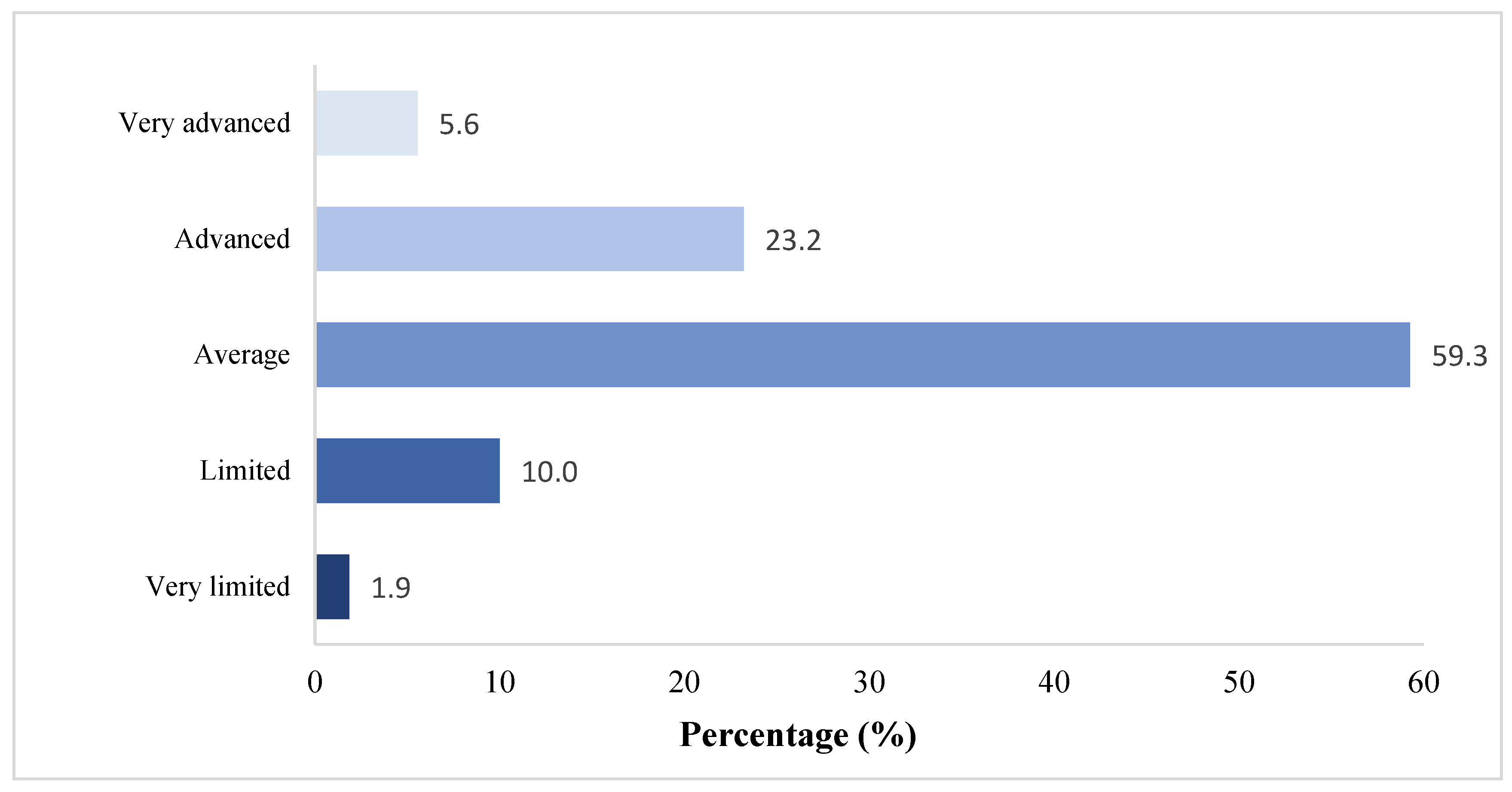
Regarding self-assessed knowledge of AI (“Question 1”), the sample reported a mean score of 3.21 (SD = 0.77), corresponding to an average level. The mode was also 3, reinforcing this trend. In terms of distribution, 59.3% of students indicated “average” knowledge, 23.3% “advanced,” and 5.6% “very advanced,” while only 10% rated their knowledge as “limited” and 1.9% as “very limited.” Overall, more than 80% of participants reported average or higher levels of knowledge, as illustrated in Figure 1, which displays the distribution of self-assessed knowledge levels among respondents.
An exploratory one-way ANOVA comparing the mean self-rated knowledge score across programs showed no statistically significant differences (p = 0.12). Given the unequal representation across programs and the exploratory nature of this analysis, this comparison is reported descriptively.
Regarding familiarity with the benefits of integrating AI into curricula, 41.5% of students reported being “familiar,” 16.3% “very familiar,” 33.0% “slightly familiar,” and 9.3% “not familiar at all.” The mean score was 2.65 (SD = 0.86), indicating an intermediate level of familiarity.
Students’ reported academic knowledge and academic use of selected AI-related tools are summarized in Table 1. The highest levels were observed for ChatGPT (OpenAI, free publicly available web-based version at the time of data collection, which primarily corresponded to GPT-3.5 for free users) (academic knowledge 99.3%; academic use 94.1%), followed by Google Scholar (77.0%; 67.8%) and Gemini (60.0%; 36.7%).

3.2. Frequency and Purposes of AI Use

Students reported frequent use of AI tools for academic activities. 58.5% indicated using AI tools more than six times per week, 19.3% three to four times per week, 13.0% five to six times per week, 7.8% once or twice per week, and 1.5% reported never using them.
The main academic purposes for AI tool use are presented in Table 2. The most commonly reported purposes were solving doubts (88.5%), summarizing information (64.4%), data analysis (51.1%), and research assignments (50.0%), followed by homework completion, literature review, preparing notes, and translation.
Despite the high frequency of AI tool use, 92.6% of students reported not having received formal training in AI. Among those who had received training, the most frequently reported sources were seminars and presentations (28.0%), free webinars (22.5%), online resources (20.2%), and self-study (14.3%). Only 2.9% reported receiving training directly from their university. In terms of interest in future training, 72.2% expressed willingness to participate in workshops, whereas 27.8% reported no interest.

3.3. Perceptions and Attitudes Toward AI Integration in Education

Concerning perceived faculty use of AI in course materials, 62.2% of students indicated they had not been informed of such use, while 37.8% reported they had.
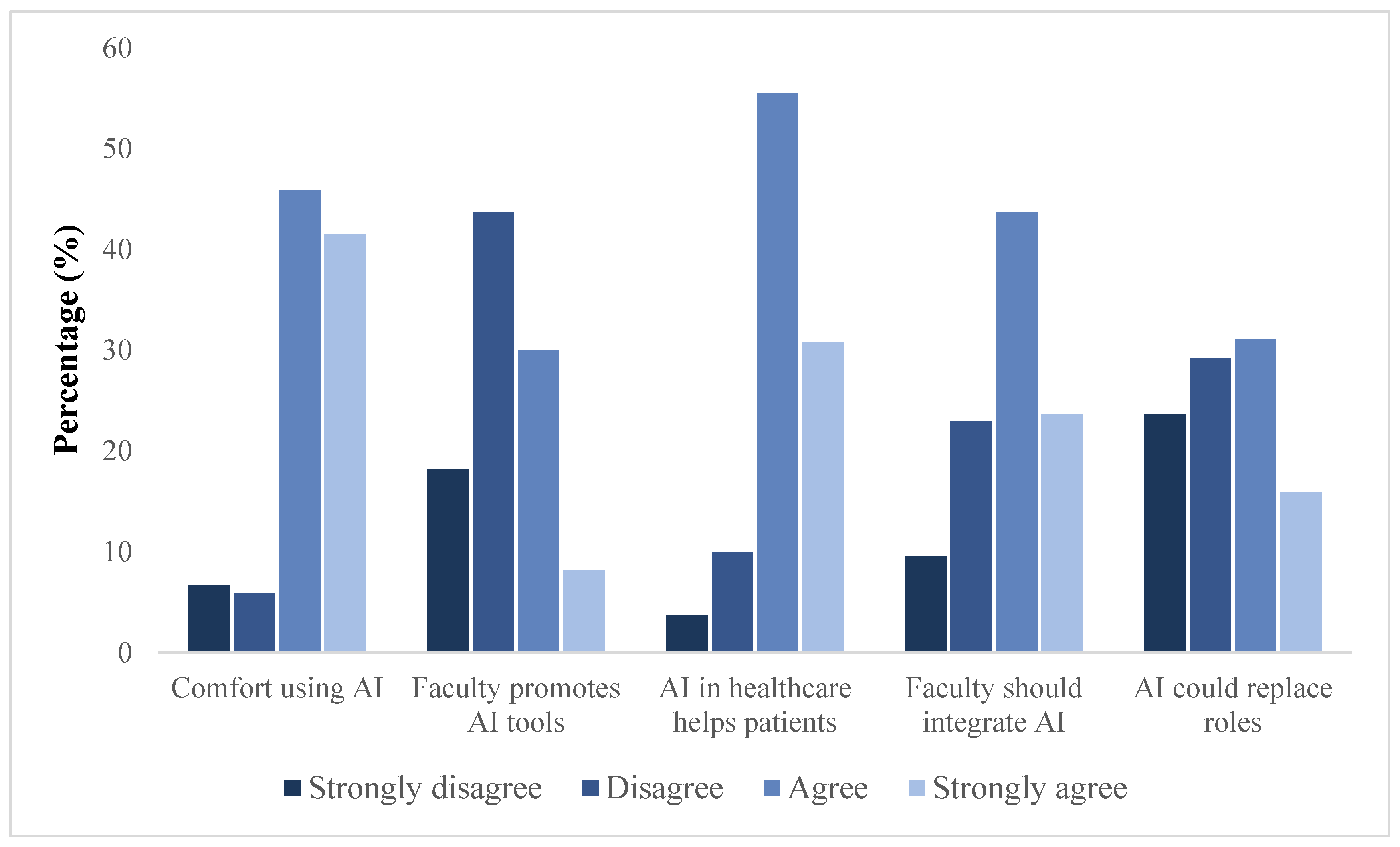
Overall attitudes toward AI integration were generally favorable. Most participants agreed with statements related to the usefulness and convenience of AI in health sciences education, as well as the importance of incorporating AI into curricula. These patterns are summarized in Figure 2, which shows higher agreement in items related to AI’s perceived benefits and the need for curricular inclusion, with comparatively lower agreement in items reflecting distrust or reluctance.

3.4. Awareness of AI Applications and Perceived Risks

Students’ awareness of AI applications in health sciences is summarized in Table 3. Notably, 41.1% reported no knowledge of any AI applications in the health sciences field. Among those who did report awareness, the most frequently recognized applications included medication reminders (33.7%), medical diagnosis (29.3%), patient health education (28.2%), and clinical decision support (22.2%), among others.

4. Discussion

The results of this study provide a comprehensive overview of health sciences students’ familiarity with, use of, and perceptions of AI within Costa Rican universities. Although the exploratory statistical analyses did not reveal statistically significant differences between academic programs, the overall patterns indicate a relatively homogeneous level of awareness, use, and attitudes toward AI across disciplines. This homogeneity suggests that exposure to AI tools among students is driven more by broader digital trends and accessibility than by discipline-specific curricular structures. These findings align with international evidence showing that students across diverse fields demonstrate openness toward adopting digital technologies that support learning and productivity, even in the absence of formal institutional guidance [11,16,21].

4.1. Knowledge and Familiarity with AI

More than 80% of students reported average or higher self-assessed knowledge of AI, reflecting a growing digital culture within Costa Rican higher education. Similar patterns have been documented in studies from North America, Europe, and Asia, where students report widespread familiarity with AI tools but limited formal understanding of their underlying principles, limitations, and risks [12,13].
The findings suggest that Costa Rican students have largely developed their AI-related competencies through informal and self-directed learning, particularly via exposure to generative tools such as ChatGPT, which have rapidly become embedded in academic routines. This mirrors a global phenomenon characterized by spontaneous adoption driven by ease of access, curiosity, and perceived academic utility rather than by structured pedagogical integration [4,11]. While this organic adoption reflects adaptability and digital initiative among students, it also raises concerns regarding uneven skill development and uncritical reliance on AI-generated outputs.

4.2. Training Gaps and Curricular Integration

A central finding of this study is the marked lack of formal institutional training in AI. More than 90% of respondents reported having received no structured instruction on AI during their academic programs, highlighting a significant gap between widespread informal use and formal curricular integration. Similar discrepancies have been reported across Latin American universities, where student enthusiasm for AI contrasts sharply with limited institutional preparedness and curricular inclusion [5,21].
Bridging this gap requires the deliberate incorporation of AI-related competencies into health sciences curricula. Such integration should move beyond technical familiarity and prioritize interdisciplinary collaboration, digital ethics, data literacy, and critical evaluation of AI-generated content. Structured educational modules that integrate technical, ethical, and humanistic dimensions would better prepare students to engage responsibly with AI technologies in clinical, academic, and research contexts. This approach aligns with global educational priorities and ethical frameworks, including those proposed by UNESCO for the responsible use of emerging technologies [22].
Consistent with regional literature, these findings reflect broader structural challenges faced by Latin American higher education systems. Previous studies have identified unequal access to digital infrastructure, limited faculty training, and insufficient institutional policies as persistent barriers to systematic AI integration [5,21]. In the Costa Rican context, Martínez and Mendoza further highlighted the presence of digital gender gaps, which may exacerbate inequalities in access to and effective use of technological tools, including AI-based systems [23]. These structural constraints underscore the need for institutional strategies that address both technological capacity and social equity.

4.3. Ethical Awareness and Institutional Challenges

Despite generally positive attitudes toward AI, students demonstrated limited awareness of ethical risks associated with its use. A substantial proportion of participants did not readily identify concerns related to misinformation, algorithmic bias, academic integrity, or data confidentiality. Comparable findings have been reported internationally, where increasing reliance on AI tools has been associated with reduced critical reasoning, superficial learning, and ethical ambiguities in academic contexts [24].
These results emphasize the importance of embedding digital ethics as a transversal component of health sciences education. Ethical instruction should not be confined to isolated modules but integrated across curricula to foster reflection, accountability, and professional responsibility. Furthermore, differences in access to AI tools across universities and programs revealed underlying digital inequalities, reflecting broader socioeconomic and institutional disparities previously documented in the literature [23,25]. Addressing these challenges requires coordinated institutional and governmental efforts aimed at improving digital infrastructure, ensuring equitable access, and reducing systemic barriers to technological inclusion.

4.4. Implications for Policy and Practice

The findings highlight an urgent need for coherent national and institutional strategies that align technological innovation with pedagogical reform. Universities should develop explicit policies that promote faculty training in AI, equitable access to digital tools, and the establishment of clear ethical guidelines governing AI use in academic settings. Strengthening collaboration between universities, educational authorities, and public institutions may facilitate the responsible and context-sensitive integration of AI into health sciences education.
In the Costa Rican context, such initiatives should operate in alignment with existing data protection regulations, including Law No. 8968 on the Protection of Personal Data [18]. By aligning institutional practices with international frameworks such as UNESCO’s recommendations on digital ethics, Costa Rican universities can transition from passive, unregulated adoption toward proactive and pedagogically grounded implementation of AI. This shift is essential to ensure that emerging technologies support critical thinking, social inclusion, and professional integrity within health sciences training [26].

4.5. Limitations and Future Directions

This study has several limitations. Its exploratory, cross-sectional design and reliance on self-reported data limit causal interpretation. Inferential analyses were descriptive in nature, and no formal testing of statistical assumptions or adjustment for potential confounding variables was performed. Consequently, the findings should be interpreted cautiously and considered hypothesis-generating rather than confirmatory.
Although the final sample of 270 students provided valuable insights, it did not reach the initially targeted sample size of 351, which may limit representativeness across all health sciences programs. In addition, certain disciplines, including Nursing, Dentistry, and Nutrition, were underrepresented, potentially affecting the generalizability of the results. The use of self-reported data also introduces the possibility of response bias, as participants’ perceptions may not accurately reflect actual knowledge or behavior.
The cross-sectional design further restricts conclusions regarding temporal relationships between AI exposure, knowledge, and perceptions. Longitudinal studies are needed to examine how AI literacy evolves throughout students’ academic trajectories. Moreover, although the questionnaire was informed by existing literature and expert review, it was not formally validated or assessed for reliability. Future research should address this limitation through confirmatory factor analysis and internal consistency testing.
Finally, this study focused exclusively on student perspectives and did not incorporate faculty or administrative viewpoints, which could provide a more comprehensive understanding of institutional readiness and policy development. Future research should adopt multi-stakeholder and mixed-methods approaches, including faculty surveys and qualitative interviews, to triangulate findings. Cross-country comparative studies within Latin America are also warranted to explore cultural and institutional factors shaping AI integration in health sciences education.

5. Conclusions

These findings highlight that Costa Rican health sciences students possess moderate to high self-perceived literacy in AI and frequently use AI tools informally for academic purposes. However, formal institutional training and ethical awareness remain limited, reflecting broader structural and curricular gaps in higher education. The results underscore the need for universities to develop strategic policies that integrate AI within health sciences curricula through faculty development, interdisciplinary collaboration, and ethical guidance. Aligning these initiatives with global standards such as UNESCO’s digital ethics framework could promote responsible, transparent, and equitable use of AI in educational contexts. Future efforts should prioritize the inclusion of AI competencies in academic programs, expand access to digital resources, and strengthen institutional readiness to ensure that students and educators can adapt to emerging technologies while upholding professional and ethical standards.

Supplementary Materials

The complete survey questionnaire used in this study can be downloaded at https://www.mdpi.com/article/10.3390/ime5010013/s1, File S1. Exploring the Integration of Artificial Intelligence in Pharmaceutical Education.

Author Contributions

Conceptualization: A.C.-A., J.M.C.-F., A.O.-U., J.M.-J. and E.Z.-M.; Methodology: A.C.-A., J.M.C.-F., J.M.-J., L.R.-Y. and M.M.-D.; Formal analysis: A.C.-A., J.M.-J. and M.M.-D.; Investigation: A.C.-A., A.O.-U., J.M.-J., L.R.-Y., N.B.-S., S.A.-C. and L.E.H.-S.; Data curation: A.C.-A., J.M.-J. and L.R.-Y.; Writing—original draft: A.C.-A., J.M.C.-F., A.O.-U., J.M.-J., L.R.-Y. and M.M.-D.; Writing—review and editing: E.Z.-M., J.M.C.-F., J.M.-J., L.R.-Y., N.B.-S., S.A.-C. and L.E.H.-S.; Visualization: A.C.-A., M.M.-D. and N.B.-S.; Supervision: E.Z.-M.; Project administration: E.Z.-M. and J.M.-J.; Resources: L.R.-Y., M.M.-D., N.B.-S., S.A.-C. and L.E.H.-S. All authors have read and agreed to the published version of the manuscript.

Funding

This research received no external funding.

Institutional Review Board Statement

This study was classified as minimal-risk, non-interventional educational research and therefore does not fall under the scope of Costa Rica’s Law No. 9234 regulating biomedical research. The study followed institutional ethical guidelines, obtained electronic informed consent from all participants prior to participation, and ensured anonymity and confidentiality in compliance with Costa Rica’s Law No. 8968 on the Protection of Personal Data.

Informed Consent Statement

Informed consent was obtained electronically from all participants involved in the study.

Data Availability Statement

The anonymized dataset supporting the findings of this study is available from the corresponding author upon reasonable request. All data were collected and stored in accordance with Costa Rican data protection law (Ley 8968). The questionnaire instrument can be made available by the corresponding author upon reasonable request.

Acknowledgments

The author thanks the participating universities and students for their collaboration and valuable time.

Conflicts of Interest

The author declares no conflicts of interest.

Abbreviations

The following abbreviations are used in this manuscript:
AIArtificial Intelligence
ANOVAAnalysis of Variance
UCRUniversidad de Costa Rica
UCIMEDUniversidad de Ciencias Médicas
UNIBEUniversidad de Iberoamérica
SECScientific Ethics Committee

References

  1. Ali, S.; Abuhmed, T.; El-Sappagh, S.; Muhammad, K.; Alonso-Moral, J.M.; Confalonieri, R.; Guidotti, R.; Del Ser, J.; Díaz-Rodríguez, N.; Herrera, F. Explainable Artificial Intelligence (XAI): What We Know and What Is Left to Attain Trustworthy Artificial Intelligence. Inf. Fusion 2023, 99, 101805. [Google Scholar] [CrossRef]
  2. In AI We Trust: Ethics, Artificial Intelligence, and Reliability|Science and Engineering Ethics. Available online: https://link.springer.com/article/10.1007/s11948-020-00228-y (accessed on 20 November 2025).
  3. Abd-alrazaq, A.; AlSaad, R.; Alhuwail, D.; Ahmed, A.; Healy, P.M.; Latifi, S.; Aziz, S.; Damseh, R.; Alrazak, S.A.; Sheikh, J. Large Language Models in Medical Education: Opportunities, Challenges, and Future Directions. JMIR Med. Educ. 2023, 9, e48291. [Google Scholar] [CrossRef]
  4. Chen, L.; Chen, P.; Lin, Z. Artificial Intelligence in Education: A Review. IEEE Access 2020, 8, 75264–75278. [Google Scholar] [CrossRef]
  5. Madrigal, C.; Emanuel, J. Inteligencia Artificial en la Educación Superior de Costa Rica: Desafíos y Oportunidades Desde Una Perspectiva Ética. Master’s Thesis, Universidad Nacional, Costa Rica, Heredia, Costa Rica, 2024. [Google Scholar]
  6. Vera, F. Integración de la Inteligencia Artificial en la Educación superior: Desafíos y oportunidades. Transformar 2023, 4, 17–34. [Google Scholar]
  7. Boscardin, C.K.; Abdulnour, R.-E.E.; Gin, B.C. Macy Foundation Innovation Report Part I: Current Landscape of Artificial Intelligence in Medical Education. Acad. Med. 2025, 100, S15–S21. [Google Scholar] [CrossRef] [PubMed]
  8. Adewale, M.D.; Azeta, A.; Abayomi-Alli, A.; Sambo-Magaji, A. Impact of Artificial Intelligence Adoption on Students’ Academic Performance in Open and Distance Learning: A Systematic Literature Review. Heliyon 2024, 10, e40025. [Google Scholar] [CrossRef] [PubMed]
  9. Tozsin, A.; Ucmak, H.; Soyturk, S.; Aydin, A.; Gozen, A.S.; Fahim, M.A.; Güven, S.; Ahmed, K. The Role of Artificial Intelligence in Medical Education: A Systematic Review. Surg. Innov. 2024, 31, 415–423. [Google Scholar] [CrossRef]
  10. Hallquist, E.; Gupta, I.; Montalbano, M.; Loukas, M. Applications of Artificial Intelligence in Medical Education: A Systematic Review. Cureus 2025, 17, e79878. [Google Scholar] [CrossRef]
  11. Veras, M.; Dyer, J.-O.; Shannon, H.; Bogie, B.J.M.; Ronney, M.; Sekhon, H.; Rutherford, D.; Silva, P.G.B.; Kairy, D. A Mixed Methods Crossover Randomized Controlled Trial Exploring the Experiences, Perceptions, and Usability of Artificial Intelligence (ChatGPT) in Health Sciences Education. Digit. Health 2024, 10, 20552076241298485. [Google Scholar] [CrossRef]
  12. Elnaem, M.H.; Okuyan, B.; Mubarak, N.; Thabit, A.K.; AbouKhatwa, M.M.; Ramatillah, D.L.; Isah, A.; Al-Jumaili, A.A.; Nazar, N.I.M. Students’ Acceptance and Use of Generative AI in Pharmacy Education: International Cross-Sectional Survey Based on the Extended Unified Theory of Acceptance and Use of Technology. Int. J. Clin. Pharm. 2025, 47, 1097–1108. [Google Scholar] [CrossRef]
  13. Zhang, X.; Li, Z.; Zhang, M.; Yin, M.; Yang, Z.; Gao, D.; Li, H. Exploring Artificial Intelligence (AI) Chatbot Usage Behaviors and Their Association with Mental Health Outcomes in Chinese University Students. J. Affect. Disord. 2025, 380, 394–400. [Google Scholar] [CrossRef]
  14. Gustafson, K.A.; Berman, S.; Gavaza, P.; Mohamed, I.; Devraj, R.; Abdel Aziz, M.H.; Singh, D.; Southwood, R.; Ogunsanya, M.E.; Chu, A.; et al. Pharmacy Faculty and Students Perceptions of Artificial Intelligence: A National Survey. Curr. Pharm. Teach. Learn. 2025, 17, 102344. [Google Scholar] [CrossRef] [PubMed]
  15. Rokaya, D.; Jaghsi, A.A.; Jagtap, R.; Srimaneepong, V. Artificial Intelligence in Dentistry and Dental Biomaterials. Front. Dent. Med. 2024, 5, 1525505. [Google Scholar] [CrossRef] [PubMed]
  16. Djaber, R. Artificial Intelligence Driven Course Generation: A Case Study Using ChatGPT. arXiv 2024, arXiv:2411.01369. [Google Scholar] [CrossRef]
  17. Hasan, H.E.; Jaber, D.; Al Tabbah, S.; Lawand, N.; Habib, H.A.; Farahat, N.M. Knowledge, Attitude and Practice among Pharmacy Students and Faculty Members towards Artificial Intelligence in Pharmacy Practice: A Multinational Cross-Sectional Study. PLoS ONE 2024, 19, e0296884. [Google Scholar] [CrossRef]
  18. Sistema Costarricense de Información Jurídica. Available online: https://pgrweb.go.cr/scij/Busqueda/Normativa/Normas/nrm_texto_completo.aspx?param1=NRTC&nValor1=1&nValor2=70975&nValor3=85989&strTipM=TC (accessed on 20 November 2025).
  19. Sistema Costarricense de Información Jurídica. Available online: https://pgrweb.go.cr/scij/Busqueda/Normativa/Normas/nrm_texto_completo.aspx?nValor1=1&nValor2=77070 (accessed on 20 November 2025).
  20. Dillman, D.A.; Smyth, J.D.; Christian, L.M. Internet, Phone, Mail, and Mixed Mode Surveys: The Tailored Design Method, 4th ed.; John Wiley & Sons, Inc.: Hoboken, NJ, USA, 2014; pp. xvii, 509. ISBN 978-1-118-45614-9. [Google Scholar]
  21. Veras, M.; Dyer, J.-O.; Rooney, M.; Barros Silva, P.G.; Rutherford, D.; Kairy, D. Usability and Efficacy of Artificial Intelligence Chatbots (ChatGPT) for Health Sciences Students: Protocol for a Crossover Randomized Controlled Trial. JMIR Res. Protoc. 2023, 12, e51873. [Google Scholar] [CrossRef]
  22. Mortlock, R.; Lucas, C. Generative Artificial Intelligence (Gen-AI) in Pharmacy Education: Utilization and Implications for Academic Integrity: A Scoping Review. Explor. Res. Clin. Soc. Pharm. 2024, 15, 100481. [Google Scholar] [CrossRef]
  23. Martínez Toledo, Y.; Mendoza Aguilar, S. Políticas públicas y Brecha digital de género (BDG): Un análisis en Costa Rica (2020–2022). Rev. Reflex. 2024, 103, 1–19. [Google Scholar] [CrossRef]
  24. Khakpaki, A. Advancements in Artificial Intelligence Transforming Medical Education: A Comprehensive Overview. Med. Educ. Online 2025, 30, 2542807. [Google Scholar] [CrossRef]
  25. Rojas, G.; Romero, R. Gestión e impacto de las medidas de intervención para la reducción de casos por COVID-19 en Costa Rica. Rev. Panam. Salud Pública 2023, 46, e23. [Google Scholar] [CrossRef]
  26. Son, J.-J.; Lee, J.-H.; Ha, J.-M.; Kang, N.-R.; Hwang, S.-M.; Jang, J.-U.; Cho, D.-H.; Kim, S.-Y.; Choi, W.-S.; Shin, Y.-U.; et al. Impact of Artificial Feeding Policies on Space Use and Competition Dynamics in Overwintering Hooded Crane and Goose Populations. PLoS ONE 2025, 20, e0336710. [Google Scholar] [CrossRef]
Figure 1. Distribution of self-assessed levels of knowledge about artificial intelligence among health sciences students. Note: The figure represents responses to a single survey item: “How would you rate your knowledge of artificial intelligence?”, assessed on a 5-point Likert scale (1 = very limited, 5 = very advanced).
Ime 05 00013 g001
Figure 2. Students’ perception of artificial intelligence integration in health sciences education. Note: The figure summarizes responses to Likert-scale items assessing perceived usefulness, ethical implications, and the need for curricular integration (1 = strongly disagree, 5 = strongly agree).
Ime 05 00013 g002
Table 1. Percentage of academic knowledge and use of artificial intelligence tools reported by health sciences students.
ToolAcademic KnowledgeAcademic Use
ChatGPT99.394.1
Google Scholar *77.067.8
Gemini60.036.7
Grammarly44.419.3
Copilot40.710.0
Open Evidence6.72.2
* Note: Google Scholar was included due to its AI-based search indexing features, although it does not operate as a generative AI tool.
Table 2. Main academic purpose for which students use artificial intelligence tools.
ToolNumber of ResponsesPercentage (%)
Solve doubts23988.5%
Summarize information17464.4%
Data analysis13851.1%
Research assignments 13550.0%
Homework completions12947.8%
Literature review 12847.4%
Prepare notes11542.6%
Translate information10237.8%
Table 3. Knowledge of artificial intelligence applications in different areas of health sciences.
ToolNumber of ResponsesPercentage (%)
No knowledge of AI applications in health sciences *11141.1%
Medication reminders9133.7%
Medical diagnosis7929.3%
Patient health education7628.2%
Clinical decision support6022.2%
Personalized treatment development4817.8%
Hospital resource management4416.3%
Patient safety3412.6%
Personalized clinical interventions2910.7%
* This category represents students who reported no awareness of any artificial intelligence applications in the health sciences field.
Disclaimer/Publisher’s Note: The statements, opinions and data contained in all publications are solely those of the individual author(s) and contributor(s) and not of MDPI and/or the editor(s). MDPI and/or the editor(s) disclaim responsibility for any injury to people or property resulting from any ideas, methods, instructions or products referred to in the content.