Article

Metabolic Fingerprints of Compost and Frass by 1H-HRMAS NMR: Detection of Betaine-Related Biotransformation Products


by
Rubén Gil-Gonzalo
1,
Palmira Villa-Valverde
2,
Inmaculada Aranaz
1,3 and
David Castejón
2,*
1
Pluridisciplinar Institute, Complutense University of Madrid, 28040 Madrid, Spain
2
ICTS Complutense Bioimaging, Complutense University of Madrid, 28040 Madrid, Spain
3
Department of Chemistry in Pharmaceutical Science, Pharmacy Faculty, Complutense University of Madrid, 28040 Madrid, Spain
*
Author to whom correspondence should be addressed.
Appl. Biosci. 2026, 5(3), 63; https://doi.org/10.3390/applbiosci5030063
Submission received: 9 June 2026 / Revised: 13 July 2026 / Accepted: 23 July 2026 / Published: 28 July 2026

Abstract

In the valorization of organic waste within circular bioeconomy frameworks, compost and insect frass are increasingly used as soil amendments, yet their molecular composition and the metabolic signatures of biological processing remain poorly characterized. In this study, high-resolution magic angle spinning (HRMAS) nuclear magnetic resonance (NMR) was applied to intact compost and frass samples to explore their metabolic profiles and assess the potential of this technique to detect bioindicators of vermi- and insect-associated biotransformation without destructive sample preparation. HRMAS NMR experiments included water-suppressed one-dimensional 1H spectra and selected two-dimensional experiments (1H–13C HSQC and 1H–13C HMBC) to support signal assignment. The analysis revealed clear differences between compost with and without vermicomposting activity, with low-molecular-weight resonances assigned to glycine betaine (betaine), a characteristic metabolite associated with biotransformation. In Tenebrio molitor frass, 1H-HRMAS spectra displayed a distinct set of small-molecule signals, including betaine resonances detected for the first time in this matrix. Time-resolved monitoring showed that betaine signals remained stable during the studied period. These findings demonstrate that HRMAS NMR provides a minimally invasive, versatile platform for direct characterization of compost and frass, supporting the identification of metabolic signatures linked to vermi- and insect-mediated processing.

1. Introduction

The valorization of organic residues is an essential component of circular bioeconomy strategies, because it allows low-value biomass streams to be redirected toward products with agronomic and environmental utility [1,2,3,4]. Among these materials, compost and insect frass are increasingly recognized as relevant soil amendments and bioproducts, but their chemical complexity and heterogeneity still limit a complete understanding of their composition and functional properties [1,5,6]. Compost is generated through the progressive microbial decomposition of organic matter, leading to the transformation of labile substrates into more stabilized humic-like fractions, whereas frass represents a biologically processed residue enriched in undigested feed particles, microbial biomass, and metabolites arising from insect digestion and excretion [1,4,5,6]. Because both matrices reflect distinct but related biotransformation processes, their detailed molecular characterization is important for assessing maturity, stability, and potential agronomic value [2,6].
The analytical study of compost has traditionally relied on bulk chemical measurements and spectroscopic approaches such as Fourier-transform infrared (FTIR) and solid-state nuclear magnetic resonance (NMR), which have shown that composting alters the balance between polysaccharidic, aliphatic, and aromatic domains and contributes to the formation of humic and fulvic fractions [7,8]. These studies support the view that humic substances are useful indicators of compost transformation, although there is still debate on how completely they capture the molecular diversity and reactivity of compost-derived organic matter [7,9]. In the case of frass, recent reviews indicate that its composition and agronomic effects depend strongly on the insect species and the feed substrate, and that its chemical and microbiological characterization remains limited compared with compost. This leaves open important questions about the small-molecule signatures that distinguish frass from other organic residues and this may reflect insect-mediated biotransformation [6,8].
NMR spectroscopy is particularly valuable for studying complex organic materials because it provides non-destructive, molecular-level information with limited sample preparation [10,11]. In this context, high-resolution magic angle spinning (HRMAS) NMR is especially attractive for semi-solid and heterogeneous samples, as it improves spectral resolution while preserving the native structure of the matrix [11,12]. Although HRMAS has been applied in other complex matrices, its systematic use for the direct analysis of intact compost and frass remains scarce, representing a methodological opportunity for the study of these materials [12,13,14]. This approach can potentially reveal both broad structural features, such as residual polysaccharides and humic-like domains, and discrete low-molecular-weight metabolites that may be lost or obscured in conventional extraction-based workflows [7,8].
In the present study, we used HRMAS NMR to directly analyze intact compost and frass samples with the aim of characterizing their molecular profiles and exploring whether this approach can reveal signatures associated with biological processing. Particular attention was paid to low-molecular-weight resonances that may reflect vermi-associated transformation processes and to sample stability during NMR acquisition inside the rotor. This work highlights the utility of HRMAS NMR as a minimally invasive and versatile platform for the direct characterization of complex organic matrices.

2. Materials and Methods

Compost samples were collected from the composting area of the Pluridisciplinary Institute of the Complutense University of Madrid (UCM), an institutional facility dedicated to composting activities and organic waste valorization. The composting area receives organic waste streams derived from the daily activities of institute staff, including residual solid municipal waste and waste from the institute gardens, in an approximate 1:2 ratio of food and household residues to garden waste. This composting setup at the UCM campus served as an experimental model of traditional compost production under controlled conditions.
Compost was collected from modular composters with a capacity of 1 m3 by taking five representative sub-samples from different points at a depth of approximately 15 cm within each unit. For each batch, the sub-samples were combined to obtain a composite sample, which was then homogenized before analysis. A total of 15 compost samples from 9 independent composting processes collected over different periods of the year were analyzed by HRMAS NMR; 6 processes were sampled at two time points (5 and 7 months; 12 samples), and 3 processes were sampled once (5 months; 3 samples). All batches had undergone at least five months of maturation before sampling. Samples were collected in their native semi-solid state and stored until analysis.
Tenebrio molitor larvae were reared at the institute as a source of chitin for ongoing biotransformation studies and were fed primarily on oat-based diets. Frass was collected from the rearing containers after the biotransformation period. The procedure involved removal of all organisms (live and dead), classified by developmental stage (larva, pupa, beetle), followed by separation of the remaining material using a sequence of sieves ordered from larger to smaller pore size (3.16 mm, 1 mm, and 500 µm). Frass was defined as the fraction passing through the 500 µm sieve, yielding a homogeneous and stable fine fraction. The collected frass was stored until analysis. A total of 15 T. molitor frass samples from 5 independent batches were analyzed in triplicate.
In addition, black soldier fly larvae (Hermetia illucens) and earthworms (Eisenia fetida) were naturally present in the outdoor composting units at the UCM campus, the former during the warmer months and the latter originating from the underlying soil. Larvae and earthworms were isolated from the composting system and maintained without food in glass containers in the laboratory. The frass excreted during this period was collected and stored until analysis. Three samples of each frass type were analyzed as independent biological replicates under the same conditions. The sampling design for all sample types is summarized in Supplementary Materials, Table S1.
HRMAS NMR experiments were carried out at the ICTS BioImagen Complutense facility using a Bruker AVIII HD 500 spectrometer (Bruker BioSpin GmbH, Rheinstetten, Germany) operating at 500.13 MHz for 1H and equipped with a 1H HRMAS probe. The HRMAS probe is equipped with a precision temperature control system that maintains the set temperature at 298 K during spectral acquisition. Samples were packed into 50 µL zirconium rotors using 10 ± 2 mg of compost or frass per rotor. Approximately 10 µL of 1 mM 3-(trimethylsilyl) propionic-2,2,3,3-d4 acid sodium salt (TSP; Scharlau, Sentmenat, Barcelona, Spain) in D2O was added, and the sample loading was adjusted to ensure a final moisture content of no more than 30% (w/w). D2O was used to provide a deuterium lock and facilitate water suppression, whereas the TSP internal standard was used exclusively for chemical shift referencing (setting δ = 0 ppm). One-dimensional 1H HRMAS spectra were acquired using the water-suppressed Bruker NOESYPR1D pulse program with a mixing time of 150 ms to enhance the detection of low-molecular-weight metabolites. Acquisition parameters included 32 k data points, a spectral width of 14 ppm, 256 scans, and presaturation of the water resonance during a 2 s relaxation delay. Spectra were Fourier transformed, phased, baseline corrected, and referenced to the TSP internal standard. Two-dimensional 1H–13C HSQC and HMBC spectra were recorded using standard Bruker pulse sequences to support metabolite assignment. HSQC spectra were acquired with a 1H spectral width of 16 ppm, a 13C spectral width of 180–220 ppm, 2 k data points in F2, 256–512 increments in F1, and 1–2 scans per increment, using a standard sensitivity-enhanced pulse program. 1H–13C HMBC spectra were acquired to confirm long-range connectivity between protons and carbons separated by two or three bonds, using 1048 points in F2 and 256 points in F1 over a bandwidth of 15 ppm in 1H and 220 ppm in 13C. Sample stability was monitored throughout the 48 h acquisition period in selected samples by intercalating 1H NOESYPR1D spectra between the 2D experiments without removing the sample from the rotor. Data acquisition and processing were performed using Bruker TopSpin 3.7 (Bruker BioSpin, Rheinstetten, Germany) and MestReNova 11.0.4 (Mestrelab Research, Santiago de Compostela, Spain). The Biological Magnetic Resonance Data Bank (BMRB) and Human Metabolome Database (HMDB) databases were employed as reference sources for metabolite confirmation [15,16].

3. Results

3.1. 1H-HRMAS NMR Spectra of Compost Sample

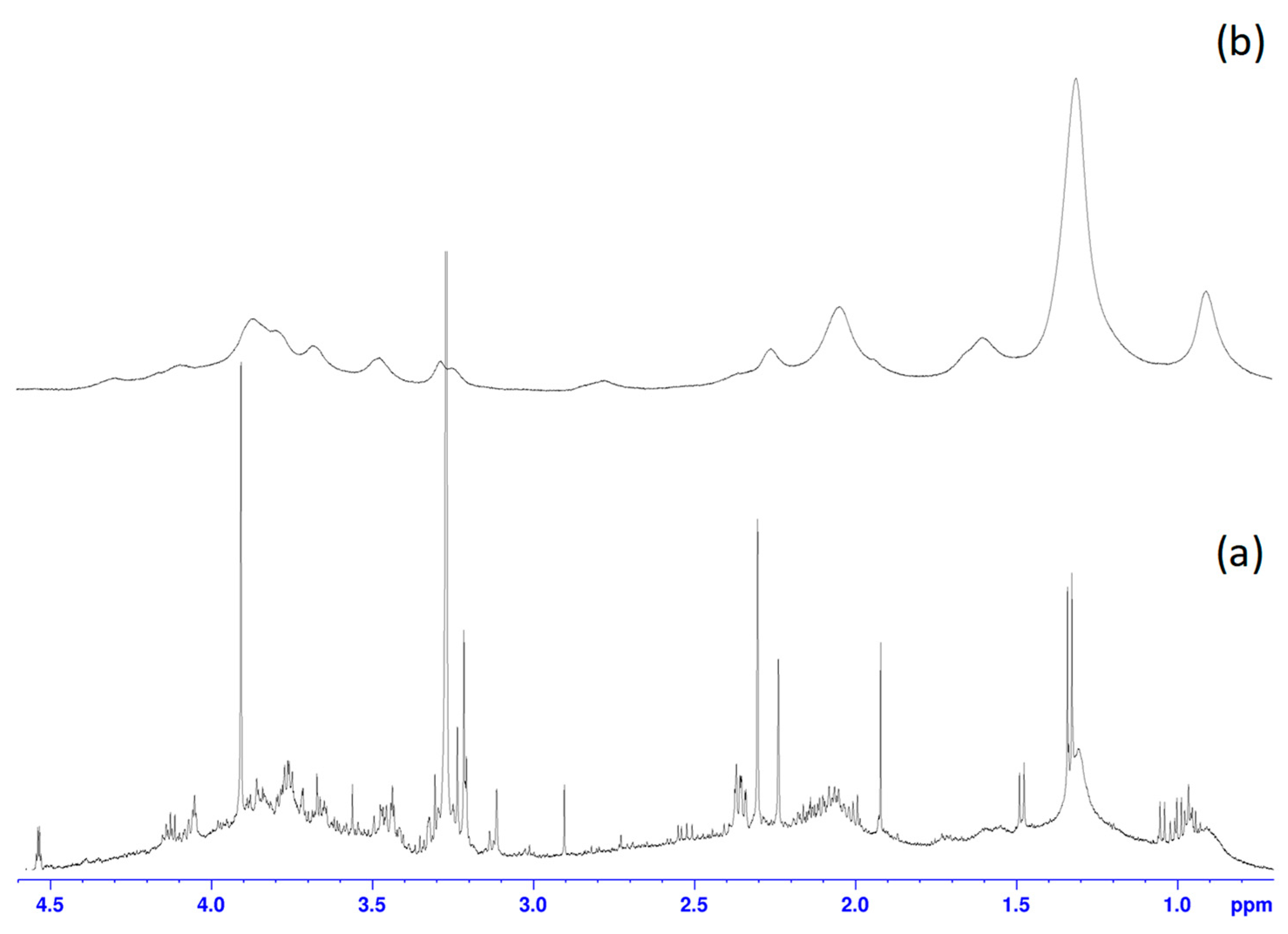
HRMAS NMR was applied to the direct analysis of intact compost and frass samples to characterize their metabolomic profiles. Representative monodimensional 1H HRMAS NMR spectra of compost samples from different batches collected across different seasons at the composting area of the Pluridisciplinary Institute are shown in Figure 1. The spectra show marked differences. Figure 1a displays narrow, well-defined signals associated with low-molecular-weight metabolites, whereas Figure 1b is dominated by broad resonances characteristic of complex, partially polymerized organic matter. The broad signals are also present in Figure 1a, but the spectrum is mainly characterized by the prevalence of sharp low-molecular-weight resonances.
Initially, seasonal variation in the composition of organic waste input to the composters (e.g., different fruit and vegetable residues in winter versus summer) was considered the primary driver of inter-batch spectral variability. However, when the spectral data were analyzed and subsequently correlated with the collection dates of each batch, a stronger association was observed with seasonal fluctuations in the composition of the decomposer community present in the outdoor composting area. In this facility, black soldier fly larvae are consistently absent during winter and their biotransformation activity is strongly restricted to the warmer months (approximately May–September), when ambient temperatures in Madrid increase. The metabolic activity of earthworms present in the compost pile is reduced during the colder winter months, consistent with previous studies showing lower growth and reproduction of Eisenia fetida under low-temperature conditions [17]. Consequently, the spectral differences between batches are attributed to the seasonal presence or absence of black soldier fly larvae during compost formation. Compost batches collected during colder months did not show the low-molecular-weight resonances observed in batches collected during warmer periods, which displayed clearer signals consistent with biological transformation. These sharp resonances are typically associated with small, mobile metabolites, such as free amino acids, low-molecular-weight carbohydrates, organic acids, and betaine derivatives. In contrast, the colder-month spectra were characterized mainly by broader signals from more complex and heterogeneous organic matter derived from compost maturation and humification [18].
To further corroborate the hypothesis that the low-molecular-weight metabolites observed in compost samples from batches produced during warmer months originated from the metabolic activity of black soldier fly larvae and earthworms, frass samples from black soldier fly larvae and Eisenia fetida earthworms obtained at the institute from specimens present in the composting area were analyzed; the corresponding spectra are provided in the Supplementary Materials (Figure S1). 1H NMR spectra of both black soldier fly frass and earthworm frass showed metabolomic profiles consistent with those observed in compost samples displaying vermi-associated activity. In all samples analyzed—vermi-active compost, black soldier fly frass, and earthworm frass—the 1H spectra were characterized by two singlet resonances at 3.27 and 3.91 ppm. These resonances were present in compost batches showing low-molecular-weight metabolite signals and were absent or markedly less intense in batches lacking vermi-associated activity.
To characterize and structurally elucidate the singlet resonances at 3.27 and 3.91 ppm, two-dimensional HRMAS experiments (1H–13C HSQC and HMBC, Figure S2) were performed on compost samples collected during warmer months (when black soldier fly larvae and earthworms were active) as well as on black soldier fly and earthworm frass. In the HSQC spectrum, correlations at 3.27/56.55 ppm and 3.91/69.42 ppm were observed, corresponding to the three equivalent N-methyl groups (CH3) and the methylene group (CH2) of betaine, respectively. Long-range HMBC correlations between the 3.27 and 3.91 ppm 1H resonances and the carboxyl carbon (172.52 ppm) confirmed the trimethylglycine structure. These data are consistent with glycine betaine (betaine).
The assignment of these resonances to betaine was further supported by comparison with reference spectra from the BMRB and HMDB databases, along with the expected chemical shifts, intensity ratio, and 2D NMR correlation pattern. The experimental and reference spectra showed an excellent match for all diagnostic signals. Taken together, these results provide strong support for assigning the resonances to betaine.

3.2. 1H-HRMAS NMR Spectra of Tenebrio Frass Sample

As an additional validation of these findings, HRMAS spectra of Tenebrio molitor frass were recorded. To provide a more controlled experimental system and further assess the reproducibility of the observations, a pilot study was conducted using Tenebrio molitor larvae. This system is more easily standardized under laboratory conditions throughout the year, and the collection of frass is more straightforward and reproducible compared with the outdoor composting system.
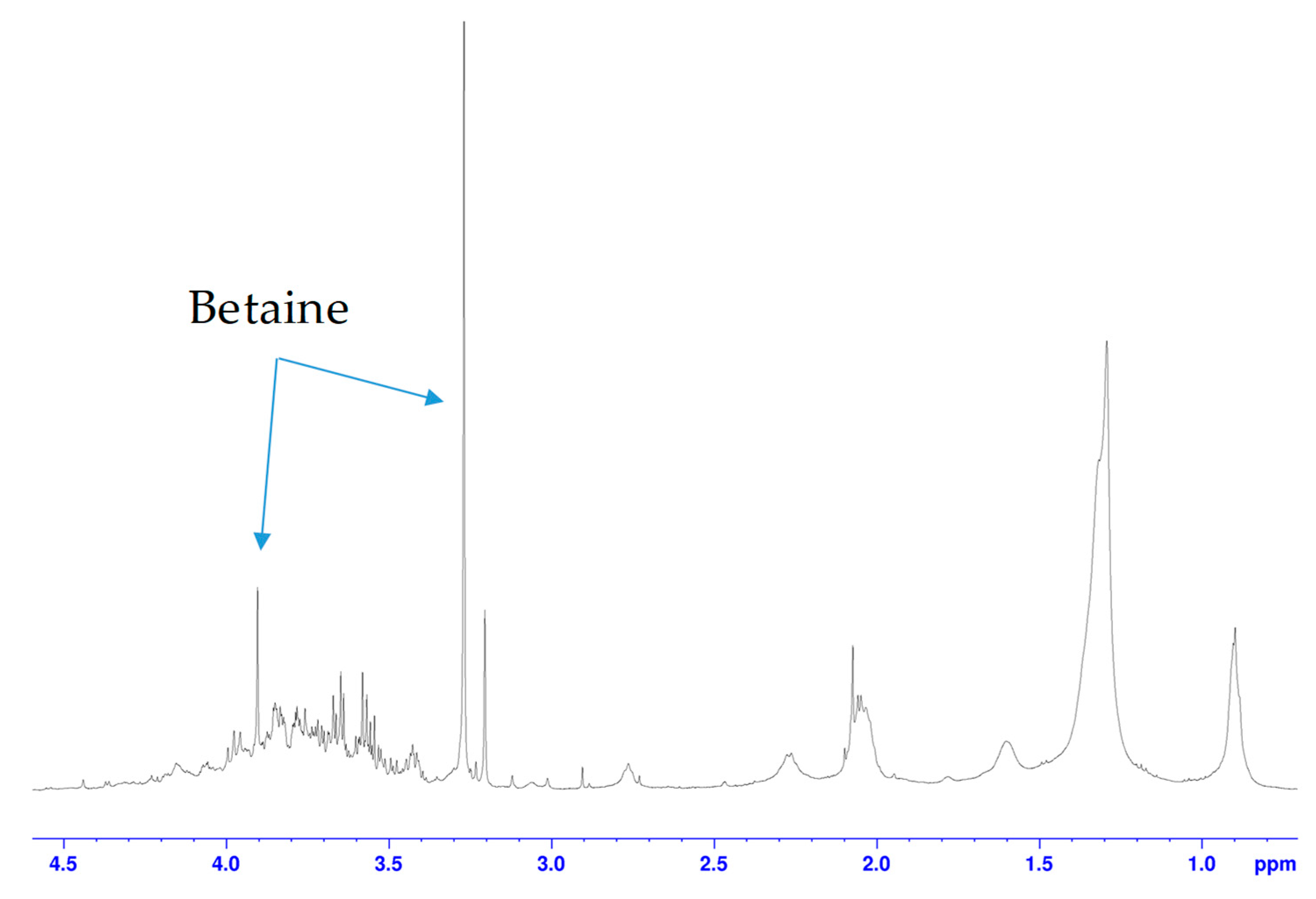
Figure 2 shows a representative 1H HRMAS spectrum of Tenebrio molitor frass. As observed in the previous studies on black soldier fly larvae and earthworms, the spectrum of the detritus is dominated by low-molecular-weight metabolites, and the signals at 3.27 and 3.91 ppm remain among the main resonances in the 1H spectrum.
The 1H HRMAS spectrum of Tenebrio molitor frass showed a distinctive metabolite profile, with prominent signals assigned to betaine (Figure 2). The resonances in the region characteristic of trimethylated quaternary ammonium compounds were clearly visible, forming a reproducible spectral pattern that differed from that observed in compost without vermicomposting activity. The assignment of the principal resonances was also supported by 2D HSQC and HMBC spectra, which confirmed the connectivity and chemical environment of the metabolites detected in the 1D spectrum. All monodimensional frass spectra obtained from Tenebrio molitor displayed a similar profile, with betaine signals as the main resonances. Analogous betaine-related signatures were also observed in frass from fly-derived material and in earthworm vermicompost (Figure S1), supporting the interpretation that these resonances are associated with vermi- and insect-mediated biotransformation across different matrices.
Although statistical analysis was not performed, the distinction between compost samples with and without vermicomposting activity was evident from the spectra. Betaine was present, and often the dominant signal, in samples associated with vermicomposting activity, whereas it was absent or detected only at trace levels in samples without such activity. To further illustrate this point, an overlay of representative spectra from multiple samples within each group has been included in the Supplementary Materials (Figure S3).

3.3. Sample Stability During HRMAS Acquisition

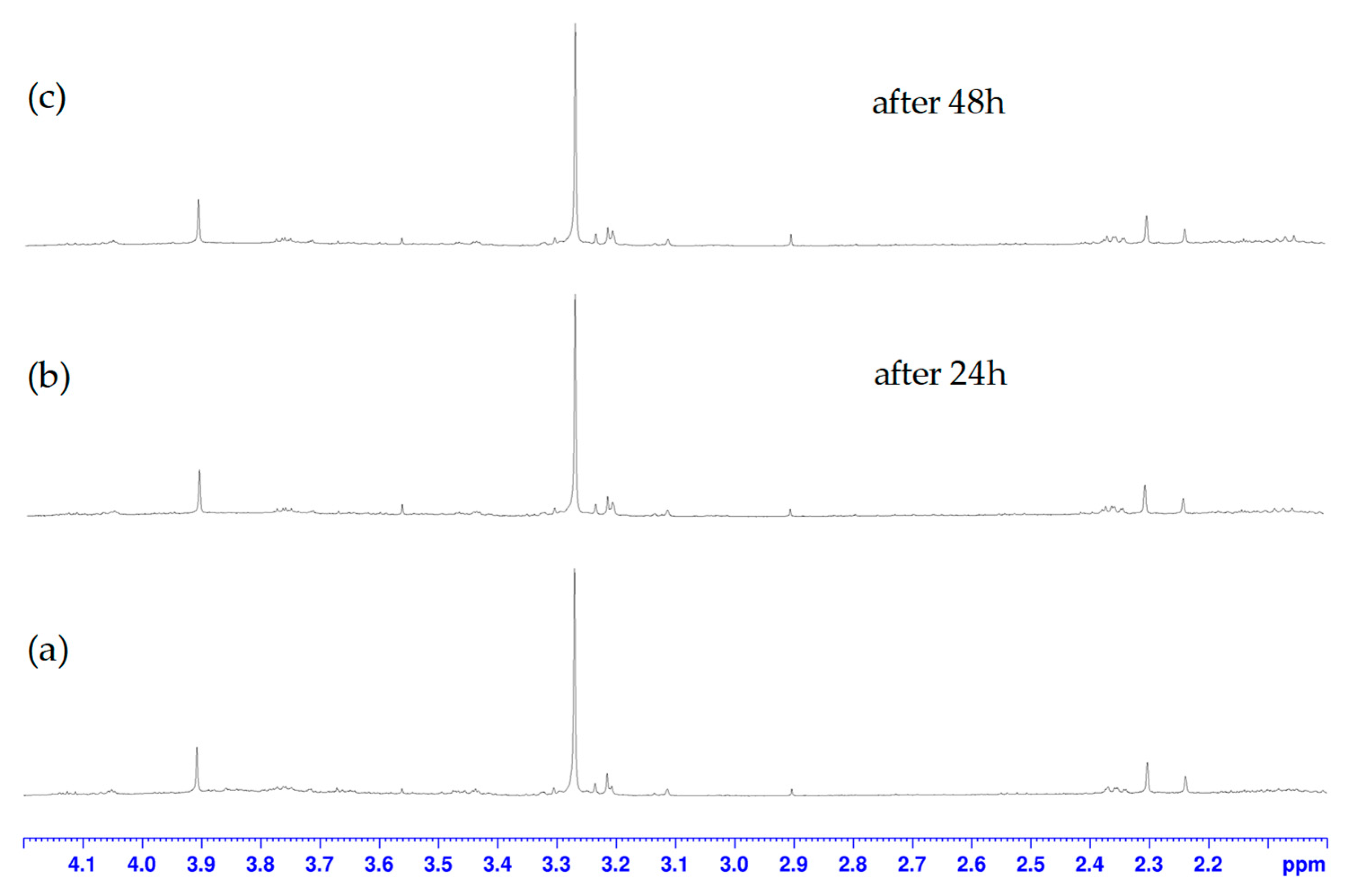
The stability of the samples during HRMAS data acquisition was systematically monitored by acquiring 1H NOESYPR1D spectra at strategic time points throughout the experiment. A 1D spectrum was recorded at the beginning of the acquisition and after approximately 24 h and 48 h of continuous spinning, corresponding to intermediate and final stages of the complete 2D sequence. These control points ensured that any potential changes in the sample could be detected during prolonged acquisition. Figure 3 shows an expansion of the 1H NMR spectra between 2.0 and 4.2 ppm for the same compost sample acquired at three time points: (a) initial spectrum, (b) after 24 h of acquisition, and (c) after 48 h of acquisition. As shown in the figure, the main metabolites displayed almost no variation over time, and the signals corresponding to betaine at 3.27 and 3.91 ppm remained unaltered, with no significant intensity loss or line broadening over the course of the experiment.
This confirms that betaine is chemically stable under HRMAS conditions and that its detection is not affected by mechanical stress, spinning, or heating artifacts during prolonged acquisition. The absence of detectable degradation supports the interpretation that betaine-related signals represent stable biochemical markers of vermi- and insect-mediated biotransformation rather than transient degradation products.

4. Discussion

The present study shows that HRMAS NMR can directly discriminate compost and frass samples according to their molecular signatures. Vermi-active compost, black soldier fly frass, earthworm frass, and Tenebrio molitor frass consistently displayed sharp resonances and a marked contribution from low-molecular-weight metabolites, whereas conventional compost batches collected during colder months were dominated by broad signals from complex organic matter. This pattern agrees with previous reports that composting and vermicomposting modify the chemical structure of organic matter, but it extends those observations by providing intact-sample metabolite information that is usually lost in extraction-based workflows [7,8].
The singlets at 3.27 and 3.91 ppm were identified as betaine based on 1H–13C HSQC and HMBC correlations, in agreement with the expected chemical shifts and comparison to BMRB and HMDB reference spectra [12,14,15,16]. Betaine has been described as biochemically diverse in earthworm tissues and as a key osmolyte involved in osmotic stress responses [19]. In bioconversion composts and vermicomposts, Huang et al. reported that larval processing can increase betaine concentrations substantially, whereas conventional composting tends to reduce them, likely due to transformations occurring during the thermophilic and mesophilic phases [20]. Our findings are therefore consistent with the view that betaine-related metabolites are associated with insect- and vermi-mediated biotransformation, and that HRMAS NMR can detect them directly in intact samples.
A key observation is that betaine signals were present in all samples with vermi or insect activity (black soldier fly, earthworm, and Tenebrio molitor), but absent or markedly reduced in compost batches collected during colder months. This seasonal difference is likely linked to the absence or reduced activity of black soldier fly larvae and earthworms during winter, which limits the production or preservation of mobile metabolites in the composting matrix. Because all batches had undergone at least five months of maturation, the persistence of betaine signals suggests that they may represent relatively stable biochemical markers of bioconversion. The reproducibility of these signals in Tenebrio molitor frass further supports this interpretation. In addition, the betaine singlets at 3.27 and 3.91 ppm remained stable throughout the HRMAS acquisition, with no significant intensity loss or line broadening observed in 1D spectra acquired before and after each 2D experiment. This confirms that betaine is chemically stable under HRMAS conditions and that its detection is not affected by mechanical stress, spinning, or heating artifacts during prolonged acquisition.
From a methodological perspective, HRMAS NMR bridges two complementary analytical scales. Solid-state 13C NMR has been widely used to follow bulk transformations in compost and vermicompost, especially the evolution of aromatic, aliphatic, and carbohydrate fractions during humification [7]. However, these approaches are less suited to detecting soluble or semi-mobile metabolites such as betaines. HRMAS NMR overcomes this limitation by preserving the native matrix while providing enough resolution to observe both broad organic matter domains and sharp low-molecular-weight resonances [12,13,14]. By contrast, commonly used chromatographic approaches such as HPLC, GC-MS, and LC-MS generally require extraction, derivatization, and chromatographic separation, whereas HRMAS NMR enables direct analysis of intact heterogeneous samples with minimal preparation. While mass spectrometry-based methods offer higher sensitivity and more precise quantification, quantitative interpretation in HRMAS can be limited by spectral overlap, sample heterogeneity, and solvent loss during rotor preparation. Overall, integrating NMR and MS can provide a more complete metabolomic picture by combining the structural information and reproducibility of NMR with the sensitivity of MS [21]. Taken together, our results add a molecular layer of information that complements previous compost and frass studies based on solid-state NMR and FTIR [8].
The results also have potential agronomic implications. Compost and frass are increasingly used as soil amendments and bioproducts, and their value depends not only on nutrient content but also on maturation state and biochemical stability [2,9]. From an agronomic perspective, the detection of betaine in vermi-active compost and insect frass is relevant because this metabolite is a well-established osmoprotectant associated with improved plant tolerance to drought, salinity, and temperature stress [20,22]. Exogenous betaine has been reported to enhance osmotic adjustment, stabilize photosynthetic machinery, and reduce oxidative damage, thereby improving crop performance under adverse environmental conditions [22]. Therefore, composts and frass containing betaine may have value not only as nutrient sources but also as potentially bioactive soil amendments in sustainable agriculture [20,22]. From an agronomic perspective, HRMAS NMR allowed the direct characterization of intact compost and frass samples without extraction, which is a key advantage over conventional approaches that rely on HPLC-MS/MS or NMR on purified extracts. Compared with conventional liquid-state NMR of compost extracts, HRMAS NMR captures both polar and non-polar metabolites in intact samples and may retain matrix-associated components lost during extraction. Unlike previous studies that required extensive sample preparation [20], the present work identified betaine as the main betaine derivative in all vermi-active and insect-derived samples, with singlets at 3.27 and 3.91 ppm consistently dominating the 1H spectra. The association of betaine signals with biologically active residues suggests that this compound could serve as a marker of transformation status in bioconversion-derived organic materials.
Overall, HRMAS NMR proved to be a useful and minimally invasive tool for the direct characterization of compost and frass. The technique provides access to low-molecular-weight metabolic fingerprints that are informative for tracking insect- and vermi-mediated biotransformation and may help establish more robust quality markers for circular bioeconomy products.

5. Conclusions

HRMAS NMR enables the direct, non-destructive metabolic profiling of intact compost and frass, revealing glycine betaine as a characteristic low-molecular-weight marker associated with vermi- and insect-mediated biotransformation. The stability of these signals during repeated measurements supports their potential use as biochemical markers of biological processing in these matrices. In combination with conventional compositional and agronomic analyses, this approach can contribute to a more comprehensive and functional characterization of compost and frass, thereby supporting the development of value-added products from agro-industrial and biowaste streams in the context of the circular bioeconomy.

Supplementary Materials

The following supporting information can be downloaded at: https://www.mdpi.com/article/10.3390/applbiosci5030063/s1, Table S1. Overview of the sample types and sampling design used in this study. Figure S1: 1H NMR spectra of black soldier fly larvae and earthworm frass; Figure S2: Two-dimensional 1H–13C HSQC and HMBC NMR spectra of frass; Figure S3. 1H-NMR spectra of samples with and without vermicomposting activity.

Author Contributions

Conceptualization, R.G.-G., I.A. and D.C.; methodology, R.G.-G. and P.V.-V.; validation, R.G.-G., P.V.-V. and D.C.; formal analysis, P.V.-V. and D.C.; investigation, R.G.-G. and D.C.; resources, D.C.; writing—original draft preparation, R.G.-G., P.V.-V., I.A. and D.C.; writing—review and editing, I.A. and D.C. All authors have read and agreed to the published version of the manuscript.

Funding

This research received no external funding.

Institutional Review Board Statement

Not applicable.

Informed Consent Statement

Not applicable.

Data Availability Statement

Representative spectra are available in a shared folder upon request for access: Applied_BioSciences_Spectra (https://ucomplutense-my.sharepoint.com/:f:/g/personal/dcastejo_ucm_es/IgAfE6YOEM2SSpxSdT9mFrP_AUq5AP0Mp6nGbHxTZm6nV7k?email=dcastejo%40ucm.es&e=xHxmU4, accessed on 13 July 2026).

Acknowledgments

The authors gratefully acknowledge the management and staff of the Pluridisciplinary Institute for their support and for providing the facilities necessary to carry out this research work.

Conflicts of Interest

The authors declare no conflicts of interest.

Abbreviations

The following abbreviations are used in this manuscript:
NMRNuclear magnetic resonance
HRMASHigh-resolution magic angle spinning
HSQC Heteronuclear multiple quantum coherence
FTIRFourier-transform infrared spectroscopy
2DTwo-dimensional
1DOne-dimensional
TSP3-(trimethylsilyl) propionic-2,2,3,3-d4 acid sodium salt
BMRBBiological Magnetic Resonance Data Bank
HMDBHuman Metabolome Database
HPLCHigh Performance Liquid Chromatography
GC-MSGas chromatography–mass spectrometry
LC-MSLiquid Chromatography–mass spectrometry

References

  1. Girotto, F.; Alibardi, L.; Cossu, R. Food waste generation and industrial uses: A review. Waste Manag. 2015, 45, 32–41. [Google Scholar] [CrossRef] [Scilit] [PubMed]
  2. FAO. The State of Food and Agriculture 2019: Moving Forward on Food Loss and Waste Reduction; Food and Agriculture Organization of the United Nations: Rome, Italy, 2019. [Google Scholar] [CrossRef] [Scilit]
  3. Parfitt, J.; Barthel, M.; Macnaughton, S. Food waste within food supply chains: Quantification and potential for change to 2050. Philos. Trans. R. Soc. Lond. B Biol. Sci. 2010, 365, 3065–3081. [Google Scholar] [CrossRef] [Scilit] [PubMed]
  4. van Huis, A.; van Itterbeeck, J.; Klunder, H.; Mertens, E.; Halloran, A.; Muir, G.; Vantomme, P. Edible Insects: Future Prospects for Food and Feed Security; FAO Forestry Paper No. 171; Food and Agriculture Organization of the United Nations (FAO): Rome, Italy, 2013; Available online: http://www.fao.org/docrep/018/i3253e/i3253e.pdf (accessed on 3 June 2026).
  5. Diener, S.; Zurbrügg, C.; Roa Gutiérrez, F.; Nguyen Dang, H.; Morel, A.; Koottatep, T.; Tockner, K. Black soldier fly larvae for organic waste treatment: Prospects and constraints. In Proceedings of the Waste Safe 2011—2nd International Conference on Solid Waste Management in the Developing Countries, Khulna, Bangladesh, 13–15 February 2011; Volume 2, pp. 13–15. [Google Scholar]
  6. Lomonaco, G.; Franco, A.; De Smet, J.; Scieuzo, C.; Salvia, R.; Falabella, P. Larval Frass of Hermetia illucens as Organic Fertilizer: Composition and Beneficial Effects on Different Crops. Insects 2024, 15, 293. [Google Scholar] [CrossRef] [Scilit] [PubMed]
  7. Pizzanelli, S.; Calucci, L.; Forte, C.; Borsacchi, S. Studies of Organic Matter in Composting, Vermicomposting, and Anaerobic Digestion by 13C Solid-State NMR Spectroscopy. Appl. Sci. 2023, 13, 2900. [Google Scholar] [CrossRef] [Scilit]
  8. Castillo, P.; Sáez-Tovar, J.A.; Andreu-Rodríguez, F.J.; Estrada-Medina, H.; Marhuenda-Egea, F.C.; Bustamante, M.Á.; Martínez-Sánchez, A.; Martínez-Sabater, E.; Orden, L.; Barranco, P.; et al. Could Insect Frass Be Used as a New Organic Fertilizer in Agriculture? Nutritional Composition, Nature of Organic Matter, Ecotoxicity, and Phytotoxicity of Insect Excrement Compared to Eisenia fetida Vermicompost. Insects 2026, 17, 142. [Google Scholar] [CrossRef] [Scilit] [PubMed]
  9. Motrescu, I.; Luchian, C.E. Bioremediation of Heavy Metal-Contaminated Agricultural Soils: Mechanisms, Emerging Technologies, and Pathways to Field-Scale Application. Agriculture 2026, 16, 1215. [Google Scholar] [CrossRef] [Scilit]
  10. Simpson, A.J.; Simpson, M.J.; Soong, R. Nuclear magnetic resonance spectroscopy and its key role in environmental research. Environ. Sci. Technol. 2012, 46, 11488–11496. [Google Scholar] [CrossRef] [Scilit] [PubMed]
  11. Mazzei, P.; Piccolo, A. HRMAS NMR spectroscopy applications in agriculture. Chem. Biol. Technol. Agric. 2017, 4, 11. [Google Scholar] [CrossRef] [Scilit]
  12. Villa, P.; Castejón, D.; Calvo, M.M.; Herraiz, M. 1H-HRMAS NMR study of smoked Atlantic salmon (Salmo salar). Magn. Reson. Chem. 2010, 48, 669–675. [Google Scholar] [CrossRef] [Scilit] [PubMed]
  13. Neita, R.; Hynes, K.; Mercer, G.V.; Schneider, C.; Cahill, L.S. Metabolomics using high-resolution magic angle spinning nuclear magnetic resonance: Neurotoxicological applications. J. Pharmacol. Toxicol. Methods 2025, 135, 108382. [Google Scholar] [CrossRef] [Scilit] [PubMed]
  14. Castejón, D.; Segura, J.; Cruz-Díaz, K.P.; Romero-de-Ávila, M.D.; Fernández-Valle, M.E.; Remiro, V.; Villa-Valverde, P.; Cambero, M.I. 1H HRMAS NMR Metabolomics for the Characterization and Monitoring of Ripening in Pressed-Curd Ewe’s Milk Cheeses Produced Through Enzymatic Coagulation. Foods 2025, 14, 2355. [Google Scholar] [CrossRef] [Scilit] [PubMed]
  15. Wishart, D.S.; Guo, A.; Oler, E.; Wang, F.; Anjum, A.; Peters, H.; Dizon, R.; Sayeeda, Z.; Tian, S.; Lee, B.L.; et al. HMDB 5.0: The Human Metabolome Database for 2022. Nucleic Acids Res. 2022, 50, 622–631. [Google Scholar] [CrossRef] [Scilit] [PubMed]
  16. Hoch, J.C.; Baskaran, K.; Burr, H.; Chin, J.; Eghbalnia, H.R.; Fujiwara, T.; Gryk, M.R.; Iwata, T.; Kojima, C.; Kurisu, G.; et al. Biological Magnetic Resonance Data Bank. Nucleic Acids Res. 2023, 51, D368–D376. [Google Scholar] [CrossRef] [Scilit] [PubMed]
  17. Subramaniam, D.; Galagedara, L.; Krishnapillai, M. Optimizing temperature and feedstock interactions for efficient vermibioconversion of pulp and paper mill sludge under boreal conditions. Sci. Total Environ. 2026, 1033, 181816. [Google Scholar] [CrossRef] [Scilit] [PubMed]
  18. Simpson, M.J.; Simpson, A.J. The Chemical Ecology of Soil Organic Matter Molecular Constituents. J. Chem. Ecol. 2012, 38, 768–784. [Google Scholar] [CrossRef] [Scilit] [PubMed]
  19. Liebeke, M.; Bundy, J.G. Biochemical diversity of betaines in earthworms. Biochem. Biophys. Res. Commun. 2013, 430, 1306–1311. [Google Scholar] [CrossRef] [Scilit] [PubMed]
  20. Huang, S.; Ma, Q.; Hou, Q.; Zuo, T.; Zhang, Z.; Ni, W. Identification and quantitative chemical analysis of betaines in different organic wastes and their bioconversion composts. Bioresour. Technol. 2021, 328, 124857. [Google Scholar] [CrossRef] [Scilit] [PubMed]
  21. Homobono Brito de Moura, P.; Leleu, G.; Da Costa, G.; Marti, G.; Pétriacq, P.; Valls Fonayet, J.; Richard, T. Integrating NMR and MS for Improved Metabolomic Analysis: From Methodologies to Applications. Molecules 2025, 30, 2624. [Google Scholar] [CrossRef] [Scilit] [PubMed]
  22. Jarin, A.; Ghosh, U.K.; Hossain, S.; Mahmud, A.; Khan, A.R. Glycine betaine in plant responses and tolerance to abiotic stresses. Discov. Agric. 2024, 2, 127. [Google Scholar] [CrossRef] [Scilit]
Figure 1. Expansion of the 1H HRMAS NMR spectra of compost samples from different batches obtained at the composting area of the Pluridisciplinary Institute of the UCM, showing the region between 0.7 and 4.6 ppm. (a) Spectrum from batches collected during warmer months. (b) Spectrum from batches collected during colder months.
Applbiosci 05 00063 g001
Figure 2. Expansion (0.7–4.6 ppm) of the 1H HRMAS NMR spectrum of Tenebrio molitor frass. Prominent singlet resonances are visible at 3.27 and 3.91 ppm, corresponding to glycine betaine (betaine).
Applbiosci 05 00063 g002
Figure 3. Expansion (2.0–4.2 ppm) of the 1H NOESYPR1D HRMAS NMR spectra of the same compost sample acquired at three time points under continuous spinning: (a) initial spectrum, (b) after 24 h, and (c) after 48 h.
Applbiosci 05 00063 g003
Disclaimer/Publisher’s Note: The statements, opinions and data contained in all publications are solely those of the individual author(s) and contributor(s) and not of MDPI and/or the editor(s). MDPI and/or the editor(s) disclaim responsibility for any injury to people or property resulting from any ideas, methods, instructions or products referred to in the content.