Communication

Effect of Feeding Lactic Acid Bacteria from Agave in Caenorhabditis elegans Lifespan, Heat Shock and Acute Oxidative Stress


by
Vania Lizett Lucas-Hernández
1,
Liliana Lugo-Zarate
2,3,
Diana Patricia Olivo-Ramírez
3,
Estefani Yaquelin Hernández-Cruz
4,
José Pedraza-Chaverri
4 and
Angélica Saraí Jiménez-Osorio
2,*
1
Área Académica de Biología, Universidad Autónoma del Estado de Hidalgo, Pachuca 42184, Mexico
2
Área Académica de Enfermería, Universidad Autónoma del Estado de Hidalgo, Pachuca 42160, Mexico
3
Área Académica de Nutrición, Universidad Autónoma del Estado de Hidalgo, Pachuca 42160, Mexico
4
Departamento de Biología, Facultad de Química, Universidad Nacional Autónoma de México, Mexico City 04510, Mexico
*
Author to whom correspondence should be addressed.
Appl. Biosci. 2026, 5(2), 27; https://doi.org/10.3390/applbiosci5020027

Submission received: 31 December 2025 / Revised: 21 February 2026 / Accepted: 20 March 2026 / Published: 2 April 2026
(This article belongs to the Special Issue Plant Natural Compounds: From Discovery to Application (2nd Edition))

Abstract

The food industry has a strong interest in lactic acid bacteria (LAB) because of their probiotic potential and health advantages. LAB have been previously isolated from pulque and agave sap, showing antibacterial action. However, their reaction to stress can limit their survivability, and their biological activities are strain-specific. To ascertain the impact of LAB isolated from pulque and agave sap on lifespan, thermal and oxidative stress, and health span parameters, we fed the nematode Caenorhabditis elegans these bacteria. The nematodes fed the Escherichia coli OP50 strain were utilized as a control for each experiment. Animals were fed each strain for four days starting from L4 and either (day 5) exposed to oxidative stress caused by high hydrogen peroxide concentrations (8 mM) or acute heat stress (35 °C) for four hours. The strains Lacticaseibacillus rhamnosus and Lactiplantibacillus plantarum significantly improved lifespan, fertility, movement, and heat shock resistance. Lacticaseibacillus casei enhanced the C. elegans lifespan, and Levilactobacillus brevis only increased its survivability in the heat shock studies. Interestingly, we discovered a harmful impact on animals fed Pediococcus acidilactici. This study highlights that, even when strains come from the same plant source, their biological activity might differ significantly.

1. Introduction

Lactic acid bacteria (LAB) are known for their role in food fermentation due to their excellent probiotic properties [1,2,3], which contribute to intestinal health by supporting homeostasis and protection against pathogens [4,5]. They have also been reported to exhibit antimicrobial [6,7,8] and antioxidant activities, enabled by their metabolism and the production of organic acids, bacteriocins, exopolysaccharides, and antioxidants that could control systemic homeostasis through probiotic actions [9,10,11].
LAB have developed various ways to respond to environmental challenges to survive, including changing their metabolism, producing special molecules, and using complex repair and control systems. It has been recognized that LAB possesses a stress-inducible system to survive against environmental changes such as heat shock, low pH, limited nutrients, and low oxygen [12]. In order to enhance health actions in the host, food technologists must isolate and employ LAB strains with high resistance to gastrointestinal tract conditions.
Moreover, the oxygen sensitivity of LAB may limit their survival in environments characterized by oxidative stress. The environment of the gastrointestinal tract in the host may stimulate the production and activity of reactive oxygen species (ROS). The imbalance between ROS production and elimination causes oxidative stress, potentially damaging proteins, DNA, and lipids, thus disrupting cellular homeostasis and LAB survival [13,14]. As a result, some probiotic LAB strains can help protect the host’s intestine from oxidative damage, which has been shown in animal studies, to provide health benefits [15,16,17]. This response appears to be dependent upon strain-specific capacities for secondary metabolite production and varied antioxidant responses [18].
On the other hand, the viability of LAB is influenced by temperature fluctuations; thus, they have evolved regulatory mechanisms for survival under cold and heat shock by enhancing the expression of the cold-shock protein A, Clp protease and chaperone genes [19,20,21]. In recent animal studies, the oral administration of Lactobacillus reuteri mitigated testicular damage induced by heat stress [22]. Lactobacillus plantarum (L. plantarum) L19 showed protective effects against heat stress-induced hepatic damage by modulating gut microbiota [23]. Heat stress response has also been studied in Caenorhabditis elegans (C. elegans), where LAB promotes resistance to heat shock and oxidative stress, as well as increased longevity [24,25]. This is a well-established model organism that offers a reproducible and accessible system for identifying strains with biological activity, making such studies valuable for understanding LAB responses to stress and their potential applications [26,27].
LAB strains isolated from plant sources are particularly intriguing in the hunt for strains with high tolerance to different stressors, perhaps because they have evolved defense mechanisms against environmental stimuli. LAB were previously isolated and identified in Mexican Agave [28] from Hidalgo, Mexico, which is used to produce pulque and agave syrup (aguamiel), traditional fermented beverages with health benefits. According to local producers, the taxonomic identity of this plant is unknown; however, current research confirms that Agave salmiana and Agave americana are the predominant species used for pulque and sap production in Hidalgo State [29]. Cervántes-Elizarrás et al. isolated L. plantarum and Pediococcus acidilactici (P. acidilactici) from sap and Levilactobacillus brevis (L. brevis) from pulque, exhibiting antibacterial activity against Helicobacter pylori in in vitro studies [28]. In addition, when these strains were inoculated in a consortium in blackberry juice, their fermentation for 16 h increased the production of antioxidant compounds and organic acids [30]; nevertheless, their effects on living organisms regarding potential resistance to oxidative and heat shock stress remain unexplored.
Since LAB are widely used in making functional foods and their health effects can vary by species and strain, it is important to test how well they can handle heat and oxidative stress in living organisms to find the strains that are more resistant. Therefore, this study aims to evaluate how five LAB strains react to oxidative and heat stress and how these strains affect the average and maximum lifespan of C. elegans. This approach may serve as a helpful tool for selecting LAB strains for food fermentation based on their survival and significant resistance to environmental stresses.

2. Materials and Methods

2.1. Lactic Acid Bacteria Strains

The LAB strains used were L. plantarum and P. acidilactici from agave sap and L. brevis, Lacticaseibacillus rhamnosus (L. rhamnosus), and Lacticaseibacillus casei (L. casei) from pulque. The aforementioned strains were previously isolated as described by Cervantes-Elizarrarás et al. [28]. Samples of pulque and agave sap were gathered in September 2015 from producers in Hidalgo, México. Each sample was diluted 1:50 in Man Rogosa Sharpe (MRS) broth (BD, Sparks, MD, USA) and incubated at 37 °C for 24 h. The identification of LAB was conducted using a polymerase chain reaction with the 16S rRNA gene sequencing (GeneBank accession number: L. plantarum, KT025937.1; P. acidilactici, NR_042057.1; L. brevis, NR_116238.1; L. rhamnosus, OQ784244.1, and L. Casei, NR_041893.1). To activate LAB, 100 μL of frozen stocks were inoculated into 5 mL of sterile MRS broth and incubated at 37 °C for 24 h; this was repeated again to complete two cycles. The culture was subsequently concentrated 1:10 using centrifugation at 8000× g for 15 min. After this process, the colony-forming units for each LAB strain were evaluated, yielding an average of 9.44 log 10 CFU/mL.

2.2. Maintenance of Caenorhabditis elegans

The N2 Bristol strain of C. elegans and its non-pathogenic food source, Escherichia coli (E. coli) OP50, were obtained from the Caenorhabditis Genetics Center (CGC, Minneapolis, MN, USA) by Dr. José Pedraza Chaverri of the Universidad Nacional Autónoma de México (UNAM). The project was registered by the Institutional Committee for Care and Use of Laboratory Animals (Registration number: CICUAL-V-I/06/2024). Thermal and oxidative stress tests were performed in Laboratory 1 of the Bioterium at the Universidad Autónoma del Estado de Hidalgo, Mexico, while lifespan tests were carried out in Laboratory 315 of Building F at the Faculty of Chemistry, UNAM.
All experiments were carried out using 35 mm Petri dishes containing 3 mL of Nematode Growth Medium (NGM) following standard procedures [31] and maintained at 20 °C. The OP50 cultures were grown for 24 h at 37 °C in Luria Broth medium, concentrated 1:10 by centrifugation (8000× g, 15 min), and 100 μL of concentrated bacteria were added to 35 mm Petri-dish with NGM. For the experiments with LAB, 100 μL of centrifuged LAB strains (9.44 log 10 CFU/mL) were placed in the 35 mm Petri dishes containing 3 mL of NGM. All animals were transferred daily to fresh plates with bacteria to prevent contamination.

2.3. Synchronization of Larval Stage

For all experiments, animals were required at the L4 stage. Synchronization was achieved by timed egg laying and bleaching using a 1:0.5 mixture of sodium hypochlorite and 1N NaOH, following Wilkinson et al. [32] with some modifications. Gravid adults were washed with M9 buffer (3 g KH2PO4, 6 g Na2HPO4, 5 g NaCl, 1 mL MgSO4 1M, adjusted to 1 L with H2O), collected with a pipette tip, and centrifuged (8000× g, 45 s). The supernatant was reduced to 500 μL, and 300 μL of bleaching solution was added, mixed for no longer than 2 min, and centrifuged again (8000× g, 45 s). The supernatant was discarded, and the washing process with M9 buffer was repeated six times. Eggs were then transferred with a micropipette to fresh OP50 plates and incubated at 20 °C until reaching the L4 stage (48 h), yielding a synchronized population.

2.4. Lifespan Assay

Lifespan and health span assays were performed as described by Yu et al. [33]. Twenty synchronized L4 nematodes were placed on each plate containing OP50 or each LAB strain (two plates for each experiment, two experiments, 80 animals in total). Animals were transferred daily to fresh plates, and deaths were recorded. Nematodes unresponsive to mechanical stimulation with a platinum wire were considered dead; those lost to plate walls or with exposed vulva were censored. Survival curves were generated as described in the statistical analysis.

2.5. Healthspan Assays

2.5.1. Progeny Assay

For each experiment, ten synchronized L4 nematodes were selected and placed on plates containing the different bacterial treatments. Animals were maintained at 20 °C and transferred daily to fresh plates. Progeny counts were recorded daily for each of the 10 nematodes until egg laying ceased.

2.5.2. Locomotion Assay

To evaluate nematode motility, ten animals from each group were transferred to fresh NGM plates. After reaching adulthood (day 2 of exposure), sinusoidal body bends were observed and recorded for 30 s every 48 h. Data were collected until the end of the experiment and analyzed by standardizing against the OP50 control.

2.5.3. Pharyngeal Pumping Assay

Ten synchronized L4 nematodes per treatment were placed on plates with the corresponding bacteria. Every third day, pharyngeal contractions were observed and counted for 60 s for each worm until all nematodes died. Results were reported as the average number of pharyngeal contractions per minute.

2.6. Thermotolerance Assay

Nematodes were maintained at 20 °C. Following Rubio-Tomás et al. [34], twenty L4 larvae per plate (two plates of twenty worms per plate) were transferred to OP50 or each LAB strain for 4 days and transferred daily to fresh plates. On day 5, nematodes were exposed to 35 °C for 4 h, then returned to 20 °C. Survival was monitored daily until all animals died. Death was defined as no response to platinum wire stimulation; animals lost to the plate walls or those that hatched internally were censored. Kaplan–Meier curves were obtained for each strain.

2.7. Oxidative Stress Tolerance Assay

Multiple approaches for producing oxidative stress have been recorded utilizing hydrogen peroxide concentrations between 1 mM and 8 mM. We selected the highest concentration based on the methodology reported by Yu et al. to assess oxidative stress tolerance in an acute regimen to determine the maximal resistance that each strain provides to the nematode [33]. Forty synchronized L4 nematodes per plate (two plates of 20 worms per plate) were fed with OP50 or LAB strains for 4 days. On day five, animals were exposed to hydrogen peroxide at a final plate concentration of 8 mM, without food, until they no longer responded to mechanical stimulation with a platinum wire.

2.8. Statistical Analysis

In all analyses, worms fed with E. coli OP50 served as controls. Kaplan–Meier survival analysis was performed, and log-rank (Mantel–Cox) tests were applied to compare survival curves and determine significant differences in median lifespan among LAB strains. One-way ANOVA with Dunnett’s test was employed to assess significance in health span experiments, and p < 0.05 was considered significant. All experiments were performed in duplicate. We utilized GraphPad Prism v8.0.1. for graphical representation and statistical analysis.

3. Results

3.1. Lifespan of Nematodes

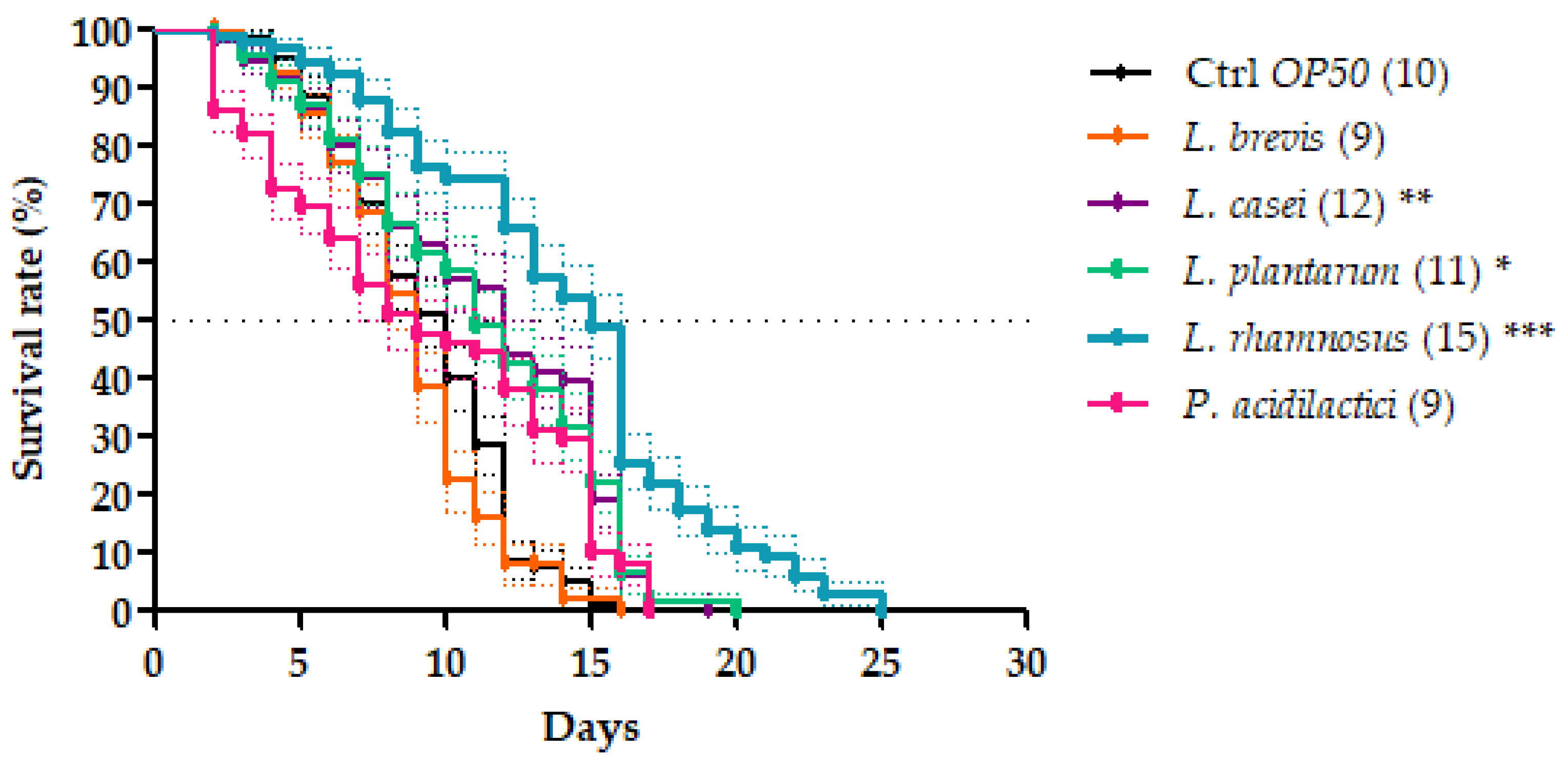
Nematodes fed with L. rhamnosus showed the highest increase in median lifespan of 33.3% and reached a maximum of 25 days versus OP50 (median life: 10; maximum life: 15). Animals fed with L. casei promoted a 16.6% increase in lifespan, and feeding with L. plantarum resulted in a minimum increase in mean lifespan (9%) and a maximum life of 20 days. In contrast, L. brevis and P. acidilactici showed a decrease in lifespan versus OP50 (Figure 1).

3.2. Healthspan

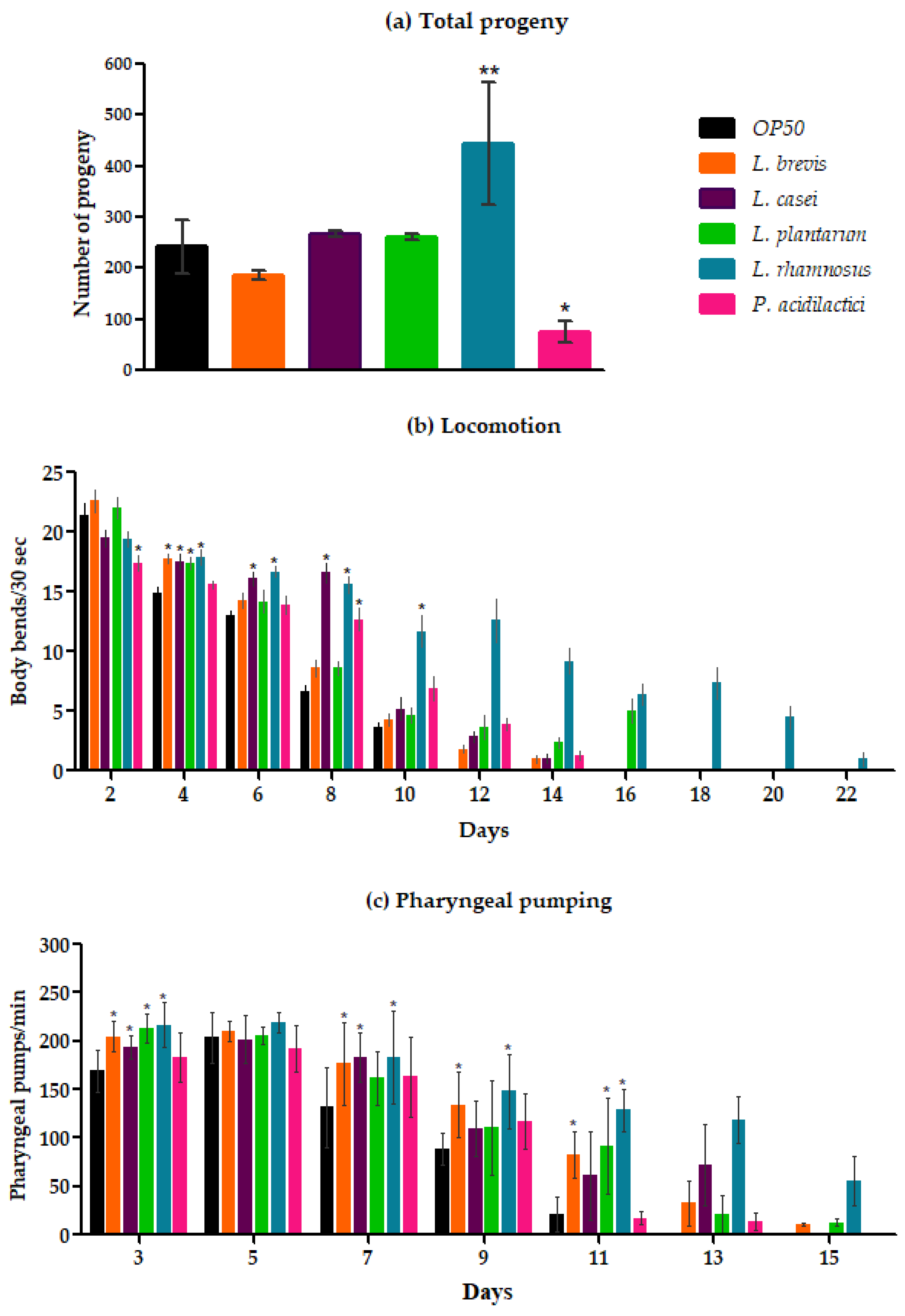
Determination of total progeny indicated favorable reproductive conditions. L. rhamnosus significantly increased progeny number, whereas P. acidilactici significantly decreased it (Figure 2a).
In addition, locomotion analysis demonstrated that feeding nematodes L. rhamnosus across their lifespan allowed them to maintain motility until the end of their lives (Figure 2b). L. plantarum and L. rhamnosus enabled the nematodes to maintain oviposition until day 14 (Figure 2b).
Pharyngeal pumps were more active and evident during the first 7 days of life, serving as an indirect indicator that animals were not under fasting conditions. As shown in Figure 2c, most strains maintained pharyngeal contractions until day 9, whereas L. rhamnosus sustained them until day 15.

3.3. Thermotolerance

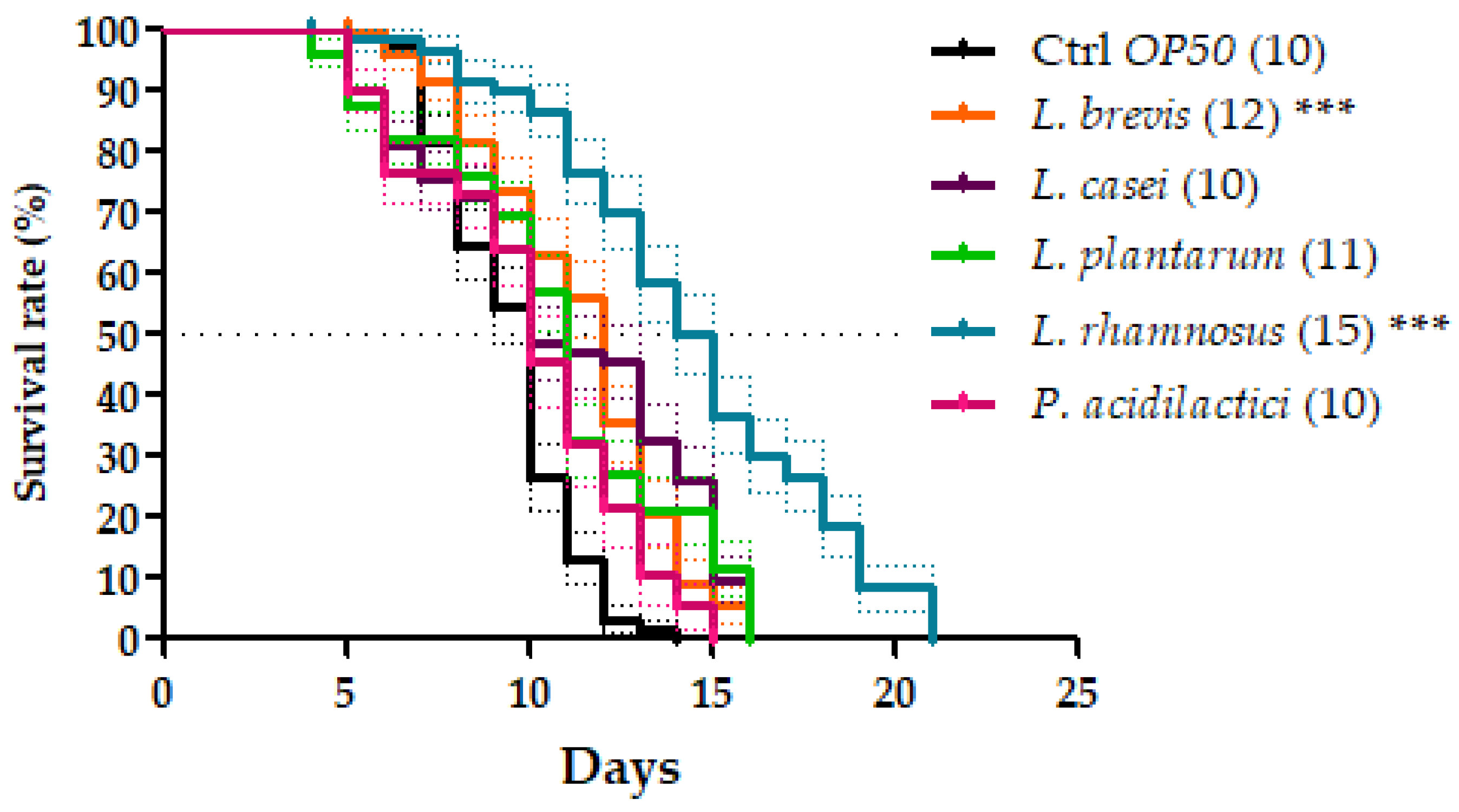
Animals were fed with each tested strain for 4 days and exposed to heat shock (35 °C) for 4 h at day 5. After recovery at 20 °C, median and maximum lifespans were determined. Nematodes fed L. rhamnosus showed the highest resistance, with a median lifespan of 15 days (50% higher than the control with E. coli OP50, 10 days) and a maximum lifespan of 21 days. L. brevis also provided significant protection, increasing the mean lifespan to 12 days (20% higher than the control) and the maximum lifespan of 16 days. L. plantarum produced a more modest increase in lifespan versus control (11 days, 10% higher than the control) and a maximum lifespan of 16 days. In contrast, L. casei and P. acidilactici did not modify mean lifespan compared to the control, although a slight increase in maximum lifespan was observed (16 and 15 days, respectively) (Figure 3).

3.4. Oxidative Stress Tolerance

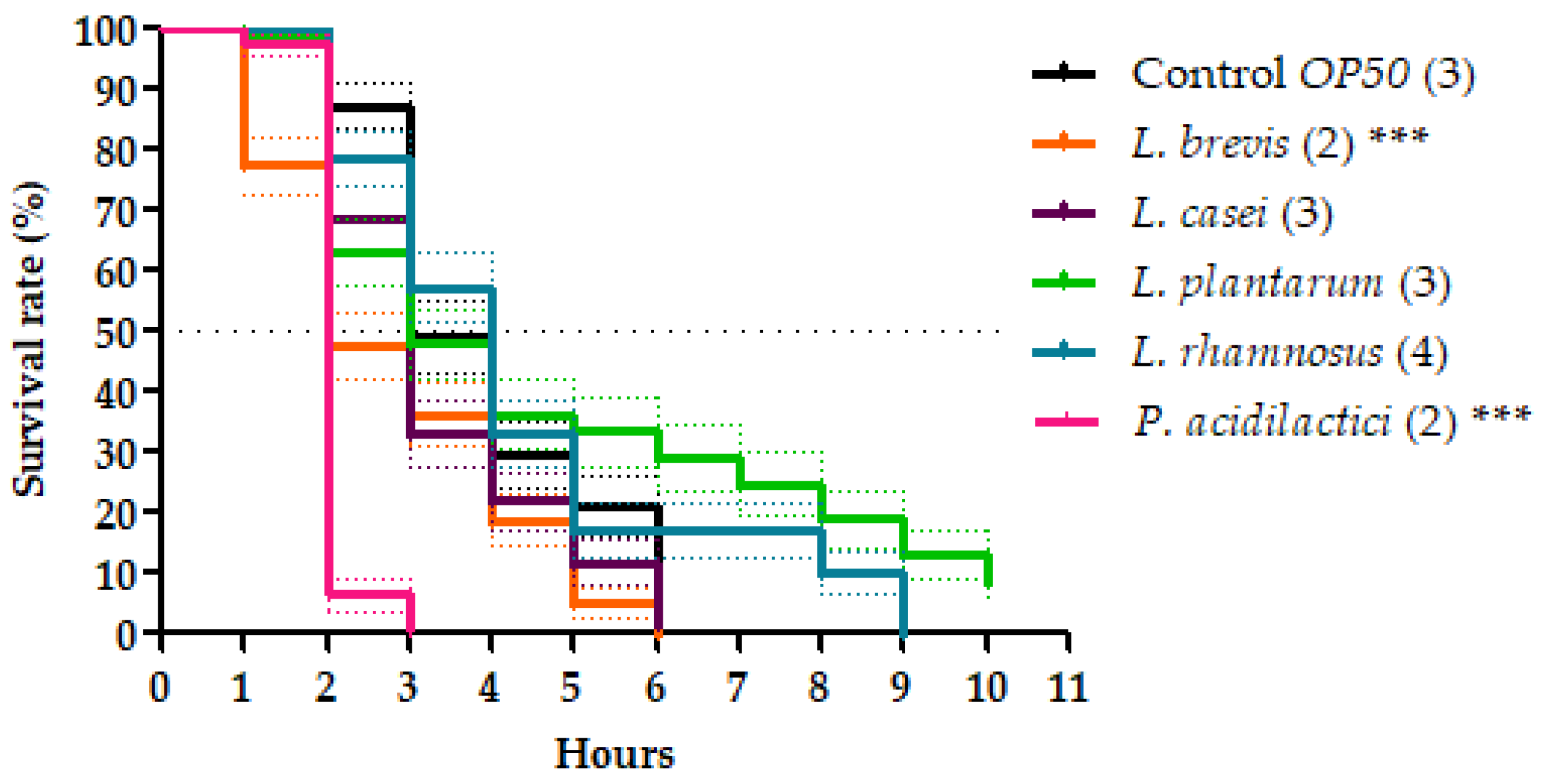
We analyzed whether pre-exposure for 4 days to different LAB strains could increase the survival capacity of C. elegans under oxidative stress induced by hydrogen peroxide (8 mM). We observed that L. rhamnosus and L. plantarum conferred resistance to oxidative stress by extending maximum survival but not median lifespan. Conversely, L. brevis and P. acidilactici significantly decreased in median lifespan versus OP50 (Figure 4).

4. Discussion

This study assessed the effect of feeding the worm C. elegans with LAB isolated from agave sap and pulque on its lifespan, health span, and thermal and oxidative stress. Among all the strains assessed, L. rhamnosus exhibited the most significant impact on enhancing lifespan, progeny count, motility, pharyngeal pumping, and heat stress tolerance. These findings align with previous reports indicating that LAB can activate conserved pathways of longevity and immunity in C. elegans [35,36,37]. Moreover, LAB have been linked to more general health benefits in C. elegans, such as changes in the integrity of the intestinal barrier, immune responses, and microRNA expression [36]. These findings reinforce the concept that probiotic strains can exert anti-aging effects through multiple mechanisms, ranging from improved intestinal health to regulation of cellular stress responses.

4.1. Lifespan Extension

In this study, L. rhamnosus increased lifespan by up to 33.3% versus OP50. The lifespan extension of L. rhamnosus in C. elegans has been previously studied, showing an increased rate ranging from 9.6% to 42.9%. Specifically, the highest increase in lifespan extension was observed in Lcr35, (Lactobacillus casei rhamnosus 35), originally isolated from the gut flora of a healthy infant [38], increasing lifespan up to 30.7–42.9% versus OP50, and 225–267% versus C. elegans infected with Candida albicans [39]. L. rhamnosus R4, from fermented Xinjiang cheese, increased the average lifespan and maximum lifespan up to 36.1% [40], whereas L. rhamnosus CNCM I-3690 protected worms by increasing their viability by 30% and also increased average worm lifespan by 20% [41]. L. rhamnosus KF7 from kefir showed a minimal effect, only increasing lifespan by 9.6% and maximum lifespan for 30 days [42]. L. casei LBC80R and L. rhamnosus CLR2, isolated from fecal samples, showed no effect in C. elegans lifespan extension [43]. We suggest these differences could be related to the LAB source, showing a greater effect in those strains isolated from fermented foods, but the intrinsic mechanisms of this hypothesis should be investigated.
In this report, we found that L. casei increased the median lifespan of C. elegans versus worms fed with OP50 by 16.6%. Previous reports showed controversial effects in lifespan extension, with an increase from 0.23% to 42%. C. elegans fed with L. casei 63 from a patient with short bowel syndrome lived 38.5% longer than OP50 [44]. However, L. casei LBC80R isolated from fecal samples only showed a 0.23% lifespan increase [43]. L. casei IDCC 3451 extended lifespan by 25% and improved motility and reduced amyloid beta accumulation by 42% [45]. In other experiments, the increase in lifespan extension was more evident when C. elegans was exposed to pathogens. For example, L. casei HY2782 increased lifespan in C. elegans treated with Pseudomonas aeruginosa PAO1 [46], and PA14 [47]. The results showed that the source of LAB and the pretreatment with pathogens could be important factors in inducing a molecular response to increase survival.
L. plantarum showed a minimum significant effect, increasing median lifespan by 9.9% compared to OP50 in this research. This strain has been widely studied and has the highest percent of lifespan extension in C. elegans. L. plantarum Pic37 isolated from traditional Italian cheese showed an increase in median lifespan of 30%. This strain also increased the survival capacity under in vitro gastrointestinal conditions up to 98% [48]. The L. plantarum CJLP133 from Korean kimchi showed an increase in lifespan of 13.89%, using a heat-killed bacterium, and also showed in vitro inhibition of Enterococcus faecalis, E. coli, Staphylococcus aureus, Yersinia enterocolitica and Salmonella typhimurium [49]. L. plantarum K90 enhanced the maximum lifespan by 50% compared to E. coli OP50 [50]. The L. plantarum PFA2018AU isolated from carrot (Daucus carota L.) showed a median lifespan increase of 86.6% compared to OP50 when animals were fed since hatching and maintained at 16 °C. However, this increase in lifespan occurred at the expense of reduced progeny (60% lower than OP50) [51]. L. plantarum TWK10 prolongs C. elegans lifespan up to 26.1% in liquid culture at 25 °C [52]. Finally, Bai et al. [53] showed that L. plantarum SY1 extended lifespan by 25.8% compared to OP50 in L4 using floxuridine to prevent egg hatching. These results may suggest that time of LAB exposition and temperature cause diverse effects in the worm response. Therefore, it is imperative to explore several temperatures of exposition from hatching to adult stages to investigate LAB colonization and response to increase lifespan.
We did not observe significant changes in worms fed with L. brevis. In concordance with our study, L. brevis SDL1411 isolated from Korean fermented soybean paste, a traditional fermented food, showed no lifespan extension when C. elegans were fed this strain, using non-killed and heat-killed LAB [54]. Otherwise, L. brevis from Brahva Laboratories increased lifespan in C. elegans up to 15.9% versus OP50 in L4 young adult worms, and 14.3% in the L1 stage. The molecular mechanisms investigated showed that L. brevis increased lifespan mediated by the increased expression of daf-16, skn-1, sod-2, hsp-16.2 and gst-4 [55]. However, the lifespan increased when C. elegans were fed L. brevis SDL 1411 24 h before being fed P. aeruginosa PA14 [54]. This revealed that the time of LAB exposition of 24 h was enough to promote resistance to pathogen invasion.
We observed that P. acidilactici reduced C. elegans lifespan and did not provide enough protection against oxidative and heat shock stress. This strain possesses the ability to produce lactic acid and reduce the pH, which in turn could be deleterious for C. elegans survival. In this sense, Fasseas et al. also reported a reduction in lifespan using killed and not-killed P. acidilactici. The exact reason is not clear, but the authors suggest that LAB need to grow and help protect the gut from harmful factors such as pathogen invasion; however, the authors think the lifespan reduction might have occurred because this strain can stop the growth of tumor-like germ cells and prevent egg hatching in C. elegans [56].

4.2. Healthspan Parameters

Health span in C. elegans was evaluated by diverse parameters such as fertility, locomotion, and pharyngeal pump. The impact of LAB on fertility highlights the complexity of probiotic–host interactions—certain strains promoted reproductive capacity (L. rhamnosus and L. casei) and others reduced total progeny (P. acidilactici). Chelliah et al. [54] reported similar results. The authors found that worms fed 35 LAB strains showed lower fertility than those fed OP50. Further analysis revealed that animals given heat-killed LAB had higher fertility. Fasses et al. showed that C. elegans fed P. acidilactici had reduced egg hatching. Yu et al. [57] also indicated that active bacteria use resources and energy in the gut of nematodes to sustain survival and reproduction. To elucidate these disparities, it is imperative to specify how each strain employs nutrients and influences energy expenditure to maintain host fertility. This variability suggests that the differences in reproduction may be linked to how each strain adjusts its regulatory processes.
Conversely, analyses of mobility and pharyngeal pumping further substantiate the advantageous role of LAB in maintaining physiological functions during aging. L. plantarum TWK10 increased crawling and swimming speed as well as body bending more than OP50 and L. rhamnosus GG at day 1 of young adulthood and day 5 of adulthood. Interestingly, in their research, Liao et al. analyzed the effect of L. plantarum TWK10 in mice and in a clinical trial. The oral administration of L. plantarum TWK10 1 × 10¹⁰ CFU/day for two weeks reduced serum lactate levels and enhanced exercise performance and glycogen storage [52]. Also, Cheng et al. reported increased body bends and pharyngeal pumping with L. rhamnosus GG and L. rhamnosus KF7 [42]. The ability of L. rhamnosus to maintain locomotion and pharyngeal activity for longer periods indicates that probiotic supplementation may help preserve neuromuscular and feeding functions, which are critical markers of health span.

4.3. Heat Shock

Thermotolerance assays revealed that the protective effects of LAB against heat stress are strain-dependent, with L. rhamnosus emerging as the most effective. This observation is consistent with previous studies reporting that LAB can enhance longevity and stress tolerance in C. elegans through activation of protein homeostasis and stress-response pathways [58]. L. brevis also increased resistance to thermal stress after 3 h of exposure to 35 °C by 21.2% compared with OP50, which was related to increased expression of the hsp-16.2 gene. In this report, we also observed increased lifespan in L. brevis after 4 h of exposure to 35 °C, which could be related to the expression of heat shock proteins, as observed by Thiruppathi et al. [55].

4.4. Oxidative Stress

Similarly, oxidative stress experiments demonstrated that LAB could induce antioxidant systems, enabling them to neutralize reactive oxygen species, chelate pro-oxidant metal ions, and regulate host stress-response genes. These properties may explain their ability to confer protection against oxidative damage and promote redox balance [58]. However, in this research, the oxidative stress resistance was not significant for L. rhamnosus and detrimental to L. brevis and P. acidilactici. Previous studies found that animals given L. rhamnosus Lcr35 did not withstand exposure to 3 mM of hydrogen peroxide, and the researchers believe this imbalance is due to the overproduction of sod-3 and the lack of catalase or peroxidases to effectively break down hydrogen peroxide [40]. In addition, Kumar et al. [59] observed that L. brevis MTCC 1759 increases the expression of sod-3. The activation of sod-3 occurs in a daf-16-dependent manner. The observed strain-specific differences suggest that distinct molecular mechanisms are involved and need to be investigated, including the activation of transcription factors such as daf-16 and skn-1/nrf2 and the regulation of target genes like sod-3 and gst-4, which were observed with L. brevis and L. casei [46].
Thiruppathi et al. [55] demonstrated that L. brevis increased survival by 45% under oxidative stress induced by 10 mM hydrogen peroxide after 2 h. The reduction in intracellular ROS and the increased expression of sod-3 and gst-4 could explain the molecular targets for ROS reduction. L. plantarum SY1 also showed increased survival by 18.8% under 2 mM of hydrogen peroxide [53]. We were not able to observe increased lifespan survival in worms exposed to 8 mM of hydrogen peroxide. However, it could be useful to investigate the effect against other oxidant agents like paraquat, colchicine or lower concentrations of hydrogen peroxide.

4.5. Limitations and Future Research

Given the discussion, we recognize that the major limitations of this communication were that we did not evaluate the molecular basis of the strain-specific effects, and oxidative stress exposition was under high levels of one oxidative agent. Future research must be designed to evaluate feeding with LAB from hatching to diverse larval stages, as well to evaluate survival at 16 °C to 25 °C. The elucidation of the molecular basis of these effects, the exploration of synergistic interactions with dietary compounds, and the evaluation of translational relevance in higher organisms will advance the understanding of the potential of probiotics isolated from plant sources for their application in the functional food industry. Despite the acknowledged limitations, the findings point to the ability of specific LAB strains, particularly L. rhamnosus, L. casei and L. plantarum, to enhance longevity in C. elegans. The implications extend beyond nematode biology, suggesting possible applications in food preservation, gut microbiota modulation, and health promotion [55].

5. Conclusions

LAB derived from plants can confer different abilities to the host, depending upon the specific strain. In this work, we examined five LAB strains isolated from agave products and noted that L. rhamnosus. L. casei and L. plantarum can extend the lifespan of the nematode C. elegans; however, only L. rhamnosus and L. brevis exhibit tolerance to heat stress. Nematodes fed L. rhamnosus improved their health span parameters, while those fed P. acidilactici exhibited detrimental effects on the nematode. These findings may be pertinent to the development of functional foods derived from LAB and strain selection related to their biological effect in the host.

Author Contributions

Conceptualization, V.L.L.-H. and A.S.J.-O.; methodology, V.L.L.-H.; software, V.L.L.-H. and L.L.-Z.; validation, E.Y.H.-C. and A.S.J.-O.; formal analysis, V.L.L.-H. and A.S.J.-O.; investigation, V.L.L.-H. and D.P.O.-R.; resources, L.L.-Z. and A.S.J.-O.; data curation, E.Y.H.-C. and D.P.O.-R.; writing—original draft preparation, V.L.L.-H.; writing—review and editing, J.P.-C., E.Y.H.-C. and A.S.J.-O.; visualization, D.P.O.-R.; supervision, E.Y.H.-C. and L.L.-Z.; project administration, J.P.-C. and A.S.J.-O.; funding acquisition, A.S.J.-O. and J.P.-C. All authors have read and agreed to the published version of the manuscript.

Funding

This research was funded by “Fondos Estatales Genéricos de la Universidad Autónoma del Estado de Hidalgo” (Number 110201 to A.S.J.-O.), and by the “Programa de Apoyo a Proyectos de Investigación e Innovación Tecnológica (PAPIIT)” (Grant Number PAPIIT IN202725 to J.P.-C).

Institutional Review Board Statement

Not applicable.

Informed Consent Statement

Not applicable.

Data Availability Statement

The data presented in this study are available on request from the corresponding author due to restrictions of the Institutional Research Committee.

Conflicts of Interest

The authors declare no conflicts of interest.

References

  1. Jin, X.; He, Y.; Zhou, Y.; Chen, X.; Lee, Y.-K.; Zhao, J.; Zhang, H.; Chen, W.; Wang, G. Lactic Acid Bacteria That Activate Immune Gene Expression in Caenorhabditis elegans Can Antagonise Campylobacter Jejuni Infection in Nematodes, Chickens and Mice. BMC Microbiol. 2021, 21, 169. [Google Scholar] [CrossRef]
  2. Li, W.; Gao, L.; Huang, W.; Ma, Y.; Muhammad, I.; Hanif, A.; Ding, Z.; Guo, X. Antioxidant Properties of Lactic Acid Bacteria Isolated from Traditional Fermented Yak Milk and Their Probiotic Effects on the Oxidative Senescence of Caenorhabditis elegans. Food Funct. 2022, 13, 3690–3703. [Google Scholar] [CrossRef] [PubMed]
  3. Abedin, M.M.; Chourasia, R.; Phukon, L.C.; Sarkar, P.; Ray, R.C.; Singh, S.P.; Rai, A.K. Lactic Acid Bacteria in the Functional Food Industry: Biotechnological Properties and Potential Applications. Crit. Rev. Food Sci. Nutr. 2024, 64, 10730–10748. [Google Scholar] [CrossRef] [PubMed]
  4. Sugimura, N.; Li, Q.; Chu, E.S.H.; Lau, H.C.H.; Fong, W.; Liu, W.; Liang, C.; Nakatsu, G.; Su, A.C.Y.; Coker, O.O.; et al. Lactobacillus gallinarum Modulates the Gut Microbiota and Produces Anti-Cancer Metabolites to Protect against Colorectal Tumourigenesis. Gut 2021, 71, 2011–2021. [Google Scholar] [CrossRef]
  5. Zhang, Q.; Zhao, Q.; Li, T.; Lu, L.; Wang, F.; Zhang, H.; Liu, Z.; Ma, H.; Zhu, Q.; Wang, J.; et al. Lactobacillus plantarum-Derived Indole-3-Lactic Acid Ameliorates Colorectal Tumorigenesis via Epigenetic Regulation of CD8+ T Cell Immunity. Cell Metab. 2023, 35, 943–960.e9. [Google Scholar] [CrossRef]
  6. Zhang, F.; Zhou, K.; Xie, F.; Zhao, Q. Screening and Identification of Lactic Acid Bacteria with Antimicrobial Abilities for Aquaculture Pathogens in Vitro. Arch. Microbiol. 2022, 204, 689. [Google Scholar] [CrossRef]
  7. Albureikan, M.O.I. Characterization and Molecular Identification of Lactic Acid Bacteria Isolated from Kefir and Evaluation of Their Antibacterial Activity against Food-Borne Pathogens in Saudi Arabia. Eur. Rev. Med. Pharmacol. Sci. 2023, 27, 11249–11263. [Google Scholar] [CrossRef]
  8. Olorunshola, M.M.; Agidigbi, T.S.; Adeniyi, B.A. Antimicrobial Activity of Lactic Acid Bacteria Isolated from the Gut of African Catfish (Clarias gariepinus) against Multi-Drug-Resistant Resident Pathogens. BMC Microbiol. 2025, 25, 410. [Google Scholar] [CrossRef]
  9. Zheng, Z.; Wei, L.; Zhu, M.; Qian, Z.; Liu, J.; Zhang, L.; Xu, Y. Effect of Lactic Acid Bacteria Co-Fermentation on Antioxidant Activity and Metabolomic Profiles of a Juice Made from Wolfberry and Longan. Food Res. Int. Ott. Ont. 2023, 174, 113547. [Google Scholar] [CrossRef]
  10. Sato, A.; Watanabe, A.; Muraki, K.; Kimoto-Nira, H.; Kobayashi, M. Novel Indirect Antioxidant Activity Independent of Nrf2 Exerted by Lactic Acid Bacteria. Int. J. Mol. Sci. 2024, 25, 10648. [Google Scholar] [CrossRef]
  11. Łepecka, A.; Kołożyn-Krajewska, D. Antioxidant Properties of Food-Derived Lactic Acid Bacteria: A Review. Microb. Biotechnol. 2025, 18, e70229. [Google Scholar] [CrossRef]
  12. Zhang, C.; Han, Y.; Gui, Y.; Wa, Y.; Chen, D.; Huang, Y.; Yin, B.; Gu, R. Influence of Nitrogen Sources on the Tolerance of Lacticaseibacillus rhamnosus to Heat Stress and Oxidative Stress. J. Ind. Microbiol. Biotechnol. 2022, 49, kuac020. [Google Scholar] [CrossRef]
  13. Mishra, V.; Shah, C.; Mokashe, N.; Chavan, R.; Yadav, H.; Prajapati, J. Probiotics as Potential Antioxidants: A Systematic Review. J. Agric. Food Chem. 2015, 63, 3615–3626. [Google Scholar] [CrossRef] [PubMed]
  14. Feng, T.; Wang, J. Oxidative Stress Tolerance and Antioxidant Capacity of Lactic Acid Bacteria as Probiotic: A Systematic Review. Gut Microbes 2020, 12, 1801944. [Google Scholar] [CrossRef] [PubMed]
  15. Chen, Z.; Pan, Y.; Chen, Y.; Wei, F.; Wu, S.; Zhou, Q.; Li, P.; Gu, Q. Antioxidant Mechanisms of Lacticaseibacillus paracasei ZFM847 and Its Oxidative Stress Regulation in Multiple Models. Mol. Nutr. Food Res. 2026, 70, e70344. [Google Scholar] [CrossRef] [PubMed]
  16. Ozgun Acar, O. Probiotic Modulation of Energy Metabolism Ameliorates Experimental Autoimmune Encephalomyelitis via Nrf2-Associated Pentose Phosphate Pathway Activation. Biochem. Biophys. Res. Commun. 2025, 791, 152934. [Google Scholar] [CrossRef] [PubMed]
  17. Zou, S.; Wu, Q.; Li, Z.; Zhang, S.; Dong, L.; Chen, Y.; Dai, Y.; Ji, C.; Liang, H.; Lin, X. Lactiplantibacillus plantarum A72, a Strain with Antioxidant Properties, Obtained through ARTP Mutagenesis, Affects Caenorhabditis elegans Anti-Aging. Foods 2024, 13, 924. [Google Scholar] [CrossRef]
  18. Lou, X.; Lin, L.; Zhu, W.; Zhang, X.; Xiong, J.; Gao, Y. Biological Activities of Lactic Acid Bacteria Isolated from Chinese Traditional Cheese and the Application in Antioxidant Foods. Microorganisms 2025, 13, 2743. [Google Scholar] [CrossRef]
  19. Sugimoto, S.; Abdullah-Al-Mahin; Sonomoto, K. Molecular Chaperones in Lactic Acid Bacteria: Physiological Consequences and Biochemical Properties. J. Biosci. Bioeng. 2008, 106, 324–336. [Google Scholar] [CrossRef]
  20. Duru, I.C.; Ylinen, A.; Belanov, S.; Pulido, A.A.; Paulin, L.; Auvinen, P. Transcriptomic Time-Series Analysis of Cold- and Heat-Shock Response in Psychrotrophic Lactic Acid Bacteria. BMC Genom. 2021, 22, 28. [Google Scholar] [CrossRef]
  21. Rocchetti, M.T.; Bellanger, T.; Trecca, M.I.; Weidmann, S.; Scrima, R.; Spano, G.; Russo, P.; Capozzi, V.; Fiocco, D. Molecular Chaperone Function of Three Small Heat-Shock Proteins from a Model Probiotic Species. Cell Stress Chaperones 2023, 28, 79–89. [Google Scholar] [CrossRef]
  22. Parsaeinejad, S.; Nejati, V.; Razi, M.; Tokmechi, A. Lactobacillus reuteri Protects against Heat Stress-Induced Testicular Dysfunction by Modulating Oxidative Stress and Autophagy Pathways in Rats. FS Sci. 2026, 7, 35–48. [Google Scholar] [CrossRef]
  23. Wang, J.; Li, N.; Liu, Y.; Zheng, H.; Wu, R.; Zhang, J.; Yang, Y.; Yang, X.; Zhong, Z.; Fu, H.; et al. Holstein Cow Milk-Derived Lactobacillus plantarum L19 Alleviates Heat Stress-Induced Liver Injury in Mice by Modulating Gut Microbiota. J. Dairy Sci. 2026, 109, 17–33. [Google Scholar] [CrossRef]
  24. Nakagawa, H.; Shiozaki, T.; Kobatake, E.; Hosoya, T.; Moriya, T.; Sakai, F.; Taru, H.; Miyazaki, T. Effects and Mechanisms of Prolongevity Induced by Lactobacillus gasseri SBT2055 in Caenorhabditis elegans. Aging Cell 2016, 15, 227–236. [Google Scholar] [CrossRef] [PubMed]
  25. Stover, M.A.; Tinoco-Bravo, B.; Shults, C.A.; Marouk, S.; Deole, R.; Manjarrez, J.R. Probiotic Effects of Lactococcus lactis and Leuconostoc mesenteroides on Stress and Longevity in Caenorhabditis elegans. Front. Physiol. 2023, 14, 1207705. [Google Scholar] [CrossRef] [PubMed]
  26. Poupet, C.; Chassard, C.; Nivoliez, A.; Bornes, S. Caenorhabditis elegans, a Host to Investigate the Probiotic Properties of Beneficial Microorganisms. Front. Nutr. 2020, 7, 135. [Google Scholar] [CrossRef]
  27. Komura, T.; Nishikawa, Y. Caenorhabditis elegans as a Model Host to Study Effects of Lactic Acid Bacteria and Functional Food Factors. Biosci. Biotechnol. Biochem. 2025, 89, 324–331. [Google Scholar] [CrossRef]
  28. Cervantes-Elizarrarás, A.; Cruz-Cansino, N.D.; Ramírez-Moreno, E.; Vega-Sánchez, V.; Velázquez-Guadarrama, N.; Zafra-Rojas, Q.Y.; Piloni-Martini, J. In Vitro Probiotic Potential of Lactic Acid Bacteria Isolated from Aguamiel and Pulque and Antibacterial Activity Against Pathogens. Appl. Sci. 2019, 9, 601. [Google Scholar] [CrossRef]
  29. Valadez-Blanco, R.; Bravo-Villa, G.; Santos-Sánchez, N.F.; Velasco-Almendarez, S.I.; Montville, T.J. The Artisanal Production of Pulque, a Traditional Beverage of the Mexican Highlands. Probiotics Antimicrob. Proteins 2012, 4, 140–144. [Google Scholar] [CrossRef]
  30. Lugo-Zarate, L.; Delgado-Olivares, L.; Cruz-Cansino, N.D.S.; González-Olivares, L.G.; Castrejón-Jiménez, N.S.; Estrada-Luna, D.; Jiménez-Osorio, A.S. Blackberry Juice Fermented with Two Consortia of Lactic Acid Bacteria and Isolated Whey: Physicochemical and Antioxidant Properties during Storage. Int. J. Mol. Sci. 2024, 25, 8882. [Google Scholar] [CrossRef]
  31. Stiernagle, T. Maintenance of C. elegans, WormBook, Ed. In The C. elegans Research Community; WormBook: Pasadena, CA, USA, 2006; pp. 1–11. [Google Scholar] [CrossRef]
  32. Wilkinson, D.S.; Taylor, R.C.; Dillin, A. Chapter 12—Analysis of Aging in Caenorhabditis elegans. In Methods in Cell Biology; Rothman, J.H., Singson, A., Eds.; Academic Press: New York, NY, USA, 2012; Volume 107, pp. 353–381. [Google Scholar]
  33. Yu, J.; Gao, X.; Zhang, L.; Shi, H.; Yan, Y.; Han, Y.; Wu, C.; Liu, Y.; Fang, M.; Huang, C.; et al. Magnolol Extends Lifespan and Improves Age-Related Neurodegeneration in Caenorhabditis elegans via Increase of Stress Resistance. Sci. Rep. 2024, 14, 3158. [Google Scholar] [CrossRef]
  34. Rubio-Tomás, T.; Alegre-Cortés, E.; Lionaki, E.; Fuentes, J.M.; Tavernarakis, N. Heat Shock and Thermotolerance in Caenorhabditis elegans: An Overview of Laboratory Techniques. Methods Cell Biol. 2024, 185, 1–17. [Google Scholar] [CrossRef]
  35. Ikeda, T.; Yasui, C.; Hoshino, K.; Arikawa, K.; Nishikawa, Y. Influence of Lactic Acid Bacteria on Longevity of Caenorhabditis elegans and Host Defense against Salmonella enterica Serovar Enteritidis. Appl. Environ. Microbiol. 2007, 73, 6404–6409. [Google Scholar] [CrossRef]
  36. Yun, B.; Ryu, S.; Kang, M.; Lee, J.; Yoo, J.; Kim, Y.; Oh, S. Probiotic Lacticaseibacillus rhamnosus GG Increased Longevity and Resistance Against Foodborne Pathogens in Caenorhabditis elegans by Regulating MicroRNA miR-34. Front. Cell. Infect. Microbiol. 2021, 11, 819328. [Google Scholar] [CrossRef]
  37. Lee, D.J.; Eor, J.Y.; Kwak, M.-J.; Lee, J.; Kang, A.N.; Mun, D.; Choi, H.; Song, M.; Kim, J.N.; Kim, J.-M.; et al. Metabolic Regulation of Longevity and Immune Response in Caenorhabditis elegans by Ingestion of Lacticaseibacillus rhamnosus IDCC 3201 Using Multi-Omics Analysis. J. Microbiol. Biotechnol. 2024, 34, 1109–1118. [Google Scholar] [CrossRef] [PubMed]
  38. Coudeyras, S.; Marchandin, H.; Fajon, C.; Forestier, C. Taxonomic and Strain-Specific Identification of the Probiotic Strain Lactobacillus rhamnosus 35 within the Lactobacillus casei Group. Appl. Environ. Microbiol. 2008, 74, 2679–2689. [Google Scholar] [CrossRef] [PubMed]
  39. Poupet, C.; Veisseire, P.; Bonnet, M.; Camarès, O.; Gachinat, M.; Dausset, C.; Chassard, C.; Nivoliez, A.; Bornes, S. Curative Treatment of Candidiasis by the Live Biotherapeutic Microorganism Lactobacillus rhamnosus Lcr35® in the Invertebrate Model Caenorhabditis elegans: First Mechanistic Insights. Microorganisms 2019, 8, 34. [Google Scholar] [CrossRef]
  40. Azat, R.; Liu, Y.; Li, W.; Kayir, A.; Lin, D.-B.; Zhou, W.-W.; Zheng, X.-D. Probiotic Properties of Lactic Acid Bacteria Isolated from Traditionally Fermented Xinjiang Cheese. J. Zhejiang Univ. Sci. B 2016, 17, 597–609. [Google Scholar] [CrossRef]
  41. Grompone, G.; Martorell, P.; Llopis, S.; González, N.; Genovés, S.; Mulet, A.P.; Fernández-Calero, T.; Tiscornia, I.; Bollati-Fogolín, M.; Chambaud, I.; et al. Anti-Inflammatory Lactobacillus rhamnosus CNCM I-3690 Strain Protects against Oxidative Stress and Increases Lifespan in Caenorhabditis elegans. PLoS ONE 2012, 7, e52493. [Google Scholar] [CrossRef]
  42. Cheng, Y.; Zhang, Y.; Pang, X.; You, C. Safety Evaluation of Lacticaseibacillus rhamnosus KF7 Based on Complete Genome, Phenotypic Assays and Alternative Models: Caenorhabditis elegans. Curr. Res. Food Sci. 2025, 11, 101227. [Google Scholar] [CrossRef] [PubMed]
  43. Bouasker, S.; Nodland, S.; Millette, M. The Probiotic Strain Lactobacillus acidophilus CL1285 Reduces Fat Deposition and Oxidative Stress and Increases Lifespan in Caenorhabditis elegans. Microorganisms 2024, 12, 1036. [Google Scholar] [CrossRef]
  44. Giron, M.; Thomas, M.; Jarzaguet, M.; Mayeur, C.; Ferrere, G.; Noordine, M.-L.; Bornes, S.; Dardevet, D.; Chassard, C.; Savary-Auzeloux, I. Lacticaseibacillus casei CNCM I-5663 Supplementation Maintained Muscle Mass in a Model of Frail Rodents. Front. Nutr. 2022, 9, 928798. [Google Scholar] [CrossRef]
  45. Kang, A.; Eor, J.Y.; Lee, J.; Kwak, M.-J.; Lee, D.J.; Seo, E.; Lee, W.J.; Son, S.-H.; Song, M.; Kim, J.-M.; et al. Lacticaseibacillus casei IDCC 3451 Alleviates Cognitive and Behavioral Functions by Reshaping the Gut Microbiome and Regulating Intestinal Barrier Integrity in Chronic Stress Animal Models. Curr. Res. Food Sci. 2025, 10, 101051. [Google Scholar] [CrossRef]
  46. Bae, W.-Y.; Nguyen, U.T.T.; Le, T.A.N.; Tran, S.H.; Lee, S.; Hong, S.-C.; Cha, K.H.; Choi, I.-D.; Kang, K. Lacticaseibacillus casei HY2782 Improves the Intestinal Barrier and Tract Environment and Ultimately Prolongs the Lifespan of Caenorhabditis elegans. Food Funct. 2025, 16, 5871–5884. [Google Scholar] [CrossRef]
  47. D’Antoni, C.L.; Pourtalebi Jahromi, L.; Sana, L.; Domínguez Rubio, A.P.; Dorfner, M.; Munkert, J.; Danzer, H.; Arnold, P.; Lebedev, M.; Zanin, E.; et al. Membrane Vesicles from Lacticaseibacillus casei BL23 Exhibit Antimicrobial Activity Against Escherichia coli and Immunostimulatory Effects on Human Peripheral Blood Mononuclear Cells. Adv. Healthc. Mater. 2025, 15, e00548. [Google Scholar] [CrossRef]
  48. Roselli, M.; Colafranceschi, F.; Cipriani, V.; Valle, A.; Zinno, P.; Guantario, B.; Schifano, E.; Uccelletti, D.; Devirgiliis, C. Isolation and Characterization of Lactic Acid Bacteria from an Italian Traditional Raw Milk Cheese: Probiotic Properties and Technological Performance of Selected Strains. Microorganisms 2025, 13, 1368. [Google Scholar] [CrossRef] [PubMed]
  49. Lee, J.; Yun, H.S.; Cho, K.W.; Oh, S.; Kim, S.H.; Chun, T.; Kim, B.; Whang, K.Y. Evaluation of Probiotic Characteristics of Newly Isolated Lactobacillus Spp.: Immune Modulation and Longevity. Int. J. Food Microbiol. 2011, 148, 80–86. [Google Scholar] [CrossRef]
  50. Sharma, K.; Pooranachithra, M.; Balamurugan, K.; Goel, G. Multivariate Analysis of Increase in Life Span of Caenorhabditis elegans Through Intestinal Colonization by Indigenous Probiotic Strains. Probiotics Antimicrob. Proteins 2019, 11, 865–873. [Google Scholar] [CrossRef] [PubMed]
  51. Pompa, L.; Montanari, A.; Tomassini, A.; Bianchi, M.M.; Aureli, W.; Miccheli, A.; Uccelletti, D.; Schifano, E. In Vitro Probiotic Properties and In Vivo Anti-Ageing Effects of Lactoplantibacillus plantarum PFA2018AU Strain Isolated from Carrots on Caenorhabditis elegans. Microorganisms 2023, 11, 1087. [Google Scholar] [CrossRef]
  52. Liao, J.-F.; Lee, C.-C.; Lee, M.-C.; Hsu, H.-Y.; Wang, M.-F.; Huang, C.-C.; Young, S.-L.; Watanabe, K.; Lin, J.-S. A Comprehensive Approach, Based on the Use of Caenorhabditis elegans, Mouse, and Human Models, Elucidates the Impact of Lactiplantibacillus plantarum TWK10 on Exercise Performance and Longevity. Curr. Res. Food Sci. 2025, 10, 101015. [Google Scholar] [CrossRef]
  53. Bai, X.; Shi, P.; Chu, W. Probiotic Attributes, Antioxidant and Neuromodulatory Effects of GABA-Producing Lactiplantibacillus plantarum SY1 and Optimization of GABA Production. BMC Microbiol. 2025, 25, 341. [Google Scholar] [CrossRef]
  54. Chelliah, R.; Choi, J.-G.; Hwang, S.-B.; Park, B.-J.; Daliri, E.B.-M.; Kim, S.-H.; Wei, S.; Ramakrishnan, S.R.; Oh, D.-H. In Vitro and in Vivo Defensive Effect of Probiotic LAB against Pseudomonas aeruginosa Using Caenorhabditis elegans Model. Virulence 2018, 9, 1489–1507. [Google Scholar] [CrossRef]
  55. Thiruppathi, G.; Mohankumar, A.; Kalaiselvi, D.; Velumani, M.; Saravana Bhavan, P.; Premasudha, P.; Tawata, S.; Sundararaj, P. Geroprotective Effect of Levilactobacillus brevis and Weizmannia coagulans in Caenorhabditis elegans. Probiotics Antimicrob. Proteins 2024, 16, 589–605. [Google Scholar] [CrossRef]
  56. Fasseas, M.K.; Fasseas, C.; Mountzouris, K.C.; Syntichaki, P. Effects of Lactobacillus salivarius, Lactobacillus reuteri, and Pediococcus acidilactici on the Nematode Caenorhabditis elegans Include Possible Antitumor Activity. Appl. Microbiol. Biotechnol. 2013, 97, 2109–2118. [Google Scholar] [CrossRef] [PubMed]
  57. Yu, L.; Yan, X.; Ye, C.; Zhao, H.; Chen, X.; Hu, F.; Li, H. Bacterial Respiration and Growth Rates Affect the Feeding Preferences, Brood Size and Lifespan of Caenorhabditis elegans. PLoS ONE 2015, 10, e0134401. [Google Scholar] [CrossRef] [PubMed]
  58. Ayuda-Durán, B.; Sánchez-Hernández, E.; González-Manzano, S.; Santos-Buelga, C.; González-Paramás, A.M. The Effects of Polyphenols against Oxidative Stress in Caenorhabditis elegans Are Determined by Coexisting Bacteria. Front. Nutr. 2022, 9, 989427. [Google Scholar] [CrossRef] [PubMed]
  59. Kumar, S.; Praneet, N.S.; Suchiang, K. Lactobacillus brevis MTCC 1750 Enhances Oxidative Stress Resistance and Lifespan Extension with Improved Physiological and Functional Capacity in Caenorhabditis elegans via the DAF-16 Pathway. Free Radic. Res. 2022, 56, 555–571. [Google Scholar] [CrossRef]
Figure 1. Caenorhabditis elegans lifespan at 20 °C fed with OP50 or five different lactic acid bacteria strains (n = 80 animals per strain). Numbers inside the parentheses indicate median survival versus OP50: *** p < 0.001, ** p < 0.01, and * p < 0.05.
Applbiosci 05 00027 g001
Figure 2. Health span parameters of Caenorhabditis elegans fed OP50 and the five LAB tested. (a) Total progeny, (b) mobility, measured as body bends per 30 s, and (c) number of pharyngeal contractions per minute (n = 20 animals per group). Dunnett’s test vs OP50 ** p < 0.01, and * p < 0.05.
Applbiosci 05 00027 g002
Figure 3. Survival of Caenorhabditis elegans fed with OP50 or five different lactic acid bacteria strains (n = 80 animals per strain) after 4 h of heat shock (35 °C), and maintenance of lifespan at 20 °C. Numbers inside the parentheses indicate median survival versus OP50: *** p < 0.001.
Applbiosci 05 00027 g003
Figure 4. Survival of Caenorhabditis elegans exposed to oxidative stress induced by hydrogen peroxide (8 mM) fed OP50 (control) or five different lactic acid bacteria strains (n = 80 animals per strain). Numbers inside the parentheses indicate median survival versus OP50: *** p < 0.001.
Applbiosci 05 00027 g004
Disclaimer/Publisher’s Note: The statements, opinions and data contained in all publications are solely those of the individual author(s) and contributor(s) and not of MDPI and/or the editor(s). MDPI and/or the editor(s) disclaim responsibility for any injury to people or property resulting from any ideas, methods, instructions or products referred to in the content.