Article

Three Spectrin-Sensitive Dielectric Relaxations in RBC Membrane: Relation to RBC Deformability and Surface Properties

by
Ivan T. Ivanov
and
Boyana K. Paarvanova
*
Department of Physics, Biophysics, Roentgenology and Radiology, Medical Faculty, Trakia University, 6000 Stara Zagora, Bulgaria
*
Author to whom correspondence should be addressed.
Appl. Biosci. 2026, 5(2), 28; https://doi.org/10.3390/applbiosci5020028
Submission received: 30 November 2025 / Revised: 17 February 2026 / Accepted: 17 March 2026 / Published: 2 April 2026

Abstract

Two spectrin-sensitive relaxations have been reported in the RBC plasma membrane: βs (1.4 MHz, related to the interface β-relaxation) and γ1s (9 MHz, rotation alignment of spectrin-bound dipoles by penetrating electric field). Here, a third (αs) relaxation type is reported within the frequency region of surface (α) relaxation. With low-ion-strength outside media, the adsorption of blood plasma immunoglobulins on RBCs was found to inhibit βs and γ1s relaxations, while αs relaxation was enforced with strong inflammation. The three relaxations are represented by three consecutive segments on the Cole′s plots: Δεrd″.ω against Δεr′ and Δεrd″/ω against Δεr′. Here, ω is the frequency of the field and Δεr* = Δεr′ + j.Δεrd″ is the change in the relative complex dielectric permittivity of RBC suspension at the denaturation temperature of spectrin. The βs segment in Δεrd″.ω against the Δεr′ plot could be regarded as a vector (complex number) whose projection on the vertical axis (the irreversible loss in energy) could express the ability of the plasma membrane to deform (under the impact of shear stress).

1. Introduction

The lipid membrane of RBC contains two major proteins, band 3 and glycophorin C, which are intercalated in a lipid bilayer [1]. It is supported by a submembrane network (spectrin network or skeleton) composed of peripheral proteins, chiefly the third major protein of the RBC plasma membrane, filamentous spectrin. In addition to spectrin–lipid interactions, there are two major protein attachment sites or bridges that connect the spectrin network to the lipid membrane: the glycophorin C–actin–spectrin bridge and the band 3 tetramer–ankyrin–spectrin bridge [2]. The outer membranes of most animal cells have almost the same structure.
Historically, impedance spectroscopy uses concepts of the electric field and its interactions with electric charges (both free and bound) and dipoles (i.e., the electric currents of free charges and the dielectric polarizations of bound charges). Concerning the outer membranes of cells, this interaction induces two major dispersions, designated as surface (α) and interface (β) dispersions, both related to the lipid membrane. The α and β relaxations represent the dielectric responses of cell suspensions to the rise in frequency over the range of 1 kHz–10 MHz, where suspension permittivity falls while conductivity increases [3,4].
α-dispersion is typically centered around l–10 kHz for cells. As cells are negatively charged, they have a diffuse cloud of counter-ions around them; these move tangentially to the cell surface as a result of the incident alternating electric field, which induces an electric dipole along the cell surface. At greater frequencies, this movement ceases, eliminating the effect of the induced dipole moment on the electric field and the current. RBCs have large surface charge densities; consequently, they have (under some preparation conditions) a strong α-dispersion.
β-dispersion is typically centered at frequencies between 1 and 3 MHz. It is mainly due to the ionic charging of the lipid membrane capacitance (accumulation of ions on the outer surface of cell) as the lipid membrane represents an electric insulator for the current, induced by the field. This membrane charging has opposite signs at opposite ends of each cell that create a large electric dipole and do not allow the electric field to enter the cytoplasm of the cell. The charge accumulation is mediated by the conduction of ions in the suspension medium and cell cytoplasm (at high frequencies), both of which have a definite viscosity and concentration of ions. Thus, at a frequency greater than the given characteristic frequency, fβ, the lipid membrane charging process falls away, giving rise to frequency dispersion in the suspension’s capacitance (permittivity) and admittance (conductivity). Above fβ, the incident field freely enters the cytoplasm and interacts directly with the spectrin dipoles.
γ (or δ) relaxation refers to the direct interaction of the electric field with molecules and macromolecules (proteins, water) which possess (in whole or part) a permanent or induced dipole moment. With proteins, this type of relaxation is centered at the range of ten or several tens of MHz; meanwhile, with water molecules, it takes place within the range of several GHz.
The α and β dispersions on the lipid membrane of cells are extensively studied, together with other types of dielectric relaxations, as they are major events, induced in living tissues and organisms during the application of electric fields for diagnostics and therapy. However, the possible involvement of the spectrin network in these relaxations attracts little attention among investigators. In general, impedance spectroscopy exhibits a high sensitivity to interface changes [4,5]; therefore, it could be helpful in studying this problem. Next, a short survey of our findings on this problem is presented.
The classical approach to dielectric studies of an RBC suspension consists of the measurement of complex dielectric data of the suspension at a constant temperature below the spectrin denaturation temperature, Ts = 49.5 °C [6]. By contrast, we conducted the same measurements at two neighboring temperatures, one prior to and the other after the Ts during rapid heating. The readings measured after the Ts (corresponding to RBCs with just denatured spectrin) were subtracted from those prior to Ts, which were regarded as corresponding to the native spectrin. Subtraction yielded the so-called admittance contribution, ΔY*(f) = ΔY′(f) + j.ΔY″(f), and the capacitance contribution, ΔC*(f) = ΔC′(f) + j.ΔCd″(f), of the spectrin network to the electric admittance, Y*(f), and capacitance, C*(f), of the RBC suspension (in fact, of the RBC plasma membranes) [7,8]. f is the frequency of the incident electric field and Cd″(f) is the dielectric loss curve of the RBC suspension (RBC plasma membrane). The usage of differential values instead of absolute values offers a substantial advantage by strongly reducing the experimental limitations (instrumental error, electric noise, low-frequency electrode polarization, and the presence of useless parts in each dielectric parameter).
Next, the frequency dependences of ΔY*(f) and ΔC*(f) were processed according to the most exploited protocols developed in electrochemical impedance spectroscopy [9,10,11]. In particular, the complex plane plot of admittance contribution, ΔY″ against ΔY′, obtained with human RBCs and RBC ghost membranes, has been shown to reveal two spectrin-sensitive, single-time dielectric relaxations in the plasma membrane of RBCs, one centered at about 1.4 MHz (βs relaxation) and another one at 9 MHz (γ1s relaxation), as well as one still unresolved deviation around 60 kHz.
However, the term “contribution of spectrin denaturation to the dielectric properties of RBC suspension” needs more meticulous attention. Upon rapid heating, the spectrin network sustained threshold denaturation at Ts, producing a frequency-dependent threshold change in the dielectric properties of RBC suspension. In general, there are three possibilities to explain this change and its frequency dependence. It could be attributed to (1) the accompanying alteration of the so-called shape factor, (2) the altered interaction of cytosol proteins with the plasma membrane and (3) the structural alteration of the plasma membrane. Let us analyze each of these possibilities.
The shape factor is equal to 2 if the suspended cells are spheres and 1 if they are cylinders normal to the field [3]. Provided that the RBCs are discocytes all stratified in one direction, the shape factor is assumed to increase at Ts from about 1.5 to about 2.0 as the denaturation of spectrin initiates a cascade of morphological changes, including rapid spherization and the slow release of fragments and small membrane vesicles. Relatedly, we undertook measures to avoid or reduce the impact of these events. These included: suspending cells in low-salt isotonic solution (10 mM NaCl/mannitol), which transforms the RBCs into stomatocytes with a sphere-like shape and inhibits fragmentation and vesiculation; the usage of rapid heating (about 2 °C/min) to ensure that the measurement precedes the consequent fragmentation and vesiculation; and comparing the results obtained for human RBCs with those obtained for RBC species which demonstrate low or no morphological changes at Ts. These were the nucleated RBCs of chicken and enucleated bovine RBCs [12], both of which exhibit the same βs and γ1s dielectric relaxations as those obtained with human RBCs [13]. In addition, the stochastic manner of space orientation of human RBCs in the real suspension prior to and after the denaturation of spectrin makes the mean shape factor hardly distinguishable from that of a perfect sphere, as substantiated experimentally [14].
The second possibility has been assessed using RBC ghost membranes (reconstructed RBCs) produced from native human RBCs. The ghost membranes were isolated by either hypotonic or isotonic hemolysis, whereas the RBC cytosol was replaced by a desired medium with predominantly ion composition. In both types of hemolysis, the suspensions of reconstructed RBCs demonstrated the same βs and γ1s dielectric relaxations as those of native RBCs.
Based on the above results and considerations, we were compelled to conclude that, even though the impact of the first and second factors could not be fully excluded, they were of minor importance compared to the third one. In addition, only the third factor has the potential to give rise to the unique frequency dependencies of the dielectric changes obtained at Ts which actually were studied. Finally, as a first approximation for the model, the network of spectrin filaments in RBC plasma membrane could be considered as an independent entity because it is separated from the lipid membrane by a substantial space gap of about 30 nm. So, based on the differential method of measurement and the above considerations, the detected βs and γ1s relaxations were chiefly described as sensitive to the native network of spectrin filaments whose native structure and dielectric activity were assumed totally lost at Ts.
Such a conception was in line with the results that the long protein bridges connecting the lipid membrane to the spectrin network showed a specific modulating effect on the strength of either dielectric relaxation. The weakening (disconnection of some part of the total number) of band 3 tetramer–ankyrin–spectrin bridges inhibited γ1s relaxation, while the weakening of glycophorin C–actin–spectrin bridges inhibited βs relaxation [7]. In addition, we used the possibility to shift up and down the characteristic frequency, fβ, of the interface (β) relaxation, varying the ion strength of the outside and inside media. As a rule, the characteristic frequency, fβs, of spectrin-sensitive βs relaxation also shifted, remaining strictly equal to fβ. At the same time, the frequency dependence of ΔCd″(f) depicted a narrow, strong and positive bell-shaped peak centered at fβs, and, relatedly, this curve was defined as the dielectric loss curve of the network of spectrin filaments.
The γ1s relaxation has been detected at frequencies (4–15 MHz), allowing the field to penetrate freely into the cytosol and align the dipoles of spectrin segments, causing pulsative shrinkage of the spectrin network [7]. The characteristic frequency, fγ1s, of γ1s relaxation has been shown to be decreased by glycerol and increased at higher concentrations of ions in the cytosol of RBC ghost membranes and Triton-X-100 shells [15]; it was also found that the smaller the size of RBC species, the higher the frequency [13].
Based on above results, the origin of βs relaxation could be explained as follows. First, the alternating electric field was assumed to produce an electrostriction of the lipid membrane through the Maxwell–Wagner effect (alternating accumulation of opposite charges on both sides of the lipid membrane). Second, the vibrations generated in the lipid membrane are assumed to be transmitted to the segments of spectrin filaments using the attachment bridges of the spectrin network, predominantly via the attachment of glycophorin C to the spectrin–actin junction and to the segments of spectrin filaments. Third, the deformed segments of spectrin became polarized due to the direct piezoelectric effect in them.
This explanation is supported by the finding that the strength of βs relaxation was linearly enhanced, while that of γ1s remained unaffected when increasing the concentration of NaCl in the outside medium from 10 to 100 mM [1]. A further increase in the NaCl concentration from 100 to 150 mM, close to that in blood plasma, inhibited both relaxations although at different rates: βs moderately, γ1s almost fully. The strength of βs relaxation was linearly enhanced, while that of γ1s remained unaffected when the outside NaCl concentration was increased up to 150 mM in case the outside medium contained either diluted homologous plasma or pure albumin or membrane-inactive synthetic polymers (polyethylene glycol, polyvinylpyrrolidone) with a molecular weight (20–40 kDa) and concentration (10–30 g/L) comparable to those of albumin in blood plasma. These outcomes were explained based on inter-cellular repulsion due to the electric double layer of cells. The intercellular electrostatic repulsion over-critically decreased at NaCl concentrations above 100 mM, allowing cells to get closer to each other via excluded-volume attraction, thereby slightly inhibiting βs and fully inhibiting γ1s relaxations. Thus, the presence of natural and synthetic polymers in the suspension medium of 150 mM NaCl, at concentrations similar to those of albumin in blood plasma, prevented these inter-membrane contacts, allowing the spectrin-sensitive relaxations to take place at their full strengths.
In the recent study, yet another aspect of the impact of blood plasma on the RBC membrane was investigated. For this aim, RBCs were reversibly covered by a layer of adsorbed blood plasma immunoglobulins, and the effect on spectrin-sensitive relaxations was examined. The immunoglobulins were reversibly deposited on the RBC surface, exposing RBCs to blood plasma diluted by isotonic, low-ionic-strength solution (LISS), and removed by washing the RBCs with isotonic, high-ion-strength solution (HISS). The number of adsorbed immunoglobulins was assessed using the level of C-reactive protein (CRP) in the donor’s blood. CRP is one of the acute phase proteins in blood plasma which increases during the inflammation and tissue injury of patients [16]. LISS is a potentiator used in clinical tests to enhance antibody uptake by RBCs during sensitization [17]. The results, presented in a new plot, support the existence of a third spectrin-sensitive (αs) relaxation.
As the coating of RBCs by the immunoglobulin layer decreases, the deformability of RBCs and the interplay between RBC membrane deformability and spectrin-sensitive relaxations was also studied using new presentation plots. Based on these results, a new concept was put forward that the strength of βs relaxation could be represented as a vector quantity (complex number) whose imaginary part demonstrated the ability to predict changes in RBC membrane deformability.

2. Materials and Methods

2.1. Materials

DIDS (4,4′-diiso-thiocyanato stilbene-2,2′-disulfonic acid), SITS (4-acetamido-4′-isothiocyano-2,2′-stilbene disulfonate), DTT (dithiothreitol), concanavalin A, WGA (wheat germ agglutinin), lysolecithin, diamide (diazene dicarboxylic acid bis-(N,N-dimethylamide)), melittin, taurine mustard, (2-[bis(2-chloroethyl)amino]ethanesulfonic acid), spermidine, glutaraldehyde, Na-arsenate, Na-fluoride, Na-orthovanadate, Na-molybdate, NaCl, MgCl2, phosphate buffer and mannitol were purchased from Sigma-Aldrich Chemicals Co, St. Louis, MO, USA.

2.2. Preparation of Suspensions Containing Control RBCs and RBCs Coated by Blood Plasma Antibodies

In this study, we used RBCs isolated from the blood of healthy humans with low levels of C-reactive protein (CRP), between 3 and 5 μg/L, and RBCs isolated from the blood of humans with high levels of inflammation (CRP about or more than 50 μg/L). The blood samples were used within two hours after drawing from patients at the University hospital of Trakia University, Stara Zagora, Bulgaria, according to the protocol N 10/5 June 2019 of the ethic commission of the Medical faculty of this university. LISS (isotonic solution of 10 mM NaCl and mannit) was used to allow the blood plasma antibodies to adsorb reversibly on the RBCs, while HISS (150 mM NaCl saline) was used to remove the adsorbed antibodies.
LISS works by reducing the concentrations of ions in the medium surrounding the RBCs, which reduces their “zeta potential” and their ability to repel other RBCs and macromolecules. By decreasing this barrier, LISS facilitates the more efficient and faster binding of antibodies to antigens on the RBC surface. In addition, excessive amounts of ions can interfere with the binding of antibodies to antigens on the RBC surface. Decreasing the number of ions in a solution enhances the adsorption of antibodies.
The blood sample, obtained from a given patient, was centrifuged; the blood plasma was discarded and the sedimented RBCs were divided into two parts. One portion of RBCs (further called coated RBCs) was washed thrice in an excess volume of LISS. As the blood plasma proteins have the ability to adsorb reversibly on the outer surface of RBCs provided the ionic strength of the medium is low, the obtained RBCs were assumed to be covered by a layer of plasma proteins, mainly immunoglobulins (antibodies). The other part of RBCs (further called control RBCs) was washed two times in HISS and finally once in LISS. The control RBCs were assumed to have a surface free of adsorbed immunoglobulins. All centrifugations were carried out at 150× g for 6 min. In each experiment (for each figure), the number of patients whose RBCs were tested was at least N = 3; a typical result is shown.
Isolated RBC plasma membranes, also called RBC ghost membranes and reconstructed RBCs, were prepared from control RBCs isolated from blood without inflammation, as explained earlier [8].
The RBCs and RBC ghost membranes, either native or chemically modified, were tested as suspensions having the same hematocrit values (0.45) and the same suspension medium (LISS or HISS).

2.3. Chemical Modification of the Lipid Membrane and Submembrane Spectrin Skeleton of RBCs

The treatment of RBCs and RBC ghost membranes by glutaraldehyde, taurine mustard (taumustine, 2-[bis(2-chloroethyl)amino] ethanesulfonic acid), diamide (tris(2-chloroethyl)amine), DIDS (diisostilbenedisulfonate), and SITS (4-acetamido-4′-isothiocyano-2,2′-stilbene disulfonate) was carried out as previously described [8]. During the second washing of RBCs, the washing solution contained DIDS or SITS at the indicated concentration, and, prior to the next centrifugation step, the RBCs were incubated at room temperature for 5 min.

2.4. Thermal Dielectroscopy of RBC Suspensions

Except single numbers (scalars), dielectric spectroscopy uses complex numbers and vectors to represent its data and basic quantities. For example, the permittivity (capacitance) and conductivity (conductance, admittance) are usually presented as complex quantities [3]. In fact, a complex number, C*, contains two scalars and is expressed by the equation C* = A + j.B, where A and B are real numbers and j is the imaginary unit, defined by the equation j2 = −1. Thus, the complex number consists of a real part (A) and an imaginary part (B) and could be expressed as a point in the Cartesian (orthogonal) coordinate system where A and B are the projections of the point on the horizontal and vertical axes, respectively.
On the other hand, the vector quantity represents a segment, placed in an orthogonal coordinate system. The segment should have a known length and given direction. Usually, a vector is represented as a complex number, whereas the projections of the segment on the horizontal and vertical axes represent the real and imaginary part of the complex number, respectively.
Prior to testing the prepared RBCs, 70 μL of their suspension was introduced with a syringe into the conductometric cuvette (conductometric constant, K = 6.5 cm−1), and the latter was inserted tightly into a hole within the heated aluminum block.
After 5 min, needed to reach thermal equilibrium, the aluminum block was heated at a constant heating rate (usually 2.0 °C/min). During the heating, the complex admittance, Y* = Y′ + jY″, and capacitance, C* = C′ − jC″, of the studied suspension were continuously measured at cycles of 16 pre-chosen frequencies and separated into their real (Y′, C′) and imaginary (Y″, C″) parts. Here, j is the imaginary unit, j2 = −1. Each cycle started at 15 kHz and finished at 15 MHz with an integration time of 1 s. During the heating, the temperature was controlled by a thermocouple, and each cycle was assigned a given temperature. The dielectric measurements were conducted using the Solartron 1260 Impedance Frequency Analyzer (Schlumberger Instruments, Hampshire, UK) controlled by a computer. The experimental set-up used to collect the raw data for Y* and C* was shown previously [8,18]. The inter-electrode voltage (100 mV) was chosen far below that creating the field usually used for dielectrophoresis and the electric deformation of RBCs [19].

2.5. Contribution of Spectrin Network to the Dielectric Properties of the Plasma Membrane of RBCs

Based on the conception that the RBC plasma membrane consists of a lipid membrane and an underlying spectrin network, it is generally accepted that its dielectric properties (conductance, capacitance) are chiefly determined by the lipid membrane and the small width (≈7 nm) of the latter. Despite the fact that the spectrin skeleton is a network well separated from the lipid membrane, it could also contribute based on its dipolar structure and the electrostatic repulsion between its large net negative charge and the negatively charged cytoplasmic aspect of the lipid membrane [20]. It could also exercise its impact through the long (≈30 nm) attachment bridges. In addition, the spectrin network has distinct thermal properties—a low denaturation temperature, Ts (49.5 °C), and a high activation energy of heat denaturation [6]. Thus, the dielectric activity of the spectrin network could be specifically eliminated by rapid heating across Ts, leaving the lipid membrane in relatively intact condition within the short time frame (≈1 min), when the raw dielectric data were collected. The resulting change in the dielectric properties of the suspension at Ts was ascribed to the removed contribution of the spectrin network to the dielectric properties of the RBC plasma membrane. Further, this change was subjected to frequency analysis according to the methods of dielectric spectroscopy.
Immediately after the denaturation of spectrin at Ts, the contribution of the spectrin network was assumed to be quenched, as reflected by the large sigmoid change in Y′, Y″, C′ and C″ (drop or rise, depending on frequency) taking place within a narrow temperature interval of around 6 °C centered at Ts [15]. At each frequency, the apparent change in Y′ (i.e., ΔY′) was defined as the value of Y′ at 47 °C (the native state of spectrin) minus the value of Y′ at 53 °C (the denatured state of spectrin). The apparent changes in Y″ (ΔY″) and C′ (ΔC′) at Ts, determined for each frequency, were defined similarly.

2.6. Temperature Correction of Dielectric Changes at Ts

In addition to the main component related to the powerful spectrin denaturation, each apparent change in dielectric properties at Ts contained a small component due to the Boltzmann type of temperature activation of a multitude of processes involving the suspension medium and cytosol. Compared to the former, the latter component was small and linear within a relatively large temperature interval. Hence, it was determined for an equal temperature interval of about 6 °C prior to spectrin denaturation and subtracted from the apparent changes in Y′, Y″, and C′ at Ts, as described at length previously [8,13].

2.7. Dielectric Loss Curve, Cd″(f), of the Plasma Membrane of RBCs

At a given temperature and frequency, f, the dissipation, C″(f), of the tested suspension of RBCs represents the rate at which the electric field dissipates its energy as conduction loss (due to movement of ions) and dielectric loss (due to oscillation and rotation of electric dipoles) [21]. The dielectric loss, Cd″(f), was calculated by determining the conduction loss and subtracting it from the total dissipation of energy, C″(f), as explained below.
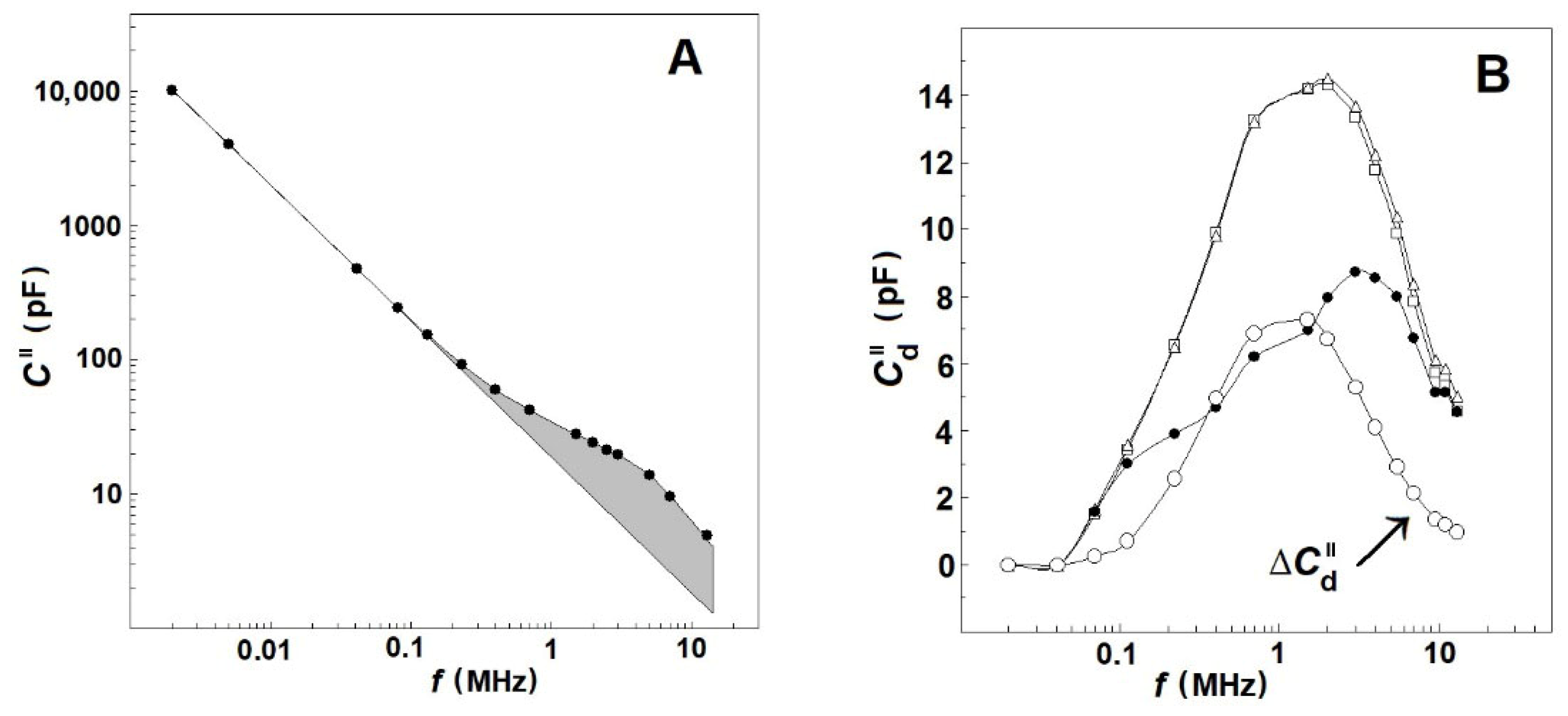
The conduction loss strongly prevails at low frequencies and decreases with the reciprocal of f, becoming smaller than the dielectric loss at the radio-frequency range (100 kHz–15 MHz) (Figure 1A). Thus, log (C″) obeys a specific frequency dependence, which allows for the separation of both types of energy loss on the frequency domain. For human blood, the dielectric loss at frequencies between 10 Hz and 0.1 MHz is negligible with respect to conduction loss, and the log (C″) linearly declines with log (f) [21]. Above 0.1 MHz, the linear shape of the log (C″)/log (f) dependence is disturbed, as the latter includes, in addition to the conduction loss, the energy loss due to dipole relaxations.
Based on the above, the values of C″(f), measured within the low-frequency portion (15–30 kHz), were used to obtain an analytical (e.g., power law) expression for the conduction loss. The obtained analytical expression was extrapolated to describe the pure conduction loss both at low and high frequencies. For the radio-frequency range, the conduction loss data, calculated from the obtained analytical expression, were subtracted from the experimentally measured values of C″(f), and the remainder was defined as the dielectric loss curve, Cd″(f), of the tested suspension at the chosen temperature (exemplified by Figure 1B) [13].

2.8. Curve of Dielectric Loss on Spectrin Network [13]

At a given temperature, the dielectric loss of a studied suspension is represented by the area under the dielectric loss curve, Cd″(f). This area is proportional to the total number of dipoles, irrespective of their spatial distribution and the dipole moments of dipoles [22]. The frequency profile of the Cd″(f) curve practically did not change within the temperature intervals of 30–47 °C and 53–59 °C. However, it abruptly shrunk at Ts, indicating a huge reduction in the dielectric loss as the spectrin filaments denatured and their dipoles ceased to contribute. To obtain the dielectric loss curve of the mere spectrin network, ∆Cd″(f), the dielectric loss curve of the studied suspension at 53 °C was subtracted from that at 47 °C, and the result was corrected by temperature using the dielectric loss curve at 41 °C (Figure 1B).

2.9. Reduction in Electrode Polarization

In a system of two measuring electrodes submerged in a liquid sample, a counter-ion layer forms at each electrode. As the current flows, a potential drop is produced on this layer which reduces the electric field available to drive charges and rotate dipoles in the sample [4]. This results in an apparently low conductivity and higher capacity of the studied sample. Considering a sample of RBC suspension, the effect increases with increasing sample conductivity and decreases with an increasing frequency and volume fraction of RBCs in the suspension, and its consequences are more pronounced on C′ (Y″) than on Y′ (C″) for the suspension.
For RBC suspensions with low volume fractions (6%) and a highly conductive suspension medium (150 mM NaCl), the electrode polarization is important up to 200 kHz [23]. In our study, the electrode polarization was reduced using dense suspensions (hematocrit values about 45% close to that in blood), suspension media with low conductivity (isotonic 10 mM NaCl and mannit solution) and low polarizable platinum and Ag/AgCl electrodes. In addition, instead of the absolute value of a chosen dielectric parameter obtained at a given temperature and frequency, our raw data consisted of the difference between two values of the parameter obtained at two different temperatures: one obtained at a temperature prior to and the other after the heat denaturation of spectrin. The two temperatures were close enough in order to similarly affect the electrode polarization; in addition, the temperature course of electrode polarization was corrected, as explained in Section 2.6. Therefore, while the spectrin denaturation strongly affected the difference between the two chosen values of the parameter, the impact of the electrode polarization was strongly reduced. All these measures, taken together, made the effect of electrode polarization insignificant for frequencies above 30 kHz. We check this conclusion by changing the distance between electrodes. Increasing the inter-electrode distance from 3 to 10 mm reduced about three times the static capacitance of the RBC suspension and, at the same time, preserved the capacitance due to electrode polarization. The comparison between the low-frequency spectrums of the capacitance of the studied RBC suspension, obtained at the two different inter-electrode distances, confirmed the conclusion that the electrode polarization was not important above 30 kHz.

3. Results

3.1. The Deposition of Immunoglobulins on the Surface of RBCs, Isolated from Blood with Inflammation, Enhanced the Interface (β) Dielectric Relaxation

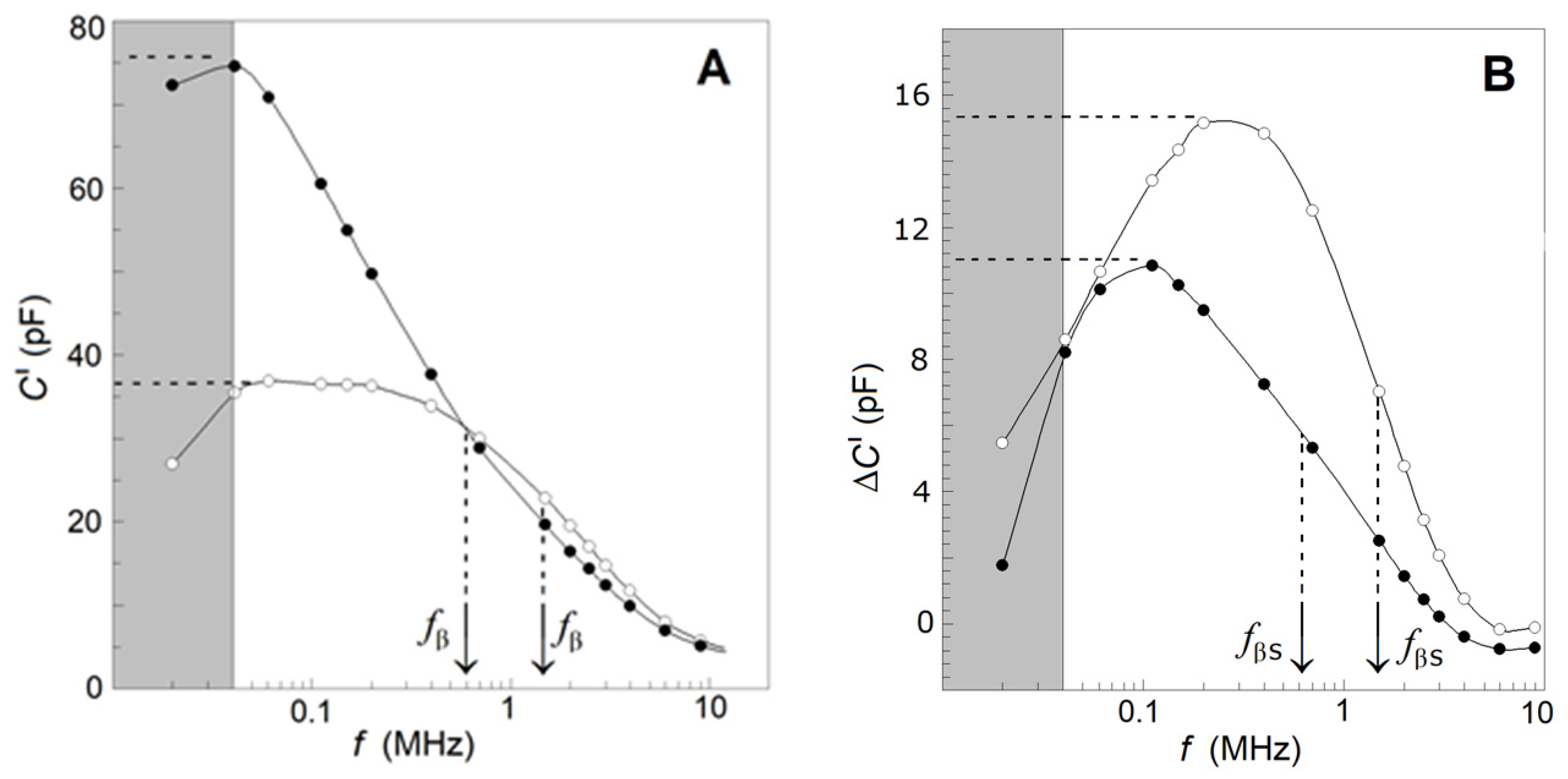
Figure 2A shows the frequency dependence of the capacitance, C′, of two suspensions of RBCs isolated from the same blood with strong inflammation. One of the suspensions contained control RBCs and the other one contained RBCs coated with blood plasma proteins. Nevertheless, that C′ represents the capacitance of the conductometric cuvette filled with the tested suspension, it chiefly reflected the capacitive properties of the plasma membrane of suspended RBCs. The frequency data for C′ were rapidly collected during the heating of each suspension on achieving the temperature of 47 °C, which is just prior to the denaturation temperature of spectrin, Ts = 49.5 °C [6]. The two suspensions were prepared using RBCs of the same patient, with the same hematocrit values (0.45) and the same suspension medium of LISS. Consequently, the only difference between the two suspensions was the layer of plasma proteins, chiefly immunoglobulins, adsorbed on the surface of coated RBCs.
As shown by the horizontal dashed lines in Figure 2A, the static, low-frequency value of C′, i.e., C0, could be obtained through the extrapolation of the plateau values of C′, determined just outside the zone of electrode polarization, to zero frequency. This procedure eliminated the effect of electrode polarization [23]. As the frequency increased, C′ decreased, describing the drop off of the interface (β) polarization, which is due to the Maxwell–Wagner effect (reversible accumulation of ions in phase with the electric field) on the RBC lipid membrane. The critical frequency, fβ, of the interfacial (β) relaxation is determined at the point of half-decline of suspension capacitance C′ between C0 and its minimal, high-frequency value C.
Figure 2A demonstrates that the C0 of coated RBCs obtained from blood with strong inflammation was about two times as high as in control RBCs of the same blood. By contrast, when testing RBCs isolated from the blood of a patient without inflammation, the difference between the C0 of coated and control RBCs was found to be within the limits of the mean statistical error of about ±7%. These outcomes are in accordance with the conception that immunoglobulins of blood plasma, whose amount is increased in the blood with inflammation, reversibly adsorb on the outer surface of RBCs, especially at a low ionic strength [17].

3.2. The Deposition of Immunoglobulins on the Surface of RBCs, Isolated from Blood with Inflammation, Inhibited Linearly the βs and γ1s Dielectric Relaxations

Heating the RBC suspension allowed us to determine the change at Ts in its complex admittance, ΔY*(f) = ΔY′(f) + jY″(f), and capacitance, ΔC*(f) = ΔC′(f) + j. ΔCd″(f), as a function of frequency, f. Figure 2B shows the frequency dependence of ΔC′ for the suspension of coated RBCs and control RBCs taken from the blood of the same patient whose blood was used for the experiment shown in Figure 2A. As explained above, the static value of the capacitance change, ΔC0, at Ts could be obtained through the extrapolation of the plateau values of ΔC′ to zero frequency (Figure 2B). When increasing the frequency, ΔC′ decreased to another plateau level, ΔC, passing through its half-value, (ΔC0 − ΔC)/2, at a frequency fβs. Preliminary reports allow us to associate this fβs with the characteristic frequency of βs relaxation for the spectrin network. In addition to the strong drop in ΔC′ at fβs, a weak rise could be noticed at the high-frequency end of the curve of ΔC′ (Figure 2B). This high-frequency deviation has been recently studied at conditions enhancing its strength, allowing for its association with γ1s relaxation in the spectrin network [1].
Although the adsorption of antibodies on the RBC surface strongly increased the static capacitance of the RBC plasma membrane, it reduced the change in this capacitance at Ts (compare the frequency behavior of C0 and ΔC0 in Figure 2). The explanation of this surprising result could be based on the inhibiting effect that blood plasma protein deposition exerts on the strengths of spectrin-sensitive (βsp and γ1sp) dielectric relaxations in RBCs.
As previously reported, the temperature-corrected changes at Ts of ΔY′(f), ΔY″(f), ΔC′(f) and ΔCd″(f) of control RBCs isolated from blood without inflammation were close to those obtained with their isolated and resealed RBC ghost membranes. This finding, combined with the usage of a differential method of measurement eliminating the impact of all secondary processes, indicates that these changes were dominated chiefly by the denaturation of the major cytoskeletal protein spectrin and the subsequent threshold alteration of the plasma membrane. Based on the assumption that the dielectric activity of denatured spectrin is nil, the above-mentioned dielectric changes at Ts were assumed to represent the contribution of the native spectrin network to the dielectric properties of plasma membranes just prior to Ts.
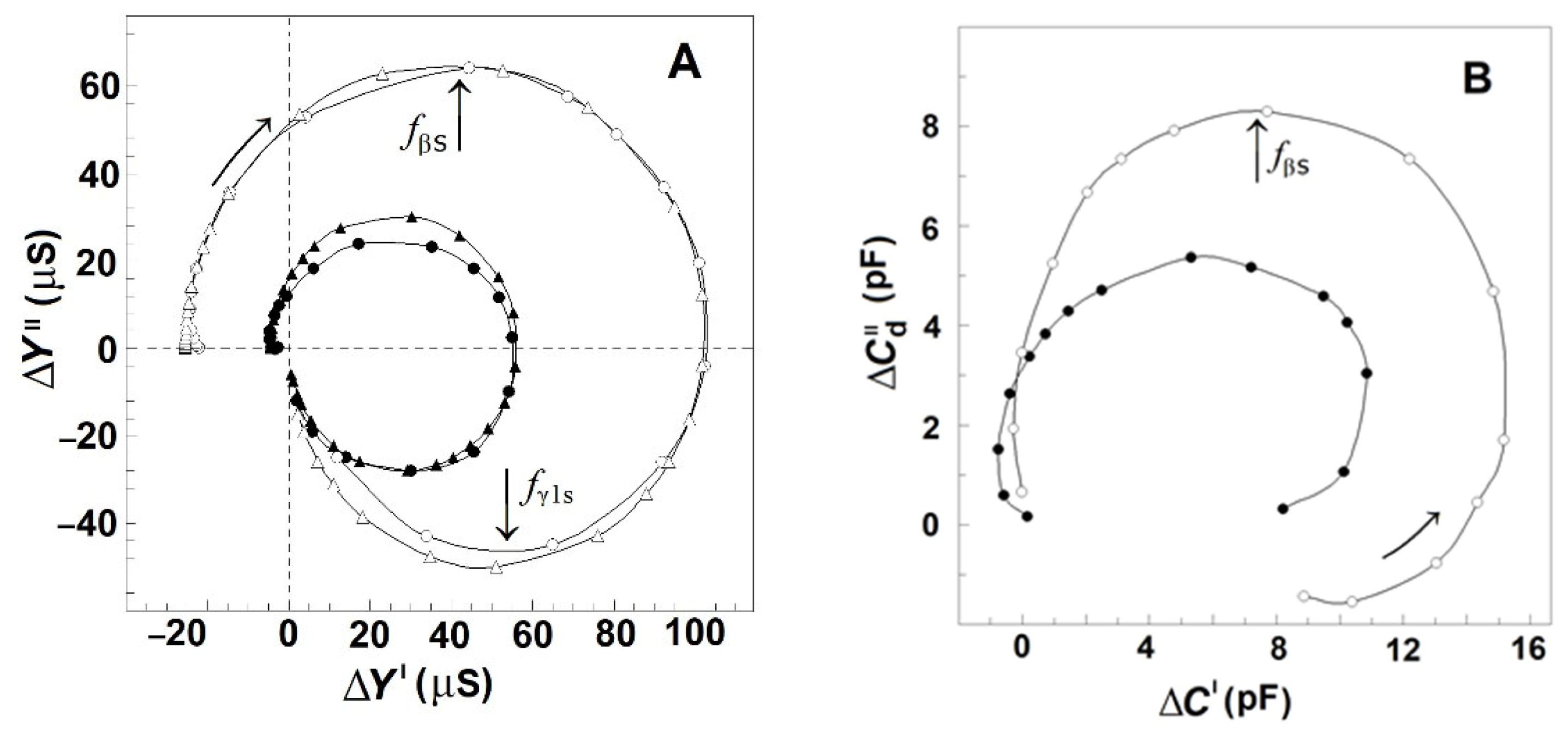
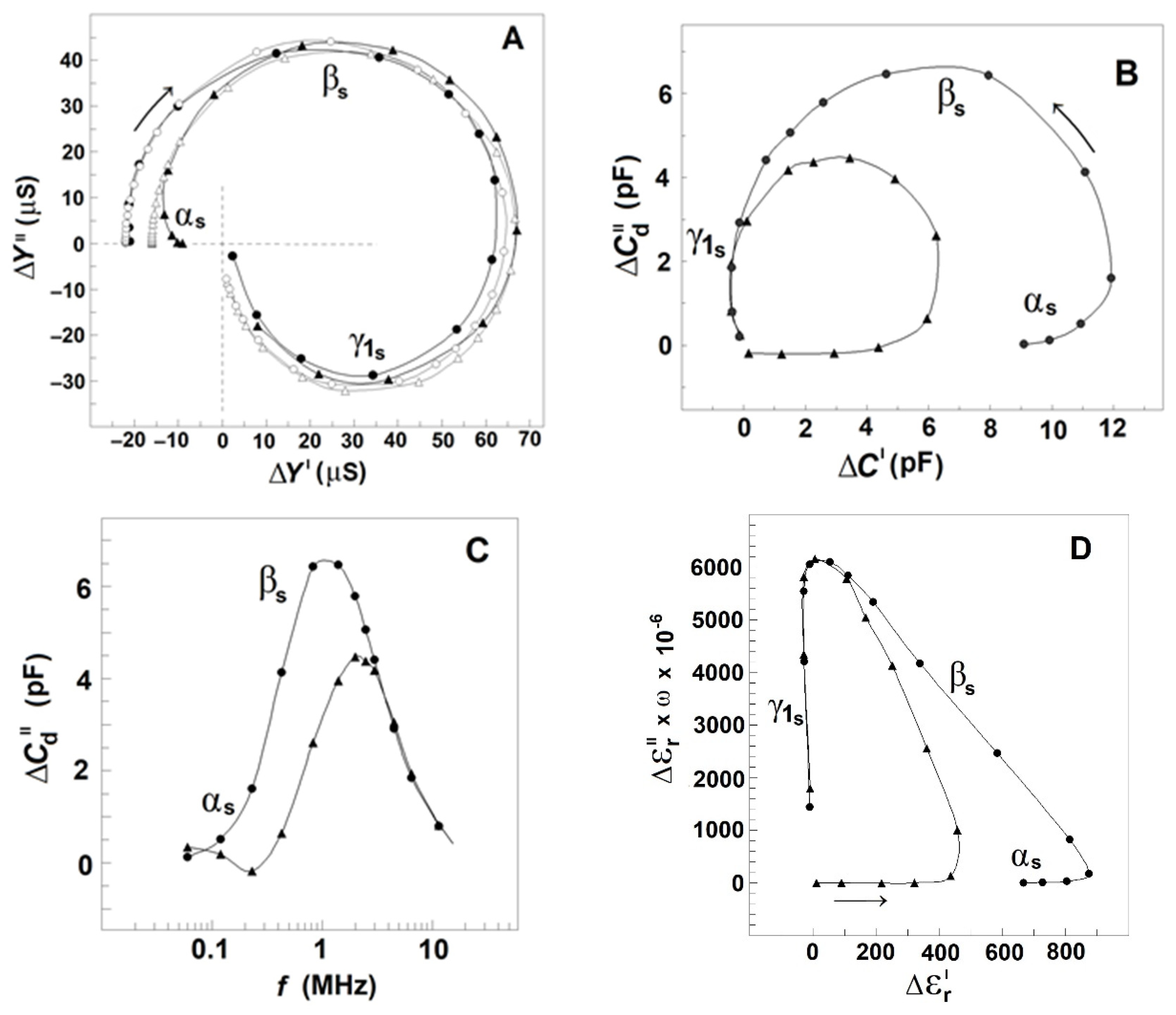
Figure 3 represents the complex plane plots of the spectrin-linked portions of the admittance (ΔY″ against ΔY′) and capacitance (ΔC″ against ΔC′) of control and coated RBCs taken from the blood of the same patient with inflammation. Similar admittance and capacitance change plots at Ts, in brief, were obtained under other circumstances earlier [1,8]. The two perfect semicircular arcs whose centers were situated on the real axis have been attributed to two single-time dielectric relaxations taking place on the native spectrin network just below Ts [7,8,13]. The semicircular arc lying above the real axis indicates a positive admittance contribution from the βs relaxation, whereas the semicircular arc lying below the real axis indicates a negative admittance contribution from the γ1s relaxation. The frequency dependence of ΔY″ depicted one positive peak centered at fβs followed by one negative comb centered at fγ1s, respectively [1]. The last dependence was used for a more precise determination of the values of fβs and fγ1s in tested RBCs.
The curves in Figure 3A, indicated by the triangles, show the Y″ versus Y′ plots of a suitable electric RC circuit modeling two single-time dielectric relaxations [8,18]. Using an iteration protocol and the experimentally determined values of fβs and fγ1s, the parameters of the model RC circuit were determined in order for the obtained model plot to fit to the respective experimentally obtained plot (Figure 3A). The model plot allows us to obtain the exact numerical values of the strengths of βs relaxation, Yβs, and of γ1s relaxation, Yγ1s, in the tested control and coated RBCs. As shown in Table 1, the strengths Yβs and Yγ1s were strongly reduced in coated, compared to control, RBCs.
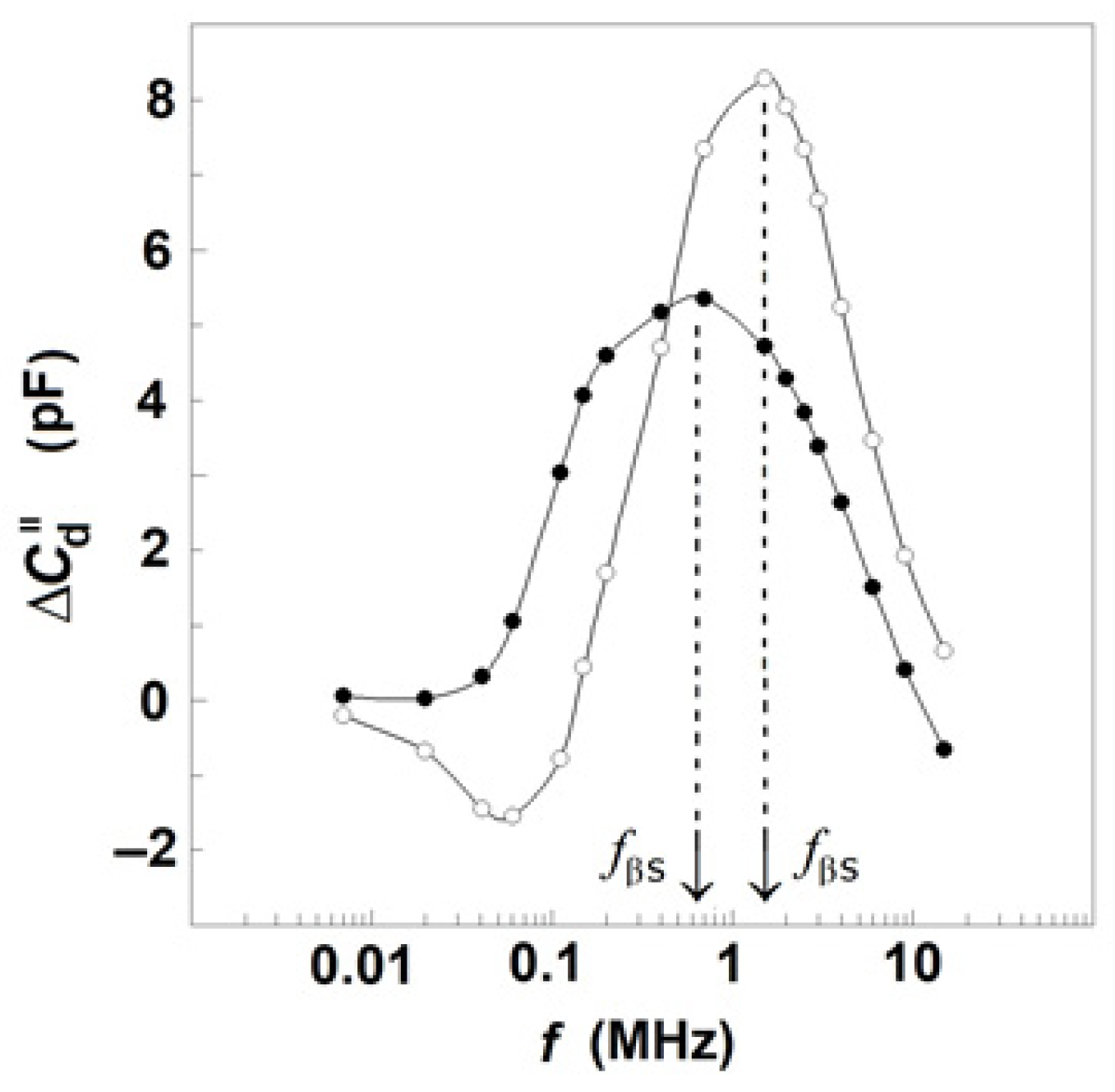
As shown previously, the dielectric loss curve of ΔCd″(f) represents the frequency dependence of the energy spent to induce the piezoelectric effect in the spectrin network during the βs relaxation just prior to Ts (for details, see Figure 1B). The ΔCd″(f) curve had a bell shape centered at fβs, the relaxation frequency of βs relaxation. In Figure 4, it is shown for control and coated RBCs isolated from the same blood with inflammation. It has been reported that the data of ΔCd″(f), incorporated in the complex capacitance change plot at Ts, ΔCds″ against ΔC′ (Figure 3B), depict a perfect semicircle with a characteristic frequency equal to fβs, reflecting the βs relaxation. Therefore, the static value of ΔC′ (Figure 2B) also represented a measure of the strength of βs relaxation.
According to the data in Figure 3A and Figure 4; Table 1, it could be concluded that the formation of an antibody layer on RBCs reduced the strength of βs and γ1s relaxations and decreased the height of the dielectric loss peak at fβs for the spectrin network. Hence, the inhibition of βs relaxation in coated RBCs could explain the smaller size of their capacity change, ΔC′, at Ts, although their static capacitance, C0′, was larger compared to control RBCs (compare Figure 2A to Figure 2B).
Figure 3A and Table 1 demonstrate that the strengths of the βs and γ1s relaxations and the height of the dielectric loss peak at fβs for the spectrin network in coated RBCs obtained from blood with inflammation were about 50 to 70% of those from control RBCs. By contrast, when testing RBCs isolated from the blood of a patient without inflammation, the difference between these values in coated and control RBCs was found to be within the limits of a mean statistical error of about ±7%. These outcomes are also in accordance with the recent reports that the immunoglobulins of blood plasma, whose amount is increased in blood with inflammation, reversibly adsorb on the outer surface of RBCs and impair the structure and function of RBCs, including the deformability of RBCs [24].
In previous publications of ours [8], it has been demonstrated that the impairment of RBC membrane deformability by several specific, as well as by a multitude of non-specific, agents was always accompanied by a diminution of the strengths of βs and γ1s relaxations. Based on these reports and taking into account the data in Figure 3, it could be assumed that the deposition of blood plasma proteins (mainly immunoglobulins) on the outer surface of RBCs should reduce the ability of the RBC membrane to deform. The above results, combined with previously reported findings, infer that the complex dielectric data of the RBC suspension collected prior to Ts could hardly reflect the changes in RBC deformability, while their changes at Ts could do this after applying appropriate data processing.

3.3. The Deposition of Immunoglobulins on RBC Surface Reduced the Characteristic Frequency of βs Relaxation in a Stepwise Manner to Half Its Value While That of γ1s Relaxation Remained Constant

As shown in Figure 2A, in RBCs isolated from blood of a patient with inflammation, the characteristic frequency of the interfacial (β) relaxation, fβ, had different values in coated RBCs (about 600 kHz) and control RBCs (about 1.3 MHz). No intermediate values were encountered. In line with previous reports [7,8,15], the fβ of these RBCs coincided with the characteristic frequency of their βs relaxation, fβs, which also had a value of about 650 kHz in coated RBCs and about 1.3 MHz in control RBCs (compare Figure 2, Figure 3 and Figure 4). The reason for the strict coincidence of fβ and fβs could be the common energy source of the two relaxations, namely the electric field-driven charge accumulation (Maxwell–Wagner effect) on the lipid membrane of RBCs.
The dielectric loss curve of the spectrin network of RBCs also exhibited a peak at fβs, having different values in coated RBCs (about 600 kHz) and control RBCs (about 1.3 MHz) (Figure 4). The same outcome could be obtained by determining the fβs using the frequency curve of ΔY″. In conclusion, the values of fβ and fβs, determined in Figure 2, Figure 3 and Figure 4 for the coated RBCs, had the same values of about 650 kHz. With control RBCs, fβ also coincided with fβs; however, both had values of about 1.3 MHz. The different values of fβ and fβs in the control and coated RBCs of inflamed blood, respectively, could also be related to the presence of plasma membrane immunoglobulins deposited on the surface of coated RBCs.
In contrast to fβs, the fγ1s was not affected by the deposition of antibodies on the RBC surface, as it did not differ in control and coated RBCs of the same blood with inflammation. Despite the fact that both relaxations took place on the same structure, the filaments of a spectrin network, they relied on different energy sources. The energy source of βs relaxation, the alternating accumulation of ions on the lipid membrane of RBCs, was located on the outer aspect of the RBC plasma membrane, and hence it was sensitive to the presence of antibodies on the local receptors of the RBC surface. The energy source of γ1sp relaxation involved a direct interaction of the electric field with the dipoles of the spectrin network, which were well isolated and directly inaccessible to the blood plasma antibodies.
Another series of experiments showed that, in contrast to the strength, the characteristic frequency of βs relaxation appeared to be far more sensitive to the deposition of antibodies on the surface of RBCs. Similar to the RBCs from blood with inflammation (CRP about 50 μg/L and more), the RBCs isolated from blood without inflammation (CRP of about 5–7 μg/L) demonstrated the same dependence of fβs (with respect to fβ) on the ionic strength of the washing medium. The latter RBCs had fβs and fβ both equal to about 650 kHz when washed in LISS, and about 1300 kHz when washed in HISS; nevertheless, the strength of βsp relaxation was the same in both cases. This result (N > 10) possibly indicates that a tiny amount of some blood plasma proteins was sufficient to adhere to the RBC surface and reduce fβ and fβs by half their value, while the amount of these proteins (immunoglobulins) has to be much greater (as with inflammation) in order to attenuate (linearly) the strength of βs relaxation. This is the reason why immunoglobulins, the only plasma proteins whose concentration in the blood of patients varies between broad limits, are assumed to be responsible for the reduction in fβs and fβ and for the inhibition of βs and γ1s relaxations.

3.4. Three (αs, βs and γ1s) Spectrin-Sensitive Relaxations in RBCs; Possible Origin of the Novel αs Relaxation

For the curves in Figure 2B, Figure 3 and Figure 4, as well as in the figures of previous reports (using RBCs and RBC ghost membranes), a deviation can be frequently noticed in the frequency interval between 30 kHz and 200 kHz, i.e., well above the frequency zone of electrode polarization at f < 30 kHz. Although it still has an unclear origin, this deviation has to be considered as a real event induced by the alternating electric field in the RBC plasma membrane. It shared common frequencies with the classical surface (α) relaxation in biological cells, which involves mainly the elimination of the polarization of the electric double layer around these cells. It is well documented that α relaxation shows up in human RBCs only in some special conditions (for example, in energy-depleted RBCs). Nevertheless, the following findings lead to the conclusion that this event constituted another spectrin-sensitive, single-time dielectric relaxation with a complex nature, here designated as αs relaxation for brevity.
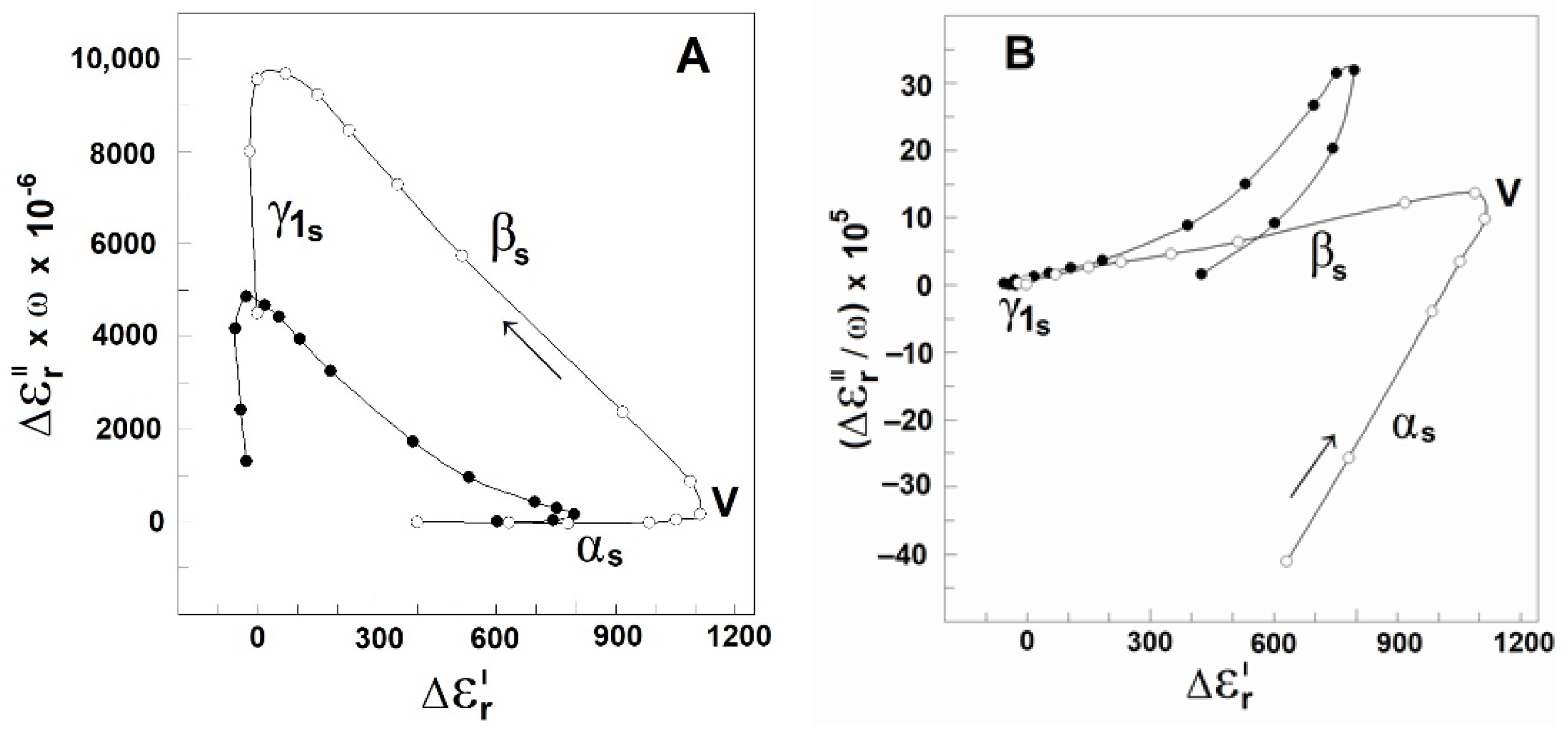
To substantiate this claim, the change at Ts of the complex capacitance of the RBC suspension, ΔC* = ΔC′ + j. ΔCd″, was transformed, following [11], into the change in the relative complex dielectric permittivity, Δεr* = Δεr′ + j. Δεrd″ = KC*/ε0 (dimensionless). Here, the constant of the conductometric cuvette, K, was determined to be equal to 650 m−1, and the permittivity of free space, ε0, was adopted as 8.854 × 10⁻¹² F.m−1. Furthermore, the frequency dependence of Δεr* was analyzed using two special plots of electrochemical impedance spectroscopy, introduced by Cole, namely Δεrd″ ω versus Δεr′ (Figure 5A) and Δεrd″/ω against Δεr′ (Figure 5B). In general, a studied dielectric relaxation will be represented in these plots by a straight line (segment) provided it has a single relaxation time, τ(s), with respect to a single characteristic frequency, fc = 1/(2πτ). The slope of this segment will be equal to 1/τ and τ, respectively, and this segment will intersect the real axis of Figure 5A at Δεr′ = Δεr0′ (for f → 0) and the real axis of Figure 5B at Δεr′ = Δεr∞′ (for f → ∞). Hence, the width of this segment, i.e., the strength of this relaxation, expressed in the units of the Δεr′ axis will be Δεr∞′ − Δεr0′ (see Table 2).
Figure 5A,B (open circles) exhibit the results obtained with control RBCs isolated from blood without inflammation. In order to represent the αs deviation more clearly and strongly, RBCs were isolated from blood metabolically exhausted through incubation at 4 °C overnight. As a result, three consecutive and interconnected straight-line segments were obtained over the frequency intervals of αs deviation (30–200 kHz), βs relaxation (200 kHz–3 MHz) and γ1s relaxation (3–15 MHz). The above-mentioned characteristic frequencies, fβs (about 1.3 MHz) for βs relaxation and fγ1s (about 9 MHz) for γ1s relaxation, were approximately located at the centers of respective segments. The fact that αs deviation was also represented by a separate straight-line segment, clearly confined between about 30 kHz and about 200 kHz on the two plots, supports the assumption that it constitutes another type of spectrin-sensitive dielectric relaxation, additional to the already published βs and γ1s relaxations. In this study, the determination of the lower-frequency end of αs relaxation (30–40 kHz) was restricted by the electrode polarization; in fact, it apparently has a much lower value. Thus, αs relaxation overlapped the frequency interval of the classical α-dielectric (surface) relaxation for the plasma membrane of biological cells.
Provided there were no other dielectric relaxations at frequencies above 10 MHz, the segment of γ1s relaxation for fresh control RBCs could be assumed to end at the origin of the Cartesian plots in Figure 5A,B when the frequency tends to infinity. In fact, measurements above 15 MHz were not possible with our instrument; however, up to this limit, the experimental points closely followed the model plot, which actually ended in this way (see Figure 3A).
Due to the multiplication of Δεrd″ by the angular frequency, ω = 2πf, on the vertical axis, the three relaxations (αsp, βsp and γ1sp) were equally well represented in Figure 5A. By contrast, Figure 5B exhibited the high-frequency γ1sp relaxation rather poorly, as Δεrd″ was divided by the frequency, ω, on its vertical axis.
Let us consider the plot in Figure 5A. While Δεr′ values on the horizontal axis represent the frequency dependence of the changes in the relative real dielectric permittivity at Ts, the product Δε″ω on the vertical axis has the meaning of real conductivity. Hence, the data on the horizontal axis of Figure 5A will represent the reversible loss in energy the field spends to separate charges during the studied dielectric transition, while the data on the vertical axis will represent the irreversible loss of energy spent on the rotation of dipoles by the alternating electric field.
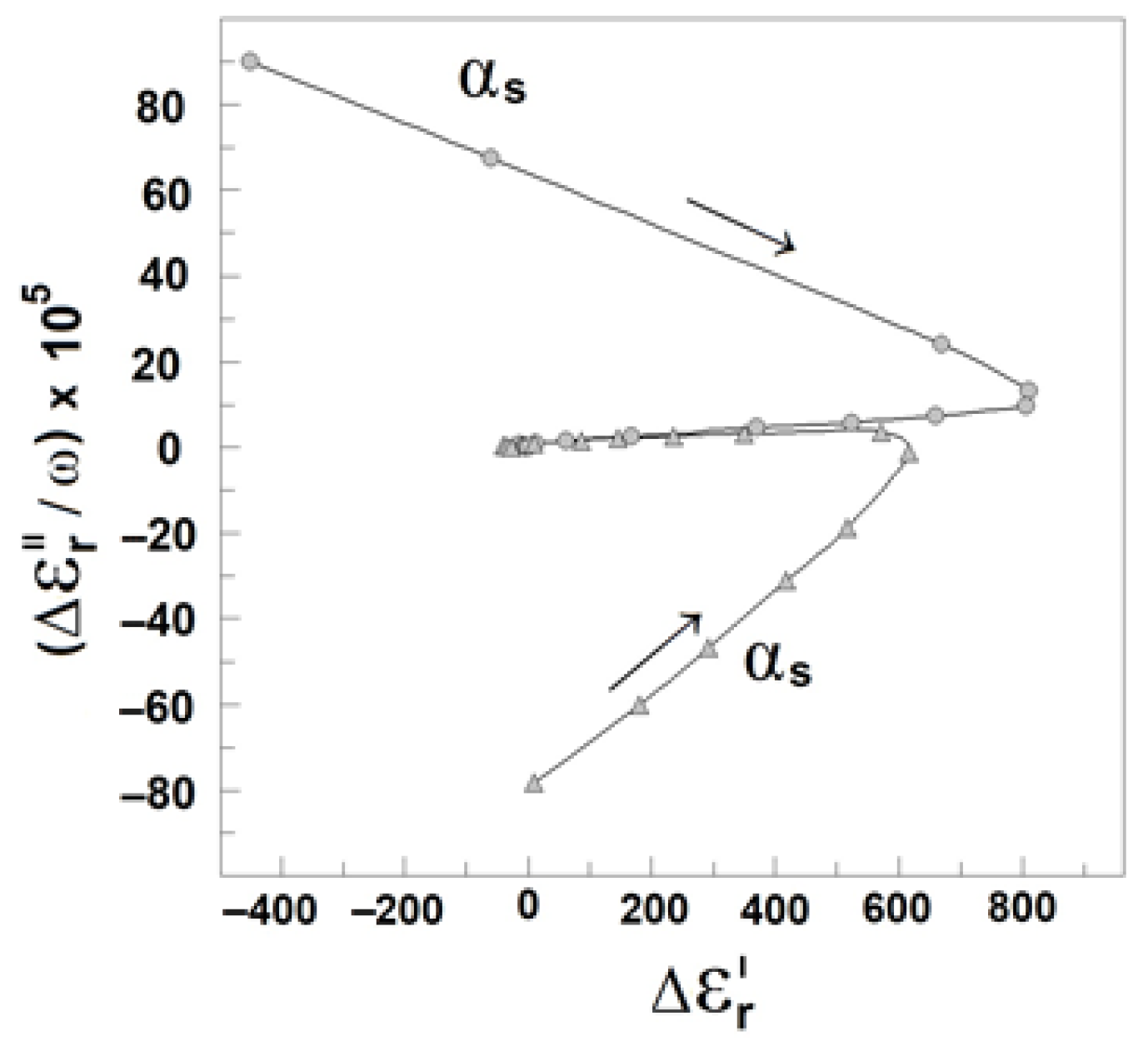
Based on the above considerations, the data in Figure 5A indicate that αs and γ1s relaxations demonstrated different natures, mostly capacitive and conductive, respectively. For control RBCs, the segment of αs relaxation was almost entirely parallel to the horizontal axis and allocated upon this axis. Hence, αs relaxation possibly involved changes at Ts mainly in the real capacitance of suspension, chiefly an elastic process of charge separation with a low amount of irreversible dielectric loss. Based on this result and taking into account its overlapping by frequency with the classical surface (α) relaxation [9], αs relaxation appears to mainly express the reversible polarization of the electric double layer around the RBCs. In two probes of RBCs from the same RBC paste, the segment of αs relaxation strongly differed by place and orientation depending on the ionic concentration of the suspension medium, which was either isotonic 10 mM/sorbit solution (for Figure 5B) or 150 mM NaCl saline (for Figure 6). As an increase in the ionic strength of the suspension medium strongly reduces the width of the double electric layer, the above result supported the assumed mechanism of αs relaxation.
In contrast to the horizontal segment of αs relaxation in control RBCs, the segment of γ1s relaxation was almost parallel to the vertical axis and located in the region of negative values of Δεr′ (Figure 5A). Therefore, the γ1s relaxation could be considered as mainly irreversibly dissipating electric energy through the rotation of electric dipoles. The above conclusion is in line with the already proposed nature of γ1s relaxation as one involving the direct interaction of an electric field with the dipoles of the spectrin network, aligning and rotating them at frequencies when the RBC lipid membrane became fully transparent to the field. More specifically, data have been provided that this interaction could include a rotation of the electric dipoles, associated with the unpaired triple-helical units of spectrin filaments [18]. The small, although negative values of Δεr′ in the region of γ1s relaxation, indicated in Figure 5A and Table 2, reflected the unusual, negative (downward) orientation of the semicircle of this relaxation in the complex plane plot at Ts of ΔY* (Figure 3A) and of ΔC* [1].
Table 2 demonstrates that the widths of the three relaxations, measured in the units of the Δεr′ axis, were specifically affected by the mild deposition of blood plasma immunoglobulins on RBCs (CRP = 50 μg/L). In comparison with the slight decrease in the width of βs relaxation from 1250 to 1030 units, the width of αs relaxation was dramatically reduced from 620 to 130 units, while the width of γ1s relaxation was practically not changed by this deposition. This outcome indicates the extreme dependence of the αs relaxation on the surface properties of the RBCs (as it is marked in Table 3).
With fresh, control RBCs, the high-frequency end of the αs segment, here designated as the V point, implicitly corresponded to the frequency of about 175 kHz and was placed above the horizontal axis of Figure 5B. The initial, low-frequency point of the αs segment lay on the horizontal axis of Figure 5B close to the V point, thus confining the minute length of this segment. In RBCs subjected to severe modifications (energy depletion, chemical modification of membrane proteins, large deposition of blood plasma proteins, etc.), the initial, low-frequency point lay well under the horizontal axis, as low as the modification was heavy, while the frequency of the V point increased up to 700 kHz (Figure 5B). Hence, the length and place of the αs segment (relaxation) in Figure 5B could be used as a marker of how much RBCs deviated from their fresh, intact counterparts (Table 3).
In coated RBCs isolated from blood with mild inflammation (CRP about 50 μg/L), the segments of the αs, βs and γ1s relaxations were markedly shortened compared to control RBCs (Figure 5). In line with the data in Figure 3A and Table 1, this finding indicates a reduced strength of αs, βs and γ1s relaxations in coated RBCs compared to control ones. The inhibition of βs and γ1s relaxations increased as the inflammation became stronger; by contrast, αs relaxation was enhanced at extremely high inflammation.
While the segments of αs and βs relaxations in control RBCs had a straight-line shape, they were markedly nonlinear and no longer straight in coated RBCs. This observation indicates that, while the αs and βs relaxations were single-time type in control RBCs, they became multi-time type in coated RBCs due to the antibody adsorption. As in control RBCs, the segment of γ1s relaxation preserved its straight-line shape in coated RBCs, again indicating that this relaxation was well isolated from the place (RBC surface) where the antibodies were piled up.
In order to remove the surface layer of adsorbed antibodies prior to testing, the coated RBCs were subjected to one extra washing in HISS containing either 150 mM NaCl or 130 mM NaCl and 20 mM (NH4)2SO4. The result of this additional washing was a decrease in the static capacitance, C0, an increase in ΔC0 at Ts, an enhancement of the strengths of βs and γ1s relaxations and a shift in fβ and fβs from 0.65 MHz to 1.3 MHz as shown in Figure 2, Figure 3 and Figure 4 for control RBCs. In addition, this extra washing in HISS restored the normal straight-line shape of αs and βs segments, as shown for control RBCs in Figure 4.
The testing of RBCs isolated from patients having blood with extreme inflammation (CRP >> 50 μg/L) did not present any difficulties when the washing media were HISS. However, the washing of RBCs in LISS was, in most cases, difficult. Sometimes, the RBCs aggregated after the third or even second washing; in other cases, the RBCs did not aggregate during washing but rapidly sedimented during the heating of the tested suspension. These outcomes were possibly due to and correlated with the different but always much larger number of antibodies adsorbed on the tested RBCs. The presence of 5–10 mM MgCl2 in washing and suspension media inhibited aggregation and sedimentation. Much better results were produced through the iso-osmotic replacement of NaCl in washing and suspension media by (NH4)2SO4, which also inhibited the aggregation and sedimentation of RBCs and almost fully restored the strengths of βs and γ1s relaxations. The above findings, obtained with RBCs isolated from blood with moderate and high inflammation, could be explained by the ability of some ions (Mg2+, NH4+, SO42−) to prevent adsorption and remove the absorbed antibodies deposited on the outer surface of RBCs.
DIDS is a membrane-impermeable bifunctional reagent that specifically binds to the band 3 protein of the lipid membrane, producing intra-monomeric cross-links both in band 3 dimers and tetramers [25]. The band 3 tetramers are linked to the spectrin network through ankyrin bridges, which involves linking sites with high and low affinity. The binding of DIDS to band 3 tetramers releases all ankyrin bridges anchored via low-affinity sites, and half of those anchored by high-affinity sites [26]. In turn, the released band 3 tetramers dissociate into dimers and detach from the ankyrin, and thereby from the spectrin cytoskeleton.
In this study, the DIDS treatment of isolated RBCs resulted in two different outcomes depending on whether the treated RBCs lacked or had a surface layer of adsorbed blood plasma proteins and how deep this layer was. According to the ΔY″ against ΔY′ plot at Ts, the coated RBCs isolated from blood with strong inflammation (CRP >> 50 μg/L) demonstrated almost fully inhibited βs and γ1s relaxations, while the segment of their αs relaxation for the Δεrd″/ω against Δεr′ plot at Ts was extremely long and started well below the horizontal axis. The treatment of these RBCs with DIDS enforced the βs and γ1s relaxations and inhibited αs relaxation, returning the lengths of their segments close to those present in control RBCs. This outcome possibly indicates that DIDS treatment released the greater part of loosely bound immunoglobulins, thus removing the inhibitory effect these antibodies produced on the strengths of spectrin-sensitive βs and γ1s relaxations. In addition, this outcome indicates that a large proportion of the (active) binding sites for blood plasma proteins on the outer surface of RBCs coincided with those of DIDS, i.e., these sites predominantly resided on the outer aspect of the band 3 integral protein. Concerning the αs relaxation, the above outcome supports the conception that, in addition to the polarization of the diffusion (Gouy–Chapman) layer of the electrical double layer, the strength of αs relaxation depended on the presence of polarizable charges loosely bound to or confined at the outer surface of RBCs (the Stern layer of the electric double layer).
Results similar to those of DIDS were produced by incubating control RBCs and deeply coated RBCs isolated from blood with extreme inflammation for 10 min in media containing 5 mM of either Na-arsenate, Na-fluoride, Na-orthovanadate or Na-molybdate. As these reagents are indeed metabolic poisons, the application of each one of them on control RBCs (lacking surface coating) resulted in a noticeable inhibition of βs and γ1s relaxations. By contrast, with deeply coated RBCs, these reagents strongly enhanced their usually very weak βs and γ1s relaxations up to the level in control RBCs. This outcome was possibly related to the ability of these agents to enter RBCs in the form of anions via the band 3 protein, causing release of antibodies adsorbed on this protein.
Based on above findings, a conclusion could be drawn that the deposition, in LISS, of blood plasma antibodies on the surface of RBCs, predominantly on the outer aspect of the band 3 integral protein, strongly and reversibly inhibited and modified the αs, βs and γ1s relaxations in RBC membranes. The removal of adsorbed antibodies through the washing of RBCs in HISS or their displacement by the ions of suitable salts (NH4)2SO4, MgCl2, DIDS, Na-arsenate, Na-fluoride or Na-orthovanadate) eliminated their inhibitory effect on βs and γ1s relaxations.

3.5. The Spectrin-Sensitive Relaxations in RBCs Could Throw Light on the Controversial Effects of DIDS on RBC Membrane Structure and Deformability

The mechanical properties of RBCs, especially their membrane deformability, are important rheological parameters of blood [27]. In a previous study, control RBCs were treated with chemical reagents (diamide up to 0.85 mM and taurine mustard up to 2 mM) which specifically cross-link and stiffen spectrin filaments, thereby reducing RBC membrane deformability and flicker. Using the complex plan plot for the admittance contribution of spectrin, ΔY″ against ΔY′ at Ts, these reagents were shown to produce a concentration-dependent inhibition of βs and γ1s dielectric relaxations [8]. This finding was assumed to substantiate that the strengths of these relaxations reflected the intrinsic deformability of the spectrin network and its effect on the deformability of the plasma membrane. Concerning both the deformability of RBC plasma membrane and the strength of βs and γ1s relaxations, there are, however, still unresolved problems, for example, the controversial effect of DIDS on both of them.
The effects produced by the DIDS treatment of control RBCs on their deformability and spectrin-sensitive relaxations are somewhat paradoxical. Despite the fact that DIDS treatment caused significant alterations of the lipid membrane structure and a severe detachment of the lipid membrane from the spectrin network, many studies have reported that this treatment did not impair the ability of RBCs to elongate under large shear stress in the LORCA ektacytometer or in the ARCA rheoscope [28,29,30,31]. Our previous studies also showed that the DIDS treatment of control RBCs did not change the strength of βs and γ1s relaxations when they were measured in the ΔY″ against ΔY′ plot at Ts [8].
However, using other techniques, methods and devices for the measurement of RBC deformability, DIDS has been found to decrease RBC deformability [31]. An attempt to deal with this discrepancy is presented below. Considering coated RBCs isolated from blood with inflammation, their treatment with DIDS will remove a significant portion of the layer of deposited antibodies, including those adsorbed on band 3 protein; thereby, the impairment of RBC deformability produced by this layer will be eliminated. Consequently, the following results refer to control and coated RBCs isolated from blood without inflammation, as both types of cells had a relatively pure outside surface (see above for the effect on fβs) and provided identical results (Figure 7). In addition, this problem was studied using more reagents to impair the RBC membrane deformability and plots to represent the αs, βs and γ1s relaxations, allowing for a more comprehensive definition of the actual strengths of these relaxations (Figure 7).
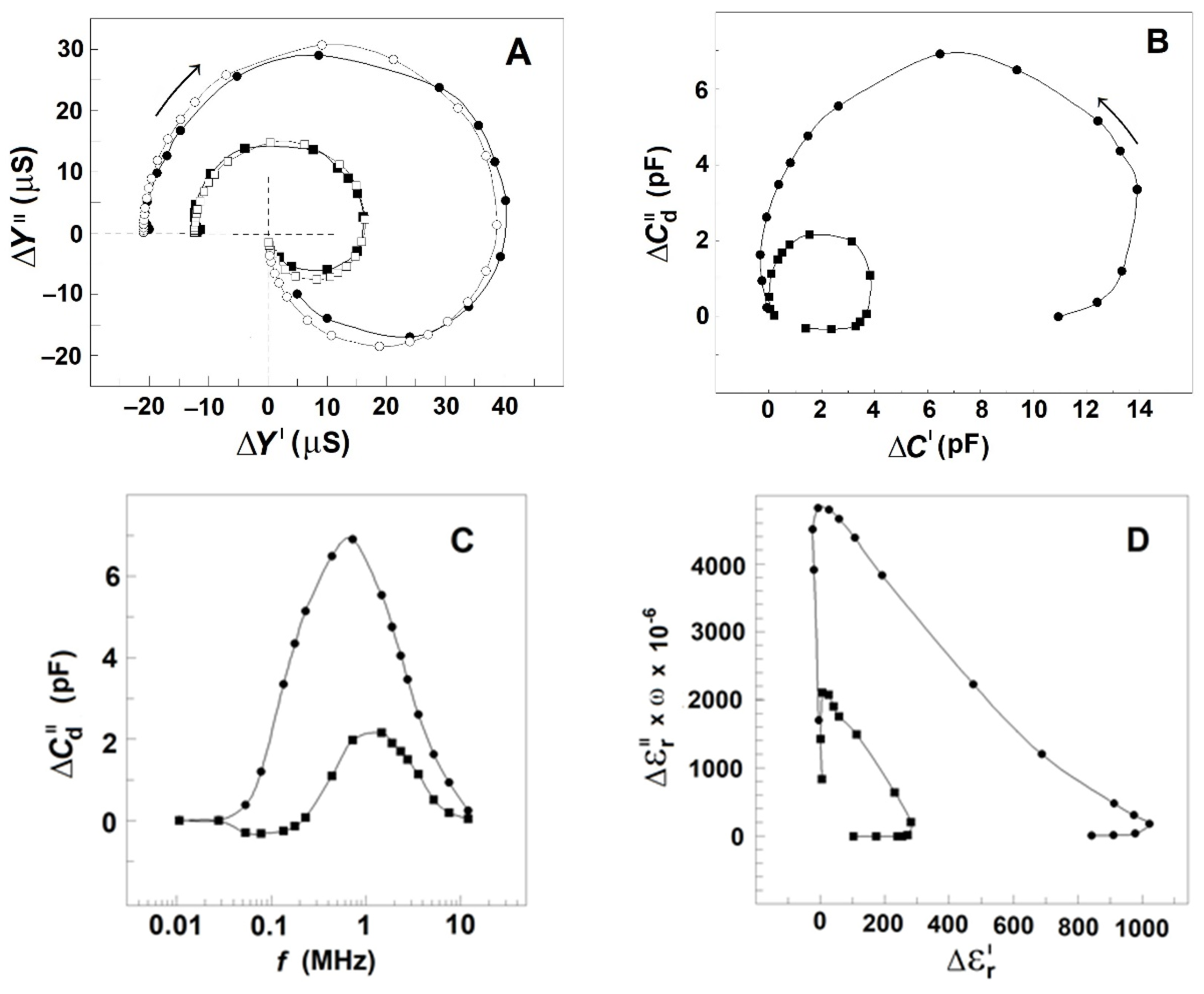
In line with the previous report [8], Figure 7A indicates that the DIDS treatment of these RBCs did not affect the strengths (as measured in the ΔY″ against ΔY′ plot at Ts) of βs and γ1s relaxations (N = 10). Based on the reports for the deformability measurements of other investigators [28,29,30,31] and on the preservation of the strengths of βs and γ1s relaxations (Figure 7A), it could be assumed that the deformability of these RBCs, if measured using the LORCA ektacytometer or the ARCA rheoscope, was not changed after their treatment with DIDS.
However, in contrast to the presentation of spectrin-sensitive relaxations in the ΔY″ against ΔY′ plot at Ts, the three other presentations in Figure 7B–D demonstrate that βs relaxation was in fact inhibited by the DIDS treatment of RBCs. Indeed, in comparison to the intact RBCs, Figure 7B shows a twofold reduction in the radius of the βs circle (the amplitude of βs relaxation), Figure 7C shows a strongly reduced height of the peak of dielectric loss for spectrin and Figure 7D demonstrates markedly reduced lengths of the βs segment and the length of its projection on the horizontal axis in RBCs subjected to DIDS treatment.
In addition to DIDS, a multitude of other reagents, divided into two groups, were used to treat the RBCs isolated from blood without inflammation. The effect of these reagents on the deformability of RBCs, obtained under standard protocols, has been thoroughly investigated and published by other investigators. These reagents were used in our study under the same protocols. The first group includes lysolecithin (up to 10 μg/mL), known to intercalate into the outer leaflet of the lipid membrane, producing strong echinocytosis (i.e., uncoupling of the spectrin network from the lipid membrane) [32,33]; DTT (5 mM), uncoupling band 3 from the spectrin network [28,29,30,31]; SITS (50–100 μM) [34]; and concanavalin A (1 mg/mL). Similar to DIDS, SITS and concanavalin A specifically bind to the outer aspect of the band 3 integral protein. In conclusion, all reagents of the first group changed, only or chiefly, the lipid membrane of RBCs, preserving the spectrin network intact. Relatedly, they have been shown by other investigators not to affect the ability of the RBC plasma membrane to deform. In this study, these reagents all produced exactly the same effect on the spectrin-sensitive relaxations, as shown in Figure 7 for DIDS. In particular, they all reduced the length of the βs segment and its projection on the real axis, while the lengths of its projections on the vertical axis were preserved, as shown in Figure 7D.
The agents of the second group included melittin (up to 1.5 μM), diamide (up to 0.85 mM), taurine mustard (up to 2 mM), glutaraldehyde (up to 0.044%), WGA (up to 0.25 mg/mL), hypertonic media (up to 600 mOsm) and spermidine (1 mM, resealed into RBC ghost membranes). All these agents changed, directly or indirectly, the spectrin network of the RBC plasma membrane. Melittin, at the concentration of 0.5 μM, has been shown to bind band 3 protein specifically from outside, turning RBCs into smooth spherocytes and stiffening the RBC membrane, as membrane fluctuations (flicker) decreased by 18% [35]. Diamide [36,37], taurine mustard, spermidine and possibly glutaraldehyde at this minute concentration specifically cross-linked the spectrin filaments, while the lectin WGA bound glycophorin A from outside, possibly inducing the association of the cytosolic part of this integral glycoprotein to spectrin [38]. In contrast to the reagents of the first group, the agents of the second group are all known to impair RBC plasma membrane deformability. As is shown for WGA in Figure 8, they all inhibited the strengths of the αs, βs and γ1s relaxations, and specifically they all reduced the length of the βs segment and the lengths of its projections on the vertical and horizontal axes, as shown in Figure 8D. Similar to the reagents of the second group, the deposition of blood plasma immunoglobulins on the RBC surface inhibited the strength of βs and γ1s relaxations, and the length of the βs segment and the lengths of its projections on the vertical and horizontal axes were especially reduced, as shown in Figure 5A. In addition, this has been reported to impair the deformability of the RBC membrane [24].

4. Discussion

It was mentioned above that the inhibitory effect produced by DIDS treatment on the membrane deformability of RBCs appears contradictory, as it has been found to depend on the type of device and its measuring principle. The results obtained in a recent study on the inhibitory effect of DIDS on the main βs and γ1s relaxations also appeared contradictory, as it was absent in the ΔY″ versus ΔY′ plot at Ts (Figure 7A) and present for other plots obtained at Ts (Figure 7B–D). Thus, there is an apparent inconsistency in the results DIDS produces both on dielectric relaxations in the RBC membrane and its deformability. Considering that dielectric relaxations in the RBC membrane and its deformability are both intertwined [8], how do we explain this parallelism and inconsistency?
Based on the proposed rationale for the mechanism of βsp relaxation and the relation of this relaxation to RBC membrane deformability, the parallelism and contradictory effect of DIDS treatment on spectrin-sensitive relaxations and RBC deformability appear to be best expressed through the behavior of the βsp segment in Figure 7D. There, the length of this relaxation segment and its projection on the horizontal axis were both strongly reduced, which could explain the apparent inhibition of βsp relaxation in Figure 7B,C and presumably the positive effect obtained by some deformation measurement devices. By contrast, the projection of this segment on the vertical axis was preserved in length, which could explain the lack of inhibition of βsp relaxation in Figure 7A and presumably the negative effect obtained by other deformation measurement devices. This assumption is supported by the results obtained for a large group of other agents known to produce an effect on RBC deformability either similar (see Figure 7) or opposite (see Figure 8) to that of DIDS.
Based on the results shown in Figure 5A, Figure 7 and Figure 8, a hypothesis could be put forward that, while the length of the βs relaxation segment could be considered as a measure of the strength of βs relaxation, the length of its projection on the vertical axis may be an actual determinant of the ability of the RBC plasma membrane to deform, at least when determined using the LORCA ektacytometer or ARCA rheoscope. Hence, the actual strength of βs relaxation (the βs relaxation segment in Figure 5A, Figure 7D and Figure 8D) should possibly be considered as a vector quantity (or a complex number) whose real part is represented by the reversible capacitive loss in energy (as determined by the projection of the βs segment on the horizontal axis), while its imaginary part is represented by the irreversible dielectric loss (as determined by the projection of the βs segment on the vertical axis). Thus, the imaginary part of βthe s relaxation vector was possibly related to the ability of the plasma membrane to deform. It was roughly reflected by the radius of the positive circle in the plot of ΔY″ against ΔY′ at Ts (see Figure 3A, Figure 7A and Figure 8A). On the other hand, the real part of the βs relaxation vector was apparently reflected by the radius of the semicircle in the plot of ΔC″ against ΔC′ at Ts (Figure 3A, Figure 7B and Figure 8B) and by the peak height of the dielectric loss curve for spectrin, ΔC″ against f at Ts (Figure 4, Figure 7C and Figure 8C).
The conception that the actual strength of βs relaxation (the length of the βs relaxation segment) might be regarded as a vector quantity (complex number) having real and imaginary parts could be transferred over the actual strengths of αs and γ1s relaxations as well. For each one of the αs and βs relaxations, the length of its segment in Figure 5A could be a measure of its actual strength, with its real and imaginary parts given by the lengths of the projections of this segment on the real (horizontal) and imaginary (vertical) axis, respectively.
Considering the αs relaxation, its real part should represent the reversible spectrin-sensitive capacitive loss in energy during the lateral (tangential) displacement of ions within the electric double layer. Its imaginary part could be possibly associated with the irreversible loss in energy within the spectrin-sensitive part of the electric double layer, possibly due to the so-called surface conductivity of RBCs. While the real and imaginary parts of this relaxation both tend to zero in fresh control RBCs with a negligible number of antibodies on their surface, they strongly increase in RBCs subjected to various alterations—a large deposition of antibodies, the chemical modification of band 3 and other membrane proteins, and energy depletion, among other cell alterations (see Table 3).
The real part of the segment of γ1s relaxation was significantly smaller than its imaginary part (Figure 5A), indicating the predominantly dissipative character of this transition. As is known, dissipative processes lead to the release of heat and a rise in temperature. Considering the segments of βs and γ1s relaxations as vectors with directions following the increase in frequency, their projections on the imaginary axis point in opposite directions (Figure 5A). This outcome is also in accordance with the disposition of βs and γ1s relaxations above and below the real axis of the ΔY″ against ΔY′ plot at Ts (Figure 7A), where they have positive and negative directions, respectively.
This study presents new data for the two previously published (βs and γ1s) spectrin-sensitive dielectric relaxations in the RBC plasma membrane and describes a novel third relaxation (αs) of a similar type. On the frequency axis, the three spectrin-sensitive dielectric relaxations coincided with the well-known surface (α), interfacial (β) and protein dipolar (γ1) dielectric relaxations in the plasma membranes of cells, including RBCs. Similarly to what is known for α polarization, αs spectrin-sensitive relaxation possibly reflected the change in the dielectric polarization of the spectrin-sensitive part of the RBC electric double layer at frequencies higher than its characteristic frequency. In previous and recent studies, the spectrin sensitivity of βs and γ1s relaxations was demonstrated using chemical reagents specific to spectrin, as well as by the effect produced by the mere thermal denaturation of spectrin. The spectrin sensitivity of the novel αs relaxation possibly reflected some impact produced by the spectrin network on the surface charge of the RBC plasma membrane, as this impact was removed through spectrin denaturation. This, still undefined impact was localized on the RBC surface, as it was detected at frequencies (f < 200 kHz) when the incident electric field had no access to the cytosol of RBCs.
In addition, the more intimate biophysical relationship between the two types of relaxations was noticed. While βs and γ1s relaxations both reflect dielectric polarization of the segments of spectrin filaments, they consume energy from different sources. For βs, this was possibly the alternating deformation produced by the interfacial polarization in the lipid membrane, whose energy was transmitted to spectrin via the connecting protein bridges (predominantly the glycophorin C–actin–spectrin bridge). For the γ1s relaxation, the energy source was the direct interaction of the incident field with the spectrin network; however, according to the data in [1], this relaxation was inhibited by intercellular interactions through the band 3 integral protein. Hence, both the βs and γ1s relaxations should simultaneously decrease their strengths at conditions reducing the deformability of spectrin filaments, as has been established experimentally [8]. Of the two relaxations, βs relaxation appears more relevant for characterizing the membrane deformability, as it implicates, in addition to spectrin filaments, the deformation of the lipid membrane and the protein bridges (Table 3).
In the in vitro tests, RBC deformability is assessed using various techniques with respect to the different types and degree of mechanical stress employed. Hence, the change a given agent produces on the organization and deformability of the RBC plasma membrane could be assessed differently depending on the type of deformability measurement technique applied [27]. This problem appears well reflected, at least in this study, in the Cole plot by the segment of βs relaxation, conveniently regarded as a relaxation vector, and especially by its imaginary component.
Concerning the in vivo conditions in human blood, in the case of low and moderate inflammation, the high concentrations of ions present in the blood plasma (which in fact represent a sort of HISS) have the capacity to prevent substantial antibody adsorption on RBCs. The movement of blood through the vascular network of humans could additionally reduce the adsorption of blood plasma proteins on the RBC surface through several mechanisms. Due to its viscosity, the laminar flow of blood through the vessels of medium size results in the radial distribution of velocity and, based on Bernoulli’s law, the separation of erythrocytes from the blood plasma (the wall effect). During the passage of blood through the blood capillaries, RBCs sustain huge elastic deformation; cytosol remains immobile, while the RBC membrane scrolls about the cytosol like a tank chain. This so-called tank-treading motion of the RBC plasma membrane could effectively remove the adsorbed plasma proteins from the RBC surface. Thus, only at strong inflammation, a huge accompanying adsorption of antibodies and consequent inhibition of relaxations and RBC deformability could take place.
This study was performed under in vitro conditions under a non-physiological ionic composition for the suspension media; hence, the in vivo relevance requires further validation. The findings and conceptions of this work could contribute to understanding how inflammatory conditions affect RBC membrane deformability. They could be helpful for a detailed analysis of the interaction of alternating electric current with the plasma membrane of cells, both enucleated and nuclear cells [12], and potentially for the interaction with the cancer cells [39]. A small step in this direction has been accomplished by applying this approach for the nuclear RBCs of chickens, showing a strong impact of the cell cytoskeleton on the state of the spectrin network [13]. These findings could have clinical relevance for electrodiagnostics (impedance tomography and rheography, bioelectrical impedance analysis) and electrotherapy (radiofrequency electric therapy, dielectric heating, diathermy, electrosurgery and electrocoagulation, hyperthermic killing of internal tumors). The results could be helpful in relation to the recent findings that a pulsed electric field (3 MHz, 20 ns duration) damages the cytoskeleton of human cells [40] and kills skin tumor cells [41].

5. Conclusions

The decomposition along the frequency axis of the changes in the complex admittance and capacitance of heated RBC suspensions taking place at the temperature of spectrin denaturation allowed for the detection of three (αs, βs and γ1s) dielectric relaxations. Each one of these spectrin-sensitive relaxations appeared to be related to their classical counterparts: the surface and interfacial dielectric relaxations and the decay of interaction between electric field and spectrin dipoles at their natural frequency. This study reports a strong but reversible inhibition of these relaxations by the deposition of blood plasma proteins (antibodies) on the RBC surface. A novel concept regarding the strength of the βs relaxation as a vector quantity appears suitable for explaining the complex effect of RBC membrane alterations, including the antibody deposition, and the changes in RBC membrane deformability.

Author Contributions

All authors contributed to the study conception and design. Material preparation, data collection and analysis were performed by I.T.I. and B.K.P. The first draft of the manuscript was written by I.T.I. and all authors commented on previous versions of the manuscript. All authors have read and agreed to the published version of the manuscript.

Funding

This research was funded by the Bulgarian Ministry of Education and Science (MES) of Bulgaria in the frames of Bulgarian National Recovery and Resilience Plan, Component “Innovative Bulgaria”, the Project № BG-RRP-2.004-0006-C02 “Development of research and innovation at Trakia University in service of health and sustainable well-being”, as well as in the frame of Science and Technology Cooperation Projects between the Governments of China and Bulgaria/MOBILITY—2024, grant number KP-06-China/1-16.12.2024.

Institutional Review Board Statement

The study was conducted in accordance with the Declaration of Helsinki. Blood samples were collected from healthy volunteers and patients at the University Hospital and Medical Faculty of Thracian University, Stara Zagora, Bulgaria. Informed written consent and ethical approval were obtained by the Ethics Committee of the Medical faculty, Thracian university, Stara Zagora, Bulgaria (protocol code 30/25 April 2024). Informed consent was obtained from all subjects involved in the study.

Informed Consent Statement

Informed consent was obtained from all subjects involved in the study.

Data Availability Statement

The original contributions presented in this study are included in the article. Further inquiries can be directed to the corresponding author.

Conflicts of Interest

The authors declare no conflicts of interest.

Abbreviations

The following abbreviations are used in this manuscript:
RBCRed blood cell
spectrin networkSpectrin-based membrane skeleton
fFrequency of alternating electric field
fcCharacteristic frequency of dielectric relaxation
fβsCharacteristic frequency of βs-relaxation on spectrin network
fγ1sCharacteristic frequency of γ1s relaxation on spectrin network
TsDenaturation temperature of RBC spectrin
DiamideDiazene dicarboxylic acid bis-(N,N-dimethylamide)
taurine mustard (taumustine)2-[bis(2-chloroethyl)amino]ethanesulfonic acid
WGAWheat germ agglutinin
DIDS4,4′-diiso-thiocyanato stilbene-2,2′-disulfonic acid; SITS, 4-acetamido-4′-isothiocyano-2,2′-stilbene disulfonate
band 3Anion exchanger integral protein (AE1)
LISSLow-ion-strength solution
HISSHigh-ion-strength solution
CRPC-reactive protein
Plot of ΔY
against ΔY′ at Ts
Complex plain plot of admittance contribution of spectrin to the passive electric properties of RBC membrane
Plot of ΔC
against ΔC′ at Ts
Complex plain plot of capacitance contribution of spectrin to the passive electric properties of RBC membrane

References

  1. Ivanov, I.T.; Paarvanova, B.K. Role of Plasma Membrane at Dielectric Relaxations and Intermembrane Interaction in Human Erythrocytes. Membranes 2023, 13, 658. [Google Scholar] [CrossRef] [PubMed]
  2. de Oliveira, S.; Saldanha, C. An Overview about Erythrocyte Membrane. Clin. Hemorheol. Microcirc. 2010, 44, 63–74. [Google Scholar] [CrossRef] [PubMed]
  3. Martinsen Orjan, H.A. Bioimpedance and Bioelectricity Basics; Elsevier: Amsterdam, The Netherlands, 2023. [Google Scholar]
  4. Asami, K. Radiofrequency Dielectric Properties of Cell Suspensions. In Dielectric Relaxations in Biological Systems. Physical Principles, Methods, and Applications; Feldman, Y., Ed.; Oxford University Press: Oxford, UK, 2015; pp. 340–362. [Google Scholar]
  5. Gimsa, J. Electric and Magnetic Fields in Cells and Tissues. In Reference Module in Materials Science and Materials Engineering; Hashmi, S., Ed.; Elsevier: Oxford, UK, 2017; pp. 1–10. [Google Scholar]
  6. Brandts, J.F.; Erickson, L.; Lysko, K.; Schwartz, A.T.; Taverna, R.D. Calorimetric Studies of the Structural Transitions of the Human Erythrocyte Membrane. The Involvement of Spectrin in the A Transition. Biochemistry 1977, 16, 3450–3454. [Google Scholar] [CrossRef] [PubMed]
  7. Ivanov, I.T.; Paarvanova, B. Thermal Dielectroscopy Study on the Vertical and Horizontal Interactions in Erythrocyte Sub-Membrane Skeleton. Electrochim. Acta 2019, 317, 289–300. [Google Scholar] [CrossRef]
  8. Ivanov, I.T.; Paarvanova, B.K. Differential Dielectroscopic Data on the Relation of Erythrocyte Membrane Skeleton to Erythrocyte Deformability and Flicker. Eur. Biophys. J. 2021, 50, 69–86. [Google Scholar] [CrossRef]
  9. Kell, D.; Harris, C. On the Dielectrically Observable Consequences of the Diffusional Motions of Lipids and Proteins in Membranes. Eur. Biophys. J. 1985, 12, 181–197. [Google Scholar] [CrossRef]
  10. Kuang, W.; Nelson, S.O. Low-Frequency Dielectric Properties of Biological Tissues: A Review with Some New Insights. Trans. ASAE 1998, 41, 173–184. [Google Scholar] [CrossRef]
  11. Beving, H.; Eriksson, L.E.G.; Davey, C.L.; Kell, D.B. Dielectric Properties of Human Blood and Erythrocytes at Radio Frequencies (0.2–10 MHz); Dependence on Cell Volume Fraction and Medium Composition. Eur. Biophys. J. 1994, 23, 207–215. [Google Scholar] [CrossRef]
  12. Mosior, M.; Bobrowska, M.; Gomulkiewicz, J. Effect of the Level of ATP and of the State of Spectrin on Osmotic Properties of Bovine Erythrocytes. Biochim. Biophys. Acta (BBA)-Biomembr. 1990, 1022, 355–360. [Google Scholar] [CrossRef]
  13. Ivanov, I.T.; Paarvanova, B.K.; Tacheva, B.B.; Slavov, T. Species-Dependent Variations in the Dielectric Activity of Membrane Skeleton of Erythrocytes. Gen. Physiol. Biophys. 2020, 39, 505–518. [Google Scholar] [CrossRef]
  14. Ivanov, I.T.; Popov, B.K. Do Changes in Cell Shape Affect Suspension Conductivity? Gen. Physiol. Biophys. 1993, 12, 311–315. [Google Scholar] [PubMed]
  15. Ivanov, I.T.; Paarvanova, B. Dielectric Relaxations on Erythrocyte Membrane as Revealed by Spectrin Denaturation. Bioelectrochemistry 2016, 110, 59–68. [Google Scholar] [CrossRef] [PubMed]
  16. Hokama, Y.; Nakamura, R.M. C-Reactive Protein: Current Status and Future Perspectives. J. Clin. Lab. Anal. 1987, 1, 15–27. [Google Scholar] [CrossRef]
  17. Walker, L. Low-Ionic-Strength Saline Solution-Antiglobulin Test (LISS-AGT). Immunohematology 2018, 34, 57–60. [Google Scholar] [CrossRef]
  18. Ivanov, I.T.; Paarvanova, B.K. Segmental Flexibility of Spectrin Reflects Erythrocyte Membrane Deformability. Gen. Physiol. Biophys. 2023, 41, 87–100. [Google Scholar] [CrossRef]
  19. Thom, F.; Gollek, H. Calculation of Mechanical Properties of Human Red Cells Based on Electrically Induced Deformation Experiments. J. Electrost. 2006, 64, 53–61. [Google Scholar] [CrossRef]
  20. Kahana, E.; Streichman, S.; Silver, B.L. The Role of Electrostatic Forces in the Interaction between the Membrane and Cytoskeleton of Human Erythrocytes. Biochim. Biophys. Acta (BBA)-Biomembr. 1991, 1066, 1–5. [Google Scholar] [CrossRef]
  21. Gabriel, S.; Lau, R.W.; Gabriel, C. The Dielectric Properties of Biological Tissues: II. Measurements in the Frequency Range 10 Hz to 20 GHz. Phys. Med. Biol. 1996, 41, 2251–2269. [Google Scholar] [CrossRef]
  22. Pethig, R.; Kell, D.B. The Passive Electrical Properties of Biological Systems: Their Significance in Physiology, Biophysics and Biotechnology. Phys. Med. Biol. 1987, 32, 933–970. [Google Scholar] [CrossRef]
  23. Feldman, Y.; Ermolina, I.; Hayashi, Y. Time Domain Dielectric Spectroscopy Study of Biological Systems. IEEE Trans. Dielectr. Electr. Insul. 2003, 10, 728–753. [Google Scholar] [CrossRef]
  24. Stuart, C.M.; Jacob, C.; Varatharaj, A.; Howard, S.; Chouhan, J.K.; Teeling, J.L.; Galea, I. Mild Systemic Inflammation Increases Erythrocyte Fragility. Int. J. Mol. Sci. 2024, 25, 7027. [Google Scholar] [CrossRef] [PubMed]
  25. Cabantchik, Z.I.; Greger, R. Chemical Probes for Anion Transporters of Mammalian Cell Membranes. Am. J. Physiol. Physiol. 1992, 262, C803–C827. [Google Scholar] [CrossRef] [PubMed]
  26. Van Dort, H.M.; Moriyama, R.; Low, P.S. Effect of Band 3 Subunit Equilibrium on the Kinetics and Affinity of Ankyrin Binding to Erythrocyte Membrane Vesicles. J. Biol. Chem. 1998, 273, 14819–14826. [Google Scholar] [CrossRef] [PubMed]
  27. Mokken, F.C.; Kedaria, M.; Henny, C.P.; Hardeman, M.R.; Gelb, A.W. The Clinical Importance of Erythrocyte Deformability, a Hemorrheological Parameter. Ann. Hematol. 1992, 64, 113–122. [Google Scholar] [CrossRef]
  28. Chasis, J.A.; Mohandas, N. Erythrocyte Membrane Deformability and Stability: Two Distinct Membrane Properties That Are Independently Regulated by Skeletal Protein Associations. J. Cell Biol. 1986, 103, 343–350. [Google Scholar] [CrossRef]
  29. Van Dort, H.M.; Knowles, D.W.; Chasis, J.A.; Lee, G.; Mohandas, N.; Low, P.S. Analysis of Integral Membrane Protein Contributions to the Deformability and Stability of the Human Erythrocyte Membrane. J. Biol. Chem. 2001, 276, 46968–46974. [Google Scholar] [CrossRef]
  30. Blanc, L.; Salomao, M.; Guo, X.; An, X.; Gratzer, W.; Mohandas, N. Control of Erythrocyte Membrane-Skeletal Cohesion by the Spectrin-Membrane Linkage. Biochemistry 2010, 49, 4516–4523. [Google Scholar] [CrossRef]
  31. Cluitmans, J.C.A.; Gevi, F.; Siciliano, A.; Matte, A.; Leal, J.K.F.; De Franceschi, L.; Zolla, L.; Brock, R.; Adjobo-Hermans, M.J.W.; Bosman, G.J.G.C.M. Red Blood Cell Homeostasis: Pharmacological Interventions to Explore Biochemical, Morphological and Mechanical Properties. Front. Mol. Biosci. 2016, 3, 10. [Google Scholar] [CrossRef]
  32. Fujii, T.; Tamura, A. Shape Change of Human Erythrocytes Induced by Phosphatidylcholine and Lysophosphatidylcholine Species with Various Acyl Chain Lengths. Cell Biochem. Funct. 1984, 2, 171–176. [Google Scholar] [CrossRef]
  33. Cluitmans, J.C.A.; Chokkalingam, V.; Janssen, A.M.; Brock, R.; Huck, W.T.S.; Bosman, G.J.C.G.M. Alterations in Red Blood Cell Deformability during Storage: A Microfluidic Approach. Biomed Res. Int. 2014, 2014, 764268. [Google Scholar] [CrossRef]
  34. Mohandas, N.; Chasis, J.A. Red Blood Cell Deformability, Membrane Material Properties and Shape: Regulation by Transmembrane, Skeletal and Cytosolic Proteins and Lipids. Semin. Hematol. 1993, 30, 171–192. [Google Scholar]
  35. Hur, J.; Kim, K.; Lee, S.; Park, H.; Park, Y. Melittin-Induced Alterations in Morphology and Deformability of Human Red Blood Cells Using Quantitative Phase Imaging Techniques. Sci. Rep. 2017, 7, 9306. [Google Scholar] [CrossRef] [PubMed]
  36. Cicha, I.; Tateishi, N.; Suzuki, Y.; Maeda, N. Rheological Changes in Human Red Blood Cells under Oxidative Stress: Effects of Thiol-Containing Antioxidants. Pathophysiology 1999, 6, 121–128. [Google Scholar] [CrossRef]
  37. Sinha, A.; Chu, T.T.T.; Dao, M.; Chandramohanadas, R. Single-Cell Evaluation of Red Blood Cell Bio-Mechanical and Nano-Structural Alterations upon Chemically Induced Oxidative Stress. Sci. Rep. 2015, 5, 9768. [Google Scholar] [CrossRef] [PubMed]
  38. Chasis, J.A.; Mohandas, N.; Shohet, S.B. Erythrocyte Membrane Rigidity Induced by Glycophorin A-Ligand Interaction. Evidence for a Ligand-Induced Association between Glycophorin A and Skeletal Proteins. J. Clin. Investig. 1985, 75, 1919–1926. [Google Scholar] [CrossRef]
  39. Nasir, N.; Al Ahmad, M. Cells Electrical Characterization: Dielectric Properties, Mixture, and Modeling Theories. J. Eng. 2020, 2020, 9475490. [Google Scholar] [CrossRef]
  40. Stacey, M.; Fox, P.; Buescher, S.; Kolb, J. Nanosecond Pulsed Electric Field Induced Cytoskeleton, Nuclear Membrane and Telomere Damage Adversely Impact Cell Survival. Bioelectrochemistry 2011, 82, 131–134. [Google Scholar] [CrossRef]
  41. Nuccitelli, R.; Pliquett, U.; Chen, X.; Ford, W.; James Swanson, R.; Beebe, S.J.; Kolb, J.F.; Schoenbach, K.H. Nanosecond Pulsed Electric Fields Cause Melanomas to Self-Destruct. Biochem. Biophys. Res. Commun. 2006, 343, 351–360. [Google Scholar] [CrossRef]
Figure 1. (A) Effect of frequency and temperature on the electric energy dissipated in the suspension of either human RBCs or their isolated plasma membranes. The energy loss is expressed by the imaginary capacitance, C″ (pF), of suspension plotted against the frequency of the electric field, f (MHz). The straight line reflects the conduction loss in the suspension, while the shadowed area represents the dielectric loss curve, Cd″ (pF), of the plasma membranes of RBCs. The temperature and hematocrit were 25 °C and 45%, respectively. (B) Effect of the temperature on the dielectric loss curve, Cd″ (pF) against f (MHz), for suspensions of either human RBCs or their isolated plasma membranes. The temperature of suspension was 41 °C (□), 47 °C (Δ) and 53 °C (●). The temperature-corrected differential dielectric loss curve (○) of the spectrin network at Ts, ΔCd″ (pF) against f (MHz), is noted by the arrow. Adapted from Ref. [1]. For further details, see the text.
Applbiosci 05 00028 g001
Figure 2. Frequency dependence of RBC suspension capacitance, C′, just prior to the denaturation of spectrin at Ts (A), and of the capacitance change, ΔC′, caused by the denaturation of spectrin (B) during heating. C′ (pF) and ΔC′ (pF) are plotted against frequency, f (Hz). The suspension contained RBCs isolated from blood with inflammation and washed either in HISS (ο) or LISS (●). The hematocrit value, heating rate and suspension medium were 0.45, 2.0 °C/min and an isotonic solution of mannitol containing 10 mM NaCl, respectively. Gray strip indicates the frequency interval with significant electrode polarization. Arrows indicate the characteristic frequencies of the interface (β) relaxation on the lipid membrane, fβ, and of the spectrin-sensitive (βs) relaxation on the spectrin network, fβs, respectively.
Applbiosci 05 00028 g002
Figure 3. Complex plane plot of the changes at Ts in admittance (A) and capacitance (B) of control RBCs (ο) and coated RBCs (●) isolated from the same blood with inflammation (CRP = 50 μg/L). In the left plot, the change in imaginary admittance, ΔY″ (μS), is plotted against the change in real admittance, ΔY′ (μS). In the right plot, the change in imaginary capacitance, ΔC″ (pF), is plotted against the change in real capacitance, ΔC′ (pF). Arrows indicate the characteristic frequencies, fβs and fγ1s, of βs and γ1s relaxations, respectively. Curved arrows indicate the rise in frequency from 40 kHz to 15 MHz. The curves indicated by triangles represent the plots of ΔY″ vs. ΔY′ for a suitable electrical RC circuit modeling both dielectric relaxations: open triangles denote control RBCs, while solid triangles denote coated RBCs. For more details, see the text. Other details are the same as in Figure 2.
Applbiosci 05 00028 g003
Figure 4. Dielectric loss curve of spectrin network of control RBCs (ο) and coated RBCs (●) isolated from the same blood with inflammation (CRP = 50 μg/L). The change in the pure dielectric part of suspension imaginary capacitance, ΔCd″ (pF), at Ts is plotted against frequency, f (Hz). Arrows indicate the characteristic frequency, fβs, of βs relaxation. Other details are the same as in Figure 3.
Applbiosci 05 00028 g004
Figure 5. Plots of Δε″.ω against Δεr′ (A) and Δεrd″/ω against Δεr′ (B) of control RBCs (ο) and coated RBCs (●) isolated from blood with inflammation (CRP = 50 μg/L). Indices αs, βs and γ1s designate the segments corresponding to the respective spectrin-sensitive dielectric relaxations in RBCs. Arrows indicate an increase in frequency from 40 kHz to 15 MHz. For an explanation of the point V, see the text. Other details are the same as in Figure 3.
Applbiosci 05 00028 g005
Figure 6. Plot of Δεrd″/ω against Δεr′ for control RBCs at Ts. The RBCs were suspended in HISS (ο) or treated with 50 μM DIDS and suspended in LISS (Δ). Other details are the same as in Figure 5.
Applbiosci 05 00028 g006
Figure 7. Plots representing three (αs, βs and γ1s) spectrin-sensitive dielectric relaxations in RBCs isolated from blood without inflammation. The plots were obtained prior to (●) and after the treatment of RBCs with 50 μM DIDS (▲). The explanation of the subfigure labels (A,B) is the same as in Figure 3, subfigure label (C) is consistent with Figure 4 and subfigure (D) follows the format of Figure 5A.
Applbiosci 05 00028 g007
Figure 8. Plots representing the αs, βs and γ1s spectrin-sensitive dielectric relaxations in RBCs isolated from blood without inflammation. The relaxations were recorded prior to (●) and after (■) the treatment of RBCs with 0.125 mg/mL WGA. The explanation for the subfigure labels (A,B) is the same as in Figure 3, subfigure label (C) follows the format of Figure 4 and subfigure (D) corresponds to Figure 5A.
Applbiosci 05 00028 g008
Table 1. Model parameters of βs and γ1s relaxations for the spectrin network of RBCs isolated from blood with inflammation. Other details are the same as in Figure 3A.
RBCs−Yβs
(μS)
Cβs
(pF)
Yγ1s
(μS)
Cγ1s
(pF)
fβs
(MHz)
fγ1s (MHz)
Control RBCs160.417.31351.751.49.5
Coated RBCs70.516.05661.170.709.0
Table 2. The width and position of the spectrin-sensitive dielectric relaxations in control and coated RBCs on the axis of relative permittivity change, Δεr′, at Ts. The RBCs were isolated from the same blood with inflammation. Other details are the same as in Figure 5.
Dielectric RelaxationControl RBCsCoated RBCs
Δεr0Δεr∞Width (in Units of Δεr′)Δεr0Δεr∞Width (in Units of Δεr′)
αs6001020620500370130
βs1170−801250930−1001030
γ1s−30030−30030
Table 3. Basic information about the spectrin-sensitive (αs, βs and γ1s) dielectric relaxations in the RBC plasma membrane.
Dielectric
Relaxation
Frequency
Range (kHz)
Energy
Source
Medico-Biological Implications
αs30–200Displacement of
surface counter-ions
  • Senses the adsorption of antibodies;
  • Senses the alteration of cell surface properties.
βs200–3000Deformation of lipid membrane
  • Senses the adsorption of antibodies;
  • Senses changes in the deformability of spectrin network and lipid membrane;
  • Senses the disconnection of glycophorin C-actin bridges;
  • Absorbs the energy of the high-frequency fields and protects cell interior.
γ1s3000–15,000Interaction of spectrin dipoles with the field
  • Senses the adsorption of antibodies;
  • Senses the intercellular interactions;
  • Senses the disconnection of band 3 tetramer–ankyrin–spectrin bridge;
  • Transfer the energy of the high-frequency fields into heat and protects cell interior.
Disclaimer/Publisher’s Note: The statements, opinions and data contained in all publications are solely those of the individual author(s) and contributor(s) and not of MDPI and/or the editor(s). MDPI and/or the editor(s) disclaim responsibility for any injury to people or property resulting from any ideas, methods, instructions or products referred to in the content.