Communication

Non-Covalent 3CLpro Inhibitors with Cross-Lineage Activity Against Zoonotic Betacoronavirus

1
Department of Pathogen Biology, School of Basic Medicine, Tongji Medical College and State Key Laboratory for Diagnosis and Treatment of Severe Zoonotic Infectious Diseases, Huazhong University of Science and Technology, 13 Hangkong Road, Wuhan 430030, China
2
State Key Laboratory of Biocatalysis and Enzyme Engineering, Hubei Collaborative Innovation Center for Green Transformation of Bio-Resources, Hubei Key Laboratory of Industrial Biotechnology, School of Life Sciences, Hubei University, Wuhan 430062, China
3
Suzhou Ark Biopharmaceutical Co., Ltd., 218 Xinghu Street, Suzhou 215123, China
4
State Key Laboratory of Antiviral Drugs, NMPA Key Laboratory for Research and Evaluation of Innovative Drug, Pingyuan Laboratory, Henan Normal University, Xinxiang 453007, China
5
Hubei Jiangxia Laboratory, Wuhan 430200, China
6
Department of Respiratory Medicine, Wuhan Children’s Hospital, Tongji Medical College, Huazhong University of Science and Technology, Wuhan 430014, China
7
Pediatric Respiratory Disease Laboratory, Institute of Maternal and Child Health, Wuhan Children’s Hospital, Tongji Medical College, Huazhong University of Science and Technology, Wuhan 430014, China
8
Hubei Provincial Key Laboratory of Pediatric Genetic Metabolic and Endocrine Rare Diseases, Wuhan 430030, China
*
Authors to whom correspondence should be addressed.
Zoonotic Dis. 2026, 6(2), 20; https://doi.org/10.3390/zoonoticdis6020020
Submission received: 14 April 2026 / Revised: 9 May 2026 / Accepted: 15 May 2026 / Published: 18 May 2026

Simple Summary

The evolution and zoonotic potential of coronaviruses pose a persistent threat to global health. Currently, the non-covalent class of inhibitors remains far less characterized than clinically deployed covalent 3CLpro inhibitors such as Nirmatrelvir. This study evaluates two novel non-covalent 3CLpro inhibitors, AKEX0730 and AKEX0757. Our research demonstrates their potent activity across seven diverse coronaviruses, including SARS-CoV-2 variants and strains from bats and pangolins. Through laboratory assays and computer simulations, we show these inhibitors maintain efficacy across divergent viral lineages. These findings provide promising candidates for broad-spectrum antivirals to combat current variants and prevent future pandemic spillovers.

Abstract

The high genetic diversity and broad host range of betacoronavirus lead to frequent zoonotic outbreaks, posing a severe threat to public health. Therefore, the development of broad-spectrum antiviral agents is critical. Our study evaluated the broad-spectrum antiviral activity of 3CL protease (3CLpro) inhibitors AKEX0730 and AKEX0757 against seven representative betacoronavirus strains from Sarbecovirus and Merbecovirus. Their efficacy was confirmed via in vitro live virus inhibition assays, and the binding mechanism and stability with conserved viral targets were elucidated using molecular docking and molecular dynamics (MD) simulations. Our experiments demonstrated that both AKEX0730 and AKEX0757 exhibit significant broad-spectrum inhibition against coronaviruses originating from diverse hosts. These findings highlight their potential as highly potent broad-spectrum antiviral agents, holding substantial promise for the prophylaxis and treatment of emerging zoonotic coronaviruses.

1. Introduction

Betacoronavirus have caused three cross-species outbreaks in the 21st century—SARS-CoV, MERS-CoV and SARS-CoV-2—with mortality rates from 3% to 34% [1]. Beyond these documented events, diverse SARS-related and MERS-like lineages that belong to the Sarbecovirus and Merbecovirus subgenera continue to circulate in animal reservoirs, posing an ongoing threat of future spillover [2,3,4]. Their continuous evolution drives heightened transmissibility, immune escape, and reduced vaccine efficacy, posing a major public health threat [5,6,7]. These challenges highlight the urgent need for broad-spectrum antiviral agents that target conserved viral vulnerabilities, thereby supporting pandemic preparedness within a One Health framework.
Among coronavirus-encoded proteins, 3CLpro, also known as main protease (Mpro), is a cysteine protease that plays an essential role in coronavirus maturation and replication, and importantly, its substrate-binding pocket is highly conserved across betacoronavirus lineages [8,9,10,11,12]. This high degree of structural conservation makes 3CLpro one of the most compelling targets for developing truly broad-spectrum coronavirus therapeutics. Existing 3CLpro inhibitors—including the clinically approved nirmatrelvir—have been primarily evaluated against SARS-CoV-2. While inhibitors have evolved from covalent peptidomimetics to non-covalent small molecules such as ensitrelvir to improve bioavailability and safety, their efficacy across divergent lineages remains insufficiently characterized [13]. Notably, AKEX0730 and AKEX0757 are two recently characterized non-covalent 3CLpro inhibitors that show nanomolar activity against SARS-CoV-2 with defined binding modes determined by NMR analysis [14]. Despite the structural conservation of the 3CLpro substrate-binding pocket across betacoronavirus, their cross-lineage antiviral activity has not been systematically evaluated [8,15,16,17].
To address this knowledge gap, we assessed the antiviral activity of AKEX0730 and AKEX0757 against a panel of representative betacoronaviruses spanning the Sarbecovirus and Merbecovirus subgenera. These viruses were selected to capture lineage diversity and host range variation, enabling a broader evaluation of inhibitory potential. Our results demonstrate that both compounds exhibit potent broad-spectrum antiviral activity against all tested viruses in vitro, supporting their further development as candidate broad-spectrum antivirals.

2. Materials and Methods

2.1. Antiviral Activity and Cytotoxicity Assay

Cells were seeded into 48-well plates at a density of 2 × 10⁵ cells/mL for Vero E6 and 3 × 10⁵ cells/mL for Caco-2 and cultured overnight. The inhibitors AKEX0730 and AKEX0757, together with the positive control Remdesivir (Selleck, Houston, TX, USA, Cat. No. S8932), were serially diluted and then added to the corresponding cell wells. The cytotoxicity of the compounds was evaluated by measuring cell viability using the CCK-8 assay. Vero E6 cells were incubated with the compounds for 24 h, and Caco-2 cells for 48 h, prior to the determination of cell viability using the CCK-8 kit (Meilunbio, Dalian, Liaoning, China, Cat. No. MA0218-3). To determine the IC50 values, compounds were added 1 h post-virus infection (MOI = 0.01), followed by a 24-h incubation period (48 h for MjHKU4r-CoV). Viral inhibition was then assessed by quantitative RT-PCR using absolute copy number determination. Primer sequences used for viral RNA quantification were as follows: For SARS-CoV-2, Omicron BA.5, Omicron JN.1, and WIV1-CoV, the forward primer was 5′-ACAGGTACGTTAATAGTTAATAGCGT-3′ and the reverse primer was 5′-ATATTGCAGCAGTACGCACACA-3′. For MpCoV-GX, the forward and reverse primers were 5′-TACCAGACGAGTTCGTGGTGGT-3′ and 5′-ATTGCGGGTGCCAATGTGATC-3′, respectively. For MjHKU4r-CoV-1, the forward and reverse primers were 5′-CTTCGTGTTGATAATGGTACTTCC-3′ and 5′-AGCAGAGTGCACATAGAAACA-3′, respectively. IC50 values was calculated by nonlinear regression fitting of the dose–response model using GraphPad Prism 9.0 software. Experiments were performed in three independent biological replicates (n = 3, Data are presented as mean ± SD). All experiments were conducted in a Biosafety Level 3 laboratory.

2.2. Molecular Docking and Molecular Dynamics Simulation

Molecular docking was performed using Autodock Vina software (v1.2). The protein structures underwent preprocessing via dehydration and hydrogenation using Vina’s editing module to generate PDBQT files. High-resolution protein structures were sourced from the PDB database: SARS-CoV-2 3CLpro (PDB ID: 7ZQV) and MERS-CoV 3CLpro (PDB ID: 9BOO). The initial 3D structures of all ligands were generated using Chem3D (v23.1.1). These structures were subsequently protonated and saved in the PDBQT file format. For molecular docking, the binding site was explicitly defined by a grid box centered on the catalytic residues of the 3CLpro. Refined docking was performed within this defined active site to determine the ligand binding modes. All structural analysis and visualization were conducted using ChimeraX (v1.10.1) [18].
Molecular dynamics simulations of the ligand-protein complexes were performed in GROMACS2025.2. System topologies were prepared with GaussView (v6.0.16). The hydrogen-bond-optimized complexes first underwent energy minimization using the Amber14SB force field and were then solvated in a cubic box of TIP3P water. System equilibration consisted of a 100 ps NPT simulation with harmonic restraints (1000 kJ/(mol·nm2)) applied to the macromolecular heavy atoms; temperature (298.15 K) and pressure (1 bar) were maintained using the Velocity-rescaling thermostat and C-rescale barostat, respectively. This was followed by a 50 ns production run with a 2 fs integration step. Trajectory analysis was performed using GROMACS tools, and the RMSD was visualized with Origin software (v2018).

2.3. The Phylogenetic Analysis

The phylogenetic tree was constructed based on the complete genome sequences of representative coronavirus strains (Human CoV HKU1: NC_006577.2, Rattus CoV HKU24: NC _026011.1, Human CoV OC43: NC_006213.1, MERS-CoV: NC_019843.3, Bat CoV HKU5: EF065510.1, Bat CoV HKU4: EF065508.1, MjHKU4r-CoV: OQ786861.1, Bat CoV HKU9: EF065516.1, Bat CoV GCCDC1: NC _030886.1, Bat Hp CoV Zhejiang2013: NC _025217.1, SARS-CoV: NC_004718.3, WIV1-CoV: KF367457.1, MpCoV-GX: MT040334.1, Bat-CoV RaTG13: MN996532.2, SARS- CoV-2: NC_045512.2). Multiple sequence alignment was performed using the Clustal Omega software (v1.2.4) with default parameters. The resulting alignment was then used to infer the phylogenetic relationship by the Maximum Likelihood method, implemented in MEGA (v11.0.13). The reliability of each phylogenetic branch was assessed by bootstrap analysis with 1000 replicates.

3. Results

3.1. Potent Broad-Spectrum Coronavirus Inhibition and Safety of Non-Covalent 3CLpro Inhibitors In Vitro

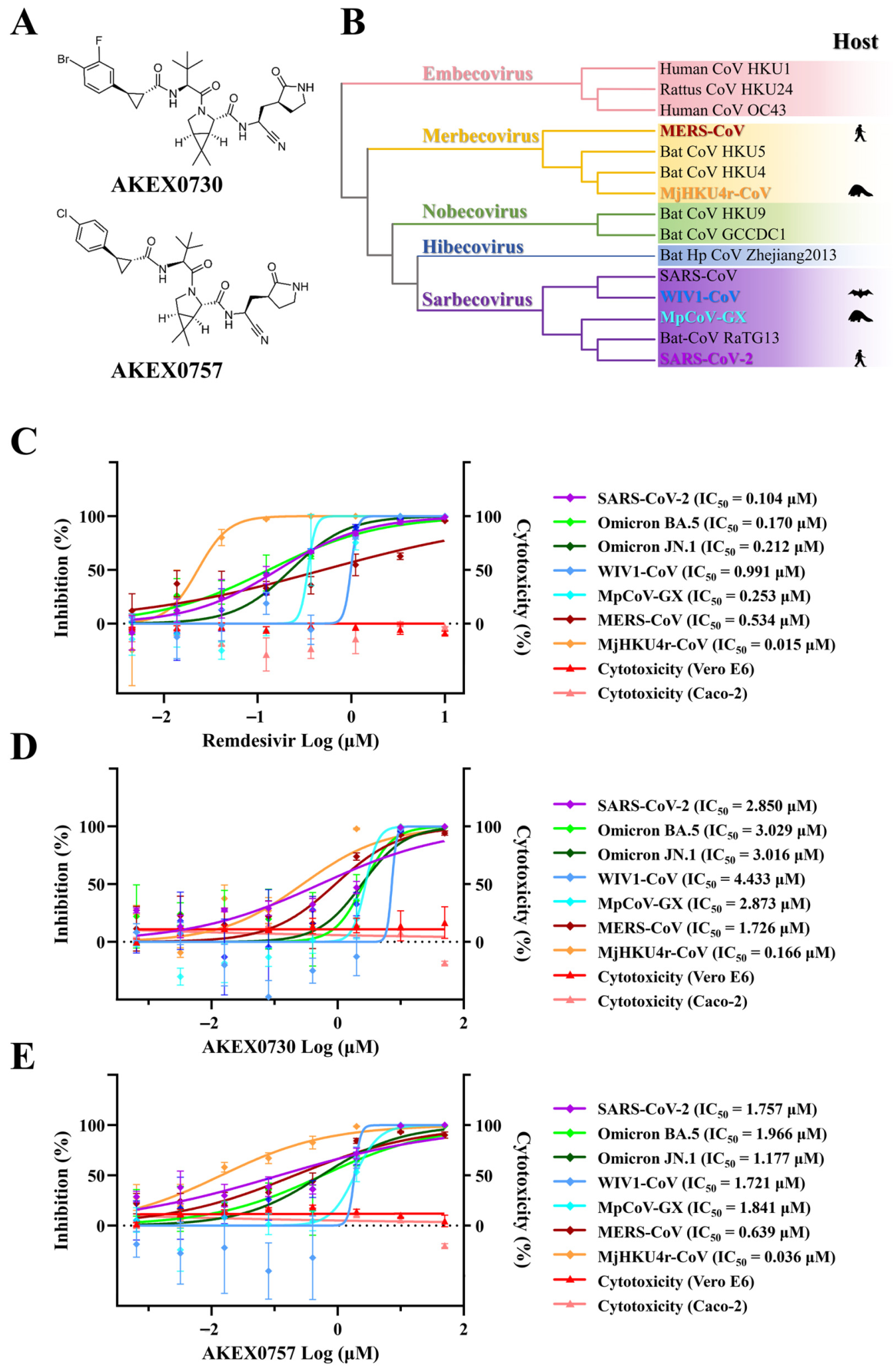
In this study, we first assessed the antiviral activity of AKEX0730 and AKEX0757 (Figure 1A) in Vero E6 and human Caco-2 cells against seven representative betacoronavirus strains spanning multiple subgenus and host reservoirs, including SARS-CoV-2 (the original Wuhan strain), two animal-borne SARS-related coronaviruses (WIV-1 from bat and MpCoV-GX from pangolin), two Omicron variants (BA.5 and JN.1), MERS-CoV, and a MERS-like virus named MjHKU4r-CoV with zoonotic potential (Figure 1B). Both compounds exhibited significant broad-spectrum antiviral activity across all the tested viruses, demonstrating cross-lineage efficacy against both Sarbecovirus and Merbecovirus lineages (Figure 1C–E). The assay system was validated using the broad-spectrum antiviral drug Remdesivir serving as a positive control, with a half-maximal inhibitory concentration (IC50) of 0.15–0.99 μM (Figure 1C). Under the same conditions, both AKEX0730 and AKEX0757 significantly suppressed replication of all seven tested betacoronaviruses (IC50 = 0.03–4.43 μM), indicating broad-spectrum efficacy comparable to the clinical reference [19]. The IC50 of small-molecule inhibitors and the positive control are shown in Figure 1D,E. In detail, the inhibitory activity of AKEX0730 against MERS-CoV (IC50 = 1.73 μM) was less potent than that against SARS-CoV-2, SARS-related coronaviruses, and its variants. In contrast, AKEX0757 exhibited overall stronger antiviral potency, with IC50 values of 0.64 μM (MERS-CoV), 1.76 μM (SARS-CoV-2) as shown in Figure 1E. To further assess cross-lineage activity, we tested our compounds against MERS-like MjHKU4r-CoV in human Caco-2 cell line. Notably, both compounds exhibited pronounced inhibition activity, further supporting their broad-spectrum activity. Importantly, both inhibitors exhibited negligible cytotoxicity at 50 μM in both Vero E6 and Caco-2 cell lines (Figure 1D,E). Furthermore, Remdesivir demonstrated low cytotoxicity consistent with previous reports (Figure 1C), validating the reliability of the cellular safety assessment results for AKEX0730 and AKEX0757. Together, these results indicate that both inhibitors retain inhibitory activity across phylogenetically diverse betacoronaviruses with favorable in vitro safety profiles.

3.2. Conserved and Stable Binding to 3CLpro Provides Structural Insights into Broad-Spectrum Coronavirus Inhibition

To investigate the molecular interaction between inhibitors and 3CLpro, we performed molecular docking analyses to predict the binding modes of AKEX0730 and AKEX0757 within the conserved substrate-binding pockets of SARS-CoV-2 and MERS-CoV 3CLpro. Results suggested that both inhibitors fit stably within the conserved substrate-binding pockets (Figures S1 and S2) [20,21,22]. AKEX0730 exhibited binding free energies of −7.3 kcal/mol with SARS-CoV-2 3CLpro and −7.8 kcal/mol with MERS-CoV 3CLpro, while AKEX0757 showed −7.6 kcal/mol and −8.5 kcal/mol, respectively. The slightly more favorable docking scores predicted for MERS-CoV 3CLpro qualitatively align with the experimental potency.
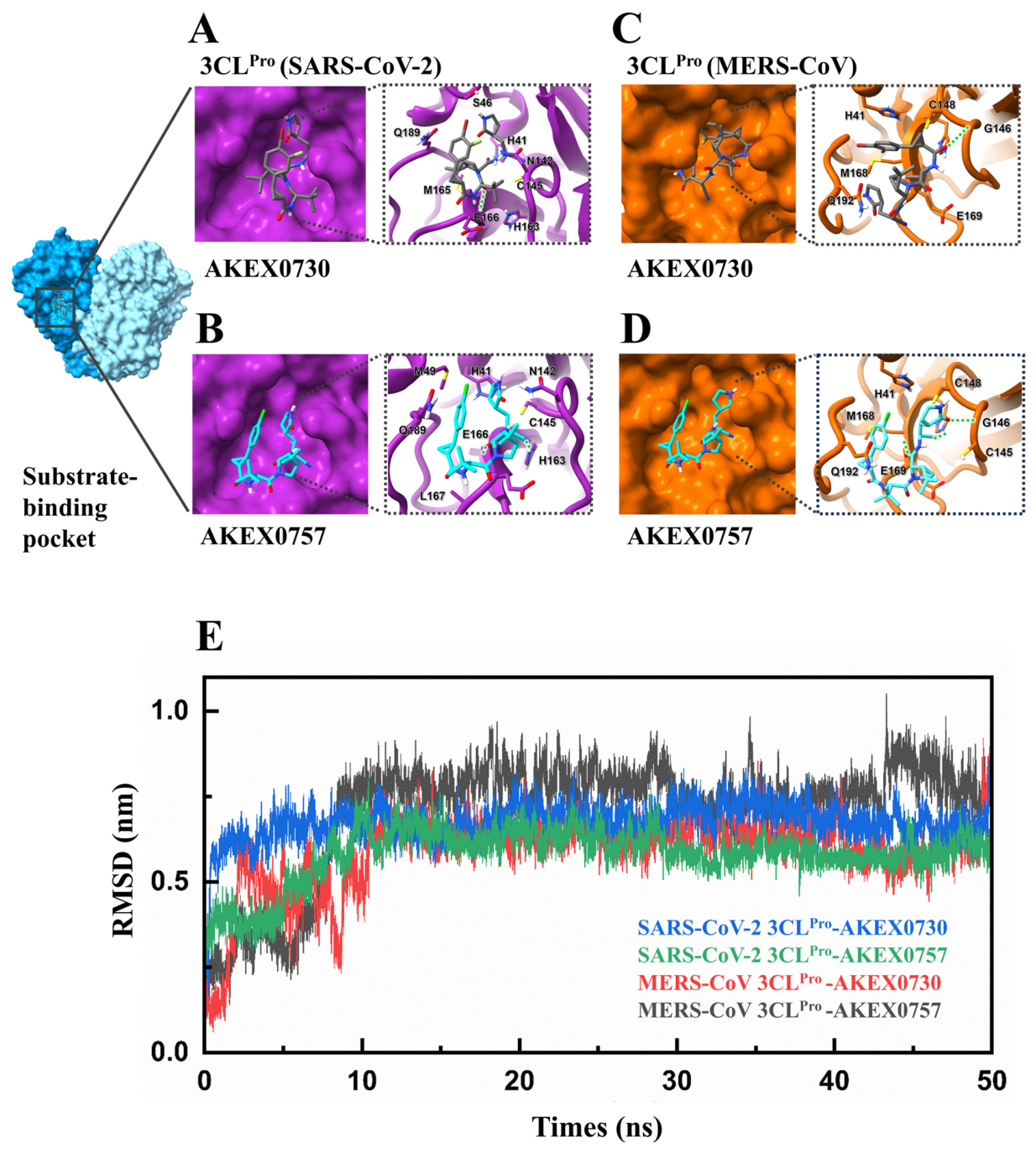
For SARS-CoV-2 3CLpro, AKEX0730 was predicted to form a hydrogen bond between its cyano group and Gly146, while its bromine atom further formed a halogen bond with the Ser46 side chain. Moreover, the bromine-anchored benzene ring additionally enhances pocket occupancy through favorable steric interactions (Figure 2A). In contrast, AKEX0757 adopts a bent conformation where the chlorine atom interacts with the pyrrolidone carbonyl oxygen via a σ-hole interaction, stabilizing the internal molecular conformation, while the cyano penetrates deeply into the S1′ subsite pocket adjacent to Cys145 [20]. The amide carbonyl group contributes to stable binding to the receptor through a hydrogen bond with the amide nitrogen of Glu166′s backbone and extensive van der Waals interactions (Figure 2B). Together, the docking results indicate that both inhibitors establish stable interactions with SARS-CoV-2 3CLpro.
For MERS-CoV 3CLpro, AKEX0730 engages in π-π stacking between its halogenated phenyl group and the imidazole of His41, while its amide carbonyl oxygen atom forms a backbone hydrogen bond with Gly146, positioning the ligand toward the catalytic His-Cys dyad (Figure 2C). AKEX0757 forms hydrogen bonds with the MERS-CoV 3CLpro, including between its α-ketoamide oxygen and Gly146, and between its amide carbonyl and Glu169. Furthermore, the halogenated phenyl group is potentially restricting His41′s catalytic site by occupying a hydrophobic pocket. (Figure 2D). In summary, these simulation results provide a structural framework that supports the broad-spectrum potential of AKEX0730 and AKEX0757 and offers plausible explanations for their lineage-dependent antiviral differences.
To assess whether these binding conformations remain stable under dynamic conditions, we next performed MD simulations on the four aforementioned complexes (Figure 2E). These simulations were conducted using the GROMACS software package (2025.2.) with the AMBER14SB force field, and the trajectories of the complexes were analyzed for 50 ns [23,24]. The root-mean-square deviation (RMSD) of the protein backbone showed that the initial RMSD values ranged from 4.44–10.53 Å. These relatively higher RMSD values may be associated with conformational rearrangements of the protein upon ligand binding. All systems converged rapidly within approximately 15 ns and exhibited only minor fluctuations around stable mean values, indicating the stability of these binding modes. To further assess the binding stability of AKEX0730 and AKEX0757 within the binding pocket, root-mean-square fluctuation (RMSF) analysis was performed on the protein complexes with the two inhibitors (Figure S3). The RMSF profiles revealed low fluctuation amplitudes (mostly < 0.3 nm) within the substrate-binding pockets, indicating that both inhibitors maintained relatively stable interactions within their respective active sites throughout the simulation. This finding provides crucial evidence from a structural dynamics perspective, elucidating the molecular basis for the broad-spectrum efficacy of these inhibitors.

4. Discussion

Coronaviruses continue to pose a recurrent zoonotic threat due to their extensive host range and genetic diversity. The development of broad-spectrum countermeasures therefore remains a central challenge in coronavirus preparedness. This study provides a systematic cross-lineage evaluation of two non-covalent 3CLpro inhibitors, AKEX0730 and AKEX0757, against a panel of representative betacoronaviruses. Unlike most existing studies that focused primarily on SARS-CoV-2, our work integrates viruses from two major betacoronavirus lineages—including SARS-related, MERS-related, and bat- and pangolin-derived strains with zoonotic potential—thus offering a broader perspective on their antiviral spectrum. The preserved activity against Omicron variants, which exhibit substantial immune escape from vaccines and monoclonal antibodies, further underscores the value of 3CLpro as a mutation-tolerant, spike-independent antiviral strategy. It is worth noting that while Vero E6 cells provide a reliable platform for evaluating direct viral inhibition, their interferon-deficient nature may influence the observed potency; thus, these findings should be viewed as an assessment of intrinsic inhibitory capacity rather than a direct surrogate for clinical efficacy. In this study, Remdesivir was selected as a positive control due to its validated broad-spectrum efficacy across diverse coronavirus lineages [25,26]. While Remdesivir targets the viral RdRp rather than 3CLpro, it serves as a robust functional benchmark for assessing broad-spectrum inhibition. Future comparative studies with 3CLpro-specific inhibitors, such as the covalent inhibitor Nirmatrelvir, will further define the mechanistic advantages of our non-covalent approach. Specifically, non-covalent inhibitors like AKEX0730 and AKEX0757 may offer advantages including reversible binding, lower off-target toxicity, and better adaptability to emerging resistant mutants. Furthermore, the structural insights from this study provide a framework for future optimization of potency and lineage coverage. Although the molecular docking and MD simulations are predictive in nature and serve as complementary mechanistic interpretations, the enzymatic inhibition and binding affinity of AKEX0730 and AKEX0757 have been experimentally determined in our previous work [14]. Recent reports highlight that stable interactions within the catalytic site are essential for sustained activity, especially as emerging mutations threaten the long-term efficacy of current therapies [12,22]. In this context, the binding stability and distinct non-covalent scaffold identified in this work offer a viable design path to address potential resistance challenges. Future structural studies, such as X-ray crystallography or NMR spectroscopy, on compound-bound 3CLpro complexes from different betacoronaviruses will help elucidate the molecular basis for the lineage-dependent potency differences between AKEX0730 and AKEX0757.
Taken together, the ability of AKEX0730 and AKEX0757 to inhibit SARS-related, MERS-related, and zoonotic betacoronaviruses highlights their promise as starting points for next-generation broad-spectrum antiviral development. The phylogenetic analysis presented here is intended to illustrate the taxonomic relationships of the selected viruses, while how the genetic diversity of betacoronaviruses may influence the antiviral activity of these inhibitors remains to be further explored. Importantly, their concordant activity across highly divergent 3CLpro homologs represents a notable advance in the search for non-covalent inhibitors with true cross-lineage coverage—an area where experimental evidence remains limited. Their activity against viruses with recognized spillover potential further supports translational relevance for future zoonotic coronavirus preparedness within a One Health framework.

5. Conclusions

This study systematically evaluated two non-covalent 3CLpro inhibitors, AKEX0730 and AKEX0757, against multiple betacoronavirus lineages. At the cellular level, both compounds exhibited broad-spectrum antiviral activity against SARS-CoV-2 and its variants, SARS-related coronaviruses, MERS-CoV, and a MERS-like virus, with relatively low cytotoxicity. Molecular docking and MD simulations revealed their stable binding modes within the conserved active site of 3CLpro and explored the molecular mechanism underlying their broad-spectrum activity. Together, these findings position AKEX0730 and AKEX0757 as promising lead candidates for the development of next-generation broad-spectrum antivirals against coronaviruses.

Supplementary Materials

The following supporting information can be downloaded at: https://www.mdpi.com/article/10.3390/zoonoticdis6020020/s1. Figure S1: Sequence alignment of the 3CLpro from the representative coronaviruses analyzed in this study; Figure S2: Structural comparison of the 3CLpro; Figure S3: RMSF profiles of AKEX0730 and AKEX0757 in complex with SARS-CoV-2 and MERS-CoV 3CLpro.

Author Contributions

S.Y. and Y.L. conceived the project and supervised the research. R.Y. and N.L. performed the analysis and interpretation of the virology experimental data and performed the inhibitor efficacy assays. C.W. completed the phylogenetic analysis and tree construction. R.Y. carried out the computational molecular docking of the ligand with the macromolecule. Z.G., M.Q., J.W. and G.Z. synthesized the inhibitory compounds. R.Y., Y.L. and S.Y. drafted and revised the manuscript. All authors contributed to data analysis and approved the manuscript.

Funding

This work was funded by the National Key Research and Development Program of China (2022YFC2305500 to Shuai Yuan and Yan Li), the Hubei Natural Science Fund for Distinguished Young Scholars (2022CFA068 to Yan Li and 2023AFA077 to Shuai Yuan), and the Hubei Public Health Youth Talents Program (to Yan Li).

Institutional Review Board Statement

Not applicable.

Informed Consent Statement

Not applicable.

Data Availability Statement

The original contributions presented in this study are included in the article/Supplementary Material. Further inquiries can be directed to the corresponding authors.

Acknowledgments

We sincerely thank Yi Wang for her dedicated work and expert support in the Biosafety Level 3 (P3) experiments conducted in this study. Her professional competence and careful execution were essential to the successful and safe completion of this part of the research. We are also grateful to the P3 laboratory management team at the Wuhan Institute of Virology from Chinese Academy of Sciences for providing the advanced facilities and necessary biosafety oversight.

Conflicts of Interest

Authors Zhao Gao, Mengfei Qian, Jin Wu, and Gang Zou were employed by the company Suzhou Ark Biopharmaceutical Co., Ltd. The authors declare that the research was conducted in the absence of any commercial or financial relationships that could be construed as a potential conflict of interest.

References

  1. Pustake, M.; Tambolkar, I.; Giri, P.; Gandhi, C. SARS, MERS and CoVID-19: An overview and comparison of clinical, laboratory and radiological features. J. Fam. Med. Prim. Care 2022, 11, 10–17. [Google Scholar] [CrossRef]
  2. Yan, R.; Wu, M.; Ge, X.; Jin, Q.; Wang, M.; Zhou, H.; Li, Y.; Wang, Y.; Yuan, S. Strategic variations in sarbecovirus and merbecovirus Nsp1 linker regions for translation inhibition. Nucleic Acids Res. 2026, 54, gkag017. [Google Scholar] [CrossRef]
  3. Menachery, V.D.; Yount, B.L.; Sims, A.C.; Debbink, K.; Agnihothram, S.S.; Gralinski, L.E.; Graham, R.L.; Scobey, T.; Plante, J.A.; Royal, S.R.; et al. SARS-like WIV1-CoV poised for human emergence. Proc. Natl. Acad. Sci. USA 2016, 113, 3048–3053. [Google Scholar] [CrossRef]
  4. Zhao, Z.; Li, X.; Chai, Y.; Liu, Z.; Wang, Q.; Gao, G.F. Molecular basis for receptor recognition and broad host tropism for merbecovirus MjHKU4r-CoV-1. EMBO Rep. 2024, 25, 3116–3136. [Google Scholar] [CrossRef]
  5. Collie, S.; Champion, J.; Moultrie, H.; Bekker, L.-G.; Gray, G. Effectiveness of BNT162b2 Vaccine against Omicron Variant in South Africa. N. Engl. J. Med. 2022, 386, 494–496. [Google Scholar] [CrossRef]
  6. Hueting, D.; Schriever, K.; Sun, R.; Vlachiotis, S.; Zuo, F.; Du, L.; Persson, H.; Hofström, C.; Ohlin, M.; Walldén, K.; et al. Design, structure and plasma binding of ancestral β-CoV scaffold antigens. Nat. Commun. 2023, 14, 6527. [Google Scholar] [CrossRef]
  7. Wang, X.; Hu, T.; Hu, B.; Liu, Y.; Wang, Y.; He, Y.; Li, Y.; Cai, K.; Zhang, X.; Guo, J. Imparting reusable and SARS-CoV-2 inhibition properties to standard masks through metal-organic nanocoatings. J. Hazard. Mater. 2022, 431, 128441. [Google Scholar] [CrossRef] [PubMed]
  8. Liu, H.; Zask, A.; Forouhar, F.; Iketani, S.; Williams, A.; Vaz, D.R.; Habashi, D.; Choi, K.; Resnick, S.J.; Hong, S.J.; et al. Development of small molecule non-covalent coronavirus 3CL protease inhibitors from DNA-encoded chemical library screening. Nat. Commun. 2025, 16, 152. [Google Scholar] [CrossRef]
  9. Yang, H.; Yang, M.; Ding, Y.; Liu, Y.; Lou, Z.; Zhou, Z.; Sun, L.; Mo, L.; Ye, S.; Pang, H.; et al. The crystal structures of severe acute respiratory syndrome virus main protease and its complex with an inhibitor. Proc. Natl. Acad. Sci. USA 2003, 100, 13190–13195. [Google Scholar] [CrossRef] [PubMed]
  10. Gahlawat, A.; Kumar, N.; Kumar, R.; Sandhu, H.; Singh, I.P.; Singh, S.; Sjöstedt, A.; Garg, P. Structure-Based Virtual Screening to Discover Potential Lead Molecules for the SARS-CoV-2 Main Protease. J. Chem. Inf. Model. 2020, 60, 5781–5793. [Google Scholar] [CrossRef] [PubMed]
  11. Liu, M.; Li, J.; Liu, W.; Yang, Y.; Zhang, M.; Ye, Y.; Zhu, W.; Zhou, C.; Zhai, H.; Xu, Z.; et al. The S1′–S3′ Pocket of the SARS-CoV-2 Main Protease Is Critical for Substrate Selectivity and Can Be Targeted with Covalent Inhibitors. Angew. Chem. Int. Ed. 2023, 62, e202309657. [Google Scholar] [CrossRef]
  12. Lu, Y.; Yang, Q.; Ran, T.; Zhang, G.; Li, W.; Zhou, P.; Tang, J.; Dai, M.; Zhong, J.; Chen, H.; et al. Discovery of orally bioavailable SARS-CoV-2 papain-like protease inhibitor as a potential treatment for COVID-19. Nat. Commun. 2024, 15, 10169. [Google Scholar] [CrossRef]
  13. Zhou, Y.; Gammeltoft, K.A.; Tjørnelund-Sjursen, H.D.; Ryberg, L.A.; Offersgaard, A.; Czarnota, A.; Duan, Z.; Pham, L.V.; Fahnøe, U.; Peters, G.H.; et al. SARS-CoV-2 Mpro inhibitor ensitrelvir: Asymmetrical cross-resistance with nirmatrelvir and emerging resistance hotspots. Emerg. Microbes Infect. 2025, 14, 2552716. [Google Scholar] [CrossRef] [PubMed]
  14. Zhang, H.; Zhou, K.; Peng, F.; Gao, Z.; Song, G.; Hu, B.; Chun, S.; Xiao, J.; Qian, M.; Wu, J.; et al. Novel small-molecule inhibitors of SARS-CoV-2 main protease with nanomolar antiviral potency. J. Infect. 2024, 88, 211–214. [Google Scholar] [CrossRef]
  15. Cho, E.; Rosa, M.; Anjum, R.; Mehmood, S.; Soban, M.; Mujtaba, M.; Bux, K.; Moin, S.T.; Tanweer, M.; Dantu, S.; et al. Dynamic Profiling of β-Coronavirus 3CL Mpro Protease Ligand-Binding Sites. J. Chem. Inf. Model. 2021, 61, 3058–3073. [Google Scholar] [CrossRef] [PubMed]
  16. Fakhar, Z.; Khan, S.; AlOmar, S.Y.; Alkhuriji, A.; Ahmad, A. ABBV-744 as a potential inhibitor of SARS-CoV-2 main protease enzyme against COVID-19. Sci. Rep. 2021, 11, 234. [Google Scholar] [CrossRef]
  17. Jin, Z.; Du, X.; Xu, Y.; Deng, Y.; Liu, M.; Zhao, Y.; Zhang, B.; Li, X.; Zhang, L.; Peng, C.; et al. Structure of Mpro from SARS-CoV-2 and discovery of its inhibitors. Nature 2020, 582, 289–293. [Google Scholar] [CrossRef] [PubMed]
  18. Meng, E.C.; Goddard, T.D.; Pettersen, E.F.; Couch, G.S.; Pearson, Z.J.; Morris, J.H.; Ferrin, T.E. UCSF ChimeraX: Tools for structure building and analysis. Protein Sci. 2023, 32, e4792. [Google Scholar] [CrossRef]
  19. Eastman, R.T.; Roth, J.S.; Brimacombe, K.R.; Simeonov, A.; Shen, M.; Patnaik, S.; Hall, M.D. Remdesivir: A Review of Its Discovery and Development Leading to Emergency Use Authorization for Treatment of COVID-19. ACS Cent. Sci. 2020, 6, 672–683. [Google Scholar] [CrossRef]
  20. Anand, K.; Palm, G.J.; Mesters, J.R.; Siddell, S.G.; Ziebuhr, J.; Hilgenfeld, R. Structure of coronavirus main proteinase reveals combination of a chymotrypsin fold with an extra alpha-helical domain. EMBO J. 2002, 21, 3213–3224. [Google Scholar] [CrossRef]
  21. Zhu, J.; Zhang, H.; Lin, Q.; Lyu, J.; Lu, L.; Chen, H.; Zhang, X.; Zhang, Y.; Chen, K. Progress on SARS-CoV-2 3CLpro Inhibitors: Inspiration from SARS-CoV 3CLpro Peptidomimetics and Small-Molecule Anti-Inflammatory Compounds. Drug Des. Dev. Ther. 2022, 16, 1067–1082. [Google Scholar] [CrossRef] [PubMed]
  22. Khamto, N.; Pruksaphon, K.; Akkravijitkul, N.; Choommongkol, V.; Patnin, S.; Meepowpan, P. Design, Synthesis and Computational Insights of 7-Hydroxystilbene-Coumarin Hybrid Scaffolds as SARS-CoV-2 3CLpro Inhibitors. J. Mol. Struct. 2026, 1357, 145240. [Google Scholar] [CrossRef]
  23. Mark Abraham, A.A.; Bergh, C.; Blau, C.; Briand, E.; Doijade, M.; Fleischmann, S.; Gapsys, V.; Garg, G.; Gorelov, S.; Gouaillardet, G.; et al. GROMACS 2023.4 Source Code; Zenodo: Geneva, Switzerland, 2024. [Google Scholar]
  24. Abraham, M.J.; Murtola, T.; Schulz, R.; Páll, S.; Smith, J.C.; Hess, B.; Lindahl, E. GROMACS: High performance molecular simulations through multi-level parallelism from laptops to supercomputers. SoftwareX 2015, 1–2, 19–25. [Google Scholar] [CrossRef]
  25. Pitts, J.; Li, J.; Perry, J.K.; Du Pont, V.; Riola, N.; Rodriguez, L.; Lu, X.; Kurhade, C.; Xie, X.; Camus, G.; et al. Remdesivir and GS-441524 Retain Antiviral Activity against Delta, Omicron, and Other Emergent SARS-CoV-2 Variants. Antimicrob. Agents Chemother. 2022, 66, e0022222. [Google Scholar] [CrossRef]
  26. Radoshitzky, S.R.; Iversen, P.; Lu, X.; Zou, J.; Kaptein, S.J.F.; Stuthman, K.S.; Van Tongeren, S.A.; Steffens, J.; Gong, R.; Truong, H.; et al. Expanded profiling of Remdesivir as a broad-spectrum antiviral and low potential for interaction with other medications in vitro. Sci. Rep. 2023, 13, 3131. [Google Scholar] [CrossRef]
Figure 1. Broad-spectrum antiviral activity and cytotoxicity profiles of AKEX0730 and AKEX0757. (A) Chemical structures of AKEX0730 and AKEX0757. (B) The phylogenetic tree of coronaviruses based on whole genomes. Viruses tested in this study are in bold with host information indicated. The Omicron variant is a sublineage of SARS-CoV-2 and is therefore included under SARS-CoV-2. (CE) Dose–response and cytotoxicity curves for the positive control Remdesivir (C), AKEX0730 (D), and AKEX0757 (E) against multiple betacoronaviruses in Vero E6 and Caco-2 cells. The IC50 values for each compound are indicated in the legend.
Zoonoticdis 06 00020 g001
Figure 2. Predicted binding modes of AKEX0730 and AKEX0757 with 3CLpro. (AD) Detailed views of the molecular docking of AKEX0730 and AKEX0757 with 3CLpro from SARS-CoV-2 and MERS-CoV. Green dashed lines indicate hydrogen bonds. (A) AKEX0730 with SARS-CoV-2 3CLpro. (B) AKEX0757 with SARS-CoV-2 3CLpro. (C) AKEX0730 with MERS-CoV 3CLpro. (D) AKEX0757 with MERS-CoV 3CLpro. (E) RMSD trajectories from 50 ns molecular dynamics simulations of the four complexes, assessing their stability over the simulation course.
Zoonoticdis 06 00020 g002
Disclaimer/Publisher’s Note: The statements, opinions and data contained in all publications are solely those of the individual author(s) and contributor(s) and not of MDPI and/or the editor(s). MDPI and/or the editor(s) disclaim responsibility for any injury to people or property resulting from any ideas, methods, instructions or products referred to in the content.