1. Introduction
Ubiquitous gastrointestinal protozoa such as
Cryptosporidium spp. can infect people, livestock, domestic animals, and wildlife worldwide [
1]. In Europe, wild animals, such as wild boars (
Sus scrofa), are hosts to this parasite [
2].
Cryptosporidium spp. infection is a significant issue concerning the game–livestock–humans interface [
3].
There are approximately 44 different species of
Cryptosporidium spp., with a great diversity of hosts, with some of them having zoonotic potential, such as
C. suis,
C. scrofarum, and
C. parvum [
4].
Cryptosporidium hominis is the dominant species in humans, and subsequently,
C. scrofarum and
C. suis are the dominant species infecting pigs and wild boars. However, most human cryptosporidiosis cases are caused by
C. parvum and
C. hominis [
4].
In terms of life cycle, this is a unicellular protozoan of the Apicomplexa phylum, developing in the intestines of vertebrate animals and eliminating oocysts in the stools. It is an infection of self-limiting character, most often without clinical signs. Non-hemorrhagic diarrhea can be observed normally in younger hosts and those subject to stress [
5,
6]. The transmission between the various hosts is fecal–oral via the subsequent elimination of oocysts in stools. This occurs through either direct contact with fecally contaminated areas and with parasites’ oocysts, or indirect contact by consumption of contaminated water and food. The fecal–oral pathway occurs both between animals and between animals and humans [
7,
8], leading to a potential zoonotic transmission.
There is no vaccine, and only one drug exists that is approved for specific treatment in veterinary medicine, nitazoxanide, but its effectiveness is scarce, and there is no data for wild populations [
9]. In terms of diagnosis, there are several laboratory methods based on fecal sample tests. Direct microscopy can be performed with observation of protozoa in fecal samples, using specific or nonspecific colorations, or molecular methods such as PCR. Indirect methods, such as immunochromatographic (IC) and indirect immunofluorescence (IFI), are used for qualitative detection of
Cryptosporidium spp. antigens in stools. An ELISA (Enzyme-Linked Immunosorbent Assay) test can also be performed [
10,
11,
12].
Prevention and control of this gastrointestinal protozoan are based on good handling practices, such as those related to good hygiene and disinfection [
13,
14], both in veterinary medicine (domestic, livestock, and wild animals) and in human medicine. However, in the public health context, this is a foodborne zoonosis of minor importance according to scientific literature.
As mentioned previously, this parasitic infection affects a wide variety of hosts. One of the most infected European wildlife hosts is known to be the wild boar. Several studies across Europe describe the presence of this parasite in wild boar populations, and Portugal is no exception [
2,
15]. A recent study conducted in various areas of Portugal indicates a molecular detection of 8.4% of this parasite in Portugal [
15]. With the current expansion of the population of the wild boar population in Portugal, the risk of infection for humans who come into contact with these animals increases [
16]. This zoonotic risk is thus driven both by the contamination of water and food via oocysts excreted in the stools of wild boars and the handling of fecally contaminated hunted wild boars’ carcasses [
17].
The main objective of this work is to evaluate the presence and circulation of Cryptosporidium spp. in 10 Portuguese hunting areas in two different locations (North of Portugal and Southeast of Central Portugal) with different hunting-related features, in a preliminary technical report. As a secondary objective, this work also assesses the risk of zoonotic transmission to hunting stakeholders.
2. Materials and Methods
2.1. Area of Study
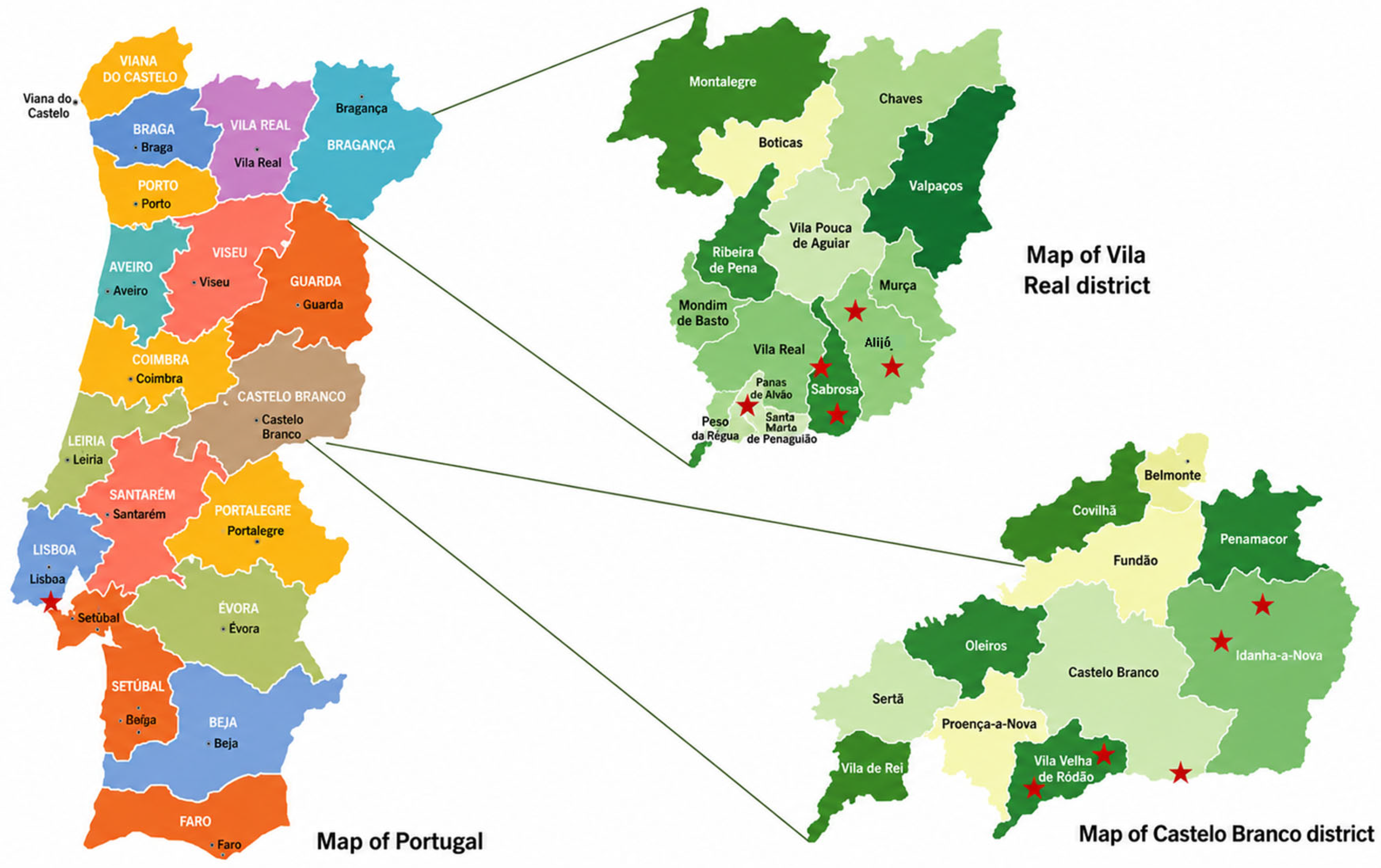
This technical study took place in two different locations in the territory of Portugal (North of Portugal and Southeast of Central Portugal). Specifically, in the North, several areas of the Vila Real district were analyzed, and in the Southeast of Central Portugal, areas of the Castelo Branco district (
Figure 1).
Vila Real is a district in northern Portugal with a total area of 4328 km
2, with a population density of 42 inhabitants per km
2. The area is semi-rural, where hunting is a highly popular activity integrated into associative and community systems. The wild boar is the most common game species in this territory. Because these locations provide the best conditions for the species’ survival, woodlands are home to a high number of wild boars [
18]. The area is characterized by great food diversity, mainly fruit crops, due to the presence of large vineyards and orchards. In this district, five hunting areas were analyzed for this work: Carlão, Donelo do Douro, Paradela de Guiães, Alijó, and Santa Marta de Penaguião (
Figure 1—red stars on the Map of the Vila Real district). Hunting activity in these places is more associative and involves less intensive hunting practices.
Castelo Branco, in turn, is the district with the largest hunting culture in Portugal. This place has unique characteristics for hunting activities (climate, agriculture, and game management). The district covers 6675 km
2 and includes more than 200 approved hunting areas (associative, municipal, and touristic), thus promoting this economic activity [
19]. It is an area with a large diversity of game species, such as the wild boar, red deer (
Cervus elaphus), fallow deer (
Dama dama), roe deer (
Capreolus capreolus), and mouflon (
Ovis aries musimon). However, the most abundant species, likewise as in the rest of the Portuguese territory, is the wild boar [
20]. In this district, five hunting areas were analyzed for this work: Monsanto, Oledo, Malpica do Tejo, Vila Velha de Rodão, and Monte Fidalgo (
Figure 1—red stars on the Map of the Castelo Branco district). It is a less associative and more intensive hunting culture area compared to the Vila Real district.
2.2. Sampling and Laboratory Analysis
During the 2022/2023 hunting season (between October and February), hunting organizations distributed throughout both districts (Vila Real and Castelo Branco) were contacted to collaborate on a preliminary technical report. In total, 10 hunting areas were accepted to participate (5 hunting areas in each district). Each organization provided written informed consent to participate. All samples were collected from legally hunted wild boars. No live animals were used for this study. This technical work did not involve the deliberate killing of animals. No ethical approval was deemed necessary.
The fecal samples of wild boars were collected directly from the intestine of the hunted animals during the initial post-driven-hunt examination by the same team. Suitable individual protection equipment was used, namely clothing and disposable gloves, and samples were packaged in sterile containers.
In each hunting area (n = 10; 5 in the North and 5 in the Center of Portugal), samples were collected from five different animals using individual cups, which were properly identified with the following information: hunting area number, individual animal characteristic (age and sex), and the date on which the sample was collected. Subsequently, the samples were frozen.
For this work, the mandatory Portuguese sampling protocol for Trichinella screening in wild boar was followed (5 animals per hunting area/driven hunt). To screen for the parasite in circulation in hunting areas, the testing was done using pools of 5 animals per hunting area, rather than individual animals.
With the sole technical purpose of screening for and alerting to the presence of the parasite, and once it was known that the real prevalence of Cryptospiridium spp. would be low and the sampled animals would be asymptomatic, it was decided to conduct the tests in pools to reduce the waste of reagents and laboratory products and rethink certain practices as necessary (in order to comply with the 5 Rs of laboratory experimentation).
The preparation of the fecal pools (one pool per hunting area) was carried out. Fecal pools were prepared by placing equal amounts of feces from the five animals sampled per hunting area into a new container. Thus, 10 fecal pools were obtained, subsequently homogenized, sent to the laboratory, and refrigerated for the research of Cryptosporidium spp. using the indirect immunochromatography method.
In the laboratory, the fecal pools were analyzed using the immunochromatographic test (Biotec S.L.: Zaragoza, Spain) for antigen research of Cryptosporidium spp., with a sensitivity of >98% and high specificity (often >90–100%) for detection in animals’ fecal samples, with validation and the use of controls specifically for swine.
2.3. Characterization and Risk Factors Analysis
All fecal samples were collected randomly from 5 hunted animals during the initial examination at the collection point, after a driven hunt. None of the samples showed clinical signs of the presence of Cryptosporidium infection, such as non-hemorrhagic diarrhea.
As mentioned earlier, both sampling locations have differences in the characteristics of wild boar populations (density of both wild and domestic species, habitat type, forest density, food and water availability, climate, and game management type) and hunting action procedures (
Table 1).
Thus, in this technical work related to game populations and their habitat characteristics, three potential risk factors regarding the presence and dispersion of Cryptosporidium spp. were chosen for evaluation: animal density, close cohabitation with domestic species, and the number of aggregation points, such as waterholes. A dichotomy of response was used: high vs. low.
Related to the hunting actions and potential risk practices for zoonotic transmission during the handling of hunted wild boars’ carcasses, there are several issues pointed out. Based on a scientific publication titled ‘Hygiene and biosecurity conditions of initial examination on-spot in Portugal: One step toward game meat safety’ [
21], related to the carcasses of hunted wild boars, six factors are noted as being of potential risk: heaping of the carcasses at transportation and collection points, care in the process of evisceration without intestinal rupture, level of fecal contamination pre- and post-evisceration, disposal of carcasses’ parts with fecal contamination, cleaning/washing of fecal-contaminated carcasses, and correct by-product disposal. Addressing the risk factors for the zoonotic transmission of several infectious agents, such as
Cryptosporidium spp., to carcasses’ handlers (mostly hunters)—mainly regarding individual protection measures—three issues are noted: use of disposable gloves during carcasses’ handling and evisceration, use of specific disposable clothing to eviscerate carcasses, and disinfection of knives between carcasses.
At the time of sampling at the collection point after a driven hunt, all these factors were marked for each hunting area and marked as yes, no, or not applicable. The analysis presented in the work is descriptive due to the lack of significant, systematic, and stratified probabilistic sampling, which made it impossible to conduct a statistical study with statistical significance (p-value > 0.05).
3. Results
Although the sample is reduced and pool analysis does not allow us to determine how many animals were individually positive, this work allowed us to screen the wild boar population in Portugal related to the potential presence and circulation of Cryptosporidium spp.
This technical work implies a possible circulation of this parasite in certain hunting areas in various districts of Portugal. By analyzing some population factors that may enhance the dispersion of the parasite among animals, and by observing some risky practices in the handling of wild boars’ carcasses, it is possible to infer a potential occupational and foodborne risk of zoonotic agent transmission for hunting stakeholders in the presence of the parasite.
3.1. Presence of Cryptosporidium spp. Antigens
In total, four hunting areas tested positive for
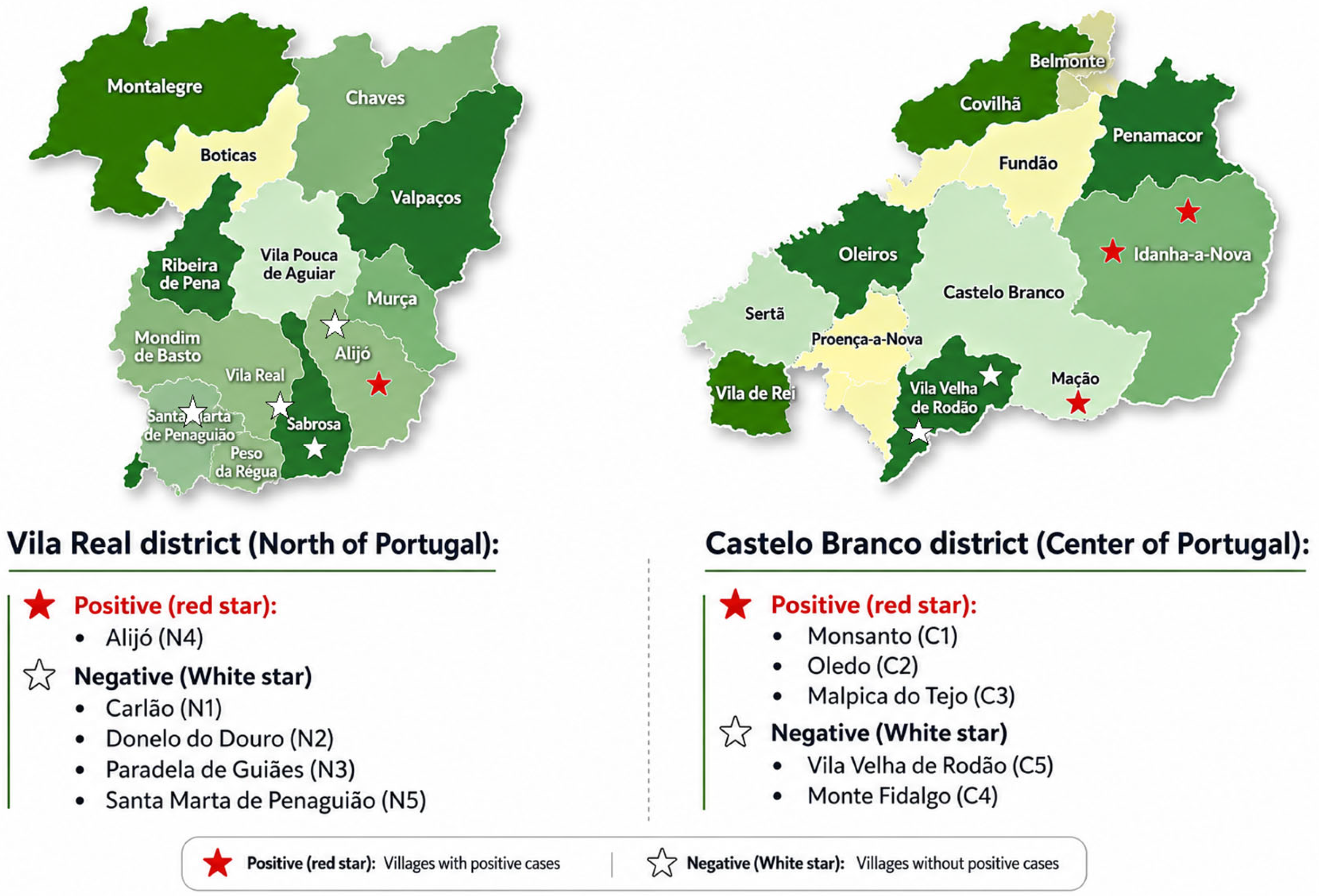
Cryptosporidium spp. antigens in the wild boar populations (three areas in the Castelo Branco district and one in the Vila Real district—4/10 positive) (
Figure 2).
In the five hunting areas of the district of Vila Real (random sampling in Northern Portugal), only one area tested positive for Cryptosporidium spp. antigens (the hunting area of Alijó).
In the five hunting areas of the Castelo Branco district (random sampling of the Central–Southeast Portugal), three areas tested positive for this parasite’s antigens (hunting areas of Monsanto, Oledo, and Malpica do Tejo).
3.2. Hygiene and Health Risk Practices
Informed consent was obtained from all organizations to evaluate and record various evisceration and initial examination practices observed in loco during wild boar carcass handling procedures and sampling wild boar stools in these 10 Portuguese hunting areas (
Table 2).
In terms of habitat factors, it is known that in the five northern hunting areas, the density of wild animals is relatively low, and there is no close cohabitation and direct or indirect contact with other domestic species, such as small ruminants or cattle. In contrast, there is a high density of aggregation points for both wild populations and various domestic–wild cohabitants. Contrary to the hunting areas of Southeast–Central Portugal—where there is a great culture of game management and also extensive cattle production—a high density of wild animals and a marked wild–domestic interface in most of the five hunting areas were observed. There is a great risk of aggregation among various cohabiting species at feeding and drinking points, such as waterholes.
There is a fluctuation between good and bad practices when handling hunted carcasses during transportation from the field to the collection point (place where the carcasses are eviscerated and sanitarily analyzed during the initial examination). The systematic observation, always conducted by the same person, led to the identification of a pattern of practice frequency during the driven hunt and the subsequent initial examination of the carcasses, resulting in classification by frequency. No pattern was observed by location or local traditional practices, except for by-product disposal, which is noted to be carried out incorrectly and systematically in Northern Portugal.
As for individual protection measures for carcass handlers, the use of disposable gloves and clothes varies by hunting area analyzed. The use of disposable clothing is observed less frequently than the use and regular exchange of disposable gloves during the evisceration and initial examination. The regular disinfection of knives between carcasses, even when fecal contamination is present, is not a common practice.
4. Discussion
Hunting is an activity strongly rooted in Portuguese culture and is of great importance for the economy. The wild boar occupies the first place among the most hunted species, with the consumption of its meat being a common practice in Portugal [
22]. Thus, a random technical sample of stools of this species was collected for a preliminary screening of
Cryptosporidium spp. (sampled pool analysis) within Portuguese hunting areas. This parasite had already been detected in wild boar samples throughout Europe [
23,
24]. However, the prospect of obtaining an epidemiological distribution and prevalence—rather than confirming the circulation in wild animals—is vital, since animals hunted and eviscerated on-site lead to a closer contact with humans and a higher risk of zoonotic transmission [
25].
In Europe, cases of
Cryptosporidium infection in wild boars have been reported [
23,
24]. In the Czech Republic, of the 193 individual samples analyzed, 13 tested positive (6.7%) for
C. suis by PCR [
24]. In the Iberian Peninsula, both in Portugal and in Spain, cases of Cryptosporidiosis in wild boars have been described [
25,
26,
27]. In Galicia (Spain), 7.6% of samples tested positive for oocysts of
Cryptosporidium spp. by parasitological methods [
26]; in Portugal, Ana Figueiredo and collaborators reported a prevalence of 8.4% for
Cryptosporidium spp. using molecular methods (PCR) [
15]. Regarding
C. scrofarum detection, Santos-Silva and collaborators, in another study, observed 1.4% positivity in 144 samples [
28]. Although the sample used in this pilot study is small and the pooled analysis does not allow us to determine how many animals were positive individually, this work allowed us to infer a possible circulation of
Cryptosporidium spp. in Portugal.
However, knowing that previous studies conducted with molecular detection in Portugal obtained low prevalence [
15,
28], and considering that the objective of this small pilot study was to infer the possible dispersion of the parasite (antigen detection), with this methodology (indirect detection by immunochromatography in sample pools), it can be concluded that the parasite possibly circulates in two quite distant areas of Portugal (approximately 250 km of distance). However, we are unable to draw conclusions about the distribution across the entire continental territory of Portugal, and whether there is cross-circulation between the two areas.
When conducting the risk factors analysis at the population and habitat level, it was found that the analyzed areas, including the Castelo Branco district (Southeast of Central Portugal), present a more favorable environment for circulation and large dispersion of
Cryptosporidium spp. in the wild boar population. It is known that the areas with high density of wild animals, and mainly where there is a large cohabitation with livestock, are most conducive to the circulation of infectious agents, with
Cryptosporidium infection being no exception [
29]. The fecal–oral transmission of this parasite promotes transversal spread, mainly indirectly, between wild species and domestic species [
30].
Cryptosporidium’s high environmental resistance is considered a key factor in wildlife–livestock–human transmission. Once this parasite survives in the soil and in water for extended periods, when these are contaminated, and animals feed on them, a large density of aggregation points of cohabiting species, such as waterholes and feeders, become high-risk locations for the transmission of the parasite [
31]. Thus, with this assumption, it was verified in our preliminary study that the location (Southeast of Central Portugal) with the most intensive game management—characterized by high density of wild populations, cohabiting with domestic species, and aggregation points—also exhibited the highest number of hunting areas positive for
Cryptosporidium spp. It should be noted that in these areas, good game management measures should be implemented, focused on infection control, hygiene, and biosafety to avoid cross-contamination.
Based on the assumption of possible circulation of
Cryptosporidium spp. in several wild boar populations, the risk of zoonotic transmission, in particular to hunters, game managers, and veterinarians, as well as possible environmental contamination of soil and water suppliers, must be taken into account [
8,
25,
32,
33].
This zoonotic agent is mostly found in the digestive tract of vertebrates, and its excretion can lead to intra- and interspecies transmission risk. However, in zoonotic terms within the hunting context, the potential transmission to humans is linked to the handling of post-driven-hunt carcasses and poor hygienic practices.
In this context of post-hunting actions, hunters, game managers, veterinarians, and other technicians come into direct contact with wild boars’ stools several times, either through contamination of the carcass due to the shooting or by improperly executed evisceration (fecal contamination by intestinal rupture) [
21,
34]. The potential zoonotic transmission risk increases when there are bad practices in handling carcasses [
35]. In these circumstances, enhancing on-spot hygiene is imperative.
The reduced number of samples (n = 10 hunting areas) does not allow for a statistical analysis demonstrating the link between risk practices (hygiene and individual protection practices and a possible zoonotic transmission) and the positivity of hunting areas. However, when analyzing the sampled areas positive for Cryptosporidium spp. antigens in wild boars’ stools, they are found in the locations with less care in the process of evisceration, where the levels of fecal contamination of carcasses are higher, and where washing of carcasses is performed despite the presence of visible fecal contamination. A correct procedure to prevent the spread of infectious agents from fecal-contaminated meat is to cut off the contaminated parts and dispose of them without washing the carcass, because washing can have the opposite effect, dispersing the contamination over clean areas. Interestingly, disposal of contaminated parts of carcasses is a correct procedure that was not observed in any of the hunting areas analyzed. Thus, a potential risk factor for zoonotic transmission of foodborne agents.
When dealing with individual protection measures for carcass handlers, it is important to create a protective barrier that avoids direct contact with the feces present on carcasses. The use of disposable gloves and clothing, disinfectants for hands and knives, and extra care in the handling of hunted carcasses and their respective by-products are mandatory tools for controlling the transmission of this zoonotic agent [
34,
35,
36].
Limitations of the Pilot Study
As limitations of this pilot study, titled ‘Preliminary evidence of circulation of Cryptosporidium spp. in hunting areas of Portugal’, it should primarily be noted that it is the result of a technical report. Therefore, the epidemiological results regarding the presence of Cryptosporidium spp. in the analyzed wild boar populations are not definitive, mainly due to the chosen laboratory methodology (pooling analysis and use of indirect test not validated for wild boars specifically) not being ideal.
Ideally, direct molecular methods would be chosen; instead, these are confirmatory tests for the presence of the parasite in stools at the moment of collection. However, indirect methods such as immunochromatography allow for the screening of wild populations and provide information that could imply a circulation of this parasite rather than certainty of its presence at the time of the study.
It was not possible in this study to establish a causal association or correlational relationship between poor hygiene practices and parasite circulation. However, the identification of risk practices in areas where the parasite possibly circulates leads to a presumptive zoonotic transmission risk during handling and initial examination. Thus, this descriptive risk analysis serves as a useful alert system for possible epidemiological sources of contact/transmission between the parasite and hunting stakeholders.
In the future, a structured epidemiological spatiotemporal study should be designed to confirm the presence of this zoonotic parasite throughout the continental territory of Portugal, analyzing positive samples molecularly and genetically, in order to map the dispersion of the parasite and analyze its circulation networks.
5. Conclusions
Knowing whether the parasite circulates and studying the predisposing factors is essential to analyze the intra- and interspecies risk of transmission, manage it, and avoid economic and health losses in the case of the presence of the parasite. These two factors are important to evaluate to determine if a specific location could be a critical point in the meat chain.
In conclusion, the current pilot study infers that in Portuguese hunting areas, some zoonotic protozoa, such as Cryptosporidium spp., possibly circulate, mainly in wild boar populations. In the absence of confirmatory methods, this preliminary study—utilizing screening by indirect methods—implies a possible presence of the parasite (several samples were positive for parasite-specific antigens). These results suggest possible circulation in the analyzed populations; however, they are unable to affirm the presence and the actual risk of intraspecies and zoonotic transmission of the parasite.
Based on the possible zoonotic risk, it is imperative to raise awareness and establish an epidemic surveillance network that focuses on game ungulates to mitigate the potential transmission of these pathogenic zoonotic agents to hunting stakeholders. It is necessary to train more hunters and veterinarians in this area, especially regarding the hygienic conditions of the evisceration site, initial examination, and preparation of the carcasses. The training should also focus on biosecurity practices for both the site and personnel handling the carcasses. The standardization of hygiene and biosecurity protocols for evisceration and initial examination spots is necessary. This is of extreme importance both to ensure the food safety of ‘wild boar meat’ and to reduce the risk of occupational exposure of stakeholders to this zoonotic parasite, ensuring greater safety in the game meat chain.
Veterinarians, hunters, and consumers must all adopt thorough hygiene and biosecurity practices; awareness programs are necessary to prevent the spread of zoonotic agents. To protect public health and food safety, game species, such as wild boar, must be closely observed, as they can serve as reservoirs of zoonotic parasite infections.




 ,
, 

 : sample collection spot.