

Integrated Phenotypic, Molecular, and Genomic Analysis of Antimicrobial Resistance in Yersinia pestis Isolates from Natural Plague Foci of Kazakhstan

 , , , , and
Abstract
1. Introduction
2. Materials and Methods
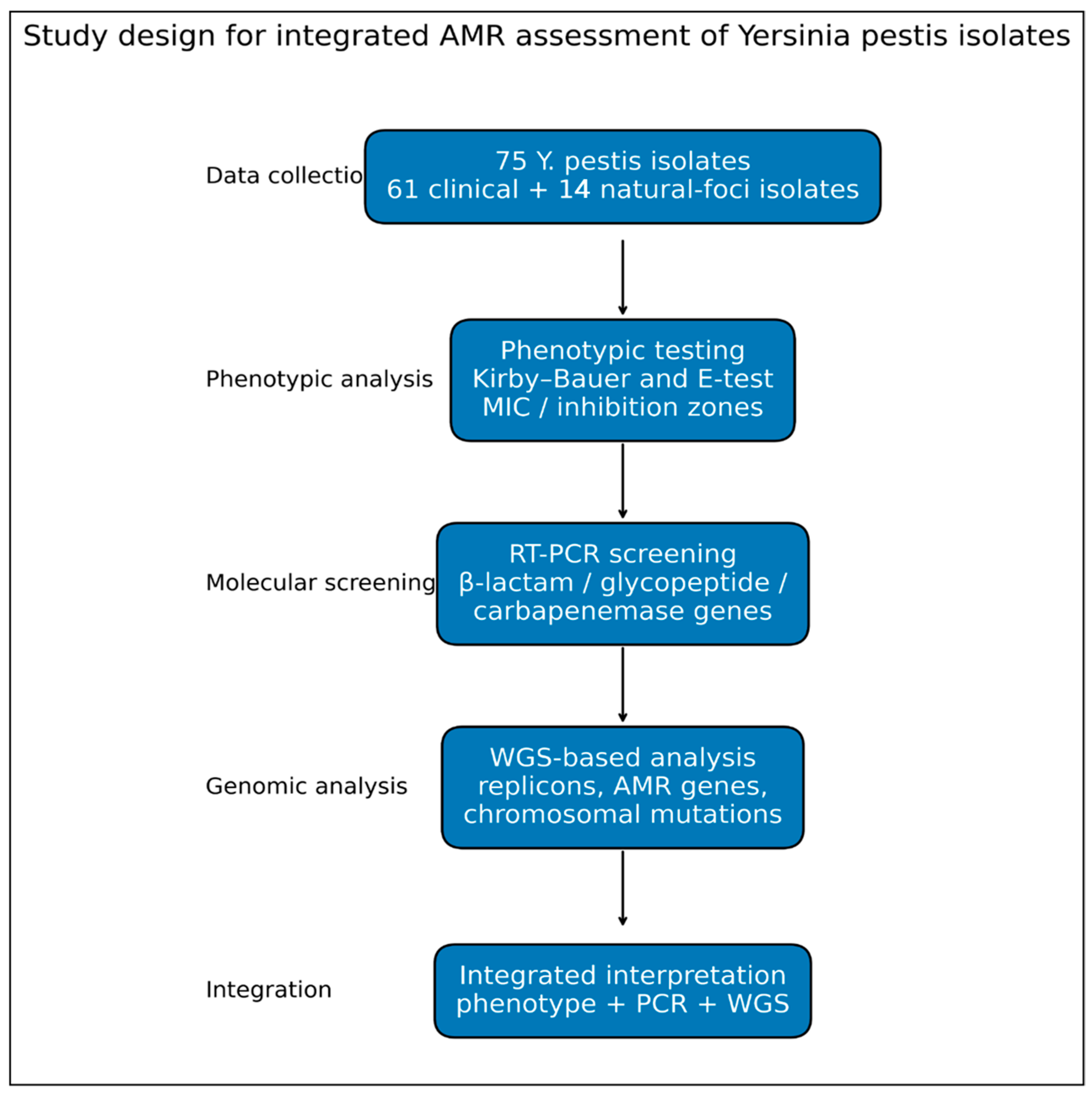
2.1. Bacterial Strains and Study Design
2.2. Culture Conditions and Identification
2.3. Antimicrobial Susceptibility Testing
2.4. Phenotypic Detection of Resistance Mechanisms
2.5. Molecular Detection of Resistance Genes (RT-PCR)
2.6. Whole-Genome Sequencing Data and Resistome Analysis
2.6.1. Detection of Acquired AMR Genes
2.6.2. Identification of Chromosomal Resistance-Associated Mutations
2.6.3. Plasmid Analysis
2.6.4. Comparative Analysis
2.7. Statistical Analysis
3. Results
3.1. General Characteristics of the Studied Strains
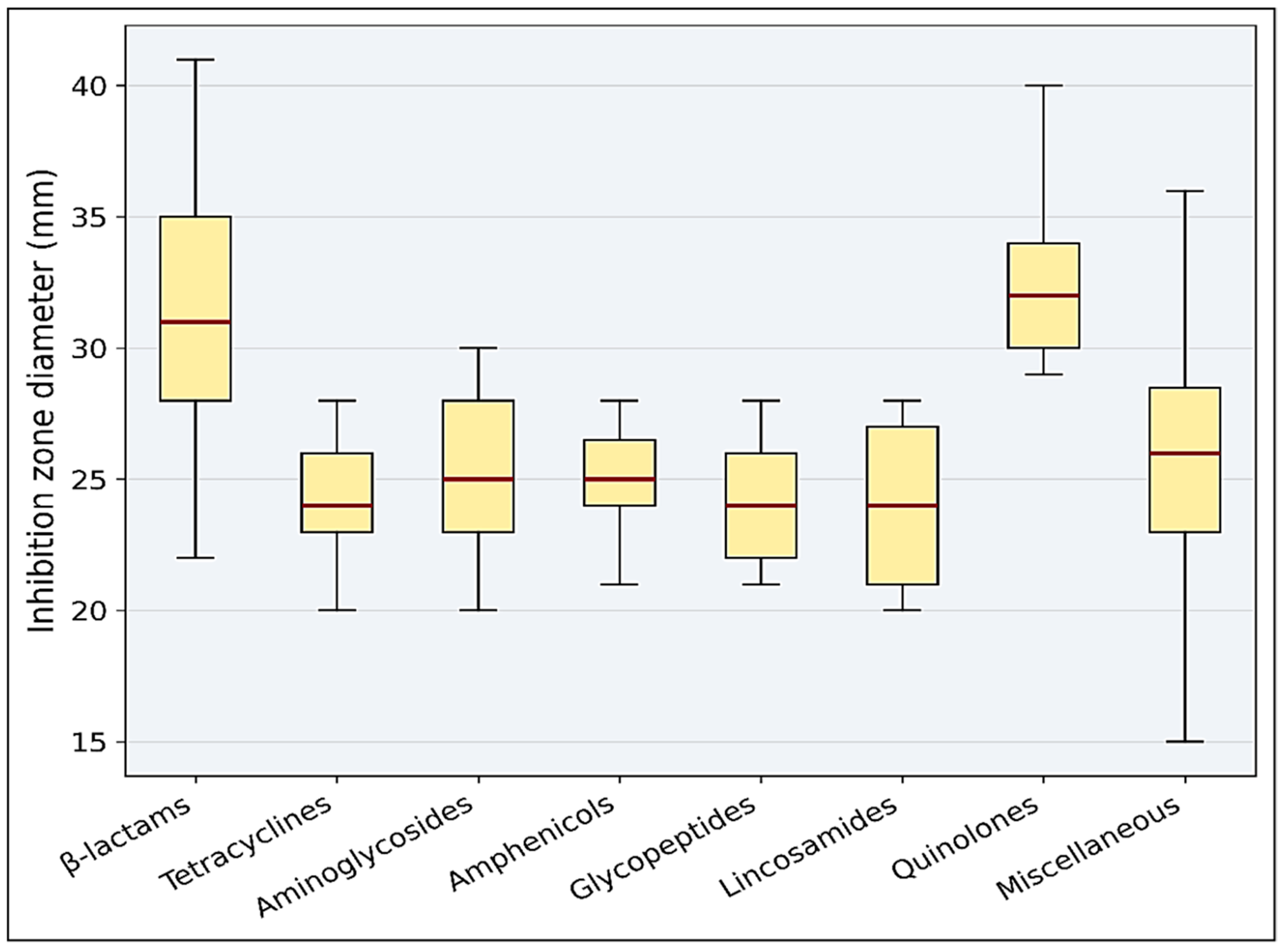
3.2. Phenotypic Susceptibility to Antimicrobial Agents
3.3. Quantitative Assessment of Antibiotic Activity (MIC Analysis)
- −
- MIC values as low as 0.023 µg/mL (moxifloxacin);
- −
- upper MIC values up to 4 µg/mL (amikacin);
- −
- mean MIC ≈ 1.06 µg/mL.
3.4. Phenotypic Evidence of Resistance Mechanisms
3.5. Molecular Screening of Antibiotic Resistance Genes (RT-PCR)
- −
- β-lactam resistance genes: tem, ctx-M-1, shv;
- −
- carbapenemases: kpc, ndm, vim, imp, oxa variants;
- −
- glycopeptide resistance genes: vanA, vanB;
- −
- methicillin resistance gene: mecA.
3.6. Whole-Genome Sequencing (WGS) and Resistome Analysis
4. Discussion
5. Conclusions
Author Contributions
Funding
Institutional Review Board Statement
Informed Consent Statement
Data Availability Statement
Conflicts of Interest
References
- Perry, R.D.; Fetherston, J.D. Yersinia pestis—Etiologic Agent of Plague. Clin. Microbiol. Rev. 1997, 10, 35–66. [Google Scholar] [CrossRef]
- Gage, K.L.; Kosoy, M.Y. Natural History of Plague: Perspectives from More than a Century of Research. Annu. Rev. Entomol. 2005, 50, 505–528. [Google Scholar] [CrossRef] [PubMed]
- World Health Organization. Plague around the World, 2010–2020. Wkly. Epidemiol. Rec. 2021, 96, 289–304. [Google Scholar]
- Centers for Disease Control and Prevention (CDC). About Plague: Maps and Statistics, Plague Worldwide. 2025. Available online: https://www.cdc.gov/plague/maps-statistics/index.html#cdc_data_surveillance_section_5-plague-worldwide (accessed on 17 May 2026).
- Eisen, R.J.; Gage, K.L. Transmission of Flea-Borne Zoonotic Agents. Annu. Rev. Entomol. 2012, 57, 61–82. [Google Scholar] [CrossRef] [PubMed]
- World Health Organization. Global Action Plan on Antimicrobial Resistance; WHO: Geneva, Switzerland, 2015. [Google Scholar]
- World Health Organization. Global Antimicrobial Resistance and Use Surveillance System (GLASS) Report 2022; WHO: Geneva, Switzerland, 2025. [Google Scholar]
- Murray, C.J.L.; Ikuta, K.S.; Sharara, F.; Swetschinski, L.; Aguilar, G.R.; Gray, A.; Han, C.; Bisignano, C.; Rao, P.; Wool, E.; et al. Global Burden of Bacterial Antimicrobial Resistance in 2019: A Systematic Analysis. Lancet 2022, 399, 629–655. [Google Scholar] [CrossRef] [PubMed]
- Holmes, A.H.; Moore, L.S.; Sundsfjord, A.; Steinbakk, M.; Regmi, S.; Karkey, A.; Guerin, P.J.; Piddock, L.J. Understanding the mechanisms and drivers of antimicrobial resistance. Lancet 2016, 387, 176–187. [Google Scholar] [CrossRef] [PubMed]
- Atshabar, B.B.; Burdelov, L.A.; Izbanova, U.A.; Kozhakhmetova, M.K.; Aimakhanov, B.K.; Abdeliev, Z.Z. Passport of regions of Kazakhstan for particularly dangerous infections. Quar. Zoonotic Infect. Kazakhstan 2015, 1, 179. (In Russian) [Google Scholar]
- Aikimbayev, A.M.; Atshabar, B.B.; Aubakirov, S.A.; Sagiyev, Z.A.; Serzhan, O.S.; Stybayeva, G.S. Epidemic Potential of Natural Plague Foci of Kazakhstan; DOIVA Publishing Center: Almaty, Kazakhstan, 2006; 153p, ISBN 9965-25-846-5. (In Russian) [Google Scholar]
- Popova, A.Y.; Kutyrev, V.V. (Eds.) Atlas of Natural Plague Foci in Russia and Foreign Countries; RA Poligrafych Publishing House: Kaliningrad, Russia, 2022; 348p, Available online: https://www.microbe.ru/main/rid/b_atl_22/ (accessed on 21 May 2026). (In Russian)
- Rivkus, Y.Z.; Blummer, A.G. Endemic Plague in the Deserts of Central Asia and Kazakhstan; LAP LAMBERT Academic Publishing: Saarbrücken, Germany, 2014; 420p, ISBN 978-3-659-48867-2. (In Russian) [Google Scholar]
- Rametov, N.; Abdel, Z.; Zhumadilova, Z.; Yessimseit, D.; Abdeliyev, B.; Mussagaliyeva, R.; Issaeva, S.; Althuwaynee, O.F.; Baygurin, Z.; Tabynov, K. Historical Assessment and Mapping of Human Plague, Kazakhstan, 1926–2003. Emerg. Infect. Dis. 2024, 30, 2483–2493. [Google Scholar] [CrossRef] [PubMed]
- Abdel, Z.Z.; Erubaev, T.K.; Tokmurzieva, G.Z.; Aimakhanov, B.K.; Dalibaev, Z.S.; Musagalieva, R.S.; Zhumadilova, Z.B.; Meka-Mechenko, V.G.; Meka-Mechenko, T.V.; Matzhanova, A.M.; et al. Demarcation of the Central Asian Desert Natural Plague Focus and Monitoring of the Range of Rhombomys opimus. Probl. Part. Danger. Infect. 2021, 2, 71–78. [Google Scholar] [CrossRef]
- Abdel, Z.; Abdeliyev, B.; Yessimseit, D.; Begimbayeva, E.; Mussagalieva, R. Natural Foci of Plague in Kazakhstan in the Space-Time Continuum. Comp. Immunol. Microbiol. Infect. Dis. 2023, 100, 102025. [Google Scholar] [CrossRef] [PubMed]
- Negi, S.; Tripathy, S.; Satapathy, P.; Neyazi, A.; Padhi, B.K. Plague Outbreak in Madagascar Amidst COVID-19: A Re-Emerging Concern. Clin. Infect. Pract. 2023, 17, 100222. [Google Scholar] [CrossRef]
- Rakotosamimanana, S.; Taglioni, F.; Ravaoarimanga, M.; Rajerison, M.E.; Rakotomanana, F. Socioenvironmental Determinants as Indicators of Plague Risk in the Central Highlands of Madagascar. PLoS Negl. Trop. Dis. 2023, 17, e0011538. [Google Scholar] [CrossRef] [PubMed]
- Kazakhstan Pharmaceutical Bulletin. IV Republican Scientific-Practical Conference “Antimicrobial Resistance—Challenges in Healthcare”. 2025. Available online: https://pharmnewskz.com/ru/news/iv-respublikanskaya-nauchno-prakticheskaya-konferenciya-antimikrobnaya-rezistentnost--vyzovy-v-zdravoohranenii_25785 (accessed on 17 May 2026).
- Pollitzer, R. Plague; WHO Monograph Series No. 22; WHO: Geneva, Switzerland, 1954. [Google Scholar]
- Eroshenko, G.A.; Odinokov, G.N.; Anisimova, L.V.; Shavina, N.Y.; Vinogradova, N.A.; Kutyrev, V.V. Antibiotic-Resistant Strains of Plague Agent and Development of PCR Detection Methods. Probl. Osob. Opasn. Infekts. 2011, 1, 53–57. [Google Scholar] [CrossRef]
- Didelot, X.; Bowden, R.; Wilson, D.J.; Peto, T.E.A.; Crook, D.W. Transforming Clinical Microbiology with Genome Sequencing. Nat. Rev. Genet. 2012, 13, 601–612. [Google Scholar] [CrossRef] [PubMed]
- Ellington, M.J.; Ekelund, O.; Aarestrup, F.M.; Canton, R.; Doumith, M.; Giske, C.; Grundman, H.; Hasman, H.; Holden, M.T.G.; Hopkins, K.L.; et al. The Role of Whole Genome Sequencing in Antimicrobial Susceptibility Testing of Bacteria. Clin. Microbiol. Infect. 2017, 23, 2–22. [Google Scholar] [CrossRef] [PubMed]
- Abdel, Z.; Zhumadilova, Z.; Mussagalieva, R.; Abdirassilova, A.; Rysbekova, A.; Issaeva, S.; Baitursyn, B.; Abdeliyev, B.; Otebay, D.; Jumagaziyeva, A.; et al. Antibiotic Susceptibility Screening and Search for Resistance Genes in Yersinia pestis Clinical Isolates from Plague Outbreaks in Natural Foci of Kazakhstan (1926–2003). Microb. Drug Resist. 2025, 31, 287–299. [Google Scholar] [CrossRef] [PubMed]
- Determination of Microorganism Susceptibility to Antibacterial Agents: Methodological Guidelines MUK 4.2.1890-04. Clin. Microbiol. Antimicrob. Chemother. 2004, 6, 306–359. Available online: https://cmac-journal.ru/publication/2004/4/cmac-2004-t06-n4-p306/ (accessed on 17 May 2026). (In Russian)
- Determination of the Susceptibility of Pathogens of Dangerous Bacterial Infections (Plague, Anthrax, Cholera, Tularemia, Brucellosis, Glanders and Melioidosis) to Antibacterial Agents: Methodological Guidelines MUK 4.2.2495-09; Federal Service for Surveillance on Consumer Rights Protection and Human Wellbeing of the Ministry of Health of Russia: Moscow, Russia, 2010; 59p. Available online: https://files.stroyinf.ru/Index2/1/4293820/4293820841.htm (accessed on 21 May 2026). (In Russian)
- Abdel, Z.Z.; Baitursyn, B.A.; Mussagalieva, R.S.; Otebay, D.M. Method for Determining the Susceptibility of Plague and Cholera Pathogens to Antibacterial Agents (ABA): Principles, Procedures, and Interpretation of Results: Methodological Recommendations; Book Expert Kazakhstan: Almaty, Kazakhstan, 2025; 85p, ISBN 978-601-82401-3-3. (In Russian) [Google Scholar]
- Meka-Mechenko, T.V.; Zakaryan, S.B. Guidelines for Molecular Genetic Analysis of Plague Strains; Methodological Recommendations; LEM Publishing House LLC: Almaty, Kazakhstan, 2011; 36p. (In Russian) [Google Scholar]
- Abdirassilova, A.A.; Abdel, Z.Z. RT-PCR Detection of Yersinia pestis DNA; Methodological Recommendations; KazBookExport: Almaty, Kazakhstan, 2023; 37p. (In Russian) [Google Scholar]
- Abdirassilova, A.A.; Yessimseit, D.T.; Kassenova, A.K.; Mussagalieva, R.S.; Shakiyev, N.S.; Baitursyn, B.A.; Abdeliyev, B.S.; Dalibayev, Z.Z.; Otebay, D.M.; Abdel, Z.Z.; et al. Whole-Genome Sequencing of Yersinia pestis from Central Asia Reveals Genetic Diversity and Convergent Evolution. PLoS Negl. Trop. Dis. 2025, 19, e0013533. [Google Scholar] [CrossRef] [PubMed]
- Armstrong, G.L.; MacCannell, D.R.; Taylor, J.; Carleton, H.A.; Neuhaus, E.B.; Bradbury, R.S.; Posey, J.E.; Gwinn, M. Pathogen Genomics in Public Health. N. Engl. J. Med. 2019, 381, 2569–2580. [Google Scholar] [CrossRef] [PubMed]
- Dennis, D.T.; Hughes, J.M. Multidrug Resistance in Plague. N. Engl. J. Med. 1997, 337, 702–704. [Google Scholar] [CrossRef] [PubMed]
- Inglesby, T.; Dennis, D.T.; Henderson, D.A.; Bartlett, J.G.; Ascher, M.S.; Eitzen, E.; Fine, A.D.; Friedlander, A.M.; Hauer, J.; Koerner, J.F.; et al. Plague as a Biological Weapon: Medical and Public Health Management. JAMA 2000, 283, 2281–2290. [Google Scholar] [CrossRef] [PubMed]
- Layton, R.C.; Mega, W.; McDonald, J.D.; Brasel, T.L.; Barr, E.B.; Gigliotti, A.P.; Kosteret, F. Levofloxacin Cures Experimental Pneumonic Plague. PLoS Negl. Trop. Dis. 2011, 5, e959. [Google Scholar] [CrossRef] [PubMed]
- Peterson, J.W.; Moen, S.T.; Healy, D.; Pawlik, J.E.; Taormina, J.; Hardcastle, J.; Thomas, J.M.; Lawrence, W.S.; Ponce, C.; Chatuev, B.M.; et al. Protection Afforded by Fluoroquinolones in Animal Models of Respiratory Infections with Bacillus anthracis, Yersinia pestis, and Francisella tularensis. Open Microbiol. J. 2010, 4, 34–46. [Google Scholar] [CrossRef] [PubMed]
- Steward, J.; Lever, M.S.; Russell, P.; Beedham, R.J.; Stagg, A.J.; Taylor, R.R.; Brooks, T.J.G. Efficacy of the Latest Fluoroquinolones against Experimental Yersinia pestis. Int. J. Antimicrob. Agents 2004, 24, 609–612. [Google Scholar] [CrossRef] [PubMed]
- Galimand, M.; Carniel, E.; Courvalin, P. Resistance of Yersinia pestis to Antimicrobial Agents. Antimicrob. Agents Chemother. 2006, 50, 3233–3236. [Google Scholar] [CrossRef] [PubMed]
- Welch, T.J.; Fricke, W.F.; McDermott, P.F.; White, D.G.; Rosso, M.-L.; Rasko, D.A.; Mammel, M.K.; Eppinger, M.; Rosovitz, M.J.; Wagner, D.; et al. Multiple Antimicrobial Resistance in Plague: An Emerging Public Health Risk. PLoS ONE 2007, 2, e309. [Google Scholar] [CrossRef] [PubMed]
- Dai, R.; He, J.; Zha, X.; Wang, Y.; Zhang, X.; Gao, H.; Yang, X.; Li, J.; Xin, Y.; Wang, Y.; et al. A Novel Mechanism of Streptomycin Resistance in Yersinia pestis: Mutation in the rpsL Gene. PLoS Negl. Trop. Dis. 2021, 15, e0009324. [Google Scholar] [CrossRef] [PubMed]
- Randriantseheno, L.N.; Andrianaivoarimanana, V.; Pizarro-Cerdá, J.; Wagner, D.M.; Rajerison, M. Review of Genotyping Methods for Yersinia pestis in Madagascar. PLoS Negl. Trop. Dis. 2024, 18, e0012252. [Google Scholar] [CrossRef] [PubMed]



| Characteristic | Value |
|---|---|
| Total number of Y. pestis isolates analyzed | 75 |
| Clinical isolates obtained from human cases and fatal outcomes | 61 |
| Epizootic isolates recovered from animal hosts and flea vectors | 14 |
| Period of isolation | 1926–2012 |
| Human-derived isolates (historical epidemic strains) | 1926–2003 |
| Animal- and vector-derived isolates | 2004–2012 |
| Administrative regions represented | 7 (Atyrau, Aktobe, Almaty, Zhambyl, Kyzylorda, Mangystau, and Turkestan) |
| Natural plague foci represented | 17 |
| Ecological zones represented | Desert, semi-desert, and high-mountain plague foci |
| Principal host species | Rhombomys opimus, Meriones meridianus, Marmota baibacina, and Marmota caudata |
| Principal sources of isolation | Humans, great gerbils, jirds, marmots, and their ectoparasites |
| Antibiotic Class | Phenotypic Result | Quantitative Summary | Interpretation |
|---|---|---|---|
| β-lactams | 100% susceptible | Inhibition zone range 23.2–39.8 mm | High activity preserved |
| Tetracyclines | 100% susceptible | 21.0–27.3 mm | Retained activity of first-line drugs |
| Aminoglycosides | 100% susceptible | 18.8–27.8 mm | No phenotypic evidence of resistance |
| Amphenicols | 100% susceptible | 23.1–26.3 mm | Preserved susceptibility |
| Glycopeptides | 100% susceptible | 21.2–25.9 mm | Uniform susceptibility profile |
| Lincosamides | 100% susceptible | 21.5–25.9 mm | Uniform susceptibility pattern |
| Fluoroquinolones | 100% susceptible | 28.8–36.7 mm | High activity, including ciprofloxacin |
| Macrolides | Low activity | 0.0–58.0% activity | Consistent with expected low efficacy against Gram-negative bacteria |
| Determinant/Feature | Method | Result | Interpretation |
|---|---|---|---|
| tem | RT-PCR | Not detected | No evidence of common acquired β-lactam resistance determinant |
| ctx-M-1 | RT-PCR | Not detected | No ESBL-associated signal |
| shv | RT-PCR | Not detected | No ESBL-associated signal |
| oxa-type targets | RT-PCR | Not detected | No carbapenemase-associated signal in screened panel |
| imp | RT-PCR | Not detected | No metallo-β-lactamase signal |
| kpc | RT-PCR | Not detected | No carbapenemase signal |
| ndm | RT-PCR | Not detected | No carbapenemase signal |
| vim | RT-PCR | Not detected | No carbapenemase signal |
| vanA/B | RT-PCR | Not detected | No glycopeptide resistance determinant detected |
| mecA | RT-PCR | Not detected | No methicillin resistance determinant detected |
| ESBL phenotype | Phenotypic confirmatory testing | Not detected | No phenotypic evidence of extended-spectrum β-lactamase production |
| Acquired AMR plasmids | WGS-based plasmid analysis | Not identified | No additional plasmid replicons associated with antimicrobial resistance were identified at the assembly level |
| Category | Feature | Result | Interpretation |
|---|---|---|---|
| Acquired AMR genes | Aminoglycoside resistance genes (strA, strB, aadA, aac, aph) | Not detected | No evidence of acquired aminoglycoside resistance |
| Tetracycline resistance genes (tet-family) | Not detected | No acquired tetracycline resistance | |
| Chloramphenicol resistance genes (cat-family) | Not detected | No acquired amphenicol resistance | |
| Sulfonamide resistance genes (sul1/sul2/sul3) | Not detected | No acquired sulfonamide resistance | |
| β-lactamase genes (bla-family) | Not detected | No acquired β-lactam resistance | |
| Carbapenemases (kpc, ndm, vim, imp, oxa-type) | Not detected | No carbapenem resistance determinants | |
| Other AMR genes (qnr, dfrA, erm, mph) | Not detected | No additional resistance determinants | |
| Chromosomal loci | rpsL (Lys43, Lys88) | No mutations | No streptomycin resistance-associated substitutions |
| gyrA (Ser83, Asp87) | No mutations | No fluoroquinolone resistance-associated substitutions | |
| parC | No variation | Conserved across isolates | |
| pmrA, pmrB, phoP, phoQ | No variation | Conserved regulatory loci with no evidence of resistance-associated variation | |
| Plasmid content | Core virulence plasmids (pCD1, pMT1, pPCP1) | Detected in 75/75 isolates | Typical plasmid profile of Y. pestis |
| Cryptic plasmid (pCKF) | Detected in 3/75 isolates | Not associated with AMR | |
| MDR-associated plasmids | Not detected | No plasmid-mediated resistance |
Disclaimer/Publisher’s Note: The statements, opinions and data contained in all publications are solely those of the individual author(s) and contributor(s) and not of MDPI and/or the editor(s). MDPI and/or the editor(s) disclaim responsibility for any injury to people or property resulting from any ideas, methods, instructions or products referred to in the content. |
© 2026 by the authors. Licensee MDPI, Basel, Switzerland. This article is an open access article distributed under the terms and conditions of the Creative Commons Attribution (CC BY) license.
Share and Cite
Abdel, Z.; Zhumadilova, Z.; Mussagalieva, R.; Abdirassilova, A.; Baitursyn, B.; Abdeliyev, B.; Dalibayev, Z.; Otebay, D.; Shaki, N.; Issaeva, S. Integrated Phenotypic, Molecular, and Genomic Analysis of Antimicrobial Resistance in Yersinia pestis Isolates from Natural Plague Foci of Kazakhstan. Bacteria 2026, 5, 37. https://doi.org/10.3390/bacteria5030037
Abdel Z, Zhumadilova Z, Mussagalieva R, Abdirassilova A, Baitursyn B, Abdeliyev B, Dalibayev Z, Otebay D, Shaki N, Issaeva S. Integrated Phenotypic, Molecular, and Genomic Analysis of Antimicrobial Resistance in Yersinia pestis Isolates from Natural Plague Foci of Kazakhstan. Bacteria. 2026; 5(3):37. https://doi.org/10.3390/bacteria5030037
Chicago/Turabian StyleAbdel, Ziyat, Zauresh Zhumadilova, Raikhan Mussagalieva, Aigul Abdirassilova, Bolatbek Baitursyn, Beck Abdeliyev, Zhandos Dalibayev, Dinmukhammed Otebay, Nurbol Shaki, and Svetlana Issaeva. 2026. "Integrated Phenotypic, Molecular, and Genomic Analysis of Antimicrobial Resistance in Yersinia pestis Isolates from Natural Plague Foci of Kazakhstan" Bacteria 5, no. 3: 37. https://doi.org/10.3390/bacteria5030037
APA StyleAbdel, Z., Zhumadilova, Z., Mussagalieva, R., Abdirassilova, A., Baitursyn, B., Abdeliyev, B., Dalibayev, Z., Otebay, D., Shaki, N., & Issaeva, S. (2026). Integrated Phenotypic, Molecular, and Genomic Analysis of Antimicrobial Resistance in Yersinia pestis Isolates from Natural Plague Foci of Kazakhstan. Bacteria, 5(3), 37. https://doi.org/10.3390/bacteria5030037