Communication

Liposome-Based Delivery of Nisin and Pink Pepper Essential Oil to Control Foodborne Bacteria

by
Nathalie Almeida Lopes
1,
Adilson Roberto Locali-Pereira
2,
Vânia Regina Nicoletti
2 and
Adriano Brandelli
1,*
1
Laboratório de Nanobiotecnologia e Microbiologia Aplicada, Departamento de Ciência de Alimentos, Universidade Federal do Rio Grande do Sul, Porto Alegre 91501-970, Brazil
2
Departamento de Engenharia e Tecnologia de Alimentos, Universidade Estadual Paulista, São José do Rio Preto 15054-000, Brazil
*
Author to whom correspondence should be addressed.
Bacteria 2026, 5(3), 38; https://doi.org/10.3390/bacteria5030038
Submission received: 9 February 2026 / Revised: 1 April 2026 / Accepted: 12 June 2026 / Published: 1 July 2026

Abstract

Background/objectives: Foodborne diseases remain a significant global public health concern, requiring innovative and effective antimicrobial strategies to control food pathogens. Encapsulation of natural antimicrobials have attracted increasing interest. In this study, liposomes encapsulating pink pepper essential oil (PPEO), nisin, or their combination were developed, aiming to potentiate antimicrobial performance against foodborne pathogens. Methods: Phosphatidylcholine liposomes were prepared by the thin-film method and characterized by DLS and FTIR. The antimicrobial activity of nisin, PPEO, and liposomes was investigated by the agar diffusion method against foodborne pathogens like Staphylococcus aureus, Listeria monocytogenes, and Salmonella Typhimurium. Results: The liposomes exhibited nanometric size ranging from 91 to 107 nm, low polydispersity, and zeta potential between −3.73 and −7.39 mV, indicating well-defined vesicles with negative surface charges. Encapsulation enhanced antimicrobial efficacy, with nisin–PPEO liposomes stored for 21 days under refrigeration showing a sustained inhibition of L. monocytogenes, outperforming liposomes containing nisin alone. The combined antimicrobials also inhibited Gram-positive bacteria in milk agar, used as a simulated food system. Additionally, the antioxidant activity of PPEO was preserved upon encapsulation, especially under refrigeration, reinforcing the protective role of the liposomes. Conclusions: The co-encapsulation approach strengthened the stability and bioactivity of natural antimicrobials, highlighting liposomal delivery as a promising strategy to control foodborne bacteria.

1. Introduction

Foodborne diseases are a major public health concern because they cause widespread illness, economic losses, and strain on healthcare systems, making the control of foodborne pathogens essential to protect populations. Foodborne diseases, caused by bacteria, fungi, viruses, or parasites, affect millions of people worldwide and contribute significantly to the global burden of disease and mortality [1,2,3]. Beyond the direct impact on health, foodborne outbreaks disturb tourism, trade, and productivity, generating huge social and economic challenges. Prevention strategies, such as hygiene practices, regulations, and effective surveillance, help safeguard food safety and public health [4]. However, controlling foodborne pathogens is crucial, as it reduces the incidence of illness, prevents the spread of antimicrobial resistance through contaminated food, and ensures food safety across the production and consumption chain. In this regard, there is growing interest in using natural antimicrobials to control foodborne pathogens in the food chain [5,6].
Commonly employed in folk medicine, extracts obtained from pink pepper (Schinus terebinthifolius Raddi) have gained focus in different areas and are applied for different purposes [7,8,9]. Recent approaches have shown that pink pepper essential oil (PPEO) is an interesting alternative for application as a biopreservative, presenting antimicrobial and antioxidant activities [10,11,12,13,14]. In this way, PPEO is considered a promising natural antimicrobial for the control of undesirable microorganisms, making it a promising candidate for applications in biomedical, food, and pharmaceutical sectors.
At the same time, nisin, a well-known natural preservative approved by the US Food and Drug Administration, has the Generally Recognized as Safe (GRAS) status and is an effective antimicrobial against Gram-positive pathogens. Some studies indicate that nisin can exert synergistic antimicrobial effects in combination with essential oils (EOs), such as cinnamon [15], garlic [16], thymol and eugenol [17,18], oregano [19], and red ginger [20]. These preservation strategies may extend the inhibitory spectra of nisin and EOs, achieving antimicrobial activity against Gram-negative bacteria through the synergistic effect. Moreover, some studies pointed to the potential of nisin as a strategy in clinical and biomedical applications, including inhibition of drug-resistant bacterial strains, anti-biofilm properties, activation of immune response, and selective toxicity against some cancer cell lines [21,22].
Despite their relevant biological activities, several challenges can be associated with the direct application of natural substances, including high susceptibility to environmental stressors, and, in the case of EOs, low water solubility is also observed. To overcome these obstacles and improve the efficacy of natural substances, the encapsulation process has been proposed [12,18,23]. For this, nanoencapsulation into liposomes has been used as an interesting strategy to deliver natural antimicrobials. Liposomes are largely studied nanostructures for the encapsulation of bioactive compounds due to their versatility, which allows the incorporation of hydrophobic, hydrophilic, and amphiphilic molecules. Moreover, liposomes can be produced from natural substances [24,25,26].
The encapsulation of nisin in liposomes has proven effective in preserving its antimicrobial activity by preventing inactivation through interactions with food components [27,28]. This is a key advantage given the global burden of foodborne diseases and the need for stable, natural preservation strategies. Likewise, the nanoencapsulation of EO compounds has improved their solubility, stability, and bioactivity, supporting their use as potent antioxidant and antibacterial agents in food systems [29,30,31]. Although several EOs have been encapsulated into liposomes, studies with PPEO are restricted to other systems than liposomes [23]. In this context, this study investigated liposomes containing PPEO, alone or co-encapsulated with nisin, aiming to characterize their physicochemical properties, stability, and antimicrobial activity against foodborne pathogens, thereby contributing to the development of natural and effective preservation strategies that support safer foods and strengthen public health protection. In addition to antimicrobial activity, the evaluation of antioxidant properties was included considering the intended application of these systems in food preservation, where both microbial growth and lipid oxidation are critical factors affecting product quality and shelf life.

2. Materials and Methods

2.1. Chemicals

The pink pepper essential oil (PPEO) was supplied by LINAX Essential Oils and Distillers (Votuporanga, SP, Brazil). PPEO composition includes α-pinene (35.9%), β-pinene (8.5%), β-myrcene (15.6%), δ-3-carene (13.1%), d-limonene (4.4%), and germacrene D (11.4%), as described previously [23]. Nisin (Nisaplin®, containing 2.5% pure nisin) was provided by Danisco Brasil (Barueri, SP, Brazil). The nisin stock solution was prepared by dissolving Nisaplin® in 10 mM phosphate buffer (pH 7.0) to obtain a working concentration of 0.16 mg/mL, filter-sterilized using 0.22 μm membranes (Sartorius, Göttingen, Germany), and then stored in sterile tubes at 4 °C [32]. The lipid used for liposome production was Phospholipon 90G®, a purified soybean phosphatidylcholine (PC, ≥94%) that was obtained from Lipoid (Ludwigshafen, Germany).

2.2. Microorganisms

The indicator bacteria for antimicrobial activity assays were Salmonella Typhimurium ATCC 14028, Staphylococcus aureus ATCC 6538, Listeria monocytogenes ATCC 15313, Listeria innocua ATCC 33090, and Bacillus subtilis ATCC 6633. The microorganisms were maintained and subcultured periodically on Brain Heart Infusion (BHI, Oxoid, Basingstoke, UK) agar plates at 4 °C. Before each experiment, strains were grown in BHI medium at 37 °C for 18–24 h.

2.3. Production of Liposomes

PPEO and nisin were encapsulated into liposomes by the thin-film hydration method [32]. The PC (76 mg) was dissolved in 15 mL of ethanol in a round-bottom flask, and the organic solvent was removed under reduced pressure at 40 °C to form a thin film on the flask wall. For the elimination of all traces of ethanol, the flask was stored overnight in a desiccator. Then, the film was dispersed by adding 5.0 mL of nisin solution or 5.0 mL of nisin–PPNO mixture (nisin solution plus 500 µL PPEO) to form PC-N and PC-NO liposomes, respectively. In the case of PC-O, PPEO (500 µL) was added together with PC and dissolved using ethanol. The dry lipid film formed by rotary evaporation of the organic solvent was hydrated with 5 mL of ultrapure water (obtained from a Milli-Q purifier). Samples that contained essential oil in the formulation were supplemented with 50 µL/mL of Tween 80 to facilitate the dispersion of lipid matrices in water. All formulations were heated at 60 °C and stirred several times to assist the liposome formation, and then samples were subjected to ultrasound processing for size reduction using a probe-type apparatus (UP 100H, Hielscher Ultrasonics, Teltow, Germany) operating at 30 kHz frequency, power 80 W, during 5 cycles of 1 min with intervals of the same time in an ice bath. After this process, the samples were sterilized by filtration through 0.22 mm membranes (Millipore, Billerica, MA, USA).

2.4. Dynamic Light Scattering (DLS)

The characterization of particle size, polydispersity index (PDI), and zeta potential was performed by DLS in a Zetasizer Nano ZS equipment (Malvern Panalytical, Malvern, UK). For this, the samples were diluted in ultrapure water, and the measurements were carried out immediately after the preparation of liposomes.

2.5. Entrapment Efficiency (EE)

The entrapment efficiency of each liposome formulation was determined using the values of antimicrobial activity units per mL (AU/mL) obtained by the agar diffusion method. First, unencapsulated nisin and/or pink pepper essential oil was separated from the liposome suspension by ultrafiltration (Ultracel YM-10 Membrane, Millipore). Then, the AU of the filtrate and the liposome-encapsulated nisin, PPEO, and their mixture were determined as described elsewhere [33], using S. aureus ATCC 6538 as indicator strain.
The EE value was calculated using the following equation:
E E   ( % ) = A U / m L   n i s i n   a n d / o r   P P E O   l o a d e d   l i p o s o m e s A U / m L   n i s i n   a n d / o r   P P E O   l o a d e d   l i p o s o m e s + A U / m L   o f   t h e   f i l t r a t e

2.6. Fourier-Transform Infrared Spectroscopy (FTIR)

The interactions between nisin and PPEO with the PC liposome were evaluated by FTIR, through the KBr disk method applied to lyophilized liposomal samples. The FTIR spectra were obtained from 64 scans in the range between 4000 and 400 cm−l, with a spectral resolution of 4 cm−l, using a Shimadzu 8300 FTIR spectrometer (Shimadzu, Kyoto, Japan).

2.7. Antimicrobial Activity Assays

The antimicrobial effect against foodborne bacteria was determined by agar diffusion assay [34]. Briefly, BHI agar plates were previously inoculated with a swab soaked in a bacterial suspension of challenge microorganisms at a concentration of 108 cells/mL, and aliquots of 10 µL containing serial dilutions of samples (free and encapsulated) were applied onto the medium and incubated at 37 °C for 24 h. Antimicrobial activity was expressed as activity units (AU) per mL, which is the reciprocal of the last dilution giving an inhibition zone [35].
After preparation of liposomes, samples of each formulation were stored at 7 °C, and an aliquot was withdrawn for testing antimicrobial activity at days 1, 7, 14, and 21 to analyze the stability over time. The inhibitory effect of liposomes against different indicator microorganism (S. aureus, B. subtilis, L. monocytogenes, and L. innocua) was also evaluated in milk-agar plates to simulate a food matrix. The antimicrobial susceptibility testing was determined as described elsewhere [36]. Aliquots of 10 µL were applied to milk-agar plates previously inoculated with a swab submerged in a suspension.

2.8. Antioxidant Activity

The antioxidant activity of the liposomes was evaluated using the ABTS radical scavenging assay [37] after 7 days of storage under refrigerated (7 °C) and room-temperature conditions (25 °C). For each analysis, 10 μL of sample was used. The Trolox calibration curve was constructed using five dilutions prepared in ethyl alcohol, with final concentrations ranging from 100 to 2000 μM. All assays were performed in triplicate, and results were expressed as mM Trolox per mL.

2.9. Data Analysis

All experimental treatments were performed in triplicate using independent samples (biological replicates), and values were analyzed by one-way ANOVA followed by Tukey’s post hoc test at a 95% significance level (p < 0.05). Data analyses were carried out using Statistica 7.0 software (Statsoft, Tulsa, OK, USA).

3. Results

3.1. Antimicrobial Activity of Nisin and Pink Pepper Essential Oil

The antimicrobial effect of nisin and PPEO was initially tested against Gram-positive and Gram-negative bacteria to estimate the concentration of antimicrobials to be encapsulated. For this, nisin was diluted to reach 16 µg/mL and tested alone and combined with three different concentrations (500, 250, and 125 µL/mL) of PPEO (1:1 ratio). PPEO presented antimicrobial activity only at the concentration of 500 µL/mL. Nisin alone resulted in an antimicrobial activity of 1600 AU/mL against S. aureus, while PPEO alone resulted in an antimicrobial activity of 800 AU/mL. However, no inhibitory activity was observed against S. Typhimurium for either nisin or PPEO alone, under the conditions of the analysis. On the other hand, the combination of nisin with PPEO exhibited antimicrobial activity against S. Typhimurium (200 AU/mL) and reached 3200 AU/mL against S. aureus. When tested against L. monocytogenes, nisin and PPEO alone showed 3200 AU/mL, while the combination reached 6400 AU/mL. Thus, 16 µg/mL nisin and 500 µL/mL PPEO were chosen for liposome production, since this combination was the minimum concentration of PPEO that maintained antimicrobial activity in agar plates.

3.2. Encapsulation of Nisin and Pink Pepper Essential Oil

Liposomes co-encapsulating nisin and PPEO were developed, and their properties are summarized in Table 1. Particle size differed significantly among all formulations (p < 0.05). The liposomes encapsulating nisin had an average particle size of 107.9 nm, showing a larger mean diameter in comparison with PC-NO liposomes. When PPEO was encapsulated alone into liposomes, the particle size was smaller, with an average diameter of 91.2 nm.
The polydispersity index (PDI) is an important indication of the degree of homogeneity of the liposome suspensions. The values of liposomes prepared with nisin (PC-N) and the combination of nisin and PPEO (PC-NO) were around 0.2, indicating a narrow size distribution. In contrast, the liposomes prepared with essential oil (PC-O) showed a higher polydispersity index (p < 0.05), exceeding 0.4, indicating a higher degree of heterogeneity of liposomes.
Zeta potential analysis measures the surface charge of particles in a particular medium, indicating the electrostatic repulsion between them, and it can be used to predict the stability of colloidal systems. The stability is considered the lowest when the value of zeta potential is around zero, since there is a higher tendency for the particles to aggregate. In this work, the zeta potential was negative (Table 1), ranging from −3.73 to −7.39 mV. Statistical analysis revealed that no significant difference was observed between PC-N and PC-NO formulations (p > 0.05), whereas liposomes containing PPEO alone (PC-O) presented a significantly more negative zeta potential compared to the other systems (p < 0.05).
The entrapment encapsulation (EE) of nisin into liposomes was 94%, while the novel liposome formulations developed in this work presented a high entrapment encapsulation for PPEO (PC-O) alone and when mixed with nisin (PC-NO), with values of 100% and 94%, respectively.

3.3. Fourier-Transform Infrared Spectroscopy (FTIR)

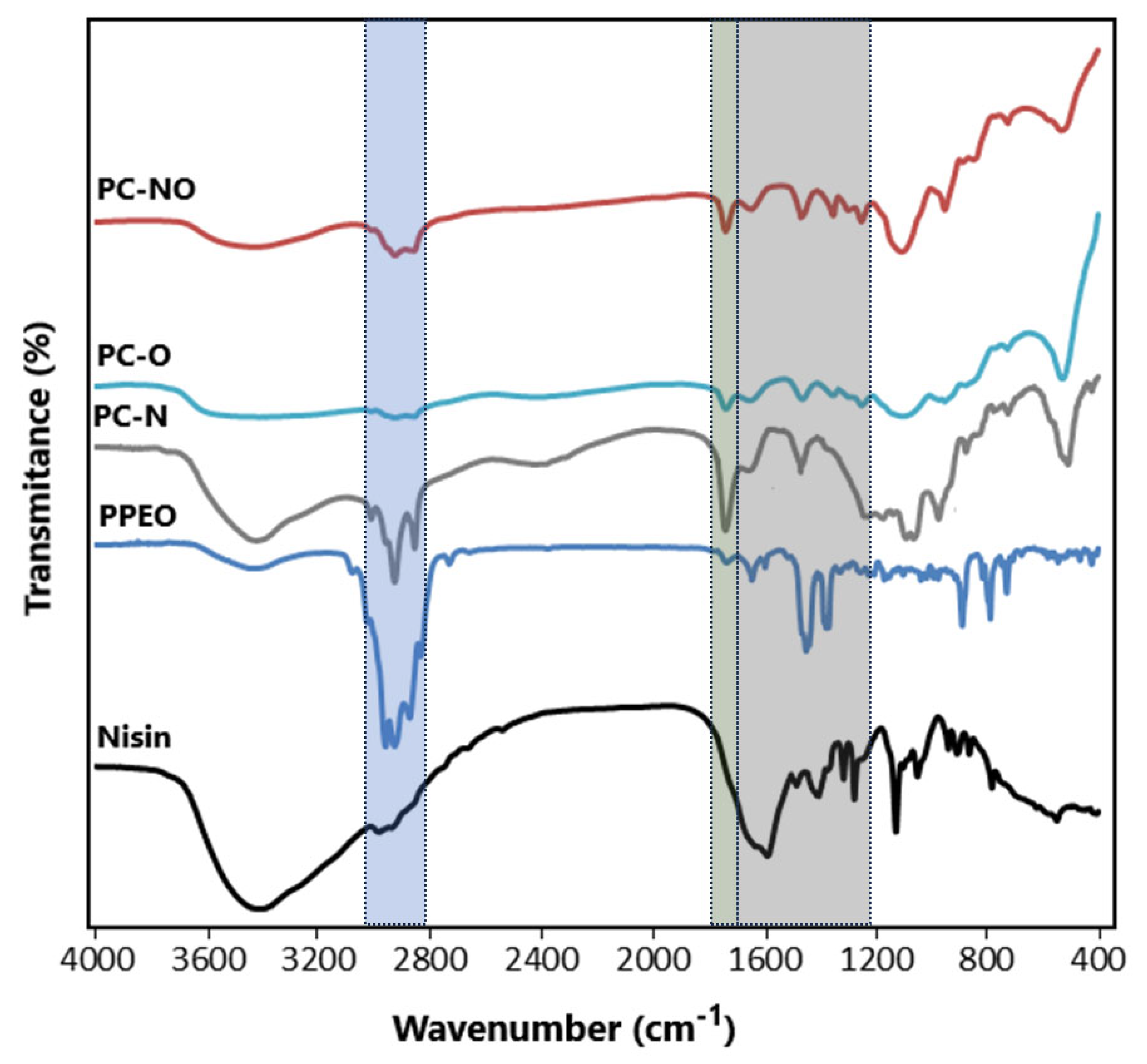
The FTIR analysis was employed to obtain information about possible interactions of PPEO and nisin with the phospholipid membrane. The FTIR spectra of nisin and PPEO, and their combination encapsulated in liposomes are presented in Figure 1. For nisin, the peak around 1585 cm−1 is attributed to the bending of primary amines, and the peak at 1402 cm−1 is due to C-N stretching of amide groups. In addition, the broad peak at 3420 cm−1 results from N−H and O−H stretching vibrations. The FTIR peaks of PPEO were most prominent around 2918−2870 cm−1, corresponding to the stretching vibration of the methylene (−CH3) groups. In addition, other PPEO bands were observed in the range of 1800−700 cm−1. The peak at 1446 cm−1 is due to C−H scissoring vibration, and the peak at 1367 cm−1 is attributed to symmetrical deformation vibration of −CH3. The bands at 880 cm−1 arise from C−H deformation vibration, and 781 cm−1 from S−C absorption.
The liposomes exhibited typical peaks of PC, including the choline antisymmetric stretching vibrations around 970 cm−1; carbonyl stretching mode frequency (1735 cm−1) of the lipid interfacial region; and the symmetric and antisymmetric stretching of the acyl chain −CH3 in the range of 2950–2850 cm−1. Moreover, it can be seen that typical bands of nisin and PPEO appeared in the FTIR spectra (Figure 1), suggesting that the antimicrobials were incorporated into the nanovesicle structure. The liposome PC-NO showed additional peaks in the range of 1650–1250 cm−1, which may indicate the presence of both nisin and PPEO in the liposome vesicle.

3.4. Antimicrobial Activity of Liposomes Encapsulating Nisin and PPEO

Liposomes co-encapsulating nisin and PPEO (PC-NO) were evaluated during refrigerated storage (7 °C), and their antimicrobial performance was monitored for up to 21 days against two major foodborne pathogens: the Gram-positive L. monocytogenes and the Gram-negative S. Typhimurium. In order to understand the performance of PC-NO over time, liposomes containing only nisin (PC-N) and only PPEO (PC-O) were also evaluated for comparison.
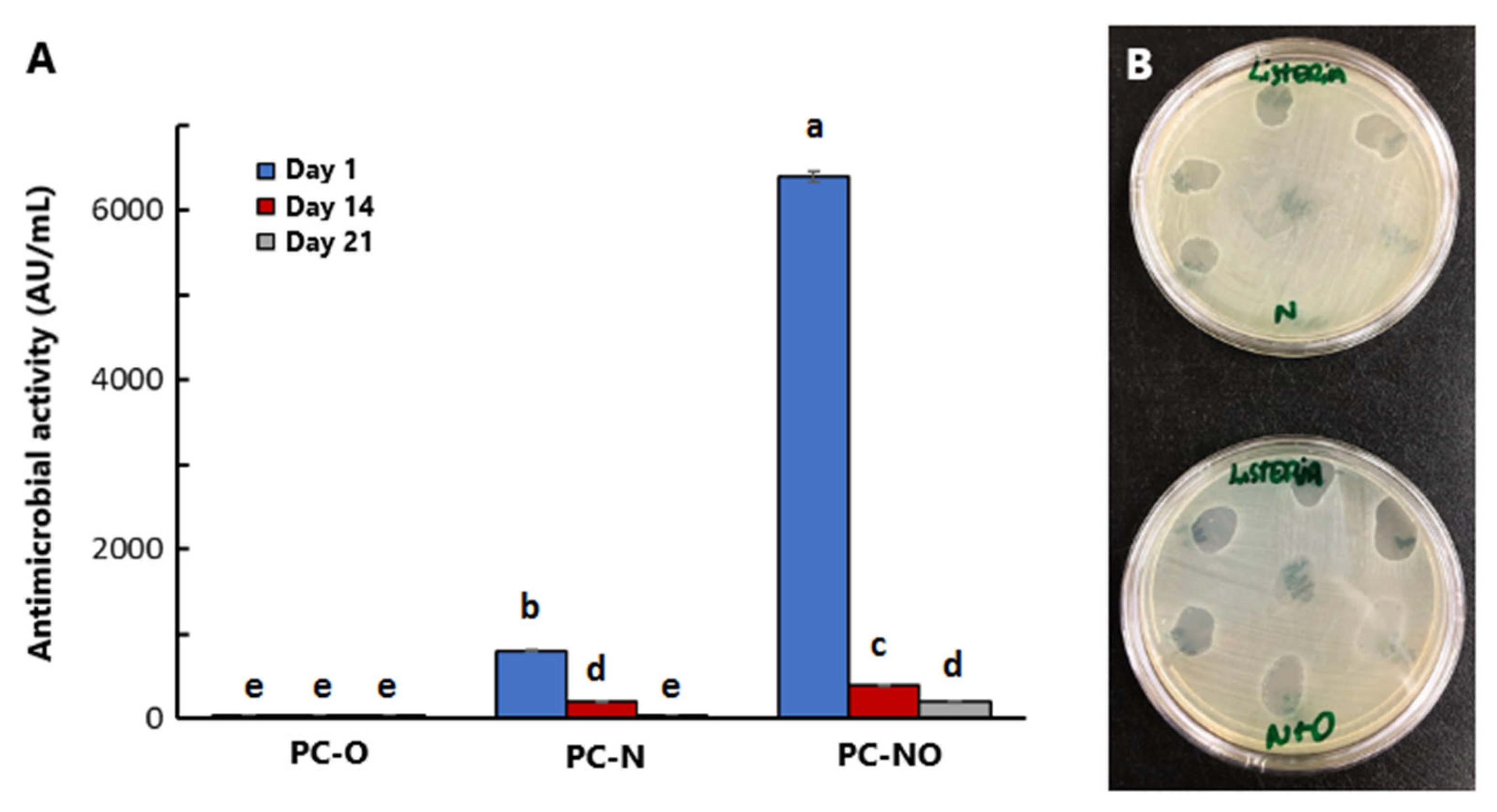
On the first day, the PC-N had an initial activity of 800 AU/mL against L. monocytogenes, whereas samples of PC-NO liposomes demonstrated a potent initial activity of 6400 AU/mL against the same microorganism (Figure 2). However, no activity was found for PC-O liposomes. Samples of PC-NO liposomes showed activity against L. monocytogenes during the 21 days tested, although the liposomes were losing their antimicrobial activity over time; however, this decrease was lower for PC-NO liposomes. At the end of 21 days, PC-NO had antimicrobial activity of 200 AU/mL, in contrast to PC-N, which did not exhibit antimicrobial activity. From these results, it can be suggested that the combination of nisin and PPEO is beneficial to control L. monocytogenes. In contrast, the formulations showed no antimicrobial activity against S. Typhimurium.
Furthermore, the antimicrobial activity of nisin and PPEO, as well as their encapsulated combination, was evaluated against four different bacteria in milk-agar plates to simulate a food system, and then the diameter of the inhibition zones was measured (Table 2). A strong antimicrobial effect was achieved with the combination of PPEO with nisin, showing larger inhibition zones (p < 0.05), mainly when evaluated against Listeria strains. Moreover, no significant difference between the antimicrobial activity of free and encapsulated nisin–PPEO was observed. However, the formulations tested were not effective in inhibiting the growth of S. aureus when simulated in a food model system.

3.5. Antioxidant Activity of Liposomes Encapsulating Nisin and PPEO

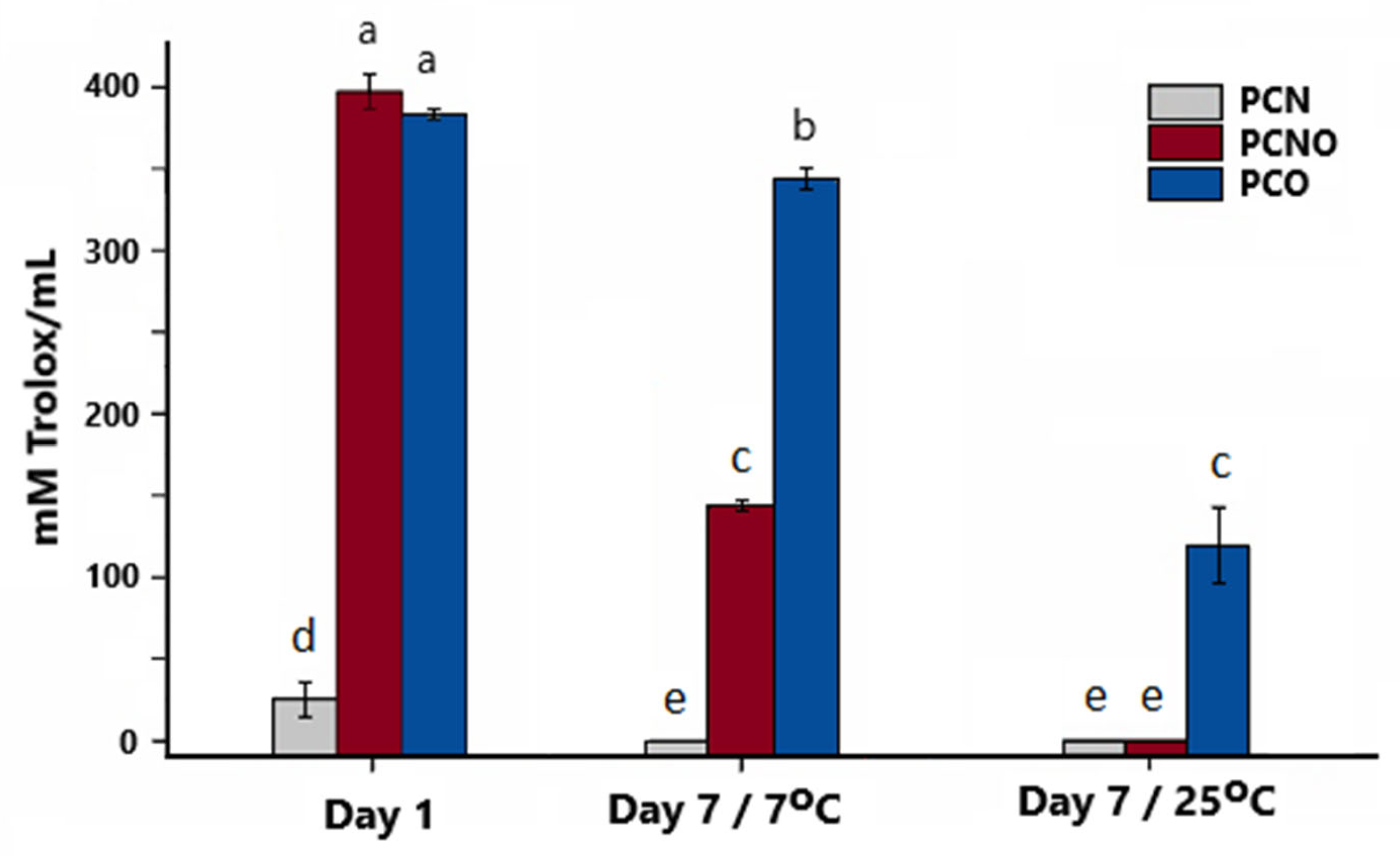
The antioxidant capacity was monitored over time using the ABTS•+ radical scavenging assay to investigate the impact of encapsulation and storage conditions on the stability oxidative behavior of the formulations. The antioxidant capacity of liposomes stored for 7 days under refrigeration and at room temperature is depicted in Figure 3. Overall, significant differences among formulations were observed from the beginning of storage (t = 0) (p < 0.05). A reduction in antioxidant activity was observed for all liposome formulations after 7 days of storage; however, this decrease was significantly lower for samples stored under refrigeration at 7 °C (p < 0.05). At the end of the storage period, only PC-O maintained detectable antioxidant activity at 25 °C (123.0 mM Trolox/mL), which was significantly lower than the values observed for the corresponding samples stored at 7 °C (p < 0.05). Under refrigerated conditions, PC-NO and PC-O presented antioxidant capacities of 142.7 and 343.2 mM Trolox/mL, respectively, with PC-O showing significantly higher values than PC-NO (p < 0.05).

4. Discussion

The combination nisin–PPEO inhibited bacteria frequently implicated in severe foodborne diseases and outbreaks associated with contaminated ready-to-eat and minimally processed foods, causing significant public health concerns worldwide [38,39]. Nisin has shown synergy with plant-derived antimicrobials against L. monocytogenes, S. aureus, B. cereus, S. Enteritidis, E. coli, and other pathogenic bacteria [15,17,19,33,40]. However, the antimicrobial effect of the combination nisin–PPEO and encapsulated nisin–PPEO against foodborne pathogens has not been previously reported. Nisin and EOs often inhibit Gram-positive bacteria better than Gram-negative ones [33,41]. Thus, the inhibition of S. Typhimurium by nisin–PPEO is important because the outer membrane of Gram-negative bacteria provides an additional barrier that prevents the passage of antimicrobial molecules to their target site, thus being a mechanism of innate resistance [42]. Although the antimicrobial effect of nisin and PPEO alone has been previously studied, the synergistic mechanism is still unknown.
Nisin and PPEO were successfully encapsulated in PC liposomes. The average diameter of liposomes was close to that reported for liposomes co-encapsulating nisin and lysozyme or nisin and garlic extract, which exhibited a particle size ranging from 86 to 116 nm [32,43]. Recent studies demonstrated that the incorporation of EOs into liposomal systems can influence the vesicle size and membrane properties. The composition of the oil and the manufacture method critically affect the physical characteristics of liposomes, including size distribution, encapsulation efficiency, and bilayer fluidity, which are important determinants of nanoparticle performance [44]. The hydrophobic constituents of EOs can interact with lipid bilayers, increasing cohesion among lipid chains and modifying membrane curvature, thereby altering liposome dimensions and structural stability [45]. Additional evidence suggests that the specific chemical composition of EOs, particularly monoterpenes and other volatiles, may influence liposome size and stability through interactions with phospholipid components [37].
Moreover, the PDI values were appropriate for systems prepared from biological materials, suggesting that the liposome population is homogeneous and the liposomes are physically stable [44]. However, the higher PDI of PC-O suggests increased size dispersion and instability for this formulation in comparison with PC-N and PC-NO.
In this work, liposomes were prepared using PC, a phospholipid holding a positive charge from the choline group and a negative charge from the phosphate group. This indicates that PC liposomes may have a net charge around zero and, consequently, low surface charge values. The negative zeta potential values often observed for PC liposomes can be associated with the binding of water molecules to PC head groups through strong interactions with phosphate groups [46], possibly directing a negative polarity to the surface. The zeta potential results observed in this work suggest moderate electrostatic repulsion and reduced colloidal stability of liposomes. Although increased stability is expected for particles showing high absolute values of zeta potential [44,47], stable liposomes with similar values to those observed in this study have been reported [28,48]. These results indicate that electrostatic repulsion is not the main stabilization mechanism in this system, and that liposome stability is likely governed by the combined influence of structural organization, lipid composition, and interactions involving the encapsulated compounds.
Nisin is a cationic peptide, holding a positive net charge due to three lysine and one histidine residues present in its structure. Thus, the incorporation of nisin promotes the modification of surface charge inducing zeta potential of the liposomes to less negative values [49]. Regarding the formulation containing PPEO, a slight increase in the magnitude of the zeta potential was observed. Recent studies have reported similar behavior for PC-based liposomes incorporating EOs. Liposomes loaded with Schinus areira EOs exhibited negative surface charges, typically ranging from −8 to −15 mV, depending on the encapsulated fraction [45]. These values are consistent with PC-based systems, in which the surface charge is predominantly determined by the zwitterionic nature of the phospholipid bilayer. Likewise, liposomes encapsulating EOs generally present zeta potential values between −5 and −20 mV, reflecting the intrinsic characteristics of the lipid composition and the stabilizing effect of hydrophobic compounds [44].
Liposomes produced by the thin film method often show high EE for nisin, and the results found in this work were similar to that reported in previous studies [28,32,36]. Although PPEO has not been previously encapsulated into liposomes, incorporation in double-layer microcapsules prepared with soy protein isolate and high methylation pectin reached a maximum oil retention of 49.4% [50]. The EE differs from one EO to another, and this difference can be explained by the physicochemical properties of the oil and/or the technique of liposome preparation, including phospholipid type and EO/lipid ratio [44,45]. A previous study also reported high EE for co-encapsulation of nisin and garlic extract, reaching 90.2% and 82.3%, respectively [33].
Further characterization of liposomes performed by FTIR revealed that the peaks observed for PC-N appear at almost the same wavenumbers to those described in previous studies, which analyzed in detail the FTIR spectra of liposomes encapsulating nisin [32,43]. PC-NO showed typical FTIR peaks of PPEO, mostly in the range of 1800−700 cm−1, in addition to 2950−2850 cm−1 for C−H, which probably consisted of the stretching vibration of the methylene groups [51]. EOs often exhibit a complex and diverse composition, and the identification of specific components can be difficult [52]. Overall, the FTIR supports that no new covalent bonds occurred, and that nisin and PPEO were incorporated into liposomes.
Although the mixture of free nisin and PPEO inhibited S. Typhimurium, the co-encapsulated nisin–PPEO was not effective. This result can be associated with the controlled release of antimicrobials encapsulated into liposomes, resulting in a relatively lower quantity available in the medium. In addition, the outer membrane of Gram-negative bacteria acts as an additional permeability barrier, limiting the penetration of antimicrobial compounds and further reducing their effectiveness. Furthermore, the ultrasound process during liposome production can cause some reduction of activity, resulting from loss of PPEO compounds responsible for antimicrobial activity. In this way, an increased concentration of the mixture nisin–PPEO may be necessary to maintain the spectrum of action after encapsulation and warrant an extended antimicrobial activity. Moreover, a synergistic effect seems limited to L. monocytogenes after co-encapsulation, which could be associated with the controlled-release behavior of liposomes and interactions with the lipid bilayer that may reduce the availability of bioactive compounds. Also, it is important to note that agar diffusion assays may underestimate the antimicrobial activity of liposomal formulations due to their limited diffusion and controlled-release behavior, and complementary assays such as MIC, MBC, and time–kill kinetics would provide a more comprehensive evaluation. These limitations highlight the need for further investigation to fully understand the behavior of the liposomes under study.
The antimicrobial activity of EOs is influenced by multiple factors, including their chemical composition, the functional groups present in their bioactive constituents, synergistic interactions among components, and the specific mechanisms by which they disturb microbial cells [45]. It should also be emphasized that these factors may vary depending on the EO type and the microbial strain evaluated. This study was performed with PPEO, which is mainly composed of monoterpenes (80.9%) and sesquiterpenes (13.9%), including α-pinene, β-pinene, β-myrcene, δ-3-carene, D-limonene, and germacrene D [23]. These terpenes have effective antimicrobial activity and are important to the bioactive properties of PPEO [41]. Although the antimicrobial mechanism of EOs is not fully elucidated, some studies proposed that the antimicrobial activity is due to aromatic nuclei with a polar functional group that acts on the rupturing of the cell membrane [45,53], whereas nisin causes injuries in the cytoplasmic membrane and hinders the peptidoglycan synthesis of Gram-positive bacteria [54]. Thus, PPEO might improve nisin action by increasing the pore size or by increasing the number of pores created by nisin in cell membranes, leading to a larger reduction of viable cells. The synergistic effect of nisin with rosemary, thyme, oregano, and dittany essential oil-containing microemulsions has been demonstrated, and it has been noted that the activity of the essential oil constituents, such as carvacrol and thymol, is enhanced by the presence of nisin [55].
The antioxidant activity of liposomes containing PPEO could be expected, since the antioxidant properties of this EO have been reported [10,41]. However, encapsulation not only prevented loss of antioxidant properties, but in fact improved the antioxidant activity of liposomes containing PPEO. This result may be attributed to the protection of bioactive molecules and the presence of phosphatidylcholine in the formulation. The antioxidant activity of phospholipids is attributable to choline and ethanolamine; the former is a side-chain moiety of PC [56]. These results suggest that at the lipid–water interface of membranes, the interactions of compounds from EO with the polar head groups of phospholipids can contribute to their antioxidant effects. Thus, the encapsulation in liposomes may influence the stability of bioactive compounds, contributing to the preservation of functional properties.

5. Conclusions

This study demonstrated that liposomes co-encapsulating nisin and PPEO represent a promising strategy to stabilize and enhance the bioactivity of natural antimicrobials with relevance to food safety. The nanostructures showed suitable physicochemical properties, demonstrated high entrapment efficiency, and maintained antimicrobial and antioxidant functions during storage, particularly under refrigeration. Co-encapsulation significantly improved the inhibitory effect against L. monocytogenes, a major foodborne pathogen, and extended antimicrobial activity over time compared with liposomes containing nisin alone. Although the formulations showed limited efficacy against Gram-negative bacteria such as Salmonella, the observed synergistic action between nisin and PPEO reinforces the potential of combining natural antimicrobials to enhance activity against specific target microorganisms. Considering the global burden of foodborne diseases and the need for safer, sustainable preservation systems, the findings support the applicability of nisin–PPEO liposomes as nanocarriers for incorporation into food systems. Their ability to stabilize volatile compounds, enhance antimicrobial performance, and preserve antioxidant properties underscores their potential to improve microbial control in foods, contributing to public health protection and the reduction of foodborne-illness risks.

Author Contributions

Conceptualization, N.A.L. and V.R.N.; methodology, N.A.L. and A.R.L.-P.; formal analysis, N.A.L. and A.R.L.-P.; investigation, N.A.L. and A.R.L.-P.; data curation, N.A.L.; writing—original draft preparation, N.A.L.; writing—review and editing, A.B.; project administration, V.R.N.; funding acquisition, A.B. All authors have read and agreed to the published version of the manuscript.

Funding

This research was funded by Conselho Nacional de Desenvolvimento Científico e Tecnológico (Brazil), grant numbers 308880/2021-8 and 405165/2023-4.

Institutional Review Board Statement

Not applicable.

Informed Consent Statement

Not applicable.

Data Availability Statement

All related data and methods are presented in this paper. Additional inquiries should be addressed to the corresponding author.

Conflicts of Interest

The authors declare no conflicts of interest.

Abbreviations

The following abbreviations are used in this manuscript:
PCPhosphatidylcholine
PPEOPink pepper essential oil
EOsEssential oils
EEEntrapment efficiency
FTIRFourier-transform infrared spectroscopy

References

  1. Hashemi, M.; Salayani, M.; Afshari, A.; Kafil, H.S.; Noori, S.M.A. The global burden of viral food-borne diseases: A systematic review. Curr. Pharm. Biotechnol. 2023, 24, 1657–1672. [Google Scholar] [CrossRef] [PubMed]
  2. Pires, S.M.; Desta, B.N.; Mughini-Gras, L.; Mmbaga, B.T.; Fayemi, O.E.; Salvador, E.M.; Gobena, T.; Majowicz, S.E.; Hald, T.; Hoejskov, P.S.; et al. Burden of foodborne diseases: Think global, act local. Curr. Opin. Food Sci. 2021, 39, 152–159. [Google Scholar] [CrossRef] [PubMed]
  3. Rossi, G.A.M.; Pereira, J.G.; Nitschke, M. Epidemiology, prevention and control of foodborne microbial pathogens. Microorganisms 2025, 13, 1435. [Google Scholar] [CrossRef] [PubMed]
  4. Todd, E. Food-borne disease prevention and risk assessment. Int. J. Environ. Res. Public Health 2020, 17, 5129. [Google Scholar] [CrossRef]
  5. Abdelhamid, A.G.; El-Dougdoug, N.K. Controlling foodborne pathogens with natural antimicrobials by biological control and antivirulence strategies. Heliyon 2020, 6, e05020. [Google Scholar] [CrossRef] [PubMed]
  6. Paparella, A.; Maggio, F. Detection and control of foodborne pathogens. Foods 2023, 12, 3521. [Google Scholar] [CrossRef] [PubMed]
  7. Neto, L.G.S.; Ribeiro, J.S.; Nunes, M.L.; Campelo, P.H.; Silva, F.A.S.; Madruga, M.S. Antioxidant and antimicrobial properties of essential oils incorporated into biodegradable films for food packaging applications. Food Packag. Shelf Life 2024, 33, 101152. [Google Scholar]
  8. Torre, R.; Medeiros, E.A.D.P.; Pereira, C.S.B.; Menezes, A.C.R.; Fontes, I.S.; Pereira, L.V.R.; Paiva, D.H.F.; Santos, A.M.; Damasceno Júnior, P.C.; Souza, M.A.A. Protection of cowpea seeds and toxicity against cowpea weevils by the essential oils from Lippia alba and Schinus terebinthifolius. Crop Protec. 2024, 180, 106670. [Google Scholar] [CrossRef]
  9. Tschoeke, L.F.P.; de Melo, J.P.R.; da Silva Filho, J.G.; Aquino, P.G.V.; Melo Júnior, J.L.A.; Bernardo, V.B.; Santana, A.E.G.; Santoro, K.R.; Monteiro, V.B.; Badji, C.A. Insecticidal activity of Schinus terebinthifolius essential oil for the management of permethrin-resistant Sitophilus zeamais (Coleoptera: Curculionidae). J. Asia Pac. Entomol. 2024, 27, 102301. [Google Scholar] [CrossRef]
  10. Barreira, C.F.T.; Oliveira, V.S.; Chávez, D.W.H.; Gamallo, O.D.; Castro, R.N.; Damasceno Júnior, P.C.; Sawaya, A.C.H.F.; Ferreira, M.S.; Sampaio, G.R.; Torres, E.A.F.D.S.; et al. The impacts of pink pepper (Schinus terebinthifolius Raddi) on fatty acids and cholesterol oxides formation in canned sardines during thermal processing. Food Chem. 2023, 403, 134347. [Google Scholar] [PubMed]
  11. Hamad, G.M.; Abushaala, N.M.; Soltan, O.I.A.; Abdel-Hameed, S.M.; Magdy, R.M.E.; Ahmed, E.M.H.; Elshaer, S.E.; Kamar, A.M.; Hashem, R.M.A.; Elghazaly, E.M.; et al. Prevalence and antibacterial effect of natural extracts against Vibrio parahaemolyticus and its application on Tilapia fillets. LWT Food Sci. Technol. 2024, 209, 116812. [Google Scholar] [CrossRef]
  12. Moser, P.; Lopes, N.A.; Locali-Pereira, A.R.; Nicoletti, V.R. Long-term storage of pink pepper essential oil microencapsulated by chickpea protein/pectin complexes: Volatile release, antioxidant and antimicrobial activities. J. Food Sci. Technol. 2024, 61, 2411–2421. [Google Scholar] [PubMed]
  13. Silva, N.S.S.; Silva, G.S.; Grisi, C.V.B.; Vieira, V.B.; Dantas, C.E.A.; Guimarães, G.H.C.; Maciel, M.I.S. Effect of yam starch coating with aroeira leaf extract on post-harvest quality preservation of ‘Tommy’ mangoes. Food Control 2026, 180, 111659. [Google Scholar]
  14. Torres, M.R.; Pires, J.B.; Lemos, G.S.; Silva, F.T.; Souza, E.J.D.; Santos, F.N.; Siebeneichler, T.J.; Gandra, E.A.; Colussi, R.; Zavareze, E.R. Gelatin film incorporated with pink pepper essential oil: Physical properties and antimicrobial activity through direct contact and microatmosphere. J. Drug Deliv. Sci. Technol. 2025, 109, 106997. [Google Scholar]
  15. Zhang, M.; Luo, W.; Yang, K.; Li, C. Effects of sodium alginate edible coating with cinnamon essential oil nanocapsules and nisin on quality and shelf life of beef slices during refrigeration. J. Food Prot. 2022, 85, 896–905. [Google Scholar] [CrossRef] [PubMed]
  16. Araújo, M.K.; Gumiela, A.M.; Bordin, K.; Luciano, F.B.; Macedo, R.E.F. Combination of garlic essential oil, allyl isothiocyanate, and nisin Z as bio-preservatives in fresh sausage. Meat Sci. 2018, 143, 177–183. [Google Scholar] [CrossRef] [PubMed]
  17. Hossain, M.I.; Mizan, M.F.R.; Toushik, S.H.; Roy, P.K.; Jahid, I.K.; Park, S.H.; Ha, S.D. Antibiofilm effect of nisin alone and combined with food-grade oil components (thymol and eugenol) against Listeria monocytogenes cocktail culture on food and food-contact surfaces. Food Control 2022, 135, 108796. [Google Scholar]
  18. Sarkar, P.; Bhunia, A.K.; Yao, Y. Impact of starch-based emulsions on the antibacterial efficacies of nisin and thymol in cantaloupe juice. Food Chem. 2017, 217, 155–162. [Google Scholar] [CrossRef] [PubMed]
  19. Zhang, J.; Li, Y.; Yang, X.; Liu, X.; Hong, H.; Luo, Y. Effects of oregano essential oil and nisin on the shelf life of modified-atmosphere-packed grass carp (Ctenopharyngodon idellus). LWT Food Sci. Technol. 2021, 147, 111609. [Google Scholar]
  20. Nissa, A.; Utami, R.; Sari, A.M.; Nursiwi, A. Combination effect of nisin and red ginger essential oil (Zingiber officinale var. rubrum) against foodborne pathogens and food spoilage microorganisms. AIP Conf. Proc. 2018, 2014, 020023. [Google Scholar] [CrossRef]
  21. Shin, J.M.; Gwak, J.W.; Kamarajan, P.; Fenno, J.C.; Rickard, A.H.; Kapila, Y.L. Biomedical applications of nisin. J. Appl. Microbiol. 2016, 120, 1449–1465. [Google Scholar] [PubMed]
  22. Tavares, T.D.; Ribeiro, A.R.M.; Silva, C.; Antunes, J.C.; Felgueiras, H.P. Combinatory effect of nisin antimicrobial peptide with bioactive molecules: A review. J. Drug Deliv. Sci. Technol. 2024, 91, 105246. [Google Scholar] [CrossRef]
  23. Locali-Pereira, A.R.; Lopes, N.A.; Menis-Henrique, M.E.C.; Janzantti, N.S.; Nicoletti, V.R. Modulation of volatile release and antimicrobial properties of pink pepper essential oil by microencapsulation in single-and double-layer structured matrices. Int. J. Food Microbiol. 2020, 335, 108890. [Google Scholar] [PubMed]
  24. Esposto, B.S.; Jauregi, P.; Tapia-Blacido, D.R.; Martelli-Tosi, M. Liposomes vs. chitosomes: Encapsulating food bioactives. Trends Food Sci. Technol. 2021, 108, 40–48. [Google Scholar] [CrossRef]
  25. Liu, W.; Ye, A.; Han, F.; Han, J. Advances and challenges in liposome digestion: Surface interaction, biological fate, and GIT modeling. Adv. Colloid Interface Sci. 2019, 263, 52–67. [Google Scholar] [CrossRef] [PubMed]
  26. Tan, C.; Wang, J.; Sun, B. Biopolymer-liposome hybrid systems for controlled delivery of bioactive compounds: Recent advances. Biotechnol. Adv. 2021, 48, 107727. [Google Scholar] [CrossRef] [PubMed]
  27. Lopes, N.A.; Mertins, O.; Pinilla, C.M.B.; Brandelli, A. Nisin induces lamellar to cubic liquid-crystalline transition in pectin and polygalacturonic acid liposomes. Food Hydrocoll. 2021, 112, 106320. [Google Scholar] [CrossRef]
  28. Wienke, S.H.; Pinilla, C.M.B.; Contri, R.V.; Brandelli, A. Development of polyelectrolyte-coated liposomes as nanostructured systems for nisin delivery: Antimicrobial activity and long-term stability. Food Biophys. 2024, 19, 994–1006. [Google Scholar]
  29. Chen, X.; Wu, J.; Aziz, T.; Alharbi, N.K.; Shami, A.; Al-Asmari, F.; Al-Joufi, F.A.; Alghamdi, A.M.; Lin, L. Toxin-responsive Litsea cubeba essential oil liposomes for enhancing beef safety by inhibiting Clostridium perfringens and its exotoxin activity. Food Biosci. 2025, 73, 107759. [Google Scholar] [CrossRef]
  30. Gan, N.; Li, Q.; Li, Y.; Li, M.; Li, Y.; Chen, L.; Zeng, T.; Song, Y.; Geng, F.; Wu, D. Encapsulation of lemongrass essential oil by bilayer liposomes based on pectin, gum Arabic, and carrageenan: Characterization and application in chicken meat preservation. Int. J. Biol. Macromol. 2024, 281, 135706. [Google Scholar] [CrossRef] [PubMed]
  31. Ma, Y.; Wang, W.; Cao, Y.; Song, Z.; Yu, Q. Development of multifunctional liposomes co-loaded with proanthocyanidins and cinnamon essential oil: Storage stability, antioxidant and antibacterial activities, and sustained release study. Food Biosci. 2025, 72, 107492. [Google Scholar] [CrossRef]
  32. Lopes, N.A.; Pinilla, C.M.B.; Brandelli, A. Antimicrobial activity of lysozyme-nisin co-encapsulated in liposomes coated with polysaccharides. Food Hydrocoll. 2019, 93, 1–9. [Google Scholar]
  33. Pinilla, C.M.B.; Brandelli, A. Antimicrobial activity of nanoliposomes co-encapsulating nisin and garlic extract against Gram-positive and Gram-negative bacteria in milk. Innov. Food Sci. Emerg. Technol. 2016, 36, 287–293. [Google Scholar]
  34. Motta, A.S.; Brandelli, A. Characterization of an antibacterial peptide produced by Brevibacterium linens. J. Appl. Microbiol. 2002, 92, 63–70. [Google Scholar] [CrossRef] [PubMed]
  35. Parente, E.; Brienza, C.; Moles, M.; Ricciardi, A. A comparison of methods for the measurement of bacteriocin activity. J. Microbiol. Methods 1995, 22, 95–108. [Google Scholar] [CrossRef]
  36. Malheiros, P.S.; Sant’Anna, V.; Barbosa, M.S.; Brandelli, A.; Franco, B.D.G.M. Effect of liposome-encapsulated nisin and bacteriocin-like substance P34 on Listeria monocytogenes growth in Minas frescal cheese. Int. J. Food Microbiol. 2012, 156, 272–277. [Google Scholar] [PubMed]
  37. Wang, J.; Jiang, X.; Feng, L.; Han, J.; Li, Y.; Wang, X.; Kitazawa, H.; Guo, Y.; Li, L. Colloidal stability of Salvia officinalis essential oil nano-liposomes and its antioxidant and antibacterial dual effect in postharvest preservation of Agaricus bisporus. Food Control. 2025, 178, 111496. [Google Scholar] [CrossRef]
  38. de Sousa, F.G.; Fraga, R.M.L.; Mendes, A.C.R.; Souza, R.C.; Beier, S.L. Listeria monocytogenes: A foodborne pathogen with implications for One Health and the Brazilian context. Microorganisms 2025, 13, 2280. [Google Scholar] [CrossRef] [PubMed]
  39. Weinstein, E.; Lamba, K.; Bond, C.; Peralta, V.; Needham, M.; Beam, S.; Arroyo, F.; Kiang, D.; Chen, Y.; Shah, S.; et al. Outbreak of Salmonella Typhimurium infections linked to commercially distributed raw milk—California and four other States. MMWR Morb. Mortal. Wkly. Rep. 2025, 74, 433–438. [Google Scholar] [PubMed]
  40. Timbe, P.P.R.; Motta, A.S.; Stincone, P.; Pinilla, C.M.B.; Brandelli, A. Antimicrobial activity of Baccharis dracunculifolia DC and its synergistic interaction with nisin against food-related bacteria. J. Food Sci. Technol. 2020, 57, 4804–4813. [Google Scholar]
  41. Dannenberg, G.S.; Funck, G.D.; Mattei, F.J.; da Silva, W.P.; Fiorentini, A.M. Antimicrobial and antioxidant activity of essential oil from pink pepper tree (Schinus terebinthifolius Raddi) in vitro and in cheese experimentally contaminated with Listeria monocytogenes. Innov. Food Sci. Emerg. Technol. 2016, 36, 120–127. [Google Scholar] [CrossRef]
  42. Maher, C.; Hassan, K.A. The Gram-negative permeability barrier: Tipping the balance of the in and the out. mBio 2023, 14, e01205-23. [Google Scholar] [CrossRef] [PubMed]
  43. Pinilla, C.M.B.; Reque, P.M.; Brandelli, A. Effect of oleic acid, cholesterol, and octadecylamine on membrane stability of freeze-dried liposomes encapsulating natural antimicrobials. Food Bioprocess Technol. 2020, 13, 599–610. [Google Scholar] [CrossRef]
  44. Yammine, J.; Chihib, N.E.; Gharsallaoui, A.; Ismail, A.; Karam, L. Advances in essential oils encapsulation: Development, characterization and release mechanisms. Polym. Bull. 2024, 81, 3837–3882. [Google Scholar]
  45. Cutró, A.C.; Maillard, A.F.; Dalmasso, P.R.; Rodriguez, S.A.; Hollmann, A. Antimicrobial nanoformulations based on Schinus areira essential oil in phosphatidylcholine liposomes. Polymers 2023, 2, 26. [Google Scholar]
  46. Pasenkiewicz-Gierula, M.; Baczynski, K.; Markievicz, M.; Murzyn, K. Computer modelling studies of the bilayer/water interface. Biochim. Biophys. Acta Biomembr. 2016, 1858, 2305–2321. [Google Scholar] [CrossRef]
  47. Laouini, A.; Jaafar-Maalej, C.; Limayem-Blouza, I.; Sfar, S.; Charcosset, C.; Fessi, H. Preparation, characterization and applications of liposomes: State of the art. J. Colloid Sci. Biotechnol. 2012, 1, 147–168. [Google Scholar] [CrossRef]
  48. Taylor, T.M.; Gaysinsky, S.; Davidson, P.M.; Bruce, B.D.; Weiss, J. Characterization of antimicrobial-bearing liposomes by ζ-potential, vesicle size, and encapsulation efficiency. Food Biophys. 2007, 2, 1–9. [Google Scholar]
  49. Imran, M.; Revol-Junelles, A.M.; Paris, C.; Guedon, E.; Linder, M.; Desobry, S. Liposomal nanodelivery systems using soy and marine lecithin to encapsulate food biopreservative nisin. LWT Food Sci. Technol. 2015, 62, 341–349. [Google Scholar] [CrossRef]
  50. Locali-Pereira, A.R.; Cattelan, M.G.; Nicoletti, V.R. Microencapsulation of pink pepper essential oil: Properties of spray-dried pectin/SPI double-layer versus SPI single-layer stabilized emulsions. Colloids Surf. A Physicochem. Eng. Asp. 2019, 581, 123806. [Google Scholar]
  51. Amalraj, A.; Haponiuk, J.T.; Thomas, S.; Gopi, S. Preparation, characterization and antimicrobial activity of polyvinyl alcohol/gum arabic/chitosan composite films incorporated with black pepper essential oil and ginger essential oil. Int. J. Biol. Macromol. 2020, 151, 366–375. [Google Scholar] [PubMed]
  52. Li, Y.; Kong, D.; Wu, H. Analysis and evaluation of essential oil components of cinnamon barks using GC–MS and FTIR spectroscopy. Ind. Crops Prod. 2013, 41, 269–278. [Google Scholar] [CrossRef]
  53. Guimarães, A.C.; Meireles, L.M.; Lemos, M.F.; Guimarães, M.C.F.; Endringer, D.C.; Fronza, M.; Scherer, R. Antibacterial activity of terpenes and terpenoids present in essential oils. Molecules 2019, 24, 2471. [Google Scholar] [CrossRef] [PubMed]
  54. Chung, W.; Hancock, R.E. Action of lysozyme and nisin mixtures against lactic acid bacteria. Int. J. Food Microbiol. 2000, 60, 25–32. [Google Scholar] [CrossRef]
  55. Chatzidaki, M.D.; Balikza, F.; Gada, E.; Alexandraki, V.; Arvanitidis, S.; Georgalaki, M.; Papadimitriou, V.; Tsakalidou, E.; Papadimitriou, K.; Xenakis, A. Reverse micelles as nano-carriers of nisin against foodborne pathogens. Part II: The case of essential oils. Food Chem. 2019, 278, 415–423. [Google Scholar] [CrossRef] [PubMed]
  56. Saito, H.; Ishihara, K. Antioxidant activity and active sites of phospholipids as antioxidants. J. Am. Oil Chem. Soc. 1997, 74, 1531–1536. [Google Scholar] [CrossRef]
Figure 1. Fourier-transform infrared (FTIR) spectra of free nisin, free PPEO, and liposomal formulations containing nisin (PC-N), nisin plus PPEO (PC-NO), and PPEO (PC-O). Shadow zones correspond to typical peaks of C-H stretching (blue, 2950–2800 cm−1); carbonyl stretching (green, 1750–1725 cm−1); and amide bands, C-H bending, and phosphate stretching (grey, 1650–1220 cm−1).
Bacteria 05 00038 g001
Figure 2. (A) Antimicrobial activity of liposomes encapsulating nisin (PC-N), PPEO (PC-O), and nisin–PPEO mixture (PC-NO). (B) Inhibition of L. monocytogenes by serial dilutions of liposomes containing nisin (N, upper panel) and nisin–PPEO mixture (N+O, lower plate). Data are expressed as mean ± standard deviation (n = 3). Different letters indicate significant differences among treatments (one-way ANOVA followed by Tukey’s post hoc test, p < 0.05).
Bacteria 05 00038 g002
Figure 3. Trolox equivalent antioxidant activity (mM Trolox/mL sample) of liposomes encapsulating nisin (PC-N), PPEO (PC-O), and nisin–PPEO mixture (PC-NO) at time t = 1 day and t = 7 days of storage. Data are expressed as mean ± standard deviation (n = 3). Different letters indicate significant differences among treatments (one-way ANOVA followed by Tukey’s post hoc test, p < 0.05).
Bacteria 05 00038 g003
Table 1. Characterization of phosphatidylcholine liposomes (PC) containing nisin (N) and pink pepper essential oil (O) *.
ParameterPC-NPC-NOPC-O
Particle size (nm)107.9 ± 0.9 a100.3 ± 2.7 b91.2 ± 1.5 c
PDI0.25 ± 0.01 b0.27 ± 0.02 b0.48 ± 0.01 a
ζ-potential (mV)−3.73 ± 0.9 a−4.99 ± 0.06 a−7.39 ± 0.24 b
* Different superscript letters in the same row indicate significant differences (p < 0.05). Values are the means ± standard deviation of three independent experiments.
Table 2. Antimicrobial activity of liposomes containing nisin and pink pepper essential oil in milk-agar against different Gram-positive bacteria *.
Inhibition Zone (mm)
AntimicrobialListeria monocytogenesListeria innocuaBacillus subtilis
Free nisin11.1 ± 0.3 cC14.6 ± 1.5 cB25.1 ± 0.7 aA
Free nisin–PPEO28.9 ± 1.3 aA30.1 ± 0.4 aA24.6 ± 0.5 bB
PC-N8.2 ± 0.5 dC25.9 ± 1.1 bA21.1 ± 0.4 cB
PC-NO24.0 ± 1.1 bC29.6 ± 0.3 aA26.2 ± 0.4 aB
* Different lowercase letters indicate significant differences among formulations within the same column (same bacterium). Different uppercase letters indicate significant differences among bacteria within the same row (same antimicrobial) (Tukey’s test, p < 0.05). Values are means ± standard deviations of three independent experiments.
Disclaimer/Publisher’s Note: The statements, opinions and data contained in all publications are solely those of the individual author(s) and contributor(s) and not of MDPI and/or the editor(s). MDPI and/or the editor(s) disclaim responsibility for any injury to people or property resulting from any ideas, methods, instructions or products referred to in the content.