
Chemical Composition, Antibacterial, and Antioxidant Activities of L. angustifolia Essential Oil Against Human Pathogenic Clinical Bacterial Isolates


Abstract
1. Introduction
2. Materials and Methods
2.1. Chemicals
2.2. Essential Oil
2.3. Essential Oil Analysis
2.4. Antibacterial Activity
2.4.1. Target Organisms
2.4.2. Agar Disk Diffusion Test
2.4.3. Determination of Minimum Inhibitory Concentration
2.5. Growth Inhibition Assay
2.6. Determination of Antibiofilm Activity
2.6.1. Inhibition of Biofilm Formation
2.6.2. Eradication of Pre-Formed Biofilms
2.7. Determination of Antioxidant Activities
2.8. Membrane Integrity
2.9. Statistical Analysis
3. Results
3.1. GC-MS Analysis
3.2. Antibacterial Activity of L. angustifolia Essential Oil
3.3. Growth Inhibition Assay of L. angustifolia Essential Oil
3.4. Biofilm Inhibition and Eradication Activity
3.5. Effect of L. angustifolia on Bacterial Antioxidant Enzymes
3.6. Effect of LEO on Membrane Integrity
4. Discussion
5. Conclusions
Author Contributions
Funding
Institutional Review Board Statement
Informed Consent Statement
Data Availability Statement
Conflicts of Interest
Abbreviations
| LEO | L. angustifolia essential oil |
| GC-MS | Gas chromatography-mass spectrometry |
| SOD | Superoxide dismutase |
| CAT | Catalase |
| WHO | World Health Organization |
| PMs | Primary metabolites |
| SMs | Secondary metabolites |
| ROS | Reactive oxygen species |
| Eos | Essential oils |
| NO | Nitric oxide |
| NMDA | N-methyl-d-aspartate |
| Na2HPO4 | Sodium phosphate dibasic anhydrous |
| NaH2PO4 | Sodium phosphate monobasic |
| H2O2 | Hydrogen peroxide |
| TSA | Tryptic soy agar |
| PMSF | Phenylmethylsulfonyl fluoride |
| EO | Essential oil |
| MIC | Minimum inhibitory concentration |
| CLSI | Clinical and laboratory standards institute |
| MBC | Minimum bactericidal concentration |
| SD | Standard deviation |
References
- Tufa, T.B.; Regassa, F.; Amenu, K.; Stegeman, J.A.; Hogeveen, H. Livestock Producers’ Knowledge, Attitude, and Behavior (KAB) Regarding sub Use in Ethiopia. Front. Vet. Sci. 2023, 10, 1167847. [Google Scholar] [CrossRef]
- Goss, M.J.; Tubeileh, A.; Goorahoo, D. A Review of the Use of Organic Amendments and the Risk to Human. Adv. Agron. 2013, 120, 275–379. [Google Scholar] [CrossRef]
- Ibtissem, S.; Feriel, R.; Assia, B.; Fatiha, C.; Naziha, A.; Saloua, N. Importance of Natural Plants in Human Health. Ecol. Environ. Conserv. 2022, 28, 86. [Google Scholar] [CrossRef]
- Ahmad Khan, M.S.; Ahmad, I. Herbal Medicine: Current Trends and Future Prospects; Elsevier Inc.: Amsterdam, The Netherlands, 2018. [Google Scholar] [CrossRef]
- Arip, M.; Selvaraja, M.; Mogana, R.; Tan, L.F.; Leong, M.Y.; Tan, P.L.; Yap, V.L.; Chinnapan, S.; Tat, N.C.; Abdullah, M.; et al. Review on Plant-Based Management in Combating Antimicrobial Resistance—Mechanistic Perspective. Front. Pharmacol. 2022, 13, 879495. [Google Scholar] [CrossRef]
- Dobros, N.; Zawada, K.D.; Paradowska, K. Phytochemical Profiling, Antioxidant and Anti-Inflammatory Activity of Plants Belonging to the Lavandula Genus. Molecules 2023, 28, 256. [Google Scholar] [CrossRef]
- Salehi, B.; Mnayer, D.; Özçelik, B.; Altin, G.; Kasapoǧlu, K.N.; Daskaya-Dikmen, C.; Sharifi-Rad, M.; Selamoglu, Z.; Acharya, K.; Sen, S.; et al. Plants of the Genus Lavandula: From Farm to Pharmacy. Nat. Prod. Commun. 2018, 13, 1385–1402. [Google Scholar] [CrossRef]
- Batiha, G.E.S.; Teibo, J.O.; Wasef, L.; Shaheen, H.M.; Akomolafe, A.P.; Teibo, T.K.A.; Al-kuraishy, H.M.; Al-Garbeeb, A.I.; Alexiou, A.; Papadakis, M. A Review of the Bioactive Components and Pharmacological Properties of Lavandula Species. Naunyn-Schmiedeberg’s Arch. Pharmacol. 2023, 396, 877–900. [Google Scholar] [CrossRef] [PubMed]
- Yap, P.S.X.; Krishnan, T.; Yiap, B.C.; Hu, C.P.; Chan, K.G.; Lim, S.H.E. Membrane Disruption and Anti-Quorum Sensing Effects of Synergistic Interaction between Lavandula angustifolia (Lavender Oil) in Combination with Antibiotic against Plasmid-Conferred Multi-Drug-Resistant Escherichia coli. J. Appl. Microbiol. 2014, 116, 1119–1128. [Google Scholar] [CrossRef]
- Blažeković, B.; Yang, W.; Wang, Y.; Li, C.; Kindl, M.; Pepeljnjak, S.; Vladimir-Knežević, S. Chemical Composition, Antimicrobial and Antioxidant Activities of Essential Oils of Lavandula × intermedia ‘Budrovka’ and L. angustifolia Cultivated in Croatia. Ind. Crops Prod. 2018, 123, 173–182. [Google Scholar] [CrossRef]
- Gismondi, A.; Di, G.; Luigi, E.; Ferrucci, L.; Cantonetti, M.; Canini, A. The Antimicrobial Activity of Lavandula angustifolia Mill. Essential Oil against Staphylococcus Species in a Hospital Environment. J. Herb. Med. 2021, 26, 100426. [Google Scholar] [CrossRef]
- Stamova, S.; Ermenlieva, N.; Tsankova, G.; Georgieva, E. Antimicrobial Activity of Lavender Essential Oil from Lavandula angustifolia Mill.: In Vitro and In Silico Evaluation. Antibiotics 2025, 14, 656. [Google Scholar] [CrossRef]
- Nazzaro, F.; Fratianni, F.; De Martino, L.; Coppola, R.; De Feo, V. Effect of Essential Oils on Pathogenic Bacteria. Pharmaceuticals 2013, 6, 1451–1474. [Google Scholar] [CrossRef] [PubMed]
- Marc, M.; Mincea, M.; Ostafe, V. Comparison of Different Extraction Methods of Essential Oils from Lavandula angustifolia and Detection of Target Compoundswith UPLC-MS/MS. New Front. Chem. 2016, 25, 83–94. [Google Scholar]
- ISO 3515:2002; Oil of Lavender (Lavandula angustifolia Mill.). International Organization for Standardization: Geneva, Switzerland, 2002.
- European Committe on Antimicrobial Susceptibility Testing (EUCAST). Antimicrobial Susceptibility Testing EUCAST Disk Diffusion Method, Version 9.0; European Society of Clinical Microbiology and Infectious Diseases: Basel, Switzerland, 2021; pp. 1–21. [Google Scholar]
- Clinical and Laboratory Standards Institute (CLSI). Performance Standards for Antimicrobial Susceptibility Testing, 29th ed.; CLSI Supplement M100; Clinical and Laboratory Standards Institute: Wayne, PA, USA, 2019. [Google Scholar]
- Ike, K.A.; Omaliko, P.C.; Fernander, M.C.; Sanders, B.M.; Enikuomehin, J.M.; Alabi, J.O.; Adelusi, O.O.; Kholif, A.E.; Thomas, M.D.; Anele, U.Y. Evaluating the Effect of an Essential Oil Blend on the Growth and Fitness of Gram-Positive and Gram-Negative Bacteria. Biology 2025, 14, 437. [Google Scholar] [CrossRef]
- Ben Abdallah, F.; Lagha, R.; Gaber, A. Biofilm Inhibition and Eradication Properties of Medicinal Plant Essential Oils against Methicillin-Resistant Staphylococcus aureus Clinical Isolates. Pharmaceuticals 2020, 13, 369. [Google Scholar] [CrossRef] [PubMed]
- Bio-Rad Laboratories. Quick Start Bradford Protein Assay Instruction Manual; Bio-Rad Laboratories: Hercules, CA, USA, 2011. [Google Scholar]
- Buege, J.A.; Aust, S.D. Biomembranes—Part C: Biological Oxidations. Methods Enzymol. 1978, 52, 302–310. [Google Scholar] [PubMed]
- Hyun, J.; Ho, K.; Seul, Y.; In, H.; Jo, C. Synergistic Bactericidal Effect of Clove Oil and Encapsulated Atmospheric Pressure Plasma against Escherichia coli O157: H7 and Staphylococcus aureus and Its Mechanism of Action. Food Microbiol. 2021, 93, 103611. [Google Scholar] [CrossRef]
- Bolouri, P.; Salami, R.; Kouhi, S.; Kordi, M.; Asgari Lajayer, B.; Hadian, J.; Astatkie, T. Applications of Essential Oils and Plant Extracts in Different Industries. Molecules 2022, 27, 8999. [Google Scholar] [CrossRef]
- Massoud, R.I.; Bouaziz, M.; Abdallah, H.; Zeiz, A.; Flamini, G.; El-Dakdouki, M.H. Comparative Study on the Chemical Composition and Biological Activities of the Essential Oils of Lavandula angustifolia and Lavandula × Intermedia Cultivated in Lebanon. ACS Omega 2024, 9, 30244–30255. [Google Scholar] [CrossRef]
- Silva, L.N.; Zimmer, K.R.; Macedo, A.J.; Trentin, D.S. Plant Natural Products Targeting Bacterial Virulence Factors. Chem. Rev. 2016, 116, 9162–9236. [Google Scholar] [CrossRef]
- Mączka, W.; Duda-Madej, A.; Grabarczyk, M.; Wińska, K. Natural Compounds in the Battle against Microorganisms—Linalool. Molecules 2022, 27, 6928. [Google Scholar] [CrossRef]
- Zhong, Q.; Chen, W. Antibacterial Activity and Mechanism of Linalool against Shewanella putrefaciens. Molecules 2021, 26, 245. [Google Scholar] [CrossRef]
- Jianu, C.; Pop, G.; Gruia, A.T.; Horhat, F.G. Chemical Composition and Antimicrobial Activity of Essential Oils of Lavender (Lavandula angustifolia) and Lavandin (Lavandula × intermedia) Grown in Western Romania. Int. J. Agric. Biol. 2013, 15, 772–776. [Google Scholar]
- Truong, S.; Mudgil, P. The Antibacterial Effectiveness of Lavender Essential Oil against Methicillin-Resistant Staphylococcus aureus: A Systematic Review. Front. Pharmacol. 2023, 14, 1306003. [Google Scholar] [CrossRef]
- Di Vito, M.; Smolka, A.; Proto, M.R.; Barbanti, L.; Gelmini, F.; Napoli, E.; Bellardi, M.G.; Mattarelli, P.; Beretta, G.; Sanguinetti, M.; et al. Is the Antimicrobial Activity of Hydrolates Lower than That of Essential Oils? Antibiotics 2021, 10, 88. [Google Scholar] [CrossRef] [PubMed]
- Barut Gök, S.; Erdoğdu, Y. Chemical Composition and Antimicrobial Activity of Essential Oils from Six Lavender (Lavandula angustifolia Mill.) Cultivars. Plant Soil Environ. 2024, 70, 111–123. [Google Scholar] [CrossRef]
- Garzoli, S.; Masci, V.L.; Franceschi, S.; Tiezzi, A.; Giacomello, P.; Ovidi, E. Headspace/Gc–Ms Analysis and Investigation of Antibacterial, Antioxidant and Cytotoxic Activity of Essential Oils and Hydrolates from Rosmarinus officinalis and Lavandula angustifolia Miller. Foods 2021, 10, 1768. [Google Scholar] [CrossRef] [PubMed]
- Perry, E.K.; Tan, M.W. Bacterial Biofilms in the Human Body: Prevalence and Impacts on Health and Disease. Front. Cell. Infect. Microbiol. 2023, 13, 1237164. [Google Scholar] [CrossRef]
- Guerra, M.E.S.; Destro, G.; Vieira, B.; Lima, A.S.; Ferraz, L.F.C.; Hakansson, A.P.; Darrieux, M.; Converso, T.R. Klebsiella pneumoniae Biofilms and Their Role in Disease Pathogenesis. Front. Cell. Infect. Microbiol. 2022, 12, 877995. [Google Scholar] [CrossRef]

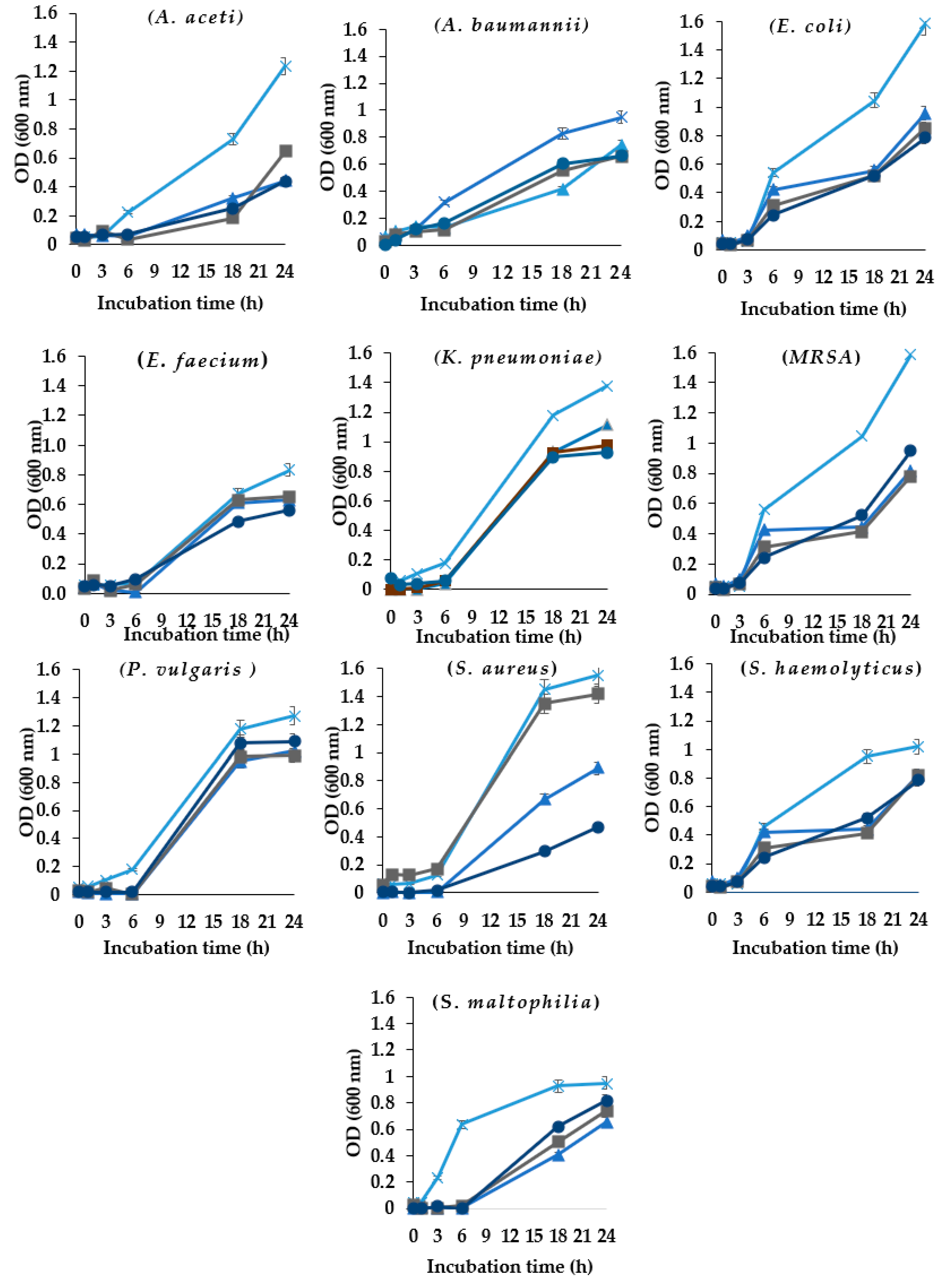
 ) Growth Control; (
 ) 0.5 MIC; (
 ) MIC; (
 ) 2 MIC. Each point represents the mean of three determinations ± SD.
) Growth Control; () 0.5 MIC; () MIC; () 2 MIC. Each point represents the mean of three determinations ± SD.
) 2 MIC. Each point represents the mean of three determinations ± SD.
) Growth Control; () 0.5 MIC; () MIC; () 2 MIC. Each point represents the mean of three determinations ± SD.
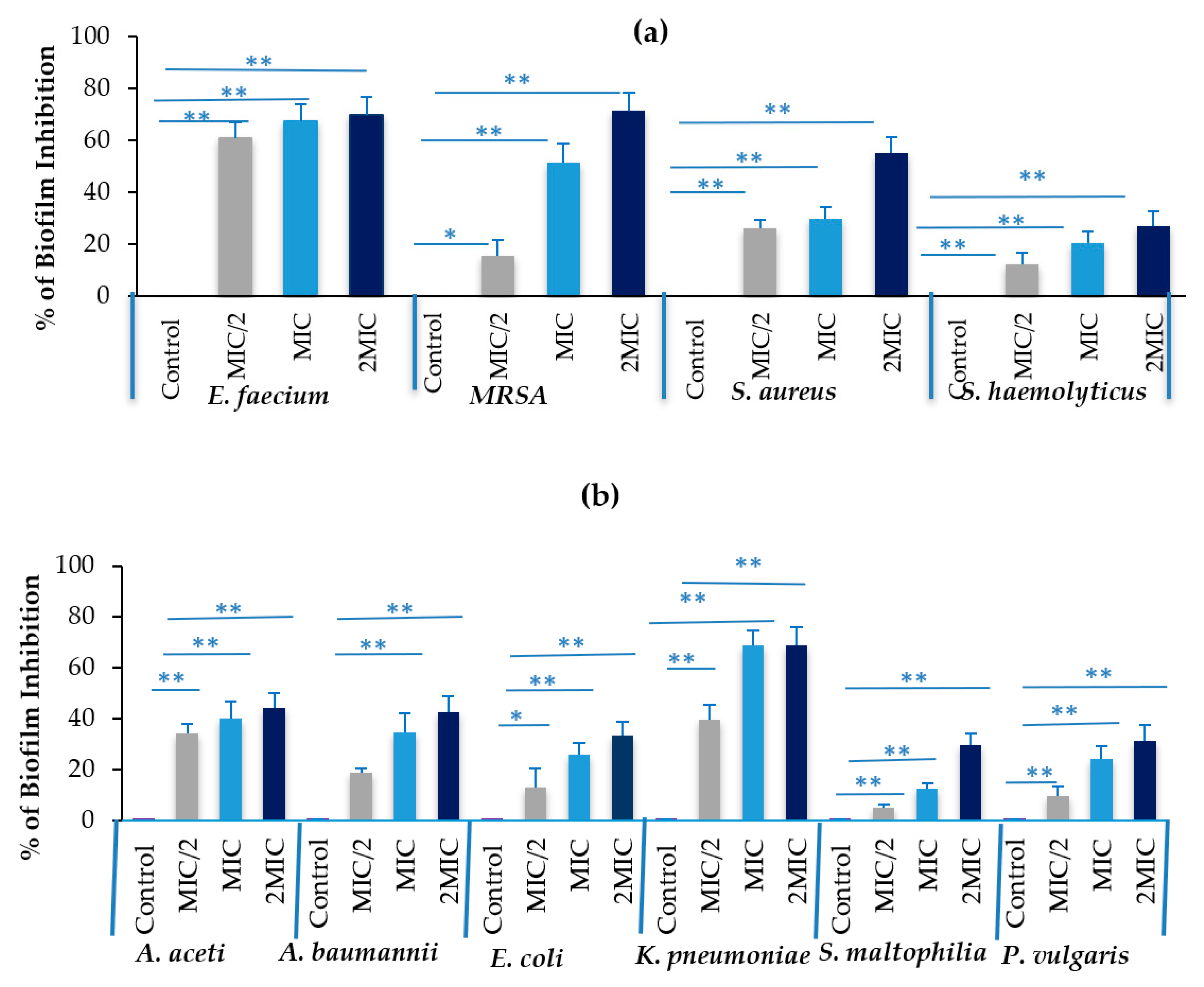
 white bars represent the control;
  gray bars represent the sub-inhibitory concentration (MIC/2);
  light blue bars represent the minimum inhibitory concentration (1× MIC); and
  dark blue bars represent the supra-inhibitory concentration (2× MIC). Values are the average of three independent determinations ± SD. The asterisks (*) and (**) correspond to p-value < 0.05 and 0.01, respectively.
white bars represent the control; gray bars represent the sub-inhibitory concentration (MIC/2); light blue bars represent the minimum inhibitory concentration (1× MIC); and dark blue bars represent the supra-inhibitory concentration (2× MIC). Values are the average of three independent determinations ± SD. The asterisks (*) and (**) correspond to p-value < 0.05 and 0.01, respectively.
dark blue bars represent the supra-inhibitory concentration (2× MIC). Values are the average of three independent determinations ± SD. The asterisks (*) and (**) correspond to p-value < 0.05 and 0.01, respectively.
white bars represent the control; gray bars represent the sub-inhibitory concentration (MIC/2); light blue bars represent the minimum inhibitory concentration (1× MIC); and dark blue bars represent the supra-inhibitory concentration (2× MIC). Values are the average of three independent determinations ± SD. The asterisks (*) and (**) correspond to p-value < 0.05 and 0.01, respectively.
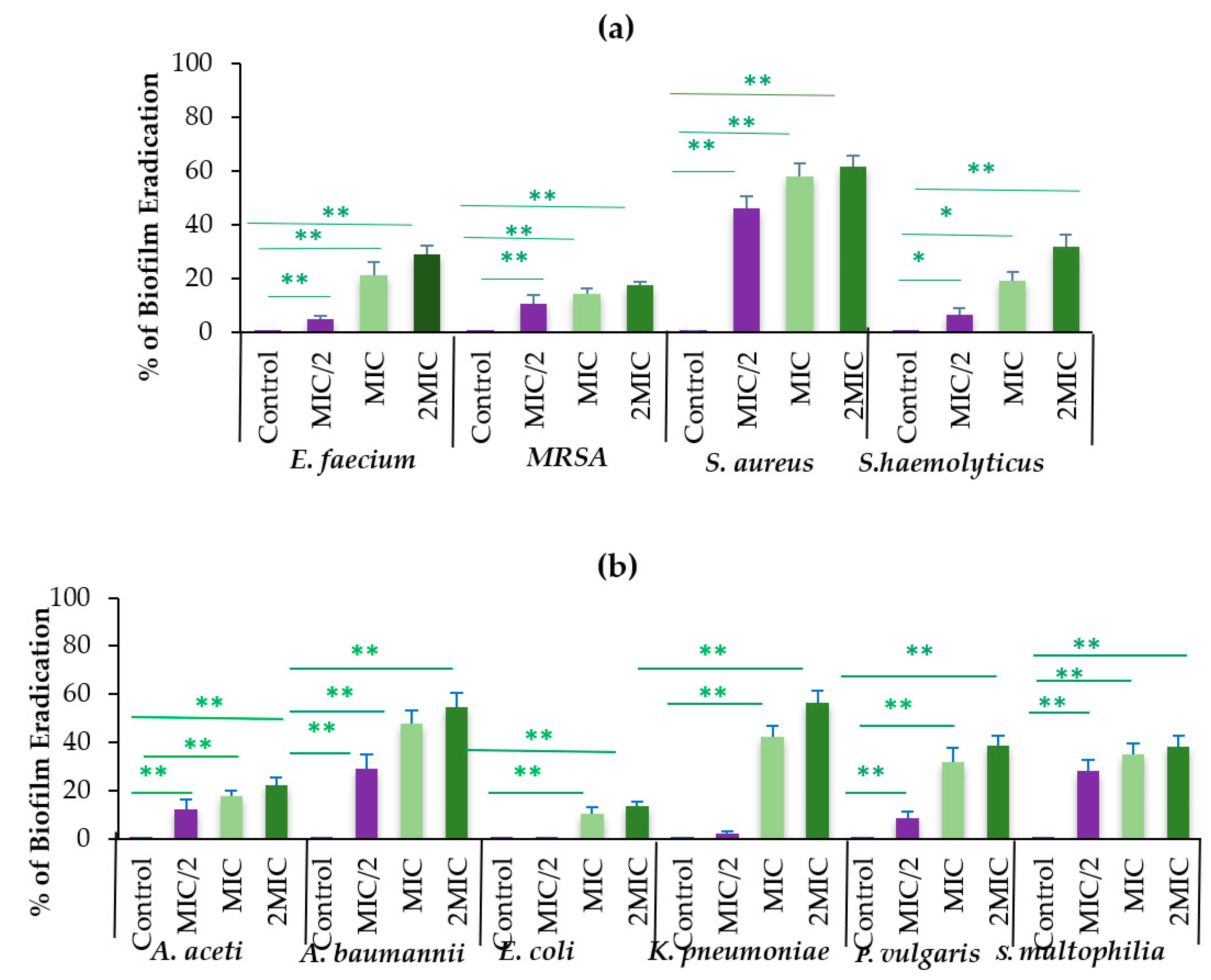
 purple bars represent the sub-inhibitory concentration (MIC/2);
  light green bars represent the minimum inhibitory concentration (1× MIC); and
  dark green bars represent the supra-inhibitory concentration (2× MIC). Values are the average of at least three independent determinations ± SD. The asterisks (*) and (**) correspond to p-value < 0.05 and 0.01, respectively.
purple bars represent the sub-inhibitory concentration (MIC/2); light green bars represent the minimum inhibitory concentration (1× MIC); and dark green bars represent the supra-inhibitory concentration (2× MIC). Values are the average of at least three independent determinations ± SD. The asterisks (*) and (**) correspond to p-value < 0.05 and 0.01, respectively.
dark green bars represent the supra-inhibitory concentration (2× MIC). Values are the average of at least three independent determinations ± SD. The asterisks (*) and (**) correspond to p-value < 0.05 and 0.01, respectively.
purple bars represent the sub-inhibitory concentration (MIC/2); light green bars represent the minimum inhibitory concentration (1× MIC); and dark green bars represent the supra-inhibitory concentration (2× MIC). Values are the average of at least three independent determinations ± SD. The asterisks (*) and (**) correspond to p-value < 0.05 and 0.01, respectively.
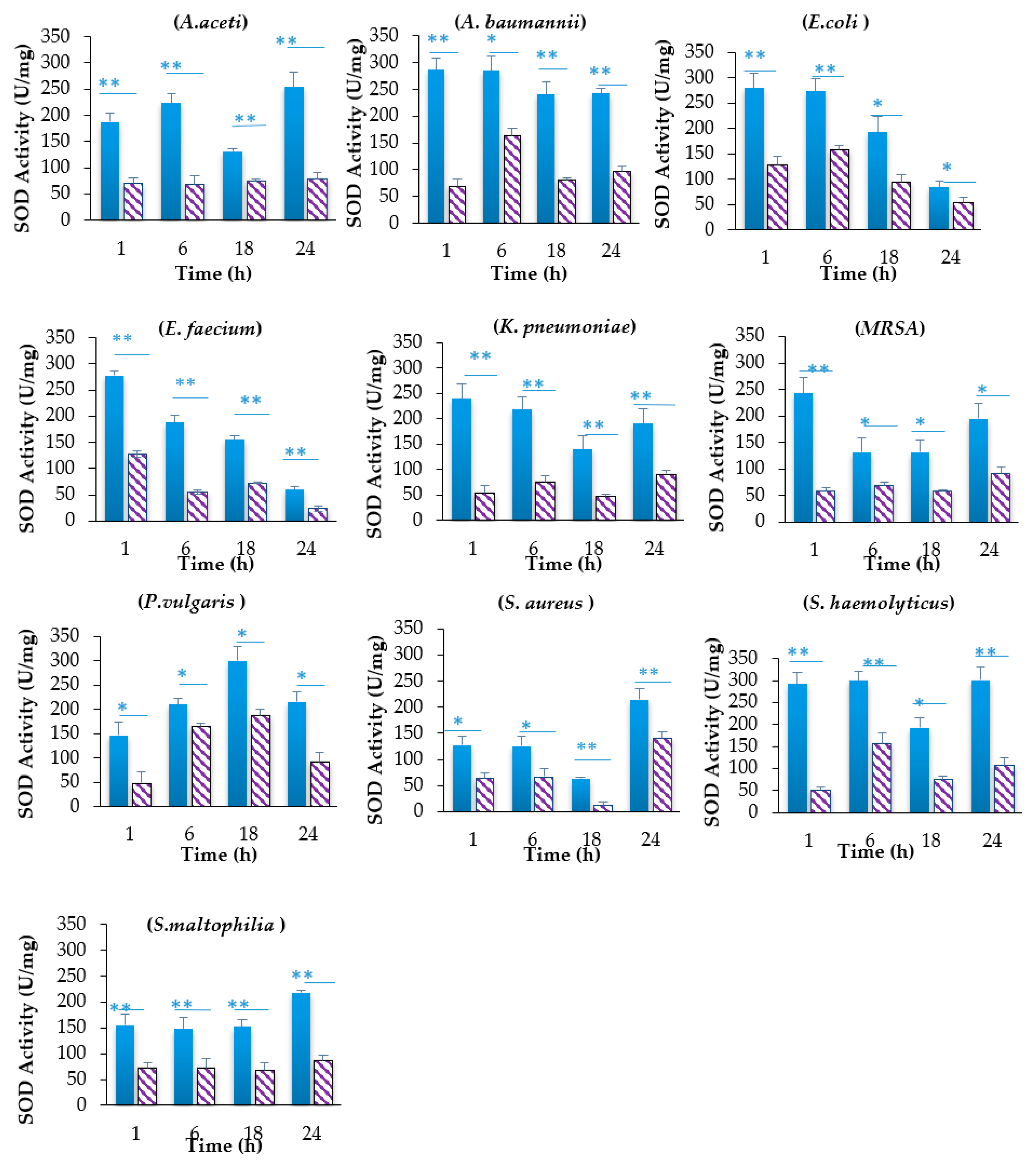
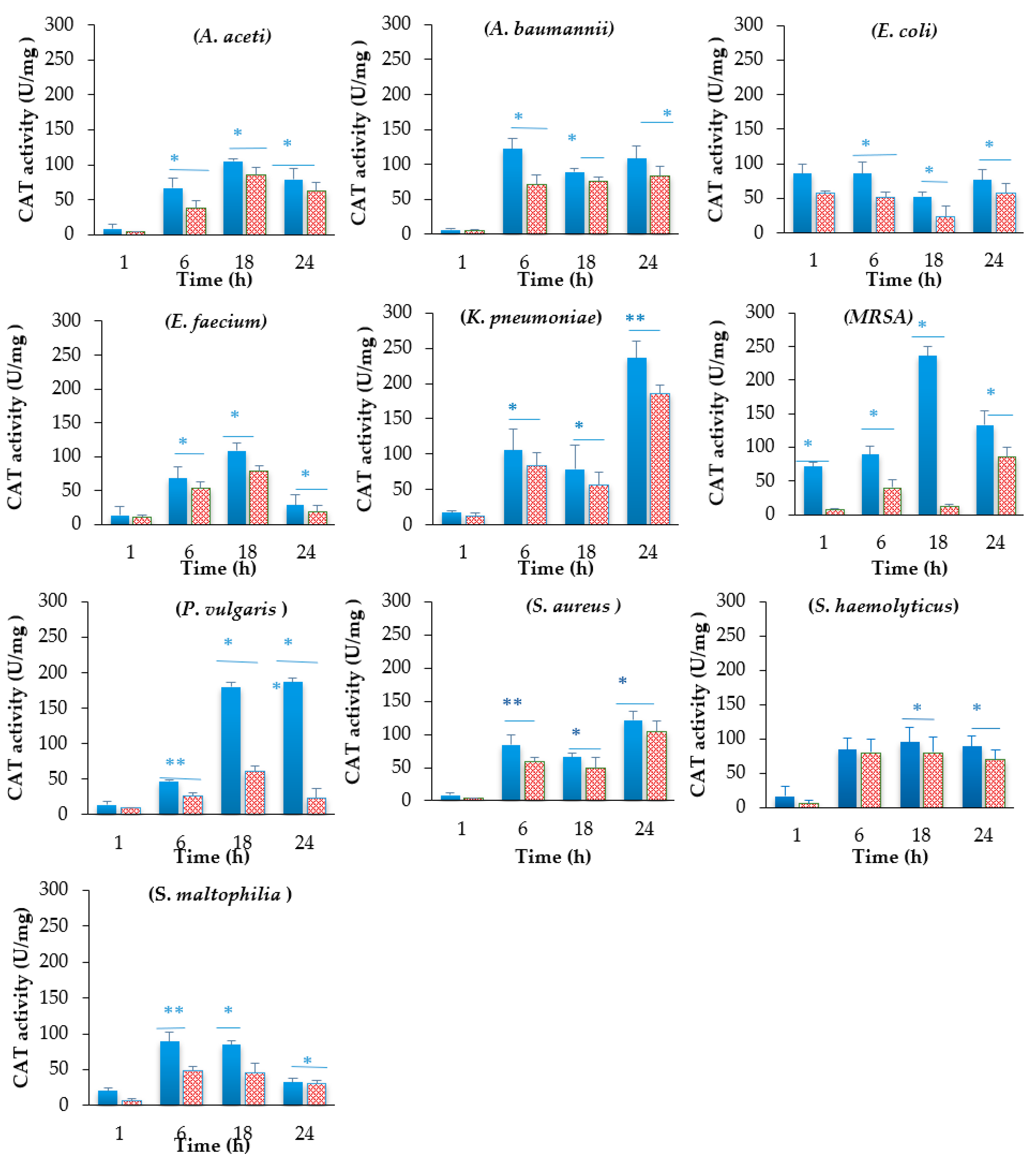
 blue bars) and experimental (
 dashed bars). Data are represented as mean ± SD. The asterisks (*) and (**) correspond to p-value < 0.05 and 0.01, respectively.
blue bars) and experimental ( dashed bars). Data are represented as mean ± SD. The asterisks (*) and (**) correspond to p-value < 0.05 and 0.01, respectively.
dashed bars). Data are represented as mean ± SD. The asterisks (*) and (**) correspond to p-value < 0.05 and 0.01, respectively.
blue bars) and experimental ( dashed bars). Data are represented as mean ± SD. The asterisks (*) and (**) correspond to p-value < 0.05 and 0.01, respectively.
 blue bars) and experimental (
 dashed bars). Data are represented as mean ± SD. The asterisks (*) and (**) correspond to p-value < 0.05 and 0.01, respectively.
blue bars) and experimental ( dashed bars). Data are represented as mean ± SD. The asterisks (*) and (**) correspond to p-value < 0.05 and 0.01, respectively.
dashed bars). Data are represented as mean ± SD. The asterisks (*) and (**) correspond to p-value < 0.05 and 0.01, respectively.
blue bars) and experimental ( dashed bars). Data are represented as mean ± SD. The asterisks (*) and (**) correspond to p-value < 0.05 and 0.01, respectively.


| No. | Compound Name | RT | % | No. | Compound Name | RT | % |
|---|---|---|---|---|---|---|---|
| 1 | α-cis-bergamotene | 23.36 | 0.06 | 24 | Juniene | 11.18 | 0.06 |
| 2 | (E)-α-Bergamotene | 22.99 | 0.04 | 25 | (R)-Lavandulol | 20.26 | 0.8 |
| 3 | Borneol | 17.65 | 4.64 | 26 | (S)-Lavandulol | 17.39 | 1.23 |
| 4 | Bornyl formate | 19.08 | 0.05 | 27 | D-Limonene | 13.15 | 0.96 |
| 5 | Butanoic acid | 19.19 | 0.53 | 28 | Linalool | 15.6 | 50.79 |
| 6 | Butyric acid | 12 | 0.07 | 29 | Linalyl acetate | 19.52 | 4.3 |
| 7 | Camphene | 10.37 | 0.28 | 30 | β-myrcene | 7.69 | 0.24 |
| 8 | Camphor | 16.95 | 11.5 | 31 | (Z)-β-ocimene | 13.74 | 0.16 |
| 9 | 3-Carene | 12.42 | 0.06 | 32 | 3-Octanol | 12.03 | 0.42 |
| 10 | Caryophyllene oxide | 26.06 | 0.06 | 33 | 3-Octanone | 11.63 | 0.16 |
| 11 | Cuminaldehyde | 19.33 | 0.2 | 34 | 1-octen-3-ol | 11.46 | 0.17 |
| 12 | m-Cymene | 12.8 | 0.007 | 35 | 1-Octen-3-yl-acetate | 15.66 | 0.24 |
| 13 | o-Cymene | 12.98 | 0.53 | 36 | 1,2-Oxolinalool | 14.55 | 0.49 |
| 14 | Episesquithujene | 22.48 | 0.23 | 37 | α-pinene | 9.8 | 0.9 |
| 15 | Eucalyptol | 13.24 | 3.63 | 38 | β-Pinene | 13.39 | 0.14 |
| 16 | (E)-β-Farnesene | 23.81 | 2.11 | 39 | α -Pinene dimer | 13.39 | 0.9 |
| 17 | Furanoid | 15.08 | 0.39 | 40 | α-Phellandrene | 12.34 | 0.01 |
| 18 | Germacrene D | 24.36 | 0.18 | 41 | α-Santalene | 23.11 | 0.1 |
| 19 | 1-Hexanol | 7.69 | 0.06 | 42 | γ-Terpinene | 14.14 | 0.1 |
| 20 | Hexyl acetate | 12.56 | 0.25 | 43 | 4-Terpineol | 17.88 | 9.9 |
| 21 | n-Hexyl butyrate | 18.11 | 1.96 | 44 | α-Terpinolene | 12.72 | 0.02 |
| 22 | Hexyl hexanoate | 22.37 | 0.23 | 45 | α-Terpinyl propionate | 12.03 | 0.27 |
| 23 | Isocaryophyllene | 23.19 | 0.35 | 46 | α-Thujene | 9.57 | 0.11 |
| (a) | ||||
| Gram-positive bacteria | Zone of inhibition (mm) | |||
| 25% | 50% | 100% | Positive control | |
| E. faecium | 13 ± 3.61 | 29.33 ± 5.51 | 33.33 ± 3.15 | 35.54 ± 3.41 |
| MRSA | 17.5 ± 3.54 | 25.42 ± 4.25 | - | 21.00 ± 1.73 |
| S. aureus | 10 ± 1.15 | 23.33 ± 2.89 | 28.33 ± 2.89 | 21.67 ± 2.89 |
| S. haemolyticus | 15 ± 1.23 | 22.33 ± 2.52 | - | 12.00 ± 2.02 |
| (b) | ||||
| Gram-negative bacteria | Zone of inhibition (mm) | |||
| 25% | 50% | 100% | Positive control | |
| A. aceti | 14 ± 1.45 | 22.67 ± 2.52 | 32.5 ± 3.54 | Resistant to antibiotics |
| A. baumannii | 13.02 ± 1.41 | 18.33 ± 1.52 | - | 10.03 ± 1.05 |
| E. coli | NA | NA | NA | 37.667 ± 3.21 |
| P. vulgaris | NA | NA | NA | 37.67 ± 2.08 |
| K. pneumoniae | NA | 15.67 ± 1.15 | 21.67 ± 0.58 | 18 ± 1.73 |
| S. maltophilia | 24.67 ± 1.53 | 29 ± 3.61 | NA | 12.33 ± 0.58 |
| (a) | |||
| Gram-positive bacteria | MIC % (v/v) | MBC % (v/v) | MBC/MIC |
| E. faecium | 3.12 | 6.25 | 2 |
| MRSA | 1.56 | 12.5 | 8 |
| S. aureus | 1.56 | 3.12 | 2 |
| S. haemolyticus | 3.12 | 3.12 | 1 |
| (b) | |||
| Gram-negative bacteria | MIC % (v/v) | MBC % (v/v) | MBC/MIC |
| A. aceti | 3.12 | 3.12 | 1 |
| A. baumannii | 3.12 | 3.12 | 1 |
| E. coli | 3.12 | 25 | 8 |
| P. vulgaris | 1.56 | 3.12 | 2 |
| K. pneumoniae | 3.12 | 3.12 | 1 |
| S. maltophilia | 3.12 | 3.12 | 1 |
Disclaimer/Publisher’s Note: The statements, opinions and data contained in all publications are solely those of the individual author(s) and contributor(s) and not of MDPI and/or the editor(s). MDPI and/or the editor(s) disclaim responsibility for any injury to people or property resulting from any ideas, methods, instructions or products referred to in the content. |
© 2026 by the authors. Licensee MDPI, Basel, Switzerland. This article is an open access article distributed under the terms and conditions of the Creative Commons Attribution (CC BY) license.
Share and Cite
Jaafar, R.; Al Hakawati, N.; Hayeck, N.; Usta, J.; Borjac, J. Chemical Composition, Antibacterial, and Antioxidant Activities of L. angustifolia Essential Oil Against Human Pathogenic Clinical Bacterial Isolates. Bacteria 2026, 5, 33. https://doi.org/10.3390/bacteria5020033
Jaafar R, Al Hakawati N, Hayeck N, Usta J, Borjac J. Chemical Composition, Antibacterial, and Antioxidant Activities of L. angustifolia Essential Oil Against Human Pathogenic Clinical Bacterial Isolates. Bacteria. 2026; 5(2):33. https://doi.org/10.3390/bacteria5020033
Chicago/Turabian StyleJaafar, Rima, Nawal Al Hakawati, Nathalie Hayeck, Julnar Usta, and Jamilah Borjac. 2026. "Chemical Composition, Antibacterial, and Antioxidant Activities of L. angustifolia Essential Oil Against Human Pathogenic Clinical Bacterial Isolates" Bacteria 5, no. 2: 33. https://doi.org/10.3390/bacteria5020033
APA StyleJaafar, R., Al Hakawati, N., Hayeck, N., Usta, J., & Borjac, J. (2026). Chemical Composition, Antibacterial, and Antioxidant Activities of L. angustifolia Essential Oil Against Human Pathogenic Clinical Bacterial Isolates. Bacteria, 5(2), 33. https://doi.org/10.3390/bacteria5020033