1. Introduction
The rapid expansion of crypto assets has intensified academic and policy interest in the economic forces underlying their adoption and in the ways these instruments interact with digital financial systems [
1,
2,
3]. In addition, the literature has increasingly emphasised that crypto assets should not be treated as a homogeneous category because different instruments perform different functions and may therefore respond differently to macroeconomic conditions [
4,
5,
6,
7]. This distinction is especially relevant when comparing stablecoins and Bitcoin. Although both belong to the broader crypto asset universe, they are not economically equivalent [
8,
9,
10]. Bitcoin is commonly associated with speculative demand and investment behaviour rather than with widespread use as a medium of exchange [
11,
12]. Stablecoins, by contrast, are increasingly discussed as instruments that may support payments, value transfers, settlement, and other transactional uses [
13,
14], particularly where dollar-linked digital instruments offer practical advantages [
5,
6,
15]. In addition, Auer et al. [
16] highlight that the drivers of cross-border flows differ across native crypto assets and asset-backed stablecoins, reinforcing the view that these instruments should not be expected to play identical macroeconomic roles.
These differences may be particularly important in emerging economies [
17,
18], especially in countries like Brazil, where exchange rate volatility, financial frictions, and dollar-linked demand can boost the appeal of stablecoins over volatile crypto assets [
19]. Brazil’s digital market and macroeconomic environment may connect stablecoins more closely to the domestic economy than Bitcoin, not merely as speculative assets but as instruments in transactions and operations. This raises an important question: do stablecoin and Bitcoin transaction volumes respond similarly to macroeconomic conditions, or do they reflect different patterns of economic integration? Our main argument is that stablecoins are more closely linked to Brazilian macroeconomic fundamentals than Bitcoin, whereas Bitcoin is more closely linked to global crypto market activity. Thus, the two assets follow distinct patterns of integration. This view is consistent with recent studies showing that stablecoins have unique use cases and macro-financial effects compared to other crypto assets [
15,
16,
20,
21].
To investigate this question, we examine the relationship among crypto asset transaction volumes in Brazil [
22], domestic economic activity, exchange rate conditions, and global crypto market activity. We compare how stablecoin and Bitcoin transaction volumes in Brazil respond to the seasonally adjusted Central Bank Economic Activity Index (IBC-Br, hereinafter referred to as IBCBr) and to the BRL/USD exchange rate (hereinafter referred to as BRLUSD), distinguishing among contemporaneous relationships, short-run dynamics, and long-run equilibrium linkages, and we evaluate whether the contrast between the two assets survives the inclusion of global crypto market controls. The long- and short-term distinction is central to the analysis, as stablecoins may react to persistent macro-financial conditions, such as exchange rates or demand for dollar liquidity, without responding immediately to small monthly rate changes. That distinction is consistent with recent research on digital dollarisation and foreign digital money that shows that stablecoins influence domestic finance through structural channels, such as currency substitution, hedging, and access to foreign liquidity [
23,
24,
25].
Our results show that stablecoin transaction volume is associated more strongly with Brazilian macroeconomic conditions than Bitcoin transaction volume. Stablecoins have a positive and significant link with domestic economic activity in both the long and short term, and this link is not absorbed by global stablecoin activity. The BRLUSD exchange rate is associated with stablecoin volume primarily through a long-term structural channel rather than through immediate monthly changes. Bitcoin transaction volume, by contrast, shows little association with domestic economic activity and is instead more strongly associated with global Bitcoin volume. Once that global variable is included, the residual association with Brazilian macroeconomic fundamentals essentially disappears.
Our findings contribute in three ways. First, this paper adds to the growing literature that treats stablecoins as a class of digital assets distinct from Bitcoin rather than inferring the behaviour of all crypto assets from Bitcoin alone [
5,
6,
7]. Second, by exploiting monthly administrative data reported by Brazilian Tax Administration under Instrução Normativa RFB nº 1.888/2019, this paper links a direct measure of domestic digital asset transaction volume to both domestic macroeconomic variables and global crypto market activity, providing a transparent identification of the channels through which different crypto assets relate to the domestic economy. Third, this paper provides evidence from Brazil, an important emerging economy in which the interaction among digital assets, domestic activity, and exchange rate conditions is likely to be especially relevant for understanding the broader macro-financial implications of crypto adoption.
The remainder of this paper is organised as follows:
Section 2 presents the literature review and the hypotheses.
Section 3 describes the data and empirical strategy.
Section 4 reports the econometric results and discusses their economic interpretation, and
Section 5 presents the study conclusions.
2. Literature Review and Hypothesis Development
Our study is grounded in the premise that crypto assets should not be analysed as an economically homogeneous category [
5,
26,
27]. Stablecoins and Bitcoin are expected to differ not only in their financial characteristics but also in the channels through which they relate to domestic macroeconomic conditions [
23]. Our central argument is that stablecoins are more closely integrated into the Brazilian economy than Bitcoin is, both because of their functional roles and the mechanisms by which they respond to activity and exchange rate conditions. On this basis, the empirical analysis is organised around the following four hypotheses.
2.1. Stablecoins as Macro-Financial Instruments
Stablecoins differ from Bitcoin in design and likely in economic function. They are intended to preserve a stable nominal value relative to a fiat unit, usually the U.S. dollar [
28], and are often presented as instruments for payments, settlement, and transfers as well as a store of value within and beyond the crypto ecosystem [
15,
29]. Adrian et al. [
15] argue that stablecoins may become especially attractive in emerging markets because they can provide easier access to foreign currency for firms and households. Likewise, Copestake et al. [
24] emphasise that stablecoins may affect domestic financial conditions, as they may facilitate currency substitution, cross-border use, and alternative forms of savings and settlement.
This suggests that stablecoin transaction volume may reflect at least two domestic mechanisms. First, stablecoin use may increase with domestic economic activity if it supports payments, treasury management, settlement, cross-border transfers, or broader transactional demand [
5,
6,
16,
30]. Second, stablecoin use may respond to exchange rate conditions, especially in environments where users seek synthetic dollar exposure or a hedge against local currency weakness. In a small open-economy model, Murakami and Viswanath-Natraj [
23] show that digital dollarisation via stablecoins can improve welfare through consumption smoothing and hedging against macroeconomic volatility, whereas volatile cryptocurrencies such as Bitcoin amplify volatility. Therefore, we state the first hypothesis:
H1. Stablecoin transaction volume in Brazil is positively associated with domestic economic activity, as measured by the IBCBr.
This expectation follows from the view that stablecoins serve functions more akin to operational instruments than to purely speculative assets [
31,
32]. In periods of stronger economic dynamism, the need for liquid instruments with lower transaction frictions and easier convertibility between banking and digital environments is likely to intensify.
2.2. Bitcoin and Macroeconomic Fundamentals
A large part of the literature treats Bitcoin as an asset whose behaviour is only loosely connected to domestic macroeconomic conditions [
33]. Corbet et al. [
34] find that major cryptocurrencies exhibit relative isolation from traditional financial and economic assets; however, these linkages can vary over time in response to shocks. De la Horra et al. [
35] argue that Bitcoin behaves largely as a speculative asset in the short run, with little evidence that it is demanded as a safe haven commodity or conventional medium of exchange. Wüstenfeld and Geldner [
36] suggest that Bitcoin activity can respond to uncertainty in ways that are unstable across countries and episodes, reinforcing the idea that local Bitcoin dynamics need not map tightly into domestic fundamentals. Feyen et al. [
37] find that global factors, such as the gold price and crypto-specific drivers, play a significant role in shaping cross-country Bitcoin volumes over time, rather than country-specific factors. Alexakis et al. [
4] reported that Bitcoin experienced a clear increase in trading during periods of tension and after the start of the Russia–Ukraine war, suggesting it was used both as a liquid crypto asset and as a means of moving wealth under stress. Di Casola et al. [
33] report that Bitcoin is primarily driven by speculative trading, with demand rising in tandem with crypto market momentum, volatility, and global risk conditions. They also find that Bitcoin can gain extra utility in emerging and developing economies when local currencies lose value, making it an alternative investment asset despite its instability.
From a theoretical standpoint, this implies that domestic Bitcoin transaction volume may reflect local participation in a globally priced crypto market more than it reflects domestic production or spending conditions. Thus, we formulate the following hypothesis:
H2. Bitcoin transaction volume in Brazil does not exhibit a robust association with domestic economic activity.
The hypothesis aligns with broader evidence that Bitcoin’s relationship with currencies and other financial assets is context-dependent rather than strongly anchored in country-specific real activity [
11,
38]. Thus, although isolated episodes of correlation with domestic variables may occur, we do not expect a stable and persistent relationship with the IBCBr.
2.3. Exchange Rate Dynamics and Digital Dollarisation
Dollar-denominated or dollar-linked stablecoins are likely to become more relevant in emerging economies when the exchange rate plays an important role in wealth protection, international settlement, and value preservation decisions [
16,
23,
39]. Recent studies find that large-scale use of foreign crypto assets or stablecoins can weaken monetary transmission, displace domestic deposits, and amplify capital flow pressures in small open economies, particularly where policy credibility is weaker [
24,
25]. Adrian et al. [
15] similarly note that stablecoins can become more attractive where inflation is high or the domestic currency is weak. Alexakis et al. [
4] find that Tether shows no significant response to “tension” events (e.g., the Russia–Ukraine war) on the days themselves, but does respond significantly to Ruble devaluation. Conversely, Oefele et al. [
40] report that Turkish economic indicators do not account for crypto asset trading volumes. They did not find evidence to support the substitution of fiat currency with crypto assets. This suggests that concerns about domestic currency substitution with crypto assets in emerging market economies with weak currencies may be overstated.
In the Brazilian case, BRLUSD may influence stablecoin use by altering the relative attractiveness of holding wealth in the domestic currency versus dollar-denominated digital assets. However, this effect need not appear through immediate responses to small monthly exchange rate movements. If agents gradually increase their use of stablecoins when the macro-financial environment makes dollar-linked instruments more attractive, then the level of the exchange rate should matter more than month-to-month changes. The exchange rate may therefore act as a structural variable shaping the broader environment in which stablecoins are used over time. Accordingly, the following hypothesis is proposed:
H3. The BRL/USD exchange rate is associated with stablecoin transaction volume in Brazil mainly through a structural or long-run relationship, rather than through immediate short-run monthly effects.
2.4. Economic Activity and Transaction-Based Crypto Use
The IBCBr is used in this study as a proxy for domestic economic activity. According to the Central Bank of Brazil, the IBCBr is a monthly indicator constructed to track the performance of the Brazilian economy in a timely manner, consolidating information across major sectors. If an asset is used for payments, settlement, or liquidity management, its transaction volume should increase with the intensity of domestic economic and financial activity. Bitcoin, by contrast, is less likely to display a stable transaction–demand relationship with domestic activity because its domestic use may be dominated by speculative participation in a globally priced asset market rather than by routine transaction demand [
23,
36]. We therefore expect Bitcoin transaction volume to be more closely associated with global Bitcoin market activity than with Brazilian macroeconomic conditions:
H4. Bitcoin transaction volume in Brazil is associated more strongly with global Bitcoin market activity than domestic macroeconomic variables.
3. Methodology
3.1. Data
This study uses monthly data from August 2019 to December 2025, yielding 77 observations. The choice of August 2019 as the sample start is directly linked to Instrução Normativa RFB nº 1.888/2019, which established the mandatory reporting of crypto asset transactions to the Brazilian Federal Revenue Service (Receita Federal do Brasil), and to the Receita Federal do Brasil’s open data documentation, for which monthly reports began in August 2019 [
41].
From the “Relatorio4” spreadsheet, the values from the column “VALOR TOTAL DAS OPERAÇÕES” and the column “CRIPTOATIVO” are collected for the assets of interest. The stablecoin variable (Stablecoin_Br) is restricted to USDT (Tether). USDT accounts for the vast majority of Brazilian stablecoin transaction volume reported by RFB across the sample period and is the only stablecoin with an uninterrupted monthly series from August 2019 onwards. Restricting the aggregate to USDT avoids combining stablecoin designs that differ in collateral structure, peg mechanism, and functional use (algorithmic, BRL-pegged, multi-collateral) and makes the international comparability of the dependent variable transparent. The Bitcoin variable (Bitcoin_Br) is the monthly Bitcoin (BTC) transaction volume reported by RFB.
The macroeconomic variables are the IBCBr and the BRLUSD nominal exchange rate. The IBCBr is the Central Bank of Brazil’s monthly indicator of economic activity. The data were obtained from Banco Central do Brasil [
42]. It is built from production-side information across the agriculture, industry, and services sectors and is widely used as a high-frequency proxy for monthly real GDP. We use the seasonally adjusted series. For BRLUSD, we use the monthly average of the daily nominal exchange rate extracted from Yahoo Finance [
43].
Two international variables complement the domestic variables: global Bitcoin transaction volume (Bitcoin_W) and global USDT transaction volume (Stablecoin_W) extracted from CoinMarketCap [
44]. These series capture aggregate crypto market activity and serve as global crypto market controls in the specifications for the Brazilian Bitcoin and stablecoin equations, respectively.
3.2. Empirical Design
The empirical strategy is organised in five stages. The first stage consists of descriptive statistics and correlation analysis, providing an initial assessment of the degree of association between each crypto asset and the domestic variables. The second stage estimates static regressions in levels and in growth rates, allowing a direct comparison of the contemporaneous relationships among crypto asset volumes, economic activity, and the exchange rate. The third stage applies augmented Dickey–Fuller unit root tests to examine the stochastic properties of the series and to determine whether they are stationary in levels or only after differencing.
The fourth stage focuses on long-run and short-run dynamics. Johansen cointegration tests are used to verify whether stablecoins or Bitcoin exhibit a long-run equilibrium relationship with the macroeconomic variables and ARDL bounds testing [
45] provides the primary long-run inference. Bounds testing is well suited to short monthly samples with mixed orders of integration because its validity does not require all variables to be I(1), and it has favourable small-sample properties. In parallel, dynamic specifications are estimated to examine short-run responses, particularly through ARDL formulations and VAR models in first differences. This part of the methodology is especially important because it allows the analysis to move beyond simple correlation and assess whether the relationship between crypto assets and domestic fundamentals persists once temporal dynamics and lag structures are taken into account.
The fifth and final stage estimates an error correction model (ECM) for stablecoins. This specification assesses whether deviations from the long-run equilibrium are corrected over time and connects short-run movements in stablecoin transaction volume with the long-run relationship examined in the cointegration analysis.
The complementary elements strengthen identification and inference. All main equations are estimated with global crypto market controls, including Stablecoin_W for the stablecoin specifications and Bitcoin_W for the Bitcoin specifications, testing whether the domestic findings survive the inclusion of the most likely external driver.
The following diagnostic tests are reported for each main equation: Durbin–Watson, Breusch–Godfrey LM for serial correlation (4 lags), Breusch–Pagan for heteroskedasticity, and Jarque–Bera for residual normality. These diagnostics support the interpretive emphasis on the cointegration and ARDL/ECM results rather than on the static level regressions.
3.2.1. Static Regressions
As an initial step, the empirical strategy estimates static regressions to examine the contemporaneous association between crypto asset transaction volume, domestic economic activity and exchange rate conditions. The models are estimated separately for stablecoins and Bitcoin in logarithmic form. The baseline level specification is expressed as follows:
where
denotes either stablecoin transaction volume (Stablecoin_Br) or Bitcoin transaction volume (Bitcoin_Br),
is the proxy for domestic economic activity,
is the exchange rate, and
is the error term. The same specification is re-estimated in first differences as follows:
3.2.2. Unit Root Tests
Before estimating long-run or dynamic models, the order of integration of the variables is assessed using augmented Dickey–Fuller (ADF) tests [
46]. For the level series, the ADF test includes a constant and a deterministic trend. For the differenced series, the trend term is omitted. The null hypothesis is the presence of a unit root. The number of augmentation lags is selected by AIC. The ADF results provide the basis for deciding whether cointegration methods are appropriate and whether short-run dynamics should be modelled in first differences.
3.2.3. Cointegration and Long-Run Structure
H3 implies that the exchange rate may matter for stablecoin volume primarily through a structural relationship rather than through immediate monthly variation. To evaluate this possibility, this study applies the Johansen cointegration test to the level variables [
47]. The Johansen framework is based on a vector autoregressive system rewritten in error correction form as follows:
where
is a vector of endogenous variables in levels,
captures the long-run structure of the system, and the rank of
indicates the number of cointegrating vectors. A positive but incomplete rank implies the existence of one or more long-run equilibrium relationships among the variables.
Two systems were examined. For stablecoins, the vector is expressed as follows:
For Bitcoin, the vector is expressed as follows:
Because the unit root evidence may indicate mixed orders of integration in levels, the Johansen cointegration analysis is complemented with ARDL bounds testing, following Pesaran, Shin, and Smith [
45]. The unrestricted error correction model is specified as follows:
where
is the dependent variable,
denotes the set of explanatory variables,
is the lag order of the dependent variable, and
is the lag order of each regressor. The null hypothesis of no long-run relationship is expressed as follows:
. The F-statistic is compared with the asymptotic critical bounds reported in Pesaran, Shin, and Smith [
45], Case III (intercept, no trend). An F-statistic above the upper I(1) bound supports the existence of a long-run relationship regardless of whether the regressors are I(0), I(1), or mixed.
3.2.4. Ardl Models and Level-Based Hypothesis Testing
To test H1 and H2 directly in a level-based dynamic framework, this study estimates ARDL models separately for ln(Stablecoin_Br) and ln(Bitcoin_Br). ARDL is appropriate because it captures both autoregressive persistence and distributed lag effects of macroeconomic variables, allowing for a direct comparison between the two crypto assets. ARDL models were estimated following the approach developed by Pesaran and Shin [
48]. The baseline structure is ARDL(2, 2, 2):
where
denotes either Stablecoin_Br or Bitcoin_Br.
Within the logic of the hypotheses, H1 is supported if ln(IBCBr) is positive and statistically significant in the stablecoin equation, whereas H2 is supported if the corresponding effect is weak or insignificant in the Bitcoin equation. To test H4, the same ARDL specifications are also estimated with the global crypto market control added at the same lag order. The Bitcoin_Br specification is compared before and after the inclusion of global Bitcoin transaction volume. H4 is supported if ln(Bitcoin_W) is statistically significant, improving the explanatory power of the Bitcoin model as well as reducing or dominating the role of domestic macroeconomic variables.
3.2.5. VAR Models and Short-Run Dynamics
Although the ARDL models focus on dynamic relationships in levels, H3 and H4 also require assessing short-run interactions. Thus, vector autoregressive models are estimated in first differences. This allows the analysis to test whether monthly changes in activity and exchange rate conditions are immediately associated with crypto asset transaction volumes.
Vector autoregressive models were estimated following [
49], with lag selection and specification guided by [
50]. The general VAR(p) model is expressed as follows:
where
is the vector of endogenous variables, c is a vector of constants,
are coefficient matrices, and
is a vector of innovations.
For the stablecoin system, the endogenous vector is expressed as follows:
For the Bitcoin system, the endogenous vector is expressed as follows:
In both cases, a VAR(2) model with a constant term was estimated.
This framework is especially useful for H3 because it tests whether BRLUSD is associated stablecoin volume through immediate monthly changes. If exchange rate lags are not significant in the stablecoin VAR but the level variables are cointegrated, this pattern is consistent with H3. The H4 is supported if short-run changes in Brazilian Bitcoin transaction volume respond more strongly to global Bitcoin market activity than to changes in IBCBr or BRLUSD with the global Bitcoin control added.
3.2.6. Error Correction Model
If evidence of cointegration is found, an error correction model (ECM) is estimated to distinguish between short-run dynamics and long-run adjustment. The logic follows the classic result that cointegrated variables can be represented using an error correction mechanism, with the lagged disequilibrium term capturing adjustment back toward the long-run relationship [
51].
In the empirical specification, the ECM includes the lagged error correction term, the contemporaneous first differences of IBCBr and BRLUSD, and one lag of each differenced variable. The operational form is expressed as follows:
where
is the lagged deviation from the long-run equilibrium relation, and
measures the speed of adjustment. A negative and statistically significant
indicates that deviations from equilibrium are corrected over time.
This model allows this study to determine whether stablecoin volume responds to short-run changes in economic activity and exchange rate conditions, and whether it converges to a long-run macro-financial equilibrium. A significant negative adjustment parameter combined with weak short-run exchange rate coefficients would be fully consistent with H3.
4. Results and Discussion
Using descriptive correlations, static regressions, cointegration analysis, and dynamic models, this section presents evidence of a clear contrast between stablecoins and Bitcoin in their relationship with domestic macroeconomic conditions in Brazil. Specifications with global crypto market controls confirm—and, in some respects, sharpen—this contrast.
4.1. Descriptive Statistics and Correlation Matrix
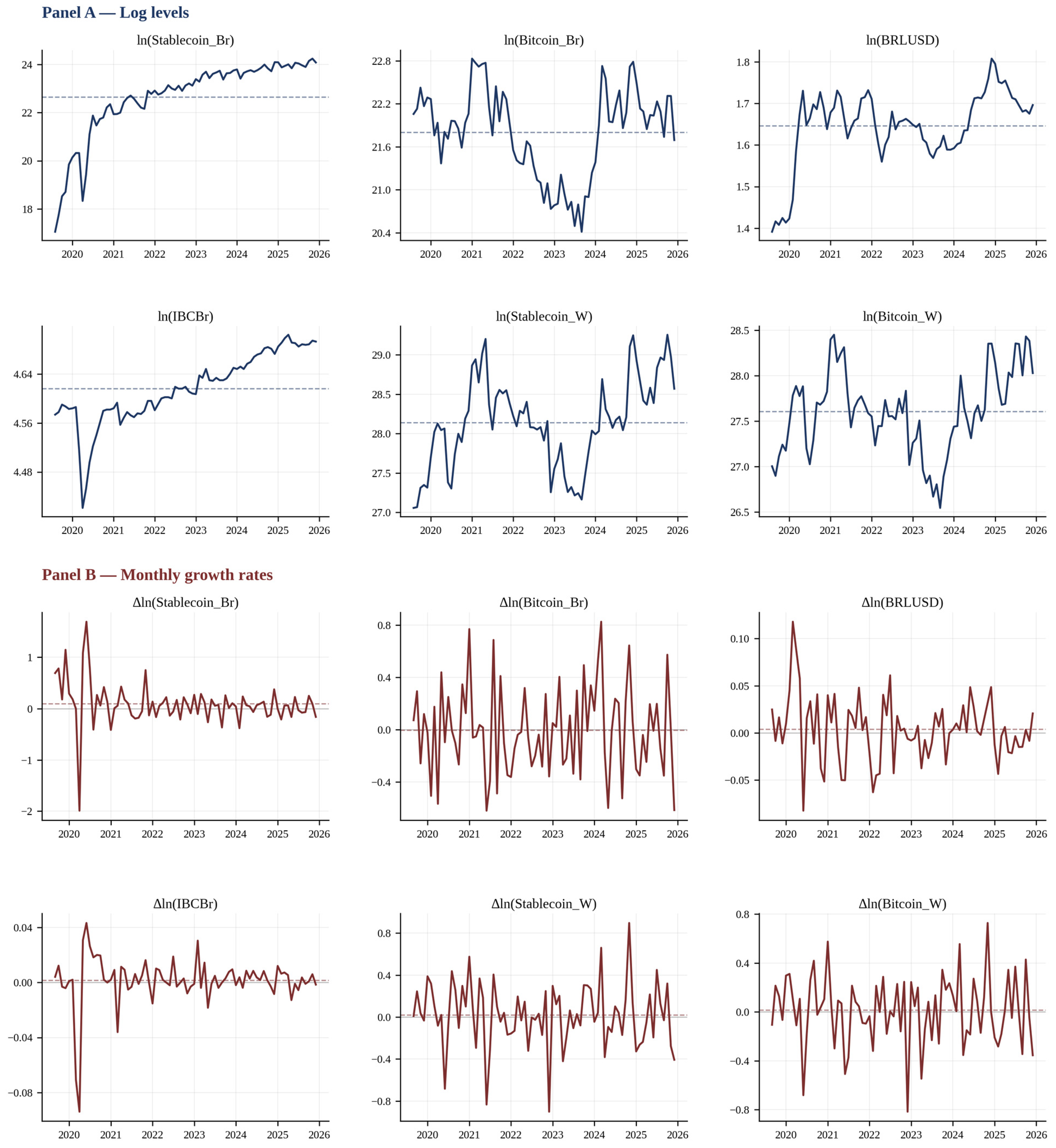
Table 1 summarises the series in levels and in monthly growth rates, and
Figure 1 plots the corresponding trajectories across the August 2019–December 2025 sample. In levels (
Figure 1, Panel A), most variables display negative skewness, indicating that lower observations are more pronounced than upper observations during the sample period. This pattern is especially visible for ln(Stablecoin_Br) and ln(BRLUSD), which both increase sharply in the first portion of the sample and then settle around the upper part of their range. The global crypto market variables, ln(Stablecoin_W) and ln(Bitcoin_W), are approximately symmetric, consistent with the more balanced trajectories visible in Panel A. Kurtosis also differs across variables. In terms of levels, most series show moderate kurtosis, with no strong evidence of extreme tails. In terms of growth rates (
Figure 1, Panel B), however, stablecoin volume and domestic economic activity display high kurtosis, indicating sharp short-run movements or outlier months. This finding suggests that short-run shocks are more relevant in growth rate specifications than in level specifications. Therefore, the descriptive statistics in
Table 1 and the trajectories in
Figure 1 indicate that stablecoin and Bitcoin series differ not only in their relationship with macroeconomic variables but also in their distributional behaviour.
Table 2 and the visual evidence in
Figure 1 together show a clear contrast between stablecoins and Bitcoin. In both levels and growth rate specifications, stablecoin volume is strongly associated with IBCBr, whereas Bitcoin volume shows little connection with domestic activity. Panel A of
Figure 1 makes this contrast immediately visible. Here, ln(Stablecoin_Br) and ln(IBCBr), positioned in the first column, share a common upward trajectory across the sample, whereas ln(Bitcoin_Br) fluctuates around its mean, peaks in 2021, and does not exhibit a comparable secular trend. Stablecoin volume is also more closely related to BRLUSD in levels, whereas Bitcoin shows only a weaker exchange rate association. The contrast reverses for the global measures. Bitcoin volume in Brazil is strongly associated with global Bitcoin volume, and Panel A shows that ln(Bitcoin_Br) and ln(Bitcoin_W) move together during the 2020–2022 crypto cycle and again from 2023 onward. In contrast, stablecoin volume is only moderately related to global stablecoin volume in levels and weakly in growth rates, and ln(Stablecoin_Br) and ln(Stablecoin_W) follow visibly distinct trajectories. Overall, the correlation matrix in
Table 2 and the time-series plots in
Figure 1 provide consistent initial descriptive evidence that stablecoins are more domestically connected, whereas Bitcoin is more globally driven and less aligned with domestic transaction-based activity.
4.2. Baseline Evidence from Static Regressions
The static regression results in
Table 3 provide a baseline assessment of the contemporaneous association among crypto asset transaction volume, domestic economic activity, and exchange rate conditions. In the log-level specification for stablecoins, domestic economic activity is positively and strongly associated with stablecoin volume (β = 17.76), and the exchange rate also shows a significant relationship (β = 8.20), with R
2 = 0.73. By contrast, the static regression for Bitcoin in levels does not show the same degree of macroeconomic anchoring. The coefficient on ln(IBCBr) is approximately zero (β = −0.32), and R
2 is only 0.04. The regressions in first differences reinforce this contrast. The monthly changes in stablecoin transaction volume remain significantly associated with monthly changes in domestic activity, whereas the corresponding relationship for Bitcoin remains weak. Adding the global control variable to each equation in levels and in growth rates leaves the Stablecoin_Br–IBCBr relationship essentially unchanged while sharply improving the fit of the Bitcoin equation. The R
2 values increase from 0.04 to 0.51 (levels) and from 0.05 to 0.45 (growth rates).
The diagnostic tests summarised in
Table 4 show consistent results across the four static level specifications. Durbin–Watson statistics are approximately 0.3 for all models, whereas Breusch–Godfrey LM tests with four lags strongly reject the null hypothesis of no residual serial correlation, with
p-values below 0.001. The Breusch–Pagan heteroskedasticity test uncovers significant asymmetry between assets. Specifically, stablecoin equations display strong residual heteroskedasticity, reflecting the heavy-tailed nature of crypto asset flows, whereas Bitcoin equations show a shift from borderline heteroskedasticity to homoskedasticity with the inclusion of ln(Bitcoin_World). This finding suggests that variability in Brazilian Bitcoin volume is associated with global crypto market activity rather than inherent heteroskedasticity. Jarque–Bera tests reveal non-normal residuals in stablecoin equations and approximately normal residuals in Bitcoin equations when the global control is included. Multicollinearity is not an issue, as variance-inflation factors remain below 1.75 across all specifications. The static results are therefore interpreted as a descriptive baseline, with inference based on the cointegration, ARDL/ECM, and bounds testing framework that follows.
4.3. Stochastic Properties
Before proceeding to the dynamic specifications, augmented Dickey–Fuller tests are used to assess the time-series properties of the variables. The results reported in
Table 5 indicate mixed integration in levels. Under the trend specification, ln(IBCBr) and ln(Stablecoin_Br) series reject the unit root null, whereas ln(BRLUSD), ln(Bitcoin_Br), ln(Bitcoin_W), and ln(Stablecoin_W) do not. After first-differencing, all variables reject the unit root null. These findings imply that the variables should not be treated as sharing identical stochastic properties in levels. This supports the use of ARDL bounds testing as the primary long-run inference. The bounds testing is valid for variables that are I(0), I(1), or mutually integrated, so the long-run conclusions do not hinge on a precise classification of every series.
4.4. Stablecoins Associated with Domestic Economic Activity
The descriptive statistics, correlation analysis, and static regression results show that stablecoin transaction volume in Brazil moves closely with domestic economic activity. The same conclusion emerges from the dynamic level model. In the ARDL(2, 2, 2) stablecoin specification reported in
Table 6, the contemporaneous coefficient on ln(IBCBr) is 11.85, the L1 coefficient is −3.56, and the L2 coefficient is −5.97. The model exhibits a high degree of fit (R
2 = 0.96).
The negative lagged coefficients are consistent with a partial reversal of contemporaneous overshooting—the within-month bunching of transactions that follow activity surprises—and the net long-run effect remains positive. For example, the stablecoins may be used in Brazil for treasury operations, settlement, dollar-linked hedging, and cross-border transfers. When economic activity increases, the operational demand for these services increases concurrently, and firms tend to concentrate the resulting transactions in the same calendar month as the activity event. Examples include payroll cycles, FX hedging following periods of strong sales, and settlement activities. In the following month, having already executed these stablecoin transactions, these firms typically transact less than usual.
Short-run dynamics also show similar trends (
Table 7). In the stablecoin VAR, the first and second lags of Δln(IBCBr) are significant in the Δln(Stablecoin_Br) equation, with coefficients of 9.42 and −9.77, respectively.
The ECM (
Table 8) confirms that economic activity is important even after accounting for long-run adjustment as long as Δln(IBCBr) enters with a coefficient of 12.82.
The ARDL bounds F-statistic is 13.14 for the stablecoin system, which is well above the 5% upper I(1) bound of 4.85. This finding confirms the existence of a long-run relationship among stablecoin volume, IBCBr, and BRLUSD regardless of the mixed integration ambiguity (
Table 9).
The global control specifications strengthen these conclusions. Adding ln(Stablecoin_W) to the ARDL does not change the role of domestic activity (contemporaneous IBCBr β = 12.21), and the global stablecoin control is itself insignificant at every lag. These findings suggest that Brazilian stablecoin transaction volume is not simply a reflection of global stablecoin volume.
This evidence supports H1, which states that stablecoin transaction volume is positively associated with Brazilian economic activity in both long-run and short-run specifications and that this association is not absorbed by global stablecoin activity. This finding is consistent with the idea that stablecoins serve transactional, treasury, or value preservation functions whose intensity scales with domestic economic and financial activity [
15,
23].
4.5. Bitcoin and Weak Domestic Anchoring
The evidence supports H2. In the baseline ARDL Bitcoin model, as shown in
Table 6, ln(IBCBr) has a coefficient of 3.70, which is insignificant. In addition, its lagged terms are also insignificant. The model is dominated by the first own lag (β = 0.79). After adding ln(Bitcoin_W) to the ARDL model, R
2 increases from 0.75 to 0.86. The contemporaneous coefficient on ln(Bitcoin_W) is 0.853, and the L1 coefficient is −0.658. Here, ln(IBCBr) and ln(BRLUSD) remain insignificant. The short-run VAR evidence does not alter this conclusion (
Table 7). In the Δln(Bitcoin_Br) equation, lagged Δln(IBCBr) and lagged Δln(BRLUSD) are not significant. The ARDL bounds F-statistic for the Bitcoin system is 1.63, which is below the 5% lower I(0) bound of 3.79 (
Table 9). This finding confirms the absence of a long-run domestic relationship. Therefore, in contrast to stablecoins, Bitcoin transaction volume in Brazil exhibits only a weak and unstable relationship with domestic economic activity. This is consistent with the literature that portrays Bitcoin as an asset whose value-side behaviour is shaped more by crypto market-specific conditions, speculative participation, and broader financial sentiment than by country-specific real activity [
23,
33].
4.6. Exchange Rate and Digital Dollarisation
The results are consistent with H3. The Johansen test for the stablecoin system rejects the null of no cointegration at 5% (
Table 10), indicating at least one long-run equilibrium relationship among stablecoin transaction volume, domestic economic activity, and the BRLUSD exchange rate. The ARDL bounds F-statistic of 13.14 confirms this conclusion in the bounds-testing framework (
Table 9). The short-run evidence for direct exchange rate effects on stablecoin volume is weak. In the stablecoin VAR, neither lag of Δln(BRLUSD) is significant in the Δln(Stablecoin_Br) equation (
Table 7). In the ECM (
Table 8), Δln(BRLUSD) is also insignificant (β = −0.65). The ECM adds a further piece of evidence. Specifically, the error correction term is negative and significant (λ = −0.189), implying that approximately 19% of disequilibrium is corrected in the following month. Stablecoin volume therefore adjusts towards a long-run equilibrium relation even though immediate monthly exchange rate changes do not have a robust direct effect. These results suggest that BRLUSD influences stablecoin use mainly as a structural factor, not as an immediate trigger. A weaker or more uncertain domestic currency can gradually create an environment in which holding or using dollar-linked digital assets becomes more attractive, consistent with the long-run findings and with the broader literature on digital dollarisation [
15,
23,
52].
4.7. Bitcoin, Global Market Activity, and Domestic Detachment
The evidence supports H4. In the ARDL with ln(Bitcoin_W), the contemporaneous coefficient on the global variable is 0.853, and the first lag is −0.658. R
2 increases from 0.748 to 0.861, and ln(IBCBr) and ln(BRLUSD) carry no statistically significant role, as shown in
Table 6. Cointegration analysis in a system that is uniformly I(1)—namely [ln(Bitcoin), ln(BRLUSD), and ln(Bitcoin_W)]—yields a trace statistic of 30.74 against a 5% critical value of 29.80, indicating one long-run vector. The Brazilian Bitcoin transaction volume has a long-run anchor, but it is to global Bitcoin activity rather than to Brazilian macroeconomic fundamentals. The corresponding ARDL bounds F-statistic for the Bitcoin system conditional on the domestic variables alone is 1.633. This is below the 5% lower I(0) bound, which is consistent with the absence of a domestic long-run relationship under the alternative inferential framework. Taken together, this evidence is consistent with Bitcoin transaction volume in Brazil being predominantly associated with global crypto market activity, whereas the contribution of domestic macroeconomic conditions is statistically and economically small. This conclusion fits the broader literature treating Bitcoin as a relatively detached asset whose response to macroeconomic conditions is context-dependent and often dominated by crypto-specific dynamics [
15,
23,
53].
5. Conclusions
This study examined whether Bitcoin and stablecoin transaction volumes in Brazil are associated with local macroeconomic conditions. The analysis compared the relationships between domestic economic activity, proxied by the IBCBr, and the BRLUSD exchange rate on the one hand and crypto asset transaction volumes on the other and evaluated the contrast between the two assets against the inclusion of global crypto market controls. The results show that stablecoin transaction volume is more closely associated with Brazilian macroeconomic conditions than Bitcoin. Stablecoins have a positive and significant association with economic activity in both the short and long term, and this association is not absorbed by global stablecoin activity. The BRLUSD exchange rate is associated with stablecoin volume mainly through long-term structural channels rather than short-term fluctuations. Bitcoin transaction volume, by contrast, has a minimal robust association with domestic economic activity and is instead more strongly associated with global Bitcoin volume, with no evidence of a long-run domestic relationship noted in either the Johansen or the ARDL bounds frameworks.
These findings suggest that stablecoins may function as a more domestically embedded macro-financial instrument in Brazil, potentially linked to transactional use, liquidity management, or demand for dollar-linked assets. Bitcoin behaves more like a globally driven and comparatively detached digital asset, with its long-run anchor in global Bitcoin activity rather than in Brazilian fundamentals. From a policy perspective, this distinction is important because stablecoins may have stronger implications for monetary transmission, digital dollarisation, and financial intermediation than analyses based solely on Bitcoin would suggest.
This study has limitations. First, the sample period is short by macroeconometric standards. The period covers August 2019 to December 2025, yielding 77 monthly observations, and includes the COVID pandemic, the 2021–2022 crypto cycle, and the 2024 spot-Bitcoin ETF cycle. This sample length supports the parsimonious ARDL(2, 2, 2) and VAR(2) specifications used here but limits the dynamic richness that can be estimated without overfitting. In addition, the strength of the global Bitcoin coupling identified here may be partly sample-specific. Second, the analysis is based on a reduced set of domestic macroeconomic variables and does not directly incorporate broader international risk indicators, U.S. monetary conditions, global liquidity measures, commodity prices, or asset-specific market sentiment, which may be particularly relevant for Bitcoin. Third, the dynamic evidence is presented using the coefficient structure of the VAR(2), ARDL(2, 2, 2), and ECM specifications as well as the ECM speed-of-adjustment coefficient rather than orthogonalised impulse response functions. We chose not to report IRFs because the small monthly sample raises power concerns for shock-by-shock identification. In addition, the dynamic patterns relevant to the hypotheses are already transparent from the reported coefficient tables; graphical IRFs would be a natural extension once the Receita Federal do Brasil open data series is sufficiently long to support the additional identification assumptions.
Future research could extend this framework by incorporating global financial variables, alternative measures of domestic uncertainty, and other classes of digital assets. It would also be useful to investigate whether the stronger macroeconomic embedding of stablecoins observed in Brazil is also found in other emerging economies with different exchange rate regimes and financial structures. Such extensions would contribute to a more comprehensive understanding of the macro-financial role of stablecoins and their implications for monetary systems in different institutional contexts.
Author Contributions
Conceptualization, R.M.d.C.; methodology, R.M.d.C. and C.V.; formal analysis, R.M.d.C. and C.V.; investigation, R.M.d.C. and C.V.; data curation, R.M.d.C.; writing—original draft preparation, R.M.d.C.; writing—review and editing, R.M.d.C. and C.V.; visualization, R.M.d.C. and C.V. All authors have read and agreed to the published version of the manuscript.
Funding
This research received no external funding.
Institutional Review Board Statement
Not applicable.
Informed Consent Statement
Not applicable.
Data Availability Statement
Acknowledgments
During the preparation of this work, the authors used ChatGPT-5.4 in order to assist with language revision and text organisation. After using this tool, the authors reviewed and edited the content as needed and take full responsibility for the published article.
Conflicts of Interest
The authors declare no conflict of interest.
References
- Morgan, J. Systemic stablecoin and the defensive case for Central Bank Digital Currency: A critique of the Bank of England’s framing. Res. Int. Bus. Financ. 2022, 62, 101716. [Google Scholar] [CrossRef] [Scilit]
- Simran; Sharma, A.K. Asymmetric impact of economic policy uncertainty on cryptocurrency market: Evidence from NARDL approach. J. Econ. Asymmetries 2023, 27, e00298. [Google Scholar] [CrossRef] [Scilit]
- Venugopal, S.K.; Talbi, M. Stock Market Reactions to Adoption of Cryptocurrency as a Payment Instrument. J. Theor. Appl. Electron. Commer. Res. 2025, 20, 160. [Google Scholar] [CrossRef] [Scilit]
- Alexakis, C.; Anselmi, G.; Petrella, G. Flight to cryptos: Evidence on the use of cryptocurrencies in times of geopolitical tensions. Int. Rev. Econ. Financ. 2024, 89, 498–523. [Google Scholar] [CrossRef] [Scilit]
- Ante, L. From adoption to continuance: Stablecoins in cross-border remittances and the role of digital and financial literacy. Telemat. Inform. 2025, 97, 102230. [Google Scholar] [CrossRef] [Scilit]
- Dionysopoulos, L.; Urquhart, A. 10 years of stablecoins: Their impact, what we know, and future research directions. Econ. Lett. 2024, 244, 111939. [Google Scholar] [CrossRef] [Scilit]
- Moura De Carvalho, R.; Inácio, H.C.; Marques, R.P.F. From instability to regulation: A systematic literature review on stablecoins. Int. J. Digit. Account. Res. 2025, 25, 71–101. [Google Scholar] [CrossRef] [Scilit]
- Bolt, W.; Lubbersen, V.; Wierts, P. Getting the balance right: Crypto, stablecoin and central bank digital currency. J. Paym. Strategy Syst. 2022, 16, 39–50. [Google Scholar] [CrossRef] [Scilit]
- Cheikh, N.B.; Zaied, Y.B.; Chevallier, J. Asymmetric volatility in cryptocurrency markets: New evidence from smooth transition GARCH models. Financ. Res. Lett. 2020, 35, 101293. [Google Scholar] [CrossRef] [Scilit]
- Kristoufek, L. On the role of stablecoins in cryptoasset pricing dynamics. Financ. Innov. 2022, 8, 37. [Google Scholar] [CrossRef] [Scilit]
- Baur, D.G.; Hong, K.; Lee, A.D. Bitcoin: Medium of exchange or speculative assets? J. Int. Financ. Mark. Inst. Money 2018, 54, 177–189. [Google Scholar] [CrossRef] [Scilit]
- Syuhada, K.; Hakim, A.; Suprijanto, D.; Muchtadi-Alamsyah, I.; Arbi, L. Is Tether a safe haven of safe haven amid COVID-19? An assessment against Bitcoin and oil using improved measures of risk. Resour. Policy 2022, 79, 103111. [Google Scholar] [CrossRef] [Scilit] [PubMed]
- Financial Conduct Authority. FCA Selects Four Firms to Test Stablecoin Innovation in Its Regulatory Sandbox. Available online: https://www.fca.org.uk/news/press-releases/4-firms-selected-test-stablecoin-regulatory-sandbox (accessed on 3 March 2026).
- The Stablecoin Surge and Fintech’s Future. The Wall Street Journal. Available online: https://www.wsj.com/video/the-stablecoin-surge-and-fintechs-future/62594670-44CF-4A4A-9D2D-31BA68DFF850 (accessed on 1 February 2026).
- Adrian, T.; Bains, P.; Bechara, M.; Cerutti, E.; Forte, S.; Grinberg, F.; Gullo, A.; Hengge, M.; Jekabsone, A.; Kao, K.; et al. Understanding Stablecoins; IMF Departmental Paper No. 2025/009; International Monetary Fund: Washington, DC, USA, 2025. [Google Scholar]
- Auer, R.A.; Lewrick, U.; Paulick, J. DeFiying Gravity? An Empirical Analysis of Cross-Border Bitcoin, Ether and Stablecoin Flows; Bank for International Settlements, Monetary and Economic Department: Basel, Switzerland, 2025. [Google Scholar]
- Goldman Sachs Global Institute. Stablecoins and Emerging Markets. Available online: https://www.goldmansachs.com/what-we-do/goldman-sachs-global-institute/articles/stablecoins-and-emerging-markets (accessed on 1 March 2026).
- Biggest African Economies Lead Stablecoin Demand Growth, Study Shows. Reuters. Available online: https://www.reuters.com/world/africa/biggest-african-economies-lead-stablecoin-demand-growth-study-shows-2026-02-18/ (accessed on 1 March 2026).
- Chainalysis. 2024 Geography of Cryptocurrency Report; Chainalysis Inc.: New York, NY, USA, 2024; Available online: https://go.chainalysis.com/2024-geography-of-cryptocurrency-report.html (accessed on 2 May 2026).
- Ghabri, Y.; Ben Rhouma, O.; Gana, M.; Guesmi, K.; Benkraiem, R. Information transmission among energy markets, cryptocurrencies, and stablecoins under pandemic conditions. Int. Rev. Financ. Anal. 2022, 82, 102197. [Google Scholar] [CrossRef] [Scilit]
- Jana, S.; Sahu, T.N. Is the cryptocurrency market a hedge against stock market risk? A Wavelet and GARCH approach. Econ. Notes 2023, 52, e12227. [Google Scholar] [CrossRef] [Scilit]
- Receita Federal do Brasil. Instrução Normativa RFB nº 1.888, de 3 de Maio de 2019; Receita Federal do Brasil: Brasília, Brazil, 2019; Available online: https://www.normaslegais.com.br/legislacao/instrucao-normativa-rfb-1888-2019.htm (accessed on 3 March 2026).
- Murakami, D.; Viswanath-Natraj, G. Cryptocurrencies in emerging markets: A stablecoin solution? J. Int. Money Financ. 2025, 156, 103344. [Google Scholar] [CrossRef] [Scilit]
- Copestake, A.; Le, A.; Papageorgiou, E.; Tan, B.J. Macro-Financial Implications of Foreign Crypto Assets for Small Developing Economies; IMF Fintech Notes No. 2023/012; International Monetary Fund: Washington, DC, USA, 2023. [Google Scholar]
- Le, A.H.; Copestake, A.; Tan, B.; Papageorgiou, E.; Peiris, S.J.; Rawat, U. Macro-financial impacts of foreign digital money. Econ. Lett. 2025, 255, 112458. [Google Scholar] [CrossRef] [Scilit]
- Ahmed, M.S.; El-Masry, A.A.; Al-Maghyereh, A.I.; Kumar, S. Cryptocurrency volatility: A review, synthesis, and research agenda. Res. Int. Bus. Financ. 2024, 71, 102472. [Google Scholar] [CrossRef] [Scilit]
- Nguyen, T.V.H.; Nguyen, T.V.H.; Nguyen, T.C.; Pham, T.T.A.; Nguyen, Q.M.P. Stablecoins versus traditional cryptocurrencies in response to interbank rates. Financ. Res. Lett. 2022, 47, 102744. [Google Scholar] [CrossRef] [Scilit]
- Moura De Carvalho, R.; Inácio, H.C.; Marques, R.P. Stablecoin: A Story of (In)Stabilities and Co-Movements Written Through Wavelet. J. Risk Financ. Manag. 2025, 18, 20. [Google Scholar]
- Bank for International Settlements. Annual Economic Report; Bank for International Settlements: Basel, Switzerland, 2025; p. 126. [Google Scholar]
- Almeida, J.; Gaio, C.; Gonçalves, T.C. Crypto market relationships with BRIC countries’ uncertainty—A wavelet-based approach. Technol. Forecast. Soc. Change 2024, 200, 123078. [Google Scholar]
- Liao, G.; Hadeed, T.; Zeng, Z. Beyond Speculation: Payment Stablecoins for Real-Time Gross Settlements; SSRN Scholarly Paper No. 4476859; Social Science Research Network: Rochester, NY, USA, 2023. [Google Scholar]
- Sood, K.; Singh, S.; Behl, A.; Sindhwani, R.; Kaur, S.; Pereira, V. Identification and prioritization of the risks in the mass adoption of artificial intelligence-driven stable coins: The quest for optimal resource utilization. Resour. Policy 2023, 81, 103235. [Google Scholar] [CrossRef] [Scilit]
- Di Casola, P.; Habib, M.M.; Tercero-Lucas, D. Global and local drivers of Bitcoin trading vis-à-vis fiat currencies. J. Int. Money Financ. 2025, 158, 103405. [Google Scholar]
- Corbet, S.; Meegan, A.; Larkin, C.; Lucey, B.; Yarovaya, L. Exploring the dynamic relationships between cryptocurrencies and other financial assets. Econ. Lett. 2018, 165, 28–34. [Google Scholar] [CrossRef] [Scilit]
- de la Horra, L.P.; de la Fuente, G.; Perote, J. The drivers of Bitcoin demand: A short and long-run analysis. Int. Rev. Financ. Anal. 2019, 62, 21–34. [Google Scholar] [CrossRef] [Scilit]
- Wüstenfeld, J.; Geldner, T. Economic uncertainty and national bitcoin trading activity. N. Am. J. Econ. Financ. 2022, 59, 101625. [Google Scholar] [CrossRef] [Scilit]
- Feyen, E.H.B.; Kawashima, Y.; Mittal, R. Crypto-Assets Activity Around the World: Evolution and Macro-Financial Drivers; Policy Research Working Paper No. 9962; World Bank: Washington, DC, USA, 2022. [Google Scholar]
- Palazzi, R.B.; Júnior, G.S.R.; Klotzle, M.C. The dynamic relationship between bitcoin and the foreign exchange market: A nonlinear approach to test causality between bitcoin and currencies. Financ. Res. Lett. 2021, 42, 101893. [Google Scholar] [CrossRef] [Scilit]
- Financial Stability Board. Cross-Border Regulatory and Supervisory Issues of Global Stablecoin Arrangements in EMDEs; Financial Stability Board: Basel, Switzerland, 2024; Available online: https://www.fsb.org/uploads/P230724.pdf (accessed on 2 May 2026).
- Oefele, N.; Baur, D.G.; Smales, L.A. The effect of currency risk on crypto asset utilization in Türkiye. Emerg. Mark. Rev. 2025, 65, 101264. [Google Scholar] [CrossRef] [Scilit]
- Receita Federal do Brasil. Criptoativos—Dados Abertos. Available online: https://www.gov.br/receitafederal/pt-br/assuntos/orientacao-tributaria/declaracoes-e-demonstrativos/criptoativos (accessed on 2 May 2026).
- Banco Central do Brasil. Índice de Atividade Econômica do Banco Central—Brasil (IBC-Br). Available online: https://www.bcb.gov.br/estatisticas/ibc-br (accessed on 2 May 2026).
- Yahoo Finance. Available online: https://finance.yahoo.com/ (accessed on 1 February 2026).
- CoinMarketCap. Available online: https://coinmarketcap.com/ (accessed on 1 February 2026).
- Pesaran, M.H.; Shin, Y.; Smith, R.J. Bounds testing approaches to the analysis of level relationships. J. Appl. Econom. 2001, 16, 289–326. [Google Scholar] [CrossRef] [Scilit]
- Dickey, D.A.; Fuller, W.A. Distribution of the estimators for autoregressive time series with a unit root. J. Am. Stat. Assoc. 1979, 74, 427–431. [Google Scholar] [CrossRef] [Scilit]
- Johansen, S. Statistical analysis of cointegration vectors. J. Econ. Dyn. Control 1988, 12, 231–254. [Google Scholar] [CrossRef] [Scilit]
- Pesaran, M.H.; Shin, Y. An Autoregressive Distributed-Lag Modelling Approach to Cointegration Analysis. In Econometrics and Economic Theory in the 20th Century: The Ragnar Frisch Centennial Symposium; Strøm, S., Ed.; Cambridge University Press: Cambridge, UK, 1999; pp. 371–413. [Google Scholar]
- Sims, C.A. Macroeconomics and reality. Econometrica 1980, 48, 1–48. [Google Scholar] [CrossRef] [Scilit]
- Lütkepohl, H. New Introduction to Multiple Time Series Analysis; Springer: Berlin, Germany, 2005. [Google Scholar]
- Engle, R.F.; Granger, C.W.J. Co-integration and error correction: Representation, estimation, and testing. Econometrica 1987, 55, 251–276. [Google Scholar] [CrossRef] [Scilit]
- Aldasoro, I.; Beltran, P.; Grinberg, F. Stablecoin Inflows and Spillovers to FX Markets; IMF Working Paper No. 2026/056; International Monetary Fund: Washington, DC, USA, 2026. [Google Scholar]
- Bonga-Bonga, L.; Khalique, M. The dynamic relationship between digital currency and other financial assets in developed and emerging markets. Int. J. Financ. Stud. 2025, 13, 205. [Google Scholar] [CrossRef] [Scilit]
| Disclaimer/Publisher’s Note: The statements, opinions and data contained in all publications are solely those of the individual author(s) and contributor(s) and not of MDPI and/or the editor(s). MDPI and/or the editor(s) disclaim responsibility for any injury to people or property resulting from any ideas, methods, instructions or products referred to in the content. |