

Trust, Privacy, and Adoption: A Global Policy Framework for Central Bank Digital Currencies


Abstract
1. Introduction
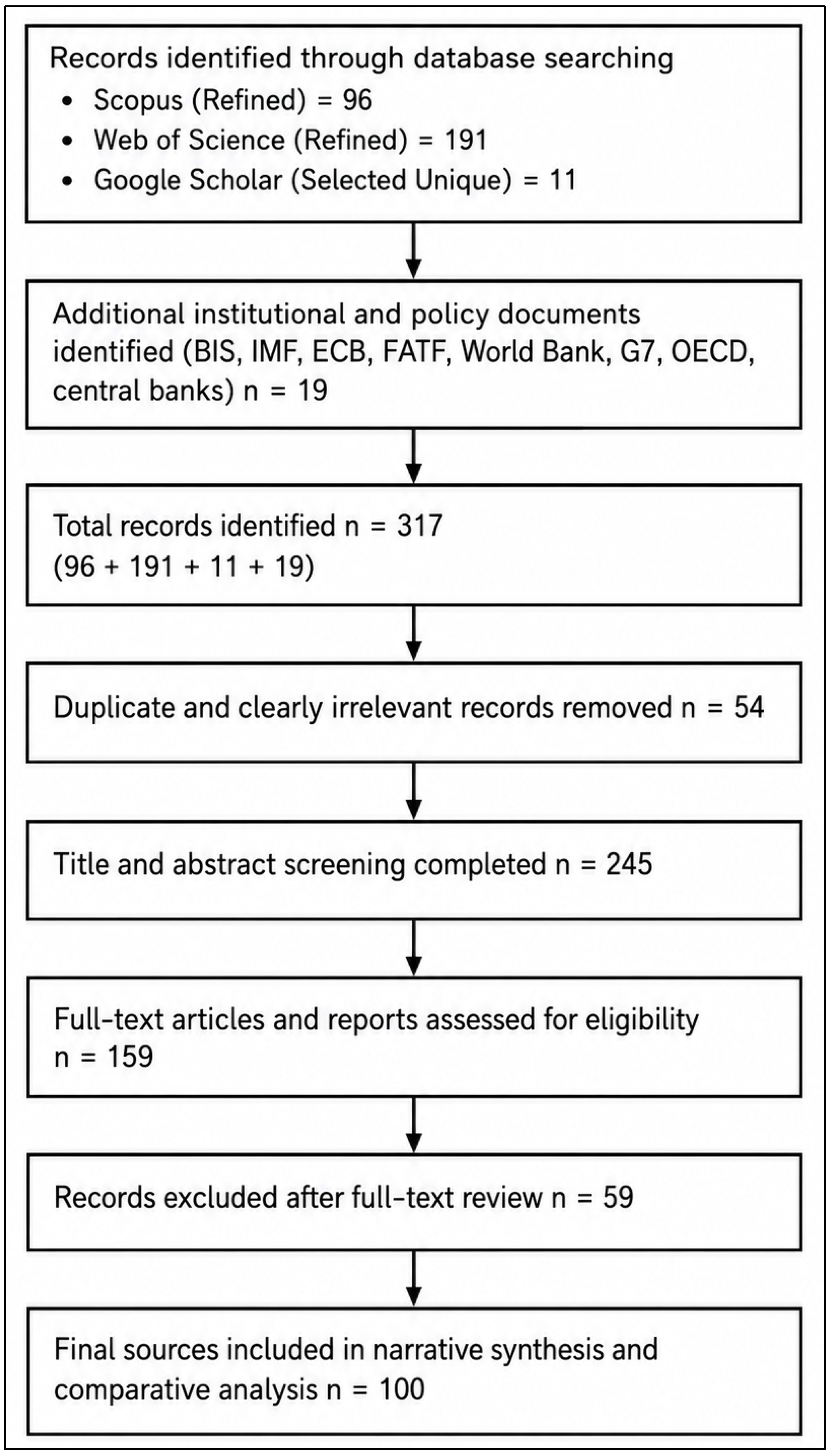
2. Methodology
2.1. Research Design and Literature Search
2.2. Case Study Selection and Comparative Analytical Approach
2.3. Framework Derivation and Proposition Development
2.4. Limitations of Methodology
3. Literature Review: CBDC Development, Trust, and Adoption
3.1. The Global Rise of CBDCs and the Trust Imperative
3.2. User Adoption Drivers and Barriers
3.3. Privacy Concerns and Their Dimensions
3.4. Privacy-by-Design as a Foundational Response
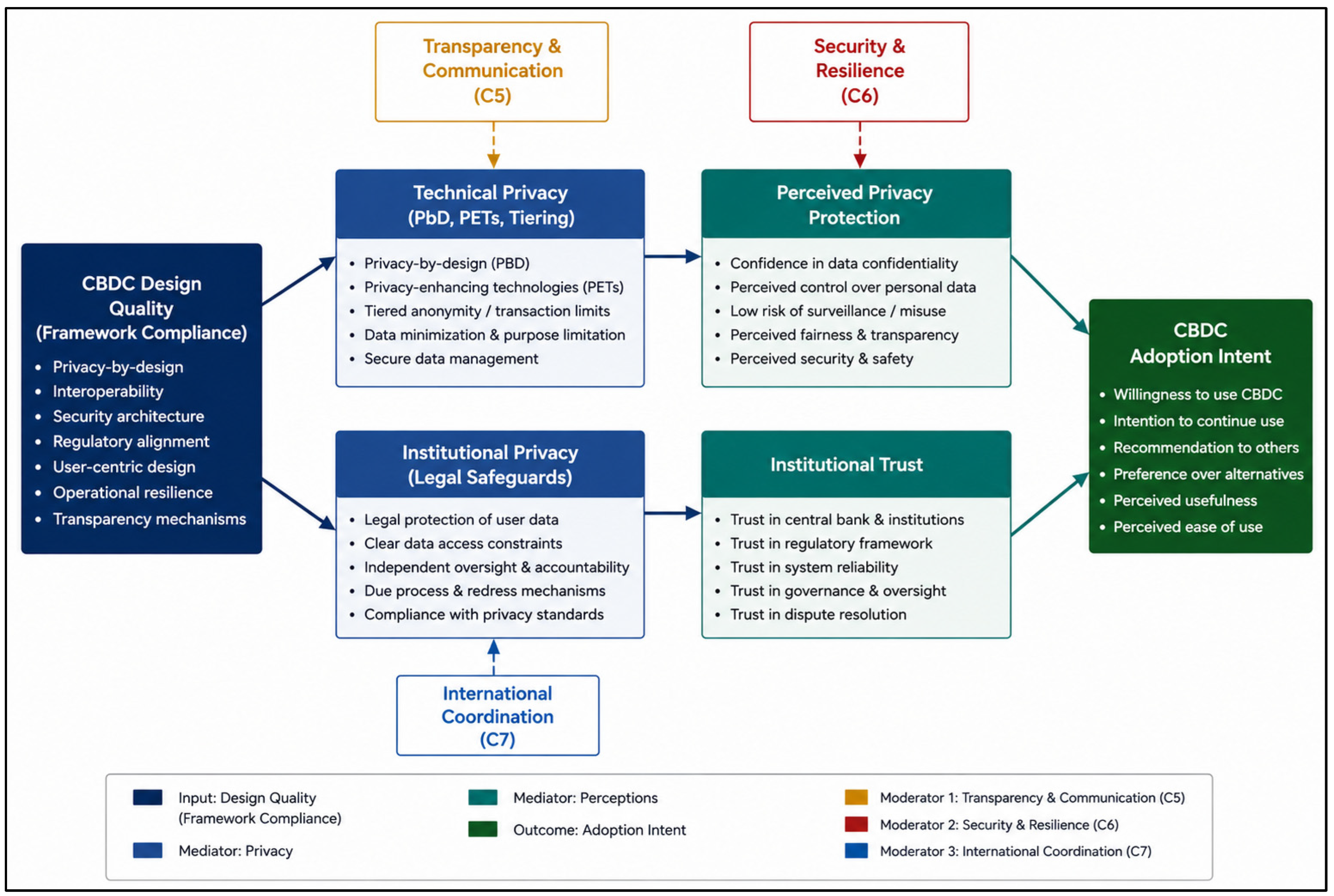
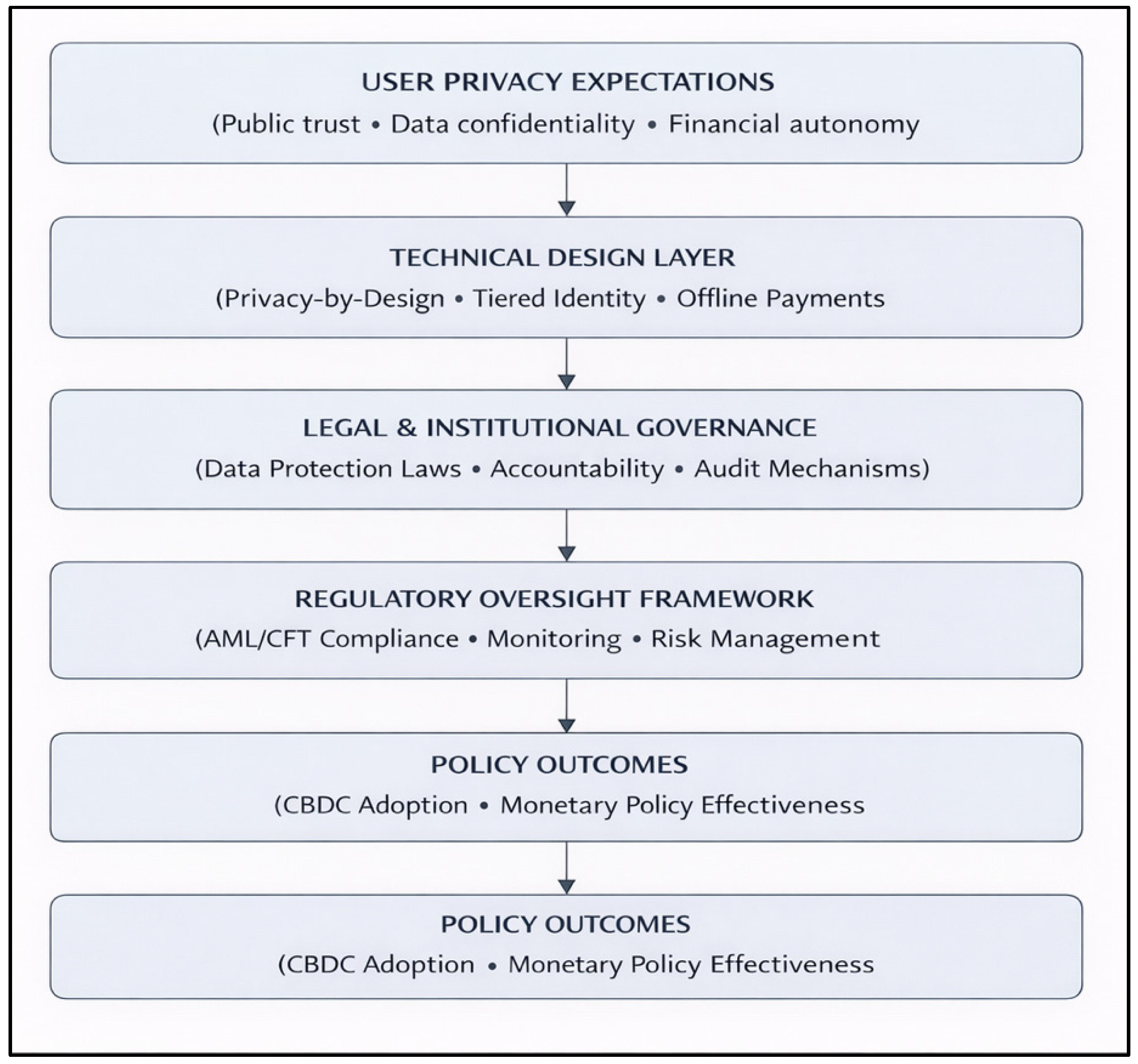
4. Conceptual Framework: The Privacy-Trust-Adoption Conceptual Chain
5. Case Evidence: CBDC Privacy Design and Adoption Outcomes
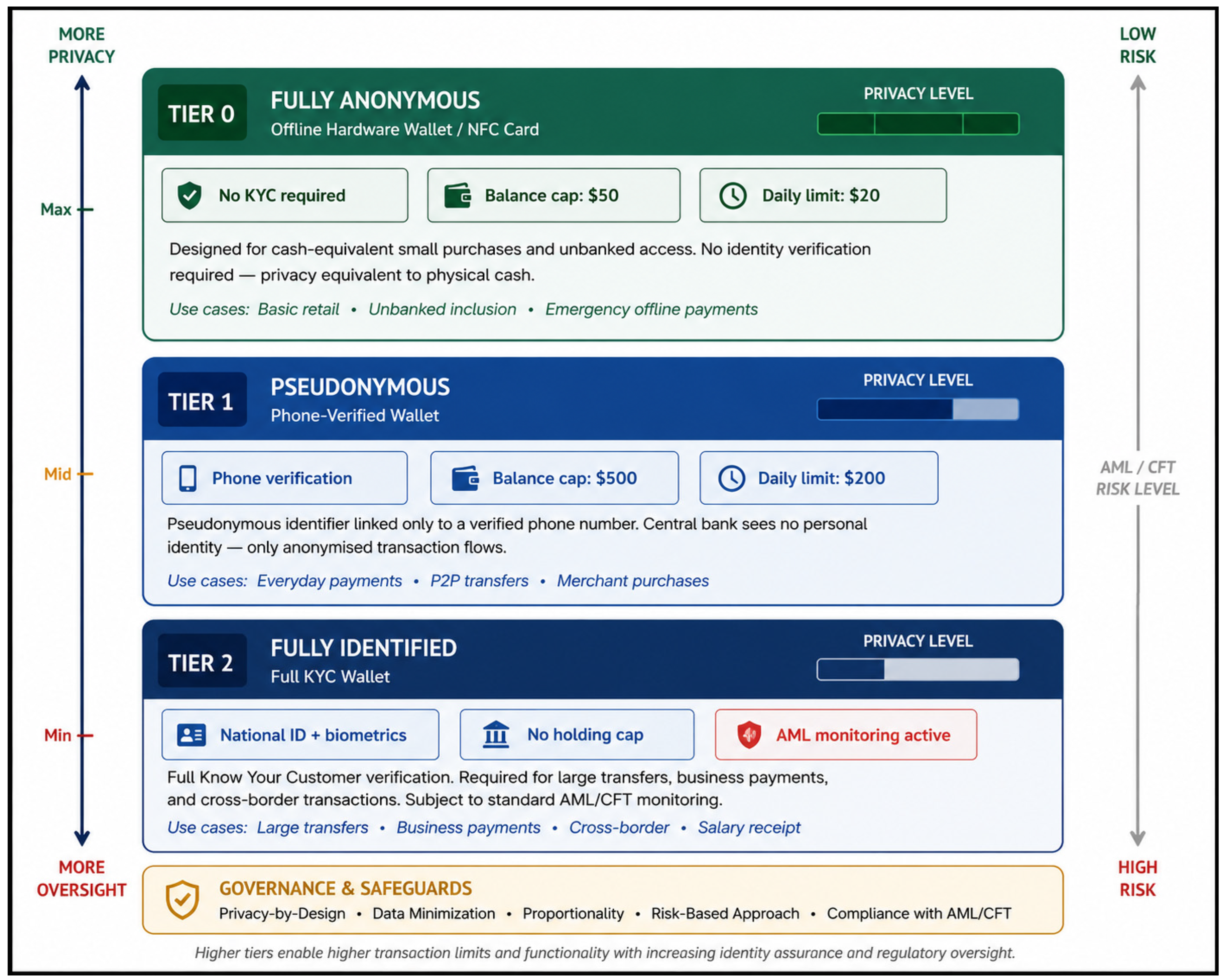
5.1. Balancing Privacy with Regulatory Oversight
5.2. Cross-Case Analysis
5.2.1. Bahamas Sand Dollar
5.2.2. Nigeria eNaira
5.2.3. China e-CNY
5.2.4. Digital Euro
6. A Global Policy Framework for Trustworthy CBDCs: Components and Propositions
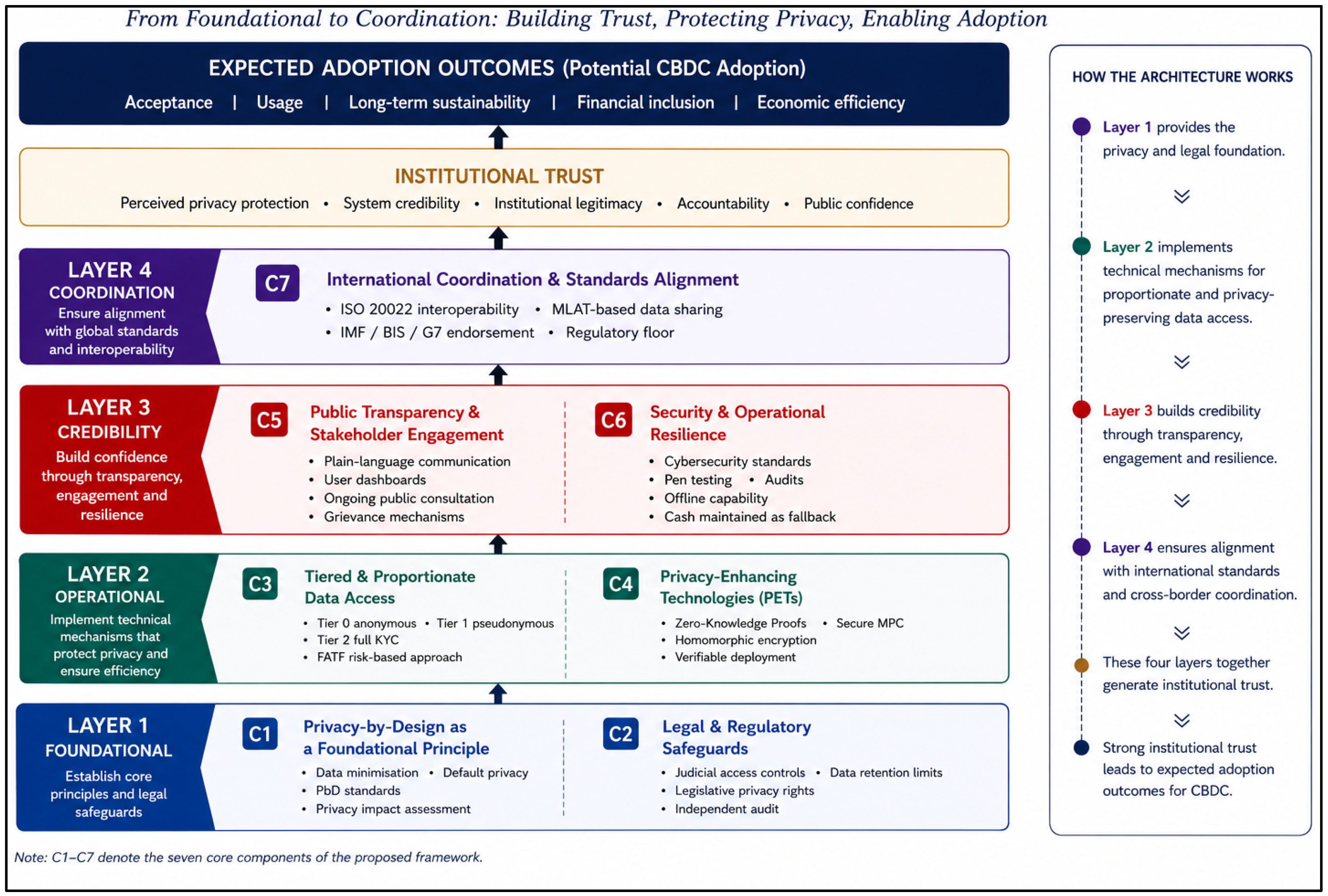
6.1. Framework Architecture
6.2. Framework Components and Research Propositions
6.2.1. Component 1: Privacy-by-Design as a Foundational Principle
- Model Specificationwhere:A(it) = α + β1PbD(it) + β2X(it) + μi + ε(it)PbD(it) = Σ (k = 1 to K) wk dkit
- Variable DefinitionsA(it) = CBDC adoption rate in jurisdiction i at time t (% active wallets/eligible population)PbD(it) = Privacy-by-Design (PbD) compliance index; weighted sum of K binary design indicators (dkit)dkit = Binary indicator (=1 if CBDC satisfies design criterion k at time t, 0 otherwise)wk = Criterion weight (equal weighting as default; confirmatory factor analysis used in robustness checks)X(it) = Control variables, including GDP per capita, financial inclusion rate, mobile penetration, and institutional trustμi = Jurisdiction fixed effects (captures time-invariant unobserved heterogeneity)ε(it) = Idiosyncratic error term
6.2.2. Component 2 (Legal Safeguards → Institutional Trust): Robust Legal and Regulatory Safeguards
- Model Specificationwhere:T(it) = α + β1LS(it) + β2Tcb(it) + β3X(it) + μi + ε(it)LS(it) = γ1JO(it) + γ2DR(it) + γ3OA(it) + γ4SR(it)
- Variable DefinitionsT(it) = Public institutional trust score (survey-based, 0–100 scale; e.g., Eurobarometer/Afrobarometer)LS(it) = Legal safeguards index (composite of sub-components listed below)JO(it) = Judicial oversight (1 if data access requires a court order, 0 otherwise)DR(it) = Data retention limit (1 if unflagged records are automatically deleted within ≤180 days, 0 otherwise)OA(it) = Open audit (1 if an independent annual privacy audit is published, 0 otherwise)SR(it) = Statutory rights (1 if CBDC privacy rights are codified in primary legislation, 0 otherwise)Tcb(it) = Pre-existing trust in the central bank (lagged by one period to avoid simultaneity bias)X(it) = Control variables, including rule-of-law index, press freedom score, and GDP per capitaμi = Jurisdiction fixed effects (captures time-invariant unobserved heterogeneity)ε(it) = Idiosyncratic error termNote: Equations (3) and (4). Measurement model for Proposition 2 (Ordered logit with Legal Safeguards composite index; mediation via perceived privacy).
6.2.3. Component 3: Tiered and Proportionate Data Access
- Measurement model for Proposition 3A(it) = α + β1TK(it) + β2FE(it) + β3(TK(it) × FE(it)) + β4X(it) + μi + ε(it)
- Variable DefinitionsA(it) = CBDC adoption rate (see Proposition 1)TK(it) = Tiered KYC index (0 = no tiers; 1 = two tiers; 2 = three or more tiers including an anonymous floor)FE(it) = Financial exclusion rate (% of adult population without a formal bank account; World Bank Findex)TK(it) × FE(it) = Interaction term capturing whether tiering disproportionately increases adoption in financially excluded populationsβ3 = Moderation coefficient (expected sign: β3 > 0, indicating that tiered KYC is more effective where financial exclusion is higher)X(it) = Control variables, including smartphone penetration, GDP per capita, and AML regulatory stringency indexμi = Jurisdiction fixed effectsε(it) = Idiosyncratic error term
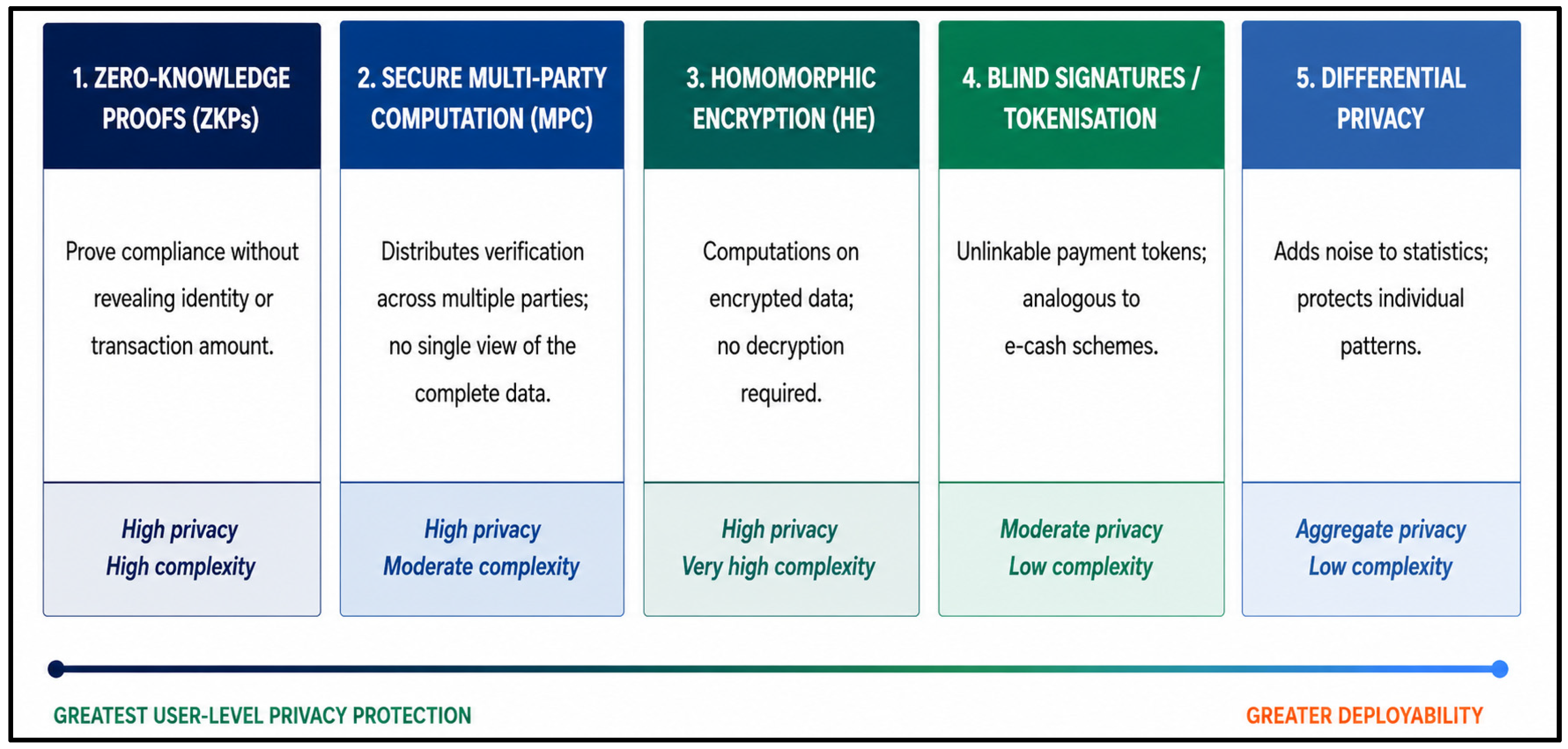
6.2.4. Component 4. Deployment of Privacy-Enhancing Technologies
- Measurement model for Proposition 4where:Wij = α + β1PETij + β2TLi + β3(PETij × TLi) + β4Xij + εijPETij = Σ (m = 1 to M) PETijm, such that PETijm ∈ {0,1}
- Variable DefinitionsWij = Adoption willingness of individual i for CBDC design j (stated preference, 1–7 Likert scale)PETij = PET deployment score for CBDC design j (0–3: none/single PET/multiple PETs/independently audited PETs)PETijm = Binary indicator for deployment of PET type m (e.g., ZKP, MPC, homomorphic encryption)TLi = Technical literacy score of respondent i (standardized digital skills index)PETij × TLi = Interaction term testing whether PET effects are stronger for technically literate usersβ3 = Moderation coefficient (expected β3 > 0; PETs are more valued by technically literate users)Xij = Control variables, including age, income, prior digital payment experience, and country fixed effectsεij = Idiosyncratic error term
- Estimation Strategy
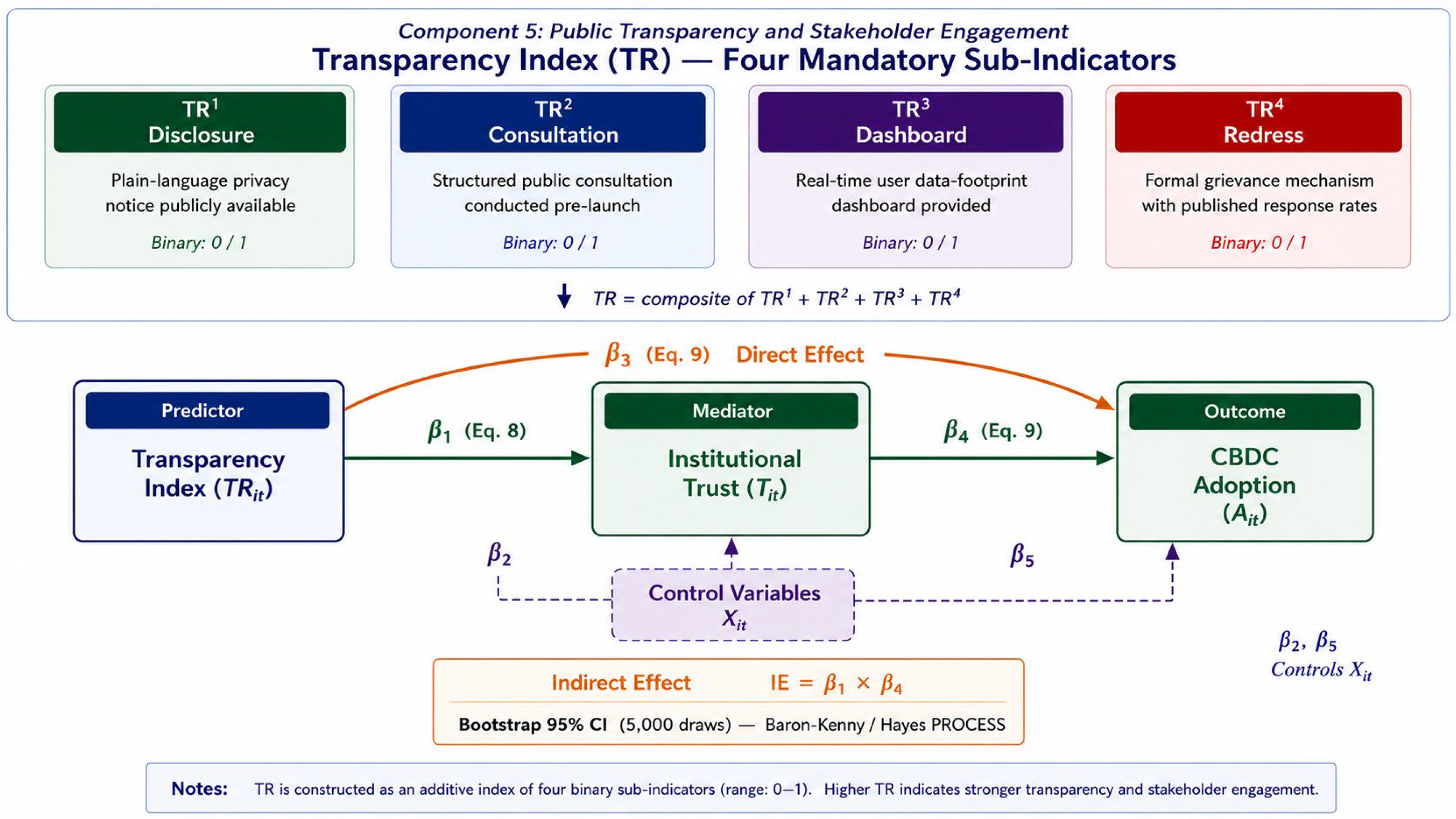
6.2.5. Component 5: Public Transparency and Stakeholder Engagement
- Measurement model for Proposition 5:Tit = α1 + β1TRit + β2Xit + εit1Ait = α2 + β3TRit + β4Tit + β5Xit + εit2
- Indirect effect:IE = β1 × β4
- Variable DefinitionsTRit = Transparency index (composite of sub-indicators listed below)TRit1 (Disclosure) = 1 if a plain-language privacy notice is publicly availableTRit2 (Consultation) = 1 if a structured public consultation is conducted pre-launchTRit3 (Dashboard) = 1 if a real-time user data-footprint dashboard is providedTRit4 (Redress) = 1 if a formal grievance mechanism exists with published response ratesTit = Institutional trust score (mediator; survey-based, 0–100 scale)Ait = CBDC adoption rate (outcome variable)IE = Indirect (mediated) effect of transparency on adoption through trust (estimated with bootstrap confidence intervals)
6.2.6. Component 6: Security and Operational Resilience
- Measurement model for Proposition 6:ΔTit = α + β1INCit + β2RECit + β3(INCit × RECit) + β4Xit + εit
- Asymmetry Test: |β1| ≫ coefficient of equivalent positive event
- Variable DefinitionsΔTit = Change in trust score from period t − 1 to t (first-differenced trust)INCit = Security incident dummy (1 if a confirmed breach or outage occurs in period t, 0 otherwise)RECit = Recovery quality index (0–1 scale measuring response speed, disclosure transparency, and remediation effectiveness)INCit × RECit = Interaction term testing whether higher-quality recovery mitigates trust lossβ1 = Expected coefficient < 0 (security incidents reduce trust)β3 = Expected coefficient > 0 (effective recovery partially offsets trust loss)Xit = Control variables, including prior trust level, media coverage intensity, and incident severityεit = Idiosyncratic error term
6.2.7. Component 7: International Coordination and Standards Alignment
- Measurement model for Proposition 7where:ARBijt = α + β1ΔPSijt + β2FLOWijt + β3(ΔPSijt × FLOWijt) + β4Xijt + μij + εijtΔPSijt = PSjt − PSitNote: privacy standard differential between corridor countries i and j
- Variable DefinitionsARBijt = Arbitrage proxy; share of cross-border CBDC transaction volume routed through lower-privacy jurisdictions in corridor i–jΔPSijt = Privacy standard differential (privacy index of country j minus country i)PSit = Privacy standards index for country i at time t (composite of C1–C6 compliance scores)FLOWijt = Cross-border CBDC transaction flow volume between countries i and j (log-normalized)ΔPSijt × FLOWijt = Interaction term testing whether larger privacy gaps amplify arbitrage in high-volume corridorsβ1 = Expected coefficient > 0 (greater privacy differentials increase arbitrage routing)μij = Corridor-pair fixed effectsXijt = Control variables, including bilateral AML agreements, FATF mutual evaluation scores, and exchange rate volatilityεijt = Idiosyncratic error termNote: The proposed measurement model for Proposition 7 is a gravity-model panel with corridor fixed effects and staggered law entry serving as a natural experiment for identification.
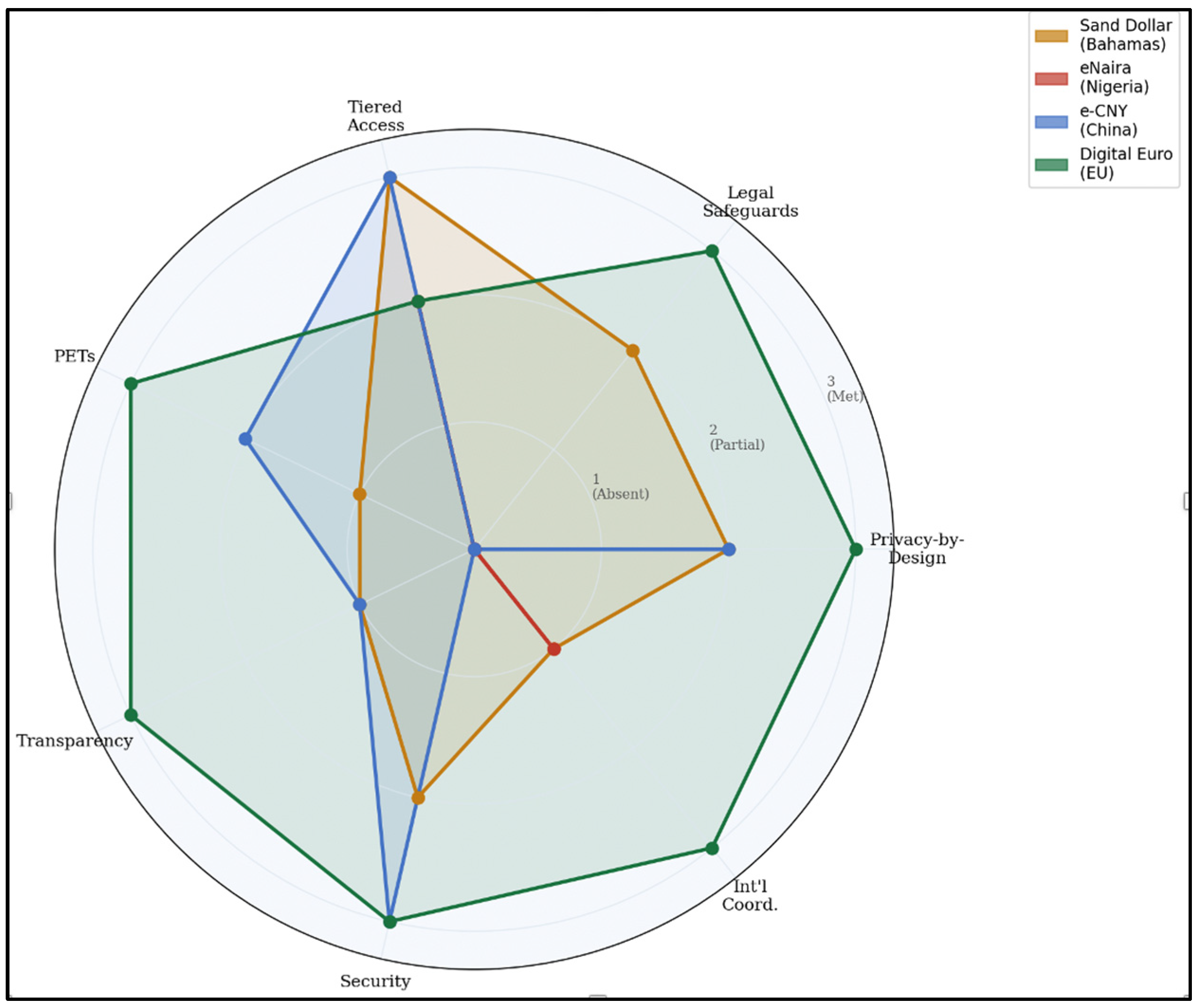
6.3. Comparative Mapping of Framework Components Across CBDC Cases
7. Discussion
7.1. Divergent Legal Regimes and the Limits of a Global Framework
7.2. Technological Complexity and Implementation Risk
7.3. Financial Integrity and the Proportionality Principle
7.4. Financial Inclusion and Privacy as Complementary Goals
8. Limitations and Future Research Directions
9. Conclusions
Funding
Institutional Review Board Statement
Informed Consent Statement
Data Availability Statement
Acknowledgments
Conflicts of Interest
Abbreviations
| AML | Anti-money laundering |
| CFT | Countering the financing of terrorism. |
| FATF | Financial Action Task Force |
| KYC | Know Your Customer |
| PETs | Privacy-enhancing technologies |
| PBoC | People’s Bank of China |
| ECB | European Central Bank |
| CBDC | Central Bank Digital Currency |
| PETs | Privacy-Enhancing Technologies |
| PbD | Privacy-by-Design |
Appendix A

| Jurisdiction | CBDC Name | Privacy Model | Anonymity Level | KYC Requirements | Data Storage | Transaction Limits | Key Privacy Features |
|---|---|---|---|---|---|---|---|
| Bahamas | Sand Dollar | Tiered Privacy | Partial (low-value) | Tiered (basic to full) | Distributed (wallets) | $500 (basic), unlimited (full KYC) | • Anonymous small transactions |
| • Wallet-based privacy | |||||||
| • No central transaction database | |||||||
| China | e-CNY (Digital Yuan) | Controlled Anonymity | Limited | Mandatory for all wallets | Centralized (PBOC) | Varies by wallet tier | • “Anonymity to merchants, not state” |
| • Government access permitted | |||||||
| • Real-name verification required | |||||||
| European Union | Digital Euro (Proposed) | Privacy-by-Design | High (offline), Low (online) | EU AML standards | Hybrid (distributed ledger) | €3000 (offline), higher (online) | • Offline anonymity option |
| • GDPR compliance | |||||||
| • Privacy-preserving technologies | |||||||
| • No central holding of personal data | |||||||
| Nigeria | eNaira | Standard KYC | Minimal | Mandatory (3 tiers) | Centralized (CBN) | ₦50,000 (tier 1), ₦500,000 (tier 2) | • Tiered wallet system |
| • Bank-mediated access | |||||||
| • Standard banking privacy | |||||||
| Sweden | e-Krona (Pilot) | Privacy-Preserving | Moderate | Standard KYC | Distributed | Under development | • Privacy-enhancing technologies |
| • Pseudonymization | |||||||
| • Limited data retention | |||||||
| Jamaica | JAM-DEX | Tiered Approach | Partial | Tiered KYC | Hybrid | J$50,000 (basic tier) | • Small-value anonymity |
| • Progressive verification | |||||||
| • Financial inclusion focus |
| Framework Component | Illustrative Mechanisms | Governance Actors | Indicative Outcomes |
|---|---|---|---|
| Privacy-by-Design | ZKPs, homomorphic encryption, differential privacy | Central banks, technology providers, privacy experts | Enhanced transaction confidentiality and user privacy |
| Legal & Regulatory Safeguards | Privacy legislation, judicial oversight, data protection rules | Legislators, regulators, privacy authorities | Greater legal clarity and institutional accountability |
| Tiered Data Access | Risk-based KYC, low-value anonymity thresholds | Central banks, financial institutions, AML authorities | Improved balance between privacy and compliance |
| Transparency & Public Communication | Public consultations, transparency reports, education campaigns | Central banks, civil society, media | Improved public trust and stakeholder engagement |
| Security & Operational Resilience | Encryption protocols, cybersecurity audits, resilience testing | Technology providers, cybersecurity agencies | Stronger operational reliability and system integrity |
| International Coordination | Cross-border standards, interoperability frameworks | BIS, IMF, FSB, central banks | Improved interoperability and regulatory harmonization |
| Continuous Evaluation & Oversight | Independent audits, policy reviews, stakeholder feedback | Regulators, academic experts, oversight bodies | Adaptive governance and long-term institutional legitimacy |
References
- Strohecker, K. Twenty-Four Central Banks Will Have Digital Currencies by 2030, Survey Shows; Rueters: Toronto, ON, Caada, 2023. [Google Scholar]
- BIS. BIS Annual Economic Report 2023; Bank of International Settlements: Basel, Switzerland, 2023. [Google Scholar]
- Soana, G.; de Arruda, T. Central Bank Digital Currencies and Financial Integrity: Finding a New Trade-off between Privacy and Traceability within a Changing Financial Architecture. J. Bank. Regul. 2024, 25, 467–486. [Google Scholar] [CrossRef]
- Genc, H.O.; Takagi, S. A Literature Review on the Design and Implementation of Central Bank Digital Currencies. Int. J. Econ. Policy Stud. 2024, 18, 197–225. [Google Scholar] [CrossRef]
- Murphy, K. Central Bank Digital Currency Data Use and Privacy Protection; Fintech Notes; International Monetary Fund: Washington, DC, USA, 2024; Volume 2024, 51p. [Google Scholar] [CrossRef]
- Grünewald, S. Digital Euro and Accountability of the European Central Bank. Maastricht J. Eur. Comp. Law 2023, 30, 438–454. [Google Scholar] [CrossRef]
- Razi-ur-Rahim, M.; Uddin, F.; Rahim, S.; Hossain, M.B. Pioneering Digital Finance: Determinants of CBDC Adoption in the Era of FinTech and Online Payments. Qual. Quant. 2026. [Google Scholar] [CrossRef]
- Guo, Y.; Yousef, E.; Naseer, M.M. Cryptocurrencies and Central Bank Digital Currencies in Global Perspective. J. Risk Financ. Manag. 2025, 18, 644. [Google Scholar] [CrossRef]
- Garratt, R.J.; Van Oordt, M.R.C. Privacy as a Public Good: A Case for Electronic Cash. J. Polit. Econ. 2021, 129, 2157–2180. [Google Scholar] [CrossRef]
- Shah, M.A.; Raj, N. Examining the Role of Blockchain and Public-Private Partnerships in Design and Deployment of Blockchain-Enabled CBDC. Digit. Bus. 2025, 5, 100111. [Google Scholar] [CrossRef]
- Popay, J.; Roberts, H.; Sowden, A.; Petticrew, M.; Arai, L.; Rodgers, M.; Britten, N. Guidance on the Conduct of Narrative Synthesis in Systematic Reviews: A Product from the ESRC Methods Programme; University of Lancaster: Lancaster, UK, 2006. [Google Scholar] [CrossRef]
- Rodgers, M.; Sowden, A.; Petticrew, M.; Arai, L.; Roberts, H.; Britten, N.; Popay, J. Testing Methodological Guidance on the Conduct of Narrative Synthesis in Systematic Reviews: Effectiveness of Interventions to Promote Smoke Alarm Ownership and Function. Evaluation 2009, 15, 49–73. [Google Scholar] [CrossRef]
- Omotubora, A. Same Naira, More Possibilities! Assessing the Legal Status of the eNaira and Its Potential for Privacy and Inclusion. J. Afr. Law 2024, 68, 245–262. [Google Scholar] [CrossRef]
- Chin, G.T. China’s ‘Digital Renminbi’ (e-CNY) as Financial Inclusion: The Global Frontier of Central Bank Digital Currency. Glob. Public Policy Gov. 2025, 5, 63–81. [Google Scholar] [CrossRef]
- Tronnier, F. Using Contextual Integrity to Uncover Acceptability of Information Flows in Central Bank Digital Currency Transactions. In Proceedings of the Hawaii International Conference on System Sciences 2024 (HICSS-57), Honolulu, HI, USA, 3–6 January 2024; pp. 5878–5887. [Google Scholar]
- Gütschow, M.; Lucke, B. The Proposed Design of the Digital Euro: A Critical Analysis. Digit. Financ. 2026, 8. [Google Scholar] [CrossRef]
- Tsouris, I.; Thanasas, G.L.; Rigou, M. Assessing the European Central Bank’s Institutional Capacity and Readiness for the Introduction of the Digital Euro. J. Risk Financ. Manag. 2026, 19, 148. [Google Scholar] [CrossRef]
- Yin, R.K. Case Study Research and Applications: Design and Methods, 6th ed.; SAGE: Los Angeles, CA, USA, 2018. [Google Scholar]
- Whetten, D.A. What Constitutes a Theoretical Contribution? Acad. Manag. Rev. 1989, 14, 490. [Google Scholar] [CrossRef]
- Sangwa, S.; Mutabazi, P. Programmable CBDCs, Digital Identity, ISO 20022, and AI: Reconfiguring Power in Payment Infrastructures. Open J. Steward. Econ. Ethical Innov. 2025, 1. [Google Scholar] [CrossRef]
- Solberg Söilen, K.; Benhayoun, L. Household Acceptance of Central Bank Digital Currency: The Role of Institutional Trust. Int. J. Bank Mark. 2022, 40, 172–196. [Google Scholar] [CrossRef]
- Ismail, A.; Steyn, H.; Phelane, C. Moving Digital Cash (Forward): The Significance of Payment Schemes. J. Paym. Strategy Syst. 2020, 14, 353–362. [Google Scholar] [CrossRef]
- Singh, A.; Sadegh, M.; Mashatan, A. Adoption of Central Bank Digital Currencies: A Data-Driven Exploration of Key Influential Factors. In Proceedings of the AMCIS 2025 Proceedings; Association for Information Systems (AIS): Atlanta, GA, USA, 2025; Volume 2, pp. 1182–1191. [Google Scholar]
- Auer, R.; Frost, J.; Gambacorta, L.; Monnet, C.; Rice, T.; Shin, H.S. Central Bank Digital Currencies: Motives, Economic Implications, and the Research Frontier. Annu. Rev. Econ. 2022, 14, 697–721. [Google Scholar] [CrossRef]
- Bijlsma, M.; van der Cruijsen, C.; Jonker, N.; Reijerink, J. What Triggers Consumer Adoption of Central Bank Digital Currency? J. Financ. Serv. Res. 2024, 65, 1–40. [Google Scholar] [CrossRef]
- Choi, S.; Kim, B.; Kim, Y.S.; Kwon, O. Central Bank Digital Currency and Privacy: A Randomized Survey Experiment. Int. Econ. Rev. 2025, 66, 823–847. [Google Scholar] [CrossRef]
- Bugár, G.; Somogyvári, M. Fundamental Principles to Design an Ethical Payment System. Humanit. Soc. Sci. Commun. 2025, 12, 299. [Google Scholar] [CrossRef]
- Omar, R.; Wylde, V.; Herd, M. Could Digital Currencies End Banking as We Know It? The Future of Money; The Conversation: Melbourne, Australia, 2025. [Google Scholar]
- Zarifis, A.; Cheng, X. The Six Ways to Build Trust and Reduce Privacy Concern in a Central Bank Digital Currency (CBDC). In Business Digital Transformation; Zarifis, A., Ktoridou, D., Efthymiou, L., Cheng, X., Eds.; Springer International Publishing: Cham, Switzerland, 2024; pp. 115–138. [Google Scholar]
- Yee, G.O.M. Privacy Protection Measures and Technologies in Business Organizations: Aspects and Standards; Yee, G.O.M., Aptus Research Solutions, IGI Global, Eds.; IGI Global: Hershey, PA, USA, 2012. [Google Scholar]
- Elliott, C.; Orser, B. Feminist Entrepreneurial Identity: Reproducing Gender through Founder Decision-Making. In A Research Agenda for Women and Entrepreneurship Identity Through Aspirations, Behaviors and Confidence; Edward Elgar Publishing: Cheltenham, UK, 2018; pp. 114–136. [Google Scholar]
- Kyriazis, N.A.; Dimitriadis, K.A.; Theodossiou, P. Can Banking Intermediates Crowd Out Their High-Tech Promising Successors? A Financial Stress Perspective. Int. J. Financ. Econ. 2026. early view. [Google Scholar] [CrossRef]
- Singh, V.; Yadav, M. User Adoption of Digital Currency: A Systematic Review and Future Agenda Using TCCM Approach. Cent. Bank Rev. 2025, 25, 100183. [Google Scholar] [CrossRef]
- Agur, I.; Ari, A.; Dell’Ariccia, G. Designing Central Bank Digital Currencies. J. Monet. Econ. 2022, 125, 62–79. [Google Scholar] [CrossRef]
- Insights, L. Bahamas Sand Dollar CBDC Has $2.1m in Circulation After 3 Years; Ledger Insights—Blockchain Enterprise: Limassol, Cyprus, 2024. [Google Scholar]
- Giraldo-Gordillo, F.E.; Bustillo-Mesanza, R. CBDCs and Liquidity Risks: Evidence from the SandDollar’s Impact on Deposits and Loans in the Bahamas. FinTech 2026, 5, 5. [Google Scholar] [CrossRef]
- Ree, J. Nigeria’s eNaira, One Year After; International Monetary Fund: Washington, DC, USA, 2023. [Google Scholar]
- Abdullahi, M.; Ahmad, A.; Pandey, B.K.; Pandey, D. Digital Currency Adoption: A Comparative Analysis of Global Trends and the Nigerian eNaira Digital Currency. SN Comput. Sci. 2024, 5, 602. [Google Scholar] [CrossRef]
- CBDC Tracker. Available online: https://cbdctracker.hrf.org/currency/nigeria (accessed on 17 May 2026).
- Quaglia, L.; Verdun, A. The Geoeconomics of Central Banks Digital Currencies (CBDCs): The Case of the European Central Bank (ECB). New Polit. Econ. 2025, 30, 639–651. [Google Scholar] [CrossRef]
- Seiler, V. What Determines Potential Usage of the Digital Euro? Res. Int. Bus. Financ. 2026, 86, 103360. [Google Scholar] [CrossRef]
- Li, Y.; Wareewanich, T.; Chankoson, T. A Study on Influencing Factors of Willingness to Use E-CNY Based on Logistic Model. Int. J. Interact. Mob. Technol. 2024, 18, 112–123. [Google Scholar] [CrossRef]
- Corbet, S.; Cumming, D.; Glatzer, Z.; Johan, S. Understanding the Rapid Development of CBDC in Emerging Economies. Financ. Res. Lett. 2024, 70, 106226. [Google Scholar] [CrossRef]
- Gaisina, A.; Finger, M. Central Bank Digital Currencies (CBDCs): A Countermeasure to Anti-Money Laundering (AML) Challenges Posed by Cryptocurrencies? Digit. Financ. 2025, 7, 201–254. [Google Scholar] [CrossRef]
- Chiu, J.; Davoodalhosseini, S.M.; Jiang, J.; Zhu, Y. Bank Market Power and Central Bank Digital Currency: Theory and Quantitative Assessment. J. Polit. Econ. 2023, 131, 1213–1248. [Google Scholar] [CrossRef]
- Ballaschk, D.; Paulick, J. The Public, the Private and the Secret: Thoughts on Privacy in Central Bank Digital Currencies. J. Paym. Strategy Syst. 2021, 15, 277. [Google Scholar] [CrossRef]
- Buterin, V.; Illum, J.; Nadler, M.; Schär, F.; Soleimani, A. Blockchain Privacy and Regulatory Compliance: Towards a Practical Equilibrium. Blockchain Res. Appl. 2024, 5, 100176. [Google Scholar] [CrossRef]
- Solomka, I.; Liubinskyi, B. Zero-Knowledge Proof Framework for Privacy-Preserving Financial Compliance. Math. Model. Comput. 2025, 12, 342–354. [Google Scholar] [CrossRef]
- Barbereau, T.; Sedlmeir, J.; Smethurst, R.; Fridgen, G.; Rieger, A. Tokenization and Regulatory Compliance for Art and Collectibles Markets: From Regulators’ Demands for Transparency to Investors’ Demands for Privacy. In Blockchains and the Token Economy; Lacity, M.C., Treiblmaier, H., Eds.; Technology, Work and Globalization; Springer International Publishing: Cham, Switzerland, 2022; pp. 213–236. [Google Scholar]
- Giraldo-Gordillo, F.E.; Bustillo-Mesanza, R. The Effects of CBDCs on Mobile Money and Outstanding Loans: Evidence from the eNaira and SandDollar Experiences. FinTech 2025, 4, 39. [Google Scholar] [CrossRef]
- C, V.A.; Kamin, S.; Zampolli, F. Central Bank Digital Currencies (CBDCs) in Latin America and the Caribbean. Lat. Am. J. Cent. Bank. 2025, 6, 100140. [Google Scholar] [CrossRef]
- Koonprasert, T.T.; Kanada, S.; Ysuda, N.; Reshidi, E. Central Bank Digital Currency Adoption: Inclusive Strategies for Intermediaries and Users; Fintech Notes; International Monetary Fund: Washington, DC, USA, 2024; Volume 2024, 57p. [Google Scholar] [CrossRef]
- Bosua, A.P.; Biswas, M. Public Perception and Adoption Approaches for Digital Currencies: Analysing Influencing Factors. In Proceedings of the 2024 29th International Conference on Automation and Computing (ICAC); IEEE: Piscataway, NJ, USA, 2024. [Google Scholar]
- Olaleye, S.A.; Ahiabenu, K.; Ojubanire, O.A. The Democratization of Digital Currency in Nigeria: A Sentiment Analysis of eNaira App Usability. Afr. J. Sci. Technol. Innov. Dev. 2024, 16, 603–620. [Google Scholar] [CrossRef]
- Ahmed, M.; Al-Hussaini, A.I.S.; Ibrahim, A.A.; Abubakar, R.A. Mediating Effect of Emotionality on the Intention to Use the Nigerian Central Bank Digital Currency (e-Naira). Int. J. Bus. Syst. Res. 2025, 19, 95–110. [Google Scholar] [CrossRef]
- Huang, Y. A Study on Anti-Money Laundering Regulation in e-CNY Cross-Border Payments. Int. J. Adv. Appl. Sci. 2025, 12, 216–225. [Google Scholar] [CrossRef]
- Heidebrecht, S. How and Why EU Institutions Promote the Digital Euro: The Politics of a Central Bank Digital Currency (CBDC). J. Common Mark. Stud. 2025, early view. [Google Scholar] [CrossRef]
- Brühl, V. The Potential Impact of a Central Bank Digital Currency (CBDC) on the Banking Sector: The Case of a Digital Euro. Eurasian Econ. Rev. 2026, 16, 215–240. [Google Scholar] [CrossRef]
- Dionysopoulos, L.; Marra, M.; Urquhart, A. Central Bank Digital Currencies: A Critical Review. Int. Rev. Financ. Anal. 2024, 91, 103031. [Google Scholar] [CrossRef]
- Allahrakha, N.; Xamdamovna, T.G.; Sokhibjonovich, B.S.; Narziev, O.; Pulatov, T. Privacy and Security Risks in Cross-Border Digital Payment Systems. Leg. J. Ilm. Huk. 2025, 33, 553–584. [Google Scholar] [CrossRef]
- Choi, J.-R. Quantum Behavior of a Nonextensive Oscillatory Dissipative System in the Coherent State. Symmetry 2021, 13, 1178. [Google Scholar] [CrossRef]
- Jiang, J. Privacy Implications of Central Bank Digital Currencies. Seton Hall Law Rev. 2023, 54, 69–135. [Google Scholar] [CrossRef]
- Wostbrock, M. Miller in a Cashless Society: Financial Surveillance and the Fourth Amendment. Columbia Bus. Law Rev. 2024, 2023. [Google Scholar] [CrossRef]
- Huber, J. The Monetary Turning Point: From Bank Money to Central Bank Digital Currency (CBDC); Palgrave Macmillan: Cham, Switzerland, 2023; 192p. [Google Scholar]
- Zafar, A. Privacy as Institutional Design: A Legal-Technological Analysis of CBDC Governance and Compliance. Comput. Law Secur. Rev. 2026, 60, 106258. [Google Scholar] [CrossRef]
- Michalopoulos, P.; Olowookere, O.; Pocher, N.; Sedlmeir, J.; Veneris, A.; Puri, P. Privacy and Compliance Design Options in Offline Central Bank Digital Currencies. IEEE Trans. Netw. Serv. Manag. 2025, 22, 3748–3763. [Google Scholar] [CrossRef]
- Rybski, R. Sustainability, Public Security, and Privacy Concerns Regarding Central Bank Digital Currency (CBDC). In Digital Transformation and the Economics of Banking; Routledge: London, UK, 2023. [Google Scholar]
- Arora, R.; Du, H.; Kazmi, R.A.; Le, D.-P. Privacy-Enhancing Technologies for CBDC Solutions; Bank of Canada: Ottawa, ON, Canada, 2025. [Google Scholar] [CrossRef]
- Teng, H.-W.; Härdle, W.K.; Osterrieder, J.; Pele, D.T.; Baals, L.J.; Papavassiliou, V.; Bolesta, K.; Kabašinskas, A.; Filipovska, O.; Thomaidis, N.S.; et al. Digital Assets: Risks, Regulations, Mitigation. Financ. Innov. 2026, 12, 65. [Google Scholar] [CrossRef]
- Michalopoulos, P.; Mack, A.; Clark, C.; Chen, L.; Sedlmeir, J.; Veneris, A. A Prototype for Privacy-Preserving and Compliant Offline CBDC Transactions. 2025. Available online: https://www.eecg.utoronto.ca/~veneris/1BRAINS25.pdf (accessed on 25 February 2026).
- Bank for International Settlements. Options for Access to and Interoperability of CBDCs for Cross-Border Payments: Report to the G20; BIS, Ed.; Bank for International Settlements: Basel, Switzerland, 2022. [Google Scholar]
- Fernández-Villaverde, J.; Sanches, D.; Schilling, L.; Uhlig, H. Central Bank Digital Currency: Central Banking for All? Rev. Econ. Dyn. 2021, 41, 225–242. [Google Scholar] [CrossRef]
- Ceylan, I.E.; Ceylan, F. A Bibliometric Analysis of Global Scientific Research on Central Bank Digital Currencies. Encycl. Monet. Policy Financ. Mark. Bank. 2025, 1, 362–372. [Google Scholar] [CrossRef]
- Gross, J. How To Design a Private and Compliant Central Bank Digital Currency? In Digital Assets and the Law: Fiat Money in the Era of Digital Currency; Routledge: London, UK, 2024; pp. 157–165. [Google Scholar] [CrossRef]
- Bank for International Settlements (Ed.) Central Bank Digital Currency (CBDC) Information Security and Operational Risks to Central Banks: An Operational Lifecycle Risk Management Framework; BIS: Basel, Switzerland, 2023. [Google Scholar]
- Cerutti, E.M.; Firat, M.; Perez-Saiz, H. Estimating the Impact of Digital Money on Cross-Border Flows: Scenario Analysis Covering the Intensive Margin; FinTech Notes; International Monetary Fund: Washington, DC, USA, 2025; Volume 2025. [Google Scholar] [CrossRef]
- Chu, J. Monetary Statecraft and the Bahamian SandDollar. Singap. J. Trop. Geogr. 2026, 47, 131–150. [Google Scholar] [CrossRef]
- FATF. FATF Guidance on Proliferation Financing Risk Assessment and Mitigation; FATF: Paris, France, 2021. [Google Scholar]
- Mooij, A.A.M. The Digital Euro and Energy Considerations: Can the ECB Introduce the Digital Euro Considering the Potential Energy Requirements? Ger. Law J. 2022, 23, 1246–1265. [Google Scholar] [CrossRef]
- Paulovici, T. The Digital Yuan vs. the Digital Euro: Diverging Paths in Central Bank Digital Currency Developments. In Proceedings of the International Conference on Business Excellence; Bucharest University of Economic Studies: Bucharest, Romania, 2025; Volume 19, pp. 2978–2992. [Google Scholar]
- Michail, N.; Selvadurai, N.; Goldbarsht, D. Privacy and National Security Issues Relating to the Introduction of a Central Bank Digital Currency in Australia. J. Money Laund. Control 2026, 29, 20–36. [Google Scholar] [CrossRef]
- Sanz Bayón, P. Current and Future Central Bank Digital Currency (CBDC) Projects. In Governance and Control of Data and Digital Economy in the European Single Market: Legal Framework for New Digital Assets, Identities and Data Spaces; Pastor Sempere, C., Ed.; Springer: Cham, Switzerland, 2025; pp. 309–347. [Google Scholar]
- Weinberg, A.I.; Petratos, P.; Faccia, A. Will Central Bank Digital Currencies (CBDC) and Blockchain Cryptocurrencies Coexist in the Post Quantum Era? Discov. Anal. 2025, 3, 8. [Google Scholar] [CrossRef]
- Patti, F.P. Towards A Global Anti-Money Laundering Law for Crypto-Assets. Georget. J. Int. Law 2025, 56, 697–727. [Google Scholar] [CrossRef]
- Panem, C.; Tripathi, A.M.; Chaudhary, N.K.; Chouhan, L.; Kori, S.A.; Rao, G.S.; Srivastava, A.M. Leveraging Machine Learning and AI for Real-Time Anomaly Detection in Financial Transactions. In Information Security, Privacy and Digital Forensics; Chaudhary, N.K., Iyengar, S.S., Modi, C., Patel, S.J., Eds.; Springer Nature: Singapore, 2026; pp. 1–17. [Google Scholar]




| Inclusion Criteria | Exclusion Criteria |
|---|---|
| English-language publications | Non-English publications |
| Studies published between 2018 and 2025 | Publications outside the study period, unless foundational |
| CBDC-related privacy, trust, governance, adoption, and regulatory studies | Cryptocurrency-only studies unrelated to sovereign CBDCs |
| Peer-reviewed journal articles | Opinion pieces and non-analytical commentary |
| Working papers and institutional reports from recognized organizations | Duplicate records |
| Empirical, conceptual, comparative, and policy-oriented studies | Publications with limited relevance to retail CBDC governance |
| Retail CBDC focus | Wholesale CBDC-only studies unless conceptually relevant |
| Survey Question/Metric | Response Category | Percentage (%) | Sample Size | Source/Year |
|---|---|---|---|---|
| Primary Privacy Concern | Government surveillance | 43% | 5240 | ECB Public Consultation (2021) |
| Loss of anonymity | 52% | 5240 | ECB Public Consultation (2021) | |
| Data breaches | 38% | 3800 | BIS Survey (2023) | |
| Commercial exploitation | 28% | 3800 | BIS Survey (2023) | |
| Trust in CBDC (General) | High trust | 28% | 8500 | Multi-country survey (2023) |
| Medium trust | 44% | 8500 | Multi-country survey (2023) | |
| Low trust | 28% | 8500 | Multi-country survey (2023) | |
| Adoption Intention with Strong Privacy | Definitely would adopt | 45% | 6200 | Academic study (2024) |
| Probably would adopt | 37% | 6200 | Academic study (2024) | |
| Unlikely to adopt | 18% | 6200 | Academic study (2024) | |
| Adoption Intention without Privacy | Definitely would adopt | 8% | 6200 | Academic study (2024) |
| Probably would adopt | 10% | 6200 | Academic study (2024) | |
| Unlikely to adopt | 82% | 6200 | Academic study (2024) | |
| Most Important CBDC Feature | Privacy protection | 41% | 4500 | IMF Study (2023) |
| Security | 32% | 4500 | IMF Study (2023) | |
| Ease of use | 18% | 4500 | IMF Study (2023) | |
| Low fees | 9% | 4500 | IMF Study (2023) | |
| Willingness to Share Data with Government | Comfortable | 15% | 7100 | Privacy International (2023) |
| Somewhat comfortable | 28% | 7100 | Privacy International (2023) | |
| Uncomfortable | 57% | 7100 | Privacy International (2023) |
| Study | Source | Methodology | Key Finding |
|---|---|---|---|
| Choi et al. [26] | BIS Working Paper No. 1147 | Randomized controlled experiment; N = 2000+ (Euro Area & US) | Privacy safeguards raise CBDC adoption willingness by up to 60%; communicating privacy features has an independent, significant positive effect |
| Singh & Yadav [33] | Central Bank Review, 25 (1) | Systematic review of 78 CBDC adoption studies (2010–2023) | Regulatory frameworks and user risk perceptions (including privacy) are the two most consistent adoption determinants across studies |
| Bijlsma et al., [25] | DNB Working Paper No. 709 | Survey experiment; N = 1800 (The Netherlands) | Privacy is the strongest stated preference; loss of privacy is perceived as the primary cost of CBDC adoption |
| Garratt & Oordt, [9] | BIS Working Paper No. 976 | Theoretical welfare analysis of CBDC privacy design | Conditional privacy—anonymity for small, traceability for large transactions—dominates both extremes on welfare grounds |
| Agur et al., [34] | Journal of Monetary Economics, 125 | Theoretical model of CBDC design & competition | Excessive data collection drives users toward anonymous private alternatives, reducing systemic monetary benefits |
| Auer et al., [24] | BIS Working Paper No. 880 | Cross-country comparative analysis of CBDC motivations | Institutional trust in the central bank is a significant moderator of adoption intent |
| Murphy, [5] | IMF Fintech Notes 2024/004 | Normative analysis; high vs. low data-intensity CBDC models | Privacy-by-design and proportionate data governance can reconcile privacy with AML/CFT; 7 PbD principles proposed |
| Framework/Study | Main Focus | Key Limitations | Contribution of the Present Study |
|---|---|---|---|
| BIS (2020–2023) CBDC Principles | Foundational policy principles for CBDC design, interoperability, and financial stability | Limited emphasis on operational privacy governance and adoption behavior | Integrates privacy governance, institutional trust, adoption dynamics, and operational policy architecture into a unified framework |
| IMF CBDC Policy Frameworks | Regulatory governance, financial inclusion, and macro-financial implications | Limited integration of privacy-enhancing technologies and behavioral adoption mechanisms | Combines legal safeguards, PETs, institutional trust, and adoption propositions within a single analytical structure |
| FATF Digital Asset Guidance | AML/CFT compliance and transaction monitoring standards | Strong compliance orientation with limited focus on citizen privacy expectations and trust formation | Introduces a balanced privacy–compliance model through tiered access and proportional governance principles |
| ECB Digital Euro Studies | Privacy preferences, offline payments, and public consultation | Primarily focused on the European institutional context and digital euro implementation | Develops a globally adaptable multi-layer governance framework applicable across diverse CBDC environments |
| Existing Academic CBDC Governance Literature | Fragmented discussions on privacy, surveillance, adoption, or technical architecture | Limited integration across technical, legal, institutional, and international dimensions | Proposes a seven-component, four-layer framework linking governance design, privacy architecture, and adoption expectations |
| Present Study | Integrated CBDC privacy and governance framework | Exploratory and theory-building in nature; requires future empirical testing | Synthesizes interdisciplinary literature and comparative case evidence into a comprehensive policy-oriented framework with associated propositions and operational measurement models |
| CBDC (Country) | Status | Privacy Design Approach | Adoption & Trust Outcome |
|---|---|---|---|
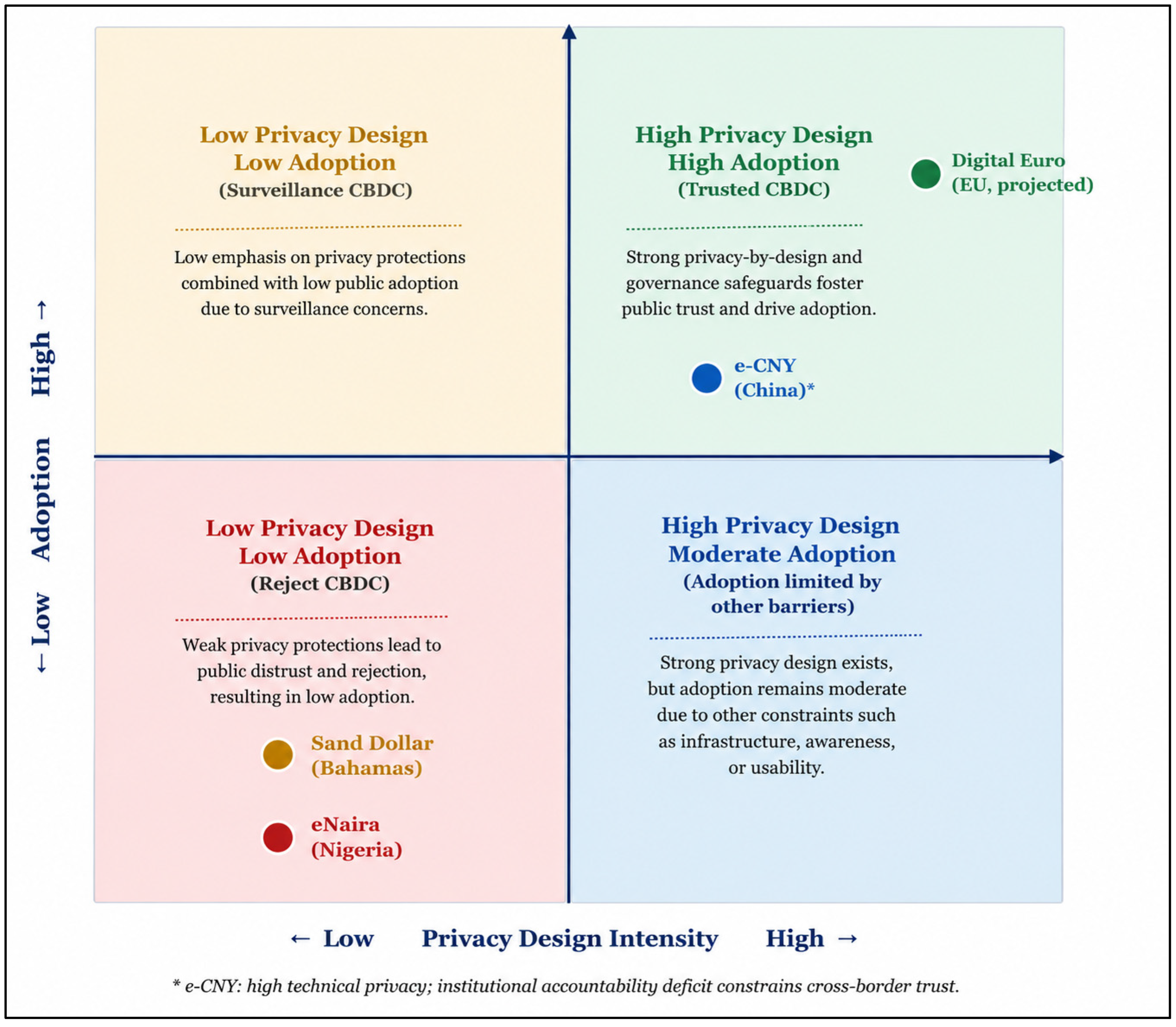
| Sand Dollar (Bahamas) | Live (Oct 2020) | Tiered KYC: Tier I = phone verification, small cap limit; Tier II = full KYC. Data routed through licensed intermediaries; central bank does not hold personal retail data directly. | Slow uptake: ~120 k wallets (pop. ~400 k); $2.1 M (~0.5% of cash) active for 3 years. No major privacy controversies. Barriers: convenience and merchant acceptance [35,36]. |
| eNaira (Nigeria) | Live (Oct 2021) | Four-tier wallets: Tier 1 = national ID-linked phone; higher tiers = bank verification (BVN). Central bank can see all ledger transactions. Privacy protections not clearly communicated to users. | Very low adoption: 0.5% usage after one year; 98.5% of wallets never activated. Surveillance fears compounded by coercive cash-scarcity policy caused severe trust deficit and public backlash [37] |
| Digital Yuan (e-CNY) (China) | Pilot (~2020+) | ‘Controllable anonymity’: Commercial banks handle KYC; PBoC sees anonymized inter-institutional flows unless legal unmasking triggered. State retains de-anonymization capability via back-end certification centers. | Large-scale pilot: 261 M+ wallets; >$13B in transactions by 2022. Moderate domestic trust. International observers note surveillance potential; human rights groups remain concerned [38,39]. |
| Digital Euro (Eurozone) | Development (pilot~2024–25) | GDPR-aligned privacy-by-design: Intermediated by private banks under EU data protection law. ECB commits to minimizing central-bank data visibility. Offline mode under design. Pseudonymous tokens and data segregation proposed. | High interest, high skepticism: 43% of 2021 ECB consultation respondents cited privacy as top concern (security: 18%). Success hinges on credible institutional privacy commitments [40,41]. |
| Technology | Privacy Benefit | Technical Maturity | Implementation Complexity | Performance Impact | Current CBDC Use | Limitations |
|---|---|---|---|---|---|---|
| Zero-Knowledge Proofs (ZKP) | Prove transaction validity without revealing details | High (e.g., zk-SNARKs) | High | Moderate computational overhead | Experimental (EU research) | • Computational intensity • Requires specialized expertise |
| Homomorphic Encryption | Compute on encrypted data | Moderate | Very High | High computational cost | Research phase | • Performance limitations • Complex implementation |
| Blind Signatures | Issuer cannot link withdrawal to spending | High | Moderate | Low | Considered for offline euro | • Requires trusted setup • Limited to specific use cases |
| Secure Multi-Party Computation (MPC) | Distributed computation without data sharing | High | High | Moderate | Pilot projects | • Coordination complexity • Network overhead |
| Differential Privacy | Statistical privacy for aggregated data | High | Moderate | Low to Moderate | Analytics in e-CNY | • Accuracy trade-offs • Parameter tuning needed |
| Pseudonymization | Replace identifiers with pseudonyms | Very High | Low | Minimal | Widely used (Sweden e-Krona) | • Re-identification risks • Not true anonymity |
| Hardware Security Modules (HSM) | Secure key storage and operations | Very High | Moderate | Minimal | Standard practice | • Physical security dependency • Cost |
| Tokenization | Replace sensitive data with tokens | Very High | Low to Moderate | Minimal | Common in payment systems | • Token management overhead • Mapping database required |
| Tiered Architecture | Different privacy levels by transaction size | High | Moderate | Minimal | Bahamas, Nigeria, Jamaica | • Complexity in threshold management • Potential for circumvention |
| Offline Capability | Transactions without network (like cash) | Moderate | High | N/A (offline) | EU Digital Euro proposal | • Double-spending prevention • Security challenges |
| Framework Component | Bahamas Sand Dollar | Nigeria eNaira | China e-CNY | EU Digital Euro | Illustrative Evidence Basis |
|---|---|---|---|---|---|
| Privacy-by-Design Architecture | ✓ | ✗ | ✓ | ✓ | privacy architecture disclosures; CBDC design papers |
| Legal & Regulatory Safeguards | ✓ | ✗ | ✗ | ✓ | CBDC legislation; GDPR provisions; judicial oversight provisions |
| Tiered & Proportionate Data Access | ✓ | ✓ | ✓ | ~ | tiered KYC structure; wallet verification levels |
| Privacy-Enhancing Technologies | ~ | ✗ | ✓ | ✓ | ZKP references; anonymization mechanisms; technical architecture |
| Public Transparency & Engagement | ~ | ✗ | ~ | ✓ | public consultations; communication strategy; user guidance |
| Security & Operational Resilience | ✓ | ✗ | ✓ | ✓ | cybersecurity reports; offline payment capability; operational disclosures |
| International Coordination & Standards | ~ | ~ | ✗ | ✓ | BIS principles; interoperability initiatives; international policy alignment |
| ✓ = substantial evidence of alignment with framework components, ~ = partial or evolving alignment ✗ = limited evidence or limited alignment with framework components | |||||
| # | Proposition | Proposition Statement | Measurement Approach | Evidence Base |
|---|---|---|---|---|
| P1 linked to C1 | Privacy-by-Design → higher adoption | CBDCs embedding PbD principles indicate significantly higher adoption rates than those treating privacy as an ex post add-on. | Two-way FE panel OLS; PbD compliance index; IV using pre-CBDC privacy law | Choi et al., Yee [26,30] |
| P2 linked to C2 | Legal Safeguards → higher institutional trust | Legally binding CBDC data protection provisions significantly increase citizens’ reported trust in the CBDC issuer. | Ordered logit/OLS; LS composite index; mediation via perceived privacy | Garratt & van Oordt, Bijlsma et al. [9,25] |
| P3 linked to C3 | Tiered Data Access → inclusion + privacy adoption | Tiered KYC positively moderates CBDC adoption among unbanked and privacy-sensitive segments. | FE panel with TK × Financial Exclusion interaction; marginal effects | Singh & Yadav (2025), FATF [33,78] |
| P4 linked to C4 | Privacy-Enhancing Technologies → higher tech-literate adoption | CBDCs with verifiable PETs achieve higher adoption willingness among technically literate users. | Conjoint/discrete choice experiment; PET score × Technical Literacy interaction | Agur et al., BIS [34,75] |
| P5 linked to C5 | Transparency & Engagement → trust | Transparent privacy communication has an independent positive effect on adoption willingness, mediated by institutional trust. | Baron-Kenny mediation; bootstrapped indirect effects (5000 draws) | Choi et al., ECB [26,79] |
| P6 linked to C6 | Security & Resilience → asymmetric trust loss | Security incidents produce asymmetric trust losses larger in magnitude than equivalent positive trust gains from transparency. | Event-study DiD; asymmetry test; incident × recovery interaction | Auer et al., BIS (2023b) [24,75] |
| P7 linked to C7 | International Coordination → regulatory arbitrage | Absence of coordinated privacy standards generates cross-border regulatory arbitrage, undermining high-privacy CBDC adoption. | Gravity-model panel with corridor FE; staggered law entry as natural experiment | BIS, FATF [75,78] |
Disclaimer/Publisher’s Note: The statements, opinions and data contained in all publications are solely those of the individual author(s) and contributor(s) and not of MDPI and/or the editor(s). MDPI and/or the editor(s) disclaim responsibility for any injury to people or property resulting from any ideas, methods, instructions or products referred to in the content. |
© 2026 by the author. Licensee MDPI, Basel, Switzerland. This article is an open access article distributed under the terms and conditions of the Creative Commons Attribution (CC BY) license.
Share and Cite
Ahmad, A. Trust, Privacy, and Adoption: A Global Policy Framework for Central Bank Digital Currencies. FinTech 2026, 5, 51. https://doi.org/10.3390/fintech5020051
Ahmad A. Trust, Privacy, and Adoption: A Global Policy Framework for Central Bank Digital Currencies. FinTech. 2026; 5(2):51. https://doi.org/10.3390/fintech5020051
Chicago/Turabian StyleAhmad, Alam. 2026. "Trust, Privacy, and Adoption: A Global Policy Framework for Central Bank Digital Currencies" FinTech 5, no. 2: 51. https://doi.org/10.3390/fintech5020051
APA StyleAhmad, A. (2026). Trust, Privacy, and Adoption: A Global Policy Framework for Central Bank Digital Currencies. FinTech, 5(2), 51. https://doi.org/10.3390/fintech5020051