3. Research Aim and Questions
The primary aim of this study is to reconstruct cryptocurrency adoption as a process unfolding over time in lived experience among users in Central and Eastern Europe. Rather than treating adoption as a one-time decision or as the aggregate outcome of isolated determinants, the study examines how engagement emerges, develops, and changes under specific institutional and socio-economic conditions.
More specifically, the study seeks to develop a processual qualitative model that moves beyond variable-centered adoption research by showing that cryptocurrency adoption is not a single outcome explained by stable determinants, but a temporally unfolding pattern of participation in which meanings, motives, and practices are reorganized across different phases of engagement. Particular attention is paid to entry into crypto, changing expectations, the role of learning and loss, the influence of platforms and communities, and the ways in which participation is later stabilized, limited, or redefined.
The study addresses the following research questions:
RQ1: How do users enter cryptocurrency engagement, and what initial meanings do they attach to it?
RQ2: How do meanings, motives, and expectations shift across different phases of engagement?
RQ3: How do learning, losses, and operational experience recalibrate participation over time?
RQ4: How do communities, platforms, and social relations shape the adoption process?
RQ5: How is cryptocurrency engagement stabilized, limited, or reorganized over time?
Together, these questions address cryptocurrency adoption as a temporally unfolding process, focusing on how engagement evolves across different phases rather than on static determinants.
4. Methodology
4.1. Research Approach and Paradigm
This study was designed as a qualitative investigation, consistent with its exploratory and process-oriented research aim. As outlined in the Introduction, prior research on cryptocurrency adoption has been dominated by quantitative approaches, particularly technology acceptance models such as TAM and UTAUT. While analytically valuable, these models tend to privilege variable-centered and largely rationalized explanations of adoption, offering limited insight into subjective experience, meaning-making, and the biographical and contextual dynamics through which cryptocurrency engagement develops over time. A qualitative approach was therefore necessary to address these limitations and to develop a more nuanced understanding of how cryptocurrency adoption is experienced, interpreted, and sustained.
The study was situated within an interpretivist (constructivist) research paradigm. From this perspective, knowledge is understood as co-constructed through the interaction between researcher and participant, rather than discovered as a neutral representation of an objective reality. Accordingly, the aim was not to extract fixed facts about cryptocurrency adoption, but to examine how participants understood and narrated their own engagement with cryptocurrencies in relation to their socio-economic, institutional, and relational contexts.
Data were collected using individual in-depth interviews (IDIs), selected as the primary data collection method due to their suitability for examining complex decision-making processes, evolving meanings, and lived experience. This format allowed participants to describe their motivations, uncertainties, learning trajectories, and reflections in their own terms, while giving the researcher the flexibility to probe emerging issues in depth.
Data analysis was conducted using Reflexive Thematic Analysis (RTA), following Braun and Clarke’s approach [
48,
49,
50]. This method is theoretically and epistemologically aligned with the interpretivist orientation adopted in the study and corresponds to a “Big Q” qualitative approach. In line with this perspective, themes were treated not as entities waiting to be discovered in the data, but as interpretative analytic constructs generated through sustained and reflexive engagement with participants’ accounts. The analytic goal was therefore not to summarize topics or count recurring categories, but to develop meaning-based accounts of how cryptocurrency adoption unfolds as a process.
4.2. Sampling Strategy
A purposive sampling strategy was employed. In line with the study’s exploratory aim and interpretivist orientation, the objective was not statistical representativeness, but the recruitment of participants with sufficiently rich, first-hand experience of cryptocurrency use to support in-depth qualitative analysis. This approach made it possible to examine diverse adoption trajectories, practices, and interpretations across participants differing in background, experience, and forms of engagement.
4.2.1. Participants and Sample Size
The final sample consisted of 25 participants originating from or residing in Central and Eastern Europe. The sample included 16 men and 9 women. Participants represented four countries: Poland (n = 10), Russia (n = 7), Belarus (n = 6), and Ukraine (n = 2). Age was reported by 21 participants and ranged from 23 to 52 years (M = 34.6). Four participants did not report their age. Educational attainment was high overall: 22 participants held a master’s degree, two held a bachelor’s degree, and one reported vocational education.
The sample size was considered adequate for the aims of the study because it provided sufficient depth, richness, and variation to support detailed interpretive analysis across cases. In line with reflexive thematic analysis, adequacy was evaluated not through formal saturation criteria, but through the capacity of the dataset to sustain meaningful pattern development and conceptual depth [
51].
This approach is consistent with qualitative research standards, where samples of approximately 15–30 in-depth interviews are commonly considered sufficient for generating rich and analytically meaningful insights [
52,
53], particularly when the goal is interpretive depth rather than statistical generalisation.
4.2.2. Inclusion and Exclusion Criteria
Explicit inclusion and exclusion criteria were applied to ensure the relevance of the sample and to focus on participants with direct experience of cryptocurrency engagement. Participants had to meet the following inclusion criteria: be at least 18 years old, originate from or reside in a Central or Eastern European country, actively engage with cryptocurrencies by owning a wallet and carrying out transactions or investments over time, and have sufficient proficiency in Polish or Russian to participate in an in-depth interview. To prioritize accounts grounded in personal experience and autonomous decision-making, individuals were excluded if they were under 18, had no hands-on experience with cryptocurrencies, merely copied others’ strategies without meaningful personal involvement, or had a close personal relationship with the researcher.
4.3. Data Collection Procedure
The research project received formal approval from the Ethics Committee for Research Projects of the Faculty of Psychology and Cognitive Science, Adam Mickiewicz University in Poznań, confirming that all procedures complied with established ethical standards for research involving human participants. Recruitment took place between July and November 2025.
Participants were recruited using two complementary strategies:
posting recruitment announcements in closed online groups and forums dedicated to cryptocurrency users (e.g., Binance Polish, Doubletop, Cryptus);
directly contacting active members of these communities who appeared to meet the inclusion criteria.
Data were collected through individual in-depth interviews conducted remotely via online communication platforms such as Zoom and Google Meet. All 25 interviews were conducted in either Polish or Russian, depending on participants’ language preference. Each interview lasted approximately 60 min.
The interviews followed a semi-structured format based on a pre-developed interview guide. The guide covered key domains relevant to the study, including motivations for entering cryptocurrency use, perceived risks and opportunities, learning processes, social context, and changing forms of engagement. This structure ensured thematic consistency across interviews while preserving enough flexibility to pursue analytically relevant issues introduced by participants themselves.
With participants’ informed oral consent, recorded at the start of each interview, all interviews were audio-recorded. Recordings were then fully transcribed verbatim in the original language of the interview. To ensure confidentiality and data protection, audio files were permanently deleted after transcription and verification. Only anonymized transcripts were retained for analysis.
4.4. Data Analysis
Data were analyzed using reflexive thematic analysis as outlined by Braun and Clarke [
48,
49,
50]. The analytic process followed the six-phase model proposed by the authors: (1) familiarization with the data, (2) initial coding, (3) theme development, (4) theme review, (5) theme definition and naming, and (6) reporting. Particular attention is given here to phases 1–3, which constituted the core analytic work, while phases 4 and 5 are elaborated further in
Section 5, where finalized themes are presented and illustrated with extracts.
All 25 interviews were treated as analytically distinct cases. Coding and theme development proceeded iteratively and reflexively across the dataset. In line with reflexive thematic analysis, the study did not seek inter-coder reliability or coding consensus. Instead, the researcher’s theoretically informed subjectivity was treated as an integral analytic resource.
4.4.1. Familiarization with the Data
All interviews were transcribed verbatim in the language in which they were conducted. Each transcript was then read in full multiple times before formal coding began. This phase aimed to develop an overall understanding of each participant’s narrative, including how they described their entry into cryptocurrency use, current engagement, and future orientation. It also allowed the researcher to begin identifying preliminary axes of meaning, such as motivations for entry, experiences of risk and loss, perceptions of opportunity, social influences, and identity-related meanings.
During this stage, the researcher produced informal analytic notes and memos capturing initial impressions, tensions, and interpretive hypotheses. Familiarization was not treated as a one-time preparatory step, but as a recurring part of the analytic process: transcripts were revisited repeatedly throughout coding and theme development, allowing earlier understandings to be refined in light of later insights.
4.4.2. Coding
Detailed coding was then conducted across the entire dataset. Coding was extensive and iterative, focusing on meaningful segments of participants’ accounts rather than on isolated statements. The analysis began primarily at the semantic level, attending to participants’ explicit descriptions, but gradually moved toward more latent meanings as interpretation developed. This allowed the researcher to move from what participants said directly to broader patterns concerning agency, institutional distrust, emotional regulation, identity work, learning, and social visibility.
For each interview, an analytic table was created linking each data extract with:
Codes were generated inductively from the data rather than imposed through a fixed a priori coding frame, although the analysis remained informed by the broader literature on technology adoption, financial risk, and investor identity. The coding framework therefore remained open and revisable throughout the analytic process.
4.4.3. Theme Development
The transition from codes to themes involved identifying broader patterns of meaning relevant to the research questions. Themes were developed through an iterative process of grouping and reinterpreting codes, with particular attention to how emerging patterns related to different phases of engagement. In line with Braun and Clarke’s approach, themes were conceptualized not as topical categories but as coherent interpretive accounts of how participants made sense of cryptocurrency adoption.
Theme development proceeded through three overlapping steps:
grouping codes into preliminary clusters based on shared interpretive content;
generating early thematic narratives that addressed what broader story each cluster of codes appeared to tell;
refining these themes through repeated engagement with the full dataset and reallocation of codes where necessary.
For example, codes referring to sanction avoidance, wartime capital mobility, distrust of banks, and the need to preserve financial control were brought together within a broader interpretive pattern concerning the reclamation of agency under institutional constraint. Across iterations, provisional theme labels were revised in order to balance empirical grounding with analytical abstraction. The final themes were thus developed as process-oriented and meaning-based accounts of adoption, rather than descriptive summaries of what participants talked about. A detailed presentation of the finalized themes and subthemes is provided in
Section 5.
4.5. Researcher Positioning and Reflexivity
Because the study was conducted within an interpretivist paradigm and used reflexive thematic analysis, the researcher’s role was treated as constitutive of the analytic process rather than external to it. Interpretation was understood as shaped by the researcher’s theoretical commitments, sensitivity to meaning, and ongoing engagement with the data. Rather than attempting to eliminate subjectivity, the analysis sought to make it more explicit and more critically examined.
Reflexivity was practiced throughout the study in several ways. First, the researcher maintained analytic memos during familiarization, coding, and theme development in order to document emerging interpretations, uncertainties, and shifts in understanding. Second, analytic decisions were revisited repeatedly in light of the full dataset, rather than fixed early and applied mechanically. Third, particular attention was paid to how prior assumptions about cryptocurrency, autonomy, risk, and financial practice might influence interpretation. This reflexive stance helped support an analysis grounded not in claims of neutrality, but in transparency and critical self-awareness.
4.6. Research Quality and Methodological Coherence
Research quality was approached in a way consistent with the interpretivist orientation of the study and the principles of reflexive thematic analysis. The aim was not to establish objectivity in a positivist sense, but to ensure methodological coherence, interpretive depth, and transparency of analytic reasoning.
Several features supported the quality of the study. First, there was a clear fit between the research questions, the interpretivist paradigm, the use of IDIs, and the choice of reflexive thematic analysis. Second, the dataset was sufficiently rich and varied to support detailed, case-sensitive interpretation across different national contexts, forms of engagement, and levels of experience. Third, analysis was iterative and thoroughly documented through memos, analytic tables, and repeated returns to the full dataset. Fourth, themes were developed as meaning-based interpretations supported by extracts from across the material, rather than as simple summaries of interview topics. Finally, the study sought analytic credibility through depth of engagement, transparency of interpretation, and close alignment between empirical material and conceptual claims.
5. Results
The analysis identified six interrelated themes that describe cryptocurrency adoption as a process unfolding across participants’ biographies, financial practices, and socio-technical environments. Rather than a single acceptance decision, adoption appeared as a sequence of engagements, recalibrations, and efforts to maintain agency under conditions of volatility, uncertainty, and uneven institutional support.
Across accounts, cryptocurrencies were described not only as speculative assets but also as components of a wider FinTech environment composed of exchanges, wallets, protocols, payment channels, and online communities. Adoption therefore emerged as participation in a digitally mediated financial ecosystem that shaped learning, risk-taking, and continued engagement over time.
Within the Central and Eastern European context, participants often described institutional trust, financial stability, and access to formal investment instruments as fragile or uneven. In this setting, cryptocurrencies were framed as tools for expanding financial optionality, experimenting with alternative financial practices, and sustaining a sense of agency, particularly where formal systems were not always experienced as fully reliable, sufficient, or accessible. At the same time, continued engagement required more than technical access: participants described identity work, attention regulation, selective visibility, and reliance on platform and community infrastructures as central to sustaining use. Across many accounts, early high-intensity engagement gradually shifted toward more selective and sustainable participation.
5.1. Theme 1—Adoption as a Project of Financial Autonomy: Reclaiming Agency Between Curiosity and Necessity
Participants rarely described adoption as a neutral reaction to market opportunity. Instead, entry into crypto was embedded in broader biographical and institutional conditions and framed as a way of expanding room for action under constraint. Curiosity often mattered at the beginning, but it was quickly linked to more practical concerns, including restricted access to investment instruments, barriers in traditional finance, capital mobility, and the search for additional income options.
Cryptocurrencies were typically positioned not as a total rejection of formal finance, but as a parallel FinTech channel that could be used when other routes were unavailable, unreliable, or too restrictive. In this sense, crypto increased optionality and reduced dependence on any single institutional environment.
For some participants, this autonomy project extended beyond investing and became linked to broader career hybridization. Crypto created space for learning, side activities, digital work, and new income possibilities. At the same time, participants emphasized that autonomy was limited by available resources. Engagement required time, attention, emotional energy, and capital, which led many to regulate their involvement rather than maximize it. Autonomy was therefore enacted not only through action, but also through selective restraint.
5.2. Theme 2—The “Conscious Investor” Identity: Legitimizing Risk Through Competence, Autonomy, and Responsibility
As engagement deepened, many participants described constructing an identity of the “conscious investor”. This identity distinguished their participation from impulsive speculation and framed crypto involvement as deliberate, controlled, and responsible. Continued exposure to risk was legitimized through competence, self-limitation, and accountability rather than certainty.
Competence was described in practical terms: small-scale experimentation, personal rules, selective project entry, and information filtering. Emotional regulation was also central. Participants treated the ability to resist fear of missing out, curb regret, and avoid reactive decisions as part of responsible participation.
This identity remained unstable rather than fully achieved. Participants often described tension between declared control and the stimulating qualities of the crypto environment, including rapid gains, constant signals, and social comparison. The “conscious investor” therefore emerged as an ongoing effort to maintain steerability in a high-stimulation financial setting.
The identity also had a relational dimension. Offline, crypto was often associated with speculation or irresponsibility, encouraging participants to emphasize autonomy and accountability. Online, competence could be recognized through knowledge sharing, technical familiarity, and informal status. Participants also described a strong ethic of caution toward others: recommendations were avoided or heavily qualified, and responsibility for financial decisions was framed as ultimately individual.
5.3. Theme 3—The Market as a School of Cost and Irreversibility: Risk Calibration Through Experience
Participants repeatedly described learning through cost as central to adoption. Losses, failed projects, scams, mistimed entries, and operational mistakes were often framed as part of the normal learning environment of the market. A common narrative presented losses as “tuition fees” for practical understanding.
However, this framing was conditional. Losses only became meaningful as lessons when they led to actual behavioral change, such as lower exposure, stronger limits, or more selective participation. Otherwise, the language of learning risked functioning as retrospective self-protection.
Participants also emphasized that cost extended beyond price volatility. Operational irreversibility—using wallets, choosing networks, executing transfers, and avoiding technical mistakes—was a major source of stress, especially early on. Over time, participants described building informal architectures of loss containment: financial buffers, small test transactions, rules about risk, and routines for operational safety.
Attention regulation formed a further part of this recalibration. Many described shifting away from constant monitoring, short-term reactivity, and rumination toward longer time horizons, more selective information use, automation, and avoidance of high-intensity strategies. Yet this remained an ongoing effort, because the market continuously generated stimulation through volatility, gains, and perceived missed opportunities.
5.4. Theme 4—Adoption Infrastructure: Platforms and Communities as Practice-Governing Systems
Participants did not describe adoption as a simple relation between an individual and an asset. Instead, they portrayed it as participation in a broader FinTech infrastructure composed of exchanges, wallets, payment channels, protocols, Telegram groups, Discord servers, and educational communities. These infrastructures shaped how adoption became possible, how learning occurred, and how engagement was sustained.
Communities often functioned as epistemic filters. They organized information, reduced noise, validated interpretations, and helped users navigate wallets, exchanges, and protocols. In this way, they lowered both cognitive and operational barriers to entry.
They also supported continuity. During periods of loss, stagnation, or uncertainty, communities provided guidance, feedback, and, in some cases, crisis support. At the same time, they were not idealized. Participants also described commercialization, low-quality advice, opportunism, and the need to filter both information and people more carefully over time.
As engagement deepened, competence became increasingly platform-specific. Familiarity with particular tools, interfaces, and ecosystems reduced friction and increased confidence, but also tied users more closely to specific socio-technical arrangements. In this sense, adoption was not only enabled by infrastructure; it was gradually organized through it.
5.5. Theme 5—The Relational Politics of Visibility
Participants described cryptocurrency use as something that had to be managed socially, not only financially or technically. Decisions about whether, how, and to whom to disclose crypto involvement formed an important part of the adoption experience. Because cryptocurrencies were often associated with speculation, fraud, or irresponsibility, visibility required active control.
In offline settings, many participants limited disclosure in order to avoid misunderstanding, criticism, or interpersonal tension. Silence often functioned as a protective strategy that reduced conflict and preserved autonomy.
By contrast, online environments were more often described as safer spaces for discussing uncertainty, losses, and technical issues. This created a divided social structure in which crypto participation could remain salient online while being partially concealed offline. Selective visibility therefore reinforced the role of online communities while segmenting crypto-related practices from everyday social relationships.
5.6. Theme 6—Practice Stabilization
Over time, many participants described a shift from high-intensity, stimulus-driven engagement toward more stable and sustainable forms of use. Stabilization did not mean disengagement. Rather, it referred to a reorganization of practice around continuity, reduced emotional burden, and better fit with broader life conditions.
Participants described simplifying their activities, reducing monitoring frequency, narrowing their range of projects, and consolidating portfolios. In many accounts, this meant building a stable core of familiar practices alongside only limited experimentation.
Longer time horizons also became more prominent. Instead of expecting rapid transformation, participants increasingly framed volatility as a normal feature of the market that did not always require action. In this phase, cryptocurrencies were more often described as part of everyday financial management than as a high-intensity project in themselves. Their role became more pragmatic, selective, and sustainable.
5.7. Cryptocurrency Adoption as a Process
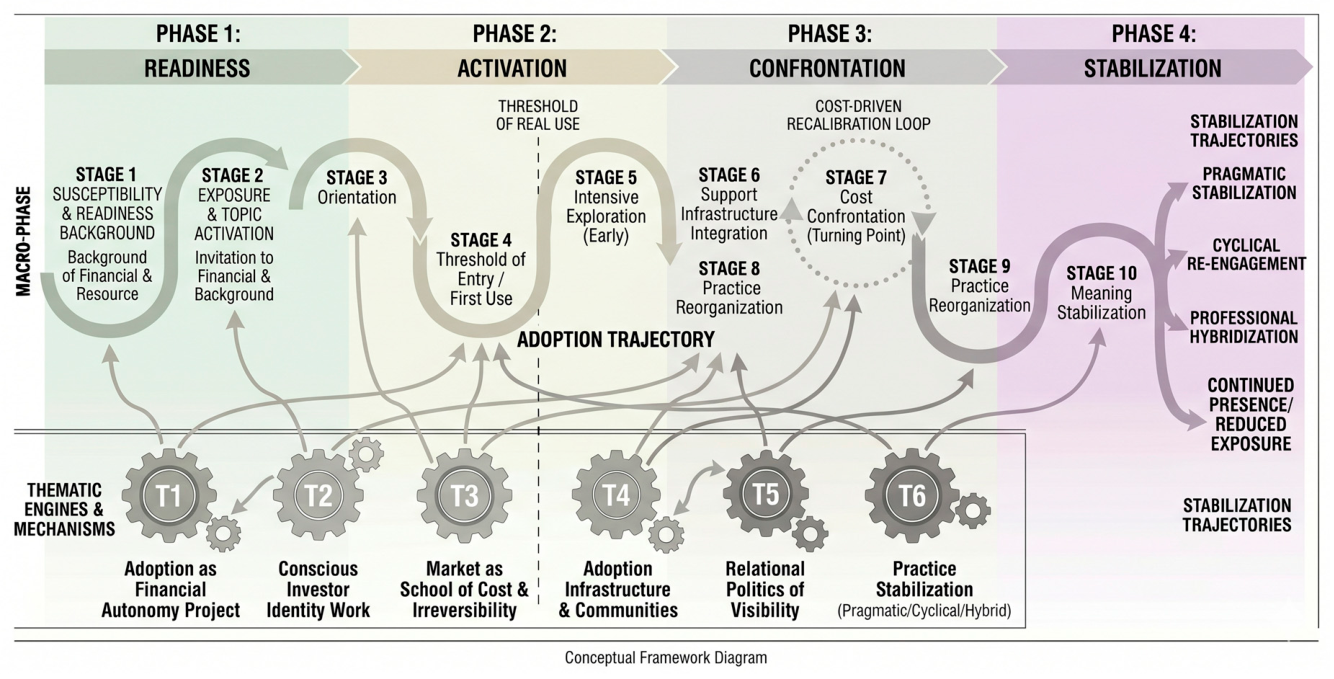
The themes reconstructed in this study suggest that cryptocurrency adoption is better understood not as a discrete decision to use or not use a technology, but as a processual, biographically embedded trajectory through which participants gradually develop, test, recalibrate, and sometimes partially withdraw their engagement. Rather than unfolding as a simple linear sequence, this process appears as a recurrent movement across partially ordered stages, with different entry points, feedback loops, and multiple later trajectories. In this sense, the model developed here is not a stage theory in the strict sense, but a process-oriented account of how adoption becomes psychologically viable, practically enacted, socially negotiated, and later either stabilized or reduced.
Across the themes, this process can be summarized as moving from readiness and entry, through activation and confrontation with cost, toward reorganization and more selective stabilization. Entry emerged through heterogeneous pathways, including curiosity, perceived opportunity, work-related exposure, and, for some participants, necessity linked to sanctions, war, blocked accounts, unstable currencies, or limited access to traditional financial instruments. What linked these diverse starting points was not one common trigger, but a broader search for options, control, and room for maneuver under conditions in which existing institutions did not fully guarantee stability or agency.
As engagement became actionable, platforms, communities, trusted others, and curated information channels often reduced the cognitive and operational cost of participation. Yet entry was followed not only by learning and excitement, but also by confrontation with cost: financial loss, scams, phishing, mistimed decisions, excessive trading, disappointment, and technical irreversibility. These experiences often functioned as turning points, leading participants to narrow their practice, reduce stimulation, strengthen self-regulation, and reassess what continued engagement should look like.
Later participation was therefore often reorganized into more selective and sustainable forms. The initial fantasy of rapid transformation was frequently replaced by a quieter logic: cryptocurrency as an option, a reserve, a competence, a plan B, or a limited but meaningful part of one’s life. This later phase did not culminate in one common endpoint, but in differentiated trajectories, including pragmatic stabilization, cyclical re-engagement, hybridization with work or professional roles, and continued presence with lower exposure and stronger protection of attention.
Taken together, the six themes do not function as parallel categories, but as processual mechanisms within a broader adoption trajectory. Financial autonomy initiates and justifies entry, infrastructure enables and sustains practice, investor identity legitimizes continued participation, market cost transforms it, relational visibility regulates its social conditions, and stabilization reorganizes it into more durable forms. What emerges is not a list of determinants, but a dynamic account of how adoption is assembled, challenged, and reconstituted over time.
Figure 1 presents this conceptual framework as a four-phase process structured around readiness, activation, confrontation, and stabilization. These phases are not analytically imposed but emerge from the thematic patterns identified through reflexive thematic analysis. The diagram also reflects the non-linear character of adoption, showing how engagement is repeatedly reconfigured through feedback loops and recalibration rather than advancing toward a single fixed endpoint.
In this sense, the model does not simply rearrange known adoption factors into a temporal sequence. It suggests that adoption itself should be theorized differently: not as the acceptance of a technology at one point in time, but as a process through which participation is repeatedly assembled, tested, recalibrated, and stabilized within a socio-technical financial environment.
6. Discussion
This study proposes a processual, multi-phase model of cryptocurrency adoption, conceptualizing engagement not as a one-time decision but as a temporally unfolding and contextually embedded process. It builds on existing FinTech research by showing that factors commonly treated as stable predictors do not operate in a fixed way, but change meaning as users move through different phases of engagement. This dynamic is particularly visible in the context of Central and Eastern Europe, where institutional conditions and constrained financial infrastructures shape how financial technologies are adopted, interpreted, and used in practice.
To clarify how the findings address the research questions,
Table 1 summarizes the main analytical responses.
6.1. Relation to Existing Literature
The present findings should be interpreted in relation to the dominant quantitative literature on cryptocurrency adoption. Frameworks such as TAM, TPB, and UTAUT/UTAUT2 have shown substantial predictive value in explaining intention to use, behavioral intention, and related forms of adoption behavior [
3,
10,
11,
12,
13,
14,
15,
16,
54,
55]. The current study does not reject this body of work. On the contrary, it starts from the recognition that these models have identified important correlates of adoption, including perceived usefulness, ease of use, trust, social influence, facilitating conditions, and price-related value [
10,
11,
12,
13,
14,
15,
16,
17,
54]. More recent studies have also expanded this model space by incorporating additional psychological constructs, value-based mechanisms, and behavioral factors, suggesting that the field has already moved beyond the narrowest versions of technology acceptance research [
11,
14,
19,
43,
56]. At the same time, prior reviews have pointed out that this literature is much better at identifying what is associated with adoption than at explaining how cryptocurrency engagement develops over time in lived experience [
10,
11,
16]. In practice, existing studies remain more informative about proximal predictors of intention than about temporal unfolding: how users move from first exposure to active participation, how initial meanings evolve, and how engagement changes after success, disappointment, or technical failure [
6,
11,
18].
The contribution of the present study lies precisely here. Rather than treating adoption as a single decision, it reconstructs it as a process in which motives, meanings, and forms of participation change over time [
55]. In this sense, the study extends existing models rather than replacing them, while proposing a different way of conceptualizing adoption—not as a single outcome, but as a process in which participation is reorganized across time and experience. More specifically, it shows that familiar adoption factors are reinterpreted through experience and change their role across phases of engagement [
8,
10,
11,
16,
17,
54,
57,
58]. This matters because much of the existing literature still treats adoption as a relatively uniform outcome, often without clearly distinguishing between initial entry, continued use, speculative engagement, payment use, platform dependence, or later stabilization [
18,
36]. The present findings suggest that these dimensions are not simply parallel predictors, but elements that are reinterpreted through experience, loss, learning, and continued participation. In this way, the study contributes not only a processual description of adoption, but also a clearer account of how familiar adoption mechanisms are reorganized over time in practice. A qualitative approach makes it possible to capture not only behavior, but also the meanings and experiences through which users make sense of cryptocurrency involvement [
48,
49,
50,
58]. It also helps bring into view dimensions that remain comparatively weakly theorized in the mainstream adoption literature, including identity work, learning through loss, the organizing role of platforms and communities, and the relational politics of visibility [
18,
19]. This is particularly important in the underexplored context of Central and Eastern Europe, where a qualitative lens helps show how cryptocurrency adoption is shaped not only by financial technology itself, but also by context-specific conditions such as uneven institutional trust, constrained opportunity structures, and the search for practical autonomy within the broader FinTech environment, thereby making more visible the practical and relational mechanisms through which adoption is sustained under institutional strain [
45,
54].
6.2. Contextual Embeddedness and Analytical Scope
The findings should be interpreted in light of the empirical context from which they emerged: the experiences of cryptocurrency users in Central and Eastern Europe. This contextual focus is both a strength of the study and an important boundary of interpretation. As noted earlier, cryptocurrency adoption research has been dominated by evidence from Western Europe, North America, and selected Asian settings, whereas CEE has remained comparatively underexplored despite being theoretically informative. The present material suggests that this context matters not simply as the location of the sample, but because it sharpens certain dynamics that may be less visible in more institutionally stable environments.
Most importantly, the data indicate that cryptocurrency engagement in this setting is often interpreted against a background of uneven institutional trust, constrained access to conventional financial pathways, and reduced predictability of formal systems. For some participants, this took particularly acute forms, including sanctions, war, blocked accounts, cross-border transfers, or the need to preserve financial room for maneuver under unstable conditions. For others, the context was less dramatic but still relevant: cryptocurrencies were framed as an additional option in settings where formal institutions were not experienced as fully reliable, sufficient, or accessible. In this sense, the CEE context does not produce a wholly different psychology of adoption, but it does make more visible the role of optionality, workaround capacity, and selective trust in the adoption process, including the tendency for cryptocurrency to function not only as a speculative asset, but also as a practical reserve of financial agency under institutional unevenness.
At the same time, the findings should not be overstated. The study does not claim that all users in Central and Eastern Europe adopt cryptocurrency for the same reasons, nor that the identified patterns are unique to the region. The sample itself was heterogeneous in terms of country, experience, and form of engagement, and the trajectories described by participants were clearly not identical. What the study supports is a more modest but analytically important claim: CEE constitutes a context in which adoption as a negotiated response to uncertainty, institutional fragility, and uneven opportunity structures becomes especially observable. In that sense, the contribution of the regional focus lies less in empirical exceptionalism than in analytical visibility.
This also clarifies the scope of the model proposed here. The findings support an analytically generalizable account of recurring processual mechanisms, including the search for financial agency, learning through cost, dependence on socio-technical infrastructures, negotiated visibility, and later stabilization through selective restraint. These mechanisms may well appear in other FinTech environments, but their intensity, form, and practical meaning are likely to vary across regulatory settings, institutional conditions, and user populations.
From a FinTech perspective, the present findings also suggest that adoption is shaped not only by user attitudes or intentions, but by the broader environments through which participation is organized. In the accounts analyzed here, exchanges, wallets, communication channels, and online communities did more than provide access to a financial technology. They structured learning, filtered information, reduced operational uncertainty, and, over time, contributed to the stabilization of participation. However, cryptocurrency adoption unfolds within socio-technical arrangements that actively mediate how users understand risk, develop competence, and remain involved despite volatility and loss. Seen from this angle, adoption is not simply an individual response to a technology, but participation in a broader FinTech ecosystem that shapes the conditions of sustained engagement.
The data point to an important gap between formal protections and everyday user practice. Participants repeatedly described self-developed ways of containing loss and reducing overstimulation, including smaller exposure, simplified routines, selective filtering of information, and clearer boundaries between risky experimentation and more protected resources. These practices should not be idealized as fully effective safeguards, but they do show that continued engagement often depends on informal, experience-based regulation developed by users themselves. This has practical relevance for FinTech research and policy. If adoption is partly sustained through user-generated strategies of coping, then education and regulation may need to move beyond basic information provision and pay greater attention to operational competence, risk transparency, and the socio-technical conditions under which participation becomes either more sustainable or more exposure-intensive.
6.3. Theoretical and Practical Implications
The contribution of this study lies not in identifying new determinants of cryptocurrency adoption, but in showing that factors well established in the FinTech literature—such as trust, risk, autonomy, and knowledge—do not function as stable predictors of intention or use. Instead, they operate as dynamic elements whose meaning and role change across different phases of engagement, as users reinterpret them through experience, learning, and adaptation over time.
This contribution is captured in the processual model of cryptocurrency adoption presented in
Figure 1, which brings together the six themes identified in the analysis into a four-phase trajectory: readiness, activation, confrontation, and stabilization. Rather than representing a linear progression, the model reflects a dynamic pattern in which engagement is repeatedly recalibrated in response to loss, operational experience, and changing life circumstances. What this model offers FinTech adoption research is not another list of predictors, but a way of understanding how familiar factors actually operate in practice. Perceived risk, for example, may begin as a barrier, later become a source of learning through loss, and eventually be incorporated into routinized strategies of exposure management, while social influence shifts from initial exposure to sustained infrastructural and community-based support.
In this way, the study extends dominant FinTech frameworks beyond static, variable-centered explanations by showing that cryptocurrency adoption is not a one-off decision, but an evolving configuration of practices, interpretations, and socio-technical constraints. Established models remain useful for explaining intention and some proximal correlates of adoption-related behavior, but the present findings indicate that continued engagement depends on dimensions that are less visible in such frameworks, including lived FinTech experience, identity work, learning through loss, negotiated visibility, and the ongoing reorganization of practice over time.
A further implication concerns the scope of adoption itself. The findings suggest that adoption should be understood not only as entry into use, but as a process extending through orientation, operational feasibility, confrontation with cost, post-loss recalibration, and later stabilization or reduction of exposure. Although the model was developed from a CEE sample, it captures dynamics that are likely to be relevant beyond a single regional context, particularly where institutional uncertainty and uneven access to financial infrastructures shape engagement.
For FinTech actors, the results indicate that sustained cryptocurrency adoption depends less on attracting first-time users than on supporting users across different phases of engagement. The findings also have implications for FinTech platform design and governance in cryptocurrency environments. From a design perspective, adoption should be treated as a phase-dependent process rather than a one-time onboarding decision, requiring support mechanisms that evolve with users’ experience. Early participation is marked by experimentation, uncertainty, and vulnerability to both operational and financial mistakes, whereas later stages involve risk calibration, selective participation, and the stabilization of practices. This suggests that FinTech platforms should move beyond static user journeys and instead support phase-sensitive engagement, in which onboarding, learning tools, and interface complexity evolve alongside users’ experience.
In addition, the results highlight that usability in cryptocurrency environments is closely tied to perceived safety and the management of uncertainty. Participants frequently described learning through operational mistakes (e.g., incorrect transfers or network selection) and financial loss, as well as reliance on platforms and communities to navigate complexity. This indicates that FinTech systems function not only as transactional tools but as infrastructures that organize knowledge, attention, and participation. Features such as guided transactions, small-scale test operations, or clearer contextual information about risks may therefore help reduce early-stage errors while supporting more sustainable, lower-intensity forms of engagement over time.
6.4. Limitations
Several limitations should be noted. The purposive sample was relatively small and consisted primarily of individuals active in online crypto communities within a specific regional context. This likely overrepresents more engaged and reflective users while underrepresenting individuals who exited the market shortly after initial losses.
The data are retrospective and subject to memory reconstruction and post-hoc sense-making. Moreover, the use of reflexive thematic analysis assumes a co-constructed interpretive process between participants and researchers. Accordingly, the themes presented represent one theoretically grounded interpretation rather than an exhaustive account.
An additional limitation concerns the interpretive nature of reflexive thematic analysis. The themes and process model developed in this study do not represent an objective structure inherent in the data, but a theoretically informed reconstruction shaped by the researcher’s analytic perspective. Although reflexive practices were used to enhance transparency and coherence, alternative interpretations of the material are possible, and different analytic lenses might have led to somewhat different conceptualisations of the adoption process.
Finally, the findings are situated within a specific market and regulatory moment, which may limit transferability to other temporal or institutional contexts.
6.5. Directions for Future Research
Future research could pursue several interrelated avenues. First, quantitative studies should test the proposed processual model by incorporating constructs derived from the qualitative analysis into existing adoption frameworks. Classical models may still serve as a useful baseline for explaining entry intentions, but they should be extended with variables that are more sensitive to process and context, such as perceived institutional dysfunction, identity-related motives, operational self-efficacy, visibility management, post-loss reorganization, and community-based dependence. This would make it possible to distinguish more clearly between entry, persistence, recalibration, and stabilization instead of collapsing them into a single adoption outcome.
Second, longitudinal designs are needed to capture adoption as it unfolds over time rather than relying primarily on retrospective accounts. Following users across phases of entry, escalation, recalibration, and stabilization would allow for stronger inferences about temporal ordering and causal mechanisms, while also showing how constructs such as trust, autonomy, identity investment, infrastructure dependence, and sensitivity to loss shift in importance across different stages.
Third, comparative research should examine more explicitly the differences already visible in the present dataset. This includes contrasts between necessity-driven and curiosity-driven entry, between novice and experienced users, and between more investment-oriented and more utilitarian forms of engagement. Such comparisons would help clarify whether the same mechanisms operate across user types or whether apparently similar adoption outcomes emerge from distinct trajectories.
Fourth, more targeted qualitative and mixed-method studies focusing on specific user groups, institutional settings, and regulatory environments are needed to clarify how adoption trajectories vary across demographic and structural contexts. This is especially important within and beyond CEE, where regional conditions, market infrastructures, and regulatory uncertainty may shape the course of adoption in ways that are not fully captured by general models. Such work would also be practically relevant for designing more tailored financial education initiatives and harm-reduction strategies in cryptocurrency markets.
Finally, future studies should pay closer attention to the relationship between regional context and processual regularities. A more systematic comparison across settings would help determine which mechanisms appear robust across contexts and which remain more locally conditioned.