1. Introduction
The term “corporate governance” was introduced in the 1970s, yet it took almost two decades for Indian banks to embrace the recommended guidelines. The Harshad Mehta stock scam of 1992 in India, where banks colluded with brokers by violating central bank guidelines, put corporate governance procedures under constant scrutiny in India. This led to various initiatives and reforms aimed at ensuring transparency and accountability. India, being one of the leaders in the banking industry among emerging markets, with more bank branches than any other country, demands increased attention and research to establish robust financial systems with sound governance mechanisms. Motivated by these developments, this study explores the influence of corporate governance variables on liquidity risk and solvency risk in both government-owned and privately operated banks in India. Our study contributes by examining the corporate governance indicators linked to liquidity and solvency risk measures of Indian banks before and after the 2008 global financial crisis, an area underexplored in existing research.
The association between corporate governance variables and liquidity and solvency risk metrics at Indian banks is analyzed based on theoretical foundations (discussed in the subsequent literature review and hypotheses section). Agency theory provides the core theoretical rationale for linking corporate governance to bank liquidity and solvency risk. Since managers’ incentives can diverge from those of outside stakeholders, governance mechanisms that strengthen monitoring and reduce information asymmetries should constrain excessive risk-taking and improve liquidity and solvency outcomes [
1]. Permatasari [
2] considered market risk, credit risk, and liquidity risk as indicators of bank risk and revealed that corporate governance within banks exerts influence over credit risk and liquidity risk, although lacking a significant impact on market risk. Bhat et al. [
3] examine the non-performing assets (NPAs) crisis in the Indian banking system through the lens of soft budget constraints. Using panel data on 105 listed firms, they found that banks disproportionately favor large firms and that credit rationing is weakly aligned with borrower risk. However, regulatory interventions, such as the RBI’s Asset Quality Review and the Insolvency and Bankruptcy Code, have partially strengthened risk-based lending, highlighting the role of governance weaknesses and soft budget constraints in driving NPAs. The aforementioned literature provides a motivation to analyze the association between corporate governance and liquidity and solvency risk measures at Indian banks.
We investigate corporate governance variables related to liquidity and solvency risk that are motivated by studies in the area. Due to the potential endogeneity issues that may arise in the relation between the corporate governance variables and risk measures, our results focus on examining the association between the risk metrics at banks and governance attributes. Utilizing both panel data regression and an alternative approach using a non-parametric decision tree machine learning technique, this paper identifies key governance factors linked to bank risk measures.
Results indicate director “busyness” in multiple board appointments, which correlates with higher liquidity risk, while higher fees and allowances provided to directors and auditors are associated with improving liquidity management in terms of core deposits and temporary assets at banks relative to total assets. The previous literature (included in
Section 2) indicates mixed evidence on the effects of director busyness on performance and profitability, whereas our findings contribute to linking the effects of director busyness to bank risk. Also, while past studies included in the literature review show the positive effects of director compensation and auditor fees on bank performance, there has been no evidence provided on their effects on bank risk, as included in our paper. Our results indicate that higher director fees, along with a larger proportion of independent directors and smaller board sizes, are associated with lower solvency risk in terms of net non-performing assets at banks. As mentioned above, the effect of director fees on performance and profitability has been studied extensively in the literature, but their influence on bank risk, as we test in our paper, has been underexplored. While our paper confirms the findings in the literature about the effects of independent board members on lowering solvency risk, there has been mixed evidence on the effects of board size on solvency risk at firms.
The effect of bank size on solvency risk has been explored extensively, with mixed evidence on the relationship, while the bank size effects on liquidity risk have been a relatively unexplored area. Our results indicate that larger banks in terms of total asset size held relatively lower core deposits and temporary assets, exhibiting higher liquidity risk. We also find that in the period after the global financial crisis, temporary assets declined at banks while non-performing assets increased, indicating higher liquidity risk from an asset management perspective and higher solvency risk. Our paper contributes to the findings on liquidity and solvency risk following the crisis period for Indian banks.
The paper is outlined as follows.
Section 2 includes the literature review to provide a theoretical foundation for the corresponding hypotheses that are also presented in this section. The methodology used to test the hypotheses, along with a description of the data employed for the study, is included in
Section 3. Results are presented and discussed in
Section 4.
Section 5 provides conclusions based on the results and includes policy implications of corporate governance factors on risk management for banks.
2. Hypotheses and Literature Review
In this segment, we introduce our hypotheses regarding how corporate governance elements could influence liquidity and solvency risks within banking institutions. We also conduct a thorough review of the relevant literature on each hypothesis, analyzing the influence of business governance variables on risk indicators in banks across developed and emerging markets. Our research delves into several corporate governance factors associated with board composition, including size, independence, gender diversity, auditor presence, director compensation, and director availability. Furthermore, we explore the implications of bank size on liquidity and solvency risk measurements for Indian banks, both preceding and following the global financial crisis.
Evidence from emerging markets further underscores the role of governance in shaping bank stability. Nguyen [
4], using panel data from Vietnamese banks over 2007–2020 and a two-step GMM approach, finds that female directors, board independence, and larger boards are associated with higher bank stability, whereas foreign board representation has a destabilizing effect. Khoza, F et al. [
5] studied the key determinants of corporate governance in selected South African financial institutions between 2007 and 2020. A corporate governance index was developed using board size, board diversity, independence of board members, and board remuneration. A positive correlation was obtained between the corporate governance index and efficiency ratios, as well as return on assets, while a negative correlation was observed between the governance index and financial stability. In the Indian context, Anjum and Ansari [
6] report that board size significantly influences market risk in new-generation private banks, while board independence and audit committee independence exhibit negligible effects on credit, market, and operational risks. Anas, M. et al. [
7] find a significant difference in the influence of corporate governance variables, including board size, board independence, board’s female proportion, board busyness, and audit committee size, on non-financial Indian firms’ performance measures in terms of impacts on Tobin’s Q and ROA before and during the COVID-19 pandemic.
In this section, we include our hypotheses based on the conceptual framework and existing literature to explain why board size, independence, female representation, director busyness, director allowances, and auditor fees are appropriate governance variables for empirical tests of liquidity and solvency risk at Indian banks before and after the 2008 global recession.
H1: The size of board membership has a significant relationship with banks’ management of liquidity (and/or solvency) risk measures.
Employing an agency theory framework, Felício et al. [
8] analyze governance structures in large European-listed banks and find that board size is positively associated with systematic risk, particularly during the global financial crisis, while macroeconomic conditions also significantly influence bank risk. Brogi and Lagasio [
9] examine the relationship between organizational and financial institutions’ profitability and risk behavior, concentrating on 23 board features of Euro Stoxx banks. They utilize various Z-score specifications in linear regressions. The study underscores independence and size as pivotal corporate governance attributes influencing banks’ risk-taking. Similarly, Kyei et al. [
10] utilize a panel GMM approach to explore the association between business governance and risks associated with banks across 48 African countries from 2000 to 2019. The results suggested a major adverse connection between board proportion and the risk associated with banks, as quantified by the ratio of loan loss reserves to total loans. Aslam and Haron [
11] examine the influence of business governance structures on willingness to take risks in Islamic banks. The research used the two-step system generalized method of moments (2SYS-GMM) estimate approach, revealing a substantial positive correlation between cash flow stability and loan repayment risk and Shariah board. Our paper examines the correlation between board proportions and liquidity and solvency risk metrics for conventional commercial and government-owned financial institutions in India.
H2: The proportion of independent board members is significantly related to banks’ management of liquidity (and/or solvency) risk measures.
Vallascas et al. [
12] observed that board independence enhances external oversight and reduces the probability of imprudent risk-taking that can erode capital buffers and raise default likelihood, especially after the September 2008 financial crisis period. El-Chaarani H. et al. [
13] consider the impact of independent board directors at Gulf Cooperation Council countries’ banks on their profitability during the COVID-19 pandemic. They observed a decrease in demand shock in terms of lowering non-performing loans with an increase in independent directors at banks.
Lassoued [
14] examined the association between organizational governance and the economic viability of Islamic financial sectors in Malaysia. Employing GLS random-effect models and OLS methods, the research analyzed annual bank-level data from 2005 to 2015 for 16 Islamic Banks (IBs). The results demonstrated a favorable and statistically significant effect of the proportion of board members who are independent on the financial stability of Islamic banks. Kyei et al. [
10], in their examination of bank risk measured by loan loss reserve to gross loans, revealed a significant negative correlation with board independence. Similarly, Aslam and Haron [
11] identified a major adverse association between cash flow stability and loan repayment risk in Islamic banks and board independence. This research examines the correlation between the percentage of independent board executives and the liquidity and solvency risks in traditional public and private financial institutions in India.
H3: The proportion of female board members has a significant relationship to banks’ management of liquidity (and/or solvency) risk measures.
Shukla et al. [
15], using panel data from 29 NSE-500 banks over the period 2009–2016, analyze whether female board representation affects the risk and performance of Indian banks. The findings show that women directors are positively associated with accounting performance, measured by return on assets, but have no significant impact on bank risk, proxied by equity beta and gross non-performing assets to total assets. Abinzano et al. [
16] also find that female directors at companies in emerging markets (in the period 2005–2019) reduce default risk with higher levels of female representation on corporate boards. Using 4617 firm-year observations from G6 countries, Banerjee et al. [
17] investigate the relationship between female board representation and firm risk. Risk, proxied by profitability relative to earnings volatility, captures firms’ risk-taking behavior. The findings indicate that female directors reduce firm risk beyond a critical threshold, with the strongest effects in European firms and the weakest in Japan. Wilson and Altanlar [
18] use a dataset of private companies in the UK, and their analysis of insolvency risk suggests that having female directors reduces the likelihood of insolvency and that companies with female directors appear to take on less debt and have better cash flow. Using India’s Companies Act, 2013, as a natural experiment, Ghosh’s [
19] study shows that mandatory female board representation reduces bank liquidity creation by constraining credit supply, with stronger effects in state-owned banks. The findings indicate more conservative lending under greater gender diversity, underscoring the role of board composition in shaping financial intermediation and banking stability in emerging markets.
Kyei et al. [
10] identified a substantial inverse link between the risk associated with banks, quantified by the ratio of provision for loan losses to net earnings from interest, and the number of female directors. Nguyen et al. [
20] found that female board representatives’ educational qualifications favorably impact Vietnamese banks’ stability. Aslam and Haron [
11] assert that male CEOs often have a greater propensity for willingness to take risks than female CEOs. Abou-El-Sood’s [
21] research in an emerging market environment indicates that increased gender diversity on boards correlates with less willingness to take risks. This correlation weakens as regulatory capital increases, offering protection against uncertain financial decisions. Furthermore, female directors are inclined to adopt less investment strategies within Islamic banks. This paper explores the possible effects of female board participation on the liquidity and solvency risk at Indian banks.
H4: Auditor fees and expenses are significantly related to banks’ management of liquidity (and/or solvency) risk measures.
Ettredge et al. [
22] concluded that auditor fees and related audit quality signals affect the reliability of financial reporting and the degree of information asymmetry faced by creditors and regulators; lower audit quality (proxied by abnormal or discounted fees) can mask solvency and liquidity vulnerabilities and therefore raise systemic risk exposure. In Bello’s [
23] investigation in 2013, the primary focus was on assessing how a positive corporate culture could reduce susceptibility to risk in Nigerian banks. The findings indicated a significant inverse correlation between board composition, audit quality, capitalization, and risk levels. In our research, we utilize auditor fees as a metric to evaluate audit quality within the banking sector.
H5: Directors’ fees and allowance have a significant relationship with banks’ management of liquidity (and/or solvency) risk measures.
Handa [
24] investigates how business governance affects the financial performance of a specific set of Indian banks over eight years. The study uncovers that directors’ average remuneration exerts a notably positive impact on the banks’ performance. Nevertheless, the author advocates for further research incorporating diverse performance and risk metrics to solidify conclusions and enhance the generalizability of results. Felício et al. [
8] use panel data analysis to investigate the association between business governance processes and risk in financial institutions, employing data from the 91 biggest publicly traded European banks from 2006 to 2010. Their findings indicate a favorable correlation between panel compensation and increased risk associated with financial institutions.
H6: Director busyness due to other board memberships held by the board of directors is significantly related to banks’ management of liquidity (and/or solvency) risk measures.
Elyasiani and Zhang [
25] analyze the effect of board busyness, measured by multiple directorships, on bank holding company performance and risk using simultaneous-equations models. The findings indicate that director busyness is positively associated with performance and negatively related to risk, with stronger effects during the 2007–2009 financial crisis, suggesting limited support for concerns about over-boarded directors. Ferris et al. [
26] identified a favorable association between directors with numerous meetings and business performance without detecting any signs of negligence in their duties. Consequently, they recommended against imposing limits on directors’ additional board positions. Conversely, Kumar and Nihalini’s [
27] study underscored the substantial impact of panel characteristics, especially the number of active directors, on bank performance. However, Fich and Shivdasani [
28] discovered that financial institutions with mostly active boards of directors, where most members held additional external director positions, exhibited weaker business governance, weakened market-to-book values, and reduced profitability. Moreover, the exit of actively engaged external directors coincided with favorable anomalous profit for companies. Hauser [
29] similarly documented adverse effects on firm outcomes related to directors holding numerous board positions, with a decrease in such appointments linked to enhanced profitability and market-to-book values. The current study examines possible correlations between director activity, particularly among public and private sector banks, and the risk metrics at the banks.
H7: Bank size is significantly related to banks’ management of liquidity (and/or solvency) risk measures.
Demsetz and Strahan [
30] identified a contrary association between the magnitude of banks and distinctive risks among financial institutions controlling corporations in the United States. According to Srivastava [
31], banks were operating in India at less than their optimum size, suggesting that bigger banks may attain cost reductions. Stever [
32] identified elevated market uncertainty in bigger banks relative to small institutions, attributing this phenomenon to the diminished diversity of smaller financial institutions, which compels them to choose lower-risk customers or loans with more security. Hakenes and Schnabel [
33] examined the relationship between willingness to take risks under the Basel II Capital Accord and the magnitude of banks. They contended that the internal ratings-based (IRB) strategy might be superior, perhaps encouraging smaller banks to undertake greater risks owing to the intensified market. This research demonstrates the influence of the magnitude of banks on liquidity and solvency risk parameters across government-owned and privately operated banks in India.
H8: The 2008 global recession had a significant relationship with liquidity (and/or solvency) risk at banks.
Kanojia and Priya [
34] identified a disparity in the standard of business governance procedures across Indian banks post-subprime crisis, highlighting a significant beneficial impact of business governance determinants on performance, especially evident in public and private sector banks. Vasquez and Federico [
35] examined the influence of bank financing mechanisms on the creditworthiness of American and European banks before and after the global financial crisis. Their results indicated that banks exhibiting weaker liquidity positions and elevated debt before the August 2008 global financial crisis encountered an increased probability of collapse during and subsequent to the crisis. Smaller, locally orientated banks were more prone to liquidity concerns, whereas bigger international banks were more sensitive to solvency issues. Moreover, the global economy and financial factors directly affected the likelihood of bank collapse after the crisis. Gambacorta et al. [
36] identified structural alterations throughout the financial crisis, reinforcing Basel III guidelines about the significance of banks’ primary capital in mitigating risks associated with liquidity. Our study seeks to analyze the varying impacts on risk metrics in banks operating in India both prior to and following the worldwide financial crisis.
3. Methodology
Panel regression is first employed to test the effects of corporate governance variables on bank risk using the following model outlined below. A non-parametric decision tree approach (discussed later in this section) is subsequently used to illustrate significant corporate governance variables along with a range of their threshold values affecting bank risk:
where
BoardSize = Number of board members.
IndepPropBoard = Proportion of independent board members.
FemPropBoard = Proportion of female members in board.
OEAF = Auditors’ fees and expenses (in Indian Rupees, INR).
OEDF = Directors’ fees, allowances, and expenses (in Indian Rupees, INR).
OtherBoardMem = Average number of other board memberships held by directors.
BankSize = log value of bank assets.
GFC Dummy = Global Financial Crisis Dummy (=1 after the 2008 financial crisis; =0 otherwise).
Various factors related to risk were evaluated for liquidity and solvency (credit) risk for financial institutions based in India from 2006 to 2018. The panel data comprises 21 government-owned public sector banks and 16 privatized banks operating in India between 2006 and 2018, compiled from the Statistical Tables relating to Banks in India released by the Reserve Bank of India. Unbalanced panel data was used in the study due to missing data for a few years (2–3 years of data) for 3–4 banks in our dataset, creating gaps. We also deleted two private sector banks from the dataset due to their data being available for only 3–4 years (2006–2010) compared to our sample period (2006–2018) used for the remaining banks. Statistical panel regression methods (fixed effects/random effects) were used for the analysis of unbalanced panels, as recommended in the literature. Our focus in this paper is to identify corporate governance variables related to bank board characteristics that may influence risk measures associated with liquidity and solvency (credit) risk at banks. We specifically examine the impact of board size, the percentage of independent board executives, and the percentage of female directors in banks. Agency issues at banks may be investigated from any association of the directors’ fees and auditors’ fees with bank risk measures. The effect of the director busyness indicator and its possible effect on bank risk is studied using the data on the number of other board positions held by the directors at the banks. The bank size is represented by the asset value of banks. Furthermore, we examine any substantial variations in risk indicators for banks in the periods pre- and post-global financial crisis of 2008.
In order to assess the liquidity and solvency risk at banks, a number of risk metrics were evaluated. The metrics that yielded superior precision measures in illuminating the aforementioned model are discussed in the Results section.
Our article analyzes the most reliable metrics for liquidity risk related to both asset and liability management in banks’ liquidity oversight.
In terms of liability management at banks, the core deposit-to-asset ratio was used as a measure of liquidity risk. Relatively higher core deposits at banks in proportion to total assets indicate lower liquidity risk. Core deposits are defined by the central bank in India as the sum of term deposits and 78% of savings deposits at banks. The core deposits were computed using the term (or time) deposits, and savings deposit amounts at each bank are available in the Statistical Tables relating to Banks in India.
The asset management measure of liquidity risk was reflected in the ratio of temporary assets to total assets at banks. Under the central bank (Reserve Bank of India) regulations, temporary assets at banks include cash, balances at other banks, and reserves at the central bank. A higher ratio of temporary short-term assets to total assets demonstrates lower liquidity risk at banks. The data for cash-in-hand, balances with banks in India, and balances with RBI (central bank) were obtained from the Statistical Tables relating to Banks in India and used to compute the temporary assets at banks.
The solvency risk indicator was represented by the net non-performing assets at banks, often regarded as a standard measure of solvency risk for banks. The Reserve Bank of India (RBI) computes net non-performing assets (NNPA) by taking a bank’s Gross Non-Performing Assets (GNPA) and subtracting the provisions for loan losses and any write-offs, revealing the net burden of bad loans. RBI sets the rules (like the 90-day overdue standard) for classifying loans as NPAs and requires banks to provision for them, making NNPA a crucial indicator of a bank’s true asset quality and solvency risk management.
This study uses the conventional panel data regression method in conjunction with a decision tree approach to evaluate risk indicators. In the case of potential violations of linearity and normality assumptions, the decision tree analysis could suitably complement the panel regression approach to address non-normality issues in the data applied in the model. Results obtained from the panel regression and decision tree analysis are compared to check for consistency in identifying significant corporate governance variables affecting liquidity and solvency risk measures at banks.
Decision trees are considered one of the most robust and interpretable machine learning algorithms used for classification and regression. The hierarchical structure of the decision tree illustrates which attributes are the most significant predictors for the dependent response variables that are transparent and easy to interpret. Employing a rule-based methodology, data are classified and divided into identical subcategories based on the outcomes of the dependent variable and the associated p-values from the chi-square tests.
In general, decision tree analysis must have enough datasets to derive the algorithmic rules, often including several hundred rows or more. The panel data used in this study, including all local government-owned banks (state and nationalized) and the private banking industry from 2006 to 2018, adequately fulfills the criteria for implementing decision tree analysis. A notable advantage of a decision tree is its ability to manage unavailable data without necessitating the imputation of values or the elimination of records, and it demonstrates resilience in the presence of outliers.
A primary motivation for using the decision tree analysis in our paper is to consider possible non-linear associations between corporate governance attributes and risk measures at banks that may not be addressed using the linear panel regression methodology. Decision trees also simultaneously account for continuous and categorical variables, as included in our baseline model. Furthermore, aside from discerning key factors influencing bank risk metrics, the analysis delineates a crucial range of values for the predictor variables that correspond to the guidelines depicted in the branches of the decision tree graphs in reference to the particular risk indicators used in the paper.
4. Results and Discussion
4.1. Liquidity Risk
As mentioned in the previous methodology section, the liquidity risk metrics for banks used in our analysis include (i) core deposits to total assets, a liability management measure of liquidity risk, and (ii) temporary assets to total assets, an asset management measure of liquidity risk that is discussed in detail in this section. While the liquidity coverage ratio, LCR (incorporating high-quality liquid assets), and net stable funding ratios, NSFR, have been employed in some studies as measures of liquidity risk, we do not use these liquidity metrics for banks in our study due to some of their limitations. The LCR requirements at banks may cause banks to hold more high-quality liquid assets at the expense of restricting credit to customers, which could then have a larger macro effect on slowing down the economy. Also, banks may be hesitant to hold more high-quality liquid assets during an economic downturn due to the possible stigma attached to signaling mechanisms similar to the cited literature on the reluctance of US banks to apply for loans from the Federal Reserve’s discount window. Similar to the limitation of the LCR, the NSFR requirements for stable funding for some short-term financing transactions could also drive down higher return loan growth and overall liquidity in the market, in spite of it being used as a measure of lowering liquidity risk at banks. The wholesale funding dependence metric for banks used as a liquidity risk in some studies is based primarily on interbank borrowing rather than customer deposits. We did not consider it as a liquidity risk measure due to its limitations of “drying” up during a financial crisis period, which is included in our period of study.
- (i)
Liquidity Risk 1
This section includes the results and analysis of corporate governance factors impacting a liability management indicator of liquidity risk, namely the core deposits at banks as a proportion of total bank assets. As discussed in the previous section, the core deposits of assets reflect a liability management indicator of liquidity risk.
The findings of the panel regression are presented in the
Table 1 below. Based on results from the LM test and the Hausman test, we infer the fixed effects as the dominant model compared to the pooled OLS and random effects model.
Based on the results highlighted for the fixed effects model, the size of the board, measured by the number of board members at banks, has a strong direct relation with core deposits as a proportion of assets, indicating a reduction in liquidity risk at banks with a greater number of board members. Furthermore, bank boards with a greater share of independent members substantially impact (p < 0.05) the mitigation of liquidity risk, as seen by the management of core deposits to assets at banks.
Both the directors’ and auditors’ fees and expenses are observed to have a positive effect on liquidity management in terms of reducing the liquidity risk measure at banks. We find that although some coefficients are precisely estimated, their magnitudes are small. For instance, coefficients on governance variables of the order of 0.00001 imply changes in risk that are economically negligible when evaluated over realistic variations in the explanatory variables. While several governance variables exhibit statistical significance, their economic impact is modest. In particular, coefficients on auditor fees, and director fees and allowances are small in magnitude, implying limited practical relevance despite precise estimation (e.g., OEAF = Auditors’ fees and expenses coefficient = 0.00001 *** and OEDF = Director’s fees and allowances coefficient = 0.0003 *** are statically significant at the 99% level of confidence, p < 0.01, but may not be economically significant in lowering liquidity risk due to its positive association with Core Deposits/Assets.
We obtained a significant negative effect on core deposit management at banks with a higher proportion of female board members. This may seem counterintuitive based on the extant literature on reductions in liquidity risk with higher female representation on boards. However, based on the additional information obtained from the decision tree (discussed below in
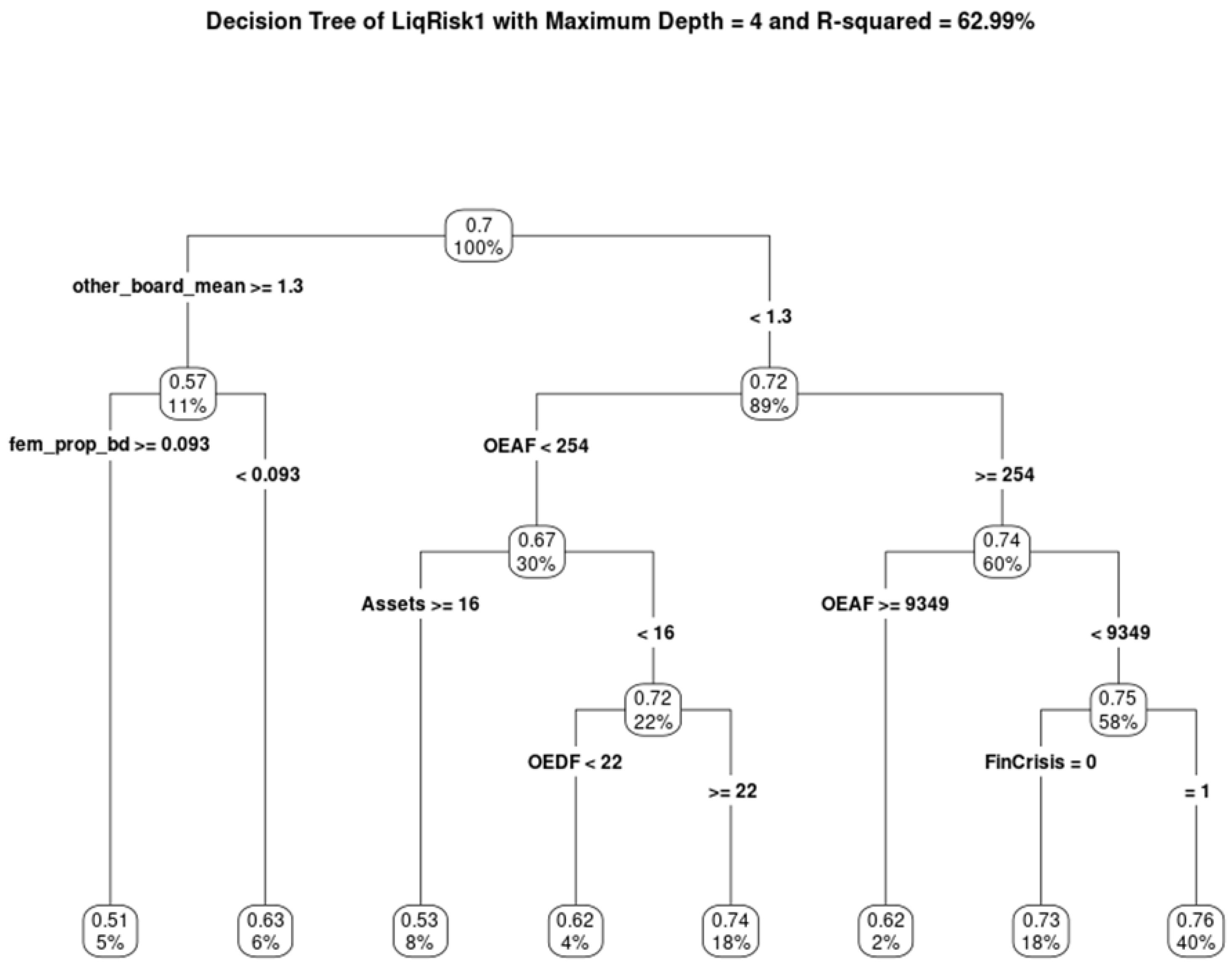
Figure 1), we find that the effect on increasing liquidity risk in terms of reducing core deposits at banks with higher female representation in boards only occurs for “busy” directors, i.e., for female directors who serve on multiple boards.
The engagement of directors in multiple board positions adversely impacts the liquidity risk management metric. Based on the results, we find that larger banks’ core deposits are lower as a proportion of their assets, implying a higher level of liquidity risk from a liability management viewpoint. The economic recession dummy, GFC, indicates no substantial impact on the liability management metric of liquidity exposure in the post-financial crisis era.
Figure 1 below demonstrates the decision tree branches for the Liquidity Risk 1 measure.
As illustrated on the top branch of the decision tree (
Figure 1), the median value of core deposits in proportion to total assets at banks is 0.7. In the subsequent tier of the hierarchy, it can be seen that financial institutions with board members holding a larger number (>1.3) of other board membership positions (an indicator of director busyness) worsens the liquidity risk in terms of lower median values of core deposits as a fraction of assets at banks (0.57 versus 0.72 at banks with board members holding fewer additional board positions). This aligns with the outcomes obtained from the fixed effects model in the panel regression analysis. In the subsequent level, we observe that a greater percentage of female board members (>0.093) correlates with reduced average values of core deposits at banks relative to assets, indicating more volatility in liquidity. At the same level on the other branch, we observe that higher auditors’ fees (OEAF > 254) result in lower liquidity risk (or higher core deposits to assets) at banks. The subsequent third level of the decision tree demonstrates that larger banks (log of assets > 16) have lower core deposits compared to assets. The above relations with respect to the proportion of female board members, auditors’ fees, and asset size of banks are consistent with the current paper’s results in the fixed effects model panel regression presented in
Table 1.
The explanatory power of the non-parametric decision tree analysis framework is observed to be higher compared to the fixed effects model. The decision tree model delineates certain predicated elements and threshold values for corporate governance parameters that significantly influence the maintenance of core deposits as a proportion of assets in banks.
- (ii)
Liquidity Risk 2
This section includes the results and discussion of corporate governance factors associated with the management of short-term temporary assets relative to total bank assets. The findings of the panel data regression are included below in
Table 2. Based on results from the LM test and the Hausman test, the random effects model dominated the pooled OLS and the fixed effects model.
The financial institution’s size, measured by assets owned by the bank, is associated negatively with the ratio of temporary assets to total assets according to the random effects model (
p-value < 0.01). A reduction in short-term assets to overall assets would elevate short-term liquidity risk. This suggests that bigger banks maintain relatively lower balances of cash and temporary assets from a portfolio oversight standpoint. Auditors’ fees are observed to have a significant positive association (
p < 0.05) with the maintenance of short-term temporary assets and a reduction in asset management liquidity risk measure at banks. However, although the OAEF coefficient = 0.0000012 ** is statistically significant at the 95% level of confidence,
p < 0.05, we acknowledge it may not be economically significant in its favorable positive association with temporary assets held at banks. The statistically significant coefficient at least confirms the effect exists, but the small economic magnitudes may reflect the constrained role of internal governance mechanisms in an environment characterized by strong regulation and state ownership, particularly in the post-crisis period. The economic crisis dummy indicates that the time subsequent to the economic meltdown (post-2008) adversely impacts the ratio of short-term assets to total assets (
p < 0.05). This shows a reduction in short-term temporary asset liquidity at banks in the period following the 2008 global economic downturn.
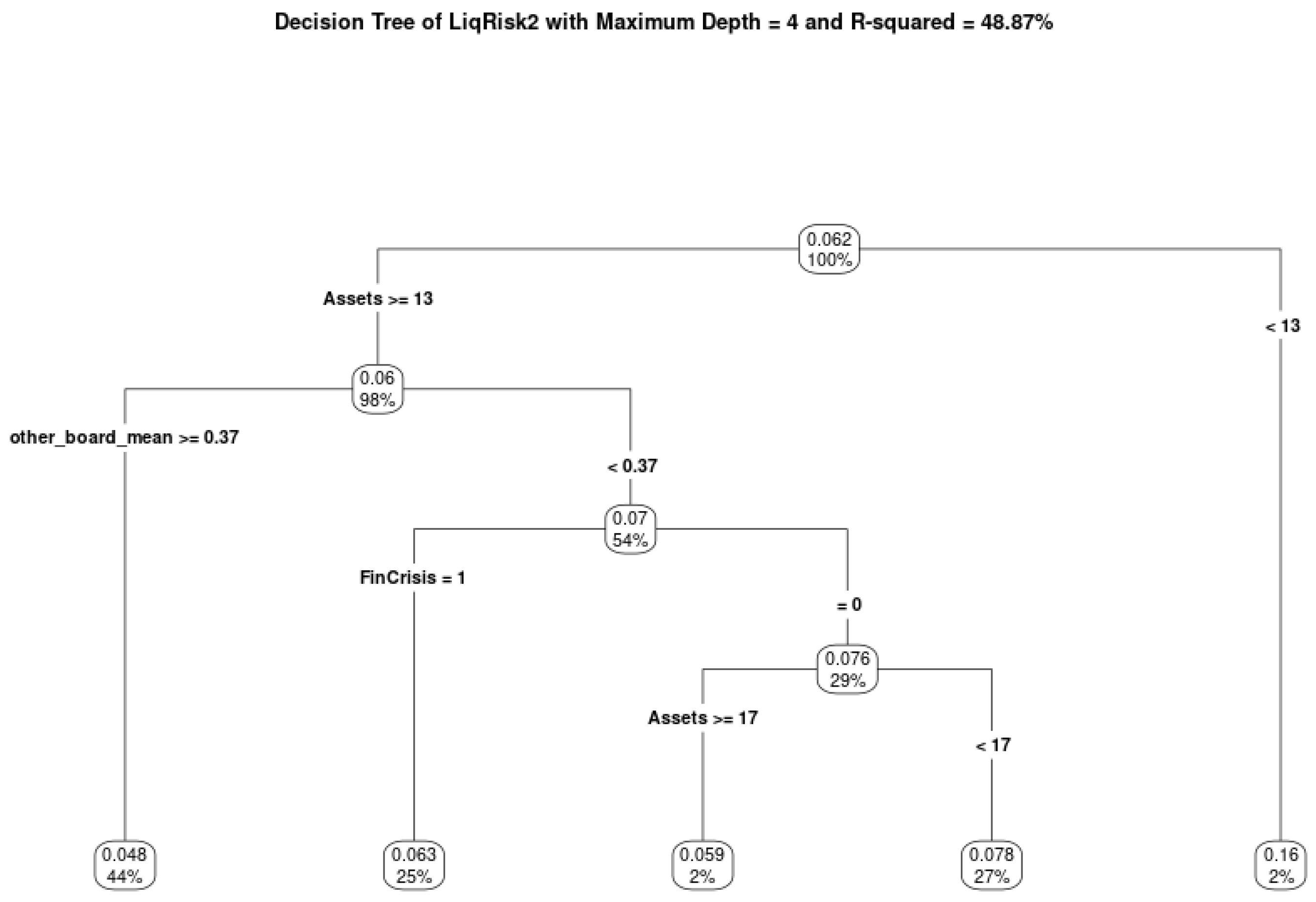
Figure 2 below illustrates the decision tree branches for the Liquidity Risk 2 measure.
At the first tier of the tree, it is evident that bigger banks (log of assets > 13) exhibited more liquidity risk, as shown by a lower median ratio of short-term assets compared with overall assets (0.06), in contrast to smaller banks (log of assets < 13), which had a median value of 0.16. This aligns with the current results of the random effects panel regression. The exact relationship is confirmed in the tree’s lower branches during the worldwide economic crisis. Generally, banks confirmed more liquidity risk in terms of lower average temporary asset balances in the period after the worldwide economic crisis (=0.063) compared to the period before the crisis based on the tree’s lower branches. The decision tree branches also reveal that banks with directors having more commitments with additional board membership positions (director busyness indicator) were worse in managing the liquidity risk from the point of view of maintaining sufficient temporary assets relative to total assets at banks, compared to bank board directors having fewer other board membership positions.
4.2. Solvency Risk
We used the net non-performing assets, NNPA, as the risk measure for solvency risk at banks, as they take into account the provisions for loan losses, and therefore, they provide transparency to stakeholders regarding the actual net burden for banks due to non-performing loans. The NNPA measure effectively considers the capital adequacy ratio in terms of accounting for the provisions for loan loss reserves at banks. Although Z-scores have been used by some studies as a measure of solvency risk in terms of distance to default, there are several limitations in using them in our study. The original Altman Z-score was developed primarily for manufacturing firms, and its applicability to financial institutions may be limited due to the differences in asset structure. Also, the traditional Z-score as a ratio of return on assets to standard deviation of returns assumes normality in bank return distribution, which may not necessarily be the case, as bank returns may be typically asymmetrically distributed.
We use banks’ net non-performing assets (NNPA) to indicate solvency risk. The findings of the panel regression are presented in
Table 3. Based on results from the LM test and the Hausman test, the random effects model dominated the pooled OLS and the fixed effects model.
Based on the random effects model, it is observed that the board size has a highly substantial, favorable association (p < 0.01) with net non-performing assets (NNPAs) at banks. However, banks that have a larger proportion of independent board members have a noteworthy negative relationship (p < 0.01) with non-performing assets, implying a reduction in solvency risk. Also, banks with higher directors’ fees and allowances are associated with lower net non-performing assets. The findings also indicate that net non-performing assets at banks increased substantially in the months following the end of the worldwide economic downturn.
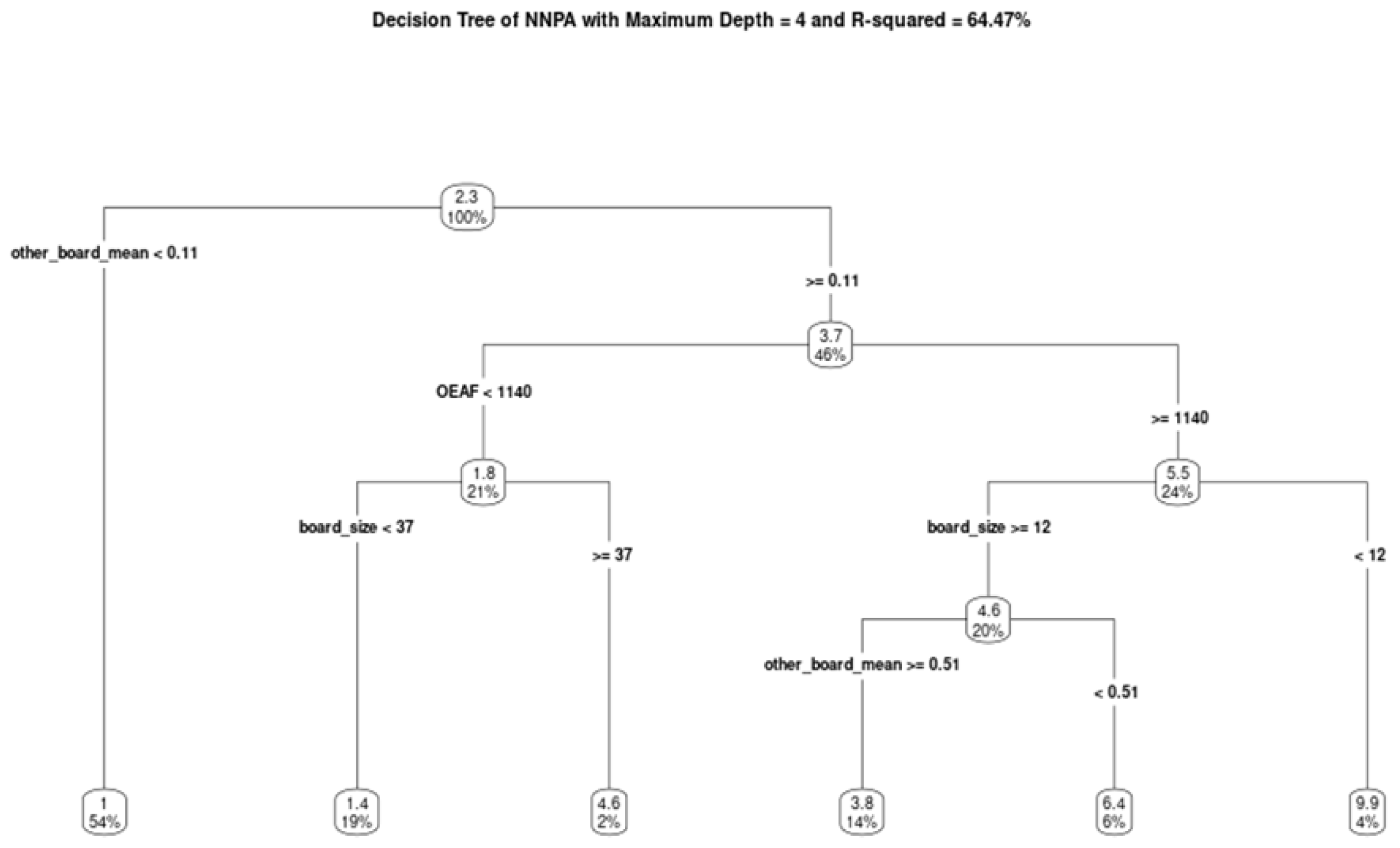
The decision tree branches for the solvency risk measure are demonstrated in
Figure 3. The median net non-performing assets (NNPAs) for banks is lower for banks having directors holding fewer outside board positions. At the subsequent tier of the hierarchy, this study identified that financial institutions with a higher median value of auditors’ fees (OEAF) were associated with banks dealing with more net non-performing assets. For banks with median auditors’ fees less than 1140, we observe that banks with smaller board sizes had lower median values of NNPA. However, among banks that paid higher auditor fees (above 1140), those with smaller boards (fewer than 12 members) showed higher NNPA values, indicating greater solvency risk.
5. Conclusions and Policy Implications
Based on the results from the management of core deposits at banks (liability management of liquidity risk measure), a larger proportion of independent board members appear to support policies to attract more core deposits at banks. Higher fees and allowances provided to directors and auditors at banks are associated with more core deposits at banks, implying a possible benefit to banks to incentivize them to improve director performance and audit quality linked to better liquidity risk management. However, increasing director busyness is seen to increase liquidity risk from the core deposit liability management perspective, implying that including directors with fewer external board commitments could reduce the liquidity risk at banks. Female participation in bank boards was associated with fewer core deposits relative to total assets at banks (as indicated in the fixed effects panel regression). However, based on the additional information obtained from the decision tree, we find that the effect on increasing liquidity risk in terms of reducing core deposits at banks with higher female representation in boards only occurs for “busy” directors, i.e., for female directors who serve on multiple boards. As a result, the effect on increased liquidity risk could be associated more with the “director busyness” variable than with the proportion of female representation on bank boards, and so we cannot conclude that female board participation is linked to increasing liquidity risk. The decision tree analysis for the asset management measure of liquidity risk also points to increasing liquidity risk for banks having directors holding more external director posts, corresponding to the impact seen in the liability management metric of liquidity threat. The director’s engagement in extra external board seats adversely impacts liquidity risk at banks. This could suggest regulatory policy reforms aimed at limiting the number of directors with multiple board positions to better manage bank liquidity risk, both from an asset management (discussed above) and a liability management viewpoint. Higher auditors’ fees are observed to have a positive association with a reduction in asset management liquidity risk measures at banks. Banks could continue to incentivize audit quality through higher fees to generate better liquidity risk management.
Our findings also reveal that larger banks are observed to have fewer core deposits from customers relative to bank assets. This may be attributed to the relatively larger size of bank loans at bigger banks that may have implicit protection under the “too big to fail” doctrine, or to insufficient core deposits at larger banks. Bigger banks are also observed to maintain relatively lower balances of cash and temporary assets relative to total assets. As a result, larger banks (by asset size) appear to demonstrate more liquidity risk both from liability management as well as asset management metrics. This would lead us to conclude that policy prescriptions for improving core deposits, as well as short-term temporary asset balances for larger banks, are warranted. We observe a reduction in short-term temporary asset liquidity at banks in the period following the 2008 global economic downturn. The finding that banks had lower temporary assets following the financial crisis period could motivate central bank regulations in the post-financial crisis period to require banks to hold more temporary asset balances to reduce their liquidity risk.
From the analysis of net non-performing assets at banks as a measure of solvency risk, we conclude that banks with more independent directors have reduced non-performing assets, implying better loan management. As directors’ fees increased at banks, the net non-performing assets decreased, indicating more director involvement in improving asset quality as their compensation increased. The results suggest policies to increase the number of independent directors on bank boards and provide monetary incentives to board directors to better manage solvency risk at banks. Based on the decision tree findings, we also observe that with higher auditor fees, larger board sizes are more effective at lowering solvency risk. Higher auditor fees may be associated with banks’ need to improve audit quality following higher levels of non-performing assets. At such banks, larger boards are more likely to include directors with diverse and extensive expertise in various areas of banking. This knowledge sharing can lead to better, more informed credit and strategic decisions, which, in turn, may help to mitigate solvency risk. However, banks having lower auditor fees may be associated with not having significant non-performing assets, in which case smaller board sizes are more cost-effective in lowering solvency risk. Also, we find that non-performing assets increased at banks after the economic crisis, implying the need for central bank regulation to improve asset quality in the post-crisis period.
We acknowledge that our analysis has limitations in making causal claims due to the potential endogeneity in the relationship between corporate governance variables and risk measures. As a result, we focus on examining the association between the liquidity and solvency risk metrics at banks and corporate governance factors, and we do not make claims on causal effects on the risk measures.
Future directions from the studies in this paper could consider the application of the random forest approach to enhance prediction accuracy for corporate governance factors affecting bank risk metrics. The random forest machine learning algorithm, employing simultaneous execution of multiple decision trees, could improve efficiency in predicting the effects of corporate governance factors on risk measures. Digitalization of banking services has been increasing at a rapid pace in India. Based on recent studies by Ionașcu, A.E. et al. [
37] in emerging banking markets such as in Romania, financial stability and efficiency have improved in terms of the correlation between digitalization and an increase in banks’ profitability and liquidity ratios. The effects of digitalization on solvency and liquidity risk metrics in Indian banks could be studied.