
Global Roadmaps for Post-Quantum Era in Finance: Policies, Timelines, and a Pragmatic Playbook for Migration



Abstract
1. Introduction
2. Impact of Quantum Computing on Cybersecurity
2.1. Risk Timeline and Migration Urgency
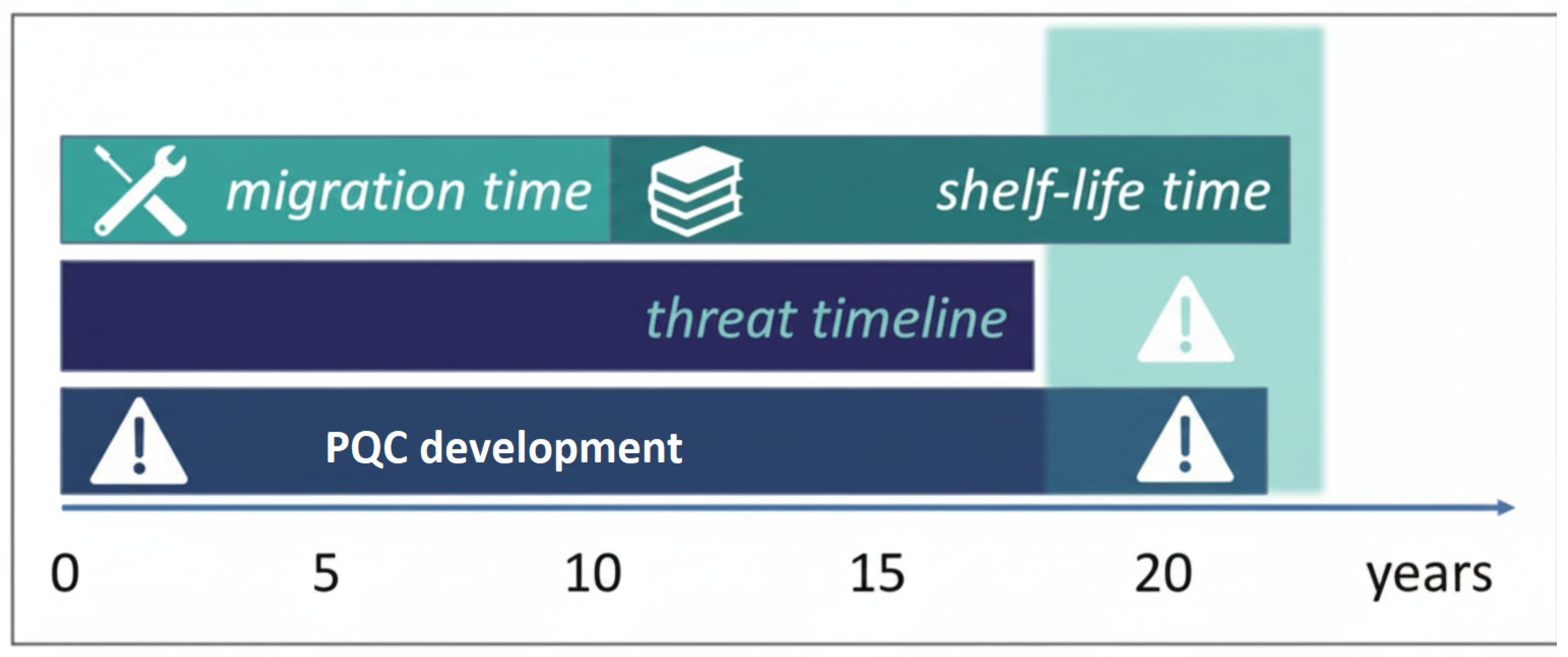
- Data lifetime (shelf life): how long the information handled by the system must remain secure.
- Migration time: how long it will take to upgrade or replace the system with a quantum-safe solution.
- Threat timeline: how soon attackers are expected to have quantum computers capable of breaking today’s cryptographic methods.
2.2. Barriers to Timely Migration
3. Historical and Technical Lessons from Cryptographic Transitions
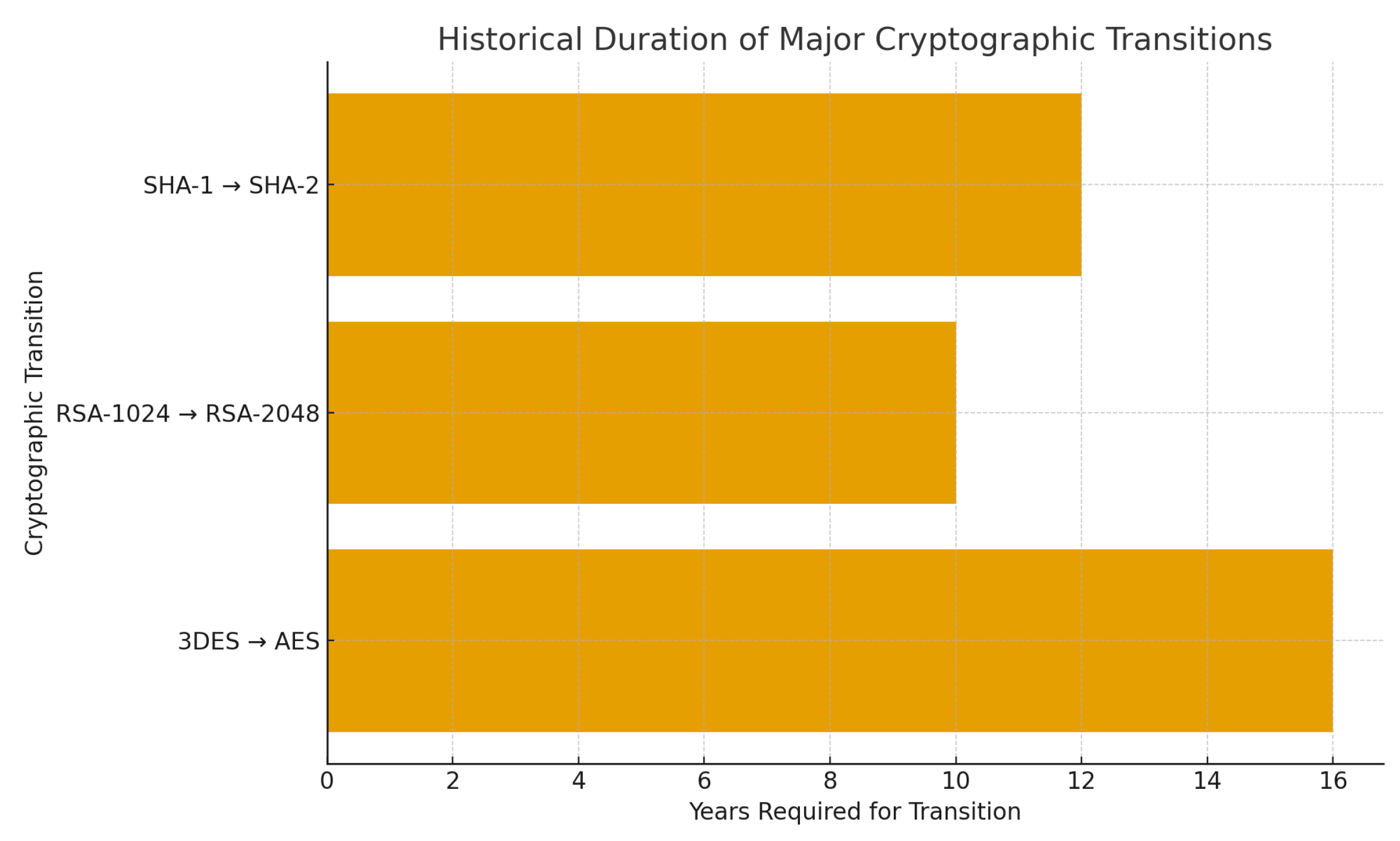
3.1. Timelines in Past Cryptographic Transitions
3.2. Migration Timelines and Long-Tail Inertia
- Initial discovery and assessment KPIs: cryptographic asset inventory coverage and dependency mapping.
- Intermediate compliance milestones: hybrid-PQC enablement, vendor-aligned upgrades, and certification updates aligned with NIST and sector-specific guidelines.
- Technical risk scores: quantifying exposure based on algorithm lifetime, data sensitivity, retention periods, and interoperability constraints across payment and financial infrastructures.
4. Complexity and Underestimation of PQC Migration
4.1. Beyond Simple Algorithm Replacement
4.2. Organizational and Ecosystem Barriers
4.3. Standardization and Tooling Lag
4.4. Realistic Migration Horizons
5. Quantum Threats and Regulatory Drivers for Payment Security
5.1. Cryptographic Foundations and Emerging Quantum Risks
5.2. Regulatory Pressures and Migration Imperatives
6. Global Policy and Compliance Landscape
Emerging Quantum Risk and Regulatory Drivers
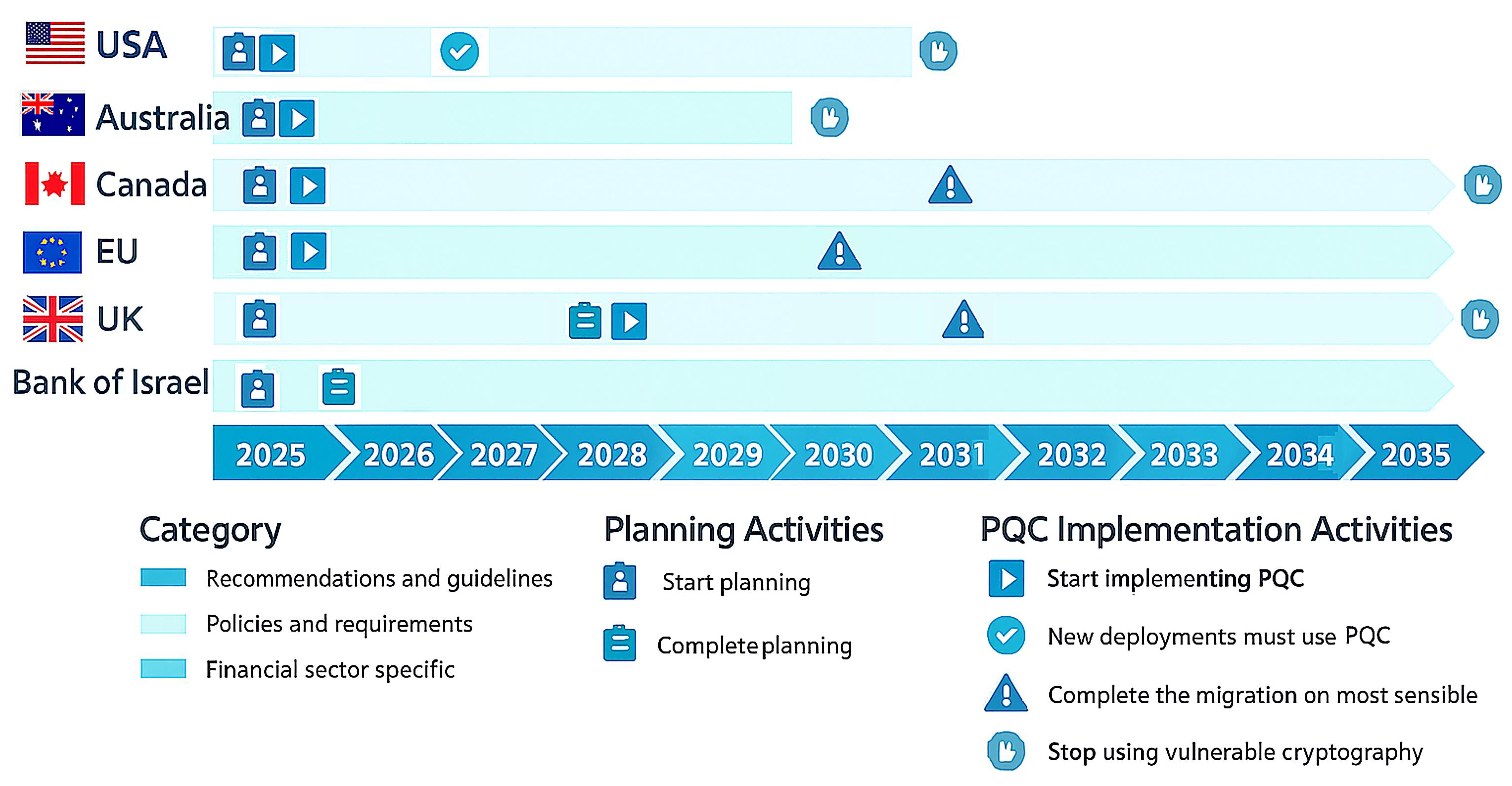
7. Government-Led Post-Quantum Cryptography (PQC) Roadmaps
Sector Guidance and Ecosystem Coordination
8. From Policy to Practice: Migration Priorities
8.1. Near-Term Measures to Reduce Long-Tail Exposure
8.2. Hybrid Cryptography and the Internet Edge
9. Financial-Sector Modernization and Dependencies
9.1. Lessons from Payment System Migrations
9.2. Payment Standards and Supervisory Signals
9.3. Dependencies
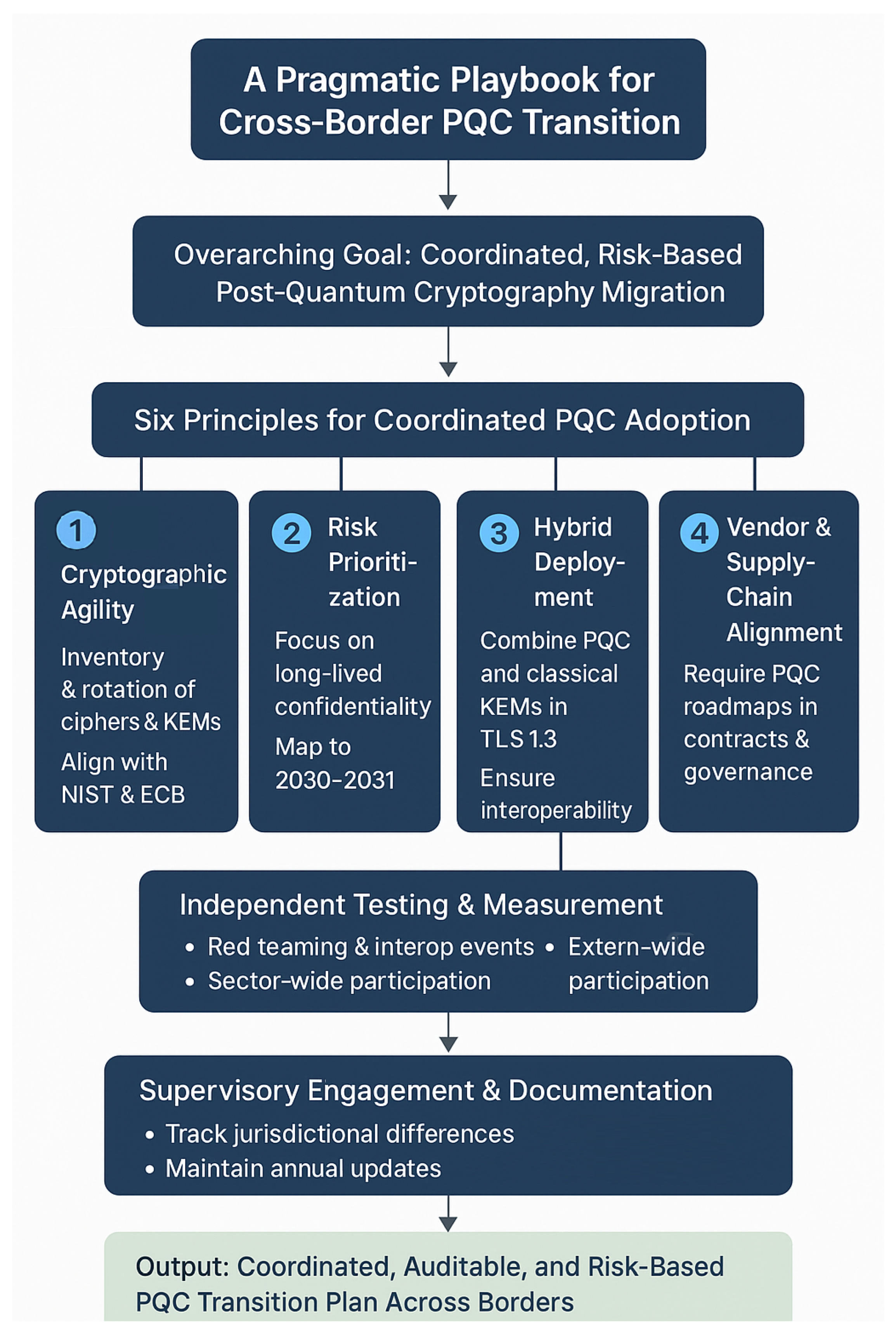
10. A Pragmatic Playbook for Cross-Border Transition
10.1. Principles for Coordinated PQC Adoption
- Principle 1—Crypto-Agility as Foundational Engineering and Governance.
- Define upgrade-safe interfaces between business logic and cryptographic implementations.
- Decouple cryptographic libraries from application code using abstraction layers.
- Implement protocol-level algorithm negotiation (e.g., flexible KEM identifiers in TLS 1.3).
- Maintain centralised, continuously updated inventories of keys, ciphers, and KEM deployments.
- Principle 2—Risk-Prioritised Scoping for Financial Stability and HNDL Mitigation.
- Classify systems and datasets by confidentiality lifetime, systemic importance, and cross-border visibility.
- Prioritise long-lived data stores, high-value messaging flows, and authentication/signature systems.
- Place these systems in early PQC pilots or hybrid-based transitional deployments.
- Principle 3—Hybrid Deployment Patterns to Manage Interoperability Constraints.
- Deploy hybrid KEM in TLS 1.3 where supported (OpenSSL, BoringSSL, CloudFront).
- Measure latency, handshake success rates, and throughput impacts across payment, messaging, and API systems.
- Use hybrid signatures internally where backward compatibility requirements persist.
- Sequence deployments to align with the readiness of third-party infrastructure, vendors, and counterparties.
- Principle 4—Vendor and Supply-Chain Alignment Across Borders.
- Request PQC enablement roadmaps from HSM, network security, banking platform, and API vendors.
- Embed crypto-agility and PQC milestones into procurement cycles and contractual acceptance criteria.
- Require demonstrable PQC capability (e.g., hybrid KEM support) for new deployments beyond 2025.
- Conduct joint pilot migrations with critical third-party service providers.
- Principle 5—Independent Testing, Measurement, and Sector-Wide Validation.
- Participate in PQC interoperability and conformance testing exercises hosted by standards bodies or supervisors.
- Use external scanning, red-teaming, and penetration testing to verify hybrid and transitional deployments.
- Benchmark performance impacts (latency, CPU cost, handshake reliability) across representative workloads.
- Share anonymised test and pilot results with sector-wide working groups to support ecosystem alignment.
- Principle 6—Proactive Supervisory Engagement and Traceable Decision-Making.
- Document and justify migration sequencing when regulatory requirements differ across jurisdictions.
- Maintain audit-ready migration plans with at least annual refresh cycles.
- Provide evidence that interim controls (e.g., hybrid modes) reduce HNDL exposure.
- Establish early, recurring communication channels with supervisors to validate approaches and timelines.
10.2. Coalescing on Migration Timelines
11. Discussion
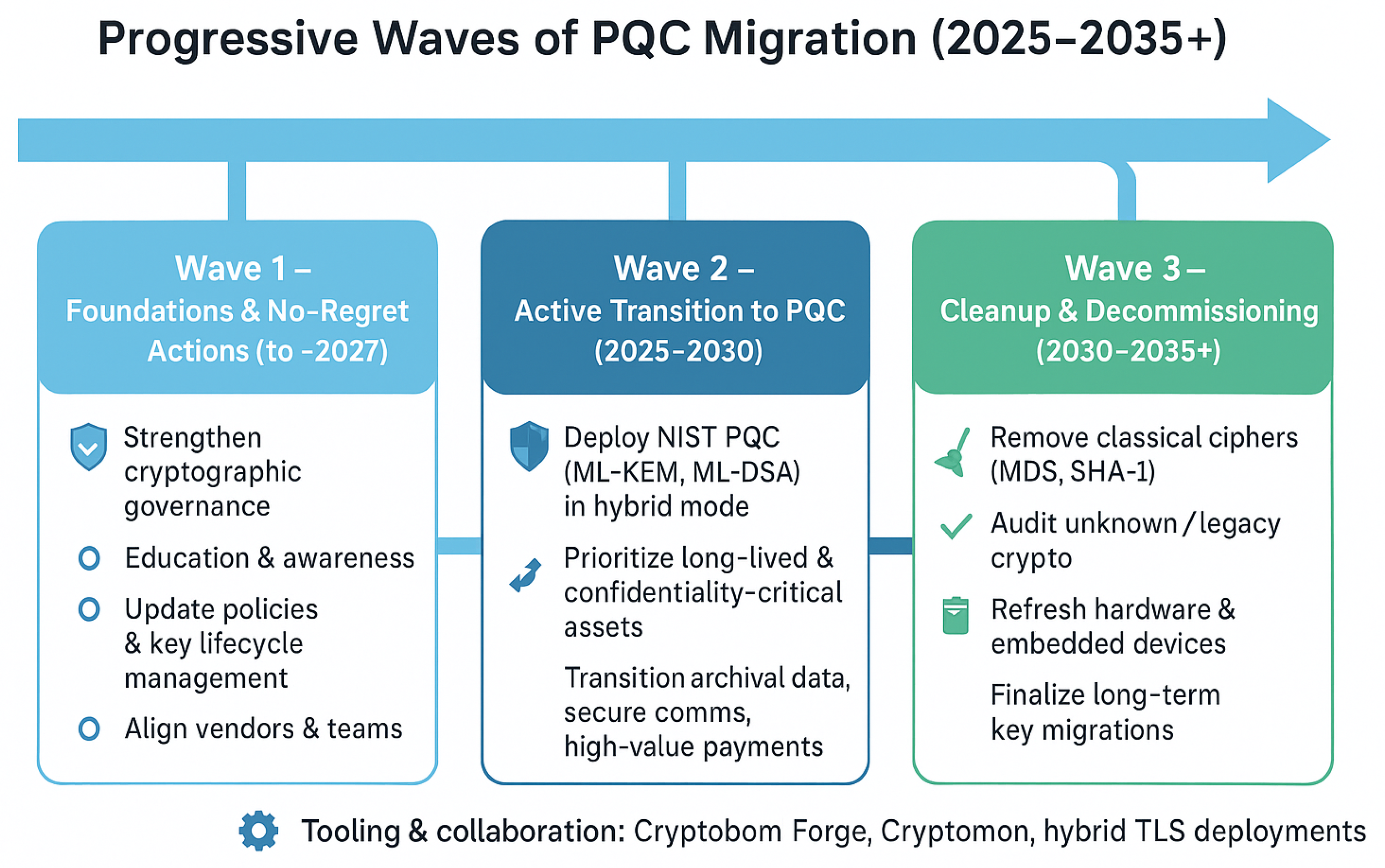
Recommended Migration Phases
- Wave 1—Foundations and No-Regret Actions (to ∼2027).
- Wave 2—Active Transition to PQC (2025–2030).
- Wave 3—Cleanup and Decommissioning of Classical Cryptography (2030–2035+).
12. Conclusions
Author Contributions
Funding
Data Availability Statement
Conflicts of Interest
References
- Arute, F.; Arya, K.; Babbush, R.; Bacon, D.; Bardin, J.C.; Barends, R.; Biswas, R.; Boixo, S.; Brandao, F.G.; Buell, D.A.; et al. Quantum Supremacy Using a Programmable Superconducting Processor. Nature 2019, 574, 505–510. [Google Scholar] [CrossRef] [PubMed]
- Mosca, M. Cybersecurity in an Era with Quantum Computers: Will We Be Ready? IEEE Secur. Priv. 2018, 16, 38–41. [Google Scholar] [CrossRef]
- European Union Agency for Cybersecurity (ENISA). Post-Quantum Cryptography: Current State and Quantum Mitigation. ENISA Report, 2022. Available online: https://www.enisa.europa.eu/publications/post-quantum-cryptography-current-state-and-quantum-mitigation (accessed on 2 October 2025).
- National Institute of Standards and Technology (NIST). NISTIR 8413: Migration to Post-Quantum Cryptography—Guidance on Discovery and Remediation of Cryptographic Systems. NIST Interagency/Internal Report. 2024. Available online: https://csrc.nist.gov (accessed on 2 October 2025).
- ETSI. Quantum-Safe Cryptography and Security (ETSI TR 103 619). ETSI Technical Report. 2020. Available online: https://www.etsi.org (accessed on 2 October 2025).
- Dixit, S. The Impact of Quantum Supremacy on Cryptography: Implications for Secure Financial Transactions. Int. J. Sci. Res. Comput. Sci. Eng. Inf. Technol. 2020, 6, 611–637. [Google Scholar] [CrossRef]
- Shaikh, F.; Sangole, M.; Pareek, V.; Patil, P.; Takale, D.; Gupta, S. Quantum Cryptographic Algorithms for Securing Financial Transactions. Comput. Fraud Secur. 2024. [Google Scholar] [CrossRef]
- Joseph, D.; Misoczki, R.; Manzano, M.; Tricot, J.; Pinuaga, F.; Lacombe, O.; Leichenauer, S.; Hidary, J.; Venables, P.; Hansen, R. Transitioning organizations to post-quantum cryptography. Nature 2022, 605, 237–243. [Google Scholar] [CrossRef] [PubMed]
- Nejatollahi, H.; Dutt, N.; Ray, S.; Regazzoni, F.; Banerjee, I.; Cammarota, R. Post-Quantum Lattice-Based Cryptography Implementations. ACM Comput. Surv. 2019, 51, 1–41. [Google Scholar] [CrossRef]
- Li, S.; Chen, Y.; Chen, L.; Liao, J.; Kuang, C.; Li, K.; Liang, W.; Xiong, N. Post-Quantum Security: Opportunities and Challenges. Sensors 2023, 23, 8744. [Google Scholar] [CrossRef]
- Xie, J.; Zhao, W.; Lee, H.; Roy, D.; Zhang, X. Hardware Circuits and Systems Design for Post-Quantum Cryptography—A Tutorial Brief. IEEE Trans. Circuits Syst. II Express Briefs 2024, 71, 1670–1676. [Google Scholar] [CrossRef]
- Sezer, B.; Akleylek, S.; Nuriyev, U. PP-PQB: Privacy-Preserving in Post-Quantum Blockchain-Based Systems: A Systematization of Knowledge. IEEE Access 2025, 13, 41382–41405. [Google Scholar] [CrossRef]
- Fernández-Caramés, T.; Fraga-Lamas, P. Towards Post-Quantum Blockchain: A Review on Blockchain Cryptography Resistant to Quantum Computing Attacks. IEEE Access 2020, 8, 21091–21116. [Google Scholar] [CrossRef]
- Preethi, P.; Ulla, M.; Sapna, R.; Mohan, K. Implementing Post-Quantum Cryptography Algorithm in Blockchain. In 2023 International Conference on New Frontiers in Communication, Automation, Management and Security (ICCAMS); IEEE: Karnataka, India, 2023; pp. 1–7. Available online: https://doi.org/10.1109/ICCAMS60113.2023.10525729 (accessed on 2 October 2025).
- Shor, P.W. Polynomial-Time Algorithms for Prime Factorization and Discrete Logarithms on a Quantum Computer. Siam Rev. 1996, 41, 303–332. [Google Scholar] [CrossRef]
- National Institute of Standards and Technology. NIST Releases First 3 Finalized Post-Quantum Encryption Standards; NIST: Gaithersburg, MD, USA, 2024. Available online: https://www.nist.gov/news-events/news/2024/08/nist-releases-first-3-finalized-post-quantum-encryption-standards (accessed on 2 October 2025).
- Bernstein, D.J.; Buchmann, J.; Dahmen, E. Post-quantum cryptography. Commun. ACM 2023, 66, 30–32. [Google Scholar] [CrossRef]
- UK National Cyber Security Centre (NCSC) and National Physical Laboratory, with Partners (Including BSI, ANSSI). Next Steps in Quantum-Safe Cryptography. Whitepaper, 2022. Available online: https://www.ncsc.gov.uk/whitepaper/next-steps-preparing-for-post-quantum-cryptography (accessed on 2 October 2025).
- Chen, L.; Jordan, S.; Liu, Y.-K.; Moody, D.; Peralta, R.; Perlner, R.; Smith-Tone, D. Report on Post-Quantum Cryptography; (NISTIR 8105); National Institute of Standards and Technology: Gaithersburg, MD, USA, 2016.
- NIST Computer Security Resource Center (CSRC). Post-Quantum Cryptography Standardization (Project Hub; Includes FIPS 203/204/205 and Ongoing Updates). Available online: https://csrc.nist.gov/projects/post-quantum-cryptography/post-quantum-cryptography-standardization (accessed on 2 October 2025).
- U.S. National Security Agency (NSA). CNSA 2.0: Commercial National Security Algorithm Suite 2.0 and Quantum Computing FAQ. Guidance on Migration Urgency, Timelines, and Interim Protections, 2022. Available online: https://media.defense.gov/2022/Sep/07/2003071836/-1/-1/0/CSI_CNSA_2.0_FAQ_.PDF (accessed on 2 October 2025).
- KPMG; Bundesamt für Sicherheit in der Informationstechnik (BSI). Quantum-Safe Cryptography: Readiness of German Enterprises. Survey Report, 2022. Available online: https://www.bsi.bund.de/EN/Themen/Unternehmen-und-Organisationen/Informationen-und-Empfehlungen/Quantentechnologien-und-Post-Quanten-Kryptografie/quantentechnologien-und-post-quanten-kryptografie_node.html (accessed on 27 September 2025).
- National Institute of Standards and Technology (NIST). Migration to Post-Quantum Cryptography: Guidance for Organizations. NIST (Landing and Working Guidance). 2024. Available online: https://csrc.nist.gov/Projects/post-quantum-cryptography (accessed on 27 September 2025).
- FeistyDuck. SSL/TLS and PKI History. Available online: https://www.feistyduck.com/ssl-tls-and-pki-history/ (accessed on 3 October 2025).
- The SSL Store. Celebrating 30 Years of SSL and TLS Versions. Available online: https://www.thesslstore.com/blog/ssl-and-tls-versions-celebrating-30-years-of-history/ (accessed on 3 October 2025).
- Smitterhane, M. How TLS Was Born to Secure the Modern Internet Age. Available online: https://dev.to/smitterhane/how-tls-was-born-to-secure-modern-age-internet-45jb (accessed on 3 October 2025).
- SSL Dragon. SSL Statistics and TLS Trends. Available online: https://www.ssldragon.com/blog/ssl-stats/ (accessed on 3 October 2025).
- IETF. TLS 1.3 Adoption Update. Available online: https://www.ietf.org/blog/tls13-adoption/ (accessed on 3 October 2025).
- Catchpoint. TLS 1.2 vs. TLS 1.3 Adoption Statistics. Available online: https://www.catchpoint.com/http2-vs-http3/tls1-2-vs-1-3 (accessed on 3 October 2025).
- SSL Labs. SSL Pulse. Available online: https://www.ssllabs.com/ssl-pulse/ (accessed on 5 October 2025).
- Anderson, R. Security Engineering, 2nd ed.; Wiley: New York, NY, USA, 2008; pp. 154–196. [Google Scholar]
- Holz, R.; Braun, L.; Kammenhuber, N.; Carle, G. The SSL Landscape: A Thorough Analysis of the X.509 PKI Using Active and Passive Measurements. In ICM’11: Proceedings of the 2011 ACM SIGCOMM Internet Measurement Conference (IMC), Berlin, Germany, 2–4 November 2011; Association for Computing Machinery: New York, NY, USA, 2011; pp. 427–444. [Google Scholar]
- NIST. Recommendation for Key Management, Part 1: General (SP 800-57); NIST Special Publication; NIST: Gaithersburg, DC, USA, 2016.
- Moore, J. The 3DES Deprecation Timeline and Its Impact. Cryptogr. Eng. Rev. 2017. [Google Scholar]
- Lenstra, A.; Verheul, E. Selecting Cryptographic Key Sizes. J. Cryptol. 2001, 14, 255–293. [Google Scholar] [CrossRef]
- Mozilla Security Team. Deprecation of 1024-bit RSA Certificates; Mozilla Security Bulletin; Mozilla Security Team: San Francisco, CA, USA, 2015. [Google Scholar]
- NIST. Announcing Approval of SHA-2 Family of Hash Functions. Federal Register; NIST: Gaithersburg, DC, USA, 2011.
- Stevens, M.; Bursztein, E.; Karpman, P.; Albertini, A.; Markov, Y. The First Collision for SHA-1 and Implications for the Web PKI; SHAttered Attack Report; Springer: Cham, Switzerland, 2017. [Google Scholar]
- NIST. Transition to Post-Quantum Cryptography; NIST Internal Report 8547; National Institute of Standards and Technology: Gaithersburg, MD, USA, 2024. Available online: https://nvlpubs.nist.gov/nistpubs/ir/2024/NIST.IR.8547.ipd.pdf (accessed on 3 October 2025).
- NIST. Considerations for Achieving Crypto Agility; NIST Cybersecurity White Paper (CSWP) 39; National Institute of Standards and Technology: Gaithersburg, MD, USA, 2022. Available online: https://nvlpubs.nist.gov/nistpubs/CSWP/NIST.CSWP.39.ipd.pdf (accessed on 3 October 2025).
- Attema, T. The PQC Migration Handbook; TNO: The Hague, The Netherlands, 2023; Available online: https://publications.tno.nl/publication/34641918/oicFLj/attema-2023-pqc.pdf (accessed on 3 October 2025).
- IETF. Deprecating TLS 1.0 and TLS 1.1; RFC 8996; IETF: Fremont, CA, USA, 2021. [Google Scholar]
- Rescorla, E. The Transport Layer Security (TLS) Protocol Version 1.3; RFC 8446; IETF: Fremont, CA, USA, 2018. [Google Scholar]
- Akamai. The state of TLS 1.3 deployment. In Akamai Security Intelligence Report; Akamai Technologies: Cambridge, MA, USA, 2019; pp. 32–58. [Google Scholar]
- Internet Engineering Task Force (IETF). The Transport Layer Security (TLS) Protocol Version 1.3. RFC 8446, August 2018. Available online: https://datatracker.ietf.org/doc/html/rfc8446 (accessed on 27 September 2025).
- APNIC Labs. Measuring the Adoption of TLS 1.3. Available online: https://labs.apnic.net/ (accessed on 27 September 2025).
- Seychelles, A.; Brown, P.; Kumar, R. Legacy cryptography and operational inertia in large-scale systems. J. Cyber Risk 2021, 10, 142–159. [Google Scholar]
- United States National Security Council. National Security Memorandum 10: Promoting United States Leadership in Quantum Computing While Mitigating Risks to Vulnerable Cryptographic Systems. The White House. (4 May 2022). Available online: https://www.whitehouse.gov/briefing-room/presidential-actions/2022/05/04/national-security-memorandum-10-promoting-united-states-leadership-in-quantum-computing-while-mitigating-risks-to-vulnerable-cryptographic-systems/ (accessed on 27 September 2025).
- UK National Cyber Security Centre. Preparing for Post-Quantum Cryptography: Guidance for Organizations. Available online: https://www.ncsc.gov.uk/whitepaper/preparing-for-quantum-safe-cryptography (accessed on 27 September 2025).
- ENISA. Post-Quantum Cryptography: Expected Impact and Preparedness; European Union Agency for Cybersecurity: Athens, Greece, 2022; pp. 1–68. [Google Scholar]
- Google. A Roadmap to Deploy Quantum-Resistant Cryptography at Scale. Available online: https://security.googleblog.com/ (accessed on 27 September 2025).
- Cloudflare. Post-Quantum Cryptography Comes to Cloudflare’s Network. Available online: https://blog.cloudflare.com/ (accessed on 27 September 2025).
- Bank for International Settlements. Roadmap for Quantum-Safe Cryptography in Financial Market Infrastructures; BIS: Basel, Switzerland, 2025; pp. 1–56. [Google Scholar]
- Bank for International Settlements. Macro-Financial Risks from Cryptographic Disruption: Scenario Analysis; BIS: Basel, Switzerland, 2025; pp. 10–24. [Google Scholar]
- U.S. Office of Management and Budget. Guidance on Budgeting for Post-Quantum Cryptography Transition; Memorandum M-24-07; U.S. Office of Management and Budget: Washington, DC, USA, 2024; pp. 1–12.
- U.S. Government Accountability Office. Post-Quantum Cryptography: Federal Agencies Need to Plan for Transition Costs; GAO-23; U.S. Government Accountability Office: Washington, DC, USA, 2023; pp. 1–40.
- White House/Office of Management and Budget. Report on Post-Quantum Cryptography Migration. White House Report, 2024. Government-Wide Estimate of Approximately USD $7.1 Billion Between 2025 and 2035 for PQC Migration in Non–National-Security Systems. Available online: https://thequantuminsider.com/2024/08/12/white-house-report-u-s-federal-agencies-brace-for-7-1-billion-post-quantum-cryptography-migration/ (accessed on 11 December 2025).
- Harvest Now, Decrypt Later. Available online: https://en.wikipedia.org/wiki/Harvest_now%2C_decrypt_later (accessed on 3 October 2025).
- Cloudflare. Why Transition to Post-Quantum Cryptography and Why Now? Blog Post, 2025. Available online: https://blog.cloudflare.com/he-il/post-quantum-zero-trust/ (accessed on 3 October 2025).
- F5. Understanding PQC Standards and Timelines. Available online: https://www.f5.com/company/blog/understanding-pqc-standards-and-timelines (accessed on 3 October 2025).
- Stormshield. Preparing for the Digital Future: Post-Quantum Cryptography Challenges and Adoption in Companies. Available online: https://www.stormshield.com/news/preparing-for-the-digital-future-post-quantum-cryptography-challenges-and-adoption-in-companies/ (accessed on 3 October 2025).
- Näther, C.; Herzinger, D.; Gazdag, S.-L.; Steghöfer, J.-P.; Daum, S.; Loebenberger, D. Migrating Software Systems towards Post-Quantum Cryptography—A Systematic Literature Review. arXiv 2024. [Google Scholar] [CrossRef]
- DigiCert. The Progress Toward Post-Quantum Cryptography, 2025. Available online: https://www.digicert.com/blog/the-progress-toward-post-quantum-cryptography (accessed on 3 October 2025).
- Ahmed, N.; Zhang, L.; Gangopadhyay, A. A Survey of Post-Quantum Cryptography Support in Cryptographic Libraries. arXiv 2025. [Google Scholar] [CrossRef]
- PQShield. NIST Recommends Timelines for Transitioning Cryptographic Algorithms. Available online: https://pqshield.com/nist-recommends-timelines-for-transitioning-cryptographic-algorithms/ (accessed on 3 October 2025).
- CyberArk. NIST’s New Timeline for Post-Quantum Encryption. Available online: https://www.cyberark.com/resources/blog/nist-s-new-timeline-for-post-quantum-encryption (accessed on 3 October 2025).
- Menezes, A.; van Oorschot, P.; Vanstone, S. Handbook of Applied Cryptography; CRC Press: Boca Raton, FL, USA, 1996; pp. 1–780. [Google Scholar]
- Hoffstein, J.; Pipher, J.; Silverman, J.H. An Introduction to Mathematical Cryptography, 2nd ed.; Springer: New York, NY, USA, 2014; pp. 1–538. [Google Scholar]
- Lenstra, A.K.; Lenstra, H.W., Jr. (Eds.) The Development of the Number Field Sieve; Springer: Berlin/Heidelberg, Germany, 1993; pp. 1–264. [Google Scholar]
- European Union. Regulation (EU) 2022/2554 on Digital Operational Resilience for the Financial Sector (DORA). Off. J. Eur. Union 2022. Available online: https://eur-lex.europa.eu/eli/reg/2022/2554/oj (accessed on 27 September 2025).
- ETSI. Quantum-Safe Cryptography and Security: An Introduction, Benefits, Enablers and Challenges. ETSI White Paper No. 28. 2021. Available online: https://www.douglas.stebila.ca/research/papers/ETSI-Whitepaper15/ (accessed on 27 September 2025).
- Le, T.D.; Do, P.H.; Dinh, T.D.; Pham, V.D. Are Enterprises Ready for Quantum-Safe Cybersecurity? arXiv 2025, arXiv:2509.01731. Available online: https://arxiv.org/abs/2509.01731 (accessed on 27 September 2025).
- Metaculus Community Forecast. Date of First Cryptographically Relevant Quantum Computer. Available online: https://www.metaculus.com/questions/ (accessed on 27 September 2025).
- NIST. FIPS 203: Module-Lattice-Based Key-Encapsulation Mechanism (ML-KEM). 2024. Available online: https://csrc.nist.gov/pubs/fips/203/final (accessed on 27 September 2025).
- NIST. FIPS 204: Module-Lattice-Based Digital Signature Algorithm (ML-DSA). 2024. Available online: https://csrc.nist.gov/pubs/fips/204/final (accessed on 27 September 2025).
- U.S. Office of Management and Budget (OMB). Memorandum M-23-02: Migrating to Post-Quantum Cryptography. 2022. Available online: https://www.whitehouse.gov/wp-content/uploads/2022/11/M-23-02-M-Memo-on-Migrating-to-Post-Quantum-Cryptography.pdf (accessed on 27 September 2025).
- NIST. SP 800-56C Rev. 2: Recommendation for Key-Derivation Methods in Key-Establishment Schemes. 2020. Available online: https://csrc.nist.gov/publications/detail/sp/800-56c/rev-2/final (accessed on 27 September 2025).
- Barker, E.; Chen, L.; Barker, E.B.; Roginsky, A.L.; Davis, R. SP 800-208: Recommendation for Stateful Hash-Based Signature Schemes; NIST Special Publication; NIST: Gaithersburg, DC, USA, 2020; pp. 1–50.
- ETSI. Migration to Quantum-Safe Cryptography. ETSI GR QSC 001 and Related TRs, 2022. Available online: https://www.etsi.org/committee/qsc (accessed on 27 September 2025).
- ISO/IEC JTC 1 SC 27; Post-Quantum Cryptography Profiles and Guidelines (Work Items, Including ISO/IEC 14888 Updates and PQC Profiles). ISO: Vernier, Switzerland, 2024. Available online: https://www.iso.org/committee/45306.html (accessed on 27 September 2025).
- Basel Committee on Banking Supervision. Prudential Treatment of Risks from Quantum Computing to Cryptographic Systems: Supervisory Considerations; BIS Publications; Basel Committee on Banking Supervision: Basel, Switzerland, 2023. [Google Scholar]
- Barker, E.; Chen, L.; Cooper, D.; Moody, D.; Regenscheid, A.; Souppaya, M.; Newhouse, B.; Housley, R.; Turner, S.; Barker, W.; et al. NISTIR 8240: Computing Environments for Cryptographic Algorithms—Crypto Agility Considerations; NIST Interagency/Internal Reports; NIST: Gaithersburg, DC, USA, 2020.
- World Economic Forum. Transitioning to a Quantum-Secure Economy: Practical Guidance for Organizations; WEF Insight Report; World Economic Forum: Geneva, Switzerland, 2023. [Google Scholar]
- Cloud Security Alliance. Preparing Enterprises for the Quantum-Safe Future; CSA Guidance; Cloud Security Alliance: Las Vegas, NV, USA, 2022. [Google Scholar]
- Souppaya, M.; Scarfone, K.; Yeluri, R. NISTIR 7966: Security of Interactive and Automated Access Management Using Secure Shell (SSH) and Lessons for Crypto-Agility; NIST Interagency/Internal Reports; NIST: Gaithersburg, DC, USA, 2015; pp. 1–52.
- ISO/IEC 27002:2022; Information Security, Cybersecurity and Privacy Protection—Information Security Controls. International Organization for Standardization: Geneva, Switzerland, 2022.
- Communications Security Establishment (CSE). Canada’s Roadmap to Post-Quantum Cryptography. Government of Canada Guidance. 2024. Available online: https://www.cse-cst.gc.ca (accessed on 26 December 2025).
- Australian Signals Directorate (ASD)/Australian Government. Planning for Post-Quantum Cryptography Commonwealth of Australia. 2024. Available online: https://www.cyber.gov.au/business-government/secure-design/planning-for-post-quantum-cryptography (accessed on 5 October 2025).
- National Security Agency (NSA). NSA Releases Future Quantum-Resistant (QR) Algorithm Requirements for National Security Systems. Available online: https://www.nsa.gov/Press-Room/News-Highlights/Article/Article/3148990/nsa-releases-future-quantum-resistant-qr-algorithm-requirements-for-national-se/ (accessed on 30 September 2025).
- National Institute of Standards and Technology (NIST). Considerations for Achieving Crypto Agility: Strategies and Practices (NIST CSWP 39). NIST Cybersecurity White Paper. 2025. Available online: https://nvlpubs.nist.gov/nistpubs/CSWP/NIST.CSWP.39.pdf (accessed on 30 September 2025).
- White House Office of Science and Technology Policy (OSTP). Advancing Post-Quantum Cryptography Readiness in Federal Systems. OSTP Memorandum. 2024. Available online: https://www.whitehouse.gov/ostp (accessed on 5 October 2025).
- Cybersecurity and Infrastructure Security Agency (CISA). Post-Quantum Cryptography Migration: Roadmap for Critical Infrastructure. CISA Guidance. 2025. Available online: https://www.cisa.gov (accessed on 5 October 2025).
- Google Chrome Team. Hybrid Post-Quantum Key Agreement in Chrome (X25519_Kyber Hybrid) Rollout Notes. Chrome Platform Status/Security Blog. 2024. Available online: https://chromestatus.com (accessed on 5 October 2025).
- Mozilla Security Engineering. Post-Quantum and Hybrid KEM Support in Firefox/TLS. Mozilla Security Blog/Release Notes. 2025. Available online: https://security.mozilla.org (accessed on 5 October 2025).
- Microsoft Edge Team. TLS Hybrid Post-Quantum Key Exchange Support in Edge. Microsoft Security Blog / Edge Platform Status. 2025. Available online: https://learn.microsoft.com (accessed on 5 October 2025).
- OpenSSL Project. OpenSSL 3.x: Hybrid PQC (X25519+Kyber) in TLS 1.3–Implementation Notes. Project Documentation. 2024. Available online: https://www.openssl.org (accessed on 5 October 2025).
- BoringSSL. Hybrid PQC Key Agreement Support for TLS 1.3. Project Repository Documentation. 2024. Available online: https://boringssl.googlesource.com/boringssl (accessed on 5 October 2025).
- Amazon Web Services. AWS CloudFront: Hybrid Post-Quantum TLS Key Agreement (Kyber) Enablement. AWS Security/CloudFront Blog. 2024. Available online: https://aws.amazon.com/blogs/security (accessed on 5 October 2025).
- Akamai. Enabling Hybrid Post-Quantum TLS at Scale. Akamai Blog / Product Documentation. 2025. Available online: https://www.akamai.com (accessed on 5 October 2025).
- European Commission. A Coordinated Implementation Roadmap for the Transition to Post-Quantum Cryptography. Available online: https://digital-strategy.ec.europa.eu/en/library/coordinated-implementation-roadmap-transition-post-quantum-cryptography (accessed on 30 September 2025).
- A Joint Statement from 18 EU Member States’ Agencies on Post-Quantum Cryptography Transition. Available online: https://www.bsi.bund.de/SharedDocs/Downloads/EN/BSI/Crypto/PQC-jointstatement.pdf?__blob=publicationFile&v=5 (accessed on 30 September 2025).
- Eurosystem. ECB Public Consultation on Cyber Resilience Oversight Expectations. Eurosystem Communication. 2025. Available online: https://www.ecb.europa.eu/press/intro/cons/html/cyber_resilience_oversight_expectations.en.html (accessed on 30 September 2025).
- European Union. NIS2 Implementation Guidance: Cryptographic Agility and PQC Considerations for Essential and Important Entities. EU/NIS Cooperation Documents. 2024. Available online: https://digital-strategy.ec.europa.eu (accessed on 30 September 2025).
- NCSC (National Cyber Security Centre). Timelines for Migration to Post-Quantum Cryptography. 2025. Available online: https://www.ncsc.gov.uk/guidance/pqc-migration-timelines (accessed on 5 October 2025).
- Australian Signals Directorate (ASD). Guidelines for Cryptography. Available online: https://www.cyber.gov.au/resources-business-and-government/essential-cybersecurity/ism/cybersecurity-guidelines/guidelines-cryptography (accessed on 30 September 2025).
- Monetary Authority of Singapore (MAS). Advisory on Addressing the Cybersecurity Risks Associated with Quantum. Available online: https://www.mas.gov.sg/regulation/circulars/advisory-on-addressing-the-cybersecurity-risks-associated-with-quantum (accessed on 30 September 2025).
- Bank of Israel, Banking Supervision Department. Supervisory Directive: Transition Planning Requirements for Banking Corporations. Supervisory Directive. 2024. Available online: https://www.boi.org.il (accessed on 5 October 2025).
- Bank of Israel. Banking System Preparedness for Cyber Risks Arising from Quantum Computing Capabilities. 2025. Available online: https://www.boi.org.il/en/economic-roles/supervision-and-regulation/letters/letter202501en (accessed on 5 October 2025).
- Financial Stability Board (FSB). FSB Chair Sets Out the FSB’s Work to Maintain Financial Stability Amidst Technological Advancements. FSB Publication. 2024. Available online: https://www.fsb.org/2024/10/fsb-chair-sets-out-the-fsbs-work-to-maintain-financial-stability-amidst-technological-advancements/ (accessed on 5 October 2025).
- Apple WebKit/Research Community. Measuring Hybrid PQC Adoption in the Web Ecosystem (Top Sites, Traffic Shares). Measurement Report/WebKit Blog. 2025. Available online: https://webkit.org/blog (accessed on 5 October 2025).
- Institute of International Finance. Quantum Safety Boot Camp (3-Day Program), December 2024. IIF Event Materials. 2024. Available online: https://www.iif.com/ (accessed on 27 September 2025).
- FS-ISAC Post-Quantum Working Group. Defining Crypto-Agility and Sector Guidance for PQC Migration; FS-ISAC Member Brief FS-ISAC: Reston, VA, USA, 2024. [Google Scholar]
- European Quantum Financial Forum. Quantum Safe Financial Forum—A Call to Action. European Cybercrime Centre (EC3), Europol. 2025. Available online: https://www.europol.europa.eu (accessed on 27 September 2025).
- UK National Cyber Security Centre. Annual Cyber Threat Report 2024/25; NCSC Report; UK National Cyber Security Centre: London, UK, 2025.
- European Union Agency for Cybersecurity (ENISA). Threat Landscape, 2024; ENISA Report; ENISA: Athens, Greece, 2024.
- National Institute of Standards and Technology (NIST). Post-Quantum Cryptography Standardization: Selected Algorithms and Draft Standards. NIST Cryptographic Standards and Guidelines. 2024. Available online: https://csrc.nist.gov/Projects/post-quantum-cryptography/post-quantum-cryptography-standardization/selected-algorithms (accessed on 27 September 2025).
- FS-ISAC. Emerging Threats to Payment Systems: Sector Brief. FS-ISAC Report. 2024. Navigating Cyber 2024: Annual Report on Emerging Threats and Operational Resilience in the Financial Services Ecosystem. Available online: https://www.fsisac.com/navigatingcyber2024 (accessed on 27 September 2025).
- FS-ISAC. Navigating Operational Resilience in the Global Payments Ecosystem. FS-ISAC Report. 2023. Available online: https://www.fsisac.com/hubfs/NavigatingCyber-2023/NavigatingCyber2023-Final.pdf?hsLang=en (accessed on 27 September 2025).
- Introduction to Post-Quantum Security: Understanding the Quantum Threat and Future Security Considerations in SWIFT Networks. 2025. Available online: https://www.swift.com/myswift/services/training/swift-training-catalogue/browse-swift-training-catalogue/introduction-post-quantum-security (accessed on 5 October 2025).
- Committee on Payments and Market Infrastructures (CPMI). ISO 20022 Migration for Cross-Border Payments: Key Learnings and Next Steps; Bank for International Settlements (BIS): Basel, Switzerland, 2023; Available online: https://www.bis.org/cpmi (accessed on 5 October 2025).
- European Central Bank (ECB). TARGET Services Annual Report 2024: T2-T2S Consolidation and ISO 20022 Migration Insights. Annual Report. 2024. Available online: https://www.ecb.europa.eu/press/targetservar/html/ecb.targetservar2024.en.htm (accessed on 2 October 2025).
- European Banking Authority (EBA). Digital Operational Resilience Act (DORA): Overview and EBA Activities on ICT Risk Management and Operational Resilience. Available online: https://www.eba.europa.eu/activities/direct-supervision-and-oversight/digital-operational-resilience-act (accessed on 2 October 2025).
- Bank of England; Prudential Regulation Authority; Financial Conduct Authority. Operational Resilience: Final Rules and Updates. UK Authorities Policy Materials, 2021–2024. Available online: https://www.bankofengland.co.uk, https://www.fca.org.uk (accessed on 5 October 2025).
- Banca d’Italia. Remarks by the Deputy Governor on Transition Planning and Operational Resilience; Banca d’Italia: Rome, Italy, September 2024. Available online: https://www.bancaditalia.it (accessed on 5 October 2025).
- Group of Seven (G7). Finance Ministers and Central Bank Governors’ Communiqué. Rome. 2024. Available online: https://www.g7italy.it (accessed on 5 October 2025).
- Financial Stability Board (FSB). Enhancing Cross-Border Payments: 2024 Progress Report. FSB Report. 2024. Available online: https://www.fsb.org (accessed on 5 October 2025).
- PCI Security Standards Council (PCI SSC). PCI DSS v4.0 and Related Guidance for the Payment Card Ecosystem. PCI SSC Standards and Guidance. 2024. Available online: https://www.pcisecuritystandards.org (accessed on 5 October 2025).
- Bank of England. RTGS and CHAPS Annual Report 2024/25. BoE Publication. 2025. Available online: https://www.bankofengland.co.uk/report/2025/rtgs-and-chaps-annual-report-2024-2 (accessed on 5 October 2025).
- UK National Cyber Security Centre (NCSC). Preparing for Post-Quantum Cryptography: Planning Expectations and Timelines. NCSC Guidance. 2024. Available online: https://www.ncsc.gov.uk (accessed on 5 October 2025).
- Openbank (Grupo Santander). Openbank Enables Hybrid Post-Quantum TLS for Customer Web Sessions. Engineering/Press Note. 2025. Available online: https://www.openbank.es (accessed on 5 October 2025).
- Accredited Standards Committee X9. X9 Financial PKI Q&A. Available online: https://x9.org/x9-financial-pki-qa/ (accessed on 5 October 2025).





| Focus Area | Key Insights | Citations |
|---|---|---|
| PQC Algorithm Surveys | Lattice, hash, code, multivariate, isogeny-based schemes reviewed | [6,7,8,9,10] |
| Financial System Impact | Disruption of secure transactions, need for hybrid/transition models | [6,7,8] |
| Blockchain Applications | PQC for privacy, digital assets, and quantum-safe blockchains | [12,13,14] |
| Implementation Challenges | Scalability, efficiency, regulatory, and legacy system integration | [6,7,8,11] |
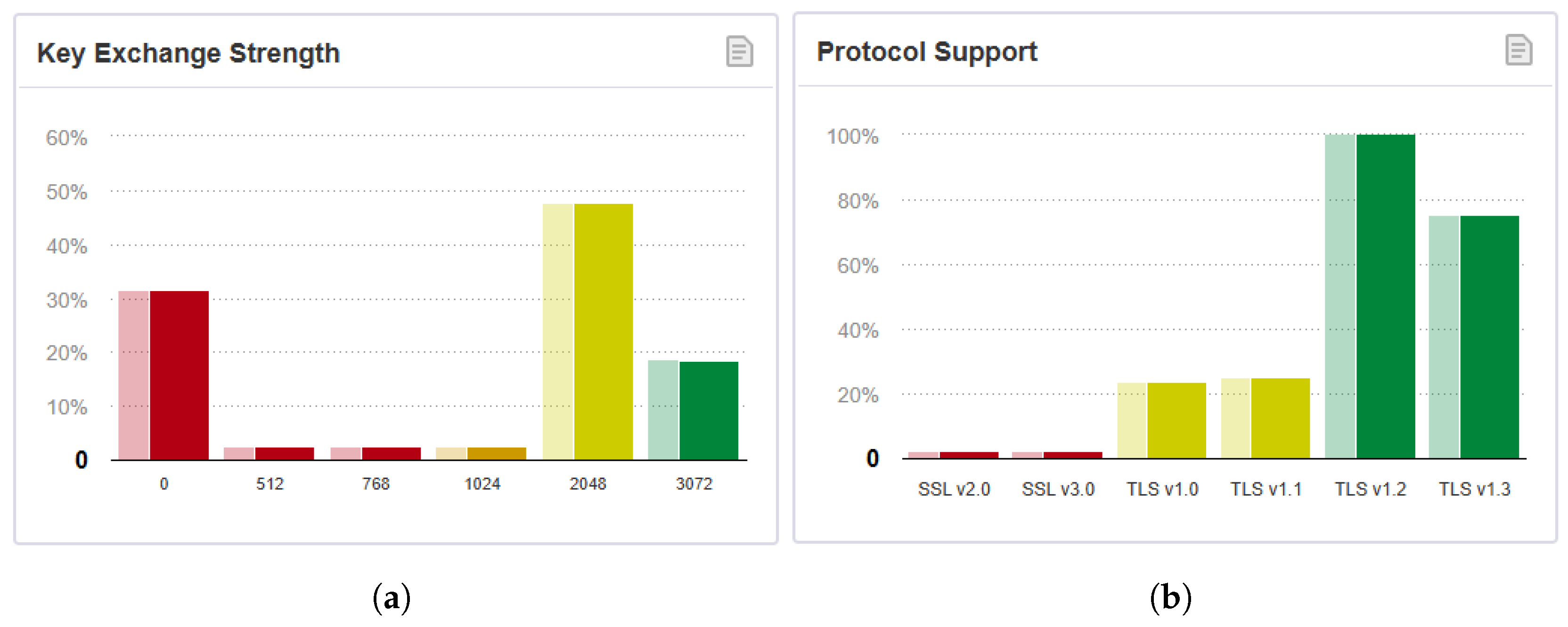
| Security Feature | % of Top Sites | Why It Matters |
|---|---|---|
| TLS 1.3 | ∼79% | The newest and most secure TLS version—faster, stronger encryption, better privacy. |
| TLS 1.2 | ∼99% | Still secure and widely supported—acts as a fallback when TLS 1.3 is unavailable. |
| Forward Secrecy (FS) | ∼89% | Protects past sessions even if the site’s private key is compromised later. |
| HSTS (Strict Transport Security) | ∼26% | Forces browsers to use HTTPS, preventing downgrade attacks and mixed content. |
| Strong Keys (≥2048-bit RSA/ECDSA) | ∼98% | Strong cryptographic keys make breaking encryption computationally infeasible. |
| HTTP/2 Support | ∼56% | Enables faster, more efficient, and secure page loading over HTTPS. |
| Weak Ciphers (RC4, 3DES, etc.) | <0.1% | Nearly extinct—indicates modern and safe cipher suites. |
| Certificate Chain Issues | ∼3% | Misconfigurations can trigger browser security warnings or failed connections. |
| Legacy SSLv3/SSLv2 | <1% | Very rare now—important because these protocols are obsolete and insecure. |
Disclaimer/Publisher’s Note: The statements, opinions and data contained in all publications are solely those of the individual author(s) and contributor(s) and not of MDPI and/or the editor(s). MDPI and/or the editor(s) disclaim responsibility for any injury to people or property resulting from any ideas, methods, instructions or products referred to in the content. |
© 2026 by the authors. Licensee MDPI, Basel, Switzerland. This article is an open access article distributed under the terms and conditions of the Creative Commons Attribution (CC BY) license.
Share and Cite
Kuka, C.; Muhyaddin, S.; Lee Teh, P.; Davies, L. Global Roadmaps for Post-Quantum Era in Finance: Policies, Timelines, and a Pragmatic Playbook for Migration. FinTech 2026, 5, 16. https://doi.org/10.3390/fintech5010016
Kuka C, Muhyaddin S, Lee Teh P, Davies L. Global Roadmaps for Post-Quantum Era in Finance: Policies, Timelines, and a Pragmatic Playbook for Migration. FinTech. 2026; 5(1):16. https://doi.org/10.3390/fintech5010016
Chicago/Turabian StyleKuka, Colin, Sanar Muhyaddin, Phoey Lee Teh, and Leanne Davies. 2026. "Global Roadmaps for Post-Quantum Era in Finance: Policies, Timelines, and a Pragmatic Playbook for Migration" FinTech 5, no. 1: 16. https://doi.org/10.3390/fintech5010016
APA StyleKuka, C., Muhyaddin, S., Lee Teh, P., & Davies, L. (2026). Global Roadmaps for Post-Quantum Era in Finance: Policies, Timelines, and a Pragmatic Playbook for Migration. FinTech, 5(1), 16. https://doi.org/10.3390/fintech5010016